Saturday, December 23, 2023

'Unprecedented' weapons seizures in Myanmar boost anti-junta resistance morale


A military operation launched in late October has turned the tide in the ongoing civil war between the Myanmar military junta and allied opposition forces throughout the country. Photos and videos shared online during December show significant weapons caches seized by resistance fighters who have taken over military outposts around the country. The seizure comes amid new anti-junta alliances and major territorial gains, according to an expert on the conflict.

Members of the Ta’ang National Liberation Army pose with weapons and ammunition captured from Myanmar military outposts in Namhsan, Shan State between December 10 and 15, 2023. © Khit Thit Media

Operation 1027 began on October 27, 2023 and has since led to significant strategic gains for Myanmar’s anti-junta opposition. 

The operation is conducted by the Three Brotherhood Alliance, made up of the Arakan Army, the Myanmar National Democratic Alliance Army and the Ta’ang National Liberation Army. These ethnic armed organisations (EAOs) make up just a small part of the anti-junta resistance in Myanmar, which has been in the throes of a civil war since a military coup overthrew its democratically elected government in February 2021.

Operation 1027 has brought new energy to the anti-coup movement as resistance fighters take over key military outposts and capture territory around the country. Images shared online show fighters posing victoriously with weapons, ammunition and heavy artillery.

Images shared on X show members of the Ta’ang National Liberation Army with weapons and ammunition captured from Myanmar military outposts in Namhsan, Shan State between December 10 and 15, 2023.
The official account of Myanmar’s opposition government in exile shared these images of the Ta’ang National Army with heavy artillery captured from military bases in Namhsan.

‘They were able to take them by surprise and take over a lot of territory’

The FRANCE 24 Observers team spoke to Erin Murphy, a senior fellow with the Asia program at the Center for Strategic and International Studies and a Myanmar expert.

What's been happening in Myanmar in the last couple of months is that you've seen unprecedented cooperation among the ethnic armed groups. They combine forces to counter the Myanmar junta. They were able to take them by surprise and take over a lot of territory, junta outposts, take their equipment and their military materiel and really kind of breathe life into the anti-junta forces that have been in place since the coup.

And so you see these photos of large caches of weapons, whether it's semi-automatic weapons, rifles, pistols. They've taken over a lot of Myanmar military weaponry by taking over these outposts.

Outposts, border towns and police stations

The three groups making up the Brotherhood Alliance operate primarily in Shan State, which borders China, and Rakhine State, on the western coast. The groups have carried out coordinated attacks, mostly in northern Myanmar.

The Arakan Army represents the Arakan ethnic group in Rakhine State, engaging in conflict with the Myanmar Armed Forces since 2009 for Arakan sovereignty. The Ta’ang National Liberation Army has been active in Shan State since the 1990s, primarily focusing on combating drug production and trade. The Myanmar National Democratic Alliance Army, rooted in Communist ideology, has opposed the Burmese government since 1989 and shifted focus to anti-junta resistance in 2021.

The Arakan Army declared that they have been able to capture 142 military bases – including camps, outposts, border posts and police stations – in Rakhine State since the operation began. The FRANCE 24 Observers team was unable to independently verify this information.

In total, the Brotherhood Alliance says it has seized more than 422 bases and seven towns since October 27. The coalition has operated mainly in Shan state, capturing more than 100 military installations on the Chinese border and effectively cutting off 40% of cross-border trade through important border crossings.

A video shared on X shows a stockpile of weapons captured from a military outpost near Muse, a northern border town with China in Shan State.

Murphy adds: 

The Myanmar military is located throughout the country. So instead of being an outward-facing force, it's really internal. It has border guard forces. It has a light infantry division. It has brigades located all throughout the country. Some of them are small, some of them are quite large, and they're located in every state and region in the country.

Images shared on X show the Ta’ang National Liberation Army at a military base in Namhkam, Shan State, captured on December 18.

So some of these outposts that these EAOs have taken over are relatively small, but some of them are about medium-sized. What they're able to seize is pretty unprecedented and pretty impressive as well. But we also have to remember that the Myanmar military still is able to get much better equipment from the Chinese, from maybe the North Koreans, the Russians, and the Belarusians. But if these EAOs are seizing that equipment, then they might be able to have the same level of firepower.

Increasing weapons supply and quality

In addition to cutting off trade through border crossings, outpost attacks help the opposition movement seize military-grade weaponry and ammunition from junta caches.

Photos shared on X detail some of the artillery seized by the Ta’ang National Liberation Army in Shan State.

Armed organisations and militias have been known to import weapons from trafficking networks or manufacture their own, sometimes even 3D printing them. However, these weapons fall behind in terms of quality. 

Capturing military bases has allowed resistance fighters to add artillery cannonsChinese-made anti-materiel rifles, and machine guns to their arsenals. 

‘It's also meant to show the junta that they're weak, that they are taking over territory, that they're taking their weapons’

Operation 1027 has also encouraged other ethnic armed groups and militias – as well as the People’s Defense Forces (PDFs), the main military wing of Myanmar’s opposition government in exile – to ramp up their assaults on the military junta around the country. While weapons seizures are a significant tactical gain for the opposition, they also serve to boost the resistance movement’s morale and regain international attention.

Murphy explained:

These photos are certainly used for public relations, for morale, and I think to show the world what they are capable of doing. It certainly helps with morale and this has been going on since the coup in February 2021. And that the EAOs, the PDFs and the anti-junta forces – and that includes the civilians who are fighting through protests and not in hand-to-hand combat – they are wondering if the world forgot them.

Two groups allied with the Brotherhood Alliance captured a police station in Nyaung Pin Thar, in southern Myanmar, on December 13. Photos shared on X show the weapons they captured.

And Ukraine, Gaza have certainly taken the the air out of the focus on Myanmar. So these types of photos kind of help boost morale. And I think it's also meant to show the junta that they're weak, that they are taking over territory, that they're taking their weapons. I think it's meant to spook them as well.

The Irrawaddy, an opposition media outlet in Myanmar, reports that more than 650 junta soldiers have surrendered or defected since Operation 1027 began. 

China has helped facilitate talks and a temporary ceasefire between the ruling military and anti-junta groups. Despite a ceasefire announced on December 14, resistance fighters continued to seize key territory.

There are certainly opportunities here, and it is become very interesting in Myanmar. But I think the one thing that we all should remember is that there are millions of people getting caught in the crossfire of this and that they are without food, without shelter. They're getting bombed by the junta trying to root out these EAOs and are getting caught in the crossfire. So we can't forget the humanitarian issues that are happening here. And that's unfortunately not unprecedented in Myanmar. But it is growing worse and worse by the day with this ongoing fighting and lack of peace.


'Holy Grail of shipwrecks': Colombian government plans to raise sunken treasure worth NZ$33 billion


The Colombian government said Thursday it will try to raise objects from the 1708 shipwreck of the galleon San Jose, which is believed to contain a cargo worth an estimated NZ$33 billion.

The 300-year-old wreck, often called the “holy grail of shipwrecks,” has been controversial, because it is both an archaeological and economic treasure.

Culture Minister Juan David Correa said the first attempts will be made between April and May, depending on ocean conditions in the Caribbean. Correa pledged it would be a scientific expedition.

“This is an archaeological wreck, not a treasure," Correa said following a meeting with President Gustavo Petro. “This is an opportunity for us to become a country at the forefront of underwater archaeological research.”

But the ship is believed to hold 11 million gold and silver coins, emeralds and other precious cargo from Spanish-controlled colonies, which could be worth billions of dollars if ever recovered.

Correa said the material extracted from the wreck, probably by robotic or submersible craft, would be taken aboard a navy ship for analysis. Based on the results, a second effort might be scheduled.


Colombia shares unprecedented images of treasure-laden shipwreck.
IVáN DUQUE/ PRESIDENT OF COLOMBIA/FACEBOOK
Colombia shares unprecedented images of treasure-laden shipwreck.

The San Jose galleon sank in battle with British ships more than 300 years ago. It was located in 2015 but has been mired in legal and diplomatic disputes.

In 2018, the Colombia government abandoned plans to excavate the wreck, amid disputes with a private firm that claims some salvage rights based on a 1980s agreement with Colombian government.


In 2018, the United Nations cultural agency called on Colombia not to commercially exploit the wreck.

A UNESCO experts’ body protecting underwater cultural heritage sent a letter to Colombia expressing concern that recovering the treasure for sale rather than for its historical value “would cause the irretrievable loss of significant heritage.”

“Allowing the commercial exploitation of Colombia’s cultural heritage goes against the best scientific standards and international ethical principles as laid down especially in the UNESCO Underwater Cultural Heritage Convention,” the letter said.

This undated composite image shows the remains of the Spanish galleon San Jose,
COLOMBIAN INSTITUTE OF ANTHROPOLOGY AND HISTORY
This undated composite image shows the remains of the Spanish galleon San Jose,

Colombia has not signed the UN Convention on the Law of the Sea, which would subject it to international standards and require it to inform UNESCO of its plans for the wreck.

The wreck was discovered three years ago with the help of an international team of experts and autonomous underwater vehicles, and its exact location is a state secret. The ship sank somewhere in the wide area off Colombia’s Baru peninsula, south of Cartagena, in the Caribbean Sea.

The ship has been the subject of a legal battle in the US, Colombia and Spain over who owns the rights to the sunken treasure.

The three-decked San Jose was reportedly 150 feet (45 meters) long, with a beam of 45 feet (14 meters) and armed with 64 guns.

Colombia has said that researchers found bronze cannons that are in good condition, along with ceramic and porcelain vases and personal weapons.

The researchers say that the specifications of the cannons leave no doubt that the wreck is that of the San Jose.

Two Russian Scholars Offer Another Reason Not to Believe Moscow Polls Showing Russians Overwhelmingly Back Putin’s War in Ukraine

Saturday, December 23, 2023


            Staunton, Dec. 21 – Two Samara sociologists, Vladimir Zvonovsky and Aleksandr Khodykin, draw on “the spiral of silence” model offered by German scholar Elisabeth Noelle-Neuman’s work to provide yet another reason for being skeptical about Moscow’s claims that polls show overwhelming majorities of Russians support Putin’s war in Ukraine.

            Their article, “Conceptions by Russians of the Conflict with Ukraine: Testing the ‘Spiral of Silence’ Hypothesis,” Sotsiologicheskiye issledovaniya, 11 (2023): 38-50 (in Russian) is available at socis.isras.ru/article/9837 and in English at eastviewpress.com/adaptation-strategies-of-opponents-and-supporters-of-the-special-military-operation-based-on-residents-of-samara-province. It is discussed at telegra.ph/Spiral-molchaniya-i-vojna-v-Ukraine-obzor-novogo-sociologicheskogo-issledovaniya-12-14 and therussianreader.com/2023/12/20/2521/.

            The two Samara researches argue that many Russians who oppose the war are not willing to voice their opinion either to others or pollsters because they are convinced that their position is unpopular and because they fear both disapproval and other negative consequences. And many then just go along with the preferred position even though they do not share it.

Ukraine’s Verkhovna Rada Set to Condemn Moscow’s Actions against Ingushetia and Back Republic's Right to Seek Independence


            Staunton, Dec. 21 – Having declared Chechnya a temporarily occupied country a year ago (windowoneurasia2.blogspot.com/2022/11/zelensky-orders-study-on-extending.html), Ukraine’s Verkhovna Rada is set to consider a resolution condemning Moscow’s actions against Ingushetia and supporting Ingushetia’s right to seek independence from Russia.

            The draft measure has already been registered on the site of the Ukrainian parliament (itd.rada.gov.ua/billInfo/Bills/Card/43321 and fortanga.org/2023/12/v-verhovnuyu-radu-ukrainy-vnesli-proekt-postanovleniya-o-priznanii-prava-ingushej-na-sozdanie-svoego-gosudarstva/) and reflects the views of the Ingush Independence Committee established last year (windowoneurasia2.blogspot.com/2023/09/committee-for-ingushetia-independence.html).

            Moscow is certain to be outraged by this move, seeing it an indication that Kyiv may soon acknowledging Russian crimes against larger non-Russian groups such as the Tatars within the current borders of the Russian Federation and supporting their right to seek independence (windowoneurasia2.blogspot.com/2022/11/moscow-not-happy-kyiv-might-recognize.html).

            Many in Russia and the West dismiss such Ukrainian actions as irrelevant, but they are important in that they signal that these peoples are not alone and have support around the world, something that may not lead to independence immediately but can play an important role of the kind US-led non-recognition policy did for the Baltic nations in Soviet times.


Strong earthquake in northwest China that killed at least 148 causes economic losses worth millions

Published: 23 Dec 2023 - 04:37 pm | Last Updated: 23 Dec 2023 - 04:40 pm

Soldiers set up tents for quake-affected people in Shiyuan Township, Jishishan County, northwest China's Gansu Province, Dec. 21, 2023.
 (Xinhua/Zhang Yongjin)


Bloomberg

Beijing: The strong earthquake that hit northwest China this week, and killed at least 148 people, has caused economic losses estimated to be worth tens of millions in the agricultural and fisheries industries, state media reported Saturday.

Officials in Gansu conducted preliminary assessments that showed the province's agricultural and fisheries industries have lost 532 million yuan (about $74.6 million), state broadcaster CCTV reported.

Authorities were considering the best use of the relief fund, set up days before, for the agricultural sector to resume production as soon as possible, the report said.

The magnitude 6.2 quake struck in a mountainous region Monday night between Gansu and Qinghai provinces and about 1,300 kilometers (800 miles) southwest of Beijing, the Chinese capital.

CCTV said that 117 were killed in Gansu and 31 others in neighboring Qinghai, while three people remained missing. Nearly 1,000 were injured and more than 14,000 homes were destroyed.

CGTN, the Chinese state broadcaster’s international arm, said the first batch of 500 temporary housing units had been built for residents in Meipo, a village in Gansu, on Friday night.

Many had spent the night in shelters set up in the area as temperatures plunged well below freezing.

Funerals were held, some following the Muslim traditions of much of the population in the affected area.

Most of China’s earthquakes strike in the western part of the country, including Gansu, Qinghai, Sichuan and Yunnan provinces, as well as the Xinjiang region and Tibet.

The latest quake was the deadliest one in the country in nine years.
Contrary to politicians’ claims, offshore wind farms don’t kill whales. Here’s what to know.

 A Block Island Wind Farm turbine operates, Dec. 7, 2023, off the coast of Block Island, R.I., during a tour of the South Fork Wind farm organized by Orsted.
 (AP Photo/Julia Nikhinson, File)Photos

BY CHRISTINA LARSON, JENNIFER MCDERMOTT, PATRICK WHITTLE AND WAYNE PARRY
December 23, 2023

PORTLAND, Maine (AP) — Unfounded claims about offshore wind threatening whales have surfaced as a flashpoint in the fight over the future of renewable energy.

In recent months, conservatives including former President Donald Trump have claimed construction of offshore wind turbines is killing the giant animals.

Scientists say there is no credible evidence linking offshore wind farms to whale deaths. But that hasn’t stopped conservative groups and ad hoc “not in my back yard”-style anti-development groups from making the connection.

The Associated Press sorts fact from fiction when it comes to whales and wind power as the rare North Atlantic right whale’s migration season gets underway:

WHERE ARE U.S. OFFSHORE WIND PROJECTS?

To date, two commercial offshore wind farms are under construction in the United States. Danish wind energy developer Ørsted and the utility Eversource are building South Fork Wind, located 35 miles (56 kilometers) east of Montauk Point, New York. Ørsted announced Dec. 7 that the first of its 12 turbines there is now sending electricity onto the grid. Vineyard Wind is building a 62-turbine wind farm 15 miles (24 kilometers) off Massachusetts. Both plan to open by early next year, and other large offshore wind projects are obtaining permits.

There are also two pilot projects — five turbines off Rhode Island and two off Virginia. The Biden administration aims to power 10 million homes with offshore wind by 2030 — a key piece of its climate goals.

Lawsuits from community groups delayed Ørsted’s two large offshore wind projects in New Jersey and the company recently announced it’s cancelling those projects. That decision was based on their economic viability and had nothing to do with offshore wind opposition in New Jersey, said David Hardy, group executive vice president and CEO Americas at Ørsted.

A pair of North Atlantic right whales interact at the surface of Cape Cod Bay, in Massachusetts, on March 27, 2023.
 (AP Photo/Robert F. Bukaty, File, NOAA permit # 21371)


ARE U.S. WIND FARMS CAUSING WHALE DEATHS?


Experts say there’s no evidence that limited wind farm construction on the Atlantic Coast has directly resulted in any whale deaths, despite politically motivated statements suggesting a link.

Rumors began to swirl after 2016, when an unusual number of whales started to be found dead or stranded on New England beaches -- a trend that predates major offshore wind farm construction that began this year.

“With whale strandings along the Northeast earlier this year in places like New Jersey, the reality is that it’s not from offshore wind,” said Aaron Rice, a marine biologist at Cornell University.

In answering questions about whale strandings earlier this year, the National Oceanic and Atmospheric Administration reported that around 40% of recovered whale carcasses showed evidence of death from fishing gear entanglement or vessel strikes. The others could not be linked to a specific cause.

In Europe, where offshore wind has been developed for more than three decades, national agencies also have not found causal links between wind farms and whale deaths.

Meanwhile, U.S. scientists are collecting data near offshore wind farms to monitor any possible impacts short of fatality, such as altered behavior or changes to migration routes. This research is still in preliminary stages, said Doug Nowacek, a marine biologist at Duke University who helped put trackers on whales this summer off Massachusetts as part of a 5-year federally-funded study.


A Block Island Wind Farm turbine operates, Dec. 7, 2023, off the coast of Block Island, R.I., during a tour of the South Fork Wind farm organized by Orsted. 
(AP Photo/Julia Nikhinson)

WHAT REAL DANGERS DO WHALES FACE?


While the exact causes of recent whale strandings along the East Coast mostly are not known, whales do face dangers from human activities.

The biggest threats are shipping collisions and entanglement in fishing gear, according to scientists and federal authorities. Underwater noise pollution is another concern, they say.

Some advocates for protecting whales have characterized the push against offshore wind power as a distraction from real issues. “It seems that this is being used in an opportunistic way by anti-wind interests,” said Gib Brogan, fisheries campaign director at the environmental group Oceana.

Since 2016, humpback whales have been dying at an advanced rate — one the federal government terms an “unusual mortality event.” The much rarer North Atlantic right whale with fewer than 360 on Earth is also experiencing an unusual mortality event.


NOAA reports 83 whales have died off the East Coast since Dec. 1, 2022. Roughly half were humpbacks between Massachusetts and North Carolina, and two were critically-endangered right whales in North Carolina and Virginia.


Guests observe the five turbines of America’s first offshore wind farm, Block Island Wind Farm, Dec. 7, 2023, off the coast of Block Island, R.I., during a tour of the South Fork Wind farm organized by Orsted.
(AP Photo/Julia Nikhinson, File)


WHAT’S BEING DONE TO PROTECT WHALES NEAR WIND FARMS?


Federal law sets limits on human-generated sound underwate r for continuous noise and short sudden bursts.

Marine construction projects can reduce possible impact on marine mammals, including by pausing construction during migration seasons, using “bubble curtains” to contain sound from pile-driving and stationing trained observers with binoculars on ships to look for marine mammals.

Offshore wind developers are taking steps required by regulators, but also are voluntarily adopting measures to ensure marine mammals are not harmed. Ørsted won’t drive piles between Dec. 1 and April 30, when whales are on the move. It uses additional lookout vehicles, encircles monopiles for turbines with bubble curtains and does underwater acoustic monitoring.

Equinor plans to use acoustic monitoring and infrared cameras to detect whales when it starts developing two lease areas off Long Island with its partner bp. The company says it will limit pile driving to months when right whales are least likely to be present.


People walk down the beach to take a look at a dead whale in Lido Beach, N.Y., Jan. 31, 2023. 
(AP Photo/Seth Wenig)


WHY ARE SOME PEOPLE ALLEGING WIND FARMS CAUSE WHALE DEATHS?


One vocal opponent of offshore wind is the Heritage Foundation, a conservative think tank based in Washington, D.C. Diana Furchtgott-Roth, director of the foundation’s center for energy, climate and environment, wrote in November that Ørsted’s scrapped New Jersey wind project was “unsightly” and a threat to wildlife.

“Whales and birds ... stand to gain if offshore wind abandons the Garden State,” Furchtgott-Roth wrote.

Ørsted’s Hardy said claims about wind farms killing whales are “not scientific” but “very much politically-driven misinformation.”

The Heartland Institute, another conservative public policy group, has also pushed back at offshore wind projects. H. Sterling Burnett, director of the Arthur B. Robinson Center on Climate and Environmental Policy at the institute, said the wind projects are subject to unfairly lax regulatory restrictions compared to fossil fuel projects.

“We think it should be held to the same standard that any oil and gas project would be,” Burnett said.

Smaller anti-wind groups have also organized in coastal communities to oppose projects they feel jeopardize water views, coastal industries and recreation.


A barge carries blades for the third turbine at the South Fork Wind farm, Dec. 7, 2023, east of Montauk Point, N.Y.
 (AP Photo/Julia Nikhinson)


WHAT’S THE IMPACT OF MISINFORMATION?

Offshore wind opponents are using unsupported claims about harm to whales to try to stop projects, with some of the loudest opposition centered in New Jersey.

Misinformation can cause angst in coastal communities where developers need to build shoreside infrastructure to operate a wind farm.

Republican politicians have taken opposition from shore towns and community groups seriously. GOP congressmen from New Jersey, Maryland and Arizona got the U.S. Government Accountability Office to open an investigation into the offshore wind industry’s impacts on commercial fishing and marine life and want a moratorium on projects.

New Jersey’s Democrat-controlled Legislature remains steadfastly behind the industry.


The first operating South Fork Wind farm turbine is visible, Dec. 7, 2023, east of Montauk Point, N.Y.
 (AP Photo/Julia Nikhinson)

ARE WHALES IMPACTED BY CLIMATE CHANGE?


One reason whale advocates push for renewable energy is that they say climate change is harming the animals — and less reliance on fossil fuels would help solve that problem.

Scientists say global warming has caused the right whale’s preferred food — tiny crustaceans — to move as waters have warmed.

That means the whales have strayed from protected areas of ocean in search of food, leaving them vulnerable to ship strikes and entanglements. Large whales play a vitally important role in the ecosystem by storing carbon, so some scientists say they are also part of the solution to climate change.
___

Associated Press climate and environmental coverage receives support from several private foundations. See more about AP’s climate initiative here. The AP is solely responsible for all content.
In mighty Atlantic Ocean, ecosystem wonders and threats lie below the surface

Scientists from numerous countries are joining forces to tackle risks to life in the world’s second-largest ocean.


NEWSROOM
DECEMBER 23, 2023
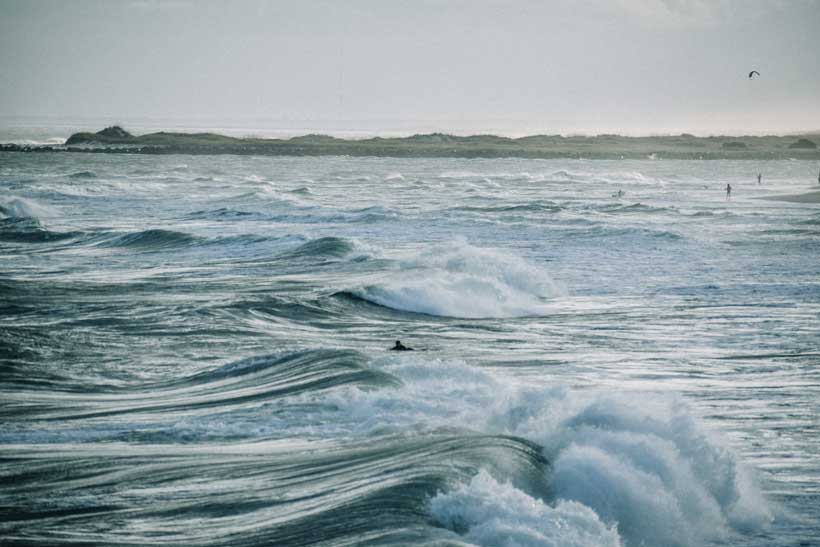
photo: Unsplash

Scientists from numerous countries are joining forces to tackle risks to life in the world’s second-largest ocean.

By Jack McGovan

During his first offshore expedition in 1997, marine-biology expert Murray Roberts was shocked to see the state of cold-water corals located west of Scotland’s Shetland Islands.

A century earlier, Victorian-era naturalists described seeing stony thickets of vibrant coral covering many kilometres. But all that Roberts noticed was coral rubble left by an environmentally destructive form of fishing: bottom trawling, which drags weighted nets along the seabed. 

Eye-opening moment

‘I saw with my own eyes what the deep-sea trawlers had done,’ said Roberts, a professor of applied marine biology and ecology at the University of Edinburgh in Scotland. 

Originally a student of general biology, he switched his focus to marine biology in 1992 after a research stint in the Egyptian Red Sea looking into tropical corals and fish.

Decades of experience in the field landed Roberts the role in 2019 of leading a research project that received EU funding to assess the health of ecosystems in the Atlantic Ocean. The Atlantic is the second-largest ocean in the world, covering more than 106 million square km.

Called iAtlantic, the project is due to end in March 2024 and has focused on deep-sea and open-ocean ecosystems. 

The initiative brings together 44 organisations from 16 countries that border the Atlantic. The nations range from Argentina and France to South Africa and the US.

‘Without a functioning and healthy ocean, we don’t have a functional planet,’ said Roberts.

Give seas a chance

The iAtlantic researchers have focused on 12 locations of international conservation significance and economic interest.

One is the Sargasso Sea, a subtropical open-ocean system that is bounded by four currents east of North America. Named after the brown Sargassum seaweed found there, it serves as a haven for biodiversity and is the world’s only sea without land boundaries. 

Another location is a major deep-sea gap in the Mid-Atlantic Ridge. Called the Romanche Fracture Zone, it is an east-west trench that reaches a depth of more than 7 000 metres and has a significant impact on the deep-water circulation of the Atlantic. 

A third is a chain of sea mountains off Brazil that extends for around 1 200 km and is home to various reef ecosystems and fish communities. The project team has conducted geological and biological surveys of the seamounts. 

Looking at the ocean as an interconnected system, the researchers have tried to identify the points at which steady environmental changes cause bigger, irreversible ones – so-called tipping points. 

The ocean is a vast, interrelated whole. Changes in one area can affect other parts of it, highlighting the need for close international cooperation to predict and prevent major damage.

Enlightening experiments

In one experiment, the project sent a rig known as a lander to the seafloor in the Cape Verde Basin. There, the researchers enclosed a section of the seabed, injected algae into it and tracked how the algae moved through all the food chains.

Results from the experiment suggested that rising global temperatures would decrease the carbon-storage potential of the deep seafloor.

The project has also harnessed local and indigenous knowledge. An amateur scientist in Bermuda, for example, had spent 15 years collecting data on humpback whales by looking at their unique tail patterns. 

The iAtlantic researchers took that information and used it to reconstruct how the population of the humpback whales had recovered following a 1986 moratorium on commercial whaling. 

Results showed that humpback whales began to increase steadily as of 2012.

‘If we give ocean species and ecosystems a chance, we see tremendous recovery,’ said Roberts. ‘But we have to keep on top of that.’

After his experience off the Shetland Islands almost 30 years ago, the United Nations in 2006 passed a resolution that banned trawling in vulnerable ecosystems, including corals. 

Roberts called this a defining moment for him by showing that basic environmental improvements were possible when the political will exists at global level. 

Circulating currents

The stakes are high on numerous fronts. 

For example, Roberts said ‘relatively strong agreement’ exists in the scientific community that a key component of ocean circulation is declining. 

Known as the Atlantic Meridional Overturning Circulation, or AMOC, it is like a conveyor belt transporting water from north to south and back again and – in the process – warms different parts of the planet while circulating nutrients crucial to sustaining ocean life. 

The AMOC makes northern Europe habitable by preventing the weather there from being near-Arctic and, as a result, the collapse of this circulation component would be a disaster, according to Roberts.

Here, iAtlantic joined forces with another EU-funded research project – TRIATLAS, which ended in November 2023 after more than four years.

TRIATLAS and iAtlantic helped fund the installation in the South Atlantic of scientific moorings to measure variations in the AMOC. 

TRIATLAS focused on marine ecosystems in the southern and tropical Atlantic and produced missing pieces of the puzzle when it comes to understanding currents and ecosystems. 

‘There’s a lot less data compared to the North Atlantic,’ said Noel Keenlyside, a professor of tropical meteorology at the University of Bergen in Norway and the coordinator of TRIATLAS.

Both projects also trained researchers in Brazil and South Africa to use the moorings, which consist of a long wire with an anchor at one end, a buoy at the other and instruments in between. 

The moorings allow better understanding of changes in currents – and the oxygen they supply – and the resulting cascading effects on ecosystems. 

Economic element

TRIATLAS included 38 organisations from 15 countries that range from Angola and Brazil to Norway and Spain, forging partnerships with nations and communities for whom the Atlantic has environmental and economic importance. 

‘Our main intention was to predict marine ecosystems shifts and their societal impacts based on climate predictions,’ said Keenlyside, who was born in Guyana, a South American nation that borders the South Atlantic.

Across the ocean in countries such as Senegal and Morocco, he said that fish stocks have declined by 80% as a result of overfishing and a changing climate, affecting the ability of local communities to feed themselves.

Here TRIATLAS too recognised the value of local and indigenous knowledge. Because monitoring fisheries is costly, the project developed an inexpensive and easy-to-use app for fishermen to report data.

The device shows how basic and affordable technologies can help fill knowledge gaps in the management of fisheries in developing nations.

Collaboration to come

Because the amounts of data on the open sea collected by TRIATLAS and iAtlantic were unprecedented, the projects will continue to feed scientific work in the area for years to come.

Both projects are part of an initiative to improve international collaboration known as the All-Atlantic Ocean Research and Innovation Alliance

The EU itself has made marine protection a policy priority, pledging in a special mission that features research initiatives to restore oceans and seas by 2030.

As it draws to a close, iAtlantic will recommend more environmental impact assessments of deep-sea mining and the usefulness of local and indigenous knowledge in related research.

Future research priorities include monitoring the moorings that were installed and using satellite data to expand knowledge about the Atlantic.

For its part, the TRIATLAS team is urging policymakers to pursue an Atlantic scientific network at regional, national and local levels.

Keenlyside stressed the urgency of protecting ocean ecosystems while addressing the headline threat to Earth as a whole of global warming.

‘We talk a lot about the climate emergency, but the ecosystem emergency is just as important,’ he said.

Research in this article was funded by the EU. The views of the interviewees don’t necessarily reflect those of the European Commission.This article was originally published in Horizon, the EU Research and Innovation Magazine.