Thursday, January 18, 2024


Why Aren't the Red Sea Attacks Affecting the Oil Market?

The destroyer USS Gravely launches a Tomahawk missile in a counterstrike against Houthi targets in Yemen, Jan. 11 (USN)

PUBLISHED JAN 18, 2024 1:05 PM BY THE STRATEGIST


[By David Uren]

Attacks on shipping in the Red Sea have had almost no impact on the oil price, despite the volume of oil shipped through the waterway surging 80% over the last two years because of the war in Ukraine.

Markets more worried about a soft global economy and rising US and Brazilian oil production than by the prospect of interrupted oil flows, having already seen the global oil market adjust to the massive disruption caused by Russia’s invasion of its neighbor.

The oil market has fragmented over the last two years, with Russia now primarily supplying China and India while the Middle East and the United States have replaced Russia in Europe.

Flows of Russian oil traveling south through the Suez Canal rose from about 700,000 barrels a day in 2020 to 3.6 million in the first half of 2023. Flows of Middle East oil traveling north through the Suez Canal rose from 2 million to 3.5 million barrels a day in the same period, according to the US Department of Energy.

In total, oil tankers were ferrying about 9.2 million barrels a day up and down the Red Sea in the first half of 2023, up from 5.1 million barrels a day in 2021.

That translates to a lot more ‘oil-miles’, but there’s been little movement in the price. The Brent oil benchmark was at US81.63 a barrel at the beginning of November but has been below US$80 for most of the last two months.

There’s been some diversion of oil tankers since November, when Houthi militias based in Yemen started attacking ships traversing the Bab el-Mandeb Strait, the 25km-wide southern entrance to the Red Sea. BP announced that it was diverting its ships around the south of Africa, while the world’s fourth-largest tanker group, Frontline, said it would avoid the Suez Canal where possible.

However, the oil tanker business is ferociously competitive with a huge number of operators. The top 30 companies control less than half of total capacity, so tanker operators will continue to run the risk of sailing through the Bab el-Mandeb Strait, weighing both the relative costs of insurance versus sailing around the south of Africa and the importance of timely delivery. Diverting large oil tankers bound for Asia around the south of Africa adds 30 to 40 days to the voyage.

An assessment by the ship-tracking service, Mari-Trace, detected an average of 76 oil tankers a day in the south Red Sea and Gulf of Aden in December, only three fewer than the average for the first 11 months of the year.

The oil industry has seen off many previous attacks in the Persian Gulf, which is much more critical to global supplies than the Red Sea. While the Red Sea is mainly a transit channel, the Persian Gulf is the source of about 21 million barrels of oil a day, with ships having to traverse the vulnerable 40km-wide Strait of Hormuz.

Between 1984 and 1988, the war that had been raging between Iraq and Iran embroiled tankers traveling to each country. An assessment by the University of Texas Strauss Center found that although 239 ships were attacked of which 55 were sunk, the disruption to oil supplies to world markets from the Persian Gulf was less than 2%.

Oil tankers were harder to damage or sink than general cargo ships or dry bulk carriers. During the so-called ‘tanker war’, 23% of the oil tankers that were attacked were sunk, compared with 34% of general cargo ships and 39% of bulk carriers. Since the big oil tankers are many times larger than navy vessels, even anti-ship missiles like the French Exocet caused relatively little damage.

There was another spate of attacks on oil tankers in the Strait of Hormuz in 2019, with responsibility variously attributed to Houthi militias, who were fighting Saudi Arabia at the time, or Iran, which was facing severe sanctions from the US on its oil shipments.

An analysis of those attacks by insurer, Allianz, helps explain why tanker operators are prepared to continue running the risk of missile attack.  A very large crude carrier could be carrying 2 million barrels of oil, which in 2019 would have been worth US$135 million.

A five-year-old ship was worth about $70 million.  Additional war insurance was between 0.2% and 0.5% of hull value, translating to between $140,000 and $350,000.  That amounts to only 0.1% to 0.25% of the cargo’s value, a sum that could readily be absorbed by suppliers or customers.

According to Mari-Trace, insurance premiums for ships in the Bab el-Mandeb Strait and the Southern Red Sea have risen from 0.07% of hull value in early December to between 0.5% and 0.7% by early January.

The oil market’s reputation as a geopolitical bell-weather dates from the 1973 Yom Kippur war when OPEC put an embargo on oil deliveries to nations supporting Israel over about six months which led to oil prices tripling to US$60 a barrel and fuelling global inflation (although deficit funding of the Vietnam war also contributed).

The 1979 Iranian revolution sent oil prices rocketing to US$150 in 1979, but they then spent the next six years slowly declining, despite the ‘tanker war’.  Since then, geopolitics have lost much of their bite in the oil market.

There was a very brief spike, lasting a few months, when Iraq invaded Kuwait in 1990, but no reaction at all to the September 11 attacks in 2001 or to the attacks on shipping in the Strait of Hormuz in 2019.

The oil price did react to Russia’s invasion of Ukraine in 2022, briefly reaching US$129 a barrel in March but were back below US$100 by August last year and have averaged about US$83 since then.

The declining sensitivity of the oil market to geopolitical events partly reflects the massive growth of US oil production, which rose from 5 million barrels a day in 2010 to 13 million barrels a day by the end of last year. This has almost eliminated the US dependence on Middle East oil and instead turned it into a significant exporter.

The US both imports and exports oil (reflecting the fact that many US refineries were built to accommodate imported crude), but the US ability to be a swing supplier helped minimize the impact of Europe slashing its purchases of Russian oil. It also means the US economy no longer reacts to passing instability in the Middle East.

The global economy has also become less dependent on oil. Oil’s share of total energy supply has dropped from about 50% in 1973 to 30% now. In 1973, the world consumed a barrel of oil for every US$1000 of GDP. By 2019, it was only consuming 0.4 of a barrel for the same (inflation-adjusted) level of output.

Still, you can’t be an economist if you don’t hedge your bets. For the moment, the rocket attacks on shipping are having negligible effect on the market. If the Gaza conflict escalates into regional war involving Iran and threatening the Persian Gulf, governments could be left revisiting their management of the 1973 crisis.

David Uren is an ASPI senior fellow. This article appears courtesy of ASPI and may be found in its original form here

The opinions expressed herein are the author's and not necessarily those of The Maritime Executive.


 

Ferry on the Way to Boneyard Suspected of Oil Leak in Canadian Port

Canadian RoRo ferry
Vacancier built in 1972 near the end of her life in 2019 in Canada (CTMA photo)

PUBLISHED JAN 18, 2024 7:31 PM BY THE MARITIME EXECUTIVE


A derelict, 50-year-old ferry on her way to the boneyard has been identified as the source of an oil sheen and smell that has been plaguing the area around Charlottetown, Price Edward Island, Canada for the past few days. The Canadian Coast Guard confirmed to CBC News in Canada that they are investigating the ferry as the source of the leak and a containment boom has been strung around the vessel.

The incident began over the weekend was residents began complaining oil smell. By Sunday, January 14, reports were increasing with an oil sheen visible in parts of the harbor. The Coast Guard confirms that there has been an oil leak but at this point, they are still investigating to determine the amount of the leak and the type of oil involved.

The Canadian Coast Guard told CBC that it is now investigating the former ferry which had made a port stop in Charlottetown as it was beginning a trip to the scrapyards of India. Renamed Ancier, the 11,400 gross ton ferry had been repositioned from Georgetown on the eastern end of Prince Edward Island to Charlottetown on Friday and was refueling to prepare for its final voyage. The fueling took place on Saturday with the first complaint filed with the local Department of the Environment on Sunday afternoon.


The ferry was commissioned in 1973 for Viking Line operating for nine years in the Baltic as the Aurella. In 1982, she was sold to Irish Ferries who renamed her Saint Patrick II. She was used as extra capacity during the busy summer season sailing between Ireland and France while in the winter months, she would be chartered to various other operators. That would continue for six years before she was chartered for operations in the Mediterranean around Greece and later from Spain. 

Already 30 years old, the ferry was sold to the Government of Canada in 2002 and after being rebuilt entered service as the Vacancier. She would spend the next 20 years mostly operating from Montreal along the St. Lawrence to the Magdalen Islands near Price Edward Island. The ferry was laid up in 2020 with the onset of the pandemic and officially decommissioned at the end of 2023 when she was sold for scrap.

With her name abbreviated and re-registered in St. Kitts and Nevis, she was being prepared for the end. Recently, the logos were painted out and she was making her final stop in Canada. 

The Coast Guard told CBC that the vessel’s owner has contracted pollution control and a surveyor for the hull. CBC reports divers surveying the hull on Wednesday did not find damage or leaks, however aboard they have identified the suspected source of the leak. The Coast Guard reports that the operator will be removing fuel from the identified tank to prevent further leaks.

The Coast Guard reports they will continue to oversee a cleanup of the area and monitor the shorelines. For the time being, the derelict ferry remains at the dock.
 

WW3.0
Pakistan's air force carries out retaliatory strikes against Iran

Story by By Associated Press • 

Prime Minister Anwaar-ul-Haq Kakar of Pakistan speaks in Davos, Switzerland, on Jan. 17, 2024.© Markus Schreiber/AP

ISLAMABAD — Pakistan’s air force launched retaliatory airstrikes early Thursday on Iran allegedly targeting militant positions, an attack that killed at least seven people and further raised tensions between the neighboring nations.

The strikes in Sistan and Baluchestan province follow Iran’s attack Tuesday on Pakistani soil that killed two children in the southwestern Baluchistan province

The strikes imperil diplomatic relations between the two neighbors, as Iran and nuclear-armed Pakistan have long regarded each other with suspicion over militant attacks.

The attacks also raised the threat of violence spreading in a Middle East unsettled by Israel’s war with Hamas in the Gaza Strip. Iran also staged airstrikes late Monday in Iraq and Syria over an Islamic State-claimed suicide bombing that killed over 90 people earlier this month. Iraq has recalled its ambassador from Iran for consultations.

Pakistan’s Foreign Ministry described their attack as “a series of highly coordinated and specifically targeted precision military strikes.”

“This morning’s action was taken in light of credible intelligence of impending large scale terrorist activities,” the Foreign Ministry said in a statement. “This action is a manifestation of Pakistan’s unflinching resolve to protect and defend its national security against all threats.”


Several insurgent groups operate in Iran and Pakistan, including the Jaish al-Adl Sunni separatist group that was targeted by Tehran in its own strike. They all have a common goal of an independent Baluchistan for ethnic Baluch areas in Afghanistan, Iran and Pakistan.

Pakistan’s Baluchistan province, as well as Iran’s neighboring Sistan and Baluchestan province, have faced a low-level insurgency by Baluch nationalists for more than two decades.

A deputy governor of Iran’s Sistan and Baluchestan province, Ali Reza Marhamati, gave the casualty figures from Thursday’s strike in a telephone interview, saying the dead included three women and four children. He did not immediately elaborate.

HalVash, an advocacy group for the Baluch people, shared images online that appeared to show the remains of the munitions used in the attack. It said a number of homes had been struck in Saravan, a city in Iran’s Sistan and Baluchestan province. It shared videos showing a mud-walled building destroyed and smoke rising over the strike immediately after.

Thursday’s development came a day after Pakistan recalled its ambassador to Tehran because of Tuesday’s strikes by Iran inside Pakistan’s southwestern Baluchistan province.

Iran claimed it targeted bases for a militant Sunni separatist group. It drew strong condemnation from Pakistan, which denounced the attack as a “blatant violation” of its airspace and said it killed two children.


Is Thailand's 'Clean Air Act' enough to end pollution?

Story by Tommy Walker (in Bangkok) •

Bangkok and Chiang Mai ranked among the most polluted cities in the world on some days last year© LILLIAN SUWANRUMPHA/AFP/Getty Images

Thai lawmakers earlier this month endorsed a bill aimed at improving Thailand's poor air quality, clearing the way for the kingdom's parliament to start debating draft legislation.

For years, environmentalist groups have been pushing for new laws to combat Thailand's unhealthy air pollution levels

But why is Thailand keen for such a law and how will it work?

The Thai capital, Bangkok, and the northern city of Chiang Mai ranked among the most polluted cities in the world on several days in 2023.

Thailand's air quality typically plummets between January and March annually — caused in part by smoke from stubble burning by farmers who are preparing for the next crop season.

This results in so-called PM 2.5 dust that contains a high concentration of fine particulate matter, the most dangerous form of haze pollution.


Thailand's air pollution last year saw 2 million people seek medical treatment, according to the health ministry© Pongmanat Tasiri/Zuma/IMAGO
Thai PM prioritizes clean air bill

Following the cabinet's approval of the legislation, it still needs to be debated and clear several more hurdles before becoming law.

But Pravit Rojanaphruk, a veteran journalist and analyst in Thailand, isn't convinced a new law would be the definitive answer.

"Air pollution, particularly PM 2.5 microdust particles, has become a major challenge facing Thai people over the past few years and it may be premature to think that the draft Clean Air Bill, once passed would quickly solve the problem," he said.

The World Health Organization recommends that the annual average concentration of fine particulate pollution should not exceed five micrograms per cubic meter of air. A microgram is a thousand times less than a milligram.

Air pollution in Thailand resulted in around 2 million people seeking medical treatment during 2023, according to the kingdom's health ministry.

Thai Prime Minister Srettha Thavisin admitted Thai people "suffered" from poor air quality and has made the clean air bill a priority.

And according to IQAir an air quality company headquartered in Switzerland, cities in Thailand are some of the most polluted.

Bangkok featured in the Top 5 of last year's rankings. The capital city's urban pollution largely stems from heavy traffic, construction work, factory emissions and trash burning.

Pravit pointed out that, despite the growing popularity of electric vehicles, the volume of gasoline-powered vehicles and their exhaust fumes is increasing.


Vehicle emissions and construction site dust are huge contributions to Thailand's air pollution, he added.

"Despite all this, there's no single NGO or civic group working on the issue full time," said Pravit.

"This can be partly explained by the fact that the problem is seasonal, mostly confined to the dry season from November to April and once it starts raining it's not an issue. Some also feel the problem is too complex to really solve," Pravit told DW.


Finding solutions to Thailand's pollution problems

Kornkanok Wathanabhoom, Mekong Legal Coordinator at EarthRights International, said Thailand needs a decentralized approach.

"One key challenge is because the central government thinks from Bangkok, but all areas in Thailand are different," she told DW.

"There should be decentralization, and give more power to local authority or local governor to create the way to protect the fire burning and also other ways to reduce the burning."


New technology is needed, Kornkanok added, suggesting that stubble burning may not be necessary if consumers are willing to pay more for the end products.

"For example, people said [the farmers are] burning sugar cane because it's easy, but it is costly if they cut without burning. If the cost of the product is higher and everyone understands we have to pay to protect our health, we don't need to buy the air purifiers or face masks."

Environmental groups have also been pushing for Thailand to implement the Pollutant Release and Transfer Register (PRTR), a database of pollutants released into the atmosphere, such as air, water and ground by factories.

Kornkanok is all for it.

"If there is any section related to PRTR, it would be good, people will have access to information. They can create prevent measures from the ministry of public health which is specific for affected people in that area," she said.

Thailand: The rice of the future

But if Thailand's clean air law passes, there would still be difficulties holding people or businesses to account if they were to pollute beyond the limits of the legislation.

Thailand shares borders with several countries, including its fellow Southeast Asian neighbors Laos and Myanmar.

"Contributing factors include burning of agricultural waste both in Thailand and neighboring countries like Cambodia, Myanmar, Laos and Vietnam. It would be difficult to cajole these countries to act if they're not willing," Rojanaphruk said.

Kornkanok echoed this sentiment, saying that enforcing the regulation would be the issue.

"Another challenge is the transboundary haze from the maize agriculture, because in the north we are affected from the corn [feed] for animal seeds, and the sugar plantations from Laos and Myanmar," Kornkanok told DW.

"There will be a problem to sue people outside the country, how they will come to our [Thai] courts. It is challenging for enforcement, you can put in a law but if you cannot enforce it, in reality the law is just on paper."

Edited by: Keith Walker

Author: Tommy Walker (in Bangkok)


'We're home': 140 years after forced exile, the Tonkawa reclaim a sacred part of Texas


Don Patterson (Ricardo B. Brazziell/American-Statesman)

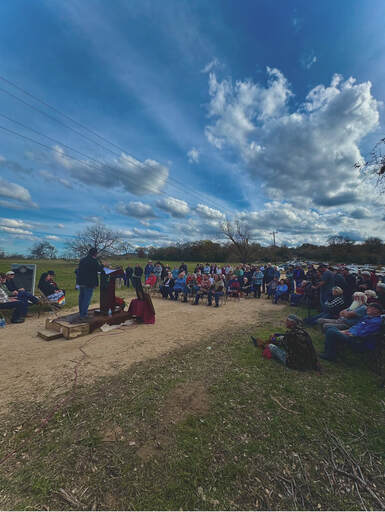
Almost exactly 140 years after the Tonkawa were expelled from Texas, they have returned to purchase Sugarloaf Mountain, a sacred site located in Milam County, northeast of Austin, that plays a key role the tribe's creation story.

"We're home," Tonkawa President Russ Martin said at a small Dec. 12 ceremony honoring the recovery of 60 acres of the tribe's ancestral lands in Central Texas. "The first time I got to the top of the mountain, I was overwhelmed. I'm not that spiritual a person, but that experience was spiritual. We're glad to be home in Texas."

The purchase of the land for a historical park is part of a larger movement, especially among Texas tribes that were expelled — or nearly exterminated — during the 19th century, to reclaim their legacies here.

Sugarloaf Mountain is a high conical hill of red sandstone that overlooks the prairies and bottomlands of the Little and Brazos rivers, which flow together just downstream of the landmark.

On those floodplains, a large village of several cooperative tribes, which the Spanish called Ranchería Grande, became the one of the most populous spots in Texas during the 1700s. So dense was the Indigenous presence that the Spanish planted three short-lived missions in what is now Milam County.


To the Tonkawa, Sugarloaf was known as Red Mountain, or "Natan Samox” in the Tonkawa language. According to one historian, the Spanish called it Turtle Mountain, or "La Tortuga."

It was a sentinel marker for the Spanish traveling along the braided Camino Real de los Tejas, which followed trails blazed by Native Americans from the Rio Grande to northwestern Louisiana.

In 1884, the Tonkawa, once called "the best friends of the Texans," were removed from Fort Griffin in northwestern Texas to first one and then another reservation in Oklahoma as part of their own "Trail of Tears." They had been moved previously in 1855 and 1859.

By the late 20th century, it was rumored that the Tonkawa had disappeared altogether.

Continue reading: EMAIL SUB REQUIRED


Picture


GUASE, TX.   December 12, 2023. 

On December 12th, 2023, the Tonkawa Tribe of Oklahoma purchased its place of origin in Central Texas. That place of origin, a mountain named Naton Samox meaning Red Mountain in the Tonkawa language, is the site of the tribe’s original creation story. The sixty acre tract near Gause Texas was purchased from Texas landowners who owned a larger parcel since 1995 containing that mountain. After the necessary preparations are concluded, the tribe will be making the site accessible to the public as a historic park, for public enjoyment of its beauty, as well as to educate the public about the tribe’s Texas history.

Chief Russell Martin, Secretary/Treasurer Racheal Starr, and Tribal Historian Don Patterson traveled to Texas for the closing of the purchase, taking possession of the land with Red Mountain in view. “I can hardly find words to describe how important this purchase is to our tribe,” said Russell Martin, President of the Tonkawa Tribe. “This past summer when it became clear we had the opportunity to purchase the site, we held a tribal meeting to discuss the situation. When we called for a vote, every hand in the room was raised in favor of the purchase. We felt part of a story that was bigger than all of us. Many eyes had tears.”
Picture
Red Mountain’s place in the tribe’s history is significant in many respects. Its geological formation and color in Central Texas is unusual; its location along ancient trade routes was strategic; it served as a regional navigational landmark; it was a gathering place for seasonal tribal celebrations; and it presided over a large collection of area campsites that provided new homes to many tribes seeking refuge during the difficult days of the Spanish period, often referred to as Rancheria Grande.

While the Tonkawa creation story had been passed down in its oral history for generations, after the tribe’s second and final removal to Oklahoma in 1884, the mountain’s exact location was lost. Using in part the old Spanish records, Donald Patterson rediscovered the mountain’s location in the early 1980s. Key to the rediscovery was the fact that the tribe was often said to reside at the confluence of the Brazos and Little Rivers, near what is today Gause Texas, a 30 minute drive Northwest of Bryan-College Station. Patterson later served multiple terms as President of the Tribe, and is now the oldest living male elder. Patterson has also filled the role of tribal historian for over fifty years.  “This purchase would not have been possible without the effort of Don Patterson,” said Russell Martin. “While his list of accomplishments and his legacy is huge, I have a feeling that Don’s rediscovery of our sacred mountain might one day be considered his most important effort of them all.”

Picture

Once the mountain was rediscovered, the tribe immediately had hopes that the site could be preserved. In July 1986, tribal President Henry Allen spoke to the Austin American Statesman about Red Mountain being the birthplace of the Tonkawa. He also said  “If there's some way we could get that back and make it a state park or a national park or a tribal park, whatever the case may be, we’d like to do that.” In that timeframe, Chief Allen hoped that the state might ultimately spend the money necessary to preserve the site that was so important to the tribe. “You don't take something from someone without offering something in return,” Allen told the paper.

While Chief Allen had called it Red Mountain in 1986, the mountain had been known in Texas by another name for more than one-hundred years: Sugarloaf Mountain.  The name Sugarloaf Mountain was given to the site by the locals because of its similarity to the way that sugar was historically transported as a smooth, round mound of molasses on a flat board. One of the highest points in Milam county, the mountain peak stands 500 feet above sea level, and 250 feet above the Little River that flows by its base. It is clearly visible from thirty miles away, as it looks out upon many square miles of flat Brazos river bottom land, and rich blackland prairie.

In 1994, a Texas landowner who owned the mountain as part of a large tract of land was approached by treasure hunters seeking Spanish gold. With the landowners approval, the treasure hunters examined the mountain carefully, but found no minerals of value. Unsatisfied, the landowner began excavating the side of the mountain himself in a haphazard, irresponsible manner, to the dismay and outcry of local residents. Then Tribal President Virginia Combrink learned of the destruction of the mountain and visited Gause, writing ​open letters to local newspapers and calling on local residents to pressure the landowner to stop the mountain’s destruction. One week later, the digging stopped, but the mountain still bears the scars of the excavations. Having seen the mountain both before and after the destruction, Don Patterson describes the Red Mountain today as being like an apple with a bite taken out of it.
In 2022, the Herzog’s expressed interest in selling off sixty acres of their land that included Sugarloaf Mountain to an organization that might want to preserve it and turn it into a local park. Independently in November 2022, two members of a documentary film crew working with the tribe invited President Russell Martin to climb the mountain with them, simply for enjoyment. When Russell Martin and the two crew members reached the summit, all climbing it for the first time, a silence fell upon them. Being moved at its beauty Russell Martin broke the silence by saying, “This mountain must be preserved.”

With the blessing of the tribal executive committee, the documentary crew researched the situation and learned of the Herzog’s desire to sell off the mountain. In 2023 the Herzog’s leased sixty acres containing the mountain to El Camino Real de los Tejas National Historic Trail Association (ElCaT), a lease which also included an option to purchase at a previously agreed sales price.
Picture
In 1995 the mountain was sold, this time to new Texas landowners, Leon and Kay Herzog who desired to protect the mountain and the woodlands surrounding it. They had no knowledge that the land might have any connection to an existing indigenous tribe. During the Herzog period of ownership, the locals often visited, considering the place to be of great beauty, and its view remarkable even without any maintained trail to its summit. Students from Texas A&M University were said to visit the site in groups each year. Stories of marriage proposals at the top of the mountain were common. Meanwhile, tribal members often visited the site whenever they made trips to Texas. Some climbed the mountain, but after NO TRESPASSING signs were added as a precaution, most tribal members just viewed the mountain from the public roads. Since Don’s rediscovery, those tribal members who climbed the mountain not only had a wonderful view, but often remarked that it was a place of spiritual reflection – a way to feel closer to their ancestors who had also climbed the summit for many generations. But since 1995 no direct contact was made between the Tonkawa Tribe and the Herzog’s, who had no knowledge of the tribal members’ interest in the site.

The tribe then approached Steven Gonzales, executive director of ElCaT, and learned that ElCaT would be willing to forgo its lease and allow the tribe to purchase the site in its entirety.  The tribe also realized that ElCaT could become an excellent partner to manage the site locally, and had great expertise in working with Texas landowners to develop historic parks. Once a management agreement was put in place between the tribe and ElCaT, all that was left was the completion of the sale between the Herzog’s and the tribe. This sale was arranged by broker and Sugarloaf advocate Dave Cunningham, who lived nearby and had long dreamed that the mountain could become a park.

For the last eighteen months, the tribe has been working to produce a film that would tell their unusual story in a feature-length documentary format.  The tribe, together with Sugarloaf Pictures’ director Andrew C. Richey, producer Bob O’Dell, and executive producer Felipe Adams, have been capturing the evolving story of the mountain and its purchase on film. The film, Tonkawa: They All Stay Together, has an expected release date of 2025.

Red Mountain is the first piece of Texas land ever purchased by the Tonkawa Tribe. The tribe has agreed to preserve and protect the land in perpetuity, and will work with ElCaT to open up the site for public access as soon as the needed preparations are complete.

US Department of Energy Allocates USD 104 Million for Clean Energy Projects

This funding, part of the USD 250 million allocation from President Joe Biden's Bipartisan Infrastructure Law, marks the first disbursement from the DOE's AFFECT program.

January 18, 2024. By Abha Rustagi


The US Department of Energy (DOE) has announced a USD 104 million investment for energy conservation and clean energy initiatives at 31 Federal facilities. 

This funding, part of the USD 250 million allocation from President Joe Biden's Bipartisan Infrastructure Law, marks the first disbursement from the DOE's Assisting Federal Facilities with Energy Conservation Technologies (AFFECT) program.

Established in 1992, AFFECT aims to assist agencies in reducing energy consumption and saving taxpayers money through various initiatives, including building electrification, geothermal heat pumps, on-site solar generation, and battery energy storage. 

The projects align with President Biden's December 2021 Executive Order, calling for a 65 percent reduction in greenhouse gas emissions from Federal operations by 2030 and a net-zero building portfolio by 2045.

US Secretary of Energy Jennifer M. Granholm highlighted the significance of the investment, emphasizing the Federal Government's role as the largest consumer of energy. The projects announced will contribute to securing energy independence, combating climate change, and creating a healthier environment.

Deputy Secretary of Defense Kathleen Hicks underscored the Department of Defense's commitment to adapting to the global energy transition. The selected projects aim to make installations more resilient, enhance critical infrastructure security, and achieve cost savings.

The funding will support projects at various Federal agencies, including the Social Security Administration, the Departments of Commerce, Defense, Energy, the Interior, Transportation, and Veterans Affairs, the General Services Administration, and the Office of Personnel Management.

Selected projects include the installation of rooftop solar panels and energy-efficient systems at the Pentagon, LED lights and PV film at the Department of Transportation's headquarters, and the replacement of boilers with electric boilers at DOE's Hanford Site, among others.

The 31 projects are expected to double the carbon-free electricity capacity at Federal facilities, resulting in 27 MW of additional clean-energy capacity. In the first year, the projects are projected to save over USD 29 million in energy and water costs, reduce greenhouse gas emissions, and decrease energy usage significantly.

Managed by DOE's Federal Energy Management Program (FEMP), the AFFECT program encourages public-private partnerships, leveraging private investment to make Federal funding go further. 

The second round of AFFECT funding is set to open in January 2024, inviting engagement from energy and sustainability stakeholders across federal agencies, private sector organizations, and utilities. 


 US Department of Energy Joins Forces with Consortium to Boost Clean Hydrogen Growth

By: BNN Correspondents
Published: January 18, 2024 


In a bid to bolster the growth of clean hydrogen, the US Department of Energy (DoE) has chosen a consortium comprising of the EFI Foundation, S&P Global Inc, and Intercontinental Exchange. This endeavor is a part of a grander USD-7-billion effort by the DoE to promote clean hydrogen as a pivotal energy source.

Push for Clean Hydrogen

The consortium, operating under the banner of the Hydrogen Demand Initiative (H2DI), will work hand in hand with the DoE over the course of the next nine months. Their collective goal is to devise mechanisms that bolster the demand for clean hydrogen. These mechanisms will be directed chiefly at incentivizing the purchase of clean hydrogen that is produced by projects under the US initiative Regional Clean Hydrogen Hubs (H2Hubs).

Expertise and Collaboration

The consortium brings to the table a diverse range of expertise in clean hydrogen, project finance, and commercial contracting. Other contributors to this initiative include the MIT Energy Initiative’s modeling and analysis group and the law firm Dentons. The collaboration with these organizations aims to mitigate investment risks and stimulate a sustainable demand for clean hydrogen.

Ernest Moniz, the former US Energy Secretary and CEO of EFIF, expressed his enthusiasm for the initiative. He emphasized the importance of collaboration with partners to lower the uncertainties associated with clean hydrogen investments and cultivate sustainable demand.

Looking Ahead

A project team is already in place and ready to launch the H2DI in the forthcoming months. Their efforts are aimed at providing demand certainty for Regional Clean Hydrogen Hubs and de-risking long-term investments in the clean hydrogen sector.


NASA Reveals the X-59—Its Antidote to the Sonic Boom

The experimental aircraft is expected to fly 1.4 times the speed of sound, or around 925 mph, according to NASA.
January 12, 2024


NASA’s X-59 quiet supersonic research aircraft sits on the apron outside Lockheed Martin’s Skunk Works facility at dawn in Palmdale, California. The X-59 is the centerpiece of NASA’s Quesst mission, which seeks to address one of the primary challenges to supersonic flight over land by making sonic booms quieter. [Courtesy: Lockheed Martin Skunk Works]

A dramatic curtain drop at Lockheed Martin’s Skunk Works facility in Palmdale, California, on Friday gave the world its first look at the X-59—NASA’s new experimental aircraft designed to quiet the sonic boom.

The one-of-a-kind X-59 Quiet SuperSonic Technology (QueSST) aircraft is part of NASA’s Low Boom Flight Demonstration project aimed at collecting data to help shape regulations for possible future commercial supersonic flight over land 50 years after it was banned by the FAA due to the noise of the sonic boom.

It’s expected to fly 1.4 times the speed of sound, or around 925 mph, according to NASA.READ MORE: NASA Ready to Roll Out Experimental X-59

“This is the big reveal,” said Catherine Bahm, the manager of NASA’s Low Boom Flight Demonstrator project who is overseeing the development and build of the X-59. “The rollout is a huge milestone toward achieving the overarching goal of the Quesst mission to quiet the sonic boom.”

Bob Pearce, associate administrator of NASA Aeronautics Research Mission Directorate, recalled one of America’s test flight heroes during the ceremony.


“This journey actually began in 1947, when the era of supersonic flight started right here in the California high desert with test pilot Chuck Yeager in the X-1,” said Pearce. “It soon became apparent that the sonic boom’s sharp thunderous sound heard when the airplane flies overhead at supersonic speed was going to be a problem.”


Engineering Sound Through Shape

The X-59 is designed to lessen the perceived sound of a sonic boom to that of a gentle thump, and it does that through a specialized aircraft shape.

Screenshot of the X-59 [Courtesy: NASA/ Lockheed Martin]

“What’s most obvious right away is the long, distinct nose which comprises almost a third of that 99.7-foot length,” said NASA Deputy Administrator Pam Melroy. “This design is really critical in dispersing shockwaves” and preventing the shocks from merging together and creating the boom.

The cockpit sits almost halfway down the length of the aircraft, and there’s no forward-facing window, which would have increased noise, Melroy said.

“It’s a huge challenge—limited visibility in the cockpit,” Melroy said. “The team developed the external vision system, which is really a marvel of high-resolution cameras feeding an ultra-high-resolution monitor. Beyond its immediate applications in the X-59, the external vision system has the potential to influence future aircraft designs, where the absence of that forward-facing window may prove advantageous for engineering reasons. It’s creating capabilities that we haven’

NASA will collect data on how communities perceive the sound of the X-59 flights, which will then be used to inform the agency’s recommendations for an acceptable noise-level standard for commercial supersonic flights and possibly repeal the current ban of supersonic flight over land.READ MORE: NASA X-59 Cleared for Final Assembly

NASA’s X-59 aircraft is parked near the runway at Lockheed Martin Skunk Works in Palmdale, California, on June 19, 2023. This is where the X-59 will be housed during ground and initial flight tests. [Courtesy: Lockheed Martin]

\
“The unveiling of NASA’s X-59 supersonic aircraft is a major milestone in aviation history that has the potential to transform our industry,” said Dave Schreck, vice president and general manager of military avionics and helicopters at Collins Aerospace, which provided the primary avionics system on the aircraft.

The X-59 is expected to take its first flight later in 2024.

“The Quesst team will conduct several of the aircraft’s flight tests at Skunk Works before transferring it to NASA’s Armstrong Flight Research Center in Edwards [Air Force Base], California, which will serve as its base of operations,” NASA said.


Watch: Time-Lapse Video of the X-59

This time-lapse video shows the manufacturing of the X-59 aircraft from May 2019 to June 2021 when the merger of its main sections—the wing, tail assembly, and fuselage—was completed.


Kimberly Johnson is managing editor of FLYING Defense & Space.
2 Eye-Popping ‘Flying Car’ Designs Debut in Las Vegas

XPeng AeroHT unveiled its ‘Land Aircraft Carrier’ modular ground/air concept and debuted its eVTOL supercar for an international audience.
FLYING MAG
January 12, 2024

XPeng AeroHT’s Land Aircraft Carrier, with its air and ground modules separated for flight.
 [Courtesy: XPeng AeroHT]

At this week’s Consumer Electronics Show (CES) 2024 in Las Vegas, it was a Chinese company that stole the show with a pair of outlandish concepts that it terms “flying cars,” though the use of the term stretches the definition for one of them.

Manufacturer XPeng AeroHT, a subsidiary of Chinese automaker XPeng Motors, unveiled its “Land Aircraft Carrier,” a lunar rover-looking vehicle that actually consists of two vehicles: a ground module and an air module that deploys from the ground module for flight. The company said customers will be able to preorder the vehicle in the fourth quarter of this year, with deliveries starting in late 2025.

Also at CES, AeroHT made the international debut of its electric vertical takeoff and landing (eVTOL) flying supercar concept, demonstrating the aircraft outside China for the first time. Production and delivery of that model will happen after the Land Aircraft Carrier takes flight, the firm predicted in October.

Billed as “the most powerful tech event in the world,” CES is an annual U.S. trade show that offers a forum for groundbreaking technology built by companies worldwide. All sorts of mind-blowing innovations were featured at the event. But AeroHT’s eccentric Land Aircraft Carrier may have taken the cake.

Announced in October, the design looks a bit like Tesla’s recently unveiled Cybertruck, with sharp lines and a sleek exterior. But stowed in its rear is a drone-like aircraft, which users could theoretically deploy and fly in a variety of settings.

The Land Aircraft Carrier is a two-part design, with an air module for vertical takeoff and low-altitude flight and a ground module for driving and storage of the compact aircraft. In addition to personal use, AeroHT envisions the vehicle being used for public services such as emergency rescue.

Though the final design is still under development, the “modular flying car,” as the company describes it, already features a futuristic, “cybermechanical” exterior. According to AeroHT, all key tests in the vehicle’s research and development validation phase are complete, and it is in the “preparation stage” for mass production.


The vehicle’s ground module is built for four to five passengers, driving on six wheels and three axles. That configuration enables 6×6 all-wheel drive and rear-wheel steering. In addition, an extended-range electric powertrain can be used to recharge the air module on the road.


The vehicle’s aerial component is fully electric, designed for a pilot and one passenger. It includes both manual and automatic driving modes, AeroHT said, as well as a 270-degree cockpit window for a wide field of view. And fortunately, getting it ready to fly is anything but a hassle.

“The automated system streamlines the separation and combination of the air and ground modules just like the Transformers [action figures], making flying more accessible and extending the user’s travel experience from the ground to the sky,” AeroHT said in a previous release.

The air module uses distributed electric propulsion to meet single point of failure safety requirements. Should one of its six rotors fail, the aircraft’s flight control system will automatically make adjustments, allowing it to fly safely even with only four propellers spinning. In addition, AeroHT in October tested a multi-parachute rescue system, which can be deployed at altitudes as low as 50 meters agl.

AeroHT this week also showcased its latest eVTOL flying car concept to an international crowd for the first time. The design, described as a supercar, was revealed in October alongside the Land Aircraft Carrier. CES attendees were treated to a live demonstration of its transition from land to flight mode.


Under development for more than two years, AeroHT’s flying supercar builds on the company’s early prototypes.

On the road, the vehicle really does look just like a car—its flying components, such as manipulator arms and rotor systems, are folded and stored inside the vehicle in land mode. Those parts unfurl in flight mode, allowing the supercar to take off and land vertically. An “intelligent cockpit” discerns between the two modes, adapting components such as the steering wheel or dashboard based on the user’s selection.

AeroHT’s eVTOL flying supercar, with arms and rotors stored for driving.
 [Courtesy: XPeng AeroHT]

“This functionality allows for intuitive navigation through congested areas and obstacles when conditions permit, effectively addressing the demand for short-distance, low-altitude travel,” AeroHT said.

The implication there is that users, when faced with traffic, will be able to switch to flight mode and bypass it through the air. That contrasts with other flying car designs that intend to limit takeoffs and landings exclusively to airfields, such as Aska’s A5.
AeroHT’s eVTOL flying supercar, with arms and rotors unfurled for flight, sits on display at CES 2024 in Las Vegas. 
[Courtesy: XPeng AeroHT]

In 2022, AeroHT tested a flying supercar prototype weighing about two tons. The company said mass production will follow as soon as policy, regulations, and application scenarios “become more mature.”

That day may be fast approaching. By AeroHT’s estimate, Chinese state and local authorities in the first half of 2023 released more than 120 policies related to the low-altitude economy, China’s equivalent to the FAA’s advanced air mobility (AAM) moniker. These include strategies such as the Outline for the Development of Green Aviation Manufacturing (2023-2035) and plans to set aside dedicated airspace for low-altitude operations.


China predicts the low-altitude economy will add hundreds of billions of dollars to its national output in the coming years. The industry kicked off in earnest with the first commercial electric air taxi flight in December, completed by manufacturer EHang.

Electric air taxis have not yet launched in the U.S., though the initial cohort of aircraft is expected to enter service in 2025. However, personal eVTOL designs, such as Pivotal’s Helix, are now beginning to hit the U.S. market.

There are also several U.S. firms billing themselves as ‘flying car’ manufacturers, and AeroHT could present some competition. In addition to Aska, Oregon-based Samson Sky is developing the Switchblade flying sports car, while California-based Alef Aeronautics is building the Model A drive-and-fly vehicle.

Alef intends to open vehicle sales in 2025, while Aska and Samson Sky have not yet announced entry into service dates.


Personal Aircraft Requiring No Certificate to Fly Hits U.S. Market

Pivotal’s Helix is an electric vertical takeoff and landing design that qualifies as a Part 103 ultralight built for recreational flyers.

By Jack DaleoJanuary 11, 2024

A digital rendering of Pivotal’s Helix, a personal eVTOL aircraft that requires no certificate to fly and is now on sale in the U.S.
[Courtesy: Pivotal]

If you’ve dreamed of taking to the skies but are too busy to put in the hours for a full program of flight training, there’s a strange new aircraft you can fly without a certificate—and it’s now on sale in the U.S.

Electric vertical takeoff and landing (eVTOL) aircraft manufacturer Pivotal this week opened online sales of Helix, a personal flying vehicle for first-time aviators and experienced pilots alike. Like a video game, Helix is controlled by a single pilot using a pair of simple joysticks, plus fly-by-wire controls. For $190,000, Pivotal will train customers to fly it and send them on their way in their very own aircraft.

Pivotal, which is backed by Google co-founder and ex-CEO Larry Page, unveiled Helix in October when it rebranded from Opener Aero. Prior to that, the firm actually sold half a dozen preproduction BlackFly aircraft. In June, it said it was the first company to actually deliver an eVTOL to a paying customer.

Helix, which unlike BlackFly is scalable for production, was designed mainly for personal or recreational use. The aircraft is available in three differently priced configurations, with initial customer shipments scheduled for June.


With an empty weight below 350 pounds, Helix qualifies as a Part 103 ultralight aircraft, meaning the FAA does not require pilot certification to fly it. In lieu of hundreds of hours of flight training, Pivotal requires customers to complete about two weeks of initial training at its Palo Alto, California, headquarters, with recurrent training after they earn their wings.

While more expensive than a typical automobile, Helix’s $190,000 base price tag is at the low end of the range for popular personal aircraft. It costs slightly more than a Texas Aircraft Colt, for example, but less than a Beechcraft G36 Bonanza, Diamond DA40 NG, Piper Archer LX, or Cessna models such as the 182 Skylane or 172 Skyhawk.

“We’re proud to begin selling, and soon delivering, our Helix aircraft,” said Ken Karklin, CEO of Pivotal. “The market is ready for the wonder of aerial recreation and short-hop eVTOL travel. We are ready to provide the beauty and freedom of personal flight to a whole lot of people with a passion for flying and an interest in creating a new generation of aviators and aviation,”

To fly Helix, owners must be at least 18 years old, weigh less than 220 pounds, and stand no taller than 6-foot-5. Customers can place a nonrefundable $250 application fee on Pivotal’s website. To lock up a production slot and receive a forecasted ship date, they’ll need to deposit another $50,000 within five business days of the initial order.

Full Tilt

There’s nothing quite like Helix flying today.

One of the more eye-catching features is its “tilt aircraft” architecture. Tilting rotors or propellers are not uncommon to eVTOL designs, aiding in both vertical and horizontal flight. Pivotal, however, decided to scrap the moving parts and tilt the entire carbon fiber composite airframe between takeoff and cruise—this, it says, reduces weight, complexity, and points of failure.

Helix relies entirely on propulsion for hover but can cruise on its fixed wings, flying quieter than even an electric car. To switch flight modes, users simply push a button on one of the two joysticks and pull back. The transition happens pretty quickly, as seen below:


Ease of use was a central tenet in Helix’s design: It enables both autotakeoff and autolanding, for example. An integrated display and user interface, meanwhile, give the pilot real-time altitude, location, speed, and other measurements.

Helix represents a major upgrade on BlackFly, with a redesigned canopy and flight deck, more comfortable seating, and improved power, propulsion, and performance. But it maintains its predecessor’s portability, capable of fitting into a 16-foot trailer and going from storage to the sky in less than 30 minutes.

Owners will be able to download a free smartphone app that simplifies preflight checks, captures flight history, and manages charging and aircraft service. Aircraft add-ons include a transport trailer; fast charging; aviation and ground radios; ADS-B; and a gimbal camera, which would allow someone on the ground to watch the flight as if they’re in the air with the pilot.

As a Part 103 ultralight, Helix speeds up time to fly in exchange for certain operational restrictions. For example, pilots will be required to fly during daytime and in Class G airspace, far from congested airspace and airports. The aircraft is also restricted to about a 20 sm (17 nm) range and 63 mph (55 knot) cruise speed.

Since the eVTOL is built for inexperienced flyers, Pivotal made sure to load it with safety features. When necessary, it can land on water, for example, and only six of its eight rotors are required for flight and landing, in addition to other fault-tolerant systems. A landing camera, beacon lights, and whole-aircraft ballistic parachute add further layers of protection.

Starting only in the U.S., Helix can be purchased in three configurations. The $190,000 base package includes a digital flight panel, canopy, HD landing camera, charger, vehicle cart, custom marking, comprehensive pilot training, and warranty. A $240,000 package comes with a glossier finish and all of the features above, plus even more. The priciest option, at $260,000, includes everything in the first two packages plus premium features, such as beacon aircraft lighting, and the option to fully customize the exterior for an added fee.

Pivotal may provide a good litmus test for the integration of outlandish new aircraft such as Helix into airspace used by GA traffic. But Karklin told FLYING the company may one day certify Helix as a light sport aircraft (LSA) under updated FAA rules, should they come to fruition. That could enable some commercial applications, and the Pivotal CEO listed public service and defense as possible future use cases.
DRONES

China’s DJI, Facing U.S. Bans, Launches Global Sales of Delivery Drone

DJI, the largest consumer drone manufacturer in the world, confronts myriad restrictions from U.S. lawmakers fearing surveillance and Chinese dominance.
FLYING MAG
January 12, 2024

DJI’s FlyCart 30 delivery drone comes in two different configurations. 
[Courtesy: DJI]

The company responsible for an estimated seven out of every 10 consumer drone sales worldwide is throwing its hat in the drone delivery ring.

China’s DJI, the market leader in consumer drones since 2015, this week announced that its recently unveiled FlyCart 30 model is now available globally. The company kicked off sales in China in August. But the international expansion marks its true entry into the drone delivery space.

Prior to last year, DJI made drones almost exclusively for hobbyists or industrial customers. Most of these are camera drones, equipped with features such as high-definition lenses and video recorders. Others are designed for surveillance and inspection, with thermal or infrared sensors, mapping software, and advanced communications systems.

Despite the Chinese government’s alleged involvement in DJI, the company’s ascent has largely been organic, fueled by its reputation for low cost, high quality products. Its drones have been used to film high-profile TV shows such as Game of Thrones, The Amazing Race, Better Call Saul, and American Ninja Warrior, and have developed a following among American users. They’ve also been discovered on the battlefield in Eastern Europe and the Middle East, often in modified forms.


DJI’s presence in the U.S. has drawn the ire of lawmakers, who have decried the company’s products as “TikTok with wings” and leveled accusations of spying, without concrete evidence. Bans at the federal and state levels have taken aim at it and other Chinese manufacturers. In December, lawmakers successfully included sweeping restrictions in the recently passed defense policy bill.

However, with the exception of a few states, the restrictions only hamper DJI at the federal level. American companies will still be able to purchase the buzzing aircraft, though the manufacturer will compete for business with established U.S. players such as Zipline and Google parent Alphabet’s Wing.
The Specs

DJI says FlyCart 30 can be deployed for a variety of use cases: last-mile delivery, mountain or offshore transportation, emergency rescue, agriculture, construction, surveying, and more. This week’s announcement did not list a price tag, but the model is on sale in China for $17,000.

FlyCart 30 is a multirotor design featuring eight blades connected by four shared axes. Carbon fiber propellers, powered by a pair of built-in-house batteries, provide lift. Measuring 9-by-10-by-3 feet, the model enters the market as one of the largest short-range delivery drones.


Despite its size, the drone tops out at about 45 mph (39 knots). With both batteries installed, it can carry a 30-kilogram (66 pound) payload over a distance of about 8.6 nm, remaining airborne for only 18 minutes. In emergency single-battery mode, the payload rises to 88 pounds but range is cut in half.

However, FlyCart 30 is more durable than the average delivery drone. It has an IP55 rating, meaning it protects against dust and moderate rain, and can fly in winds as fast as 27 mph. The drone can also operate in temperatures as high as 122 degrees or as low as minus-4 degrees Fahrenheit—its batteries heat themselves, maintaining performance even in the freezing cold.

In addition, the drone’s propellers are optimized to fly at up to 19,600 feet agl, or up to 9,800 agl with a 66-pound payload—far higher than the 400-foot altitude occupied by most delivery drones today. This will allow FlyCart 30 to serve China’s mountainous landscape and hard-to-reach locations in other countries.

For beyond visual line of sight (BVLOS) flights, FlyCart 30 can communicate with a remote controller as far as 12 miles away. But its unique Dual Operator mode extends that range by allowing pilots to transfer control of the drone with the push of a button.


During flight, a suite of sensors and visual systems can detect obstacles in multiple directions, in all weather conditions, day or night. A built-in ADS-B receiver alerts crewed aircraft of the drone’s approach. And in case of emergency, an integrated parachute can deploy at low altitude for a soft landing—or the drone can automatically pick an alternate landing site.

FlyCart 30 comes in two configurations, both of which can fold down for transport in a “standard-sized vehicle.” In cargo mode, payloads are placed in a 70-liter case built from material commonly found in the reusable packaging industry. Capable of being installed or removed in under three minutes, the case includes weight and center of gravity sensors to prevent swaying in the air.

Customers can also opt for winch mode, which is ideal for deliveries to inconvenient landing sites. A winch crane can carry up to 88 pounds of cargo, releasing it automatically at the delivery location on a 65-foot cable. Augmented reality projection is used to guide the cable to the landing point.

A FlyCart 30 purchase comes with the aircraft, batteries, charging hub with cables, and DJI’s RC Plus remote controller. In addition, FlyCart can be linked with the company’s DeliveryHub software, which provides operation planning, status monitoring, team resource management, and data collection and analysis.


Viewable on the RC controller is Pilot 2, another software that displays real time information on flight status, cargo status, battery power level, and more. Pilot 2 also alerts operators of potential risks along the flight path and generates alternate landing points in the case of extreme weather or other abnormal conditions. From the controller, users can even view flights live through the drone’s first-person view gimbal camera.
The Outlook

DJI has held the pole position in consumer drones for nearly a decade. The company could continue to bring in billions of dollars in annual revenue by specializing in that area. But the launch of drone delivery signals the firm’s ambitions run deeper.

Rather than selling exclusively to individual hobbyists, DJI can now reach enterprise customers such as retailers or medical organizations. That segment is less susceptible to macroeconomic swings and could help the company stabilize revenue. Skydio, the largest consumer drone company in the U.S., recently shuttered its consumer business entirely, electing instead to pursue enterprise customers.

Working in DJI’s favor is its already established international network of dealers and customers. The firm has become a trusted brand in the consumer drone space, and many companies and organizations—which could become drone delivery customers—are already familiar with DJI systems and interfaces. Some of them already use the company’s other drones.


A potential concern, however, is FlyCart 30’s niche. The drone doesn’t fit neatly into a single category: its limited range and flight time suggest it will hone in on the last mile, but its size and weight make it better suited to deliver heavy cargo rather than food and groceries. Medical payloads could be a good fit (DJI has said as much) but the company would need to compete with Zipline, whose drones can fly 190 miles on a single charge. As of January, Zipline has completed nearly 900,000 deliveries worldwide.

In addition, FlyCart 30’s 143 pound empty weight with both batteries installed would exceed the FAA’s limits for small unmanned aircraft systems (sUAS). To fly in the U.S., DJI would require type certification or an exemption to Section 44807 of Title 49 of U.S. Code. The European Union and New Zealand, two other emerging drone delivery markets, have similar rules.

DJI may be able to overcome those restrictions in other foreign countries, but breaking into the U.S. market could be challenging. For years, American lawmakers have targeted it and other Chinese manufacturers with bans, though these only restrict the technology at the federal level. However, a few states have already shown willingness to pass their own bans.

Further, U.S. lawmakers are pushing legislation that would extend DJI bans to the consumer level, restricting hobbyists and potentially even businesses from flying the drones. But DJI has made one thing very clear: Global scale, not regional, is the objective.


Jack Daleo
Jack is a staff writer covering advanced air mobility, including everything from drones to unmanned aircraft systems to space travel—and a whole lot more. He spent close to two years reporting on drone delivery for FreightWaves, covering the biggest news and developments in the space and connecting with industry executives and experts. Jack is also a basketball aficionado, a frequent traveler and a lover of all things logistics.