Wednesday, February 28, 2024

'A Massive Step': Starbucks Agrees to New Contract Talks With Union Workers


One labor expert and professor said it is "hard to overstate how big a deal this is."
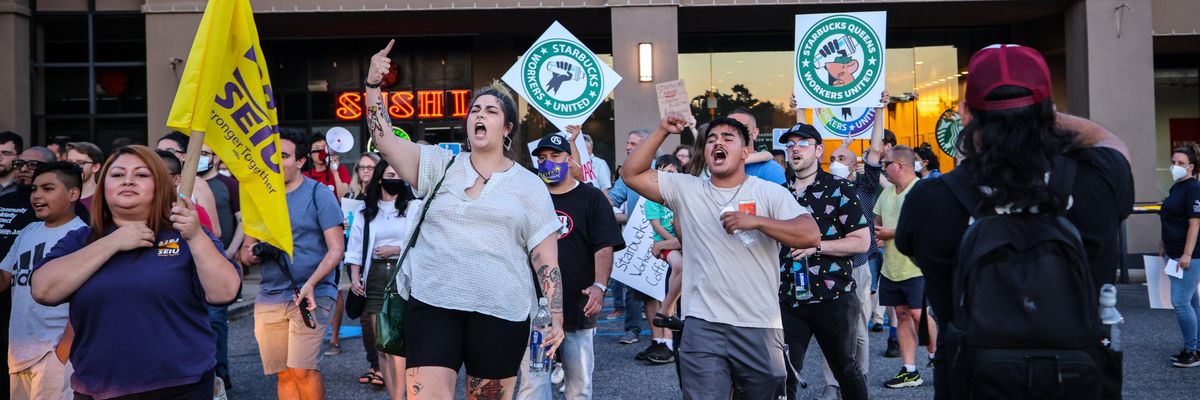

Protesters rally against Starbucks union-busting outside one of the global coffee chain's locations in Great Neck, New York on August 15, 2022.
(Photo: Thomas A. Ferrara/Newsday RM via Getty Images)


BRETT WILKINS
Feb 27, 2024
COMMON DREAMS

U.S. labor advocates on Tuesday hailed an agreement between the Starbucks Workers United union and coffee giant to restart talks aimed at reaching a collective bargaining agreement after a two-and-a-half year impasse

"Starbucks and Workers United have a shared commitment to establishing a positive relationship in the interests of Starbucks partners," the company and union said in a joint statement. "During mediation discussions last week for the ongoing brand and [intellectual property] litigation, it became clear that there was a constructive path forward on the broader issue of the future of organizing and collective bargaining at Starbucks."

The statement added that the two parties "have agreed to begin discussions on a foundational framework designed to achieve both collective bargaining agreements for represented stores and partners, and the resolution of litigation between the union and the company. This includes resolving litigation related to both the partner benefits announced in May 2022 and the use of the Starbucks brand."

Reacting to the news, More Perfect Unionsaid on social media: "Starbucks has been refusing to bargain with over 300 unionized stores. Now they seem to finally be conceding to the union. This is a massive step forward."


Eric Blanc, a labor expert and professor at Rutgers University in New Jersey, said it is "hard to overstate how big a deal this is."

"Relentless organizing by Starbucks Workers United has forced Starbucks to stop illegally denying benefits to union members and to start (it appears) bargaining a first contract in good faith," he added.

In what Starbucks called a "sign of good faith," the company agreed to offer approximately 10,000 employees in unionized stores higher wages and benefits it extended to nonunionized workers nearly two years ago, including the ability for customers to add tips to credit card payments.

Starbucks executive vice president and chief partner officer Sara Kelly said: "We have reached an important milestone. We have agreed with Workers United that we will begin discussions on a foundational framework designed to achieve collective bargaining agreements, including a fair process for organizing, and the resolution of some outstanding litigation."

"There is a lot of work ahead, but this is an important, positive step," Kelly added. "It is a clear demonstration of our intent to build a constructive relationship with Workers United in the interests of our partners. I want to acknowledge and appreciate the union's willingness to do the same."

While workers at nearly 400 Starbucks stores have voted to unionize, none have worked out contracts with the company.

Last week, baristas at 21 Starbucks stores in 14 states launched the largest single-day unionization drive in company history.

Starbucks agrees to US union organizing 'framework'
By Daniel Wiessner
February 27, 2024

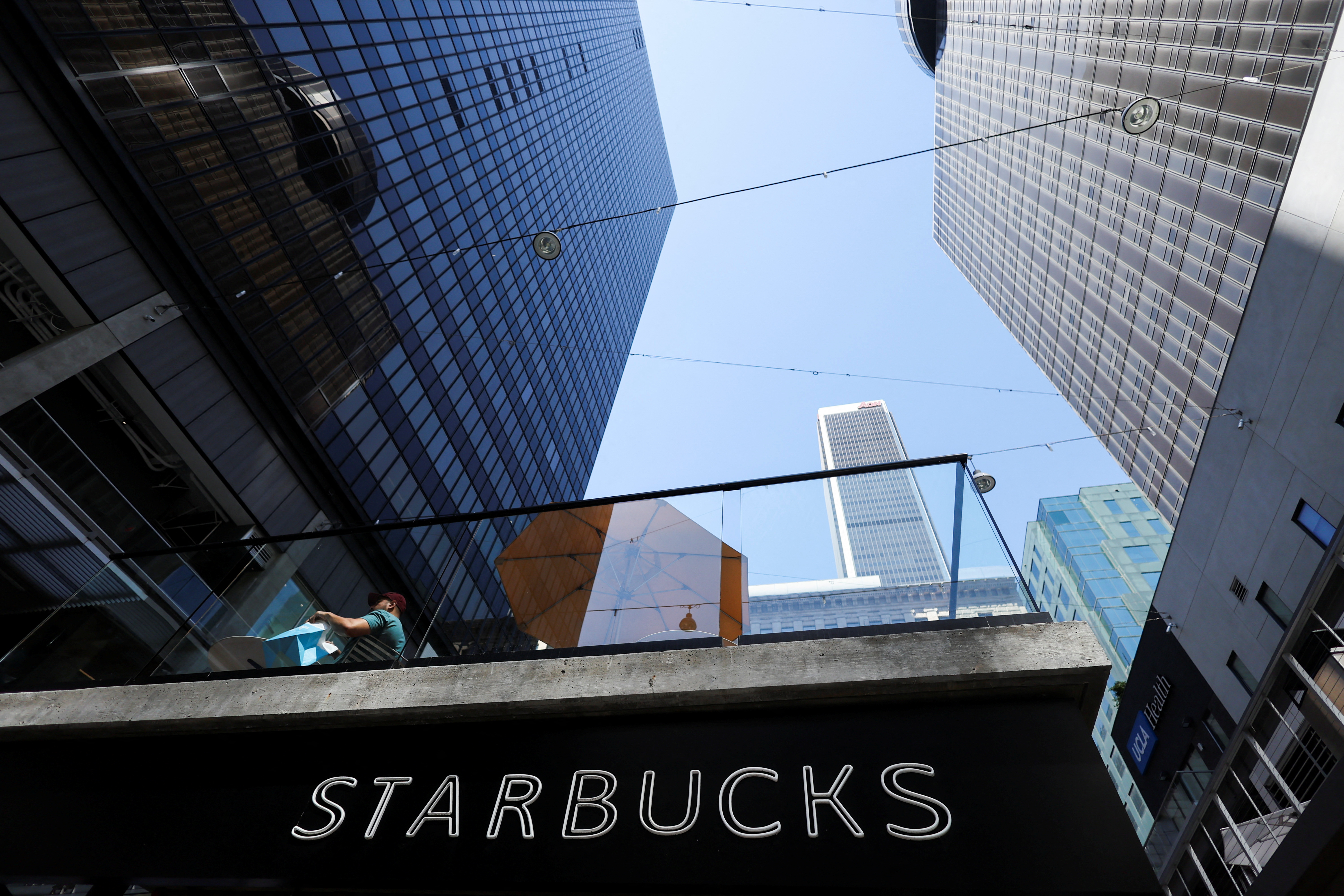
A Starbucks coffee shop is seen in downtown Los Angeles, California, U.S., June 29, 2022. REUTERS/Lucy Nicholson Purchase Licensing Rights, opens new tab

Feb 27 (Reuters) - Starbucks (SBUX.O), opens new tab and a union seeking to organize the coffee chain's U.S. workforce said on Tuesday they have agreed to create a "framework" to guide organizing and collective bargaining and potentially settle scores of pending legal disputes.

Starbucks and Workers United said in a joint announcement that during talks last week to settle an ongoing court case, "a constructive path forward emerged" on the future of the nationwide labor campaign that began in 2021 and has led workers to unionize at nearly 400 of the company's 9,000 U.S. stores.

The coffee chain and the union said they agreed to begin discussions on a "foundational framework" that includes a fair process for workers to organize and a process to achieve collective bargaining agreements on a store-by-store basis.

Starbucks said that "as a sign of good faith" it agreed to provide workers at unionized stores with benefits that were granted to non-union workers in 2022, including the ability to receive customer tips from credit card transactions.

The announcement is a remarkable turn in a contentious battle, with both sides accusing the other of improper and unlawful conduct. Starbucks in December said it would resume bargaining talks with the union in an attempt to mend its strained relationship with some employees.

Workers United has filed hundreds of complaints with the National Labor Relations Board accusing Starbucks of illegal labor practices, including threatening and firing union supporters and shuttering stores to prevent unionizing. The board and several federal courts have ruled that Starbucks violated

 U.S. labor law.

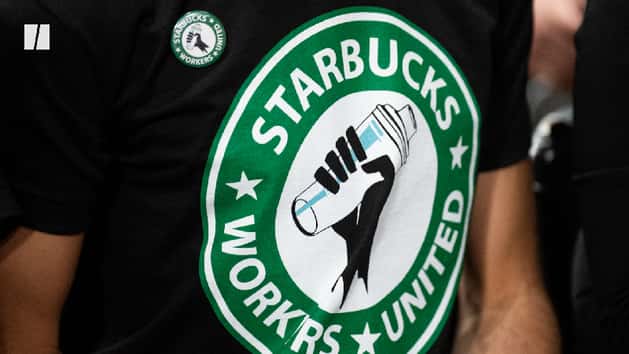
Starbucks has denied wrongdoing while accusing the union of trademark infringement for using the company's circular green logo as the basis for its own branding, and claiming it encouraged workers to violate company policies.

According to Tuesday's announcement, Starbucks and Workers United will also work toward settling the outstanding legal cases, but it was not clear which cases that cover.

In addition to the cases before the NLRB, Starbucks also has a case pending at the U.S. Supreme Court over Starbucks' firing of seven pro-union workers at a Memphis, Tennessee store. That case poses the broader question of when the NLRB can win court orders requiring employers to reinstate fired workers or take other steps to address alleged illegal labor practices.

Earlier this month, Starbucks also raised claims in a separate case before the labor board that the agency's structure violates the U.S. Constitution. Rocket maker SpaceX, Amazon.com (AMZN.O), opens new tab, grocery chain Trader Joe's and two Starbucks baristas who oppose unionizing are making similar arguments in separate cases.

Reporting by Daniel Wiessner in Albany, New York; Editing by Alexia Garamfalvi and Stephen Coates

Starbucks, Union Seek Path to Reach Collective Agreement

Daniela Sirtori-Cortina and Josh Eidelson
Tue, February 27, 2024 


(Bloomberg) -- Starbucks Corp., in a break from the labor tactics of its former chief executive officer, said it agreed with the main union representing its workers to start talks about how to achieve collective-bargaining agreements and provide a fair process for union organizing.

Starbucks said it also agreed to provide workers represented by the Starbucks Workers United union with benefits, such as credit-card tipping, that it was previously providing only to nonunion cafes. The company had maintained that labor law prevented it from extending those perks to unionized shops that lacked collective bargaining agreements, sparking one of many legal disputes that the two sides said they’re now working to resolve.

During mediation discussions last week, “it became clear that there was a constructive path forward on the broader issue of the future of organizing and collective bargaining at Starbucks,” the company said in a statement Tuesday. The union, Starbucks Workers United, issued a similar statement on X, formerly known as Twitter.

The announcement marks one of the first concrete steps toward resolving a public, bitter fight between the company and the union. Around 400 of Starbucks’ more than 9,700 corporate-run US locations have voted to join the union since its first landmark win in December 2021. Yet none of the locations has come close to securing a union contract with the company, and the pace of the union’s growth has slowed.

Howard Schultz, the founder of the modern Starbucks chain and three-time holder of the CEO title, handed the reins to Laxman Narasimhan in March. In December, Starbucks said it reached out to Workers United to attempt to end an impasse over contract talks. The company was looking to restart talks in January with the goal of completing “bargaining and the ratification of contracts in 2024.”

Sara Kelly, the company’s chief partner officer, called Tuesday’s announcement an “important, positive step” in a statement.

“It is a clear demonstration of our intent to build a constructive relationship with Workers United in the interests of our partners,” Kelly said. “I want to acknowledge and appreciate the union’s willingness to do the same.”

Brand Lawsuits


On Tuesday, the two parties said they’re also looking to resolve lawsuits concerning the use of its brand. The coffee chain had sued the union in October after the outbreak of the Israel-Hamas war, saying the group used the company’s intellectual property in social media posts suggesting the chain supported violence against civilians.

Workers United responded with its own lawsuit for defamation, accusing Starbucks of seeking to “exploit the ongoing tragedy in the Middle East to harm the union’s reputation.”

Regional directors of the US National Labor Relations Board have issued more than 100 complaints against the company, alleging illegal antiunion tactics including closing stores, firing activists, and refusing to fairly negotiate at unionized cafes.

The agency’s general counsel, Jennifer Abruzzo, said this month that she considers Starbucks “a bad actor nationally.” Starbucks has denied wrongdoing, and has said the union has been the one refusing to negotiate in good faith.

An NLRB judge ruled in September that Starbucks had violated federal law across the country by providing improvements such as credit card tipping as well as higher pay to nonunion stores while refusing to do the same at unionized locations. The agency judge concluded that Starbucks’ argument that it legally couldn’t extend those improvements was incorrect and not made in good faith.

The pivot on credit-card tipping, as well as the signals of potential coming headway on bargaining, could spur more growth for the union campaign, which has struggled at times to maintain momentum. Unionized baristas have been excluded from new perks their nonunion counterparts were receiving, while seeing little sign of progress with the company at the bargaining table.

 Bloomberg Businessweek

Starbucks and workers’ union agree to talks in breakthrough for both sides

Joint statement announces agreement to work toward labor agreements on ‘constructive path forward’


Associated Press
Tue 27 Feb 2024 

Starbucks and the union organizing its US workers said on Tuesday they have agreed to begin talks with the aim of reaching labor agreements.

The announcement was a breakthrough for the two sides, which have been at odds since Workers United first organized baristas at a Starbucks store in Buffalo, New York, in late 2021.

“Starbucks and Workers United have a shared commitment to establishing a positive relationship in the interests of Starbucks partners,” the company and the union said in a joint statement.

Twenty-five US universities face calls to cancel Starbucks contracts


Workers have voted to unionize at more than 370 company-owned Starbucks stores in the US, but none has reached a labor agreement with the company.

The process has been contentious. In multiple cases, federal courts have ordered Starbucks to reinstate workers who had been fired after leading unionization efforts at their stores. Regional offices of the National Labor Relations Board also have issued at least 120 complaints against Starbucks for unfair labor practices, including refusal to bargain and reserving pay raises and other benefits for non-union workers.

Starbucks said on Tuesday that, in a sign of goodwill, it will provide workers in unionized stores with benefits it announced in May 2022, including the ability for customers to add a tip to their credit card payments.

Starbucks was the first to indicate that it wanted a better relationship with the union. In December, the company said it wanted to restart labor talks with the goal of ratifying contract agreements in 2024. Before then, the two sides had not spoken for seven months.

During discussions last week, the two sides said it had become clear there was “a constructive path forward on the broader issue of the future of organizing and collective bargaining at Starbucks”.

Starbucks and Workers United said on Tuesday that they also plan to discuss resolving litigation between them. In October, Starbucks sued Workers United, saying a pro-Palestinian social media post from a union account early in the Israel-Gaza war had angered hundreds of customers and damaged its reputation. The company demanded that the union stop using its name and likeness. Workers United countersued, saying Starbucks had defamed the union and implied it supported terrorism.

“While there is important work ahead, coming together to work on this framework represents an important step forward and is a clear demonstration of a shared commitment to working collaboratively on behalf of partners,” the two sides said in their statement.


Message from Sara: Starbucks and Workers United Agree on Path Forward

A message from Sara Kelly, evp, chief partner officer, Starbucks Coffee Company:

In December, we shared a letter with Workers United expressing our sincere desire to work together, with the goal of completing bargaining and contract ratification in 2024 for stores that have chosen to be represented by Workers United.

Since Laxman became ceo, he’s spent time in our stores, listening to, and learning from, partners. He’s been clear that we are deeply committed to delivering on our partner promise and to restitching the fabric of the green apron for all partners at Starbucks.

I want to let you know that we have reached an important milestone. We have agreed with Workers United that we will begin discussions on a foundational framework designed to achieve collective bargaining agreements, including a fair process for organizing, and the resolution of some outstanding litigation.

There is a lot of work ahead, but this is an important, positive step. It is a clear demonstration of our intent to build a constructive relationship with Workers United in the interests of our partners. I want to acknowledge and appreciate the union’s willingness to do the same.

Our partners are the core of our business, and we are committed to providing everyone who wears the green apron a bridge to a better future.

Further, the Company issued the following statement:

Starbucks and Workers United have a shared commitment to establishing a positive relationship in the interests of Starbucks partners. During mediation discussions last week for the ongoing brand and IP litigation, it became clear that there was a constructive path forward on the broader issue of the future of organizing and collective bargaining at Starbucks.  

Starbucks and Workers United have agreed to begin discussions on a foundational framework designed to achieve both collective bargaining agreements for represented stores and partners, and the resolution of litigation between the union and the company. This includes resolving litigation related to both the partner benefits announced in May 2022, and the use of the Starbucks brand.

As a sign of good faith, Starbucks has agreed to provide partners represented by Workers United with the May 2022 benefits, including credit card tipping.  

While there is important work ahead, coming together to work on this framework represents an important step forward and is a clear demonstration of a shared commitment to working collaboratively on behalf of partners.


For Workers United’s statement and related inquiries, contact Danny Massey.


21 Starbucks Stores Plan To Form Unions In 1-Day Blitz


The union Workers United has organized roughly 400 stores, but is locked in a bitter bargaining fight with the coffee chain.


By Dave Jamieson
HUFFPOST
Feb 20, 2024


Starbucks baristas from 21 stores around the country told the company Tuesday that they plan to organize, potentially adding hundreds of new members to a union campaign that’s battling the coffee chain for first contracts.

The union, Workers United, said it is the largest group of Starbucks stores to go public with their organizing plans in a single day since the effort began in Western New York in 2021. The 21 locations are scattered across 14 states from coast to coast.

Workers sent a joint letter to the company’s CEO, Laxman Narasimhan, demanding “higher wages, fair and consistent scheduling, improved benefits, and a safe and dignified workplace.”

“We have been met with higher and higher expectations without being given the resources to meet them,” they wrote.

A Starbucks spokesperson said that although the company believes a “direct relationship as partners is core to our culture,” it would respect employees’ right to organize and intends to negotiate first contracts with unionized stores this year.

“We encourage all partners at stores petitioning for representation to get the facts, make an informed choice and ensure their voice heard by voting in neutral, secret-ballot elections,” the spokesperson said.

Baristas at roughly 400 of Starbucks’ 9,000 corporate-owned stores have formed unions with Workers United as part of the campaign, one of the biggest U.S. labor organizing successes in years. Workers United has won more than 80% of the union elections that have been held, according to the National Labor Relations Board, the federal agency that oversees elections and investigates union-busting allegations.

“It’s important that we’re recognized as people rather than profit machines.”
- Barista Lizzie Harlow

But the pace at which stores are unionizing has slowed since 2022 in the face of an aggressive counter-campaign by the Seattle-based company.

Federal labor prosecutors have accused Starbucks of illegally firing union supporters, making unlawful threats and refusing to bargain with workers throughout the campaign. Labor board judges have ruled against Starbucks again and again, finding the company violated the law in 48 of 49 cases that have been heard so far, according to a tally provided by an NLRB spokesperson.

Barista Lizzie Harlow said in an interview that those findings didn’t discourage co-workers from signing on for the union as part of Tuesday’s push. The 31-year-old works in the town of Sulphur, Louisiana, two hours west of Baton Rouge, and said none of the Starbucks locations in their district have formed unions yet.

Harlow said a lot of workers at the store are worried about losing hours, which could jeopardize their qualification for benefits.

“It’s important that we’re recognized as people rather than profit machines,” she said. “We don’t have another choice but to stand together.”
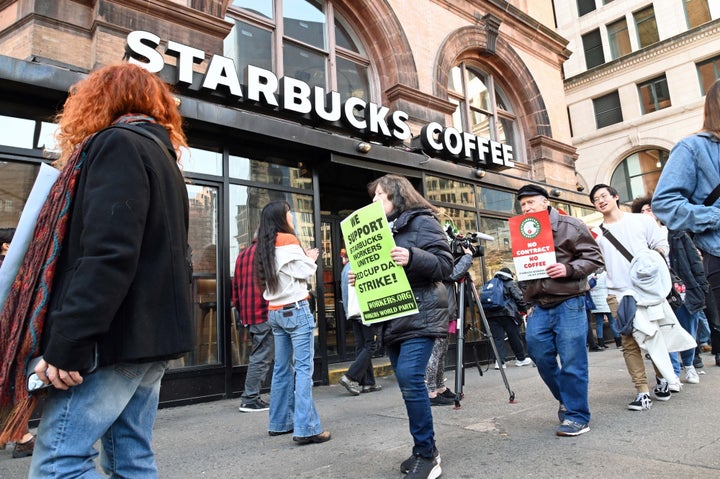


Workers United said Starbucks workers at 21 stores around the country notified the company Tuesday that they plan to unionize.
NURPHOTO VIA GETTY IMAGES

The Starbucks spokesperson said the company “has continued to work to build weekly schedules that reflect our partners’ preferred hours.”

Twenty-year-old Alex Taylor, whose store in Madison, Wisconsin, also plans to petition for a union, said he’s optimistic the union will start to make good headway on a collective bargaining agreement.

“Through this mass filing we hope, and I certainly do, that Starbucks treats us like we’re advertised to be, as well-supported and respected partners,” Taylor said.

Growing the campaign is critical to any success the union hopes to have at the bargaining table. Starbucks has insisted that each store must bargain its own contract, just as each store has unionized on its own, but the larger the campaign gets, the easier it will be for the union to bend the company toward a nationwide agreement.

The Starbucks effort is part of a wave of new organizing at big-name companies like Amazon, Trader Joe’s, Apple and REI, all of which were previously union-free. Those campaigns have all notched big organizing wins but have struggled to secure contractual gains at the bargaining table.

“Starbucks has blunted the organizing effort by rolling out new raises and benefits for non-union stores while withholding them from those that have organized.”

The Starbucks workers are demanding minimum pay of $20 per hour, annual raises of 5% and a guarantee of at least 32 hours a week for full-time workers, among other proposals. A strong contract could turbocharge more Starbucks organizing and set a bar for similar food-service chains, though the two sides are still a long ways off from reaching a deal.

Starbucks has blunted the organizing effort by rolling out new raises and benefits for non-union stores while withholding them from those that have organized — a nationwide policy one labor board judge deemed illegal. Starbucks has denied it broke the law and appealed the decision.

As HuffPost recently reported, the company is even excluding union workers from its North America Barista Championship, the winner of which gets a trip to Starbucks’ coffee farm in Costa Rica.

Taylor said he’s noticed the disparate treatment: “It says in fine print, every single time, that if you are in a unionized store you may not be eligible for this.”

But Taylor, who’s working toward his college degree, said he’s focused on bigger workplace issues, like making sure baristas get enough hours to make ends meet.

“At end of the day [I look at] what the union is fighting for — guaranteed hours, secure scheduling, higher wages,” he said. “Having a barista championship is not nearly as impactful as being able to pay my rent and get groceries in a way that I’m not stressed out every month.”


Canada's Suncor looks to cut high oil sands mine operating costs

Nia Williams
Thu, February 22, 2024 

Suncor Energy facility is seen in Sherwood Park, Alberta

(Reuters) - Suncor Energy, Canada's second-largest oil producer, will focus this year on cutting operating costs in its oil sands mining business, CEO Rich Kruger said on Thursday, as the company continues efforts to fix long-running underperformance.

Calgary-based Suncor is trying to improve safety and efficiency after a string of fatalities at oil sands sites in recent years and slope stability issues at its Fort Hills mine in northern Alberta.

The company's bitumen mines produced more than 600,000 barrels per day (bpd) in 2023, which were upgraded into synthetic crude and account for the bulk of Suncor's total 746,000 bpd production.

But operating costs at its oil sands plants, including Fort Hills and the Syncrude project, range from $28-$38 a barrel, compared with around $22 a barrel at rival Canadian Natural Resources' mining and upgrading operations.

"We know exactly what our unit cost competitive gap is relative to best in class," Kruger said on a call to discuss Suncor results. "Fundamentally as a company we will improve our cost performance as our mining business improves its performance."

Moving ore around is the single highest cost component of bitumen production, Kruger said. To tackle that, Suncor is buying larger haul trucks and ramping up autonomous operations.

The company will double its autonomous haul truck fleet to 91 vehicles this year so that all ore at Base Plant will be moved autonomously, Kruger said, adding each conversion saves about C$1 million ($741,455) per truck per year.

Suncor Base Plant and Syncrude have been operating for decades and are the oldest mines in the oil sands. Part of the cost underperformance was due to the age and configurations of those assets, the CEO said.

"We're also evaluating alternatives to address our structural gap via alternate mining scenarios or different technologies in our mines," he added.

Former Exxon Mobil executive Kruger became CEO last year, replacing Mark Little, who resigned in mid-2022 following the death of a worker on a Suncor site.

Little's departure came after activist investment firm Elliott Management built a stake in the company and demanded changes including a board revamp.

On Wednesday, Suncor said Russ Girling, who joined the board in 2021 after stepping down as CEO of pipeline company TC Energy, had been appointed chair.

Suncor on Wednesday reported fourth-quarter earnings that beat analysts' expectations, helped by higher production. Its shares were flat at C$45.36 on the Toronto Stock Exchange on Thursday.

($1 = 1.3487 Canadian dollars)

(Reporting by Nia Williams in British Columbia; Editing by Bill Berkrot)
Qatar Has Eyes on More Long-Term Deals as It Bets Big on LNG

Qatar is seeking more gas deals in Europe and Asia in a bet demand will continue to grow as it embarks on a new multibillion-dollar project to expand exports.


Bloomberg News
Verity Ratcliffe
Published Feb 26, 2024 •
Join the conversation
An LNG terminal in Japan. 
PHOTO BY TOMOHIRO OHSUMI /Bloomberg

(Bloomberg) — Qatar is seeking more gas deals in Europe and Asia in a bet demand will continue to grow as it embarks on a new multibillion-dollar project to expand exports.

The Middle Eastern nation — already one of the world’s largest suppliers of LNG — plans a new 13% increase in annual capacity on top of a previously announced expansion. Population growth, particularly in Asia, will drive demand along with an economic recovery across the world, Qatar’s Energy Minister Saad Al-Kaabi said. The country is also looking to lock in more contracts in Europe, he said.

The decision to plow yet more investment into gas production comes as an outlook for a supply glut and a shift by some countries away from fossil fuels threatens projects elsewhere. Global gas demand could peak by the end of this decade, according to some analysts, including the International Energy Agency.

Qatar’s push highlights the importance of gas for the country. Exports of the fuel are the country’s biggest revenue earner which has already made it one of the wealthiest countries and helped boost its global clout since it started shipments about two decades ago.

“We’ve been consistently saying that we need a lot of LNG,” Al-Kaabi said in an interview on Sunday. “We need more gas for the world, and we need more players.”

Qatar will add 16 million tons of annual production capacity before the end of this decade, in addition to a 49 million tons-per-year expansion that’s already underway. It has signed a 27-year pact with China Petroleum & Chemical Corp. and with European companies such as Eni SpA, TotalEnergies SE and Shell Plc. Still, BloombergNEF data show the country needs to find buyers for supply from about half of the ongoing expansion.

US Pause


The move also comes just as the US, the world’s biggest LNG producer last year, has paused issuing new export licenses while it considers the impact of higher exports on the climate, the economy and national security.

That decision will hit small American producers that rely on securing long-term sales agreements to underpin investments in liquefaction projects, according to Al-Kaabi.

“Buyers will not go for these sellers if every day the government could stop the process,” he said. “It’s very difficult to have long-term planning when you have that.”

Natural gas prices have slumped in recent months, in part due to mild weather and muted demand, but also because Europe’s energy crisis has faded and new LNG production facilities are expected to ease any residual market tightness.

While it’s counterintuitive for Qatar to expand in a potentially “oversupplied market, we believe the region, which is the lowest-cost LNG supplier in the world, can benefit from increased long-term market share while conveying the image of a reliable supplier,” Goldman Sachs Group Inc. said in a note.

The expansion follows discoveries of more gas in the North Field. If Qatar’s North Field West starts up in 2030, Qatar will have a 23% share of global LNG production by 2033, assuming global demand for the fuel remains unchanged, said Fraser Carson, senior research analyst for global LNG at Wood Mackenzie Ltd.

Qatar is insulated from the full impact of global price swings, Al-Kaabi said. “If there’s a downturn, we will be able to cope with it more than others.”

—With assistance from Fiona MacDonald, Stephen Stapczynski and Anna Shiryaevskaya.

(Updates with WoodMac estimates for Qatar’s share in penultimate paragraph.)
Osino Resources agrees to all-cash acquisition offer from Yintai Gold

Daniel Johnson , BNN Bloomberg
Feb 26, 2024

Yintai Gold Co., a Chinese mining company, entered into an agreement to acquire Vancouver-based gold exploration company Osino Resources.

Osino Resources announced in a press release on Monday, that it agreed to an all-cash offer from Yintai at $1.90 per share. The total acquisition price is around $368 million and represents a premium of around 32 per cent above a previous offer from Dundee Precious Metals Inc., which Osino terminated prior to entering into the agreement with Yintai.

“Whilst we were appreciative of the previous offer from DPM, the all-cash offer from Yintai represents a significant premium to the DPM offer price, thus is clearly a superior proposal, and is an excellent outcome for Osino’s shareholders,” Osino President and CEO Heye Daun said in the release.


Canadian gold miner agrees to sell itself to Chinese company in possible test of Ottawa policy

Yintai Gold to buy Osino Resources for $368 million


Author of the article: Naimul Karim
Published Feb 26, 2024 • 


Yintai Gold Co.’s main interest in Osino Resources Corp. seems its gold project in central Namibia. 
PHOTO BY NEWMONT MINING/AP FILES

Ottawa’s policy of preventing Chinese companies from investing in Canadian-listed firms may be put to the test after Vancouver-based Osino Resources Corp. agreed to be bought by Yintai Gold Co. Ltd. for $368 million.

Yintai’s main interest in Osino seems to be the latter’s gold project in central Namibia. The Twin Hills Gold project is expected to have a 13-year mine life with average gold production of more than 169,000 ounces per year, according to a third-party study. The project is expected to generate about US$1.5 billion with a relatively low cost of about $365 million to build the mine.

Yintai president Xingong Ou in a press release said Twin Hills represents a unique opportunity for the company to add a “high-quality gold development asset” to its portfolio.

However, Osino’s Omaruru Lithium project, still in its early stages, lies just 20 kilometres away from the Twin Hills project. Osino in 2022 inked an agreement with Australia’s Prospect Resources Ltd. to explore the property for lithium. Prospect can own about 51 per cent of the project if it meets certain conditions.

Yaron Conforti, an Osino spokersperson, said the company would divest its lithium asset prior to closing.

Even though Canada has blocked gold transactions in the past — for example, Shandong Gold Ming Co.’s bid for TMAC Resources Inc. — Beacon Securities Ltd. analyst Bereket Berhe said Osino’s assets are not in Canada and gold is not recognized as a critical mineral.

“The acquisitions of TSE-listed gold mining companies by Chinese operators, including Zijin Mining’s acquisition of Nevsun Resources (2018), Continental Gold (2019) and Guyana Goldfields (2020) did not prove problematic,” Behre said in a research note. “All acquired companies had assets outside of Canada. Although there is no guarantee … we believe there is a higher probability of the transaction closing successfully than not.”

Ryan Walker, an analyst at Echelon Wealth Partners Inc., doesn’t expect Osino’s lithium project to be an obstacle in completing the deal.

“We would expect that if such an asset were to present any impediment to deal completion (lithium representing a strategic mineral and currently subject to a ban on unprocessed ore), which we do not expect, the asset would be monetized,” Walker said in a note on Feb. 26

In November 2022, Canada ordered three Chinese companies to divest their shares from three junior Canadian lithium miners. This was after Ottawa released a policy that made it more difficult for foreign businesses either owned or influenced by “non-like-minded” nations to own or invest in Canadian miners dealing with metals such as lithium, nickel and copper.

Late last year, Industry Minister François-Philippe Champagne reaffirmed this stance and said he would not compromise on national security.

Canada considers 31 minerals, including lithium and copper, as critical due to the key roles they are expected to play in the gradual transition away from energy produced from fossil fuels in the near future. The restrictions were imposed to ensure Canada lessens its dependence on China for these raw materials.

A spokesperson from the federal government said in a statement that the Investment Canada Act provides for the review of the most significant investments by non-Canadians to ensure its likely net benefit to the Canadian economy, and for the review of foreign investments of any size for national security concerns.

“The government has not hesitated and will not hesitate to take action on transactions that would be injurious to Canada’s national security,” the statement read.

Despite Ottawa’s stance, Canadian companies have been looking to make deals with Chinese companies.

For example, Montreal-based SRG Mining Inc. in July agreed to sell 19.4 per cent of the company to China’s Carbon One New Energy Group Co. Ltd. SRG is developing the Lola Graphite Project in Guinea, West Africa. Graphite, used in batteries, is also considered a critical mineral.

SRG on Feb. 26 said it was now thinking of redomiciling the company in the United Arab Emirates. The move will be subject to a shareholder vote in the second quarter of this year. The company said it intends to be listed on the Toronto Stock Exchange and will, therefore, require approval from the exchange as well.

In another deal, Vancouver-based Solaris Resources Inc., which is developing a copper project in Ecuador, inked an agreement with China’s Zijin Mining Group Co. to receive $130 million by way of a private placement of common shares. The deal is subject to approval from the Canadian government among other conditions.


Indigenous leader in Nova Scotia accusing radiologists of conducting secret tests

Chief Andrea Paul, of the Pictou Landing First Nation
 (THE CANADIAN PRESS/Andrew Vaughan)

Michael MacDonald
The Canadian Press
Updated Feb. 27, 2024 6:45 a.m. MST
HALIFAX -

A Mi'kmaq chief in Nova Scotia has filed a lawsuit against two Halifax radiologists alleging they conducted medical tests on her and other members of the Pictou Landing First Nation(opens in a new tab) without their consent.

In a statement of claim, Andrea Paul says she and other band members agreed in March 2017 to undergo Magnetic Resonance Imaging (MRI) scans at the QEII Health Sciences Centre(opens in a new tab) in Halifax as part of a research project led by the Canadian Alliance for Healthy Hearts and Minds(opens in a new tab).

The claim, filed in Nova Scotia Supreme Court(opens in a new tab) in June 2020 and certified as a class action on Feb. 7, alleges the chief and 60 band members were subjected to additional "secret" scans of their livers without consent.

"Chief Andrea was unaware of the Indigenous study or that she was participating in it," the statement of claim says. "The MRI scans generated data that reveal intimate medical information about her body without her knowledge or consent. She had been singled out for one reason -- she was Mi'kmaq."

Paul, who was the chief of Pictou Landing when she filed the lawsuit, has since become the Assembly of First Nations(opens in a new tab) regional chief for Nova Scotia.

The lawsuit names Dalhousie University(opens in a new tab) radiologists Robert Miller and Sharon Clarke as defendants.

None of the allegations have been proven in court, and Lawyer Harry Thurlow, who represents the two radiologists, said Monday in an email his clients would not be commenting on the court action.

At the time of the MRI testing, both Miller and Clarke were also employed by the Nova Scotia Health Authority in the radiology department of the QEII Health Sciences Centre, the statement of claim says.

Paul learned about the secret testing on June 21, 2018 and later met with Miller and Clarke, who confirmed the unpublished results had been shared with other radiologists at a conference in Halifax, the lawsuit says. The study was titled: "MRI Findings of Liver Disease in an Atlantic Canada First Nation."

The lawsuit says Paul felt betrayed, violated and humiliated by what she was told, knowing the "long history of subjecting Indigenous people in Canada to cruel medical experiments, including starvation studies among children."

"Chief Andera felt powerless, vulnerable and discriminated against because she was Mi'kmaq. She suffered a loss of dignity and self-esteem as a result."

Among other things, the lawsuit alleges the two radiologists are liable for invasion of privacy, acting recklessly and causing distress and anguish. Both are also accused of negligence, unlawful imprisonment and assault and battery for allegedly keeping the participants inside the confined space of the MRI machine for longer than they should have.

As well, the radiologists are accused of failing to immediately advise participants of serious health issues discovered on the additional MRI scans.

"Unfortunately, there is a long history of oppression of Indigenous people in Canada including many instances where Indigenous people were subjected to medical treatment and research against their will and without their consent," the lawsuit says.

"There is an historically and evidentiary based mistrust of the health-care system."

This report by The Canadian Press was first published Feb. 26, 2024.


Indigenous people sue over alleged Canadian secret medical experiment

First Nation members say in lawsuit that radiologists subjected them to a secret study without their knowledge or consent


Leyland Cecco in Toronto
THE GUARDIAN
Mon 26 Feb 2024 

Members of a First Nation in Canada have launched a lawsuit alleging they were subjected to a secret medical experiment without their consent that left them feeling “violated and humiliated”.

The class-action lawsuit, which was certified by the Nova Scotia supreme court in early February, revives the painful history of Canada conducting medical experiments on Indigenous peoples and the persistent discrimination they continue to face within the country’s healthcare system.


Indigenous reporter fears more journalists will be targeted after arrest as police cleared Canada camp


In a statement of claim, Chief Andrea Paul, the lead plaintiff, says she and 60 other members of the Pictou Landing First Nation participated in an MRI in 2017 for a medical research project administered by the Canadian Alliance for Healthy Hearts and Minds.

But after the test finished, staff at the hospital in Halifax kept her for a second test.

“As she lay inside the claustrophobic MRI chamber, holding her breath, and cringing from the loud banging sounds around her, the MRI scans generated data that revealed intimate medical information about her body without her knowledge or consent,” reads the statement of claim. “She had been singled out for the one reason – she was Mi’kmaq.”

A year later, Paul, who also serves as regional chief for the Assembly of First Nations in Nova Scotia, learned that two radiologists had allegedly used the second procedure to conduct MRI elastography to study the livers of Indigenous subjects, without their knowledge or consent.

The class-action lawsuit has named the radiologists Robert Miller and Sharon Clarke as defendants. According to the claim, Miller met with Paul in 2018 and told her the MRI had been used for a broader research project titled “MRI Findings of Liver Disease in an Atlantic Canada First Nations Population”. Miller, an associate professor at Dalhousie University’s faculty of medicine who previously served as president of the Canadian Association of Radiology, allegedly told her the findings had been shared with a radiology conference after initially denying disclosing the test results.

Neither researchers with the Canadian Alliance for Healthy Hearts and Minds nor the plaintiffs were given the results of the test.

Canada has a dark history for its treatment of Indigenous peoples under the guise of healthcare, with the deadly effects of systemic racism persisting into the present day.

In the 1940s, nearly 1,300 Indigenous children across Canada were starved for studies about the effects of malnutrition as part of a government-run study. Indigenous women have also been sterilized against their will, leading human rights groups to call for an end to the practice.

“Knowing the long history of subjecting Indigenous people in Canada to cruel medical experiments … and to confirm the Indigenous right to own and control research data of Indigenous people, Chief Andrea felt powerless, vulnerable, and discriminated against because she was Mi’kmaq.”

The claim also asserts that Indigenous people “have been reluctant to participate in health research and receive treatment from non-Indigenous doctors, health centers, and hospitals” because of a legacy of mistreatment and abuse.

“There is an historically and evidentiary based mistrust at the healthcare system,” the claim reads. Paul says in the claim she had worked to persuade community members to participate in the initial MRI test and the actions of the two radiologists is emblematic of the mistrust held by Indigenous communities.

Paul and 60 members of Pictou Landing are seeking a declaration from the defendants for invasion of privacy, unlawful imprisonment, negligence, breach of fiduciary duty, breach of contract, charter breaches and damages. They also argue the tests amount to assault and battery because the MRI scan procedures “amount to a medical procedure that was performed on [the plaintiffs] without their knowledge or informed consent”.

A lawyer for the two radiologists has said neither will provide comment. None of the allegations have been tested in court and no hearing dates have been set.

Indigenous people accuse radiologists of secretly studying their organs


By Leo Sands
The Washington Post
February 27, 2024

Dozens of Indigenous people have brought a lawsuit against two radiologists in Canada, accusing them of conducting MRI scans without their consent as part of a secret scientific study of their livers.

According to the lawsuit, 59 members of the Pictou Landing First Nation were subjected to invasive MRI scans between 2017 and 2018 for research purposes without their knowledge. The complaint was first filed to Nova Scotia’s Supreme Court in June 2020 and certified as a class-action lawsuit this month.

In their suit, the plaintiffs evoked Canada’s dark history of subjecting Indigenous people to nonconsensual experimentation, which they said was motivated by racism.

According to the claim, Pictou Landing Chief Andrea Paul, the lead plaintiff, took part in a consensual MRI scan in March 2017 as part of a medical research project conducted by the Canadian Alliance for Healthy Hearts and Minds at a research facility in Halifax, Nova Scotia.

Instead of being withdrawn from the MRI machine when the scan finished, the suit alleged that Paul was unwittingly kept in the scanner as part of a second, separate study into liver disease among First Nation populations.

“Chief Andrea was unaware of the Indigenous Study or that she was participating in it. As she lay inside the claustrophobic MRI chamber holding her breath and cringing from the loud banging sounds around her, the MRI scans generated data that revealed intimate medical information about her body without her knowledge or consent,” the suit said. “She had been singled out for one reason — she was Mi’kmaq.”

The lawsuit named radiologists Robert Miller and Sharon Clarke as the defendants, whom it accused of undertaking the separate MRI study. Based on the scans, the suit said, Miller and Clarke later presented their results to a conference in Halifax and wrote an unpublished research paper titled “MRI Findings of Liver Disease in an Atlantic Canada First Nations Population.”

When contacted by The Washington Post, a lawyer representing Miller and Clarke declined to comment. Lawyers representing the plaintiffs did not immediately respond to a request for comment.

Chief Andrea only learned about the other study in June 2018, after which the suit said dozens more members of the Pictou Landing First Nation community also became aware that their livers had been studied without their consent between 2017 and 2018.

“Knowing the long history of subjecting Indigenous people in Canada to cruel medical experiments, including starvation studies among children, and knowing that there were research protocols in place to ensure the consent of Indigenous participants in health studies and to confirm the Indigenous right to own and control research data of Indigenous people, Chief Andrea felt powerless, vulnerable and discriminated against because she was Mi’kmaq,” the lawsuit said.

According to lawyers representing the plaintiffs, the participants were not given the results of their scans — even where they “revealed a medical issue requiring medical treatment.”

The plaintiffs are seeking damages from the defendants and declarations of invasion of privacy, unlawful imprisonment, assault and battery, negligence, breaches of fiduciary and trust duties, and breach of contract. The action will next proceed to a common issues trial for which no date has yet been set, the lawyers said.

What to know about Canada’s residential schools and the unmarked graves found nearby

In recent years, Canada has embarked on a national reckoning of its treatment of its Indigenous populations — including the observation of a National Day of Truth and Reconciliation to commemorate the Indigenous victims and survivors of Canada’s government-funded and Catholic church-run boarding school system.

Nearly 150,000 Indigenous children were sent to the residential schools to be assimilated between the 19th century and the late 1990s. In 2021, the remains of 215 Indigenous children were found in unmarked graves near the grounds of one residential school in British Columbia.

Within the residential schools, researchers subjected children to bizarre, invasive, and cruel experiments — many of which the wider Canadian public has only learned of recently.

In the 1940s, 50 children at Indian Residential School in Brandon, Manitoba, were subjected to tests seeking to establish evidence of extrasensory perceptions, or a “sixth sense,” among Indigenous people.

In 2013, a researcher at McMaster University revealed that starting in 1942, researchers conducted nearly a decade of “nutritional” experimentation on Indigenous children. The experiments involved depriving children of nutrition in the name of science and allowing conditions of virtual starvation to continue.

The Crown broke a promise to First Nations. It could now owe billions.

Prominent institutions in the United States are also grappling with their histories of mistreating Indigenous people and artifacts in the pursuit of scientific research, including many violations that have only recently come to light.

Last year, The Washington Post reported that the Smithsonian National Museum of Natural History holds more than 30,700 sets of human remains largely taken from graveyards, battlefields, morgues and hospitals around the world in the 19th and 20th centuries; among them were 254 human brains, most of which were taken from Black, Indigenous and other people of color to further now-debunked theories of racial differences.

Revealing the Smithsonian's 'racial brain collection'

In January, the American Museum of Natural History in New York announced it would close two halls dedicated to Indigenous cultures of North America while it reviewed whether the museum needed consent to display the artifacts. Last year, Interior Secretary Deb Haaland strengthened federal regulations requiring museums and federal agencies to identify and return stolen sacred items to their respective cultural groups.


By Leo SandsLeo Sands is a breaking-news reporter and editor in The Washington Post’s London Hub, covering news as it unfolds around the world. Twitter

Groups bring findings of racism at Canadian Human Rights Commission to global body


Alessia Passafiume
The Canadian Press
Feb. 27, 2024 

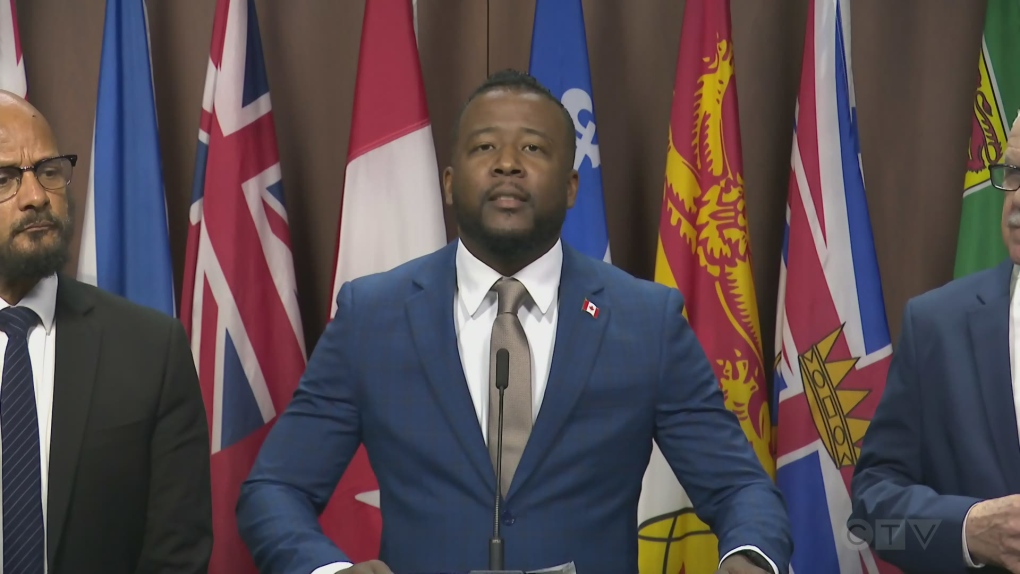
Nicholas Marcus Thompson, executive director of the Black Class Action Secretariat, speaks at a press conference in Ottawa. Feb. 26, 2024. (CTV News)


OTTAWA -

A coalition of federal unions and organizations representing Black workers has filed an international complaint against the Canadian Human Rights Commission.

The nine organizations say the body that handles human-rights complaints against the federal government is violating global law because of its treatment of Black employees.


"The Canadian Human Rights Commission, which should be at the forefront of promoting and protecting human rights, advocating for change as Canada's human-rights protector, has itself been discriminatory," said Nicholas Marcus Thompson, executive director of the Black Class Action Secretariat.

RELATED STORIES
Feds ask court to dismiss $2.5 billion class-action lawsuit brought on by Black public servants
Action needed to end anti-Black racism in public service: advocates
Canadian government announces first step in action plan for Black public servants

"Today, we demand accountability."

The groups are requesting that the Global Alliance of National Human Rights Institutions review the commission's accreditation.

They say their effort underlines the urgent need for reform. The alliance is headquartered in Geneva and works closely with the United Nations.

A December Senate report on anti-Black racism in the commission found a "crisis of confidence" in the body and questioned its ability to respond to human-rights complaints in a "fair and equitable manner."

The study was prompted by grievances against the commission about its treatment of Black and racialized employees.

Senators found some employees were harmed by their employer, and the report noted that workplace discrimination can have significant and lasting effects.

"It is never acceptable, yet it is a daily fact of life for many Black and racialized people in Canada," the report said.

Thompson said the coalition, which represents some 700,000 employees, is relying on the commission to "play a role in the fight to dismantle systemic discrimination, not to be the perpetrator in all of this."

The commission said in a statement Monday it is in the process of reviewing the coalition's complaint, but noted it underwent a periodic re-accreditation last year.

It was found to be in "full compliance," based on a "comprehensive review of all of the commission's work in promoting human rights between 2016 and 2022," the statement said.

"We are confident that we continue to operate in full compliance and look forward to providing (the global alliance) with all the information it requires."

The coalition seeking a review of the commission's status includes Thompson's organization, the Public Service Alliance of Canada, the National Union of Public and General Employees, the Canadian Black Nurses Alliance, the Red Coalition, the Federation of Black Canadians, the Black Canadians Civil Society Coalition, 613-809 Black Hub and The Enchante Network.

They want Canada to amend the Canadian Human Rights Act to create a direct access model in which complainants can go directly to the human-rights tribunal rather than through the commission.

They also seek amendments to the Employment Equity Act to include specific mention of Black people.

Labour Minister Seamus O'Regan, who released the Employment Equity Act Review Task Force's final report late last year, said his government would work toward recognizing Black and LGBTQ+ people in two new designated groups under the act.

Legislation to that effect has not yet been tabled.

The coalition also wants to see an appointment for a Black equity commissioner to serve as an independent officer of Parliament and work toward preventing future instances of anti-Black racism and discrimination.

Treasury Board President Anita Anand announced a plan to support Black public servants last week, including with mental-health supports and career development opportunities.

The coalition said it was not consulted on the initiative, and called for that approach to change.

Anand, speaking outside the House of Commons Monday, pushed back on that assertion by saying she and her team consulted with "a number of Black public servants" and were in contact with the task force that recommended changes.

She said the government will continue to engage with communities and stakeholders.

"We have a lot of work to do," she said.

"In terms of building trust with public servants from the Black community, and beyond, who feel that the federal government has not underscored and supported the work that needs to be done to move to a world in a public service where discrimination is not the reality."

This report by The Canadian Press was first published Feb. 26, 2024.


Groups fighting anti-Black racism file complaint against Canadian Human Rights Commission

Groups say they want Ottawa to appoint a Black equity commissioner as officer of Parliament


Peter Zimonjic · CBC News · Posted: Feb 26, 2024

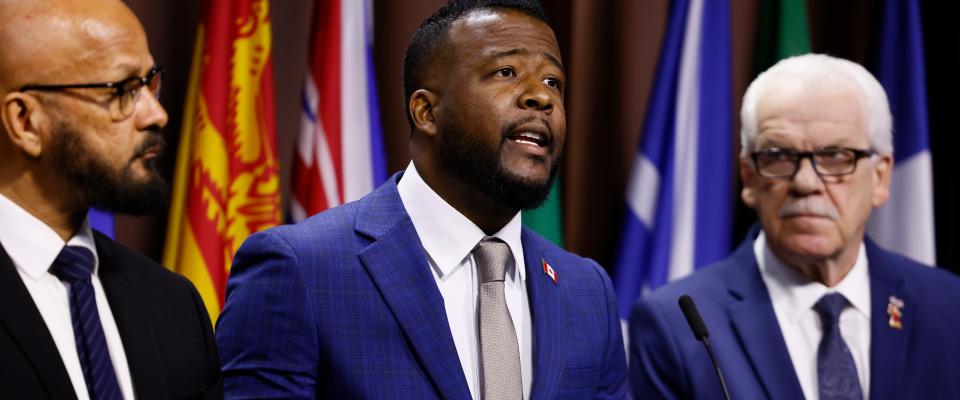
Nicholas Marcus Thompson, executive director of the Black Class Action Secretariat, outlines steps his group and others want the federal government to take to combat racism in the public service. (CBC)

A coalition of human rights groups advocating for Black and racialized Canadians has lodged a formal complaint against the Canadian Human Rights Commission (CHRC) for discriminating against its own employees.

The coalition also outlined a number of actions Monday it wants the federal government to take to combat what it calls "systemic discrimination within its structures."

"We're relying on the Canadian Human Rights Commission to play a role in the fight to dismantle systemic discrimination, not to be the perpetrator in all of this," Nicholas Marcus Thompson, executive director of the Black Class Action Secretariat (BCAS), said in Ottawa Monday.

The coalition said it has asked the Global Alliance of National Human Rights Institutions (GANHRI) to review the CHRC's accreditation with the group.

GANHRI is an umbrella organization that coordinates policy and action between the United Nations and domestic human rights organizations.


The coalition said it wants Canada's human rights body reviewed by GANHRI for violating international human rights law and failing to adhere to the Paris Principles.

Adopted by the UN General Assembly in 1993, the Paris Principles are a set of principles national human rights organizations have to follow to access the United Nations Human Rights Council and other bodies.

The CHRC receives and investigates complaints from federal departments and agencies, Crown corporations and private sector organizations such as banks, airlines and telecommunication companies. It decides which cases will proceed to the Canadian Human Rights Tribunal.

Racism within the CHRC

Last spring, the Canadian government's human resources arm, the Treasury Board of Canada Secretariat (TBCS), reported that the CHRC had discriminated against its own Black and racialized employees.

The TBCS came to that conclusion after nine employees filed a policy grievance through their unions alleging that "Black and racialized employees at the CHRC face systemic anti-Black racism, sexism and systemic discrimination."

"The organizations remain hopeful that this action will lead to significant reforms within the CHRC, ensuring it can effectively safeguard human rights and foster an inclusive society," the coalition said in a statement released Monday.

The coalition said it does not wish to see CHRC's funding cut but wants it to fulfil its role of combating systemic racism.

"We would like to see appropriate funding, and the government not cut funding for the [CHRC] as any type of remedy to address any shortfalls," Thompson said.

President of the Treasury Board Anita Anand announced the first steps of the Liberal government's action plan to support Black public servants last week.
 (Adrian Wyld/The Canadian Press)

The coalition is calling on the federal government to amend the Canadian Human Rights Act to allow complaints to go directly to the Canadian Human Rights Tribunal, rather than through the CHRC.

The coalition also wants the CHRC's role changed so that it acts to support people making complaints before the tribunal.

The group said it wants the Employment Equity Act amended "to better reflect intersectionality and to specifically include Black and other equity-deserving groups as designated groups."

The coalition said it also wants the federal government to appoint a Black equity commissioner to serve as an officer of Parliament with powers akin to that of the Auditor General of Canada. The commissioner would be tasked with ensuring equity across "all levels of government and the public service," the coalition said.

The coalition said it also wants public servants found to have committed acts of discrimination to be held accountable for their actions.
Criticism of the federal action plan

Last week, President of the Treasury Board Anita Anand announced the first steps of the Liberal government's action plan to support Black public servants.

It includes boosting the number of Black counsellors providing mental health support to public servants and their family members to 60 across the public service.

Anand also announced the launch of an executive leadership program for Black executives to improve career development services for Black public servants.

Ottawa backs listing Black and LGBTQ workers under Canada's workplace equity laws

The coalition criticized the move on mental health services, saying it would have preferred for the department to work with Black public servant groups to develop the initiatives.

"Black employee networks within the federal government [as well as unions] were not consulted on that … announcement about the employee assistance program," Thompson said. "We're very, very concerned about that. That approach has to change."

The coalition includes the BCAS, the Canadian Black Nurses Alliance, the Public Service Alliance of Canada, the Red Coalition, the National Union of Public and General Employees, the Federation of Black Canadians and the Black Canadians Civil Society Coalition.

Later Monday, Anand conceded that her government has "a lot of work to do in terms of building trust with public servants from the Black community." She said she did reach out to the community before her announcement last week.

"In advance of that announcement, I and my team engaged in consultations with a number of Black public servants," she said. "Consulting with Black public servants is at the heart of what we are doing as we come forward with supports for Black public servants."


Unified Action Against Systemic Discrimination in the Federal Public Service of Canada


February 26, 2024

In an unprecedented move to address systemic discrimination within the Federal Public Service of Canada, a coalition of leading organizations announced today a formal complaint against the Canadian Human Rights Commission (CHRC). This coalition includes the Black Class Action Secretariat (BCAS), the Public Service Alliance of Canada (PSAC), the National Union of Public and General Employees (NUPGE), the Canadian Black Nurses Alliance (CBNA), The Enchanté Network, the Red Coalition, the Federation of Black Canadians (FBC), 613-819 Black Hub and the Black Canadians Civil Society Coalition (BCCSC), united in their efforts to hold the CHRC accountable for its discriminatory practices.

The complaint, rooted in the CHRC's failure to adhere to the Paris Principles and its violations of international human rights law, marks a critical step in holding the Commission accountable for its discriminatory practices. The organizations have filed for a special review of the CHRC’s accreditation status with the Global Alliance of National Human Rights Institutions (GANHRI), underlining the urgent need for reform to ensure the CHRC can effectively protect individuals from discrimination.

The coalition's complaint highlights recent findings by the Senate of Canada Human Rights Committee and the Treasury Board Secretariat, which uncovered systemic racial discrimination within the CHRC, including higher dismissal rates of race-based complaints and exclusion of Black and racialized employees from promotions. These practices contravene core international human rights treaties and underscore the CHRC's failure to fulfill its mandate.

As the federal watchdog against discrimination, the CHRC's role is instrumental in combating discriminatory practices within Canada. The organizations urges GANHRI to thoroughly review the CHRC’s adherence to the Paris Principles and reassess its 'A' status accreditation.

The organizations remain hopeful that this action will lead to significant reforms within the CHRC, ensuring it can effectively safeguard human rights and foster an inclusive society.

In addition to filing the formal complaint, the coalition jointly calls on the Government of Canada to take significant steps toward rectifying systemic discrimination within its structures:Amend the Canadian Human Rights Act to create a direct access model, allowing complaints to go directly to the Canadian Human Rights Tribunal and repurposing the Canadian Human Rights Commission to support complainants with their matters at the Tribunal.
Amend the Employment Equity Act to better reflect intersectionality and to specifically include Black and other equity-deserving groups as designated groups.
Appoint a Black Equity Commissioner as an independent officer of Parliament to oversee and ensure equity across all levels of government and public service.
Ensure Accountability: Following the findings of discrimination at the Canadian Human Rights Commission by both the Senate Human Rights Committee and the Treasury Board Secretariat, it is imperative that those who committed discrimination be held accountable. This includes a thorough leadership review and necessary changes to prevent future occurrences.

Quotes:

Nicholas Marcus Thompson, Executive Director of the BCAS, stated, "Today, we stand united in our demand for accountability and change. The evidence of systemic discrimination within the CHRC is undeniable and unacceptable. Our action today is about restoring faith in our institutions and ensuring that the CHRC becomes a true champion of equality and human rights for all Canadians."

Chris Aylward, National President of the PSAC, emphasized the importance of this moment, "The Canadian Human Rights Commission’s failure to combat systemic racism within its own ranks strikes at the heart of justice for workers. As representatives of Black federal public service workers, PSAC demands immediate reform to restore the CHRC's integrity and efficacy. It's time for action, not words.”

Hodan Ahmed, Senior UN Fellow and Lead for the BCCSC, revised her focus, stating, " As we navigate through the UN International Decade for People of African Descent, it is imperative that our actions reflect a strong commitment to eradicating all forms of discrimination. The systemic issues within the CHRC not only undermine the values we champion during this decade but also significantly impact the lives of Black Canadians and other marginalized communities. Our call for a review of the CHRC’s accreditation is a step towards ensuring that Canada upholds its obligation and is aligned with its commitments to promote equality."

Media Contacts:

Black Class Action Secretariat info@bcas-srcn.org

Canadian Black Nurses Alliance infocbna@gmail.com

Public Service Alliance of Canada media@psac-afpc.com

Red Coalition info@redcoalition.ca

National Union of Public and General Employees jmaclean@nupge.ca

Federation of Black Canadians info@fbcfcn.ca

Black Canadians Civil Society Coalition contact@bccsc.ca


Could liquid hydrogen make fuel-cell trucks more viable vs. EVs?

FEBRUARY 26, 2024 


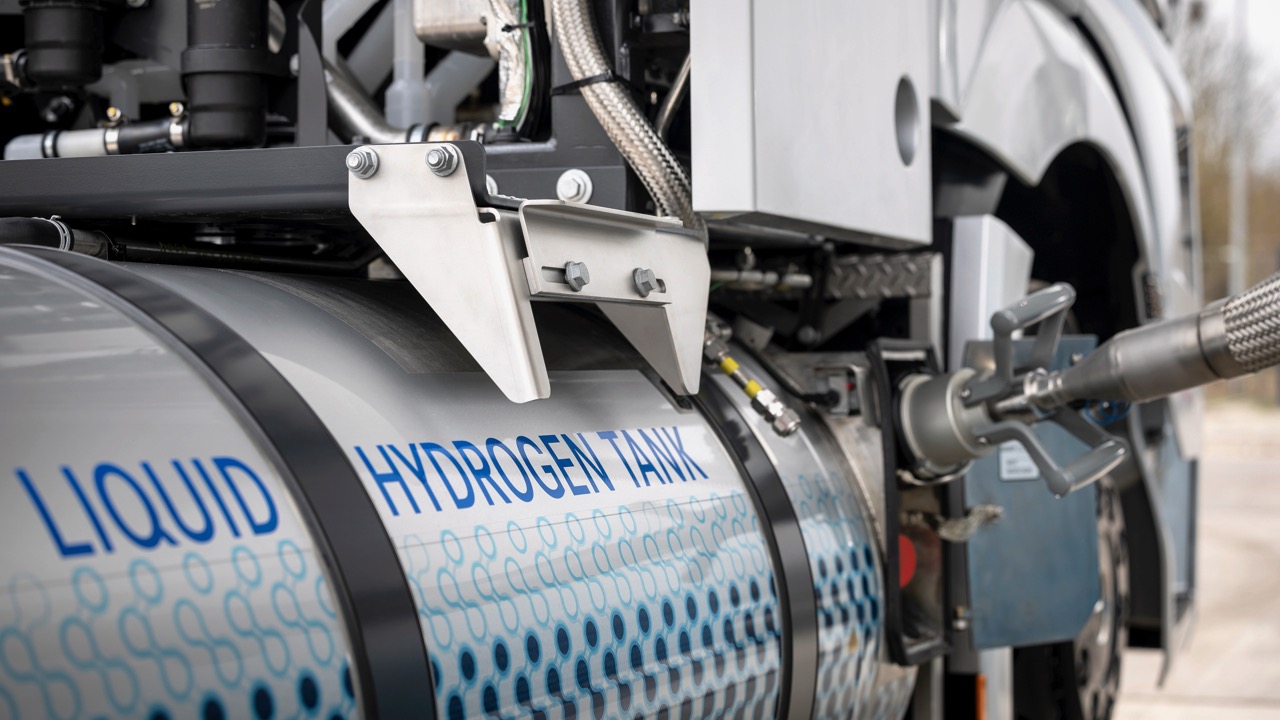
Gaseous hydrogen is the default for fuel-cell vehicles, but Daimler Truck is experimenting with liquid hydrogen for large commercial vehicles—and it's a technology that has the potential to cross over to passenger vehicles, eventually.

The truck maker has partnered with Linde Engineering to set up a public liquid hydrogen station in Wörth am Rhein, Germany. Called sLH2, it will fuel Mercedes-Benz GenH2 trucks from five companies taking part in a customer trial starting later this year, according to a Daimler press release.

The station uses a new type of pump that raises the pressure of liquid hydrogen, turning it into supercooled liquid hydrogen, according to Daimler. This allows for higher storage density, a smaller footprint for the station, and lower energy consumption, the company claims.


Daimler sLH2 liquid hydrogen fueling station


Refueling speed is also claimed to be comparable to diesel trucks. Pumps can add 621 miles of range in 10 to 15 minutes, Daimler claims, while enough liquid hydrogen can be stored onsite for 10 hours of non-stop refueling, with additional capacity easily added by refilling the tanks.

The downside is that, to maintain a liquid rather than a gaseous state, hydrogen must be cooled to -423 degrees Fahrenheit. The installation also requires special materials. So the cost of implementing such a solution may be prohibitive.

This isn't the first we've heard of long-haul liquid-hydrogen semis from Daimler. The company has been discussing liquid hydrogen since showing a concept semi truck in 2020. That truck had the same GenH2 badging as the ones to be used in the upcoming customer trial, but with more futuristic styling.


Daimler sLH2 liquid hydrogen fueling station


Liquid hydrogen tech is also something that Airbus has been working on for jet engines—as an alternative to fuel cells and electric turboprops. Although storage issues remain complex there, too, some see it as a replacement for jet fuel.

Meanwhile Nikola is pushing ahead with its Hyla refueling network, which is designed around gaseous hydrogen, as part of a strategic plan to establish up to 60 hydrogen refueling solutions in the coming years.


Toyota Tests Tech That Sucks CO2 From The Air On GR Corolla

A filter could suck up CO2 in the air as cars drive, but right now the technology is slow and inconvenient


by Sebastien Bell
February 26, 2024 


While Toyota has been cautious about fully transitioning to an all-electric lineup, a stance supported by some analysts, the company is actively pursuing alternative green technologies. One concept in development not only aims to enhance the eco-friendliness of its new vehicles but also tackle the environmental aftermath of outdated internal combustion engines.

Toyota is developing filters that could be integrated into the front of its vehicles to suck carbon dioxide from the atmosphere. The company is currently experimenting with this concept on its hydrogen combustion GR Corolla racecar. According to Toyota, initial tests suggest that this innovation could potentially render its cars carbon negative rather than merely carbon neutral.

The technology is clever in that it doesn’t require any additional power to work. Circular filters at the front of the car capture carbon dioxide, then waste heat from the engine is used to dissolve it into a liquid that can be disposed of. That means that this technology could also work in regular combustion engines, not just those who run on hydrogen.

Read: Toyota Turns Garbage Into Electricity, Makes Battery Recycling Cleaner Too

In Toyota’s vision, that would create a vehicle that actually cleans the air as it is being driven. Unfortunately, the technology is still a long way off. In its test, the filters only captured 20 grams of carbon dioxide in 20 laps of running (57 miles/91 km). That’s better than nothing, but engines running on fossil fuels emit 8,887 grams of carbon dioxide per gallon they consume, on average.

Bigger filters could suck up more carbon dioxide, but they would likely be difficult to package in passenger vehicles. However, deploying them in commercial vehicles, such as Hino trucks, could facilitate the advancement of this technology.

What’s more problematic is that there is still debate about how to safely deal with the liquid that contains the CO2. Furthermore, the technology is currently pretty inconvenient. In the GR Corolla Toyota used to test it, the filters needed to be changed manually during every pit stop, leading to questions about waste, among other things.

Yet, if Toyota can successfully develop the technology to passively suck CO2 from the air while drivers operate their vehicles, it could become a highly valuable innovation. However, its development comes as the company is attempting to rehabilitate its green image, following reports that it contributed to the campaigns of climate change denying politicians in the U.S.


US judge halts government effort to monitor crypto mining energy use

Federal judge in Texas says new requirement would cause ‘irreparable injury’ to industry amid surging electricity usage


Oliver Milman
THE GUARDIAN
Tue 27 Feb 2024

The US government has suspended its effort to survey cryptocurrency mining operations over their ballooning energy use following a lawsuit from an industry that has been accused by environmental groups of fueling the climate crisis.

A federal judge in Texas has granted a temporary order blocking the new requirements that would ascertain the energy use of the crypto miners, stating that the industry had shown it would suffer “irreparable injury” if it was made to comply.

The US Department of Energy had launched an “emergency” initiative last month aimed at surveying the energy use of mining operations, which typically use vast amounts of computing power to solve various mathematical puzzles to add new tokens to an online network known as a blockchain, allowing the mining of currency such as bitcoin.

The growth of cryptocurrency, and the associated mining of it, has been blamed for a surge in electricity use as data centers have sprung up across the US, even reviving, in some cases, ailing coal plants to help power the mining.

The federal government has said it needs better information about major miners’ power use, but estimates that up to 2.3% of the US’s total electricity demand last year came from just 137 mining facilities. Globally, crypto miners are thought to soak up as much as 1% of all electricity demand, which is the same as the entire country of Australia, with bitcoin mining’s energy use doubling just last year.

This new thirst for electricity risks worsening the climate crisis, campaigners say. In the US, where nearly four in 10 of all bitcoin are now mined, up to 50m tons of carbon dioxide is released each year due to the mining operations, according to RMI, a clean energy thinktank.

The rise of crypto mining has also placed a strain upon certain electricity grids. Last year it emerged that authorities in Texas paid a bitcoin enterprise called Riot more than $31m in energy credits to voluntarily lower its electricity usage during a heatwave that caused a spike in power demand from the public.

“The massive energy consumption of cryptocurrency mining and its rapid growth in the United States threaten to undermine progress towards achieving climate goals, and threaten grids, communities and ratepayers,” said Mandy DeRoche, deputy managing attorney of the clean energy program at Earthjustice.

Until now, a lack of publicly available information has only benefited an “industry that has thrived in the shadows”, DeRoche added.

The crypto mining industry, however, has claimed it is the victim of a “politically motivated campaign” by Joe Biden’s administration and has, for now, succeeded in averting a survey that it contends is unfairly onerous.

“This is an attack against legitimate American businesses with the administration feigning an emergency to score political points,” said Lee Bratcher, president the Texas Blockchain Council, one of the groups that sued to stop the survey.

“The White House has been clear that they desire to ‘to limit or eliminate’ bitcoin miners from operating in the United States.

“Although bitcoin is resilient and cannot be banned, the administration is seeking to make the lives of bitcoin miners, their employees, and their communities too difficult to bear operating in the United States. This is deeply concerning.”
Millions of mystery holes at the bottom of the North Sea are not what scientists thought they were

Holes in the seafloor off the coast of Germany looked like those associated with methane. They might actually be the work of porpoises looking for eels.

Seafloor pits discovered at the bottom of the North Sea were initially thought to have been created by methane leakage
(Image credit: Jens Schneider von Deimling)

In the murky waters of the North Sea, shallow divots dot the seafloor. The pits are round or oval, and range in width from a few meters to more than 196 feet (60 meters), but are only 4.3 inches (11 centimeters) deep. Some pits appear to have merged, creating oblong Venn-diagram-shaped depressions.

Such pits usually form when fluids containing methane or other groundwater bubble out of the sediment. But new research published in Communications Earth & Environment suggests that thousands, and perhaps millions, of pits in the North Sea and elsewhere might actually be the work of foraging porpoises. The work showed that these and other megafauna may play a large role in shaping the seafloor.

For years, geoscientist Jens Schneider von Deimling of Kiel University was skeptical that the North Sea pits were made from leaking methane. The floor of the North Sea is made of porous sand and has strong currents, which aren’t conducive to methane accumulating in sediment.

"I didn't really see any mechanisms that accumulate methane," Schneider von Deimling said. Out on the water during a research cruise, he and his colleagues confirmed his suspicion. Mapping studies designed to detect methane in the sediment using a subbottom echo sounder, which is a form of sonar that bounces sound off the seafloor to image the shallow subsurface, turned up nothing. "We mined thousands of miles of data for shallow gas, and simply didn’t find that," he said.

Related: 'It is biological in origin': 1st analysis of weird golden orb from ocean floor leaves scientists stumped

To get a better look at the pits, the team used a multibeam echo sounder that allows for surveys of the seafloor in high resolution. Whereas older multibeam technologies can miss pits entirely, the multibeam tool allowed the researchers to scrutinize the shape of the pits down to the centimeter scale. "They had the opportunity to collect this really, really high resolution data, which is great because it means you can closely examine the structures," said Jess Hillman, a marine geoscientist at GNS Science in New Zealand who wasn't involved in the study.

The multibeam echo sounder revealed that the pits weren't, in fact, conical as would be the case if a narrow stream of methane burst through the sediment. "What makes them exceptional is that the depth doesn’t change with its aspect ratio," Schneider von Deimling said. Regardless of their width, the pits are roughly 4.3 inches deep

On the hunt for what might be creating the pits, Schneider von Deimling called up a biologist and diver friend, who told him about how harbor porpoises (Phocoena phocoena) scour the seafloor sniffing for sand eels, which earned their name because they bury themselves in the sand. After that call, Schneider von Deimling teamed up with biologists studying porpoises.

The group used existing models to predict the habitats of eels and porpoises and overlaid oceanographic data of currents. (Porpoises and sand eels both live where currents are strong.) They found that the habitats overlapped with their study area. Back on the water with the echo sounder, the researchers found that wherever they had expected to find porpoises and sand eels, they also found more pits. The bigger pits, according to the researchers, are porpoise pits that had been scoured by ocean currents.

Schneider von Deimling said he hopes someday to get photographic proof of a porpoise digging a pit, but he's not holding his breath. The waters of the North Sea are too murky to see much. "Also, the harbor porpoise is pretty shy," he said. For now, the researchers are working with scientists in Ireland to confirm that their predictions of pit locations based on porpoise habitat apply to areas outside of the North Sea.

Hillman said that interdisciplinary studies such as this are a way for geoscientists to help biologists learn more about animal behavior. Understanding how seafloor pits are formed can be important for understanding submarine hazards. Pits created by methane seepage can be a sign of tectonic hazards. Faults bring fluids and gases up from depth and are often associated with these methane vents, Hillman said. If scientists know how to recognize pits that are made by living things, they could help quell concerns about tectonic activity.

The study results suggested that large animals may have had a greater impact on shaping the seafloor and mobilizing sediment than was previously thought, Schneider von Deimling said. Because bathymetric surveys aren't performed regularly and often have low resolution, the subtle changes in the seafloor had been obscured until now. "If you think over geological timescales, the function of [animals] perturbating the sediments might be quite important," he said.

This article was originally published on Eos.org