Thursday, August 15, 2024

Stonehenge monument altar stone came from Scotland via sea
DW
AUGUST 14,2024

"Completely unexpected" finding connects Stonehenge’s 6.6-ton Altar Stone to the northernmost parts of Great Britain and possible transport by ocean.


The origins of Stonehenge are slightly less mysterious now
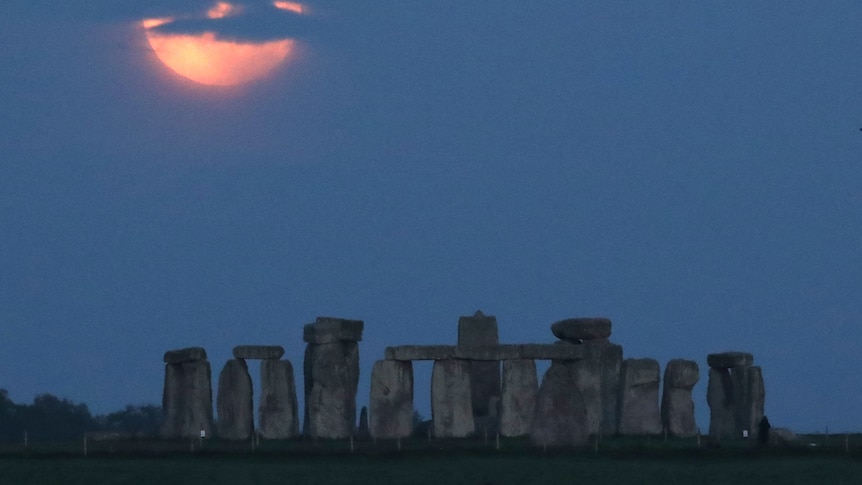
Image: Toby Melville/REUTERS


A detailed chemical study of Stonehenge's central monolith has upended understanding of the British monument's mysterious origins, suggesting one of its central stones was transported from northern Scotland.

The findings more than triple the distance that the five-square-meter, six-ton sandstone slab might have traveled, compared to previous assumptions.

The 5,000-year-old neolithic stone circle is a treasured part of Britain's archeological heritage, visited by more than a million people each year. It's a site for annual solstice celebrations and most recently the subject of a controversial climate protest.

But how the structure was built remains uncertain.

Until last year, the Altar Stone was described as a 'bluestone' despite being found to be sedimentary sandstone, which was thought to have originated from a deposit near the Brecon Beacons in Wales.

Along with smaller dolerite and rhyolite bluestone boulders from the Mynydd Preseli deposits on the country’s west coast, it has long been thought that ancient Britons transported these rocks 225 kilmoters (140 miles) to construct Stonehenge. The site also features large slabs of locally-sourced sandstone.

But a report from the University of Aberystwyth last year found the Altar Stone's composition was fundamentally different from the sandstone of Wales, with its authors surmising an origin in northern Britain.

On a recommendation from the Aberystwyth team, tiny fragments of the Altar Stone were sent to the other side of the world – Western Australia – where a PhD student at Curtin University put them under the microscope.
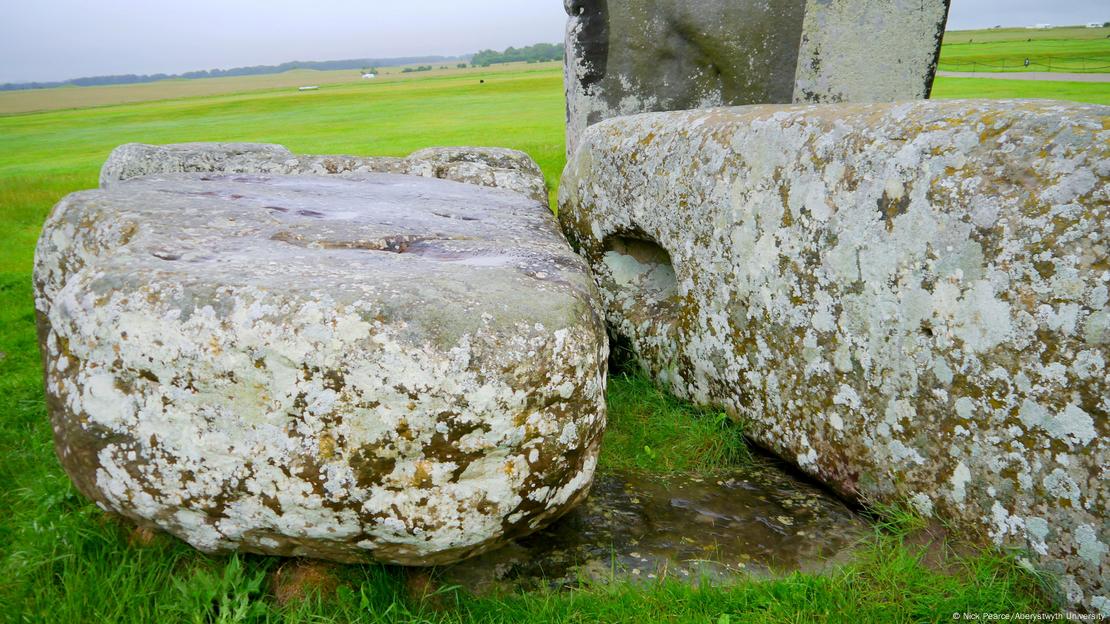
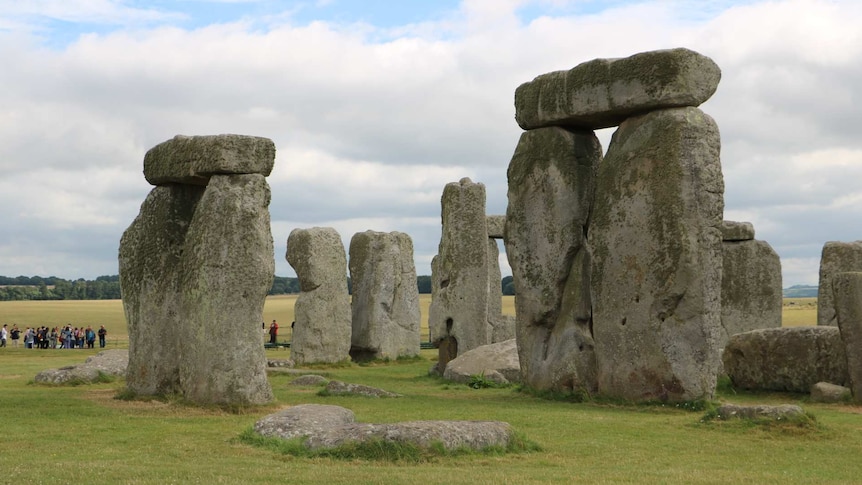
The six-ton Altar Stone is submerged beneath these two sandstone slabs at Stonehenge.
 Nick Pearce/Aberystwyth University


"Rock DNA" uncovers the origins of Stonehenge's Altar Stone


Stonehenge's large, central Altar Stone lies embedded in the earth beneath two larger sarsen sandstone blocks, which were sourced from the local Wiltshire region along with the other large upright stones that form the monument's outer circle.

But when the Aberystwyth researchers led by geologist Richard Bevins identified the possibility of a different origin for the Altar in 2023, it took a Welsh expat working on the other side of the world to fill in the gaps.

"I grew up kind of wandering those [Preseli] hills, much like, maybe, Neolithic Britons did thousands of years ago, and in some way that must have inspired me," said Anthony Clarke, a geologist originally from South Wales who currently works at Curtin University's Timescales of Mineral Systems group in Perth.
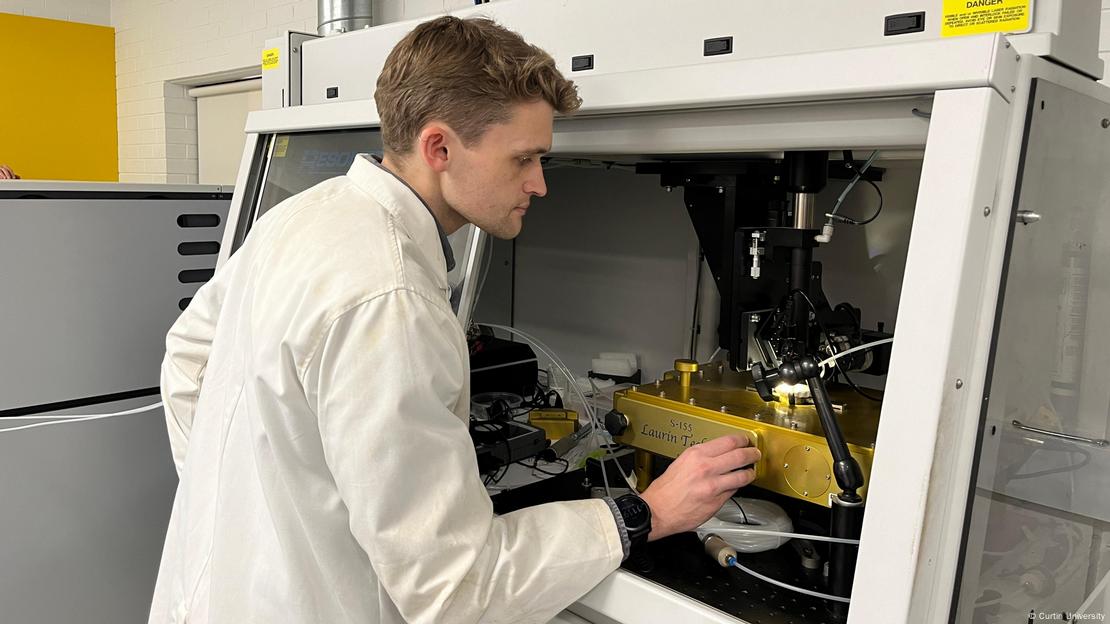
Anthony Clarke examines stone samples in his lab at Curtin University, Australia.
Image: Curtin University

Clarke and his colleagues performed an isotopic analysis of tiny decaying uranium fragments within the Altar Stone's crystals.

This process fires a laser into the rock slivers, measuring the ratio of uranium and lead released by the stone.

Using these measurements, Clarke and colleague Chris Kirkland – a Scotsman also working at Curtin – used an extensive geological database of the UK’s rock deposits to match the Altar Stone with the Orcadian Basin, about 850 kilometers north of Stonehenge.

"By measuring the isotopic ratios of uranium and lead within these little crystals, we have miniature 'clocks'," said Kirkland.

"These clocks are very handy because they tell us about the original age of the material that was eroded to produce our sandstone (...) we can look at lots of different crystals within the Altar Stone and build up an 'age fingerprint', much like DNA. It's like DNA for our rock."

Stonehenge: a story of seafaring trade?


Hauling a six-ton rock overland for more than 1,000 kilometers would have been a remarkable feat 6,000 years ago.

Instead, the researchers say the Altar Stone was probably transported over water.

"We initially thought it had to have been moved by ice – it's just such a long distance for humans to transport. But if we look at ice flow directions during previous ice ages in the UK, ice was actually moving even further away from southern Britain," Clarke said.

"If you look at overland transport of the Altar Stone, they would have to have passed some formidable barriers: rivers, the heavily forested nature of prehistoric Britain, the marshy boggy landscape and the mountains standing in the way, from northern Scotland (...) which then leaves us with a marine transport route."

Clarke points to evidence of sea-based trade, shipping and social connections throughout the British Isles at the time of Stonehenge's construction as supporting the ocean transport hypothesis.

It's similar to recent studies by archaeologists that uncovered the existence of an extinct branch of the Nile. Their analysis found the extinguished channel would have passed right by the site of many of the pyramids, indicating water transport was used by the Ancient Egyptians to transport the huge quantities of stone needed for their construction.

Clarke expects the water-transport hypothesis will draw a mix of responses from the archeological community but is confident this new Stonehenge study will help focus the search for the true source of the material used at the ancient site.

"I'm sure there's going to be a mixture of amazement and perhaps skepticism," Clark said.

"But this is something we welcome going forward, to really narrow down the source of the Altar Stone, perhaps to the individual outcrop or even quarry it might have been sourced from."

The new findings were published in the journal Nature.

Edited by: Derrick Williams

Primary source:

Clarke et al (2024). A Scottish provenance for the Altar Stone of Stonehenge. Nature. https://doi.org/10.1038/s41586-024-07652-1

Additional sources:

Bevins et al. (2023). The Stonehenge Altar Stone was probably not sourced from the Old Red Sandstone of the Anglo-Welsh Basin: Time to broaden our geographic and stratigraphic horizons? Published in Journal of Archaeological Science: Reports. https://doi.org/10.1016/j.jasrep.2023.104215

Bradley, Richard (2024). Beyond the bluestones: links between distant monuments in Late Neolithic Britain and Ireland. Antiquity. https://doi.org/10.15184/aqy.2024.3

Ghoneim et al (2024). The Egyptian pyramid chain was built along the now abandoned Ahramat Nile Branch. Communications Earth & Environment. https://doi.org/10.1038/s43247-024-01379-7


The Altar Stone at the centre of Stonehenge may have come from more than 700km away in Scotland, Australian study suggests
ABC NEWS AUSTRALIA
Stonehenge is a UNESCO World Heritage Site, but many things about it remain unknown.(Reuters: Peter Cziborra)

In short:

The 6-tonne Altar Stone inside Stonehenge may have come from a location in Scotland more than 700km away from its final placement, according to a new study.

"Fingerprinting" samples of the stone matched it to other samples in north-east Scotland, rather than Wales.
What's next?

Many questions, including how the stone may have been transported and what the original purpose of Stonehenge was, remain unanswered.


The 6-tonne stone at the centre of Stonehenge may have come from a location in Scotland more than 700km away from its final placement, new research has suggested.

The Altar Stone was long believed to have come from Wales, but may have been transported via sea, according to research led by Curtin University and published in science journal Nature.

The peer-reviewed study, funded by an Australian Research Council Discovery Project, was a collaboration between Curtin, the University of Adelaide, Aberystwyth University and University College London.


The Altar Stone, seen here underneath two bigger sarsen stones.(Aberystwyth University: Nick Pearce)

Stonehenge, a UNESCO World Heritage Site, is located on the Salisbury Plain in Wiltshire, England, and is believed to have been constructed between 3100 BC and 1600 BC.

Previous research has identified two types of stone used to make its inner and outer rings.


WA-led research has unlocked secrets of Stonehenge

The outer ring is made up of standing sarsen stones originating from a location about 25km away, while the inner ring is made up of smaller "bluestones", of which the Altar Stone is the largest.

Lead researcher and Curtin University PhD candidate Anthony Clarke said their team had analysed two fragments of the stone.


"As of last year, the ultimate source of the Altar Stone was an open question," he said.

"We've had [work] ongoing on the Altar Stone … [and it] has a provenance all the way in the Orcadian Basin of north-east Scotland, some 700 to 800 kilometres away.

"This is a completely unexpected result, given that we thought it was going to originate in Wales."

Anthony Clarke said visiting the area as a child was part of what inspired him to research Stonehenge.(Supplied: Curtin University)

Professor Chris Kirkland of Curtin University's School of Earth and Planetary Sciences said they had examined the Altar Stone's "fingerprint" using the "little crystals" in the sandstone.

"What we can do is look at those little crystals … [they] contain small amounts of uranium, and we know the rate of change [from] uranium to lead," he said.


"By measuring the … uranium and lead within these little crystals, we have miniature clocks [that] tell us the original age of the material.

"We can [then] build up an age fingerprint, much like DNA for a rock. Then we can compare that to a large database of other rocks around the United Kingdom [and] compare the age."

The team also investigated several ways the stone could have moved or been transported such a long distance to its final location in the centre of the monument.

University of Adelaide associate professor Stijn Glorie, a co-supervisor of Mr Clarke's PhD studies, leads the Australian Research Council Project, which funded the research.

"We collected some data on minerals inside this [sample of the Altar Stone] to understand the fingerprints of the rocks and then link that with rocks in Britain," he said.

"What this study shows us is that there was a long, long transport mechanism involved for those people to bring the rocks from Scotland.

"We first looked at the possibility that these rocks were just supported by glaciers, and we could rule this out because of the flow directions of these glaciers at the time were the opposite direction.

"So it was kind of impossible. The other option would then be that these humans have transported it themselves.

"Over land that becomes tricky, because of huge obstacles along the way, so we quite quickly get to the conclusion that the only possible way really to bring that rock from Scotland to Stonehenge is over [the sea]."

Many questions surrounding Stonehenge, including its original purpose, remain unanswered.

"It's been something that's been, particularly in Britain's history, quite important," Dr Glorie said.

"So it's something that is in people's minds and understanding how it was built and how it was formed has clear importance for understanding history.

Scientists crack Stonehenge origin mystery

Geochemical testing indicates that 50 of Stonehenge's 52 pale-gray sandstone megaliths share a common origin about 25 kilometres away at a site called West Woods.


"One key question, and I don't think we can answer it at all, to be honest, is the why?

"Why would those people go all the way to Scotland to bring a rather unremarkable rock all the way to Stonehenge?

"Obviously there is no written record, so it's hard to work out why that would be so.

"We can only speculate on this, it's a very hard research question. Why would they have come all the way to Scotland [for] a rock that looks not much different to rocks that are locally sourced?

"Maybe it has some kind of spiritual meaning to them."
Opinion

‘What can pro-Israel entities gain from backing Tommy Robinson?’ A lot

August 14, 2024

Tommy Robinson addresses the rally from a stage in Parliament Square in London, England on June 1, 2024 [Guy Smallman/Getty Images]

by Nasim Ahmed
Nasimbythedocks


“What can pro-Israel entities gain from backing Tommy Robinson?” asks John Ware in an article this week. “Absolutely nothing,” says the British journalist, dismissing the series of allegations that the far-right agitator, who many hold responsible for the recent riots across the UK and anti-Muslim pogroms, is funded by Zionist groups.

Ware goes on to describe proponents of these claims as engaging in conspiratorial thinking, implying that anyone making a connection between far-right leaders sowing hate and division on the streets of Britain and Zionist leaders are anti-Semites peddling in conspiracy theories about Jewish puppet masters controlling the world.

Ware, who is no stranger to controversy, having produced the contentious BBC Panorama programme on alleged anti-Semitism in the Labour Party and accused by his critics of stoking a witch-hunt against British Muslims, mentions Dr Anas Altikriti. The CEO and Founder of The Cordoba Foundation repeated widely shared claims that Robinson and his financiers are linked to the Zionist state of Israel and that the far-right protest on British streets were retribution for British solidarity with Palestinians in Gaza.

Altikriti is one of several people on Ware’s list described as having a “conspiratorial take on the root causes of the riots.” He cites Massoud Shadjareh, Chair of the Islamic Human Rights Commission. MEMO contributor, Yvonne Ridley, and comments made by the British journalist describing Robinson as “Israel’s poster boy”. David Miller, a former professor, who called Robinson a Zionist asset working for Israel since 2009, and rapper, Lowkey, who suggested Robinson’s actions were part of a Zionist agenda.


Exposed: what links Israel to UK far-right riots?

Ware does acknowledge that Robinson has an affinity with Israel. But the support of the far-right leader for the apartheid state, according to Ware, is a “way of weaponising his bigotry against Muslims” rather than any genuine alliance with Zionism. He points out that mainstream UK Jewish organisations have condemned Robinson and the far-right violence unequivocally. For instance, the Board of Deputies condemned the lawlessness and thuggery, while the Chief Rabbi, Sir Ephraim Mirvis, highlighted the moral stain from targeting mosques, asylum seekers and refugees.

It is, perhaps, understandable why Ware would jump to the defence of Israel from allegations that some of the worst actors in our society are spearheading its cause. Given his own well-documented support for Israel and having also funded projects in the apartheid state, would I want a cause to which I am deeply committed to, be associated with a man accused of spearheading anti-Muslim pogroms?

Ware, however, does an extremely poor job in making his argument. At no point does he challenge the actual evidence for why Robinson is called a Zionist asset. Surely, if the aim is to debunk that claim you would spend more time explaining the well-documented funding of a far-right agitator like Robinson by Zionist anti-Muslim groups and less time smearing critics. At no point does Ware refute the evidence cited as proof that Robinson is a Zionist asset.

Both can be true: some sections of the pro-Israeli community, as Ware pointed out, despise Robinson and what he stands for, while other sections of the global Zionist community see him – and the far-right, in general – as allies in a broader civilisational conflict with Muslims. I think that would have been a reasonable position. But Ware appears to discount that as a possibility.

Perhaps Ware missed the article about Robinson published in the Time of Israel four years ago asking “why are US ‘pro-Israel’ groups boosting a far-right, anti-Muslim UK extremist?” The revealing piece uncovers the very connections between Robinson and various pro-Israel groups and individuals that Ware dismisses as conspiracy.

According to the 2019 investigation, Robinson is said to have received significant financial and ideological support from The Middle East Forum (MEF), a Philadelphia-based think tank, long known for its pro-Israel and anti-Muslim stance. MEF has been one of Robinson’s biggest sponsors. MEF’s president, Daniel Pipes, reportedly confirmed that his organisation spent approximately $60,000 on three demonstrations supporting Robinson during his legal trials.

The Times of Israel report also mentions Robert Shillman, described as a US-based ultra-Zionist billionaire, who frequently donates to Israeli institutions. Shillman reportedly financed a fellowship that paid for a position Robinson held in 2017 with the Rebel Media, a right-wing Canadian website. Other organisations, including the Gatestone Institute and the David Horowitz Freedom Centre, have published articles defending Robinson. These groups have long been known as major players in the global anti-Muslim industry.

Many of the organisations cited are part of the American right-wing infrastructure that supports Israel. Nina Rosenwald, described as an “ardent Zionist” and American-Jewish philanthropist, reportedly funds both MEF and the Gatestone Institute. Pipes, when interviewed, expressed an affinity with Robinson based on shared concerns about what he termed “the Islamist threat”. Pipes suggested that people concerned about Israel’s security often share concerns about Muslims.


Did Ware also miss the 2018 Guardian report which uncovered ties between Robinson and Zionist anti-Muslim pro-Israel groups? On its list of donors and supporters of Robinson, it too cites MEF spending around $60,000 on legal fees and demonstrations in London. Apparently a senior MEF executive was also closely involved in preparations for a pro-Robinson march.

Commenting on Shillman, the Guardian said that the Zionist billionaire played a crucial role in Robinson’s financial support and listed ways in which he helped pay for Robinson’s employment. Other organisations have contributed to Robinson’s cause. The Australian Liberty Alliance, a small right-wing group, is said to have provided funding, though the amount was not disclosed. Support by previously mentioned the Gatestone Institute, DHFC in California, are on the Guardian list. The DHFC has also lobbied for Robinson to address US politicians.

These organisations are well-funded by influential right-wing donors that are deeply and ideologically wedded to Israel. Tax returns examined by the Guardian show that, between 2014 and 2016, they received almost $5 million from several millionaire donors. The MEF received $792,000 from a foundation led by Nina Rosenwald, while the DHFC received over $1.6 million from five wealthy benefactors. The Gatestone Institute received more than $2 million in donations, including $250,000 from the Mercer Family Foundation, which is run by one of Donald Trump’s top donors.

Ware’s article is a very poor attempt at playing the man and not the ball. To throw the question back to the journalist, “What can pro-Israel entities gain from backing Tommy Robinson?” The answer is far from “absolutely nothing” as Ware suggests. It is a lot and, judging by how long Zionist groups have been funding the far-right extremist who many hold responsible for the anti-Muslim pogroms in the UK, I bet it’s more than Ware would ever care to admit.


What is the Online Safety Act and why have riots in the UK reopened debates about it?

london police
Credit: Unsplash/CC0 Public Domain

Recent rioting, and unrest in the UK has led to calls for the Online Safety Act to be revisited. Mayor Sadiq Khan has called it "not fit for purpose" and Cabinet Office minister Nick Thomas Symonds suggested that the government could change the law, which was passed under the previous government and includes a raft of measures relevant to the recent riots, including powers to fine social media companies.

Prime Minister Keir Starmer has been less forthcoming about the act and has said only that he would "look more broadly at  after this disorder." His spokesperson suggested the act was not under active review.

In practical terms, social media played a key role in the widespread coordination of events in locations across the country. Online platforms have also served as a vehicle through which misinformation and hateful rhetoric has spread.

The act, enforced by the independent media regulator Ofcom, deals with the regulation of online speech and aims to protect users from potential harm including abuse and harassment, fraudulent activity and hate offenses.

Specifically, it seeks to place more responsibility on social media companies to ensure their platforms are safe, with fines of up to 10% of their annual revenue being issued to providers whose platforms are deemed unsafe.

In more extreme cases, Ofcom has the power to require advertisers and internet providers to cease working with platforms that do not comply with the regulations. The act passed into law in October 2023, and laws in relation to individual offenses are already in effect. For example, it is now an offense to share false information with an intention to cause non-trivial harm.

However, the frustration in the wake of the riots has arisen from the fact that the parts of the act are not due to come into effect until late 2024. These include enforcement powers and other measures that Ofcom could apply to social networking platforms and other platform providers, such as  and instant messaging platforms. This raises questions as to what might have been different in the past 14 days had they already been in place.

Algorithm concerns

A key concern has been the way in which algorithms deciding what content is recommended on social networking platforms may have propagated harmful content in relation to the riots—including racist, hateful and .

For example, it was found that people were using TikTok to live-stream content of the riots as they unfolded.

At present, social media platforms such as TikTok, X, Facebook and YouTube are designed to optimize user engagement through their recommendation algorithms, with  concerns not typically weighted within these systems. X, for example, employs different algorithms for content moderation versus content recommendation.

As a result of this, it is possible that harmful content can be recommended by one  before it is identified as needing to be moderated by another algorithm.

The Online Safety Act aims to address this challenge by requiring platforms to test the safety implications of their recommendation algorithms. That is, when changes are made to their recommendation algorithms, services will be encouraged to collect safety metrics, allowing them to assess whether these algorithm changes are likely to increase individuals' exposure to illegal content.

By incorporating these safety considerations when designing and refining content recommendation algorithms, it is hoped that fewer individuals will be exposed to  before content moderation teams have had the opportunity to remove it.

Neutral oversight

One of the primary challenges around the regulation of online content is the unwillingness of platform providers to be seen as "arbiters of truth." For example, X has recently changed the name of its Trust and Safety team to just Safety, as Elon Musk, CEO of X, stated that: "Any organization that puts 'Trust' in their name cannot be trusted as that is obviously a euphemism for censorship."

Mark Zuckerberg, CEO of Meta, said something similar back in 2016 after the US election, when he stated that Meta "shouldn't be the arbiter of truth of everything that people say online."

However, and as recent events have shown, this has not precluded Musk himself from propagating specific narratives in relation to the UK riots and adding fuel to an already inflamed discourse.

The Act addresses this challenge by using the independent regulator, Ofcom, to enforce and regulate online content and algorithms. While the law was passed by the UK government, the government does not have powers to determine what content is allowed and what should be disallowed—thus securing political neutrality in the long-term implementation of the act.

Prevailing challenges

At present, the Online Safety Act does not include any legislation about misinformation and disinformation. This appears to be why Khan suggested that in its current form, the act does not go far enough.

The prevailing challenge of misinformation was put in sharp focus by the murders that led to the riots, with content falsely claiming that the Southport attacker was a Muslim migrant trending across several social networking platforms in the aftermath of the incident.

The home secretary Yvette Cooper claimed that social networking platforms "put rocket boosters" under the spread of this content, and there has been much debate as to whether it helped fuel the violence seen on many city streets.

This leaves some observers concerned that, until the act fully comes into force, we are in a legal purgatory around what can and cannot be litigated against online.

However, we won't really know how effective the Online Safety Act can be until all of it has come into force and it has been tested in another situation like the recent riots.

Provided by The Conversation 

This article is republished from The Conversation under a Creative Commons license. Read the original article.The ConversationSouthport riots: Why social media's role in unrest is overblown

UK

The anger is understandable but why target immigrants?

Anger at austerity is justified, but why target immigrants? The real culprits sit in Westminster, diverting blame from their own failures


Mark Fisher lamented the apathy of the British public in suffering austerity and the negative effects of capitalism over a decade ago. He thought it could be the tiniest incident that would tear through the fake veneer of a well-functioning UK. Perhaps the citizenry is about to waken up for real.

It is possible to perceive that British people have run out of patience with the cumulative failure of successive UK governments to reverse falling living standards, stagnating wages, lack of housing and increasing wealth inequality. Also on the increase is the cost of essential utilities while the quality of these services falls. Daily life in our local communities looks bleaker due to failing public services stressed by the austerity economics afflicting UK society. 

This package of issues is likely to be the direct cause of current unrest. The rioting is notable in at least two respects, but certainly not unexpected. Firstly, it has taken 14 years of austerity policies to provoke a violent reaction. Secondly, immigrants are the target of the anger. The blame for all the above lies at the door of the House of Commons.

Every real troublesome societal issue is a problem for the entire population and as individuals we have a responsibility to play our part in mitigating any factor we can. When it comes to institutional failures or problems at the level of national or regional infrastructure, it is beyond the ability of individuals to alleviate. 

As a society, we elect governments to take responsibility for not only maintaining and sustaining the services we rely on, but to provide an environment where citizens are free to innovate and create to improve these services to advance the lives of citizens and humanity as a whole.

The blame game

Austerity economics has reversed the direction of travel and, instead of holding their collective hands up and accepting responsibility for the suffering this causes, the five UK governments since David Cameron’s have abdicated this responsibility. Not only have they been derelict in this duty, but each administration has sought to divert blame and media attention to other actors. 

The European Union (EU), a long-standing bugbear of a significant faction within the Conservative Party, became the first target. Rising house prices and an NHS struggling through underinvestment became the focus of discontent, despite both issues being the result of political choices. The pro-Brexit advocates pointed to the open-border policies of the EU putting undue stress on UK services as the ailment, and immigration as the symptom that had to be treated to cure the disease.

The media, undergoing its own form of austerity through failure to find a niche in the advance of information technology, found an ability to cash in by sensationalising and speculating rather than printing more reasoned facts or nuanced commentary. This austere environment enabled wealthy actors to buy headlines to influence outcomes and democracy – in these circumstances – dies a slow death through disinformation. The Brexit vote was a victory for propaganda tapping into a discontented populace and aiming this powerful weapon at a relatively innocent and benign target.

Eight years later, with European Union membership far behind in the rear-view mirror of British life, we have more legal and illegal migrants arriving than ever before. Still, the same actors rage against this ‘invasion’ without recognising the fact that the UK is not producing enough doctors, teachers, engineers, tradespeople or scientists to meet the demands of society.

The real deficits in the UK economy

UK citizens face deficiencies in their local communities every day – from uncut grass in former well-tended public parks, to dilapidated buildings in need of refurbishment to provide living or industrial accommodation. There is no end of jobs to be done if the government would simply fund the departments and local authorities adequately, to allow the resources required to make things right to be targeted accurately. 

The latest statistics show a significant drop in UK birth rates. Again, it is easy to equate the precarity young people experience through insecure, low-paid work and unaffordable house prices or rents, to the austerity policies of successive UK governments. When young adults contemplate the potential for marriage and setting up a home to start a family, many must simply despair. Understandably, movement through life plans is postponed as secure footholds are sought, resulting in smaller families and, in some cases, no family at all.

Immigration is not the cause of this situation. In fact, until the UK can reverse the current trend and experience another baby boom, immigrants are essential to allowing our public services, industry and utilities to function adequately in future decades. The rioters out on the English streets expect a comfortable retirement in the good old British tradition. Without immigrants carrying out the necessary tasks, there may be no reliable public services to ease life and nothing on the supermarket shelves to buy with a pension – state or private.

Unite to beat the villains – real or imagined

There is no point in unprovoked violent protest, the only entity gaining from such action would be ’the big Other’, the metaphorical puppet masters behind the media headlines. We perceive a powerful group observing the news feed, guffawing while another handful of popcorn is scooped up. This, as Lacan tried to illustrate, is another way of using a virtual reality to absolve ourselves of personal responsibility to act.

Instead, we must unite to send a message to the UK monarchy and its government that it is no longer serving the people. Whether you are on the right, the left, an immigrant, an independence supporter in Scotland or Wales, a supporter of the Union and The King, we have a right to expect a steady advance in the standard of living for our families, adequate public services and an aspirational vision for the future to aim for. 

This means recognising that our causes intersect, and the extent of our interdependence. The groups must talk to each other to defeat the divide and conquer tactics, whether these are a consequence of normal human traits or engineered and employed by self-serving actor(s) pulling the strings. 

A perfect counter would be for the two groups organising protests this September in Glasgow, to invite speakers from the other faction to address their rally and for the invitations to be accepted in good faith by both sides. If each side speaks their truth, we all have much to learn from the event both in common ground and in the limits to acceptability. Both sides have legitimate concerns and dialogue will emphasise that the solutions lie in unity of purpose, and a concerted effort against a dominant establishment.

It should become obvious that all ordinary Scots (and Brits) want to mitigate the same problems. With this knowledge, we can unite to attempt to force the UK government to address the deficit in living standards. All it takes is investment from the Treasury to enact the will of the people. That investment is authorised in the antiquated Punch and Judy theatre of Westminster. 

Those who have been provided the opportunity to occupy the famous green benches by the people, must be strongly encouraged to serve us, or make way for others who will. If Westminster proves immovable, then it may be time for the English, Welsh, Northern Irish and Scots to amicably end the Union and take away the Westminster punchbowl from the population’s most affluent 1%.

Who's to blame for Britain's far-right riots?

August 14, 2024
By Henry Ridgwell
VOA

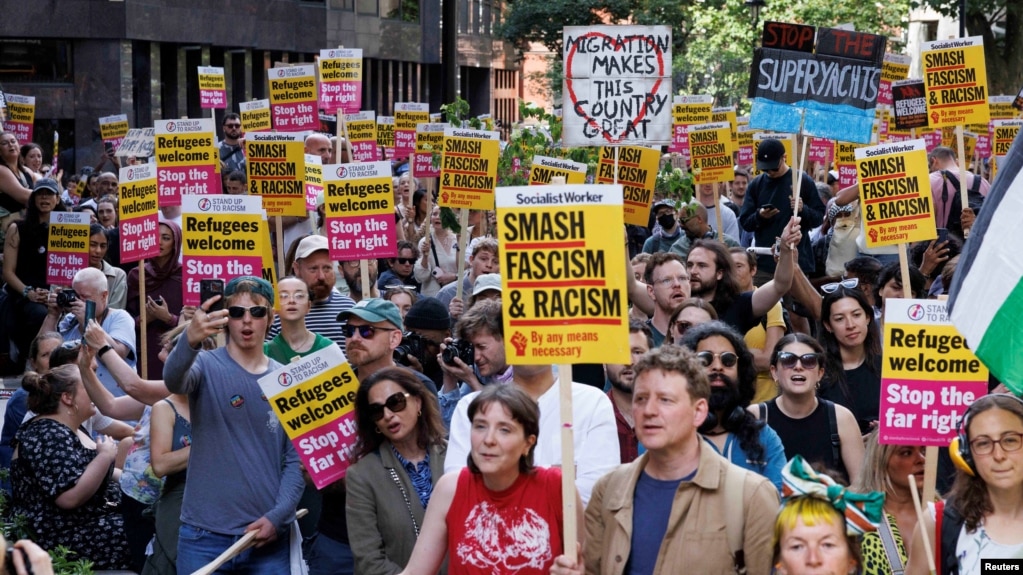
People hold signs at a protest against racism outside Reform UK's headquarters in Westminster, in London, Aug. 10, 2024.

British authorities are trying to ascertain the origins of the violent far-right protests that erupted in towns and cities across the country in recent weeks. While some blame simple racism and false news posted on social media, others say deeper social forces are at play – and warn that the government faces significant challenges in trying to prevent further unrest.


Who’s to blame for Britain’s far-right riots?

As the debate rages over the possible root causes of the riots, the initial trigger for the violence is undisputed. On July 29, a teenager with a knife attacked several children attending a dance class in Southport near Liverpool, resulting in the deaths of three girls, ages 6, 7 and 9.

False reports initially posted by an obscure crime website called Channel3 Now, wrongly identified the killer as a Muslim asylum seeker who had arrived on a small boat. The false news spread quickly on social media.

There was initial speculation that the Russian state was behind the disinformation. An analysis by the BBC, however, suggested that Channel3 Now had purchased an existing YouTube channel based in Russia to gain subscribers, but no link with Russian authorities has so far been identified.

Britain has accused hostile foreign states, including Russia, of amplifying misinformation in the days following the Southport attack.

Police later named the Southport suspect as 18-year-old Axel Muganwa Rudakubana, who was 17 when the attack took place. Rudakubana was born in Britain to Rwandan parents.

The role of social media is now in sharp focus.

“The initial violence was kicked off by a falsehood. To an extent, I think it’s fair enough to blame social media,” said Anand Menon, a professor of international politics at Kings College London.

The riots began the day following the Southport knife attack, July 30, as far-right protesters attacked a nearby mosque. Dozens of police officers were injured and a police van was set on fire.

The violence spread to other cities across Britain in the following days.


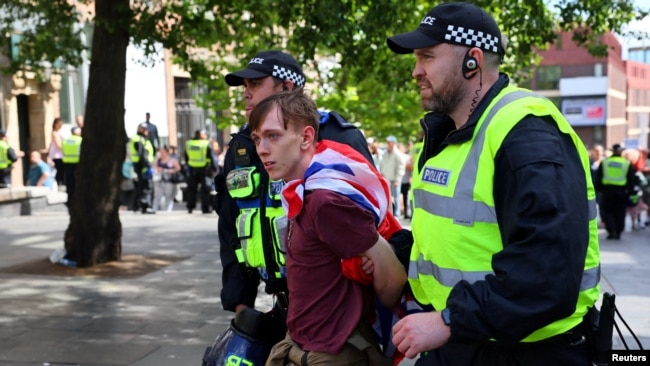
An anti-immigration protester is detained by police officers, in Newcastle, Britain, Aug. 10, 2024

Shops were looted and public buildings set on fire. Businesses owned by people of color were targeted. Mosques were attacked amid a wave of anti-Muslim violence. Hotels purportedly housing asylum seekers were set alight.

Immigration – and especially the influx of asylum seekers in small boats across the English Channel – appears to have been a driving force behind the riots. Forty-one-year-old mother Karina, who did not want to give her family name, was among those attending a far-right protest in the city of Nottingham.

“We want to see an end to people coming over illegally on boats from safe countries,” she told Agence France-Presse.

More than 1,000 people have been arrested since the violence erupted.

Many observers see deeper social divisions driving the violence.

“These are tensions that you see in a lot of countries right now – I would include the U..S to some extent in that, too – where you have emerging feelings of nationalism, a sense that people are being left behind, a sense that people's freedoms are being denied, the sovereignty of the nation is at stake,” Stephanie Alice Baker, a sociologist at City, University of London, told The Associated Press.

“And a lot of this really coincides with a rise of immigration and a cost-of-living crisis. So, people have these first-hand experiences of grievances, and a lot of these negative feelings are projected onto an 'other,’” she said.

Critics accused some right-wing politicians – especially Nigel Farage, the leader of the anti-immigration Reform party – of fanning the violence. On his YouTube channel, Farage has previously publicized the location of hotels that purportedly house asylum seekers. He has also accused British police of operating a so-called “two-tier” system where right-wing protesters are dealt with more harshly than other groups, although he has not provided any evidence. British authorities strongly deny the accusation.

A large demonstration was held Sunday outside the Reform party headquarters in London.

Farage has strongly denied inciting the riots.

“At no point in the last week or in the previous 30 years have I ever encouraged the use of violence, have I ever encouraged the use of anti-democratic means,” he told LBC News on August 6.


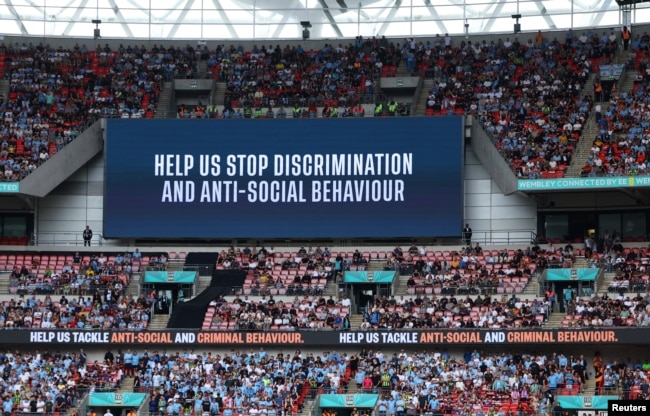
An anti-discrimination message is shown on a big screen at London's Wembley Stadium during a soccer match between Manchester United and Manchester City on Aug. 10, 2024.

The riots pose a challenge for Britain’s politics, said analyst Anand Menon.

“I think it’s a problem when political figures come very close, as some of them have, to actually justifying violence. On the other hand, I think if you get something like this it would be strange if you weren’t to think about the kind of causes that lead people to feel so angry that they’re able to contemplate this sort of thing,” he told VOA.

Far larger demonstrations against the far right have dominated towns and cities across Britain in recent days. A significant increase in policing and widespread arrests have also stymied the far-right protests.

British police, prepared for far-right agitators, find peaceful anti-racism protesters instead

Justice has been swift. More than 1,000 people have been arrested and hundreds convicted of offenses linked to the riots. The youngest was 12 years old; the oldest, 69. Scores of people have been charged with offenses relating to posts on social media, even though they may not have taken part in the violence.

Elon Musk, the owner of the social media site X, has faced criticism for allowing such posts to be published. He has himself posted in apparent support of the far-right protests, writing that “civil war is inevitable” in Britain. That prompted fury from many British lawmakers.

The riots pose the first big test for Prime Minister Keir Starmer, whose Labour Party won the July 4 election by a landslide.

“In relation to online and social media, the first thing I'd say is this is not a law free zone, and I think that's clear from the prosecutions and sentencing. … That's a reminder to everyone that whether you're directly involved or whether you're remotely involved, you're culpable and you will be put before the courts if you've broken the law,” Starmer told reporters on August 9.

“I do agree that we're going to have to look more broadly at social media after this disorder. But the focus at the moment has to be on dealing with the disorder and making sure that our communities are safe and secure.”

The unrest poses a longer-term challenge, said Anand Menon, professor of European Politics and Foreign Affairs at King's College London in the UK and has been serving as director of the UK in a Changing Europe initiative after his appointment in 2014.

“The UK has, over the last 10 to 15 years, had very low economic growth and hasn’t done much for many people who are struggling economically,” Menon told VOA. “And while that isn’t to justify the violence in any way, shape or form, I think it is absolutely appropriate to think, given what’s happened – are there circumstances that make people feel so desperate that they are more prone to this than others?”
UK

Challenging the rise of the new far right


Analysis by Stephen Lambert
14-08-2024


Photo by Monkey Butler Images


Unlike the fascism of the inter-war years, Teesside University academic Paul Stocker argues in his book English Uprising, that the re-emergence of the extreme populist right, manifested in a wave of brutal racist rioting in the last month, is a cultural rather than just an economic phenomenon.

Stocker provides a critical overview of the history of 20th century British fascism. Unlike Oswald Mosley’s BUF Blackshirts in the 1930s, the spectacular rise of groups like the National Front and BNP, were a direct response to post-war black commonwealth immigration in the fifties and sixties. In 1967 the NF, a racialist party of the extreme right was founded by the author Chesterton. Its main belief system was a redefinition of the ‘real’ British community in terms of colour. For the NF whites were seen as ‘true’ Brits. Black and Asian minority ethnic groups weren’t and were blamed for social problems like unemployment and bad housing.

By 1979 the NF lost a lot of it support partly due to its thuggish skinhead image, street violence and partly due to Thatcher’s populist stance on overseas migration. By 1992 it fell into decline and was eclipsed by the British National Party. Till 2011 the BNP was the lead player on the extreme right and enjoyed modest success in council elections particularly in the deprived outer boroughs of London. By 2009 its leaders Nick Griffin and Andrew Broms were elected to the European Parliament for the first time.

By 2012 the rapid rise of UKIP, although not a fascist party, represented the ”further mainstreaming” of ideas popularised by the BNP. As Nigel Farage, UKIP’s former leader boasted: ”We’ve taken a third of the BNP vote and I’m quite proud of that”.

Currently the new far right is splinted into a number of groups ranging from the EDL, Britain First and Patriotic Alternative. Britain First led by Paul Golding sees itself as the successor to the BNP with a blend of far right street protests and stunts like mosque ‘invasions’. It has an extensive presence on social media and its estimated 800 members have tried to whip up unrest in predominantly Muslim neighbourhoods. Its harmful online propaganda played a key role in the radicalisation of the convicted far right terrorist Daren Osbourne. Nick Lowles of the anti-racism charity, Hope Not Hate, said: ”The speed with which Osbourne was radicalised was frightening.”

Patriotic Alternative, formed in 2019 by former BNP activist Mark Collett, has presented itself as an anti-migrant and ”white pride” organisation.

Although one of its leaders was jailed for racial hatred it has kept a low profile in the wider context of the recent riots. One of the key contemporary figures of the new far right, however, is Stephen Yaxley-Lennon aka Tommy Robinson founder of the defunct English Defence League. Robinson is being investigated by the police for spreading online disinformation and being behind some of the riots which hit many towns across the UK including Sunderland, Hartlepool and Middlesbrough.

Although the recent racist yobbish behaviour on our streets alarmed the vast majority of people it received no public support even amongst those who have concerns about the impact of migration. Although racist attitudes and values were prevalent in the latter part of the 20th century, the UK is by and large a tolerant multi-ethnic and multi-racial society. Research by Hope Not Hate notes that we’ve become more, not less tolerant since 2011. Overtly racist opinions, as measured by surveys, have dropped significantly in the last two decades.

British Future, a thinktank, has pointed out that the UK enjoys a high level of integration compared to several European countries and the US. There has been a consistent fall in intergenerational racial prejudice and a gradual decline in ethnic residential segregation in cities and large towns.

However, there’s some evidence that hard right extremist elements are gaining a foothold in some urban ‘left-out’ communities. Following Brexit the radical right wing party, Reform UK, which attracted over four million votes at the last general election, is becoming increasingly racialised with five elected MPs including Nigel Farage.

British values and the role of education

In 2017 the government with cross party support unveiled its Fundamental British Values initiative coupled with the launch of the Building A Stronger Britain, part of the state’s counter-extremism strategy, to address genuine concerns about the potential growth of far right groups and ‘Islamo-fascism’ in local communities and in schools.

Although most schools and colleges have integrated FBVs into their systems of delivery, Ofsted noted, that too often they are being taught in a piecemeal and ad hoc way. For a minority of white working class young people their sense of disenchantment and alienation can easily be exploited by far right extremists who ”promise a better tomorrow by scapegoating and blaming minorities today”.

Clearly educational providers have an important role in challenging extremism in the classroom, online and outside the wider community. That’s why it’s vital that all schools re-emphasise the shared common values of democracy, tolerance, respect and the rule of law through the formal and ‘hidden’ curriculum. Alistair Campbell in his new book, But What Can I Do, has gone one step further calling for the introduction of anti-fascist education as part of a universal civics programme across all schools.

Left behind areas


Stocker challenges an explicit economic explanation for the growth of new far right populism and urban unrest. Other experts point out, the core lesson from inter-war Britain, is that this nativist populism only comes alive when government fails to address the anxieties of the dispossessed living in left-behind and neglected post-industrial towns and coastal communities both in the north and elsewhere. Violence, thuggery and damage to property broke out in seven of England’s most disadvantaged areas: Middlesbrough, Blackpool, Liverpool, Hartlepool, Hull, Manchester and Blackburn.

As former Chair of the Social Mobility Commission Alan Milburn warned four years ago a failure to bridge an unequal society, stem industrial decline, tackle stagnant incomes and a sense of political alienation could fuel support for a proto-fascist solution through new far right movements or hard left totalitarian groups in some parts of our divided and fractured post-Brexit nation.

Stephen Lambert is director of Education4Democracy and a Newcastle City Councillor.

SCOTLAND


FM Swinney and unions release joint

statement to condemn ‘inexcusable’ rioting

The violence in England and Northern Ireland began in the wake of the murder of three young girls in Southport, Merseyside.


Violence erupted over several days in England and Northern Ireland (
Owen Humphreys/PA)

PA Wire
Craig Paton


Scotland’s trade unions have described the recent riots in England and Northern Ireland as “inexcusable” in a joint statement with John Swinney.

As of Wednesday, 372 adults have been charged, along with at least 65 people under the age of 18, in the wake of riots following the murder of three young girls in SouthportMerseyside.

The Crown Prosecution Service said 69 adults have been sentenced, with 64 sent to prison as a result.


The riots have not spread north of the border, despite rumours of planned protests.


Police Scotland has repeatedly said there is no intelligence to suggest disorder could take place, but a planned “pro-UK rally” – touted by former English Defence League founder Tommy Robinson – is planned on September 7.

In a joint statement alongside First Minister John Swinney, STUC general secretary Roz Foyer said: “Alongside the Scottish Government, we jointly condemn the recent, inexcusable violence and disorder perpetuated by the far-right across the UK.

“Scotland is not immune and we cannot become complacent.

“We must do all we can to oppose the far-right, including reaching out to our faith and migrant communities to offer solidarity, support and the reassurance that they enrich the social and cultural fabric of our nation.

“Scotland is their home. We stand with them.”

Mr Swinney said the trade union movement has a “long and proud history” of standing up against oppression, work Ms Foyer said “continues”.

She added: “We won’t cower to hatred and prejudice. We will work with the Scottish Government to ensure inclusivity, respect and tolerance triumphs over persecution and ignorance and will oppose, across every village and town, those who wish to divide us.”

Mr Swinney said: “The Scottish Government and STUC are aligned in our support of communities across the UK that have faced violence and intimidation instigated by far-right groups.


“Scotland is a diverse, multi-cultural society and this diversity strengthens us as a nation.
UK, Germany Condemn Israeli Minister’s ‘Provocative’ Visit to Al-Aqsa Mosque Compound


Israel's far-right National Security Minister Itamar Ben-Gvir, center, flanked by his security detail, approach the entrance to Jerusalem's most sensitive holy site, which Jews revere the site as the Temple Mount, believed to be the location of the First and Second Temples, and it is a holy site for Muslims as Haram al-Sharif or the Noble Sanctuary, in the Old City, Tuesday, Aug. 13, 2024. (AP)


14 August 2024 AD Ù€ 09 Safar 1446 AH

Britain strongly condemns Israeli Security Minister Itamar Ben-Gvir's visit to the Al-Aqsa Mosque compound known to Jews as Temple Mount, British foreign minister David Lammy said on Wednesday.

"The UK strongly condemns Minister Ben-Gvir's deliberately provocative visit to Jerusalem's Holy Sites," Lammy wrote on X.

"Such actions undermine the Hashemite Kingdom of Jordan's role as custodian of the sites and the longstanding Status Quo arrangements."

Germany also condemned Ben-Gvir's visit, saying it expects the Israeli government to halt deliberate provocations.

"We reject unilateral steps that jeopardize the historical status quo of the holy sites in Jerusalem," the Foreign Ministry in Berlin posted on social media platform X.
ANTI CREATIONISM

New gardens at the Natural History Museum take Londoners on a Jurassic journey through time

The fern landscape. Photography: The Trustees of the National History Museum

ArchitectureNews I 14.08.24 I by Ellen Himelfarb

The new Urban Nature Project at London’s Natural History Museum has been called a ‘living laboratory’, a ‘wondrous jungle’, a ‘haven for wildlife’, and a ‘triumph’. The museum’s first landscape redesign in its 140-year history is all these things, not to mention an accessible approach to the museum itself—a gentle entree into an enduring institution that guides visitors back through aeons.

Architects Feilden Fowles and landscape architects J&L Gibbons have collaborated on this piece of natural theatre, which is as absorbing as a David Attenborough series (indeed the man himself is represented in a quote embedded in bronze at the museum’s entrance: ‘The future of the natural world, on which we all depend, is in our hands’). They’ve segmented the outdoor space into scenes of interest, demarcated with plantings, signage and smaller curiosities to discover, all folding into the larger purpose of telling the story of nature on Earth.
Photography: Kendal Noctor

It begins with the Evolution Garden, a gradual build-up of prehistoric rock from all corners of the nation. Ancient species of ferns trace the earth’s botanical history, leading to a 26-metre bronze-cast Diplodocus called Fern. Primeval creatures are stamped into surfaces like fossils, alongside actual fossils.

The Nature Discovery Garden was designed to enhance the biodiversity of the urban landscape while enhancing our understanding of our climate emergency. It consists of old London plane trees, woodland plantings, grasses and wetland plants added to the museum’s pre-existing garden. The landscapers incorporated well-considered drains and gutters to gather rainwater for the facility’s upkeep.
The pond landscape. Photography: The Trustees of the National History Museum

Connecting these zones is the newly widened pond, encircled by sunken pathways that meander past stone benches, each evoking a different geological era. Among them are two new buildings in limestone and Douglas fir, designed to bring the community further inside the landscape. The Nature Activity Centre and a Garden Kitchen, to open in September, will be valuable neighbourhood spaces and a reason to stay a while, even in inclement weather.

Experienced all together, the thriving expanse becomes not only its own exciting Jurassic Park but also a place to monitor and observe the changing nature of nature, for better or worse – while highlighting the antique beauty of the museum building itself.
A model of megazostrodon rudnerae – an early shrew-like mammal. Photography: The Trustees of the Natural History Museum
Evolution timeline rock canyon. Photography: The Trustees of the National History Museum