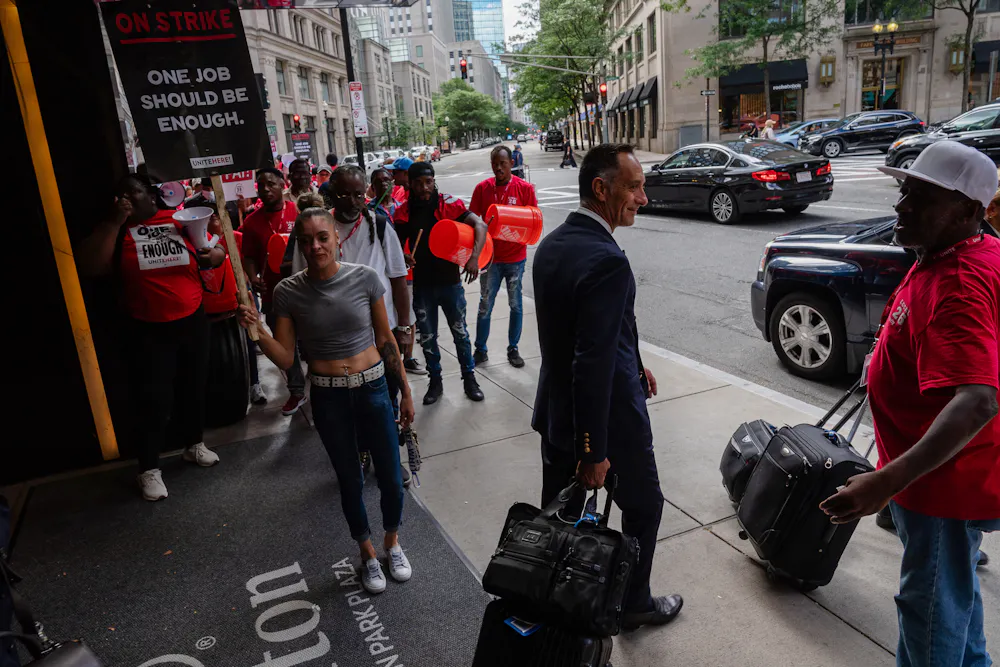
In their fight against Boeing, striking IAM members have significant leverage over the boss and the state.
Jason Koslowski and James Dennis Hoff
LEFT VOICE, U$A

Photo credit: Wall Street Journal
It’s been almost two weeks since more than 33,000 Boeing workers in Washington and Oregon went on strike, crippling one of the largest aerospace companies in the world. Since then Boeing has lost more than $500 million and is losing millions more every day. Thanks in large part to a series of terrible decisions, they seem unprepared to weather a long strike, but the struggle at Boeing has significant international implications as well. Boeing, after all, is the largest exporter in the United States by dollar value, the biggest supplier of commercial aircraft in the United States, and one of the main manufacturers of the weapons that Israel is using in both its genocide in Gaza and its war against Lebanon. It is also a key chokepoint in a much larger and still vulnerable global supply chain that extends across the globe.
All of this means that Boeing workers currently have a level of influence and leverage that far exceeds the immediate impact on the company’s bottom line. The union not only has a chance to recoup the major concessions forced on them by years of neoliberalism. They have a chance to throw a wrench into the imperialist machine itself.
In capitalism, the working class always has key strategic power. That’s because the source of all value and of all profit is ultimately exploited work, sucked out of us, vampire-like, by our bosses. We’re the ones who flip the burgers, drive the buses, weld the plane fuselages, teach the classes … and on and on and on. When we go on strike we remove that power — and start stemming the flow of profits made off of our labor.
But Boeing workers in particular are striking at a major strategic nexus of the global economy. It’s a “chokepoint,” and applying force here cuts off huge flows of profit across the system.
To see just how much leverage these 33,000 workers are holding in their hands, it helps to think in terms of concentric circles: the economics of Boeing, its place in the U.S. economy, and then its place in the global economy.
A Crisis of Boeing’s Own Making
Whatever kind of day you’re having, it’s not as bad as the Boeing CEO’s. That’s good news for the working class — and not just in this country.
First of all, Boeing is in the midst of a major crisis of consumer and investor confidence.
Not only is it massively in debt, but for months now, every major newspaper across the globe has been reporting on one Boeing disaster after another, highlighting how Boeing has, time and time again, put profit over the safety of its workers and consumers. In January, for instance, an emergency exit door blew off one of their planes mid-flight, leading to a loss of cabin pressure that could have been catastrophic. It was a 737 MAX 9, produced at the Renton plant outside Seattle, one of their newest models.
This was hardly just a blip on the radar.
In 2018 and 2019, two planes crashed, killing every person on board. This past July, the company’s leaders pled guilty to criminal fraud in those cases. Meanwhile, problems with the Boeing Starliner space capsule have left two astronauts stranded on the International Space Station for months. These astronauts will now not be able to return home until February.
All told, Boeing has already lost something like $1.4 billion in the last three months. It’s shouldering $58 billion in debt. And now there’s a strike.
In other words, the union has tremendous leverage over the boss: Boeing simply can’t afford this strike. If this strike is anything like the last one in 2008, they’re looking down the barrel of losing something like $100 million in lost revenue per day until the strike is settled and workers return to the production lines.
How’d we get here? To see that, we have to take a glance at the last couple of decades at Boeing.
First, it’s worth remembering that in 2004, under then-President George W. Bush, the Federal Aviation Administration (FAA) decided that Boeing can regulate its own production. In other words, it would not be regulated by an outside body. This helps to explain why Being was able to cut corners so aggressively in making its planes, to maximize its output and its profits.
The problems with this system of self-regulation were made clear when a whistleblower came forward to detail the many mistakes and safety problems that were being ignored by the company. This whistleblower was reporting exclusively on the production of the 787 at Renton, but the lack of any outside oversight means we can probably assume that these kinds of “cost cutting” procedures are common in making other planes, too. For instance, Fortune has reported that “engineers in the construction of the 777 jets” were also “‘pressured to overlook’ issues. … The complaint … alleges these defects ‘are generally not detectable through visual inspection… [and] could ultimately cause a premature fatigue failure without any warning.’”
Another key plank of this production model is the company’s attempts to undercut the union. Just after the last contract was settled with the IAM — in 2009 — Boeing announced it would be building its newest model of jets in Charleston, South Carolina, far from the unionized main plant outside Seattle. The main reason: the workers there, like so many others in the south, wouldn’t be unionized. That, in turn, meant cheaper workers whose hours and workload could be ramped up without any protections from a union. The move was a powerful blow to the IAM’s leverage, raising the specter that the company could just shut down and move production if the union did not play ball. And unfortunately that’s exactly what the union did. The leadership of the IAM cut a deal a few years later to give huge concessions to the bosses, including giving away the guaranteed pension — one of the main grievances in this current strike.
In the wake of these attempts to undermine the union’s power, union workers have faced even more pressure from Boeing to ramp up production. At the Washington plant, some aircraft “can move down the line with incomplete work in order to maintain speed,” reports Business Insider.
Speaking to National Transportation Safety Board investigators in April, another Renton [Washington] factory employee, who works on seat installation, said there were problems with time management. “You just got to work around it,” he said. “So if like, another crew is behind, we’ll just work on the next plane we need to work on.” … He added that 60% to 70% of the aircraft that come through to his station are still waiting for other work to be done. “They travel defects [defective parts] constantly. The line has to keep going” …
Boeing isn’t very original, though. These practices are part of the wider trend of “just-in-time” production that’s been a key part of capitalism over the last few decades: reduce lag time, increase shipping speeds, reduce warehouse space, and speed up production to its maximum in order to ramp up profits.
In other words, the catastrophic failures of Boeing’s planes aren’t the result of lazy workers; they’re baked into the system. Doors falling off of airplanes is par for the course.
But, as Kim Moody so elegantly explains, what makes this system of just-in-time production so profitable, also makes the company vulnerable. In On New Terrain, Moody says:
The overall picture of the context in which the U.S. working class has taken shape since the early 1980s began as one of decentralized production via outsourcing, increased precarious work, and the experience of fragmentation. As is so often the case in the expansion of capital accumulation, however, the reality of competition has produced an opposite tendency in the increased concentration and centralization of capital in almost every realm of the production of goods and services. As part of this process, more and more aspects of production are tied together in just-in-time supply chains that have reproduced the vulnerability that capital sought to escape through lean production methods and relocation
When these supply chains are broken, when production slows down, even a little, it can have knock-off effects across the industry and often the entire economy. This is why this strike in particular, and similar strikes at other major manufacturing or shipping bottlenecks like the ports, Amazon, or the Big Three auto manufacturers are so powerful. But these workers don’t just have leverage over their bosses. They have significant leverage over the global economy as a whole.
A Chokepoint in the Global Economy
Boeing, after all, isn’t just another corporation. It’s a massive monopoly and is more or less the only major U.S. supplier and manufacturer of commercial aircraft.
Its total revenue last year was an astounding $77.8 billion (up 17 percent from the year before). Though a small portion of the total U.S. GDP, Boeing is just one part of a much larger chain of production that reaches across the entire economy. Making an aircraft, for example, also requires making glass, plastic chairs, fuselages, rubber tires, microchips and entire electronic displays, and so on. The strike threatens to disrupt a long supply chain of goods in the U.S. economy — precisely when it seemed like the supply chain disruptions of the pandemic were smoothing out, and at a time when both Harris and Trump are promising a restored “normal” economy for the ruling class. Since Boeing is one of the largest suppliers of commercial aircraft to U.S. airlines, it also threatens to disrupt the airline industry, leading to potentially higher consumer costs, aka inflation, which has been a significant contributor to the labor struggles, particularly among organized labor, that we’ve seen since the end of the pandemic.
This strike, in other words, doesn’t just hold leverage over Boeing’s bottom line. The workers are holding in their hands a significant chunk of the United States’s overall economic output. All this gives some sense of the leverage of the IAM union at this moment.
And it’s not just in the United States that Boeing has such economic weight. As the single biggest exporter in the U.S., it stands at the center of its imperial agenda. Its main competitor in the world is AirBus and together — as a global duopoly — they corner the vast majority of the world’s aviation economy. With a wobbling Boeing, though, the problem isn’t just that AirBus will take on more market share, increasingly crowding Boeing out of the market. The problem is the United States’s imperialist maneuverings against China. As a symbol of America’s technological leadership, the calamitous state of Boeing’s production process, the safety scandals, and accidents, are yet more signs of the decline of U.S. imperialism.
Both Trump and Biden have made trying to maneuver against China central to their administrations. In this, they were continuing a much longer legacy, which includes Obama’s “pivot” to Asia to try to contain China. When Biden unrolled his “Build Back Better” plan to rebuild the United States’s infrastructure, a key goal was to prepare the United States to compete with China. As it is, though, the Chinese economy is already leading in one key area: electric vehicles. They’re flooding the markets of the world with their models, with the United States struggling to respond. Now the danger to the plan of containing China economically, then, is that, with a struggling Boeing, China could better market its own aircraft abroad.
But Boeing doesn’t just make planes. It makes weapons, too — a lot of them. It’s the fourth largest weapons company in the world, and weapons manufacturing account for a full 44% of its total revenue. And in the last few years it’s also been the single biggest producer of weapons for the State of Israel, fueling the still unfolding genocide, which has completely upended the lives of millons and already led to the deaths of more than 40,000 Gazans.
In this sense, the global impact of an extended strike at Boeing not only threatens capitalist profits, it also directly threatens the imperialist firepower of the United States.
No wonder then that major players in the U.S. state have already sent federal mediators in to settle the strike as soon as possible. Though the union leadership of IAM sees such mediation as being in their favor, the rank and file should not place any trust in the U.S. state or the National Labor Relations Board (NLRB) to represent their interests or the larger interest of the larger working class. Make no mistake, the federal mediators are not there for the workers but are part of an effort to keep the wheels of imperialism well greased and running smoothly. But the rank and file have a chance to take this strike into their own hands and, alongside the larger working class, use their leverage to build a fight against both the boss and the state.
Strike Boeing for Gaza
Although the workers currently on strike at Boeing are focused mostly on their contract struggle, the strike — as we explain above — has the power to disrupt not only Boeing but also the broader U.S. economy, and even the global economy.
That leverage is a crucial weapon to reverse a long history of concessions to the bosses that led, among other things, to the elimination of IAM’s pension.
There’s much more at stake, too. Not least is our own safety.
We already pointed out that Boeing is a duopoly, and the only U.S. maker of commercial aircraft. It hasn’t just been cutting corners, it’s been slashing at them. Doors are falling off planes; the leaders of the company have already pled guilty to criminal fraud in deadly crashes. The IAM fight, in other words, isn’t just about better conditions and wages; it’s about the safety and integrity of the aircrafts that so many of us have to fly on.
However, in the midst of an unfolding genocide that is being fully funded by the United States, with weapons made by the very same company these workers are fighting against, they are also in a unique position to go further, to take a stand against that genocide, and to demand an end to all weapons shipments and aid to Israel. This is a hugely popular demand among working class people in the United States; it could garner a ton of support for the strike, while at the same time asserting the hegemony of the working class, showing how they can fight for deeply-felt causes in our society.
We already know the old story: Biden, Harris, and the Democrats wave a vague hand at the idea of stopping the slaughter, while continuing to send guns, bullets, bombs, and cash. Boeing’s CEO and its shareholders are cashing in. Stopping the brutality now is going to have to happen because of workers standing at global chokepoints.
In other words, by taking up the fight for Gaza, the workers on the Boeing picket lines have a chance to link up with one of the most militant and dynamic parts of class struggle recently in the United States — to build up wider, and militant, support for the strike.
And this is not just pie in the sky. It is something that several unions have already taken up, including the Association of Flight Attendants (AFA), the Service Employees International Union (SEIU), the National Education Association (NEA), and the United auto Workers (UAW). While the bureaucracies of these unions have done little more than make statements, the demand, thanks in part to these efforts, has become more mainstream.
In fact, IAMs own Executive Council has already called for a ceasefire — in March of this year!
In cloudy Seattle, we’re seeing thousands of workers on picket lines who have the power to throw a wrench into the local economy, the global flow of profits, and the imperialist war machine — to win their demands and actually do the thing their union leaders, and union leaders across the country, are calling for. It seems clear from the outside the union leaders don’t have much interest in following through on their own call for a ceasefire. In other words, the workers have major leverage, but to be fully used, it’ll have to be wielded by the rank and file themselves.
And even more than this, IAM rank and filers are facing down a chance to set a precedent for the entire labor movement to follow. We’ve seen plenty of our unions in the United States offering fine words — and little action — against the genocide. Taking a stand now, using the strike to fight against the shipment of bombs to Israel, could be the inspiration that other rank and filers need to help them join the fight in their own strikes: to turn words into action.
IAM’s fight is ours too; it belongs to the whole working class. It’s a powerful part of the tooth-and-claw fight to reverse the long decay of worker power and conditions in the neoliberal age. Boeing’s pickets are at the vanguard of that fight today. But IAM’s fight is at the vanguard of the working class’s struggle right now, too — a chance to disrupt the imperialist slaughter that the United States is so good at exporting.
Jason Koslowski
Jason is a contingent college teacher and union organizer who lives in Philadelphia.

James Dennis Hoff
James Dennis Hoff is a writer, educator, labor activist, and member of the Left Voice editorial board. He teaches at The City University of New York.
It’s been almost two weeks since more than 33,000 Boeing workers in Washington and Oregon went on strike, crippling one of the largest aerospace companies in the world. Since then Boeing has lost more than $500 million and is losing millions more every day. Thanks in large part to a series of terrible decisions, they seem unprepared to weather a long strike, but the struggle at Boeing has significant international implications as well. Boeing, after all, is the largest exporter in the United States by dollar value, the biggest supplier of commercial aircraft in the United States, and one of the main manufacturers of the weapons that Israel is using in both its genocide in Gaza and its war against Lebanon. It is also a key chokepoint in a much larger and still vulnerable global supply chain that extends across the globe.
All of this means that Boeing workers currently have a level of influence and leverage that far exceeds the immediate impact on the company’s bottom line. The union not only has a chance to recoup the major concessions forced on them by years of neoliberalism. They have a chance to throw a wrench into the imperialist machine itself.
In capitalism, the working class always has key strategic power. That’s because the source of all value and of all profit is ultimately exploited work, sucked out of us, vampire-like, by our bosses. We’re the ones who flip the burgers, drive the buses, weld the plane fuselages, teach the classes … and on and on and on. When we go on strike we remove that power — and start stemming the flow of profits made off of our labor.
But Boeing workers in particular are striking at a major strategic nexus of the global economy. It’s a “chokepoint,” and applying force here cuts off huge flows of profit across the system.
To see just how much leverage these 33,000 workers are holding in their hands, it helps to think in terms of concentric circles: the economics of Boeing, its place in the U.S. economy, and then its place in the global economy.
A Crisis of Boeing’s Own Making
Whatever kind of day you’re having, it’s not as bad as the Boeing CEO’s. That’s good news for the working class — and not just in this country.
First of all, Boeing is in the midst of a major crisis of consumer and investor confidence.
Not only is it massively in debt, but for months now, every major newspaper across the globe has been reporting on one Boeing disaster after another, highlighting how Boeing has, time and time again, put profit over the safety of its workers and consumers. In January, for instance, an emergency exit door blew off one of their planes mid-flight, leading to a loss of cabin pressure that could have been catastrophic. It was a 737 MAX 9, produced at the Renton plant outside Seattle, one of their newest models.
This was hardly just a blip on the radar.
In 2018 and 2019, two planes crashed, killing every person on board. This past July, the company’s leaders pled guilty to criminal fraud in those cases. Meanwhile, problems with the Boeing Starliner space capsule have left two astronauts stranded on the International Space Station for months. These astronauts will now not be able to return home until February.
All told, Boeing has already lost something like $1.4 billion in the last three months. It’s shouldering $58 billion in debt. And now there’s a strike.
In other words, the union has tremendous leverage over the boss: Boeing simply can’t afford this strike. If this strike is anything like the last one in 2008, they’re looking down the barrel of losing something like $100 million in lost revenue per day until the strike is settled and workers return to the production lines.
How’d we get here? To see that, we have to take a glance at the last couple of decades at Boeing.
First, it’s worth remembering that in 2004, under then-President George W. Bush, the Federal Aviation Administration (FAA) decided that Boeing can regulate its own production. In other words, it would not be regulated by an outside body. This helps to explain why Being was able to cut corners so aggressively in making its planes, to maximize its output and its profits.
The problems with this system of self-regulation were made clear when a whistleblower came forward to detail the many mistakes and safety problems that were being ignored by the company. This whistleblower was reporting exclusively on the production of the 787 at Renton, but the lack of any outside oversight means we can probably assume that these kinds of “cost cutting” procedures are common in making other planes, too. For instance, Fortune has reported that “engineers in the construction of the 777 jets” were also “‘pressured to overlook’ issues. … The complaint … alleges these defects ‘are generally not detectable through visual inspection… [and] could ultimately cause a premature fatigue failure without any warning.’”
Another key plank of this production model is the company’s attempts to undercut the union. Just after the last contract was settled with the IAM — in 2009 — Boeing announced it would be building its newest model of jets in Charleston, South Carolina, far from the unionized main plant outside Seattle. The main reason: the workers there, like so many others in the south, wouldn’t be unionized. That, in turn, meant cheaper workers whose hours and workload could be ramped up without any protections from a union. The move was a powerful blow to the IAM’s leverage, raising the specter that the company could just shut down and move production if the union did not play ball. And unfortunately that’s exactly what the union did. The leadership of the IAM cut a deal a few years later to give huge concessions to the bosses, including giving away the guaranteed pension — one of the main grievances in this current strike.
In the wake of these attempts to undermine the union’s power, union workers have faced even more pressure from Boeing to ramp up production. At the Washington plant, some aircraft “can move down the line with incomplete work in order to maintain speed,” reports Business Insider.
Speaking to National Transportation Safety Board investigators in April, another Renton [Washington] factory employee, who works on seat installation, said there were problems with time management. “You just got to work around it,” he said. “So if like, another crew is behind, we’ll just work on the next plane we need to work on.” … He added that 60% to 70% of the aircraft that come through to his station are still waiting for other work to be done. “They travel defects [defective parts] constantly. The line has to keep going” …
Boeing isn’t very original, though. These practices are part of the wider trend of “just-in-time” production that’s been a key part of capitalism over the last few decades: reduce lag time, increase shipping speeds, reduce warehouse space, and speed up production to its maximum in order to ramp up profits.
In other words, the catastrophic failures of Boeing’s planes aren’t the result of lazy workers; they’re baked into the system. Doors falling off of airplanes is par for the course.
But, as Kim Moody so elegantly explains, what makes this system of just-in-time production so profitable, also makes the company vulnerable. In On New Terrain, Moody says:
The overall picture of the context in which the U.S. working class has taken shape since the early 1980s began as one of decentralized production via outsourcing, increased precarious work, and the experience of fragmentation. As is so often the case in the expansion of capital accumulation, however, the reality of competition has produced an opposite tendency in the increased concentration and centralization of capital in almost every realm of the production of goods and services. As part of this process, more and more aspects of production are tied together in just-in-time supply chains that have reproduced the vulnerability that capital sought to escape through lean production methods and relocation
When these supply chains are broken, when production slows down, even a little, it can have knock-off effects across the industry and often the entire economy. This is why this strike in particular, and similar strikes at other major manufacturing or shipping bottlenecks like the ports, Amazon, or the Big Three auto manufacturers are so powerful. But these workers don’t just have leverage over their bosses. They have significant leverage over the global economy as a whole.
A Chokepoint in the Global Economy
Boeing, after all, isn’t just another corporation. It’s a massive monopoly and is more or less the only major U.S. supplier and manufacturer of commercial aircraft.
Its total revenue last year was an astounding $77.8 billion (up 17 percent from the year before). Though a small portion of the total U.S. GDP, Boeing is just one part of a much larger chain of production that reaches across the entire economy. Making an aircraft, for example, also requires making glass, plastic chairs, fuselages, rubber tires, microchips and entire electronic displays, and so on. The strike threatens to disrupt a long supply chain of goods in the U.S. economy — precisely when it seemed like the supply chain disruptions of the pandemic were smoothing out, and at a time when both Harris and Trump are promising a restored “normal” economy for the ruling class. Since Boeing is one of the largest suppliers of commercial aircraft to U.S. airlines, it also threatens to disrupt the airline industry, leading to potentially higher consumer costs, aka inflation, which has been a significant contributor to the labor struggles, particularly among organized labor, that we’ve seen since the end of the pandemic.
This strike, in other words, doesn’t just hold leverage over Boeing’s bottom line. The workers are holding in their hands a significant chunk of the United States’s overall economic output. All this gives some sense of the leverage of the IAM union at this moment.
And it’s not just in the United States that Boeing has such economic weight. As the single biggest exporter in the U.S., it stands at the center of its imperial agenda. Its main competitor in the world is AirBus and together — as a global duopoly — they corner the vast majority of the world’s aviation economy. With a wobbling Boeing, though, the problem isn’t just that AirBus will take on more market share, increasingly crowding Boeing out of the market. The problem is the United States’s imperialist maneuverings against China. As a symbol of America’s technological leadership, the calamitous state of Boeing’s production process, the safety scandals, and accidents, are yet more signs of the decline of U.S. imperialism.
Both Trump and Biden have made trying to maneuver against China central to their administrations. In this, they were continuing a much longer legacy, which includes Obama’s “pivot” to Asia to try to contain China. When Biden unrolled his “Build Back Better” plan to rebuild the United States’s infrastructure, a key goal was to prepare the United States to compete with China. As it is, though, the Chinese economy is already leading in one key area: electric vehicles. They’re flooding the markets of the world with their models, with the United States struggling to respond. Now the danger to the plan of containing China economically, then, is that, with a struggling Boeing, China could better market its own aircraft abroad.
But Boeing doesn’t just make planes. It makes weapons, too — a lot of them. It’s the fourth largest weapons company in the world, and weapons manufacturing account for a full 44% of its total revenue. And in the last few years it’s also been the single biggest producer of weapons for the State of Israel, fueling the still unfolding genocide, which has completely upended the lives of millons and already led to the deaths of more than 40,000 Gazans.
In this sense, the global impact of an extended strike at Boeing not only threatens capitalist profits, it also directly threatens the imperialist firepower of the United States.
No wonder then that major players in the U.S. state have already sent federal mediators in to settle the strike as soon as possible. Though the union leadership of IAM sees such mediation as being in their favor, the rank and file should not place any trust in the U.S. state or the National Labor Relations Board (NLRB) to represent their interests or the larger interest of the larger working class. Make no mistake, the federal mediators are not there for the workers but are part of an effort to keep the wheels of imperialism well greased and running smoothly. But the rank and file have a chance to take this strike into their own hands and, alongside the larger working class, use their leverage to build a fight against both the boss and the state.
Strike Boeing for Gaza
Although the workers currently on strike at Boeing are focused mostly on their contract struggle, the strike — as we explain above — has the power to disrupt not only Boeing but also the broader U.S. economy, and even the global economy.
That leverage is a crucial weapon to reverse a long history of concessions to the bosses that led, among other things, to the elimination of IAM’s pension.
There’s much more at stake, too. Not least is our own safety.
We already pointed out that Boeing is a duopoly, and the only U.S. maker of commercial aircraft. It hasn’t just been cutting corners, it’s been slashing at them. Doors are falling off planes; the leaders of the company have already pled guilty to criminal fraud in deadly crashes. The IAM fight, in other words, isn’t just about better conditions and wages; it’s about the safety and integrity of the aircrafts that so many of us have to fly on.
However, in the midst of an unfolding genocide that is being fully funded by the United States, with weapons made by the very same company these workers are fighting against, they are also in a unique position to go further, to take a stand against that genocide, and to demand an end to all weapons shipments and aid to Israel. This is a hugely popular demand among working class people in the United States; it could garner a ton of support for the strike, while at the same time asserting the hegemony of the working class, showing how they can fight for deeply-felt causes in our society.
We already know the old story: Biden, Harris, and the Democrats wave a vague hand at the idea of stopping the slaughter, while continuing to send guns, bullets, bombs, and cash. Boeing’s CEO and its shareholders are cashing in. Stopping the brutality now is going to have to happen because of workers standing at global chokepoints.
In other words, by taking up the fight for Gaza, the workers on the Boeing picket lines have a chance to link up with one of the most militant and dynamic parts of class struggle recently in the United States — to build up wider, and militant, support for the strike.
And this is not just pie in the sky. It is something that several unions have already taken up, including the Association of Flight Attendants (AFA), the Service Employees International Union (SEIU), the National Education Association (NEA), and the United auto Workers (UAW). While the bureaucracies of these unions have done little more than make statements, the demand, thanks in part to these efforts, has become more mainstream.
In fact, IAMs own Executive Council has already called for a ceasefire — in March of this year!
In cloudy Seattle, we’re seeing thousands of workers on picket lines who have the power to throw a wrench into the local economy, the global flow of profits, and the imperialist war machine — to win their demands and actually do the thing their union leaders, and union leaders across the country, are calling for. It seems clear from the outside the union leaders don’t have much interest in following through on their own call for a ceasefire. In other words, the workers have major leverage, but to be fully used, it’ll have to be wielded by the rank and file themselves.
And even more than this, IAM rank and filers are facing down a chance to set a precedent for the entire labor movement to follow. We’ve seen plenty of our unions in the United States offering fine words — and little action — against the genocide. Taking a stand now, using the strike to fight against the shipment of bombs to Israel, could be the inspiration that other rank and filers need to help them join the fight in their own strikes: to turn words into action.
IAM’s fight is ours too; it belongs to the whole working class. It’s a powerful part of the tooth-and-claw fight to reverse the long decay of worker power and conditions in the neoliberal age. Boeing’s pickets are at the vanguard of that fight today. But IAM’s fight is at the vanguard of the working class’s struggle right now, too — a chance to disrupt the imperialist slaughter that the United States is so good at exporting.
Jason Koslowski
Jason is a contingent college teacher and union organizer who lives in Philadelphia.
James Dennis Hoff
James Dennis Hoff is a writer, educator, labor activist, and member of the Left Voice editorial board. He teaches at The City University of New York.
Dispatch from the Boeing Picket Lines
Here’s what I saw at three Boeing picket lines in Washington and Oregon.
Samuel Karlin
September 18 in Renton, Washington
I returned the following evening to a much different scene. Maybe it was just a weird day and time for the picket. Maybe it was because this was the day that Boeing and the union returned to negotiations which are closed to the rank and file. Maybe it was the news of Boeing furloughing thousands of white collar employees. Whatever the case, far fewer people were out on the picket line, and the mood was much more passive.
I arrived at the location where there’d been about 80 people celebrating the day before. This time there were just five workers holding it down, not talking to each other much, though occasionally one would crack a joke to another. Despite the small numbers, these workers seemed to be in good spirits.
At one point a pedestrian walked by and while waiting to cross the busy intersection, asked about the negotiations. One of the more talkative workers responded that if they don’t get the 40 percent raise that they’re demanding, then “We’ll vote no again.”
I walked down to some of the other locations. The first one I approached had about ten workers. A child of a worker, maybe about eight years old, sat in a camping chair blasting a horn at passing cars. Some workers stood in clusters making small talk.
I walked to another entrance covered by a small but mighty group of workers who were putting all their effort into getting honks from passing cars and hollering “Just give me my money!” One or two cars flipped off or yelled racial slurs at the workers as they passed, an unfortunate reminder that there’s still people out there who are hostile to class struggle, especially when Black and Brown workers are part of it. Still, only about two people like this passed. Dozens if not hundreds honked in support.
Again, I noticed that whenever vans drove in and out of the factory the drivers tended to honk and express solidarity, and the picketers seemed to appreciate it. I asked a worker about it and he simply said, “Yeah they’re in a different union. I think the forklift drivers?” I thought to myself how powerful it would be to see these drivers join the strike, showing clearly that Boeing is nothing without workers in all points of production, from the machinists building planes to drivers transporting materials. Sadly, labor law has greatly attacked the historical practice of workers in different unions striking in solidarity with their class siblings who go on strike for better pay, benefits, and conditions. But at least at the Renton factory, there’s clearly some driver/machinist solidarity that can be built upon for greater shared struggle.
Later on I heard a younger worker telling his fellow picketers about his typical work shift which starts around 2am and runs through to the morning. He said, “It’s not too bad,” but he and his coworkers joked that if he wants a girlfriend he’ll have to meet her in the factory and take her on a date in the cafeteria. A worker who’d been there a decade at least replied, “I’ve seen this work break up so many families,” referring to the long hours that seem to be the norm for most of the machinists.
While it didn’t come up at these pickets, there has been much reporting on how Boeing uses forced overtime to make workers labor for long hours, with some workers spending 70 hours a week at the factory.
Here’s what I saw at three Boeing picket lines in Washington and Oregon.
Samuel Karlin
September 26, 2024
LEFT VOICE, U$A

When I booked a trip to the Pacific Northwest back in April, I didn’t think for a second that it would align perfectly with the largest strike in the United States so far this year. I just thought I’d be hiking and see the world’s largest rubber chicken in Seattle.
But then 33,000 machinists at Boeing voted overwhelmingly to strike, despite the International Association of Machinists bureaucracy pushing workers to accept a sell-out contract. Less than a week later I was lucky enough to meet some of these workers on the picket lines. The flight from Newark to Seattle was six hours on a Boeing plane, so even before reaching the picket I was reminded of just how different mine and so many people’s lives would be if not for the machines these workers build.
After picking up a rental car and a quick meal, I went straight to the picket line at the Boeing factory in Renton, WA, just outside of Seattle. As I drove by to find parking, picketers were dancing along the sidewalk. Before my trip was over I’d go there once more and also visit the picket in Portland, Oregon.
When I booked a trip to the Pacific Northwest back in April, I didn’t think for a second that it would align perfectly with the largest strike in the United States so far this year. I just thought I’d be hiking and see the world’s largest rubber chicken in Seattle.
But then 33,000 machinists at Boeing voted overwhelmingly to strike, despite the International Association of Machinists bureaucracy pushing workers to accept a sell-out contract. Less than a week later I was lucky enough to meet some of these workers on the picket lines. The flight from Newark to Seattle was six hours on a Boeing plane, so even before reaching the picket I was reminded of just how different mine and so many people’s lives would be if not for the machines these workers build.
After picking up a rental car and a quick meal, I went straight to the picket line at the Boeing factory in Renton, WA, just outside of Seattle. As I drove by to find parking, picketers were dancing along the sidewalk. Before my trip was over I’d go there once more and also visit the picket in Portland, Oregon.
September 17 in Renton, Washington
I don’t think I’ve ever strolled up to a more energetic picket line. As I approached the big tent surrounded by a large crew of workers and their families, someone greeted me with “Welcome to the block party!” It sure felt like one, with all sorts of food from pizza to freshly grilled sausages blanketing two folding tables and loud hip hop blasting from a speaker. The energy from the workers was matched by the constant stream of cars passing by and honking in solidarity.
Asian, Black, and white workers were dancing, laughing, and talking with one another. It was a beautiful reminder that despite stereotypical depictions of the working class in the United States as mainly chauvinist white men, U.S. workers are diverse and nothing breaks down the very real racial divisions of our class like a shared struggle on the picket line.
I grabbed a sign and stood at the curb soaking it up. Pretty early on it became clear that vehicles were still regularly driving in and out of the facility, almost always honking or raising their fists in solidarity with the workers on strike. Even though these drivers were still helping Boeing run, the striking machinists seemed to mainly just appreciate the honks from these workers and see them as acting in solidarity.
After about an hour I spoke with a machinist who works at the end of the line, checking the quality of the product. He was practically bursting with excitement to be on the picket line. It was his first ever strike. He was ecstatic that I’d come all the way from New Jersey to support, yelling every few minutes at his coworkers “They came all the way from New Jersey!”
He also said in passing that he was surprised I was there to support because “A lot of people don’t like Boeing.” I see where he’s coming from. Boeing has been in the news lately for planes breaking down, and especially in light of this strike I’ve noticed a media campaign trying to pin the blame on the workers who construct the planes. The truth is, these workers are incredibly talented craftspeople spending long hours making machines that improve countless people’s lives and help the world run. It’s the company and bosses who deserve scrutiny for trying to cut corners and ramp up production to save money which degrades the quality of the planes and thus the safety of the workers making them and the passengers using them.
From the still constant stream of honks from passing cars, it seemed that even if people don’t like Boeing the company, they like workers and agree that for their contributions they deserve the 40 percent raise and quality retirement and healthcare that they’re demanding.
I then talked to another machinist who works at the end of the line. “I’m here for my coworkers,” he said, emphasizing that his highly-skilled position pays comfortably, but that he knows so many Boeing workers who aren’t paid a decent wage and that it was important to him to support them. He also expressed some anger with the union leadership which had tried to sell out these workers and prevent a strike. He talked about the union not managing retirement funds well, and donating to “all sorts of political campaigns.” This point really resonated. Especially in this election year, it’s been clear to me that the role of the union bureaucracies is to align workers with the capitalist parties at a time when the labor movement is becoming much more combative. Along with strengthening the parties of the bosses, this work of the union bureaucracies leads many workers to distrust unions as organizations that can be by and for the rank and file. Unions should be organized from below by people like this machinist who was committed to fighting for his less well-off coworkers, not by bureaucrats beholden to the Democrats.
After spending some time at this main tent, I walked down the road where there were smaller (but still highly energetic) pickets sprinkled outside each entrance to the factory. At one of these spots a group of workers kept yelling “do a wheelie” at the passing cars. They were clearly having just as good a time away from the main tent. Eventually I left to check into my hotel and take a desperately needed nap, but very excited to return.
As I was leaving I walked past signs taped to a large traffic pole, reading “THE UNION SOLD US OUT,” and “2014 ALL OVER AGAIN,” the latter referring to the 2014 contract that passed by a mere 51 percent due to pressure on workers from the union leadership. There were also signs encouraging a no vote on this recent contract that the union had been pushing prior to the strike. Another reminder that if the workers win, it’ll be from the fight that the rank and file puts up.
I don’t think I’ve ever strolled up to a more energetic picket line. As I approached the big tent surrounded by a large crew of workers and their families, someone greeted me with “Welcome to the block party!” It sure felt like one, with all sorts of food from pizza to freshly grilled sausages blanketing two folding tables and loud hip hop blasting from a speaker. The energy from the workers was matched by the constant stream of cars passing by and honking in solidarity.
Asian, Black, and white workers were dancing, laughing, and talking with one another. It was a beautiful reminder that despite stereotypical depictions of the working class in the United States as mainly chauvinist white men, U.S. workers are diverse and nothing breaks down the very real racial divisions of our class like a shared struggle on the picket line.
I grabbed a sign and stood at the curb soaking it up. Pretty early on it became clear that vehicles were still regularly driving in and out of the facility, almost always honking or raising their fists in solidarity with the workers on strike. Even though these drivers were still helping Boeing run, the striking machinists seemed to mainly just appreciate the honks from these workers and see them as acting in solidarity.
After about an hour I spoke with a machinist who works at the end of the line, checking the quality of the product. He was practically bursting with excitement to be on the picket line. It was his first ever strike. He was ecstatic that I’d come all the way from New Jersey to support, yelling every few minutes at his coworkers “They came all the way from New Jersey!”
He also said in passing that he was surprised I was there to support because “A lot of people don’t like Boeing.” I see where he’s coming from. Boeing has been in the news lately for planes breaking down, and especially in light of this strike I’ve noticed a media campaign trying to pin the blame on the workers who construct the planes. The truth is, these workers are incredibly talented craftspeople spending long hours making machines that improve countless people’s lives and help the world run. It’s the company and bosses who deserve scrutiny for trying to cut corners and ramp up production to save money which degrades the quality of the planes and thus the safety of the workers making them and the passengers using them.
From the still constant stream of honks from passing cars, it seemed that even if people don’t like Boeing the company, they like workers and agree that for their contributions they deserve the 40 percent raise and quality retirement and healthcare that they’re demanding.
I then talked to another machinist who works at the end of the line. “I’m here for my coworkers,” he said, emphasizing that his highly-skilled position pays comfortably, but that he knows so many Boeing workers who aren’t paid a decent wage and that it was important to him to support them. He also expressed some anger with the union leadership which had tried to sell out these workers and prevent a strike. He talked about the union not managing retirement funds well, and donating to “all sorts of political campaigns.” This point really resonated. Especially in this election year, it’s been clear to me that the role of the union bureaucracies is to align workers with the capitalist parties at a time when the labor movement is becoming much more combative. Along with strengthening the parties of the bosses, this work of the union bureaucracies leads many workers to distrust unions as organizations that can be by and for the rank and file. Unions should be organized from below by people like this machinist who was committed to fighting for his less well-off coworkers, not by bureaucrats beholden to the Democrats.
After spending some time at this main tent, I walked down the road where there were smaller (but still highly energetic) pickets sprinkled outside each entrance to the factory. At one of these spots a group of workers kept yelling “do a wheelie” at the passing cars. They were clearly having just as good a time away from the main tent. Eventually I left to check into my hotel and take a desperately needed nap, but very excited to return.
As I was leaving I walked past signs taped to a large traffic pole, reading “THE UNION SOLD US OUT,” and “2014 ALL OVER AGAIN,” the latter referring to the 2014 contract that passed by a mere 51 percent due to pressure on workers from the union leadership. There were also signs encouraging a no vote on this recent contract that the union had been pushing prior to the strike. Another reminder that if the workers win, it’ll be from the fight that the rank and file puts up.
September 18 in Renton, Washington
I returned the following evening to a much different scene. Maybe it was just a weird day and time for the picket. Maybe it was because this was the day that Boeing and the union returned to negotiations which are closed to the rank and file. Maybe it was the news of Boeing furloughing thousands of white collar employees. Whatever the case, far fewer people were out on the picket line, and the mood was much more passive.
I arrived at the location where there’d been about 80 people celebrating the day before. This time there were just five workers holding it down, not talking to each other much, though occasionally one would crack a joke to another. Despite the small numbers, these workers seemed to be in good spirits.
At one point a pedestrian walked by and while waiting to cross the busy intersection, asked about the negotiations. One of the more talkative workers responded that if they don’t get the 40 percent raise that they’re demanding, then “We’ll vote no again.”
I walked down to some of the other locations. The first one I approached had about ten workers. A child of a worker, maybe about eight years old, sat in a camping chair blasting a horn at passing cars. Some workers stood in clusters making small talk.
I walked to another entrance covered by a small but mighty group of workers who were putting all their effort into getting honks from passing cars and hollering “Just give me my money!” One or two cars flipped off or yelled racial slurs at the workers as they passed, an unfortunate reminder that there’s still people out there who are hostile to class struggle, especially when Black and Brown workers are part of it. Still, only about two people like this passed. Dozens if not hundreds honked in support.
Again, I noticed that whenever vans drove in and out of the factory the drivers tended to honk and express solidarity, and the picketers seemed to appreciate it. I asked a worker about it and he simply said, “Yeah they’re in a different union. I think the forklift drivers?” I thought to myself how powerful it would be to see these drivers join the strike, showing clearly that Boeing is nothing without workers in all points of production, from the machinists building planes to drivers transporting materials. Sadly, labor law has greatly attacked the historical practice of workers in different unions striking in solidarity with their class siblings who go on strike for better pay, benefits, and conditions. But at least at the Renton factory, there’s clearly some driver/machinist solidarity that can be built upon for greater shared struggle.
Later on I heard a younger worker telling his fellow picketers about his typical work shift which starts around 2am and runs through to the morning. He said, “It’s not too bad,” but he and his coworkers joked that if he wants a girlfriend he’ll have to meet her in the factory and take her on a date in the cafeteria. A worker who’d been there a decade at least replied, “I’ve seen this work break up so many families,” referring to the long hours that seem to be the norm for most of the machinists.
While it didn’t come up at these pickets, there has been much reporting on how Boeing uses forced overtime to make workers labor for long hours, with some workers spending 70 hours a week at the factory.
September 21 in Portland, Oregon
After a drive down the 101, I was in Portland where I had the opportunity to check out another picket at a different factory. This one was smaller than the first one I attended, about 30 people maybe, but it ended up being the most overtly friendly picket of the three. Just about everyone along the sidewalk outside the factory was smiling as I pulled up.
I arrived at a small tent with two people and we immediately started talking. I asked how they felt about the strike. One said she’d start looking for work soon because she didn’t want to be sitting around with nothing to do. The other seemed more content, adding “we’ve had years to prepare for this.”
I soon learned from conversations that this factory in particular had about 1,000 workers and while the strike was taking place there were 4 scabs inside trying to fill the tasks of about 30-something people and operate machines that they had no clue how to use. I was also happy to learn that this picket had received support from many other unions including firefighters, representatives from the local AFL-CIO, and Society of Professional Engineering Employees in Aerospace, to name a few. Plenty of passing cars also showed solidarity with their horns.
“I think how these negotiations go will affect how all negotiations in the future go,” one worker said. Adding that “If Boeing can get away with cutting retirement, what’s stopping other companies from doing it? If they can go after healthcare, other companies will.” He clearly understood this strike not just as a fight for himself and his coworkers, but for the larger labor movement.
I also learned from talking to another worker that the union was in charge of scheduling who showed up for which picketing shifts, and at least at this factory that meant workers were mostly only scheduled to picket with people they’d typically work with inside the factory. This type of bureaucratic organization of the picket lines is the norm and presents an obstacle to this strike and many others becoming as powerful as possible. Pickets should be spaces that bring out as many workers and community members as possible. In fact, the pickets should serve as spaces where workers have the opportunity to decide how to organize their strike rather than having the union bureaucracy dictate tactics to the workers. These could be spaces where Boeing workers try to convince drivers to join them on strike, affirm their most important demands, and strategize the fight so that the picket can last the long-haul and no contracts skimp out on their demands.
As I headed out I saw some type of box for telecommunications just inside the factory lawn, with “free Palestine fuck Boeing” scrawled across the top. It was powerful to see this message right outside the factory given the role that Boeing is playing in the current Israeli genocide in Gaza. Boeing has long been one of the top weapons manufacturers, and reporting from The Intercept highlights the company’s direct, currently expanding role in Israel’s genocidal campaign.
With no context of who wrote the message or how long it had been there, I don’t want to make too many assumptions. Maybe it was from an unrelated protest. But it made me hopeful that the historic movement for Palestine can find its way onto the picket line in solidarity with these workers fighting for the company to pay them what they deserve. The historic, youth-led movement for Palestine in the United States has shown that imperialist countries should not be written off as sites of struggle against oppression of the world’s most vulnerable people. Meanwhile, the Boeing strike and other recent struggles from the U.S. working class shows the unparalleled role that workers play in making everything, including imperialist companies like Boeing, run. These two struggles, the movement for Palestine and the strike at Boeing, showing up for one another is a scenario that could greatly change how each movement understands its own power and the role that the U.S. working class can play in resisting oppression and all forms of imperialism.
So far, there have only been a few examples of connections being made between the striking Boeing machinists and the anti-imperialist movement for Palestine. The bureaucratic control of the union leadership also is likely to present an obstacle to more militancy in Boeing workers, whether it be the workers taking up anti-imperialist demands or organizing the strike from the rank and file. Despite these limits, I can’t help but feel moralized by these picket lines and what they show about the growing desire of the U.S. working class to fight for everything we deserve.

Samuel Karlin is a socialist with a background in journalism. He mainly writes for Left Voice about U.S. imperialism and international class struggle.
After a drive down the 101, I was in Portland where I had the opportunity to check out another picket at a different factory. This one was smaller than the first one I attended, about 30 people maybe, but it ended up being the most overtly friendly picket of the three. Just about everyone along the sidewalk outside the factory was smiling as I pulled up.
I arrived at a small tent with two people and we immediately started talking. I asked how they felt about the strike. One said she’d start looking for work soon because she didn’t want to be sitting around with nothing to do. The other seemed more content, adding “we’ve had years to prepare for this.”
I soon learned from conversations that this factory in particular had about 1,000 workers and while the strike was taking place there were 4 scabs inside trying to fill the tasks of about 30-something people and operate machines that they had no clue how to use. I was also happy to learn that this picket had received support from many other unions including firefighters, representatives from the local AFL-CIO, and Society of Professional Engineering Employees in Aerospace, to name a few. Plenty of passing cars also showed solidarity with their horns.
“I think how these negotiations go will affect how all negotiations in the future go,” one worker said. Adding that “If Boeing can get away with cutting retirement, what’s stopping other companies from doing it? If they can go after healthcare, other companies will.” He clearly understood this strike not just as a fight for himself and his coworkers, but for the larger labor movement.
I also learned from talking to another worker that the union was in charge of scheduling who showed up for which picketing shifts, and at least at this factory that meant workers were mostly only scheduled to picket with people they’d typically work with inside the factory. This type of bureaucratic organization of the picket lines is the norm and presents an obstacle to this strike and many others becoming as powerful as possible. Pickets should be spaces that bring out as many workers and community members as possible. In fact, the pickets should serve as spaces where workers have the opportunity to decide how to organize their strike rather than having the union bureaucracy dictate tactics to the workers. These could be spaces where Boeing workers try to convince drivers to join them on strike, affirm their most important demands, and strategize the fight so that the picket can last the long-haul and no contracts skimp out on their demands.
With no context of who wrote the message or how long it had been there, I don’t want to make too many assumptions. Maybe it was from an unrelated protest. But it made me hopeful that the historic movement for Palestine can find its way onto the picket line in solidarity with these workers fighting for the company to pay them what they deserve. The historic, youth-led movement for Palestine in the United States has shown that imperialist countries should not be written off as sites of struggle against oppression of the world’s most vulnerable people. Meanwhile, the Boeing strike and other recent struggles from the U.S. working class shows the unparalleled role that workers play in making everything, including imperialist companies like Boeing, run. These two struggles, the movement for Palestine and the strike at Boeing, showing up for one another is a scenario that could greatly change how each movement understands its own power and the role that the U.S. working class can play in resisting oppression and all forms of imperialism.
So far, there have only been a few examples of connections being made between the striking Boeing machinists and the anti-imperialist movement for Palestine. The bureaucratic control of the union leadership also is likely to present an obstacle to more militancy in Boeing workers, whether it be the workers taking up anti-imperialist demands or organizing the strike from the rank and file. Despite these limits, I can’t help but feel moralized by these picket lines and what they show about the growing desire of the U.S. working class to fight for everything we deserve.
Samuel Karlin is a socialist with a background in journalism. He mainly writes for Left Voice about U.S. imperialism and international class struggle.