Sunday, September 29, 2024

Militarism Abuse Disorder



 September 25, 2024
Facebook

Image by Thomas Hawk.

My name is Frida and my community is military dependent. (I feel, by the way, like I’m introducing myself at a very strange AA-like meeting with lousy coffee.) As with people who have substance abuse disorders, I’m part of a very large club. After all, there are weapons manufacturers and subcontractors in just about every congressional district in the country, so that members of Congress will never forget whom they are really working for: the military-industrial complex.

Using the vernacular of the day, perhaps it’s particularly on target to say that our whole country suffers from Militarism Abuse Disorder or (all too appropriately) MAD.

I must confess that I don’t like to admit to my military dependency. Who does? In my case, it’s a tough one for a few reasons, the biggest being that I’m an avowed pacifist who believes that war is a crime against humanity, a failure of the imagination, and never (no, not ever) necessary. Along with the rest of my family of five, I live below the taxable income level. That way, we don’t pay into a system that funds war preparations and war-making. We have to be a little creative to make our money stretch further and we don’t eat out or go to the movies every week. But we don’t ever feel deprived as a result. In essence, I’ve traded career success and workplace achievement for a slightly clearer conscience and time — time to work to end militarism and break our collective addiction!

The Peter G. Peterson Foundation estimates that, in 2023, the United States of America spent $142 billion buying weapons systems and another $122 billion on the research and development of future weaponry and other militarized equipment. And keep in mind that those big numbers represent only a small fraction of any Pentagon budget, the latest of which the Pentagon’s proposing to be $849.8 billion for 2025 — and that’s just one year (and not all of what passes for “national defense” spending either). A recent analysis by the Costs of War Project at Brown University calculated that, since September 11, 2001, the United States has used an estimated $8 trillion-plus just for its post-9/11 wars. Talk about addiction! It makes me pretty MAD, if I’m being honest with you!

It would be nice to ignore such monstrous numbers and the even bigger implications they suggest, to unfocus my eyes slightly as I regularly drive by the fenced facilities, manicured office parks, and noisy, bustling shipyards that make up the mega-billion-dollar-a-year industry right in my own neighborhood that’s preparing for… well, yes… the end of the world. Instead, I’m trying to be clear-eyed and aware. I’m checking my personal life all the time for compromise or conciliation with militarism: Am I being brainwashed when I find myself cheering for the fighters in that blockbuster movie we splurged on? Am I doing enough to push for a ceasefire in Gaza? Am I showing up with young people in my community who are backing higher salaries for teachers and no more police in schools? And of course, I keep asking myself: How are my daily consumer decisions lining up with my lofty politics?

I don’t always like the answers that come up in response to such questions, but I keep asking them, keep trying, keep pushing. Those who suffer from Militarism Abuse Disorder can’t even ask the questions, because they’re distracted by the promises of good jobs, nice apartments, and cheap consumer goods that the military-industrial complex is always claiming are right around the corner.

But here in my community, they never deliver!

New London: A Profile of Militarism Abuse Disorder

New London is a town of fewer than 28,000 people. The median income here is a little over $46,000 — $32,000 less than the state average. We are a very old community. Long part of the fishing and hunting grounds of the Eastern Pequots, NehanticsMashantucket Pequot, and Mohegan, the city was founded in the 1600s and incorporated in the late 1700s. You see evidence of our age in the shape of our streets, curbed and meandering, long ago carved out of fields by cows and wagons, and in our architecture — aging industrial buildings, warehouses, and ice houses in the neighborhoods where their workers once lived — now derelict and empty or repurposed as auto repair stores or barber shops.

Sometimes I watch, almost mesmerized by the ferocious energy of all those cars careening up Howard Street on their way to work at General Dynamics. Car after car headed for work at the very break of day. Every workday at about 3 p.m., they reverse course, a river of steel and plastic rushing and then idling in traffic, trying to get out of town as fast as possible.

General Dynamics Electric Boat repairs, services, and manufactures submarines armed with both conventional and nuclear weapons. And it certainly tells you something about our world that the company is in the midst of a major hiring jag, looking to fill thousands of positions in New London, Groton, and coastal Rhode Island to build the Columbia-class submarine, the next generation of nuclear-powered, nuclear-armed subs. Those behemoths of human ingenuity and engineering will cost taxpayers a whopping $132 billion, with each of the 12 new boats clocking in at about $15 billion — and mind you, that’s before anything even goes wrong or the schedule to produce them predictably stretches out and out. The company has already solved one big problem: how to wring maximum profits out of this next generation of planet-obliteration-capable subs. And that’s a problem that isn’t even particularly hard to sort out, because some of those contracts are “cost plus,” meaning the company says what the project costs and then adds a percentage on top of that as profit.

Such a cost-plus business bothers me a lot. I could almost be converted into a hard-nosed militarist if our weapons production industry was a nonprofit set of organizations, run with the kind of shoestring ingenuity that dozens of outfits in New London employ to feed the hungry, house the homeless, and care for the victims of domestic violence.

I break from my traffic-watching fugue on Howard Street to reflect on all that furious effort, all those advanced degrees, all that almost impossible intelligence being poured into making an even better, bigger, faster, sleeker, stealthier weapons-delivery system, capable of carrying and firing conventional and nuclear warheads. Why? We have so many already. And as the only nation that has ever used nuclear weapons in war (in 1945) and has tested, perfected, and helped proliferate the technology of ultimate destruction for the last eight decades, the United States should be leading the charge to denuclearize, disarm, and abolish such weaponry. That, after all, is what’s called for in the Treaty on the Prohibition of Nuclear Weapons.

If we are ever going to break our MAD addiction, one place to start is here on Howard Street with people who make their living working on one tiny component of this incredibly complex system. Economic conversion, moving resources and skills and jobs from the military-industrial complex to civilian sectors, is a big project. And it could indeed begin right here on Howard Street.

You Get What You Pay For

Our small town is also home to the Coast Guard Academy and two private colleges. Add the acreage of those three non-taxpaying institutions to the nearly 30 churches, synagogues, and other houses of worship that enjoy tax-free status here; throw in the dozens of nonprofits that do all the good work and you end up with an awfully small tax base. As a result, the municipal budget leans heavily on commercial taxpayers like General Dynamics Electric Boat, the military-industrial behemoth that moved into 24 acres of prime waterfront real estate in 2009 after it was vacated by the tax scofflaw Pfizer.

General Dynamics, like other military manufacturers, essentially only has one customer to please, the United States government. That makes the cost-plus contracting scheme even more egregious, guaranteeing that, no matter what goes wrong, its profits are always assured. Such a bonkers, counter-capitalist scenario passes all the costs on to American taxpayers and allows the privately held corporation to pocket all the profits, while handing out fat dividends to its shareholders. According to Sahm Capitol, “Over the past three years, General Dynamics’ Earnings Per Share grew by 3.7% and over the past three years, the total shareholder return was 62%.”

For 2024, General Dynamics Electric Boat is paying taxes on property valued at $90.8 million — almost twice as much as that of the next highest taxpayer in our town. But it is also a bone of contention. The company, which paid CEO Phebe Novakovic $22.5 million in salary and stock awards in 2023, has no trouble taking the City of New London to court when they feel like their property is being overvalued or overtaxed. They win, too, so their property valuations yo-yo year to year when New London has been ordered to repay taxes to General Dynamics. Whether they pay taxes based on $90.8 million in property or $57 million doesn’t really matter to the company. It’s literal pocket change to the Pentagon’s third largest weapons contractor, a company that boasted $42.3 billion in revenue in 2023. But it matters a lot in a place like New London, where the annual budget process routinely shaves jobs from the schools, public works, and the civil service to make the columns all add up.

According to a report by Heidi Garrett-Peltier for the Costs of War Project at Brown University, $1 million of federal spending in the military sector creates 6.9 jobs (5.8 direct jobs and 1.1 in the supply chain). That same $1 million would create 8.4 jobs in the wind energy sector or 9.5 jobs in solar energy. Investing $1 million in energy efficiency retrofits creates 10.6 jobs. Use that $1 million to build streets or highways or tunnels or bridges or to repair schools and it will create “over 40 percent more jobs than the military, with a total multiplier of 9.8 jobs per $1 million spending.”

Wait, what? Are you telling me that, with their lack of transparency, accountability, and their cost-plus contracts, while building weapons systems for the sole purpose of destruction and wasting a lot of money in the process, the military-industrial complex is a lousy job creator? Am I to understand that spending money on just about anything else creates more jobs and more economic activity, while not threatening the world with annihilation?

As I work on a local level in my small town in Connecticut, I see how municipal policy should prioritize small businesses, mom-and-pop stores made of brick and mortar, over multinational corporations or big business. I see the return on investment from a small business in granular and tangible ways: the grocery store owner who starts each day by picking up garbage in his parking lot, the funeral home that sponsors the Little League team, the woman at the art gallery and frame shop who waters the street flowers, or the self-employed local photographer who serves on the board of the cooperative grocery store.

These businesses don’t employ tens of thousands of people, but they also don’t insist on tax abatements that undermine our local budget or fill our crowded streets with commuters hell-bent on getting away from the office and our town as quickly as possible.

You get what you pay for, right? Garrett-Peltier’s Costs of War report goes on to note that “healthcare spending creates more than twice as many jobs for the same level of spending, while education creates up to nearly three times as many jobs as defense spending… The employment multipliers for these domestic programs are 14.3 for healthcare, 19.2 for primary and secondary education, and 11.2 for higher education; the average figure for education is 15.2 jobs per $1 million spending.”

These are numbers I wish my City Council would commit to memory. In fact, we should all know these numbers by heart, because they counter the dominant narrative that military spending is good for the economy and that good-paying jobs depend on militarism.

The United States is investing trillions of dollars in the military, as well as in weapons contractors like General Dynamics, Boeing, and Lockheed Martin. Every U.S. president in modern history has prioritized the bottom lines of those corporations over a safe and healthy future for the next generation. Consider all of that as just so many symptoms of Militarism Abuse Syndrome. Isn’t it finally time to get really mad at MAD? Let’s kick the habit and get clean!

This piece first appeared on TomDispatch.

Frida Berrigan is the author of It Runs In The Family: On Being Raised by Radicals and Growing into Rebellious Motherhood. She is a TomDispatch regular, writes occasionally for WagingNonviolence.Org, and serves on the Board of Kirkridge Retreat and Study Center. She has three children and lives in New London, Connecticut, where she is a gardener and community organizer.

Public Radio, Public Media and Local News Deserts


 September 26, 2024
Facebook

Image by Getty and Unsplash+.

The late sixties was a heady time for the civic pioneers who persuaded Congressional lawmakers to provide the American people with radio and television programs with real news – local and national – and also report what civic advocates and civic communities were proposing or doing. In 1961 commercial television stations were described by the chairman of the Federal Communications Commission Newton Minow as a “vast wasteland,” before the National Association of Broadcasters. The audience was startled. (He could have included radio in his critique.) But things only got more commercial, profit-driven, and violative of the Communications Act of 1934 standard of providing for the “public interest, convenience and necessity,” information needs of viewers and listeners.

Encouraged by pragmatic visionaries like the former president of CBS Fred Friendly, the Carnegie Corporation, and the Ford Foundation, Congress acted and, in 1969, gave birth to Public Broadcasting Service (PBS) and in 1970 the National Public Radio (NPR). They were mandated to be publicly-funded serious news gatherers, featuring presenters and reflectors of diverse voices, political and civic institutions, culture, and people in their communities. Commercial entertainment, music, sports, and incessant advertisements were left for the commercial stations.

As Bill Siemering, one of the organizers and first program director of NPR, said in 1970: “National Public Radio will not regard its audience as a ‘market’ or in terms of disposable income…”

Fast forward, NPR’s budget, mostly stripped of Congressional funding, became reliant on funding from corporations and wealthy donors and has indeed become a “market” with all that such commercialization entails for its programming priorities and biases.

Today, NPR and its affiliate stations have about 30 ads an hour using the repetitive phrase “support for this station comes from…” It has too many entertainment-celebrity stories, too much music time (especially after 6:00 pm on weekends), too little local content being produced by NPR’s hundreds of local station affiliates, too much self-censorship regarding corporate malfeasance and power, too much indifference to the civic community, too much aloof smugness. Many of their editors and reporters are uncommunicative and many of their managers are obsessed with raising money and shaping programming decisions accordingly.

NPR has been largely ignored by Congress because the former critics – conservative Republicans – now like its receptivity to their opinions and because commercial interests like Walmart, Chevron, Eli Lilly, Amazon, Raymond James Brokers, and large Banks advertise and support NPR and PBS. As a result, there has been a serious absence of supportive Congressional hearings and oversight. The House Energy & Commerce Committee did, however, hold a hearing because House Speaker Mike Johnson believes NPR needs to be held “accountable for its ideological bias and contempt for facts.” Speaker Johnson is not known for his appreciation of facts.

Public media escapes scrutiny and higher expectation levels by its audience because comparisons with the rancid commercial radio/TV stations makes it look good. NPR and PBS do have some good programs – documentaries, features from the field, and some investigative reports, especially when, for example, NPR collaborates with nonprofit media groups like Pro Publica.

However, its news slots raise the issue of mimicry of their commercial counterparts. Top-of-the-hour news by NPR is just like that of CBS or ABC – just three minutes or less of often the same news bite stories. The local affiliates are not much better with the exception of several stations like WNYC-FM (New York) or WAMC (Albany), WGBH (Boston), KQED-FM (San Francisco), and KAXE (Northern Minnesota) that have numerous full-time local reporters. Restoring public media to its founding purposes is more essential than ever as financing for the private press has collapsed and 1800 counties now lack a daily local news source.

Michael Swerdlow, the author of our report, “The Public’s Media: The Case for a Democratically Funded and Locally Rooted News Media in an Era of Newsroom Closures , demonstrated that NPR’s “commercialization means that public media remains reliant on the satisfaction of corporate donors and is obsessed with treating its ‘audience’ as a market….” This has meant that many of its talented, experienced reporters are underchallenged, working on routine, repetitive abbreviated deliveries that invoke pathos.

Our report is designed to spark support to return Public Media to its original public interest missions and decrease corporate domination on its national and local station Boards of Directors. The report notes that “The United States spends $3 per person, New Zealand spends $21, Canada spends $33, Australia $53, Japan spends $67, the U.K. spends $97, and Germany spends 41 times more at $124.” Public Media needs more adequate public and per capita funding. The Public Media must become structurally more open to the civic communities’ information needs and inputs which were the legislation’s original inspiration.

Swerdlow’s report is deep on constructive reforms, innovative proposals, and references to other Western nations’ approaches to governance and funding of their Public Media. His analysis explains how the collapses of the “business model” for local for-profit news media – hundreds of daily and weekly newspaper closings or retrenchments – leaves Public Media with even greater responsibilities to fill gaps created by the spread of news deserts in county after county.

We invite audiences to raise their expectation levels for Public Media’s daily performance and demand an annual public budget of about $10 billion dollars (the cost of two-thirds of an unneeded aircraft carrier) to provide the information and two-way engagements with the audience that gives meaning to the functioning of our First Amendment protections. We also invite PBS and NPR staff to share their concerns about the decline of Public Media with us by sending an email to: info@csrl.org or sending a letter to the address below.

You can receive a printed copy of our report by sending a check for $15.00 to: CSRL, P.O. Box 19367, Washington, DC, 20036 (a PDF version is available online at CSRL.ORG).

You should find it troubling, fascinating, empowering, and quite original in its analysis, data, and recommendations.

Ralph Nader is a consumer advocate, lawyer and author of Only the Super-Rich Can Save Us! 

Imperial Hypocrisy of the US-China Climate Talks


 September 26, 2024
Facebook

Image by Getty and Unsplash+.

Earlier this month, US climate envoy John Podesta met with Chinese Foreign Minister Wang Yi in Beijing to discuss climate financing for the upcoming years. The US has long criticized China’s approach to confronting the climate threat, and continuously pushes Chinese leaders to do more.

At the same time, US leaders label China’s investment into green energy technology as “exploitative” and attempt to sabotage its efforts with high tariffs, driving up the cost of Chinese imports, and making it more challenging to make the transition to green energy.

“They get less attention but they’re fully half of what’s causing global warming,” Podesta commented.

Former President Donald Trump officially cut off climate talks with China in 2017 after withdrawing from the Paris Agreement. This past year, Biden has made increasing efforts to engage with China on the topic before the end of his term.

This month’s climate talks are underscored by Beijing’s doubt over the upcoming election and the knowledge that any agreements would be undermined by another Trump win. Foreign Minister Wang Yi has also voiced concerns over US “pan-securitism and protectionism”—

kind words for describing US actions that are accelerating a new cold war with China, including steps for conflict escalation by 2027.

Still, in the face of Washington’s increasingly threatening posture, Yi emphasizes the importance of US-China climate cooperation, saying the talks are “a positive signal to the outside world that as two major powers, China and the US not only need to cooperate but can indeed work together.”

Discussions under the Biden administration began with former climate envoy John Kerry, who stepped down earlier this year. Kerry was one of the chief negotiators of the Paris climate agreement and had built strong rapport with top Chinese officials over the years. New climate envoy John Podesta got his start in climate policy under the Obama administration, but is well known for serving as the White House chief of staff under President Bill Clinton, and for his consummate insider status in wealthy liberal circles. He co-founded the Podesta Group with his brother, which operated as one of the most powerful lobbying firms before it was shut down following its association with the Robert Mueller investigations. He’s also the founder of the progressive think tank Center for American Progress, which was created with the support of other liberal elites.

As the newest climate envoy, Podesta joins a long line of wealthy US political leaders more inclined to imperialist finger-wagging fueled by western superiority and fears that China’s rise threatens US global hegemony. So while the US pushes China to do more, it also strategically undermines its efforts.

Let’s break it down.

Is China doing “enough?”

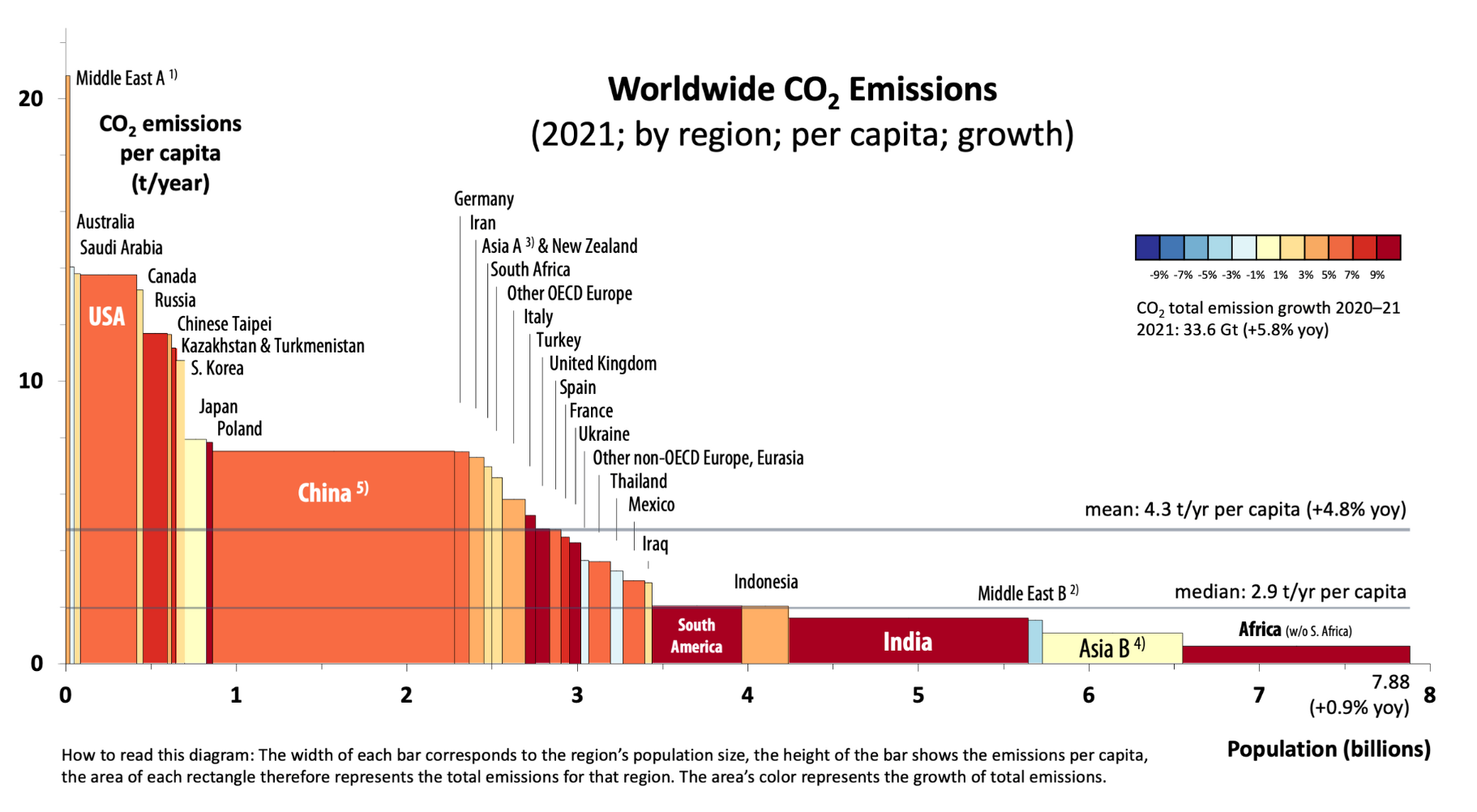
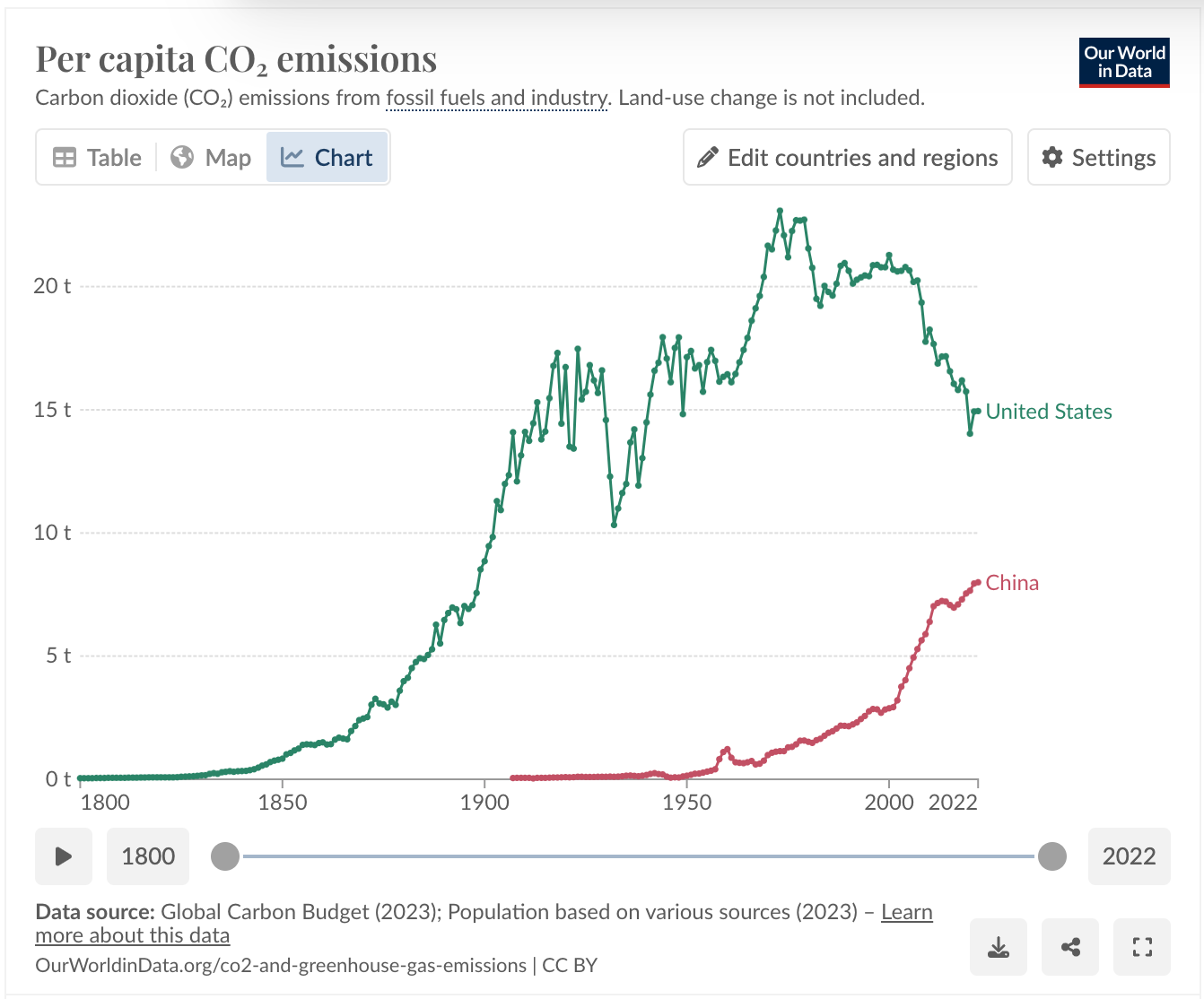
First, it’s important to note that China’s population makes up approximately 18% of the world, and its CO2 emissions per capita fall short of many other countries, including the US, Canada, Australia, South Korea, and the UAE.

Additionally, China is a relatively new industrial power, and the total amount of CO2 emitted over the last three centuries is incomparable to the 400 billion metric tons produced by the United States since 1750. It was only in recent years that China saw a sharp growth in emissions.

China’s early 20th century was marked by a political and social struggle of internal instability after the fall of the Qing Dynasty in 1911. After the establishment of the PROC in 1949, the challenge became improving the lives of its citizens. The Chinese government has been working to increase living standards across the country, and is, in fact, the only country to rise from low to high on the UN Development Index since the program was created. Over 840 million people were taken out of extreme poverty, leading to a sharp rise in life expectancy, literacy rates, and quality of life.

In the early 2000s, as China became increasingly aware of the negative impacts of its fossil fuel use, leaders sought solutions that would create opportunities for future populations and not negate any of the progress made in the last century. Thus began China’s turn to manufacturing renewable technology in industries from solar to wind, green hydrogen, and geothermal energy. Today, China has approximately 80% of the world’s capacity for solar manufacturing. The mass production of renewable tech enabled lower sales costs, paving the way for nations in the Global South to afford making the move to green energy. In fact, China’s production of wind and solar tech enabled other nations to reduce CO2 emissions by over 800 million tons in 2023 alone.

In 2020, President Xi Jingping announced the plan for China to become carbon neutral by 2060, with a carbon peak no later than 2030. The declaration spurred new green projects and policies aimed at accomplishing the goal. The National Energy Administration (NEA), which regulates China’s energy, launched the Whole County PV program, which aims to install solar panels in half of China’s rural administration (a quarter of the population). China’s desert regions were deemed ideal locations for massive wind and solar farms, which will connect to towns and cities through high-speed transmission lines. In 2022, China installed as much solar capacity as all other nations combined, then doubled that number the following year– which was over twice as much as the United States.

It’s true that China still has a long way to go when it comes to switching away from fossil fuels, but it’s currently on track to reach its goals– and the Chinese government has a plan, which includes the construction of a unified power grid to better manage supply and demand.

So why the criticism?

Ultimately, the US and China have different strategies of approaching the climate issue, and the US isn’t happy with China’s methods. In fact, US criticism over China’s green energy strategy lay partially in its condemnation of China’s monopoly over green energy tech, and the effects affordable prices could have on other US business sectors, such as car manufacturing. Just last week, the US locked in steep tariffs of 100% on incoming EVs from China, 50% on chips, and 25% on batteries. Chinese company BYD is the biggest Electric Vehicle (EV) manufacturer, with costs as low as $10,000 per car. Though not currently operating in US markets, BYD electric cars with imposed tariffs would still be the cheapest option for US consumers.

It seems likelier that US politicians will protect the auto industry, which poured $85.5 million into lobbying efforts in 2023, a record high, rather than allow affordable, environmentally friendly electric cars from China to take over the market. Unfortunately, many politicians continue to call climate change a hoax and refer to EVs, like Trump did, as “green new scams.”

Chief economist of the International Monetary Fund, Pierre-Olivier Gourincha, commented on the matter, warning that the high tariffs will “make it harder to coordinate policies that address global challenges, such as the climate transition.” Similarly, David Victor, Professor of innovation and public policy at the University of California San Diego, wrote that these policy moves are “bad for the environment” and will only “slow down the transition.”

The US also continues to push China to contribute more money to fund countries in the Global South under the Copenhagen Accord drafted at the 2009 United Nations Climate Change Conference (COP15), in which multiple countries pledged to contribute to a $100 billion goal annually by 2020. However, while Podesta and Yi were talking about climate finance, other Chinese leaders were hosting the 2024 Summit of the Forum on China-Africa Cooperation with leaders from over 50 states across Africa. The summit concluded with China announcing an additional $50 billion in funding over the next three years, with a heavy focus on green energy transitioning. Additionally, President Xi announced plans to launch 30 new clean energy projects, as well as plans for EV manufacturing.

China’s rapid economic growth and growing global influence has enabled it to be an alternative source of investment for developing nations across the world. Western powers have been quick to criticize China’s global initiatives, brushing them off as self-interested and negatively impactfully– though only when it’s outside the bounds of western institutions like the International Monetary Fund. This is hypocritical, over-simplified, and misleading.

According to a McKinsey Global Institute report, delays in the global green energy shift will produce catastrophic results. As of right now, only 10% of the necessary low-emission technology needed to reach carbon neutrality by 2050 has been deployed. It’s crunch time, and slowing the transition due to political or economic interests is unacceptable.

Essentially, the US orders China to contribute more to countering climate change, all while treating China’s growing dominance over the “green economy” as a security threat, and labeling China’s efforts to invest in green energy projects in the Global South as “geopolitical expansionism.” The message is clear: China needs to contribute to the climate effort, but only in ways the US deems acceptable.

This strategy is ultimately counterproductive– it will only hinder the global effort to convert to renewable energy and delay climate goals, setting the stage for future potential environmental disasters. Instead, the US and China need to work together as two of the most powerful countries to pave the way to net global carbon neutrality. This means removing tariffs on green energy tech, and providing avenues for all countries to make the transition. At the same time, the US needs to make internal change, and defund the world’s highest polluting institution– the US military.

Sources:

https://www.reuters.com/sustainability/sustainable-finance-reporting/us-china-still-have-some-differences-climate-finance-us-envoy-says-2024-09-06/

https://www.globaltimes.cn/page/202408/1318843.shtml

https://e360.yale.edu/features/china-renewable-energy

https://ourworldindata.org/co2/country/china

https://www.bbc.com/news/articles/cy0r74j7j1wo

https://www.cnn.com/2023/03/20/world/ipcc-synthesis-report-climate-intl/index.html

https://www.mckinsey.com/mgi/our-research/the-hard-stuff-navigating-the-physical-realities-of-the-energy-transition

Megan Russell is CODEPINK’s China is Not Our Enemy Campaign Coordinator. She graduated from the London School of Economics with a Master’s Degree in Conflict Studies. Prior to that, she attended NYU where she studied Conflict, Culture, and International Law. Megan spent one year studying in Shanghai, and over eight years studying Chinese Mandarin. Her research focuses on the intersection between US-China affairs, peace-building, and international development.