Sunday, November 03, 2024

Israel investigates leaks that appear to have bolstered Netanyahu as Gaza truce talks
 stalled

TIA GOLDENBERG
Updated Sun, November 3, 2024 


Israeli Prime Minister Benjamin Netanyahu speaks at a memorial ceremony for those killed by Hamas on Oct. 7, 2023, and those who fell in the "Iron Sword" war, at the Knesset, the Parliament, in Jerusalem, Monday, Oct. 28, 2024.
 (Debbie Hill, Pool Photo via AP)

TEL AVIV, Israel (AP) — An Israeli court on Sunday loosened a gag order on a case investigating leaks of classified information suspected to involve one of Prime Minister Benjamin Netanyahu’s media advisers. Critics say the leaks were aimed at giving Netanyahu political cover as Gaza cease-fire talks ground to a halt.

Netanyahu has denied any wrongdoing, downplaying the affair and publicly calling for the gag order to be lifted. Netanyahu has said the person in question “never participated in security discussions, was not exposed to or received classified information, and did not take part in secret visits.”

On Sunday, an Israeli court allowed the publication of the name of the central suspect in the case, Eli Feldstein, whom Israeli media said was one of Netanyahu’s media advisers. Israeli media reports say the case concerns the leak of classified information to two European media outlets, allegedly by Feldstein, who may not have been formally employed and did not have security clearance. The media reported Feldstein joined Netanyahu as an adviser weeks after the Oct. 7, 2023 attacks and previously worked as an adviser to far-right National Security Minister Itamar Ben-Gvir.


The court did not release the names of three other suspects who are also being investigated in connection with the leak.

The leaked documents are said to have formed the basis of a widely discredited article in the London-based Jewish Chronicle — which was later withdrawn — suggesting Hamas planned to spirit hostages out of Gaza through Egypt, and an article in Germany's Bild newspaper that said Hamas was drawing out the talks as a form of psychological warfare on Israel.

Israeli media and other observers expressed skepticism about the articles, which appeared to support Netanyahu's demands in the talks and absolve him of blame for their failure. Netanyahu made no mention of the case in a visit to Israel’s northern border with Israel Sunday, according to a video released by his office.

The articles came out as Netanyahu was calling for lasting Israeli control over the Philadelphi corridor along the Gaza-Egypt border, a demand that was first made public over the summer. Hamas rejected the demand and accused Netanyahu of deliberately sabotaging the talks, which have been mediated by the United States, Qatar and Egypt.

The articles also seemed to provide political cover as Netanyahu faced intense criticism from the families of the hostages and much of the Israeli public, who blame him for the failure to reach a deal. The criticism reached a fever pitch in early September, with mass protests and calls for a general strike, after Hamas killed six hostages as Israeli troops closed in on them.

A court document confirmed that an investigation by police, the military and the Shin Bet internal security agency is underway and that a number of suspects have been arrested for questioning. It said the affair poses “a risk to sensitive information and sources" and “harms the achievement of the goals of the war in the Gaza Strip.”

The leak led to a scandal at the Jewish Chronicle, where prominent columnists resigned in protest over the discredited articles. The London-based newspaper removed the article in question and others by a freelance journalist, saying it was “not satisfied with some of his claims.”

The Bild article suggested Hamas was not serious about the negotiations and was using psychological warfare to stoke Israeli divisions. Netanyahu cited it in a meeting with his Cabinet after it was published.

He again defended the article in a statement released over the weekend, saying it had “exposed the Hamas methods of exerting psychological pressure from home and abroad on the Israeli government and public by blaming Israel for the failure of the talks to release the hostages.”

Netanyahu has sought to blame Hamas, whose Oct. 7, 2023, attack into Israel ignited the war, for the failure of the talks. Hamas, which is still holding scores of hostages, has said it will only release them in exchange for a lasting cease-fire, a complete Israeli withdrawal from Gaza and the release of a large number of Palestinian prisoners.

Hamas says those demands have not changed following last month's killing of its top leader Yahya Sinwar, as the United States, Egypt and Qatar seek to restart the negotiations.

Netanyahu, often described by critics as image-obsessed, is on trial for corruption in three separate cases, two of which involve accusations that he gave favors to media moguls in exchange for positive coverage.

His office has downplayed the latest affair and accused the judiciary of bias, citing the many other leaks over the course of the war. It has also denied the leak in question had any impact on the cease-fire talks.

“The document only helped the effort to return the hostages, and certainly did not harm it,” Netanyahu's office said in a statement Saturday, adding that he only learned about the document when it was publicized.

His critics say the allegations are far more serious.

Yoav Limor, writing in the pro-Netanyahu daily Israel Hayom, called it “one of the gravest affairs Israel has ever known.”

“The damage it caused extends beyond the realm of national security and gives rise to suspicion that the prime minister’s bureau acted to scuttle a hostage deal, contrary to the war’s objectives.”


Israeli authorities probe suspected Gaza intelligence leak by Netanyahu aide

Updated Sun, November 3, 2024 


Court ruling on the lifting of a gag order on an ongoing investigation into the suspected leak of classified documents seized in Gaza by Israeli PM Netanyahu's circle, in Rishon Lezion


By Rami Amichay and Maayan Lubell

RISHON LE-ZION, Israel (Reuters) - A suspected leak of classified Gaza documents involving an aide to Prime Minister Benjamin Netanyahu has jolted Israeli politics and outraged the families of hostages held by Hamas who have been pushing for a deal to get their loved ones home.

Details of the case have trickled out slowly because of a gag order.

But a magistrate's ruling partly lifting the order has provided an initial glimpse of the case that the court said had compromised security sources and may have harmed Israel's efforts to release the hostages.

"Classified and sensitive intelligence information was taken from IDF (Israel Defence Forces) systems and taken out illegally," a ruling by the Rishon Le-Zion Magistrates' Court said on Sunday, which may have caused "serious damage to the state's security and posed a risk to information sources".

In that, the court said, the leak could have hurt efforts to release the hostages.

Netanyahu has denied any wrongdoing by his office staffers and said in a statement on Saturday that he was only made aware of the leaked document by the media.

The four suspects - one a spokesman from Netanyahu's circle and three of them members of the security establishment - could not be reached for comment.

Details from the document in question were published by the German Bild newspaper on Sept. 6, according to Israeli newspaper Haaretz, one of the media outlets that had appealed the court to lift the gag order.

The article, labelled as an exclusive, purportedly outlined the negotiation strategy of Hamas, the Palestinian Islamist militant group that Israel has been fighting in Gaza for more than a year.

Around that time, the United States, Qatar and Egypt were mediating ceasefire talks between Israel and Hamas, that were to include a deal to release hostages held in Gaza.

But the talks faltered with Israel and Hamas trading blame for the deadlock. The article in question largely corresponded with Netanyahu's allegations against Hamas over the impasse.

It was published days after six Israeli hostages were found executed in a Hamas tunnel in southern Gaza. Their killing sparked mass protests in Israel and outraged hostage families, who accused Netanyahu of torpedoing the ceasefire talks for political reasons.

On Saturday, some of the families joined the Israeli journalists' appeal to lift the gag order.

"These people have been living on a rollercoaster of rumours and half truths," said their lawyer, Dana Pugach.

"For the last year they have been waiting to hear any intelligence or any information about negotiations for the release of those hostages. If some of that information had been stolen from army sources then we think that the families have the right to learn about any relevant detail," she added.

In another session on Sunday about the investigation by the Shin Bet domestic security service, police and the military, the court ordered one suspect be released, while keeping others in remand, according to Haaretz.

Asked about the investigation, Bild said that it does not comment on its sources. "The authenticity of the document known to us was confirmed by the IDF (Israel Defence Forces) immediately after publication," it said.

The war in Gaza erupted after Hamas-led militants attacked Israel on Oct. 7, 2023, killing some 1,200 people and taking 251 hostages back to the enclave, according to Israeli tallies. Israel's retaliatory offensives have killed more than 43,000 Palestinians and reduced much of Gaza to rubble.

(Additional reporting by Emily Rose in Jerusalem and Friederike Heine in Berlin; Editing by James Mackenzie, Christina Fincher and Barbara Lewis)
Israel has long wanted to dismantle the UN’s Palestinian refugee agency. The consequences could be disastrous for all

Mick Krever, CNN
Sun, November 3, 2024


Benjamin Netanyahu sat down for his regular cabinet meeting and had some words for a new ally – and an old enemy.

“Last week I met with US Ambassador to the United Nations Nikki Haley,” the Israeli prime minister told his colleagues. “I thanked her, on your behalf as well, for her decisive words in favor of the state of Israel – and against the anti-Israel obsession at the UN.”

“It is time UNRWA be dismantled,” he declared.

It was June 2017: the beginning of Donald Trump’s presidency. The possibilities for Netanyahu – who once bunked in the childhood bed of Trump’s son-in-law – seemed endless. In a few months, the American president would buck decades of foreign policy precedent and move his country’s embassy to the disputed city of Jerusalem.

In the case of UNRWA – the United Nations Relief and Works Agency for Palestine Refugees – Netanyahu would not get his wish so quickly. It would take another eight years.

The Israeli parliament, or Knesset, on Monday voted through legislation to ban UNRWA from Israel and prohibit any contact between it and Israeli officials. The two laws do not mean the immediate end of the agency. Nor do they technically prevent it from working in the Israeli-occupied West Bank and Gaza. But given the near-inextricable link between the agency’s ability to function there and the Israeli authorities, they almost certainly mean the end of UNRWA’s operation as we know it.

There are as many opinions on why UNRWA, which provides services and aid to millions of Palestinians across the Middle East, was banned as there are people to ask.

Many point to allegations by the Israel Defense Forces that a handful of UNRWA’s 13,000 employees in Gaza participated in the October 7 massacre, which saw 1,200 people killed and around 250 taken hostage. In a country still reeling from the worst attack on Jews since the Holocaust, this has been a potent and impossible to ignore argument against UNRWA.

Others see the move as another step in the erosion of Palestinian rights and the removal of their distant but long-promised right to return to the villages, now in Israel, from which they and their ancestors were violently evicted when the Jewish state was created in 1948.

In any case, the head of UNRWA has said that the legislation “will only deepen the suffering of Palestinians, especially in Gaza where people have been going through more than a year of sheer hell.”
‘Low-hanging fruit’

Boaz Bismuth, a Likud member of Knesset, wrote one of the two bills to ban UNRWA, which passed 92 to 10. In the wake of October 7, he believed that dismantling the agency was urgent.

“I did not see December ’49,” when UNRWA was created, he insisted. Nor, he said, was he motivated by the claim that UNRWA perpetuates Palestinian refugee status. “All this is totally irrelevant for me. What was relevant for me in my bill was the fact that they participated on the 7th of October massacre, and this is why they will not work in Israel anymore.”

The Israeli government in January said that 12 UNRWA staff members in Gaza had participated in the Hamas-led attack on Israel, and later added more to that list. The agency immediately fired most of the individuals concerned. A UN investigation found that nine employees “may have” been involved in the October 7 attack.

Hamas' armed wing, the Qassam Brigades, on October 07, 2023. - Hani Alshaer/Anadolu Agency/Getty Images

The Washington Post in February obtained CCTV footage from Kibbutz Be’eri on October, which it said showed one of the UNRWA employees accused by Israel of involvement, carrying the corpse of an Israeli man killed by Hamas militants.

UNRWA to this day maintains that Israel never provided it with evidence against its former employees. The agency says it had regularly provided Israel with a full list of its staff members, and has accused Israel of detaining and torturing some of its staffers, coercing them into making false confessions about ties to Hamas.

But Bismuth said that “for me, UNRWA equals Hamas” – and his view is widespread in Israel. In a country where Netanyahu is politically ascendant against the odds, supporting his party’s legislation was plain old good politics.

“UNRWA was low-hanging fruit for this Israeli government,” said Aaron David Miller, a longtime American policymaker in the Middle East who was a key player in the last serious round of Israeli-Palestinian negotiations, in 2000.
A long history

UNRWA is nearly as old as Israel itself. The violence surrounding the creation of Israel in 1948 displaced close to a million Arabs from their homes in what had been British-mandate Palestine – an event Palestinians call the Nakba, or “catastrophe.”

The UN General Assembly, which had consented to Israel’s creation, declared that all the displaced Arabs should be allowed to return “at the earliest practicable date.” A year later, it created UNRWA “to prevent conditions of starvation and distress.”


Palestinian Arabs fleeing their village near Jerusalem, in 1948. - AFP/Getty Images

The entrance to Aida Refugee Camp, near Bethlehem, in the occupied West Bank. Above the entrance to the camp is a key, symbolizing the Palestinians' right to return to villages from which they were forced in 1948. - Mick Krever/CNN

To Israelis, UNRWA is an anachronism that represents the unrealistic and distant dream of millions of Palestinians to return to their homes in what is now Israel. That is what Netanyahu means when he says the agency “perpetuates the Palestinian refugee problem.” Philippe Lazzarini, the Swiss commissioner-general of UNRWA, has made clear that even if his agency were dissolved, it “will not strip the Palestinians from their refugee status.”

Israelis have long accused UNRWA of perpetuating anti-Israel ideology in schools they run. A UN-commissioned inquiry found that examples in textbooks of anti-Israel bias were “marginal” but nonetheless constituted “a grave violation of neutrality.”

Israeli leaders believe that Palestinians do not deserve their own refugee agency and should permanently resettle where they now live – assisted, if need be, by the agency responsible for all other refugees in the world, the Office of the UN High Commissioner for Refugees, or UNHCR.

“What makes Palestinian refugees different is that they’re not seeking refuge in a third country,” said Diana Buttu, a Palestinian human rights lawyer. “They want to go home.”
‘What more do they want?’

Saleh Shunnar, displaced from his home in Gaza by the year-long war, knows what it means to be a refugee.

“Israel has always wanted to do this,” he said, speaking from a tent encampment in Deir Al-Balah, in central Gaza. “If they shut down UNRWA, that means there is no Palestinian refugee cause. They took away the Palestinian cause.”

Those fears run deep for many Palestinians. But concerns about the impact on so-called final status negotiations are “tethered to a galaxy far, far away, rather than to the realities back here on planet earth,” said Miller, the former American negotiator.

“I can understand why the Palestinians would regard this as a systematic first step to undermine the right of return,” he said. But the issues facing any negotiations over a Palestinian state are so numerous and so fraught that the right of return is far down the long list of obstacles, he said.


Palestinians gather to receive aid outside an UNRWA warehouse in Gaza, in March. - Mahmoud Issa/Reuters

That is particularly the case when so many Palestinians face an imminent humanitarian catastrophe.

“These are the simplest of needs,” Deir Al-Balah resident Ghalia Abd Abu Amra said of the aid she receives. “What more do they want to take from us than what they already have? Our homes are gone, now they want to take UNRWA too?”

The massive tent camps for internally displaced Gazans have steadily become entrenched. Cloth walls become tarpaulin. Mud floors are replaced with wood. This transformation has been happening for decades across the 58 refugee camps run by UNRWA in the Palestinian territories and elsewhere in the region, as tent camps became residential blocks.

A tent camp for displaced Palestinians in Gaza City. - Dawoud Abo Alkas/Anadolu/Getty Images

An UNRWA school in al-Am'ari Refugee Camp, in Ramallah, in the West Bank. The agency runs 706 schools in the Middle East. - Issam Rimawi/Anadolu/Getty Images

For millions of Palestinians, UNRWA functions as a parallel government. It is a vast organization that provides services that governments – whether in Lebanon, Jordan, Syria, Gaza, or the occupied West Bank and East Jerusalem – are unable or unwilling to provide. It educates half a million students. It employs 3,000 medical professionals. It helps feed nearly two million people.

“UNRWA has saved Israeli taxpayers billions of dollars over the last 57 years,” said Chris Sidoti, an Australian human rights lawyer who sits on the UN’s Independent International Commission of Inquiry on the Occupied Palestinian Territory. “Israel, as the occupying power under the fourth Geneva Convention, is responsible for the care, protection, and the provision of services to persons under occupation.”

“The international community has been doing that by its financial support for UNRWA,” he told journalists in New York. “So if UNRWA is kicked out, the cost for the Israeli taxpayer is going to be ginormous. So this is a decision that is bad for the Palestinians and ridiculous for Israeli taxpayers.”


An UNRWA school in Nuseirat Refugee Camp in Gaza City, after an Israeli airstrike in September. - Anadolu/Anadolu/Anadolu via Getty Images

Bismuth, the Knesset member who authored the UNRWA legislation, said that Israel would step in.

“You will not have a vacuum,” he said. “I feel good with my bill. Because all the services that they got – not only will they continue to get it, but we will even upgrade it.”

Indeed, UNRWA’s benefit to Israel had long been recognized by those in the government responsible for Palestinian affairs, said Nadav Tamir, a former diplomat who now serves as executive director of J Street Israel, a left-wing lobby group. He characterized their view as: “‘Of course UNRWA is problematic, but we don’t have another option, we need someone to take care of the issues.’” Before October 7, he explained, politicians could not overcome the “realpolitik” that UNRWA was an asset in taking a problem off Israel’s plate.

Nur Shams refugee camp near Tulkarm, in the Israeli-occupied West Bank, after an Israeli raid in September. - Mohamad Torokman/Reuters

What that will look like remains a mystery to most. Miller is blunt: “Israelis don’t have a long-term solution.” In conversations with UNRWA staff members in the refugee camps around Jerusalem – who asked to remain anonymous because they are not authorized to speak with the media – confusion reigned.

No one knows whether, when the legislation fully go into effect in three months, schools will remain open or medicine will be delivered. Tens of thousands of Palestinians who work for the agency could soon be unemployed.

“Most Israelis don’t really know the facts,” Tamir said. “They don’t really understand that there is no alternative. They think, ‘Oh, we can just bring another organization, or we could somehow do it on our own.’”

Even if the Israeli leadership decides that it can cast aside the moral issue of providing for Palestinian civilians, shutting down services for millions poses a threat for Israel itself.

“It’s a strategic issue that will promote more terrorism and of course all kind of epidemics that are not stopping at the border,” Tamir said. “So people who really know the situation I think are concerned. But most people and most politicians don’t really care about the reality. It’s all about the perception.”

Zeena Saifi, Abeer Salman, Mohammed Al-Sawalhi, and Shira Gemer contributed to this report.


Israel officially informs UN of end to relations with Palestinian relief agency

Reuters
Sun, November 3, 2024 

Palestinians gather to inspect the damages at the headquarters of UNRWA in Gaza City


JERUSALEM (Reuters) - Israel has officially notified the United Nations that it was cancelling the agreement that regulated its relations with the main U.N. relief organization for Palestinian refugees (UNRWA) since 1967, the country's foreign ministry said on Monday.

Last month, the Israeli parliament passed legislation banning UNRWA from operating in Israel and stopping Israeli authorities from cooperating with the organization, which provides aid and education services to millions of Palestinians in the occupied West Bank and Gaza.

Israel has long been critical of UNRWA, set up in the wake of the 1948 war that broke out at the time of the creation of the state of Israel, accusing it of anti-Israel bias and saying it perpetuates the conflict by maintaining Palestinians in a permanent refugee status.

Since the start of the Gaza war in October last year, it has also said that the organization has been deeply infiltrated by Hamas in Gaza, accusing some of its staff of taking part in the Oct. 7 attack on Israel.

The legislation has alarmed the United Nations and some of Israel's Western allies who fear it will further worsen the already dire humanitarian situation in Gaza, where Israel has been fighting Hamas militants for a year. The ban does not refer to operations in the Palestinian territories or elsewhere.

Israel's U.N. Ambassador Danny Danon said in a statement that despite the overwhelming evidence "we submitted to the U.N. highlighting how Hamas infiltrated UNRWA, the U.N. did nothing to address this reality".

The legislation does not directly outlaw UNRWA's operations in the West Bank and Gaza, both considered by international law to be outside the state of Israel but under Israeli occupation.

But it will severely impact its ability to work in those areas and there has been deep alarm among aid groups and many of Israel's partners.

The Israeli foreign ministry said activity by other international organizations would be expanded and "preparations will be made to end the connection with UNRWA and to boost alternatives to UNRWA".

(Reporting by Muhammad Al Gebaly and Nilutpal Timsina; Writing by Tala Ramadan Editing by Kim Coghill and Michael Perry)


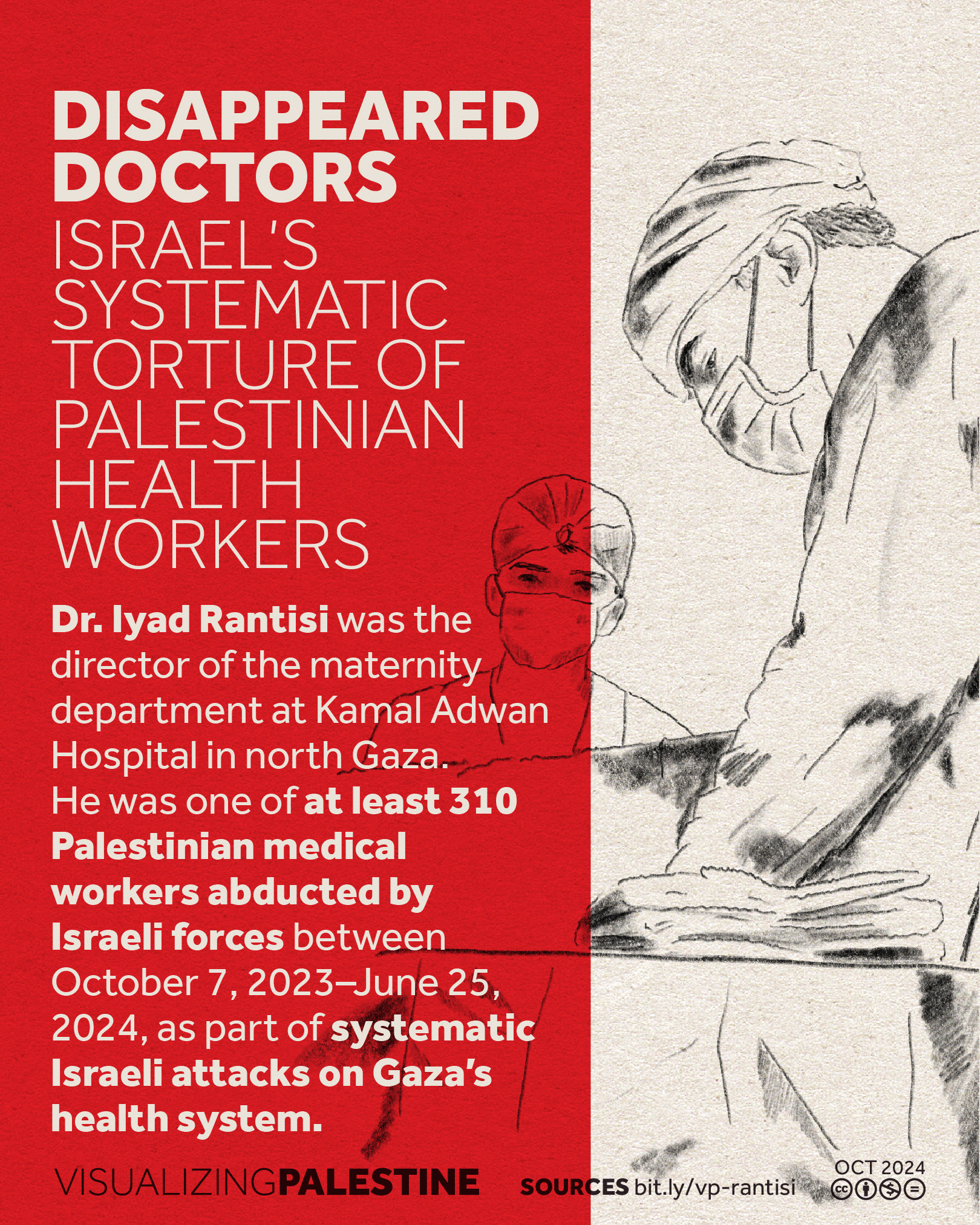
Disappeared Doctors

We are in some of the darkest days of this genocide. The Israeli military is currently carrying out a systemic extermination campaign in north Gaza, committing massacre after massacre while completely cutting off humanitarian aid and banning UNRWA.

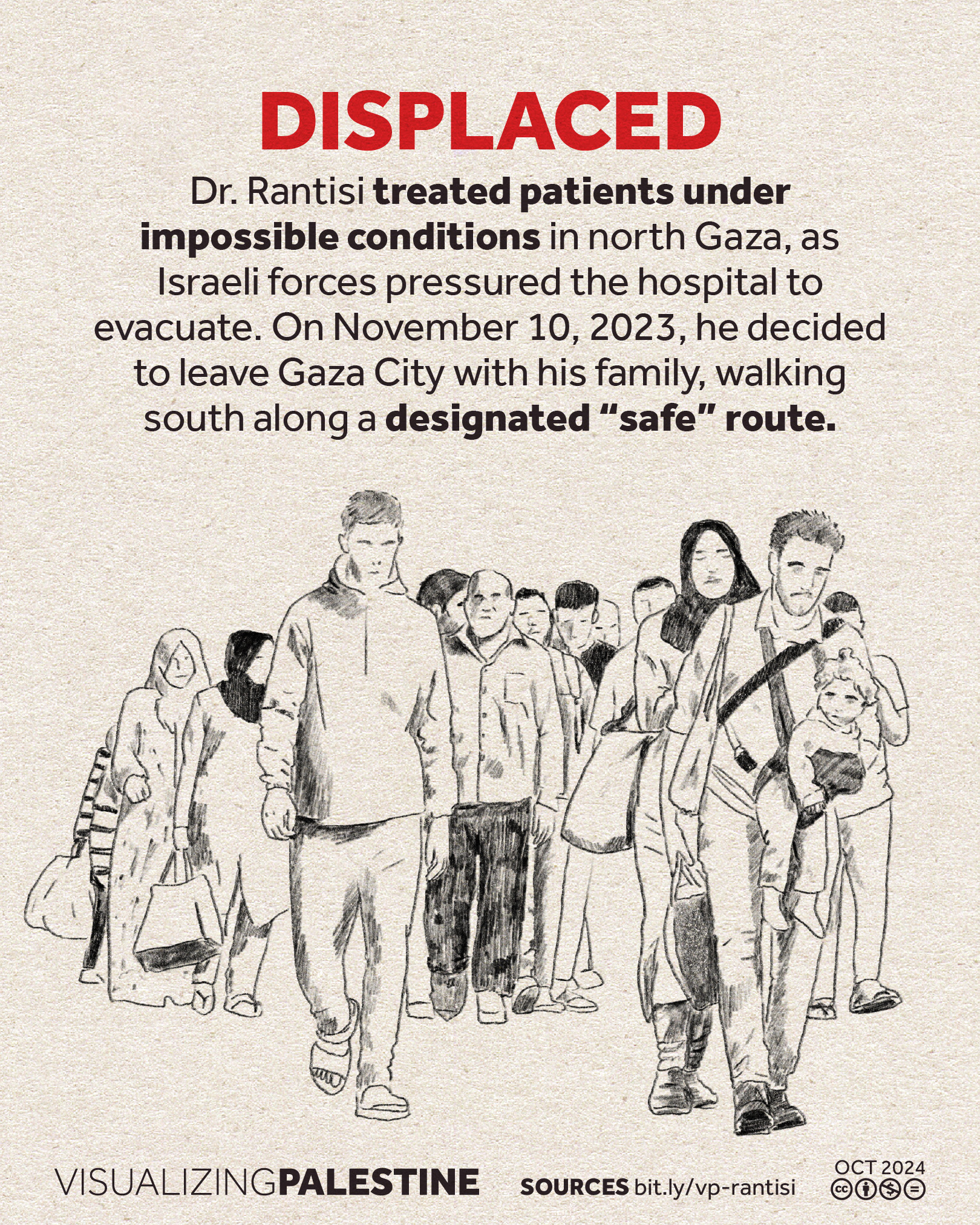
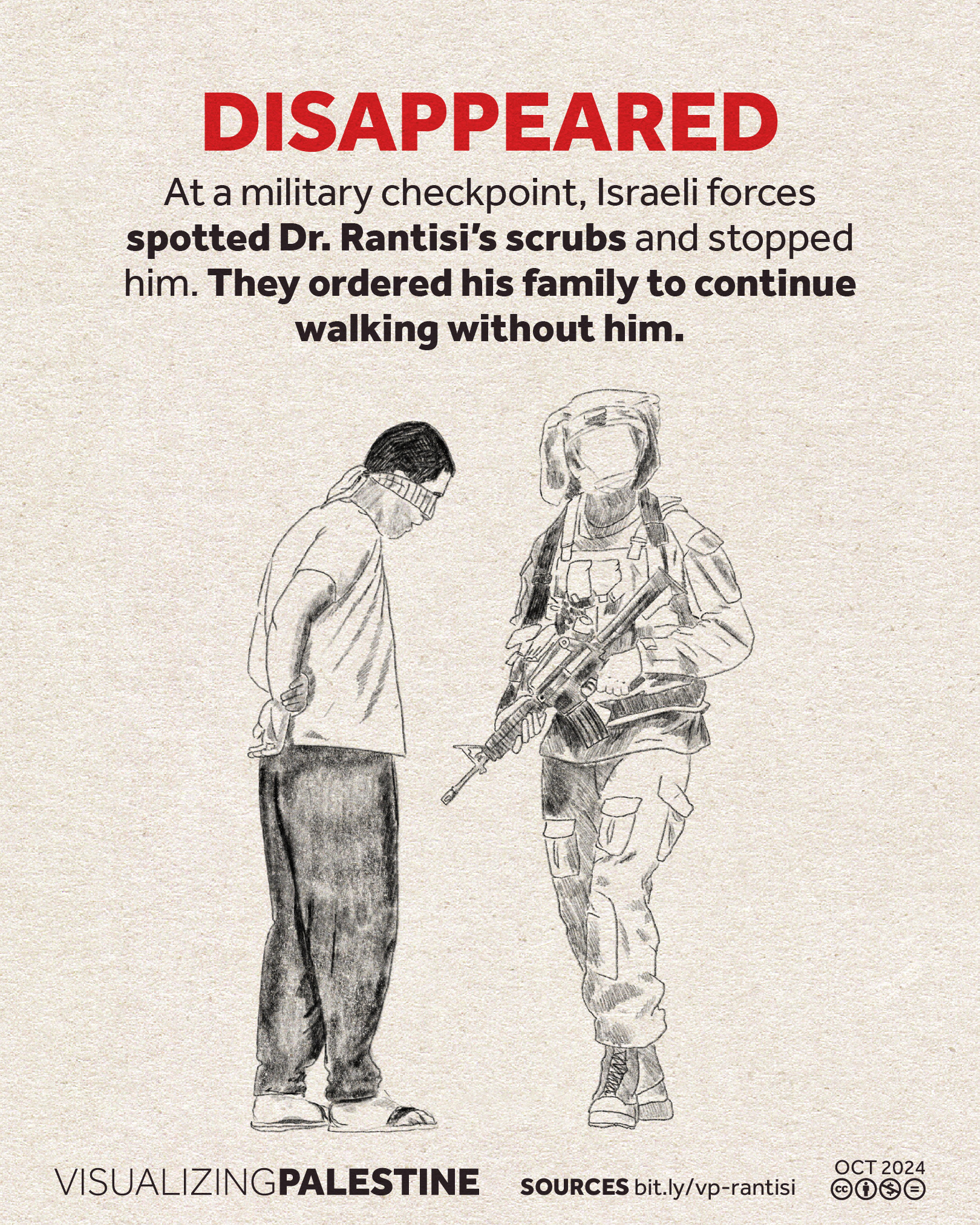
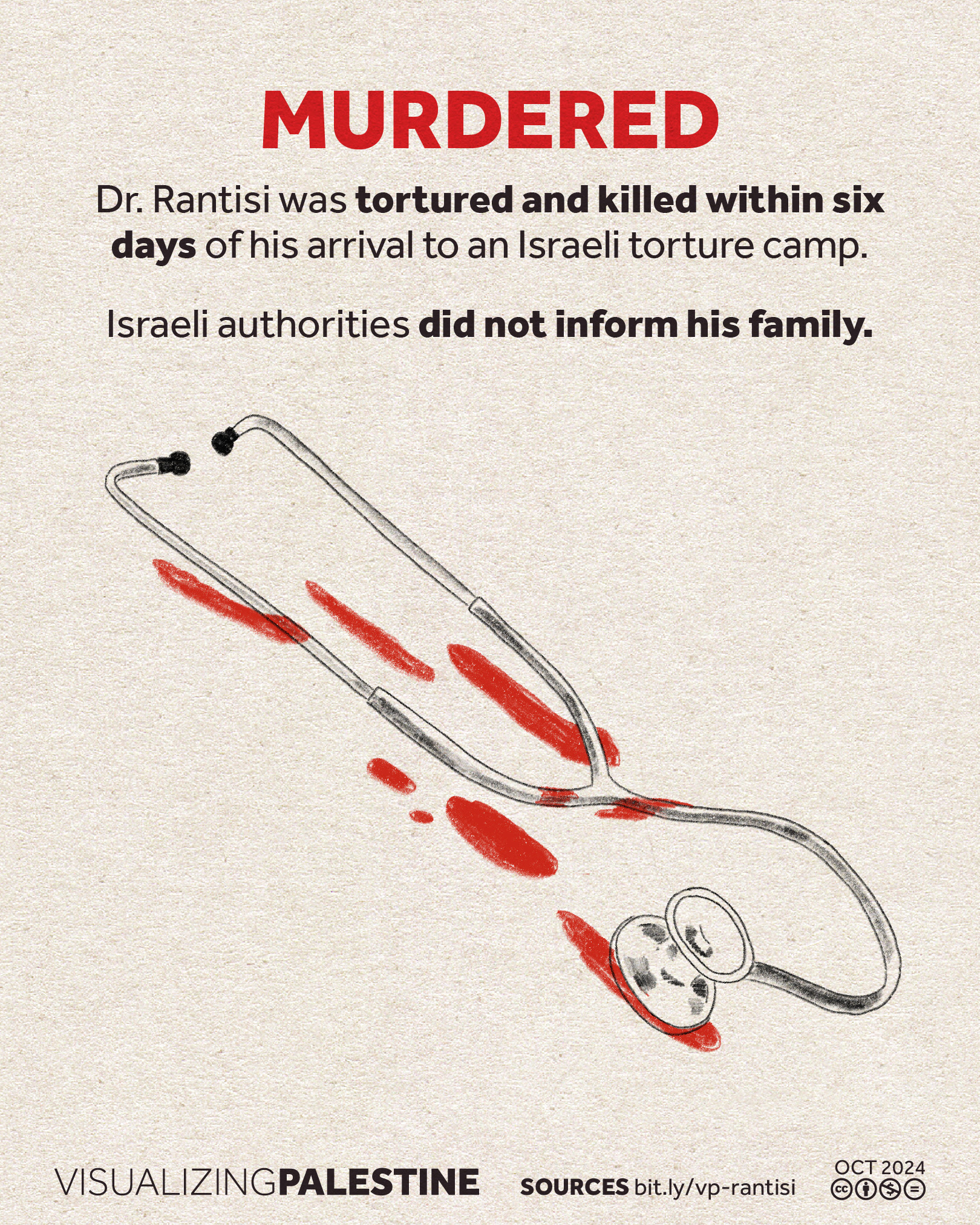
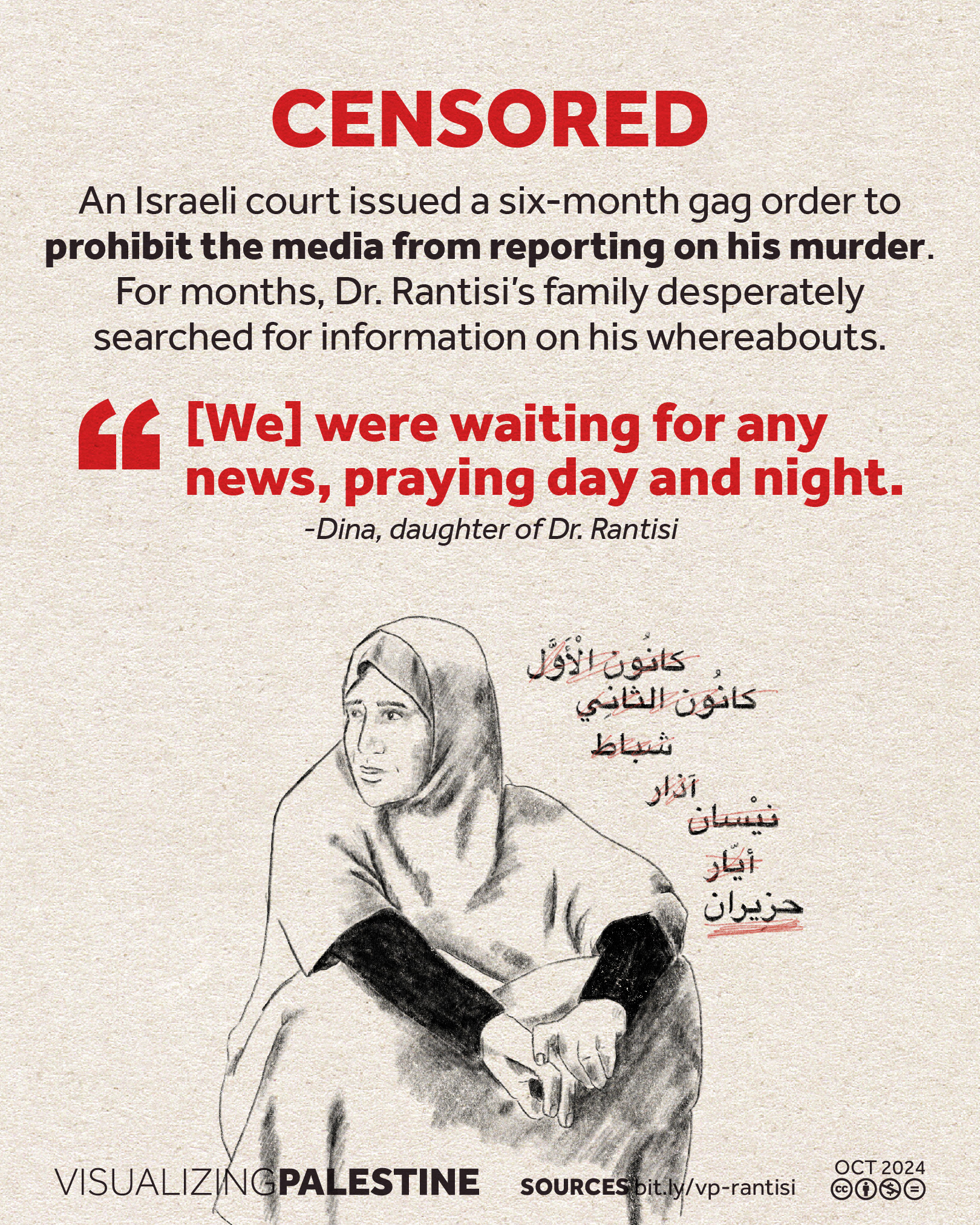
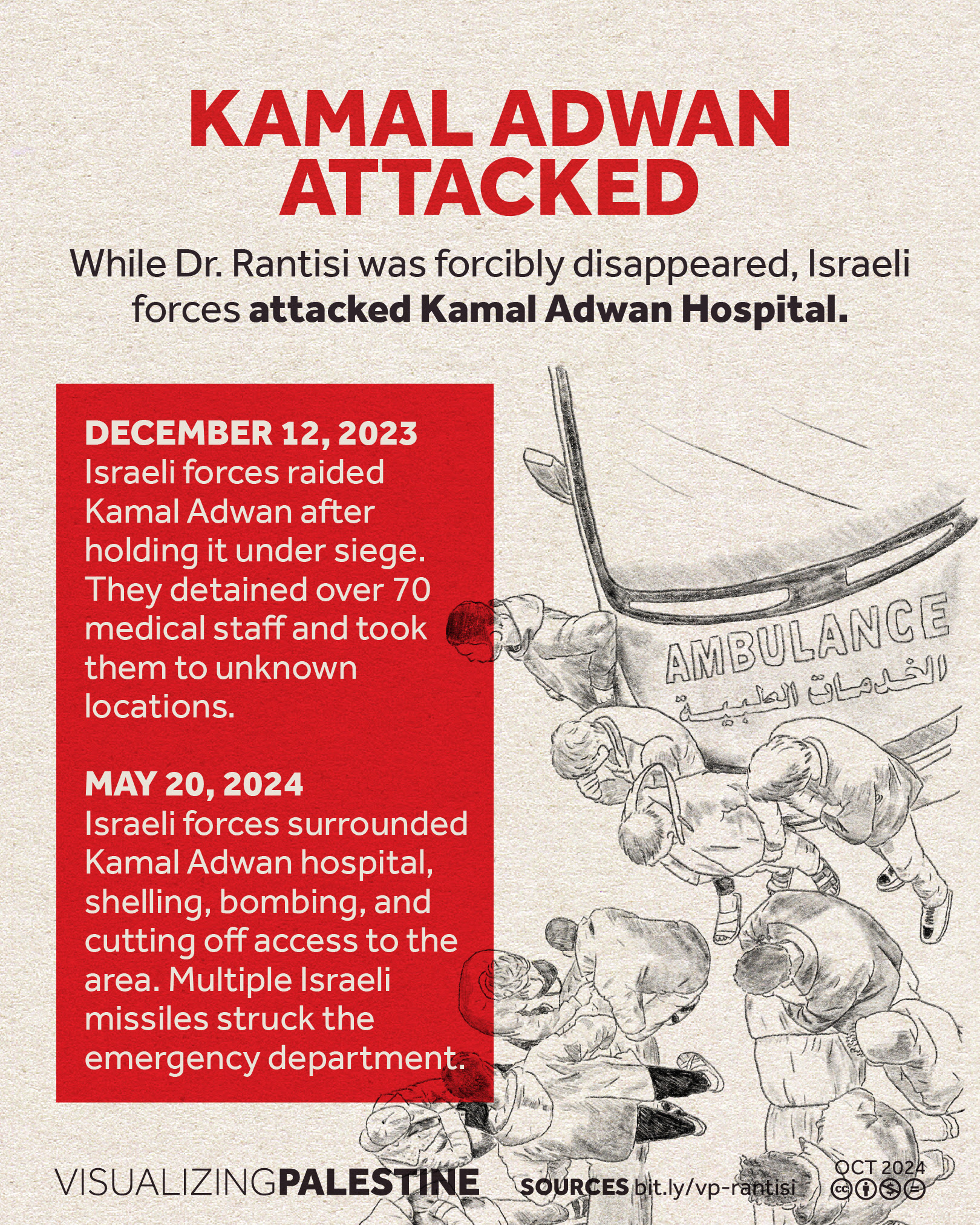
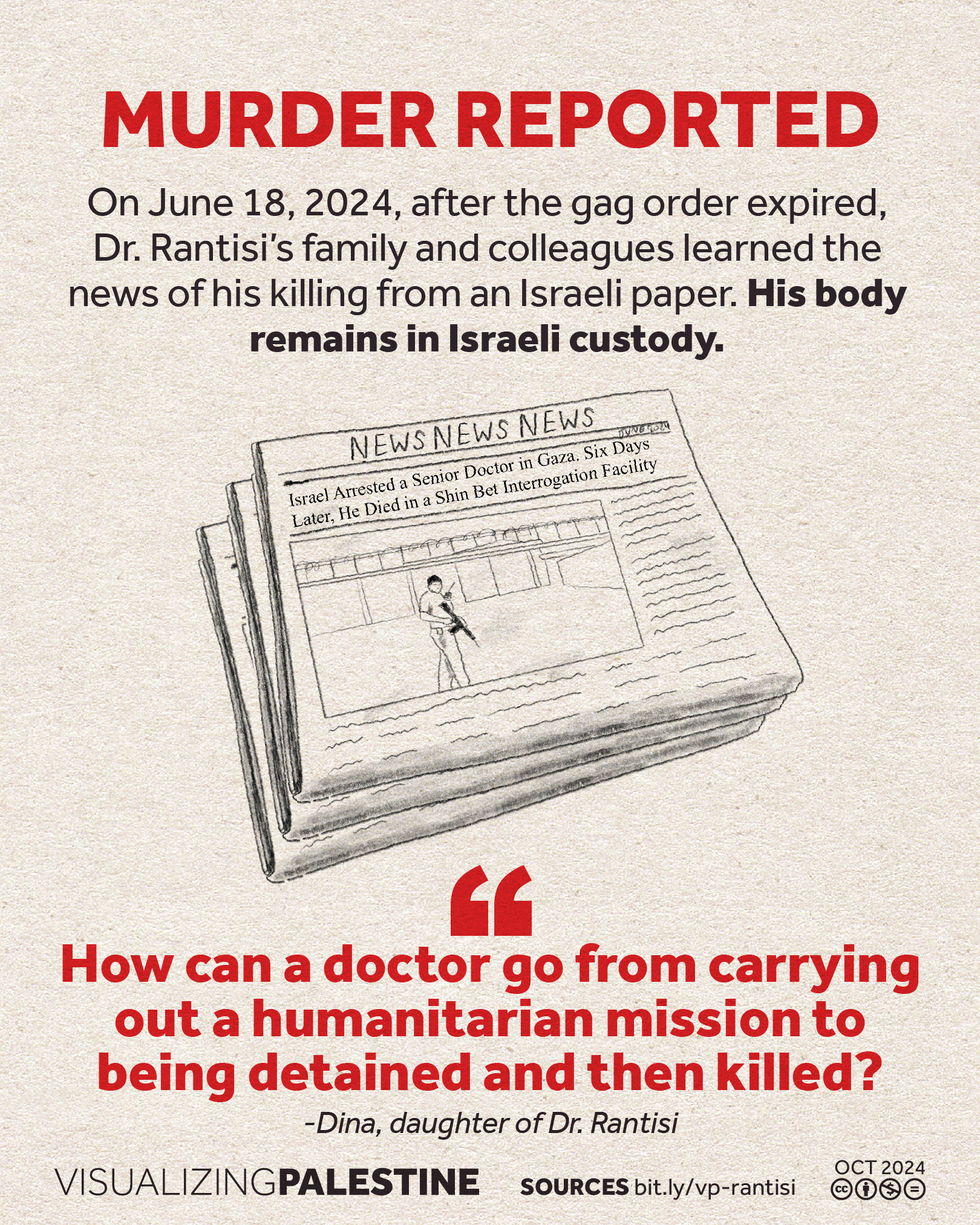
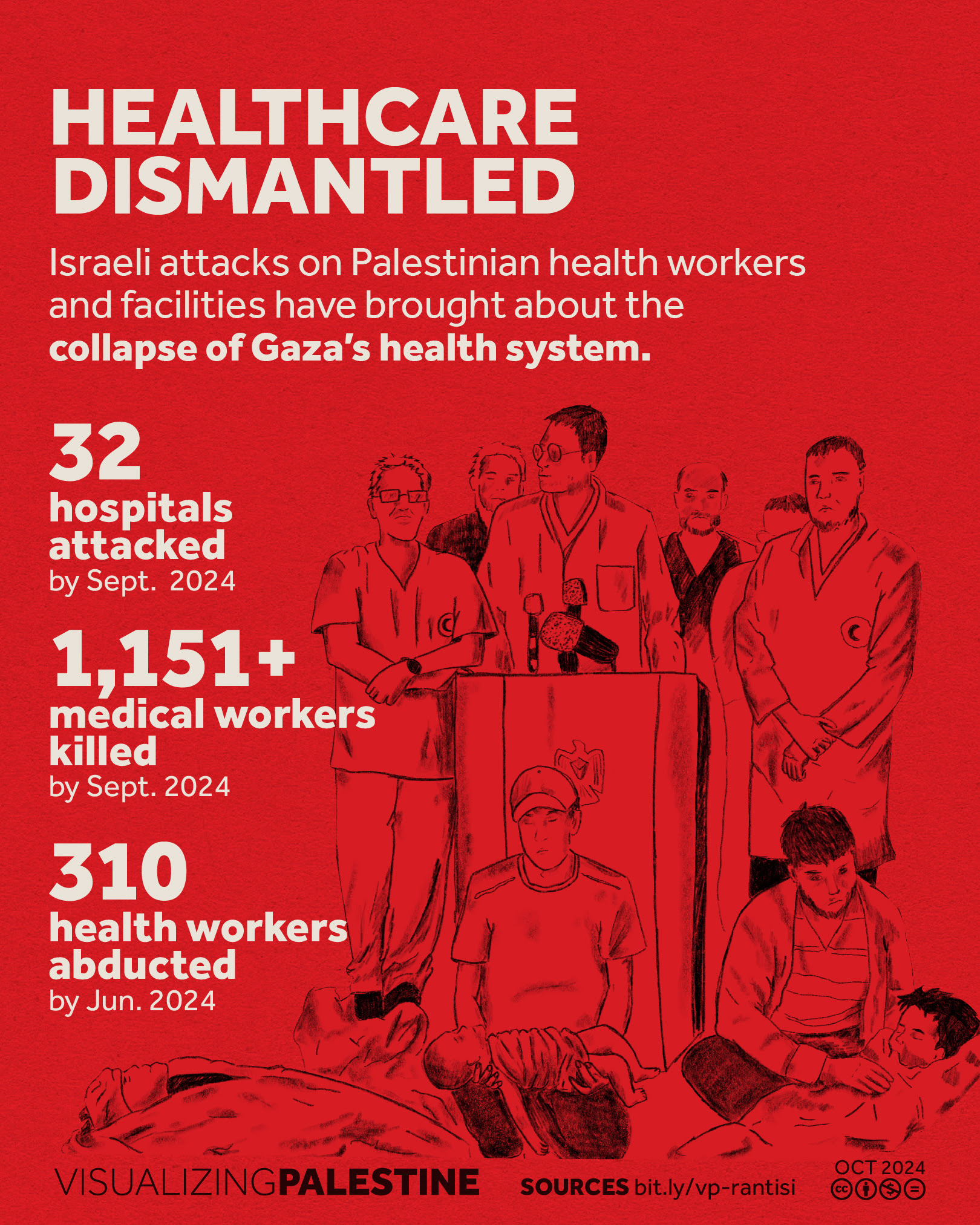
On October 29, 2024, an Israeli airstrike killed 93 Palestinians in Beit Lahia, north Gaza. Those injured in the massacre have no access to medical care, because on October 26, 2024, Israeli forces attacked Kamal Adwan Hospital and abducted 44 of its 70 staff. Our latest visual highlights the continuous targeting of Palestinian healthcare workers and facilities by Israeli forces in Gaza, focusing on the enforced disappearance, torture, and murder of Dr. Iyad Rantisi, the director of the maternity department at Kamal Adwan Hospital.

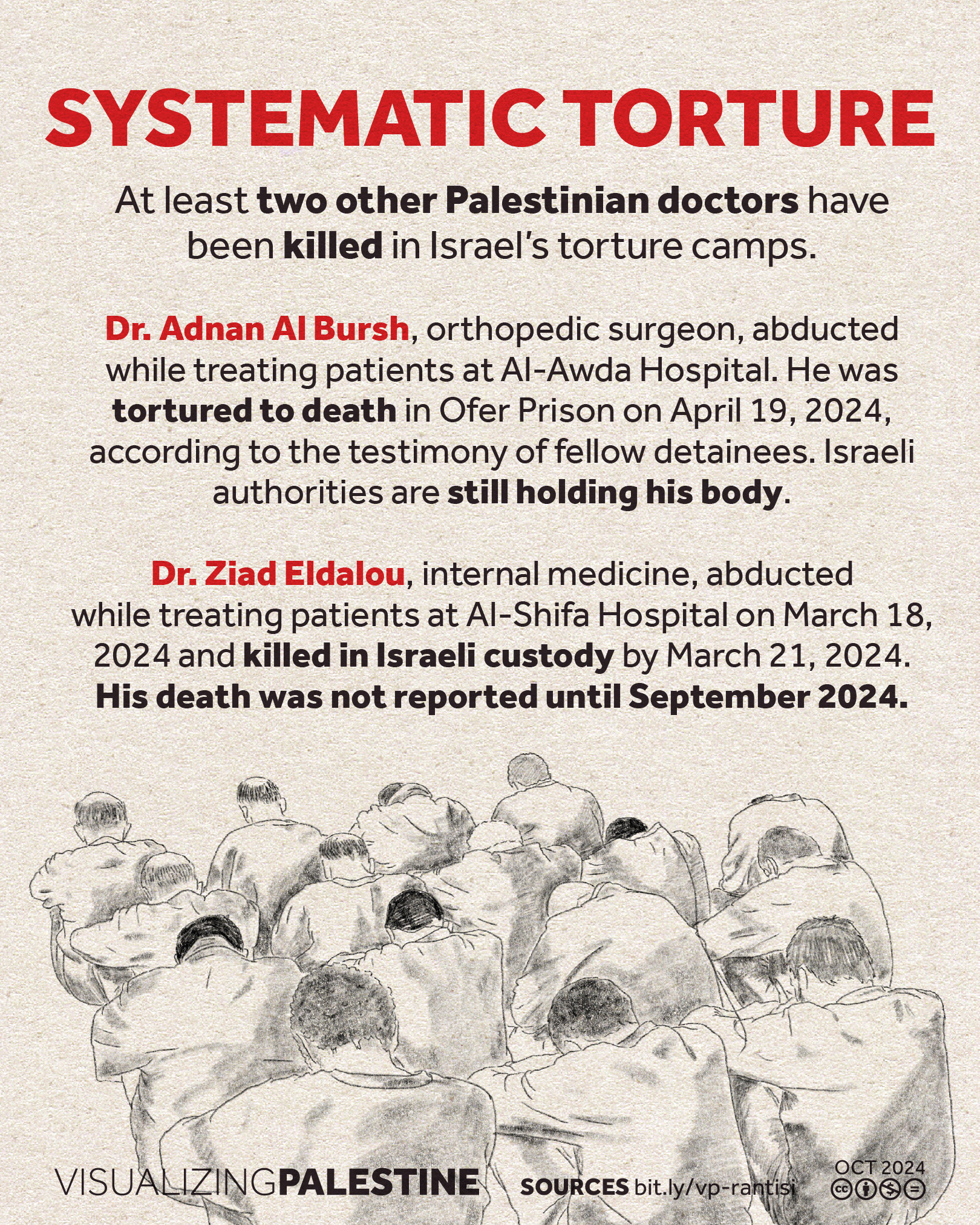
Dr. Rantisi is one of at least three Palestinian doctors murdered in Israeli custody since October 2023. Israeli attacks on hospitals and health workers, which initially shocked and outraged the world in 2023, have now become a constant, routine feature of this genocide. By devastating the health system in Gaza, Israeli forces are “deliberately inflicting on the group conditions of life calculated to bring about its physical destruction in whole or in part,” as described by the genocide convention. In these conditions, those who are not immediately killed by direct violence are more likely to die slowly due to lack of access to medical services, denial of humanitarian aid, mass starvation, untreated traumatic injuries, and disease.

This is the third visual in a series raising awareness about Israel’s practices of mass incommunicado detention and torture of Palestinians. Our first visual illustrates the testimony of Fadi Bakr, a law student from Gaza City, who was captured by Israeli soldiers in early January and spent more than 30 days in Sde Teiman, part of a network of Israeli torture camps. The second visual captures the testimony of Palestinian women from Gaza who were arbitrarily detained and held incommunicado by Israel.FacebookTwitterRedditEmail

Visualizing Palestine is the intersection of communication, social sciences, technology, design and urban studies for social justice. Visualizing Palestine uses creative visuals to describe a factual rights-based narrative of Palestine/Israel. Read other articles by Visualizing Palestine, or visit Visualizing Palestine's website.


WORKERS CAPITAL

Singapore's CPF scores big in global pension index

Yahoo News Singapore
Updated Sun, November 3, 2024 

Singapore's Central Provident Fund (CPF) system ranks fifth globally, scoring 78.7 in the Mercer CFA Institute Global Pension Index, highlighting its effectiveness and robust framework

In a world where many countries struggle to secure retirement for their citizens, Singapore shines brightly. Ranking fifth in the world, the Central Provident Fund (CPF) ensures citizens can save adequately for their golden years, according to the latest Mercer CFA Institute Global Pension Index. With a score of 78.7, Singapore's pension system is a beacon of hope for retirees. The CPF offers a strong structure that ensures adequacy, sustainability, and integrity. Challenges remain as the population ages, necessitating ongoing reforms and education. 

MERCER REPORT ON GLOBAL PENSIONS
Texas OB-GYNs urge lawmakers to change abortion laws after reports on pregnant women's deaths

Pooja Salhotra
Sun, November 3, 2024 

Thousands of people walk in a march in support of abortion rights near downtown San Antonio on June 24, 2022. Credit: Kaylee Greenlee Beal for The Texas Tribune

A group of 111 OB-GYNs in Texas released a letter to elected state leaders Sunday urging them to change abortion laws they say have prevented them from providing lifesaving care to pregnant women.

The doctors pointed to recent reporting by ProPublica on two Texas pregnant women who died after medical staff delayed emergency care.

Josseli Barnica, 28, died of an infection in 2021 three days after she began to miscarry. More than a dozen medical experts said Barnica’s death was preventable. However, the state’s abortion laws kept doctors from intervening until they couldn’t detect a fetal heartbeat, which didn’t happen until about 40 hours after the miscarriage started.

Nevaeh Crain, 18, died last year after developing a dangerous complication of sepsis that doctors refused to treat while her six-month-old fetus still had a heartbeat. Two emergency rooms didn’t treat her and a third delayed care, moving Crain to the intensive care unit only after she was experiencing organ failure. Medical experts said if the hospital staff had treated her early, they either could have helped Crain with an early delivery or saved her life by ending the pregnancy if the infection had gone too far.

“Josseli Barnica and Nevaeh Crain should be alive today,” the doctors wrote in their letter. “As OB-GYNs in Texas, we know firsthand how much these laws restrict our ability to provide our patients with quality, evidence-based care.”

In 2021, Texas lawmakers passed a law prohibiting doctors from performing an abortion after six weeks. The law allows members of the public to sue doctors or anyone who helps perform an abortion for $10,000.

After the Dobbs v. Jackson ruling overturned Roe v. Wade, Texas banned almost all abortions — including in cases of rape and incest. The law does create an exception for a doctor to perform an abortion when they believe it is necessary to save the life of the pregnant patient. Doctors who violate the state’s abortion law risk losing their medical license and potentially spending life in prison.

Doctors have said that confusion about what constitutes a life-threatening condition has changed the way they treat pregnant patients with complications. The Texas Medical Board has offered guidance on how to interpret the law’s medical exception, and the Texas Supreme Court has ruled that doctors don’t need to wait until there’s an imminent risk to the patient to intervene. But some physicians say the guidance is vague and that hospitals are navigating each situation on a case-by-case basis.

ProPublica’s reporting about Crain and Barnica comes as U.S. Sen. Ted Cruz and U.S. Rep. Colin Allred of Dallas face off in a heated bid for one of Texas' two seats in the U.S. Senate. Their divergent views on abortion have been a central issue in the race, and both candidates have weighed in on Crain and Barnica’s deaths.

“Texas doctors can’t do their jobs because of Ted Cruz’s cruel abortion ban,” Allred wrote on X, linking to the story about Crain. “Cruz even lobbied SCOTUS to allow states to ban life-saving emergency abortions.”

In 2021, Cruz sponsored a 20-week federal abortion ban. He also co-introduced a bill that would allow states to exclude medical providers that perform abortions from receiving Medicaid funding. After the U.S. Supreme Court overturned Roe v. Wade, Cruz celebrated the decision as a “massive victory.”

Cruz has previously said he thought Texas’ exception to save the life of the pregnant mother was working. This week he reiterated that stance. He called Crain and Barnica’s deaths “heartbreaking” in an interview with The Houston Chronicle and said procedures necessary to save the life of the pregnant mother are legal in Texas.

Dozens of women have come forward saying that, after the state’s abortion ban went into effect, they were unable to get the health care they needed for their medically complex pregnancies.

Last year, state lawmakers passed a law allowing abortions for people with ectopic pregnancies, a nonviable type of pregnancy in which the embryo implants outside the uterus, as well as when a patient’s water breaks before the fetus is viable.

The doctors who signed the letter said they want to see a change in state law.

“Texas needs a change. A change in laws. A change in how we legislate medical decisions that should be between a patient, their family, and their doctor.”


Texas woman died after waiting 40 hours for emergency care during miscarriage: report

Ryan Chandler
Sun, November 3, 2024


AUSTIN (NEXSTAR) — A new report published Wednesday details the story of a 28-year-old Texas woman who died from an infection after doctors allegedly delayed treating her miscarriage for about 40 hours, reigniting concerns about the state’s strict abortion laws.

Josseli Barnica arrived at a Houston hospital at 17 weeks pregnant in Sept. 2, 2021, experiencing severe cramping and bleeding, according to the nonprofit investigative newsroom ProPublica. The next day, an ultrasound confirmed she was experiencing a miscarriage.

However, Barnica reportedly told her husband that doctors could not intervene.

“They had to wait until there was no heartbeat,” the husband, whose name was not disclosed, told ProPublica in Spanish. “It would be a crime to give her an abortion.”

As she waited, Barnica’s cervix remained open, leaving her uterus exposed to bacteria, according to the outlet. After a fetal heartbeat was no longer detected, she delivered the fetus with medical assistance and was discharged later that day.

See where abortion will be on the ballot in the 2024 election

On Sept. 7, as her condition worsened, Barnica’s husband brought her back to the hospital, where she died from a sepsis infection.

Barnica’s story has reinvigorated the concern that Texas’ abortion ban does not give doctors enough autonomy to treat pregnancy complications.

Rep. Colin Allred, the Democratic candidate for U.S. Senate who has made abortion access a central tenant of his campaign, quickly used Barnica’s story as a critique of Sen. Ted Cruz’s anti-abortion stance.

“Josseli Barnica should be alive today but because of Ted Cruz’s cruel abortion ban, Texas women have been denied the life-saving health care they need,” Allred wrote on social media.


Sen. Ted Cruz, left, and Rep. Colin Allred are pictured in these side-by-side images. (Photos: Getty Images)

Cruz called the story “heartbreaking,” but he said Texas’ law is not to blame.

“I’ve read the story here, and the facts of the case seem heartbreaking. That this woman lost her life is truly a tragedy,” Cruz told reporters after a rally in Georgetown on Wednesday.

“The Texas law makes clear that any procedure that is necessary to save the life of a mother can be done and should be done,” Cruz added. “We don’t know all the details of what happened here, but it is critical that we do everything necessary to save the lives of moms and we grieve with the family at the tragedy that occurred here.”

Texas law prohibits abortion in nearly all cases, without exceptions for rape or incest. Physicians may be punished for performing abortions with six-figure fines, the loss of their medical license, and prison time.

An abortion is permitted under the law if, “in the exercise of reasonable medical judgment,” the pregnant person has a life-threatening condition caused or worsened by the pregnancy that poses a risk of death or serious impairment to a major bodily function, making the abortion necessary

Physicians have sued to argue that language is too vague, claiming the “reasonable medical judgment” standard is too subjective to allow them to act freely without concern for their own liability.

In May, the Texas Supreme Court rejected those concerns, ruling that the abortion ban’s exceptions are acceptable and permit abortions before imminent emergencies.

“The law does not require a woman to surrender her life or to first suffer serious bodily injury before an abortion may be performed,” the court wrote.

According to October polling from the Texas Politics Project, 7% of Texas likely voters say abortion/women’s rights is the most important issue to their vote, trailing the economy, immigration/border security, and inflation/cost of living.

Copyright 2024 Nexstar Media, Inc. All rights reserved. 


How strict abortion bans impact women's health care

Brit McCandless Farmer
Sun, November 3, 2024 

Yahoo is using AI to generate takeaways from this article. This means the info may not always match what's in the article. Reporting mistakes helps us improve the experience.Generate Key Takeaways


The Supreme Court's landmark 2022 overturning of Roe v. Wade has had an impact on women's health beyond abortion, accelerating a gap in obstetrics and gynecological care in some states across the country.

In Texas, the first state to implement more restrictive abortion laws, a fear of discussing abortion has impacted doctors practicing there and the medical students and OB-GYN residents looking to learn there.

"We asked for [abortion care] in our curriculum they're like, 'Oh, well, it's a state-funded school. And since the state doesn't support it, then we probably shouldn't teach it,'" said Dr. Dani Mathisen, who received her medical degree in Texas but relocated to Hawaii to complete her OB-GYN residency.

Doctors say strict abortion laws in Texas put pregnant women and their physicians at serious risk

Mathisen said she had discovered that education on anything to do with abortion was so limited, she and her fellow students had to teach themselves. They rented classrooms, where abortion providers came in to teach about abortion care and students practiced on papayas and dragon fruit.

"It's actually really common," Mathisen said. "[Fruit] is a really great model for a uterus."

OB-GYN resident Dr. Adrianne Smith began her residency in Texas but transferred to a hospital in New Mexico. Like Mathisen, Smith saw how abortion laws were impacting her education and said limits on education lead to restrictions on care — and not just in pregnancy.

"We're seeing now with these new restrictions, more OB-GYNs are leaving these states," Smith said. "You need OB-GYNs for pap smears, for birth control, for mammograms. And then not to mention routine pregnancy care. You need OB-GYNs staffing the hospitals and staffing those labor and deliveries, which in rural areas are already struggling to stay open. And so people are having to travel further for care — pregnancy or other care — and then waiting even longer to be able to be seen."

Texas women facing pregnancy complications are forced to travel out of state for care

These vacancies are contributing to what a recent report by the March of Dimes calls a "maternity care access crisis." According to the report, more than one-third of counties in America are considered maternity care deserts. That means they don't have a single doctor, nurse, midwife, or medical center that specializes in maternity care, impacting more than 2.3 million women of reproductive age.

"We've seen people leave states," said Dr. Stella Dantas, the president of the American College of Obstetricians and Gynecologists. "We know we have maternal care deserts around the country that are being worsened by people leaving."

As an example, Dantas pointed to Idaho, where nearly one quarter of practicing obstetricians have left the state since its strict abortion laws took effect, according to a report by the Idaho Physician Well-Being Action Collaborative.

Dantas said that, in addition to practicing physicians leaving the state, restrictive abortion laws are also impacting training.

"When a medical student is applying to train for residency, they're now looking at residency programs and asking questions, 'What is the abortion training I'm going to get there? Am I going to get enough training to come out and feel competent and confident to practice the field that I desire?'" Dr. Dantas said.

How Texas's abortion laws are driving doctors out of the state

She went on to explain that OB-GYN residents are required to have training in abortion care to become licensed physicians.

"Abortion is reproductive health care, and OB-GYNs are the people that provide reproductive health care," Dantas said. "Abortion is the same procedure that's used in miscarriage management [and] ectopic pregnancy management. It is used in … situations where the pregnancy's highly desired and it cannot go on for the health of the mom. So, you do need that training."

In May, the Association of American Medical Colleges released a revealing set of data on the domino effect of the overturning of Roe and its potential impact on maternal health. In the two years since Dobbs, states with complete bans saw OB-GYN residency applications drop 6.7% in one year, compared to a small increase of applications in states without restrictions.

For Smith, the growing gap in women's health care has made her want to practice medicine in a state like Texas or Georgia after she completes her residency.


"Patients need us there," she said. "We need OB-GYNs in these areas that can provide these procedures, and the education and counseling in the cases where we can still do them. And we need the OB-GYNs to advocate for changes. If no one is there advocating on behalf of these patients, then we may not ever see some of these laws get overturned."

What Colonial Williamsburg may teach us about politics today

Georgia election officials fighting voting misinformation | 60 Minutes

The unintended consequences of Texas' strict abortion laws | 60 Minutes


Jasmine Crockett Hits Ted Cruz With Brutal Reality Check On Texas Abortion Bans

Ben Blanchet
Updated Sat, November 2, 2024 

Rep. Jasmine Crockett (D-Texas) on Friday reminded Sen. Ted Cruz (R-Texas) that he’s a politician and not her doctor as she went after GOP officials for their defense of the state’s strictabortionbans.

“I don’t want my governor, I don’t want AG Paxton, I definitely don’t want Ted Cruz telling me what to do with my body if my doctor has a recommendation because the last time I checked, I don’t need any of them to be my doctor,” she told MSNBC’s Chris Hayes, referring to Texas Attorney General Ken Paxton.

“I don’t want them to be my elected officials,” she added.

Crockett appeared on MSNBC as Hayes highlighted the death of Nevaeh Crain, a Texas teenager and one of at least two pregnant women in the state who died after doctors delayed treating miscarriages, ProPublica reported.

“When people talk about women’s lives being on the line in this election, it’s not a slogan, it’s not hyperbole,” said Hayes. He added that women are seeing “preventable deaths right now” due to GOP-backed abortion bans in multiple states following the Supreme Court’s 2022 decision to overturn Roe v. Wade, the 1973 ruling that had legalized abortion nationwide.

Hayes later turned to Republicans getting “slippery” on the abortion issue, including Cruz, who he noted has been “anti-abortion his entire career” and is currently in a tight race to defend his Senate seat in Texas.

The MSNBC host played a clip of Cruz giving a nonanswer on abortion during a debate last month with his Democratic opponent, Rep. Colin Allred (D-Texas).

“Why is this an issue you won’t address, about saying whether you support or oppose exceptions like rape and incest?” asked moderator Jason Whitely after Cruz repeatedly dodged the question.

“Jason, I’m curious, why do you keep asking me that?” said Cruz, before pivoting to talk of Allred’s opposition to state law requiring parental notification for minors wanting abortions.

Hayes asked Crockett if she has “any doubt in her mind” over where Cruz is on abortion.

“I have zero doubts,” Crockett said.

She later continued, “When you can’t answer a question, that is the answer, right? And the idea that we should just trust you, we shouldn’t trust you. Not when people are dying. You guys are not going to save us. You are going to, again, inflict more pain.”
THE GRIFT

Trump campaign leaving some cities with hundreds of thousands in unpaid bills after rallies

SOO RIN KIM
Sun, November 3, 2024

Shortly before former President Donald Trump's unlikely return to the Democratic stronghold of Albuquerque, New Mexico, on Thursday -- just five days ahead of Election Day, Albuquerque's Democratic Mayor Tim Keller sent a special welcome message for the former president.

"Still waiting for Trump to pay the half million he owes. Maybe he's making a special Halloween delivery to the Duke City? We won't hold our breath," Keller posted on his social media, with a photo of a skeleton sitting at a desk.

Thursday was Trump's first visit to Albuquerque in five years, after officials say he left an unpaid bill of $211,176 in public safety costs from his 2019 rally at the Santa Ana Star Center in Rio Rancho, which is a part of the Albuquerque metropolitan area.

Fast forward five years, the bill has now snowballed into $444,986 including interest over the years, according to the city of Albuquerque.


PHOTO: Republican presidential nominee former President Donald Trump arrives at a campaign rally, Oct. 31, 2024, in Albuquerque, N.M. (Julia Demaree Nikhinson/AP)

Albuquerque is just one of many cities where Trump's campaign -- over his three tries for the White House -- has accrued hundreds of thousands of dollars in unpaid bills after holding campaign events, often leaving local governments with hefty sums of unexpected expenses that cause them to go over their budget.

ABC News has spoken with officials from more than a dozen cities and municipalities he has campaigned in over the last few years, where his rallies and events have cost the cities between tens of thousands of dollars to hundreds of thousands of dollars in unreimbursed expenses, including overtime payments for local police officers, fire fighters, EMS and other first responders deployed to guide and protect the crowds Trump's campaign events attract.

The Trump campaign’s lack of payment for such costs continues even as the former president touts his support for law enforcement officers and promises better benefits and work conditions for them, while attacking Vice President Kamala Harris once supporting the Defund the Police movement.

While Trump isn’t the only political figure whose campaign events produce extra public safety costs for local governments, his visits – which bring thousands to tens of thousands of people to small towns – have often required more public resources than other recent presidential candidates. That, coupled with his unique and long political career of running as a presidential nominee for three consecutive presidential election cycles, has led to the bills piling up.


PHOTO: Republican presidential nominee former President Donald Trump speaks at a campaign rally, Oct. 31, 2024, in Albuquerque, N.M. (Julia Demaree Nikhinson/AP)

Trump’s massive rally at the Santa Ana Star Center in the Albuquerque metropolitan area in 2019, for example, caused an “extreme strain on resources” for the city by forcing the city to shut down the downtown area, including the city hall. Police officers, first responders and other city employees who assisted with the rally worked a combined overtime of 1,500 hours that night, according to the mayor’s office.

His office told ABC News it has sent the bills to Trump's residences in New York and to Mar-a-Lago – and that a collection agency is currently working to recover the debt.

Some cities opt to not bill the campaign at all, like Rio Rancho, which ended up with nearly $240,000 in expenses after assisting with Trump's 2019 visit to the Albuquerque metropolitan area. The city's spokesperson said it chose not to seek reimbursement from the Trump campaign because it determined these costs "necessary to ensure the health, safety, and welfare of its citizens."

Similarly, in September, Nassau County opted not to bill the Trump campaign after his massive rally in Long Island cost $1 million in police overtime alone, according to the county’s Minority Office of Budget review, prompting Democratic legislators to file a Federal Election Commission complaint against Republican Nassau County Executive Bruce Blakeman claiming improper use of taxpayer resources for a presidential campaign.

Campaign Legal Center’s senior legal counsel Shanna Ports told ABC News that a state or municipal government can deploy official resources like police officers to a presidential campaign event without being reimbursed by the campaign if those resources are used “solely to ensure the safety of attendees – consistent with how it would respond to any non-campaign event.”


PHOTO: Donald Trump gestures after speaking at a campaign rally at Resch Center, Oct. 30, 2024, in Green Bay, Wis. (Julia Demaree Nikhinson/AP)
Tens of thousands bills from recent campaign events leave cities in critical battleground states

But numerous other local governments like Green Bay, Wisconsin, and Erie, Pennsylvania, where Trump visited to court key battleground voters, have sought to get reimbursement from the Trump campaign — with little success.

On Wednesday, Trump campaigned in Green Bay, Wisconsin, where his rally in April earlier this year had left the city with more than $33,000 in public safety costs, including roughly $24,100 in police overtime, the city told ABC News.

This was after the Trump campaign in 2016 left the city without more than $9,000 in unpaid bills after a campaign event. Former Secretary of State Hillary Clinton's campaign also has nearly $12,000 in unpaid bills from her rally there in 2016, the city said. The city is still determining total costs incurred from Trump's recent visit.

Vice President Kamala Harris' visit in July cost Green Bay $635 for police deployment, which the Harris campaign had not yet paid as of October, the city's spokesperson told ABC News.

In another battleground state of Pennsylvania, the city of Erie has recently sent an invoice of $63,190 to the Trump campaign for his rally in September but the campaign has yet to respond to the city's request for payment, according to the city's Communications Director Robert Lee.

The campaign already had unpaid bills of more than $35,000 in Erie prior to his September visit, including $5,200 from his rally in July last year and $32,000 from his rally in 2018. Erie's spokesperson also said the city plans to bill the Harris campaign "for still-to-be-determined costs incurred by city police and other departments in relation to her rally last month.

Asked about unpaid bills to local agencies, a Trump campaign official directed questions related to local law enforcement and first responder costs to the U.S. Secret Service.

A spokesperson for the Secret Service in a statement to ABC News acknowledged the lack of mechanism to reimburse local governments for costs incurred from supporting the Secret Service despite a "crucial" role local law enforcement agencies play in the operation.

"In recent discussions with Congressional leaders, we identified this as a critical need, given the essential role our police and public safety partners play," the statement reads. "We are grateful for the additional funding provided in the continuing resolution, and we will continue to work with Congress to advocate for the necessary resources to support the city, county, and state law enforcement agencies that assist us every day."
How cities are finding new ways to ensure payment from campaigns

Like Albuquerque, the city council of El Paso, Texas, has hired a law firm to collect more than half a million dollars in unpaid bills from Trump's rally in 2019, including roughly $470,000 in public safety costs and nearly $99,000 in one-time late fee. The city is still seeking a payment from he campaign, a spokesperson told ABC News.

In Tucson, Arizona, the city decided not to pursue roughly $80,000 in public safety costs incurred from a Trump rally in 2016, nor did it with roughly $40,000 incurred from Bernie Sanders' rally there in that year, as the city determined a legal action could be more costly, the city's spokesperson told ABC News.

Instead, when Trump returned to Tucson in September, the city required the campaign to pay estimated public safety costs in advance along with the facility rental cost – ensuring the campaign's total payment of $145,222 up front, including nearly $116,000 in police department costs.

In Eau Claire, a small town in Wisconsin, Trump's visit in 2016 left the city with more than $47,000 in unpaid bills and Clinton's visit the same year with $6,800 in unpaid bills, contributing to the city's operating budget going over by nearly $62,000 that year.

Eau Claire's budget analyst Corey Lee told ABC News, "Overall, it is a low expense in the grand scheme of things" but added that "ideally, we would want to recover costs for circumstances that are unforeseen or outside of normal city operations."

"But we also have the responsibility of protecting the community regardless of the circumstances," he said.

More recently, Eau Claire has been billing public safety costs through venues instead of directly sending invoices up front to campaigns, to ensure payments from campaigns -- including $4,000 from Sen. JD Vance's visit in September and roughly $16,000 from Harris' visit in August.


PHOTO: Republican presidential nominee former U.S. President Donald Trump attends a campaign rally at McCamish Pavilion, in Atlanta, October 28, 2024. (Brendan Mcdermid/Reuters)


Wisconsin mayor: 'We expect to be reimbursed. Or we'd say, 'Don't come'

In Prairie Du Chien, a small town in Wisconsin of just over 5,000 population, Trump's campaign remarks focused on border security and immigration. The event, held at the local high school's arts center in September, left the city with $17,000 in public safety costs.

The campaign paid the local school district ahead of the event for renting out the arts center but didn't have an answer when Prairie du Chien's Mayor Dave Hemmer asked about reimbursements for public safety costs in advance of the event.

"He basically said we typically don't do that. And I said, well, I think that's in polite language – I think that's a bunch of BS," Hemmer said of his conversation with the campaign staffer before the event. Hemmer said he also asked the staffer about reimbursements on the day of the event.

Prairie du Chien's Police Chief Kyle Treynor, who spoke on stage as one of the pre-programming speakers during Trump's visit, told ABC News that the Secret Service advised him to bill the expenses to the campaign if they wanted reimbursement as the service does not reimburse the local police department for these costs.

Treynor said police chiefs of other cities in the Southwest region of Wisconsin that have similarly hosted Trump events have told him they have not gotten reimbursed from the campaign either.

"So I have a lack of anticipation of being paid as well. So we will invoice them and hope that they do the right thing and pay. And if they don't, we'll consider options at that point," he said.

Hemmer, the mayor, said $17,000 is "not going to bankrupt us" but that it's "not a small amount" to Prairie du Chien.

"Honestly, I don't expect to get 100% reimbursement, but I would be happy to get 50% reimbursement. I think that would probably make it a difference," Hemmer said.

"And I've had, we've had a couple of people, local residents, calling, saying, demanding, 'I want to know how much it's cost, and are we going to get reimbursed for that?' And I don't have an answer either way right now, because I don't know what the final cost is," the mayor said.

Hemmer said candidates are welcome to campaign in Prairie du Chien -- but not if they don't pay their bills.

"He's welcome here, but we need to have our bills paid, any expenses incurred by us for him being here, or we don't really want him here," Hemmer said. "And I would say that about, you know about Trump or vice president here, Harris, the same thing, because, like, we are a smaller city and if we incurred expenses like that, we expect to be reimbursed. Or we'd say, 'Don't come.'"

Trump campaign leaving some cities with hundreds of thousands in unpaid bills after rallies originally appeared on abcnews.go.com