Friday, November 29, 2024


KR's Latest Decarbonization Magazine Reveals Key Decarbonization Insights
Korean Register

Published Nov 27, 2024 12:22 PM by The Maritime Executive


[By: Korean Register]

KR (Korean Register) has released insightful analysis of Carbon Intensity Indicator (CII) ratings across its fleet in the fall edition of KR Decarbonization Magazine, offering crucial insights for maritime companies navigating the industry's green transition.

First launched in 2022, the KR Decarbonization Magazine is a quarterly publication designed to provide clients with timely insights into decarbonization strategies. The magazine aims to assist the maritime sector in navigating increasingly stringent greenhouse gas regulations introduced by the International Maritime Organization (IMO) and the European Union (EU).

The latest issue provides an in-depth analysis of CII ratings across KR-classed vessels, revealing industry-wide decarbonization trends. It also includes a comprehensive overview of cutting-edge advancements in liquefied hydrogen carriers.

The issue features an exclusive interview with HD Hyundai Heavy Industries' Executive Vice President RHEE Sangkee on the development of ammonia-powered vessels. RHEE outlines the significant technical advances in ammonia engine development, safety protocols, and exhaust gas aftertreatment systems. His insights provide shipping companies with essential guidance on ammonia's viability as a marine fuel, including key considerations for vessel operations, current development milestones, and future implementation timelines. The interview offers valuable perspectives for maritime stakeholders considering ammonia-powered solutions as part of their decarbonization strategy.

SONG Kanghyun, Head of KR’s Decarbonization and Ship R&D Center, commented, “With the IMO’s mid-term measures advancing rapidly, as seen at the 28th MEPC meeting, the time has come for the industry to adopt practical and actionable strategies. KR remains committed to supporting the maritime industry in addressing the decarbonization challenges through proactive and innovative approaches.”

The full magazine is available on the dedicated KR Decarbonization Magazine website (http://kr-decarbonization.co.kr) or through the KR official website (www.krs.co.kr).

The products and services herein described in this press release are not endorsed by The Maritime Executive.

Auramarine and Quadrise Join Forces to Support Maritime Decarbonisation
Auramarine
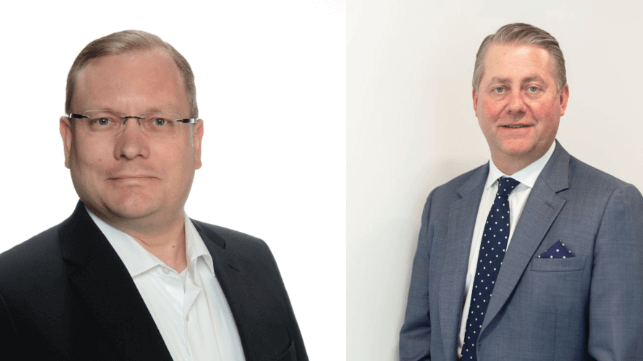
(Left) John Bergman, CEO of Auramarine & (right) Jason Miles, CEO of Quadrise

Published Nov 27, 2024 12:44 PM by The Maritime Executive


[By: Auramarine]

Auramarine Ltd., the leading fuel supply systems pioneer for the marine and other industries and Quadrise Plc, the supplier of innovative clean energy solutions have announced a collaboration agreement to develop innovative solutions that will support maritime decarbonisation The purpose of the co-operation is to leverage the expertise of both companies in emulsion fuels, biofuels and fuel supply systems, providing innovative solutions for marine customers that support them in meeting decarbonisation and sustainability targets.

Quadrise will provide its expertise in MSAR®; (Multiphase Superfine Atomized Residue) and bioMSAR™ fuels. MSAR®; is a more environmentally friendly emulsion fuel that offers a lower-cost and is a cleaner alternative to heavy fuel oil (HFO) used in the marine and power generation industries. The Quadrise oil-in-water emulsion technology blends residual oils, water and additives to create a lower cost synthetic fuel oil that is more efficient. bioMSAR™ is the renewable biofuel version of MSAR®; incorporating sustainable components such as water-based glycerin and other lower-cost biofuels.

Auramarine will provide its expertise in designing and installing fuel supply systems (including Quadrise’s blend-on-board technology) for the conversion of marine vessels to support the use of Quadrise fuels. Auramarine’s vast experience in retrofits and modular fuel supply systems will enable it to find markets for Quadrise’s fuel technology on a wider scale and across multiple vessel types. Auramarine’s retrofit solutions do not require dry docking which makes implementation easier and more efficient, which provides further value to ship owners.

As part of the co-operation, Quadrise and Auramarine will work together to combine their resources and networks, jointly developing and promoting new sales opportunities that offer a comprehensive value proposition to the shipping industry to help them comply with new environmental regulations.

Commenting on the development, John Bergman, CEO of Auramarine, said: "We are pleased to announce this collaboration agreement with Quadrise, who are driving a positive shift in the marine sector with their proven emulsion technology to improve efficiency, lower emissions and supply new sustainable fuels. The current uptake of future fuels needs to be accelerated to meet decarbonisation targets within the maritime industry and new, viable innovations are essential to delivering this. By combining our strengths and expertise, we are confident that this partnership will drive further innovation and create significant value for our customers and other stakeholders.”

Jason Miles, CEO of Quadrise, continued: "We are delighted to sign this collaboration agreement with Auramarine, who have extensive experience and an enviable track record in the design, supply and servicing of fuel systems for conventional and future fuels. This collaboration is in line with our strategy of working with new channel partners to decarbonise shipping, adding the necessary expertise, network and resources of Auramarine in marine fuel systems to accelerate the implementation of MSAR®; and bioMSAR™ fuel conversions globally."

The products and services herein described in this press release are not endorsed by The Maritime Executive.


Value Group New €2 Million Investment from Energy Transition Fund Rotterdam
Value Group
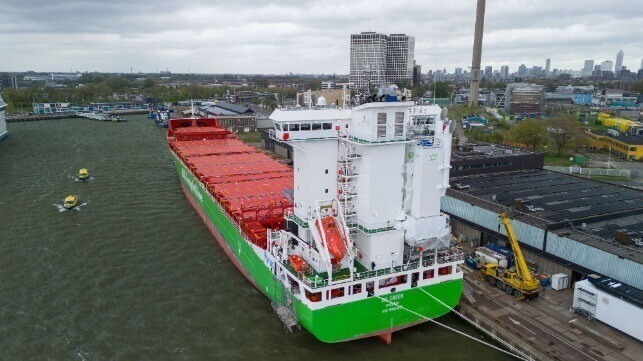
Installation of the Filtree System at the VM quayside in Rotterdam

Published Nov 27, 2024 10:09 AM by The Maritime Executive


[By: Value Group]

Rotterdam-based sustainability innovator Value Group (Value Maritime and Value Carbon) announces that it has secured Energietransitiefonds Rotterdam (‘ETF-R’) as an investor. The fund’s investment will drive the further development of the Value Hub for CO2 offloading and processing in Rotterdam. The technology captures CO2, stores it, and allows it to be effectively reused or stored elsewhere. In the Port of Rotterdam, the maritime industry benefits from emissions reduction enabled by the technology.

Carbon care
Value Maritime, part of the Value Group, is the innovative developer and installer of one of the first commercially viable hybrid CO2 capture and exhaust gas cleaning systems, known as Filtree. This system not only captures and stores CO2 but also cleans sulphur, ultra-fine particulate matter, and CO2 from ships’ exhaust emissions as well as oil residue and particulate matter from the vessels’ washing water. As a result, the Filtree System supports compliance with current and future environmental regulations.

The key to the Filtree System is its integrated carbon capture feature which allows ships to store the CO2 they collect onboard in dedicated fixed tanks or non-fixed battery containers. These onboard storage facilities can then be sustainably offloaded in port for reuse or further storage, managed by Value Maritime’s sister company, Value Carbon.

Value Group Co-Founder and Director Maarten Lodewijks says, “With InnovationQuarter as a new shareholder, Value Group gains a strong strategic partner to accelerate the development of our Value Hub in Rotterdam for CO2 offloading and processing. This partnership not only strengthens the realisation of this Value Hub as a blueprint for future Value Hubs but also drives the ongoing expansion and innovation of our patented Carbon Capture technology.”

Accelerating CO2 handling
With ETF-R’s €2 million investment and further active support from InnovationQuarter, Value Group aims to accelerate the development of its Value Hub in Rotterdam. The Value Hub will manage the CO2 offloading from ships and ensure efficient, sustainable processing.

Meanwhile, a pilot programme in Westland greenhouses demonstrates the technology's practical application. Captured CO2 is released during the day to enhance photosynthesis and plant growth, showcasing a sustainable solution for agriculture.

InnovationQuarter/ ETF-R Senior Investment Manager Reinaud Struycken says, “We are very happy to be able to invest in a sustainable company that supports the reduction of CO2 emissions in Rotterdam and beyond. Their innovative 'catch & release' technology perfectly aligns with our vision for a cleaner and more sustainable Rotterdam. They serve as a prime example of how carbon capture and storage technology can benefit this and other sectors. ETF-R is looking forward to helping Value Group grow.”

Value Group
The Value Group unites two innovative sister companies—Value Maritime and Value Carbon—working together to drive decarbonisation across shipping and industry.

Since 2017, Value Maritime has been at the forefront of maritime sustainability, helping dozens of shipowners and operators boost competitiveness through significant emissions reductions and cost savings. Its cutting-edge technology is designed to reduce the environmental footprint of shipping, contributing to a more sustainable future for the entire maritime industry. The goal is to help transform the way the sector operates, combining cleaner solutions with tangible financial benefits.

Meanwhile, Value Carbon focuses on land-based carbon management, addressing the entire carbon value chain. From carbon capture and handling to innovative reuse strategies, it aims to create efficient systems for storage and “catch and release” initiatives, all with a focus on generating both environmental and financial dividends. Together, the mission is clear: to help our clients achieve valuable emission reductions through sustainable, innovative technologies, backed by a team that is committed to making a real impact.

Rotterdam Energy Transition Fund
The ‘Energietransitiefonds Rotterdam’ is a €100 million investment fund of the City of Rotterdam. The fund finances innovative companies and large sustainable projects that can contribute to Rotterdam's energy transition and circular economy. With the fund, the city aims to reduce CO2 emissions, improve air quality and reduce the use of raw materials. InnovationQuarter acts as fund manager for the Rotterdam Energy Transition Fund.

InnovationQuarter
InnovationQuarter is the regional economic development agency for South Holland. InnovationQuarter manages funds worth more than €300 million. We finance disruptive startups and scale-ups that contribute to a cleaner, smarter, and healthier world. High risk, but also high impact.

The products and services herein described in this press release are not endorsed by The Maritime Executive.


 TOTALLY QUALIFIED, NOT

Trump Picks Investment Manager John Phelan as Next Navy Secretary

The first Trump administration had seven Navy secretaries, a record in the history of the post. 

Jeff & Nicola Marcus, Amy & John Phelan at the Palm Beach Police Fire and Rescue Ball at Mar-a-Lago (Palm Beach Police & Fire Foundation)
John Phelan (right) and his wife Amy with fellow philanthropists at the Palm Beach Police Fire and Rescue Ball at Mar-a-Lago (Palm Beach Police & Fire Foundation)

Published Nov 27, 2024 6:35 PM by The Maritime Executive


President-elect Donald Trump has selected investment manager John Phelan to be the next Secretary of the Navy, replacing former surface warfare officer and shipbuilding reform advocate Cmdr. Carlos del Toro (USN, ret'd). 

"It is my great honor to announce John Phelan as our next United States Secretary of the Navy!" Trump said, in a statement. "John will be a tremendous force for our Naval Servicemembers and a steadfast leader in advancing my America First vision."

According to Politico, other candidates who were considered but not selected included former Navy aviator Rep. Mike Garcia (R-CA) and former Navy doctor Rep. Ronny Jackson (R-TX), Trump's personal physician during his first term in office. 

Phelan is a career-long investment manager who made his fortune running tech executive Michael Dell's personal fund, MSD Capital. In June 2022, during MSD's restructuring, Phelan stepped down from his post as its CEO and chairman "to focus on his personal investment and philanthropic interests." He went on to launch his own investment firm, Florida-based Rugger Management.

Phelan is known as a collector of contemporary art, a conservative political donor and a philanthropist. He and his wife reportedly split their time between homes in Palm Beach and Aspen, and he has been spotted before at Trump's private club in Palm Beach, Mar-a-Lago. Phelan is a Florida native, an avid fisherman, and a member of boards or committees at the Aspen Art Museum, the Whitney Museum, the Museum of Modern Art, the Fish & Wildlife Foundation of Florida and the CIA-focused Third Option Foundation. 

Phelan played a widely-reported role in raising financing for the Trump 2024 presidential run. Earlier this year, he hosted Trump for a headline-grabbing campaign fundraiser at his Colorado home, charging entry fees of $25-500,000 per couple. 

Phelan has no prior experience in the military, the public sector or the defense industrial base. He will be the only Secretary of the Navy since at least the Second World War to take the role without previous participation in the national defense establishment, whether in uniformed service, congressional oversight, political leadership or private-sector manufacturing.  

"It might help that he has a personal relationship with the president. However, his lack of experience in defense and the Pentagon will hurt the Navy," CSIS adviser Mark Cancian told the Washington Post, noting that the Navy is starved of funding and will need politically influential leadership in order to build up its fleet. “It will take him a while to learn the levers of power.”

Phelan's nomination will require approval by the Senate, and he will serve at the pleasure of the president. The first Trump administration had seven Navy secretaries, a record in the history of the post. 


THE WAR AT SEA

Philippine Coast Guard Finds Illegal Chinese Crew on Local Dredger

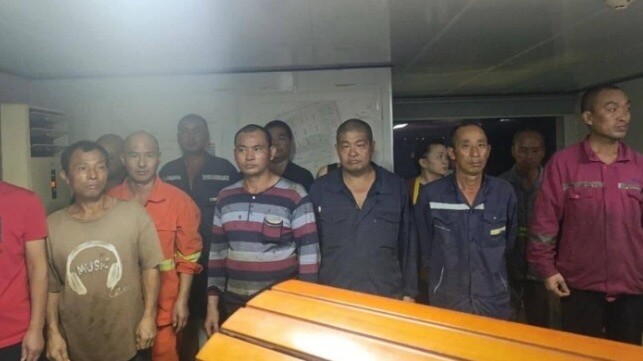
Chinese crew on dredger
Courtesy PCG

Published Nov 27, 2024 11:31 PM by The Maritime Executive


On Tuesday, the Philippine Coast Guard boarded a domestic dredging vessel at an anchorage near Manila and discovered that a large share of the crew were undocumented Chinese nationals - four of whom attempted to hide from the authorities during the inspection. 

At about noon on Tuesday, the shipping agent for the Philippine-flagged dredger Harvest 89 (IMO 8591457) contacted the Philippine Coast Guard to notify the PCG of the vessel's planned departure. The ship was bound for San Felipe, Zambales for a domestic dredging contract. A vessel named Harvest 89 does not exist in international shipping databases, but the IMO number corresponds to the aggregates carrier Mao Hua 8, owned by Oromarine Shipping. The vessel was originally Chinese-registered, and was flagged into the Philippine registry in 2022.

When the PCG attempted to board the vessel for a pre-departure inspection, the agent attempted to prevent the officers from boarding. He allegedly told them that the ship's paperwork was correct and that there was no need to come aboard. In response, the PCG station decided to carry out a full inspection of the ship.  

The boarding team found nine undocumented Chinese crew members, all without proper papers. The vessel's crew manifest named only eight Filipino crew members. Philippine cabotage laws require that all crewmembers on vessels in domestic trade - like Harvest 89 - must be Philippine nationals. 

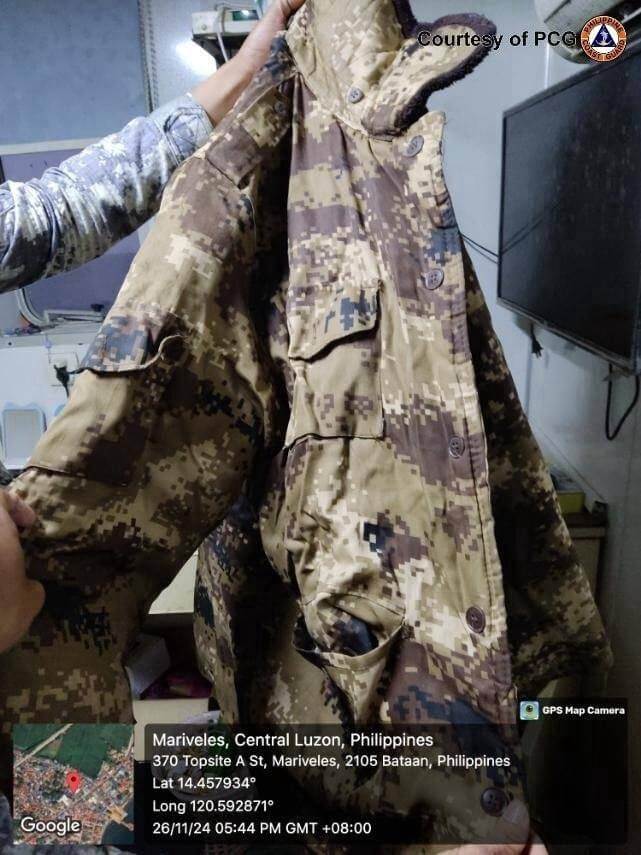
During a follow-up inspection, PCG officers found four more undocumented Chinese nationals who were trying to hide on board, bringing the total to thirteen. They also found one military-style uniform in a digital camouflage pattern, similar to People's Liberation Army fatigues. For the PCG, which faces off with Chinese forces in the South China Sea every day, the uniform raised "significant concerns regarding the intentions of these undocumented individuals."

Image courtesy PCG

The agency released the names and birthdates of every undocumented Chinese crewmember on board, and said it is working on options for legal action and detention of the unauthorized foreign crewmembers. 

"We will continue our vigilant inspections and take necessary actions to address any violations of maritime laws," said PCG spokesman Jay Tarriela in a statement. 

On the same day as the inspection on Harvest 89, shipowner Oromarine posted an "urgent" job recruitment notice on its Facebook page, seeking officers for a dredging vessel / sand carrier of about the same size. The firm says that it is in need of a new master, chief mate, second mate, second engineer and third engineer for the vessel.


Understanding Indonesia's Gambit With China in the South China Sea

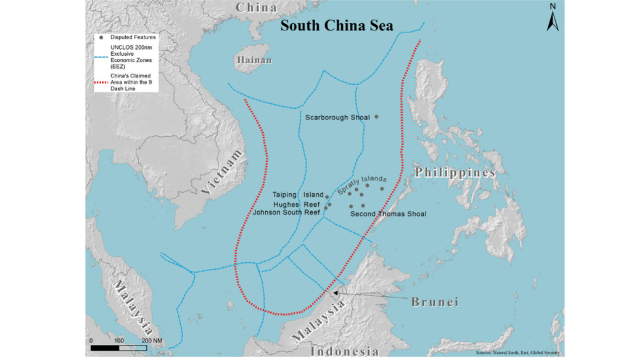
Nine Dash Line
China's nine-dash line claim, red line, and neighboring states' EEZs, blue lines (Courtesy U.S. State Department)

Published Nov 27, 2024 10:53 PM by The Lowy Interpreter


[By Emirza Adi Syailendra]

China and Indonesia recognise that they have overlapping claims in the South China Sea. However, this should not be construed as Indonesia’s acknowledging the legitimacy of the nine-dash line. Mutual recognition of disputes by both parties does not automatically give credence to the other party’s claim. Likewise, merely denying the existence of a dispute does not negate its reality. As the International Court of Justice noted in the Interpretation of Peace Treaties case: “Whether there exists an international dispute is a matter for objective determination.” These legal principles are essential to understanding the dynamics between Indonesia and China and the significance of their recent 2024 Joint Statement during President Prabowo Subianto’s visit to Beijing on 9 November.

Some critics argue that Indonesia has yielded to China, recognised the “nine-dash line”, or demand that Prabowo refrained from executing the statement by establishing bilateral cooperation to manage disputes. But recognising the existence of disputes does not signify Indonesia yielding to Beijing but acknowledges a natural progression in response to China’s assertive stance. Indonesia’s acknowledgment of disputes with China in the Joint Statement simply recognises the reality that disputes already existed because both sides have used legal arguments against one another since mid-2016.

As legal scholar Christopher Schreuer has previously observed, “Very little is required in the way of the expression of opposing positions by the parties to establish a dispute. In particular, the denial of the existence of a dispute by one party will be to no avail.” Therefore, Indonesia’s options are limited to shaping domestic rhetoric around these disputes, rather than preventing their existence. This should not necessarily be viewed as yielding to China.

Nevertheless, this joint statement is notable, even though its significance needs to be put into perspective.

Although Indonesian policymakers have previously floated ideas of joint cooperation in the Natunas with China, including Foreign Minister Marty Natalegawa in 2014 and Coordinating Minister of Maritime Affairs Luhut Panjaitan in 2016, this is the first time such intent has been formalised in writing. It departs from Indonesia’s longstanding policy of denying disagreements over whether China’s nine-dash line intersects with Indonesia’s Exclusive Economic Zone (EEZ) in the Natunas.

Since 1995, following Indonesia’s then foreign minister Ali Alatas’ visit to Beijing, Jakarta and Beijing had for a long time maintained that no disputes exist, downplaying any potential disagreements. Even in March 2016, when China Coast Guard vessels intervened as Indonesia attempted to seize a Chinese fishing boat, Kway Fey, caught in the Natuna EEZ, China’s foreign ministry spokesperson Hua Chunying dismissed the incident, reiterating that “Indonesia has no territorial claims over China’s Nansha Islands, and China fully agrees that the Natuna Islands belong to Indonesia.”

But a shift occurred in the months afterwards. For the first time, in response to a subsequent standoff between the Indonesian Navy and two CCG vessels that attempted to stop the arrest of a Chinese fishing boat, China employed a legal argument against Indonesia: “This took place in waters which are Chinese fishermen’s traditional fishing grounds and where China and Indonesia have overlapping claims for maritime rights and interests.” (emphasis added) China had used such a legal point against other South China Sea disputants, but not against Indonesia.

Indonesia countered by citing the UN Convention of the Law of the Sea, arguing that traditional fishing grounds are not legally recognised. As Indonesia and China began presenting legal arguments against each other – China relying on historical claims and Indonesia invoking UNCLOS – it marked the start of a formal dispute over fishing rights.

Foreign fishing vessels that have been captured and sunk in Natuna waters near Lagong island in Riau Islands province, Indonesia (Bay Ismoyo/AFP via Getty Images)

By 2021, Chinese fishing activities and law enforcement encroachments in the Natunas had become frequent. In response, Indonesia inaugurated a new military unit in the Natunas in 2019, conducted large-scale military exercises in 2020 and 2021, and intensified its defence diplomacy with the United States, focusing on border defence. Against this backdrop, China sent a diplomatic note in August 2021, demanding that Jakarta cease its activities in the Tuna Block. China’s denial of Indonesia’s right to drill gas within its continental shelf marked an expansion of its claim from traditional fishing grounds to broader maritime jurisdiction.

By this point, based on my fieldwork in Jakarta in the early 2022, key factions within the Jokowi administration had come to see denying disputes as no longer viable—a perspective that has persisted into Prabowo’s administration.

Interviews with stakeholders in 2022 revealed that the Jokowi administration was exploring alternative approaches, including those now enacted by Prabowo, and concluded that a tacit understanding allowing both sides to coexist in contested regions was preferable. Prabowo has evidently taken this a step further, offering to recognise the existence of overlapping claims with Beijing in exchange for Beijing’s support for Indonesia’s own domestic and geopolitical goals, particularly regarding its ambition to be part of Electric Vehicle global value chain.

Recognising disputes, as Prabowo has done, creates new opportunities – either for aggressively contesting Beijing’s nine-dash line through an international tribunal, as the Philippines has done in the past, or for managing tensions while shelving disputes. Jakarta and Beijing have favoured the latter approach since the joint statement was issued.

Jakarta might continue to deny being a claimant in the South China Sea disputes, as it does not claim any features in the Spratlys or Paracels. However, by acknowledging the disputes, it could collaborate with other Southeast Asian claimants to influence their resolution – whether through the conclusion of the long negotiations for a Code of Conduct or other mechanisms.

The question remains: can Prabowo solidify the alleged benefits of Beijing formally acknowledging these disputes?

Emirza Adi Syailendra is a PhD Scholar at the Strategic and Defence University, the Australian National University. He is also a Co-Investigator of a Strategic Policy Grant on Indonesia’s Maritime Strategy.

This article appears courtesy of The Interpreter and may be found in its original form here

The opinions expressed herein are the author's and not necessarily those of The Maritime Executive.

ALT. FUELS

Maersk Names Next Methanol Ship for Founder A.P. Møller

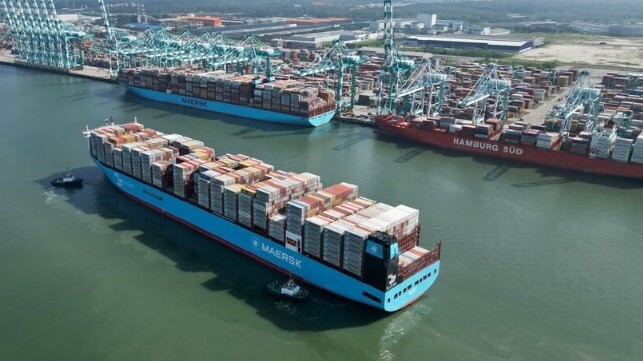
Maersk containership
Maersk's new generation vessel arriving with the older vessels on dock (Maersk file photo)

Published Nov 28, 2024 1:39 PM by The Maritime Executive


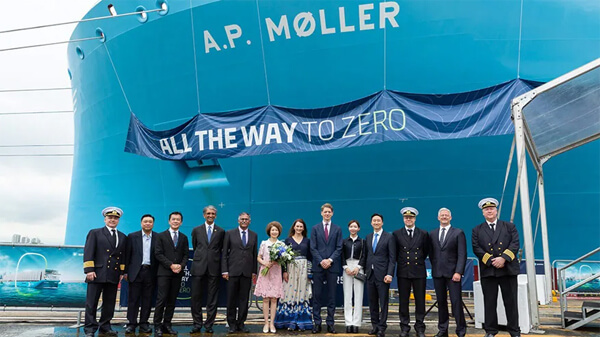
The rollout of Maersk’s dual-fuel methanol containerships continued with the naming ceremony in Singapore for the A.P. Møller. The vessel, which is the ninth in the line’s fleet able to operate on methanol was named in honor of Arnold Peter Møller, founder of the company.

A.P. Møller (174,000 dwt) is part of the series of 18 large dual-fuel methanol vessels being built for Maersk and scheduled for delivery in 2024 and 2025. Built at Hyundai Heavy Industries in Ulsan, South Korea, she can carry 16,592 TEU. Maersk reports she is the seventh of these large dual-fuel methanol vessels to join the Maersk fleet in 2024, following sister ships including Ane Maersk which was the first of the class which was named in January. Others include Astrid Maersk, Antonia MaerskAlette Maersk, and Alexandra Maersk.

The newest vessel of the class, A.P. Møller departed from Ningbo, China on November 16 to start her maiden voyage. She has made stops in Shanghai, Nansha, and Yantain, China before arriving on November 27 in Singapore. She is due to depart on November 29 with her next scheduled stops in Malaysia and Sri Lanka. Ms. Chan Su-Shan, the wife of the CEO of Temasek Holdings was the godmother of the vessel during the ceremony on November 28.


Naming ceremony for the newest vessel took place in Singapore during its maiden voyage (Maersk)


“Today marks a significant milestone in our journey of decarbonizing the maritime industry,” said Murali Pillai, Minister of State, Ministry of Law and Ministry of Transport in Singapore during the naming ceremony. “The arrival of A.P. Møller in Singapore not only showcases the advancements in shipping technology but also reinforces our commitment to support solutions that can reduce greenhouse gas emissions.”

Singapore officials highlighted that the port also conducted the inaugural ship-to-containership methanol bunkering for the Laura Maersk in July 2023. The feeder ship was the first introduced built to operate on methanol. Maersk also recently completed the first conversion of an in-service containership to dual-fuel methanol capabilities. 

The delivery of the dual-fuel fleet Maersk highlights as a significant component of its decarbonization goal of achieving net-zero greenhouse gas (GHG) emission by 2040. During a press briefing in Singapore, Maersk told reporters that alternative fuel last year accounted for just three percent of the approximately 10 to 11 million metric tons of fuel it uses each year. 

The line projected its alternative fuel use would probably rise to between 15 and 20 percent by 2030. They noted that however, the fuel strategy anticipates that it will be using a combination of biodiesel, green methanol, and bio-methanol. They have discussed the supply concerns for alternative fuels while again emphasizing the price gap and the need to support the transition to alternative fuels.

The new vessel, A.P. Møller reportedly loaded 500 metric tons of green methanol before it departed the HD Hyundai Heavy Industries shipyard earlier in the month. The new large dual-fuel vessels have the capacity to carry 16,000 cubic meters of methanol for a trip from Asia to Europe and back to Asia. The vessels are powered by MAN dual-fuel engines.


Hapag-Lloyd Follows Maersk with Large Methanol Supply Agreement from China

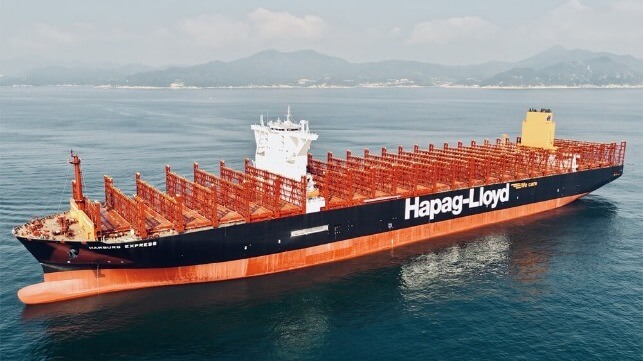
Hapag-Lloyd containership
Hapag secured supplies of green methanol for its new fleet as it continues the introdcution of its LNG-fueled vessels (Hapag-Lloyd)

Published Nov 28, 2024 6:09 PM by The Maritime Executive


Hapag-Lloyd Follows Maersk with Large Methanol Supply Agreement from China

Germany shipping major Hapag-Lloyd reports it has completed a long-term supply agreement with Chinese energy company Goldwind to ensure a source of green methanol for the long-term power of its vessels. The deal comes almost a year after its soon-to-be partner Maersk completed a similar supply deal with Goldwind.

The new agreement is for the delivery of 250,000 tones of green methanol per year to Hapag-Lloyd. It will consist of a blend of bio- and e-methanol, ensuring greenhouse gas emissions reductions of at least 70 percent according to Hapag. As a company, Hapag-Lloyd aims to reduce the absolute GHG emissions of the fleet by around one-third compared to 2022. Compared to conventional fuels, the company reports the ordered quantity of green methanol can save a total of up to 400,000 tonnes of CO2e emissions in fleet operations per year.

“With the agreement, we are securing a significant proportion of our requirements for green fuels,” said Rolf Habben Jansen, CEO of Hapag-Lloyd. “This will bring us an important step closer to our goal of achieving net-zero fleet operations by 2045. It is and remains our ambition to play a leading role in the transformation of the liner shipping industry.”

Hapag is set to launch its new cooperation called Gemini with Maersk. Both companies have ambitions to be at the forefront of the transition and now both have long-term supply agreements with Goldwind. In November 2023, Maersk signed an offtake agreement calling for annual volumes of 500,000 tons of green methanol. At the time, Maersk called it the first large-scale green methanol offtake agreement for the global shipping industry.

Early volumes of the supply are expected to begin in 2026. Goldwind also plans to build a new green methanol factory adjacent to its existing project in Hinggan League, in northeast China. Goldwind plans to produce the fuels utilizing wind energy.

“The planned new factory will share technology, utilities, facilities, and infrastructures with its neighboring sister plant, boosting production efficiency,” said Liu Rixin, Head of Goldwind Green Methanol. It is still subject to the financial investment decision of the Goldwind board. We anticipate the completion of a megaton green methanol base in Hinggan League in late 2027.”

Maersk highlights the supply will be critical for its fleet of dual-fuel methanol containerships that it is in the process of rolling out. The seventh vessel was named today in Singapore.

Hapag earlier in the month announced a massive $4 billion investment in 24 new vessels. The orders include a dozen 9,000-TEU vessels from New Times Shipbuilding and a dozen 17,000-TEU vessels from Yangzijiang Shipbuilding. The company this month also marked the delivery of number eight in a series of 12 large, 23,660 TEU, LNH containerships being built by Hanwha Ocean (formerly Daewoo) as part of its fleet transition plan. Hapag also converted one in-service vessel starting in 2020 to LNG and recently announced a plan with Seaspan to convert five 10,100 TEU containerships on long-term charter to dual-fuel methanol operations starting in 2026.

Gasum has also agreed to provide Hapag-Lloyd with bio-LNG to fuel containerships sailing between Singapore and Rotterdam in 2025 and 2026. The supply that will meet Hapag’s obligation under its contract with the cargo owners project, ZEMBA, where it won the first bidder for a volume of low-carbon shipping from the buyers alliance that unites major shippers including Amazon, Patagonia, Bauhaus, New Balance, Nike, REI, and others. Gasum will bunker Hapag-Lloyd’s containerships with a total amount of 20,000 mt of bio-LNG during 2025-2026.

Copenhagen Infrastructure Partners Plans Ammonia Shipping Newbuilds

ammonia-fueled tanker
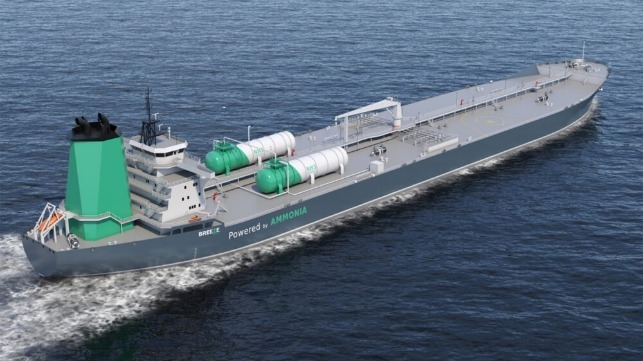
Faerder Tankers worked with Equinor and Wartsila on the development of an ammonia-fueled Aframax tanker (Faerder Tankers)

Published Nov 27, 2024 6:28 PM by The Maritime Executive


The well-known Danish fund manager Copenhagen Infrastructure Partners (CIP) which focuses on renewable energy investments is moving forward to develop ammonia-fueled carriers to lead in the energy transition. Its Energy Transition Fund entered into agreements with Norwegian shipping company Faerder Tanks and with Singapore-based BW Epic Kosan to develop one of the first fleets of ammonia-fueled ammonia carriers with a goal of launching an end-to-end solution for ammonia to be used by the shipping industry.

CIP is a leader in segments of the energy transition well-known for its investments in wind energy as well as pioneering projects in hydrogen and industrial-scale Power-to-X projects. The investment group is pursuing ammonia production with facilities to be located in Australia, South America, and Mexico and now looks to connect the supply and demand with a fleet of ammonia carriers. The goal is to deliver comprehensive, end-to-end solutions for ammonia-fueled tankers, promoting the green transportation of clean ammonia.

“Our objective is to facilitate the green transportation of clean ammonia by utilizing the cargo as fuel,” said Niels H. Lindegaard, Senior Business Advisor at CIP. “The dialogue with leading companies has given us valuable industry insights and the ability to develop safe and robust end-to-end bunkering solutions as well as first-hand knowledge about critical developments and maturity of solutions.”

Working with Faerder Tanks, CIP has entered into a Memorandum of Understanding to develop a 50,000 cmb ammonia carrier. CIP reports the vessel will feature high maneuverability and ship-to-ship bunkering capabilities, setting a new standard for medium gas carriers (MGCs). The first vessel, expected to join the fleet in the second half of 2028, is based on the successful MGC sector which they highlight has become a workhorse of the shipping industry.


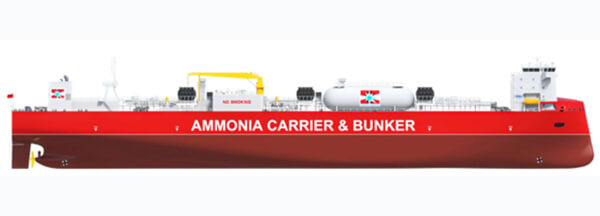
Faerder Tankers highlights the innovative features of the design for its 50,000 cbm ammonia vessel to be built for CIP (Faerder)


Faerder Tankers is calling the vessels the next generation of MGCs. CEO Capt. Paal Stenberg said, “These innovative vessels represent a breakthrough in design and functionality, combining state-of-the-art dual-fuel ammonia engines, superior maneuverability, and unparalleled bunkering capabilities—all within the trusted framework of today’s MGCs.”

They highlight the vessels will be equipped with dual-fuel ammonia engine, high maneuverability with retractable bow thruster and aft thruster, and full ammonia bunkering capabilities, all within the physical dimensions of today's MGCs. Each vessel will feature front accommodation for crewmembers and a 360-degree view from the bridge. Faerder says the design will enhance control during bunkering and ship-to-ship operations, while also improving hydrodynamics and fuel consumption efficiency. 
Faerder Tankers, which was launched in 2018, worked in a multi-year partnership that was led by Equinor and involved Wartsila to develop a pilot ammonia-fueled Aframax tanker. The design concepts were presented in April 2023.

In a parallel effort, CIP and BW Epic Kosan plan to develop handy-sized ammonia carriers equipped with dual-fuel ammonia engines and bunkering capabilities. BW Epic Kosan will time charter a number of dual-fuel ammonia gas carriers ranging from 9,000 cbm to 35,000 cbm to CIP’s ETF or its subsidiaries.

CIP also reports that it is in “advanced discussions: with major shipping operators to develop Very Large Ammonia Carriers (VLACs). They would be used for its large-scale projects designed to build the end-to-end solution in the supply of ammonia as a fuel for shipping.

The investment group looks to develop an early leadership position in the emerging ammonia sector. A few ammonia-fueled tankers have already been ordered to be built in South Korea while much of the shipping industry continues to follow engine manufacturers' progress in commercializing ammonia-fueled marine engines. 

HMM Joins Ranks of LNG Boxship Companies with Korea’s First LNG Vessels

LNG containership
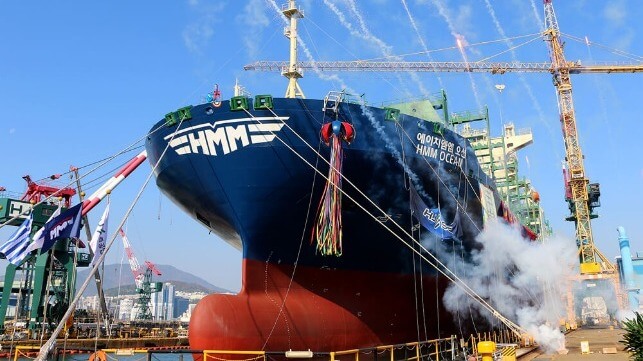
HMM marked the name of its first two LNG-fueled containerships (HJ Shipbuilding)

Published Nov 25, 2024 7:31 PM by The Maritime Executive


Shipping companies operating LNG-fueled vessels were part of an elite club that is continuing to grow and is now being cited as a fleet differentiator. South Korea’s HMM celebrated the name of its first two LNG-fueled containerships along with HJ Shipbuilding & Construction which called the vessels a key part of its re-entry into the commercial shipbuilding market.

The ceremony took place in Busan, South Korea at the HJ Shipbuilding yard on November 21. The two vessels, each with a capacity of 7,700 TEU are another example of the mid-sized segment converting to LNG following the large vessels which were among the first to adopt LNG.

HMM reports the ships, named HMM Ocean and HMM Sky, will enter service in January 2025. They will be deployed on its Far East-India-Mediterranean service. They will be both the first LNG containerships for the line and South Korea. HMM Ocean and HMM Sky are each 892 feet (272 meters) and are registered in Liberia.

The ships are part of a $240 million contract placed by Greece’s Navios Maritime Partners in 2022. HMM reports it has entered into a long-term charter for up to 14 years to operate the two vessels. They are part of the line’s efforts at further expansion and adopting alternative fuels. HMM also ordered in 2023 nine methanol-powered containerships to be built by HD Hyundai Heavy Industries and HJ Heavy Industries for delivery starting in 2026. HMM highlights that it plans to invest more than $10 billion to strengthen its eco-friendly competitiveness.

LNG has grown in popularity among shipowners as an available fuel option that will also permit future transitions to green fuels. Emerging just a decade ago, LNG continues to grow in adoption. DNV calculates that there are over 600 vessels worldwide now in service using LNG. This includes over 120 containerships with DNV calculating a further 300 LNG-fueled containerships are currently on order. LNG is only being challenged by methanol as the most common fuel type for new orders while Alphaliner calculated that 55 percent of the orders this year were for LNG dual-fuel vessels.

Zim, another mid-size operator, joined the LNG ranks in 2023 and is adding a total of 24 LNG vessels as part of a fleet construction program for a total of 46 vessels. Speaking to investors on its recent earnings call Zim cited the benefits of being an early adopter of LNG. They said it has provided both environmental and financial benefits, with LNG being 25 percent more efficient and consistently cheaper than LSFO. When Zim completes its new ship deliveries, 40 percent of its capacity will be on LNG-fueled vessels.

HMM’s president Kim Kyung-bae said during the naming ceremony that the new LNG vessels will be “a great help to HMM’s operations.”

HJ Shipbuilding highlights that it returned to commercial shipbuilding in 2021 due to the strong demand in the market and they are focusing on the 5,000 to 9,000 TEU midsized containership segment. They have also built six 5,500 TEU vessels and in June 2024 received an order from Navios for two 7,900 TEU vessels as well as an option for two more ships of the class.


Passengers Return to Ferry After it is Refloated off Fiji

ferry Fiji
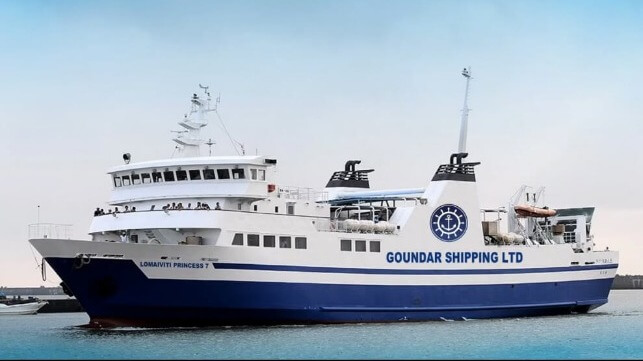
Lomaiviti Princess and interisland ferry grounded with 245 passengers aboard (Goundar Shipping)

Published Nov 28, 2024 3:51 PM by The Maritime Executive


The Maritime Safety Authority of Fji and a local ferry company called Goundar Shipping are reporting the safe recovery after one of the company’s ferries grounded overnight. The authorities had been closely monitoring the situation as 245 passengers were aboard the stranded vessel.

Lomaiviti Princess VII (600 gross tons) was underway on Wednesday, November 27, when it stranded on a reef near Moala Island, the ninth-largest island of Fiji, located southeast of the capital of Suva. The ferry, which was built in Japan in 1992, has been sailing under the flag of Fiji since 2019. She is a Ro-Ro with a length overall of 216 feet (66 meters) and a capacity for up to approximately 150 cars or 40 trucks. It is unclear what the total passenger capacity is for the vessel.

The Maritime Safety Authority was informed of the grounding at approximately 7:00 p.m. local time and said an emergency response was immediately begun. Life jackets were supplied to the 245 passengers onboard and the 33 crewmembers. They reported that there were no signs of a hull breach and that water ingress had not been reported.


The first efforts to refloat the vessel were unsuccessful. Another of the company’s ferries, the Ro-Ro Lady Daya, another Japanese-built ferry that is 1,500 gross tons, was directed to meet up with its stranded fleet mate. The passengers were transferred to the second ferry for their safety, but at high tide, the reports said they were able to refloat the stranded vessel.

Divers inspected the hull of the Lomaiviti Princess VII and determined that the ship had not suffered significant damage. The decision was made to return passengers bound for Totoya and Matuka to the first vessel, and it is again underway. Passengers bound for Moala remained on the Lady Daya which resumed its trip after an approximate 12-hour delay. She will then proceed to Sava.

The company has a checkered history and has apologized to Fijians for its poor service. In 2019, the Fiji Maritime Authority reported it would stop the operation due to safety concerns. This year, the Lomaiviti Princess VII got stuck at Vunisea Jetty on Kadavu Island in March and had to be towed to Suva. Goundar Shipping in July launched the newly acquired Lady Daya and apologized for past service problems, especially in the prior six months. Goundar told FBC News it was confident that it could win back the trust of the passengers.


USN’s First Forward-Deployed Virginia-Class Sub Arrives in Guam

Minnesota fast-attack submarine
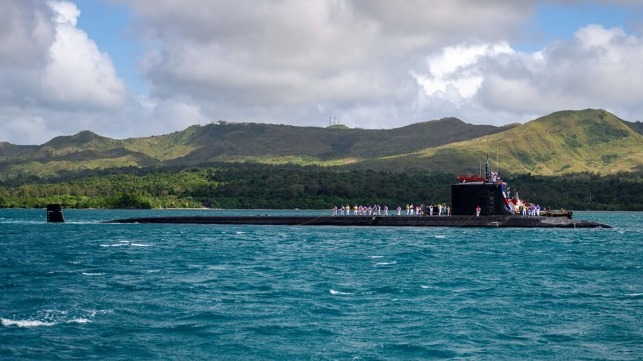
USS Minnesota became the first forward-deployed Virginia-class nuclear fast-attack sub to arrive in Gaum (USN)

Published Nov 27, 2024 4:05 PM by The Maritime Executive


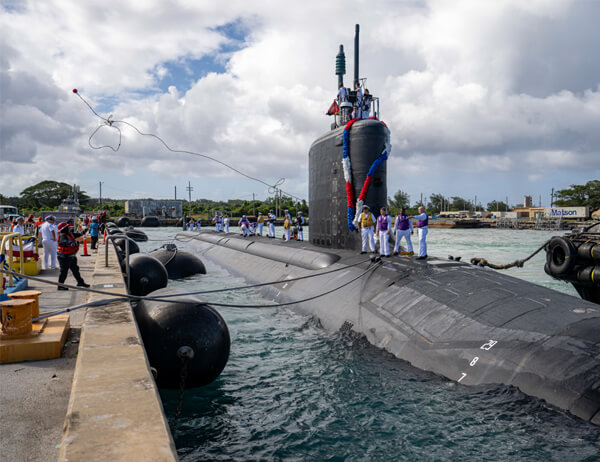
In a move that is seen by analysts as a critical strategic step to counter both China and North Korea, the U.S. Navy reported the USS Minnesota arrived on November 26 at its new homeport of Naval Base Guam. It is the first of the new, more powerful Virginia-class fast-attack submarines to be forward deployed to Guam.

"Guam serves as a strategic outpost in the Western Pacific, playing a vital role in maintaining stability across the region,” said Capt. Neil Steinhagen, commander, Submarine Squadron 15. “With its motto, 'From the North, Power,' Minnesota embodies the strength and resolve that will make it an exceptional addition to our forward-deployed submarine force. Its presence will enhance our operational capabilities and further strengthen deterrence efforts throughout the Indo-Pacific.”

Commissioned September 7, 2013, in Norfolk, Virginia, Minnesota became the 10th Virginia-class submarine in service and part of the Navy’s next-generation fleet. The vessels at 377 feet (115 meters) and a displacement of 7,800 long tons, are considered to be the premier nuclear submarines and will serve as the replacement for the older 6,000 ton displacement Los Angeles-class (362 feet / 110 meters). 

Minnesota, which had been homeported in Honolulu since 2022, has a crew of approximately 140 sailors. The Navy highlights it is capable of supporting various missions, including anti-submarine warfare, anti-surface ship warfare, strike warfare, and intelligence, surveillance, and reconnaissance.

The Virginia-class was introduced by the namesake of the class in 2004 and the latest order was reported in October 2024. Currently, there are 23 in service with number 24 due to enter service early in 2025. An additional 15 are either under construction or commissioning or announced orders. The Virginia-class is now as large as the remaining in-service Los Angeles-class which was built from 1972 to 1996. 


Minnesota was redeployed from its homeport in Honolulu to Guam as part of the Navy's strategic laydown plan for the Indo-Pacific region (USN)


“The security environment in the Indo-Pacific requires that the U.S. Navy station the most capable units forward,” wrote the Navy announcing the arrival of the submarine in Guam which the Navy said was part of its strategic laydown plan for the Indo-Pacific. “This posture allows flexibility for maritime and joint force operations, with forward-deployed units ready to rapidly respond to deter aggression and promote a peaceful and prosperous Indo-Pacific region.”

Minnesota joins four Los Angeles-class fast-attack submarines forward deployed in the Pacific. The Navy called Guam’s fast-attack submarines “the tip of the spear, helping to reaffirm the submarine forces’ forward-deployed presence in support of a free and open Indo-Pacific.”

It is also part of a significant, ongoing investment by the United States into its presence on Guam which is viewed as a critical deterrent and show of force in the region. Guam is just 1,800 miles from China’s East Coast. In 2021, the Pentagon outlined plans for an investment of $11 billion to expand the military infrastructure on Guam. The airbase and other facilities are being upgraded and a new Marine base is being built able to handle up to 5,000 personnel. It is Guam’s first Marine base since 1952.

The Navy said the crew of Minnesota looks forward to being integrated into the operations and becoming part of the local community


submarine-warfare-an-illustrated-history.pdf