Friday, November 29, 2024

Kalkan: The PKK always seen Kurdish freedom in the democratization of Turkey and the Middle East

The Kurdish freedom movement is entering a new year of struggle. This transition is characterized by various discussions. While the international pressure for the release of the peoples leader Abdullah Öcalan is increasing, and accordingly the demand for

ANF
BEHDINAN
Thursday, 28 November 2024, 07:50

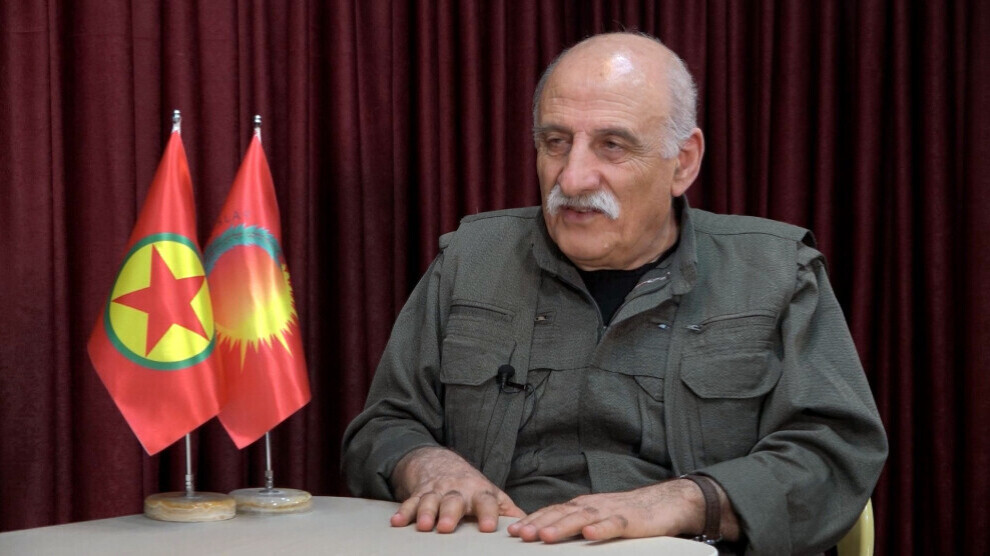
In the fifth part of this in-depth interview, Duran Kalkan, member of the KCK Executive Council, spoke about the 46th anniversary of the PKK as well as the way the organization will enter the new year of struggle.

The first part of the interview can be read here, the second part here, the third part here, and the fourth part here.

The Kurdish freedom movement is entering a new year of struggle. This transition is characterized by various discussions. While the international pressure for the release of the peoples' leader Abdullah Öcalan is increasing, and accordingly, the demand for a democratic solution to the Kurdish question, the Turkish state is trying to escape this, trying to play with the agenda and creating false expectations. What can you tell us about this?

The PKK is entering its 47th year of struggle more prepared, planned, and determined than ever before. We will develop the 47th year struggle with the central aim of physically liberating Rêber Apo [Abdullah Öcalan] , becoming stronger in every field and achieving important results. This is our stance; this is how we enter the year. Based on this, we salute the 47th anniversary of our party and call on all comrades, our people, and international friends to struggle harder and be even more successful in the 47th year struggle.

Not long ago, we received the greetings of Rêber Apo. I greet him with deep longing and respect. On the occasion of the 46th anniversary of the founding of the PKK, I congratulate Rêber Apo’s. I state that in the 47th year we will fight stronger and achieve greater success following the path of the Rêber Apo and the party.

On October 23rd, Rêber Apo’s nephew Ömer Öcalan came to Imrali, and they held a meeting. Rêber Apo expressed the situation clearly in this meeting. He expressed essentially two points: firstly, the isolation continues, and secondly, he said that if the appropriate conditions are created, he has the power to play a role, to play a role in the solution of the Kurdish question and democratization. While revolutionary, democratic, and patriotic circles are discussing and trying to understand what Rêber Apo expressed in order to take steps, other circles are speculating in a negative way and searching for ways to ensure their own interests.

The developing struggle and the level that the Third World War has reached, which continues on a global scale, have indeed put the Turkish state, particularly the AKP and MHP fascism, into a complete deadlock and brought it to collapse. This catastrophe is stemming from the state’s anti-Kurdish colonialist, genocidal mentality, and politics, and mainly from the AKP and MHP fascist dictatorship. We were warning them many times that they were dragging Turkey into a catastrophe. But they did not listen; they did not want to listen; they did not want to understand. Now that reality has caught up with them and imposed itself on them, they started to panic. They started to speak about Kurdish-Turkish brotherhood, called for national unity, expressed their fear of Israel attacking them, and said Rêber Apo should come and speak in the parliament. But they didn’t just invite him to talk, as if he is in a position where he can go wherever he wants and speak wherever he wants; they wanted to force him to declare the liquidation of the movement.

The Turkish press is a center of special and psychological warfare, and they are doing heavy propaganda, claiming and speculating many things, many of them far away from any reality. They are trying to discuss Rêber Apo in the same way. It has become clear that they have made no preparations for the circumstances they are currently facing. When they realized the danger that they were facing, they started to put forward some things in panic and try to divert the agenda. They want to direct public opinion.

Our global freedom campaign aiming for the physical liberation of Rêber Apo has faced a lot of difficulties. It exposed the system of isolation, torture and genocide of Imrali. This exposure has spread all over the world. Now, everyone is aware of this situation. Politicians, lawyers, artists, academics, intellectual circles, women, young people, all kinds of societies, and peoples. No one who hears about the Imrali system can fit it into any form of law and morality. Everyone who hears about the Imrali system demands the freedom of Rêber Apo. Accordingly, there is very serious pressure created by this. Obviously, the conspirators wanted to alleviate it, to weaken it, to loosen our level of action. They started with random discussions, dropping a word here or there, creating hopes and expectations, trying to change the general agenda in order to push through their own and thus weaken the struggle. That was their calculation.

But their masks fell rather quickly. Indeed, the action by comrades Asya and Rojger revealed everything. It destroyed their calculation, the game. It unmasked them. Our people should not listen to the games of the conspirators. They have no meaning, no value. They say a lot of things about us, about the PKK. None of them are true. They are hoping that if they say something, it may be totally wrong and empty, and repeat it dozens of times, people will start to believe it. Therefore, no one should pay attention or listen to them. As Rêber Apo clearly put it, the isolation continues. That indicates the necessity to struggle against it. He said that if appropriate conditions are met, he is able to play a role. That means we should focus on this. How can appropriate conditions be created? Through struggle. So the duty falls on us, on everyone of us, to increase the struggle further. The guerrillas must struggle more intensely, as must the people in the four parts and abroad, particularly the women and the youths. Everywhere we must develop our struggle for the physical freedom of Rêber Apo. There must never be any misconception, regression, or relaxation in this regard. But I’m convinced that no one will fall for their games anyway. However, it may be that some people have question marks in their heads, which is why we want to show them the real situation.

On November 16th in Cologne, Germany, our people once again revealed their stance. On February 17th, the global freedom campaign had a peak, and it marked the point from when this campaign started to be a mass mobilization. The Kurdish people, their international friends, those who organize and carry out the campaign abroad had clearly expressed their loyalty to Rêber Apo, how much they want Rêber Apo’s physical freedom, and how much they see themselves in this freedom. What was shown back then in February was now again made clear a couple of days ago in the rally in Cologne. Also, the protests of our people, women, and youth continue in all four parts of Kurdistan. The people are standing up in Rojava and also in northern Kurdistan; the resistance against the attack of implementing trustees continues uninterrupted. The Turkish state never stopped attacking and continues to conduct massacres.

While on the one hand, they block and forbid Rêber Apo from meeting his relatives or lawyers, they try to confuse people’s minds day and night through the organs of the special war they call the press. This is a special war, and people must not believe them. After all, the facts and the situation are clear. They left almost no stone unturned in Rojava. And on November 6, they gave a new six-month disciplinary punishment to Rêber Apo, and eventually they have already prepared the next one to announce in May.

The issue is clear. If they want to do something, they should take some steps; they could do it easily. If they had really changed their mind, renounced their fascist, colonialist, genocidal mentality, and politics, and now favored the solution of the Kurdish question, they could act accordingly. Rêber Apo is in front of them. The Kurds have never let a hand that reaches out to them hang in the air. Now they are not at a level where they cannot understand the situation. That is something they seemingly do not understand.

We can define their agenda as fabricated, developed to create grounds for new fascist attacks, to create grounds to realize through fascist usurpation what they could not get through elections. Without being fooled by these, we will develop and deepen our struggle for Rêber Apo. We need to raise an uproar against the ban on visits with lawyers and family members. We need to expose them in legal circles all over the world. There is no justification for the ways they act. The ongoing discussions have nothing to do with reality. It’s all a game. We as a whole people, in the four parts of Kurdistan and our international friends abroad, develop our global freedom campaign and take up the struggle. We will enrich actions everywhere, making them more permanent and more result-oriented. We will develop new methods of action. Like this, the truth will come out. Everything will become clear.

The PKK is entering its 47th year and can look back on a long history of resistance. What can we expect in the coming year and what discussions are currently taking place, particularly with regard to Turkey and Turkish society?

The PKK was officially established with the first congress held on November 26 to 27, 1978. So now it is the 46th anniversary and, accordingly, there are celebrations everywhere. In particular, the news of Rêber Apo’s health and his greetings have made the women, the youths, our people and international friends in the four parts of Kurdistan and abroad extremely excited and enthusiastic. All of this is reflected in these celebrations on November 27th.

There are also actions on the occasion of November 25th, the international day for the elimination of violence against women, which means the struggle for women’s freedom. The PKK is a women’s party and the essence of the PKK’s struggle is the struggle for women’s freedom. Rêber Apo has become the leader of this by developing Jineoloji. For more than 50 years he has been pioneering it. The united struggle of women shows itself in the streets every day. Kurds in all four parts of Kurdistan and all over the world developed actions on this occasion as well.

I would like to greet all these actions, rallies, seminars, marches, and other gatherings celebrating the anniversary of the founding of our party. I congratulate all comrades, especially Rêber Apo, our heroic guerrilla forces, our women and youth movement, our people, and our international friends on their party feast. I wish them great success in their struggle for freedom and democracy in the 47th year of the PKK. Again, by commemorating comrade Haki Karer, the first great martyr of our party, I commemorate with respect, love, and gratitude all our heroic party martyrs and martyrs of the freedom struggle, starting with comrade Haki Karer and extending to today’s pioneers, comrades Asya Ali and Rojger Helin. I reiterate once again, on the occasion of this party anniversary our promise to keep their memories alive and achieve their goals.

There is a need for the reality of the PKK to be recognized and well understood. This means a correct understanding of the reality of Rêber Apo. There is a certain effort in this direction. In fact, for the last 40 or 50 years, the reality of Rêber Apo and the PKK had been one of the most discussed topics in Turkey and in many other parts of the world. There is no regression in this. In its 46th year, the PKK has waged a struggle equal to previous years. With great courage and sacrifice, it has overcome all difficulties and obstacles, set the agenda, and developed a struggle that imposes the democratization of Turkey and the Middle East on the basis of Kurdish freedom on the entire political environment. The debates show this. If this were not the case, the PKK would not be discussed so much today. Moreover, there would not have been so many falsehoods about the PKK. There would not have been so much work to confuse the public, especially the Turkish public, to distort their consciousness and their knowledge about the PKK. These are the results of the PKK’s 46th year of struggle. It is an indication that this struggle is having more and more influence on Turkish society. A correct understanding of the relationship between the PKK and Turkey is needed.

The PKK is a movement with its own uniqueness and distinctive characteristics, and never before has there been a leadership like that of Rêber Apo. He was laying the organizational foundations of the PKK at the Cubuk Dam with Kurdish young people; he was staying in a house with Haki Karer and Kemal Pir, carrying out joint revolutionary work with two revolutionary young people from the Black Sea region, laying the foundations of an organization in Kurdistan. There was no problem with working and discussing with revolutionary youth from the Black Sea region. That is the level of relationship, the level of understanding with the Turkish people that is needed. It started with ADYOD, founded in the spring of 1974, then continued as FKBDC in the early 80s. Today it has come to HBDH. The PKK is in all alliances that want Turkey to be democratized. It is not detached from the reality of Turkey. The reality of the PKK reveals how Kurdish liberation and the democratization of Turkey go hand in hand, how they are not contradictory but two fundamental developments that feed each other and are indispensably linked to each other.

No one can say that the PKK is a narrow power and that it is not concerned with Turkey’s problems. Just as it broke away from narrow Kurdish nationalism, struggled against primitive nationalism, reformist, surrenderist petite bourgeoise nationalism, and transformed itself into a Kurdish freedom movement that envisions the democratization of Turkey and the Middle East, it also struggled against social chauvinism, which is the effective cause of the Turkish problem. What is meant by this social chauvinism? An understanding has been created that the existence of the Turks excludes the existence of the Kurds and that their existence makes freedom impossible. The ideology of the Turkish state is directed against the Kurds. Therefore, they were not able to analyze Turkey correctly. They could not develop the revolutionary line in the struggle correctly. Now, just as the break with Kurdish nationalism and the struggle against it was not a break with Kurdishness, Kurdish existence, and Kurdish freedom, but on the contrary, a better integration with them, the break with Turkish social chauvinism and the struggle against it is not a break with Turkish society and Turkish democratization, but on the contrary a stronger integration with it.

In the context of the Imrali trial, Rêber Apo said, “We have waged a struggle for democracy in Turkey; we cannot accept anything else.” He emerged from the revolutionary democratic movement in Turkey. The PKK and the reality of Rêber Apo need to be understood from this aspect by looking at the historical developments. In addition to understanding its connection with Kurdish society, the Kurdish people, Kurdish history, and its unity with Kurdish reality, we must also see and understand its connection with Turkish society, Turkish democratization, Middle Eastern democratization, and, moreover, with free and democratic humanity. From the beginning, the PKK has always considered these strategically. It has always seen Kurdish freedom in the democratization of Turkey, the democratization of the Middle East, and the free and democratic march of humanity. It defined them as strategic allies, saw them, and carried them out in this way.

As we enter our 47th year, the struggle of the 46th year has revealed these realities, and they are affecting the environment in Turkey. So many circles are discussing, trying to understand, and are trying to understand honestly. We salute them, we respect them, but there are many, many more who try to deflect.

What will the 47th year struggle look like? We are entering this year on the basis of the global liberation campaign aiming for the physical freedom of Rêber Apo and on the basis that the campaign has started to yield practical results. We have declared that the physical liberation of Rêber Apo will no longer be a propaganda demand but will become a fact that will be realized step by step in practice. Based on this, we will develop the struggle for the physical freedom of Rêber Apo in a planned and organized manner everywhere. We are prepared for this as a movement. There are no problems or weaknesses in evaluating the past, foreseeing the future, and planning the 47th year struggle through our leadership, all our cadres, and our committees. They are extremely clear, precise, and determined; they have the power to identify and plan tasks, and these are being done.

We are entering the 47th year on the basis of the accumulation of the struggle of the 46th and previous years. We are more prepared, planned, and determined than ever before. We will develop the 47th year struggle with its central aim of achieving the physical freedom of Rêber Apo, much stronger in every field, and we will win big. This is our claim. On this basis, we salute the 47th anniversary of our party and call on all comrades, our people, and international friends to struggle harder and win more in the 47th year struggle.


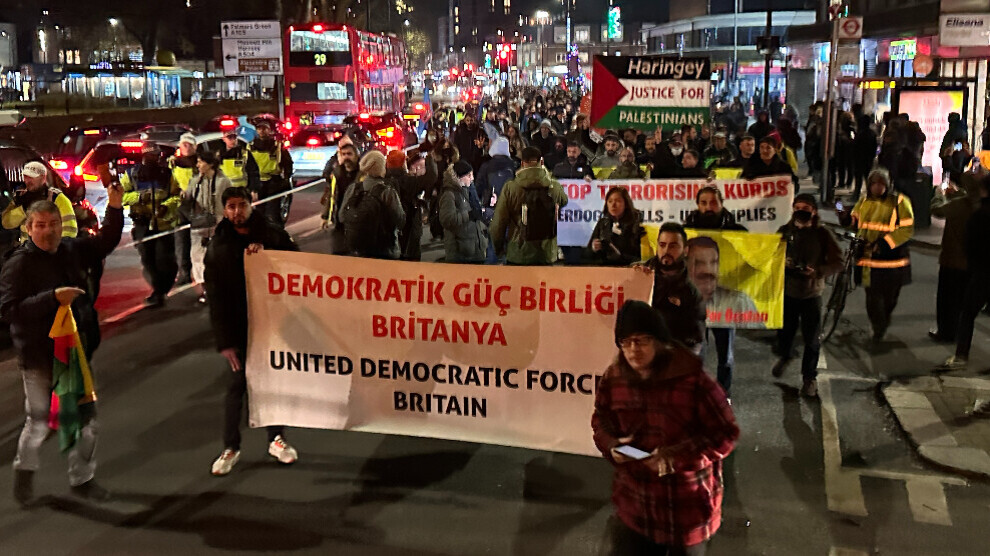

Thousands of Kurds in London protest British police raid of Community Center

Thousands of Kurds marched to the Kurdish Community Center in the London borough of Haringey, after the raid by the British police. The march was organized by the Democratic Forces Union.


HIKMET ERDEN
LONDON
Friday, 29 November 2024, 10:34

Thousands of Kurds marched to the Kurdish Community Center in the London borough of Haringey, after the raid by the British police. The march was organized by the Democratic Forces Union.

Following the simultaneous operation by the British police on 27 November against the London Kurdish Community Center and Kurdish activists, the protests initiated by the Kurds and their friends continue. The interrogation of the 7 Kurds taken into custody in the operation continues at the police station. It was reported that the British police applied to the court to extend the detention period of the Kurdish activists for another 7 days with a court order.

It was learned that the 6 Kurds taken into custody during the protests the day before were released, but they were banned from entering the Haringey area.

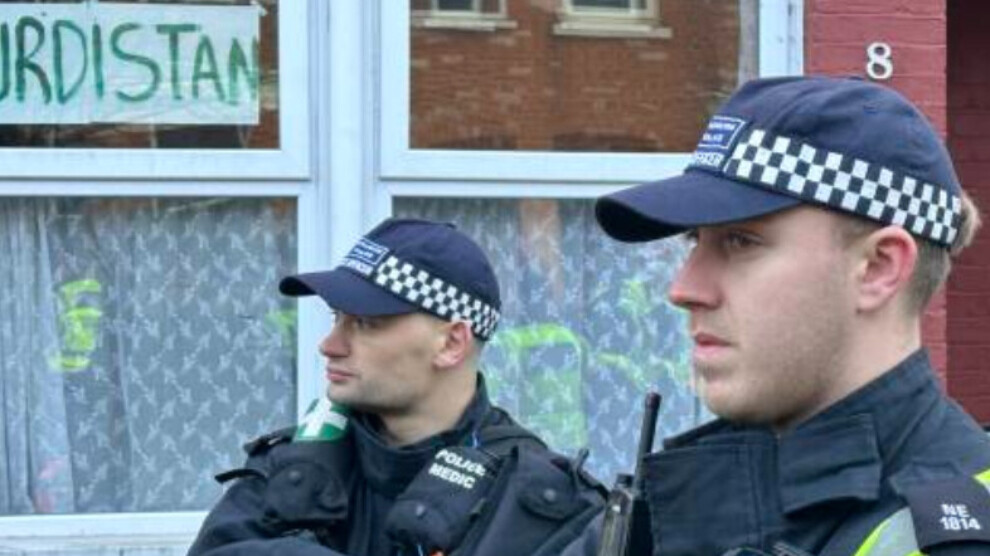
The police occupation of the Kurdish Community Center building continues.

The front of the KCC building continues to be closed with iron barricades. In addition to the barricade, hundreds of police are constantly on standby. It was also learned that the investigation of the anti-terror teams and intelligence officers in the KCC building continues.

While Kurds set up tents on the street where the occupied KCC building is located, a group of hunger strikers continue their protest opposite the police barricade.

Meanwhile, restaurants, cafés and markets in Haringey have closed their doors for several hours to protest the police occupation of the Kurdish Community Center. Hundreds of people have visited the tent where the hunger strikers are located throughout the day, and tensions have frequently erupted between the police and the public.

Yusuf Açıl on behalf of the United British Democratic Forces, said that dozens of British politicians, such as British Foreign Secretary David Lammy, have visited the Kurdish Community Center many times. "Those who come and ask for support from these institutions are raiding the KCC today. Then our duty is to defend our institutions without taking any steps back. This position is a position created by the Kurds. We will defend our position until the end. There is no stepping back an inch."


Lawyer Has: Police in London are posing as Turkish prosecutors

Lawyer Ali Has said that police in London are posing as Turkish prosecutors by asking about political cases in Turkey.


ANF
LONDON
Thursday, 28 November 2024, 10:34

The first day of interrogation of 7 Kurdish activists who were taken into custody in London in raids on the Kurdish Community Center and homes by the Anti-Terror Teams affiliated with the Metropolitan Police in England has ended.

The health conditions of Kurdish People's Assembly co-chair Türkan Budak, KHM employee Ercan Akbal, Kurdish politician and writer Ali Poyraz, Kurdish Foreign Relations Representative Agit K., Kurdish women activist Berfin K., Kurdish youth Mazlum S. and Doğan K., who were detained after their homes were broken with sledgehammers by police, are good.

British police detained the Kurdish activists on the basis of the Anti-Terror Law. Questions about the PKK were asked during the first day of questioning.

The lawyer of the Kurdish activists, Ali Has, said that no concrete evidence has been presented so far. He said that police put the Kurdish Community Center through the criminalization process with this operation, and added: "They divide the interrogation into several parts. General questions about the PKK; are you a member or a sympathizer? Clearly, they are trying to associate my clients with that organization. They have not presented anything concrete at the moment. This is pure criminalization."

They are trying to intimidate Kurdish society

Lawyer Has said that the Kurdish activists were asked questions like 'We think you are a terrorist. What do you think?'. He added: "The interrogations were not based on anything concrete. There are no complaints about my clients. These are predetermined names. They are all taken at the same time. Simultaneous raids are carried out. Normally, they would go at 7 in the morning. However, simultaneous raids are carried out at 03:00 at night. This is practically torture at that time of night."

Lawyer Has drew attention to the fact that the operation was prepared in advance, and added that, while the Kurdish centre was being raided, news of the raid was simultaneously served to all newspapers.

The lawyer said that the police were trying to turn a civilian institution into something criminal, and added: "What they are saying is, there is a picture of Abdullah Öcalan, there are pictures of martyrs... These alone are not elements of a crime. Moreover, the centre is private property."

Has drew attention to the fact that the police asked young activists Doğan K. and Mazlum S. about the political cases filed against them in Turkey, and said that, in fact, "police were posing as the Turkish prosecutor."

The lawyer added: "The police are trying to put the Kurdish Community Center in a difficult position, claiming that it is the headquarters of the PKK in England. And the reason for the arrest is Article 41. The National Security Act was passed in England in 2023. While that law was being passed, an addition was also made to the Terrorism Act. According to this article, the police are granted extensive powers and the right to question anyone without concrete evidence that they have committed any crime under the Terrorism Act. Currently, Kurdish activists have been detained based on this article."

Lawyer Has said: "The force used is disproportionate. They want to intimidate the Kurdish community here and create fear."

Kurds in London condemn attacks on Kurdish Community Centre
On Wednesday, British police raided the London Kurdish Community Centre (KCC) and the homes of many Kurdish patriots and politicians.The Kurdish Community in London issued a statement condemning ...

Jeremy Corbyn: Attack on the Kurdish Community Centre is an attack on us all

“The Kurds have changed our part of London for the better – and their resolve is an inspiration to millions of us seeking to build a more just and peaceful world,” said MP Jeremy Corbyn.


ANF
NEWS DESK
Friday, 29 November 2024

Following the simultaneous operation by the British police on 27 November against the London Kurdish Community Center and Kurdish activists, the protests initiated by the Kurds and their friends continue. The interrogation of the 7 Kurds taken into custody in the operation continues at the police station. It was reported that the British police applied to the court to extend the detention period of the Kurdish activists for another 7 days with a court order.

Jeremy Corbyn, former Labour Party leader and currently an Independent MP for Islington North in the British Parliament, made a statement on the operation against the Kurdish Community Centre and its employees.

The statement by Corbyn includes the following:

“I am deeply alarmed by the raid on the Kurdish Community Centre by large numbers of riot police.

The Centre is an important cultural space for the diverse and inclusive communities of North London. It provides support for refugees who have fled war and persecution, and a space for the Kurdish community to come together. Its services and classes are a lifeline for many.

Attacks on one community's institutions or its democratic freedoms is an attack on us all.

I am proud to represent a constituency with a vibrant Kurdish community. They have changed our part of London for the better – and their resolve is an inspiration to millions of us seeking to build a more just and peaceful world.”


North London protest rages against police repression of Kurdish Community Centre

The protest came after police raided the Kurdish Community Centre in Haringey, north London


On the protest to demand Kurdish rights in north London (Picture: Guy Smallman)


By Arthur Townend
Thursday 28 November 2024   
SOCIALIST WORKER Issue 2933


Over 1,000 people took to the streets of north London on Thursday night in solidarity with the Kurdish Community Centre (KCC).

Kurdish organisations, socialists and trade unionists rallied outside Turnpike Lane station in Haringey.

Police had raided the KCC the previous day. They had arrested seven people for alleged involvement with the Kurdistan Workers’ Party (PKK), a proscribed organisation in Britain.

The Kurdish People’s Assembly in the UK is based in the KCC building, which police have now barricaded.

One Kurd directly affected by the police arrests told Socialist Worker, “My people are being criminalised—for what? The Kurds do not deserve this kind of treatment. The community centre is where we can have an identity after fleeing Turkey’s repressive regime.

“The police have retraumatised a traumatised community and are behaving as if they were hired by the Turkish state.

“We are reliving every single thing we tried to leave. The message to Kurds is that Britain is not a democratic country.”

The protester added, “The Kurds are not terrorists but we are being called that and harassed. It’s constant oppression that is affecting all of us. We face an increasingly authoritarian government, with increasing police power, and they want to pit us against each other.

“They make it seem like we face different issues, but it’s all the same thing and it’s all capitalism.”

The rally marched loudly and militantly towards the KCC chanting, “Free, free KCC,” and, “UK shame on you.”

An activist from the Young Struggle group said to Socialist Worker, “We’ve seen this before in France, Germany and Belgium. But this hit us a little hard because now the British state has an operation.

“It was very much a targeted and planned attempt—it’s not just one random house raid but it’s a plan.”

“I have never seen anything as serious as this current repression against the Kurdish community in the UK,” long-time activist for Kurdish liberation Mark Campbell told Socialist Worker.

“This is to show Turkey that the British government is cracking down on the Kurds. Keir Starmer and the Labour Party are quite happy to show how amazing they are at cracking down.

“Never ever has there been any suggestion of terrorism from the Kurds in this country. These are people who are political asylum seekers who are simply trying to campaign and raise awareness for the Kurdish people’s struggle in Turkey.”

Mark slammed Labour and foreign secretary and north London MP David Lammy as “one of the biggest betrayers”. “Ironically, the Kurdish people went out campaigning for him,” he said. “He was actually on the management committee of the KCC.”

As the march approached the KCC, police rushed to barricade the community centre. Protesters clashed with the police as cops blocked them from getting to the centre.

After the clash, one Kurdish activist said, “I can see very clearly that the police are trying to provoke us. We are trying to have a peaceful demonstration—please stop provoking us.”

Protesters continued to defy the police, singing and dancing outside the KCC. The whole labour movement should oppose the crackdown and support the Kurdish freedom struggle.


Kurdish Community demand decriminalisation after violent police attacks 

NOVEMBER 28, 2024

Not for the first time, a north London Kurdish Community Centre has been targeted by police. What lies behind the latest arrests?

In the early hours of 27th November, Metropolitan Police counter-terrorism officers raided the homes of six Kurdish activists, reportedly inflicting emotional and physical violence on their families, including children. They have now been expelled from their homes, and will not be allowed to return for 14 days.

At the same time, units invaded the Kurdish Community Centre (KCC) on Green Lanes in Haringey in northeast London, reportedly inflicting the same violence on those staying there and barricading the property. Hundreds of riot police in armoured vans, accompanied by police dogs and helicopters, imposed a military-like occupation of  the surrounding area, harassing residents who gathered to oppose the attack on the centre of their community life. Airspace over Haringey was closed, and police units stayed long into the night. Reports of police brutality are shocking, including allegedly striking a child and beating elderly community members. People in the Community Centre were reportedly handcuffed and made to stand outside in the rain while the police undertook their search.

A member of one of the targeted households said: “I awoke suddenly at 2am and thought an earthquake had hit. The door of my house was smashed in and fifteen balaclava-clad police officers appeared at the top of the stairs and jumped on my husband, brutally beating and then arresting him. Soon after my 15-year old son appeared, and police jumped on him and started beating him also. He and I screamed, telling them that he is a child and then they stopped.

“In my more than 23 years living in Britain I have never experienced anything like this. My entire family is shaken to the core, and my son is suffering terribly from the traumatic experience. The police won’t even allow us to go home to retrieve his school uniform.”

The UK Kurdish community comprises many refugees who fled cultural and political persecution in Turkey. Yet Kurds with Turkish citizenship and family connections to regions ruled by Turkey are regularly harassed at the UK border, and their community organizations are routinely criminalised and targeted by British state institutions.

This longstanding state harassment of this community saw an unprecedented escalation this week, say campaigners. It is a telling ‘coincidence’, they say,  that a UK minister has been visiting Turkey and the Kurdistan Regional Government in Iraq, so that this attack prefaces their talks on trade and arms deals.

Climate activist Greta Thunberg reminded us of the plight of Kurds, tweeting this week: “Recently I have been travelling through northern Kurdistan, and have met with Kurdish people from all different kinds of backgrounds. They told countless stories of the current systematic oppression and repression they face – especially from the Turkish state –, as well as a history full of massacres.”

She added that the Turkish government “continues to use ‘terrorism’ as a pretext to silence its political opponents. Tens of thousands of politically active individuals remain imprisoned without fair trials. International organizations such as the ECHR, UN, and Amnesty have condemned this and call for their release.”

Haringey’s Kurdish Community Centre, argue its supporters, is a crucial space where community members, neighbours, and all those interested, can engage with the ideas of a movement advocating for a democratic solution for Kurdistan, the wider region and across the world, based on the principles of women’s liberation, ecology and participatory democracy. Green Lanes has long provided a home for the Kurdish community in London, a refuge where they contribute to the area’s rich diversity, and London’s celebrated multiculturalism. The KCC on Green Lanes is the hub of this vibrant community, providing music and language classes, supplementary schools, cultural celebrations, concerts, shared meals, and many other activities.

The KCC and Kurdish community have done all this in the face of constant surveillance and suspicion. Now, with this unprecedented attack, their contribution to London and the UK’s cultural life is under severe threat, say campaigners, bringing to the streets of Britain scenes identical  to those found in repressive, autocratic states like Turkey.

One community member said: “As a community we are in shock at the violent attack against us. Despite decades of mistreatment by the British state, in our time living here in Britain, we have never witnessed such violent attacks and invasion of our community space. What has taken place, the premeditated violence and the lies about our community have shattered all trust with local authorities. It will also have dire implications for the democratic rights and freedoms of everybody in Britain.”

The Metropolitan Police have claimed that their attack is part of a longstanding, serious investigation into the arrested activists, claimed to be connected to terrorist activity. However, apparently no charges have been brought against any of those arrested.

Aso Kamali, co-chair of the Kurdish People’s Assembly Britain, told Novara Media that the actions of the police showed that Kurds in the UK were a “community being discriminated against for the nature of their ethnicity.” Kamali said she was left bleeding following the raid and may need to go to hospital.

Attempts to criminalise the Kurdish community rest on the listing of the Kurdistan Workers’ Party (PKK) as a proscribed terrorist organisation. In 2020, however, the Belgian courts ruled after a ten-year long legal case that the PKK is not a terrorist organisation, but is a party to an internal armed conflict as defined in international law. The PKK’s proscription in the UK appears to be being used more broadly against Turkish and Kurdish democrats and progressives.

Novara Media also reported that the KCC’s anniversary celebration on 27th November last year was also raided by the police, though that time they were pushed back by Kurds at the Community Centre and forced to leave. They also pointed out that supporting the release from prison of PKK founder Abdullah Ocalan, who has been in prison in Turkey since 1999, does not constitute overt support for the PKK, and the Freedom for Ocalan campaign is supported by many trade unions. Foreign Secretary David Lammy, whose Tottenham constituency contains the biggest proportion of diaspora Kurds in the UK, has previously voiced support for the campaign to release Ocalan. In 2016, David Lammy was photographed at a protest where Kurdish groups displayed flags including the proscribed PKK flag.

Jeremy Corbyn MP reacted with concern to the police operation, tweeting: “I am deeply alarmed by the raid on the Kurdish Community Centre by large numbers of riot police. The Centre is an important cultural space for the diverse and inclusive communities of North London. It provides support for refugees who have fled war and persecution, and a space for the Kurdish community to come together. Its services and classes are a lifeline for many. Attacks on one community’s institutions or its democratic freedoms is an attack on us all.”

Campaigners are demanding:  

  • The immediate release of community members, and a full explanation for their arrest.
  • An end to the occupation of the KCC, so that it can immediately resume essential community services.
  • An end to the criminalisation of the Kurdish community, including the harassment of activists.
  • The delisting of the PKK as a proscribed terrorist organisation, and a meaningful UK contribution t o a democratic peace process in Turkey. 
  • A public apology from the Metropolitan Police and the Mayor of London, in his capacity as Police and Crime Commissioner for London, and a public affirmation of the inviolability of essential community spaces and services, as well as a commitment to their maintenance and protection.

Image: Metropolitan police counter-terrorism officers. https://the-siu.org.uk/uk-and-us-cooperate-to-arrest-man-for-funding-terrorism/ Creator: rawpixel.com / Sergeant Matt Hecht | Credit: rawpixel.com / Sergeant Matt Hecht. Licence: CC0 1.0 Universal CC0 1.0 Deed


Scenes From The Atlanta Forest Website Is Offline

From Unravel
November 23, 2024

Hash: SHA512

This is our last canary, =

you can find our pgp key on our canary page at https://web.archive.org/web/https://scenes.noblogs.org/submissions/promise/

As of 11/22/2024(MM/DD/YYYY), no-one working on this project, nor the project itself has ever received a National Security Letter, an order under the Foreign Intelligence Surveillance Act, has been contacted by law enforcement, contacted by any government entity, has been served a subpoena for a Grand Jury related to this project, or any other classified request for user information. If we ever receive such a request, we would seek to let the public know.

This project has come to a close.

The noblogs team Autistici/Inventati decided to shut down this blog shortly following the republication of the Heritage Foundation dox from againstbeltwayfascism.noblogs.org and after the dox of the Elbit Systems of America. This blog hosted a great deal of antagonistic content over the years, and we are thankful to the Autistici/Inventati team for allowing a majority of the content to remain up for so long. They undoubtedly tolerated a great deal of resistance – we trust that their decision to shut down the blog did not come lightly.

the addresses published in the aforementioned two doxxes are still easily available on https://web.archive.org/web/sceneshosting.blackblogs.org and https://web.archive.org/web/20240815105347/https://againstbeltwayfascism...https://web.archive.org/web/20240815105347/https://againstbeltwayfascism..., and a significant archive of the rest of the blog is hosted at https://web.archive.org/web/https://scenes.noblogs.org/

This site served as a nexus for anonymous publication, a space for engaging in dialogue with other rebels, and a place to spread complicity and proliferate autonomous activitiy.

Please keep those who are languishing in jails for accusations related to this movement in your hearts- better yet, send them letters.

Continue fighting for the end of RICO charges.

Never forget Tortuguita, a hero whose bravery cannot be understated.

Continue fighting for a world without markets, hierarchy, and fascism.

For a time, the struggle in the atlanta forest was one of the powerful torches that carried the flames of antagonstic anarchist destruction. We hold our actions in this struggle proudly, and hope you do as well.

We will never forget the weelaunee forest, we will never forgive those that perpetrated its destruction.

!Viva Tortuguita!

Nothing is Finished

Everything Continues

scenes admins


A Critique of Filial Piety and the Traditional East Asian Family Model

From The Commoner by Liao

This piece is a continuation of a series of articles that seek to articulate Asian anarchism. To briefly reiterate, Asian anarchism aims to unite Asian and Asian-diasporic thought under a lens of anti-hierarchical analysis as we look toward a liberatory future. Given that Asia is extremely diverse, there will be a plurality of viewpoints, and as a Chinese-Taiwanese writer, I am best suited to examine and critique the cultures that I know best. Additionally, this piece was written in tandem with a conversation between myself and another Chinese comrade, whose words are paraphrased in various places within the text. However, I would invite any Asian anarchist to give their own critiques and thoughts regarding the hierarchies within their own cultures. 

Hierarchies permeate every society, and despite being thought of as natural, the reality is that hierarchical relations are taught and ingrained into us at a young age by the cultures that surround us. While anarchist critiques of the family model are quite extensive, I will be focusing on both a core concept in the historical and present Chinese familial model and an alternative horizontal conception as a replacement. The basis of Chinese culture is heavily influenced by Confucianism, and as a result, the concept of xiao (filial piety) is fundamental in placing hierarchy at the core of the Chinese family model. However, we first must understand what filial piety is and how it has evolved as a concept of social control throughout Chinese history to the present. 

Historical Context

Filial piety is an underlying concept within Confucianism that has served as a foundational pretext for both individual and societal harmony. Originally, it meant the unwavering obedience of a child to a parental figure, based on the assumption that the parental figure is fulfilling their responsibilities and duties as a parent. The intention behind this concept was for children to treat their parents well, and vice versa. Especially, as in the time of Confucius, it was common for the parents and children of the aristocratic class to murder and turn on one another. This can be best seen in Analects 2.5:

'Meng Yi asked what filial piety was. The Master said, “It is not being disobedient.” Soon after, as Fan Chi was driving him, the Master told him, saying, “Meng-sun asked me what filial piety was, and I answered him, — ‘not being disobedient.’” Fan Chi said, “What did you mean?” The Master replied, “That parents, when alive, be served according to propriety; that, when dead, they should be buried according to propriety; and that they should be sacrificed to according to propriety.”'

The key phrase here is that parents should be served according to propriety. This is indicative of the fact that filial piety was not originally intended to be used as a tool for parents to command their children however they want. However, they were only constrained by propriety, essentially the conventional social norms dictated by traditional ritualistic customs and behaviour. This meant that parents could command their children to do essentially anything that fits within the dominant social norms. These commands were to be regarded as essentially unconditional, with the child being forced to obey the parent, considering that rebellion and defiance were seen as unacceptable within Confucian ethics. As Neo-Confucianism, which was in many ways an authoritarian and socially regressive evolution upon its predecessor, came into being, it demolished the idea of 'according to propriety' altogether and replaced it with total obedience, no matter the circumstance, to the parents, which is the form of filial piety that is most familiar to East Asians and Chinese people of today.

The roles of parent and child within Confucianism were rigid and firmly placed the former as a superior and the latter as a subordinate. This is largely tied to the Confuscianist concept of the rectification of names and the five basic relationships in life. The rectification of names, simply put, means that what something is called, should be what it is. Confucius explains this to his disciple in Analects 13.3:

'A superior man, in regard to what he does not know, shows a cautious reserve. If names be not correct, language is not in accordance with the truth of things. If language be not in accordance with the truth of things, affairs cannot be carried on to success. When affairs cannot be carried on to success, proprieties and music do not flourish. When proprieties and music do not flourish, punishments will not be properly awarded. When punishments are not properly awarded, the people do not know how to move hand or foot. Therefore a superior man considers it necessary that the names he uses may be spoken appropriately, and also that what he speaks may be carried out appropriately. What the superior man requires is just that in his words there may be nothing incorrect.'

People should act as they are called, for example: if someone is conceptually a father, then they should act as a father, if someone is a mother, then they should act as a mother, if someone is a child, then they should act as a child. Importantly, that 'should act as' is defined by propriety.  It changes with time, as all social norms do. Neo-Confucianism ties in the rectification of names with the five basic relationships of life, those being as follows: the ruler and subject, the parent and child, the husband and wife, the elder brother and younger brother, and friends. In these relationships, the latter were expected to unconditionally respect and obey the former, creating in every instance a hierarchical relationship, often based upon age, but sometimes on gender or class status. In every instance but in the case of friends, this dynamic traps a person within a certain role or function within society that they must work within, for Confucius believed that defining every person’s role in society and forcing everyone to act according to that role was the key to a good and just society.

These concepts of filial piety and rectification of names tied in with the five relationships of life would come to form the basis of China’s social and political culture. Confucianism conceives of the family as the point in which obedience to societal hierarchies at large is established, with the family unit being emphasized in particular to maintain social order. Indeed, obedience to family through filial piety is seen as a precursor to obedience to the State, as described in Analects 1.2.

'Master You said, “A young person who is filial and respectful of his elders rarely becomes the kind of person who is inclined to defy his superiors, and there has never been a case of one who is disinclined to defy his superiors stirring up rebellion. The gentleman applies himself to the roots. ‘Once the roots are firmly established, the Way will grow.’ Might we not say that filial piety and respect for elders constitute the root of Goodness?”'

Within Confucianism, the family essentially serves as the place where the concept of obedience of authority is indoctrinated into citizens of the State from a young age, serving as a means to create and maintain social control among the populace. The relationship of the parent to child serves as a parallel to that of the ruler and the ruled, such that an obedient child will grow up to be an obedient citizen. The emphasis on obedience to hierarchy stifles the questioning of authority and limits personal freedom, in regards to both the family and the state. Further, the essence of patriarchy and age-based hierarchy has been imbued within Chinese society from the family model, as the father was seen as the head of the house, with the wife subservient to him, and the children subservient to both. Once these values became intrinsic to Chinese social order, they were pushed upon the people as villages were forcibly reshaped into Confucian models, with the empire appointing village heads and establishing these family hierarchies that were not present prior. In this manner, hierarchical obedience was internalized and instilled into society, as it served an important role in both political and personal life.

Critiques of Filial Piety’s Effects Upon the Individual

Clearly, filial piety is utterly incompatible with any vision for an anarchist future. Now that the conceptual basis and background of the concept of filial piety has been laid out, I offer a critique from an Asian anarchist lens. 

To begin, let us examine the core values of filial piety: namely, obedience, service, and obligation. In contrast, anarchism posits freedom, mutual aid, and free association. Unwavering obedience to an authority figure, in this case parents, obviously infringes upon the freedom of an individual to do what they want, as it subjugates their wants and needs to another person. This is perhaps the most egregious violation of anarchist principles within the system created by filial piety. Within filial piety, there is a lack of morality, in that there is no 'right or wrong.' Instead, the parent is always right, no matter the circumstance. As that’s the case, filial piety degrades relationships between parents and children, for it results in ineffective communication and often hypocritical standards. This can further result in distrust and hatred within familial relationships, as children are unable to properly and fully express themselves and their objections to their parents. Disagreeing with the authority figure is seen as unfilial and is subsequently punished with both physical and social consequences, as children are deprived of their dignity and ability to stand up for themselves. By conditioning children to always do whatever their parent says, no matter their feelings on the matter, their critical thinking skills and need to question the justification for the actions of those who hold authority inevitably dwindles, which is of course useful for not only the heads of the family, but also for an authoritarian and hierarchical State. On the other hand, freedom of thought and of action allow for a person to critique and demand justification for the systems that rule over us and actually take action to change them. 

The concept of service is not inherently against anarchist thought, especially as mutual aid is a core concept within both anarchist theory and praxis. However, the conception of service within filial piety is one of exclusively one-sided, subservient service. The child is not only expected but societally compelled to provide the parent with unconditional material support. The logic behind this element of filial piety is that children owe a lifelong debt to their parents for bringing them into the world, along with providing for them when they are young and unable to do so themselves. In fact, it’s common for Chinese couples to have children to ensure material support as they get older, as they see children as investment possessions that they will get a material return on in the future. This type of mindset not only dehumanizes children as means to the end of accumulating Capital, but it also has evolved within Capitalism to commodify people and relationships in a materialistic conception. Under filial piety, love is not shown by trust or mutual understanding or even affection but solely by material exchange. This is just like Capitalism, wherein love and relationships are viewed as transactional rather than emotional. In parallel, a lack of or refusal to provide material support is seen as a sin within traditional Chinese culture. This once again creates a hierarchy within the family, whereby the parents are the owed and the children are the owers. Additionally, in a similar manner to Capitalism, this dynamic alienates the children from their labor and autonomy, as they are working to provide a life for their parents rather than for themselves. Obviously, children do not owe their parents either the fruits of their labor or material support when they get older—especially, not unconditionally. While society should provide resources from each according to their ability, to each according to their need, parents should not have an inherent claim over the resources or labor of their children. Care should be provided not by the expectation and coercion of filial piety, but by a genuine desire to support one another.

The obligation to maintain and uplift the family name and legacy is once again antithetical to anarchism, as it deprives the individual of autonomy and the ability to freely live out one’s life. Within filial piety, the life choices of an individual are not up to oneself, but rather, are subject to elders’ decisions. Children are forced to give up their individual values, interests, and pursuits to instead follow the traditional and often dogmatic values of the family. Parents are given control to plan out the life of their child. This includes picking what schools to go to (often based off prestige and how it will reflect on the family), what job to work (often based off how much wealth and luxury the job will provide to the parents), who to marry (often based off ethnic demographic or class status), how many kids to have (often based off receiving a male heir), etc., all to create a child that has an obligation to fulfill their every need and embolden the family legacy. This makes the process of self-actualization nigh impossible, for the needs of the individual are subjugated for the needs of the family, as the child loses their autonomy and individuality, as well as their freedom. In this structure, the wants of the child are inherently subservient to those of the parents, and children functionally serve as extensions of the will of the family. This creates yet another hierarchical structure, as the elderly are given control over the entirety of the life of the child for their own benefit. This expectation coerces individuals into conforming to external pressures from their families, rather than exploring and fulfilling their own aspirations, thus undermining their capacity for free thought and action.

Additionally, the pursuit of family legacy often involves maintaining or enhancing social status, wealth, and influence, which can perpetuate existing social inequalities, such as jockeying for position, as it often involves exploiting or oppressing others to maintain or improve the family’s social standing. People should live out their lives in accordance with their own values and their own wants rather than conforming to the expectations of those who came before them.

As an aside, before delving into filial piety’s effects on the societal level, it’s important to note its usage as a form of manipulation and abuse on an individual level. In many familial situations, as described above, filial piety is not merely a cultural ideal but a tool used to force obedience and subjugate the child. Through invoking the cultural duty to obey and serve familial elders, parents and authority figures can exert immense psychological pressure to coerce their children into conforming to their expectations and fulfilling their wants under the guise of familial obligations. This duty can be exploited in a variety of different ways, though I will name the ones that I believe are most correlated to the values of filial piety discussed above. Obedience to one's parents is prioritized above all, effectively making the parents’ authority unquestionable. This is essentially a form of authoritarian conditioning. Through subjection to these dynamics, children are conditioned to accept their parents' authority as absolute and unquestionable. They thus internalize a mindset of submission that stifles critical thinking and self-assertion and can lead to learned helplessness. Service within filial piety creates a form of codependency where the child is expected to sacrifice their own needs and well-being for the parents, as they are compelled to provide material, emotional, and physical support to their parents, regardless of their own circumstances or desires. Obligation can be weaponized as a form of emotional blackmail implemented through gaslighting, where parents or elders invoke the child’s supposed duty to rationalize unreasonable demands and influence over a child’s life choices. While filial piety is not always invoked in this manner, this is a common occurrence within Chinese families and one that must be addressed.

Critiques of Filial Piety’s Effects on Society

The consequences of filial piety however stretch far beyond the level of the family unit and in fact create the hierarchical structure that underlies all of Chinese culture and society. Through an intersectional analysis, it becomes clear that filial piety is interconnected with hierarchies not only of age but also of gender and class status. As discussed prior, filial piety relies on the authoritarian rigidifying of people and their positions within society based on stereotypes that serve to define and categorize people in a hierarchical manner. Perhaps most apparent, the hierarchical structure of age is heavily prevalent within filial piety. Society is conditioned into being dictated by the elderly, such that the youth are subjugated as their individuality and autonomy is crushed. The youth are dominated and indoctrinated into believing in the all-encompassing power of authority as they learn to do exactly and only what they are told by those older than them.

While children are dominated by their parents, hierarchy still exists between the parents as the patriarchal structure of the family subjugates the wife under the husband. Women are expected to give birth to and take care of children, do jobs around the household, and obey the husband in the same manner that the children obey their parents in order to fulfill marital filial piety. In this way, all that has been said on the oppression of the child through obedience, service, and obligation is true for all women as well. Women must unconditionally obey their husbands’ commands, whether they want to or not. Women must provide services to their husbands, such as household work and childcare with no reciprocation, and were similarly seen as the property of their husbands. Women were obligated to marry into families for wealth or reputation rather than love and to abandon their dreams and pursuits to better serve their husbands. In this, filial piety is a core pillar in maintaining the system of the patriarchy, not only within the family unit but in society at large.

Of course, it would be remiss to critique filial piety without also mentioning how it enforces the class structure.  Filial piety intertwines with class status, shaping familial expectations and obligations according to socio-economic standing. Children are burdened with the expectation of upholding and furthering the family's economic and social standing. This often means pursuing careers deemed prestigious or profitable, not out of personal desire, but to secure the family’s reputation and ensure the continuation of its status. The expectation is for children to provide financial support, often sacrificing their own opportunities for education or career advancement to ensure the well-being of the family, thus reinforcing the idea that social and economic capital should remain concentrated within the family, perpetuating class inequality. The societal valorization of this form of sacrifice obscures the structural conditions that necessitate it, framing it instead as a familial duty. By positioning children as the primary means through which families should seek the accumulation of Capital, filial piety shifts responsibility away from systemic issues of wealth inequality and onto individual families, thus legitimizing and perpetuating class-based expectations and oppression.

The concept of filial piety serves as a tool of social domination that the State uses to maintain the status quo. The purpose of any power structure, including Capitalism and the State, is to perpetuate itself and so, ideas that rationalize these hierarchical power structures are propped up and disseminated among the populace. Within Confucianism, the family unit is seen as the precursor to social order, for it serves as the place where subservience to other hierarchical structures is established, with filial piety playing a key role in doing so. The parents play a pivotal role in conditioning the children with hierarchical ways of thinking and instilling the obedience of authority within them. Due to this indoctrination, the children become unquestioning citizens of the State who are accustomed to following the commands and dictates of those in positions of hierarchical authority. In this way, the family is not simply a private unit divorced from political life but instead a moral and social institution that instills the values of the State into its citizens. Confucius himself connected filial piety with societal harmony, as he asserted that obedience within the family leads to a well-ordered society. Just as children learn to obey the parent unconditionally, they are primed to obey the ruler with the same unquestioning submission. Through this social conditioning, filial piety prepares individuals to accept the hierarchical authority of the state. The act of obeying parents, without questioning their moral or ethical correctness, becomes the acceptance of State authority, even when it may act unjustly. This creates a population that is likely to be submissive and not challenge the State because authority itself is seen as an inherent good, mirroring the role of the parent in the family structure. 

Authority being rationalized by filial piety is furthered by the rectification of names as the ruler is conceptualized as a "parent" of the nation, and the subjects are like children. Just as a child should respect and obey their parents, so a citizen should respect and obey the State. Confucius stated that social harmony was dependent on everyone fulfilling their given role within society. A parent ought to act as a parent and a child ought to act as a child, just as a ruler ought to act as a ruler and the subject to act as a subject. This philosophy is instrumental in legitimizing the hierarchies of culture and the authority of the State, as it obliges individuals to adhere to their societal positions and roles without challenging their worldview. Disobedience to the family is equated with social chaos, just as disobedience to the State is seen as a threat to societal order. In this framework, the ruler’s authority is considered natural and just, much like a parent’s authority in the household. By teaching that questioning authority, whether parental or political, leads to disharmony and disorder, filial piety actively discourages resistance to the State and upholds authoritarian ideals. This becomes a form of ideological control where defying the State is seen not only as a political transgression but also as a moral failure to fulfill one’s role within society.  Filial piety, then, serves as the cultural foundation for a hierarchical worldview that benefits those in the ruling class, ensuring that citizens internalize and perpetuate structures that keep the State in control.

Filial piety suppresses individual autonomy by placing duty and obedience above personal desires, which on a macro scale leads to people placing the needs of the State and authority figures over their own desires. The obligation of service restricts personal freedom and autonomy as filial duty becomes a lifelong commitment that overshadows the pursuit of one’s own desires. This relationship of service to the family becomes a model for hierarchical social interaction at large where obedience to the State and Capital takes precedence over personal rights and freedoms. As people are taught to obey their elders and follow commands without question, they easily accept a similar dynamic in the workplace, in political life, and in society at large. This suppression of individual thought and autonomy not only limits critical thinking but frames disobedience to the status quo as a betrayal of cultural values. Consequently, filial piety reinforces a rigid social structure where personal freedom is sacrificed for the preservation of societal order, leaving little room for dissent or personal expression. In this, filial piety is able to not only legitimize authoritarian States but also foster a culture of conformity, where obedience is celebrated and rebellion is punished. By intertwining familial and political authority, filial piety discourages individuals from challenging the State, as it equates political dissent with personal immorality. This creates a powerful ideological foundation for State power, embedding loyalty and submission into the fabric of society.

Further, filial piety not only underpins the State but also instils the population with rigid social hierarchies based on age, gender, and class. From a young age, children are conditioned to define and categorize people as they grow up, with rigid hierarchies of age, gender, and class dictating how people ought to act based upon their identities. These expectations are shaped by societal ideals perpetuated by filial piety, where elders, men, and more privileged socioeconomic classes are afforded greater authority. Children learn that their role within society is dictated by their identity, and this understanding becomes deeply ingrained as they mature. As these hierarchies are internalized, they come to see social hierarchies and societal expectations based upon identity as natural and inevitable. The authority of elders, men, and the wealthy as opposed to the subjugation of the youth, women, and the poor is seen as how things have been and should be. These rigid social hierarchies shape the behavior of people, suppress individual autonomy, and limit the potential for equality, as people are taught to accept and act out their roles within the given societal framework, rather than challenge them. This process strengthens the control of social hierarchies as their reinforcement promotes the State’s supposed social stability and conditions people to accept hierarchy as natural. Filial piety becomes a cultural tool to enforce hierarchies across every level of society, ensuring that each individual understands and accepts their place within the social order. By categorizing people based on these hierarchies, the State can more easily maintain control and perpetuate the hierarchical power structures that serve its interests.

A final critique of filial piety’s usage as an ideological weapon by the State is in how it shifts collective responsibilities onto the individual. As filial piety demands that children provide for and care for their parents, the collective responsibility of caring for the elderly is transferred from a societal goal to one that individuals must carry out on a personal level. As children are expected to owe lifelong debt and service to their parents, a cycle of individual obligation is created which alleviates responsibility for collective care, as such care is atomized down to the familial level. This applies to the State as well, as it can provide fewer resources to social security nets, as the assumption is that is provided by the children of the elderly as demonstrated by modern day examples in China and Taiwan. In fact, this dynamic mirrors the logic of neoliberalism, in which the State diminishes its role in social welfare and transfers the onus of care to individuals and private entities. Through invoking filial piety as a cultural and moral duty, the State is able to rationalize its own inaction to systemic issues such as aging populations, healthcare, or poverty. It shifts the narrative from a societal responsibility that a collective must fulfill to one of personal duty, positioning failures in care or support not as structural deficiencies but as moral failings of individuals and their families. This not only reduces the financial burden on the State but also obscures the broader need for the removal of the State at large and its replacement with a horizontal socio-political model. In this way, the State is able to undermine communal care and social movements aimed at a complete rehauling of the system. By framing care as an issue of individual morality rooted in filial piety, the State can suppress calls for systemic change while maintaining social control. The individualization of responsibility fragments efforts to address larger social inequalities and shifts attention away from the need for collective solutions, reinforcing both State power and existing social hierarchies while degrading collective solidarity.

Concluding Thoughts

While the above critique of filial piety is primarily a critique of the Confucianist model that is seen primarily in China and other East Asian countries such as Taiwan, Japan, and Korea, that is not to say that a similar critique would not apply to other Asian countries and cultures. In fact, I believe that other strains of Asian anarchism could address other forms of filial piety such as tôn ti trật tự and khiêm tốn in Vietnamese culture, seva in Indian culture, or the countless other forms that filial piety takes in the cultures of the Philippines, Pakistan, Singapore, etc. This is not a concept that is limited to just China but is a cultural norm that stretches across the entirety of the Asian continent. As such, it should be addressed by anarchists from across Asia as we seek to deconstruct filial piety and work towards a liberatory world. Filial piety is not merely a concept in Asian culture and across the diaspora but is truly a reality that underlies the basis of our cultural existence. In some countries such as Bangladesh, China, India, and Singapore it is even written into law, with punishment for noncompliance. As it is weaponized by States around the world and affects people from all of our cultures, it is our common enemy to defeat. It is hence also our collective responsibility to critique and suggest alternative models for familial relations. 

I do not believe in critique without suggesting an alternative. However, I also do not believe in prescribing a solution to a societal issue that can only be addressed collectively. So here I present a vague notion of a replacement for the current model of family based upon filial piety. In the end, I do think filial piety \gets a couple of things right, those being that the elderly should be cared for, and that there should be a level of mutual respect between the child and parent. However, as previously written, I very much disagree with the means that filial piety uses to fulfill those ends. Instead of a family model based on obedience, service, and obligation, I would posit one with the principles of equality, mutual aid, and free association in mind. In my conception, parents and children should be seen as equals who have respect for one another, with children being liberated to pursue their own interests and explore their own ideas by being afforded their own autonomy and supported by their parents. Children should no longer be forced to obey and adhere to age-based authority. Rather than children being coerced into providing material support for their parents, it should be the responsibility of the collective to ensure that the elderly along with those who cannot care for themselves are taken care of. Resources should be distributed to all according to their need. The principles of communal free association should also be applied to the raising of children, as it should not be undertaken by solely two parents but by the community as a whole. A return to communal childcare would build bonds of solidarity, induce horizontal socialization, and help to avoid abusive situations. Additionally, as in any anarchist conception of the family, societal roles and expectations based on identity should be done away with, and hierarchies of age, gender, and class should be abolished, as all should share in labor both within and outside of the household. Most importantly, the family should be a place of genuine love based on mutual respect, trust, and affection that fosters and encourages the children to grow and their parents with them. The implementation of the family model that is gestured to above would in my view bring us much closer to an anarchist world.

In the process of articulating Asian anarchism, it only seemed fitting to begin on a personal level, as the personal is political. As I seek to further explore and explain Asian anarchism, I felt it made the most sense to start with the filial piety which underlies nearly every Asian culture and serves to condition and crush the individual from a young age. Alas, it also seems important to write about it while I am still young myself, as one can only write about youth liberation and critique an age-based family model from a young perspective for so long. I hope that this essay has begun to demonstrate what exactly Asian anarchism is and will continue to be. To end this article, I will leave you with a quote from anarcha-feminist He Zhen’s What Women Should Know About Communism: “If we only unite together, with communism we can naturally have a good future. There is no doubt about it. As we say colloquially, ‘the good times are coming.’”


Many thanks to our patrons who help keep The Commoner thriving:

Kevin Atkinson, Vervain, Carrie Sanders, Ben Dunn, Barry, Loke, Alex Paterson, Le Val, Bogdan Ovidiu Gheorghiu, Cy.Maggran, Chaotic Capybara, Diana Rahim, Jordan, Joshua Akapo, Kimonoko, Meghan Morales, Aryeh Calvin, Aki, Steven Adger, Simona Ferlini, and Richard Grayson.

Anarchist Antiauthoritarian and Antifascist Cultural Politics

Cover art: Manuel Monleón Burgos, "Estudios" no. 163, April, 1937

From Anarchist Developments in Cultural Studies

Original title: "Vol. 2024 No. 2 (2024): Anarchist Antiauthoritarian and Antifascist Cultural Politics "

This issue of Anarchist Developments in Cultural Studies emerges at a fraught time for anarchists specifically and antifascists generally. Its content reminds readers of some of the anti-fascist, antiauthoritarian cultural wars waged against those dark forces that have sought to further segregate people by imposing new authoritarian hierarchies of power both historically and today.

Cover Art: Manuel Monleón Burgos, Estudios no. 163, April, 1937

Articles

Anarchist Antiauthoritarian and Antifascist Cultural Politics in Europe and the United States, 1890s–2020s
Kirwin Shaffer
9-22
https://journals.uvic.ca/index.php/adcs/article/view/22183/10125

Anarchist Romance
Andrew H. Lee
25-58
https://journals.uvic.ca/index.php/adcs/article/view/22191/10126

The Popular Will in Hispanic Antifascist Graphic Art in the United States, 1936-1977
Montse Feu
61-84
https://journals.uvic.ca/index.php/adcs/article/view/22192/10127

Smashing Whiteness: Race, Class, Punk Culture, and Anarchist Anti-Fascism
Spencer Beswick
87-117
https://journals.uvic.ca/index.php/adcs/article/view/22193/10128

Mabel Holland Thomas Grave, the Anarchist Pastoral
Constance Bantman, Mike Jones
119-137
https://journals.uvic.ca/index.php/adcs/article/view/22194/10129

Book Reviews

M. Testa, Militant Anti-Fascism: A Hundred Years of Resistance (Oakland: A.K. Press, 2015).
Mark Antliff
139-143
https://journals.uvic.ca/index.php/adcs/article/view/22195/10130