It’s possible that I shall make an ass of myself. But in that case one can always get out of it with a little dialectic. I have, of course, so worded my proposition as to be right either way (K.Marx, Letter to F.Engels on the Indian Mutiny)
Saturday, November 30, 2024
RNS holiday gift guide 2024: Ideas for your atheist pals and spiritual loved ones alike
(RNS) — Ganesh ornaments, humanist children’s books and Hanukkah nail decals are just some of the gifts to consider.
(RNS) — It’s that time of year — when holidays, including Christmas, Hanukkah, Yule and Kwanzaa, converge in one month of festive merrymaking — and gift giving.
And whether the folks on your list are religious, spiritual or nothing at all, RNS has you covered. Each year we religion nerds gather a list of our favorite quirky, rare and sentimental items. From ironic atheism sweatshirts to Jubilee 2025 merch, zodiac glassware and a kid-friendly dinosaur-shaped hanukkiyah, there’s truly something for everyone on this list. So unwind, cozy up and peruse away!
Rabbi Yael Buechler typically goes viral on TikTok for pointing out Hanukkah “fails,” but she gave Target a shoutout for what she called its “Menorosaurus Rex” hanukkiyah. Featuring space for up to nine candles (including a spot for the shamash, or helper candle), the blue dino candle holder adds playfulness to your Hanukkah celebration.
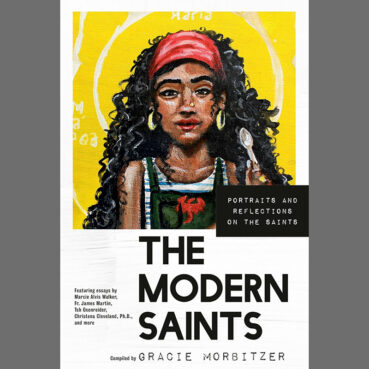
Filled with illustrations from Catholic artist Gracie Morbitzer and ruminations from theologians such as James Martin and Christena Cleveland, “The Modern Saints: Portraits and Reflections on the Saints,” featuring vibrant, modernized paintings of 52 saints, is the perfect collectable for art and icon lovers.
‘The Chosen’ Season 4 DVD
After months of delays, the latest season of the hit show about Jesus’ life is available on Blu-ray and DVD. As physical media begins a timid comeback, now is the perfect time to gift the Chosen fan in your life a hard copy of all eight Season 4 episodes.
‘Original Non-Prophet’ atheism sweatshirt
This quirky sweatshirt is a great find for your nonreligious pals. Featuring a festive atheism snow globe and a prophet pun, this item from Etsy seller DismantleThreads also comes in sizes XS – 5XL.
Jubilee 2025 Pilgrim’s Backpack
Is someone you know planning a pilgrimage to the Vatican for Jubilee 2025? This modern satchel, which includes a laptop compartment, pilgrim-shaped zipper and the official Jubilee logo, could be just the item they need for their journey.
Eighth Generation upcycled wool stocking
These one-of-a-kind upcycled wool stockings from Seattle-based Indigenous retailer Eighth Generation are made of textiles that would have otherwise ended up in a landfill. Made of slightly damaged blankets with a woven design of Raven the Creator by Tlingit artist Richard Dalton III, the stockings are festive and, as the site indicates, good for Mother Earth.
Hanukkah nail decals
This nail decal set for adults and children is from a Jewish-owned small business and includes images of dreidels, Judah Maccabee and latkes. The 49 decals are designed to upgrade any manicure and to last up to eight days.
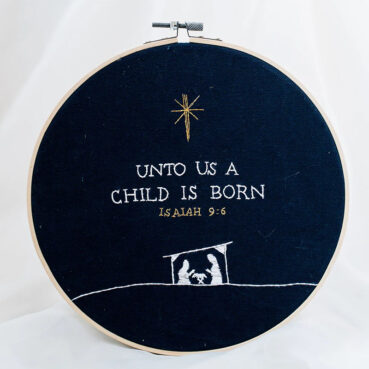
This fair-trade, handmade 9-inch embroidery hoop includes a delicately stitched depiction of the holy family beneath an excerpt from Isaiah 9:6. From a local shop in Lynchburg, Virginia, that sells products made by refugees, people transitioning out of homelessness, disabled folks and human trafficking survivors, the purchase of this item supports communities in Thailand.
‘Elle the Humanist’ children’s book
For the nonreligious kiddos in your life, “Elle the Humanist” is a children’s book written by 11-year-old Elle Harris that emphasizes the value of science, reason and wonder. An introduction to humanism told with bright illustrations, the book is available autographed and comes with a free signed bookmark.
Principles of Kwanzaa sweatshirt
Faith is one of the seven principles of Kwanzaa and is displayed as part of this festive sweatshirt from Etsy seller MelantedMagic. Available in a range of colors, this sweatshirt will keep your loved one cozy when Kwanzaa starts on Dec. 26.
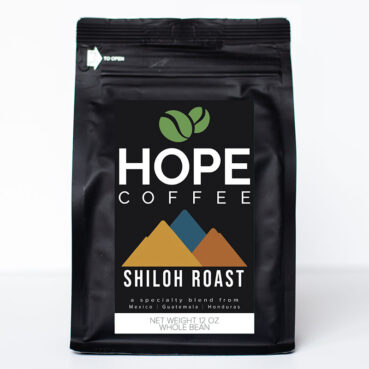
Hope Coffee Shiloh Roast
Hope Coffee company is a Christian-owned ministry that purchases coffee directly from farmers in Honduras and Mexico, paying the farmers higher-than-average wages and then putting 100% of the after-tax profits toward service projects and missionary efforts in those two countries. This coffee blend is named after Shiloh, a place of peace in the Old Testament.
Quran Verses jar
For Muslims in interfaith families or who celebrate Christmas culturally, this London-based seller of Islamic gifts offers a Quran Verses jar, brimming with color-coded cards and printed verses suitable for a range of emotions and situations.
Zodiac astrology sign glass cup
Seeking a celestial item for the astrology lovers in your life? Opt for a glass cup (plus lid and straw) with their zodiac sign.
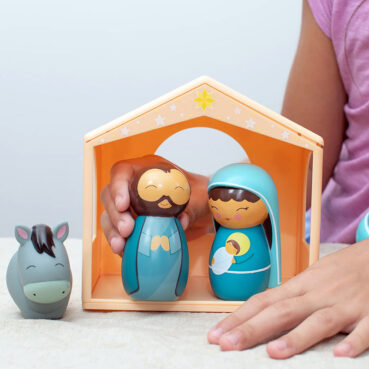
The Catholic-owned company Shining Light Dolls has toys of the Catholic saints, including a vinyl play set of the holy family suitable for kids of all ages. The set comes with a donkey, stable, St. Joseph, Expectant Virgin Mary and Virgin Mary with baby Jesus.
Ganesh holiday ornament
More than 70% of U.S. Hindus reportedly observe Christmas in some way, so it’s no surprise that Desi Favors, which specializes in Indian handmade products, also offers a holiday ornament of the Hindu god Ganesh.
Labyrinth-inspired meditation mug
With a finger labyrinth inscribed into the side, this handmade stoneware cup is designed to let the user trace a finger along the winding path as a form of meditation. Made by potters in Wisconsin, this mug could add spiritual depth to anyone’s morning brew.
Jain Americans adapt Thanksgiving by applying an ethic of nonviolence even to the turkey
(RNS) — Jain Americans have forged Thanksgiving traditions of their own, participating in a ritual fast, praying for forgiveness or cooking up a vegan feast for their families.
(RNS) — When Ami Doshi was invited as a new migrant from India to friends’ Thanksgiving Day festivities, it shocked the then-middle schooler to hear the meat of a rare, elaborately feathered bird would be on the menu.
“I actually had no idea what a turkey was,” said Doshi, now in her early 40s. But her bigger question was a moral one. “When you kill a bird, they can feel it, they can see it, you know, with all of the five senses, they can experience it,” she said. “Why is a pet’s life more important than a bird’s life?”
Doshi, who was raised in the Jain faith, has been a vegetarian her whole life. Committing to their fundamental tenet of ahimsa, or nonviolence, Jains avoid causing harm to all living beings, whether in thought, word or action. Many avoid eating root vegetables, like onion and garlic, out of reverence for every form of life, including the insects uprooted when the plants are harvested.
It seemed odd to Doshi, she said, that the centerpiece of a holiday dedicated to gratitude would be a roasted and stuffed creature.
For Jain Americans who want to participate in this most American of holidays, an alternative was needed. Jains in the U.S., who number about 200,000, have made the day their own by forging a tradition of attending temple services to pray for the millions of lives lost, serving meals to the needy and cooking up an all-vegan feast.
“We figured out a place for us,” said Nirva Patel, a second-generation Jain American and executive director of the Brooks McCormick Jr. Animal Law & Policy Program at Harvard Law School. “We believe that Thanksgiving is about gratitude, about being present, about family. We kind of pulled the good from that holiday, and we’re doing it in our own curated way.” Guests enjoy the 2023 Thanksgiving potluck hosted by Nirva Patel. (Photo courtesy of Nirva Patel)
Patel, who executive produced a well-received 2018 vegan lifestyle documentary “The Game Changers,” hosts a plant-based potluck every year, complete with a plastic turkey centerpiece as a conversation starter.
Growing up as a Jain in suburban Massachusetts was complicated this time of year, she said. “It was very, very foreign concept and a very strange thing to see the kids and teachers celebrating a turkey and talking about a turkey’s gobble and coloring printouts of turkeys, but then literally talking about how they carve them up and eat them,” she said. “You just kind of stayed silent in the back of the classroom.”
A former chair of the animal advocacy group Farm Sanctuary, Patel gained a newfound appreciation for the bird when the organization held its own “Celebration for the Turkeys”: a feast of turkey-friendly foods prepared for the rescued guests of honor. “It really makes you think about this beautiful creature that is being so exploited,” she said.
Forcing anyone else to change their beliefs on meat consumption is not the point, said Patel. Accepting multiple viewpoints is another tenet of Jainism, though one that can be difficult to act out either as an activist or at the dinner table.
Nirva Patel. (Photo courtesy of Harvard)
“Getting people on board is really about having convictions of your own self, your own beliefs and being unapologetic about it, but also not being harsh and rude about it,” she said. “The best thing we can do is just be as compassionate as possible in our thoughts, in our actions, (and) realize that everything starts with what’s on your plate.”
Rahul Jain, a consultant in the Washington area who moved to America 25 years ago, said it took Jains time to adopt Thanksgiving. Many chose at first to participate in a ritual fast called Ayambil, in which devotees consume only simple, bland foods in the practice of spiritual discipline. Others, said Jain, would attend prayer services at one of the 72 nationwide Jain centers, chanting a mantra asking for forgiveness for the fate of the 50 million turkeys who are slaughtered each year.
Both practices remain common, said Jain, but in the past decade, younger generations of Jains have begun to celebrate the holiday more traditionally, likening it to the Jain festival of Paryushana, during which the last day is dedicated to expressing gratitude for friends and family.
“If you put the food aside, the concept of giving thanks is quite remarkable,” he said. “It resonates well with the Jain principle of aparigraha, which is nonattachment: Don’t get too attached to one thing, one person, one job. That kind of rings true with, ‘Did you give thanks?’ You’re saying, ‘I am grateful for what I have. I don’t need more.'”
The vegetarian feasts can be complemented with a nightlong prayer, and combined with a side of backyard football. “I can’t change every single human being in the world to match with my ideas,” said Jain. “And that’s OK. As long as we can all live in harmony and peace is what Jainism stands for, and that’s the message we want to convey.”
Sulekh Jain, a Jain community leader, came to the U.S. for the first time in the 1960s, when Jain residents were relatively few, with no organizational infrastructure or even temple to attend. The now retired aerospace engineer “started from scratch,” co-founding the JAINA, the umbrella organization for all Jain societies across the country, in 1980.
But with the rising popularity of veganism, animal rights advocacy and cruelty-free awareness, he said, “every day has gotten easier and easier to follow Jain values.”
“It is very difficult for me to preach,” said Jain, who lives in Las Vegas. “I don’t want to hurt somebody in their own sensibility. But, what are we giving thanks for?” he said.
A bright pumpkin soup adorns a table.
(Photo by Katrin Bolovtsova/Pexels/Creative Commons)
Jain regrets that the Thanksgiving holiday, thanks to creeping commercialism, has moved away from the principle of gratitude. “When we say ‘Happy Thanksgiving,’ let’s make that happy Thanksgiving a reality, and save this environment and save this planet.” Meat production, he notes, is a large contributor to climate change.
Manish Mehta, chair of JAINA’s diaspora committee, said Jains are increasingly concerned about “our carbon footprint, and our karmic footprint.” He participates in vegan food drives throughout the year that distribute hundreds of thousands of meals to the needy. In its own celebrations, such as shared Diwali meals, his Jain community in Michigan is careful to use biodegradable cutlery. “There is more care taken about how we cook food and how we avoid food waste, and reducing what goes into landfills.”
Their choices on Thanksgiving Day are an extension of that sensibility. “Jains are trying to evolve practices and adapt to a North American lifestyle,” he said, keeping their own traditions alive while contributing to American society. After all, “for us,” he says, “compassion is kind of in our DNA.”
Aug 17, 2021 ... Jains are the only religious group in India where a majority say they are members of a higher General Category caste. Most Indians (68%) are ...
In Darien Gap, Latino Protestant leaders see migrant journey firsthand
“Migration is the crisis of the 21st century,”
(RNS) — The trip, taken just days after President-elect Donald Trump won a second term in the U.S., brought 25 Latino Protestant leaders and pastors to Panama to help them understand the experiences of migrants who may later arrive in their communities.
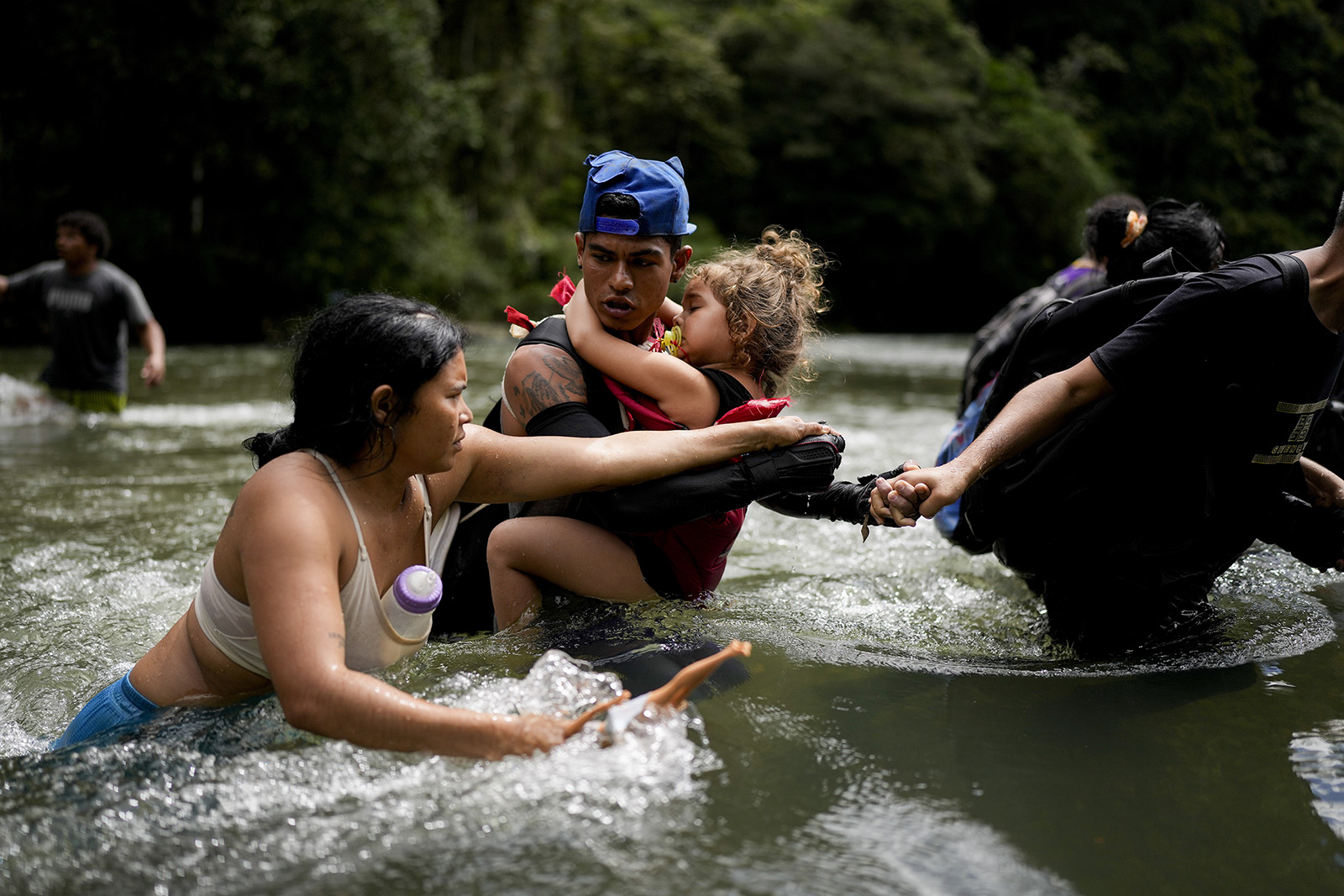
Venezuelan migrant Alvaro Calderini carries his niece across a river near Bajo Chiquito, Panama, after walking across the Darien Gap from Colombia on their way north to the United States, Nov. 9, 2024. (AP Photo/Matias Delacroix)
(RNS) — Elket Rodríguez, the Cooperative Baptist Fellowship’s global migration advocate, has served migrants on the Texas-Mexico border for years. But until earlier this month, he had never been to the Darien Gap, a dangerous jungle route many migrants traverse as they move from Colombia to Panama, most often en route to the United States.
In early November, just days after former U.S. President Donald Trump was elected to a second term, Rodríguez joined a pilgrimage sponsored by Como Nacido Entre Nosotros, or “As Born Among Us,” an ecumenical Protestant Christian network working on migration issues. “It’s a level of vulnerability, even much higher than what I see at the border,” Rodríguez said of his experience.
The trip brought 25 Latino Protestant leaders and pastors to Panama to help them understand the experiences of migrants who arrive in their communities and to explore opportunities to collaborate with Panamanian churches and other partners to support migrants. Participants came from 10 Latin American countries and several states across the U.S., and included representatives of Mission Talk, Latino Christian National Network, Mygration Christian Conference and Avance Latino.
The Rev. Carlos Malavé, a southern Virginia pastor of two churches and president of Latino Christian National Network, said he was motivated to go on the trip because “it’s not the same to listen or hear about stories as a religious leader in the U.S. than experiencing face-to-face the pain of people,” saying he’d heard “horrific stories” and understood “the reasons why they risk their lives” when he was in Panama.
Many of these pastors count immigrants from Latin America among their congregants. Even for their churchgoers who have not migrated, a story of a loved one’s migration is always close at hand.
“The person who arrives here is already bathed, clean and ready. They’re only thinking about work, about the next thing, about beginning to grow and beginning to produce,” said the Rev. Rubén Ortiz, Latino field ministries coordinator for the Cooperative Baptist Fellowship, who took a leading role in the two Darien Gap pilgrimages sponsored by the Como Nacido Entre Nosotros network. Ortiz, a Cuban immigrant who now lives in Deltona, Florida, where he formerly pastored a church, now coordinates the work local churches in his denomination do with migrants, including food distribution and connecting them with services.
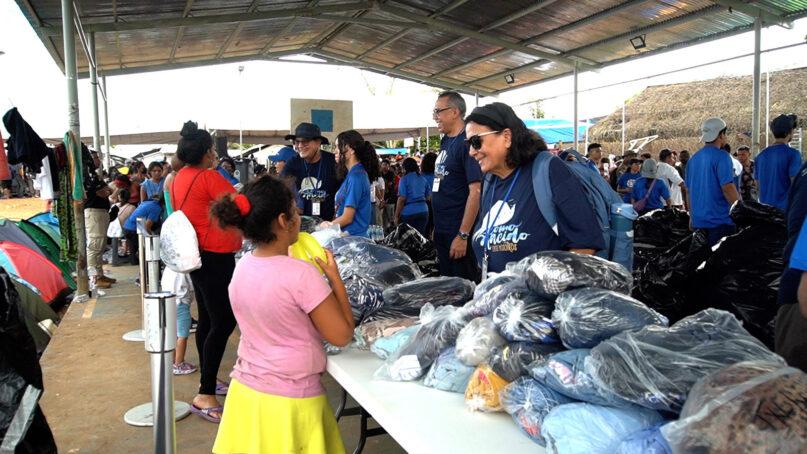
Volunteers with Como Nacido Entre Nosotros, in blue shirts, distribute donations to migrants at the Lajas Blancas migrant reception center, Nov. 8, 2024, in southern Panama. (Photo courtesy of Como Nacido Entre Nosotros)
“We want people to understand where this person comes from and to understand the traumas and possible circumstances that they will find in their pastoral life with them,” Ortiz explained. “It would be terrible, for example, to deport them,” he said, “because those people have already lived trauma.”
Beginning their work in Panama on Nov. 8 — two days after Trump, who campaigned on a platform that included mass deportations, had been declared the winner — was an experience of “grief,” Ortiz said. “It wasn’t easy at all because many of us had no words of hope” to share with migrants, the pastor said.
The pilgrims met with evangelical and Catholic church groups and Panamanian government officials, and they visited Lajas Blancas migrant reception center, where migrants arrive, often hungry, injured or exhausted, after crossing the Darien Gap. The Como Nacido Entre Nosotros delivered donations of food, clothing and personal hygiene items, as well as medical assistance and spiritual care.
Rodríguez said he was struck by the commitment of the Panamanian Christian young adults who woke up at 2 a.m. on a Saturday to fill two buses of donations and then drive more than five hours to the Darien Gap, where they served until late at night.
“In this country, we live a Christianity completely privileged, comfortable and of cheap grace,” Rodríguez said of the U.S., where he has not seen a similar commitment by Christians.
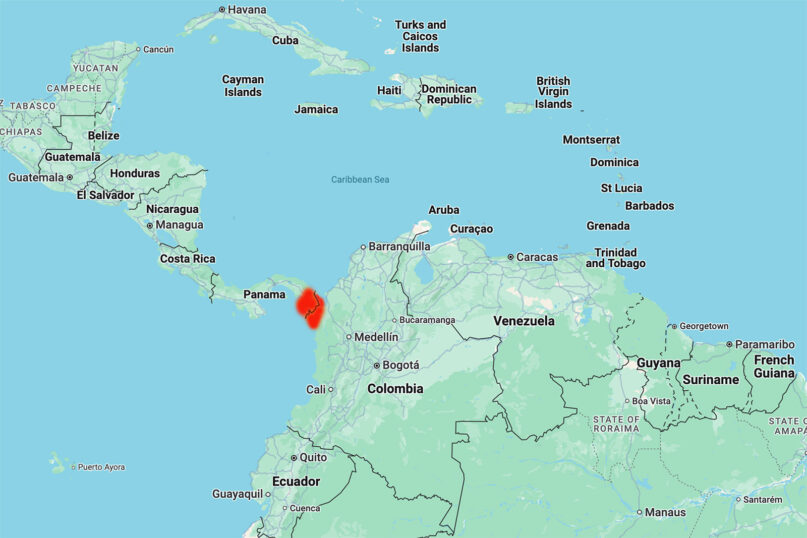
The Darien Gap, red, connects North and South America along the Panama-Colombia border. (Image courtesy Google Maps)
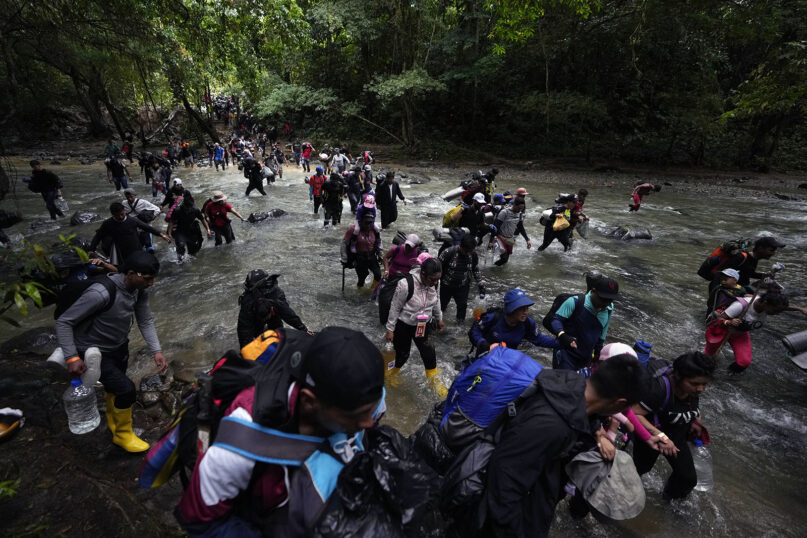
The Darien Gap, a jungle and marshland landscape covering a 60-mile break in the Pan-American Highway, is the only overland route connecting North and South America. Crossings through the Darien rose from an average of 2,400 crossings annually in the early 2010s to more than half a million people last year, as more migrants flee South America countries, such as Venezuela. Migrants through the jungle face criminal gangs, difficult terrain and lack of cellphone service, clean water and food.
Meeting the migrants also moved Rodríguez. “I am a man. I identify with the men who cannot provide for or protect their families, that type of powerlessness,” said Rodríguez, clarifying that the men are not physically powerless, but instead morally powerless.
Rodríguez was outraged by reports of sexual violence against migrant women on the journey — and by the “silence” and lack of action to address it. “As if it is something normal, that many migrant women are sexually abused on their journey, and no one does anything. There is total impunity.”
“My conscience does not allow me to get to the level of having to accept that as a given fact of the migration process,” Rodríguez said.
Ortiz said the migrants he spoke with were fleeing from personal experiences of violence, and many were hoping to reunite with family. In the camp, they met migrants from Latin America and Africa, including Congo and Cameroon, as well as Pakistan and Nepal.
He provided RNS with recordings of conversations he had with migrants in Lajas Blancas, where many repeatedly urged other migrants to avoid crossing the Darien Gap because of its danger, and some recommended against migrating altogether.
An Ecuadorian father named Carlos told Ortiz that “the voyage was extremely difficult,” mentioning hunger, as well as tigers and snakes in the jungle. He said that he had been tricked by his guides, who had not followed through on their promises, and that his wife had miscarried her pregnancy of two months.
Carlos also recounted jumping back in a river after his own crossing in order to rescue a family from drowning who had been swept away by a current.
Other migrants recounted losing people who had traveled with them or seeing dead bodies.
William, a 57-year-old migrant with infected wounds on his legs from a fall during the crossing, said the vast majority of people crossing the jungle suffered some kind of injury.
During their meeting with Panamanian authorities, Ortiz said, the Christian group learned that, while crossings of the Darien Gap have significantly dropped since their peak in 2023, the government believes it will run out of money to feed migrants in December. The Panamanian officials also shared that migrants leave over 2,000 tons of garbage in the jungle, which is a national park.
Migrants, mostly Venezuelans, cross a river during their journey through the Darien Gap from Colombia into Panama, hoping to reach the U.S., Oct. 15, 2022.
(AP Photo/Fernando Vergara, File)
Ortiz also said that at the request of the Panamanian government officials, the pilgrims prayed for the soldiers during the camp visit and the trauma they experience in their work with migrants.
After conversations with local churches and the government, the network is looking for more ways to collaborate on humanitarian support and logistics. Instead of just welcoming migrants who arrive in the U.S., Ortiz said the idea is to “encounter the people on their journey and get to know them on their journey so that they feel accompanied by the church because the church is one no matter which country it is in.”
Looking ahead, the network hopes to plan more pilgrimages, especially in response to changes in government policy in the U.S., Panama and Venezuela, because, regardless of policy, leaders of the network cannot imagine migration stopping.
“Migration is the crisis of the 21st century,” Ortiz said.
Malavé said, “As I deal with the new reality that we are experiencing in our country, the anti-immigrant sentiment, it is very powerful when you can look back and look at the faces of people, having heard their stories, and that motivates you to keep working and to not give up even though this scenario looks very grim and very difficult.”
Rodríguez said Christians have a choice between seeing migrants as angels or as criminals or “scum.”
Citing Matthew 25, Rodríguez said, “The decision that we take on how to see the migrant will be the material for our judgment in front of the Lord.”
POSTMODERN FUEDALISM
Partido Lakas ng Masa (The Philippines): On the escalating feud between the Marcos and Duterte clans
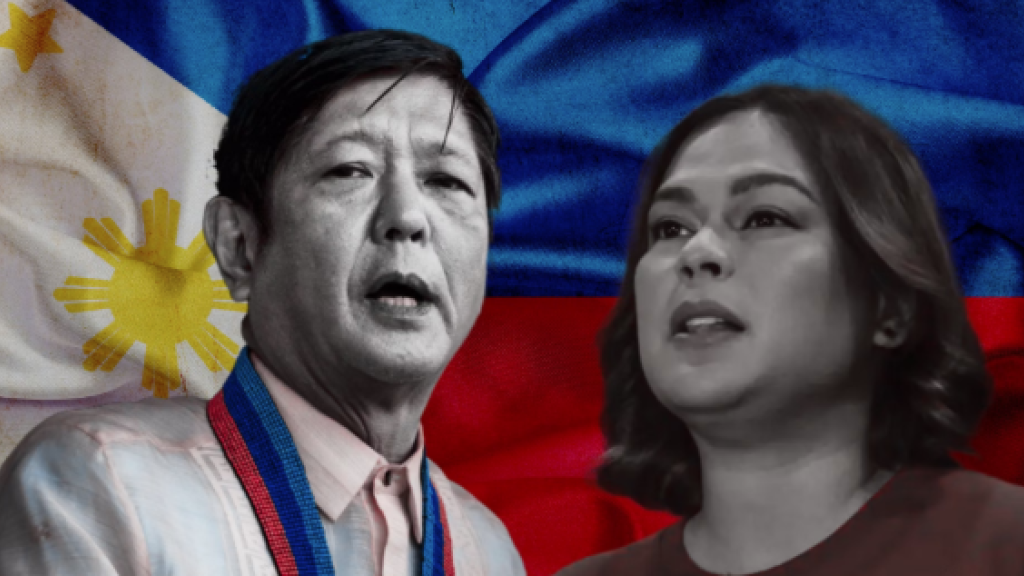
1. The feud between the two ruling dynasties in the country — the Marcos and Duterte dynasties — intensifies almost daily.
2. The skirmish between the two groups is reaching an eruption. They are now engaged in destabilization campaigns. For the Dutertes, it is now heading toward an impeachment plan against Vice-President Sara Duterte. For former President Rodrigo Duterte, there is an anticipation of an impending arrest, whether by the International Criminal Court or the country’s security forces.
3. In response, the Dutertes have stepped up their campaign of destabilizing the Marcos-Romualdez dynasty. Along with threats to kill the Marcoses — President Bongbong Marcos (BBM) and wife Liza Araneta — and House Speaker Martin Romualdez, Sara Duterte’s team is attempting to mobilize “people's power”. Her father Rodrigo is now calling for military intervention, essentially a coup d’etat, against the “fractured government” of BBM.
4. The clash of these wicked dynasties will affect not only their families, minions, and supporters but also the millions of Filipino masses, who will be hit the hardest by these skirmishes. A destabilized situation will negatively impact the economy, government services, and any development plan for the country.
5. These dynasties do not bicker on the corruption issue as they are both corrupt. They do not bicker over criminality and government ineptness as they are both criminal and inept clans. These clans will fight to the death in pursuit of power, especially as they prepare for the upcoming 2025 election and the battle for the presidency in 2028.
6. Do not allow us to be used by any of these dynasties. We have nothing to gain from any of them. Every dynasty that has governed has enriched its clans while continuously oppressing the masses. While they prosper in office, we reel under perennial unemployment, low wages, commodity price rises, lack of housing and medical care, and other life-related torments.
7. The masses must act to defend and advance their rights and aim to form a government that will improve their condition because the masses will run it.
8. No support whatsoever to the two ruling dynasties. They are an obstacle to the development of the country and the people. We can only hope that they destroy each other. And in their place, a Government of the Masses that will defend and advance the interests of the masses will finally come to power.
Partido Lakas ng Masa (PLM)
November 27, 2024
Friday, November 29, 2024
Commemorating November 29, 1943: The founding of a new Yugoslavia
A few days ago, the Serbian government announced its decision to demolish the iconic Yugoslavia Hotel, a landmark badly damaged during the 1999 NATO bombing campaign, to make way for a luxury Ritz-Carlton Hotel. Opened in 1969, the Yugoslavia Hotel was the largest in the entire federation and a remaining symbol of a country that no longer exists. Yet, even as the physical traces of Yugoslavia fade, its historical significance and virtual presence remain as potent as ever. This enduring legacy prompts us to reflect on the transformative vision and global impact of Yugoslavia, as we commemorate the anniversary of its founding on November 29.
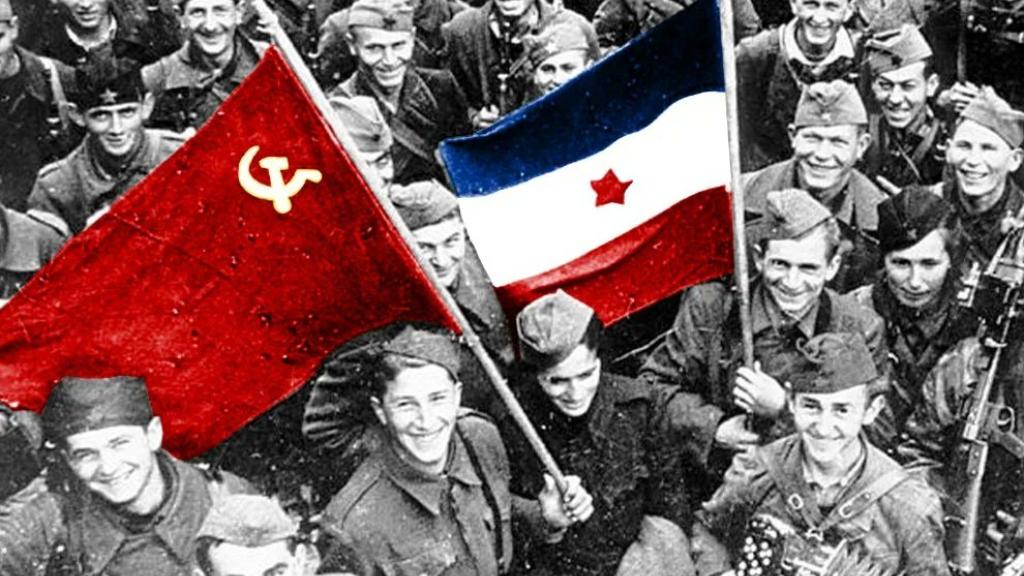
On November 29, 1943, amid the turmoil of World War II, the Anti-Fascist Council for the National Liberation of Yugoslavia (AVNOJ) proclaimed the foundation of the new Yugoslavia in Jajce, Bosnia. This moment marked the birth of a federation that envisioned a radically different future from the inequalities and divisions of the royalist past. Underpinned by the principles of “brotherhood and unity,” the Yugoslav project sought to transcend the ethnic, social and economic cleavages that had defined the interwar kingdom.
For decades, November 29 was celebrated as Republic Day across the federation. It was a day of parades, cultural events and communal reflection on the revolutionary legacy and aspirations of the socialist state. Families would gather, workers would reflect on their contributions, and students would learn about the struggles and achievements of a united Yugoslavia. The day symbolised not only the victory over fascism but also the promise of a society built on equality, solidarity, and collective progress. Even after the collapse of Yugoslavia, this day was celebrated in Serbia until 2001. I vividly remember attending a state reception hosted by Slobodan Milošević in 1998 at the Sava Center — an iconic venue in Belgrade that hosted the last congress of the League of Communists of Yugoslavia. That moment, like the day itself, evoked both the grandeur and the contradictions of Yugoslavia’s legacy.
The transformational promise of the new Yugoslavia
Yugoslavia’s founding ideals resonated deeply with its working masses, who were mobilised to rebuild a war-torn country and embark on an ambitious journey of socio-economic transformation. The vision was clear: to eradicate the inequalities of royalist Yugoslavia and forge a society where all nations and nationalities could thrive.
The boldness of the Yugoslav project becomes even more remarkable when viewed against the backdrop of bitter inter-ethnic strife and the atrocities of World War II. The horrors of the war, such as the genocide of Serbs, Jews, Roma, and anti-fascist Croats in the Independent State of Croatia, along with the other brutalities and divisions sown by the war, left deep scars on the peoples of Yugoslavia. Overcoming these wounds required a revolutionary vision that went beyond simple reconciliation.
The founders of socialist Yugoslavia, firmly convinced that a new socially just state belonging to the working people of all nations could unite its citizens, embarked on a transformative project that sought to transcend the past. This vision was grounded in the principles of “brotherhood and unity,” not as mere slogans but as a deliberate strategy to foster solidarity among the country’s diverse ethnic groups. The idea was clear: only a state based on social justice, equality, and shared prosperity could heal the divisions and create a better future.
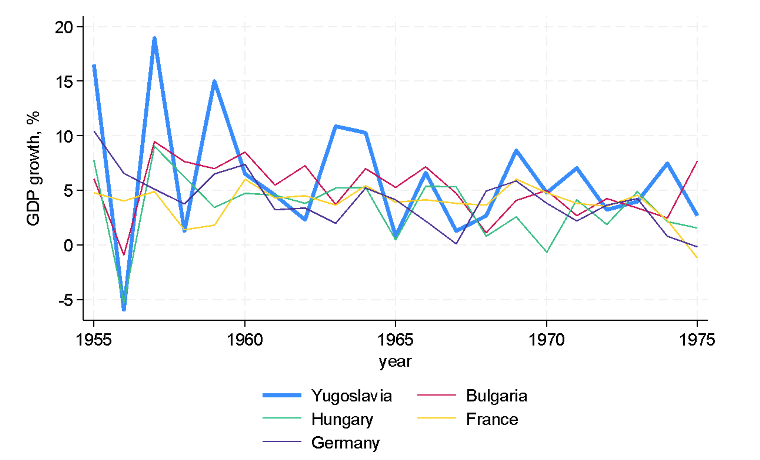
In the three decades following its founding, Yugoslavia achieved remarkable progress. During the 1950s to ’70s, a period often called “the glorious thirty” for the widespread economic growth across Europe, Yugoslavia stood out as one of the fastest-growing countries on the continent. This can be observed in Figure 1: while volatile, Yugoslavia’s growth rate was often above not only other socialist countries but also such European powerhouses as Germany and France. On average, the Yugoslav economy grew at 6.2% annually between 1955-75 compared to 5.2% in Bulgaria, 3.5% in Hungary, 3.8% in France and 4.0% in Germany. Yugoslavia’s GDP tripled over this period. From predominantly agrarian, the country transformed into a modern industrial state with advanced industries, such as production of automobiles, aircraft, and electronics. Through its unique model of socialist self-management, the country combined industrial modernisation with grassroots participation, creating opportunities for millions.
Figure 1. Yugoslavia’s GDP growth in comparison with some European countries. Source: Author based on the Maddison Project Database 2020
A grand experiment in socialism
Whereas all socialist countries experimented to some extent — though in the Soviet Union this experimentation ended rather early, and in countries such as Hungary and Czechoslovakia it was checked by Soviet interventions — Yugoslavia was arguably the most prone to experiment. Its entire post-war development was one grand experiment in a creative effort to align the country’s functioning with the tenets of Marxism. Disappointed in etatism after a short period, Yugoslavia embarked on the ambitious project of building self-management socialism, where economic and political decisions rested with working collectives rather than state bureaucracies, as in the Soviet Union.
This drive for experimentation was enshrined in the Program of the League of Communists, which declared nothing that had been created “can be so sacred that it could not be superseded by the better, the more advanced, the more humane.” Tito famously argued that workers’ self-management was the strongest bulwark against the nationalism that threatened the country: “There is no Serb or Croatian proletariat,” he declared. “There is but one Yugoslav proletariat.” At its height, Yugoslavia’s experiments in workers’ self-management drew the attention of both Western and developing nations, eager to study its novel approaches to governance and economic organisation.
Some critics argue that these experiments pushed Yugoslavia too far and sowed the seeds of its collapse, while others, such as Branko Horvat contend that the country ultimately fell apart because it never fully implemented workers’ self-management. As the concept of self-management regains attention in both heterodox and mainstream economic discussions, the Yugoslav experience remains profoundly relevant, calling for renewed analysis of its successes and failures.
A global leader in Non-Alignment
The transformational promise of Yugoslavia extended beyond its borders. By the 1960s and ’70s, the country emerged as a leader in the global Non-Aligned Movement (NAM), advocating for an alternative path in the polarised Cold War world. Yugoslavia’s role in the movement was not only unique but also groundbreaking. It was one of the very first socialist countries — and arguably the only one in its early stages — to join the NAM, long before the thaw in relations between the West and the Soviet bloc. This was a courageous and well-thought-out political action, signaling Yugoslavia’s commitment to an independent foreign policy that rejected alignment with either superpower.
Unlike other non-aligned countries, whose non-alignment was often born of anti-colonial revolutions or post-colonial defiance against former imperial masters, Yugoslavia’s non-alignment emerged directly from the dynamics of inter-bloc politics. It was the product of an authentic Communist revolution striving for independence and equality, not just within its own borders but also in the international arena. Yugoslavia’s non-alignment was the culmination of an arduous political journey that took it from the fringes of European bloc politics to the forefront of global diplomacy. From this unique position, Yugoslavia set the pace of political developments both within NAM and across the Third World during the Cold War era, shaping a new ideological and foreign policy response to the dominant currents in international relations.
Yugoslavia played a pivotal role in shaping NAM, providing a bridge between the Global North and Global South. This dual position allowed the country to act as what some scholars have termed a “liminal hegemony” — a space between the developed and developing worlds. On one hand, Yugoslavia provided leadership for the Global South, helping to unify the newly independent nations of Africa, Asia and Latin America under a shared agenda of anti-imperialism and equitable global development. On the other hand, its socialist model, unique economic experiments, and relatively developed economy gave the movement greater international credibility and positioned it as a legitimate third force in global politics.
Under Josip Broz Tito’s leadership, Yugoslavia was instrumental in convening the first NAM summit in Belgrade in 1961, which brought together representatives from 25 countries to articulate a vision of international cooperation, peace and solidarity. Unlike the Soviet Union’s focus on ideological conformity, Yugoslavia’s engagement with NAM was pragmatic, emphasising decolonisation, economic independence and peaceful coexistence. This approach resonated with many post-colonial states seeking to navigate the treacherous waters of Cold War politics without succumbing to the pressures of alignment.
Yugoslavia’s contributions to NAM extended beyond rhetoric. It offered technical and developmental assistance to Global South countries, supported their anti-colonial struggles, and advocated for a New International Economic Order that prioritised the needs of the developing world. By setting the pace of NAM’s political agenda, Yugoslavia shaped key debates on sovereignty, development and global justice during a crucial period in world history.
Through its “liminal” position, Yugoslavia enhanced its own international standing while reinforcing NAM’s role as a vital actor in global diplomacy. NAM’s principles of sovereignty, equality and non-interference — principles that Yugoslavia helped champion — continue to inspire debates about global governance, justice and the legacy of colonialism. In this way, Yugoslavia’s unique role in NAM remains a testament to the possibilities of an independent and principled foreign policy, rooted in the ideals of solidarity, equality, and peace.
Legacy and reflection
As we remember November 29, we celebrate not just the birth of a new Yugoslavia but the ideals that mobilised a generation to dream of a fairer and more equitable society. Yugoslavia was a goal-driven state, whose continuous experimentation reflected the ambition of its revolutionary vision. None of the successor states can boast of such a transformative goal. The pursuit of European Union membership by countries such as Serbia, Bosnia and North Macedonia pales in comparison — unless one seriously believes that the EU represents Communism.
In its role as a leader of NAM, Yugoslavia demonstrated a bold and innovative approach to international relations. It transcended the binaries of the Cold War, setting the pace for political developments in the Third World and offering a pragmatic yet principled vision of global solidarity. Yugoslavia’s “liminal hegemony” between the Global North and South was not just a political strategy but a reflection of its revolutionary ideals — an effort to reshape global dynamics through equality, cooperation and mutual respect.
Yugoslavia’s dissolution not only marked the end of a visionary dream but also deprived an entire group of people of their country. By 1981, more than 1.2 million individuals identified as Yugoslavs, transcending the narrow confines of ethnic identities. For these people, being Yugoslav was not simply an administrative label but a lived reality and a unifying identity. With the collapse of the federation, these individuals were forced to adopt restrictive ethnic affiliations, often at odds with their personal sense of belonging. In a world where identifying as European has become fashionable, identifying as Yugoslav has become unpopular, even despised — a painful reminder of the ideological and cultural disintegration that accompanied Yugoslavia’s fall.
Domestically, Yugoslavia’s political and institutional design offered a unique experiment in federalism. With its high degree of federalisation, where decision-making was based on consensus between republics and autonomous provinces, and where republics held the right to enter into bilateral relations with other states and even had their own banks to exercise significant control over regional investment policies, socialist Yugoslavia can justly be considered a precursor to today’s EU. Its structure sought to balance national aspirations with the need for unity, offering a framework of shared sovereignty that echoes the EU’s founding principles.
However, the tragic splitting of Yugoslavia along ethnic lines and its eventual demise raise important questions about the EU’s future. Can the EU, faced with its own tensions — ranging from rising nationalism to economic inequalities — avoid a similar fate? What lessons can be drawn from Yugoslavia’s efforts to hold diverse communities together under a shared vision, and its failure to sustain this unity in the face of growing internal divisions? Yugoslavia’s experience serves as both an inspiration and a cautionary tale, underscoring the need for solidarity, adaptability, and shared commitment to common ideals to prevent fragmentation.
Against the backdrop of a continuous and deepening crisis of neoliberal capitalism, now coupled with the “long retreat” of the left from nearly all positions of power and influence, and amid an increasingly volatile international security environment, Yugoslavia offers valuable lessons. It stands as an example of principled yet measured politics, promoting de-escalation and international cooperation.
Today, the legacy of Yugoslavia calls for renewed reflection on its bold experiments in workers’ self-management, its independent and forward-looking foreign policy, and its steadfast commitment to unity and solidarity. It remains a powerful reminder that even in a divided and unequal world, an alternative vision of global and domestic politics — rooted in equality, justice, and collective progress — is not only possible but essential.