SYRIA UPDATES
Jordan to host Syria talks after Damascus erupts in celebration
By AFP
December 13, 2024

Fireworks erupt above people celebrating the ouster of Syrian president Bashar al-Assad at Umayyad Square in central Damascus - Copyright AFP Omar HAJ KADOUR
Maher Al Mounes with Laure Al Khoury in Sweida
Jordan will host US, EU, Turkish and Arab diplomats on Saturday for high-level talks on Syria, a day after celebrations in Damascus and nationwide rejoicing at the ouster of president Bashar al-Assad.
Syrians celebrated the day they called the “Friday of victory” with fireworks heralding the fall of the Assad dynasty.
More than half a century of brutal rule by his clan came to a sudden end on Sunday, after a lightning rebel offensive swept across the country and took the capital.
Assad’s fall has also led to fast-moving diplomatic developments, with US Secretary of State Antony Blinken among envoys set to discuss Syria on Saturday in the Jordanian city of Aqaba.
Turkey, meanwhile, will reopen its embassy in Damascus, closed since 2012 amid calls by Ankara for Assad to step down.
A Qatari diplomat said a delegation from the Gulf emirate would visit Syria on Sunday to meet transitional government officials and discuss aid and the reopening of their embassy.
Unlike other Arab states, Qatar never restored diplomatic ties with Assad after a rupture in 2011.
Assad has fled Syria, closing an era in which suspected dissidents were jailed or killed, and capping nearly 14 years of war that killed more than 500,000 people and displaced millions.
– ‘Tears of joy’ –
Abu Mohammed al-Jolani, head of the Islamist group Hayat Tahrir al-Sham (HTS) which spearheaded the offensive, had called on Syrians “to go to the streets to express their joy”.
Celebrations continued into the night on the first Friday — the Muslim day of rest and prayer — since Assad took flight.
Umayyad Square in Damascus was jammed with vehicles, people and waving flags as fireworks shot into the air, AFPTV live images showed.
Thousands flocked to the capital’s landmark Umayyad Mosque, some raising the three-star Syrian independence flag that none dared wave in the capital during Assad’s repressive rule.
Crowds also gathered in the squares and streets of other Syrian cities, including Homs, Hama and Idlib.
There was a festive and relaxed atmosphere as hundreds rallied in the main square of Syria’s second city Aleppo, a scene of fierce fighting during the country’s civil war, AFP correspondents said.
A huge billboard depicting Assad and his father Hafez was set on fire.
Ahmad Abd al-Majed, 39, an engineer who returned to Aleppo from Turkey, said that many shed “tears of joy and happiness”.
“Syrians deserve to be happy,” he said.
In the southern city of Sweida, the heartland of Syria’s Druze minority, Bayan al-Hinnawi, 77, never believed he would live to see such a day.
“It’s a wonderful sight. Nobody could have imagined this could happen”, said Hinnawi, who spent 17 years in prison.
– Tens of thousands missing –
Sunni Muslim HTS is rooted in Syria’s branch of Al-Qaeda and designated a terrorist organisation by many Western governments.
The group has sought to moderate its rhetoric, and the interim government insists the rights of all Syrians will be protected — as will the rule of law.
The European Union was seeking “to establish contacts” with the new rulers soon, an EU official told AFP on condition of anonymity.
The UN refugee agency said the new government had sent “constructive” initial signals, including asking the organisation to stay in the country.
Leaders of the Group of Seven (G7) democratic countries, who met virtually on Friday, expressed hope for “a peaceful and orderly transition through the definition of an inclusive political process” in Syria.
Inside much of Syria, the focus is turning towards unravelling the secrets of Assad’s rule, particularly the network of detention centres and suspected torture sites.
Syrians have descended upon prisons, hospitals and morgues in search of long-disappeared loved ones.
“I turned the world upside down looking,” Abu Mohammed told AFP as he searched for news of three missing relatives at the Mazzeh airbase in Damascus.
“We just want a hint of where they were.”
The International Committee of the Red Cross said it documented more than 35,000 disappearances during Assad’s rule, with the actual number likely far higher.
While Syrians celebrate the end of Assad’s brutal rule, they face a struggle for necessities in a country ravaged by war, sanctions and runaway inflation.
On Friday, the EU announced the launch of an “air bridge” operation to deliver an initial 50 tonnes of health supplies via neighbouring Turkey.
– Israel ready to stay in buffer zone –
Assad was propped up by Russia — where a senior Russian official told US media he has fled — as well as Iran and Lebanon’s Hezbollah militant group.
Turkish Foreign Minister Hakan Fidan told private NTV television that his country had urged Russia and Iran not to intervene militarily “to ensure minimum loss of life”.
The rebels launched their offensive on November 27, the same day a ceasefire took effect in the Israel-Hezbollah war, which saw Israel inflict staggering losses on Assad’s Lebanese ally.
Both Israel and Turkey, which backs some of the rebels who ousted Assad, have since carried out strikes inside Syria.
Israel’s latest strikes hit military sites in the Eastern Qalamun region, the Syrian Observatory for Human Rights war monitor said Saturday.
Israel has also sent troops into a UN-patrolled buffer zone that separated Israeli and Syrian forces on the Golan Heights, in a move the UN said violated a 1974 armistice.
The army has been ordered to “prepare to remain” there throughout the winter, Defence Minister Israel Katz’s office said Friday.
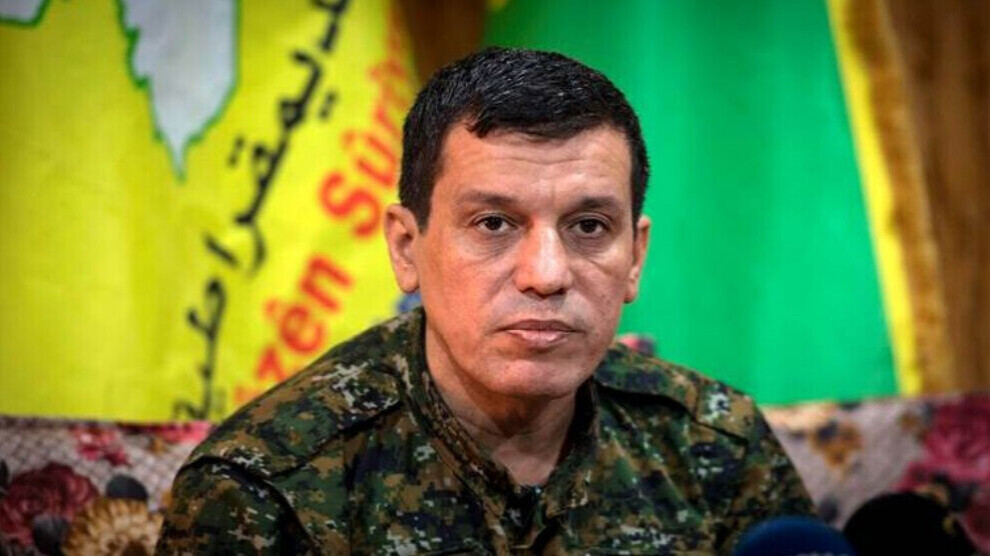
Mazlum Abdi: We see the statement issued in Jordan as positive
Mazlum Abdi, the Commander-in-Chief of the SDF, issued a statement regarding the final statement of the meeting held in Jordan about Syria's future.
ANF
NEWS DESK
Sunday, 15 December 2024
In a statement on his social media accounts, Mazlum Abdi, the Commander-in-Chief of the Syrian Democratic Forces (SDF), said about the meeting held in Aqaba, Jordan: "We see the outcome of the Aqaba summit of Arab foreign ministers regarding Syria as positive.
We also support the efforts of the Arab countries to ensure stability in Syria. We view this as a fundamental step toward constructive dialogue to build a new Syria. We also emphasize the importance of halting all military activities on Syrian soil. Stability in Syria begins with the participation of all parties and the recognition of the country's unity, which opens the path to lasting peace."
Background
Foreign ministers from Jordan, Saudi Arabia, Iraq, Lebanon, Egypt, the UAE, Bahrain and Qatar issued a joint statement on Saturday after they met in the Jordanian Red Sea port of Aqaba. The diplomats from the eight Arab League countries agreed to "support a peaceful transition process" in Syria following President Bashar al-Assad’s overthrow.
In a statement, the Foreign ministers said that "all political and social forces" must be represented in the new Syrian government and warned against "any ethnic, sectarian or religious discrimination" and called for "justice and equality for all citizens".
They added that the political process in Syria should be supported by "the United Nations and the Arab League, in accordance with the principles of Security Council Resolution 2254", a resolution in 2015 which set out a roadmap for a negotiated settlement.
Shopping spree in Syria’s former rebel heartland
By AFP
December 14, 2024

A young man holds a Syrian independence flag in a shopping mall near Sarmada, in the northern province of Idlib - Copyright AFP/File Fabrice COFFRINI
Anne Chaon
Crowds of visitors wander brilliantly lit shopping aisles, stunned by the abundance of goods on offer in the heart of the former rebel stronghold in northwest Syria.
Dana, near Sarmada in Idlib province, is less than 40 kilometres (25 miles) east of second city Aleppo, but had been cut off from the rest of the country until the fall of president Bashar al-Assad less than a week ago.
It is a major shopping centre because of its proximity to the border with Turkey.
You can pay for your purchases in Turkish lira or in US dollars, and all the big names are available, brought in from Syria’s powerful neighbour.
Everything from clothes to electrical goods to furniture is on display in main street stores and four shopping malls with gleaming windows.
“It’s a long time since I have seen so many things,” said 54-year-old mother Aisha Darkalt, visiting from Aleppo with her family.
“The kids, they don’t know where to look… It’s hard to imagine all this was so close. We never left Aleppo any more.”
Aleppo, the first city to be taken by the rebels in their lightning offensive that ended decades of rule by the Assad clan, still has just three hours of electricity a day.
But bright lights, pink fabric flowers and flashy garlands adorn the shopping malls of nearby Dana after 13 years of deprivation in the rest of the country, which has been ravaged by a civil war that broke out in 2011.
– Close to Turkey –
The Sarmada region was relatively well off while Aleppo and much of the rest of Syria was engulfed in conflict and poverty under Assad rule, squeezed for taxes and rife with corruption.
Unlike Idlib, the rebel “capital” that was subject to Russian bombardment until the start of the month, Sarmada was generally spared because it is so close to neighbouring Turkey.
In 2021, the Carnegie Middle East Center said the region’s prosperity dated to the outbreak of the war in 2011 and the rupture between Damascus and Ankara, when Assad stopped the importation of goods from Turkey.
Local businessmen were well used to cross-border dealings, and benefited from an influx of displaced people into an area where just 15,000 inhabitants lived previously.
A flourishing commercial hub was born, one that the Islamists of the Hayat Tahrir al-Sham (HTS) rebel group was careful not to oppose.
But it still remained out of bounds to the rest of the country — until now. In recent days, people have been flocking to the area to shop, arriving from Aleppo, Hama, Homs and even the capital Damascus.
Maher al-Ahmad, 42, runs a store selling household goods and carpets.
“People are surprised,” he said amid a shopping frenzy worthy of sales time at department stores in the West.
“They thought we lived in a dangerous place full of criminals, and then they come here! We have electricity, we have everything they need.”
– Return to normal –
Imad Fares, 40, has lived in Dana for the past three years after leaving his home town of Maaret al-Numan, which was devastated by the conflict.
“The people from Aleppo look miserable and tired. You can tell from their faces that they lived in a prison,” he said.
“They’re shocked at how we live here.”
It is the beginning of a return to normal.
Ahmad loaded two flat-screen televisions and toys he had bought into the boot of his ancient car.
“You can find anything,” the 42-year-old said.
“But the most important thing is knowing you can get back home without being robbed by Assad’s people on the way.”
His vehicle was a stark contrast to the shiny new cars and SUVs with Idlib plates that popped up in the streets of Aleppo this week.
Because bringing cars in from Turkey was banned, Syrians often pushed their own ageing vehicles to the limit.
A doctor from Aleppo said he got his car in 2013, and 11 years later it was still considered new.
“A week ago I got $50,000 for it,” he said. “But now you can buy a new one in Sarmada, it wouldn’t be worth more than $8,000.”
He looked on at friends who had come to do their shopping in the former rebel bastion, where prices were up to three times lower than in the city.
“We just didn’t understand that we were the unfortunate ones,” he laughed
Syrian pubs cautiously reopen after Islamist victory
By AFP
December 14, 2024

For four days after Islamist-led fighters entered Damascus, pubs and liquor stores remained shut but no crackdown emerged and now venues are tentatively reopening. - Copyright AFP/File Omar HAJ KADOUR
Dave CLARK
The citizens of Damascus largely celebrated the fall of Bashar al-Assad’s hated regime with joy, after 13 long years of brutal civil war.
But the city’s drinking holes did have one concern.
The rebel army that overthrew the former leader was led by Hayat Tahrir al-Sham (HTS), an Islamist group which some drinkers feared would forbid the sale of alcohol.
For four days after the HTS fighters entered the city, pubs and liquor stores remained shut but no crackdown emerged and now venues are tentatively reopening.
And Safi, the landlord of the Papa Bar in the winding alleys of the Old City, wants everyone to calm down and enjoy a drink or two in the normally busy Christmas season.
– Social media fears –
In an interview with AFP over the bar in his cellar pub, Safi — who did not give his family name so as not to identify community origins — complained of a social media driven panic.
When rumours started spreading that the Islamist gunmen in control of the neighbourhood were going to crack down on bars, he went to the police post they control on the Bab Touma roundabout.
“I told the them that I own a bar and would like to hold a party and serve alcoholic drinks,” he said, standing in front of a row of bottles of imported Scotch whisky and fine Syrian arak.
“They responded: ‘Yes, open the place, there is no problem with that at all. You have the right to work and live your life as you did before’,” he said, as pop music blared.
The HTS-led government has not made any official statement on the status of alcohol and many bar owners and restaurants closed as the city fell to the lightning rebel offensive.
But the new government has also stressed that it is an interim administration and will be tolerant of all social and religious groups in Syria.
“Talk about an alcohol ban is not true,” an HTS official told AFP on condition of anonymity. Pressed, he became exasperated, insisting the government had “bigger issues to deal with”.
The Papa Bar and a handful of nearby pubs have duly reopened, but trade is light and Safi would like the government to make a firmer public statement that they are safe.
On reopening night, he hosted around 20 people for a late night party under the gaze of Tiki Bar-style grimacing Polynesian statues, but on the second night things were quiet.
“The people who attended the party were confused and afraid. They were at the party, but they were not happy,” he complained.
“But if there is reassurance… you will find the whole world staying up late and happy because we are now in the month of Christmas, the month of celebrations.”
Syria has a large Christian minority which celebrates Christmas and decorations are going up in Damascus.
In the Al Alia restaurant around the corner, a singer was belting out popular hits as party-goers enjoyed vast platters of mezze and quaffed arak and beer.
The room wasn’t full, but Dr Mohsen Ahmad, a jovial and stylishly dressed character was determined to have a good time.
“We expected a big mess in the situation,” he told AFP, as neon party lights glinted off the hanging snowflake decor. “But we are very quickly back to our life, night life, our rights.”
– Party with a singer –
The manager of the Al Alia, Yezan Shalash, said HTS fighters had interrupted the venue’s re-opening night party but had not closed it down.
“We started working yesterday. Things were very good … there was a party and a singer. People started to come. In the middle of the party, members of HTS came,” he said,
“They, entered with all politeness and respect. They took off their weapons outside the door.”
Instead of raiding the joint, the former rebels were keen to reassure everyone that business could continue.
“They told people: ‘We didn’t come here to scare anyone, or terrorise anyone. We have come here to live together in Syria, enjoying the freedom that we have been waiting for so long,” Shalash said.
“They treated us very well yesterday but I am afraid that this will be temporary.”
Syria’s new interim government will continue under HTS leadership until March 1. After that, the bar owners don’t know what to expect. In the meantime, Safi wants drinkers to come out.
Syria’s Druze hope for better future without Assad
By AFP
December 13, 2024

Sweida, a Druze city in Syria's south, has been the site of anti-government protests for the past year and a half - Copyright AFP LOUAI BESHARA
Bayan al-Hinnawi, who spent years behind bars in Bashar al-Assad’s Syria, joined crowds in the heartland of the Druze minority on Friday to celebrate the president’s fall, “a dream” come true for the former prisoner.
Hundreds of people descended on Sweida’s main square, singing and clapping in jubilation, just days after Islamist-led rebels took the capital Damascus, sending Assad fleeing.
The Druze-majority city in Syria’s south has been a focal point of renewed anti-government demonstrations over the past year and a half.
On Friday, residents waved Syria’s pre-Assad flag of white, green and black with three stars, and raised olive branches in a sign of peace.
Some of them have lost family members during the anti-government uprising that began in 2011 and spiralled into civil war. Others, like Hinnawi, had languished in prison under the Assad family’s five-decade rule.
“It was a dream,” said 77-year-old Hinnawi of Assad’s ouster.
Decades ago, a few years after Hafez al-Assad seized power — which he later handed over to his son Bashar — a 23-year-old Hinnawi was jailed.
He was released 17 years later.
The grey-haired man said he had “dreamed that one day the regime would fall”, but did not believe that he would live to see the day.
“It’s a wonderful sight. Nobody could have imagined that this could happen”, he said.
– ‘Dignity’ –
But his joy was incomplete, remembering the many who have died in jail.
“I wish that those who died when I was imprisoned in Mazzeh or Saydnaya could see this scene,” said Hinnawi.
Since Assad’s fall, rebel forces and residents have broken into both detention centres, freeing political prisoners and searching for long-missing loved ones.
Activists and rights groups say the Assad government tortured and abused inmates at both facilities.
“I got out when I was 40, I missed out of my whole life,” said Hinnawi, who served in the Syrian army before being jailed.
Recalling torture behind bars, he said that “no oppressor in history has done what they did to us.”
Since Sunday, the ousted government’s security forces were nowhere to be seen in Sweida, and the office of Assad’s Baath party has been abandoned, as have army checkpoints on the road to Damascus.
Local armed men are present, but not the Islamist group Hayat Tahrir al-Sham which spearheaded the rebel offensive against Assad.
Siham Zein al-Din, who lost her son in 2014 after he defected from the national army to join rebel fighters, said he had “sacrificed his life… for freedom, for dignity”.
The family was still searching for Khaldun’s remains, said his 60-year-old mother.
Like her son, some members of the Druze community took up arms against Assad’s forces during the war.
– A brother’s congratulations –
The Druze, who also live in Lebanon, Israel and the Israeli-occupied Golan Heights, make up about three percent of Syria’s population, around 700,000 people.
Beyond defending themselves from attacks in the areas where they live, Syria’s Druze largely stayed on the sidelines of the civil war.
Many managed to avoid compulsory conscription since 2011.
Residents of Sweida have long complained of discrimination and the lack of basic services.
Many buildings in the city are constructed from black volcanic stone that can be found in the area, and its roads have fallen into disrepair.
Sheikh Marwan Hussein Rizk, a religious leader, said that “Sweida province has been marginalised” for decades, with most of its residents living in poverty.
But, surrounded by the joyful protesters, Rizk said better days may be coming.
“Today, we look to the future and ask for a helping hand… Our hand is extended to all Syrians.”
Next to him, resident Hussein Bondok held up a poster of his brother Nasser, a journalist and opposition activist who was last heard from in 2014 when he was arrested.
Bondok, 54, said he believes his brother was likely killed under torture in one of Damascus’s prisons.
Nasser struggled for freedom, Bondok said.
“I want to congratulate him now, because the seeds he had planted with his brothers-in-arms has become a tree.”
Ex-prisoners back in Syria’s cells ‘of despair’
By AFP
December 14, 2024

Former prisoner Mohamed Darwish gives AFP a guided tour of the feared detention centre of the Palestine Branch of Syrian military intelligence where he was interrogated for 120 days - Copyright AFP LOUAI BESHARA
Laure Al Khoury
This time he was there by choice. Mohammed Darwish was back in a jail that was run by Syria’s feared intelligence services — and Bashar al-Assad was no longer president.
Cell number nine reeks of putrefaction. It is an underground windowless room with blackened dripping walls where the 34-year-old journalist was held with around 100 others.
Darwish was detained for months by one of the most feared branches of the former government’s many-tentacled intelligence services.
It was to the so-called Palestine Branch in Damascus, also known as Branch 235, that he was taken for interrogation, suspected by the authorities of supplying information to “terrorist” groups.
Many people who ended up there never saw the light of day again.
“I was one of those they interrogated the most,” Darwish told AFP of his ordeal in 2018. “Every day, morning and night” for the 120 days he was detained.
He said people were held after “arbitrary arrests and with no charges ever laid” against them.
Darwish recalled being kept in the cell which held some 50 prisoners with tuberculosis. He also remembered a young Turkish inmate he said was driven mad by the lashes that rained down upon him.
“When the door closed behind us, we were plunged into the depths of despair. This cell was witness to so much tragedy,” he said.
– Abandoned ID cards –
When Damascus was taken last Sunday by an Islamist coalition led by Hayat Tahrir al-Sham (HTS), which was formerly linked to Al-Qaeda, those who worked at Assad’s Palestine Branch simply melted away.
In one dark room, AFP saw a woman whose face was covered with a grey scarf rummage desperately through a pile of abandoned ID cards.
Thousands like her have swarmed the country’s notorious houses of detention over the past week, looking for evidence that might lead them to loved ones who had disappeared under Assad’s rule.
And some former prisoners, like Darwish, are also returning as free men to where they were once incarcerated, trying to find closure.
Adham Bajbouj, 32, is another former prisoner.
“They told us our stay at the Palestine Branch was just for a question and answer session,” he said.
“But I was in there for 35 days. Or maybe it was 32, I no longer remember very well,” Bajbouj said.
His brother, who was accompanying him, did remember one key detail.
“He weighed 85 kilos (187 pounds) when he arrived, and was just 50 when he got out,” he said.
– Constant humiliation –
As well as being questioned, prisoners were subject to constant humiliation.
“We had to scrub clean the torture areas and toilets, and drag the dead from the cells,” said Bajbouj, who is still frail and said that this was his first time near the building since his release.
What the former detainees call the “torture rooms” are on the top floor. The smell of smoke still lingered from the offices of some of those who had been in charge.
Before these officials left, they burned thousands of documents on the shelves of one room, many of which were presumably stamped “Secret”.
One letter dating to 2022 that escaped the flames was addressed by the army’s high command to those “charged with dealing with terrorism affairs”.
It described the arrest of a soldier who was accused of maintaining relations with “armed terrorist organisations”.
Another former inmate of cell number nine seemed unable to come to terms with the new reality in Syria.
“They charged me with terrorism,” 42-year-old Wael Saleh said. “I’m still charged with terrorism.
“I will never forget what I went through here. I remember there were 103 of us crammed into this cell. We stayed standing up so the older ones could lie down.”
A palace in shock: Bashar al-Assad’s final moments in Syria
By AFP
December 14, 2024

The presidential palace in Damascus on December 8, hours after rebel forces declared they had taken the Syrian capital - Copyright AFP/File Omar HAJ KADOUR
Maher Al Mounes with Sammy Ketz in Cairo
Hours before rebel forces seized Damascus and toppled his government on Sunday, Syrian president Bashar al-Assad was already out of the country, telling hardly anyone, five former officials told AFP.
The night before, Assad had even asked his close adviser Buthaina Shaaban to prepare a speech — which the ousted leader never gave — before flying from Damascus airport to Russia’s Hmeimim air base in Syria, and from there out of the country.
Assad left even “without telling… his close confidants in advance”, a former aide told AFP, requesting anonymity for security reasons.
“From the Russian base, a plane took him to Moscow.”
“His brother Maher,” who commanded the Syrian army’s feared Fourth Brigade, “heard about it by chance while he was with his soldiers defending Damascus. He decided to take a helicopter and leave, apparently to Baghdad,” added the former aide.
Other top officials in Assad’s government and sources told AFP what happened in the final hours of the iron-fisted leader’s 24-year rule.
All spoke on condition of anonymity because of security concerns.
– Leaderless –
When Islamist-led rebel forces launched their offensive in Syria’s north on November 27, Assad was in Moscow, where his wife Asma has been treated for cancer.
Two days later, when their son Hafez was defending his doctoral thesis at a Moscow university, the whole family were there, but not Bashar, according to a presidential palace official.
On November 30, when Assad returned from Moscow, Syria’s second city of Aleppo was no longer under his government’s control.
The following week, the rebels took Hama and Homs in quick succession, before eventually reaching the capital.
Another palace official said he did not see Assad the day before Damascus fell last Sunday.
“On Saturday Assad didn’t meet with us. We knew he was there, but did not have a meeting with him,” said the top official.
“We were at the palace, there was no explanation, and it caused great confusion at the senior levels and on the ground,” he said.
“Actually, we had not seen him since the fall of Aleppo, which was very strange.”
During that fateful week, Assad called a meeting of the heads of Syria’s intelligence services to reassure them.
But the longtime leader did not show up, and “Aleppo’s fall shocked us”, said the same top palace official.
Hama was next to fall into rebel hands.
“On Thursday, I spoke at 11:30 am with troops in Hama who assured me the city was under lockdown and not even a mouse could make it in,” an army colonel told AFP.
“Two hours later they received the order not to fight, and to redeploy in Homs to the south,” added the officer of the next strategic city sought by the rebels on their way to Damascus.
“The soldiers were helpless, changing clothes, throwing away their weapons and trying to head home. Who gave the order? We don’t know.”
The governor of Homs told a journalist that he had asked the army to resist. But no government forces defended the city.
– Delay –
On Saturday morning, someone in the halls of power in Damascus brought up the idea of Assad making a speech.
“We started to set up the equipment. Everything was ready,” said the first palace official.
“Later on we were surprised to learn that the speech had been postponed, maybe to Sunday morning.”
According to him, top officials and aides were unaware that while this was happening, the Syrian army had already begun destroying its archives by setting them on fire.
Still on Saturday, at around 9:00 pm (1800 GMT), “the president calls his political adviser Buthaina Shaaban to ask her to prepare a speech for him, and to present it to the political committee which is meant to meet on Sunday morning”, said a senior official close to Assad.
“At 10:00 pm she calls him back, but he no longer picks up the phone.”
That evening, Assad’s media director Kamel Sakr told journalists: “The president is going to deliver a statement very soon.”
But then Sakr, too, stopped answering his phone, as did interior minister Mohammed al-Rahmoun.
The palace official said he stayed in his office until 2:30 am on Sunday. Within less than four hours, the rebels were to announce that Assad was gone.
“We were ready to receive a statement or a message from Assad at any moment,” said the top palace official.
“We could have never imagined such a scenario. We didn’t even know whether the president was still at the palace.”
– ‘Everything was lost’ –
At around midnight, the palace official had been told that Assad needed a cameraman for Sunday morning.
“That reassured us that he was in fact still there,” he said.
But just before 2:00 am, an intelligence officer called to say all government officials and forces had left their offices and positions.
“I was shocked. It was just the two of us in the office. The palace was almost empty, and we were totally confused,” said the official.
At 2:30 am he left the palace.
In the city centre, “arriving at Umayyad Square, there were plenty of soldiers fleeing, looking for transportation,” he said.
“There were thousands of them, coming from the security compound, the defence ministry and other security branches. We found out that their superiors had ordered them to flee.”
The official said it was a “frightening” scene.
“Tens of thousands of cars leaving Damascus, and even more people marching on the road on foot. It was that moment I realised everything was lost and that Damascus had fallen.”
Assad’s final hours in Syria: Deception, despair and flight
Reuters Published December 14, 2024

A shoe rests on top of a bust of former Syrian president Hafez al-Assad, as fighters of the ruling Syrian body inspect the damage at a military site, in the aftermath of an Israeli strike according to Syrian Observatory for Human Rights, after fighters of the ruling Syrian body ousted Syria’s Bashar al-Assad, in Damascus, Syria on December 14. —
Reuters
Bashar al-Assad confided in almost no one about his plans to flee Syria as his reign collapsed. Instead, aides, officials and even relatives were deceived or kept in the dark, more than a dozen people with knowledge of the events told Reuters.
Hours before he escaped for Moscow, Assad assured a meeting of about 30 army and security chiefs at the defence ministry on Saturday that Russian military support was on its way and urged ground forces to hold out, according to a commander who was present and requested anonymity to speak about the briefing.
Civilian staff were none the wiser, too.
Assad told his presidential office manager on Saturday when he finished work he was going home but instead headed to the airport, according to an aide in his inner circle.
He also called his media adviser, Buthaina Shaaban, and asked her to come to his home to write him a speech, the aide said. She arrived to find no one was there.
“Assad didn’t even make a last stand. He didn’t even rally his own troops,” said Nadim Houri, executive director of the Arab Reform Initiative regional think-tank. “He let his supporters face their own fate.”
Reuters was unable to contact Assad in Moscow, where he has been granted political asylum. Interviews with 14 people familiar with his final days and hours in power paint a picture of a leader casting around for outside help to extend his 24-year rule before leaning on deception and stealth to plot his exit from Syria in the early hours of Sunday.
Most of the sources, who include aides in the former president’s inner circle, regional diplomats and security sources and senior Iranian officials, asked for their names to be withheld to freely discuss sensitive matters.
Assad didn’t even inform his younger brother, Maher, commander of the Army’s elite 4th Armoured Division, about his exit plan, according to three aides. Maher flew a helicopter to Iraq and then to Russia, one of the people said.
Assad’s maternal cousins, Ehab and Eyad Makhlouf, were similarly left behind as Damascus fell to the rebels, according to a Syrian aide and Lebanese security official.
The pair tried to flee by car to Lebanon but were ambushed on the way by rebels who shot Ehab dead and wounded Eyad, they said. There was no official confirmation of the death and Reuters was unable to independently verify the incident.
Assad himself fled Damascus by plane on Sunday, Dec 8, flying under the radar with the aircraft’s transponder switched off, two regional diplomats said, escaping the clutches of rebels storming the capital. The dramatic exit ended his 24 years of rule and his family’s half a century of unbroken power, and brought the 13-year civil war to an abrupt halt.
He flew to Russia’s Hmeimim airbase in the Syrian coastal city of Latakia, and from there onwards towards Moscow.
Assad’s immediate family, wife Asma and their three children, were already waiting for him in the Russian capital, according to three former close aides and a senior regional official.
Videos of Assad’s home, taken by rebels and citizens who thronged the presidential complex following his flight and posted on social media, suggest he made a hasty exit, showing cooked food left on the stove and several personal belongings left behind, such as family photo albums.
Russia and Iran: No military rescue
There would be no military rescue from Russia, whose intervention in 2015 had helped turn the tide of the civil war in favour of Assad, or from his other staunch ally Iran.
This had been made clear to the Syrian leader in the days leading up to his exit, when he sought aid from various quarters in a desperate race to cling to power and secure his safety, according to the people interviewed by Reuters.
Assad visited Moscow on Nov 28, a day after Syrian rebel forces attacked the northern province of Aleppo and lightning drive across the country, but his pleas for military intervention fell on deaf ears in the Kremlin which was unwilling to intervene, three regional diplomats said.
Hadi al-Bahra, the head of Syria’s main opposition abroad, said that Assad didn’t convey the reality of the situation to aides back home, citing a source within Assad’s close circle and a regional official.
“He told his commanders and associates after his Moscow trip that military support was coming,” Bahra added. “He was lying to them. The message he received from Moscow was negative.”
Kremlin spokesman Dmitry Peskov told reporters on Wednesday that Russia had spent a lot of effort in helping stabilise Syria in the past but its priority now was the conflict in Ukraine.
Four days after that trip, on Dec 2, Iranian Foreign Minister Abbas Araqchi met with Assad in Damascus. By that time, the rebels from the Hayat Tahrir al-Sham (HTS) Islamist group had taken control of Syria’s second-largest city Aleppo and were sweeping southwards as government forces crumbled.
Assad was visibly distressed during the meeting, and conceded that his army was too weakened to mount an effective resistance, a senior Iranian diplomat told Reuters.
Assad never requested that Tehran deploy forces in Syria though, according to two senior Iranian officials who said he understood that Israel could use any such intervention as a reason to target Iranian forces in Syria or even Iran itself.
The Kremlin and Russian foreign ministry declined to comment for this article, while the Iranian foreign ministry was not immediately available to comment.
Assad confronts own downfall
After exhausting his options, Assad finally accepted the inevitability of his downfall and resolved to leave the country, ending his family’s dynastic rule which dates back to 1971.
Three members of Assad’s inner circle said he initially wanted to seek refuge in the United Arab Emirates, as rebels seized Aleppo and Homs and were advancing towards Damascus.
They said he was rebuffed by the Emiratis who feared an international backlash for harbouring a figure subject to US and European sanctions for allegedly using chemical weapons in a crackdown on insurgents, accusations that Assad has rejected as a fabrication.
The UAE government didn’t immediately respond to a request for comment.
Yet Moscow, while unwilling to intervene militarily, was not prepared to abandon Assad, according to a Russian diplomatic source who spoke on condition of anonymity.
Russia’s Foreign Minister Sergei Lavrov, attending the Doha forum in Qatar on Saturday and Sunday, spearheaded the diplomatic effort to secure the safety of Assad, engaging Turkey and Qatar to leverage their connections to HTS to secure Assad’s safe exit to Russia, two regional officials said.
One Western security source said that Lavrov did “whatever he could” to secure Assad’s safe departure.
Qatar and Turkey made arrangements with HTS to facilitate Assad’s exit, three of the sources said, despite official claim by both countries that they had no contacts with HTS, which is designated by the US and the UN as a terrorist organisation.
Moscow also coordinated with neighbouring states to ensure that a Russian plane leaving Syrian airspace with Assad on board would not be intercepted or targeted, three of the sources said.
Qatar’s foreign ministry didn’t immediately respond to queries about Assad’s exit, while Reuters was unable to reach HTS for comment. A Turkish government official said there was no Russian request to use Turkish airspace for Assad’s flight, though didn’t address whether Ankara worked with HTS to facilitate the escape.
Assad’s last prime minister, Mohammed Jalali, said he spoke to his then-president on the phone on Saturday night at 1030pm.
“In our last call, I told him how difficult the situation was and that there was huge displacement (of people) from Homs toward Latakia … that there was panic and horror in the streets,” he told Saudi-owned Al Arabiya TV this week.
“He replied: ‘Tomorrow, we will see’,” Jalali added. “‘Tomorrow, tomorrow’, was the last thing he told me.”
Jalali said he tried to call Assad again as dawn broke on Sunday, but there was no response.