How Yoon Planned to Set South Korea on the Path to Military Dictatorship
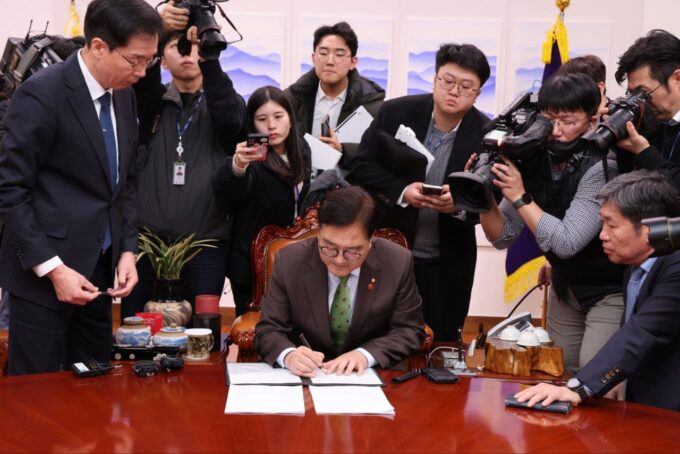
Photograph Source: 대한민국 국회 – KOGL Type 1
Since South Korean President Yoon Suk Yeol’s failed attempt to impose martial law on December 3, a steady stream of revelations has emerged from reporters and investigators, painting an increasingly disturbing picture of events. Plans drawn up by Yoon’s co-conspirators included a shocking level of brutality and the promise of repression on a mass scale. His administration even made efforts to provoke a conflict with North Korea to bolster the case for martial rule. Although many Western reports framed the end of martial law as a triumph of democracy, South Korea is not out of danger yet. The extreme right actively opposes Yoon’s impeachment, and it remains to be seen if the Constitutional Court will confirm Yoon’s impeachment.
Background to Martial Law
Although the martial law declaration shocked many, signs of Yoon’s authoritarian nature were apparent long before. There was his propensity for making blanket condemnations of critics as “anti-state forces,” in essence conflating opposition to his right-wing policies with treason. That attitude was often openly expressed, as in a speech Yoon delivered on National Liberation Day in 2023, branding the liberal and progressive opposition as “anti-state forces that blindly follow communist totalitarianism, distort public opinion, and disrupt the society through manipulative propaganda.” In Yoon’s Manichean viewpoint, pitted against his far-right policies was a sizeable segment of Korean society that lacked legitimacy. “The forces of communist totalitarianism,” he continued in delusional mode, “have always disguised themselves as democracy activists, human rights advocates, or progressive activists while engaging in despicable and unethical tactics and false propaganda. We must never succumb to the forces of communist totalitarianism.”
Yoon’s repressive tendencies often came to the fore more directly. Such was the case on May 31, 2023, when police attacked a union rally and then searched a construction union headquarters several days later, seizing electronic equipment and documents. In another example, a year ago, National Intelligence Service (NIS) agents, backed by more than a thousand riot police, raided the headquarters of the Korean Confederation of Trade Unions (KCTU) and fourteen other union offices and residences. Based on the trumped-up charge that union officials were taking orders from North Korea, the raid netted three unionists who were arrested and later convicted to multi-year prison sentences. It is worth recalling that the NIS has a history of fabricating evidence against activists, most famously in its manufactured ‘evidence’ that led to the forcible dissolution of the Unified Progressive Party ten years ago.
Political organizations also experienced repression, and last August, police raided the office of the People’s Democratic Party and its members’ residences, and two leaders of Korea Solidarity were sentenced to prison terms for violating the National Security Act, which has often been used as a weapon over the years to smother dissent.
Yoon has faced rising labor unrest in response to his anti-labor policies. His response has been to implement a repressive policy against the union movement, characterized by a pattern of harassment. One of Yoon’s primary motivations for a military takeover was to deal a fatal blow to the union movement. He often ranted about the Korean Confederation of Trade Unions, a particularly passionate object of his hatred. At Yoon’s residence in August, he discussed adopting emergency measures and specified what that meant for the KCTU: “We have to take action against these people.”
Yoon obsessed over the April 10 legislative election in South Korea, which handed a landslide victory to the opposition, widely seen as a rebuke to him personally and his policies. Social media was flooded with inaccurateclaims of electoral fraud by his supporters. No doubt, Yoon found such claims a more acceptable explanation of electoral disaster than to look within himself as the cause. Yoon began to cultivate relationships with far-right YouTubers who fed his delusion, firing his resentment and anger, and the subject formed another main factor motivating his plan for a military takeover.
Planning for Military Dictatorship
Martial law had a long gestation, the origin of which predated the April 10 election. Yoon drove the process at every step, with the earliest documented case of its expression in December 2023, when he remarked to military officials, “The only way to solve difficult social problems is through emergency measures.”
Serious planning got underway in five-party meetings led by Yoon that took place between June and November and which were attended by his key co-conspirators. Representing the military were General Lee Jin-woo, commander of the Capital Defense Command, and Special Warfare Commander Kwak Jong-geun. Others included Kim Yong-hyun, who held the position of chief of the Presidential Security Service at the time of the initial meeting and later on became defense minister. The final member of the team was Yeo In-hyung, chief of the Defense Intelligence Command. Yoon met with Yeo and Kim at least ten times to plan the operation, ending in November when they conducted a martial law simulation.
At first, things did not go as smoothly as Yoon would have liked. According to an inside military source, “The president’s commitment to martial law has always been firm,” but Kim Yong-hyun was initially not very actively involved. By March 2024, though, Kim “had become a staunch believer in martial law, while on the other hand, National Intelligence Service Director Cho Tae-yong and [then Defense Minister] Shin Won-sik consistently opposed it.” At dinner one evening that month, Yoon, livid over his political frustrations, blurted out, “We will have to impose martial law soon.” Taken aback, Shin and Cho tried to dissuade Yoon, without success. Emotions ran high, and after dinner, Kim and Yeo joined Shin at his home, where they clashed over Yoon’s comment. Shin adamantly opposed martial law, and he and Kim soon became embroiled in a heated argument, shouting at each other until late into the night.
Something had to be done about Shin, who, although a hawk, did not support Yoon’s overturning of the constitutional order. A man with his attitude toward martial law would not do. On August 12, Yoon nominated the more supportive Kim Yong-hyun as his new minister of national defense, which took effect in September. A firm believer in martial law was needed in this position of authority over the military, and Kim was that man. In appointing Kim, Yoon shunted Shin to another position where he would not get in the way.
Plans had progressed in September to the stage where elite agents from the Headquarters Intelligence Detachment (HID) began training to carry out operations under martial law. The HID is a special warfare unit that, in the event of war, has as its mission infiltration into North Korea to assassinate officials and commit acts of sabotage. Why this particular skill set was considered suitable against a domestic civilian population is indicative of Yoon’s attitude toward democratic opposition. HID agents assigned to martial law operations were chosen for their proficiency in hand-to-hand combat. On the day Yoon declared martial law, five of the HID agents deployed to Pangyo, on the outskirts of Seoul, and the remaining 35 were assigned to various locations inside the capital city.
By November, the Defense Counterintelligence Command drafted high-level plans for martial law. Roh Sang-won, a former intelligence commander widely regarded as the architect of Yoon’s martial law insurrection, devised implementation plans. Roh brought an unsavory background to the project beyond his intelligence experience. Six years ago, he was dishonorably discharged from the service after being sentenced to 18 months in prison for sexual assault. Despite his civilian status, Roh was a key collaborator, apparently due to his intelligence experience and longstanding friendship with Defense Minister Kim Yong-hyun.
In mid-November, Roh instructed Maj. General Moon Sang-ho, head of the Defense Intelligence Command, to provide a list of 15 people skilled in covert operations who would assist in a planned raid on the National Election Commission. Moon selected agents for the mission “who were really good at North Korean operations.” As the day of martial law approached, plans became more detailed. On December 1, Roh met with Moon and two military intelligence colonels at a Lotteria fast-food restaurant, where they discussed operational plans supporting martial law. Despite Roh’s civilian status, he gave the orders. Roh instructed the others to seize control of the election commission “to secure evidence of election fraud.” It was unconventional, to say the least, for a civilian to be in a military chain of command, delivering orders. However, Roh’s tight relationship with Defense Minister Kim Yong-hyun was well understood. Roh played upon that factor in promising future assistance in directing promotion opportunities to the two colonels if they cooperated. However, the instructions that Defense Minister Kim had issued to Moon beforehand carried more weight: “Make it known that Roh Sang-won’s orders are my orders.”
Several hours before Yoon declared martial law on December 3, a second meeting occurred at Lotteria. This time, Koo Sam-hoe, commander of the Second Armored Brigade, joined others in attendance. Under orders from Roh, Koo headed afterward to an intelligence command center in Gyeonggi Province to join HID agents on standby mode. Koo’s apparent role was connected to his brigade being the closest armored unit to Seoul. Although no information on the nature of his orders has been revealed yet, it should be noted that on the same day, Defense Minister Kim remarked, “The National Assembly is messing around with the defense budget, so let’s smash it with tanks.” There are well-founded suspicions that the conspirators anticipated that there would be large-scale demonstrations against martial law and that tanks were needed to put them down.
Martial Law Goes into Effect
At about 10:25 PM on December 3, Yoon began his speech proclaiming martial law. Supplementing the speech, the martial law decree prohibited all political activities, strikes, and demonstrations. It also stipulated that all acts that deny or attempt to overthrow military rule, which the document perversely termed “the free democratic system,” would not be allowed. All media were to be placed under the control of the Martial Law Command, with the warning that violators may be arrested, detained, searched without a warrant, and punished. The decree was chillingly redolent of South Korea’s previous experiences under martial law when people faced repression on a mass scale, imprisonment, torture, and executions.
The South Korean constitution provides for martial law based on two exigencies – military necessity or national emergency. Neither applied in this case. But Yoon calculated that violence could substitute for legality. According to one estimate, Yoon unleashed at least 4,200 riot police and more than 1,700 military personnel at a variety of locations as his insurrection unfolded. Another estimate puts the combined total at 4,749. Because the constitution grants authority to the National Assembly to overturn martial law, it was Yoon’s primary target. If Yoon could stop the National Assembly from reaching a quorum and taking a vote, then he could make martial law stick.
As soon as the news was broadcast, outraged citizens by the thousands raced to the National Assembly to confront the army and police, buying enough time for arriving lawmakers to fight their way through the military blockade and gain entry to the building. Those inside the building erected barricades at the doors and used fire extinguishers to fend off soldiers who had entered through windows.
Many of the soldiers deployed to the National Assembly were informed beforehand that they were being sent to the border area and instructed to write a will and have blood drawn. Helicopters transporting them to the scene deliberately adopted complex flight patterns to disorient the passengers as to their destination. However, as soon as they arrived, it was immediately apparent to the soldiers that they had been misled. Several soldiers resisted orders to drag legislators out of the building. One soldier pointed out that his unit comprised only 230 people and asked, “So how could we possibly drag them out?” The officer in charge responded by explaining, “Dragging out means subduing them with guns or special forces techniques to immobilize them and then dragging them out.”
Yoon’s motives were both strategic and personal, and his animus drove him to instruct the deputy director of the National Intelligence Service to target several individuals that he particularly loathed, including Democratic Party leader Lee Jae-myung, National Assembly Speaker Woo Won-shik, and Han Dong-hoon, the leader of his ruling party. “Take this opportunity to arrest them all, sort them all out, and give the National Intelligence Service the authority to conduct counter-intelligence investigations,” he urged. Additional orders went out to the counterintelligence arrest team to prioritize apprehending those three individuals and transferring them to a detention facility in Suwon, using handcuffs and shackles. The personalization of Yoon’s martial law took on such prominence that the office of the Defense Counterintelligence Command’s arrest team had a whiteboard listing the names of fourteen people to be rounded up.
As Yoon began to fear that his plan to blockade the National Assembly was starting to unravel, his compound became a beehive of activity. A flurry of calls went out, demanding that martial law troops crush resistance. In one encrypted call to Special Warfare Commander Kwak, Yoon said he did not think the Assembly had a quorum yet and ordered him to break down the doors, go in, and drag out the people inside. Colonel Kim Hyun-tae of the Special Warfare Command received a similar call from Yoon, who told him that “there shouldn’t be more than 150 lawmakers in the chamber.” Defense Minister Kim Yong-hyun made frantic calls along the same lines, instructing Colonel Kim to go in and drag out Assembly members before a quorum formed. He also urged Kwak to order his soldiers to force their way in, firing blanks and tasers. Under pressure from Kwak, commanders at the scene discussed those orders and the option of shutting off power to the National Assembly, but many of them expressed doubts about the legality of those orders.
Desperate for more forceful action, Yoon reached out to Lee Jin-woo, commander of the Capital Defense Command, pleading, “Can’t four people go in and take them out, one by one?” Yoon soon called again. “Haven’t you gone in yet? What are you doing? Break down the door with a gun and drag them out.” Yoon badgered National Police Commissioner Cho Ji-ho six times that night, demanding, “Chief Cho, arrest all the lawmakers trying to enter the National Assembly. It’s illegal. All the lawmakers are violating the proclamation. Arrest them.”
Meanwhile, as soon as Yoon proclaimed martial law, ten Defense Intelligence Command soldiers entered the National Election Commission (NEC) headquarters in Gwacheon. Around two hours later, 110 military personnel deployed around the building, only departing about fifty minutes after the National Assembly vote. An additional 130 troops headed to a position near the commission’s Election Training Center in Suwon. Martial law troops photographed wire connections to the servers and other details in preparation for reconnection in a planned removal of servers to a martial law-controlled installation. However, time ran out when the National Assembly vote cut short that assignment.
Jeong Seong-woo, chief of the Counterintelligence First Division, met with the Military Security Office director, Cyber Security Office director, and Scientific Investigation Office director to convey instructions from the head of Counterintelligence, Yeo In-hyung. “The prosecution and the National Intelligence Service will come to the Central Election Commission,” he informed them. “The important tasks will be entrusted to the prosecution, and we will provide support afterward.” These instructions strongly indicate that the Supreme Prosecutor’s Office, or well-placed officials within, were complicit in the martial law conspiracy.
After Martial Law Fails, Yoon Strives for a Second Martial Law
At 1:01 AM on December 4, having collected a quorum, the 190 assembly members who had successfully made their way inside voted unanimously to reject Yoon’s martial law. As specified by South Korea’s martial law act, once the National Assembly votes to lift a martial law decree, the president must announce its termination “without delay.” Rather than follow that constitutional obligation, Yoon maintained three and a half hours of public silence.
Yoon’s immediate reaction was to ignore the National Assembly’s decision and forge ahead with plans to impose martial law. After the vote, Yoon called Commander Lee Jim-woo, telling him, “I can’t even confirm that 190 people have come in… Even if it’s lifted, I can declare martial law two or three times, so keep going.” For the first two hours, the Martial Law Command repeatedly contacted the administrative office of the Supreme Court, demanding that it send a court clerk to the command, presumably to act as a liaison officer. Through this arrangement, the military hoped to exert control over the judiciary. Doubting the legitimacy of martial law, the Supreme Court disregarded the demand.
Half an hour after the National Assembly vote, Yoon summoned generals to meet with him in the martial law situation room at the Joint Chiefs of Staff. A bus transported 34 generals and high-ranking officers to Yoon’s compound. Details of the meeting have not been made public. What is known is that not long after martial law was voted down, the martial law command ordered the 7th Airborne Brigade in North Jeolla Province and the 13th Airborne Brigade in North Chungcheong Province to go into standby mode and prepare to advance on Seoul and reinforce troops stationed there. The 11th Airborne Division in Jeollanam-do Province was also set to go, issuing bulletproof vests, helmets, and firearms to the unit and keeping vehicle engines running, ready for immediate departure.
Yoon also convened a council of ministers meeting in a KakaoTalk group chat room, which may not have gone as he had hoped, as Yoon subsequently went on the air at around 4:30 AM to announce the lifting of martial law. It was only then that airborne troops were told to stand down. It is not publicly known what other factors may have contributed to Yoon’s tardy decision to lift martial law.
Yoon’s Plans for the First Days of Martial Law
The Martial Law Command had prepared multiple facilities to house prisoners. One site, the B1 Bunker at the Capital Defense Command, located on the border between Seoul and Gwacheon, can hold up to five hundred people. A second site, the psychological warfare building in Seoul, is not far from the National Assembly, and it is here where prisoners were to be processed through the not-so-gentle hands of HID interrogators. These sites were intended to handle high-profile prisoners. It appears that ordinary civilians who were arrested would be directed into standard prisons. At 1:01 AM on December 4, as the National Assembly voted down martial law, a nationwide request went out to prisons, asking them to report on their capacity. Such a request would ordinarily only occur during regular working hours for prison staff, and the unusual timing is highly suggestive that the martial law operation included plans for immediate mass incarceration.
Had Yoon prevailed, his troops stood poised to seize control of the election commission and its computer servers, which were to be examined for imagined evidence of electoral fraud. Democratic Party assemblyman Kim Byung-joo received information from an inside source that intelligence agents, supplemented by HID soldiers, planned to go to the National Election Commission headquarters, “overpower the department heads and thirty key staff members, bind their wrists and ankles with cable ties, cover their faces with masks, and bring them to the B1 bunker.” Election computer servers were to be transferred to the counterintelligence agency.
A harsher fate than imprisonment awaited election officials after being abducted by the martial law arrest team. Specific equipment was needed to encourage the desired answers from the prisoners during interrogation, including awls, nippers, hammers, and metal baseball bats. It is all too easy to imagine the kind of damage such implements could inflict upon human beings. However, there were those who liked the idea, in particular Roh. At the December 1 Lotteria meeting, he said he would personally interrogate the chairman of the NEC. “Bring the baseball bat to my office,” he ordered, adding that he can break anyone who “doesn’t talk properly.” Roh also intended to compel the election commission website manager to post a “confession of electoral fraud” on the NEC’s website. At little more than two weeks before martial law, Roh was even more explicit about the interrogation methods that were to be employed against captured election officials. “If we catch and pulverize all the people involved in the fraudulent election, everything that was fraudulent during the election will come out.”
Martial law planners intended to arrest and imprison a great many people. Following the collapse of Yoon’s insurrection, police raided the home of conspirator Roh, the central figure in drawing up implementation plans for martial law. They uncovered Roh’s notebook, where he had jotted down meeting notes. He identified as “targets for collection” and “detention and handling” the names of politicians, journalists, labor unionists, religious figures, judges, and government workers. Shockingly, the notebook mentioned executions by gunshot. How many people were destined to be killed under martial law has not yet been revealed. We only know the intention.
Yoon personally supervised operations to arrest those whom he especially detested. High on his list was Speaker of the National Assembly Woo Won-shik. Forty minutes after martial law was voted down, several soldiers and two plainclothesmen arrived at Woo’s home, evidently waiting for his arrival so that they could seize him. However, like most lawmakers, Woo stayed overnight at the National Assembly to defend against any further attack by Yoon’s forces. Woo thereby evaded capture, and the soldiers waiting to pounce on Woo only departed three hours later, once Yoon announced the end of martial law.
Cover Up
Efforts at coverup began immediately after the cancellation of martial law. When soldiers returned to camp after the confrontation at the National Assembly, their mobile phones were confiscated, and they were forbidden to leave the base, an order that was not rescinded until December 17, three days after Yoon was impeached. The intent was to cut off communication with the outside world and prevent soldiers from appearing as witnesses before investigators. Only the commanders were exempted from this order. It is also reported that lower-level personnel in the Capital Defense Command and Special Forces faced similar restrictions. Lim Tae-hoon, director of the Military Human Rights Center, noted, “Attempts to destroy evidence and conceal the truth are being openly carried out everywhere. As long as Yoon Suk Yeol, the mastermind behind the insurrection, is not arrested and detained, attempts to destroy evidence by those involved in the insurrection will not cease.”
After martial law came to an end, several conspirators gathered at Yoon’s residence to coordinate their stories to the public. Afterward, all the participants changed their mobile phones in an apparent attempt to cover their tracks. For his part, Yoon repeatedly employed delaying tactics, such as instructing his security service to block police from searching his home and repeatedly ignoring summons to appear before investigators.
There is reason to suspect that the insurrection had more widespread roots than initially thought. Back on September 4, Democratic Party assemblyman Yang Moon-seok raised concerns that 130 generals had made or started to make deletions to Namuwiki, a Korean information website, over a short span of time. At his September press conference, Yang expressed fears about what he thought this may have portended. “I have strong suspicions that the Yoon Suk Yeol government and the military are preparing for a state of emergency, such as martial law, aimed at war or large-scale military deployment.” That fear, it turned out, was well-placed, and if there is indeed a connection with the mass deletions, then investigators have yet to uncover the full extent of the rot at the heart of the military. The first person to delete information was Commander of the Defense Counterintelligence Command Yeo In-hyung, who played a pivotal role in the martial law plot. Others known to have been involved in the insurrection also made deletions, but a connection has not yet been established for the others. It may be that the generals’ motivation was to remove public information that could tie them to other conspirators. At a meeting of the National Assembly Steering Committee on December 19, Yang once again raised suspicions about the incident, calling for an investigation and suggesting that the fact that generals “deleted their information on Namuwiki is highly likely to indicate that they are hidden collaborators in the insurrection.”
Military Emergency as Justification for Military Rule
As December 3, the day of martial law approached, the Yoon administration sought to establish a legal framework for military rule that the National Assembly could not reverse. Military necessity was one option. All one had to do was create a conflict with North Korea, and then no one could stop martial law. Astonishingly, the conspirators imagined that they could fine-tune the level of North Korea’s response just enough to manufacture a conflict while sacrificing some South Korean lives along the way, but without plunging the peninsula into a far more serious war. However, always in a conflict, the other side makes its calculations, and it is a delusion to believe that those can be externally guided. Those South Korean citizens who may have lost their lives in the process were not a factor for consideration.
In one of the efforts to stir up trouble, South Korea sent drones over Pyongyang in October, releasing propaganda leaflets. Based on reports provided to Democratic Party investigators, it was the Office of National Security that ordered Drone Command to launch the cross-border drones, bypassing the Ministry of National Defense and Joint Chiefs of Staff. However, the military produced and supplied the propaganda leaflets to be dropped. Hoping for a response from the North Koreans, the Joint Chiefs of Staff announced, “In the event of a drone infiltration, we will respond accordingly and take due measures.” However, the South Korean military reaped only disappointment as North Korea failed to take the bait, denying the South of an opportunity for disproportionate retaliation.
A more surefire approach was needed. Roh Sang-won’s notebook documented a more reckless concept. The Northern Limit Line is a highly disputed maritime boundary off the western coast that had been drawn, without North Korean participation, angling sharply northwards to hand over to South Korea a few islands that, in normal practice, would have belonged to the North. If one wanted to provoke a conflict, this would be a promising location to do so. In his notebook, Roh had written down the phrase, “inducing a North Korean attack around the Northern Limit Line (NLL).”
First, the scene had to be set, and on June 3, 2024, the South Korean military nullified its September 19, 2018 agreement with North Korea that had, among other things, bound both sides to “cease all live-fire and maritime maneuvers” off the west coast. Later that month, the South Korean Marine Corps on the western islands of Yeonpyeong and Baengnyeongdo fired nearly 300 rocket, missile, and howitzer rounds. When that failed to elicit the desired reaction from the North, additional large-scale firing drills were conducted in September and November. One South Korean military official commented, “We thought this should have been enough to trigger a response from the NK military, but there was no reaction, and there was no sign of any provocation.” There is a discernible tone of disappointment in that statement.
Another contentious issue in inter-Korean relations that held potential was related to the decades-long practice of right-wing groups in South Korea sending balloons across the border to dump propaganda materials. Tons upon tons of material repeatedly strewn across the landscape forced North Korea to expend enormous time and money in clean-up efforts. For years, the North Koreans limited themselves to complaints about the practice, generally to no avail. Finally, in May 2024, the exasperated North Koreans decided to give their neighbors in the South a taste of their own medicine. Over a period of several months, a series of trash-dumping balloons were sent across the border, imposing on the South Koreans their own need for expensive clean-up operations.
Here, surely, was an opportunity, martial law planners concluded. Since the North Koreans failed to respond as desired to indirect attempts to trigger conflict, then more direct action could do the trick. At more than one point, Roh and Defense Minister Kim discussed the potential ramifications of attacking balloon launch sites. They expected that North Korea would respond with countermeasures. In turn, South Korea could next strike Pyongyang, leading to an all-out war. This was too much even for such an extremist as Roh, who expressed reservations that Kim did not share.
Undeterred, Defense Minister Kim Yong-hyun established a chain of command dedicated to Operation North Wind to prepare for an artillery attack on North Korea. According to an inside military source, five days before martial law, Defense Minister Kim ordered Kim Myung-soo, chairman of the Joint Chiefs of Staff, to carry out military strikes on North Korean balloon launch sites, an act of war that could have led to disastrous and uncontrollable consequences. Fortunately for Koreans on both sides of the border, Chairman Kim Myung-soo refused to follow such an irresponsible order. For his understandable caution, he was rewarded by having Defense Minister Kim Yong-hyun shower him with verbal abuse. In the end, none of these potential pathways to producing a military conflict bore fruit, and impatience may have driven Yoon to act when he did. Yoon’s plunging approval rating had dropped to 17% the month before martial law, accentuating his political failure and almost certainly hastening his urge to act.
A single source, an HID agent whose name has not been revealed for obvious reasons, contacted Assemblyman Lee Kwang-hee and provided details on one of the wilder schemes meant to buttress the case for martial law. Given the source and the ample evidence that the insurrectionists were capable of anything, his story cannot be too readily dismissed. According to the informant, the 35 HID agents deployed in Seoul had each been armed with five pistol magazines and a C4 plastic explosive. Their assignment was to create violent incidents if the martial law plan fell apart, which would provide Yoon with the pretext he needed for a second martial law adventure. The HID agents were not told when they would go into action; they only had to wait for the order to proceed. Their assigned targets were the Cheongju International Airport, the THAAD anti-missile base at Seongju, and the military airbase at Daegu. To maximize effect, American military assets were among the targets. The HID informant felt conflicted about his mission when he realized that he had been tasked to carry out an act of terrorism, and that led him to reveal what he knew in the hope that publicity would “stop the mission as soon as possible.” The informant’s revelation appeared to have his desired impact, as once the story made the news, the order came down to the HID agents to cancel their missions.
Democratic Assemblyman Park Sun-won, a former National Intelligence Service deputy director, pointed out that hitting those targets would inevitably involve the U.S. military. Presumably, that intervention would have supported Yoon against his contrived enemies. Park also believes that if Yoon had managed to trigger a conflict with North Korea, that would have enabled martial law forces to more freely kill political opponents.
There have also been uncorroborated reports that the Martial Law Command had planned assassinations and other acts of violence to provide a falsified pretext for martial law, in which South Korean soldiers would be suited in uniforms of the North Korean People’s Army to misdirect responsibility. At this time, evidence for this allegation is thin. However, it does appear that an operation of some sort may have been in the works. In August, the Defense Intelligence Command contracted with a private company to manufacture 170 North Korean military uniforms to be delivered in the first week of December. The company, which had experience in manufacturing uniforms, was supplied with an actual North Korean uniform to use as a model. The ostensible purpose for the request was that the uniforms were needed to produce a movie, an unlikely scenario for the Defense Intelligence Command. Despite the company’s skepticism about the stated need, it made the uniforms and delivered them on December 6, by which time martial law had collapsed.
Relations with the United States
For the United States, Yoon had been a dream come true, a president who wholeheartedly embraced his assigned role as a junior partner in the anti-China tripartite military alliance with the U.S. and Japan. If Washington had any deep concern about martial law, it would only be that failure might risk opening the door to a less enthused, albeit still obedient, partner for U.S. militarism. Certainly, U.S. relations with South Korea would not have been adversely impacted by military dictatorship, as attested to by U.S. relations during South Korea’s previous experiences under martial law and other cases such as Pinochet’s Chile or Suharto’s Indonesia. What the United States did care about – and deeply so – was that regardless of events, South Korea would maintain its support for U.S. military confrontation with China. That is all that mattered, even if the freedom of South Korean people had to be sacrificed along the way. All the U.S. had to offer regarding Korea’s internal situation were anodyne comments, phrased so as not to antagonize any party. The Biden administration was far more active in laying stress on the expectation that South Korea should continue supporting U.S. militarism in the Asia-Pacific. Numerous statements and direct contacts were made to Seoul to remind them of that fact, including a personal visit from U.S. Deputy Secretary of State Kurt Campbell.
Military Dictatorship Over the Long Term
So far, investigators have mainly centered their attention on the events leading up to and during the period of martial law. It is hoped that they will also address an additional question: what were the insurrectionists’ long-term plans? How did they envision military rule in the months and years to come? We do not have much direct information yet. Still, we can discern Yoon’s objectives in general terms based on the speech he delivered on December 3, in which he excoriated the National Assembly as a “den of criminals.” He went on to threaten to “immediately eradicate the unscrupulous pro-Pyongyang anti-state forces,” using his customary twisted characterization of progressives, trade unionists, activists, and the majority of Democratic Party members and supporters. One can conclude that a vast swathe of Korean society would have been imperiled.
Let us also dwell upon Yoon’s choice of the word ‘eradicate’ in that speech. It is a strong word, and Yoon deemed it important enough that he spoke it three times. What kind of violence was Yoon suggesting with such language? We know the Martial Law Command was preparing for a significant influx of prisoners. However, mass incarceration is not necessarily synonymous with eradication. Yoon may have had something more permanent in mind. Additionally, Yoon had already demonstrated that he had no compunction in employing violence and that, at a minimum, plans included executing at least some high-profile prisoners and violently torturing election officials. Might many ordinary citizens also have been similarly ‘eradicated’? Even if this would not have been the case, under martial law, Korean society as a whole was fated to be subjected to repression on a mass scale. Furthermore, Yoon envisioned military rule as a long-term process. Just hours before announcing martial law, he issued a directive to “prepare a reserve fund for the emergency martial law legislative body” to replace the National Assembly. One does not establish a military-appointed legislature without anticipating it will be in place for years.
Looking to the Future
Yoon’s defiant attitude toward investigators has hindered progress in the impeachment process, allowing him time to systematically destroy evidence. In addition to obstructing legal procedures, his seditious messages are rousing extremist elements within the ruling People’s Power Party and among his supporters to back his refusal to relinquish power. Some fanatics have even begun to advocate violent measures. In his New Year message, Yoon warned that South Korea was in danger from “anti-state groups,” referring to advocates for the restoration of democracy and legality. Yoon added, “With you, I will fight to the end to protect this country,” signaling extremists to mobilize a tenacious and potentially violent resistance to keep him in power.
Although stripped of active duties, Yoon remains as president of South Korea. It may take months for the Constitutional Court to reach a ruling on impeachment, and if the court fails to uphold Yoon’s impeachment, he will return to active duty as president. In that scenario, the only lesson he is likely to have learned is that a second attempt at martial law must employ more violence to succeed. South Korea’s future is riding on the development and outcome of the effort to bring Yoon to justice.