Thursday, January 09, 2025

ECOCIDE

Oil Leak Causes Salvage Effort for Grounded Tanker to be Suspended

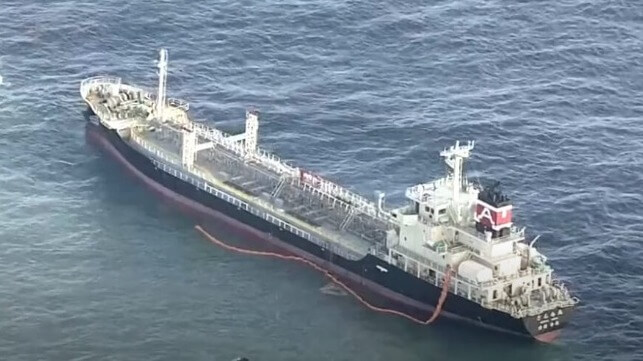
tanker aground in Japan
Sanwa Maru grounded in Northern Japan (Japanese TV)

Published Jan 8, 2025 11:04 AM by The Maritime Executive


The Japan Coastguard is reporting that efforts to remove a small tanker that grounded earlier in the week have been suspended. The majority of the crew was evacuated from the ship after it shifted while an investigation was seeking the source of an oil slick that formed on Wednesday, January 8.

The vessel, the 5,000 dwt Sanwa Maru, grounded at the southern end of Hokkaido, Japan’s northernmost island. Asahi Tanker Company confirmed the incident reporting the vessel grounded around 1830 on January 6. Initial reports said there were no injuries and that the vessel had not suffered damage.

The Japan Coastguard dispatched vessels and there was an attempt on January 7 to pull the tanker which is owned by Wako Kisen off the rocks. They were unable to dislodge the vessel and additional tugs were being dispatched.


This morning however the crew of the vessel reported the ship had shifted listing 5 degrees to starboard and raising concern. They requested assistance in removing the crew. The Japan Coastguard reports seven of the 11 crewmembers aboard were rescued while four have remained aboard to continue the efforts to free the vessel.

An oil slick appeared and people said there was a strong smell of oil around the vessel. Asahi Tanker reports the vessel is loaded with 3,919 kiloliters of kerosene and 700KL of diesel fuel. The slick extended nearly a mile and a half from the ship but the Coastguard believed it was a small leak and that the cargo tanks remain intact.

The salvage operation was suspended while they investigate the leak and attempt to prevent it from growing. Salvage efforts may be resumed on January 9 after the situation is accessed.


Report: China’s Shandong Port Group to Turn Away US-Sanctioned Oil Tankers

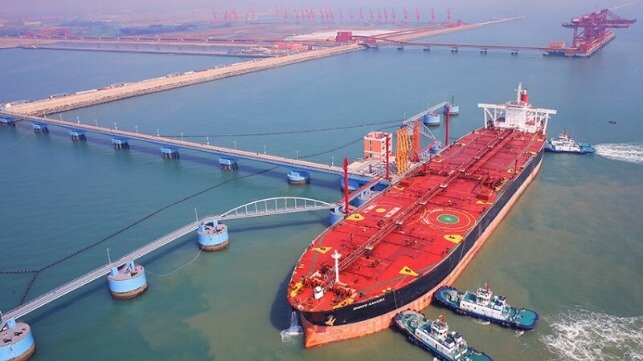
tanker Shandong Port China
Shandong Port Group accounts for a third of China's oil imports (Shandong Port Group)

Published Jan 7, 2025 3:33 PM by The Maritime Executive


China’s state-owned Shandong Port Group has reportedly announced a new policy for 2025 blocking tankers under U.S. sanctions from using its port facilities. Reuters released an exclusive report after traders shared copies of memos from the port regarding the new ban.

According to the memos shared with Reuters, Shandong Port Group “forbids ports to dock, unload or provide ship services to vessels on the Office of Foreign Assets Control list managed by the U.S. Department of State.”

An enforcement of the ban would mark a critical blow, especially to Iran which ships the majority of its oil to China. Last week, the NGO United Against a Nuclear Iran (UANI) cited data in its year-end report saying that Iran’s oil exports grew by 10.75 percent to 587 million barrels in 2024. China, it reported remains the largest destination and has grown its percentage of the trade receiving 533 million barrels, which UANI highlights is up 24 percent from 2023. China it said accounts for 91 percent of Iran’s total oil exports up from 83 percent in 2023.

Shandong Port Group is one of the leading port companies in China with operations at Yantai, Quingdao, Rizhao, and Bohai Bay Port. According to Reuters, at least eight large crude oil tankers, all under U.S. sanctions, docked at the group’s ports in December. 

Highlighting the significance of the oil trade to China, Li Zhi, President of Dongming Petrochemical Group Co. spoke as part of the port group’s year-end presentation. He highlighted the group’s mission of ensuring national energy security and boosting regional economic development, by accelerating the construction of a safe, efficient, and smooth crude oil artery. Its crude oil imports Li reported account for more than a third of the country's total imports, and has developed into an important global energy supply chain hub.

Reuters says the group told traders the ban would have a small impact because most of the oil arrives on tankers not under the sanctions. However, UANI has called for increased sanctions by the West including an expanded focus on repeat offenders receiving oil in ship-to-ship transfers. Chinese tankers have frequently been cited as receiving oil in these transfers off ports such as Singapore and Indonesia.

Much of the sanctions have been targeted at the so-called shadow fleet servicing the Russian oil trade. The U.S. however has increased the sanctions on Iran in response to the instability in the Middle East and assertions that Iran is using the oil to fund its proxies including Hamas, Hezbollah, and the Houthis.

Analysts speculate China might have taken the move in a step as part of larger trade negotiations it hopes to have with the new Trump Administration. China is working to avoid Trump’s plans for sweeping tariffs.


China and COSCO Lash Out Over U.S. Listing of Military-Related Companies

Today’s action by the Department of Defense, however, is seen largely as symbolic.

DOING IT JUST TO PISS OFF CHINA

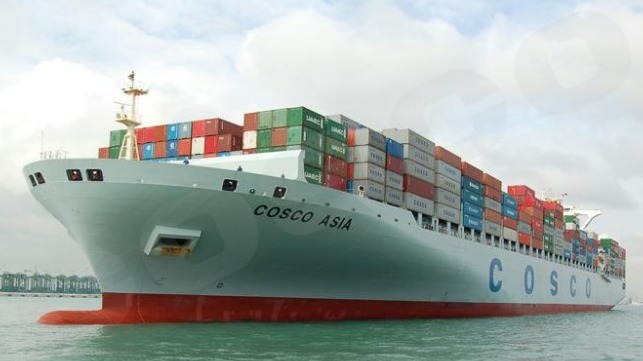
COSCO containership
COSCO was listed by the U.S. as a "Chinese military company" for its support of the military (file photo)

Published Jan 8, 2025 1:00 PM by The Maritime Executive


The Chinese government and COSCO Shipping responded to the U.S. Department of Defense’s inclusion of the company among the 134 organizations listed for ties to the military. The Chinese government continued to blame anti-China sentiments in the U.S. while calling for fair treatment for its companies while COSCO said it would “engage with U.S. authorities to clarify the matter.”

The U.S. Department of Defense was mandated by Congress in 2021 to start compiling and releasing a listing each year of companies it believes are supporting China’s military. The listing of so-called “Chinese military companies” carries no specific penalties, but is used to discourage U.S. businesses from working with these companies. The Pentagon can not do business with companies that are deemed to be supporting the Chinese military.

COSCO, which is the world’s largest shipowner, was added to the listing that was released yesterday, January 7. It joins other well-known Chinese companies including China State Shipbuilding Corporation as well as the manufacturer of shipping containers.

COSCO North America issued a mostly boilerplate statement about consistently adhering to local laws and regulations and maintaining strict compliance in all international operations. In the statement, it said none of its companies (COSCO Shipping, the North American division, and COSCO Shipping Finance which were each listed) are Chinese military companies.

A spokesperson for China’s Ministry of Commerce when asked said they had “noted” the listing while calling on the U.S. to respect facts and stop “discriminatory treatment to Chinese companies.”  He said, “China is strongly dissatisfied with and firmly opposes,” the listing of the companies.

The Ministry of Commerce asserted that the U.S. “continued to generalize the concept of national security,” and “groundlessly accused China of its ‘military-civilian integration’ strategy.

China it said, will closely follow relevant developments and take all necessary measures to resolutely defend the legitimate rights and interests of Chinese companies.


China’s COSCO Shipping Listed by U.S. for Links to Chinese Military

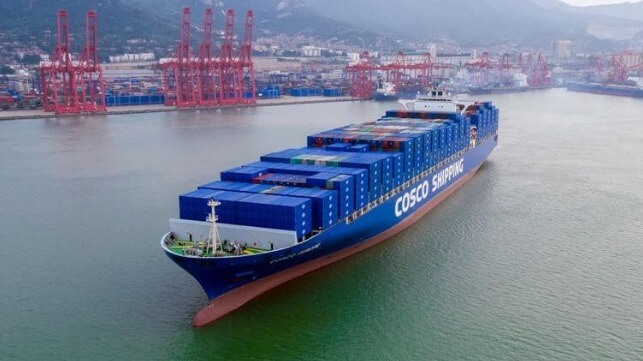
COSCO containership
COSCO Shipping was added to the list of “Chinese military companies” released by the U.S. Department of Defense (COSCO)

Published Jan 7, 2025 12:19 PM by The Maritime Executive


The U.S. Department of Defense published its annual listing of companies linked to China’s military adding shipping giant COSCO Shipping and two of its subsidiaries, as well as other companies including the Chinese oil company Cnooc, to the designation. The associations between Chinese companies and the military have long been reported but this step formalizes the designation in an effort to discourage U.S. involvement with the companies on the list.

The National Defense Authorization Act for Fiscal Year 2021 included the requirement for the annual listing. Written by Congress, the subsection requires the Secretary of Defense to identify and publish a list of “Chinese military companies” annually. DoD published today, January 7, the notice of the annual listing in the Federal Register.

The Pentagon reviews the companies and sets the criteria for what entities qualify as “Chinese military companies.” The U.S. government is barred from doing business with those companies and the publication is meant to expose the companies. Congress’s goal was to discourage private companies from working with companies on the list.

It is not the first time COSCO, which calls itself the world’s largest shipowner, has come under scrutiny by the U.S. government. The first Trump administration in 2019 briefly sanctioned COSCO’s tanker operator for transporting Iranian oil. The sanctions however were removed the following year.

In addition to COSCO Shipping, the new listing includes COSCO Shipping (North America) and COSCO Shipping Finance Co. Cnooc was also included on the list and joins others including China State Shipbuilding Corporation which had already been cited. Among the total 134 companies listed are also China International Marine Corporation, the manufacturer of shipping containers, and China Shipbuilding Trading Co., a CSSC subsidiary used to promote Chinese shipbuilding globally. CATL, the leading battery manufacturer is also on the list.

It has long been asserted that China uses the commercial industry to support its military. COSCO transports military goods and CSSC is the builder of vessels of China’s Navy. Among its projects are China’s new aircraft carrier and it recently launched the world’s largest amphibious assault ship.

Increasingly elements of Chinese industry have been coming under scrutiny. In March 2024, five U.S. unions formed an alliance filing a trade complaint to challenge China’s shipbuilding industry. The U.S. Senate also held subcommittee hearings on China’s shipbuilding industry. The pressure for action against the shipbuilding sector continues to grow as China expands its dominance in the global orderbook for new ships.

A bipartisan group of U.S. Senators and members of the House of Representatives in December 2024 introduced the SHIPS for America Act calling it the first comprehensive effort to revitalize the U.S. merchant marine. Key elements focus on China and Chinese shipping. In addition to Trump’s proposed tariffs on Chinese goods, the act would create a requirement to transport 10 percent of Chinese goods on American ships and add tariffs on Chinese shipping.

Today’s action by the Department of Defense, however, is seen largely as symbolic. It solidifies the designation of the association between Chinese industry and the military. Analysts have long said those ties existed in all parts of Chinese industry. 


Op-Ed: U.S. Tariffs Won't Slow Down China's Clean-Energy Sector

Compared to its other export industries, China’s cleantech is much less vulnerable to Trump administration trade measures

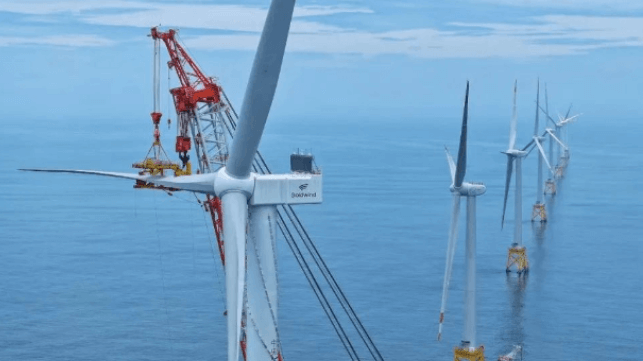
Goldwind turbines
File image courtesy Goldwind

Published Jan 9, 2025 1:11 PM by Dialogue Earth


[By Lauri Myllyvirta and Hubert Thieriot]

Clean energy technology, particularly the “new three” of solar power, batteries and electric vehicles, emerged as an important source of growth in China’s exports in 2023. Thanks to booming markets at home and abroad, clean energy has become a key driver of economic growth.

A lot of media and policymaker attention is focused on possible US and European tariffs on China’s cleantech exports, with the perception that these could be a major blow to the  industry.

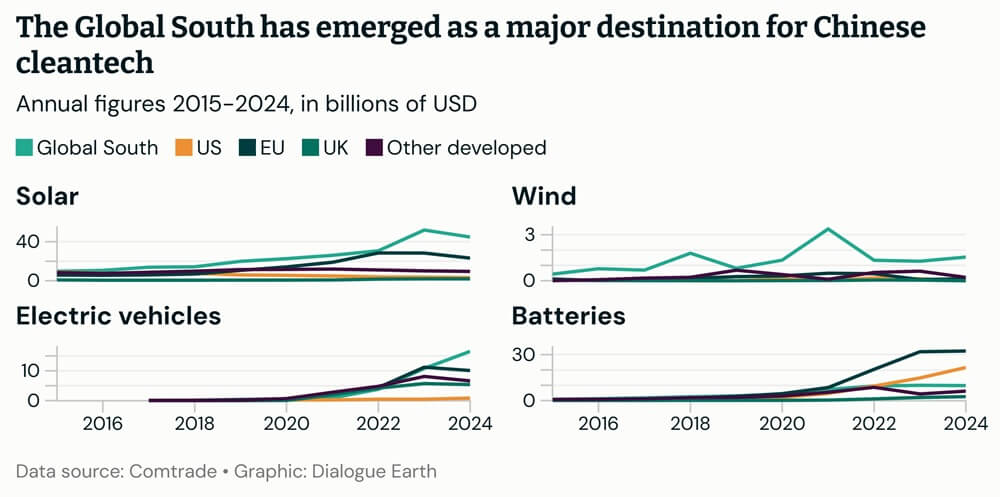
What is missing from this picture is that half of all China’s exports of solar and wind power equipment and electric vehicles (EVs) now go to the Global South, according to UN Comtrade data. Emerging and developing countries have driven most of the recent growth in export volumes.

In 2024, the value of EV exports from China to the Global South overtook those to the EU, with China’s exports to developed markets falling and those to developing markets posting strong growth.

As we will see, Global South countries collectively have been the largest importer of solar and wind power equipment from China since at least 2015, but the gap widened in 2023, when the volume of these solar imports from China grew 70% year-on-year.
The US is a niche market for China’s cleantech

Solar and other clean energy have gone global in the past decade. In 2010-2015, 70% of solar and 50% of global wind installation occurred in developed economies. By 2023, these shares had fallen to just over 20%.

The US now represents only 7% of the global market for newly installed solar power plants, and even the European Union and the US combined make up less than 20%.

The US has imposed tariffs on imports from China for a long time and, as a result, most of its supply already comes from other producers. Only 4% of China’s total exports of solar power and wind power equipment and EVs go to the US, compared with 15% of China’s overall exports.

This means that China’s cleantech exports are much less reliant on the US in particular and western markets in general than its export industries overall. In a market where sales volumes are growing at 30% this year, the US is a footnote.

While the majority of solar, wind and EV exports already go to the Global South, the US and the EU remain the dominant importers of batteries. These are intermediate inputs into vehicle production and other manufacturing. Targeting them with high tariffs would hurt local manufacturing.

Cleantech exports to Global South are booming

The falling reliance on developed markets comes down to China’s cleantech manufacturing boom having catalysed rapid deployment of solar, wind and EVs in the Global South. Around 47% of China’s exports of these products went to the Global South in 2024, a record-high share and close to matching exports to developed countries for the first time.

From 2021 to 2024, emerging and developing markets drove 70% of the growth in China’s exports of solar, wind and EVs, with seven of the ten top growth markets located in the Global South.

Examples include solar power booms in South Africa and Pakistan, and strong growth in for example Brazil and Thailand. The five largest importers of wind power technology from China are all developing countries – South Africa, Egypt, Chile, Brazil and Uzbekistan – as are the five largest growth markets for solar: Saudi Arabia, Pakistan, Uzbekistan, Indonesia and India. Two Global South countries also feature on the list of the five largest importers of EVs – Brazil and Thailand.
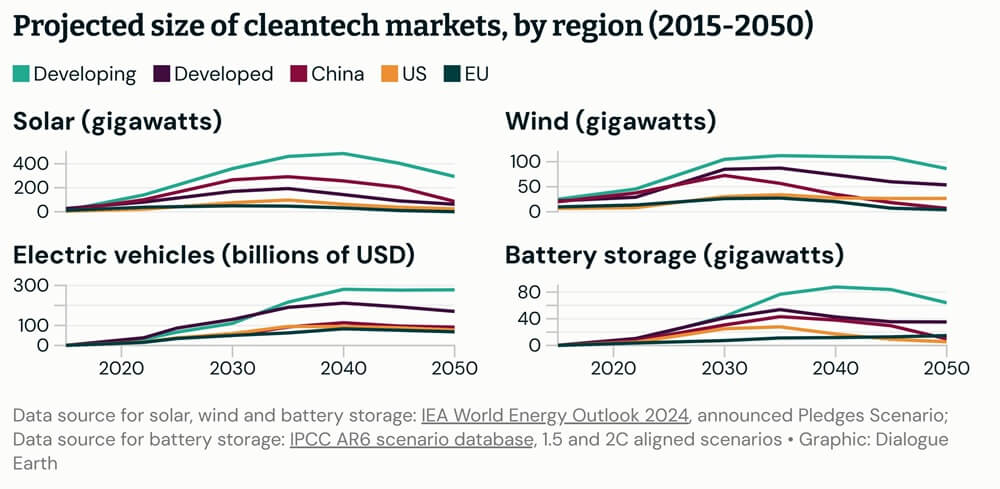
This trend is expected to continue. Emerging and developing countries are expected to have a market share of 70% in solar PV and 60% in wind and in battery storage during this decade out to 2030, according to the International Energy Agency’s World Energy Outlook.

The US and other developed country markets are more significant in electric vehicles, due to high private car ownership. Yet, in the IPCC 1.5 and 2C pathways, the share of the US and the EU in global investment in electrified transportation falls from almost 50% in 2022 to 36% by 2035, with two-thirds of the market growth coming from outside these two regions. If Donald Trump’s policies slow down the electrification of the transport sector in the US, the significance of these markets will diminish further.

China’s increasing efforts to increase clean energy lending and co-operation will also stimulate demand from the Global South. Examples of this include recently announced new green energy deals with Indonesia, increased financing of renewable energy projects such as in Africa and Central Asia, and increasing share of renewable energy in projects under the Belt and Road Initiative.

Decoupling efforts will have a limited impact on China’s cleantech industry

China’s dominance in clean energy manufacturing has caused some major economies to try to diversify or decouple their supply chains from it. The US and India have clearly committed to slashing their dependence on China. Even those two markets have a very long way to go to meet their own demand without relying on the East Asian nation.

For example, the solar equipment production capacity in the world outside of China is barely sufficient to cater to the US market, meaning there is little possibility for other buyers to switch to non-Chinese supply. India is adding a significant amount of production capacity for solar cells and panels, but capacity additions in the key upstream input, polysilicon, are much more modest.

It’s entirely possible for the US and India to build their own supply chains for solar. Yet the impact on China’s cleantech industry will be limited, as the two countries’ strategy for doing this relies on high tariffs to shelter domestic production. This means that their producers won’t be able to compete overseas, surrendering this market to China.

While the US and India already have policies in place, the EU is torn between conflicting impulses. The bloc needs clean energy technology to meet climate targets, reduce reliance on imported fossil fuels and bring down energy prices. The EU is concerned about reliance on China but lacks the industrial policy framework to address the issue, and will find it hard to match the US on spending. The bankruptcy of Swedish battery maker Northvolt, dubbed “Europe’s best shot at a homegrown electric-vehicle battery champion”, made this evident. The industrial and supply-chain policies needed to reduce the EU’s reliance on cleantech imports from China could yet emerge, but the bloc can hardly afford to slow down clean energy deployment during the long period that such policies would take to yield results.

As other major economies pursue diversification, Beijing should have little to complain about. It has largely ringfenced its own domestic cleantech market – by far the largest in the world – to exclude imported products. How this has been done matters. Tariffs raise the cost of the targeted technologies and therefore have the potential to slow down the energy transition. While China has used trade barriers, the main thrust has been supporting and subsidising domestic supply of cleantech, in the process driving down prices and speeding up adoption not just in China but globally.

China has a strong self-interest in the global energy transition

Given the minor significance of the US market for China’s clean energy industry, the only real risk from the Trump administration to the industry would be if he succeeds in slowing down global climate action. This seems unlikely, as clean energy adoption is driven by economics more than altruistic global goals.

Given the important role that clean energy technology plays in the country’s economy and exports, China has a strong interest in making sure the global energy transition keeps accelerating. That will be seen in bilateral lending and diplomacy, and could also lead the country to take more forward-leaning positions in multilateral climate negotiations.

Lauri Myllyvirta is senior fellow at Asia Society Policy Institute, China Climate Hub. He is also the lead analyst of Centre for Research on Energy and Clean Air.

Hubert Thieriot is data lead at the Centre for Research on Energy and Clean Air.

This article appears courtesy of Dialogue Earth and may be found in its original form here


Norway Launches Second Phase of Nuclear Propulsion in Shipping Study

nuclear propulsion
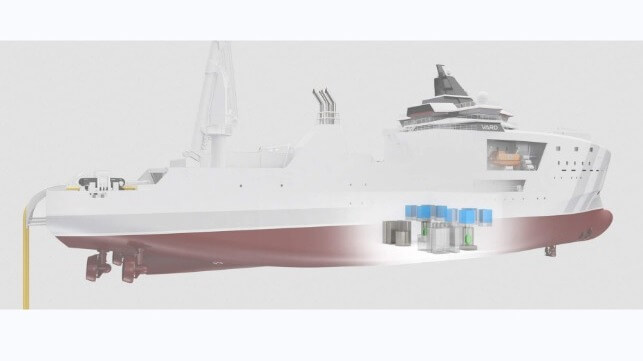
VARD will be integrated the nuclear propulsion designs into different ship designs (VARD)

Published Jan 7, 2025 5:46 PM by The Maritime Executive


Norway’s NuProShip (Nuclear Propulsion in Shipping) project is transitioning into its second stage as of January 2025 after having completed initial studies into Generation IV reactors.  The project which launched in 2023 has the ultimate purpose to develop a commercially viable zero-emission technology for deep-sea ships.

The Research Council of Norway awarded nearly $1 million (NOK 10 mission) in support of the project which has also drawn support from some of the leading companies in the shipping industry. DNV is among the partners as is Knutsen Tankers, the Norwegian Maritime Administration, and Spanish nuclear consultancy IDOM. Shipbuilder VARD reports it is joining the second stage of the project, which is currently scheduled to run through the end of 2025.

The project started with a focus on approved designs with a power of 25 to 55 MW. In the first phase, it was studying the feasibility of different nuclear reactor concepts within the Generation IV domain. VARD reports there was an extensive assessment of concepts from 99 companies before three reactor types were selected for future study.

Two of the concepts use TRISO fuel participles which are billed as one of the most resilient nuclear fuel types available today. It would be used with a Fluoride high-temperature molten salt reactor which is reported to be a robust design that would provide efficient operation. A second is a helium-cooled gas reactor. The third concept is smaller variants of the lead-cooled reactor concept using uranium oxide as a fuel.

The shipping industry has shown increasing interest in the concept of nuclear-powered propulsion returning to concepts first explored nearly 70 years ago. The United States was successful in building a demonstration prototype passenger-cargo ship, the NS Savannah, but the nascent stage of the technology, concerns over the dangers of nuclear reactors, and the navy’s focus on nuclear propulsion limited the commercial applications. Russia is the primary user of nuclear propulsion for its icebreakers.

The next phase of the NuProShip project will be expanded to also include insurance companies to further explore the viability of nuclear technology in the shipping industry. The concepts defined in the first phase will be further analyzed during the second phase as they also study feasibility, safety, costs, waste, and other factors. 

VARD reports its primary role involves the integration of the reactor concepts into various vessel types. It will be assessing the technical challenges to enable the future commercial use of nuclear-powered ships.

The third phase of the project calls for developing and testing a prototype. The conclusion will assemble all the insights and estimate the economic and environmental effects. It will outline the risks and future development needs to proceed with the concept of nuclear-powered merchant ships.


Three SMRs selected for evaluation in ship propulsion study

Tuesday, 7 January 2025

The initial phase of Norway's NuProShip initiative - which is evaluating Generation IV small modular reactor technologies for their viability in commercial shipping applications - has concluded, with three SMR technologies being selected for further evaluation in the next phase.

Three SMRs selected for evaluation in ship propulsion study
A concept of a nuclear-propelled ship (Image: VARD)

The NuProShip project is being funded by the Research Council of Norway. Alongside Norwegian shipbuilder VARD, the project is supported by prominent partners, including the Norwegian University of Science and Technology, class society DNV, the Norwegian Maritime Administration, ship owner Knutsen Tankers, and the Spanish nuclear consultancy IDOM.

VARD said its primary contribution involves integrating these reactor systems into various vessel types, assessing the technical challenges to enable the future commercial use of nuclear-powered ships.

The ultimate purpose of the research programme is to develop a commercially viable zero-emission technology for deep-sea ships that satisfies all stakeholders and requires no subsidies after the initial development process. 

During Phase I of the project, which began in 2023 and ended on 31 December, a total of 99 companies developing advanced reactor technologies were assessed.

The main purpose of NuProShip I is to adjust a Generation IV SMR to the needs of international shipping. The technical starting point was an already approved design at 25–55 MW. The nuclear technology itself was studied, but also regulatory issues, safety issues, ship design implications, maintenance, handling of radioactive rest material and crew requirements.

VARD has now announced that three promising SMR designs have been selected for more in-depth assessment in NuProShip II, which will run over the next two years. This phase aims to develop a workable prototype solution. In NuProShip III, it will be tested.

The selected technologies are: Kairos Power of the USA's fluoride high-temperature molten salt reactor using TRISO (tri-structural isotropic) fuel particles; Ultra Safe Nuclear Corporation of the USA's helium-cooled gas reactor, also employing TRISO fuel particles; and Blykalla of Sweden's lead-cooled reactor concept utilising uranium oxide as fuel.

The second phase of NuProShip will expand the consortium to include insurance companies, "a critical step for evaluating the business viability of nuclear technology in the shipping industry", VARD said.

The shipping industry consumes some 350 million tonnes of fossil fuel annually and accounts for about 3% of total worldwide carbon emissions. In July 2023, the shipping industry, via the International Maritime Organization, approved new targets for greenhouse gas emission reductions, aiming to reach net-zero emissions by, or around, 2050.

WORLD NUCLEAR NEWS


47 Nations Back ICS Plan for Global Bunker Levy

it would be the first UN-administered global carbon tax of any kind

Bunker tanker with container ship
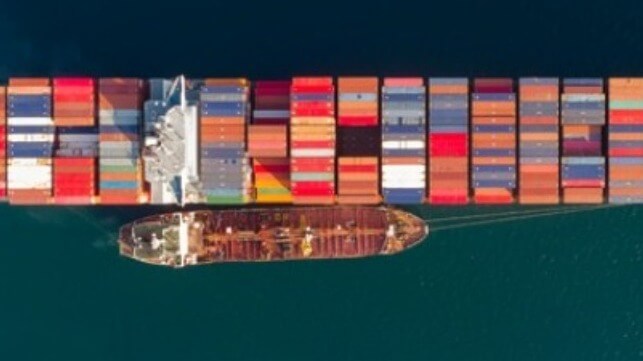
File image

Published Jan 9, 2025 2:28 PM by The Maritime Executive


With support from shipping's largest business association, 47 nations have submitted a revised, detailed proposal for an IMO carbon levy on bunker fuel. If approved at the next meeting of the Marine Environment Protection Committee in April, it would be the first UN-administered global carbon tax of any kind, with implications for energy stakeholders inside and outside of the maritime sector.

“The industry fully supports the adoption by IMO of a GHG pricing mechanism for global application to shipping. The joint text put forward by this broad coalition is a pragmatic solution and the most effective way to incentivize a rapid energy transition in shipping," said ICS secretary general Guy Platten, describing the text as "hard-fought."

At MEPC 82 in October, IMO discussed but did not finalize a package of "mid-term measures" to encourage shipping to reduce its carbon emissions. The most controversial - and proponents say, the most necessary - parts are "economic elements," meaning a global tax on fossil bunker fuel and subsidies for green fuels. Without a fee structure to tilt the price balance in favor of low-carbon fuels, the new green options will not be commercially competitive with bunker fuel, clean-shipping advocates say. 

After MEPC 82, IMO recommended that the shipping community continue to work with member states to develop a consensus proposal. Together with the International Chamber of Shipping and the European Commission, a coalition of 47 states came up with what it believes to be the most mature, vote-ready measure yet - if it can gain traction with petroleum-exporting nations. 

Under the proposal, ships would begin paying a levy for their annual bunker fuel use beginning in 2028. The text contemplates a surcharge for noncompliance, though details of the penalty are not yet fully formed. The levies would be collected by an IMO-administered fund overseen by MEPC and governed by a diverse international board. 

Beginning in 2028, ships that use green fuels would be eligible for a financial reward, calculated based on their usage data. The reward would be paid from the IMO-administered fund using the same revenues collected from fossil-fueled ships, effectively cross-subsidizing green fuel usage by taxing fossil bunkers. Additional funds would go to green-fuel research and to helping developing states make the transition to green shipping fuels.  

The initial amount of the levy will be determined in further discussions, but ICS suggests that it would fall in the range of $60-300 per tonne of bunker fuel. Unlike most carbon tax policy proposals, the fee would not ratchet upwards automatically on a set implementation timetable through 2050: Instead, it would be reviewed and voted upon by all nation-state members of MEPC every two to five years, requiring political agreement to secure each incremental increase. 

The list of supporters includes several prominent shipping nations - like Japan, Greece, and the largest flag registries - but many key players are not represented. "While a large number of governments now support a universal flat rate GHG contribution by ships – or something similar – a minority of governments continue to have concerns," noted Platten, without naming any states. "Working in co-operation with all IMO Member States we will do our best to allay such concerns during the final stages of these critical negotiations about regulatory text."


Finland Detains Suspected Sabotage Ship for Serious Maintenance Issues

Eagle S under detention off Porvoo (Finnish Border Guard)

Published Jan 8, 2025 6:27 PM by The Maritime Executive


Finland's transport ministry has completed a port state inspection of the tanker Eagle S, the vessel suspected of sabotaging five Baltic Sea cables with its anchor on Christmas Day. After finding serious deficiencies, the agency has detained the vessel, preventing it from leaving port until safety issues have been corrected.

On December 25-26, Eagle S was boarded and detained by Finnish police on suspicion of severing four fiber-optic cables and one power cable by dragging its anchor. The tanker was diverted to Finnish waters, taken into custody and moved to a secure anchorage for inspection by criminal investigators. The safety inspection was a separate administrative procedure and began after the police process was well under way. 

During the weeklong inspection off Porvoo, Traficom identified no less than 32 deficiencies aboard the aging Russia-linked tanker. The discoveries aligned with previous reports about the vessel's poor material condition: an independent vetting examination found dozens of problems aboard last year, according to Lloyd's List, and the tanker's last two port state control inspections turned up nearly three dozen more.

Traficom announced Tuesday that it has detained Eagle S for three of the 32 newly-identified problems. These "serious" issues relate to shipboard fire safety, navigation equipment and ventilation of the pump room. Other issues related to accommodations, electrical safety and general maintenance, as well as SMS deficiencies - a category identified in the last two inspections as well. 

"The vessel has such deficiencies that it is not permitted to operate on it until the deficiencies are corrected. Correcting the deficiencies will require repair assistance from outside the vessel and will take time," says Sanna Sonninen, Finland's Director of Maritime Affairs.

Traficom's administrative detention ensures more time for police investigators to sweep the ship and question the crew, without the risk that a court order might allow the tanker to leave Finnish waters - an order that Eagle S's owner has sought. So far, Finland's courts have upheld the right of the National Bureau of Investigation (NBI) to hold the ship and continue its work. There are other barriers to departure: eight crewmembers have been served with travel bans for suspected criminal activity; the ship's cargo has been impounded for a customs investigation; a subsea cable operator has sued to seize the ship for civil damages; and - in the most definitive detention measure possible - Eagle S may soon be trapped by Baltic ice until the spring thaw, depending on weather.  

So far, Finnish police have found strong technical indications that Eagle S caused the cable breaks. The tanker's AIS track lined up with the time and place of the cable outages. It was missing an anchor when it was boarded, and the anchor was later recovered from the bottom, heavily damaged, near the end of a 50-mile-long drag track. A dive inspection revealed that the tanker's hull has patches of newly missing paint near the bow, a possible sign of recent anchor chain contact.

Maritime security experts have expressed strong doubt that the damage could have been accidental, and suspicions immediately turned to Russian intelligence. The Eagle S is an identified part of the Russia-serving "dark fleet" of irregular tankers, and it was the third vessel in 15 months suspected of severing a subsea cable while headed to or from a Russian port. More broadly, European counterintelligence agencies have been combating a wave of Russian-backed arson and sabotage operations across the EU for more than a year. 

Against this backdrop, Finland's security services have attracted praise for swift action in detaining the tanker. Unlike the last two cable-damage incidents, the suspect ship was diverted and seized before it could continue on its commercial voyage - even though it was operating in international waters, outside of Finland's legal jurisdiction. Finnish authorities say that the tanker crew voluntarily changed course towards Finland when requested; at an unspecified point during this evolution, a tactical boarding operation involving the Finnish armed forces and an elite Finnish police team occurred. 

"We should make it clear to the Russians that anytime there's an accident like this, we are going to impound the vessel that was involved," said former US Army Commander in Europe Ben Hodges in an interview this week. "Until they get punched in the nose, until we make them stop, they will continue doing this. And it only gets worse until we act."


Dark Fleet Tanker Might Have Damaged More Subsea Lines if Not Stopped

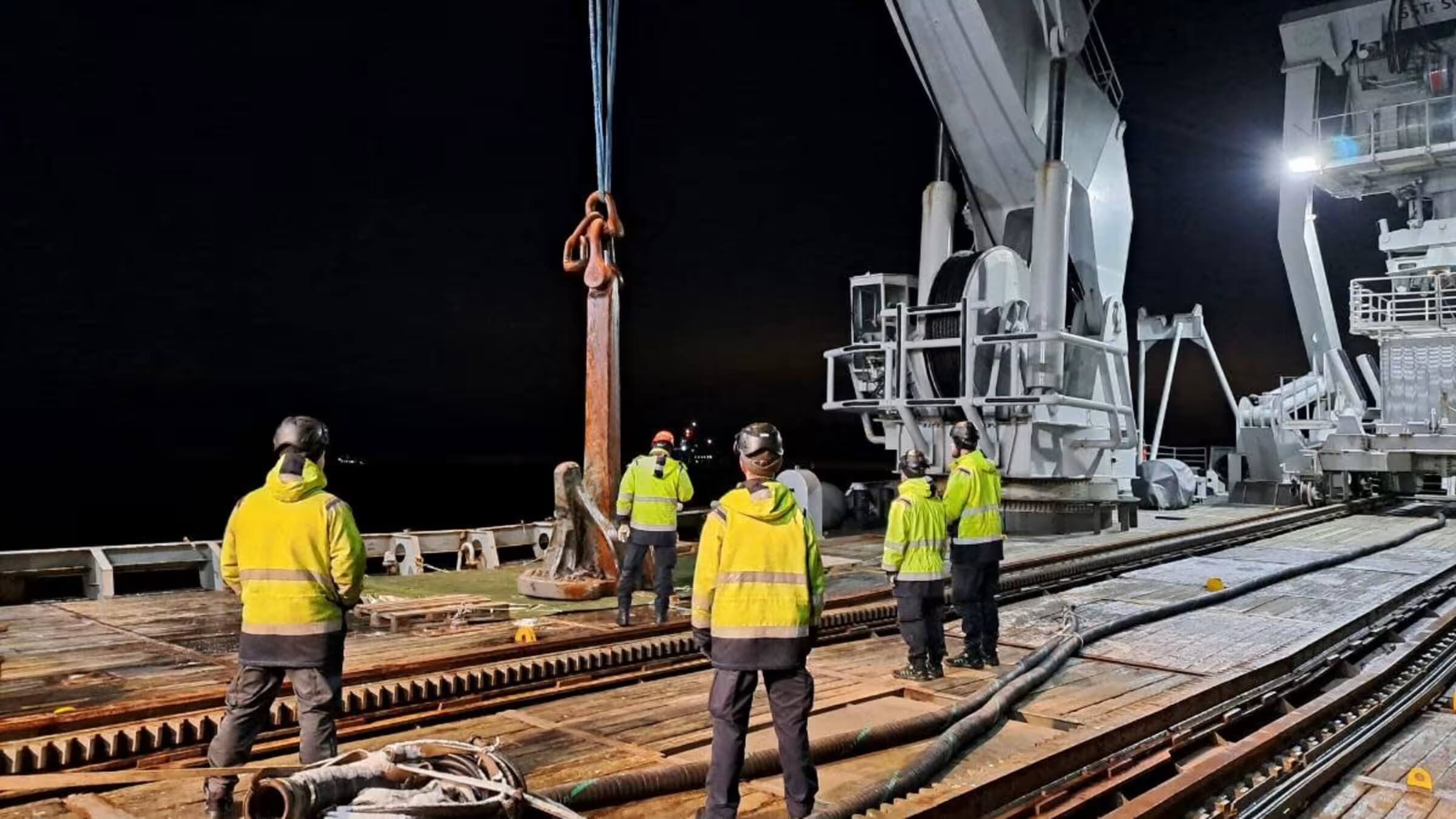
Investigators recover the anchor of the Eagle S onto the deck of a Swedish Navy salvage ship, January 6 (Finnish Border Guard)

Published Jan 9, 2025 6:01 PM by The Maritime Executive


Finland's National Bureau of Investigation (NBI) has found and recovered the missing anchor from the "dark fleet" tanker Eagle S, which is suspected of severing four subsea telecom cables and a high-voltage power cable in the Baltic on Christmas Day. The next step in the investigation is to determine when it came loose - before or after the authorities asked the Eagle S to raise the anchor it was dragging on the bottom.

On Dec. 25, Fingrid's EstLink 2 power transmission cable and four subsea telecom cables suddenly broke down. The outages corresponded to the position of the tanker Eagle S; Finland dispatched a police tactical team in a helicopter and asked Eagle S to divert, and the crew agreed to comply. 

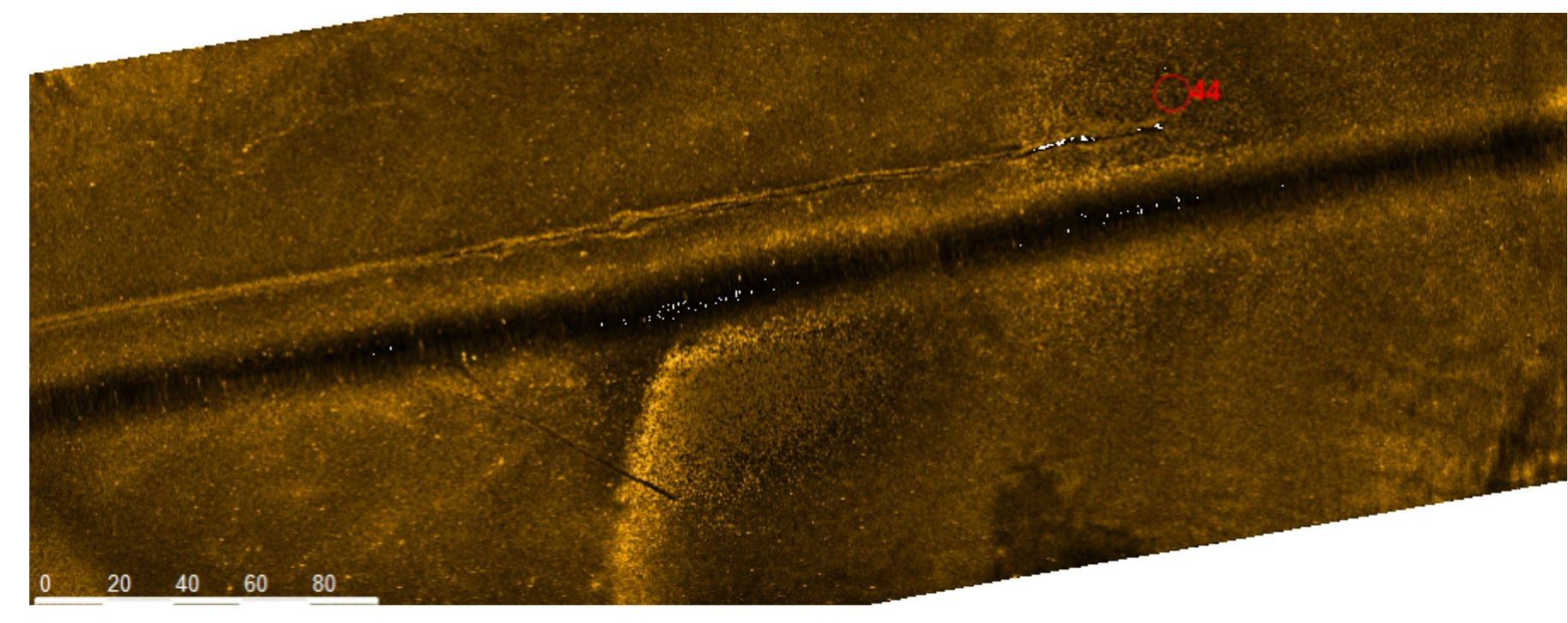
In a sonar survey after the casualty, a drag line of about 50 nautical miles in length was found on the bottom. Eagle S' anchor was discovered at the end of the line, near the Porkkala Peninsula, and Swedish military salvors helped raise it to the surface on Sunday night. 

Track of the anchor drag line and the location of the lost anchor (sonar image courtesy NBI)
The location where the damaged anchor was recovered happened to be near the place where Finnish authorities instructed Eagle S to raise her anchor. This is of interest to the authorities, as it raises questions about whether the incident could have been worse without government intervention. The tanker's onward route would have passed over the Estlink 1 power cable, as well as the Balticconnector gas line. 

"If the anchor only came loose during the hoisting, it is likely that the anchor could have caused further damage to the seabed infrastructure if the vessel had continued its journey," Detective Superintendent Risto Lohi of the National Bureau of Investigation said in a statement. 

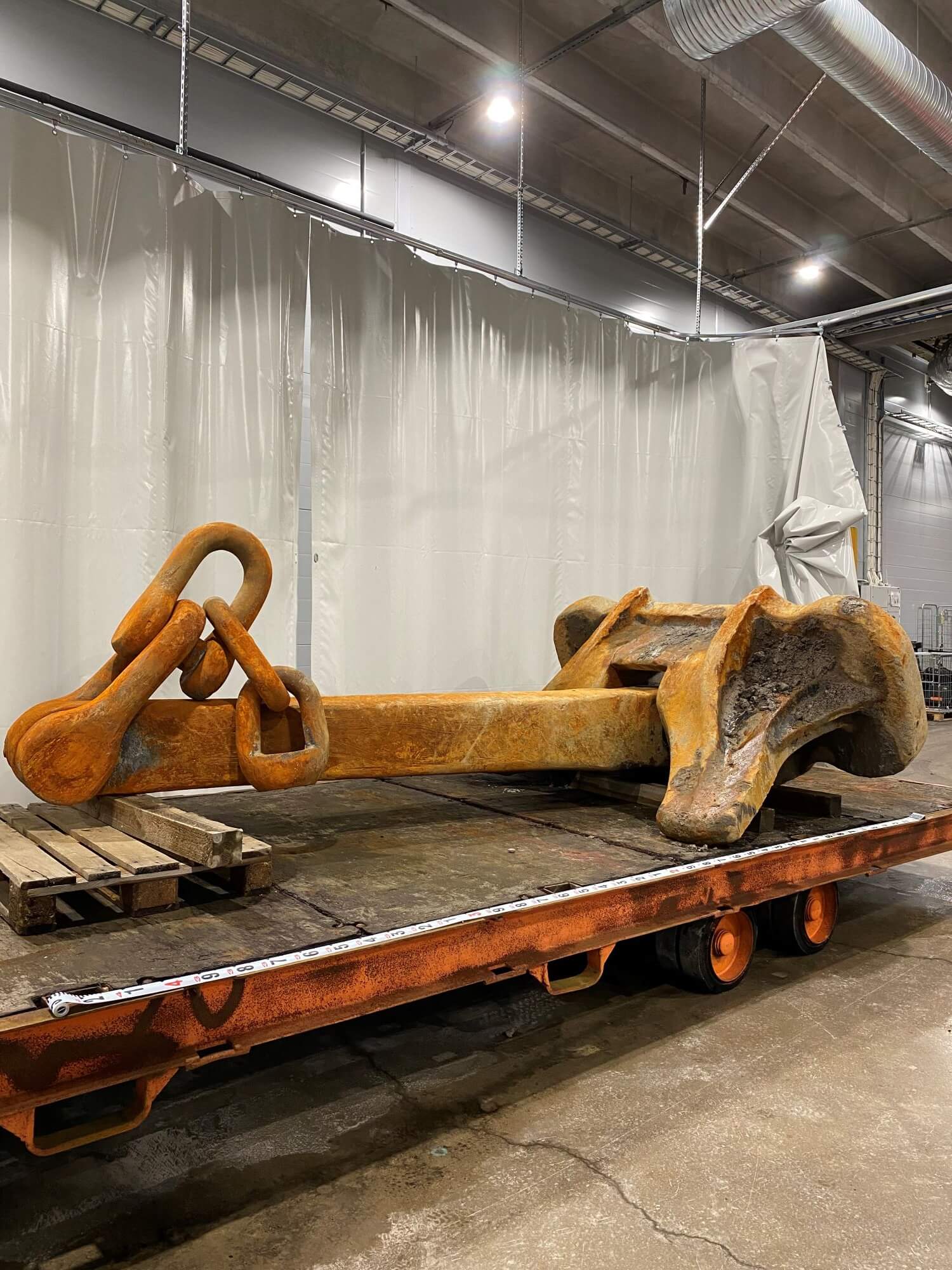
New images released by the NBI show that the anchor's crown is cracked, and its flukes are much shorter than typical. Previous photos of the Eagle S - taken in years past, when she operated under a previous name - show that the tanker was originally equipped with normal Hall- or Speck-type anchors, like most merchant ships. 

Courtesy NBI


Suspected Sabotage Ship's Anchor Shows Signs of Extreme Damage

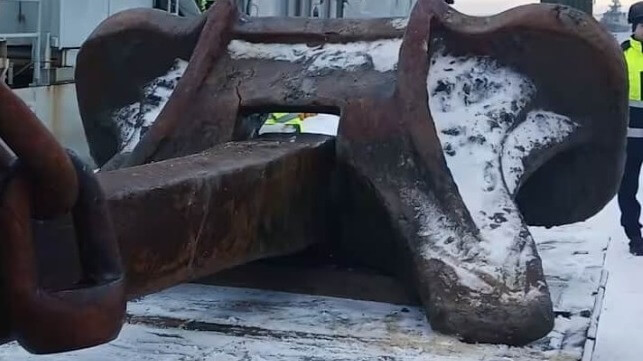
Brokjen-off flukes, cracked crown: signs of damage to Eagle S's recovered anchor (Finnish Border Guard)
Broken-off fluke, cracked crown: signs of damage to Eagle S's recovered anchor (Finnish Border Guard)

Published Jan 7, 2025 2:16 PM by The Maritime Executive


Finnish and Swedish authorities have recovered the lost anchor of the dark fleet tanker Eagle S, the vessel suspected of severing four fiber-optic cables and a power cable in the Gulf of Finland on Christmas Day. 

"The location where the anchor was found is along the Eagle S’s route, near the Porkkala Peninsula. The anchor was located towards the western end of the drag trace found on the seabed, near the point where the trace ends," said Detective Superintendent Risto Lohi of Finland's National Bureau of Investigation (NBI). 

Officials suspect that Eagle S dragged its anchor under power for about 50 nautical miles along the bottom of the Baltic, dredging up and severing five cables. It was the third such incident in 15 months, following similar cable casualties involving the Chinese vessels Newnew Polar Bear and Yi Peng 3.  

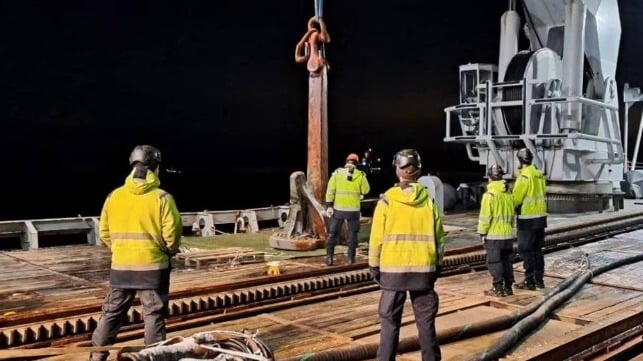
On Sunday night, with the help of the Swedish submarine rescue vessel HMS Belos, Finnish authorities located the anchor off Porkkala Peninsula in 80 meters of water. Preparations for the recovery began, and the anchor was raised to the surface at about 1700 hours Monday. 

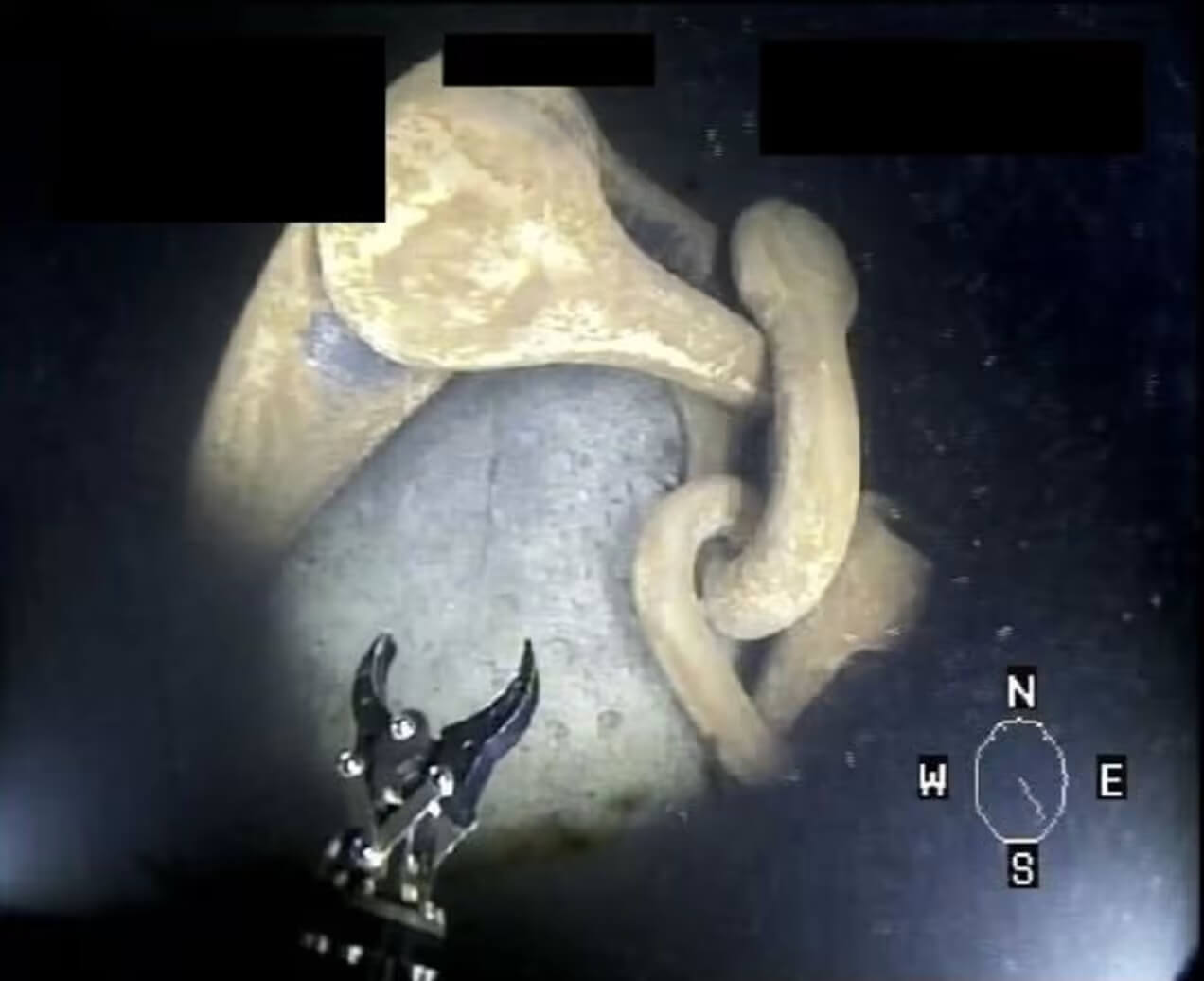
ROV sonar imaging of the anchor (Finnish Border Guard)

ROV prepares to rig the anchor for hoisting (Finnish Border Guard)

The recovered anchor on the deck of the Belos (courtesy Finnish Border Guard)
As in the case of the Newnew Polar Bear, the Eagle S's anchor showed signs of extreme damage. At least one fluke is broken off and missing (above); the location of the break has worn and rounded edges, indicating abrasion after the break occurred. A large crack is visible on the crown (image at top).

Maritime security experts have expressed little doubt that the anchor-drag incident was intentional, given how many manual tasks would have to be performed and then overlooked by the crew to cause it by accident. Local investigators agree: Finland has detained the vessel for a criminal investigation and issued travel bans to eight crewmembers who are suspected of criminal activity. 

To execute this maneuver by accident, the Eagle S's crew would have to slow down and pay out the right length of anchor chain, then secure it to prevent it from running out all the way under extreme loads. This sequence would have to happen while making way in a busy sea lane, next to submarine cable crossings - factors that firmly rule out a normal anchoring evolution. Then, over the course of a 50-mile transit, they would have to fail to notice the effects of the anchor dragging on the bottom. Dragging typically causes vibration of the chain at the hawsepipe - vibration that would likely be extreme when dragging under power at nine knots, a load severe enough to damage the anchor. 


Bulker Refloated After Being Aground for Two Weeks on St. Lawrence

Bulker stuck on St. Lawrence
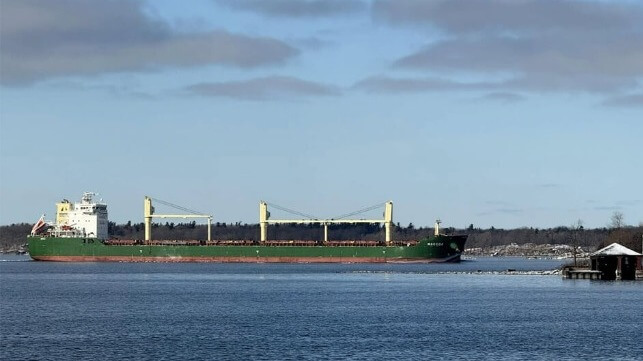
After two weeks and a lightering operation, the bulker was refloated today (Holly Crowe-Ortolani/Facebook)

Published Jan 7, 2025 2:26 PM by The Maritime Executive


The Canadian Coast Guard reports efforts to free the grounded bulker Maccoa (30,898 dwt) were successful and that the vessel is being moved to undergo additional surveys. The bulker which is registered in Cyprus had been aground for two weeks with the efforts to refloat the vessel in part delayed by the holidays.

Shortly after 0800 local time today, January 7, three tugs were placed alongside the vessel for the second attempt to refloat her and reposition the vessel back into the shipping channel. The Canadian Coast Guard had reported that the ship which went aground on Christmas Eve after departing Montreal was “sideways outside the navigation channel.” The Maccoa was believed to have suffered a power failure shortly after departing and starting the transit of the St. Lawrence River on a trip bound for Ireland.

After the first attempt at refloating the vessel failed, it was determined that they would need to offload a portion of the vessel’s cargo of corn. The refloating effort had been delayed by the Christmas holiday and then the lightering was delayed till barges could be brought in from Quebec.

The first barge took 1,250 tonnes of corn. It was completed on January 6 and a second barge was positioned to receive additional corn. The Coast Guard had said the plan was to remove approximately 3,000 tonnes.

Initially, the Coast Guard said the next attempt to refloat the vessel would be on Wednesday, January 8, but this morning SMIT Salvage indicated it was possible to attempt to refloat the bulker. The second barge had completed the lightering operation overnight.

Maccoa is now underway on the St. Lawrence under power along with a tug escort. Reports indicate it will be berthed at Sorel-Tracy to undergo an inspection. There were no signs of pollution during the grounding but the survey will determine if repairs are required. The vessel will also reload the cargo that was transferred to the barges.

There were two grounding in the St. Lawrence although in different areas in one month’s time. The Coast Guard and Fisheries and Oceans Canada however believe it was a coincidence and have not cited any conditions on the river making navigation more difficult. Both the Tim S Dool and the Maccoa ultimately required lightering before the vessels could be refloated.