Friday, January 10, 2025

The Yanquis Are Coming: Trump Threatens a “Soft Invasion” of Mexico


 January 10, 2025
Facebook

Drawing by Nathaniel St. Clair

Towards the end of Sinclair Lewis’ 1935 novel, It Can’t Happen Here, the fascist dictatorship which has come to power in the US has launched a war of aggression against Mexico. I thought of this as I read that President-Elect Donald Trump has been talking about using US special operations units against Mexican drug cartels.

Trump had considered launching missile attacks against the cartels in 2020, the final year of his first term as president. Mark Esper, at that time Trump’s secretary of defense wrote in his 2022 memoir, A Sacred Oath, that Trump claimed that “No one would know it was us.”

Never doubt the staying power of a bad idea. Rolling Stone reported in November 2024 and January 2025 that the incoming Trump administration is contemplating a “soft invasion” to obliterate Mexico’s drug cartels; the only question in their minds is the scale of the incursion. US military action could take the form of targeted assassinations or abductions of cartel leaders, airstrikes on drug labs, training of Mexican troops, raids on cartel bases by US special operations forces—or all of the above. These actions would be taken with or without the Mexican government’s consent.

Trump’s plan is being called “Iraq all over again.” It’s also good, old-fashioned Yankee imperialism. Mexicans have not forgotten la intervención estadounidense en México (the 1846 to 1848 Mexican War), a straight-out land grab of half of Mexico’s territory. The western and southwestern US states are almost entirely made up of conquered land. One year earlier, in 1845, the US annexed Texas. In the twentieth century, US forces would intervene twice during the Mexican Revolution: first, in 1914, by invading the port of Veracruz in response to a slight against drunken US sailors who had been briefly detained by the Mexican army; then, in 1916-17, by dispatching a “Punitive Expedition” in a failed attempt to hunt down Mexican revolutionary Pancho Villa after Villa raided the border town of Columbus, New Mexico.

Trump’s plans for Mexico are consistent with his overall imperial designs. Trump has renewed an offer from his first term to purchase Greenland from Denmark. Greenland provides an access route to the Arctic where a clash between the US and Russia is shaping up over the Arctic’s oil. Trump has sent his son Don Jr. to scope out Greenland, giving rise to the question: what has Greenland done to deserve this?

Trump also threatens to retake the Panama Canal; and (jokingly?) refers to Canadian Prime Minister Justin Trudeau as “Governor of the Great State of Canada” while exulting on his social media site Truth Social at the prospect of Canada becoming the “51st state.” (Trudeau announced on January 6 that after nine years he is stepping down as premier.)

At a news conference at Mar-a-Lago on January 7, Trump would not rule out using the US military against Panama or Greenland, but added that only “economic force” would be brought to bear against Canada. Good to know. Trump hasn’t used the words “Manifest Destiny,” but that’s probably due to his ignorance of US history.[1] Trump’s followers have often celebrated him for not starting any “new wars” during his first term. Now, it appears that he’s ready to start two or three.

You may object that the Trump administration cannot justify an invasion inasmuch as Mexico has not attacked the US. There you’d be wrong. In a November 25 post on Truth Social, Trump echoed other Republican hawks in labeling as an “invasion” the entry of drugs, particularly fentanyl, and “illegal Aliens” into the US. In the same post, Trump declared:

“On January 20th, as one of my many first Executive Orders, I will sign all necessary documents to charge Mexico and Canada a 25% Tariff on ALL products coming into the United States, and its ridiculous Open Borders. This Tariff will remain in effect until such time as Drugs, in particular Fentanyl, and all Illegal Aliens stop this Invasion of our Country!”

Then, on December 22, Trump told an audience at a gathering of the far right Turning Point USA that upon taking office he would “immediately designate the cartels as foreign terrorist organizations.” This move could make military action in Mexico legal under US law, although without the Mexican government’s consent attacks would still constitute aggression under international law. That would be fine by Trump. Violating international law does not bother Trump any more than violating domestic law.

Claudia Sheinbaum Pardo has only been President of Mexico since October 1 and already she has to contend with a crazy Gringo—a crazy, misogynistic Gringo. President Sheinbaum and Trump have yet to meet, but during a November 27 telephone conversation, which both leaders described positively, the Mexican president tried to impress upon Trump that his threatened 25 percent tariff on Mexican goods could devastate both nations’ economies. Earlier, the Mexican Embassy released a November 26 letter from President Sheinbaum to Trump which warned that if the US raised tariffs on Mexico, Mexico would retaliate by raising its own tariffs on US goods.

In a farcical postscript to the call, Trump claimed on Truth Social that President Sheinbaum had “agreed to stop Migration through Mexico, and into the United States, effectively closing our Southern Border.” Sheinbaum fired back on X (formerly Twitter) that she had said nothing of the kind: “We reiterate that Mexico’s position is not to close borders but to build bridges between governments and between peoples” (English translation).

Finally, President Sheinbaum has dismissed the possibility that there will be a “soft invasion” from the US, but stressed that Mexico will always defend its sovereignty.

It is impossible to say how far Trump’s jingoism should be taken seriously; or whether Trump actually believes things like his claim that the US “spend[s] hundreds of billions a year to protect [Canada].” In trying to read Trump’s intentions, it may help to recall Trump’s 2015 boast to Fox News that he was “the most militaristic person there is.” In any event, Trump’s expansionist noises ought to put paid to any lingering belief that Trump is a dove or an isolationist. Nor should anyone expect Trump to put an end to “forever wars,” one of the reasons the MAGA crowd gives for supporting him. We will have to wait for answers.

Notes.

[1]  It is amusing that a columnist for the rambunctiously conservative New York Post opposes the US acquiring Canada—not out of any namby-pamby concern for Canada’s sovereignty, but because Canada “would drag the US down.” Let’s hope Republicans go on thinking that.


Charles Pierson is a lawyer and a member of the Pittsburgh Anti-Drone Warfare Coalition. E-mail him at Chapierson@yahoo.com.


Should Panama Be Afraid of Trump’s New Imperialism?


U.S. President-elect Donald Trump has recently taken to calling the Prime Minister of Canada the “Governor… of the Great State of Canada.” In the past days, he has gone beyond the jocular tone that some Canadian ministers have insisted he had, citing quite specific reasons why Canada would benefit from annexation by the States. Canadians, he said, pay taxes that are “far too high.” Trump said that, if Canada “was to become our 51st State, their Taxes would be cut by more than 60%, their businesses would immediately double in size, and they would be militarily protected like no other Country anywhere in the World.”

Upon Monday’s resignation of Canadian Prime Minister Justin Trudeau, Trump posted, “Many people in Canada LOVE being the 51st State… If Canada merged with the U.S., there would be no Tariffs, taxes would go way down, and they would be TOTALLY SECURE from the threat of the Russian and Chinese Ships that are constantly surrounding them. Together, what a great Nation it would be!!!”

Despite Trump’s claim that “[m]any Canadians want Canada to become the 51st State,” recent polling shows that only 13% of Canadians want Canada to become a U.S. state with 82% saying they oppose the idea.

While Trump has floated the idea of annexing Canada, his comments on annexing Greenland have gone beyond an idea and taken the tone of an imperative.

Trump has called acquiring Greenland a necessity: “For purposes of National Security and Freedom throughout the World the United States of America feels that the ownership and control of Greenland is an absolute necessity.”

Greenland’s Prime Minister Múte Egede responded that “Greenland belongs to the people of Greenland. We are not for sale and we will not be for sale.”

On December 24, Denmark announced plans to spend at least $1.5 billion on defense spending in Greenland to ensure a “stronger presence” in the Arctic. The plans include long-range drones, inspection ships, sled patrols and airport upgrades to accommodate F-35 fighter jets.

The timing may be an “irony of fate,” as one Danish official says, or it may be the first historical instance of a NATO ally adjusting its defense policy because it feels the need to defend against the United States. Trump’s threats are “an unusually strange way to be an ally,” one Danish politician said.

But the country that may have the most reason to fear Trump’s new expressions of desire for territorial expansion is Panama.

Trump has turned his anger and his imperial solution against Panama over concerns with the Panama Canal. Trump has said “[t]he fees being charged by Panama are ridiculous,” adding that “[t]his complete ‘rip-off’ of our country will immediately stop.” He issued the clear threat that if the “unfair and injudicious” treatment of American ships is not corrected, “we will demand that the Panama Canal be returned to us, in full, and without question.”

Referring to China, Trump also said that the canal is “falling into the wrong hands.” In a Truth Social post, Trump wished a “Merry Christmas to all, including to the wonderful soldiers of China, who are lovingly, but illegally, operating the Panama Canal.”

Panamanian President José Raúl Mulino vehemently denied the insinuation, saying “There are no Chinese soldiers in the canal, for the love of God.” He said that “every square meter of the Panama Canal and its adjacent zones is part of Panama, and it will continue to be. Our country’s sovereignty and independence are not negotiable.” Trump responded with the ominous post, “We’ll see about that!” He then posted a picture of an American flag flying over the Panama Canal with the caption “Welcome to the United States Canal!”

Panama’s history is tied closely to U.S. imperialism and intervention. In fact, Panama was born out of an act of imperialism designed to acquire the canal.

In a little remembered story, Panama was created to facilitate American ambitions for the canal. When Theodore Roosevelt set out to build the Panama Canal, there was no country of Panama. Panama was a province in Columbia, and the Columbian government was proving to be an obstacle with its unwillingness to surrender its sovereignty over the canal zone.

So, Roosevelt created a small band of revolutionaries who, without the necessity of winning a revolution, simply declared Panama an independent country. In Overthrow, Stephen Kinzer reports that when a Columbian army commander demanded a train to take his troops to Panama, the U.S. cabled ahead to warn of his journey, and he and his men were arrested upon arrival.

The very next day, the U.S. recognized Panama as an independent nation and sent a fleet of warships to protect its new ally. Work on the Panama Canal could now begin.

And the canal would continue to feature in U.S. involvement in Panama. In January 1990, George H.W. Bush, in an unprovoked attack on the civilian population of a nation that had never threatened America, would take out Panama’s Manuel Noriega.

Noriega had been a U.S. asset but had recently become more independent and defiant. The list of sins the U.S. levied against him were many. He refused to extend what he called “a training ground for death squads and repressive right-wing militaries,” or what the U.S. called the School of the Americas. He also came to oppose the American war on Nicaragua and to embrace a peace plan for Central America that Reagan strongly opposed. And he also committed the cardinal canal sin. He explored the idea of building a new Japanese funded canal and, most crucially, insisted that the U.S. honor the Canal Treaty that Carter had negotiated with Panama, granting control of the Panama Canal to Panama. Noriega would later explain what sealed his fate: “the Panamanian invasion was a result of the US rejection of any scenario in which future control of the Panama Canal might be in the hands of an independent, sovereign Panama.”

The UN General Assembly resolved that it “strongly deplores the intervention in Panama by the armed forces of the United States of America, which constitutes a flagrant violation of international law and of the independence, sovereignty, and territorial integrity of states.”

Canada has reason for concern. Greenland may have more reason for fear. But history suggests that Panama may be the nation in Trump’s sights with the most serious reason to fear Trump’s new territorial expansionism.

Ted Snider is a regular columnist on U.S. foreign policy and history at Antiwar.com and The Libertarian Institute. He is also a frequent contributor to Responsible Statecraft and The American Conservative as well as other outlets. To support his work or for media or virtual presentation requests, contact him at tedsnider@bell.net.


Why Jimmy Carter Pardoned Draft Resisters


The passing of Jimmy Carter has been duly noted in ubiquitous remembrances and commentaries on his four-year presidency, 1977-1981. Carter is lauded more for his post-presidential humanitarian projects, while his presidency is deemed a mixed bag by left and right alike. For many Vietnam War resisters – myself included, it is more personal.  Jimmy Carter’s first act as president was to pardon draft resisters.  He then established a program for military deserters like me, who were able to return from exile or up from “underground” without going to prison.

President Carter’s pardon took a certain amount of courage and compassion, and for that we remember him fondly. To say that “Jimmy Carter pardoned war resisters,” however, is a bit like saying that “Abe Lincoln freed the slaves.” Both presidential decrees were the culmination of years of determined resistance and organizing – by the war resisters and the slaves – and by their many valuable allies. Grassroots people’s movements laid the table.

Over One Million People Needed Amnesty

Resistance to the US war on Vietnam was widespread throughout the late sixties and early seventies. Over a million young men found themselves in legal jeopardy – an estimated 300,000 draft resisters, as many as 500,000 deserters, and another 500,000 veterans who were discharged from the military with “less-than-honorable” discharges – life sentences of discrimination, particularly by employers. There were also thousands of women and men who had been prosecuted for their antiwar protests.

Somewhere between 60,000 and 100,000 Vietnam War resisters emigrated to Canada – the majority being draft resisters, often accompanied by girlfriends and spouses.  Thirty thousand became Canadian citizens.  Another 800 US war resisters – mostly deserters – fled to Sweden, the only country to officially grant asylum to Vietnam War resisters. (Canada’s immigration policy was wide open at the time, unlike today, and did not care about the military obligations of other countries).

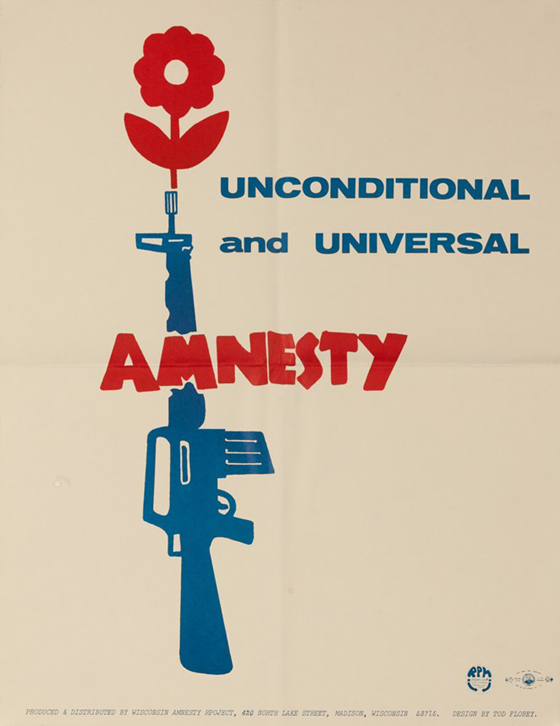
In 1972, AMEX-Canada, a Toronto-based collective of US deserters and draft resisters, of which I was part, took the lead in calling for unconditional amnesty for all war resisters and veterans with less-than-honorable discharges. (AMEX = American Exile.) We fought hard for this position within the broad-based National Council for Universal, Unconditional Amnesty (NCUUA), which included the National Council of Churches, the American Civil Liberties Union (ACLU), War Resisters League (WRL), Women Strike for Peace, Vietnam Veterans Against the War (VVAW) and many local peace groups. The initial instinct of some of the church groups was to call for amnesty only for draft resisters, who were mostly white and middle-class, and not for deserters, who were largely working class, and were wanted by the military.

It was a bigger struggle yet to include veterans with less-than-honorable discharges, who were often people-of-color who had resisted racism within the military.  But AMEX-Canada, the only organized group of war resisters within the amnesty coalition, along with WRL and VVAW, prevailed, as evidenced by the awkward but specific name, National Council for Universal, Unconditional Amnesty.

AMEX-Canada always called for the US to end its “illegal, immoral” war in Vietnam, which killed over 3 million Vietnamese, mostly civilians.  AMEX’s Jack Colhoun, an Army deserter and historian, chronicled the progress of the Vietnam war in the pages of AMEX-Canada magazine. By demanding amnesty, war resisters had opened an antiwar front that outlasted the antiwar movement, which waned after US troops were withdrawn from Vietnam in 1972-73.

In September 1974, AMEX-Canada hosted an international conference in Toronto, with exiled US war resisters from Canada, Sweden, France and the UK, who were joined by Vietnam Veterans Against the War and other US peace activists.  Several days before the long-planned conference, President Gerald Ford announced that he was granting an unconditional pardon to his disgraced predecessor, Richard Nixon, along with a very limited and conditional “earned re-entry” program for Vietnam war resisters. Returning resisters would have to sign loyalty oaths, to perform alternative service, and – if they were deserters – accept a new kind of “less-than-honorable” discharge that would mark them for life.

Resisters Demanded Total Amnesty, Not “Shamnesty”

The U.S. media flocked to Toronto to hear US war resisters’ response. We totally rejected Ford’s so-called “clemency” program and unanimously demanded an unconditional amnesty for all Vietnam war resisters. “It is right to resist an unjust war,” we exclaimed.  We called on our fellow war resisters to boycott Ford’s punitive program, and we vowed to continue our struggle for total amnesty

In order to raise the temperature, we sent a draft resister, Steve Grossman, back to the U.S. to challenge the program. And then a deserter, yours truly.  Grossman’s draft charges were dropped, as was my jail sentence, after a 50-city speaking tour that put the government on the defensive. Although some war resisters were able to take advantage of Ford’s “earned re-entry” program, relatively few did.  The program was scheduled to end on January 31, 1975. The White House extended it twice – for a total of two months – in the hopes of gaining greater numbers. But to no avail. The media declared Ford’s program a resounding failure.  We kept pushing for real amnesty, not “shamnesty.”

The Democratic Convention in New York City in July 1976 provided us with a great stage. That was the convention that nominated Jimmy Carter for president.  Carter had campaigned on a pledge to pardon draft resisters.  Little did he know that a draft resister and a Vietnam veteran would steal the show at his convention.  Fritz Efaw, who was living in England after refusing draft orders, managed to get himself elected as an Alternate Delegate from Democrats Abroad, and flew into New York’s Kennedy Airport.  Lawyers for the amnesty coalition (NCUUA) negotiated a deal with authorities that delayed Efaw’s arrest to allow him to participate in the convention.

By 1976, the mood of the country had changed. Most people agreed that the Vietnam War had been – at the very least – a terrible mistake. A majority of grassroots Democrats supported an amnesty for Vietnam War resisters. That probably included a majority of the 2100 or so delegates to the Democratic Convention.  But it took only 300 of their signatures to nominate Fritz Efaw to be the next vice president of the United States.

Draft Resister and Paralyzed Vietnam Veteran Take the Podium at Democratic Convention

And so it was that a wanted draft resister grabbed a precious fifteen minutes of prime time TV before a very large audience.  First, Efaw had to literally draw straws with the other three VP candidates to determine the order of their nominating speeches.  The other three were progressive African American Rep. Ron Dellums (with whom the amnesty activists had coordinated), an anti-abortion advocate whose name has long been forgotten, and the “other Fritz” – Fritz Mondale, who would become Carter’s running mate.  Fritz Efaw won the most desirable primetime spot.

Next came the battle with the Democratic National Committee (DNC) over who could speak on Efaw’s behalf.  The established format was for a nominating speech, a seconding speech and an acceptance speech.  NCUUA had chosen Gold Star mother Louise Ransom, a leading advocate for amnesty, to make the nominating speech. Her son had been killed in Vietnam. But it was the seconding speaker, paraplegic Vietnam veteran and fiery antiwar activist Ron Kovic, who ran into resistance.

The DNC did everything in their power to keep Ron Kovic off the podium.  They even claimed that the Democratic Party – the party of Roosevelt – did not have insurance to cover a wheelchair on the podium. The diverse team of amnesty advocates, including former exiled war resisters Dee Knight, Steve Grossman and Gerry Condon (that’s me), would not take no for an answer. Eventually Ron Kovic was allowed to make what many observers agreed was the most powerful speech of the convention. He began with these words:

I am the living death
the memorial day on wheels
I am your yankee doodle dandy
your john wayne come home
your fourth of july firecracker
exploding in the grave

These words are also how Ron Kovic begins his remarkable autobiography, Born on the Fourth of July (his birthday), later memorialized in Oliver Stone’s marvelous 1989 film by the same name. Tom Cruise did an amazing portraying Ron Kovic, and was nominated for Best Actor at the 62nd Academy Awards. The last scene in the film dramatizes Ron Kovic’s triumphant appearance at the 1976 Democratic Convention.

The team of amnesty organizers at the Convention was exuberant after the powerful presentations by Louise Ransom, Ron Kovic and Fritz Efaw. And rightly so. We had won fifteen minutes of primetime TV proclaiming that Vietnam War resisters were heroes for resisting an unjust war, and should not be punished. What a triumph!

True to his word, once elected and inaugurated, Jimmy Carter wasted no time – his very first act as president was to pardon draft resisters.  He also ordered the military to establish a case-by-case program for returning deserters. In a nod to the amnesty movement’s demand for a Single Type Discharge, Carter even set up a program for case-by-case review of less-than-honorable discharges.

This was not quite the “universal, unconditional” amnesty that we had fought so hard for. But it was quite an achievement.  Many war resisters were able to resume normal lives without fear of arrest and imprisonment.  Even those who chose to remain in Canada, Sweden and other havens, were able to legalize their status so they could return to the US for family visits – a welcome departure from the days when the FBI would haunt their parents’ funerals looking to make arrests.

President Nixon had ended the draft in 1973, in part to defuse the antiwar movement, but six years later in 1979, during the Iran hostage crisis and increasing tensions with the Soviet Union, President Carter resumed draft registration, sparking another era of draft resistance.  Young men are legally required to register for the draft when they turn 18, but millions have failed to do so.  Fast forward to 2025: the Congress is haltingly considering several bills that would extend draft registration to women, and the debate about resuming the draft continues.

U.S. Is Immersed in War and Genocide Today

The terrain for GI resisters is arguably more difficult today.  Soldiers who refused to deploy – or re-deploy – to the US wars in Iraq and Afghanistan had a really hard time fighting for refuge in Canada, whose immigration policy has tightened considerably since the Vietnam era.  Some were able to remain in Canada while others were forced to return to the US and face military court martial. Sweden offered no refuge to Iraq and Afghanistan war resisters, and recently abandoned its neutrality in favor of joining US-dominated NATO.

A 14-month-long Israeli campaign of daily horror and genocide against the Palestinian people – especially children – is being actively facilitated by the United States. US troops remain in Syria, after helping to overthrow the Syrian government and replace it with an al-Qaeda offshoot. The US is escalating the war in Ukraine by facilitating the firing of US missiles into nuclear-armed Russia. And the notorious Neocons who inhabit both Democratic and Republican administrations are pushing for wars against Iran and China. People across the political spectrum worry aloud about the looming threat of a civilization-ending nuclear war, while war planners insist they can fight and win a nuclear war. When will they ever learn…?

It Is Right To Resist an Unjust War

Veterans For Peace (VFP), which includes Vietnam combat veterans as well as former GI resisters, has issued a statement applauding those Israeli soldiers who are refusing to fight in Gaza. Aaron Bushnell, an active-duty US Airman self-immolated in front of the Israeli Embassy in Washington to protest the US/Israeli genocide.  Another active-duty Airman, Larry Hebert, then fasted against genocide in front of the White House and Congress. Many active duty personnel are expressing concern that they will be ordered to fight or facilitate illegal wars and genocide.

Veterans For Peace has joined with About Face – Veterans Against the War, the Center for Conscience and War, and the Military Law Task Force of the National Lawyers Guild to promote the Appeal for Redress (v.2), an opportunity for active-duty GI’s to legally present their concerns about war and genocide to their Congressional representatives. The veterans also refer GI’s who are thinking about becoming Conscientious Objectors to the Center on Conscience and War, and to the GI Rights Hotline, 1-877-447-4487. If needed, the 40-year-old veterans’ organization can put people in touch with lawyers experienced in military law.

Harkening back to the Vietnam era amnesty movement, the VFP statement concludes with: “Remember, it is right to resist unjust wars and illegal orders.” These words will become all the more important in the dangerous days ahead, as will increasing support for military personnel who refuse to be part of unjust wars of empire and genocide.
Gerry Condon refused Army orders to deploy to Vietnam in 1968. He was court-martialed and sentenced to ten years in prison, but escaped to Sweden, where he worked with the American Deserters Committee, and then to Canada, where he worked with the AMEX-Canada war resister collective.  He currently serves on the Board of Veterans For Peace.

US Always Knew NATO Expansion Led to War


The present severed from the past is easily misunderstood. In discussions of the Russia-Ukraine war, not enough is made of the historical facts that, at the end of the Cold War, the newly independent Ukraine promised not to join NATO, and NATO promised not to expand to Ukraine.

Not enough is made of the fact that Article IX  of the 1990 Declaration of State Sovereignty of Ukraine, “External and Internal Security,” says that Ukraine “solemnly declares its intention of becoming a permanently neutral state that does not participate in military blocs….” That promise was later enshrined in Ukraine’s constitution, which committed Ukraine to neutrality and prohibited it from joining any military alliance: that included NATO.

Nor is enough made of the fact that in 1990 and 1991, the Bush administration gave assurances to Gorbachev – assurances that arguably reached the level of a deal – that NATO would not expand east of Germany, including to Ukraine.

But even less is made of what the Clinton administration later promised Yeltsin nor of what the U.S. already knew at the time of where plans of NATO expansion to Ukraine would lead.

Recently declassified documents clearly show that, between 1993 and 2000, the U.S. already knew that a cornered Boris Yeltsin was distraught about NATO expansion and about the West’s broken promise, that expansion to Ukraine was a red line, and that if Russia ever enforced that red line, the U.S. would respond forcefully.

Though Czechia, Hungary and Poland were invited to begin accession talks in 1997 and joined NATO in 1999, a secret October 1994 policy paper, written by National Security Advisor Anthony Lake and entitled “Moving Toward NATO Expansion,” makes it clear that the decision to expand NATO had already been made by that time. The paper explicitly keeps “the membership door open for Ukraine.”

Interestingly, though Russia is always publicly painted as a predatorial nation with imperial ambitions, a confidential 1993 cable states that most Eastern European states seek NATO membership “not [because they] feel militarily threatened by Russia” but because they believe “that NATO membership can help stave off the return of authoritarian forces” in their own countries. Though the cable makes the exception that Ukraine and the Baltic states may feel threatened by Russia.

By September 1994, Clinton had explicitly told Yeltsin that NATO would expand. While visiting Yeltsin in the hospital on December 16, 1994, Vice President Al Gore clarifies that “What Clinton told you in September was that eventually NATO will expand.”

But Gore promises Yeltsin that “the process will be gradual and open and we will consult carefully with you.” He adds that “The process will be conducted in parallel with a deepening of the US-Russia partnership and your partnership with NATO.”

Though less than a week later, a secret NSC memorandum clarifies that Russia will not be given “a veto or right of prior consultation over NATO decisions,” this promise of a deepening “institutionalized relationship between NATO and Russia – possibly in the form of a Treaty (“alliance with the Alliance”) or Charter” that will be established in parallel with NATO expansion is repeatedly mentioned. A secret memorandum written by Anthony Lake to Clinton on July 17, 1995 identifies “plans to develop a formalized NATO-Russia relationship in parallel with enlargement.” The spirit of this promise would be broken.

Importantly, it is evident that the Clinton administration was very aware of Russia’s opposition to NATO expansion and of their feeling of betrayal. Knowing that expansion is an impossible sell in Russia, Gore promises Yeltsin that expansion won’t occur before 1996 because “[w]e understand you have parliamentary elections in mid-1995 and it would be hard for you if we moved forward then.

In the July 17, 1995 memorandum, Lake informs Clinton of a “hardening Russian opposition to NATO expansion.” In a section called “Intensifying Russian Opposition,” Lake says that “opposition to NATO enlargement appears to be hardening across the political spectrum among the Russian political elite.” He reports that key Russian officials insist “that NATO enlargement and NATO-Russia cooperation are incompatible.” He recognizes that Yeltsin has “approved… a strategy for delaying and possibly derailing NATO enlargement.” Lake forecasts little hope of the position softening because “Russia’s opposition is deep and profound.”

Though much has been made of William Burns’ important 2008 warning that “Ukrainian entry into NATO is the brightest of all redlines for the Russian elite (not just Putin),” it was not the first such warning.

In a 1991 appeal cited in M.E. Sarotte’s Not One Inch, U.S. ambassador to Moscow Robert Strauss warned that “the most revolutionary event of 1991 for Russia may not be the collapse of Communism, but the loss of something Russians of all political stripes think of as part of their own body politic, and near to the heart at that: Ukraine.” An internal 1991 draft paper recommended leaving “the possibility of Ukraine joining the NATO liaison program” for “a later time.” Sarotte reports that Richard Holbrooke, who aggressively pushed expansion, called NATO in a briefing paper “an Alliance [Ukraine] can probably never enter.”

secret/sensitive memorandum dated July 29, 1996 clearly states that Russia seeks to “draw red lines around certain countries (e.g. the Baltics and Ukraine) to prevent their ever being considered for NATO membership.”

The declassified documents make it clear that, at the time of the decision to expand NATO east toward Russia, the Clinton administration knew that Russia vehemently opposed expansion and especially expansion to Ukraine. They also knew that crossing that red line could lead to trouble.

The July 29, 1996 memo shows, not only knowledge of Russian opposition, but understanding of it: “From a Russian perspective, they cannot (and probably should not ever want to) endorse formally NATO enlargement.”

An August 23, 1996 draft memorandum written by deputy secretary of state Strobe Talbot says that “The Russians are saying that they will not ‘negotiate’ on the issue of Baltic and Ukrainian eventual membership in NATO.” Using the language of conflict for, perhaps, the first time, Talbot says that “[t]his has the distinctly ominous implication of a warning to us…”

Remarkably, having recognized that Russia had drawn a red line at NATO expansion to Ukraine, the U.S. proceeded to invert that red line: “An important part of our job will be to make sure our red lines stick – and that the Russians’ <sic> don’t cross ours (i.e., trying to label UNACCEPTABLE Ukrainian and Baltic membership.” Enlarging on the new language of conflict, the memo then says that if Russia’s “nasty implication [of a warning] becomes explicit, we should slam back hard…” This is the most prescient line in the declassified documents, forecasting a “hard” American response if Russia asserts it red line at NATO expansion to Ukraine.

And it is clear that the Clinton administration had no illusions about Russia’s serious concerns or about their resentment of Clinton’s breaking the promise that was made to them at the end of the Cold War. In a memorandum to Strobe Talbot, Dennis Ross says that the Russians “see NATO expansion” as their being “humiliated,” but “worse,” that it confirms that “they will face potential threats closer to their borders.” Ross adds that the Russians “feel they were snookered at the time of German unification” by the breaking of “[Secretary of State James] Baker’s promises on not extending NATO military presence into what was East Germany” which was “part of a perceived commitment not to expand the Alliance eastward.”

In an important meeting between Clinton and Yeltsin in Helsinki on March 21, 1997, Yeltsin’s frustration and anger are made clear. Discussing the NATO-Russia Founding Act, Yeltsin makes sure that Clinton knows that Russia’s “position has not changed. It remains a mistake for NATO to move eastward.” He then says, “But I need to take steps to alleviate the negative consequences of this for Russia. I am prepared to enter into an agreement with NATO not because I want to but because it is a forced step.”

Yeltsin then personally tells Clinton, “But one thing is very important: enlargement should also not embrace the former Soviet republics. I cannot sign any agreement without such language. Especially Ukraine.”

Yeltsin implores Clinton that “[d]ecisions by NATO are not to be taken without taking into account the concerns or opinions of Russia.” He also demands that “nuclear and conventional arms cannot move eastward into new member to the borders of Russia.” Clinton then promises Yeltsin “to make sure that we take account of Russia’s concerns as we move forward.” Another broken promise.

Interestingly, as an indication that the U.S. recognizes that objections to NATO expansion are not just Putin’s objections but Russia’s, in a November 16, 2000 meeting, Talbot suggests that “the next round of NATO enlargement might be easier under Putin than it had been under Yeltsin.”

Reuniting the present with the context of its past is crucial, not for condoning Russia’s war against Ukraine, but for understanding it. More importantly, it will be crucial when it finally comes to resolving and ending it.

Ted Snider is a regular columnist on U.S. foreign policy and history at Antiwar.com and The Libertarian Institute. He is also a frequent contributor to Responsible Statecraft and The American Conservative as well as other outlets. To support his work or for media or virtual presentation requests, contact him at tedsnider@bell.net.

Genocidal President, Genocidal Politics


When news broke over the weekend that President Biden just approved an $8 billion deal for shipping weapons to Israel, a nameless official vowed that “we will continue to provide the capabilities necessary for Israel’s defense.” Following the reports last month from Amnesty International and Human Rights Watch concluding that Israeli actions in Gaza are genocide, Biden’s decision was a new low for his presidency.

It’s logical to focus on Biden as an individual. His choices to keep sending huge quantities of weaponry to Israel have been pivotal and calamitous. But the presidential genocide and the active acquiescence of the vast majority of Congress are matched by the dominant media and overall politics of the United States.

Forty days after the Gaza war began, Anne Boyer announced her resignation as poetry editor of the New York Times Magazine. More than a year later, her statement illuminates why the moral credibility of so many liberal institutions has collapsed in the wake of Gaza’s destruction.

While Boyer denounced “the Israeli state’s U.S.-backed war against the people of Gaza,” she emphatically chose to disassociate herself from the nation’s leading liberal news organization: “I can’t write about poetry amidst the ‘reasonable’ tones of those who aim to acclimatize us to this unreasonable suffering. No more ghoulish euphemisms. No more verbally sanitized hellscapes. No more warmongering lies.”

The acclimatizing process soon became routine. It was most crucially abetted by President Biden and his loyalists, who were especially motivated to pretend that he wasn’t really doing what he was really doing.

For mainline journalists, the process required the willing suspension of belief in a consistent standard of language and humanity. When Boyer acutely grasped the dire significance of its Gaza coverage, she withdrew from “the newspaper of record.”

Content analysis of the war’s first six weeks found that coverage by the New York TimesWashington Post and Los Angeles Times had a steeply dehumanizing slant toward Palestinians. The three papers “disproportionately emphasized Israeli deaths in the conflict” and “used emotive language to describe the killings of Israelis, but not Palestinians,” a study by The Intercept showed. “The term ‘slaughter’ was used by editors and reporters to describe the killing of Israelis versus Palestinians 60 to 1, and ‘massacre’ was used to describe the killing of Israelis versus Palestinians 125 to 2. ‘Horrific’ was used to describe the killing of Israelis versus Palestinians 36 to 4.”

After a year of the Gaza war, Arab-American historian Rashid Khalidi said: “My objection to organs of opinion like the New York Times is that they see absolutely everything from an Israeli perspective. ‘How does it affect Israel, how do the Israelis see it?’ Israel is at the center of their worldview, and that’s true of our elites generally, all over the West. The Israelis have very shrewdly, by preventing direct reportage from Gaza, further enabled that Israelocentric perspective.”

Khalidi summed up: “The mainstream media is as blind as it ever was, as willing to shill for any monstrous Israeli lie, to act as stenographers for power, repeating what is said in Washington.”

The conformist media climate smoothed the way for Biden and his prominent rationalizers to slide off the hook and shape the narrative, disguising complicity as evenhanded policy. Meanwhile, mighty boosts of Israel’s weapons and ammunition were coming from the United States. Nearly half of the Palestinians they killed were children.

For those children and their families, the road to hell was paved with good doublethink. So, for instance, while the Gaza horrors went on, no journalist would confront Biden with what he’d said at the time of the widely decried school shooting in Uvalde, Texas, when the president had quickly gone on live television. “There are parents who will never see their child again,” he said, adding: “To lose a child is like having a piece of your soul ripped away… It’s a feeling shared by the siblings, and the grandparents, and their family members, and the community that’s left behind.” And he asked plaintively, “Why are we willing to live with this carnage? Why do we keep letting this happen?”

The massacre in Uvalde killed 19 children. The daily massacre in Gaza has taken the lives of that many Palestinian kids in a matter of hours.

While Biden refused to acknowledge the ethnic cleansing and mass murder that he kept making possible, Democrats in his orbit cooperated with silence or other types of evasion. A longstanding maneuver amounts to checking the box for a requisite platitude by affirming support for a “two-state solution.”

Dominating Capitol Hill, an unspoken precept has held that Palestinian people are expendable as a practical political matter. Party leaders like Senator Chuck Schumer and Representative Hakeem Jeffries did virtually nothing to indicate otherwise. Nor did they exert themselves to defend incumbent House Democrats Jamaal Bowman and Cori Bush, defeated in summer primaries with an unprecedented deluge of multimillion-dollar ad campaigns funded by AIPAC and Republican donors.

The overall media environment was a bit more varied but no less lethal for Palestinian civilians. During its first several months, the Gaza war received huge quantities of mainstream media coverage, which thinned over time; the effects were largely to normalize the continual slaughter. Some exceptional reporting existed about the suffering, but the journalism gradually took on a media ambience akin to background noise, while credulously hyping Biden’s weak ceasefire efforts as determined quests.

Prime Minister Benjamin Netanyahu came in for increasing amounts of criticism. But the prevalent U.S. media coverage and political rhetoric – unwilling to expose the Israeli mission to destroy Palestinians en masse – rarely went beyond portraying Israel’s leaders as insufficiently concerned with protecting Palestinian civilians.

Instead of candor about horrific truths, the usual tales of U.S. media and politics have offered euphemisms and evasions.

When she resigned as the New York Times Magazine poetry editor in mid-November 2023, Anne Boyer condemned what she called “an ongoing war against the people of Palestine, people who have resisted through decades of occupation, forced dislocation, deprivation, surveillance, siege, imprisonment, and torture.” Another poet, William Stafford, wrote decades ago:

I call it cruel and maybe the root of all cruelty to know what occurs but not recognize the fact.

Norman Solomon is the national director of RootsAction.org and executive director of the Institute for Public Accuracy. His latest book, War Made Invisible: How America Hides the Human Toll of Its Military Machine, was published in paperback this fall with a new afterword about the Gaza war.