Friday, January 10, 2025

 Geopolitics

Trump’s Greenland bid is really about control of the Arctic and the coming battle with China

Friday 10 January 2025, by Stefan Wolff


When Donald Trump first offered to buy Greenland in 2019, he was widely ridiculed and nothing much came of it, apart from a canceled state visit to Denmark. Fast forward six years and Trump’s renewed “bid” for the world’s largest island is back on the table.

And with renewed vigour at that. In an interview on January 7, the incoming US president refused to rule out the use of force to take possession of Greenland and he dispatched his son, Don Jr, “and various representatives” there on January 8, 2025, to underline his seriousness. With Elon Musk on board as well, money may not be an obstacle to any deal that Trump envisages.

Trump is not the first US politician to try to buy Greenland. The earliest documented attempt to acquire the island goes back to 1868.

The last serious pre-Trump effort is that by President Harry S. Truman’s government in 1946. Trump’s renewed interest in Greenland thus stands in a long tradition of American efforts of territorial expansion.

Even without this historical background, Trump’s latest bid is less irrational today than it may have seemed back in 2019. On the one hand, Greenland is exceptionally rich in so-called “critical minerals”. According to a 2024 report in the Economist, the island has known deposits of 43 of 50 of these minerals. According to the US Department of Energy, these minerals are essential for “technologies that produce, transmit, store, and conserve energy” and have “a high risk of supply chain disruption”.

The latter certainly is a valid concern given that China – a key supplier of several critical minerals to global markets – has been increasing restrictions on its exports as part of an ongoing trade war with the US. Access to Greenland’s resources would give Washington more supply chain security and limit any leverage that China could to bring to bear.

Strategic value

Greenland’s strategic location also makes it valuable to the US. An existing US base, Pituffik Space Base, is key to US missile early warning and defence and plays a critical role in space surveillance. Future expansion of the base could also enhance US capabilities to monitor Russian naval movements in the Arctic Ocean and the north Atlantic.

US sovereignty over Greenland, if Trump’s deal comes to pass, would also effectively forestall any moves by rivals, especially China, to get a foothold on the island. This may be less of a concern if Greenland remains part of Nato member Denmark which has kept the island economically afloat with an annual grant of around US$500 million (£407 million).

Greenland’s independence – support for which has been steadily growing – could open the door to more, and less regulated, foreign investment. In this case, China is seen as particularly keen to step in should the opportunity arise.

Add to that growing security cooperation between Russia and China and the fact that Russia has generally become more militarily aggressive, and Trump’s case looks yet more credible. Nor is he the only one to have raised the alarm bells: CanadaDenmark and Norway have all recently pushed back against an increasing Russian and Chinese footprint in the Arctic.

So, the problem with Trump’s proposal is not that it is based on a flawed diagnosis of the underlying issue it tries to address. Growing Russian and Chinese influence in the Arctic region in general is a security problem at a time of rising geopolitical rivalry. In this context, Greenland undeniably poses a particular and significant security vulnerability for the United States.

The flaws in Trump’s plan

The problem is Trump’s “America first” tunnel vision of looking for a solution. Insisting that he wants Greenland and that he will get it – even if that means exceptional tariffs on Danish exports (think Novo Nordisk’s weightloss drugs) or the use of force.

Predictably, Greenland and Denmark rejected the new “offer”. And key allies, including France and Germany, rushed to their ally’s defence – figuratively for now.

Rather than strengthening US security, Trump is arguably effectively weakening it by, yet again, undermining the western alliance. Not only does the irony of doing so in the north Atlantic appear to be lost on Trump. But it also seems that there is an even more fundamental problem at work here in that this kind of 19th century-style territorial expansionism reflects Trump’s isolationist impulses.

“Incorporating” Greenland into the US would likely insulate Washington from the disruption of critical mineral supply chains and keep Russia and China at bay. And signalling that he will do it whatever the cost is an indication that, beyond the kind of bluster and bombast that is normally associated with Trump, his approach to foreign policy will quickly do away with any gloves.

Rather than investing in strengthening security cooperation with Denmark and the rest of its Nato and European allies to face down Russia and China in the Arctic and beyond, Trump and his team may well think that the US can get away with this. Given that what is at stake here are relations with the US’s hitherto closest allies, this is an enormous, and unwarranted, gamble.

No great power in history has been able to go it alone forever – and even taking possession of Greenland, by hook or by crook, is unlikely to change this.

This article is republished from The Conversation under a Creative Commons licence


Statements from Venezuelan left: End the detentions, forced disappearances and repression!


Published 

Juan Barreto Maria Alejandra Diaz

LINKS International Journal of Socialist Renewal is publishing various statements released by revolutionary left groups and human rights organisations denouncing the wave of police repression unleashed in the lead up to Nicolás Maduro’s inauguration.

Maduro plans to be inaugurated on January 10 for a third term, despite the country’s National Electoral Council having failed to publish the results of the disputed July 28 presidential elections, as it is required to do so by Venezuelan law.

The Frente Democrático Popular (Popular Democratic Front, FDP), which was set up by left opposition groups and moderate political parties in the wake of the elections, has been a key target of the government’s repression. The FDP has been campaigning for the results to be published in order to remove the grave doubts that hang over the election, and for an end to the repression against those protesting to defend their democratic rights.

Below are statements by FDP, Surgentes (human rights collective), the Plataforma Ciudadana en Defensa de la Constitución (Citizens' Platform in Defence of the Constitution, PCDC), Coordinadora Nacional Autónomo Independiente De Trabajadores (National Autonomous and Independent Coalition of Workers, CAIT) and the Partido Comunista de Venezuela (Communist Party of Venezuela). New statements will be added when they appear and are translated.


FDP demands the release of its members and an end to their harassment

Popular Democratic Front

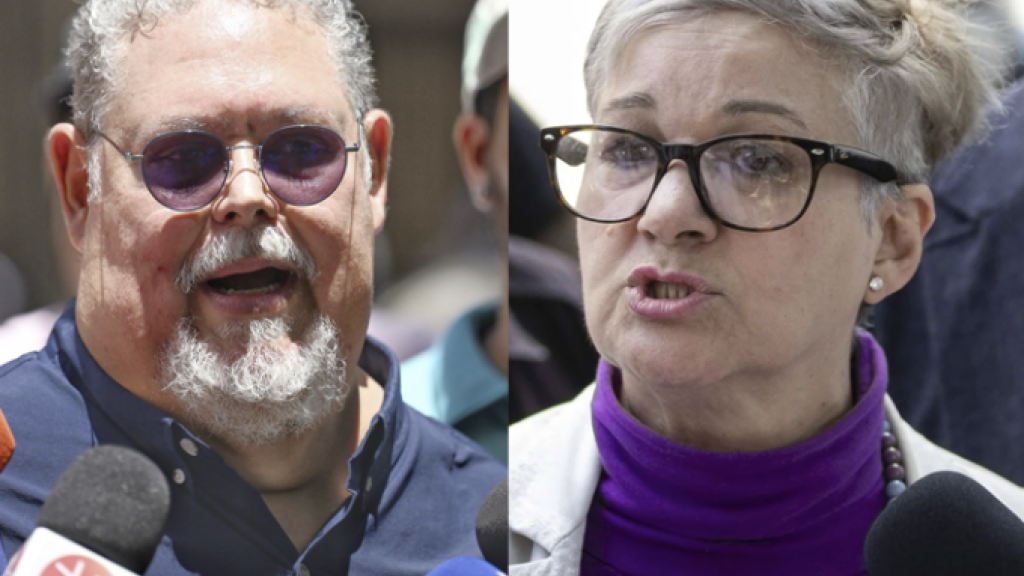
At 12:30 a.m. on January 8, we were informed that yesterday, January 7, Enrique Márquez was arbitrarily detained and that Juan Barreto and María Alejandra Díaz had been harassed by security forces, with a police presence established outside their homes. All three are founding members of the Popular Democratic Front.

The Popular Democratic Front proposes political, peaceful and constitutional solutions to the legitimacy crisis generated by the lack of transparency and auditability of the electoral results announced by the CNE (National Electoral Council) and validated by the TSJ (Supreme Court of Justice). The government is only ratifying its authoritarian drift with these harassments and arbitrary detentions, which come on top of seven others that occurred that same day.

We demand the immediate release of Enrique Márquez and the other detainees and an end to the harassment of María Alejandra and Juan.


In response to the wave of arbitrary detentions, disappearances and police harassment

Surgentes

The human rights collective Surgentes states the following in view of the new wave of detentions, disappearances and harassment carried out by the Venezuelan state:

1. Yesterday, January 7, at least 10 people were arbitrarily detained by unidentified, hooded men (a common practice of the security forces): human rights activist Carlos Correa; former presidential candidate Enrique Márquez; the son-in-law of former presidential candidate Edmundo Gonzalez, Rafael Tudares; and seven members of opposition parties in the states of Trujillo, Falcon and Bolivar: Marianela Ojeda, Francisco Graterol, Alejandro Briceño, Darío Durán, Robert Rea, Francisco Cariello and Jeremy Santamaría. None of them have had contact with their families or lawyers. In none of these cases has the state acknowledged their detention. These are part of a pattern of forced disappearances.

2. Left activists María Alejandra Díaz and Juan Barreto were also harassed by security forces yesterday. Police went to the home of the former (neighbours prevented them from entering the building) while the latter had a police patrol stationed outside his home. María Alejandra Díaz and Juan Barreto, together with Enrique Márquez, are part of the Popular Democratic Front, a space which arose after the electoral fraud of July 28 in order to bring together social and political organisations to defend human rights, the constitution and popular sovereignty.

3. We are witnessing a new wave of repression, one that part of a consistent pattern when it comes to security forces (police and military): arbitrary detentions for political reasons, forced disappearances (generally for short durations), officials operating with their faces covered and without uniforms or marked vehicles, and the initial silence of authorities.

In light of the detentions/disappearances and harassment denounced here, we demand: a) immediate recognition by the state of the detention of these persons, that they be allowed to communicate with their relatives and lawyers, verification by the Public Ministry and the Ombudsman's Office of their state of health, and their release; and b) an end to the harassment of María Alejandra Díaz and Juan Barreto.

With only two days to go until the formal birth of the second de facto government in Venezuela this century (both this one, led by Maduro, like the first one headed by Pedro Carmona Estanga, representing an alliance of sectors of capital with sections of the military), we view this wave of repression as an attempt to terrorise, demobilise, silence and crush all opposition and all dissent. The fight to regain democracy, constitutionality and respect for human rights requires identifying and circumventing the intentionality of power. It is time to debate, speak out and denounce; to unite popular and democratic forces; and to mobilise in defense of human rights and popular sovereignty.


We reject the ongoing repression being carried out by the Nicolás Maduro government.

Citizens’ Platform in Defence of the Constitution

The Citizens’ Platform in Defence of the Constitution (PCDC) rejects the illegal detention of political leader Enrique Márquez, who was a candidate in the July 28 presidential elections. As his relatives have denounced in social networks and the media, Márquez’s case should be considered a forced disappearance, given para-police groups took him away and he has been deprived of his freedom, with authorities refusing to provide information on his conditions or whereabouts ever since January 7.

That same day, journalist Carlos Correa, who is the director of the civil organisation Espacio Público and has a long career as a defender of the collective rights of Venezuelans, was also arbitrarily detained.

At the time of writing, both professionals are missing and no competent authority, such as the Public Prosecutor’s Office, the Ombudsman’s Office, the police or the military, have provided information on their cases. Their relatives do not know where they are or in what physical and moral conditions they are in, and are concerned by the authorities’ refusal to provide information on the whereabouts of both defenders of the law.

The government is once again repeating the same unconstitutional practices, violating the rule of law and due process, by resorting to the violent detention of opposition leaders, social activists and ordinary citizens who are made to disappear for extended periods of time before being brought before the courts weeks or months later, denied a lawyer of their choosing and kept incommunicado even from their families.

The detention of Enrique Márquez and Carlos Correa is an unjustified act. Both of them have obtained a high profile for their academic, social, political and human rights activities and commitments, which means it is impossible to accuse them of acting outside the constitutional framework. Enrique Márquez, in particular, has enthusiastically promoted the introduction of legal appeals before the Supreme Court of Justice, with the aim of summoning the National Electoral Council (CNE) to publish the tally sheets of the July 28 presidential elections as well as detailed results for each polling booth, polling centre, parish, municipality and state. More than five months after the election, the CNE has not published these results, which calls into question Nicolás Maduro’s supposed electoral triumph.

The PCDC demands the immediate release of Enrique Márquez and Carlos Correa. We also demand an end to the repressive practices carried out throughout the country by the Nicolás Maduro government, which in no way contribute to creating a climate of peace and democratic citizen’s participation. Maduro’s government has slipped into the fascist practices of the dictatorial regimes that ravaged the South American continent half a century ago.

Demanding respect for the constitution and the most basic civil rights are not a crime. With these fascist practices, Maduro’s government has placed itself outside the constitution that we Venezuelans voted in favour of in 1999, and has reinforced the very serious political crisis unleashed by its disregard of the July 28 election results, for which the CNE has still not published full and disaggregated results.

Our call is for the immediate release of all political prisoners, particularly those detained for peacefully protesting after the electoral fraud of July 28. The government, instead of releasing hundreds of citizens detained for political reasons, has in recent weeks unleashed a campaign of selective arrests against opposition leaders, with almost 20 social movement and opposition group leaders having been detained and disappeared this week.

We demand the immediate release of all political prisoners!

Edgardo Lander, Gustavo Márquez, Oly Millán, Héctor Navarro, Antonia Muñoz, Santiago Arconada,

Carlos Mendoza Potellá, Mariano Crespo, Juan García, Sofía Viloria, Luis Mogollón y Roberto López Sánchez.


Against the recent arbitrary detentions, disappearances and acts of harassment by the Maduro government

National Autonomous and Independent Coalition of Workers (CAIT)

Yesterday, Tuesday January 7, the government once again carried out a series of arbitrary detentions and police harassment against political leaders of the Popular Democratic Front (FDP). This front represents a coalition of social and political organisations that fight in defence of human rights, the constitution and popular sovereignty, and which arose as a result of the uncertainty surrounding the July 28 presidential elections.

Among those arrested is Rafael Tudares, son-in-law of former presidential candidate Edmundo Gonzalez, together with seven militants of right-wing opposition parties.

The context of these arrests occurs at a time when a pro-imperialist right-wing coup is seeking to weaken the government by denouncing its illegitimacy and authoritarianism, and is calling on the armed forces to carry out a military coup, an action of insurrectional character.

The announced return of Edmundo Gonzalez to the country, after a “tour” through several Latin American countries and the United States, in the company of former heads of state and members of the IDEA group, which continues the work of the Lima Group, could result in an unconstitutional shortcut that pushes the country towards a precipice of violence and institutional disorder.

Juan Barreto, former Mayor of Metropolitan Caracas, as well as attorney María Alejandra Díaz and Enrique Márquez, all FDP leaders, have maintained a position of democratic opposition within the constitutional context. In light of the controversy generated by the July 28 elections, they filed an appeal before the TSJ [Supreme Court of Justice] to order the publication of the disaggregated results of the presidential elections, as established by the CNE in its schedule. Counting votes cast at each polling booth will dissipate the reasonable doubt that has arisen around the July 28 elections, in which the ultra-right opposition claims that its candidate, Edmundo González Urrutia, was the winner.

The Superior Court of Justice dismissed the legal action, pointing out the “recklessness” of the citizens who presented it. Article 28 of the Organic Law of Appeal on Constitutional Rights and Guarantees was mentioned as justification, which indicates that, upon denial of an appeal, the court must rule on the recklessness of the action filed and has the authority to impose up to 10 days of arrest or a fine, the latter of which was applied to María Alejandra Díaz.

Despite not agreeing with the determination of the Constitutional Chamber of the Supreme Court of Justice regarding his request for a review of the judgment validating the result of the July 28 election, former presidential candidate Enrique Marquez has stated that he will abide by the TSJ’s decision.

Arbitrary detentions, disappearances and harassment represent a manifest violation of the guarantees of democratic rights and liberties enshrined in the Constitution of the Bolivarian Republic of Venezuela, which have been affected by the authoritarian tendency of the government. In the face of this situation, it is crucial that we do not remain silent. Therefore, we categorically reject any call, regardless of its origin, that seeks to promote violence, disorder and confrontation, as well as coup intentions and foreign interference in the affairs of the Venezuelan nation.

In the face of the authoritarian and regressive policies of the government, it is imperative that we workers independently and autonomously establish our own agenda. This must focus on the recovery of wages, defence of labour and social rights, as well as the protection of the Labour Law and democratic, economic and political rights.

Workers must not, under any circumstances, abandon the defence of their interests, which are diametrically opposed to those of the capitalist class. Likewise, we are willing to dialogue with militants of different political orientations in order to establish an independent political grouping that defends our interests as a class, both in the political and union arena.


PCV demands respect for democratic freedoms and immediate release of former presidential candidate Enrique Márquez

Communist Party of Venezuela

The Political Bureau of the Central Committee of the Communist Party of Venezuela (PCV) denounces before national and international public opinion the arbitrary detention of Enrique Márquez, former presidential candidate supported by Venezuelan communists in the elections of July 28, 2024.

On the night of January 7, the disappearance of Márquez, leader of the Centrados en la Gente party and member of the Popular Democratic Front (FDP), a platform that groups together left-wing, popular and revolutionary political and social organizations, among them the PCV, was confirmed.

A few hours before this event, other political leaders of the FDP, such as journalist Juan Barreto and constitutional lawyer María Alejandra Díaz, denounced police harassment at their homes. In the case of Barreto, a commission of the FDP, formed by the PCV and Comunes, verified that the subjects were hooded and equipped with long-range weapons.

The FDP has led an important institutional campaign to demand from the Public Powers, particularly the National Electoral Council and the Supreme Court of Justice, the publication of the results of the presidential elections, disaggregated table by table ─as established by Venezuelan law. The appeals introduced so far have been dismissed and the governmental response has been a dirty war promoted by the leadership of the United Socialist Party of Venezuela (PSUV) to uselessly try to link the FDP with reactionary sectors of the opposition.

From the Communist Party of Venezuela (PCV) we condemn this repressive escalation against the forces that clamor for the restitution of the Constitution and the rule of law in the country.

We reiterate that in Venezuela a dangerous conspiracy is underway by the constituted powers ─under total control of the PSUV leadership – to disregard the will of the people. The Government of Nicolás Maduro has deployed in the past days ─unprecedented in recent history─ its repressive forces, to prevent the rejection of the people to its anti-democratic maneuvers from turning into mobilization. The PCV vindicates the right to peaceful protest and political organization.

We demand the appearance and immediate release of former presidential candidate Enrique Marquez and the cessation of government repression. Defending the Constitution is not a crime.

The PCV calls on the genuinely democratic and popular forces to the broadest unity of action to confront the authoritarian drift of the anti-worker and anti-popular administration of Nicolás Maduro and to advance towards the recovery of constitutional guarantees.

We are still on our feet! Joining forces and organizing struggles!
 

Mozambique: A new revolution, this time without revolutionaries — How rigged elections sparked a historic uprising


Published 

Mozambique riots

First published in French at Lundi. Translation by Adam Novak for Europe Solidaire Sans Frontières.

“PREC” (Processo revolucionário em curso) was the acronym used in 1974-1975 to describe the radicalisation of the Carnation Revolution, which celebrates its 50th anniversary in 2024. The context is entirely different, except for one point: in both cases, no one imagined what would happen, namely that a significant event (in 1974 in Portugal, a military coup; today in Mozambique, yet another fraudulent election) would trigger a revolutionary process. Unfortunately, Trump’s election and the fall of the abominable Assad regime in Syria have completely overshadowed the crisis in this East African country since 20th October.

This is no longer merely a protest against rigged elections, as frequently occurs in Africa. Everything started there, certainly. The 9th October 2024 elections were, even according to international observers, shamelessly rigged. The government awarded itself a result (over 70% of votes) that nobody believes and which presents numerical disparities that even the National Electoral Commission (CNE) declared itself unable to explain, though this didn’t prevent it from recognising their validity.

Fraud is customary in Mozambique, particularly since the 1999 elections which the opposition very likely already won – but the international community was then relieved by the maintenance in power of the ex-Marxist-Leninist party, a good manager of the neoliberal turn. In 2004, 2009, 2014 and 2019, fraud was repeated (with changing methods) to such an extent that the regions most traditionally favourable to the opposition saw their abstention rates soar: what’s the point of voting? In 2024, more than half of Mozambicans didn’t vote (even accounting for those who voted without knowing it and non-existent voters who voted). These regions were also the least registered (machines always broke down), to reduce the number of voters there whilst conversely the number reached 130% of inhabitants in the loyal province of Gaza. So why are the 2024 elections different? There are at least two sets of reasons that can be put forward.

A change of era

Firstly, Mozambique’s population is extremely young, with more than half of inhabitants under fifteen years old and the majority of voters therefore having no experience of the civil war (1976-1992). The effects of this demographic evolution began to show in 2013, when the opposition would have won the municipal elections in Maputo and Matola, the two major southern cities and historical heart of the social base of the Mozambique Liberation Front (Frelimo, the party that led the anti-colonial guerrilla warfare from 1964 to 1974), were it not for an opportune power cut during vote counting:. ne

New voters in these two cities could now vote for the party born from the pro-South African rebellion, the Mozambique National Resistance (Renamo), which would have been unthinkable in their parents’ time. The shift deepened thereafter: parties emerging from the post-colonial period (namely the “Marxist-Leninist” period from 1975 to 1989, the civil war from 1976 to 1992, the post-civil war neoliberal period during which the two parties that emerged from it maintained Mozambican bipartisanship, 1994-2019) were increasingly challenged.

This illustrated a change in historical period, the end of the post-colonial period, with civil war memory no longer structuring the country’s political life. Nevertheless, Renamo nearly succeeded in becoming the tool of “post-post-colonial” opposition to power: after resuming low-intensity guerrilla warfare in 2012-2016, it doubled its votes and deputies in 2014. But its undisputed leader, Afonso Dhlakama, died in the Gorongosa massif from where he directed operations in May 2018, replaced by a lacklustre general who had been city-based for more than twenty years.

Fraud in the 2019 general elections was massive (biased registration, maximum pressure on voters, expulsion of observers, assassinations, rejection of all appeals, etc.). Nevertheless, Renamo remained the main opposition party, and its municipal candidate in the capital, Venâncio Mondlane, was once again actually victorious in 2023. These municipal elections in the country’s regions saw obvious fraud but were accepted by the Electoral Commission except in four communes. The message was that the following year (in 2024), local Frelimo committees could ’go all out’. It wasn’t even about hiding the fraud, but clearly signifying to all that elections served to maintain Frelimo – the country’s founder in 1975 – in power. For the 150 families who had owned the state for fifty years and ttransformed themselves from “Marxist” bureaucrats to businessmen, losing elections was completely unthinkable.

For the mass of new voters, Frelimo was no longer the party that had brought independence, built schools and hospitals, electrified part of the country and resisted a guerrilla movement supported by apartheid.

Consequently – second set of reasons – Frelimo had become an insolently rich elite, especially since the discovery of immense gas deposits in the north, the opening of open-pit coal mines (ultra-polluting for kilometres around), precious stone mines (from which artisanal gold panners were brutally evicted to give them to joint ventures dominated by foreign companies) or oil sands. All this sustained the elite through commissions and service provisions benefiting only companies of those in power, with enormous corruption scandals. In short, those in power were increasingly perceived as an enclave within the country.

The ongoing revolution is therefore not only democratic – protest against institutionalised fraud – it has a profound social motivation. Aren’t the most frequently shouted slogans or written on placards “Power to the people”, “Revolution”, “We want independence from the black coloniser” (meaning “out with the new black colonisers”). But how did we get here?

Renamo’s failed transition

Renamo failed to follow the socio-demographic evolution of its base. While its electorate was increasingly massive in southern cities – historically established mainly in northern cities and the countryside – it refused to promote new educated and urban leaders, reappointing old guerrilla military leaders to positions of responsibility. Venâncio Mondlane, an engineer well known for having been a former radio and television journalist with a mocking tone, from the South like the majority of the Frelimo elite, evangelical, crowned with his municipal successes of 2013 and 2023 – he had been prevented from running in 2018 – wanted to be Renamo’s presidential candidate (without necessarily being party president). But he was prevented from participating in the April 2024 congress which reappointed the party president, General Ossufo Momade, as presidential candidate. V. Mondlane then ran as an independent candidate and obtained support from a small party born from a modest split from Frelimo, Podemos (“We can”, Optimist Party for Mozambique’s Development). It quickly appeared that Renamo’s new electorate that emerged from 2013 – in fact more “anti-Frelimo” than “pro-Renamo” – and which flocked to its meetings across the country, was rapidly shifting towards this new generation political entrepreneur. In the 2023 municipal elections, without his party’s agreement, he organised parades in the capital to celebrate his victory before the Electoral Commission proclaimed the Frelimo candidate winner, thus signifying that he did not accept to defer to appeal bodies totally controlled by those in power. He did the same in the general elections (provincial, legislative and presidential) of October 2024, setting up a parallel count equipped with computers and competent people – which Renamo had never managed to do. Even before the official proclamation of results, he announced, with polling station minutes in hand, his victory with more than 60% of votes across the country (except perhaps in Zambezia where the traditional opposition would have won). And he called on the Mozambican population to impose this result. Renamo collapsed, relegated far behind to the country’s third political force with about 10% of votes and only 15 deputies nationally.

But to clearly show its determination not to yield, the power elite had Venâncio Mondlane’s personal lawyer, Elvino Dias, and Podemos party’s national representative, Paulo Guambe, assassinated, each riddled with 25 bullets in the night of 18-19 October, in downtown Maputo. Venâncio Mondlane took refuge abroad (first in South Africa where he also narrowly escaped assassination). But since then, every day on his Facebook channel, he exhorts his supporters to new street actions, which are religiously awaited by immense crowds – which often go beyond the leader’s words in their enthusiasm and frustration.

Plebeian revolution

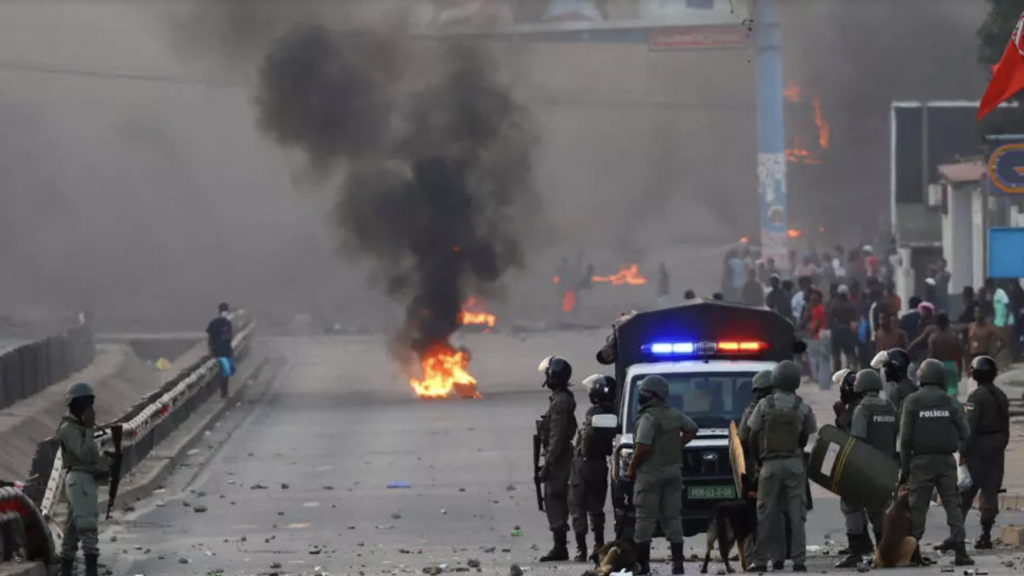
The demonstrators, in the capital and other major cities, but also in very small towns across the country, are most often very poor young boys who go beyond V. Mondlane’s peaceful directives, burning Frelimo party headquarters, attacking police stations and attempting to steal weapons there, district electoral commissions, destroying leaders’ statues, threatening them by revealing their addresses, sometimes even killing them (as in Inhassunge): fear is beginning to change sides. The middle class, which hardly demonstrates (except doctors, lawyers, professors who were already active before) shows its support through endless nocturnal pot-banging. Repression is brutal even if fortunately, it has not yet meant the bloodbath that can be feared: there are probably already more than a hundred deaths ( ostly from live ammunition fire, particularly in the northern city of Nampula), thousands of wounded and 3,000 arrests.

What is remarkable in these protests is that there is no ethnic dimension in this very heterogeneous country. From north (even in areas affected by Islamic guerrilla warfare) to south of the country, there are demonstrations, attacks on symbolic places of power, toppled statues – including that of the Maconde leader, Alberto Chipande who had proclaimed: “Daqui ninguém nos tira” (“Nobody will remove us from here [from power]”), whose statue was torn down in Pemba, the major city closest to jihad zones. There are also public prayers in the streets, cars abandoned in place to block traffic, national route No.1 (North-South) is blocked, as well as the border with South Africa. The power elite has a powerful militarised police force, the Rapid Intervention Unit, formidable secret services (State Information and Security Services, which primarily monitors the population), with police totalling close to 100,000 people while the army has only a few thousand men. But this army has so far committed no violence against demonstrators.

Revolution or chaos

How will the situation evolve? Some are suggesting to Venâncio Mondlane the possibility of forming a “national unity government”. This has already been tried in neighbouring Zimbabwe when ZANU-PF (Zimbabwe African National Union-Patriotic Front) which had used great violence to maintain power then convinced the exhausted opposition to join them in power. With ZANU keeping the presidency and key ministries, this had mainly served to discredit the opposition. A national unity government can therefore only be considered after organising new internationally monitored elections.

The most reasonable solution would be for the Constitutional Council to accept, before Christmas, to cancel the entire electoral process and postpone it to a later date even if this means keeping the outgoing president, Filipe Nyusi, for a few months. Nothing in its history suggests this Council will do so but it’s not impossible, given the fear now felt by the elite whose official denial (the demonstrations are acts of bandits and terrorists manipulated from abroad) does not hide their horrified stupefaction: Frelimo is no longer the people and Frelimo no longer recognises its people, including these young boys who hate it from north to south of the country, even in Gaza. It’s not impossible that the army will intervene to restore order – a political move which is not at all in its tradition since independence – which would not necessarily mean support for the current power. But it would be wrong to believe that the plebeian subject who has been demonstrating now for six weeks will quietly return to his urban periphery slum even if a transitional political solution is found. The day Venâncio Mondlane returns to Maputo, there will be a gigantic multitude to welcome him and it will demand that he immediately become the new President. This multitude believes in him, but social demands are there, wealth will need to be shared and new elections organised, there will need to be a profound institutional overhaul, with truly independent electoral structures. Venâncio Mondlane hardly has a programme, doesn’t have a real party, but the ongoing revolutionary process wants justice, dignity and more equality.

French diplomacy for its part would do well to distance itself from the Mozambican power elite. Already, in the Afungi peninsula (extreme north) where Total has its gas installations, women have demonstrated with placards indicating that “Mozambique does not belong to France”. There is no solution without complete cancellation of the elections and this could be said quite clearly.


The Palestinian Authority and the completion of the siege


Published 
PA in West Bank

First published in Arabic at Al-Quds al-Arabi. Translation from Gilbert Achcar's blog.

It was only natural for the genocidal war launched by Israel on the Gaza Strip, in the wake of the Hamas-led Operation Al-Aqsa Flood of 7 October 2023, to be accompanied by an onslaught on the West Bank. Indeed, the Zionist state saw in the Hamas-led operation a golden opportunity to pounce on the Palestinian people in the territories it occupied in 1967 in order to complete the 1948 Nakba there. For, when Israel occupied the remaining parts of British Mandate Palestine between the River and the Sea, it was surprised by the resilience of most of their residents and their steadfast refusal to flee the battlefield, unlike what happened in 1948, when the majority of the residents of the land seized by the Zionist forces fled and were never allowed to return, thus becoming refugees. The residents of the West Bank learned the lesson of that bitter historical experience, as did the residents of Gaza (in addition to the fact that the geographical conditions make fleeing to Sinai a hazardous adventure).

That is why Israel refrained from annexing the territories it occupied in 1967, except for East Jerusalem. Successive Zionist governments discussed various plans to dislodge the population from Gaza and the West Bank in an endeavour to complete the seizure of all of Palestine from the River to the Sea, by annexing the 1967 territories without having to face the dilemma of the fate of their indigenous inhabitants. Since it was out of the question for the Zionist state to grant them Israeli citizenship as it had granted the Palestinian minority that remained in the territories it seized in 1948 – a gesture which allowed it to claim to be democratic – the Zionist government that supervised the 1967 war also prepared a backup plan, known by the name of the minister who drafted it, Yigal Allon. It planned the permanent seizure of strategic areas of the newly occupied territories, including the Jordan Valley, by deploying military bases and settlements in those areas, and handing over areas with high Palestinian population density to the guardianship of the Hashemite kingdom of Jordan.

The glorious 1988 Intifada put an end to this project, as the Hashemite kingdom shirked responsibility for administering the West Bank, and even abandoned the claim to recover it as a land that had been annexed to the kingdom in 1949. This decision was ostensibly a concession to the Palestinians’ desire to enjoy self-rule, confirmed by the Palestinian National Council held in Algiers in the same year, but in reality it was the result of the kingdom’s conviction that control over the Palestinian people in the 1967 territories had become intractable and dangerous. This sequence of events is what convinced the Zionist Labour Party, which acted according to the Allon Plan when it was in power, to replace the Hashemite kingdom with the Arafat leadership of the Palestine Liberation Organization after the Labourites returned to power under Yitzhak Rabin’s leadership of in the summer of 1992.

This was the preamble to the secret negotiations held in Oslo, which Yasser Arafat and Mahmoud Abbas joined behind the backs of other members of the Palestinian leadership, and which led to the famous accords signed at the White House, in Washington, in September 1993. As for the purpose of those accords, it was clear to anyone who did not indulge in the illusion that miracles would occur leading to the “independent Palestinian state” that Arafat had promised. The Zionist government immediately worked to intensify colonial settlement activity in the 1967 territories and entrusted what was called Palestinian National Authority with the task of suppressing any attempt at rebellion or resistance among the Palestinian people. It is the mission for which Israel authorised the entry of the Palestinian Liberation Army (made up of Palestinian refugees) into the 1967 territories and its mutation into a police force equipped with light weapons, responsible for controlling the local population.

When the Oslo Accords began to be implemented with the handover of Gaza and Jericho to the new Palestinian Authority (PA) in the summer of 1994, the latter decided to prove to the occupier its ability to rein in its people by bloodily suppressing a demonstration led by Hamas in Gaza in the autumn of the same year, in an incident known as the Palestine Mosque Massacre – the most prominent opening to a series of repressive actions carried out by the security forces affiliated with the PA, against Islamic movements in particular. The truth is that there can be no Palestinian “National” Authority next to the Zionist state and with its consent, but only an authority affiliated with the occupier, similar to the Vichy government that took over the administration of the part of French territory that was not directly occupied by Nazi Germany in 1940. This is the comparison that Edward Said famously made in his critique of the Oslo Accords, which angered the Arafat leadership to the point of banning the writings of the most famous Palestinian thinker in the territories under its supervision.

Said’s analogy was confirmed, except that Yasser Arafat refused to continue playing the role of Maréchal Philippe Pétain, the military commander who headed the Vichy government, after he realized that his dream of “independent state” was nothing but an illusion, and understood the reality of Zionist aims, albeit with great delay. Arafat led the Al-Aqsa Intifada that started in the autumn of 2000, a stance which led to his demise four years later. While most of the Palestinian people had illusions when the Oslo Accords were announced and started to be implemented, especially due to the personal prestige that Yasser Arafat enjoyed, these illusions completely dissipated after Mahmoud Abbas succeeded him. Abbas has become a symbol of the corruption and oppression inherent in the Ramallah PA to the point that, under his leadership, Fatah, the leading PLO fraction, lost the Palestinian Legislative Council elections in 2006. The rest is well known: Hamas won those elections; then Mohammed Dahlan orchestrated in the Gaza Strip an attempt to bring down the Islamic movement in 2007; it failed, but led to the division of the 1967 territories between two rival Palestinian authorities, that of Mahmoud Abbas in the West Bank and that of Hamas in the Gaza Strip.

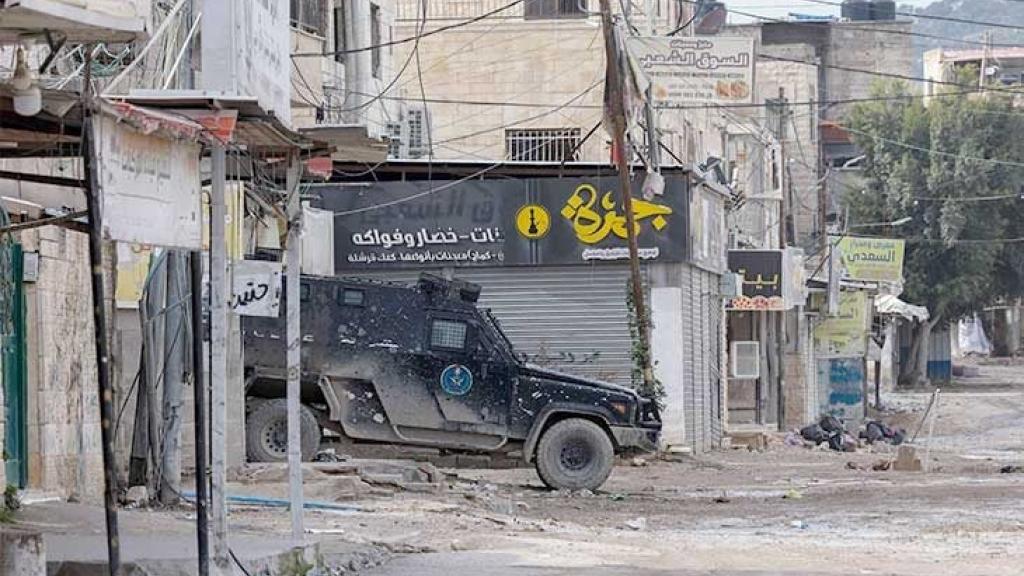
Since the completion of the first year of the ongoing Zionist genocidal war on Gaza, that is, since last October, a shameful scene has been taking place before our eyes in the West Bank. The Ramallah PA has decided to complement the onslaught launched by the Zionist armed forces in the West Bank in parallel with their invasion of the Gaza Strip – the most violent Israeli onslaught in the West Bank, including the use of air force, since the suppression of the Al-Aqsa Intifada more than twenty years ago. As in the autumn of 1994, the PA launched a bloody attack on armed youth factions, starting in the city of Tubas and culminating in the ongoing attack on the Jenin refugee camp, home to the Jenin Battalion, a group of resistance fighters against the Israeli occupation.

In its desire to convince the United States and Israel of its ability to quell the Palestinian people, which necessarily implies an imitation of what the Zionist state does, the Ramallah PA has gone so far, while waging war on the Jenin camp at the same time that the Zionist forces were waging war on the Jabalia camp in the Gaza Strip, as to decide to ban the Al Jazeera TV network on its territory, similar to Israel’s ban of the same a few months ago. In the face of this shameful scene, we are torn between resentment of the PA that has sunk to new lows, and contempt for its delusion of managing to convince Donald Trump and Benjamin Netanyahu of its ability to play the role of guards of the large prison in which they want to confine the remaining residents of the West Bank and Gaza.