Friday, January 10, 2025


To Desegregate, Ride the Bus


 January 10, 2025
Facebook

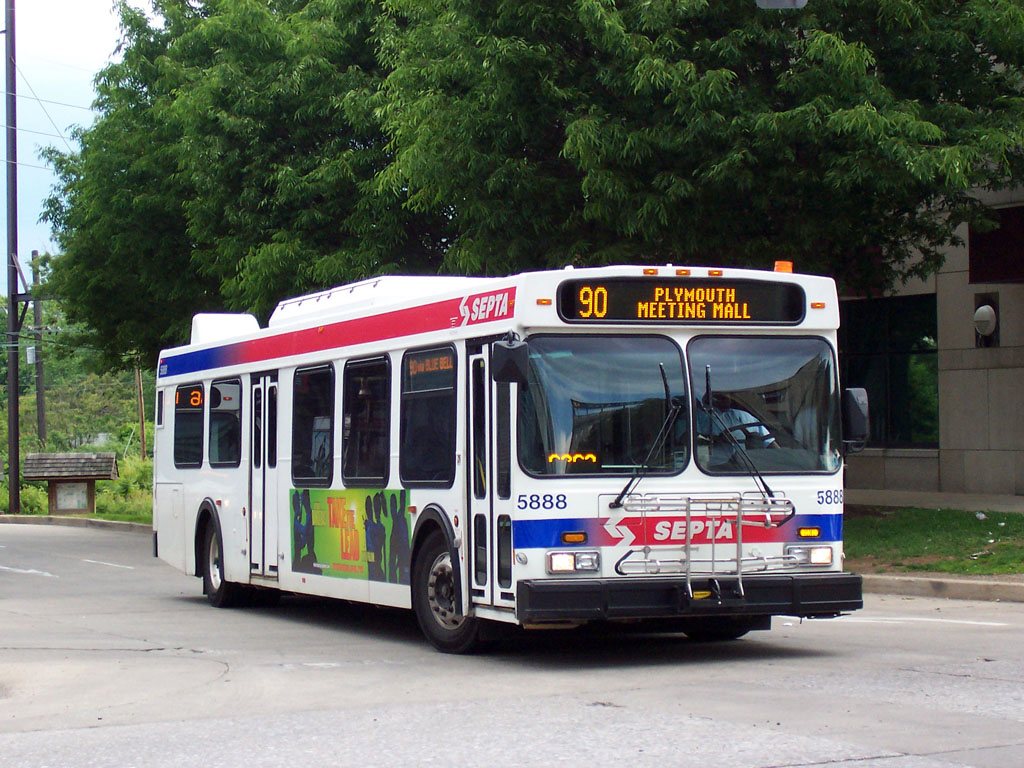
Banner photo by Adam E. Moreira, CC BY-SA 3.0 unported. Copy of Kimball & Richards advertisement from elycefeliz via Flickr, CC-BY-NC-ND 2.0.

Rosa Parks took a seat to take a stand. These days, prejudice pushes people into bus seats, not out of them.

The descendants of Europeans wouldn’t even think of letting go of their cars, for car commuting “rules the roads outside the city.” They say it’s just not possible to take the bus out here. You’re really car-dependent.

Behold our inherent vulnerability in a social system focused on the primacy of private cars over public transit.

Car-dependent.

And still, somehow, the bigger your car, the tougher you are. Are you? Take the bus, buttercup. Sit down with folk who make your lifestyle possible every day.

But most suburbanites couldn’t tell you which bus route comes closest to their home. Why should they? After all, stepping onto the bus and joining the human race puts you at the mercy of those patchy schedules and dreary waits so emblematic of U.S. public transit. Who rides the bus to and from downtown Philadelphia? Those who must.

Here, a few miles west of Philadelphia, the Southeastern Pennsylvania Transportation Authority (SEPTA) winds down its daily service much too early to serve suburbanites even for the odd night out. Who wants to dart away in the middle of a play’s second act to catch the last train before it’s gone? Even getting a bus ride into the city is iffy. Occasionally, because this is SEPTA in suburbia, the bus doesn’t come. How long until the next scheduled bus? A half-hour? An hour? Check the app. It might be right. It might be wrong. Don’t ask why; just wait there in the traffic and the slush or the heat, and speaking of heat, global heating is magnifying the summer sun something fierce, so the people you mainly don’t see on the buses in suburbia are the suburbanites.

The 1920s: Do You Know Where Your Ancestors Are?

In 1927, 44 homeowners on West Penn Street in northwest Philly agreed to exclude any new residents “other than those of the Caucasian race.” Others would be subject to eviction by force of arms.Exclusionary Covenants | Exclusionary covenants In the 1920s… | Flickr
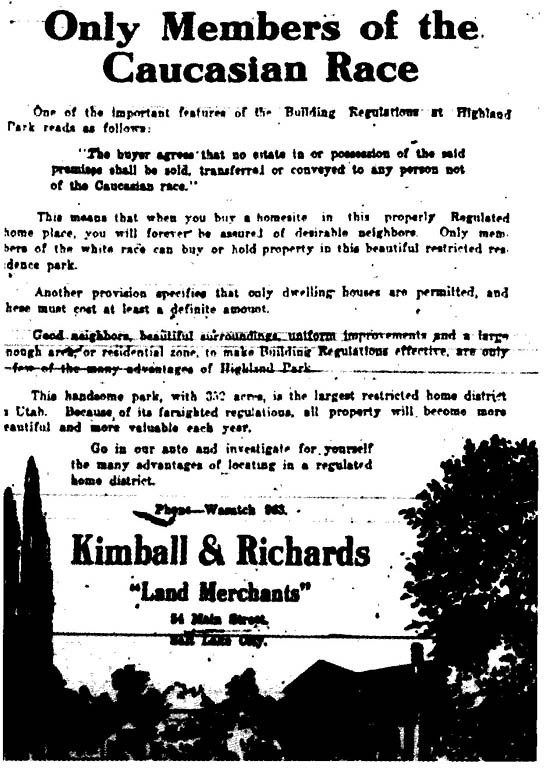
Noxious restrictions oozed outward, through the stately suburbs of the Main Line—such as Haverford Township, where just 3% of residents are African-American today. In nearby Ardmore, developers insulated their clientele by building roads around the area where Black people settled.

Racial exclusion became a marketing theme. Developers touted racial deed restrictions as protections for property values.

The National Association of Real Estate Boards joined with the U.S. Department of Commerce to provide a model race restriction that developers could use. Homeowner associations and real estate brokers followed suit. In and around Spokane, Denver, Cincinnati, and slews of other cities, exclusionary deed language maintained segregation.

Racial deed restrictions kept coming even after the Supreme Court declared them unconstitutional in 1948. And the Federal Housing Administration relied upon these exclusions when insuring home loans until 1962. The FHA preferred loans for new houses in the suburbs over existing properties in the cities. As urban properties languished, suburban real estate flourished.

The federal Fair Housing Act of 1968 banned housing discrimination. States soon legislated accordingly, preventing developers from writing racist deed language into the public records. And still the language lingered on the older deeds. Millions of them.

A deed covenant is legally indelible, buyers were always told. Don’t worry; racial covenants can’t be enforced. Only in the last few years have states changed their views. Arizona adopted a deletion process; Virginia offers deed-scrubbing workshops. As of July 1, 2024, county deed recorders in Kansas can certify releases of race-based exclusions, for a fee. The new Kansas law also directs homeowner associations to remove racial covenants from their governing documents.

From 2016 to 2020, Mapping Prejudice, an initiative based at the University of Minnesota, found 8,000 racial covenants in Minneapolis. Now, the state lets deed holders renounce them. In 2021, California started redacting racial covenants. A county clerk successfully pressed Oregon to do likewise in 2024.

Speaking of Oregon, the bill of rights for its constitution (ratified 1857) contained a racial exclusion for the entire state:

“No free negro or mulatto not residing in this state at the time of the adoption of this constitution, shall come, reside or be within this state or hold any real estate, or make any contracts, or maintain any suit therein…”

In the words of Matt Novak, Oregon was explicitly founded as a kind of white utopia. This was in line with the Oregon Territorial Legislature’s earlier exclusion law, whose preamble opined that “it would be highly dangerous to allow free Negroes and mulattoes to reside in the territory to intermix with Indians, instilling in their minds feelings of hostility against the white race.”

The 2020s: Do We Live in a Sundown Town?

Phyllis Raybin Emert writes about the warning signs: “Whites Only Within City Limits After Dark.” “God Help You If the Sun Ever Sets on You Here!” Some towns’ signage used the N word.

Emert points to James W. Loewen’s Sundown Towns – A Hidden Dimension of American Racism. In thousands of U.S. towns, from 1890 to 1968, Blacks would be arrested or harrassed after dusk. In effect, this restricted the ability of Black people to travel by car.

In some areas, existing Black households would be chased out, their land seized. Some owned hundreds of acres they’d never get back.

In 1968, Carol Jenkins, a 21-year-old with a new job selling encyclopedias door-to-door, was stabbed to death with a screwdriver in an Indiana sundown town. Emert observes that Ferguson, Missouri, where police officer Darren Wilson killed 18-year-old Michael Brown, was a sundown town from 1940 to 1960. Examining the context of Brown’s death in 2014, the U.S. Justice Department found deep patterns of racism in Ferguson, where Black residents were disproportionately targeted through arrests and fines.

Levittown too was a sundown town. I first heard about William Levitt in a sociology course, when the prof discussed the planning of U.S. suburbs after World War II. What never appeared in our course materials was Levittown’s history of exclusion. Levittown mortgages and leases were limited to “Caucasians” and their “domestic servants.” To defend this, the famous developer resorted to “the plain fact” that “most whites prefer” segregation. Even after removing the restrictive clauses, Alan Singer observes, Levitt and Sons still turned away Blacks.

In short, decades of opportunity-hoarding shaped the maps of generations, including mine and yours. (When SEPTA winds down its daily service, who is in for the night, and who is out?)

One reason for what “most whites prefer” involves real estate values, as William Levitt knew well. Owners of expensive homes fund high-achieving school districts, perpetuating the wealth divide. And now, who is positioned to come up with the down payments needed to buy homes?

The Urban Institute observed in 2024 that the “Black homeownership rate is lower than it was in 2000 (44.3 versus 45.7 percent), and the Black-white homeownership gap is wider than it was when segregation was legal.” Let’s keep this in mind when we hear Trump promise to guard single-family zoning in the suburbs (and, lest we forget, to protect suburban women).

“Nonminorities have brought about many of the problems that minorities encounter”, as the Report of the Oregon Supreme Court Task Force on Racial/Ethnic Issues in the Judicial System stated in 1994. Mere lip service, the Oregon State Bar observed in its vivid response, doesn’t resolve those problems; we must commit to an active search for truth and vision.

Centuries of financial inequality, imposed to benefit the group in charge, have shaped today’s bus ridership. They’ve shaped the routes where people go when they’re going home. They’ve shaped human interactions daily. They’ve shaped people’s health—research links areas with race-based deed restrictions to overheating hazards. Heat extremes kill. And this brings us back to the car. One major reason for global heating, of course, is the car.

Understanding, followed up by action, could bring people together. But first it would inconvenience the people who’ve benefited most from segregation, people imagining that private cars will continue to rule the roads—albeit on battery power.

Can we actively support a better idea? A collective kind of problem-solving? A system redirected, by public participation, to bring communities together by offering comfortable transit to everyone? Tack this onto your new year’s resolutions:

Ride the bus.

Lee Hall holds an LL.M. in environmental law with a focus on climate change, and has taught law as an adjunct at Rutgers–Newark and at Widener–Delaware Law. Lee is an author, public speaker, and creator of the Studio for the Art of Animal Liberation on Patreon.


Kvetching, the Highest Stage of Capitalism


 January 10, 2025
Facebook
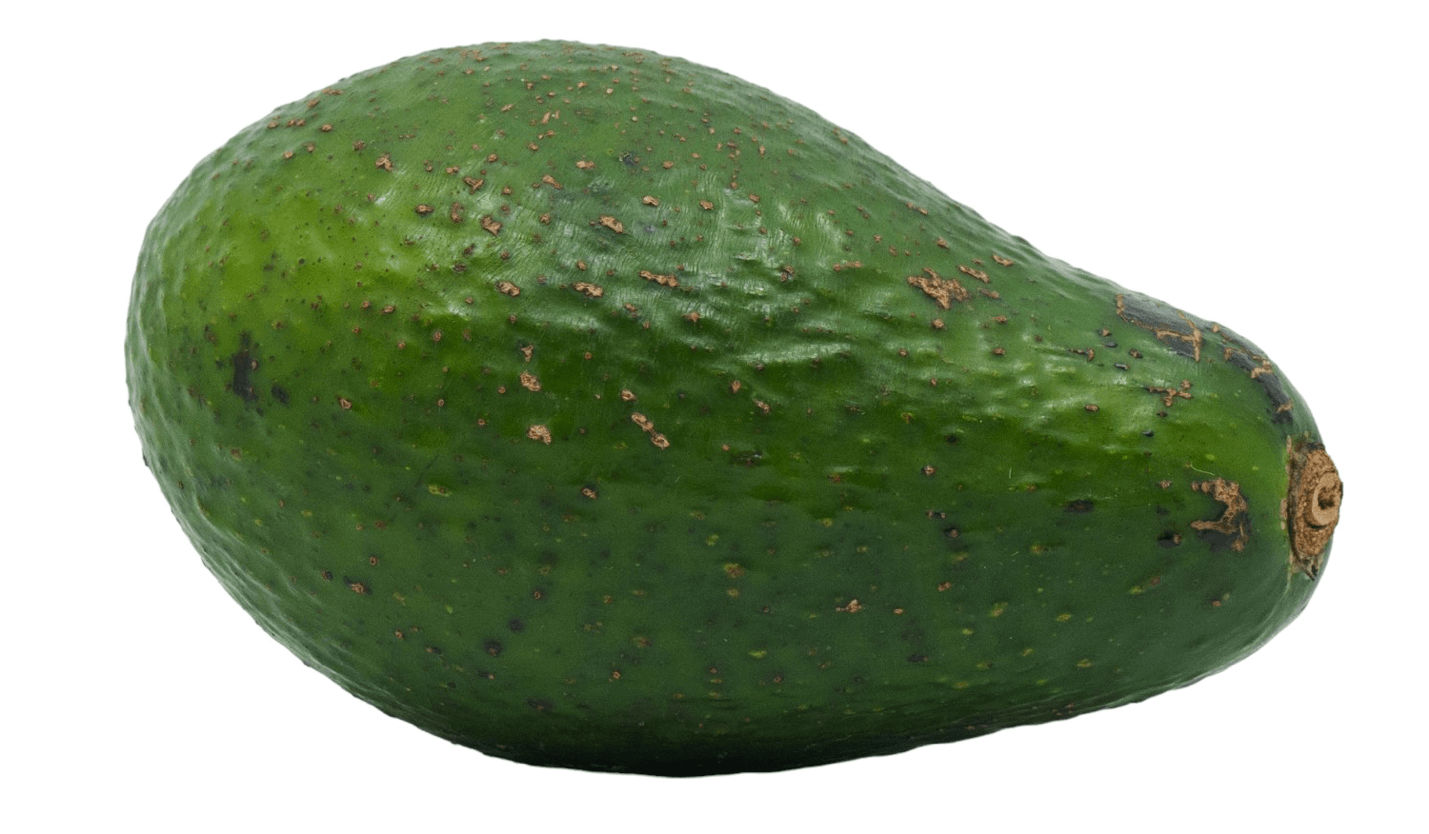
A close up of a green avocado Description automatically generated

Gwen avocado (attribution), photographer unknown, n.d.

“Is this truth I’m delivering up, or is it just plain kvetching? Or is kvetching for people like me a form of truth?”

– Philip Roth, Portnoy’s Complaint,1969

Form and content of the expat’s kvetch

Harriet knew it would happen eventually but was surprised it was so soon. Barely six months since our expatriation, she noticed I had begun to kvetch. (Harriet is gentile but learned the Yiddish word early in our relationship.) My complaints take the following, approximate form: “In the U.S., I used to…” succeeded by a past delight and current deprivation. For example: “In Florida, I used to get creamy avocados that I could smear on a bagel. Here in Norwich, they are often dry — and there are no bagels. Who wants desiccated avocados on crumpets?”

Here’s two additional examples: After agreeing that our small, white, Renault Clio was tan from the Norfolk mud, I said: “In Florida, I used to visit those big, automatic car washes. Here, they have little wash booths that only rearrange the dirt.” Then I began to ruminate on U.S. car washes of yesteryear.

“Some were shaped like paddle steamers or ocean liners, others had futuristic Jetson-style flourishes. You typically stayed in the car and experienced the suds, brushes, rinse, wax and dry through the windshield, as if you were sitting in a 3-D movie. I remember when I was a kid, my dad and I used to go to one on Queens Boulevard in Rego Park…”

My eyes grew misty from the reminiscence. Harriet looked embarrassed.

“I used to know how to park a car,” I said on another occasion. “In the U.S. there are clear rules. Here it’s anarchy! Park on the curb of a two-lane highway? Fine. On the side of the road facing oncoming traffic? OK. On a narrow street in a small town, with two wheels on the sidewalk (they call them pavements here)? No problem!

Sometimes my complaints take a different form but have similarly trivial content. They begin: “I can’t stand …” followed by, for example: overcrowded trains, yobs (young drunken louts), weak cocktails, littering, no coffee refills, and timorous reporters on BBC radio 4. I sometimes complain about the National Health Service, though I always preface it with the requisite: “Of course, they are doing the best they can, given the years of Tory austerity.”

Ever patient Harriet tolerates my kvetching, but sometimes directs at me a dubious gaze. When that happens, I stammer out something like: “These are just observations — constructive criticisms.” I then continue, pompously: “If enough people, said something about [xxx], maybe things would improve in this country!”

Somebody once said that without complaints, an expatriate is only a tourist. I understand that to mean visitors don’t feel the sting of absence like an expat does. Kvetching for me, however, is more fundamental than mere complaint; it’s a form of political speech, especially when the content is trifling. It isn’t American car washes, avocados, or coffee fill-ups I miss. Those are screens that hide the loss I really grieve but am ashamed to admit: belonging to the global hegemon, being a bigshot. Even for someone as critical of U.S. expropriation and exploitation as I am, that’s a feeling hard to shake. Kvetching about the small stuff forces me to confront the big, unspoken or unmentionable stuff. Kvetching, Portnoy says, “is a form of truth.”

Biblical kvetching

In Genesis 2:19-21, God invited Adam to name all the newly created animals, including “every beast of the field; but… there was not found a helpmeet for him.” The Bible is silent as to whether Adam complained to God about the absence of a woman, but he must have — unless the creator read Adam’s mind — because Eve was soon born from Adam’s rib. In Paradise Lost, John Milton is more explicit. After admiring God’s creation, Adam kvetches:

Thou hast provided all things: But with me
I see not who partakes. In solitude
What happiness? who can enjoy alone;
Or, all enjoying, what contentment find?

(viii, 363-66)

God becomes a bit defensive here, pointing out the wonderful non-human beings he has created, but finally concedes:

What next I bring shall please thee, be assured,
Thy likeness, thy fit help, thy other self,
Thy wish exactly to thy heart’s desire.

(viii, 449-52)

Kvetching paid off big-time!

In Exodus, the second book of the Hebrew bible, there’s additional complaining:

“And it came to pass in process of time, that the king of Egypt died: and the children of Israel sighed by reason of the bondage, and they cried, and their cry came up unto God by reason of the bondage.”

(Exodus 2:23)

Soon after, Moses too complained to God. Why had he encouraged him to plead to the new Egyptian king on behalf of the Jews, only for the Pharoh to administer even harsher treatment. Moses’ kvetch worked — God agreed to let his people go. But that only led to more complaints. When the people of Israel crossed the desert, they kvetched that they lacked food, so God provided them meat in the evening and fresh bread (mana) every morning for 40 days. The diet must have been pretty boring (and constipating) but had they asked for more they likely would have been punished. To take or demand more when you have enough was the sin of arrogance condemned by the ancient pastoralists who inhabited biblical texts. That’s still true among foragers and pastoralists, as the anthropologist Richard Borshay Lee famously argued in his studies of the  !Kung people of the Kalahari in Southern Africa. But in most places in the world today, taking more than you need is a way of life; it’s the very foundation of the modern economy and society.

Capitalist kvetching

The word kvetch has a curious etymology. It derives from the Middle High German questschen, which in turn comes from the medieval French esquasher meaning to squeeze, crush, bruise or apply pressure. That’s still one of its meanings in Yiddish. Thus, to press a button is kvetch ah knepel. How exactly it assumed its more common modern definition is not entirely clear, except that kvetching is to press a point or to squeeze somebody or something to gain an advantage. A kvetcher therefore might whine and wheedle to obtain money (thereby becoming a schnorrer as well) or else squeeze a donation or loan from a person or institution. Kvetching is this sense is fundamental to modern business. Profit is obtained by wringing every cent from a worker (“surplus value”), parcel of land, machine, patent, copyright, or license. In a retail operation, profit comes not from the first units sold but from the last. The same is true in extractive industries requiring high initial investments. Oil companies are determined to sell the last ounce of petroleum from every rig and leasehold, regardless of the environmental consequences, because that’s the source of their biggest profits.

Private equity firms succeed by sucking – vampire-like — every drop of capital from a business (inventory, machinery, patents) and then liquidating the rest and firing the workers. Bankruptcy protection is a form of kvetching: after accumulating maximum value for management and shareholders (if it’s a publicly traded entity), you declare bankruptcy and squeeze the creditors. Donald Trump is the U.S. kvetcher in chief by virtue of his frequent bankruptcies and cons, and his whining complaints that he is being picked-on by prosecutors, judges, juries, Democrats, journalists and the women he has sexually abused. Trump is a man of his time: Kvetching is the highest stage of capitalism.

Kvetch dialectics

Last week, I was a champion kvetcher. The weather turned frigid, and I felt the absence of our former home in rural Florida. In addition to the cold, I complained about the lack of kosher pickles, satellite radio, and vegan cream cheese. While changing a bulb, I kvetched about Direct Current (quite dangerous). During a walk into the city, I kvetched about the ubiquity of chewing gum splotches on pavements. Twenty years ago, Parliament proposed the development of non-sticky gum, but so far, there have been no breakthroughs. Recently, it established a Chewing Gum Task Force. Again, there has been no progress. I suggest putting gum-littering offenders in the stocks.

I miss pickles, vegan cream cheese, alternating current and gum-free sidewalks. But what I miss most, I now understand, is something I am also at pains to renounce: an association with empire. The U.S. is both a global hegemon and a complete disaster. Its military bullies supposed enemies and allies alike. Its geopolitical prerogatives are unchallenged, and yet it can’t adequately feed, house, educate, or protect the health of its population. It abuses the immigrants who help grow its food, build its houses and care for its children, old folks and gardens. The U.S. cultivates and imports delicious avocados but can’t protect its own water and air from contamination. Non-farm animals are threatened with extinction and children with death from gun violence. Empire be damned.

The open roads and endless horizons of the American landscape remain intoxicating. They conjure both theft (from their original occupants) and emancipation. The narrow, winding roads that snake across Norfolk, often hedged high on both sides, are less conducive to myth and dreams. If you take your eyes off the road even for a few seconds, you could wind up in a ditch or in the path of oncoming traffic. But whenever Harriet and I visit my parents-in-law in Burnham-Overy-Staithe on the North Norfolk Coast, we glimpse vast tidal marshes and culminating dunes that are as intoxicating as any American vista. The U.K. is a middling European state with an ineffectual Labor government little different, so far, from the Tory regime it replaced. Wealth is concentrated in the hands of overbearing financiers, tech entrepreneurs and rentiers who are bleeding the country dry. In its foreign policy, the U.K. tragi-comically plays lapdog to the American behemoth. As an expat, I can consider all this without blinders. When we next visit the U.S., I hope I’ll remember that North Sea coastline as I kvetch about my temporary separation from Marmite, mushy peas, warm beer, roundabouts, BBC4 and the National Health Service.

Stephen F. Eisenman is emeritus professor at Northwestern University. His latest book, with Sue Coe, is titled “The Young Person’s Guide to American Fascism,” and is forthcoming from OR Books. He can be reached at s-eisenman@northwestern.edu