Sunday, January 12, 2025

Tunisian rehab barge offers hope for vulnerable sea turtles


By AFP
January 11, 2025


Life Medturtles released the rehabilitated turtles back into the Mediterranean - Copyright AFP Akim REZGUI

Akim Rezgui with Youcef Bounab in Tunis

On a barge hundreds of metres off the Kerkennah Islands in southern Tunisia, a group of students watches intently as Besma, a recovering sea turtle, shuffles towards the water and dives in.

The barge, used to treat injured loggerhead turtles, is the first floating rehabilitation centre for the species in the Mediterranean, its organisers say.

Harbouring netted enclosures underwater, it allows the threatened species to receive care in saltwater, its natural habitat.

“It is important that the sea turtles recover in their natural environment,” said Hamed Mallat, a marine biologist who heads the UN-funded project.

“We place them in a space that’s large enough for them to move and feed more comfortably,” he added.

Mallat, a member of the local Kraten Association for Sustainable Development and the International Sea Turtle Society, founded the project last month and said the rehab barge was refashioned from a sunken aquaculture cage.

It can hold up to five sea turtles at a time, each in its own enclosure, and spans 150 square metres (1,610 square feet) at the surface, with netting below to allow the convalescing animals to reach the sea floor.

The loggerhead sea turtle, also known as Caretta caretta, is considered a vulnerable species by the International Union for Conservation of Nature.

Every year, around 10,000 loggerheads are caught by trawlers and in fishing nets in the waters off Tunisia.


– ‘Educational value’ –


Life Medturtles, an EU-funded sea life conservation project, estimates that more than 70 percent of sea turtle deaths in the Mediterranean are caused by gillnets — large nets used for mass fishing.

It is often the fishermen themselves who bring the injured turtles to the barge, said Mallat.

The project is also an opportunity to teach younger generations about preserving sea life, he added.

“This is a direct application of the things we study,” said 24-year-old Sarah Gharbi, a fisheries and environment student at the National Agronomic Institute of Tunisia (INAT).

“It’s also a first interaction with marine species that we usually don’t see as part of our study or in our laboratories. It’s something new and enriching.”

Her teacher, Rimel Ben Messaoud, 42, said the barge’s “educational value” was in giving students a first-hand experience with marine life conservation.

Due to rising sea temperatures, overfishing and pollution, a number of marine species have seen their migratory routes and habitats shift over time.

Mallat said the project could help study those patterns, particularly among loggerhead sea turtles, as Besma now bears a tracking device.

“It gives us a significant advantage for scientific monitoring of sea turtles, which is somewhat lacking in scientific research in Tunisia,” he said.

Mallat said he also hoped to attract the islands’ summer tourists to raise awareness about the vulnerable species.

Sahra Wagenknecht, Germany’s combative ‘left-wing conservative’

A STALINIST BY ANY OTHER NAME

SHE NAMED HER PARTY AFTER HERSELF, 
AND LEAVING THE LEFT SHE WENT FROM BLONDE TO DARK BRUNETTE

By AFP
January 12, 2025


Hailing from the former communist East Germany, Wagenknecht has spoken with nostalgia about the vanished state - Copyright AFP David Swanson


Frank Zeller and Pierrick Yvon

After a lifetime in opposition, Germany’s hard-left standard-bearer Sahra Wagenknecht has shaken up the political scene with a blend of pro-poor, Moscow-friendly and anti-immigration policies.

On Sunday, the 55-year-old launches the campaign of her one-year-old BSW party in the hope it will enter parliament after a snap general election slated for February 23, replicating its success in regional and European polls last year.

Known as a polarising TV talk show guest and best-selling author, Wagenknecht has long given voice to popular discontent at what she calls heartless capitalism, arrogant political elites and dangerous Western militarism.

Hailing from the former communist East Germany, she has spoken with nostalgia about the state that vanished a year after the Berlin Wall fell in 1989.

Unlike traditional leftists who encourage solidarity with refugees, she has demanded strict limits on migrants and those seeking asylum, also a key theme for the far-right Alternative for Germany (AfD).

Her favourite targets are progressive Green party voters and “lifestyle leftists” who, Wagenknecht charges, preach sustainable living and multiculturalism but look down on the poor and less educated.

A year ago, she broke with her long-time comrades-in-arms at Die Linke, the successor to East Germany’s socialist SED ruling party, to form a party named after herself, the Alliance Sahra Wagenknecht (BSW).

What she has dubbed a “left-wing conservative” agenda blends demands for higher wages, pensions and benefits with calls for stricter border controls, more police and a defence of family, homeland and state.

“She appeals to left-wing authoritarians, voters who hold economically left-wing positions but are culturally conservative,” said political scientist Jan Philipp Thomeczek of Potsdam University.


– ‘System detonator’ –


Wagenknecht got a taste of power when the BSW obtained scores ranging from 12 to 16 percent in elections in three eastern states last year, allowing the party to enter coalition governments in two of them, Thuringia and Brandenburg.

For many years Germany’s mainstream parties were able to dismiss parties on the left and right fringes — but this has changed as ever more parties have emerged and eaten away at their support.

All parties have pledged a “firewall” of non-cooperation with the AfD, which has forced them to instead reach out to the BSW to build majorities despite the ideological chasm between them.

Wagenknecht has tried to leverage this new power to win symbolic concessions, including on her demand that the West stop arms supplies to Kyiv and seek peace talks with Moscow.

In the eastern states, parties spent weeks haggling over formulations they could all live with, settling in the end on a watered-down commitment to seek “peace in Europe”.

News magazine Der Spiegel last year dubbed Wagenknecht the “system detonator”, depicting her in a cover illustration holding aloft a red dynamite stick with a lit fuse.


– Strict hierarchy –


Wagenknecht grew up during the Cold War in what was then East Berlin, where the philosophy and economics graduate was known early on for her headstrong and rebellious nature.

But in the final months of the German Democratic Republic, she demonstratively joined the SED. Years later she declared that she “would have preferred to spend my life in the GDR a thousand times rather than in the Germany in which I have to live now”.

She is married to former Social Democratic Party heavyweight Oskar Lafontaine, decades her senior at 81, with whom she lives in the southwestern region of Saarland.

Her BSW has attracted a mix of personalities from the arts and sports as well as the millionaire businessman Ralph Suikat, who has said he wants to “pay more tax”.

But, as the name suggests, the BSW is heavily centred on its founder and chief, with a strict hierarchy and tight vetting of new members by Wagenknecht’s inner circle.

So far the party has just 1,100 full members and around 25,000 registered supporters. In many regions it still lacks established party structures and volunteers.

The BSW currently polls at around five percent nationwide, the minimum for entry into parliament, but Wagenknecht is determined to anchor her party in German politics.

Der Spiegel said Wagenknecht long “had her own speaker’s corner in the political marketplace, from where she drowned out most of the others, but now that’s no longer enough for her, now she wants to join in”.


 BETTER LIVING THROUGH CHEMISTRY

Ketamine could treat Parkinson’s movement disorders


By Dr. Tim Sandle
January 12, 2025
DIGITAL JOURNAL

Alzheimer's, the most common form of dementia, is thought to affect 50 million people worldwide and usually starts after age 65 - Copyright AFP/File Philippe LOPEZ

University of Arizona researchers have revealed new insights into one of the most common complications faced by Parkinson’s disease patients: uncontrollable movements that develop after years of treatment.

Parkinson’s disease is a neurological disorder of the brain that affects a person’s movement. The disease develops when the level of dopamine (3,4-dihydroxyphenethylamine), a chemical in the brain that’s responsible for bodily movements, begins to dwindle.

To counter the loss of dopamine, a drug called levodopa is administered and later gets converted into dopamine in the brain. However, long-term treatment with levodopa induces involuntary and uncontrollable movements known as levodopa-induced dyskinesia.

A study published in the science journal Brain has uncovered new findings about the nature of levodopa-induced dyskinesia and how ketamine, an anesthetic, can help address the challenging condition.

Over the years, the brain of a Parkinson’s patient adapts to the levodopa treatment, which is why levodopa causes dyskinesia in the long term. In the new study, the research team found that the motor cortex – the brain region responsible for controlling movement – becomes essentially “disconnected” during dyskinetic episodes. This finding challenges the prevailing view that the motor cortex actively generates these uncontrollable movements.

Because of the disconnect between motor cortical activity and these uncontrollable movements, there’s probably not a direct link, but rather an indirect way in which these movements are being generated. The researchers recorded activity from thousands of neurons in the motor cortex.

The study was led by Abhilasha Vishwanath, a postdoctoral research associate in the U of A Department of Psychology.

“There are about 80 billion neurons in the brain, and they hardly shut up at any point. So, there are a lot of interactions between these cells that are ongoing all the time,” Vishwanath said.

The research group found that these neurons’ firing patterns showed little correlation with the dyskinetic movements, suggesting a fundamental disconnection rather than direct causation.

This new understanding of dyskinesia’s underlying mechanism is complemented by findings regarding the therapeutic potential of ketamine, a common anesthetic. The research demonstrated that ketamine could help disrupt abnormal repetitive electrical patterns in the brain that occur during dyskinesia. This could potentially help the motor cortex to regain some control over movement.

Ketamine works like a one-two punch. It initially disrupts these abnormal electrical patterns occurring during dyskinesia. Then, hours or days later, ketamine triggers much slower processes that allow for changes in the connectivity and activity of brain cells over time, known as neuroplasticity, that last much longer than ketamine’s immediate effects. Neuroplasticity is what that enables neurons to form new connections and strengthen existing ones.

With one dose of ketamine, beneficial effects can be seen even after a few months.

These findings gain additional significance in light of an ongoing Phase 2 clinical trial at the U of A, where a group of researchers from the Department of Neurology are testing low doses of ketamine infusions as a treatment for dyskinesia in Parkinson’s patients. Early results from this trial appear promising, Vishwanath said, with some patients experiencing benefits that last for weeks after a single course of treatment.


Research alert: Ketamine use on the rise in U.S. adults; new trends emerge


University of California - San Diego


A recent study analyzing data from the National Survey on Drug Use and Health (NSDUH) found that past-year recreational ketamine use among adults has increased dramatically since 2015, including significant shifts in associations with depression and sociodemographic characteristics such as race, age and education status. Ketamine use has shown promise in clinical trials therapy for several mental illnesses, including treatment-resistant depression, and the new research suggests that ongoing monitoring of recreational use trends is crucial to balancing these clinical benefits against the risk of unmonitored recreational use.

Key findings include:

  • Overall past-year recreational ketamine use increased by 81.8% from 2015 to 2019 and by 40% from 2021 to 2022.
  • Adults with depression were 80% more likely to have used ketamine in the past year in 2015-2019, but this association weakened in later years. In 2021-2022, ketamine use increased only among those without depression.
  • In 2021-2022, adults aged 26-34 were 66% more likely to have used ketamine in the past year compared to adults aged 18-25. Those with college degrees were more than twice as likely to have used ketamine compared to people with a high school education or less.
  • People were more likely to use ketamine if they used other substances, such as  ecstasy/MDMA, GHB, and cocaine.

The researchers recommend expanding prevention outreach to settings like colleges, where younger adults may be at heightened risk, as well as providing education on the harms of polydrug use, particularly in combination with opioids. As medical ketamine becomes more widely available, they also emphasize the need for continued surveillance of recreational ketamine use patterns and further research to understand the factors that contribute to ketamine use.

The study, published online in the Journal of Affective Disorders, was led by Kevin Yang, M.D., a third-year resident physician in the Department of Psychiatry at UC San Diego School of Medicine. The research was supported by the National Institute on Drug Abuse of the National Institutes of Health.

# # #

Tech sector’s energy transition draws attention at CES Vegas show

 OR LACK THEREOF

By AFP
January 11, 2025


The CES sign is seen on the venue during the Consumer Electronics Show (CES) in Las Vegas in January 2025. — © AFP

Thomas URBAIN

With its focus on innovative products and cutting-edge technology, the annual Consumer Electronics Show (CES) has not historically paid much attention to energy companies.

But there were signs of a shift at this year’s Las Vegas event, as the tech sector begins to confront its substantial energy needs, which are certain to grow as cloud computing and artificial intelligence advance.

“If you’d asked me to do CES five years ago, I wouldn’t necessarily have seen the point,” said Sebastien Fiedorow, chief executive of the French start-up Aerleum, which manufactures synthetic fuel from carbon dioxide (C02).

“But we are in a very different CES than five years ago,” he told AFP, adding that even if energy companies remain “on the fringes” of CES, “we’re here.”

“It’s a good first opportunity,” he added.

Data centers accounted for 4.4 percent of US electricity needs in 2023, a figure that is likely to rise to 12 percent by 2028, according to the US Department of Energy.

Gary Shapiro, chief executive of the Consumer Technology Association, which organizes CES, said energy transition was intended to be “a big focus” of this year’s show.

“It’s something we’ve talked about for awhile,” he added, stressing that the tech sector needs “innovative solutions” to ensure it has the power it requires moving forward.

– ‘Not the most sexy’ –

Among the companies pitching such innovation at CES, which wrapped up on Friday, was the Dutch firm LV Energy, which generates electricity from sound and vibrations.

General director Satish Jawalapersad said the company’s presence at the show was noteworthy.

“The fact that we’re here with the CES does say something, definitely,” he told AFP
.

Attendees walk through the main entrance during the Consumer Electronics Show in Las Vegas on January 10, 2025 – Copyright AFP/File Ian Maule

But LV Energy didn’t mention artificial intelligence in its presentation, which he said likely suppressed interest, with AI being “the magic word,” at CES.

“Maybe we’re not the most sexy… because we don’t say those words,” he told AFP.

Other energy firms also acknowledged a struggle to break through.

DataGreen, another French company, aims to build smaller, greener data centers that run on renewable power, saving tech companies money by reducing data storage costs.

Cloud computing giants have so far shown no interest, said DataGreen’s head of AI, Julien Choukroun.

“For now, they don’t see the point (in partnering with DataGreen) but we’re trying to convince them,” Choukroun said.

The company won an innovation award at CES this year, its first appearance at the show, and Choukroun argued its services are essential.

“We can’t continue to increase the hangar space (of data centers),” he said, stressing the land available to house sprawling storage sites “is not infinite.”

He voiced confidence that once Big Tech realizes DataGreen offers cost savings, that will “be more persuasive than the ‘green'” aspect.

– Changing mindsets –


Jordan Huyghe, product manager at the French company Otrera, which designs small nuclear reactors, said a major change in the relationship between tech and the energy sector will require investment from giants like Amazon, Google and Microsoft.

Amazon is already the world’s largest purchaser of renewable energy.

In September, Microsoft signed a deal with Constellation Energy to reopen the Three Mile Island power plant in the US state of Pennsylvania, the scene of a devastating nuclear meltdown in 1979.

Energy from the plant will power Microsoft data centers.

Solutions, Huyghe said, can come from companies big enough to fund them.

“To move forward on projects like these, you need to raise money,” he said.

While interest remains muted for smaller players, Jawalapersad of LV Energy said his company has “numerous leads” in the United States.

Fiedorow of Aerleum said there was no doubt the tech sector’s focus on energy is growing.

“We produce fuel and work on a technology that is pretty far removed from the focus of the Consumer Electronics Show,” he said.

Aerleum’s presence in Las Vegas “shows that the mindset is changing.”

CAPPLETALI$M

Apple wants to keep diversity programs disavowed by other US firms


By AFP
January 12, 2025


Apple has made user privacy a cornerstone of its brand image 
- Copyright GETTY IMAGES NORTH AMERICA/AFP/File SCOTT OLSON

Apple’s board of directors has recommended shareholders vote against a proposal to end the company’s diversity, equity and inclusion (DEI) programs, going against the grain of decisions by other large US corporates.

The National Center for Public Policy Research, a conservative think tank, proposed Apple shareholders consider ending the firm’s DEI program to prevent lawsuits following a 2023 Supreme Court’s ruling against affirmative action in universities.

But the Apple board has recommended voting against the proposal when it meets late this month.

“The proposal is unnecessary as Apple already has a well-established compliance program,” said the board, which includes Tim Cook, the California-based company’s boss.

“The proposal also inappropriately attempts to restrict Apple’s ability to manage its own ordinary business operations, people and teams, and business strategies,” it said, accusing the think-tank of trying to “micromanage” the company.

Apple CEO Tim Cook attended the opening of his company’s newest store in Shanghai, amid growing worries over the iPhone maker’s market share in China
 – Copyright AFP STR, STR

The board said the iPhone maker “is an equal opportunity employer and does not discriminate in recruiting, hiring, training, or promoting on any basis protected by law”.

The proposal will be put to a shareholder vote at Apple’s annual general meeting on February 25.

Following in the footsteps of McDonald’s, Ford, Walmart and a host of others, Meta became the latest US firm to end its DEI programs.

The Friday announcement by Meta which owns Facebook and Instagram, comes amid what it described as “a changing legal and policy landscape”.

President-elect Donald Trump who takes office next week, has been a harsh critic of Meta and its owner Mark Zuckerberg for years, accusing the company of bias against him and threatening to retaliate against the tech billionaire once back in office.

Zuckerberg has been moving aggressively to reconcile with Trump since his election in November, including donating $1 million to his inauguration fund and hiring a Republican as his public affairs chief.

Republicans are also fiercely against DEI programs in corporate America, many of which were established in the aftermath of the Black Lives Matter movement and the nation’s attempt to reckon with longstanding racial disparities.

Read more: https://www.digitaljournal.com/business/apple-wants-to-keep-diversity-programs-disavowed-by-other-us-firms/article#ixzz8xAXerN00
WELCOME TO THE BIG LEAGUE

Pro-Russian disinformation makes its Bluesky debut


By AFP
January 12, 2025


Bluesky has become a haven for users disillusioned by Elon Musk's X
 - Copyright AFP/File Ian Maule

Claire-Line NASS, Dounia MAHIEDDINE

The first symptoms of disinformation are emerging on the social media network Bluesky, with echoes of the pro-Russian “Matryoshka” campaign that flooded Elon Musk’s X — but with a few twists.

The @antibot4navalny collective, which specialises in tracking influence operations, revealed the extent of the so-called “Russian doll” campaign last year.

In recent weeks, there are indications of a similar phenomenon on the new US network Bluesky, which claimed to have some 26 million users by the end of December last year, many of them disillusioned former members of X.

The data, analysed by AFP, show dozens of posts with a similar pattern, consisting of calling out media asking them to verify disinformation.

The twist is that on Bluesky, as well as sometimes imitating content from media outlets, certain posts use artificial intelligence to impersonate universities.

In essence, the aim seems always the same: to present Russia in a favourable light, while criticising Western support for Ukraine and often castigating a favourite target — French President Emmanuel Macron.

The accounts used have all the characteristics of pro-Russian “bots” — fake profiles used to artificially increase the visibility of posts, argued Eliot Higgins, the co-founder of open-source investigation group Bellingcat, last month.

– Academic deepfakes –

Using data collected by @antibot4navalny, AFP pinpointed about 50 “Matryoshka” posts.

Most simply republished messages already on X but the collective also spotted posts first on Bluesky, which has become a haven for many users unhappy with the former Twitter.

Valentin Chatelet, research associate for security at the Atlantic Council’s digital forensic research lab, said: “The operation is trying to test its efficacy in reach and assess how much and how fast it is going to be taken down.”

Peter Benzoni, investigative data and research analyst at the Alliance for Securing Democracy at the German Marshall Fund, said the aim of pretending to be universities could be “an appeal from authority… adapted to Bluesky’s audience”.

In one doctored video, a professor at Aix-Marseille University in southern France talks about “numerous errors in the organisation of the Olympic Games” linked to difficulties of “the French economy”.

The caption suggests it is because of “sanctions against Russia”.

The video is a deepfake whose audio has been manipulated. AFP found the original video that was broadcast at the end of October on the university’s Instagram account.

The law professor makes no mention anywhere of the French economy and was reviewing his university department’s year in 2024.

Dozens of other videos use a similar staging, with an expert facing the camera and the logo or the name of the university.

After a few sentences, illustrations follow using images from the media or stockshots.

In another example shot on the campus of Sunderland University in northeast England, students and teachers supposedly give their opinion on Russia in glowing terms.

The video is again fake. In the original, which AFP has seen, Russia is not mentioned at all.

– ‘Industrialised’ fakes –

“This indicates that the campaign has managed to industrialise its manufacturing of deepfake voiceovers, which echoes a trend that is common among various Russian-sponsored disinformation operations,” said the Atlantic Council’s Chatelet.

He likened it in particular to influence campaigns such as “Doppelganger”, which works by copying Western media internet sites.

The @antibot4navalny collective has shared a list of accounts spreading disinformation on Bluesky, and called on users to report them.

AFP noted that the majority of publications singled out were deleted from the platform, which encourages users to report problematic content and claims to be actively committed to tackling disinformation.

In 2023, Bluesky moderators said they had processed more than 358,000 reports.

Chatelet said that the social network, which did not respond when contacted by AFP, was “aware of the problem and that the community of fact-checkers and open-source researchers is already investigating and reporting this content to prevent its virality”.

Its efforts “are rather efficient at deplatforming the operation”, he added but said it remained “very much ‘reactive’.

“Bluesky has yet to prove that it can proactively take down this operation,” he said.
China’s women e-sports players defy sexism for love of the game


By AFP
January 12, 2025


Women are carving out a niche for themselves in China's booming e-sports industry, despite the sexism they face - Copyright AFP Adek BERRY
Luna LIN

For women e-sports players in China, mastering the game is just the first hurdle to carving out a space for themselves in the male-dominated field.

To compete, casually but especially professionally, they must also overcome vicious trolls, gender norms, familial expectations and limited opportunities.

China has become one of the world’s largest markets for e-sports. Its teams participate in the top tier of international competitions, despite state media once dubbing video games “spiritual opium”.

E-sports in China generated more than $3.7 billion in revenue in 2024 and attracted 490 million viewers to sell-out tournaments with lucrative prize pools and top players, according to an industry report by the China Audio-Video and Digital Publishing Association.

But more than 90 percent of the 195 professional e-sports clubs in China are exclusively for men, by industry insiders’ estimation.

“People wouldn’t recognise my skills because I’m a girl,” professional e-sports player Liu Anqi, 23, told AFP after a game with her all-women club RE-girls.

“I wanted to prove them wrong and earn the title of ‘professional player’ so they couldn’t say I cheated or wasn’t good enough.”

Unsolicited, malicious comments follow them everywhere: their skills and strategies belittled, their voices and appearances picked on — even their choice of character or usernames can make them targets.

“If you make a mistake, they say you don’t deserve to play professionally,” said Wang Qianna, an e-sports player from Killer Angel Girl E-Sports Club (KA).

Even “Liooon” Li Xiaomeng, the country’s most prominent woman e-sports player, was questioned about whether her boyfriend was secretly playing for her.

Women gamers also face misogynistic accusations that they use sex to get promotions.

“I just throw these insults right back at them,” Wang said.

– Women excluded –

The challenges extend beyond online abuse.

Structural but often unspoken inequalities, like a lack of recruitment opportunities for women, make it harder for women players to progress.

Liu said a lower-tier club rejected her for a rookie training programme — despite her clear over-qualification — seemingly because she was a woman.

“They asked me why I only had experience in women’s tournaments.”

That reluctance by elite and more established clubs to train women has led many to start clubs of their own.

It was like “wanting to punch but finding no target”, player Wang Fei said.

“E-sports was basically just for men,” said KA coach Chen Bo, adding that official tournaments for women only began to emerge in the past few years.

Although the times are slowly changing, women players still see fewer opportunities and receive less recognition than their male counterparts.

The prize pool for 2024’s Honor of Kings Women’s Open in December amounted to $140,000.

By comparison, last year’s inaugural King Pro League Grand Finals, the most prestigious championship for the same e-sports title, handed out $9.6 million between 12 male teams.

– Passion over money –

Liu says most women players are still “generating electricity for love” — meaning they play for passion rather than financial gain.

And with so few examples of prominent players, those who do seek a career in e-sports find it much harder to convince their families that what they do is worthwhile.

“I really understand nothing about this e-sports industry,” said Liu’s father Liu Yuanjun, who did not support his daughter’s career choice at first.

He has slowly come around, but still not watched any of her professional matches.

The financial solution, Liu and coach Chen said, lies in increased investment from big gaming companies and more supportive policies from authorities.

“Only with substantial prize money can clubs invest in top players and coaches,” she said.

“If the prize money is only $135,000 or so, and there are only two tournaments a year or… none at all, who will spend the money running a club?” said coach Chen.

On a chilly December evening, Liu and her team battled rivals in the semi-final of last year’s Women’s Open for “Honor of Kings” — one of the world’s biggest mobile games.

Her opponents, the blue team, inched through the last line of defence and the red bar indicating the health of her team’s crystal became shorter and shorter until it exploded — game over.

Liu’s team lost 3:0, but she was unfazed.

“There will be next year and many other opportunities to come,” Liu explained as she processed the defeat.

“What others think doesn’t matter as much anymore. Winning a championship isn’t as important as before.”

“What matters is finding self-validation.”


Is WHO putting politics over science with the return of Trump?

By Josef Gregory Mahoney | chinadaily.com.cn | Updated: 2025-01-10

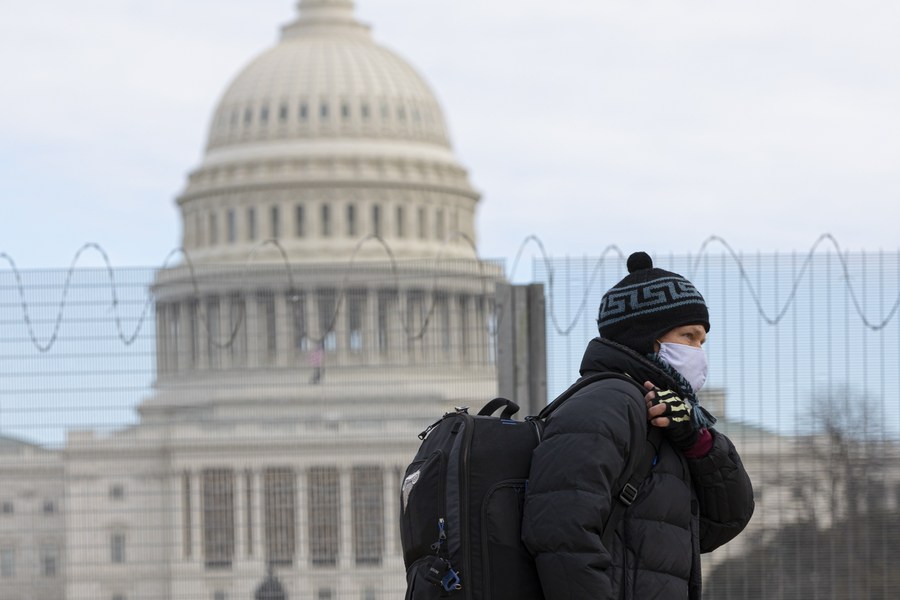
A man wearing a face mask walks past the US Capitol building in Washington, DC, the United States. File photo. [Photo/Xinhua]The World Health Organization (WHO) has recently called on China to provide more information related to the COVID-19 outbreak, and done so in the midst of gratuitous hyping by some international media about an uptick in human metapneumovirus (HMPV) infections in China.

In fact, HMPV has been around for decades, and outbreaks wax and wane in the winter months. The virus has been found worldwide since at least 2001, when it was first detected in the Netherlands. There's no indication that it originated in China, and no evidence that the recent surge in cases presents a significant new risk to public health.

Fundamentally, the world is aware of HMPV cases in China because the Chinese public health system does a good job monitoring and disseminating data about outbreaks. This is not a new phenomenon. Rather, it's a commitment and ability that has taken dramatic steps forward since China first encountered the SARS and bird flu outbreaks many years ago, and which was already strong and in practice when Covid arrived and which has gotten stronger since then.

With this in mind, let's return to the WHO's request. There are three key lessons we need to learn from the Covid experience, which have long been known by scientists but neglected by politicians.

First, years before 2019, leading scientists and public health agencies knew a novel coronavirus outbreak was likely because there had already been three, SARS1, SARS2 and MERS, and there was mounting evidence that coronaviruses in particular are vulnerable to mutations in natural reservoirs in mammals like bats due to climate change. In short, coronavirus outbreaks appear to correlate with increasing temperatures associated with global warming.

Scientific modeling predicted an outbreak in 2020, and this is why there was already considerable planning and preparation underway, including new vaccine development. In fact, Covid arrived a little early, but scientific evidence points to it first emerging in the natural world and then jumping species. We know that it was discovered in Wuhan, China's Hubei province, but we don't know if it started in China or somewhere else. The reason some people want to answer this question definitively, which is likely impossible scientifically speaking, is because they want to blame China for the outbreak.

It's quite ironic that many such conspiracy theorists don't actually trust science and prefer racist rhetoric to compensate for deep-seated fear and mistrust of their own governments and well-deserved inferiority complexes. Nevertheless, such people, and the politicians who manipulate them, will always disregard the scientific evidence that it first emerged in nature and that climate change was a trigger, that Covid or something like it was coming regardless, and that China did a better job handling the outbreak than any other country in the world.

Second, China continuously shared key information about Covid with its own people, the global scientific community, foreign governments and international organizations during and after the outbreak. This is a matter of public record. Furthermore, contrary to Donald Trump's previous public statements, as The Washington Post reporter Bob Woodward noted, Trump had confided in him that the Chinese leadership had been completely candid from the beginning, in short an admission that the US leadership was simply lying about China not sharing information, and doing so to cover for America's own catastrophic failures, despite the US Centers for Disease Control and Prevention (CDC) providing the first Trump administration with a pandemic response plan for an anticipated coronavirus outbreak months before Covid was first detected.

Third, although China was hit hard by the initial outbreak, it moved quickly to enact public health measures that saved the lives of millions of people and through a zero-COVID policy kept the Chinese economy running, upon which the world depended for key goods. While other countries suffered economic, social and political collapses, China held the line, for the greater good of its own people and the rest of the world, including producing lifesaving vaccines and making them available internationally while other countries externalized their failures and played games like vaccine diplomacy, vaccines for profits, and spreading misinformation about China and Chinese vaccines to sow fear and confusion, as has been proven by reporting by key Western media into secret Pentagon campaigns. In short, China established a new gold standard for handling an outbreak, while other countries failed miserably and have tried to discredit China in turn.

With these points in mind, why is the WHO revisiting this issue now? We don't have a good answer for this but the timing is suspicious. With Trump returning to the White House, we can well imagine that WHO is concerned about continued US support, given the fact that Trump quit the organization at the height of the pandemic in 2020. Is the WHO pandering to Trump and one of his favorite conspiracy theories as he regains power? Do we smell a rat or a bat? Perhaps both. But this request likely has little to do with actual science or information sharing it seems, and much to do with new risks to global public health and climate change represented with the transfer in power currently underway in Washington.

Josef Gregory Mahoney is professor of Politics and International Relations and deputy dean of the Institute of Singularity Studies at East China Normal University (Shanghai), and senior research fellow with the Institute for the Development of Socialism with Chinese Characteristics and concurrent professor of Marxism at Southeast University (Nanjing) and the Hainan CGE Peace Development Foundation (Sanya). He was a public health officer with the US CDC in the 1990s. The views don't necessarily reflect those of China Daily.

If you have a specific expertise, or would like to share your thought about our stories, then send us your writings at opinion@chinadaily.com.cn, and comment@chinadaily.com.cn


Beijing blasts false claims regarding HMPV infection

By ZHANG YUNBI | CHINA DAILY | Updated: 2025-01-11 

Beijing has made a fresh rebuke to some voices labeling China's recent cases of infection with human metapneumovirus, or HMPV, as an "unknown virus", calling such claims "run counter to basic scientific knowledge and scaremongering".

According to authorities in charge, HMPV is not a "new strain", and it has been present in the human world for more than 60 years, Foreign Ministry spokesman Guo Jiakun said on Friday.

"It is a common virus that causes upper respiratory tract infections, and its infections are characterized by self-limiting illnesses," the spokesman said at a daily news conference when asked about some people's worries about the safety of travel to China and notions such as "an unknown virus appeared in China".

Guo's point was echoed in a statement by the World Health Organization, or WHO, about HMPV infections in China on Tuesday, which said, "The observed increase in respiratory pathogen detections is within the range expected for this time of year during the Northern Hemisphere winter".

The WHO noted that China has an established sentinel surveillance system for severe acute respiratory infections, including HMPV, which conducts routine virological surveillance for common respiratory pathogens with detailed reports published weekly on the China Center for Disease Control and Prevention website.

"Surveillance and laboratory data for HMPV are not available routinely from all countries," it added.

Speaking about the current influenza in China, Guo, the spokesman, said winter is usually the season with a higher frequency of respiratory infections in the Northern Hemisphere, and influenza viruses are one of the common pathogens.

"At the moment, the scale and intensity of infectious respiratory disease epidemics in China are lower than those of the same period last year," Guo said.

He emphasized that the Chinese government has always attached great importance to the health of its own people and foreign nationals in China.

In addition to the country's sentinel surveillance of a wide range of acute respiratory infectious diseases and the publication of the results, China's experts in disease control have also introduced scientific protective measures on many occasions, he noted.

China also maintains close communication with the WHO to share timely information on respiratory diseases, he added.


US democracy: Two parties, one core ideology

By Otton Solis | CHINA DAILY | Updated: 2025-01-08 
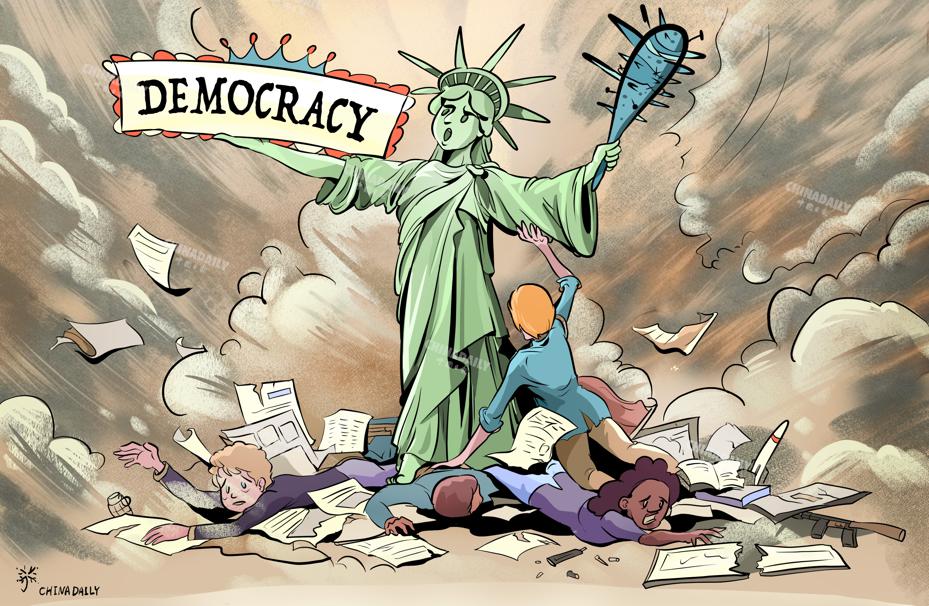
Ma Xuejing/China Daily

For the West, democracy is a form of government in which supreme power is vested in the people and exercised by them directly or indirectly through a system of representation usually involving periodic free elections, which are contested by more than one party. This, the West believes, helps voters to fulfill their personal and national aspirations, and the political parties, which represent voters based on their ideological and political beliefs, to enact policies to suit their vote banks. In a democratic system, voters of all persuasions find a party that identifies with their core convictions and ideology on the most relevant issues.

But far from being an ideal scenario, in a majority of countries in the West as well as the Global South, the parties with a real chance of forming a government are limited to two or, at best, three in number. During political campaigns, each party uses propaganda to settle scores with the other contenders, and even after one of them wins the election, government policies on some of the most basic issues hardly change.

The US is a good case in point. In the United States, only two political parties have the chance of forming a government or gaining majority in the House of Representatives and the Senate. To be sure, there have been instances in which the two parties have had meaningful differences on substantive issues but such instances have been few and far in between. One example is their approach to slavery: the Republican Party opposed it while the Democrats supported it. But in modern times, their stances on private property, the role of market forces, military expenditure and global policing, self-bestowed by the US, have been practically identical.

As is customary, the core strategy of the election campaigns of the two parties is to portray the other to be at the far end of the ideological spectrum. In fact, if the just-concluded campaign hyperbole were to be taken seriously, we would have to believe that president-elect Donald Trump's ideology is "totalitarianism" while incumbent Vice-President Kamala Harris' is "socialism". If that were the case, voters would really have different choices and the US would have a true bipartisan system.

But the fact is that regardless of who becomes the new lodger in the Oval Office, the US will continue to be a private sector, market-oriented economy; a defender and practitioner of press freedom and freedom of expression; the strongest military power on the planet; the staunchest ally of Israel; a trigger-happy marauder in world affairs; a leading member of NATO; a key player in world trade and foreign direct investment flows; and tough on migrants and nosy about human rights if violated in countries that it deems as rivals or enemies.

Even on the issue of trade, the protectionist approach of Trump was largely adopted by President Joe Biden. Something similar happened on migration, as even Harris supports the wall along the border with Mexico, a hallmark of Trump policy.

Of course, the policies that Trump and Harris, during their campaign, proposed on abortion, gun control, immigration, climate action and taxation were different. But at the end of the day, even on these issues, the difference in actual policy outcomes would be little.

Terrified by China's increasing industrial and technological competitiveness, Trump has vowed to impose up to 60 percent extra tariffs on Chinese products. He might even strengthen economic and military alliances against China in Asia and beyond. But to believe the actual policy under a Harris presidency would have been different would be wishful thinking.

Despite the room for ideological diversity granted by democracy, how could the actual outcomes be so homogenous? First, because regardless of press freedom, the US' media outlets, beyond their bombastic posturing, hold an identical position on core issues.

Second, the very visible failures of planned economy and the success of those economies that have created enough space for private initiatives and market forces to operate have been a strong stumping factor for the US' political system.

Third, and most important, money is a key factor in US politics, so much so that political analysts and pundits, when forecasting election results both for the White House and Capitol Hill, accord the greatest importance to corporations' contributions to the two parties' candidates as a deciding factor. The limit on donations was abolished by the US Supreme Court in 2010 through its decision in the Citizens United v. Federal Election Commission case.

Since then millionaires and billionaires have been filling up the two parties' coffers, with the parties splurging the donations on their political campaigns. In fact, it is estimated that in 2024 total spending to elect a US president and members of Congress hit at least $15.9 billion.

When money plays the key role in election success, the political discourse across parties and candidates becomes homogenized, and revolves around the ideology and the whims of the moneyed class. As such, the expected diversity of thought across the political spectrum has become just a theoretical component of most Western democracies, especially US democracy.

Perhaps it would be far-fetched to say that in the US, mindless of the fact that legally there can be many political parties competing for power, from the point of view of ideology and core policies, money has helped create a de facto one-party system. The path that will be followed by the US under Trump will therefore not be very different to what would have happened should the Democrats have won the presidential election.

The author is a professor at the Instituto Empresarial University in Spain, a senior fellow at the Beijing Club for International Dialogue, and was special adviser to the president of Costa Rica from 2018 to 2022.

The views don't necessarily reflect those of China Daily.