Friday, January 17, 2025

'Dark Chapter': Sanders Says American People Must 'Grapple' With Complicity in Gaza's Destruction


"Israel chose not to go to war simply against Hamas, but has instead waged an all-out war against the entire Palestinian people," Sanders wrote.


Sen. Bernie Sanders (I-Vt.) talks with reporters in the U.S. Capitol on November 28, 2023.
(Photo: Tom Williams/CQ-Roll Call, Inc. via Getty Images)

Eloise Goldsmith
Jan 17, 2025
COMMON DREAMS

With a cease-fire deal between Hamas and Israel set to go into effect as soon as Sunday, Senator Bernie Sanders released a statement Friday saying that he's please the Israeli security cabinet has signed off on the agreement, but highlighted the approved deal "is essentially the same agreement that Prime Minister [Benjamin] Netanyahu and his extremist government rejected in May of last year."

"More than 10,000 people have died since that proposal was presented, and the suffering of the hostages and innocent people in Gaza only deepened," he wrote.

On Wednesday, President Biden announced the breakthrough, saying “this is the ceasefire agreement I introduced last spring."

What's more, the independent senator from Vermont said that Americans must "grapple with our role in this dark chapter." The U.S. government, he said, "allowed this mass atrocity to continue by providing an endless supply of weapons to Netanyahu and failing to exert meaningful leverage."

The U.S. has provided Israel with at least $17.9 billion in military aid to its ally in the Middle East since October 2023, when Israel's military campaign in Gaza commenced following an attack by Hamas on Israel. In early January the State Department informed Congress of a planned $8 billion arms sale.

Local health officials in Gaza say the death toll in the enclave stands at over 46,000. However, a recently published peer-reviewed analysis estimates that Israel's assault on Gaza had actually killed 64,260 people—mostly civilian men, women, and children—have been killed between October 7, 2023 and June 30, 2024—a figure significantly higher than the official one reported by the enclave's health ministry.

Multiple human rights organizations have said that Israel's conduct in Gaza constitutes genocide or acts of genocide, and the International Criminal Court has issued arrest warrants for Israeli Prime Minister Benjamin Netanyahu and former Israeli defense chief Yoav Gallant for alleged war crimes in Gaza. The body has also issued an arrest warrant for Hamas leader Ibrahim Al-Masri for alleged crimes against humanity,

In his Friday remarks, Sanders called Hamas' October 7, 2023 attack on Israel "barbaric" and stated that Israel "clearly had the right to defend itself against Hamas."

However, he said, "Israel chose not to go to war simply against Hamas, but has instead waged an all-out war against the entire Palestinian people."


American Historical Association Slammed for 'Craven' Veto of Gaza Scholasticide Resolution

"Academics will make careers out of writing about past atrocities while ignoring the ones happening in real time," said one critic.



Children look through the ruins of a classroom in a school destroyed by Israeli forces in the al-Shati refugee camp in Gaza, Palestine on June 25, 2024.
(Photo: Mahmoud Issa/Anadolu via Getty Images)

Brett Wilkins
Jan 17, 2025
COMMON DREAMS

In what one observer decried as an "absolutely shameful" rebuff of American Historical Association members' overwhelming approval of a resolution condemning Israel's annihilation of education infrastructure in Gaza, the elected council of the nation's oldest learned society on Thursday vetoed the measure over a claimed technicality.

AHA members voted 428-88 earlier this month in favor of a resolution opposing Israeli scholasticide—defined by United Nations experts as the "systemic obliteration of education through the arrest, detention, or killing of teachers, students, and staff, and the destruction of educational infrastructure"—during the 15-month assault on the Gaza Strip.

However, the AHA's 16-member elected council voted 11-4 with one abstention to reject the measure, according toInside Higher Ed, which noted that the panel "could have accepted the resolution or sent it to the organization's roughly 10,450 members for a vote."


While the council said in a statement that it "deplores any intentional destruction of Palestinian educational institutions, libraries, universities, and archives in Gaza," it determined that the resolution does not comply with the AHA's constitution and bylaws "because it lies outside the scope of the association's mission and purpose."

Council member and University of Oklahoma history professor Anne Hyde told Inside Higher Ed that she voted to veto the resolution "to protect the AHA's reputation as an unbiased historical actor," adding that the Gaza war "is not settled history, so we're not clear what happened or who to blame or when it began even, so it isn't something that a professional organization should be commenting on yet."

However, Van Gosse, a co-chair and founder of Historians for Peace and Democracy—the resolution's author—told the outlet that "we are extremely shocked by this decision," which "overturns the democratic decision" of members' "landslide vote."

Lake Forest College history professor Rudi Batzell said on social media: "Shame on the AHA leadership for vetoing the scholasticide in Gaza resolution. Members voted overwhelmingly to support, and the resolution was written so narrowly and so carefully to meet exactly this kind of procedural objection. Craven."

The AHA council's veto follows last week's move by the Modern Language Association executive council, as Common Dreamsreported, to block members of the preeminent U.S. professional group for scholars of language and literature from voting on a resolution supporting the boycott, divestment, and sanctions movement for Palestinian rights.


ICC Prosecutor Says Israel Hasn't Tried to Probe Gaza War Crime Allegations

Prosecutor Karim Khan also said the threat of sanctions against the ICC "is a matter that should make all people of conscience be concerned."
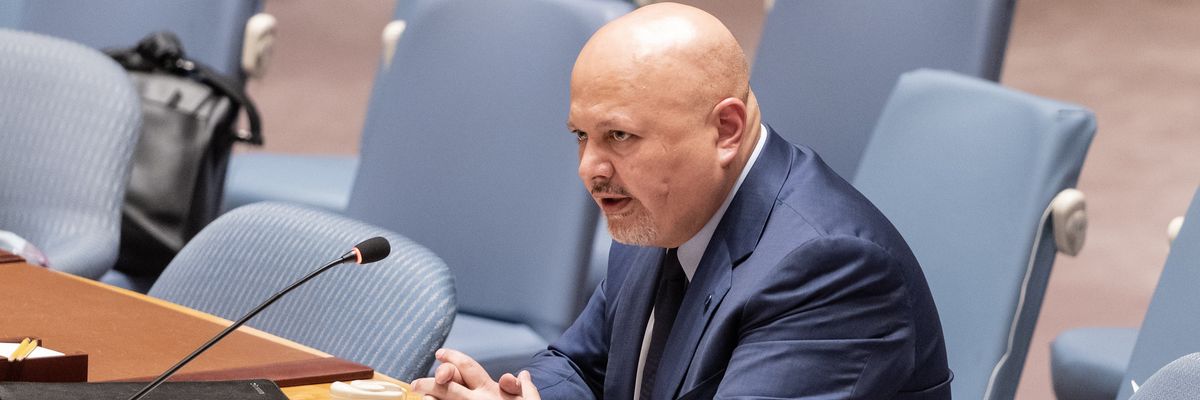

Karim Khan, prosecutor of the International Criminal Court speaks at a United Nations Security Council meeting on July 12, 2023.
(Photo: Lev Radin/Pacific Press/LightRocket via Getty Images)

Eloise Goldsmith
Jan 17, 2025
COMMON DREAMS

After International Criminal Court prosecutor Karim Khan brought allegations of war crimes against Israeli Prime Minister Benjamin Netanyahu, Israel could have probed the accusations itself, Khan told Reuters in a Thursday interview—but it has made "no real effort" to do so.

The conversation took place a day after Israel and Hamas reached a cease-fire and hostage deal that is expected to go into effect on Sunday, though Israeli airstrikes in the besieged Gaza strip have continued since the deal was announced.

Khan sought arrest warrants against Israeli Prime Minister Benjamin Netanyahu and former Israeli defense chief Yoav Gallant for alleged war crimes in Gaza, including starvation of civilians as a method of warfare and the directing of attacks against civilians. The warrants were granted by ICC judges in November. Israel rejects the charges.

Khan also successfully sought an arrest warrant for Hamas leader Ibrahim Al-Masri, who he accused of crimes against humanity including murder, extermination, torture, and rape.

Khan told Reuters that "we're here as a court of last resort and... as we speak right now, we haven't seen any real effort by the State of Israel to take action that would meet the established jurisprudence, which is investigations regarding the same suspects for the same conduct."

Khan added that an Israeli investigation could have led to the case being send to Israeli courts under what are called complementary principles. It's possible for Israel to demonstrate its willingness to investigate, even after warrants were issued, Khan told Reuters.

However, "the question is have those judges, have those prosecutors, have those legal instruments been used to properly scrutinize the allegations that we've seen in the occupied Palestinian territories, in the State of Palestine? And I think the answer to that was 'no'," he said.

Khan said he still felt firm in his decision regarding the arrest warrants despite the fact the U.S. House of Representatives last week voted to sanction the International Criminal Court (ICC) to protest the warrants.

The ICC is an international body with 125 member countries—a list that does not include the United States or Israel—that seeks to investigate and prosecute grave offenses such as war crimes and genocide.

The Republican-controlled House passed the "Illegitimate Court Counteraction Act," with the help of 45 Democrats, which would "impose sanctions with respect to the International Criminal Court (ICC) engaged in any effort to investigate, arrest, detain, or prosecute any protected person of the United States and its allies," including Israel.

Passage in the House sets the bill up for likely enactment, given Republican support for the measure and GOP control of both the Senate and the White House.

Khan told Reuters that the threat of sanctions against the ICC “is a matter that should make all people of conscience be concerned.”

Cease-Fire 'Only the First Step' for Gaza Plunged Into 'Horrifying Abyss' by Israel


Human Rights Watch warned that "continued weapons sales to Israel by its partners despite vast evidence of its unchecked atrocity crimes are putting those countries and officials at risk of direct complicity."


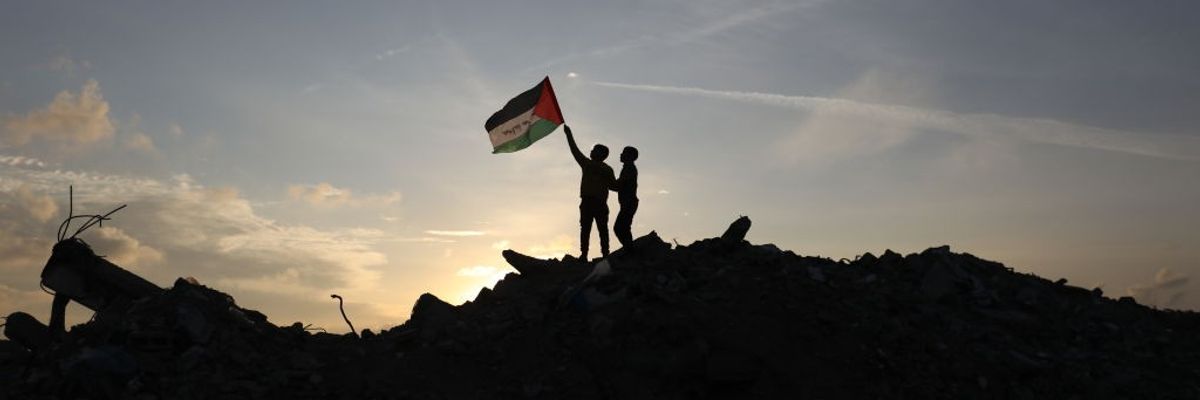
Children hold a Palestinian flag as they stand on rubble in the Bureij Refugee Camp in Gaza City, Palestine on January 17, 2025.
(Photo: Moiz Salhi/Anadolu via Getty Images)


Brett Wilkins
Jan 17, 2025
COMMON DREAMS

While people around the world welcomed Wednesday's announcement of an agreement to pause Israel's assault on the Gaza Strip and free the remaining hostages held by Hamas, human rights defenders stressed that the only way to truly end the suffering of Palestinians is to address the root causes of their oppression and for countries to stop arming Israel.

"The news that a cease-fire deal has been reached will bring some glimmer of relief to Palestinian victims of Israel's genocide. But it is bitterly overdue," Amnesty International secretary-general Agnès Callamard said Thursday. "For Palestinians—who have endured more than 15 months of devastating and relentless bombardment, have been displaced from their homes repeatedly, and are struggling to survive in makeshift tents without food, water, and basic supplies—the nightmare will not be over even if the bombs cease."

"Israel's continuous and deliberate denial and obstruction of humanitarian aid to Gaza has left civilians facing unprecedented levels of hunger and children have starved to death," Callamard continued. "The international community, which has thus far shamefully failed to persuade Israel to comply with its legal obligations, must ensure Israel immediately allows lifesaving supplies to urgently reach all parts of the occupied Gaza Strip to ensure the survival of the Palestinian population."

"Unless Israel's illegal blockade of Gaza is promptly lifted, this suffering will only continue," she added. "Israel must dismantle the brutal system of apartheid it imposes to dominate and oppress Palestinians and end its unlawful occupation... once and for all."

Human Rights Watch (HRW)—which highlighted Israel's alleged "unchecked crimes against humanity and war crimes" in its annual World Reportpublished Thursday— asserted that "all countries which provide weapons to Israel, including the United States, the United Kingdom, and Germany, should suspend weapons transfers due to the Israeli military's repeated, unlawful attacks on civilians."


HRW added that nations should defend the International Criminal Court—which last year issued arrest warrants for Israeli Prime Minister Benjamin Netanyahu and Yoav Gallant, his former defense chief—as well as the International Court of Justice, which is weighing a genocide case against Israel and has ordered its forces to prevent genocidal acts and allow the unimpeded flow of humanitarian aid into besieged Gaza. Critics have accused Israel of ignoring the ICJ orders.

"Israel's decadeslong systematic repression of Palestinians worsened dramatically and plunged civilians in Gaza into a horrifying abyss, but possibilities for international justice are emerging," HRW Middle East and North Africa director Lama Fakih said on Thursday. "Continued weapons sales to Israel by its partners despite vast evidence of its unchecked atrocity crimes are putting those countries and officials at risk of direct complicity."

The Israeli human rights group B'Tselem welcomed the cease-fire—which was approved by Israel's Security Cabinet on Friday and, if agreed upon by the country's full Cabinet as expected, is set to take effect Sunday—but stressed that "the catastrophe persists" in Gaza.

"Millions of people in Gaza remain destitute, starving, and homeless," the group said in a statement. "A cease-fire is only the first step, and one that should have happened long ago. There is a real concern that Israel will resume fighting after the first phase of the deal is complete."

As Common Dreams reported Thursday, Israeli forces killed scores of Palestinians in Gaza following Wednesday's cease-fire announcement.


"The international community must do everything in its power to demand Israel stop the war completely and permanently," B'Tselem said. "Beyond a lasting cease-fire that includes enough humanitarian aid for the entire Gaza Strip, its residents must be allowed to return to all parts of Gaza."

"Israeli decision-makers responsible for serious violations of the laws of war and for crimes against humanity must be held accountable, and all Israeli violence against the Palestinian people in the entire area between the Jordan [River] and the Mediterranean must cease," the group stated.

"The only way to break the cycle of bloodshed is to end the occupation, oppression, and apartheid regime and ensure the human rights of everyone living in this space," B'Tselem added.


Displaced Gazans awaiting truce so they can go home


By AFP
January 17, 2025


Most Gazans have been displaced at least once by the war

 - Copyright AFP/File Anthony Kwan

 Allison ROBBERT

In a sprawling tent city in central Gaza, Palestinians displaced by war to other parts of the territory are all waiting for one thing: a ceasefire so they can go home.

Most of Gaza’s 2.4 million people have been displaced at least once by the Israel-Hamas war to other parts of the territory.

With a long-awaited truce deal due to take effect on Sunday, they may finally be able to return to their neighbourhoods.

Umm Khalil Bakr has been living with her family in the Nuseirat camp, where displaced Palestinians have tried their hardest despite the war to lead a semblance of normal life.

There, they bake flatbread on clay ovens, play cards to pass the time when there are no bombings, and sweep the streets as an act of dignity.

If the ceasefire takes hold, people will start moving back to their neighbourhoods, though they are under no illusions as to what they might find.

“I will take my tent, remove the rubble from the house and place my tent on the rubble, where I will live with my 10 children,” Umm Khalil told AFP.

“We know the weather will be cold, and we won’t have blankets for the bedding, but what matters is that we return to our homeland.”

Around her, young children gathered to watch their mother speak, bouncing idly on the tent sides.

Her determination to rebuild her life despite the utter devastation from 15 months of war was shared by her fellow camp residents.

Whatever the state of their homes, the hardships of life in the camp were far worse, said Umm Mohamad al-Tawil.

“We will return, and whatever hardships we might face, we will return,” she said.

“This is not life, and it is not our life.”


– ‘Live in the tent’ –


A few kilometres (miles) to the south, in Deir el-Balah, the Moqat family were packing their few belongings into cardboard boxes, ready to go back to Beit Lahia in the north of the Gaza Strip.

The family were looking for a truck to take them home, said Fatima Moqat.

“We will take the tent with us… and live in it just as we stayed here inside the tent,” she said.

“There we will live in the tent until they find us a solution for reconstruction.”

With the truce not yet in effect, there has been no let-up in the violence.

On Friday, Gaza’s civil defence agency said at least 113 people had been killed by Israeli bombardment of the territory since Qatar and the United States announced the deal.

The scale of the destruction in Gaza wrought by month after month of air strikes, shelling and street-to-street fighting means reconstruction could last well into the next decade, international agencies have said.

The World Health Organization said rebuilding the territory’s health system alone would cost $10 billion and take five to seven years.

According to the UN, United Nations, by December 1, nearly 69 percent of buildings in the Gaza Strip had been destroyed or damaged, with the UN Development Programme estimating last year that it could take until 2040 to rebuild all destroyed homes.


– ‘Kiss my land’ –


The Gaza war began on October 7, 2023, when Hamas staged the deadliest attack in Israeli history.

The attack resulted in the deaths of 1,210 people, mostly civilians, according to an AFP tally of official Israeli figures.

Israel’s retaliatory campaign has left 46,876 people dead, the majority civilians, according to the health ministry in Hamas-run Gaza, figures the UN has described as reliable.

To Moqat, it was the grief over lives lost in the war that would be the hardest to overcome.

“Gaza was destroyed and rebuilt a hundred times before… Houses can be replaced, but people cannot be replaced,” she said.

Back in Nuseirat, reclining on the floor inside his carpet-lined tent, Nasr al-Gharabli could not wait to return to his home.

“I am waiting for Sunday morning when they will announce the ceasefire… I will go to kiss my land,” he said.

“If I die on my land it would be better than being here as a displaced person.”

Gaza Ceasefire Raises Hopes of Renewed Security in the Red Sea

 NO SUCH THING THE ZIONISTS WANT WAR

Houthi missiles on display at a parade, 2024 (Houthi Military Media)

Published Jan 16, 2025 10:07 PM by The Maritime Executive


On Thursday, Israeli Prime Minister Benjamin Netanyahu announced that an agreement for a ceasefire and hostage exchange had been reached with terrorist group Hamas, setting conditions for the end of hostilities in Gaza - though an unspecified last-minute issue has delayed an Israeli cabinet vote to finalize the deal. If approved, it appears to satisfy most of the demands of Yemen's Houthi rebels, who have attacked shipping in the Red Sea for more than a year in protest of Israeli operations in Gaza. 

In a response to Netanyahu's announcement early Friday, Houthi leader Malik Al-Houthi cast the ceasefire as a loss for Israel and America. He suggested that the group's "naval operations have reached a decisive result and a real victory," and contributed to a "failure" for Israel in the Gaza Strip. He cautioned that the group would monitor the situation for the next three days as the deal takes effect; notably, Al-Houthi did not pledge a halt to attacks on shipping, and he left open the possibility of renewed strikes. "At any stage in which the Israeli enemy returns to aggression and escalation, we will be ready to support [Hezbollah]," said Al-Houthi. 

Shipping and security analysts have given mixed predictions about the group's intentions going forward. Dimitris Maniatis, CEO of Marisks, told Reuters that the Houthis' capabilities have been significantly reduced by Israeli and American airstrikes over the past month, leaving the group eager for "a pretext to announce a ceasefire" and end their campaign. Multiple other sources told Reuters that shipping interests are already eyeing a return to the Red Sea route after a year of disruption, so long as sky-high war risk insurance rates come down. 

Others are less sure, especially since Houthi fighters have reportedly developed a revenue stream from their campaign. A UN panel on Yemen investigated their operations and spoke with regional shipbrokers and service providers; the panel heard multiple accounts that the group was extorting shipowners out of hundreds of thousands of dollars for each safe transit past Yemen, and estimated that the Houthis are earning about $2 billion per year from "security" fees. While the exact amount of the fee is debated, "there's clearly some deal-cutting," U.S. special envoy for Yemen Tim Lenderking told The Economist - and those deals may create a business incentive for Houthi fighters to continue launching attacks. 

Blue-chip carriers have signaled that they do not plan a quick return to the route. Maersk has predicted that the Red Sea will stay shut down for global container liners "well into 2025," and a spokesperson told Reuters on Thursday that it is "still too early to speculate about timing." Hapag-Lloyd concurred, saying that the "agreement has only just been reached."  

Others will be unaffected. The Russia-linked "shadow fleet" tankers that ferry Russian oil to buyers in India and China have consistently used the Suez-Red Sea route, without interruption, and will likely continue to do so after an eventual cessation of Houthi hostilities. Chinese shipping interests have also benefitted from a public nonaggression pact, and many continue to use the route.

Climate-Fueled Insurance Cost Hikes Putting American Dream 'Out of Reach'


"Policymakers across the country should see this data as a blaring warning that they can no longer ignore the alarm bells of a climate-driven financial crisis," said one advocate.


A State Farm insurance company sign sits amid the rubble of a building destroyed by the Palisades Fire on Sunset Boulevard in the Pacific Palisades neighborhood of Los Angeles on January 16, 2025.
(Photo: Frederic J. Brown/AFP via Getty Images)


Julia Conley
Jan 17, 2025
COMMON DREAMS

As communities across the Los Angeles area continued to grapple with catastrophic wildfires, the U.S. Treasury Department on Thursday released the most far-reaching report ever on the climate emergency's impact on home insurance—shedding light on how disasters like the one devastating Southern California this month could increasingly push U.S. families toward financial ruin.

More than three years after President Joe Biden issued an executive order directing the Federal Insurance Office to assess "the potential for major disruptions of private insurance coverage in regions of the country particularly vulnerable to climate change impacts," the FIO released an analysis showing that homeowner insurance costs are rapidly rising across the U.S.—8.7% faster than the rate of inflation in 2018-22.

During that period, homeowners in the 20% of ZIP codes in coastal areas and other regions vulnerable to climate disasters faced insurance premiums that averaged $2,321—82% higher than people in the ZIP codes with the lowest risk.

"Climate change is already increasing our cost of living—and it's only going to get worse," said Steven Rattner, an investor and New York Times opinion writer.


For a growing number of homeowners, rising insurance costs have led to a cost-benefit analysis that puts them at risk for financial ruin, as they have given up on keeping current with their payments.

Analyzing 246 million insurance policies issued by 330 insurers nationwide from 2018-22, the FIO found that insurers canceled at least 10% of policies in 2022 due to nonpayment. Cancellation rates were highest in hurricane-prone areas such as Hilton Head, Charleston, and Myrtle Beach, South Carolina, as well as places that are vulnerable to increasingly fast-moving wildfires like California and Arizona.

During the time period analyzed, five wildfires in the Southwest caused more than $100 million in damages, with homeowners claiming an average of $27,000.

"While insurance companies will no doubt find ways to profit from the crisis, households across the country cannot sustain rising costs indefinitely."

"Treasury's analysis comes at a time of devastating tragedy, loss of life, and destruction from the wildfires in the Los Angeles area," said Secretary of the Treasury Janet Yellen. "While it's far from clear what the exact financial costs of this disaster will be, it is a stark reminder of the impacts of the growing magnitude of natural disasters on the U.S. economy."

"This report identifies alarming trends of rising costs of insurance—to consumers and insurers themselves—as well as lack of availability of insurance, all of which threaten the long-term prosperity of American families," Yellen added.

In other words, said Carly Fabian, senior insurance policy advocate with Public Citizen's Climate Program, the climate-fueled insurance crisis is helping to push the American Dream of home ownership "out of reach" for a growing number of families.

"This report shows exactly what we feared: Climate change is creating an insurance crisis for households across the country. For many Americans, home ownership is a key part of the American Dream," said Fabian. "While insurance companies will no doubt find ways to profit from the crisis, households across the country cannot sustain rising costs indefinitely."

In 2022, Public Citizen joined more than 75 consumer advocacy and environmental justice groups in calling on the Treasury Department to promptly follow Biden's executive order and collect data on how the climate emergency is affecting homeowners.

"While this report is an essential step, it is only a first window into the data necessary to monitor this crisis," said Fabian. "The fact that the Federal Insurance Office had to be the first to propose collecting and now publishing this data shows the utter failure of the fragmented state regulatory system to protect the public. In the aftermath of the fires in Los Angeles and the devastation in Asheville [from Hurricane Helene], policymakers across the country should see this data as a blaring warning that they can no longer ignore the alarm bells of a climate-driven financial crisis."

The Los Angeles fires this month could ultimately cost as much as $275 billion, AccuWeatherreported this week, and the National Oceanic and Atmospheric Administration revealed this month that from 2018-22, 84 billion-dollar climate disasters—excluding floods, which are typically not covered by home insurance—cost more than $609 billion. The costs of such events have continued rising since 2022.


Climate reporter Kate Aronoff of The New Republic likened the burgeoning home insurance crisis to the for-profit health insurance industry, in which corporate consolidation is also pushing premiums higher and contributing to medical debt that's owed by about 20 million people.


"Everyone gets sick. Dealing with that's a nightmare even if you have good coverage," said Aronoff. "Not everyone's house will burn down or flood but [there are] some real parallels in terms of human tragedy and suffering being mediated through an infuriating for-profit bureaucracy with haphazard public backing."
Actuaries and Scientists Warn Climate Shocks Risk 'Planetary Insolvency'

A new report "shows a 50% GDP contraction between 2070 and 2090 unless an alternative course is chartered," said the lead author.


Gas company employees work in Malibu, California, after the Palisades Fire destroyed beach homes on January 12, 2025.
(Photo: Frederic J. Brown/AFP via Getty Images)


Jessica Corbett
Jan 16, 2025
COMMON DREAMS

U.K. actuaries and University of Exeter climate scientists on Thursday warned that "the risk of planetary insolvency looms unless we act decisively" and urged policymakers to "implement realistic and effective approaches to global risk management."

Actuaries have developed techniques that "underpin the functioning of the global pension market with $55 trillion of assets, and the global insurance market, collecting $8 trillion of premiums annually, to help us manage risk," Tim Lenton, University of Exeter's climate change and Earth system science chair, noted in the foreword of a report released Thursday.

Planetary Solvency—Finding Our Balance With Nature is the fourth report for which the Institute and Faculty of Actuaries (IFoA) has collaborated with climate scientists. In financial terms, solvency is the ability of people or companies to pay their long-term debts. Co-authors of one of the previous publications coined the phrase planetary solvency, "setting out the idea that financial risk management techniques could be adapted to help society manage climate change and other risks."

Three IFoA leaders—Kalpana Shah, Paul Sweeting, and Kartina Tahir Thomson—explained in their introduction to the latest report how "planetary solvency applies these techniques to the Earth system," writing:
The essentials that support our society and economy all flow from the Earth system, commodities such as food, water, energy, and raw materials. The Earth system regulates the climate and provides a breathable atmosphere, it is the foundation that underpins our society and economy. Planetary solvency assesses the Earth system's ability to continue supporting us, informed by planetary boundaries, tipping points in the Earth system, and other scientific discoveries to assess risks to this foundation—and thus to our society and the economy.

Our illustrative assessment of planetary solvency in this report shows a more fundamental, policy-led change of direction is required. Our current market-led approach to mitigating climate and nature risks is not delivering. There is an increasing risk of severe societal disruption (planetary insolvency), as our economic system drives further global warming and nature degradation.

"Impacts are already severe with unprecedented fires, floods, heatwaves, storms, and droughts," the document points out, emphasizing that human activity—particularly burning fossil fuels—drives climate change and biodiversity loss. "If unchecked they could become catastrophic, including loss of capacity to grow major staple crops, multimeter sea-level rise, altered climate patterns, and a further acceleration of global warming."

The report was released as wildfires ravage California and shortly after scientific bodies around the world concluded that 2024 was the hottest year on record and the first in which the average global temperature exceeded a key goal of the Paris agreement: 1.5°C above preindustrial levels. In the United States, experts identified 27 disasters with losses exceeding $1 billion.

"We risk triggering tipping points such as Greenland ice sheet melt, coral reef loss, Amazon forest dieback, and major ocean current disruption," the new publication warns, adding that "tipping points can trigger each other," and if multiple are triggered, "there may be a point of no return, after which it may be impossible to stabilize the climate."

Food system shocks and more frequent and devastating disasters increase the risk of mass mortality for humanity—including due to hunger and infectious diseases—along with mass migration and conflict, the report highlights.


"Climate change risk assessment methodologies understate economic impact, as they often exclude many of the most severe risks that are expected and do not recognize there is a risk of ruin," the document stresses. "They are precisely wrong, rather than being roughly right."

Specifically, lead author and IFoA council member Sandy Trust said in a statement, "widely used but deeply flawed assessments of the economic impact of climate change show a negligible impact" on gross domestic product (GDP).

However, Trust continued, "the risk-led methodology, set out in the report, shows a 50% GDP contraction between 2070 and 2090 unless an alternative course is chartered."

To mitigate the risk of planetary insolvency, the co-authors called on policymakers around the world to implement independent, annual assessments; set limits and thresholds that respect the planet's boundaries; enhance governance structures to support planetary solvency; and "enhance policymaker understanding of ecological interdependencies, tipping points, and systemic risks so they understand why these changes are needed."

They also underscored the need to limit global warming and avoid triggering tipping points with actions such as accelerating decarbonization, removing greenhouse gases from the atmosphere, restoring damaged ecosystems, and building resilience.

"You can't have an economy without a society, and a society needs somewhere to live," said Trust. "Nature is our foundation... Threats to the stability of this foundation are risks to future human prosperity which we must take action to avoid."
Survivors of Deadly LA Wildfires Seek Criminal Charges for 'Reckless' Big Oil

"While these deaths and injuries are unspeakably tragic, they aren't just tragedies, they're also crimes," said one attorney.


Khaled Fouad (L) and Mimi Laine (R) embrace as they inspect a family member's property that was destroyed by the Eaton Fire on January 9, 2025 in Altadena, California.
(Photo: Justin Sullivan/Getty Images)

Brett Wilkins
Jan 16, 2025
COMMON DREAMS

Victims of the deadly wildfires still devastating large swaths of Los Angeles County were joined Thursday by scientists and legal experts at a press conference demanding criminal accountability for the fossil fuel industry over its role in the climate crisis.

"The disasters we are seeing today are not natural. They are crimes," Danielle Levanas, who grew up in Pacific Palisades and whose parents' home was destroyed by the Palisades Fire, said during the press conference attended by Common Dreams. "My elementary and middle school, our rec center, our library, the local community theater, the banks, the post office where we voted, the grocery stores, our favorite restaurants—they have all been taken out."

"How do you communicate the value of your deceased mom's journal from 1981, when she was pregnant with you, or the textiles you collected when you worked in West Africa in your mid-20s, or the boxes of home videos carefully labeled and organized, but not yet digitized, that captured moments with your family you had hoped to one day share with your own kids?" she asked. "Losing that house in some ways feels like losing my mom all over again."

"The severity of these fires has escalated dramatically due to climate change and the actions of Big Oil companies that have exacerbated this crisis."

Sam James, a 24-year-old Santa Monica resident, watched the Palisades Fire rage from her window. James grew up in Altadena, where the Eaton Fire destroyed the homes of her grandfather and other relatives.

"Our roots in Altadena and Pasadena go back to at least 1890, with a legacy of building opportunities for Black generational wealth primarily through home ownership," she explained. "Much of this progress has been destroyed by recent wildfires including the Eaton Fire."

"While we always understood the risks of living in this area, the severity of these fires has escalated dramatically due to climate change and the actions of Big Oil companies that have exacerbated this crisis," James said. "Their reckless pollution and disregard for the environmental impact have directly contributed to climate change and the intensification of natural disasters like these wildfires. They must take responsibility for the harm that they've caused, pay reparations to the affected communities… and take immediate steps to mitigate further damage."

"The science is clear," she added. "We've seen the writing on the walls. Climate change is here, and it's only getting worse. Our communities cannot continue to bear the physical and emotional toll of this crisis caused by the actions of a powerful few. It's time for Big Oil to be held accountable and take real, measurable steps toward a more sustainable future."

Kristina Dahl, vice president of science at Climate Central, told reporters at the news conference that "we are up against a very deep-pocketed fossil fuel industry that has made it very difficult to address the crisis."

However, "California has held corporations accountable for their role in wildfires, and yet much of the financial burden is still falling on taxpayers and ratepayers," she added, "and the companies that are shaping the conditions under which these fires are occurring are largely let off the hook."

Wildfire evacuee Maya Golden-Krasner, the deputy director and senior attorney at the Center for Biological Diversity's Climate Law Institute, said during the press conference: "Having inflicted as much as—or maybe more than—$250 billion in damages, the LA fires already rank as one of the worst disasters in U.S. history. Yet the fossil fuel polluters who rake in massive profits and have created the conditions for the fires, the floods, and the other disasters have faced no responsibility to pay for the consequences, and that leaves the rest of us stuck with the multibillion-dollar tab."

Golden-Krasner continued:
So one of my and my organization's top priorities this legislative session is to pass a climate superfund bill. The bill is modeled on federal law that requires hazardous waste polluters to clean up their toxic messes and also on California's Childhood Lead Poisoning Prevention Act. It would make the largest fossil fuel polluters pay a portion of their huge profits to address the climate consequences they helped create and help California adapt to future disasters. Vermont and New York have actually already passed similar bills last year. And in California we're already paying for Big Oil's climate destruction not just with money but with our lives.

"That's why we need our own climate superfund bill, to put billions of dollars in climate costs back on corporate polluters where they belong," she added.

While unable to share details about which state lawmakers will sponsor it or exactly when it will be introduced, Golden-Krasner told reporters that new California climate superfund legislation is likely to be released "within the next few days."

"Please stay tuned for that," she said. "There was a bill last session that made it through three committees in 60 days and the fossil fuel industry pushed really hard against it. So we're hoping that this year folks will come out and support it and we'll be able to pass it."

Noting that "climate change didn't happen out of the blue," attorney and Public Citizen Climate Program Accountability Project director Aaron Regunberg said that "the climate effects driving these fires are the direct and foreseeable—and in fact foreseen—consequences of the actions of a small number of fossil fuel companies that knowingly generated a huge portion of all the greenhouse gasses that caused this crisis and fraudulently deceived the public about the dangerousness of their products specifically in order to block and delay the very solutions that could have avoided these catastrophes."

"What's more, they did all of this with full knowledge of just how lethal their conduct really was, having long predicted that the continued burning of their fossil fuel products would cause, in their own words, 'catastrophic' climate harms," he continued.

"We have a concept in the law for when someone consciously disregards a substantial risk of causing harm to another person," Regunberg said. "That is called recklessness. And that's what we mean when we say that, while these deaths and injuries are unspeakably tragic, they aren't just tragedies, they're also crimes."

"The victims and survivors of climate disasters deserve justice, and fortunately we have mechanisms to give it to them," he stressed. "We have new legislative frameworks like the climate superfund. We have the civil justice system, which is designed to repair harms and compensate those who have been injured."

"The victims and survivors of climate disasters deserve justice, and fortunately we have mechanisms to give it to them."

"And that's exactly what cities and states all across the country including California are seeking with their climate accountability lawsuits, which continue to move forward and just this week overcame another dismissal attempt by Big Oil at the [U.S.] Supreme Court," Regunberg said. "And we also have the criminal justice system, which is designed to protect citizens from harm and hold wrongdoers accountable."

Regunberg last year co-authored a legal memo laying out how local or state prosecutors could bring criminal charges against Big Oil for deaths from extreme heat.

"Did you know that it's a felony in California to recklessly cause a fire?" he added. "It's involuntary manslaughter to recklessly cause a death. Local prosecutors should consider whether Big Oil's conduct here amounts to violations of these kind of criminal laws."
Trump Readies 'Day One Climate Destruction Package' After Raking in Big Oil Cash


"The fossil fuel industry invested $75 million to secure Trump's victory, and now they're expecting a return," said the executive director of Oil Change International.


Then-U.S. President Donald Trump listened to California Gov. Gavin Newsom at Sacramento McClellan Airport in McClellan Park, California on September 14, 2020.
(Photo: Brendan Smialowski/AFP via Getty Images)

Jake Johnson
Jan 17, 2025
COMMON DREAMS

The fossil fuel industry pumped tens of millions of dollars into President-elect Donald Trump's successful bid for a second White House term—and it could begin seeing a return on its investment on his very first day in office.

Trump pledged on the campaign trail to be a "dictator" on day one in the service of accelerating U.S. fossil fuel production, which is already at record levels as nations around the world—including the United States—face the devastating consequences of planet-warming emissions.

Soon after his inauguration on Monday, Trump is expected to begin signing executive orders—some of them likely crafted by fossil fuel industry lobbyists—revoking climate-protection rules implemented by his predecessor and paving the way for new liquefied natural gas export permits, among other gifts to the industry.

Citing "several fossil fuel industry lobbying groups helping shape Trump's energy agenda," Business Insiderreported Thursday that Trump "could direct federal agencies to approve new terminals to export liquefied natural gas (LNG) and start unwinding restrictions on oil and gas leasing on federal lands and waters."

The president of the American Petroleum Institute, the oil and gas industry's powerful lobbying group, said earlier this week that his organization is "excited" about the prospect of Trump lifting the LNG pause.

A study published Friday warns that a flurry of LNG terminal approvals would "deliver a windfall for U.S. fracking companies and exporters of liquefied methane" while "extending an export explosion that's pushing up prices for American consumers while harming the climate and vulnerable communities."

"Trump is handing these companies a blank check to expand their operations at precisely the moment we need to end fossil fuel extraction."

Trump, whose Cabinet is set to be packed with fossil fuel industry allies, has also said he would immediately move to roll back President Joe Biden's ban on offshore oil and gas drilling across more than 625 million acres of U.S. coastal territory—even though the law Biden used does not give presidents the power to undo previous offshore drilling bans.

In a statement on Friday, Oil Change International (OCI) listed a number of other actions Trump could take on day one, including withdrawal from the Paris climate accord, an emergency declaration to boost fossil fuel production, an expansion of drilling on public lands, and an attempt to revive the Keystone XL pipeline.

OCI dubbed the agenda "Trump's day one climate destruction package."

"The fossil fuel industry invested $75 million to secure Trump's victory, and now they're expecting a return," said Elizabeth Bast, OCI's executive director. "By appointing fossil fuel CEOs to key Cabinet positions and planning to dismantle critical environmental protections, Trump is handing these companies a blank check to expand their operations at precisely the moment we need to end fossil fuel extraction."

"As Trump returns to office, we're witnessing the deadly price tag of fossil fuel industry control over our democracy," Bast said. "From the still-burning wildfires in Los Angeles to the destruction left by Hurricane Helene in Asheville, to the unprecedented droughts and floods devastating Southern Africa, the climate crisis is accelerating. These deadly disasters are driven by fossil fuel executives who put their profits ahead of our future."

E&E Newsreported Friday that Trump "could sign somewhere between 50 and 100 executive orders" on the first day of his second term. One of the first targets, according to the outlet, will be Biden's early executive order directing federal agencies to take part in a "government-wide approach to the climate crisis."

Trump is also expected to take aim at renewable energy initiatives, including wind projects and an electric vehicle tax credit implemented under the Inflation Reduction Act.


In response to Trump's planned actions, climate activists said the movement for a livable future must mobilize around the world and fight back in every way possible.


"One man and one election may temporarily cloud the horizon, but they cannot halt the relentless momentum of climate action," Dean Bhekumuzi Bhebhe, senior just transitions and campaigns adviser at Powershift Africa, said Friday. "If anything, such moments are an invitation for historically polluting nations to step forward, not with the rhetoric of obstruction, but with the deeds of redemption. The world is watching, and we've seen enough bluster, now it’s time for genuine action. The stakes are no longer abstract, lives are being lost every day."
'Really screwed up': Biden hammers red states over pandemic response in exit interview


U.S. President Joe Biden delivers remarks at the U.S. Conference of Mayors in Washington D.C., U.S., January 17, 2025. REUTERS/Annabelle Gordon

January 17, 2025
ALTERNET

President Joe Biden will leave office on Monday, after President-elect Donald Trump is inaugurated at 12 PM Eastern Time. But the 46th president of the United States is using one of his final public appearances to take swings at Republican-led states' economic management.

NBC News recently reported that Biden didn't hold back when blasting how his political opponents in state governments across the country handled the aftermath of the Covid-19 pandemic – particularly when it came to rebuilding their economies after millions were put out of work due to the virus. Biden's remarks came in response to a question from MSNBC host Lawrence O'Donnell, who asked the outgoing president why his administration "invested more in red states than blue states."

"Red states really screwed up in terms of the way they handled their economy and the way they handled manufacturing and the way they handled access to supply chains," Biden said. He also admitted that, despite getting the U.S. economy back on track in the wake of the pandemic, he made a "mistake" in "not getting our allies to acknowledge that the Democrats did this."

Biden said he overlooked the need to "let people know that this was something the Democrats did, that it was done by the party," when it came to passing critical legislation like the American Rescue Plan. That legislation — which passed largely on party lines — injected roughly $2 trillion into the economy that provided relief for renters, workers, homeowners, student borrowers, small businesses and state governments to aid in pandemic recovery.

"Ironically, I almost spent too much time on the policy and not enough time on the politics," the president told O'Donnell.


The outgoing president observed that Trump's decision to sign the first wave of Covid-19 stimulus checks was smart politics. Even though it didn't result in him winning the 2020 election, Biden said voters' hazy memories going into the 2024 election led to a lot of confusion about who was ultimately responsible for getting the U.S. through the pandemic.

"It helped [Trump] a lot, and it undermined our ability to convince people that we were the ones that were getting this to them," Biden said.

Click here to read NBC News' full article.
Hailing Ozempic Price Negotiation Plan, Sanders Asks: 'Will Trump Back Down' to Big Pharma?

"We will soon find out," said Sen. Bernie Sanders.


U.S. President Joe Biden and Sen. Bernie Sanders (I-Vt.) deliver remarks about prescription drug prices on April 3, 2024 in Washington, D.C.
(Photo: Chip Somodevilla/Getty Images)


Jake Johnson
Jan 17, 2025
COMMON DREAMS

U.S. Sen. Bernie Sanders welcomed news Friday that the Biden administration included the expensive and increasingly popular drugs Ozempic and Wegovy on a slate of 15 medications that will soon be subject to price negotiations.

That is, if President-elect Donald Trump allows the Medicare price-negotiation program to continue.

"Will Trump make sure that all Americans—not just those on Medicare—pay no more than people in other countries for Ozempic and Wegovy?" Sanders (I-Vt.), ranking member of the Senate Committee on Health, Education, Labor, and Pensions (HELP), asked in a statement Friday, pointing to the president-elect's previous criticism of Big Pharma. "Or will Trump back down on his commitment and continue to allow the pharmaceutical industry to get away with murder by taking away the government's power to negotiate prices?"

"We will soon find out," said Sanders, who has publicly grilled pharmaceutical giant Novo Nordisk's CEO over the exorbitant prices of the obesity and diabetes drugs Ozempic and Wegovy.

Reutersreported that shortly following the 2024 election, the pharmaceutical industry began pushing Trump's team to weaken the price negotiation program, which was put in place by the Inflation Reduction Act.

"Pharma expects to piggyback on Republican moves to scrap some of the energy and green subsidy provisions in the legislation," Reuters reported.

The drug industry is reportedly not lobbying senators to block the confirmation of Robert F. Kennedy Jr., Trump's pick to lead the Department of Health and Human Services (HHS). If confirmed, Kennedy would oversee the price-negotiation program.

"The Trump administration could go in one of three directions with the Medicare negotiations program: stay the course, water it down, or repeal it altogether," KFF senior vice president Tricia Neuman wrote Friday. "There are potential tradeoffs with each, but the first would be most popular."

"We must keep pushing to expand the wildly popular Medicare negotiation program. Patients fought extremely hard for the passage of these reforms."

HHS said Friday that the 15 newly selected drugs—which add to the 10 medications that have already faced price negotiations—"accounted for about $41 billion in total gross covered prescription drug costs under Medicare Part D."


"When combined with the total gross covered prescription drug costs under Medicare Part D of the 10 drugs selected for the first cycle of negotiations over that same time period, this represents over a third of total gross covered prescription drug costs under Medicare Part D," the agency said.

If the Trump administration allows negotiations on the 15 drugs to proceed, the new prices would take effect in 2027.

"For the last twenty years, drug corporations have rigged the system in their favor—hiking prices at will and leaving millions of patients at their mercy," said Merith Basey, executive director of Patients for Affordable Drugs. "Thanks to the 2022 prescription drug law, last year Medicare negotiated a better deal on 10 of some of the most expensive and most commonly used drugs covered by the program."

"Today's announcement of 15 additional high-cost drugs builds on that historic progress and will lower costs for millions more patients in 2027," Basey added. "But let's be clear: We must keep pushing to expand the wildly popular Medicare negotiation program. Patients fought extremely hard for the passage of these reforms and they continue to vigorously defend them against pharma's attacks—because nobody should have to choose between life-saving drugs and their basic needs."
Biden's Clemency Clock Winds Down for Donziger, Littlejohn, Peltier, and Assange

There are only a few days left for Biden to heed calls for clemency coming from a diverse array of rights groups.


Charles Littlejohn is serving a five-year prison sentence for leaking information about tax avoidance by wealthy individuals including Republican U.S. President-elect Donald Trump.
(Photo: Friends of Charles Littlejohn/GoFundMe)

Eloise Goldsmith
Jan 17, 2025
ALTEWRNET

Outgoing U.S. President Joe Biden announced commutations on Friday for approximately 2,500 people who have been convicted of non-violence drug crimes—a move that was cheered by rights groups and brings his total number of pardons and commutations to the highest of any president.

But Biden has so far stopped short of granting clemency to a number of high profile individuals whose cases—while all very different—have generated significant public interest and sympathy. They include: the former IRS contractor Charles Littlejohn, the environmental lawyer Steven Donziger, Indigenous activist Leonard Peltier, and WikiLeaks founder Julian Assange.

The cases have prompted a flurry of calls from various groups for Biden to take action on the cases before he hands over the White House to President-elect Donald Trump on January 20.

Littlejohn was sentenced in January 2024 to the five years in prison for unauthorized disclosure of tax information to the media. In 2020, The New York Times published a story based on information leaked byLittlejohn revealing that Trump paid only $750 in federal income taxes the year he won the presidency and in 2017. Later, journalists at ProPublicaused documents made available by Littlejohn to report on how the wealthiest 25 individuals in America were able to get away with paying very little in income tax between 2014 and 2018.

Given the nature of his case, Kenny Stancil of the Revolving Door Project and Bob Lord of the Institute for Policy Studies, wrote in December that Littlejohn "very well could be on Trump's enemies list" and urged Biden to commute his sentence.

"The longer Littlejohn languishes in jail, the more he is at risk of retribution from Trump," wrote Stancil and Lord, who also highlight that Littlejohn was given the statutory maximum sentence for his crime.

On Thursday, millionaire Abigail Disney penned a defense of Littlejohn, writing that Biden should commute his sentence because he "did the nation a great service by spotlighting the urgent need for tax reform in a country being ripped apart by extreme and rising inequality."

Indigenous leaders and the human rights organization Amnesty International are calling for clemency for another man who is currently behind bars: the Indigenous rights activist Leonard Peltier, who was convicted in 1977 of having murdered two FBI agents and has spent the majority of his life in prison, despite concerns about the fairness of his trial and conviction.

Peltier had his request for parole and compassionate release denied last year, meaning clemency is "likely his only chance for freedom," according to Amnesty International.

"All of us see a little bit of ourselves in Leonard Peltier, and that's why we fight so hard for him," said Nick Tilsen, the founder and CEO of NDN Collective, an Indigenous rights group. "This is about paving a path forward that gives us the opportunity to have justice and begin to heal the relationship between the United States government and Indian people. And so, this decision is massive."

Meanwhile, 50 human rights and environmental groups sent a letter in early January to President Biden, urging him to pardon U.S. human rights lawyer Steven Donziger, who secured a multibillion settlement for Indigenous plaintiffs against Texaco (later acquired by Chevron) in an Ecuadoran court over the company's destructive oil pollution in the Amazon, but was later charged with criminal contempt of court in the U.S. for withholding evidence in a countersuit brought by Chevron. Donziger was disbarred in 2018, and then spent time in both prison and under house arrest.

Rep. Jim McGovern (D-Mass.), who has called for Donziger's pardon, recently toldDemocracy Now! that "Chevron has spent countless millions and millions of dollars going after Steven Donziger and not helping a single person in Ecuador deal with what they left behind. We have to stand up to corporate excesses in this country."

"If President Biden would pardon him, I think that would be a signal that maybe things are beginning to change," he added.

Also this week, press freedom and civil liberties organizations demanded that Biden pardon WikiLeaks founder and publisher Julian Assange, who last year—as a way to avoid extradition to the U.S. after languishing for years in a British prison—pleaded guilty to a felony charge under the U.S. Espionage Act of conspiring to obtain and disclose classified national military documents. Per the terms of the plea deal, he was allowed to return to his native Australia and is no longer incarcerated.

Freedom of the Press Foundation director of advocacy Seth Stern said in a statement Thursday that Assange's case "normalized the criminalization of work national security journalists do every day—talking to sources, obtaining documents from them, and publishing those documents."

"A pardon won't undo the harm the case has done to the free press or the chilling effect on journalists who now know their work can land them behind bars at the whim of the Department of Justice. But it will help reduce the damage," he said.


Biden grants clemency to 2,500 people, most ever in a day


By AFP
January 17, 2025


US President Joe Biden. - © AFP SAUL LOEB

President Joe Biden on Friday commuted the sentences of nearly 2,500 people convicted of non-violent drug offenses in what the White House called the largest single-day act of clemency in US history.

Those whose sentences were commuted were serving “disproportionately long sentences” compared to what they would receive today, Biden said in a statement.

He called the move “an important step toward righting historic wrongs, correcting sentencing disparities, and providing deserving individuals the opportunity to return to their families.”

“With this action, I have now issued more individual pardons and commutations than any president in US history,” Biden said, adding that he may issue further commutations or pardons before he hands over power to President-elect Donald Trump on Monday.


President Joe Biden commuted the sentences of nearly 2,500 people convicted of non-violent drug offenses, the largest single-day act of clemency in US history – Copyright GETTY IMAGES/AFP CHIP SOMODEVILLA

The outgoing president said those receiving clemency had received lengthy sentences based on now-discredited distinctions between crack and powder cocaine, which have disproportionately impacted the Black community.

Historically, there have been considerably more crack cocaine convictions involving Black offenders than whites and the disparate sentencing policy has been condemned as racist.

Kara Gotsch, executive director of The Sentencing Project, which campaigns for prison reform, welcomed the White House clemency action, saying it would provide “relief for countless families who have endured punishments for loved ones that far exceed their utility.”

“Cruel and excessive prison sentences that have overwhelmingly harmed Black communities have been the cornerstone of federal drug policy for generations,” Gotsch said in a statement. “American communities, disproportionately Black and Brown, have long borne the scars of the Drug War.”

Biden commuted the sentences of nearly 1,500 people and pardoned 39 others last month.

Among those pardoned in December was Biden’s son Hunter, who was facing a possible prison sentence after being convicted of gun and tax crimes.

Biden has meanwhile reportedly been debating whether to issue blanket pre-emptive pardons for some allies and former officials amid fears they could be targeted for what Trump has previously called “retribution.”

In December, Biden also commuted the death sentences of 37 of the 40 inmates on federal death row.

Three men were excluded from the move: one of the 2013 Boston Marathon bombers, a gunman who murdered 11 Jewish worshippers in 2018 and a white supremacist who killed nine Black churchgoers in 2015.

Trump has indicated that he will resume federal executions, which were paused while Biden was in office.
'This Is a Victory': Biden Affirms ERA Has Been 'Ratified' and Law of the Land


"It is long past time to recognize the will of the American people," said the president.


Advocates march to demand the ratification of the Equal Rights Amendment. 1975
 U.S. President Joe Biden on January 17, 2025 said the ERA is ratified.
(Photo: Barbara Freeman/Getty Images)


Julia Conley
Jan 17, 2025
COMMON DREAMS

More than half a century after the U.S. Congress passed the Equal Rights Amendment, President Joe Biden on Friday announced his administration's official opinion that the amendment is ratified and its protections against sex-based discrimination are enshrined in the U.S. Constitution.

The announcement has been long demanded by rights advocates including Democratic lawmakers who have recently called on Biden to affirm the ERA's ratification in order to protect reproductive rights that have been gutted by the Republican Party.

"It is long past time to recognize the will of the American people," said Biden. "In keeping with my oath and duty to Constitution and country, I affirm what I believe and what three-fourths of the states have ratified: The 28th Amendment is the law of the land, guaranteeing all Americans equal rights and protections under the law regardless of their sex."

The statement came five years after Virginia became the 38th state to ratify the ERA. With that move, state lawmakers completed the requirement that three-fourths of U.S. states ratify the amendment.

According to the Brennan Center for Justice, ratification deadlines that were set by Congress after the ERA had passed by the time Virginia ratified the amendment, and five states have rescinded their approval.

But a senior White House official toldCNN Friday that the president's decision was informed by the American Bar Association's opinion that "no time limit was included in the text of the Equal Rights Amendment."

"The Constitution's framers wisely avoided the chaos that would have resulted if states were able to take back the ratifying votes at any time," according to the legal association.


Former U.S. Rep. Cori Bush (D-Mo.), who in November called on Biden to take every action available to him in order to protect reproductive rights, including ensuring the ERA was recognized as part of the Constitution, called the president's announcement "an historic and consequential step."

"For over a century, we have fought for the principle that 'equality of rights under the law shall not be denied or abridged by the United States or any state on account of sex,'" said Bush. "These 24 words must now be published and enshrined in our Constitution to provide a crucial safeguard against discrimination for women, LGBTQ+ folks, and all marginalized communities."

With Biden issuing his opinion, advocates have held that the archivist of the United States, Colleen Shogan, must now certify and publish the amendment.

In December, Shogan released a statement saying that in 2020 and 2022, "the U.S. Department of Justice affirmed that the ratification deadline established by Congress for the ERA is valid and enforceable" arguing that the ERA could not be certified.

The senior administration official told CNN that Shogan "is required to publish an amendment once it has been effectively ratified."

"It will be up to the courts to interpret this and their view of the Equal Rights Amendment," they added.

Kate Kelly, a human rights lawyer who wrote the book Ordinary Equality about the ERA, asserted the amendment has been part of the Constitution since it was ratified by Virginia in 2020.

"The Archivist has no constitutional or legal role in the amending process," said Kelly. "She does NOT get to decide what is or is not in the U.S. Constitution. Her boss (the president of the United States) has spoken for his administration. That's it. The ERA is in! This is a victory."

Rep. Pramila Jayapal (D-Wash.) said Biden's action on Friday honored "the work of generations of activists and organizers for equal rights."

"While we still have much work to do to ensure that the next generation of women has more, not less, rights than previous generations, this is an important declaration," said Jayapal. "Now we must do the work to truly make this the practice of the land."

Biden sparks legal battle by declaring Equal Rights Amendment is now 'law of the land'


President Joe Biden, Image via Screengrab.

David Badash
January 17, 2025
ALTERNET

President Joe Biden, just days before he will exit the White House, announced on Friday that the Equal Rights Amendment, which would enshrine in the U.S. Constitution equal rights for women, is now the 28th Amendment and “the law of the land.” Although he has some legal scholars backing this declaration, experts say there are still legal hurdles and a legal battle to overcome.

“Today I’m affirming what I have long believed and what three-fourths of the states have ratified: The 28th Amendment is the law of the land, guaranteeing all Americans equal rights and protections under the law regardless of their sex,” President Biden wrote. “I have supported the Equal Rights Amendment for more than 50 years and have long been clear that no one should be discriminated against based on their sex. We must affirm and protect women’s full equality once and for all.”

“On January 27, 2020,” President Biden explained in his statement on the White House website, “the Commonwealth of Virginia became the 38th state to ratify the Equal Rights Amendment. The American Bar Association (ABA) has recognized that the Equal Rights Amendment has cleared all necessary hurdles to be formally added to the Constitution as the 28th Amendment. I agree with the ABA and with leading legal constitutional scholars that the Equal Rights Amendment has become part of our Constitution.”

“It is long past time to recognize the will of the American people. In keeping with my oath and duty to Constitution and country, I affirm what I believe and what three-fourths of the states have ratified: the 28th Amendment is the law of the land, guaranteeing all Americans equal rights and protections under the law regardless of their sex.”

CNN calls Biden’s announcement “a last-minute move that some believe could pave the way to bolstering reproductive rights.”

“It will, however, certainly draw swift legal challenges – and its next steps remain extremely unclear as Biden prepares to leave office.”

The news network also credits U.S. Senator Kirsten Gillibrand (D-NY) with “making a major push for certification, saying in a memo to interested parties that it would give Biden a way to ‘codify women’s freedom and equality without needing anything from a bitterly divided and broken Congress’ in the aftermath of the 2022 Supreme Court decision overturning Roe v. Wade.

In 2020, after Virginia became the 38th state to ratify the ERA, the necessary requirement of three-fourths ratification may have been met.

As The Brennan Center for Justice noted just days later, “there are still hurdles in the ERA’s path. The ratification deadlines that Congress set after it approved the amendment have lapsed, and five states have acted to rescind their prior approval. These raise important questions, and now it is up to Congress, the courts, and the American people to resolve them.”

Congress could try to waive the deadline and try to ignore the states that rescinded their ratification.

President Biden did not order the National Archivist to certify the ERA as the 28th Amendment. Some have suggested neither has the legal authority to do so at this point.

But some have also suggested the deadline was unconstitutional.

The Associated Press called President Biden’s declaration “a symbolic statement that’s unlikely to alter a decades-long push for gender equality,” and “unlikely to have any impact.”

“Presidents do not have any role in the amendment process. The leader of the National Archives had previously said that the amendment cannot be certified because it wasn’t ratified before a deadline set by Congress,” the AP added. It noted that the National Archives said, “the underlying legal and procedural issues have not changed.”

'No reason it shouldn't be done': Democrats cheer Biden's latest move on equal rights

President Joe Biden announced on Friday that the Equal Rights Amendment (ERA) has officially been affirmed.

Sarah K. Burris
January 17, 2025 
RAW STORY

Official White House Photo by Adam Schultz.

In a statement, Biden said Virginia's 2020 vote means that enough states have ratified the law. This move will likely begin the legal debate over whether it is official and can be considered law. Congress had set a timeline for ratification, and Virginia's ratification was after that deadline.

"The American Bar Association (ABA) has recognized that the Equal Rights Amendment has cleared all necessary hurdles to be formally added to the Constitution as the 28th Amendment. I agree with the ABA and with leading legal constitutional scholars that the Equal Rights Amendment has become part of our Constitution," Biden said in a statement.


READ ALSO: America is marching toward theocracy one zygote at a time

The move caused a lot of shock and anticipation across the left.

Demcast host Nick Kundsen exclaimed, "Holy S---," responding to the unexpected news.

"But there's still another step -- and a legal fight -- ahead," said Moms Demand Action Shannon Watts.

"But he also has no formal role in the process, and WH officials say he is not ordering the archivist to help ratify it," said Washington Post reporter Matt Viser.

Former federal prosecutor Joyce Vance wrote a Blue Sky thread on the legal debate saying, "The ERA needs to be formally published or certified to come into effect by the National Archivist — it's not clear what that means with the change in administrations."

"Next the archivist should publish the ERA. That task is 'purely ministerial,' he's required to do it once the law is ratified," she added. "It could happen today but more likely, Biden has put Trump in the position of letting it go into effect or holding it up. If Trump does, expect lawsuits because, ministerial."

She also pointed out that Trump has promised to replace the Archivist because the incumbent in the office played a role "in noticing Trump was illegally holding on to classified documents and asking to get them back. So, expect the new guy to be thoroughly in Trump's control."

"There is a legitimate legal issue BUT, there is no impediment to putting ERA into law, IF elected officials agree women deserve equal rights. There is no reason it shouldn't be done," she said, implying that Biden is forcing Republicans to argue women don't deserve equal rights publicly.

She also shared a 2020 explainer from The Brennan Center for Justice about it.