What I Learned After “The End of History”
History in HD.
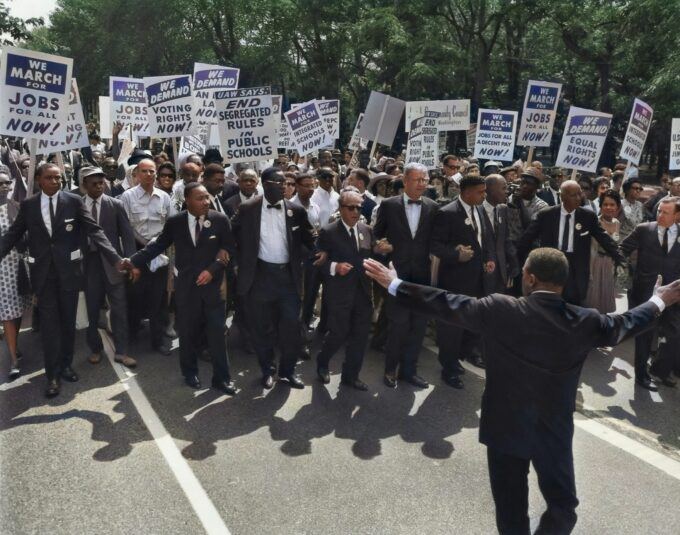
“The arc of the moral universe is long, but it bends towards justice.” So declared Dr. Martin Luther King, Jr. Ah, if only it had proved to be so.
Although my respect for MLK is enduring, when it comes to that upward-trending curve connecting past to present, his view of human history has proven to be all too hopeful. At best, history’s actual course remains exceedingly difficult to decipher. Some might say it’s downright devious (and, when you look around this embattled planet of ours today, from the Ukraine to the Middle East, deeply disturbing).
Let’s consider a specific, very recent segment of the past. I’m thinking of the period stretching from my birth year of 1947 to this very moment. An admission: I, too, once believed that the unfolding events during those long decades I was living through told a discernible story. Although not without its zigs and zags, so I was convinced once upon a time, that story had both direction and purpose. It pointed toward an ultimate destination — so politicians, pundits, and prophets like Dr. King assured us. In fact, embracing the essentials of that story was then considered nothing less than a prerequisite for situating yourself in the ongoing stream of history. It offered something to grab hold of.
Sadly enough, all of this turned out to be bunk.
That became abundantly clear in the years after 1989 when the Soviet Union began to collapse and the U.S. was left alone as a great power on Planet Earth. The decades since then have carried a variety of labels. The post-Cold War order came and went, succeeded by the post-9/11 era, and then the Global War on Terror which, even today, in largely unattended places like Africa, drags on in anonymity.
In those precincts where opinions are manufactured and marketed, an overarching theme informed each of those labels: the United States was, by definition, the sun around which all else orbited. In what was known as an age of unipolarity or, more modestly, the unipolar moment, we Americans presided as the sole superpower and indispensable nation of Planet Earth, exercising full-spectrum dominance. In the pithy formulation of columnist Max Boot, the United States had become the planet’s “Big Enchilada.” The future was ours to mold, shape, and direct. Some influential thinkers insisted — may even have believed — that History itself had actually “ended.”
Alas, events exposed that glorious moment as fleeting, if not altogether illusory. For several reasons — Washington’s propensity for needless war certainly offers a place to start — things did not pan out as expected. Assurances of peace, prosperity, and victory over the foe (whoever the foe it was at that moment) turned out to be false. By 2016, that fact had registered on Americans in sufficient numbers for them to elect as “leader of the Free World” someone hitherto chiefly known as a TV host and real estate developer of dubious credentials.
The seemingly impossible had occurred: The American people (or at least the Electoral College) had delivered Donald Trump to the pinnacle of American politics.
It was as if a clown had taken possession of the White House.
Shocked and appalled, millions of citizens found this turn of events hard to believe and impossible to accept. President Trump promptly proceeded to fulfill their worst expectations. By almost any of the measures habitually employed to evaluate political leadership, he flopped as a commander-in-chief. To my mind, he was an embarrassment.
Yet, however inexplicably, Trump remained to many Americans — growing numbers, it would turn out — a source of hope and inspiration. If given sufficient time, he would redeem the nation. History had summoned him to do so, so his followers believed, fervently and adamantly.
In 2020, the anti-Trump Establishment did manage to scratch out one final chance to show that it was not entirely bankrupt. Yet sending to the White House an elderly white male who embodied the politics of the Old School merely postponed Trump’s Second Coming.
No doubt Joe Biden was seasoned and well-intentioned, but he proved to possess little or nothing of Trump’s mystifying appeal. And when he stumbled, the remnant of the Establishment quickly and brutally abandoned him.
So, four years on, Americans have reversed course. They have decided to give Trump — now elevated to the status of folk hero in the eyes of many — another chance.
What does this head-scratching turn of events signify? Could History be trying to tell us something?
The End of the End of History
Allow me to suggest that those who counted History out did so prematurely. It’s time to consider the possibility that all too many of the very smart, very earnest, and very well-compensated people who take it upon themselves to interpret the signs of our times have been radically misinformed. Simply put: they don’t know what they’re talking about.
Viewed in retrospect, perhaps the collapse of communism did not signify the turning point of cosmic significance so many of them then imagined. Add to that another possibility: Perhaps liberal democratic consumer capitalism (also known as the American Way of Life) does not, in fact, define the ultimate destination of humankind.
It just might be that History is once again on the move — or simply that it never really “ended” in the first place. And as usual, it appears to have tricks up its sleeve, with Donald Trump’s return to the White House arguably one of them.
More than a few of my fellow citizens see his election as a cause for ultimate despair — and I get that. But to saddle Trump with responsibility for the predicament in which our nation now finds itself vastly overstates his historical significance.
Let’s start with this: Despite his extraordinary aptitude for self-promotion, Trump has shown little ability to anticipate, shape, or even forestall events. Yes, he is distinctly a blowhard, who makes grandiose promises that rarely pan out. (If you want documentation, take your choice among Trump University, Trump Airlines, Trump Vodka, Trump Steaks, Trump Magazine, Trump Taj Mahal, and even Trump: the Game.) Barring a conversion akin to the Apostle Paul’s on his journey to Damascus, we can expect more of the same from his second term as president.
Yet the yawning gap between his over-the-top MAGA rhetoric and what he’s really delivered should be instructive. It trains a spotlight on what the “end of history” has actually yielded: lofty unfulfilled promises that have given way to unexpected and often distinctly undesired consequences.
That adverse judgment hardly applies to Trump alone. In reality, it applies to every president since George H.W. Bush unveiled his “new world order” back in 1991, with his son George W. Bush’s infamous 2003 “Mission Accomplished” claim serving as its exclamation point.
Since then, at the national level, American politics, especially presidential politics, has become a scam. What happens in Washington, whether in the White House or on Capitol Hill, no more reflects the hopes of the Founders of the American republic than Black Friday and Cyber Monday express “the reason for the Season.”
In that sense, while Trump’s return to the White House may not be worth celebrating, it is entirely appropriate. It may well be History’s way of saying: “Hey, you! Wake up! Pay attention!”
The Big Enchilada No More
In 1962, former Secretary of State Dean Acheson remarked that “Great Britain has lost an empire and has not yet found a role.” Although a bit snarky, his assessment was apt.
Today, one can easily imagine some senior Chinese or Indian (or even British) diplomat offering a similar judgment about the United States. America’s imperial pretensions have run aground. Yet the loudest and most influential establishment voices — Donald Trump notably excepted — continue to insist otherwise. With apparent sincerity, President Biden all too typically clung to the notion that the United States does indeed remain the planet’s “indispensable nation.”
Events say otherwise. Consider the arena of war. Once upon a time, professing a commitment to peace, the United States sought to avoid war. When armed conflict became unavoidable, America sought to win, quickly and neatly. Today, in contrast, this country seemingly adheres to an informal doctrine of “bomb-and-bankroll.” Since three days after the 9/11 attacks (with but a single negative vote), when Congress passed an Authorization for the Use of Military Force, or AUMF, war has become a fixture of presidential politics, with a compliant Congress issuing the checks. As for the Constitution, when it comes to war powers, it has become a dead letter.
In recent years, U.S. military casualties have been blessedly few, but outcomes have been ambiguous at best and abysmal — think Afghanistan — at worst. If the United States has played an indispensable role in these years, it’s been in underwriting disaster, spending billions of dollars on catastrophic wars that were, from the moment they were launched, of distinctly questionable relevance to this country’s wellbeing.
In his inconsistent, erratic, and bloviating way, Donald Trump — almost alone among figures on the national stage — has appeared to find this objectionable and has proposed a radical course change. Under his leadership, he insists, the Big Enchilada will rise to new heights of glory.
To be clear, the likelihood of the incoming administration making good on the myriad promises contained within its MAGA agenda is close to zero. When it actually comes to setting basic U.S. policy on a more sensible course, Trump is manifestly clueless. Buying Greenland, taking the Panama Canal, or even making Canada our 51st state will not restore our ailing Republic to health. As for the team of lackeys Trump is assembling to assist him in governing, let us simply note that there is not a single figure of Acheson’s stature among them.
Still, here we may find reason for at least a glimmer of hope. For far too long — all my life, in fact — Americans have looked to the White House for salvation. Those expectations have met with repeated, seemingly endless disappointment.
Vowing to Make America Great Again, Donald Trump has, in his own strange fashion, vaulted those hopes to a new level. That he, too, will disappoint his followers, no less the rest of us, is, of course, foreordained. Yet his failure might — just might — bring Americans to rethink and renew their democracy.
Listen: History is signaling to us. Whether we can successfully interpret those signals remains to be seen. In the meantime, brace yourself for what promises to be a distinctly bumpy ride.
This piece first appeared on TomDispatch.


