Monday, January 20, 2025


Svalbard's Glaciers Have Lost an Area the Size of Manhattan Into the Sea
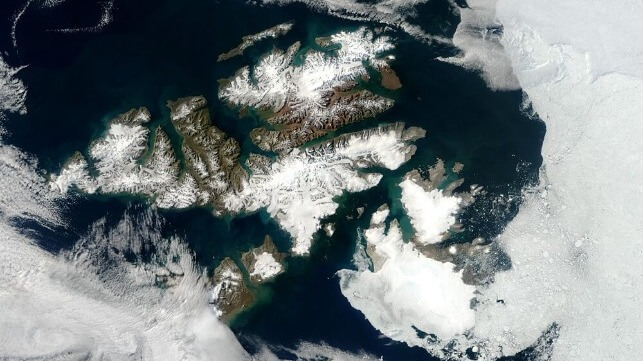
Svalbard
File image courtesy NASA

Published Jan 19, 2025 8:15 PM by The Conversation


[By Tian Li, Jonathan Bamber and Konrad Heidler]

The Arctic has warmed nearly four times faster than the global average since 1979. Svalbard, an archipelago near the northeast coast of Greenland, is at the frontline of this climate change, warming up to seven times faster than the rest of the world.

More than half of Svalbard is covered by glaciers. If they were to completely melt tomorrow, the global sea level would rise by 1.7cm. Although this won’t happen overnight, glaciers in the Arctic are highly sensitive to even slight temperature increases.

To better understand glaciers in Svalbard and beyond, we used an AI model to analyze millions of satellite images from Svalbard over the past four decades. Our research is now published in Nature Communications, and shows these glaciers are shrinking faster than ever, in line with global warming.

Specifically, we looked at glaciers that drain directly into the ocean, what are known as “marine-terminating glaciers”. Most of Svalbard’s glaciers fit this category. They act as an ecological pump in the fjords they flow into by transferring nutrient-rich seawater to the ocean surface and can even change patterns of ocean circulation.

Where these glaciers meet the sea, they mainly lose mass through iceberg calving, a process in which large chunks of ice detach from the glacier and fall into the ocean. Understanding this process is key to accurately predicting future glacier mass loss, because calving can result in faster ice flow within the glacier and ultimately into the sea.

Despite its importance, understanding the glacier calving process has been a longstanding challenge in glaciology, as this process is difficult to observe, let alone accurately model. However, we can use the past to help us understand the future.

AI replaces painstaking human labor

When mapping the glacier calving front – the boundary between ice and ocean – traditionally human researchers painstakingly look through satellite imagery and make digital records. This process is highly labor-intensive, inefficient and particularly unreproducible as different people can spot different things even in the same satellite image. Given the number of satellite images available nowadays, we may not have the human resources to map every region for every year.

A novel way to tackle this problem is by using automated methods like artificial intelligence (AI), which can quickly identify glacier patterns across large areas. This is what we did in our new study, using AI to analyze millions of satellite images of 149 marine-terminating glaciers taken between 1985 and 2023. This meant we could examine the glacier retreats at unprecedented scale and scope.

Insights from 1985 to today

We found that the vast majority (91%) of marine-terminating glaciers across Svalbard have been shrinking significantly. We discovered a loss of more than 800km² of glacier since 1985, larger than the area of New York City, and equivalent to an annual loss of 24km² a year, almost twice the size of Heathrow airport in London.

The biggest spike was detected in 2016, when the calving rates doubled in response to periods of extreme warming. That year, Svalbard also had its wettest summer and autumn since 1955, including a record 42mm of rain in a single day in October. This was accompanied by unusually warm and ice-free seas.

How ocean warming triggers glacier calving

In addition to the long-term retreat, these glaciers also retreat in the summer and advance again in winter, often by several hundred meters. This can be greater than the changes from year to year.

We found that 62% of the glaciers in Svalbard experience these seasonal cycles. While this phenomenon is well documented across Greenland, it had previously only been observed for a handful of glaciers in Svalbard, primarily through manual digitization.

We then compared these seasonal changes with seasonal variations in air and ocean temperature. We found that as the ocean warmed up in spring, the glacier retreated almost immediately. This was a nice demonstration of something scientists had long suspected: the seasonal ebbs and flows of these glaciers are caused by changes in ocean temperatures.

A global threat

Svalbard experiences frequent climate extremes due to its unique location in the Arctic yet close to the warm Atlantic water. Our findings indicate that marine-terminating glaciers are highly sensitive to climate extremes and the biggest retreat rates have occurred in recent years.

This same type of glaciers can be found across the Arctic and, in particular, around Greenland, the largest ice mass in the northern hemisphere. What happens to glaciers in Svalbard is likely to be repeated elsewhere.

If the current climate warming trend continues, these glaciers will retreat more rapidly, the sea level will rise, and millions of people in coastal areas worldwide will be endangered.

This article appears courtesy of The Conversation and may be found in its original form here

Tian Li is Senior Research Associate, Bristol Glaciology Centre, University of Bristol.

Jonathan Bamber is Professor of Glaciology and Earth Observation, University of Bristol.

Konrad Heidler is Chair of Data Science in Earth Observation, Technical University of Munich.


Violence on TV: What happens to children who watch?


University of Montreal


Results of new study led by Linda Pagani, Professor at the Université de Montreal’s School of Psychoeducation, long-term associated risks of early exposure to violent content in childhood and later teen antisocial behavior, more than a decade later.

“Although past evidence showing causal links between modelling and getting rewarded for violence had an immediate impact on aggressive behavior in 4-year-old children, few studies have investigated long-term risks with antisocial behavior. We studied such risks in mid-adolescence, explained Pagani, who is also a researcher at the Centre de recherche Azrieli du CHU Sainte-Justine. It was ideal to study this question with typically developing middle-class children because, as a population, they have the lowest chances of engaging in aggression and behavior harmful to others.”

Close to 2,000 children
In all, Pagani and her team looked at 963 girls and 982 boys born between the springs of 1997 and 1998 who were enrolled in the Quebec Longitudinal Study of Child Development. Parents reported the frequency of their child’s exposure to violent television content at ages 3.5 and 4.5 years old. Boys and girls then self-reported on several aspects of antisocial behavior at age 15.

The study defines screen violence as anything “characterized by physical aggression, verbal aggression, and relational aggression […] depicting situations that intentionally attempt or cause harm to others.” Children, the study says “are attracted to fast-paced, stimulating violent content, which often features appealing characters like superheroes who commit and are rewarded for aggressive acts, thus increasing the likelihood of exposure."

The researchers then conducted analyses to examine whether exposure to violent television content at ages 3.5 and 4.5 years predicted later antisocial behavior eleven years later.

The researcher added, “We statistically took into account alternative child and family factors that could have explained our results, to be as close as possible to the truth in the relationships we were looking at.”

Boys stand out
At age 15, for boys only, preschool violent televiewing predicted increases in antisocial behavior. Being exposed to violent content in early childhood predicted later aggressive behaviors such as hitting or beating another person, with the intention of obtaining something, stealing, with or without any apparent reason.

Risks also included threats, insults, and gang fight involvement. The use of weapons is also among the behavioral outcomes predicted by exposure to childhood television violence in this study. No effects were found for girls, which was not surprising given that boys are generally more exposed to such content.

Pagani concluded, “Our study provides compelling evidence that early childhood exposure to media violence can have serious, long-lasting consequences, particularly for boys. This underscore the urgent need for public health initiatives that targets campaigns to inform parents and communities about the long-term risks and empower them to make informed choices about young children's screen content exposure.”

The entire team of students from Université de Montréal and researchers from the United States and Italy established that, "Parents and communities can play a crucial role in limiting future problems by carefully avoiding young children's exposure to violent media content."


About the study

The article, “Prospective associations between preschool exposure to violent televiewing and externalizing behavior in middle adolescent boys and girls” was published on January 20, 2025 in the International Journal of Environmental Research and Public Health.    

Linda Pagani, lead author of the study, is a professor at the Université de Montréal's School of Psychoeducation and a researcher at the Centre de recherche Azrieli du CHU Sainte-Justine and at the School Environment Research Group. Amélie Gilker-Beauchamp, Laurie-Anne Kosak and Kianoush Harandian are graduate students under her direction. Claudio Longobardi is professor in the Department of Psychology at the University of Turin, in Italy. The study’s senior author is Eric F. Dubow is distinguished research professor and director of clinical training in the Department of Psychology of Bowling Green State University, in Ohio.

This work was made possible thanks to the participation of parents, teachers and children in the Quebec Longitudinal Study of Child Development, and under the auspices of the Institut de la statistique du Québec for data collection, storage and hosting. The overall study was funded by the Fondation Lucie et André Chagnon, the Institut de la statistique du Québec, the Ministère de l'Éducation (Québec), the Ministère de la Famille (Québec), the Ministère de l'Emploi et de la Solidarité sociale (Québec), the Institut de recherche Robert-Sauve en santé et en sécurité du travail, the CHU Sainte-Justine and the Ministère de la Santé et des Services sociaux du Québec (Québec).


New global research reveals strong public trust in science


Largest global study since COVID-19 pandemic shows scientists are trusted around the world


University of Bath


A new international study on public trust in science, conducted across 68 countries, has found that most people trust scientists and believe they should be more involved in society and policymaking. Further, a majority of survey participants believe that scientists should be more involved in society and policymaking.

Published in Nature Human Behaviours (pre print link), this research was conducted by TISP, a Harvard University-based consortium led by Dr Viktoria Cologna (Harvard University, RTH Zurich) and Dr Niels G Mede (University of Zurich), which includes 241 researchers from 169 institutions worldwide, including the University of Bath.

The study, which includes 71,922 respondents—2,008 of them from the UK—provides the largest global dataset on trust in scientists since the COVID-19 pandemic.

Key Findings

  • Widespread trust: Across 68 countries, the study finds that a majority of the public have relatively high trust in scientists (mean trust level = 3.62, on a scale from 1 = very low trust to 5 = very high trust). Majorities also perceive scientists to be qualified (78%), honest (57%), and concerned about people’s well-being (56%). 
  • Desire for scientists’ engagement: A large majority (83%) agree that scientists should communicate science with the public. Only a minority (23%) believe that scientists should not actively advocate for specific policies. 52% believe that scientists should be more involved in the policymaking process.

Global Rankings

  • Most Trusted: Egypt topped the list, followed by India, Nigeria, Kenya, and Australia.
  • Middle of the Pack: The UK ranked 15th, three spots behind the US, but ahead of Canada (17th) and Sweden (20th).
  • Least Trusted: At the bottom, Albania ranked 68th, followed by Kazakhstan (67th), Bolivia (66th), Russia (65th), and Ethiopia (64th).

Dr Eleonora Alabrese, an economist from the University of Bath, collected responses for part of the UK sample. She said:

“The UK has a generally high level of trust in science, ranking above many European countries, including Denmark, Germany, Sweden, and Belgium. Trust in scientists is higher among women, older individuals, and those with more education. Interestingly, a conservative political orientation is linked to lower trust in science in North America and parts of Europe. However, this pattern does not hold globally, suggesting that the political leadership may influence such attitudes in different regions.”

Lead researcher, Dr Viktoria Cologna from Harvard University and ETH Zurich said: “Our results show that most people in most countries have relatively high trust in scientists and want them to play an active role in society and policymaking”.

Second study lead Dr Niels G Mede from University of Zurich said: “The study is the most comprehensive post-pandemic snapshot of trust in scientists, societal expectations of their involvement in society and policymaking, and public views on research priorities.”

Challenges

The findings also highlight some areas of concern.  Globally, less than half of respondents (42%) believe that scientists pay attention to others’ views. The findings also show that many people, in many countries, feel that the priorities of science do not always align well with their own priorities. Participants assigned high priority to research dedicated to improving public health, solving energy problems, and reducing poverty. Research on developing defence and military technology was assigned a lower priority. In fact, participants explicitly believe that science prioritises developing defence and military technology more than they desire.

Recommendations

The consortium of academics recommends that scientists take these results seriously and find ways to be more receptive to feedback and open to dialogue with the public, consider ways in Western countries to reach conservative groups, and, in the fullness of time, consider their role in setting priorities aligned with public values.

Dr Eleonora Alabrese said: “While trust in science remains generally high, even a small decline in trust from a minority could influence how scientific evidence is used in policymaking. These findings are crucial for scientists and policymakers working to maintain public trust in science.”


A new chapter in Roman administration: Insights from a late Roman inscription


The Hebrew University of Jerusalem

Aerial view of Abel Bet Maacah looking south-east 

image: 

Aerial view of Abel Bet Maacah looking south-east (courtesy of the Tel Abel Beth Maacah excavations. Photo: Robert Mullins).

view more 

Credit: (courtesy of the Tel Abel Beth Maacah excavations. Photo: Robert Mullins).


Archaeologists have uncovered a rare Tetrarchic boundary stone at the site of Abel Beth Maacah in northern Israel. Originally marking land borders under Roman Emperor Diocletian’s tax reforms, the stone provides insight into ancient land ownership, local settlement patterns, and imperial administrative practices. The discovery also introduces two previously unknown place names, expanding our understanding of the region’s historical geography and socio-economic landscape.

Archaeologists Prof. Naama Yahalom-Mack and Dr. Nava Panitz-Cohen from the Institute of Archaeology at the Hebrew University, and Prof. Robert Mullins from Azusa Pacific University have uncovered a significant relic of ancient administrative practices during their excavation of the biblical site of Abel Beth Maacah near Metula in northern Israel. The find, which was deciphered by Dr. Avner Ecker and Prof. Uzi Leibner from the Hebrew University is a boundary stone, originally inscribed to delineate agrarian borders between villages during the reign of the Roman Tetrarchy (a short-lived system instituted by the emperor Diocletian in 293 CE to govern the Roman Empire by dividing it between two emperors, the augusti, and their junior colleagues and designated successors, the caesares) and was found in secondary use in  a Mamluk-period installation. This basalt slab, etched with a detailed Greek inscription, has provided a wealth of historical insights.

The inscription revealed two previously unknown village names, Tirthas and Golgol, which may correspond to ancient sites identified in the 19th-century Survey of Western Palestine. The slab also mentions an imperial surveyor, or "censitor," whose name is attested here for the first time. These markers reflect the sweeping tax reforms initiated by Diocletian in the late third century CE, emphasizing the role of land ownership and settlement structures in the economic landscape of the Roman Near East.

“This discovery is a testament to the meticulous administrative re-organization of the Roman Empire during the Tetrarchy,” said Prof. Uzi Leibner. “Finding a boundary stone like this not only sheds light on ancient land ownership and taxation but also provides a tangible connection to the lives of individuals who navigated these complex systems nearly two millennia ago.”

Dr. Avner Ecker added, “What makes this find particularly exciting is the mention of two previously unknown place names and a new imperial surveyor. It underscores how even seemingly small discoveries can dramatically enhance our understanding of the socio-economic and geographic history of the region.”

This discovery adds to a unique corpus of over 20 boundary stones concentrated in the northern Hula Valley and surrounding areas. The stones mark a period of heightened administrative control aimed at standardizing taxation and clarifying land ownership. Remarkably, this specific find highlights the interconnectedness of historical geography, economic policies, and local settlement patterns. Scholars believe the abundance of boundary stones in this region underscores the high concentration of small landholders who operated independently of major urban centers. Interestingly, a contemporaneous rabbinic tradition mentions a burden imposed by the emperor Diocletian on this specific area, and apparently also reflects the hardships the tax reform drew on the local population.  

The find enriches our understanding of the socio-economic dynamics during the Tetrarchy, particularly the implications of Diocletian’s reforms on rural communities. Prof. Leibner and Dr. Ecker emphasize that such discoveries provide a unique glimpse into the lives of ancient inhabitants, the pressures they faced under imperial rule, and the enduring traces of their communities in the archaeological record. This exceptional artifact now joins the broader narrative of Roman imperial administration in the Levant.

An Iron Age citadel and Mamluk-period installation in which the inscription was incorporated in secondary use (courtesy of the Tel Abel Beth Maacah excavations. Photo: Robert Mullins).

Credit

(courtesy of the Tel Abel Beth Maacah excavations. Photo: Robert Mullins).

The boundary stone (courtesy of the Tel Abel Beth Maacah excavations. Photo: Tal Rogovsky).

Credit

(courtesy of the Tel Abel Beth Maacah excavations. Photo: Tal Rogovsky)


In chimpanzees, peeing is contagious


Cell Press
Three chimpanzees holding leafy branches 

image: 

 Three chimpanzees in an enclosure holding leafy branches

view more 

Credit: Kumamoto Sanctu


A new study reported in the Cell Press journal Current Biology on January 20 is the first to describe a phenomenon researchers refer to as “contagious urinations.” The study in 20 captive chimpanzees living at the Kumamoto Sanctuary in Japan shows that, when one chimp pees, others are more likely to follow. 

“In humans, urinating together can be seen as a social phenomenon,” says Ena Onishi of Kyoto University.  

“An Italian proverb states, ‘Whoever doesn’t pee in company is either a thief or a spy’ (Chi non piscia in compagnia o è un ladro o è una spia), while in Japanese, the act of urinating with others is referred to as ‘Tsureshon’ (連れション). This behavior is represented in art across centuries and cultures and continues to appear in modern social contexts. Our research suggests that this phenomenon may have deep evolutionary roots. We found that chimpanzees, our closest relatives, tend to urinate in response to the urination of nearby individuals.” 

The researchers decided to study this behavior after noticing that the sanctuary chimpanzees seemed to pee at about the same time. It reminded them of human behavior, and they wondered whether it might be comparable to contagious yawning. To find out, they documented peeing behaviors in the Kumamoto chimpanzees over more than 600 hours, including 1,328 urination events. They analyzed the observational data to see whether peeing among the chimpanzees was significantly synchronized in time. They also explored whether it was influenced by nearby individuals or shaped by social factors. 

The evidence showed that urination events were significantly more synchronized during observations than would be expected if the chimpanzees were simply peeing at random times with respect to one another. The likelihood of contagious urination also increased with physical proximity to the initial urinator, they report. Interestingly, individuals with lower dominance ranks were more likely to pee when others were peeing. The finding suggests that urination patterns are influenced by social hierarchy, with a tendency for the behavior to "flow down" the dominance structure, the researchers say. 

“We were surprised to discover that the contagion pattern was influenced by social rank,” Onishi says. “Since there were no prior studies on contagious urination in any species, we drew parallels to contagious yawning, another semi-voluntary physiological behavior. Based on this, we initially expected that any social influences might resemble those seen in yawning—such as stronger contagion between socially close pairs. However, our results showed no evidence of effects related to social closeness. Instead, we observed a clear influence of social rank, with lower-ranking individuals being more likely to follow the urination of others.” 

“This was an unexpected and fascinating result, as it opens up multiple possibilities for interpretation,” Shinya Yamamoto, also of Kyoto University, adds. “For instance, it could reflect hidden leadership in synchronizing group activities, the reinforcement of social bonds, or attention bias among lower-ranking individuals. These findings raise intriguing questions about the social functions of this behavior.” 

The findings may have important implications for understanding and exploring the role of this behavior in maintaining group cohesion, facilitating coordination, or reinforcing social bonds within the group, according to the researchers. It reveals how this seemingly mundane and necessary behavior might be of overlooked social significance. 

The researchers say more study is needed to understand the specific functions and mechanisms underlying contagious urination in chimpanzees. They’re also curious to know whether this phenomenon exists in other species.  

### 

Current Biology, Onishi et al.: “Contagious urination in chimpanzees.” https://www.cell.com/current-biology/fulltext/S0960-9822(24)01594-X

Current Biology (@CurrentBiology), published by Cell Press, is a bimonthly journal that features papers across all areas of biology. Current Biology strives to foster communication across fields of biology, both by publishing important findings of general interest and through highly accessible front matter for non-specialists. Visit http://www.cell.com/current-biology. To receive Cell Press media alerts, contact press@cell.com.