Tuesday, January 21, 2025

Watchdogs, Unions Target DOGE With Lawsuits Mere Minutes Into Trump Administration


"This fight is about fairness, accountability, and the integrity of our government," said AFGE national president Everett Kelley.


Eloise Goldsmith
Jan 20, 2025
COMMON DREAMS


The legal fight over President Donald Trump's "Department of Government Efficiency" kicked off less than hour into his presidency with a flurry of lawsuits filed in federal court—including multiple that allege the body is in violation of the the 1972 Federal Advisory Committee Act.

Trump tapped billionaire and Tesla CEO Elon Musk and tech entrepreneur Vivek Ramaswamy to run the Department of Government Efficiency (DOGE), which was conceived by Trump to help aid with cuts to government spending and regulation. (Ramaswamy, however, is reportedly departing DOGE to launch a bid for Ohio governor).

In a Monday statement announcing one of the lawsuits, Skye Perryman, CEO of Democracy Forward, said that "allowing unelected billionaires to run roughshod over essential services without being transparent about their operations does not achieve the efficiency the American people want to see from their government and only threatens to further undermine the public's trust."

Democracy Forward is serving as co-legal counsel in one of three lawsuits alleging Federal Advisory Committee Act violations. That complaint was filed by a diverse group of plaintiffs, including the advocacy organization the American Public Health Association, the union the American Federation of Teachers, the veterans group the Minority Veterans of America, the progressive veterans group VoteVets Action Fund, the consumer advocacy group the Center for Auto Safety, and the watchdog group Citizens for Responsibility and Ethics in Washington (CREW).

A second was filed by the watchdog group Public Citizen, the watchdog nonprofit State Democracy Defenders Fund, and the federal employees union the American Federation of Government Employees (AFGE). A third was filed by the public interest firm the National Security Counselors.

"This fight is about fairness, accountability, and the integrity of our government," said AFGE national president Everett Kelley in a statement Monday. "Federal employees are not the problem—they are the solution. They deserve to have their voices heard in decisions that affect their work, their agencies, and the public they serve."

Plaintiffs in the first three suits argue that DOGE is operating as a federal advisory committee but not adhering to regulations overseeing those bodies.

Under the 1972 law, federal advisory committees—bodies that advise federal decision-makers on policy, which are also known as FACAs—must do things like furnish meeting minutes and make their meetings open to the public. The groups must also establish a charter and ensure the viewpoints of its members are "fairly balanced."

According to the complaint co-authored by lawyers with Democracy Forward and CREW, the defendants—who include DOGE and the Office of Management and Budget—"have taken no action to comply with FACA, including by making a formal determination that DOGE's creation serves the public interest, nor have they filed a charter identifying the scope of DOGE’s work."

The lawsuit also alleges that "DOGE's membership does not include anyone who brings the perspective of the people and communities that will be most directly affected by the drastic cuts to the federal programs and services that DOGE will recommend."

The complaint co-authored by Public Citizen also makes the same argument regarding balanced viewpoints. Each of the plaintiffs listed in that suit appealed to have representatives from their respective groups join DOGE in order to offer expertise, according to the filing.

"Elon Musk and Vivek Ramaswamy both hold financial interests that will be directly affected by federal budgetary policies—presenting substantial conflict of interest concerns," said Lisa Gilbert, co-president of Public Citizen, in an early January statement regarding her request to join DOGE.

Two of Musk's companies account for at least $15.4 billion in government contracts over the past 10 years, according to New York Timesreporting from October. Ramaswamy's perch atop DOGE could also present conflicts of interest stemming from financial interests he has in multiple companies with exposure to the federal government, the Timesreported before revelations of his plans to leave DOGE.

Also Monday, the conservation organization the Center for Biological Diversity sued to obtain public records showing how "people claiming to represent DOGE" have communicated with the White House since the presidential transition began.

In t complaint, the Center for Biological Diversity argues that they filed an unfilled public records request with the Office of Management and Budget for materials that would "shed valuable light on any directives or communications with OMB regarding DOGE and its objectives, which will shed light on the new administration's intended operations and responses as they take office."

"Whether it's Trump or Elon Musk who's really running the government, we're a nation of laws and the people have a right to know what Musk and his cronies have been up to during the transition," said Kierán Suckling, executive director of the Center for Biological Diversity, in a statement Monday.
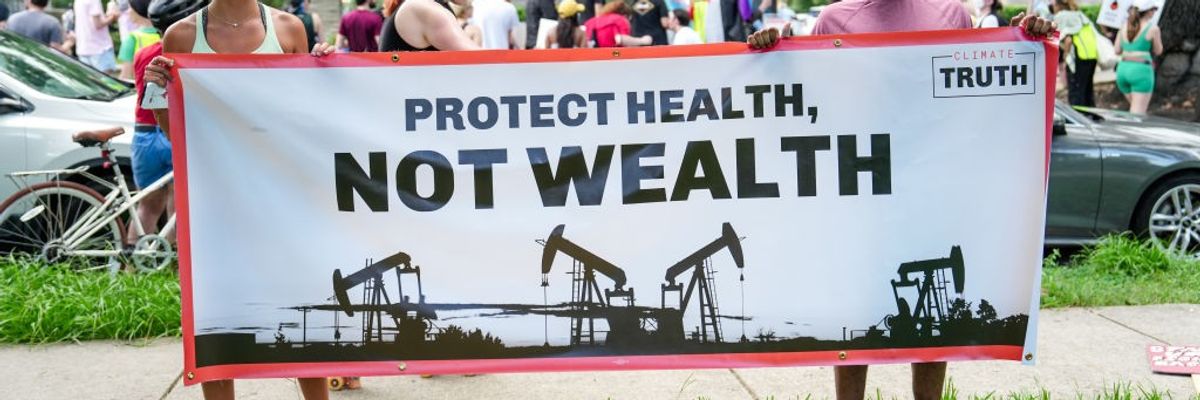
Climate Movement Alarmed by Trump Declaring Energy Emergency to 'Drill, Baby, Drill' 
MEANS THE RAPE OF THE NATIONAL PARKS

Green groups vowed to fight against "all attempts by Trump and his allies in Congress to weaken commonsense environmental rules and put polluter profits over the health, safety, and well-being of people and the planet."


Protesters gather outside the home of Boysie Bollinger during a fundraiser for then-former President Donald Trump on June 24, 2024 in New Orleans, Louisiana.
(Photo: Josh Brasted/Getty Images for Climate Power)

Jessica Corbett
Jan 20, 2025
COMMON DREAMS

U.S. President Donald Trump said during his Monday inaugural address that he would declare a "national energy emergency," intended to help deliver on his campaign pledge to "drill, baby, drill" for climate-heating fossil fuels—one of the Republican's various planned actions that have alarmed green groups in recent days.

Other plans—some confirmed by the Trump administration's White House website—include withdrawing from the Paris climate agreement again, lifting a pause on new liquefied natural gas (LNG) exports, and attacking efforts to limit planet-heating emissions with actions targeting clean energy and automobile rules.

"These actions are an unprecedented handout to billionaires," said Aru Shiney-Ajay, executive director of the youth-led Sunrise Movement. "They will make a small handful of rich men unimaginably richer while killing good-paying jobs and threatening our health and homes. As wildfires rage across California, families flee their homes, and workers struggle to make ends meet, Trump's actions make it clear whose side he's on: the billionaires and powerful corporations who bankrolled his campaign."


The combined wealth of the world's billionaires surged by $2 trillion last year, Oxfam revealed Monday, as some of them joined Trump for his inauguration—an event decried as "a coronation of our country's descent into oligarchy." The president has also nominated billionaires, climate science deniers, and fossil fuel backers to Cabinet posts and other key positions.

"We are organizing in every corner of the country to make sure the American people see these actions for what they are: handouts to billionaires at our expense," said Shiney-Ajay. "Democrats must take off the gloves and do everything in their power to expose this blatant corruption and stand against Donald Trump's agenda."

While the fossil fuel industry applauded what American Gas Association president and CEO Karen Harbert called "President Trump's decisive action to maximize the benefits from our nation's abundant and essential energy and to protect consumer choice," Oil Change International executive director Elizabeth Bast joined Shiney-Ajay in emphasizing the importance of organizing during his second term.

"The fossil fuel industry invested $75 million to secure Trump's victory, and now they're expecting a return on that investment. By appointing fossil fuel CEOs to key Cabinet positions and planning to dismantle critical environmental protections, Trump is handing these companies a blank check to expand their operations at precisely the moment we need to end fossil fuel extraction," Bast said. "But the greed of fossil fuel billionaires and their political allies cannot overcome the power of our movements. In communities across America and around the world, we're standing up not just to toxic fossil fuel projects, but to the bigotry, hatred, and division that props up corporate power."

John Noel, deputy climate program director at Greenpeace USA, similarly highlighted that "during his campaign, Trump openly requested $1 billion from Big Oil. Executive orders like declaring a 'national energy emergency' and rubber-stamping more LNG exports are the prize—a quid pro quo—rewarding those who financed his political rise."

"The latest science and economic analysis from the Department of Energy concludes that unfettered LNG exports are not in the US public interest," Noel noted. "LNG exports have already driven up U.S. energy prices. Rubber-stamping new export authorizations will only exacerbate the cost of living crisis for working people."


Nodding to Trump's previous withdrawal from the Paris agreement, which former President Joe Biden reversed, Oxfam America president and CEO Abby Maxman said that ditching the deal again "is more than reckless—it's economic self-sabotage and a betrayal of every community, both in the U.S. and globally, already facing catastrophic storms, heatwaves, and rising seas."

"While we will have a climate denier in the White House, any predictions that this is 'game over' for climate ambition are wrong," she added. "Most Americans support climate action, and communities, cities, and states across the country are stepping up to work for a sustainable future. The struggle to protect our planet isn't over—and together, we can still win."

Rachel Cleetus, policy director and lead economist for the Union of Concerned Scientists' Climate and Energy Program, similarly called the Paris withdrawal "a travesty" that "is in clear defiance of scientific realities and shows an administration cruelly indifferent to the harsh climate change impacts that people in the United States and around the world are experiencing."

"Last year was the first time global average temperatures exceeded 1.5°C above preindustrial levels for an entire year. Unless world leaders act quickly, the planet is on track for up to a 3.1°C increase, which would be catastrophic," she stressed. "As the largest historical emitter of heat-trapping emissions, the United States has a responsibility to do its fair share to stave off the increasingly dire consequences of the climate crisis."

"His disgraceful and destructive decision is an ominous harbinger of what people in the United States should expect from him and his anti-science Cabinet hell-bent on boosting fossil fuel industry profits at the expense of people and the planet," Cleetus added, pushing for "urgent actions from U.S. and global policymakers" to tackle the fossil fuel-drive climate emergency.

Green groups vowed to spend the next four years fighting against what Food & Water Watch executive director Wenonah Hauter called "Trump's filthy fossil fuel agenda," which she said "may benefit billionaires invested in the oil and gas industry, but it will hammer everyday Americans."

"Trump's declaration of a national energy emergency leverages a false premise to encourage expanded fossil fuel production at a time when the United States is already the top oil and gas producer in the world," said Hauter. "Though Trump claims he is acting to reduce costs for consumers, his actions will only increase expenses for everyone, through higher utility bills, greater pollution impacts, and the overwhelming costs of climate change-supercharged disasters—all falling disproportionately on low-income families and communities of color."

"We will vigorously fight back against any and all attempts by Trump and his allies in Congress to weaken commonsense environmental rules and put polluter profits over the health, safety, and well-being of people and the planet," she pledged.


Kierán Suckling, executive director at the Center for Biological Diversity, declared that "no one in American history has shown more disdain for the environment than Donald Trump. His reckless contempt for our nation's natural heritage and people's health will only get worse, but we'll fight him at every step."

"The United States has some of the strongest environmental laws in the world, and no matter how petulantly Trump behaves, these laws don't bend before the whims of a wannabe dictator," he continued. "The use of emergency powers doesn't allow a president to bypass our environmental safeguards just to enrich himself and his cronies. We'll see Trump in court to challenge each of these horrific, senseless attacks on wildlife, public lands, and our health."

The Center for International Environmental Law said that "our vision remains clear: Justice, democracy, and a sustainable future are not aspirations—they are the foundation of our work and the promise we strive to fulfill every day. With communities and allies around the globe, we stand firmly and unapologetically for a world where these principles thrive, building a future rooted in hope, courage, and collective action."

"It is repugnant that these remarks occur from the highest U.S. office on Dr. Martin Luther King Jr. Day," the group added. "Today, and every day, we channel Dr. King's call to action: 'Change does not roll in on the wheels of inevitability, but comes through continuous struggle.' Together and through collective, continuous action, we will bend the arc of history towards justice."
'He Is Who We Think He Is': Elon Musk Appears to Do Fascist Salutes at Post-Inauguration Celebration


"Tomorrow we'll get an explanation that it wasn't a Sieg Heil, he was just pantomiming his 'heart going out to the people.' Legacy media will basically accept this explanation. But you know what you saw and you know what he is," wrote one observer.


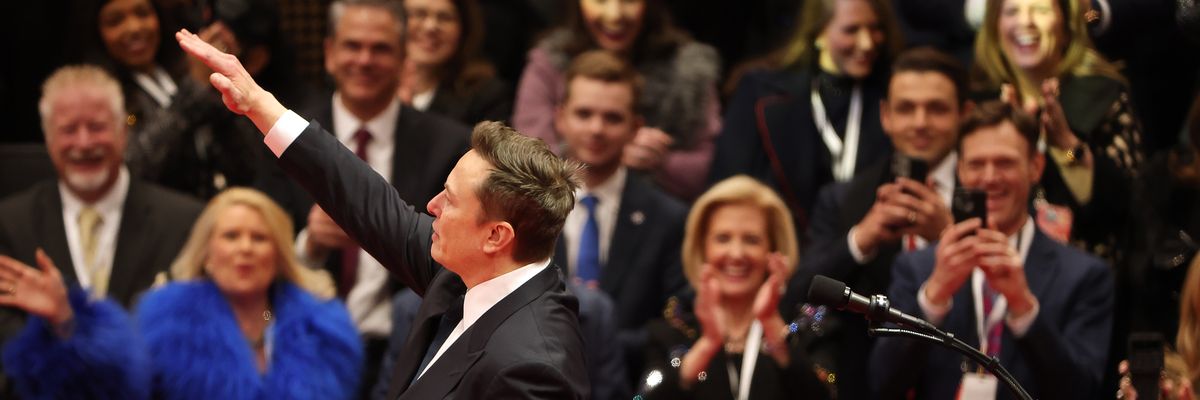
Tesla, SpaceX and X CEO Elon Musk gestures as he speaks during an inauguration event at Capital One Arena on January 20, 2025 in Washington, DC. Donald Trump takes office for his second term as the 47th president of the United States. (Photo by Justin Sullivan/Getty Images)

Eloise Goldsmith
Jan 20, 2025
COMMON DREAMS

While concluding his remarks at a Washington, D.C. celebration rally following President Donald Trump's inauguration Monday, Tesla CEO and billionaire Elon Musk raised his right arm, with his palm facing down, in a gesture that appeared to resemble a salute associated with Nazi Germany. Musk can be seen making the gesture twice.

The Anti-Defamation League (ADL), a group that combats antisemitism, defines the Nazi salute as consisting of "raising an outstretched right arm with the palm down."

The ADL, however, released a statement on Monday saying that Musk's gesture was not a Nazi salute. "It seems that [Elon Musk] made an awkward gesture in a moment of enthusiasm, not a Nazi salute," the group wrote on the platform X, which is owned by Musk. "In this moment, all sides should give one another a bit of grace, perhaps even the benefit of the doubt, and take a breath," they wrote.

The ADL's comment engendered criticism, including from Rep. Alexandria Ocasio-Cortez (D-N.Y.), who wrote in response, "Just to be clear, you are defending a Heil Hitler salute that was performed and repeated for emphasis and clarity."


Former Rep. Cori Bush (D-Mo.) wrote: "Dang he meant that. Looks as if he's been holding that in for a while and finally was able to let it rip. Like he practiced in the mirror to hit that angle just right."

Others also weighed in on social media. "Did Elon Musk just hit the roman salute at his inauguration speech?” Twitch streamer Hasan Piker posted on X. "Why isn't Elon Musk doing two Nazi salutes at Trump's inauguration a lead story today?" asked political strategist Walid Shahid.

A Bluesky user wrote "Casual Nazi salute on live television."

"He accidentally did a Nazi salute... TWICE," wrote the journalist Mehdi Hasan. "He is who we think he is."

Musk, a GOP megadonor who is slated to play a key role in the Trump administration, has expressed his support for the Alternative for Germany party (AfD), a virulently ant-immigration party that has been designated by the German domestic intelligence service as a "suspected extremist" organization. Figures in the party have been accused of using Nazi slogans in speeches and downplaying the Holocaust. Musk held a live event on X with the leader of AfD, Alice Weidel, in early January.

Musk has also repeatedly attacked billionaire and philanthropist George Soros, who has been the target of antisemitic conspiracy theories, including by sharing social media posts that falsely claimed Soros "collaborated with the Nazis as a teenager" and describing him as a "psychopath trying to destroy the West," according to the Israeli newspaper Haaretz

Michael McCarthy, a PhD student at Indiana University wrote on X: "Tomorrow we'll get an explanation that it wasn't a Sieg Heil, he was just pantomiming his 'heart going out to the people.' Legacy media will basically accept this explanation."

"But you know what you saw," McCarthy added. "And you know what he is."

This article was updated with comments from the ADL and Rep. Alexandria Ocasio-Cortez.


SEIG HEIL
Musk raises eyebrows with salute gesture at Trump rally


By AFP
January 20, 2025


Elon Musk's gesture at a rally for US President Donald Trump has generated controversy for its resemblance to a Nazi salute - Copyright AFP ANGELA WEISS

Billionaire Elon Musk sparked controversy Monday after making a gesture at an event celebrating US President Donald Trump’s inauguration, with some calling it a “Nazi” or “fascist” movement.

The X, SpaceX and Tesla chief appeared on stage at the Capital One Arena in Washington, where supporters of the newly inaugurated president had gathered for a rally.

Upon thanking the crowd for returning the 78-year-old Republican to the White House, Musk tapped the left side of his chest with his right hand and then extended his arm with his palm open, repeating the gesture for the crowd seated behind him.

Claire Aubin, a historian who specializes in Nazism within the United States, agreed Musk’s gesture was a “sieg heil,” or Nazi salute.

“My professional opinion is that you’re all right, you should believe your eyes,” Aubin posted on X, aligning with those who found the gesture was an overt reference to Nazis.

Ruth Ben-Ghiat, a historian of fascism, also found the gesture “was a Nazi salute — and a very belligerent one too,” she said on X.

Democratic Party members also quickly responded with alarm.

Congressman Jimmy Gomez reacted to the moment by posting on X: “Well, that didn’t take long.”

Musk, who has posted a dozen times on his social network X since making the gesture, did not immediately react to the swirling controversy.

One attendee at the rally told AFP he thought Musk was making the gesture as a joke.

“He’s very humorous, and he uses a lot of sarcasm. So when he did that on the stage, I don’t think he meant it,” said Brandon Galambos, a 29-year-old pastor and tech worker.

Reports by Wired and Rolling Stone magazines said far-right personalities in the United States were celebrating the move, like the writer Evan Kilgore, who called the salute “incredible.”

Musk has also made several statements in recent weeks in support of Germany’s far-right AfD party and British anti-immigration party Reform UK.

The Anti Defamation League (ADL), an organization founded to combat anti-Semitism which has criticized Musk in the past, defended his actions this time around.

“It seems that Elon Musk made an awkward gesture in a moment of enthusiasm, not a Nazi salute,” the organization said in a statement posted on X.

Democratic Representative Alexandria Ocasio-Cortez blasted the ADL’s reaction, saying on X: “Just to be clear, you are defending a Heil Hitler salute that was performed and repeated for emphasis and clarity.”

Another historian, Aaron Astor, also rebuffed accusations of Musk’s Nazi emulation.

“I have criticized Elon Musk many times for letting neo-Nazis pollute this platform,” he wrote on X, adding: “But this gesture is not a Nazi salute.”

“This is a socially awkward autistic man’s wave to the crowd where he says ‘my heart goes out to you.'”

In 2021, Musk announced he had been diagnosed with Asperger’s syndrome, a form of autism.


'Rewarding Political Violence,' Felon Trump Pardons Jan. 6 Insurrectionists

"This move not only erases accountability for one of the darkest days in our nation's history but also emboldens far-right extremists and grants them free license to continue their ideological reign of terror," said one critic.


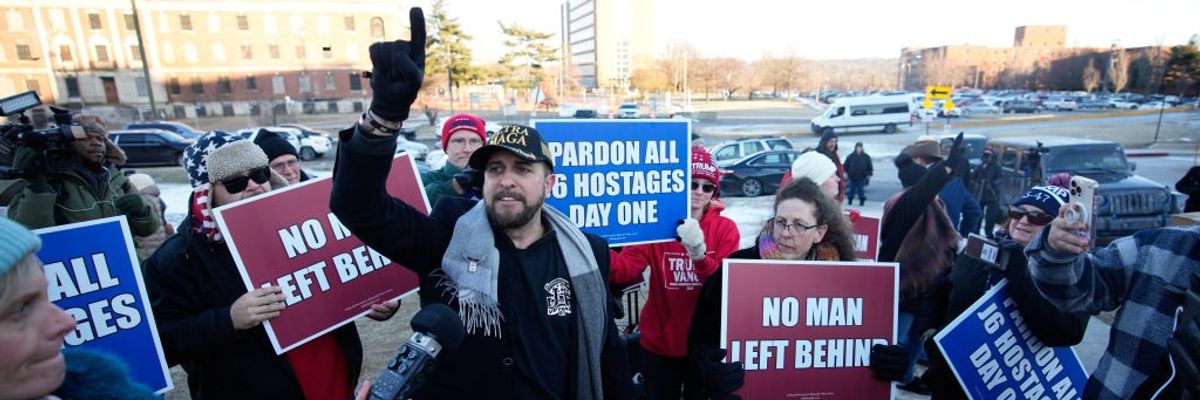
Joshua Macias gathers with demonstrators outside the Central Detention Facility in Washington, D.C. on January 20, 2025 before President Donald Trump pardoned insurrectionists.
(Photo: Bryan Woolston/Getty Images)

Jessica Corbett
Jan 20, 2025
COMMON DREAMS


Democracy defenders on Monday night swiftly condemned U.S. President Donald Trump's decision to pardon roughly 1,500 insurrectionists who stormed the Capitol on January 6, 2021 and commute the sentences of some others.

The widely anticipated move, which Trump made with television cameras in the Oval Office, came just hours after he returned to power on Monday afternoon—despite being convicted of 34 felonies in New York last year and facing various other legal cases, including for his attempts to overturn his 2020 loss to Democratic former President Joe Biden that culminated in inciting the 2021 Capitol attack.

"Just hours after promising to bring 'law and order back to our cities,' Trump pardoned more than a thousand January 6th rioters and put violent offenders right back in our neighborhoods—people who assaulted police officers, destroyed property, and tried to overturn our freedom to vote," said Sean Eldridge, president and founder of the progressive advocacy group Stand Up America, in a statement.

"By giving January 6th rioters a free pass, Trump is rewarding political violence and making all of us less safe," he continued. "No one should be above the law in the United States of America, and our first responders and the American people deserve better than this."


Joseph Geevarghese, executive director of the grassroots progressive political organizing group Our Revolution, said that "Trump's pardons of January 6 rioters, including those convicted of violence against law enforcement, mark a grave and unprecedented attack on the rule of law and American democracy. This move not only erases accountability for one of the darkest days in our nation's history but also emboldens far-right extremists and grants them free license to continue their ideological reign of terror."

"These are not patriots, these are traitors who will now be free to recruit others into what Trump views as his own personal militia," he asserted. "By granting clemency to these individuals, who sought to overturn the peaceful transfer of power, Trump is signaling that political violence and the rejection of democratic norms are acceptable tactics in service to his authoritarian agenda. This is a direct threat to the foundations of our democracy and the safety of our communities."


Lisa Gilbert, co-president of watchdog Public Citizen, said that "it is perhaps on-brand that Donald Trump has kicked off his second term with an assault on our democracy, just as he ended his first term."

"This isn't just about degrading the U.S. Constitution and the rule of law in theory, his disgraceful actions here send a message that political violence is acceptable, so long as it is in support of him and his pursuit of unchecked power," she continued. "We intend to fight against these types of abuses over the next four years to maintain the integrity of the rule of law."

Accusing the Republican of "condoning insurrection," Common Cause president and CEO Virginia Kase Solomón similarly warned that "this will not be the last time President Trump attacks democracy" and vowed that her organization stands "ready to defend it."

During the insurrection, Kase Solomón said, "people died and more than 140 law enforcement officers were injured protecting members of Congress from the attack that followed. These deaths and injuries should not be in vain. To pardon those involved is a blatant and dangerous abuse of power."

"Trump was charged with multiple crimes for his attempts to overturn the 2020 election which ended in the insurrection at the Capitol," she noted. "Only his reelection, coupled with an extremely misguided ruling from the Supreme Court on presidential immunity, allowed him to escape trial. In pardoning those who attempted to violently overturn the election and invalidate 80 million votes, Trump is showing his contempt for our justice system and our democracy."

Noah Bookbinder, a former federal prosecutor who is now president of the watchdog Citizens for Responsibility and Ethics in Washington, warned that "giving a pass to those who participated, all of whom were convicted after trial with ample evidence and process or pleaded guilty to crimes, sends a message that the right of the people to choose our own leaders no longer matters because the results can merely be overturned by force."

"And," he said, "it raises a terrifying question: What happens if Trump doesn't want to leave the White House at the end of his term?"

Trump commuted the sentences of Jeremy Bertino, Joseph Biggs, Thomas Caldwell, Joseph Hackett, Kenneth Harrelson, Kelly Meggs, Roberto Minuta, David Moerschel, Ethan Nordean, Dominic Pezzola, Zachary Rehl, Stewart Rhodes, Edward Vallejo, and Jessica Watkins. The others—whom Trump called "hostages"—received "a full, complete, and unconditional pardon."

"I further direct the attorney general to pursue dismissal with prejudice to the government of all pending indictments against individuals for their conduct related to the events at or near the United States Capitol on January 6, 2021," Trump's order said. "The Bureau of Prisons shall immediately implement all instructions from the Department of Justice regarding this directive."

Shortly before leaving office on Monday, Biden issued a final wave of pardons, including for members of the U.S. House of Representatives select committee that investigated the insurrection. The Democrat said that he could not "in good conscience do nothing" to protect them and the pardons "should not be mistaken as an acknowledgment that any individual engaged in any wrongdoing, nor should acceptance be misconstrued as an admission of guilt for any offense."


This post has been updated with comment from Citizens for Responsibility and Ethics in Washington.


Op-Ed

Trump Has Pledged an Era of Spectacular Violence. We Can’t Be Passive Onlookers.


Trump is poised to employ his mastery of spectacle to expand the oppressive forms of state violence at work in the US.
January 19, 2025


The incoming Trump administration is preparing to carry out a major chapter of state violence in U.S. history. The mass deportations that Donald Trump is planning aim to be in the same league as the internment of Japanese and Japanese Americans during World War II. Attacks on progressive nonprofit organizations (particularly those involved in the movement to stop the genocide of Palestinians), as well as plans for sweeping criminalization of protest call to mind the McCarthy era of the 1950s and the Counter Intelligence Program (COINTELPRO) of the 1960s and ‘70s.

State violence centrally involves the use of force by police agencies, at the border and by the military, and it is an ongoing feature of daily life. Deportations, detaining migrants, separating families, humiliating and isolating people who seek entry to the country at border stations — these are just some features of the daily violence that constitutes operating the U.S. border. Making a spectacle of that violence — rather than concealing it — is central to Trump’s approach.

Consider, in contrast, President Joe Biden’s approach to the border. There can be no doubt that while Biden rhetorically discussed a more humane approach to the border, his actual tenure has been devastating for migrants. Biden deported 271,484 people in 2024 alone — the highest number of any year since 2014. He maintained Trump-era border restrictions, such as the misuse of the Title 42 public health statute to deny migrants access to the U.S. and violate due process of asylum seekers. In its opening days, the Biden administration detained 14,000 Haitian migrants seeking asylum, and summarily deported them en masse. The devastating episode involved U.S. border agents on horseback whipping Haitians, producing photos reminiscent of slavery.

But the Biden administration disavowed those images. Jen Psaki, the White House press secretary at the time, said: “It’s important for people to know this is not who we are. That’s not who the Biden-Harris administration is.”

Similarly chaotic scenes at the U.S.-Mexico border — where desperate migrants faced deprivation, detention and deportation — were put on an endless loop by Fox News to promote the notion of a “border crisis” to the embarrassment of the Biden administration. He preferred for the actions of U.S. agencies on the border to be invisible.

Related Story   

Surveillance Technologies Don’t Create Safety. They Intensify State Violence.
Surveillance technologies create a dragnet to monitor nearly everyone and collect data on all of our behaviors. By Ed Vogel & Fletcher Nickerson , Truthout May 21, 2023

Trump, on the other hand, wants his state violence to be highly visible. During his first term in 2018, as caravans of migrants from Central America approached the U.S.-Mexico border, Trump’s Department of Homeland Security (DHS) actually closed lanes of traffic on the San Ysidro crossing between Tijuana and San Diego, one of the busiest land border crossings in the world, and added additional concrete barriers to the road. The resulting backup of cars and trucks provided visuals that illustrated Trump’s narrative of an overwhelmed border that required violence to establish control over it.

That violence came. Less than a week after the incident at San Ysidro, U.S. police forces fired tear gas across the border into crowds of thousands of migrants on the Mexico side. Trump combined that armed attack on migrant families with a denial of their entry to the U.S. to seek asylum, violating the law and denying them due process.

The 2018 episode is instructive. Trump manufactured a “crisis at the border” to justify the use of graphic violence. His administration used these acts to illustrate a story it told, in which U.S. forces acted as brave defenders of the nation against invading villains. Then-Homeland Security Secretary Kirstjen Nielsen threatened at the time to prosecute “anyone who destroys federal property, endangers our front-line operators, or violates our nation’s sovereignty.”

She added that, “DHS will not tolerate this type of lawlessness and will not hesitate to shut down ports of entry for security and public safety reasons” — though the only “lawlessness” came from U.S. border agents.

Lastly, Trump deployed this set of actions and rhetoric to officially change policy, reversing longstanding legal rights for asylum seekers.

Trump’s signature campaign promise for his first term — building a wall on the U.S.-Mexico border — was similar. By the end of his first term, Trump had 458 miles of wall built. The vast majority of this construction, however, was on sections of the border where there were already barriers built by previous administrations, including Democratic ones. Despite the fact that new barriers were redundant, Trump tweeted video of the construction of what he called a “powerful Wall.” The imagery of the wall’s construction was more important than the actual operation of the barrier.

But there is a function of the spectacle of the wall beyond the physical construction of the wall itself. The deployment of this imagery — broadcasting scenes of children being torn from their families and detained via the “child separation policy” — are central to producing a more violent and repressive society.

Trump as a Master of Spectacle

These actions, and the images that accompany them, are not just the work of a provocative demagogue, as much as Trump is one.

In his seminal work, The Society of the Spectacle, critical theorist Guy Debord writes, “the spectacle cannot be understood either as a deliberate distortion of the visual world, or as a product of the technology of the mass dissemination of images. It is far better viewed as a weltanschauung that has been actualized, translated into the material realm — a worldview transformed into an objective force.”

When Debord published this work in 1967, he was grappling with the rise of mass media — not just as a new means to transmit the ideas of governments and corporations, but as a force all its own in imposing capitalist relations on society. The result is a society where we are by and large reduced to “spectators,” watching history happen to us rather than subjects who are collectively shaping it.

Today, in a time shaped by both mass media and social media, the powerful portray their actions as inevitable and invincible — and the rest of us are relegated to being observers and commentators.

With a lifetime in the elite and years of experience as a media personality, Trump is a master of spectacle. He will use this mastery — along with a robust right-wing media infrastructure; social media platforms helmed by executives eager to serve him and promote their shared worldview; and a powerful policing, detention and border apparatus — to ratchet up oppression.

This oppression will be highly functional and strategic. Trump’s broader program includes extremely unpopular policies such as enormous tax cuts for the wealthy and corporations at the expense of Social Security and public services. Trump takes potential outrage from those who will suffer from his policies and redirects their energy into furious resentment against immigrants, LGBTQ folks, Black people, and others. This approach is not particularly new or unique, but Trump is highly effective at it, which explains his support among the wealthy.

But Trump’s program cannot be reduced to a distraction to implement a regressive economic program. It is instead an ever more oppressive worldview that reserves special brutality for targeted communities.

The Transition From Trump to Biden

Will Trump be worse than Biden? This has been a complicated question to answer for many on the left in light of Biden’s unwavering participation in Israel’s genocide in Gaza. For sections of the population, there will be a dramatic, catastrophic change from Biden to Trump. The new attacks on reproductive rights, LGBTQ folks and women, immigrants and Muslims should not be underestimated. We should also prepare for a new round of attacks on organizing, beginning with especially vulnerable activists, such as international students, Muslim and immigrant organizers. But such attacks are already happening under Biden, who has presided over mass arrests of student protesters and the criminalization of organizing for Palestine.

Beyond formal policing and other actions of the state, Trump’s return to the White House seems certain to encourage far right elements on the ground. In some cases, this will be direct and literal, as Trump pardons Proud Boys and other far right actors who participated in the January 6 attack on the Capitol.

This continuity between Biden and Trump — and convergence between the Democratic Party and MAGA — complicates an assessment of Trump and made it difficult for many progressives to support Kamala Harris’s campaign.

The Democratic rightward turn is not limited to support for Israel and repression of the movement resisting genocide. As Ron DeSantis and Greg Abbott have made moves similar to Trump’s — stationing the military at the U.S.-Mexico border and busing migrants to cities run by Democrats — Democratic officials have responded with their version of anti-immigrant politics. From Mayor Eric Adams declaring that “immigrants will destroy New York City” to Massachusetts Gov. Maura Healey seeking to revisit the state law requiring the sheltering of homeless families in the face of what she called “waves and waves of people,” many Democratic leaders have accepted the premise that immigration is a “problem” because immigrants drain public resources. This is hardly the basis for a firm opposition to the unfolding anti-immigrant onslaught.

Similarly, Massachusetts Democratic Rep. Seth Moulton’s comments targeting trans children following the election, which provoked fairly little outcry among his colleagues in office, may be an indicator of just how far right politics in the U.S. have shifted, especially within the political class, including among Democrats.

The continuity between Biden and Trump means that Biden inherited a set of tools from Trump to crack down on immigration. Biden used and stewarded the deportation infrastructure, which he is now handing back to Trump even stronger. Biden may have deported people more quietly than Trump, but the incoming president will employ his mastery of spectacle to both use and extend oppressive measures that Biden has put in place.

None of this is to minimize the impact of Trump’s program, which is certain to be devastating. It is worth drawing lessons from similar figures around the world, like El Salvador’s President Nayib Bukele, who has tweeted from his personal account videos of his government humiliating people it has incarcerated. Making a spectacle of this violence has gone hand in hand with Bukele’s endlessly extended “state of emergency,” which he has used to usher in a new era of authoritarianism.

In this context, what is possible in terms of resistance and progressive politics under Trump? This is also a complicated question to answer, because on one hand, Trump’s broadcasting of a cruel crackdown may provoke mass opposition. But conversely, Trump’s wave of repression may achieve its goal of intimidating many into inaction and despair. It will likely be a mix of the two, and the challenge for organizers, activists and the left is to defend against such attacks and push the possibilities for a radically different direction for society as far as they will go. Above all else, we need to find our collective strength as actors, and must refuse to be spectators.

This article is licensed under Creative Commons (CC BY-NC-ND 4.0), and you are free to share and republish under the terms of the license.

We need your help to become less dependent on traffic from Facebook and X. Follow us on Bluesky today!


Khury Petersen-Smith is the Michael Ratner Middle East Fellow at the Institute for Policy Studies.


Trump Makes Frightening Far Right Promises in Inauguration Speech


Trump made promises to target LGBTQ people and immigrants, and to enact a number of other right-wing plans.
January 20, 2025

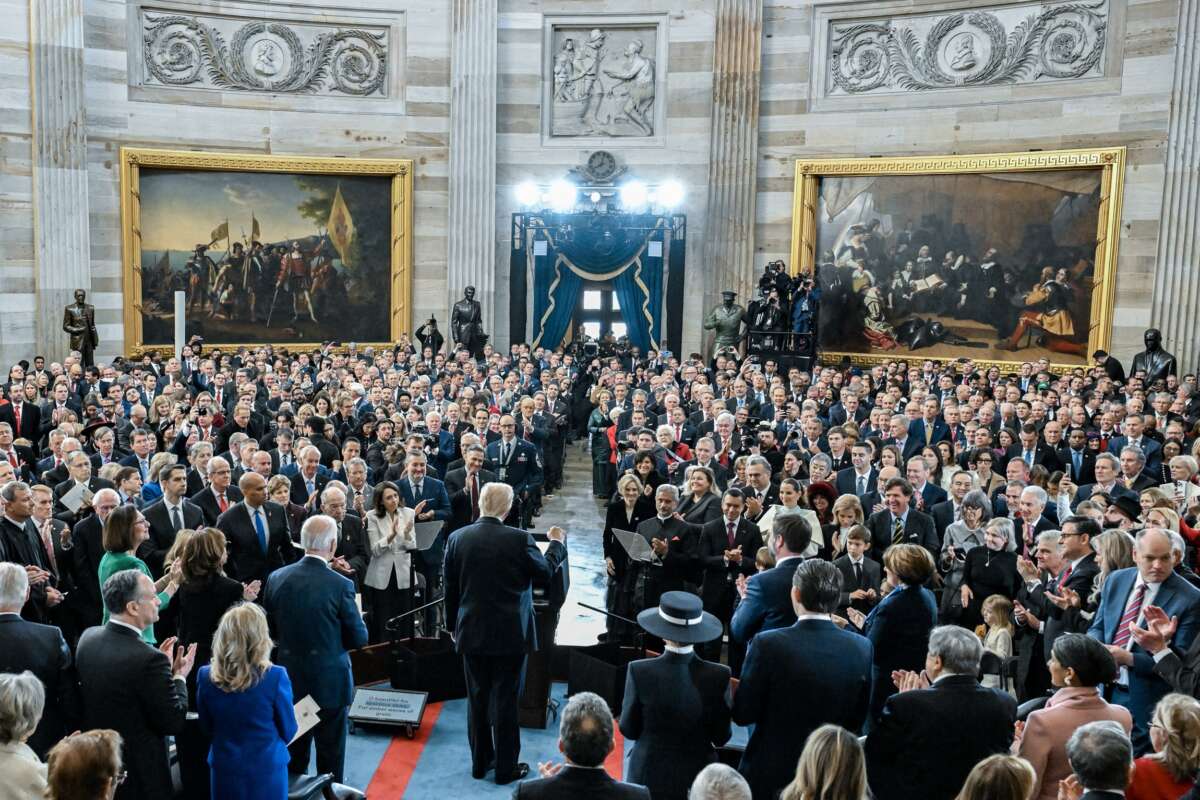
The inauguration of Donald Trump as the 47th president of the United States, inside the Capitol Rotunda of the U.S. Capitol building in Washington, D.C., on Monday, January 20, 2025.Kenny Holston/The New York Times/AFP via Getty Images

Donald Trump has officially been sworn in as the 47th president of the United States.

The quadrennial ceremony was moved inside due to cold weather, held in the rotunda of the U.S. Capitol building — the very place where, four years earlier, hundreds of Trump loyalists violently disrupted the certification of the 2020 election after Trump lost the race to Joe Biden, an event that led to hundreds of participants being charged and convicted.

Though Trump himself received indictments for instigating the attack and doing nothing to stop it (among other actions he took to overturn the 2020 election), he avoided a trial by using delay tactics in the courts. Ultimately, the charges against Trump were dropped by Department of Justice (DOJ) special counsel Jack Smith after he won the 2024 presidential election.

Trump took his constitutionally mandated oath of office, administered by Chief Justice of the Supreme Court John Roberts, at noon Eastern Time. First Lady Melania Trump stood by his side, with nearby onlookers including other members of Trump’s family, his various nominees for his cabinet, and the three richest people in the world: Elon Musk, Jeff Bezos and Mark Zuckerberg.

After taking the oath and receiving a round of applause, Trump addressed the nation, as is typical during presidential inauguration ceremonies.

Trump attempted to portray himself as seeking unity with his political detractors — yet, at various points, he discussed his grudges against his opponents and attacked entire groups of people, making false and disparaging claims against them.

He announced numerous executive orders he would sign later in the day — including orders targeting immigrants and LGBTQ people, directives requiring schools to teach a whitewashed version of U.S. history, and the enactment of a fossil fuel-focused anti-climate energy policy.

Trump also said he would declare a “national emergency” at the U.S.-Mexico border, and would use the Alien Enemies Act of 1798 to enact his other immigration policies. He repeatedly used dehumanizing language to describe immigrants living in the U.S., calling their presence in the country an “invasion.”

Trump’s speech included a direct attack on transgender and nonbinary people. He wrongly insisted that “there are only two genders: male and female,” and said that he would issue an executive order directing government agencies to follow this scientifically errant and long discredited principle.

Trump also inserted religious imagery within his speech, a clear acknowledgment of the Christian nationalists that supported him during the campaign. The president invoked the attempt on his life from this past summer, for example (an incident he once vowed he would never bring up again), stating that God spared his life that day “to Make America Great Again,” citing his campaign slogan within his storytelling.

“We will not forget our God,” Trump added later on.

Trump also stated that he would “forge a society that is color blind,” and that he wanted to make Martin Luther King Jr.’s “dream come true.” But he also said his administration would end diversity, equity and inclusion (DEI) practices, falsely stating that children across the country were being taught “to be ashamed of themselves” by being given lessons describing the history of slavery and racism in the U.S.

He also touched upon his imperialist ambitions, calling for the U.S. to reclaim the Panama Canal after errantly claiming that a treaty with that country had been violated. “We’re taking it back,” Trump said. He then claimed that he would change the name of the Gulf of Mexico to the “Gulf of America.”

Trump wrongly asserted that the country is “rapidly” coalescing behind his agenda, describing his election win as a “mandate” to “completely and totally reverse a betrayal” against him. In fact, Trump won the election without support from a majority of voters, showcasing that his win is not actually a mandate, and recent polling shows that in the weeks since the 2024 election, his statements and actions during the presidential transition period have made Americans less confident in his ability to lead.

He ended his disunifying speech by claiming that he would usher in “the four greatest years in American history,” adding that his administration is “going to win like never before.”

“Nothing will stand in our way. … The future is ours, and our golden age has just begun,” Trump concluded.

Trump enters office with a long list of far right priorities, chief among them a pledge to enact an unprecedented and inhumane mass deportation plan targeting immigrants in the U.S. — a plan that will undoubtedly lead to the separation of families and due process rights being disregarded. The plan will also likely feature detention camps, a horrifying recollection of internment camps targeting Japanese residents in the 1940s and concentration camps in Nazi Germany, critics have warned — not to mention, mass deportation campaigns the U.S. has conducted in the past.

Trump has also shown he intends to govern in fascist and autocratic ways. These include:Urging the military to suppress left-leaning dissenters who disagree with him;
Vowing to use the Justice Department to go after his political opponents;
Calling for the Federal Communications Commission (FCC) to restrict media that criticizes him or produces reports that portray him in a negative light;
Campaigning on restricting the rights of LGBTQ people, with particular emphasis on transgender people.

Reactions to Trump’s speech were varied, with critics warning that his speech was a harbinger of troubling developments to come.

Former Labor Secretary Robert Reich took note of the oligarchy that would aid Trump during his next four years in office. “Big Tech billionaires had a front row seat at Trump’s inauguration. They were seated in front of Trump’s own cabinet. Tells you everything you need to know,” Reich said in a post on Bluesky.

Lawyer and frequent Trump critic Tristan Snell observed that many of the talking points in Trump’s speech were “LITERALLY a rundown of Project 2025,” a far right manifesto drawn up by the Heritage Foundation that Trump had tried to distance himself from during the campaign.

“Funny, for a guy who tried to say he had nothing to do with Project 2025, he sure is copycatting a bunch of its content,” Snell added.

Imara Jones, journalist and CEO of TransLash Media, called attention to Trump’s anti-LGBTQ rhetoric.

“Trump’s recognition of only ‘two genders’ means a war on trans people, as well as any cis person with a gender expression outside of the gender binary,” Jones said.

Zeteo founder Mehdi Hassan expressed his grievances with those who attended the speech knowing who Trump is and what he stands for.

“None of what you saw today was normal. Shame on those Democrats and ‘liberal media’ journalists who helped normalize it,” Hassan wrote. “A narcissistic insurrectionist using neo-Nazi rhetoric, who should have been disqualified from running, who should have been tried & convicted long ago, is now president again.”


Trump Is Packing His Cabinet With Crypto, Oil and Private Prison Profiteers

Trump’s policy makers will be overseeing the industries that they run and own
.

January 18, 2025

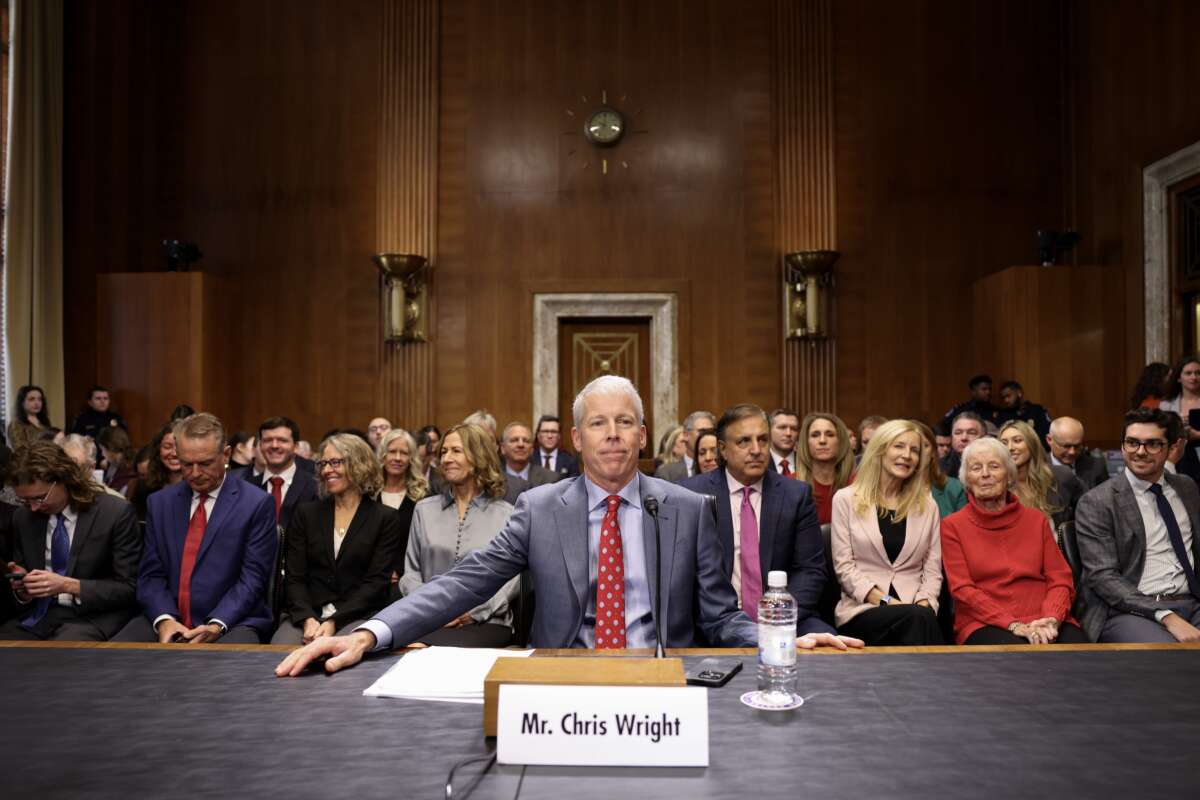
Chris Wright, Donald Trump's nominee for secretary of energy, testifies during his Senate Energy and Natural Resources confirmation hearing on Capitol Hill on January 15, 2025, in Washington, D.C. Wright is CEO of Liberty Energy, which is the second-largest fracking company in North America
Kayla Bartkowski / Getty Images

Money in U.S. politics is nothing new, but the scale of crass intervention in 2024 by mega-billionaire donors through super PACs was unprecedented. Now, corporate elites are indicating they could exert new levels of direct influence within the incoming Trump administration.

Elon Musk, worth over $430 billion, has rightly dominated this story. After spending nearly $300 million toward electing Donald Trump and his GOP allies, Musk, amid a minefield of conflicts of interests, has entered the president-elect’s innermost circle and is helping to shape the new administration.

But the breadth of direct corporate sway within the incoming regime goes beyond big campaign donations and individual players like Musk. What’s becoming clear is that key spheres of policy-making — energy, finance and tech — will be overseen by wealthy figures plucked from the industries they’re tasked to oversee.

Some nominees claim they’ll remove themselves from positions and investments that present competing interests. “All nominees and appointees will comply with the ethical obligations of their respective agencies,” Trump transition spokesperson Brian Hughes told Truthout in a statement. Still, watchdog groups worry that the new administration will be mired in corporate influence and conflicts.

Jeff Hauser, executive director of the Revolving Door Project, which monitors executive branch appointees, told Truthout that, while the first Trump administration was “catastrophically corrupt,” it still made gestures toward limiting conflicts of interest. But now, he says, “there are essentially no restraints being promised.”

Fossil Fuels

Trump rode to reelection vowing to “drill, baby, drill” and courting oil billionaires who donated handsomely to his campaign. Now, he’s tapped a clique of industry representatives and allies to oversee that agenda.

Chris Wright, a fracking industry diehard, is set to become Trump’s energy secretary, overseeing the nation’s energy programs and nuclear infrastructure.

Wright is CEO of Liberty Energy, a Denver-based fracking company with operations across major North American drilling fields. Liberty reported $4.7 billion in revenue and $556 million in profits in 2023. As of January 3, 2025, Wright owned over $50 million in Liberty Energy stock.

Wright famously drank fracking fluid claiming it was safe, and he boasts of the “many positive changes” of climate change, which he says is not a global crisis. Wright and his wife donated $540,000 toward Trump’s reelection.

It’s unclear whether Wright will divest from his energy holdings, though he’s reportedly resigning from the board of a nuclear company that receives federal subsidies.

During his confirmation hearing Wednesday, Wright said, “appropriate ethics people” had reviewed his investments, and he has “agreed to take all the appropriate action to avoid any real conflicts or perceived conflicts of interest.”

North Dakota Gov. Doug Burgum, Trump’s pick for interior secretary, will play an even more influential role in the administration’s fossil fuel agenda.

Key spheres of policy-making — energy, finance and tech — will be overseen by wealthy figures plucked from the industries they’re tasked to oversee.

Burgum will oversee more than 500 million acres of federal lands that Trump wants to open up for oil drilling, and he’ll also serve as Trump’s energy czar and head of his National Energy Council, tasked with implementing Trump’s “energy dominance” agenda.

Burgum governs the nation’s third-largest oil producing state, where many politicians are close to the fracking industry. Burgum’s predecessor in North Dakota, John Dalrymple, now sits on the board of a coal corporation.

Burgum is a close ally of oil billionaire Harold Hamm, a longtime Trump backer and key liaison with the fossil fuel industry.

Hamm’s drilling company, Continental Resources, is the largest oil and gas leaseholder in the state. Burgum has earned up to $50,000 leasing 200 acres of his farmland to Hamm and Continental for drilling.

Hamm organized the 2024 fundraiser where Trump asked for $1 billion from the oil industry in exchange for carrying out its agenda. Burgum attended the fundraiser alongside Hamm.

Chris Wright was Hamm’s top choice for energy secretary, and Wright’s wife, Liz Wright, co-hosted a Trump fundraiser last August that featured Burgum.

“The people with authority over energy and the environment are all committed to the destruction of the planet’s delicate ecosystem,” said Hauser.


A Cabinet of the 1 Percent

To the delight of Wall Street, Trump has promised to cut corporate taxes and weaken financial regulations. The private equity and hedge fund billionaires who backed Trump are now hoping to accelerate mergers and acquisitions and access trillions in retirement savings.

(Historically, private equity firms — huge investors in private markets that charge higher fees, are more opaque and make riskier investments — have been restricted from accessing 401(k)s and other defined-contribution retirement plans.)

Now, Trump is placing industry figures in top positions overseeing his economic policies.

Billionaire Howard Lutnick is set to be commerce secretary. Lutnick is the CEO of Cantor Fitzgerald, a huge financial services firm, and chairman of BGC Group, another financial services firm.

“His companies are involved in nearly every sector in the U.S. economy,” wrote the New York Times after Trump’s announcement of his pick.

As commerce secretary, Lutnick will hold a powerful role over U.S. economic and business policies. He is also Trump’s transition co-chair, charged with filling 4,000 positions in the new administration.

Another billionaire, Scott Bessent, who donated more than $1.6 million toward Trump’s election efforts, is set to become treasury secretary. Bessent heads a hedge fund, Key Square Group, which manages hundreds of millions in assets.

While corporate executives have praised Bessent’s nomination, Hauser is skeptical. “He’s ludicrously unqualified for the job,” he told Truthout. “I think he is going to use the position to make himself and his friends richer.”

If confirmed, Bessent says he’ll divest from dozens of holdings and his hedge fund, while Lutnick says he’ll leave Cantor Fitzgerald and its spin-offs and divest his interest in those companies.

Other high-up appointees and nominees have close ties to finance. Stephen Feinberg, Trump’s pick for the deputy secretary of defense, the second-top Pentagon position, is a billionaire private equity executive, while finance executive Frank Bisignano, picked to head Social Security, was once the second-highest paid U.S. CEO, in 2017, during Trump’s first term.

Carceral Lobbyists and Consultants

Key Trump appointees and nominees are corporate lobbyists and consultants whose clients include those who profit from prisons.

Pam Bondi, Trump’s nominee for attorney general, served two terms as Florida’s attorney general before joining lobbying and legal firm Ballard Partners in 2019.

To resist the onslaught of billionaire and corporate control of politics we need publicly funded elections and to overturn the Supreme Court’s Citizens United ruling.

A New York Times profile depicts Bondi as a corporate-friendly Florida attorney general, with an “open-door approach to companies” and “transactional philosophy” and, as a lobbyist, an ability to “help grease relations with the Trump administration.”

One of Bondi’s lobbying clients was GEO Group, the Florida-based private prison corporation. Bondi was a registered lobbyist for GEO Group in 2019 on the issue of “promoting the use of public-private partnerships in correctional services.”

Share prices for private prison companies have soared since Trump’s reelection. In December 2024, GEO Group announced $70 million in new capital expenditures to service Immigration and Customs Enforcement (ICE) immigration jails. GEO Group says it is the largest service provider to ICE.

Bondi was also registered to lobby for the Florida Sheriffs Association and Major County Sheriffs of America ​through 2024. Her other corporate clients have included Amazon, Uber, General Motors and the mega-cruise line Carnival Corporation, who she helped snag an Oval Office meeting with Trump.

Trump’s chief of staff and transition co-chair, Susie Wiles, was also a lobbyist for Ballard, as well as another firm, Mercury Public Affairs, with numerous clients that included fossil fuel companies like ​Alliance Resource Partners, the fourth-biggest U.S. coal producer.

Tom Homan, Trump’s hardliner pick for “border czar” promising to oversee mass deportations, runs a consulting firm, Homeland Strategic Consulting LLC, that claims it’s helped its clients obtain “tens of millions of dollars of federal contracts.”

While its corporate clients are not disclosed, the firm says it “has been extremely successful in assisting small and large companies in business development with both federal and state governments,” and notes the firm’s close ties to government agencies like the Department of Homeland Security, Department of Justice and ICE.

Among other roles, Homan is also a “strategic advisor” for the Government Technology & Services Coalition (GTSC), a nonprofit association of “midsized company CEOs that create, develop, and implement solutions for the Federal homeland and national security sector.”

Past GTSC events include “ICE Day” conferences featuring Homan and past annual reports list over 200 member corporations across tech, finance and weapons industries.

Homan previously served as acting director of ICE during the first year of the Trump presidency.

Crypto-Corruption

The 2024 election saw a nexus of tech and cryptocurrency billionaires ardently back Trump. Elon Musk is the most well-known example, but other powerful people joined him.

These include Marc Andreessen, co-head of the largest U.S. venture capital fund for cryptocurrency and tech; Brian Armstrong, CEO of Coinbase, a top cryptocurrency exchange; the Winklevoss twins, who run the Gemini cryptocurrency exchange; and the influential Silicon Valley investor and former PayPal executive David Sacks.

This bloc has now emerged as a true force in U.S. politics, and it has a clear agenda aimed at deregulating AI and crypto industries.

“Silicon Valley is now kind of co-dominant with Wall Street, the traditional center of the economy, and deciding what sectors of the economy will get investment and grow,” economist Rob Larson, author of books on tech elites and the ruling class, told Truthout. “It’s conspicuous how many of those figures were so heavily evolved in this election.”

In particular, Silicon Valley billionaires oppose Biden’s Securities and Exchange Commission (SEC) chair, Gary Gensler, who they see as overregulating cryptocurrency, and Biden’s United States Federal Trade Commission head Lina Khan, a staunch antitrust regulator.

All told, crypto and tech billionaires poured hundreds of millions of dollars toward electing Trump and his GOP allies, and for this, they have been rewarded with major influence within the new administration.

Trump named David Sacks the “White House A.I. & crypto czar” overhauling regulatory policies toward these industries. Trump also announced a new “crypto advisory council” that will contain industry representatives to assist with this.

Trump is also nominating a new pro-crypto SEC chair, Paul Atkins, currently CEO of financial services company Patomak Partners. Trump seems likely to pick an industry-friendly chair for the Commodity Futures Trading Commission. Right-wing billionaire Peter Thiel is also reportedly providing a “staffing pipeline” for the administration.

Commerce secretary nominee Lutnick has close ties to cryptocurrency. His firm Cantor Fitzgerald is a 5 percent owner of Tether, a privately run digital dollar that has been called the “de facto reserve currency for crypto,” and Lutnick seems intent on expanding his ties to crypto.

Trump’s own social media company, Trump Media and Tech­no­logy Group, is in talks to buy Bakkt, a cryptocurrency trading venue whose former CEO is Kelly Loeffler, who Trump has nominated to head his Small Business Administration. Trump also has his own crypto project, World Liberty Financial.

“Trump is no longer pretending in any meaningful sense that he will rein in his own personal conflicts of interest,” says Hauser. “I think that the scale of corruption possible with things like Trump’s crypto investments and Truth Social are incredible.”
Deadly Appointments

To resist the onslaught of billionaire and corporate control of politics, Larson says we need publicly funded elections and to overturn the Supreme Court’s Citizens United ruling. But he says winning “major progressive national policy changes” like these will “take a lot of absolute bedrock level organizing and building for some time.”

Meanwhile, Hauser says people focus more on the actions he’s taking, especially through his key appointments, than his outlandish speech.

“If we focus on him as the utterer of abhorrent things, then he can, in the shadows, give away the store to America’s worst corporations,” says Hauser, with consequences that go beyond “the abstract value of clean government.”

“Workers will die needlessly, consumers will be gouged, the environment will decline,” says Hauser. “These are tangible consequences of misgovernment.”