It’s possible that I shall make an ass of myself. But in that case one can always get out of it with a little dialectic. I have, of course, so worded my proposition as to be right either way (K.Marx, Letter to F.Engels on the Indian Mutiny)
Wednesday, January 29, 2025
Sean Duffy Confirmed as U.S. Secretary of Transportation
Then-Rep. Sean Duffy, 2017 (Adam Fagen / CC BY-NC-SA 2.0)
The U.S. Senate has confirmed the appointment of Transportation Secretary Sean Duffy, a former congressman from Wisconsin and a former Fox Business host. Multiple U.S. maritime stakeholders have lined up to welcome Duffy and support his selection.
"The Shipbuilders Council of America congratulates Sean Duffy on his confirmation as Secretary of Transportation. His leadership comes at an important time when solutions are needed to strengthen domestic shipbuilding and ship repair, expand maritime infrastructure, and secure the resilience of the U.S. shipyard industrial base," said Matthew Paxton, President of the Shipbuilders' Council of America. "We stand ready to work alongside Secretary Duffy and the Department of Transportation to promote policies that uphold the strength and competitiveness of our nation’s shipyard workforce and maritime fleet."
The Coalition for America’s Gateways and Trade Corridors (CAGTC) highlighted opportunities to work with Duffy on major freight projects, leveraging federal grant opportunities such as INFRA, Mega and BUILD.
"Secretary Duffy shared the new Administration’s goal to invest in large, durable projects that connect the nation and commerce. CAGTC shares this goal and is eager to work with Secretary Duffy to ensure that nationally and regionally significant freight projects are advanced swiftly and funded robustly," said CAGTC Executive Director Elaine Nessle.
The secretary has authority over the U.S. Maritime Administration, including the National Defense Reserve Fleet, the Maritime Security Program and the U.S. Merchant Marine Academy. He also oversees several key infrastructure grant programs that benefit ports and landside freight transport stakeholders.
Like President Trump, Duffy got his start in public life on reality television, appearing on MTV's The Real World and Road Rules in 1997, 1998 and 2002. Duffy completed law school at William Mitchell College of Law and was appointed district attorney for Ashland County, Wisconsin in 2002, a post he held until he began his first campaign for Congress in 2010. He served for nine years in the House of Representatives, focusing his efforts on financial regulation in the House Committee on Financial Services. He resigned in 2019 and was hired by CNN as a contributor, but soon transferred to Fox News Media.
Most of Duffy's experience has been outside of the transportation sector, but he has encountered maritime affairs at least once before. In 2016, he was active on the Congressional Task Force on Economic Growth in Puerto Rico, which briefly contemplated Jones Act reform.
As Secretary of Transportation, Duffy will face an immediate task: all federal grant disbursements from all agencies were suspended for a review by the Trump administration on Tuesday, except for funds that are payable directly to individuals. At least seven states filed suit to block the pause, and a federal court immediately ordered the White House to reverse course and resume payments until at least next Monday.
A 52-page guidance document from the Office of Management and Budget shows the scope and depth of the administration's ongoing review, in which DOT will play a part. 2,600 accounts are listed for examination, including most of DOT's maritime portfolio, like the accounts for:
- Federal Ship Finance Guarantees
- Maritime War Risk Insurance
- Funding for state maritime schools,
- The U.S. Merchant Marine Academy
- The Maritime Security Program
- Federal Assistance to Small Shipyards
- The Marine Highway Grant Program
- The Capital Construction Fund
- The Port Infrastructure Development Program
- and the newly-enacted Cable Security Fleet and Tanker Security Programs
In advice to corporate clients, law firm Holland & Knight noted that the administration has already changed course on federal funding freezes several times, and suggested that this is an active area to monitor.
"As a practical matter, clients may need to expect delays in disbursements and manage cash flow as best they can. In addition, clients need to pay special attention to meeting the terms of any award or loan agreements so that there is no reason government officials can use to cancel the awards," Holland & Knight advised. "There are other budget statutes governing federal funds, such as the Prompt Payment Act, which may require the government to eventually honor federal obligations and even pay interest on late required payments."
Fourth U.S. Training Ship Floated at Hanwha Philly Shipyard
Lone Star State was moved from the dry dock to start her outfitting stage (Texas A&M Maritime Academy)
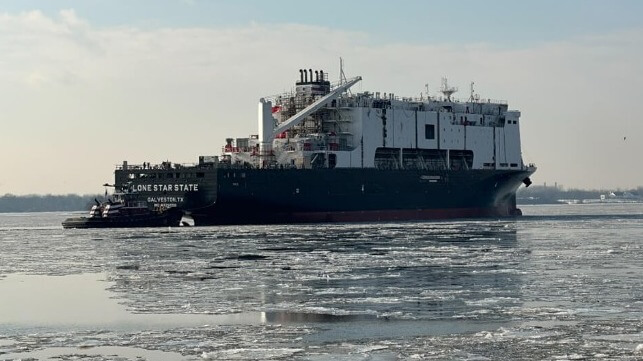
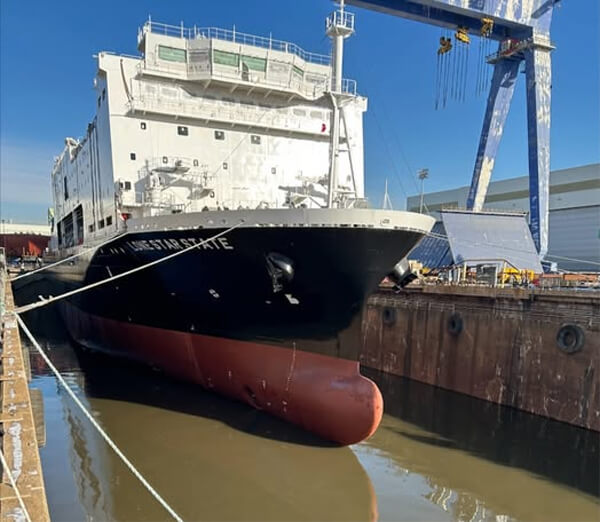
MARAD’s program to build the first modern training ships for the U.S. merchant marine marked another milestone with the floating of the fourth vessel of the class. The future Lone Star State which has been assigned to Texas A&M Maritime College took to the water for the first time on Friday, January 24, and was towed to the outfitting berth.
“This is an exciting milestone because the vessel moves from production on land to water, and it is one of the last major moves before heading out for sea trials,” said Hanwha Philly Shipyard posting a video of the repositioning. She was towed to a lay-berth where she will remain for the next two weeks while the dry dock is cleaned and reset. NSMV IV will then move to dry dock number five at Hanhwa Philly Shipyard for outfitting. According to the yard, much of the interior work will be done over the next few months.
Lone Star State afloat for the first time (Texas A&M Maritime Academy)
The future Lone Star State joins NSMV III, the future State of Maine, which is entering the final stages of her outfitting. She is due to be delivered to Maine Maritime earlier in 2025 and the Lone Star State is tentatively scheduled for delivery in late 2025. Work has also commenced on the fifth and final vessel of the class, the future Golden State, which is assigned to Cal Maritime and scheduled for delivery in 2026.
The U.S. Congress approved $325 million in funding to construct the NSMV in December 2020 for Texas A&M. The 524-foot state-of-the-art ship will feature instructional spaces, a full training bridge, and space for up to 600 cadets to train at sea. In addition, each ship of the class will have modern hospital facilities, a helicopter pad, and the ability to accommodate up to 1,000 people in times of humanitarian need. The NSMVs can also provide needed roll-on/roll-off and container storage capacity for use during disaster relief missions.
The first of the vessel, Empire State was delivered to SUNY Maritime College in New York and has completed its first training cruises. The second vessel, Patriot State, was delivered in September 2024 to Mass Maritime.
Texas A&M is currently using a hand-me-down from Mass Maritime as MARAD reassigned the TS Kennedy to the Texas college in April 2023 to replace a 1983-vintage ocean surveillance ship for the U.S. Navy that was sailing as the training ship General Rudder. Kennedy is a 1967-built C-5 Far East Clipper-class break bulk cargo ship that sailed till 1985 as the Velma Lykes, for Lykes Bros. Steamship Company. She was in the reserve fleet and saw service during Dessert Storm in Kuwait in 1991 before becoming a training ship in 2003.
The float-out was the first milestone of the shipyard after South Korea’s Hanwha Group completed the acquisition of the shipyard in December 2024. The group has committed to investing in the operations of the yard and looks to expand into naval work. Its current order book includes a rock installation vessel for Great Lakes Dredge & Dock Company and an order from Matson to build three 3,600 TEU, 854-foot Aloha Class container vessels. Steel cutting began in September 2024 with the vessels scheduled for delivery in 2026 and 2027.
Seawork 2025 Expands with a Dedicated New Associations Hall
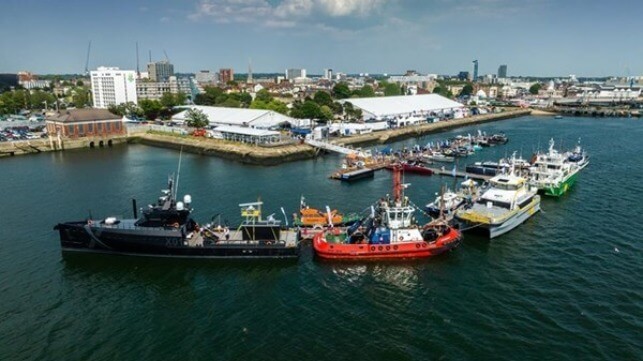
Seawork 2025, Europe’s leading commercial marine and workboat exhibition, is set to launch an exciting new feature – a dedicated Associations Hall – as part of its ongoing growth and commitment to fostering industry collaboration.
Building on the success of previous years, the expanded Hall 3 will become a dynamic Association Zone, welcoming both long-term supporters and first-time exhibitors. This vibrant space will serve as a hub for networking, professional development, and knowledge sharing, enabling supporting associations to connect with their members through social events, meetings, and speaking sessions held directly on-site.
Returning exhibitors include prominent organisations such as the Workboat Association, Society of Maritime Industries (SMI) and. Association of Diving Contractors. They will be joined by newcomers, including British Marine and the European Onshore Power Supply Association (EOPSA), further enriching the exhibition’s offering to the commercial marine industry.
The UK Harbour Masters Association (UKHMA), a steadfast supporter of Seawork for over 25 years, will once again play a significant role in the event. Following a highly successful 2024 programme that included hosting their AGM at Seawork, the UKHMA will return with their Summer National Council meeting and a sponsored members’ luncheon. Captain Martin Willis, Executive Officer of UKHMA, stated: “The UK Harbour Masters Association has been supporting Seawork since its inception 25 years ago. We greatly appreciate the reciprocal support from the Seawork team and look forward to the 2025 event, which allows our Professional and Commercial members to engage with the wider industry.”
New to Seawork 2025, the European Onshore Power Supply Association (EOPSA) will exhibit for the first time, promoting the adoption of sustainable onshore power solutions to support decarbonisation efforts in ports and port cities worldwide.
The dedicated Associations Hall provides participating organisations with an unparalleled opportunity to increase membership, create brand awareness, and promote events and services. With the addition of new exhibitors and the continued presence of established partners, the hall promises to be a cornerstone of Seawork 2025’s dynamic programme..
The products and services herein described in this press release are not endorsed by The Maritime Executive.
Norwegian Society for Sea Rescue Deploys IMAS® Across Entire Fleet
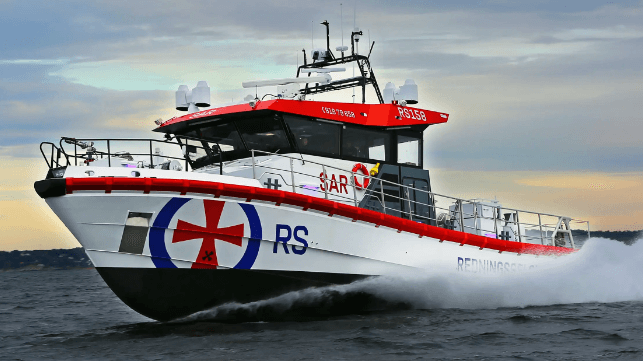
Hefring Marine and Norwegian Society for Sea Rescue (Redningsselskapet) strengthen partnership with fleet-wide deployment of IMAS® solution.
Hefring Marine is proud to announce the expansion of its collaboration with the Norwegian Society for Sea Rescue (Redningsselskapet). Following a rigorous two-year competitive selection process, Hefring Marine’s IMAS system has been chosen to be equipped on Redningsselskapet’s entire fleet, further strengthening Norway’s search and rescue capabilities.
This agreement marks a significant milestone in the collaboration that began in 2020, when Redningsselskapet became an early adopter of Hefring Marine’s first IMAS prototype. Over the years, the partnership has grown steadily, with eight vessels currently utilizing the innovative system. The newly-announced fleet-wide rollout will take place over 2025 and 2026, ensuring all Redningsselskapet vessels are outfitted with IMAS technology.
Gorm Hillgaar, Maritime Director from Redningsselskapet commented: “We are excited to reach this milestone with Hefring Marine, that will solidify our cooperation in the coming years with an expansion of the IMAS system to a fleet level. Through detailed testing and mapping of internal needs, we are positive that the IMAS system will play an important role to meet our strategic goals of optimising fleet utilisation and reducing the carbon footprint of our operations.”
IMAS is a state-of-the-art solution that enhances situational awareness, optimises operational efficiency, and improves safety for maritime operations. For Redningsselskapet, this fleet-wide adoption signifies a commitment to leveraging cutting edge technology to safeguard lives and optimize vessel usage along Norway’s rugged coastline.
“We are immensely proud of our partnership with the Redningsselskapet, and the full deployment of IMAS across their entire fleet of Norwegian Sea Rescue vessels marks a powerful milestone in our journey together”, said Karl Birgir Björnsson, CEO at Hefring Marine. “This decision reinforces our dedication to empowering Redningsselskapet in their lifesaving mission at sea. With our technology crafted to enhance maritime safety, we are thrilled to see it play a pivotal role in such vital operations.”
Redningsselskapet, the largest voluntary maritime rescue organization in Norway, plays a crucial role in ensuring maritime safety throughout the country. By equipping its vessels with IMAS, the organization ensures that its fleet administrators and crews have access to the most advanced tools available, enabling safer responses in challenging conditions, heightened training, increased capabilities for analytics and more efficient operations.
This partnership exemplifies the critical role technology plays in maritime safety and emergency response. Hefring Marine remains committed to providing innovative solutions that empower maritime operators and rescuers, ensuring that safety remains a top priority in all operations.
Together, the two organizations are poised to drive innovation and excellence in search and rescue operations for years to come.
The products and services herein described in this press release are not endorsed by The Maritime Executive.
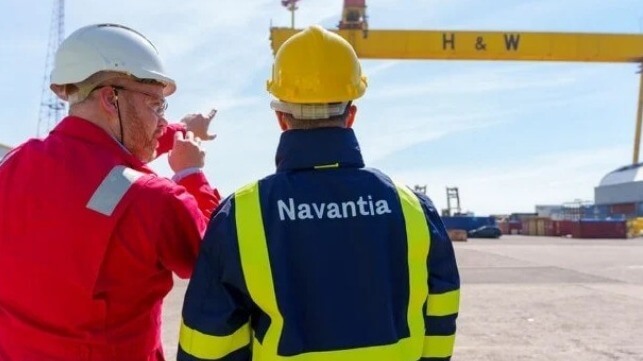
Spanish shipbuilder Navantia Group’s UK subsidiary completed the acquisition of the four shipyards and the offshore operations of the UK’s financially troubled Harland & Wolff Group. It was a strategic deal supported by the UK government and ensured the project to build three support ships for the Royal Fleet Auxiliary.
The UK government of Prime Minister Keir Starmer was heavily involved reporting it worked closely with Navantia UK and agreed on an amendment to the existing Fleet Solid Ship Program contract on commercial terms, which made the minimum changes necessary to ensure Navantia could still deliver on the contract and build all three navy ships. The support for the sale came after the government last summer decided not to provide loan guarantees for Harland & Wolff to refinance its operations.
In announcing that all the necessary regulatory approvals had been received, Navantia also thanked the UK government for its support during the negotiations. The company is committed to protecting more than 1,000 jobs while making investments in the operations.
“The completion of this acquisition marks a significant milestone for Navantia UK and demonstrates our long-term commitment to UK industry,” said Ricardo Domínguez, Chairman of Navantia. “By combining Harland & Wolff’s proud heritage and facilities with Navantia’s global expertise in defense, maritime, and renewable energy, we are creating an exceptional platform for growth.”
Navatia acquired the facilities of Harland & Wolff’s historic shipyard as well as the facilities of Appledore in Devon, and the smaller fabrication yards Methil and Arnish both in Scotland. The yard in Belfast and Appledore will both participate in the Royal Fleet shipbuilding program building components and outfitting the three vessels which will also be built by Navantia at the Puerto Real facility in Cadiz, Spain.
Harland & Wolff’s parent company went into administration last fall when the UK government refused to support the refinancing. Initially, the shipyards continued to operate but in mid-January, the company said it determined it was no longer possible to run the yards and they would also proceed into administration. It was reported as a step in the sale process making it possible for Navantia to buy the assets without taking on all the debts of Harland & Wolff.
The deal and the asset sale raised questions in the UK Parliament and concerns that suppliers would not be paid. GMB Union which represents workers at the yards today however released a message on social media saying closing the deal meant workers could relax with job security. However, the union noted that without more work the wards would continue to struggle.
The prior management group had acquired the storied Belfast yard from administration in 2019 and mapped a strategy to expand the business focusing on shipbuilding, repair, and opportunities in structures for the offshore energy market. They acquired the long-idle Appledore yard and the yards in Scotland and had begun to win assignments including its first new builds in 20 years. However, it also required extensive investments to modernize the facilities.
Navantia looks to use its extensive depth in the maritime industry both with naval construction and repairs to expand Harland & Wolff’s operations.
Ireland Apprehends Nine Men Hiding in a Container Arriving from Africa
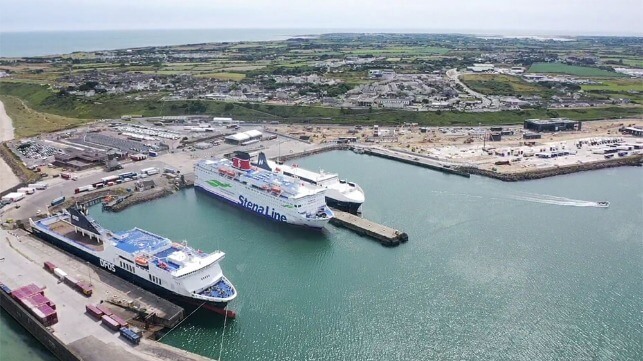
Rosslare Europort is a busy cargo port for Ireland (Rosslare Europort)
Irish police are investigating the circumstances of what appears to be another case of human traffic through one of its busy cargo seaports. Nine men were found in a container at the Rosslare Europort in southeast Ireland this morning January 27 and handed over to the police.
It is unclear how long the container had been at the busy seaport or how long it had been traveling. Media reports indicate the container originated in Africa. It is believed to have made two stops in Europe while traveling to Ireland.
The police were called to the port at approximately 10:30 am this morning Monday, January 27, after the nine individuals were discovered. Medical teams checked the individuals and reported either were healthy while one was transferred to a local hospital with non-life threatening injuries. The media reports the individuals are possibly from Djibouti although the police only commented that the investigation was ongoing.
Rosslare Europort located approximately 90 minutes driving distance to either Dublin or Cork is one of Ireland’s fastest-growing cargo ports. It has direct connections both to Europe and the UK and is serviced by a broad range of companies including DFDF, Neptune Lines, Stena, Brittany Ferries, and Irish Ferries. In 2023, the port’s operator reported overall freight in the past two years had grown cumulatively by 53 percent with a 398 percent increase in continental trade.
This is the latest in a series of incidents of human smuggling the Irish Times reports. According to the newspaper, in March 2024 seven people were discovered in a trailer. They were determined to be from Eritrea.
Twelve months ago, the Irish Times reported that 14 migrants, including men, women, and children, were found hiding in another trailing at the port. It has arrived from Zeebrugge in Belgium. The investigation revealed they were Kurdish people from Iran and Iraq.
China Launches Express Container Service to Germany
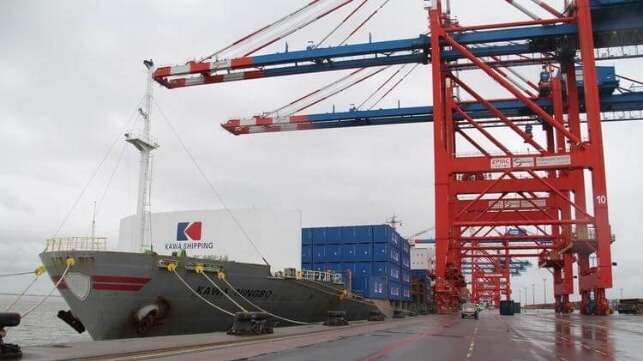
Service was started with the 2,495 TEU Kawa Ningbo arriving in Germany last week (State Council of Information, China)
The first containership in a new express service between China’s Ningbo port and Germany arrived at the terminal in Wilhelmshaven as part of an effort to build China’s maritime trade routes. The launch of the express service comes as the new Maersk-Hapag-Lloyd cooperation is also set to launch highlighting its service reliability on its first routes from Asia to Europe.
A little-known Chinese company, Zhejiang Seaport Logistics Group, is the face of the operation which has been named Kawa Shipping and the Kawa Express. Reports indicate it was conceived by officials in Shanghai and may have financial support from interests in the United Arab Emirates and Turkey. Zhejiang Seaport Logistics Group launched in 2023 offering a feeder service to the UAE.
The first vessel on the new express route was named Kawa Ningbo. Built in 2002, she is a 2,495 TEU containership that was run by Wan Hai. It was acquired by Chinese interests in July 2024 and registered in Panama. The vessel is 30,240 dwt and 656 feet (200 meters) in length.
The managing director of Kawa Shipping, Maud Lau, explained the rationale behind the new service. "Many Chinese companies, especially those in high-value sectors like automotive, lithium batteries, and solar energy require faster delivery time." The announcement refers to the service as part of China’s “Belt and Road” initiative and a commitment to “strengthening China-Europe ties.”
During the welcoming ceremonies in Wilhelmshaven on January 24, the chairman of the Zhejiang Seaport Logistics Group, Tao Chengbo, said "We are delighted to welcome the first ship of the new CEX service, the Kawa Ningbo, which started its sea voyage in Ningbo on December 30, 2024, in Wilhelmshaven on time.”
According to the Chinese what makes this new service “remarkable” is the reduced travel time between Ningbo and Wilhelmshaven. The ship is traveling the 13,800 km route (12,000 nautical miles) route in just 26 days versus the normal shipment time of 45 days for the point-to-point service. They are operating the route without intermediate stops saying the faster service will be a “game changer” for time-sensitive, high-value goods.
One advantage the Chinese have is the vessel is routing through the Red Sea and Suez Canal taking advantage of the Houthis' “safe passage” given to Chinese ships and the newly announced suspension of attack after the Gaza ceasefire. The executives pointed out during the ceremonies that many vessels are diverting taking the longer route extending travel times to 50 to 60 days.
The strategy calls for expanding the initial monthly sailings to bi-weekly in the second half of 2025. The executives said they plan to also move to a larger, 5,000 TEU vessel during the summer. They also look to add a transshipment service from Wilhelmshaven to the East Coast of the United States.
The rollout of the Chinese service comes as Maersk prepares to begin the transition to its new route system on February 1. Maersk highlights a “leaner” approach for its main line loops cutting traditional routes from seven port stops or as many as 14 to 15 stops down to just three between Asia and Germany. The new routing will be supported by dedicated shuttles with right-sized capacity for the feeder ports and moving containers to the hubs. While Maersk is not promoting it as an express service and says transit time will remain constant, it promotes the Gemini Cooperation as providing far greater service reliability and ultimately on-time schedule reliability of greater than 90 percent.
With small vessels, the Chinese service is positioned as a niche option. The United States Trade Representative recently accused China of targeting shipping services and leveraging the government for unfair competition as it seeks to dominate the shipping industry.
Beijing Struggles to Control Provinces as They Expand Distant-Water Fleet
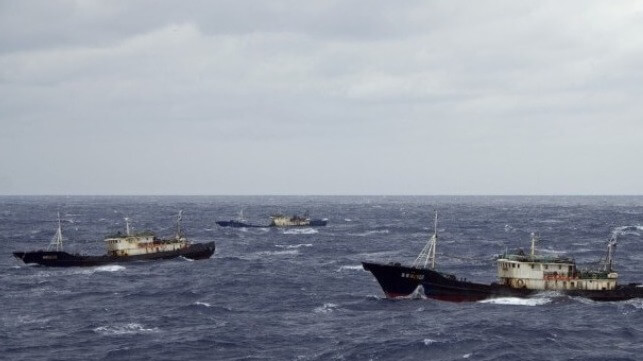
Chinese distant-water fishing vessels in the North Pacific (USCG)
Since the late 2010s, China has shown increasing sensitivity to the environmental and socioeconomic impacts of its distant-water fishing (DWF) growth, as well as the reputational harm partly inflicted by international environmental advocacy.
DWF describes countries that fish outside their own territories and extend their range of activity to the other countries’ economic exclusive zones or the high seas.
Was China’s exponential DWF growth necessarily a direct result of Beijing’s grand strategy to develop what’s known as a “blue economy” and become a maritime power? And what are the main challenges China faces if it’s going to rein in this growth?
In an article published in Marine Policy, I seek to shift the state-centric perspective on the rapid development of China’s DWF and explore the crucial role of Chinese provinces in driving this growth.
Provincial variations
Not all of China’s coastal provinces are equally interested in expanding their DWF industry. Between 2010 and 2020, Liaoning, Shandong, Zhejiang, Fujian and the China National Agricultural Development Group Co. Ltd. played a disproportionate role in boosting China’s DWF activities, as measured by the number of vessels, horsepower and fish catch.
As of 2020, these provinces collectively owned 84 per cent of China’s DWF vessels, and their combined horsepower accounted for 86.6 per cent of the total horsepower across all Chinese DWF vessels. Their catch also constituted 87 per cent of the total weight and 86.8 per cent of the total value of China’s DWF catch.
Fujian excelled as the province where fleet capacity growth yielded the highest returns in capture fisheries. It didn’t have the largest DWF fleet (Zhejiang did) or the most powerful (Shandong did). But it led in both total DWF catch volume and average catch per vessel, and was second only to Shandong in catch value per vessel.
Proactive Fujian
Although Fujian was not initially chosen as a pilot province for marine economy development in 2010, it soon formed what’s known as a leading small group, headed by the provincial governor, to reapply.
This effort succeeded in 2011, granting Fujian additional administrative and budgetary powers to develop its marine economy. Sub-provincial leading small groups were also created to enhance co-ordination and compliance across bureaucratic levels.
Once Fujian’s marine economy development gained national importance, it quickly expanded its DWF industry. In 2013, the provincial government urged efforts to forge a new era for its DWF vessels to “sail to the Western Ocean for the second time”. Local businesses seized this opportunity to seek support and gain a competitive edge over their peers from other provinces.
Starting in 2014, the provincial government promoted targeted policy incentives across the industry’s value chain: vessel renovation, access to fishing grounds, business operations and human resources. The launching of the Maritime Silk Road in 2015 with Fujian as a key participant further enabled its DWF expansion.
These measures led to a production-focused, extraction-driven DWF growth in Fujian. From 2012 to 2015, the number of Fujian’s DWF vessels and catch rose by 78 per cent and 50 per cent, significantly exceeding national targets of 15.5 per cent and 18 per cent.
Reining in growth
Since 2016, amid heightened international scrutiny, Beijing started to recentralize and tighten control over China’s DWF fleet. But this effort took time to trickle down to the provincial level. The Fujian incentive measures remained in place and were implemented until 2018 to facilitate the province’s DWF growth.
Towards the end of the 2010s, Beijing started implementing concrete centralized policies to rein in DWF growth. These included a blacklist for vessels and captains involved in illegal, unreported and unregulated (IUU) fishing, a compliance ranking for DWF companies and revisions to China’s DWF regulations.
While Fujian appeared to adhere to Beijing’s policy to limit fleet growth, it shifted efforts to secure the establishment of a national DWF base on its coast. This form of terraqueous infrastructure seeks to reorganize spaces where land and sea meet. The goal is to reduce the turnover time of DWF catch as commodities, and to maximize its commercial value.
Information-gathering challenges
Beijing’s delegation of certain administrative and fiscal power to local governments is crucial to enhancing economic performance in China’s provinces. But economic interests can motivate local governments to pursue policies that result in excessive growth and can lead to unintended foreign policy consequences for China.
Fujian’s incentive policies suggest a firm commitment to a DWF growth model focused on enhancing capacities, maximizing outputs and boosting production. These policies pay inadequate consideration to potential environmental impacts beyond its border.
A performance evaluation report on Fujian’s special subsidy fund for marine economic development praises the shift of Fujianese fishers from offshore fishing near its coast to distant-water fishing.
It says there are “social” and “environmental” benefits that include supplying more DWF professionals and easing offshore over-fishing. The report makes no reference to potential concerns over overcapacity or the ensuing environmental and foreign policy impacts.
Measures introduced by Beijing during the 13th Five-Year planning period in 2017 marked a first step towards recentralizing control and oversight over such provincial activism. But monitoring DWF poses a daunting challenge for Beijing, as its environmental footprints occur outside China and are not borne directly by Chinese citizens.
Looking ahead
China’s 2023 White Paper on DWF reaffirms efforts to improve information-gathering and monitoring on DWF fleet capacities and operations. These include establishing an inclusive DWF data collection framework and expanding the national fisheries observer program.
Although Beijing views the West as “strongly suppressing and restricting” China’s DWF, the white paper endorses dialogue with international non-governmental organizations on sustainable fisheries management and actions against IUU fishing. In other words, it acknowledges the role of international bottom-up monitoring in addressing the pervasive problem Beijing faces in gathering information on DWF.
Strengthening information-gathering and verification regarding any violations by Chinese DWF vessels of both domestic and international regulations has become critical since China replaced the DWF fuel subsidy with the international compliance capacity enhancement subsidy in 2021.
This new subsidy is partly tied to compliance scores of DWF enterprise. The Chinese Ministry of Agriculture publishes these scores annually. Any of the 14 DWF-regulated violations leads to lower scores, which in turn reduces the subsidy amount for offending enterprises.
Prompt and reliable data on IUU breaches is therefore essential to achieve the intended deterrent effect. A meaningful degree of monitoring and transparency efforts by fisheries NGOs, alongside with continued collaboration with international and regional fisheries organizations, should be encouraged and maintained by Beijing.
Hang Zhou is an Assistant Professor, Department of Political Science and Affiliated faculty member, Graduate School of International Studies at Université Laval.
This article appears courtesy of The Conversation and may be found in its original form here.
The opinions expressed herein are the author's and not necessarily those of The Maritime Executive.
IRAN
The Naval Show of Force That Wasn't
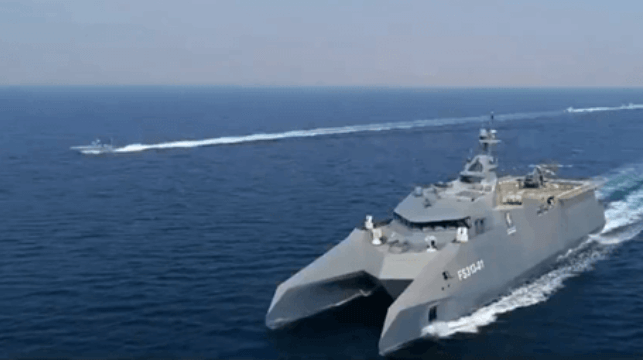
Shahid Soleimani (FS313-01) (Iranian Ministry of Defense)
Several weeks ago, the Iranian authorities announced that the IRGC Navy (Nesda) would hold a major exercise in the Straits of Hormuz on January 11, involving 300 ‘combat vessels’, to be followed by an exercise January 18-23 within the Gulf, all to be concluded by the IRGC’s ‘largest ever fleet review’ on January 27.
The UK Maritime Trade Organisation (UKMTO) team in Dubai has associated two activities with what it thought might be the delayed start of this major exercise. The US-flagged container ship Liberty Power received an instruction on January 24 by VHF radio from a small craft, ordering it to change course for Iranian waters, an instruction which it ignored. Other vessels in the Northern Arabian Gulf have also received similar VHF radio challenges. While such activity might normally be associated with piracy or IRGC seizure operations, this may have been an indicator that the exercise had begun in the central and northern waters of the Gulf, confirmed when officially-sanctioned social media sites began posting video of exercise activity.
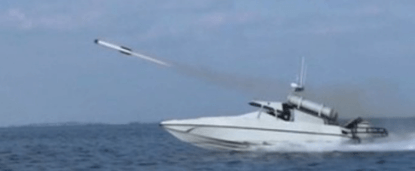
Khowsar missile being fired from a Nesda speedboat (Iranian Ministry of Defense)
This activity featured large numbers of speedboats firing Khowsar 222 missiles. The Khowsar is believed to be based on the Chinese TL-10, designed specifically for export to Iran by the Hongdu Aviation Industry Corporation. The missile is a ‘fire and forget’ system designed to attack smaller shipping targets, with its own autonomous seeker system and a range of up to 12 miles. A Khowsar missile, supplied by Iran to Hezbollah, is believed to have been used in the fatal attack against the Israeli corvette INS Hanit in June 2006.
Marines were seen in another video landing on the deck of a civilian tanker, reminiscent of the Houthis’ seizure of the MV Galaxy Leader, whose crewmembers were finally released after 14 months in Houthi activity this week.
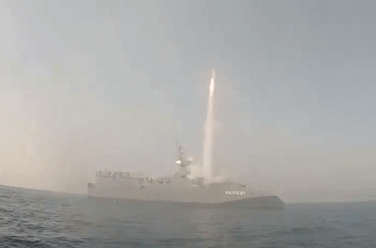
Shahid Soleimani (FS313-01) firing a Navab anti-aircraft missile from a forward vertical launch tube (Iranian Ministry of Defense)
Also featured was the Nesda’s missile corvette Shahid Soleimani (FS313-01), seen firing a short range Navab surface to air missile from its vertical firing tubes. The Navab has an infrared autonomous seeker and a range of 10 miles. Nesda had announced that two additions to the same name missile corvette class, the Shahid Bahman Baqeri and the Shahid Rais Ali Delvari, were to join the fleet during the exercise, but neither have been spotted so far, though the Shahid Rais Ali Delvari (FS313-04) was unveiled last week in pictures issued by the Iranian Ministry of Defense.
Besides now routine coverage of drones firing missiles, the only other notable development seen so far has been a new system for deploying sea mines, using a Fajr-5 rocket with a 50 mile range. This would be an expensive method of deploying a single free-floating mine, but could be useful in an emergency situation or to fill a gap in a minefield.
Sea mine being deployed as a warhead on a Fajr-5 rocket (left, Iranian Ministry of Defence)
As part of the run-up to the exercise, the Nesda made much of their underground storage complexes, in which speedboats and coastal defense missiles could be stored on trailers ready for rapid deployment. The IRGC’s promotional videos did not disclose the locations of these complexes, but two have subsequently been identified close to known Nesda bases, and visible in Google Earth at Bushehr (28.881686N 50.842836E and Asaluyeh (27.353557N 52.623110E).
The exercise is believed to have concluded next day, January 25. The Nesda commander Rear Admiral Alireza Tangsiri, speaking in Bushehr on January 26, said all goals set for the exercise had been achieved.
Meanwhile, the two largest ships in the Nesda, the tankers converted to drone carriers Shahid Mahdavi (C110-3) and Shahid Bagheri (C110-4), the latter easily identified by its angled flight deck, together with a third unidentified but naval vessel, have been seen at anchor in the roadstead off Bandar Abbas, their positions unchanged save for the swing of the wind and tide since January 7. These vessels could have been expected to form the centerpiece of any large-scale at-sea exercise. The only evidence of unusual activity has been the presence close by of what may be a large barge which could act as a viewing platform for a final exercise fleet review, which the Nesda previously announced would take place on January 28.
Situation normal: Bandar Abbas Roads January 24, with three Nesda naval vessels and a possible viewing platform to the south, and IRINS Makran on its usual pier in the outer harbour (left, Landsat-8/Jonathan Campbell-James)
Throughout the exercise, activity and ships within Bandar Abbas harbor - where the regular Iranian navy has the dominant presence - are reflective of normal routine. The large logistic vessel IRINS Makran (K441) has not been seen to leave its pier in the outer harbor during this period. What is believed to be the 101st Naval Flotilla, consisting of IRINS Bushehr (K422) and IRINS Lavan (L502) cast off from the harbor on January 26 on the regular winter training cruise with cadets aboard.
The delay and apparent curtailment of what had been announced as a much longer and larger scale exercise may be a reflection of Iranian nervousness at present about doing anything too bombastic or belligerent before the newly-installed president of the United States makes his position clearer on how he intends to approach Iran’s threatening behavior.
On land however, there is strong evidence of considerable concern on the part of the IRGC regarding the internal security situation in the country. Under the guise of the Great Prophet-19 exercise, large-scale internal security sweeps have been taking place in the southeast against Baluch separatists, in the northeast against infiltrators from Afghanistan, in the northwest against Kurdish separatists, and also in the traditionally restive Arabic-speaking region of Khuzestan. A stream of IRGC combat casualties has been announced. A major internal security exercise that took place in Tehran on January 10 had the appearance of an exercise in intimidation rather than training. The Iran International website noted that rather than an expected 110,000 Basij volunteer participants, fewer than half that number turned up, many of whom were Afghan refugees.
Iranian Ships Load Ballistic Rocket Fuel in China
A cargo of explosive ingredients seized from a dhow in the Gulf of Oman in 2022. Ammonium perchlorate was part of the cargo (USCG file image)
According to a widely-quoted report in the Financial Times datelined Washington and Taipei, intelligence officials in two unidentified countries have briefed the paper that two Iranian ships are loading ballistic missile propellant in the Yangtze river port of Taicang north of Shanghai. Once loading is complete, the ships are scheduled to set sail for Bandar Abbas.
The two ships concerned are the container ships MV Golbon, currently holding its position in the Xiushan Island anchorage 100 miles East of Shanghai, and the MV Jairan, which is yet to complete loading.
Both ships are owned by Islamic Republic of Iran Shipping Lines (IRISL), which is closely associated with the Islamic Revolutionary Guard Corps (IRGC), IRISL ships having been used for intelligence collection purposes. Both vessels are also listed by the US Treasury as being subject to OFAC secondary sanctions.
Although subject to sanctions, the two vessels appear to have made numerous port calls in friendly countries in recent years without attracting US Treasury reprisals against those handling the ships. MV Golbon visited 30 ports in 2024, including calls in the UAE and Malaysia. MV Jairan mustered 29 similar such port calls in 2024.
The cargo to be shipped is sodium perchlorate in pellet form, of which MV Golbon has loaded 34 20-foot containers and MV Jairan is to load 24 such containers.
Sodium perchlorate - when transformed into ammonium perchlorate in a chemical reaction - makes up 70% of the standard fuel load of most of Iran’s solid-fueled ballistic missiles. Iran probably has the industrial capacity to manufacture sodium perchlorate domestically, in facilities at Parchin to where the Chinese shipment was consigned. But it may be facing capacity issues, with booming production of missiles and the need for solid fuel propellant increasing to replace stocks fired at Israel, but also to support increased exports.
Fath-360 missile test launch (Fars / CC BY)
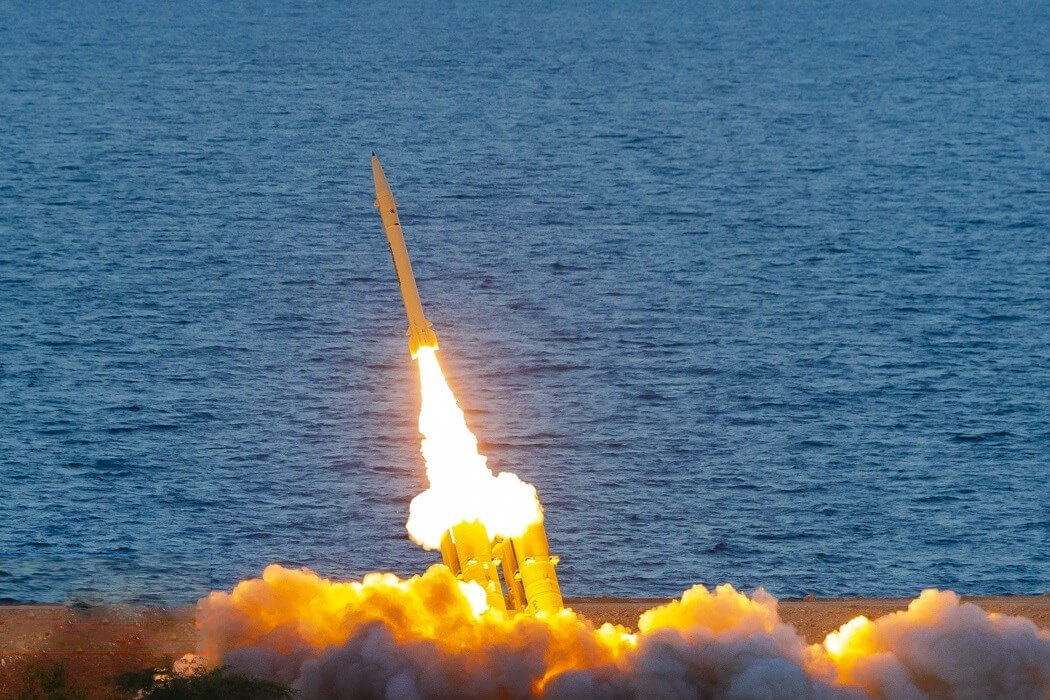
The Iranian solid fuel ballistic missile inventory includes both longer range missiles such as the Khybar-Shikan and Fattah, used in attacks against Israel. But it also includes shorter-range missiles such as Fateh-110 and Zolfaghar systems exported to Russia for its war on Ukraine. Iran was spotted shipping Fath-360 solid-fueled ballistic missiles to Russia across the Caspian Sea in January. Resistance of Axis allies, including latterly to Hezbollah in Lebanon, have also received Iranian solid-fueled systems.
In November 2022, USCGC John Scheuerman (WPC 1146) and the destroyer USS The Sullivans (DDG 68) intercepted 70 tons of ammonium perchlorate in the Gulf of Oman en route between Iran and the Houthis. The Houthi solid-fueled Palestine-2 missile used ineffectively against Israel is believed to be either an Iranian Fattah missile or derived from it. The US base at Al Asad in Iraq has been attacked on at least two occasions with Iranian solid-fuel ballistic missiles, including Fateh-313 missiles.
Both the MV Golbon and the MV Jairan were expected to sail directly to Bandar Abbas without further port calls. But now that the Chinese authorities - not normally known for being unsighted domestically - have been alerted as to what has been loaded in Shanghai, it is possible that the ships’ itinerary and cargo may be adjusted.
Glosten Joins Core Power's Nuclear Power Barge Project
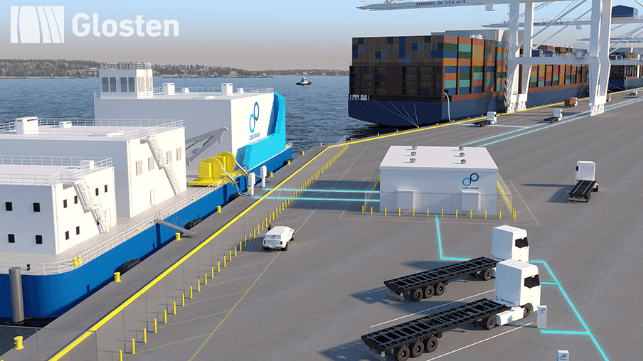
Maritime nuclear power startup Core Power has partnered with Glosten to design a floating nuclear power plant that could be installed at U.S. ports to provide a boost to the local grid. The barge-based design could produce about 175GWh of clean power per year, solving clean-power challenges for ports and increasing energy security - and all at a favorable price.
"Over 80% of the cost of nuclear power on land is in civil construction, with reactors and power systems accounting for less than 20%. FNPPs will be shipyard-manufactured and mass-assembled, ensuring delivery speed and low costs," said Mikal Boe, CEO of Core Power.
The idea of a nuclear power barge dates back to the early 1960s, when the U.S. Army decided to build a 10 MW powerplant inside the hull of an old Liberty ship. This mobile power station - the MH-1A Sturgis - was moored in the Panama Canal Zone and provided supplementary power from the late 1960s into the mid-1970s. Russian state energy agency Rosatom revived the concept in the 2000s with the design and construction of the Akademik Lomonosov, a one-of-a-kind 70 MW power station built around two icebreaker propulsion reactors.
Core Power envisions a future for scalable floating nuclear power plants at U.S. seaports, and Glosten will work with Core Power to turn the concept into reality. Its scope of work includes the barge operational concept, design, regulatory path, site location approvals, and identification of potential suppliers for fabrication and installation.
"Glosten’s job is to turn Core Power's vision into a design that demonstrates the practicality of providing reliable, zero-emissions nuclear power to port facilities and has a defined path to regulatory approval," said Morgan Fanberg, CEO of Glosten.




 Sea mine being deployed as a warhead on a Fajr-5 rocket (left, Iranian Ministry of Defence)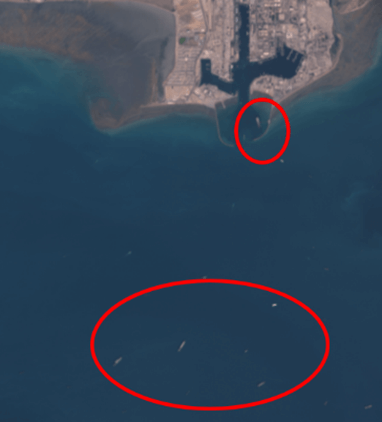

 Fath-360 missile test launch (Fars / CC BY)