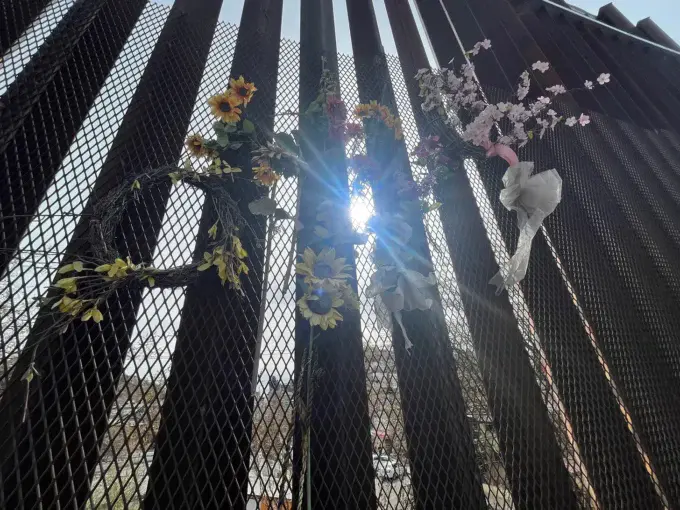
Flowers on the Nogales border wall as a memorial to José Antonio Elena Rodríguez who was killed by the U.S.. Border Patrol in 2012. (Photo by Todd Miller)
I approached Mirabel Cruz to ask her what she thought of the national emergency declaration for the U.S.-Mexico border, announced by President Donald Trump during his inauguration. She was at her house on International Street in Nogales, Arizona, where she lives in front of the 20-foot rust-colored wall, the very place that, according to Trump, is suffering a “dangerous invasion.”When he declared the national emergency, there was a rousing standing ovation. I found the enthusiasm startling. Did the attendees at his inauguration know something I don’t? So I came down to walk alongside the wall and take a look. Along the way, I’d talk to residents like Mirabel to hear their thoughts.
“Since you live right here,” I asked her in Spanish, “right on the border, do you think there is a national emergency?” She paused. She looked at me as if the question were ludicrous. It certainly felt ludicrous coming out of my mouth. I wondered if, in that moment, the expression on her face represented the feelings of most people from the borderlands after hearing Trump’s declaration. In the official statement from the White House, Trump declared that U.S. sovereignty is under attack. He claimed that the “invasion” has caused “chaos and suffering over the last four years.” He declared that the “assault on the American people and the integrity of America’s sovereign borders represents a grave threat to our nation.”
“It is very calm here,” Mirabel told me, “There is nothing happening here.” When I asked her if they should send soldiers, she immediately said no. She is from Mexico originally but has been living in her house for 16 years. “Besides,” she said, pointing to a green-striped vehicle leaving a cloud of dust on the dirt road, “Border Patrol is all over the place.”
I thanked her and returned to the border wall to walk. Maybe here I would see something. But it looked the same as it has for years. The area has already been hypermilitarized, and Trump’s declaration would only heap onto it. Through the thick steel bars of the wall, I could see Mexico going on as usual: passing city buses, people walking on the sidewalk, even the sound of children playing at a nearby elementary school. I brought with me Robin Wall Kimmerer’s new book, The Serviceberry: Abundance and Reciprocity in the Natural World. I wanted to bring the book because Kimmerer wrote it especially because of the election. Regardless of the outcome, she said, “we would need a vision of a different way forward.” She focuses on the serviceberry, which, she writes, is a gift from the land that shows us how “sharing, respect, reciprocity, and gratitude” are integral parts. When I pulled the book out before my walk, I couldn’t keep my eyes off one quote: “All flourishing is mutual.”

Vines overtaking razor wire at the Nogales border wall. (Photo by Todd Miller)
Perhaps it was thanks to this book that I noticed the vegetation growing under and around the border wall, particularly what looked to be vines crawling up through the coils of razor wire, the same sharp wire that was installed during Trump’s last presidency. Indeed, this was Trump’s addition to the wall, a bipartisan creation, starting with Clinton in 1994. As I walked, I came to a place where the vines were so heavy and thick that they weighed the coils down, in some cases to the ground, like a wrestler taking the border apparatus down on a mat. Here, the barbed wire was contorted into odd shapes. Along with shreds of clothing and vegetation, and the wall itself, it looked like an odd sculpture of the mangled 21st century. In this there was even a battle, a supreme drama, between plant life and humans’ most authoritarian elements. Further on, a ripped pair of pants clung to the barbs, hanging and fluttering in the breeze like a shredded flag. A solitary sneaker lay in front of another mound of viny wire, as if someone had lost it while crossing. I wondered where the other one was. Each item had its own profound story. Later, I saw a stuffed animal entrapped in the center of a coil. I stared at it for a long moment because it reminded me of the stuffed toy fox that my six-year-old daughter hugs as she sleeps at night.
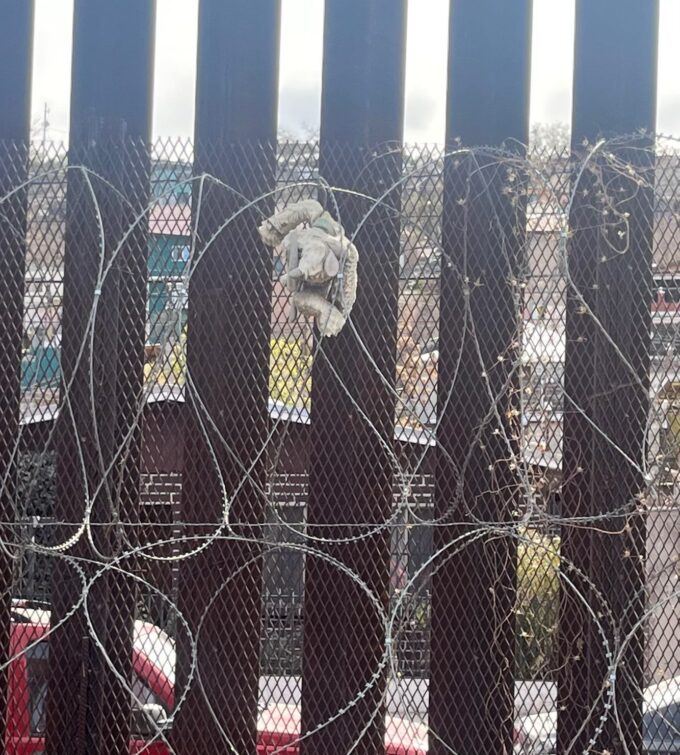
Stuffed animal in razor wire at Nogales border wall. (Photo by Todd Miller)
Still further down, a paloverde tree’s branches jutted through the bollards, like large old fingers coming through the thick bars. It was a binational plant, flouting the laws of nation-states. All this reminded me of a chunk of steel border barrier I saw several years ago a quarter mile into Mexico after it had been swept in by a vicious flood during the summer rains. I saw it about a year after this happened, and I swear the earth was eating this border wall alive. It was covered with spiderwebs and purple flowers. It was embedded deep into the soil. Will it be gone soon, I wondered, transformed into something else entirely? Even with the national emergency and Trump’s overhyped bravado, there was an aspect of fragility to this border infrastructure. Left alone, it would be overrun by vegetation, unable to survive. Maybe “mutual flourishing” can be an aggressive power, transforming anything in its way.

Vines, coat, and razor wire on the Nogales border wall. (Photo by Todd Miller)
Meanwhile, as I walked, I noticed that the Border Patrol kept cruising by me, sometimes slowing down. I kept walking, taking pictures, keeping my head down, and jotting in my notebook, looking for the reason behind the national emergency. A Nogales city police car circled back and forth; was I going to be questioned? But no. Even still, the omnipresent cameras didn’t assuage my sense of being in the full heat of the border panopticon. I kept walking. The national emergency declaration was serious. Not only did it call for the deployment of the U.S. military “to support the activities of the Secretary of Homeland Security in obtaining complete operational control of the southern border of the United States,” but it also opened the door for constructing more walls and barriers and more technology, adding another layer to one of the most fortified borders on earth. There was no visible military presence yet, but would it be on the way?

A mural near Morley Avenue and close to the border wall in Nogales. (Photo by Todd Miller)
Nogales resident David Sanner, who I talked to near the wall on Morley Avenue—home to many stores and a burgeoning arts district—called the whole wave of Trump executive orders, especially those about the border, “ludicrous and frightening.” He worried about the president going after people with naturalized citizenship, since there were so many people in that situation here. Nogales, he said, is a “sleepy little border town, a lovely town, a lovely community, and now we are the focus of the nation as described by people not from here. They describe it as a war zone. It’s frustrating.”
At the end of my walk, I sat on a bench in a nearby park near the wall and pulled out The Serviceberry. In the passage I read, Kimmerer asks, “When an economic system destroys what we love, isn’t it time for a different system?” She then proposes a new, dare I say, counter-border wall economy, one that includes “the flow of gratitude, the flow of love, literally in support of life.” In that moment, I felt that those subversive plants and humans I had seen and met along the way were a part of that. They might be more important than any executive order.
This first appeared on Border Chronicles.