Thursday, January 30, 2025

Trump & Ukraine: The Coming Battle Over Conscription

There may be a battle looming, not just between the Trump administration and Ukraine over the conscription of men between the ages of 18 and 25, but also within the Trump administration.

The call for Ukraine to cast a wider conscription net predates the Trump administration. Facing imminent loss on the battlefield, after NATO had bankrupted its supply of weapons, demanding that Ukraine throw more men into battle emerged as the last grasp solution during the Biden administration.

National Security Council spokesman John Kirby said, “In fact, we believe manpower is the most vital need they have. So, we’re also ready to ramp up our training capacity if they take appropriate steps to fill out their ranks.” Secretary of State Antony Blinken explained that “getting younger people into the fight, we think, many of us think, is necessary. Right now, 18 to 25-year olds are not in the fight.”

That call was picked up by Trump’s national security advisor, Mike Waltz, who said “one of the things we’ll be asking of the Ukrainians is, they have real manpower issues. Their draft age right now is 26 years old, not 18. I don’t think a lot of people realise that they could generate hundreds of thousands of new soldiers… [I]f the Ukrainians have asked the entire world to be all in for democracy, we need them to be all in for democracy.”

But Trump’s secretary of state, Marco Rubio, seemed to take the opposing view to Waltz, recognizing that throwing more Ukrainians into the battle compounds Ukraine’s problems rather than solving them. “The problem with Ukraine is not that they’re running out of money,” Rubio said at his January 22 confirmation hearing, “but that they’re running out of Ukrainians.”

And they are running out of Ukrainians. According to Florence Bauer, the Regional Director for Eastern Europe and Central Asia for the UN Population Fund, Ukraine’s population has declined by over 10 million since the conflict began in 2014, with 8 million of those occurring since Russia’s invasion in 2022. Even before the war, Ukraine ranked sixth in the world for losing citizens to emigration. According to a report by the CIA, Ukraine has the lowest birth rate and the highest death rate in the world. By 2023, the birth rate had dropped by nearly half compared to the year before the war. The Ukrainian armed forces has suffered hundreds of thousands of deaths or injuries and at least 100,000 desertions.

Though the battle may exist within the Trump administration, it will be much more heated if they wage it with the Zelensky administration. Zelensky has consistently resisted lowering the draft age below the current cut off of 25. In April, 2024, Ukraine lowered the age of people who were eligible to be drafted from 27 to 25 and tightened laws around exemptions. But it wasn’t enough. The changes fell far short of making up for battlefield losses. But Zelensky has resisted U.S. pressure to go further. There are several reasons, including military, political and sociological, why Zelensky has been unyielding.

Asking Ukrainians to throw more soldiers into a lost war is asking a lot of Ukrainians. But asking them to send their 18-25 year olds is especially asking a lot. There is a special demographic difficulty with asking Ukrainians to offer up their 18-25 year olds.

Ukraine is in a precarious position that it does not have enough of that generation. When the Soviet Union collapsed, economic hardship led to plummeting birth rates in the newly independent Ukraine. Birth rates dropped from 1.9 per woman to 1.1 in the first year. The small number of children born then are the 18-25 year old cohort now. And many of them are either serving already, have been killed or injured, have left Ukraine or are exempt, making the small pool even smaller.

The small cohort leads to three problems. The first is economic. Losing large numbers of the already anemic upcoming generation will leave a void in the workplace. The second is demographic. It will create a challenge to the future population of the already shrinking nation. As The New York Times put it, “Ukraine must balance the need to counter a relentless Russian offensive by adding more troops against the risk of hollowing out an entire generation.”

The third is military. The pool of 18-25 year olds is not sufficient to make a difference in the war. A poll conducted in the summer of 2024, cited by Peter Korotaev and Volodymyr Ishchenko found that only 32% of Ukrainians disagree with the statement “mobilization will have no effect other than increased deaths.” Ukraine is being pressed to throw more of its young people into the teeth of the Russian advance to win a war that they have come to know cannot be won.

But in addition to the economic, demographic and military reasons why mobilization is failing and lowering the draft age would be unpopular, there is a fourth, more endemic and, potentially, more corrosive reason identified by  Korotaev and Ishchenko. Polling suggests that Ukrainians are increasingly unwilling to fight for Ukraine because they increasingly feel abandoned and betrayed by Ukraine.

The abandonment takes the form of the state asking Ukrainians to give to the state when the state has given little to Ukrainians. Richard Sakwa says in his new book, The Culture of the Second Cold War, that Zelensky has pursued a policy of “radical neoliberal policies, including the privatization of land and state property, the weakening of labor and welfare legislation, and steep increases in the price of utilities.” Minimum wage and social security have remained flat while inflation rapidly rises. Ishchenko and Korotaev say “[a]ll of a sudden, a state that had hardly been present in Ukrainians’ lives demanded that they sacrifice themselves for its survival.”

By the third year of the war, public enthusiasm to sacrifice and volunteer was waning. Polling in June 2024 found that only 32% “fully or partly supported” the new mobilization law. And that mobilization only lowered draft eligibility to 25. The U.S. is pushing for 18.

The betrayal takes the form of anger at the unequal application of the draft. While the poor are being nabbed off the street and deposited on the front line, those who can afford it find ways to work the corrupt system and pay their way out of service. The taking of bribes by draft officials has become an industry. Ishchenko and Korotaev cite a parliamentarian who, upon returning form the front near Pokrovsk, said that the soldiers manning the front lines “were mainly those who could not ‘decide things’ with a bribe.”

The unequal distribution of the demand to serve has changed the definition of patriotism. Polling now shows that only 29% of Ukrainians consider it shameful to dodge the draft. And Ukrainians are not only voting for dodging the draft, they’re dodging it. The new mobilization law required all eligible males to submit their papers by July 17, 2024. 6 million out of 10 million have not. Ishchenko and Korotaev add that of the 40% who did file their papers, at least half of them had “medical or other reasons allowing them to legally avoid mobilization.” Mobilization officials in Ukraine are investigating half a million men for draft evasion.

Both Democrats and Republicans have pushed for a plunging age eligibility for conscription in Ukraine. And while there may be some disagreement between security and state in the Trump administration, there seems to be less disagreement among Ukrainians. And there is shaping up to be even greater disagreement between the U.S. and Ukraine if the Trump administration pressures Ukraine to lower the draft age or conditions support on that decision.

Ted Snider is a regular columnist on U.S. foreign policy and history at Antiwar.com and The Libertarian Institute. He is also a frequent contributor to Responsible Statecraft and The American Conservative as well as other outlets. To support his work or for media or virtual presentation requests, contact him at tedsnider@bell.net

How Washington Helps: Bloody Lessons From Ukraine to Bosnia


Nearly three years after Russian President Vladimir Putin invaded Ukraine, Kiev’s outlook appears worse than ever. Ukrainian forces, facing manpower shortages, are losing territory at a faster pace than in the first 30 months of the conflict.
Now, Kiev looks at an evolving political situation where future support is less certain. President Donald Trump has promised to end the war in Ukraine, and several prominent figures in the MAGA movement are calling for an end to shipping billions of dollars to Kiev as Americans struggle.

If Kiev is going to make a deal to end the war, it will be decidedly worse than the one that was on the table in 2022. In April, just two months after the invasion, an agreement between Moscow and Kiev was nearly completed that would have seen Ukraine retain all its territory except for the Crimean Peninsula, which was annexed in 2014.

Over the past three years, the Kremlin has annexed four additional regions in Ukraine that Putin says will never be returned to Kiev.

Ukraine fighting a three-year war at the insistence of the West only to get a worse deal is not the first time an American “ally” in Europe was pushed to fight a war for no reason.

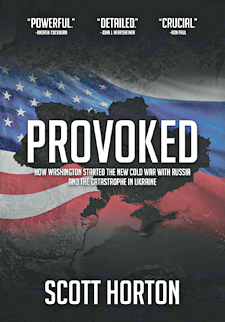
30 years after the Dayton Accords were signed, it is important to look back at the Bosnian War because it teaches an important lesson about the current war in Ukraine. The following is an excerpt from Scott Horton’s new book, Provoked: How Washington Started the New Cold War with Russia and the Catastrophe in Ukraineon the negotiations in Bosnia during the George HW Bush and Bill Clinton administrations.

~ Kyle Anzalone


Lisbon Deal

In July 1991, Serb Democratic Party (SDS) leader Radovan Karadžić and Adil Zulfikarpašić from the Muslim Bosniak Organization (MBO) signed the Zulfikarpašić-Karadžić agreement which would have kept the union between Bosnia-Herzegovina, Serbia and Montenegro. However, as mentioned above, Bosnian President Alija Izetbegović initially supported but then opposed the deal, killing it. This process repeated itself early the next year after the Badinter Commission, when, in February 1992, the Carrington-Cutileiro plan, or “Lisbon deal,” was struck by Portuguese Foreign Minister Jose Cutileiro between Bosnian Muslim, Croat and Serb representatives. The deal said that Bosnia-Herzegovina would remain united politically but would be divided into three ethno-religious cantons with a very weak central government in the capital city of Sarajevo. The supposedly intransigent Bosnian Serbs were represented at the meeting by Karadžić, who said, “Either we remain in Yugoslavia, or else we will get a sovereign state in Bosnia-Herzegovina which will form an alliance of states, that is a confederation, together with the other two states.” The Bosnian Serbs were willing to accept independence from Yugoslavia and reduce the proportion of land they controlled from approximately 60 percent to only 42.5 percent.

Said by the U.S. to be the aggressors in this part of the war, the Bosnian Serbs were satisfied with this compromise. Zimmermann says “Karadžić was ecstatic” over this deal, which would give the Bosnian Serbs plenty of autonomy in a new system “based on three constituent nations and joined by a common government and assembly.”

Izetbegović had said he would support the arrangement, originally accepting and signing the Lisbon deal; then, two days later, on American advice, he killed it, this time starting a war. It was Amb. Zimmermann who was responsible. As recounted by State Department official George Kenney, then-head of the Yugoslavia desk, “Zimmermann told Izetbegović, ‘Look, why don’t you wait and see what the U.S. can do for you?’ meaning, ‘We’ll recognize you and then help you out. So don’t go ahead with the Lisbon agreement, don’t accept the Cutileiro plan, and just hold out for some kind of unitary Bosnian state.’” Canadian Amb. Bissett added, “Upon finding that Izetbegović was having second thoughts about the agreement he had signed in Lisbon, the Ambassador suggested that if he withdrew his signature, the United States would grant recognition to Bosnia as an independent state.” Izetbegović was convinced. He then “withdrew his signature and renounced the agreement.” Two days later, on March 30, he called for a referendum on secession. Just a few days after that, on April 4, he announced a full military mobilization. On the 6th he declared independence. The war was on. Referring to the peace deal that finally ended the war two and a half years later, Damjan Krnjevic-Miskovic wrote: “One still hears it said that ‘the difference between the Lisbon and the Dayton agreements is simply two years of mass graves.’”

Though he denied it in his book, Zimmermann later admitted his error to the Times. “Our hope was the Serbs would hold off if it was clear Bosnia had the recognition of Western countries. It turned out we were wrong.” He confessed, “He said he didn’t like it. I told him, if he didn’t like it, why sign it?” In retrospect, “the Lisbon agreement wasn’t bad at all.” That was too bad, because, as the paper said, “after talking to the Ambassador, Mr. Izetbegović publicly renounced the Lisbon agreement.”

After citing another Times report which said the U.S. had intervened to ruin the Lisbon deal, Tucker and Hendrickson wrote that “Izetbegović’s repudiation of the… agreement… was the immediate trigger for the war,” but that “[t]he war may have occurred in any event. The Lisbon formula was vague in crucial respects, and contained no agreement respecting the boundaries of the three cantons.” Still, they wrote, that “cannot detract from the judgment that American diplomats acted in an extremely irresponsible manner… If war was to be averted, an agreement respecting cantonization was the last step at which it might have been.” The two also noted that even though the Bosnian referendum was necessary to satisfy the requirements of the EC and U.S., the referendum itself was unconstitutional. The constitution “had conferred a right of secession but made it dependent on the mutual agreement of the nations composing Yugoslavia… [T]o move to secession without the consent of the Serbs was a plain violation of its terms.”

They also showed that there is nothing in the international law that confers upon the United States or anyone else the authority to intervene or to take sides in civil wars or wars of secession in other sovereign nations, and that the U.S. recognition of Bosnia’s independence was “an illegal intervention in Yugoslavia’s internal affairs, to which Belgrade had every right to object.” Otherwise, “the contrary view may only be asserted on the debased view that international law is whatever the United States and the Security Council says it is and that we are free, like an Alice in the grip of deconstructionism, to have words mean anything we like.”

With the Germans making initial inroads in the newly independent Croatia and Slovenia, and taking a strong lead in the EC on the issue, the U.S. government wanted Bosnia to be their project along the same lines, even though the intelligence agencies, and even the Germans, were warning that Bosnia would “blow up” into civil war. David Binder wrote that Secretary Baker, by recognizing Bosnian independence, “literally created… Bosnia-Herzegovina… with the blessing of President Bush, with considerable input from Lawrence Eagleburger and Warren Zimmermann.” Despite the warnings from leaders on every side of the issue, Zimmermann had gone ahead and recommended recognition of Bosnian independence. Of course this led directly to war between the Bosnian Muslims and Bosnian Serbs. In his own defense, Zimmermann deployed the circular argument that the war he helped provoke would have happened anyway, since the Bosnian Serbs’ landgrabs, launched after Izetbegović’s declaration of independence, would have caused what up until then had not happened.

Roger Cohen wrote in the Times that “[w]ith the precedent of 1991, when a much smaller Serbian minority went to war to resist joining a Croatian state, this international decision on Bosnia looks as close to criminal negligence as a diplomatic act can be.” He added, “Indeed, international recognition and the outbreak of the Bosnian war were simultaneous: the world put a light to a fuse.” He must have meant President Bush.

Once the war started, factions of the JNA stayed in Bosnia and merged with Bosnian Serb forces, making them better equipped than their new enemies and leaving open the argument that Serbian troops were participating in a deniable role as members of local Bosnian Serb forces, though the majority of them were still Bosnian.

The Bush and Clinton administrations went on to sabotage a series of peace offers between 1992 and 1995, until Clinton finally signed the Dayton Accords in November 1995, which, as the Times conceded, looked much like the Lisbon deal from three years before, only with less land for America’s chosen Muslim allies and an indefinite NATO military presence.

Author: Scott Horton

Scott Horton is editorial director of Antiwar.com, director of the Libertarian Institute, and podcasts the Scott Horton Show from ScottHorton.org. He’s the author of the 2024 book Provoked: How Washington Started the New Cold War with Russia and the Catastrophe in Ukraine the 2021 book Enough Already: Time to End the War on Terrorism, the 2017 book, Fool’s Errand: Time to End the War in Afghanistan, and the editor of the 2019 book, The Great Ron Paul: The Scott Horton Show Interviews 2004–2019. He’s conducted more than 5,500 interviews since 2003. Scott’s articles have appeared at Antiwar.com, The American Conservative magazine, the History News Network, The Future of FreedomThe National Interest and the Christian Science Monitor. He also contributed a chapter to the 2019 book, The Impact of War. Scott lives in Austin, Texas with his wife, investigative reporter Larisa Alexandrovna Horton. He is a fan of, but no relation to the lawyer from Harper’s. Scott’s TwitterYouTubePatreon. 


The True Cost of Guantánamo


Originally published at TomDispatch.

On January 10th, one day before the 23rd anniversary of its opening, a much-anticipated hearing was set to take place at the Guantánamo Bay Detention Facility on the island of Cuba. After nearly 17 years of pretrial litigation, the prosecution of Khalid Sheikh Mohammed (KSM), the “mastermind” of the devastating attacks of September 11, 2001, seemed poised to achieve its ever-elusive goal of bringing his case to a conclusion.  After three years of negotiations, the Pentagon had finally arranged a plea deal in the most significant case at Guantánamo. Along with two others accused of conspiring in the attacks of 9/11, KSM had agreed to plead guilty in exchange for the government replacing the death penalty with a life sentence.

After more than 50 pre-trial hearings and other related proceedings, Americans – and the victims’ families – would finally see closure for those three individuals who stood at the center of this country’s attempt to reckon legally with the 9/11 attacks.

Because of the fact that the defendants had been tortured at notorious CIA “black sites” before arriving at Guantánamo, the case had long been endlessly stalled. After all, so much of the evidence against them came from torture confessions. As it happens, such evidence is not admissible in court under U.S. or international law, or even under the rules of Guantánamo’s military commissions. For obvious reasons, it’s considered tainted information, “the fruit of the poisonous tree,” and so inadmissible in court. Although military commission prosecutors tried repeatedly over the years to find ways to introduce that all too tainted evidence at trial, attempts to do so failed time and again, repeatedly pushing potential trial dates years into the future. As a recently compiled Center on National Security chart shows, the forever delays in those hearings led to calendars of such length as to defy comprehension. In Khalid Sheikh Mohammed’s case, for example, such delays have so far amounted to 870.7 weeks.

With the plea deal now set to come before Judge Matthew McCall, who had agreed to delay his retirement in an effort to see this case to its conclusion, attorneys, journalists, and victims’ family members boarded planes, preparing to witness the longed-for conclusion to a case that had seemed endless. Perhaps you won’t be surprised to learn, however, that the hearing never took place. Delay was again the name of the game. As it turned out, from the moment the plea deal was announced, it became the centerpiece of an intense battle launched by then-Secretary of Defense Lloyd Austin.

What Happened

Two days after the August 2024 announcement of the plea deal by the “convening authority,” Brigadier General (Ret.) Susan Escallier, the Pentagon official in charge of the military commissions at Guantánamo Bay, Austin summarily overruled her, revoking the plea deal with little explanation and leaving experts and observers alike confused and disappointed. Had the secretary of defense not been consulted on the plea arrangement? That seemed unlikely. Had political pressure caused him to take such a drastic act? If so, then perhaps after the election he would change his mind and restore it. No such luck.

Whatever Austin’s motivation, Judge McCall refused to take “no” for an answer, declaring his revocation invalid.

McCall made it clear, instead, that he was moving forward. As the judge explained, in the memo that Austin had long ago issued appointing Escallier, he had attested to her independent authority. “Ms. Escallier shall exercise her independent legal discretion with regard to judicial acts and other duties of the Convening Authority.” But even as McCall prepared to go forward, Austin appealed to the Court of Military Commissions Review, asking it to rule that he did indeed have the authority to revoke the plea deal. However, that court then ruled that the secretary had improperly rescinded the deal after it had taken effect.

Still, he refused to give up, seeking help elsewhere. And he found it. On the eve of the scheduled hearing, the Department of Justice filed papers asking the D.C. Circuit Court to prohibit the Gitmo court from moving ahead and to stay proceedings while it contemplated the decision. Those who had flown to Guantánamo then returned home, and a new hearing was set for January 28th at the DC Circuit Court. At issue was both Austin’s authority to take over the plea deal and whether he had the right to withdraw from it, as lawyers argue that the dependents had already started performing their part of the deal. Of course, in the second age of Trump, it is no longer Austin but secretary of defense Pete Hegseth who will decide what happens next.

So, more than 23 years after the 9/11 attacks, here we are in the very same place we’ve been for endless years — on pause again, despite the endless charade of forward steps that go nowhere.

The Mirage of the Military Commissions

At this point, it’s worth asking whether the resolution of those cases by trial was ever a priority – or even a realistic goal. A look back over the course of the military commissions and the 9/11 case suggests some answers.

The Guantánamo detention facility was set up by a presidential military order issued on November 13, 2001. It authorized the detention of war-on-terror captives and mentioned future trials. “It is necessary for individuals subject to this order… to be detained, and, when tried, to be tried for violations of the laws of war and other applicable laws by military tribunals.” Accordingly, the commander of the naval base at Guantánamo spent the early months of the detention operation scouring the base itself for a suitable facility in which to hold such trials. He was surprised when no one at the Pentagon approached him about the need for such a building.

Fast forward six years, a year after those “high-value detainees” already tortured at CIA black sites were brought to Guantánamo. As NBC’s Bob Windrem later reported, an “Expeditionary Legal Complex was built in 2007 in the expectation it would be used for the trial of terrorists accused of murdering nearly 3,000 people with twin attacks on New York and Washington on September 11, 2001.” In 2008, the 9/11 defendants were charged. And last April, 17 years later, the Pentagon opened a second courtroom at the cost of $4 million for other cases pending before the military tribunals. Intrepid New York Times Gitmo reporter Carol Rosenberg recently summed up the costs associated with those signs of a continuing belief that actual trial proceedings were indeed in the cards this way: “The war court proceedings have cost hundreds of millions of dollars in salaries, infrastructure, and transportation. Since 2019, the Office of Military Commissions has added two new courtroom chambers, new offices and temporary housing, more lawyers, more security personnel, and more contractors.”

On the surface, it would seem as if the commitment to holding various war-on-terror trials was perfectly real. The price tag was certainly hefty enough, as were the numerous pre-trial proceedings in the 9/11 case, as well as in other cases before the military commissions, each involving charges against those accused of committing acts of terrorism – the bombing of the U.S.S. Cole destroyer with one defendant; terror bombings in Bali, Indonesia, with three defendants; and the cases of several other individuals charged with crimes of terrorism.

Yet given the failure of significant forward movement in such cases for so long, it’s hard not to wonder just how serious the commitment to resolving them ever was and whether the construction of such expensive trial buildings was either a mirage, intended to hide the fact that the cases were destined to go nowhere, or self-deception on the part of presidents George W. Bush, Barack Obama, and Joe Biden. (Donald Trump halted the military commissions during his first term in office, leaving them in legal limbo.)

After all this time, only two cases have ever gone to trial, one of which, that of Salim Hamdan, was later overturned. In the other, Ali Hamza al-Bahlul was convicted on three counts, two of which were eventually overturned. (At present, Mr. Bahlul is serving a life sentence at Gitmo, having arrived on its opening day 23 years ago.)

Meanwhile, there have been a grand total of nine plea deals over all these years.  Of those, one convicted detainee is serving out a sentence at Guantánamo that ends in 2032, two convictions have been overturned, and two remain on appeal – a paltry record at best, especially given the grimness of those acts of terror. For all of the time, effort, and money, not to mention emotional distress, the results have been appallingly minimal.

Biden and Gitmo

To his credit, President Joe Biden, who inherited a Guantánamo with only 40 detainees left out of a total population that once stood at 790, seemed determined to make progress both in the military commissions and in releasing some of the remaining “forever prisoners” (a term originally coined by Times reporter Rosenberg to describe those living in the legal limbo of indefinite detention, neither charged nor released).  Biden provided Gitmo watchers (like me) with some hope that the prison, distinctly offshore of American justice, would actually close someday.

During Biden’s years in office, the population was reduced to 15 men – six forever prisoners and nine still part of the military commissions (two of whom are already convicted). Eleven of the Biden releases, consisting of Yemenis sent to Oman, occurred amid the battle over Khalid Sheikh Mohammed’s plea deal, as if he were whispering to us that we needn’t worry, the road to closure was still available. Yet even that set of transfers suffered from the same sort of one-step-forward-two steps-back shuffle that’s been the essence of Gitmo’s history. The Oman arrangement had originally been planned for October 2023, only to be put on pause once the war in Gaza erupted. One of the men released had been cleared since 2010, only to await arrangements made two presidencies later.

The Biden administration unfortunately never released the last prisoners held without charge or brought the accused to trial. Even in these final moments of his presidency, when he was arguably free to do whatever he wanted, including closing the prison, he chose instead, by virtue of his administration putting the deal on hold, to halt forward progress, leaving us to wonder why.

So here we stand, with Donald Trump back in the White House, awaiting what this will mean for the future of the forever prison.

Once You Break It, You Can Never Really Fix It

Sometimes, when it comes to Gitmo, it almost seems as if forces beyond the capacity of mere mortals are at play. No matter what promises are made, no matter what hope-inspiring acts are taken, no matter what progress occurs, the prison seems to have a life of its own, aided and abetted by those who continue to mount obstacles to any significant steps forward.

Of course, the biggest of the lessons learned should have been to honor the laws, both domestic and international, forbidding torture. Had the United States not authorized a program of what was euphemistically referred to by the administration of President George W. Bush as “enhanced interrogation techniques,” including beatings, waterboarding, sleep deprivation, sexual humiliation, sensory bombardment, and all too much more, those trials could have been held in a timely fashion and in federal court on the mainland.

As President Barack Obama’s attorney general, Eric Holder, had wanted, the federal courts would have been capable of handling such cases without using “evidence”  produced by torture. In fact, one Guantánamo detainee, Ahmed Ghailani, was indeed transferred to the United States for trial in federal court and, though he was acquitted on 284 of 285 charges, he was found guilty on one count and sentenced to life in federal prison. Still, the hundreds of acquittals in his case chased away the idea of trying the remaining Guantánamo defendants in federal court.

From all of this, there’s a basic lesson to be learned: once you violate both fair treatment of prisoners and the basic principles of law, finding an unchallenged resolution to such cases is essentially inconceivable.

In other words, once you break it, you can never really fix it.

Today, that long, soul-crushing, legally abhorrent story stands, at a far greater cost than we might once have imagined, where it has always stood – as a mistake that never should have happened and that, once made, never found a leader able to muster the courage to end it.

Follow TomDispatch on Twitter and join us on Facebook. Check out the newest Dispatch Books, John Feffer’s new dystopian novel, Songlands (the final one in his Splinterlands series), Beverly Gologorsky’s novel Every Body Has a Story, and Tom Engelhardt’s A Nation Unmade by War, as well as Alfred McCoy’s In the Shadows of the American Century: The Rise and Decline of U.S. Global Power, John Dower’s The Violent American Century: War and Terror Since World War IIand Ann Jones’s They Were Soldiers: How the Wounded Return from America’s Wars: The Untold Story.

Karen J. Greenberg is the director of the Center on National Security at Fordham Law. She is also the editor-in-chief of the weekly Aon CNS Cyber Brief. She is the author of Subtle Tools: The Dismantling of American Democracy from the War on Terror to Donald Trump and co-editor with Julian Zelizer of Our Nation at Risk: Election Integrity as a National Security Issue.

Copyright 2025 Karen J. Greenberg

Will There Be a Trump Corollary to the Monroe Doctrine?


One of the earliest points to become apparent about Donald Trump’s second term as president is that there is a significant difference in foreign policy priorities and a vast change in style from his predecessors over the past 8 or 9 decades.  Blather about the United States promoting or defending democracy around the world has already faded with the onset of the new administration.  That change is just as well, since more often than not, such rhetoric merely served as a cover for U.S. power politics and an attempt to prolong Washington’s fading global hegemony.

If one truly wants to understand Trump’s likely approach to both continental and world affairs, though, it would be more instructive to study the presidencies of Theodore Roosevelt, James K. Polk, and Andrew Jackson than to focus on the post-Pearl Harbor, globalist presidents.  That is especially true with respect to Trump’s attitudes and policy preferences regarding the Western Hemisphere.  Indeed, his focus on that arena is so intense and stridently nationalist that it is not too early to wonder if there will be a “Trump Corollary” to the Monroe Doctrine.

The original Monroe Doctrine became official U.S. policy in 1823.  The actual architect was Secretary of State John Quincy Adams, and it was a bold declaration of rising U.S. power as well as the explicit assertion of a sphere of influence for the upstart republic.  Indeed, the scope of the declaration greatly exceeded Washington’s military and economic capabilities at the time to enforce it unaided.  However, Great Britain’s objectives and interests in keeping other major powers out of the Western Hemisphere coincided with those of the United States.  London became a de facto U.S. ally for that limited, but important, goal.  During the post-Civil War period, U.S. economic and military power gradually grew to the point that Washington’s assertion of preeminence in the hemisphere became increasingly credible. Indeed, U.S. leaders even made it clear to their British counterparts in the 1890s that new or expanded enclaves by their country would be as unwelcome as such entities controlled by other outside powers.

Emphasizing U.S. hegemony, though, created the growing perception in Washington that the United States now needed to be more active and assertive in maintaining order within its sphere of influence.  When some poorly governed countries in the hemisphere reneged on debts owed to major European powers (especially Germany), it created the prospect that those aggrieved powers might use such incidents as a justification (or excuse) to take action.  In promulgating the “Roosevelt Corollary” to the Monroe Doctrine, President Theodore Roosevelt insisted that the United States had both the right and obligation to discipline irresponsible hemispheric neighbors to forestall such outside interference. Washington’s assertion of hemispheric hegemony grew.  It also was a model that the United States would apply to other regions of the world in a few decades.

There are ample signs that although Trump might be more selective and cautious about some U.S. obligations and objectives elsewhere in the world, his emphasis on enforcing U.S. hegemony closer to home may exceed the stance of all his predecessors.  The principal feature of an emerging Trump Corollary to the Monroe Doctrine is an insistence on total U.S. control of security and economic affairs in the Western Hemisphere – especially the northern portion from Venezuela to the Arctic.

Trump apparently has concluded that outright U.S. ownership is needed to assure adequate control of certain territories. He already indicated his intention to pressure Denmark to sell Greenland to the United States.  Although that island’s largely Inuit population has enjoyed autonomy over domestic affairs since 1979, Denmark retains responsibility for military and foreign affairs.  As the United States is already in the midst of a power struggle with both Russia and China for dominance in the Arctic, accepting Greenland’s continued reliance on a small European country for its security seems decidedly out of character for Donald Trump.

The president has made it clear that he regards Greenland as a crucial geostrategic asset for the United States.  His demand that the Panamanian government return ownership of the Canal to the United States reflects a similar mentality. Trump’s appointment of the ultra-hawkish Marco Rubio as secretary of state indicates a likely intention to oust the radical leftist governments in Cuba and Venezuela.

During his first term, Trump was receptive to the idea of using force against drug cartels in Mexico if the Mexican government was unable to restore order in its country.  That threat remains in effect as Trump takes office again.  He does not seem the least bit shy about violating Mexico’s sovereignty if he deems that step necessary.

All of these positions point to the adoption of a very hardline policy toward Washington’s neighbors. There may be an understandable temptation to scorn Trump’s belligerent, jingoistic statements as mere posturing and boastfulness.  That would be a mistake, especially with respect to policy in the Western Hemisphere. Washington’s conduct in that region is likely to resemble the unapologetic imperialism that the United States pursued from the 1890s until Franklin Roosevelt initiated a more subtle version with his so-called Good Neighbor policy.  Americans need to buckle up now, since we could be in for a wild ride throughout the hemisphere under Donald Trump.

Ted Galen Carpenter is a senior fellow at the Randolph Bourne Institute and a senior fellow at the Libertarian Institute. He also served in several senior positions during a 37-year career at the Cato Institute.  Dr. Carpenter is the author of 13 books and more than 1,300 articles on foreign policy, national security, and civil liberties topics.  His latest book is Unreliable Watchdog: The News Media and U.S. Foreign Policy (2022).


Gaza and Trump’s Ethnic Cleansing of the Century Proposal


 January 29, 2025
Facebook

Youtube screenshot.

Nearly eight years ago, Donald Trump and his Zionist son-in-law, Jared Kushner, unveiled the so-called “Deal of the Century”—a plan Palestinians aptly labeled the “Steal of the Century.” The so-called peace proposal sought to normalize illegal Jewish-only colonies in the West Bank, and deny Palestinians their aspirations for an independent state. Four years later, the only “Deal of the Century” turned out to be the $2 billion investment Jared Kushner secured for his new fund from Saudi Arabia.

Now, Trump is proposing relocating Palestinians from Gaza, urging Arab regimes to “build housing at a different location where they can maybe live in peace for a change.” He floated the idea of displacing approximately 1.5 million people—a figure strikingly similar to the number of 1948 refugees now living in Gaza.

I agree with Trump—but let’s take it a step further. Instead of relocating 1.5 million people to another location, we should relocate 1.6 million Palestinians back to their original homes from which they were ethnically cleansed in 1948, not to Egypt, not to Jordan.

Trump is reaching out to Abdel Fattah al-Sisi of Egypt, and King Abdulla of Jordan when he should be talking to Benjamin Netanyahu. Rather than looking far east and west, he should be looking north and east of Gaza, demanding that Netanyahu return Palestinians to their original villages and cities. Any proposal to move Palestinians outside historical Palestine only compounds the original sin of the 1948 ethnic cleansing.

The essence of the old Trump’s misnomer, Deal of the Century, and current proposal to “. . . just clean out that whole thing” in Gaza stems from the same deeply rooted Zionist dehumanization of Palestinians. Trump’s proposal to displace Palestinians is nothing less than a regurgitation of the Israeli Likud Party’s racist agenda, aimed to maintain a Jewish apartheid state from the river to the sea. This idea is a grotesque inversion of justice, where the oppressed are further punished for their victimhood, while the oppressor is enabled and rewarded.

The immediate, and raw response to Trump’s racist proposal came from the hundreds of thousands who, despite immense hardship, waited in the cold to return to their homes—many reduced to rubble in northern Gaza. Their resilience and determination serve as a powerful rebuke to any plans to uproot them from their land.

This unwavering determination underscores the unbreakable bond between the Palestinian people and their homeland, a connection that endures even in the face of immense suffering and destruction. For these individuals, their homes—no matter how devastated—represent more than physical structures; they embody identity, history, and a profound connection to the land.

Trump’s presumptuous proposal is a continuation to the legacy of systemic Israeli apartheid policies that prioritize the expansion of illegal Jewish-only colonies on Palestinian land. It reflects an unabashed disregard to the rights of Palestinians and perpetuates oppression and dispossession under the guise of false compassion. Not surprising, the first two individuals who welcomed Trump’s proposals were Israeli racist ministers Bezalel Smotrich and Itamar Ben Gvir.

Like the racist Israeli ministers Smotrich and Ben Gvir, Trump sees the very existence of Palestinians as an obstacle to peace. This mindset echoes the ideology of the Nazis, who viewed the presence of European Jews as a problem—an ideology that ultimately failed despite the horrors of the Holocaust. Similarly, Israel’s attempts to ethnically cleanse Gaza have also failed, even after subjecting Gaza to more explosives than were dropped on Dresden, Hamburg, and London during WWII.

Blaming the victims only serves to deflect attention and absolve the aggressor from responsibility for the structural injustices and human rights violations it inflicts. Such a warped perspective allows Israel to persist with its malevolent policies while avoiding meaningful international scrutiny and accountability.

Palestinians in Gaza, enduring one of the most inhumane economic siege areas on Earth, have long resisted displacement. After persistent 15 months of genocidal war, during which 66% of homes were destroyed and more than 10% of the population was murdered or injured, their resilience remains unbroken. The new “soft approach” to uproot Palestinians from their land echoes memories of the 1948 Nakba, when hundreds of thousands of Palestinians were “temporally” displaced to make room for the European Jewish immigrants escaping the Nazi atrocities.

If there is any logic to the idea of relocation, it should start with Israeli leaders like Benjamin Netanyahu, Smotrich, and Ben Gvir—whose ancestry traces back to places like Poland, Ukraine, and Iraq—and who might consider moving back to their ancestral lands rather than demanding the displacement of Native Palestinians from their homes.

Any suggestion to displace Palestinians—whether overt or disguised—is a grave breach of the Fourth Geneva Convention, enables and emboldens Israeli right-wing policies that undermine Palestinian statehood and the right to self-determination. These actions are not only morally reprehensible but sets a dangerous precedent to legitimize ethnic cleansing under the guise of political pragmatism.

Yet, Trump’s proposal should not come as a surprise, given that many of his cabinet members openly align with Israel’s right-wing agenda. In fact, some of them appear to champion and prioritize Zionist interests even more fervently than Trump’s so-called “America First” agenda.

Like his so-called “Deal of the Century,” any proposal that perpetuates injustice cannot bring peace; it only fuels cycles of hatred and sows the seeds of endless conflict. Trump’s plan is not only immoral but also emblematic of a broader pattern of anti-Palestinian racism, dehumanization, and dispossession. The people of Gaza deserve justice, not further humiliation; dignity, not ethnic cleansing.

Jamal Kanj is the author of Children of Catastrophe: Journey from a Palestinian Refugee Camp to America, and other books. He writes frequently on Arab world issues for various national and international commentaries.