Friday, January 31, 2025

THE ONE GOOD THING THE IRS DOES

Exposed: Republicans Trying to Kill Free 'Direct File' Program Funded by For-Profit Tax Prep Industry

"Direct File should be expanded, kept permanent, and be held up as a model for government programs enacted to help average Americans—not corporate America."



Advocates gather in Washington, D.C. to call out tax prep companies like Intuit TurboTax and H&R Block for blocking simplified filing and to support Internal Revenue Service (IRS) exploration of alternative free tax filing on April 17, 2023.
(Photo: Tasos Katopodis/Getty Images for Economic Security Project)

Julia Conley
Jan 30, 2025
COMMON DREAMS


The popular, free Direct File program introduced by the Internal Revenue Service in 2024 is being expanded this tax season despite the objections of dozens of congressional Republicans—but an analysis released Thursday reveals why GOP lawmakers are so intent on ensuring the Trump administration ultimately eliminates the program and forces taxpayers to rely on services from private tax filing corporations.

The 29 Republicans who sent a letter to President Donald Trump in December asking him to end Direct File with a "day-one executive order" have received more than $1.8 million in campaign contributions over the course of their careers from "Big Tax Prep and their proxies," said the consumer advocacy watchdog Public Citizen.


The companies that have donated to the lawmakers include Intuit and H&R Block, as well as the American Coalition for Taxpayer Rights—a group of lobbying firms that work on behalf of the tax filing industry.

With Direct File offered to taxpayers in 25 new states starting this week—after being available in 12 states last year—Public Citizen revealed that in 2024, the industry and its lobbying firms contributed more than $700,000 to the Republican lawmakers who wrote the letter.

Lobbyists and lobbying firms contributed most of the money detailed in the report—more than $1.5 million of the total. The remaining money was donated by political action committees (PACs) for H&R Block, Intuit, and the lobbying firms.

"The new administration must stand up to greedy Big Tax Prep giants and their army of hired lobbyists by continuing to build on the popular Direct File program beyond this tax season."

U.S. Rep. Adrian Smith (R-Neb.), who spearheaded the letter claiming Direct File poses a "threat to taxpayers' freedom from government overreach," received the second-most campaign donations of any of the signatories.

The tax filing industry and lobbying firms have given Smith $224,350 over the course of his career, second only to Rep. Darin LaHood (R-Ill.), who received $242,256.


Both also received more money from tax filing interests in 2024 than any other lawmaker.

Public Citizen noted that 12 of the signatories represent five of the states with Direct File pilot programs in place last year.

"According to data from the Economic Security Project, a combined 15.2 million taxpayers in these states were eligible for the program in the first year," reads the report. "Had they all used the program, these taxpayers would have saved more than $2.4 billion in filing fees."

With the 12 lawmakers having taken more than $640,000 from "the Direct File opposition and their proxies throughout their career... these Republicans are putting the interests of their donors ahead of their constituents," said Public Citizen.

"Direct File is a commonsense government program that was overwhelmingly well-liked by the filers who used it during its 2024 pilot," said Susan Harley, managing director for Public Citizen's Congress Watch division. "Eligible filers in 25 states now have an option to directly e-file their taxes for free to the IRS. The new administration must stand up to greedy Big Tax Prep giants and their army of hired lobbyists by continuing to build on the popular Direct File program beyond this tax season."

According to the report, donations from the tax filing industry have particularly flowed toward Republicans who sit on the House Ways and Means Committee, which has jurisdiction over the IRS and taxation.

"Together, these signers have received more than $1.3 million over their careers including more than $500,000 during the 2024 cycle," said Public Citizen. "These members account for nearly two-thirds of the Republican majority on the committee."


People in 25 states will be able to save hundreds of dollars by filing their taxes without paying a private company or giving a cut of their refund to Intuit or H&R Block, noted Public Citizen.

"These savings can provide some financial relief at a time when budgets are stretched thin," said the group. "Direct File should be expanded, kept permanent, and be held up as a model for government programs enacted to help average Americans—not corporate America."
RFK Jr Pressed on Whether He and Trump Will 'Cave to Big Pharma' on Medicare Drug Prices


"Will you defend the law in the Inflation Reduction Act which already is negotiating prescription drug prices?" Sen. Bernie Sanders asked Kennedy during his second confirmation hearing.


THE RASPY VOICE OF A CARTOON VULTURE


Robert F. Kennedy Jr., President Donald Trump's nominee to be secretary of the Health and Human Services Department, testifies in front of the Senate Finance Committee on January 29, 2025.
(Photo: Nathan Posner/Anadolu via Getty Images)

Jake Johnson
Jan 30, 2025
COMMON DREAMS


Senate Democrats and Independent Sen. Bernie Sanders on Thursday pressed Robert F. Kennedy Jr., President Donald Trump's pick to lead the Health and Human Services Department, to pledge that the new administration won't give in to the pharmaceutical industry's attacks on a popular Medicare drug price negotiation program that has already yielded significant results.

Sanders raised the matter during Kennedy's confirmation hearing before the Senate Health, Education, Labor, and Pensions Committee, on which the Vermont senator serves as the ranking member.


"Will you defend the law in the Inflation Reduction Act which already is negotiating prescription drug prices?" Sanders asked, referring to the Biden-era measure that empowered Medicare to negotiate the prices of a select number of prescription drugs directly with pharmaceutical companies.

Declining to provide a yes or no answer to Sanders' question, Kennedy replied that "President Trump wants us to negotiate drug prices" and added that, if confirmed as Health and Human Services (HHS) secretary, he would "comply with the laws."

Watch:


The exchange came after the Centers for Medicare and Medicaid Services (CMS), an agency within HHS, issued a statement Wednesday declaring that "lowering the cost of prescription drugs for Americans is a top priority of President Trump and his administration" and expressing commitment to "incorporating lessons learned to date from the [Inflation Reduction Act] program and to considering opportunities to bring greater transparency in the negotiation program."

"CMS intends to provide opportunities for stakeholders to provide specific ideas to improve the negotiation program, consistent with the goals of achieving greater value for beneficiaries and taxpayers and continuing to foster innovation," the agency added.

While some advocates for lower drug prices cautiously welcomed the CMS statement, Senate Democrats warned Thursday that its choice of language "appeared to open the door to Big Pharma's requests."

"If confirmed as secretary, you will be under tremendous pressure to cave to Big Pharma and undermine Medicare drug price negotiation Republicans have worked in lock-step with Big Pharma by relentlessly attacking Medicare drug price negotiation at every turn," a group of 12 Senate Democrats and Sanders wrote in a letter to Kennedy. "Now, Republicans have unified control of the federal government. They will undoubtedly try to leverage this power to walk back the progress Democrats made to lower drug prices through this important new authority."

The letter pushes Kennedy to answer a number of questions related to the drug price negotiation program, including whether he would recommend that the Trump administration defend the program from the pharmaceutical industry's ongoing legal assault.

"On behalf of the tens of millions of Americans who count on Medicare," the new letter states, "Democrats on the Senate Finance Committee want to know whether the Trump administration will follow through on negotiating with Big Pharma to deliver the lower costs promised to the American people."

After Trump announced his intent to nominate Kennedy as HHS chief late last year, the pharmaceutical lobby made clear its plan to push the new administration to undercut the price negotiation program that is poised to deliver billions of dollars in savings by bringing down the prices of expensive and widely used medications.

Earlier this month, the CEO of pharmaceutical giant Eli Lilly said his company and other drugmakers would ask the Trump administration to pause the price-negotiation program, claiming that "they need to fix it" before proceeding to talks over the next slate of 15 drugs selected in the final days of the Biden administration.

In their letter on Thursday, the senators demanded that Kennedy "confirm in writing" that he "will follow the law and reject

Big Pharma's request to pause Medicare drug price negotiation."


RFK Jr Refuses to Say Healthcare Is a Human Right at Confirmation Hearing

"The problem is that Kennedy isn't 'anti-establishment' in any way that would actually help working-class people at the expense of wealthy plutocrats."


Robert Kennedy Jr., the U.S. secretary of health and human services nominee, testifies during a Senate Finance Committee hearing on his nomination in Washington, D.C. on January 29, 2025.
(Photo: Andrew Caballero-Reynolds/AFP via Getty Images)

Julia Conley
Jan 29, 2025
COMMON DREAMS

Anti-vaccine activist Robert F. Kennedy Jr., President Donald Trump's nominee to direct federal health policy, faced the U.S. Senate Finance Committee on Wednesday having made a name for himself as a public figure bent on "making America healthy again"—pushing anti-scientific warnings against seed oils, falsely claiming as recently as 2023 that "autism comes from vaccines," and pledging to protect Americans from harmful toxins.

But Kennedy's confirmation hearing to be the secretary of health and human services presented the latest evidence that the environmental lawyer and former presidential candidate has little if any concern about how the health of the country is impacted by one significant factor: the fact that Americans rely on a for-profit industry—empowered to deny coverage for lifesaving treatment on a whim—in order to obtain healthcare.

In his opening statement to the committee, Kennedy signaled a lack of interest in discussions about the finances involved in the U.S. healthcare system—one in which the top five health insurers have reported more than $371 billion in profits since the Affordable Care Act was passed in 2010, while increasingly denying medical claims and charging families an average of $26,000 per year in premiums.

"I don't want to make this too much about money," said Kennedy, adding that "the nation has been locked in a divisive healthcare debate about who pays."

He dismissed debates about whether healthcare costs at the point of service should be paid by the government, corporations, providers, or families as "like rearranging deck chairs on the Titanic" and turned his attention to "chemical additives in our food supply" and "chronic disease."

Ahead of the hearing, political commentator Ben Burgis wrote at MSNBC that while Kennedy has sold himself to the public as an anti-establishment figure, unafraid of standing up to Big Pharma by spreading conspiracy theories about vaccines, "the problem is that Kennedy isn't 'anti-establishment' in any way that would actually help working-class people at the expense of wealthy plutocrats."

He has all but dismissed concerns about health insurers like UnitedHealthcare, which made $23 billion in profits last year and now reportedly denies 1 in 3 medical claims, including for cancer treatments in some cases.

"The profit motive is human nature," Kennedy said in an interview with the online news show Breaking Points in 2023.

The nominee said at the hearing that he has "often disturbed the status quo by asking uncomfortable questions," but in an exchange with Sen. Bill Cassidy (R-La.) about Medicare and Medicare Advantage, the privatized system into which right-wing policymakers aim to push more seniors, even as it denies patients necessary care, Kennedy made clear again that he doesn't aim to question the status quo regarding the for-profit system.

Americans "would prefer to be on private insurance," said Kennedy. "Most Americans, if they could afford to be, will be on private insurance."


The comment drew incredulous laughter from Sen. Bernie Sanders (I-Vt.), a longtime proponent of Medicare for All, according to reports.

Kennedy didn't cite any sources for his claim. A Gallup poll last month found that 62% of U.S. adults—the highest percentage in a decade—believe the government should guarantee that all Americans have health coverage. The survey was released days after the killing of UnitedHealthcare CEO Brian Thompson, an event that sparked a nationwide discussion over the for-profit healthcare industry's claim-denial practices and exorbitant out-of-pocket costs for patients, which have proven deadly for some and have pushed millions of Americans into medical debt.

Later, Sanders pointed to the $70 billion the insurance industry raked in last year as 85 million Americans remained uninsured or underinsured and asked whether Kennedy agrees that the U.S. "should join every other major country on Earth and guarantee healthcare as a human right."

Kennedy replied that healthcare should not be treated as a human right as free speech is, because "in healthcare, if you smoke cigarettes for 20 years and you get cancer, you are now taking from the pool."


Annabelle Gurwitch, an author and activist, said Kennedy's response pointed to a worldview that is "dangerous to our health."

"So now we are going to determine care based on a metric that measures perceived responsibility: We'll need to police eating habits, drinking habits, and perhaps genetics and doling out care based on that," said Gurwitch, urging senators to "vote no on Kennedy."


'That is so dangerous': RFK Jr. blasted for claim on Black immunity and vaccines


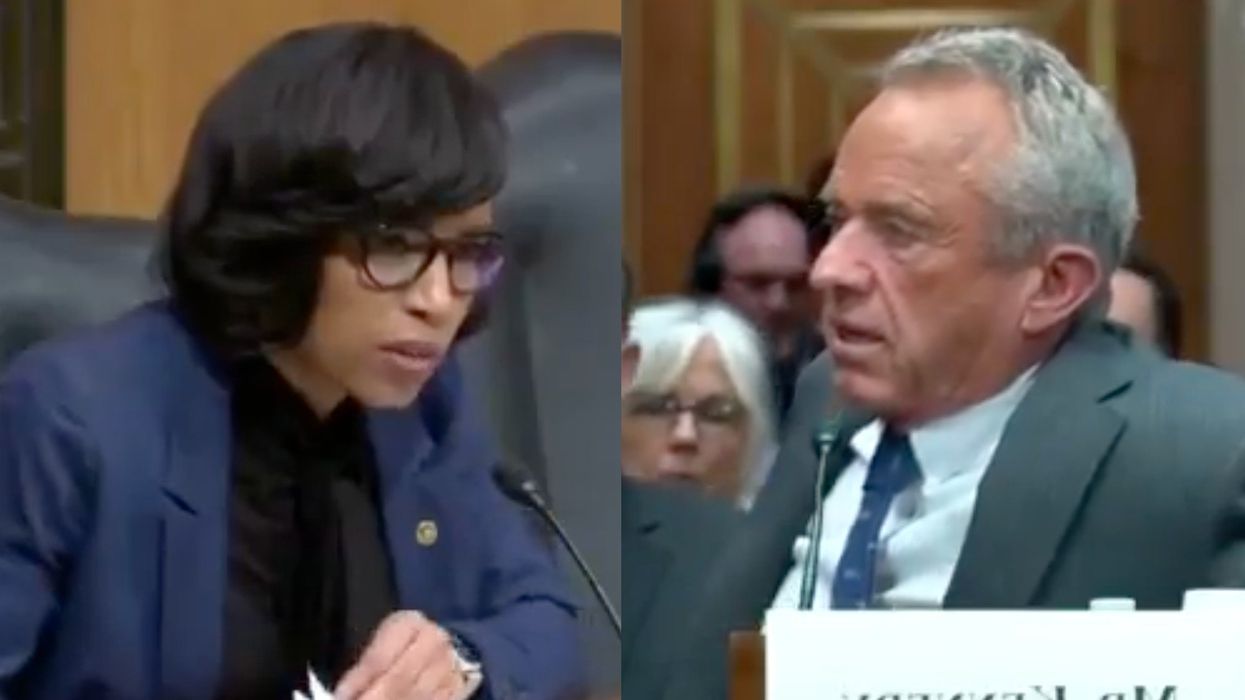
Sen. Angela Alsobrooks (D-Md.) and Health and Human Services Secretary-designate Robert F. Kennedy Jr. on January 30, 2025 (Image: Screengrab via @atrupar / X)
January 30, 2025
ALTERNET


Robert F. Kennedy Jr., President Donald Trump’s nominee to head the U.S. Department of Health and Human Services, faced grilling from Democrats and at least one Republican on day two of his Senate confirmation hearing. One Democrat declared RFK Jr.’s views on vaccinations and immunity “dangerous” after he claimed Black people have stronger immune systems than White people.

“You said the following, and I quote: ‘We should not be giving Black people the same vaccine schedule that’s given to Whites, because their immune system is better than ours.’ Can you please explain what you meant?” U.S. Senator Angela Alsobrooks (D-MD) asked (video below), after quoting Kennedy’s remarks about Black people and vaccines back to him.

“There’s a series of studies, I think most of them by [Andrew] Pollard that the particular antigens that show that Blacks have a much stronger reaction. There’s differences in reaction to different products by different races,” Kennedy responded, a claim he has made before.

“So what different vaccine schedule would you say, I should have received?” Senator Alsobrooks asked.

“Well, I mean, the Pollard article suggests that Blacks need fewer antigens —”

“This is so dangerous,” the Maryland Democrat Senator replied. “Mr. Kennedy with all due respect, that is so dangerous.”

“Your voice would be a voice that parents would listen to, that is so dangerous,” Alsobrooks continued. “I will be voting against your nomination because your views are dangerous to our state and to our country.”


On the website for his anti-vaccine non-profit’s website, Kennedy made that and other similar statements.

“As it turns out, blacks have a much more robust immune system than whites,” the website’s exact transcript of Kennedy’s remarks during an interview reads. “We now know this because there was a guy called Andrew Pollard who is on their side, and he works for the Mayo Clinic, and he’s done these studies. And what he’s found out is that blacks only need half of the antigen that whites do. So if you’re trying to immunize black for measles, if you’re trying to immunize a white person, you need to give a certain amount of the measles virus to them, the dead virus or the live virus. For a black, they’ll get the same immune response if they get half that now.”

The Washington Post this week reported that Kennedy “has repeatedly disparaged vaccines, falsely linked themto autism and argued that White and Black people should have separate vaccination schedules, according to a Washington Post review of his public statements from recent years.”

The Post, highlighting Kennedy’s remarks that Black people’s immune systems are better than White people’s, reported: “Several experts said no scientific basis exists to support that claim.”

Watch the video below or at this link.


Majority of Voters Think Musk Will Use DOGE for Self-Enrichment While Targeting Social Safety Net


"Our polling finds that voters want the government to do more to help them," said Data for Progress' leader, warning that "their view of DOGE and the administration could quickly sour."


Jessica Corbett
Jan 30, 2025
COMMON DREAMS


Survey results released Thursday show that majorities of U.S. voters think billionaire Elon Musk will use his position in the Trump administration for self-enrichment and fear that the presidential advisory commission he is chairing will target Social Security, food assistance, healthcare programs, and more.

Data for Progress and the Progressive Change Institute conducted a series of surveys about Musk—the world's richest person—and the new Department of Government Efficiency (DOGE) in the lead-up to and shortly after Republican President Donald Trump's return to the White House on December 14-15, January 10-11, and January 24-27.

Watchdogs and some lawmakers have sounded the alarm about Musk—whose business affiliations include social media platform X, space exploration company SpaceX, and electric vehicle makerTesla—potentially using his post at DOGE to benefit himself, and the new polling suggests voters share those concerns.

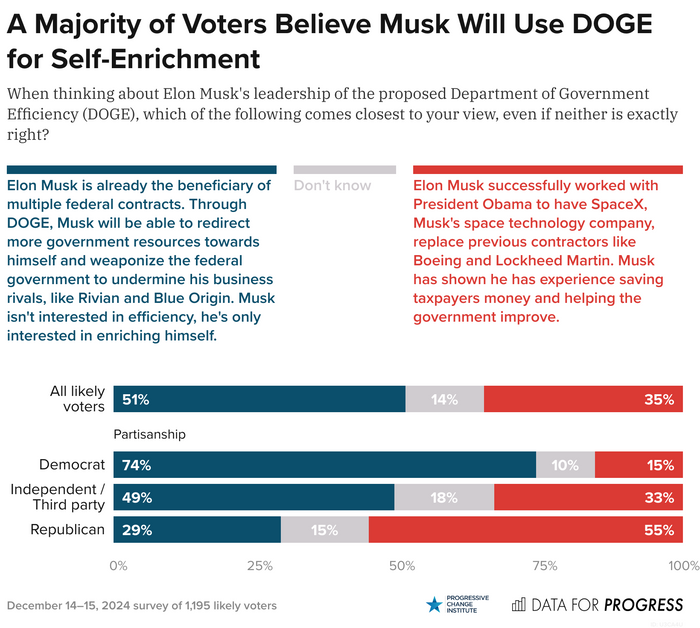
Pollsters found that 51% of voters across the political spectrum agreed that Musk "isn't interested in efficiency, he's only interested in enriching himself," and he will be able to use DOGE to direct resources—including more federal contracts—toward his companies and weaponize the government to undermine competitors.

There were clear divisions among party lines: 74% of Democrats expect self-enrichment from Musk, while just 29% of Republicans have such concerns. Independents and third-party voters were split at 49%. Among all respondents, 14% said they "don't know," and 35% believe that "Musk has shown he has experience saving taxpayers money and helping the government improve."


Trump announced that the billionaire would lead DOGE—which is focused on gutting federal regulations and slashing spending—shortly after his November victory, which was aided by over a quarter-billion dollars from Musk. They initially floated cutting $2 trillion but Musk has since tempered expectations.

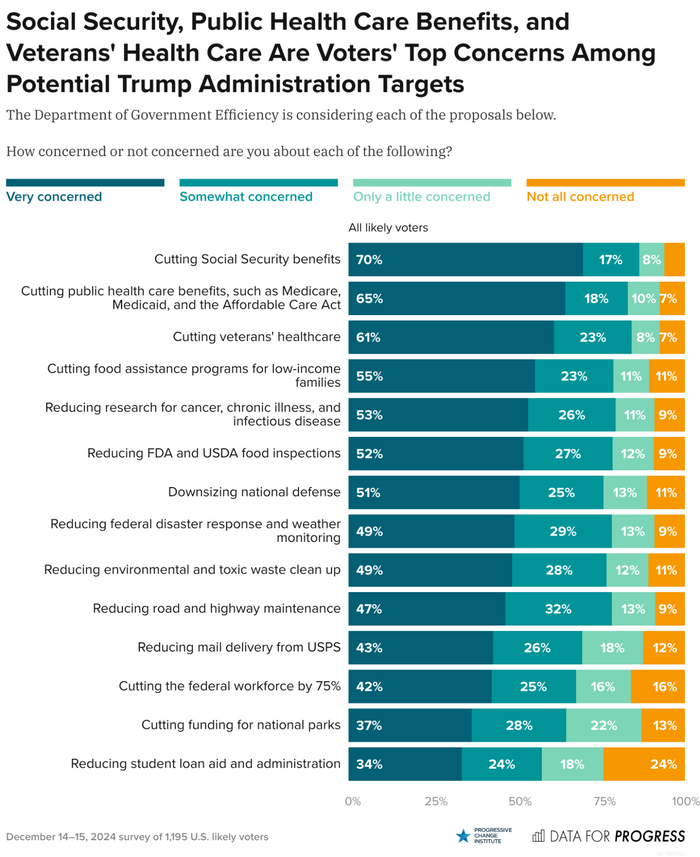
The pollsters found that 87% of U.S. voters are somewhat or very concerned about DOGE and the Trump administration targeting Social Security for cuts. Similarly, 84% fear cuts to veterans' healthcare, and 83% worry about cuts to the Affordable Care Act, Medicaid, or Medicare.

The polling shows that 79% are worried about reducing food inspections as well as research for cancer, chronic illness, and infectious diseases. Additionally, 78% fear cuts to food assistance for low-income families, such as the Supplemental Nutrition Assistance Program (SNAP).

Majorities of voters are concerned about downsizing national defense as well as cutting the federal workforce and funding for national parks, according to the surveys. They are also worried about reducing: federal disaster response and weather monitoring, environmental and toxic waste cleanup, road maintenance, mail delivery, and student loan aid.


The surveyers also questioned voters about messaging on the Musk-led commission. As Data for Progress detailed in a Thursday blog post:

When a case for DOGE is tested against two alternative messages against DOGE, saying DOGE will "steal from you by cutting Social Security, Medicare, and veterans healthcare to give tax breaks to giant corporations and billionaires like Musk" performs better with Independent voters, whose views on DOGE shifted 24 points more unfavorably on net, compared with simply saying DOGE will cut those programs or simply saying DOGE will benefit billionaires...

Additionally, while saying DOGE will cut programs to "give tax breaks to giant corporations and billionaires like Musk" effectively decreases DOGE's favorability, a message that combines "steal from you" and "give tax breaks" has an even greater negative impact on voters' opinion on DOGE, particularly among Independents whose views on DOGE shifted 14 points more unfavorably on net with the combined message.

Another round of tax cuts for the wealthy, similar to the law Trump signed in 2017, is a top legislative priority for Republicans, who now control both chambers of Congress in addition to the White House.

The pollsters also found that 56% of all voters—including 67% of Democrats, 55% of Independents, and 45% of Republicans—believe "the government should do more to solve problems and help Americans." Another 19% believe the government is doing "the right amount," while 22% think it is doing "too much" and 7% aren't sure.

Data for Progress executive director Danielle Deiseroth noted in a Thursday statement that the survey results were published amid mass chaos over a now-rescinded Office of Management and Budget (OMB) memo about Trump's federal funding freeze, which led to lawsuits and the Tuesday shutdown of Medicaid payment portals nationwide.

"As Trump's chaotic OMB memo showed, his administration is using 'government efficiency' as a way to slash the healthcare and benefits that Americans rely on each day from the federal government," she said. "Our polling finds that voters want the government to do more to help them, and as they learn more about these disruptions led by Trump and Elon Musk, their view of DOGE and the administration could quickly sour."


As Trump Blames DEI for Plane Crash, Report Shows Understaffed Air Traffic Control


One controller was doing the work of two people at the long-understaffed tower in the Washington, D.C. area.


National Transportation Safety Board Chair Jennifer Homendy speaks during a press conference as the search continues at the crash site of an American Airlines plane on the Potomac River on January 30, 2025 in Arlington, Virginia.
(Photo: Kayla Bartkowski/Getty Images)


Julia Conley
Jan 30, 2025
COMMON DREAMS

A preliminary report on Wednesday night's crash involving a American Airlines commercial flight and a military helicopter revealed that the air traffic control tower in the vicinity of the accident was not staffed at "normal" levels, with just one controller handling a task that two employees ordinarily would have done in the high-stress job.


The Federal Aviation Administration (FAA) report on Thursday said the staffing at the time of the crash was "not normal for the time of day and volume of traffic."

One controller was instructing helicopters near Ronald Reagan Washington National Airport while also directing planes landing at and departing from the airport.


As The New York Timesreported, controllers use different radio frequencies to communicate with helicopter pilots and those flying planes.

"While the controller is communicating with pilots of the helicopter and the jet, the two sets of pilots may not be able to hear each other," according to the Times.

Air traffic controllers have been forced to work longer hours and workweeks in recent years, amid budget constraints and high turnover. In 2023, the tower near Washington, D.C. had 19 fully certified air traffic controllers. The FAA and the controllers' union say the optimal number is 30.

The FAA report was released shortly after President Donald Trump presented his own theory, without evidence, of why the crash that killed 67 people happened.

Trump suggested at a press briefing that under the Biden administration, the FAA had overseen a "diversity push" with a "focus on hiring people with severe intellectual and psychiatric disabilities."

A reporter at the briefing asked whether Trump was saying the crash "was somehow caused and the result of diversity hiring" and called on him to offer evidence to support the claim.

"It just could have been," Trump said, adding that his administration has "a much higher standard than anybody else" for hiring federal employees.


Government Executive noted that the FAA began diversity, equity, and inclusion (DEI) hiring programs as early as 2013, which continued under the first Trump administration.

No identifying information has been reported about the air traffic controller who was handling the flight paths in question on Wednesday. American Airlines has also not released any personal information about who was piloting its aircraft; Army officials said the helicopter was piloted by one man and one woman, and a male staff sergeant was also on board.


Trump told reporters that he was confident that DEI hiring practices played a role in the crash because he has "common sense."

But critics including Rep. Alexandria Ocasio-Cortez (D-N.Y.) noted that Trump has taken several steps since taking office less than two weeks ago that could make air travel more dangerous for Americans in the long term.

"Trump gutted the aviation safety committee last week," said the congresswoman, referring to the Aviation Security Advisory Committee. "Air traffic controllers—already understaffed—got Trump's 'buyout' this week with a one-week ultimatum to decide. It's not DEI—it's him."

Rep. Rick Larsen (D-Wash.) also warned last week that Trump's federal hiring freeze could worsen understaffing among air traffic controllers.

"Hiring air traffic controllers is the number one safety issue according to the entire aviation industry," said Larsen at the time. "Instead of working to improve aviation safety and lower costs for hardworking American families, the administration is choosing to spread bogus DEI claims to justify this decision. I'm not surprised by the president's dangerous and divisive actions, but the administration must reverse course."

On Thursday, Larsen offered condolences for the families of the victims in the crash, and cautioned against speculating "on the causes of aviation accidents before we have the facts and the details."

"However, I know it's not DEI because it never is," said Larsen. "The National Transportation Safety Board will look at the causes and contributing factors of this accident. It is important to let the NTSB complete its work before we consider any potential policy response."


No scientific link found between sickle cell trait and sudden death


Expert panel’s findings refute attribution of sudden death to sickle cell trait


American Society of Hematology


(WASHINGTON—Jan. 30, 2025) – A systematic literature review found no evidence to support that physical exertion without rhabdomyolysis (muscle breakdown) or heat injury can cause sudden death for individuals with sickle cell trait (SCT), nor is there any high-level evidence that SCT causes acute pain crises. These results were published today in the American Society of Hematology’s flagship journal, Blood, and informed the Society’s updated position statement on SCT

“SCT has long been misunderstood, fueling widespread misinformation and medically inaccurate claims that it can lead to sudden death. This misconception has been especially prominent in cases of Black men with SCT,” said Belinda Avalos, MD, ASH president. “In light of the pervasive, widely publicized, and harmful nature of this myth, the Society aims to further promote accurate information to protect and empower affected communities.” 

Individuals with SCT have one copy of the gene associated with sickle cell disease (SCD). SCD is a blood disorder characterized by misshapen blood cells that can cause blockages, leading to infections and episodes of severe pain, often referred to as acute pain crises. Unlike SCD, SCT – which affects over 100 million people worldwide, including 8 to 10% of Black Americans – is not a disease. Individuals with SCT do not go on to develop SCD and generally do not experience any related health complications.  

“To date, this is the most authoritative and definitive systematic review on this subject,” said study author Michael R. DeBaun, MD, MPH, professor of pediatrics and medicine at Vanderbilt University School of Medicine and founder and director of the Vanderbilt-Meharry Sickle Cell Disease Center of Excellence. “This review shows that any primary, secondary, or tertiary cause of death attributable to SCT is not a diagnosis substantiated by the medical evidence.” 

ASH convened an expert panel of hematologists and forensic pathologists to systematically review all existing available research to answer two primary questions: 1) Do uncomplicated acute pain crises occur in people with SCT? and 2) Can physical activity above baseline result in sudden death among those individuals? 

The experts conducted a multi-database search for English-language studies on SCT and pain crises or mortality, identifying 1,474 such citations. Only seven of those studies reported original data, included laboratory testing for SCT in individuals, and addressed the two primary research questions.  

Of these studies, none assessed acute pain crises in individuals with SCT compared to those with SCD and only one described death in individuals reported to have SCT. This study of active-duty U.S. soldiers found only that SCT was associated with a higher risk of heat-related-exertional rhabdomyolysis, or muscle breakdown, but not a higher risk of death from any cause. After the implementation of precautions to prevent heat and environmental-related injury in military personnel, the race-adjusted risk of death was no different in individuals with SCT compared to individuals without SCT. 

“In the absence of two medical conditions that we are all at risk for, exertional rhabdomyolysis or crush injuries leading to rhabdomyolysis, individuals with SCT are not susceptible to sudden death. Even under these extreme environmental conditions, unexplained sudden death cannot be attributed to SCT,” said Dr. DeBaun. Taken together, these findings demonstrate that “in individuals with SCT, the likelihood of SCT alone or pain crises being the root cause of sudden death is medically impossible,” he added. 

While conducting this systematic review, the experts found several studies in which the presence of sickled blood cells at autopsy was cited as evidence of death by acute pain crisis in individuals with SCT. However, the experts did not find any studies that had human data to support this hypothesis, nor any clinical descriptions sufficient to make a diagnosis of an acute pain crisis immediately preceding death.  

“Medicine, even in the post-mortem setting, is science,” said corresponding study author Lachelle D. Weeks, MD, PhD, assistant professor of medicine at Harvard Medical School and physician-scientist in the division of population sciences at Dana-Farber Cancer Institute. “Our diagnoses have to make sense and be backed by medical evidence. Given the findings of this study, we owe it to individuals with SCT to ensure that post-mortem examinations check for evidence of rhabdomyolysis and other medical or traumatic causes of death.” 

The review had some limitations, most notably a lack of high quality, peer-reviewed direct evidence. To help mitigate this challenge, panel members were encouraged to consider indirect evidence when reviewing abstracts and judged evidence certainty following the GRADE (Grading of Recommendations, Assessment, Development and Evaluation) framework. However, given this paucity of data, the experts hope this review prompts additional SCT research.  

Following the results of this study, ASH revised its position statement on SCT, which states that listing “sickle cell crisis” or “sickle cell trait” as a cause of death on an autopsy report for an individual with sickle cell trait is medically inaccurate and without medical evidence of causation. To read the updated statement and learn more about ASH’s advocacy efforts in this area, visit https://hematology.org/advocacy

### 

 Additional resources on SCT and SCD: 

The American Society of Hematology (ASH) (hematology.org) is the world’s largest professional society of hematologists dedicated to furthering the understanding, diagnosis, treatment, and prevention of disorders affecting the blood. Since 1958, the Society has led the development of hematology as a discipline by promoting research, patient care, education, training, and advocacy in hematology. 

The Blood journals (https://ashpublications.org/journals) are the premier source for basic, translational, and clinical hematological research. The Blood journals publish more peer-reviewed hematology research than any other academic journals worldwide. 


DEI

Community racial and ethnic representation among physicians in US internal medicine residency programs


JAMA Network Open


About The Study:

 In this cross-sectional study, underrepresented in medicine internal medicine residents remained underrepresented compared with their program’s county populations. These findings should inform racial and ethnic diversity policies to address the continuing underrepresentation among graduate medical education physicians, which adversely impacts the care of historically underserved communities. 


Corresponding Author: To contact the corresponding author, Jung G. Kim, PhD, MPH, email jung.kim3@nyulangone.org.

To access the embargoed study: Visit our For The Media website at this link https://media.jamanetwork.com/

(doi:10.1001/jamanetworkopen.2024.57310)

Editor’s Note: Please see the article for additional information, including other authors, author contributions and affiliations, conflict of interest and financial disclosures, and funding and support.

#  #  #

Embed this link to provide your readers free access to the full-text article This link will be live at the embargo time 

http://jamanetwork.com/journals/jamanetworkopen/fullarticle/10.1001/jamanetworkopen.2024.57310?utm_source=For_The_Media&utm_medium=referral&utm_campaign=ftm_links&utm_term=013025


About JAMA Network Open: JAMA Network Open is an online-only open access general medical journal from the JAMA Network. On weekdays, the journal publishes peer-reviewed clinical research and commentary in more than 40 medical and health subject areas. Every article is free online from the day of publication. 


Sharks and rays benefit from global warming - but not from CO2 in the Oceans


Even positive effects do not compensate for the complex dangers of climate change


Peer-Reviewed Publication

University of Vienna

Fig. 1: A group of whitetip reef sharks (Triaenodon obesus) resting under a table coral off the coast of Indonesia, one of the world's current hotspots of cartilaginous fish diversity. 

image: 

Fig. 1: A group of whitetip reef sharks (Triaenodon obesus) resting under a table coral off the coast of Indonesia, one of the world's current hotspots of cartilaginous fish diversity.

view more 

Credit: Manuel A. Staggl


Sharks and rays have populated the world's oceans for around 450 million years, but more than a third of the species living today are severely threatened by overfishing and the loss of their habitat. An international research team led by palaeobiologist Manuel A. Staggl from the University of Vienna has now investigated whether and how global warming influences the diversity of sharks based on climate fluctuations between 200 and 66 million years ago. According to the study, higher temperatures and more shallow water areas have a positive effect, while higher CO2 levels have a clearly negative effect. The study was recently published in the scientific journal "Biology".

There have been five mass extinctions in Earth’s history - and one group of animals has survived them all: cartilaginous fish, which include sharks and rays, have inhabited the oceans for more than 450 million years; more than 1,200 shark and ray species are known today. However, more than a third of these species are now seriously threatened due to their habits and increasing over-exploitation and habitat destruction; extinction would also have a direct impact on many ecosystems. 

"The current rapid climate warming could also have a negative impact on this group of animals - in an international study based on earlier climate changes, we have now looked at how exactly this might impact rays and sharks," explains palaeobiologist Manuel A. Staggl from the University of Vienna. The international team investigated the driving forces behind the biodiversity of sharks and rays during the so-called Jurassic (200-143 million years ago) and Cretaceous (143-66 million years ago), a heyday of shark and ray evolution with a wide range of different environmental conditions. Fossilised shark and ray teeth were used to determine the species diversity for each age and compared with the climate data of the respective age. "We wanted to understand which environmental factors influence the diversity of sharks and rays in order to be able to develop possible future scenarios with regard to current global warming," says Jürgen Kriwet, professor of palaeobiology at the University of Vienna.

Higher CO2 level as a decisive environmental factor

The results show that three environmental factors are decisive: Higher temperatures and more shallow water areas have a positive effect; however, a higher carbon dioxide (CO2) concentration clearly has a negative effect. This is the first time that the negative impact of CO2 concentrations in the ocean has been so clearly described: "We cannot yet fully explain the exact mechanisms behind the negative effect of CO2 on the biodiversity of sharks and rays," says Staggl. However, laboratory studies on sharks and rays living today have revealed direct physiological effects of higher CO2 concentrations on the animals - from impacts on the animals' senses to changes in the skeleton during embryonic development. In any case, the fossil record shows that a higher CO2 content contributed to the extinction of individual shark and ray species.

Climate change as an opportunity?

On the other hand, the current global warming may also harbour opportunities for sharks and rays: Rising sea levels and higher temperatures have already been beneficial for the biodiversity of these predators in the past - firstly due to the increase in shallow coastal waters and secondly due to the global expansion of warm waters that offer stable conditions all year round. 

The rise in sea level in particular appears to have been of great importance. "The resulting habitats in shallow seas that cover large continental areas are real biodiversity hotspots; sharks and rays were able to colonise them very quickly and efficiently thanks to their adaptability," explains Staggl. Due to the sometimes significantly higher temperatures during the Jurassic and Cretaceous, the tropics and subtropics were able to expand further north and south, and without distinct seasons, stable and more complex ecosystems with a greater diversity of species were able to develop.

No bright future

However, assuming that sharks and rays are facing a bright future would be too short-sighted, explains Staggl: "The environment is currently changing particularly quickly - unfortunately probably too quickly for the animals and their ecosystems." Together with overfishing, habitat loss and the rise in CO2 levels in the oceans, it is unlikely that these predators will benefit greatly from global warming. 

In order to reduce the environmental pressure on sharks, urgent measures are therefore needed to protect them. This is not just about protecting the sharks and rays themselves, but also about preserving entire ecosystems. "Because without the top predators, the ecosystems would collapse," emphasises Kriwet: "By protecting sharks and rays, we are investing directly in the health of our oceans and therefore also in the people and industries that benefit from these ecosystems," says the professor of palaeobiology.

Fig. 3: Diversity curve of neoselachians (modern sharks and rays and the extinct synechodontiform sharks) from the Triassic to the Holocene in millions of years. The curve shows "sampling standardised range through" diversity.

Credit

Manuel A. Staggl