Tuesday, February 18, 2025

Australian central bank cuts benchmark interest rate for the first time since October 2020


ByROD MCGUIRK
 Associated Press
February 17, 2025, 


MELBOURNE, Australia -- Australia’s central bank on Tuesday reduced its benchmark interest rate for the first time since October 2020 as the nation’s inflation cools.

The Reserve Bank of Australia reduced the cash rate by a quarter percentage point from 4.35% to 4.1% at its first board meeting for the year.

The cut was widely anticipated after inflation rose only 0.2% in the December quarter and 2.4% for calendar 2024. Annual inflation peaked at 7.8% two years earlier.

The bank manipulates interest rates to keep inflation within a target band of between 2% and 3%.

“Inflation has fallen substantially since the peak in 2022, as higher interest rates have been working to bring aggregate demand and supply closer towards balance,” the board said in a statement.

Bank Governor Michele Bullock later advised against believing economic forecasts that several more rate cuts were expected this year. The board will next consider changing interest rates at its meeting on April 1.

“Some other central banks have cut interest rates quite sharply over the past year, but we have taken a different strategy to most,” Bullock told reporters.

“Our policy rate was not raised as much as many countries overseas. We judged that while inflation expectations remained anchored, we could take a bit longer to bring inflation back to the target band, but we could keep unemployment lower,” she added.

Unemployment in Australia remained at near-record low levels of 4% in December, up from 3.9% in November.

Bullock said U.S. plans to increase tariffs on trading partners had the potential to be bad for economic activity around the world.

“The tariff threats and what’s going on overseas is very uncertain and probably even worse, it’s unpredictable,” Bullock said.

The rate shift is a welcome development for Prime Minister Anthony Albanese’s center-left Labor Party government which will seek reelection at elections due by May 17.

Treasurer Jim Chalmers welcomed the independent board's decision.

“This is the rate relief Australians need and deserve,” Chalmers said in a statement. “It won't solve every problem in our economy or in household budgets but it will help."

Chalmers said his government had curbed inflation without the negative consequences experienced in other countries including of high unemployment, a shrinking economy and recession.

Twelve of the last 13 rate increases have taken place since the government was elected for its first three-year term on May 21, 2022.

The cycle began in the final days of the previous government’s tenure when the rate rose from a record low 0.1% to 0.35% on May 4, 2022.

The high cost of living and a shortage of housing around Australia are expected to be major issues in the upcoming election campaign.

The central bank had held the cash rate at 4.35% since November 2023. That was the highest rate since it fell from 4.5% to 4.25% in December 2011.
Senior Afghan Taliban Officials In Japan For Talks

This is the Taliban's first known diplomatic trip outside the Central Asia-Middle East region since the Taliban seized control of Afghanistan in 2021.


Associated Press
18 February 2025 


Senior Afghan Taliban Officials In Japan For Talks Photo: | Representative Image

Japanese officials said senior Afghan Taliban officials were in Japan for talks, as part of Tokyo's efforts to help Afghanistan build a more inclusive political system and protect human rights.

It's their first known diplomatic trip outside the Central Asia-Middle East region since the Taliban seized control of Afghanistan in 2021.

The unidentified Taliban senior officials were invited by grant-making organization Nippon Zaidan and were also set to talk with Japanese Foreign Ministry officials, Chief Cabinet Secretary Yoshimasa Hayashi told reporters Monday.

The Taliban officials were invited to help them better understand the need “to have a broad perspective toward their future nation building and to widely accept humanitarian assistance from the international community for vulnerable people, Nippon Zaidan said in a statement. It declined to give details of the visitors and their schedule.

Japan does not formally recognize the Taliban as Afghanistan's official government.

Hayashi noted the visit was initiated by a private organization but complements the Japanese government's effort to work with the international community to call on the Taliban to make policy changes that protect human rights.

Restrictions the Taliban impose on women and girls are a major hurdle to the Taliban being recognised as the official government of Afghanistan.

The trip was initially revealed by Latif Nazari, the Taliban's deputy economy minister, who posted on the X platform that “a high-level delegation” was heading to Japan and that the Taliban seek dignified engagement with the world as an active member of the international community

Cyprus-Egypt pipeline a reality, at last


by fm
18th February 2025

A decade after the idea was first put on the table, Cyprus and Egypt have finally agreed to transport natural gas from the island’s as yet unutilised offshore reserves to facilities on the North African coast for processing and re-export to international markets.

This means that Cyprus will at last abandon the over-ambitious plan to build its own liquefaction plant and save about 10 bln euros, which oil majors were reluctant to foot the bill for.

Instead, Egypt’s under-utilised plants at Damietta and Edku, some 240 kms south, can now work at increased capacity, reducing costs and making the Cyprus natgas more affordable.


Due to rapidly growing demand, Egypt too is seeking alternative sources of energy to fire up its power stations, as Cairo aims to become a regional energy exporter because its own output suffered declines in recent years.

“Cyprus’ energy plans are proceeding normally, with the signing of the (commercialisation) agreement and memorandum of understanding in Cairo, decisive for the future of our energy plans,” said President Nikos Christodoulides, after returning from Egypt.

The Cypriot president and Abdel Fattah El Sisi had extensive talks about cooperation on the sidelines of the Egypt Energy Show (Egypes), an event bringing together world leaders in the energy sector and policy makers dedicated to the sustainable energy transition.

Two agreements were signed for the transport of gas from the Cypriot fields of Aphrodite in Block 12 operated by U.S. giant Chevron and three gasfields in Block 6, operated by Italian Eni, to the natural gas liquefaction plants near Alexandria.

Egypt, along with Italian energy giant Eni and France’s TotalEnergies, have agreed to collaborate to commercialise the natural gas reserves discovered within Block 6 of the Cyprus exclusive economic zone (EEZ).

Export to Europe


According to ENI, the gas would be transported and processed in Egypt at “existing Zohr facilities, before being liquefied in the Damietta (liquified natural gas) LNG plant for export to European markets.”

First discovered in 2011, Aphrodite is estimated to hold 3.5-4.4 trln cubic feet. It is operated by Chevron, which bought the rights from Noble Energy, and is partners with BG Cyprus (Shell) and NewMed Energy 30%.

Frank Cassulo, Chevron’s International Exploration and Production’s vice president issued a statement, saying that it will “provide the basis to move forward with related commercial arrangements.”

Cassulo reaffirmed Chevron’s commitment to developing the Aphrodite project, emphasising its strategic importance both for Cyprus and for Chevron’s eastern Mediterranean portfolio.

The approved development and production plan (DPP) includes the establishment of a floating production unit (FPU) within Cyprus’ EEZ and a pipeline to export gas to Egypt. Chevron’s extensive resource base in the eastern Mediterranean, estimated at 45 tcf of gross resources, offers significant expansion opportunities to meet growing natural gas demand in the coming decades.

ExxonMobil future plans

In Cairo, Christodoulides also met with ExxonMobil’s vice president for global exploration, John Ardill, who briefed the Cypriot president on the U.S. energy giant’s drilling activities in Block 5 and future plans from Block 10.

“We will soon have results. He will visit Cyprus during the second week of March to inform us in person, and the energy plans of the Republic of Cyprus are progressing normally,” Christodoulides added.

“This agreement paves the way to bring Cyprus’ gas to the market in a timely fashion, contributing to energy security and competitiveness of energy supply,” said Claudio Descalzi, Eni’s CEO.

“This project leverages Egypt’s existing infrastructure, including export facilities, which are a key enabler for developments in the region. Egypt and Cyprus reaffirm their roles in the emerging energy hub of the eastern Mediterranean, which is set to play an increasing role in the global gas supply in the near future.”

Discovered in 2022, Cronos is estimated to hold more than 3 tcf in natgas reserves, while Block 6 encompasses further potential resources under exploration and appraisal, including the Zeus field also discovered in 2022.

Block 6 is operated by Eni holding a 50% interest, while TotalEnergies holds the remaining 50%. Eni also operates Block 8 and has participating interests in Blocks 7 and 11.

Eni has been present in Egypt since 1954. The company is currently the country’s leading producer with an equity production of approximately 280,000 barrels of oil equivalent per day in 2024. It also has a 50% share in the Damietta LNG Plant.
Trump's aid cuts stop South African HIV vaccine trials in their tracks

Scientific officer Anathi Nkayi works in the research lab at the University of Cape Town's Institute of Infectious Disease and Molecular Medicine, in Cape Town, South Africa on Feb 17.
PHOTO: Reuters

February 18, 2025 12:55 AM

JOHANNESBURG — South African lab technician Nozipho Mlotshwa was waiting for the test results for a potential HIV vaccine, which has eluded scientists for decades, when the order came from the United States Agency for International Development (USAID) to stop work.

The first round of vaccines she and her colleagues made in Johannesburg had produced an immune response in rabbits, which was promising but not conclusive — so they tweaked the formula and sent off four new versions for pre-clinical tests.

"This was very exciting. We were getting quite good results," Mlotshwa, 32, told Reuters in the lab in the Antiviral Gene Therapy Research Unit at the city's University of the Witwatersrand.


Now the animal blood samples containing their results are sitting untouched in a freezer.

A trial of an earlier, separate vaccine candidate, which was about to be tested on humans in South Africa as well as Kenya and Uganda, is also on ice.

Both trials are among the casualties of US President Donald Trump's decision to dismantle the USAID.

They are part of a wider South African-led HIV vaccine development scheme known as BRILLIANT and funded entirely by a US$45 million (S$60 million) grant from USAID. It is unclear if or when the project could resume. The US State Department did not immediately respond to a request for comment.

"It feels like you're building something and you could really make a huge difference," Nigel Garrett, Chief Scientific Officer at the Desmond Tutu Health Foundation, a partner in the project, said.


"And then it's wiped away."

The project is one of many research efforts worldwide to be hit by Trump's actions since taking office last month. Others include halting efforts to protect food crops from pests and diseases and blocking publication of a paper on the monkey pox outbreak.

'Holy grail'

HIV's ability to mutate quickly has confounded efforts to create a vaccine ever since it was first identified in 1983. The researchers in Johannesburg are using the mRNA technology that created some Covid-19 vaccines.

Several other mRNA-based HIV vaccine candidates worldwide have reached clinical trials. BRILLIANT is unique in being Africa-led, aiming to develop capacity for producing vaccines in Africa.

For the past year the Johannesburg team had been working with genetic sequences from two South African patients who have HIV but whose bodies produce a rare type of antibody that neutralises the virus. They are trying to simulate that immune response.

"We were gaining momentum," said Patrick Arbuthnot, director of the research unit, adding: "a HIV vaccine is the holy grail of the field".

Trump in January ordered a 90-day pause in all foreign development assistance pending assessment of its consistency with his America First foreign policy.

Separately, he has targeted South Africa with an executive order to cut all funding to the country, citing disapproval of its land reform policy and its genocide case against US ally Israel.

The US foreign aid freeze has affected programmes across the globe, stranding shipments of life-saving medical supplies, including HIV drugs, and leaving disaster response teams unable to deploy. Waivers for "life-saving humanitarian assistance" have been hampered.

'Good for the world'

Because South Africa has the world's largest population of people living with HIV, at more than eight million, it is a hub for research on the virus.

"Most of the landmark and groundbreaking studies have been conducted in this country. But these have been good for the whole world," said Ntobeko Ntusi, CEO of the South African Medical Research Council, which is spearheading the HIV vaccine search.

Ntusi said he did not expect funding for projects like BRILLIANT to resume, given the executive order on aid to South Africa. The council gets about a third of its funding from US federal sources, for research that is mostly on HIV and tuberculosis but covers other areas including maternal and infant mortality and antimicrobial resistance, he said.

Garrett said the shot that was ready for testing on humans was a mix of two vaccine substances developed in the US and the Netherlands which have shown promise but never been tested together.

They are now sitting in storage.

"We had a huge opportunity, good funding. It's difficult for other funders to fill that gap," he said.


Hamas says 'ready to relinquish power' in Gaza, provided employees integrated and armed resistance preserved

Abdul Latif al-Qanoua, Hamas's spokesperson, said that Hamas does not oppose the establishment of a committee to oversee Gaza’s administration.


Sally Ibrahim
Gaza
18 February, 2025
NEW ARAB


Hamas insists that these approximately 40,000 employees, who form the backbone of Gaza's governmental institutions, including healthcare, education, and security, be integrated into the new administration's structure without discrimination.
 [Getty]

The Palestinian Islamic Hamas movement is willing to step aside from governing the war-torn Gaza Strip, provided that a technocratic government is formed to manage the coastal enclave's affairs, according to an official at the movement.

Speaking to The New Arab, Abdul Latif al-Qanoua, Hamas's spokesperson, said that Hamas does not oppose the establishment of a committee to oversee Gaza's administration.

However, he emphasised that Hamas must approve the committee's members and its mandate, further stating that the notion of Hamas completely withdrawing from governance is "inaccurate."

"Hamas prefers the formation of a national unity government that includes all Palestinian factions without Hamas," he added. "However, if such an arrangement proves unattainable, Hamas supports the creation of a 'Community Support Committee' to ensure the continued provision of essential services in Gaza."
Will the PA return to Gaza?

A well-informed source revealed that Hamas has communicated to the Palestinian Authority (PA) its readiness to transfer governance in Gaza on the condition that the Hamas's employees, appointed after the Islamic movement took over the strip in 2007, are retained in their positions and their salaries and rights are safeguarded.


According to a source close to Hamas, who prefer to remain anonymous due to the sensitivity of the topic, the issue of retaining employees remains one of the primary obstacles for a final agreement.

Hamas insists that these approximately 40,000 employees, who form the backbone of Gaza's governmental institutions, including healthcare, education, and security, be integrated into the new administration's structure without discrimination.

In that regard, the Islamic movement requested formal guarantees, either from the PA or through regional mediators, to ensure the continued payment of these employees' salaries.

Hamas fears a repeat of the 2017 reconciliation agreement, brokered by Egypt, which collapsed due to the PA's failure to fulfil its commitments on salaries and administrative integration.

Another source within Hamas noted to TNA that Egypt and Qatar are currently playing a crucial role in bridging the gap between Hamas and the PA as intense negotiations are underway to establish a technocratic government capable of managing Gaza's affairs while preventing a political or security vacuum.

Egypt, in particular, has reportedly conveyed to Hamas that any agreement must have the approval of the PA and international stakeholders to ensure its sustainability and to prevent further sanctions and restrictions on Gaza.
The future of armed resistance

Beyond the issue related to employees, another major point of contention remains security and the future of armed resistance in Gaza.

While the PA demands complete control over Gaza's security apparatus, Hamas firmly rejects any move that could lead to the dismantling of its military wing, the Al-Qassam Brigades.

Hamas's spokesperson, al-Qanoua, further clarified that Hamas is open to cooperating with a new government regarding civilian and administrative affairs, but will not permit any interference in resistance activities.

"The resistance's weapons are not up for negotiation. We are willing to work within a framework that ensures internal stability while respecting the sacrifices of our people," al-Qanoua said.

Al-Qanoua stressed that Hamas remains committed to facilitating any efforts aimed at achieving Palestinian reconciliation but insists on safeguarding the principles of resistance.

"Any attempt to undermine the weapons of the resistance, the Al-Qassam Brigades, or other military wings is a red line that cannot be crossed," he asserted.

These developments occur while Gaza faces escalating humanitarian and economic challenges due to the ongoing Israeli blockade and deteriorating living conditions after more than 15-months of an Israeli genocidal war.

Analysts believe that mutual guarantees must be established for any agreement to succeed. These would include improving the economic situation in Gaza, easing restrictions on movement and trade, and finding a compromise on contentious issues such as the future of security forces and the resistance's military capabilities.

UPDATED

Egypt developing plan to rebuild Gaza as counter to Trump’s call to depopulate area

Scheme envisions establishing ‘secure areas’ where Palestinians can live, and an administration not aligned with either Hamas or PA to oversee territory during reconstruction


By AP and ToI Staff
Today, 

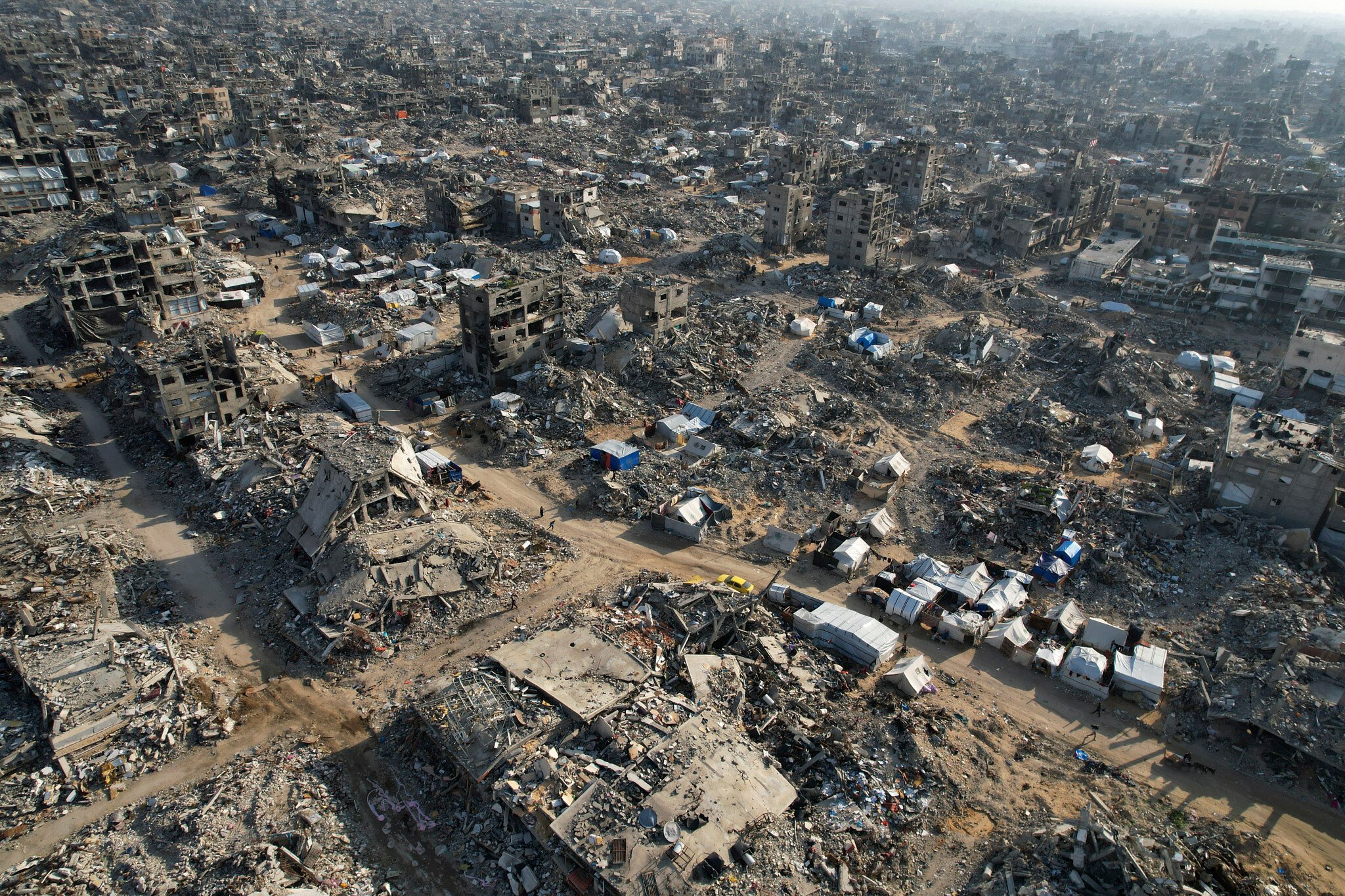
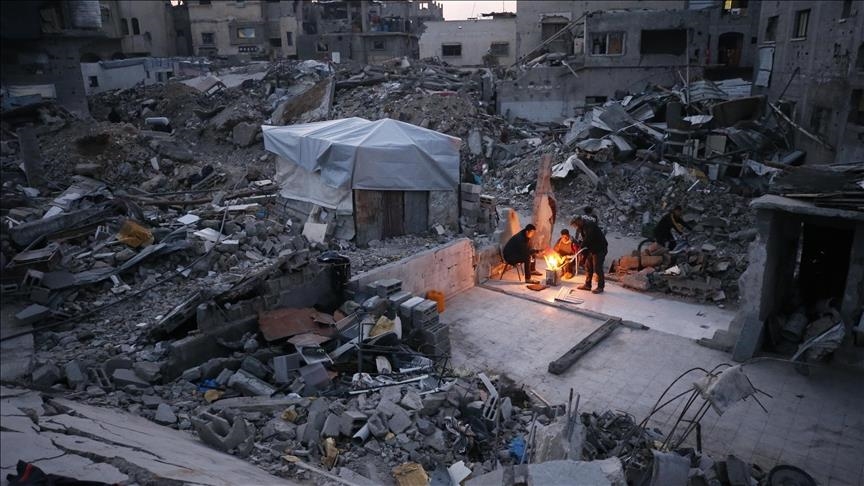
An aerial photograph taken by a drone shows tents amidst the destruction from war in Beit Lahiya, northern Gaza Strip, on February 17, 2025. (Mohammad Abu Samra/AP)


CAIRO — Egypt is developing a plan to rebuild Gaza without forcing Palestinians out of the Strip, in a counter to US President Donald Trump’s proposal to depopulate the territory and for Washington to take it over.

Egypt’s state-run Al-Ahram newspaper said the proposal calls for establishing “secure areas” within Gaza where Palestinians can live initially while Egyptian and international construction firms remove and rehabilitate the strip’s infrastructure.

Egyptian officials have been discussing the plan with European diplomats as well as with Saudi Arabia, Qatar and the United Arab Emirates, according to two Egyptian officials and Arab and Western diplomats. They are also discussing ways to fund the reconstruction, including an international conference on Gaza reconstruction, said one of the Egyptian officials and an Arab diplomat.

The officials and diplomats spoke on condition of anonymity because the proposal is still being negotiated.

The plan comes after an international uproar over Trump’s call for the removal of Gaza’s population of some 2 million Palestinians. Trump suggested the United States would take over the Gaza Strip and rebuild it into a “Riviera of the Middle East,” though Palestinians would not be allowed back.

Palestinians have widely said they will not leave their homeland, while Egypt, and Jordan, backed by Saudi Arabia, have refused Trump’s calls for them to take in Gaza’s population. Rights groups have widely said the plan amounts to forced expulsion, a potential war crime. European countries have also largely denounced Trump’s plan. Israel’s Prime Minister Benjamin Netanyahu has praised the idea and says Israel is preparing to implement it.


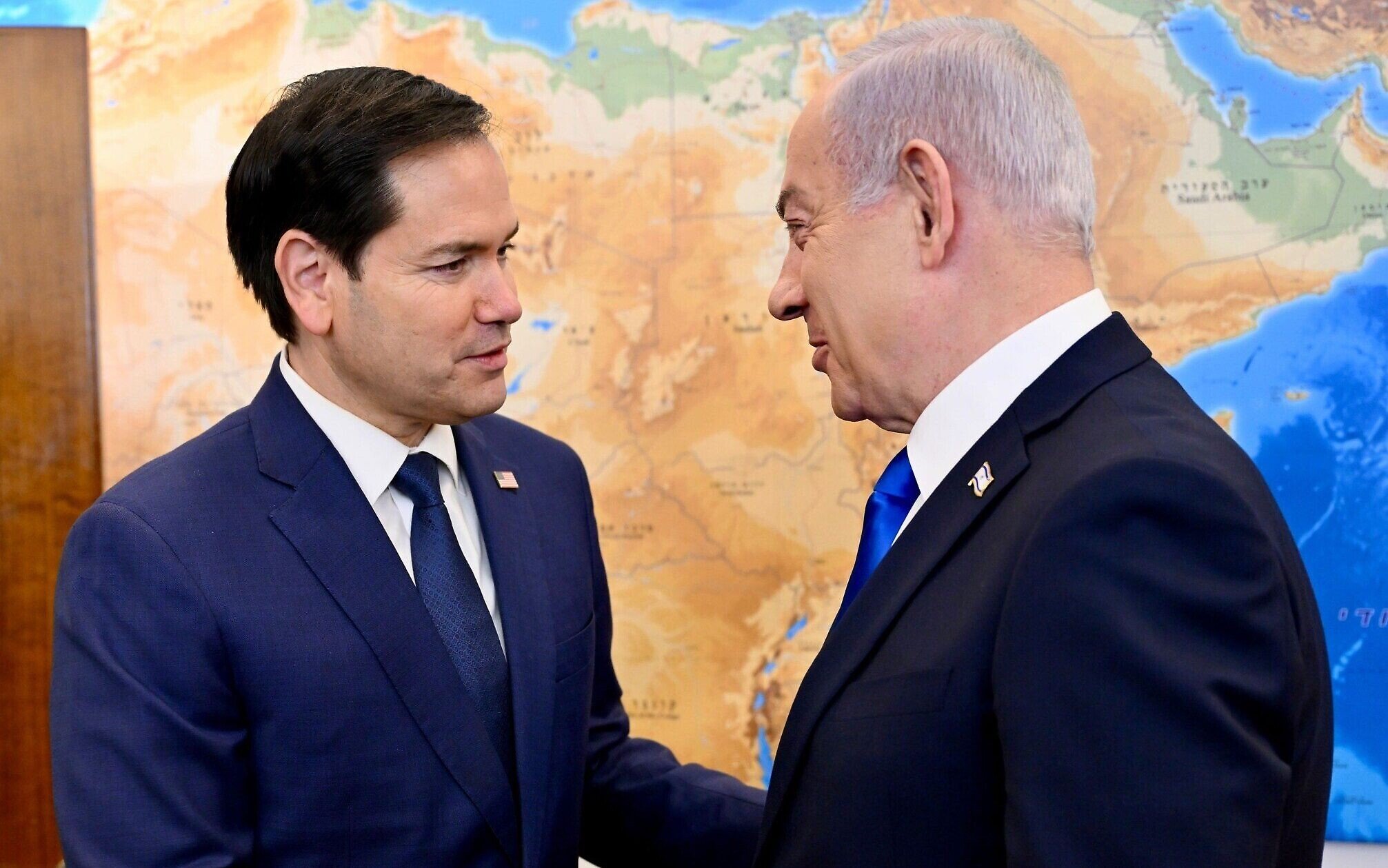
(L) US Secretary of State Marco Rubio meets Prime Minister Benjamin Netanyahu in Jerusalem on February 16, 2025 (David Azagury/US Embassy Jerusalem)

US Secretary of State Marco Rubio, who was in Saudi Arabia on Monday in a tour of the region, has said the United States was up to hearing alternative proposals.

“If the Arab countries have a better plan, then that’s great,” Rubio said Thursday on the US radio program “Clay and Buck Show.”
Advertisement

Ad Feedback

Egypt’s Al-Ahram said the proposal is designed to “refute American President Trump’s logic” and counter “any other visions or plans that aim to change the geographic and demographic structure of the Gaza Strip.”

Gaza is nearing a critical juncture, with the first phase of a ceasefire with Israel due to run out in early March. Israel and Hamas must still negotiate a second phase meant to bring a release of all remaining hostages held by the terrorists, a full Israeli withdrawal from Gaza, and a long-term halt to the war.

The three-stage ceasefire agreement, reached last month, halted some 15 months of fighting triggered by the group’s October 7, 2023, invasion of Israel, when Hamas-led terrorists killed some 1,200 people and took 251 hostages.

The deal requires Hamas to release all its hostages, Israel to release thousands of Palestinian security prisoners — including hundreds serving life sentences — and a halt to fighting in the Strip, followed by negotiations for a “sustainable calm” and IDF withdrawal from the enclave.

Any reconstruction plan will be impossible to implement without a deal on the second phase, including an agreement on who will govern Gaza in the long term. Israel demands the elimination of Hamas as a political or military force in the territory, and international donors are unlikely to contribute to any rebuilding if Hamas is in charge.

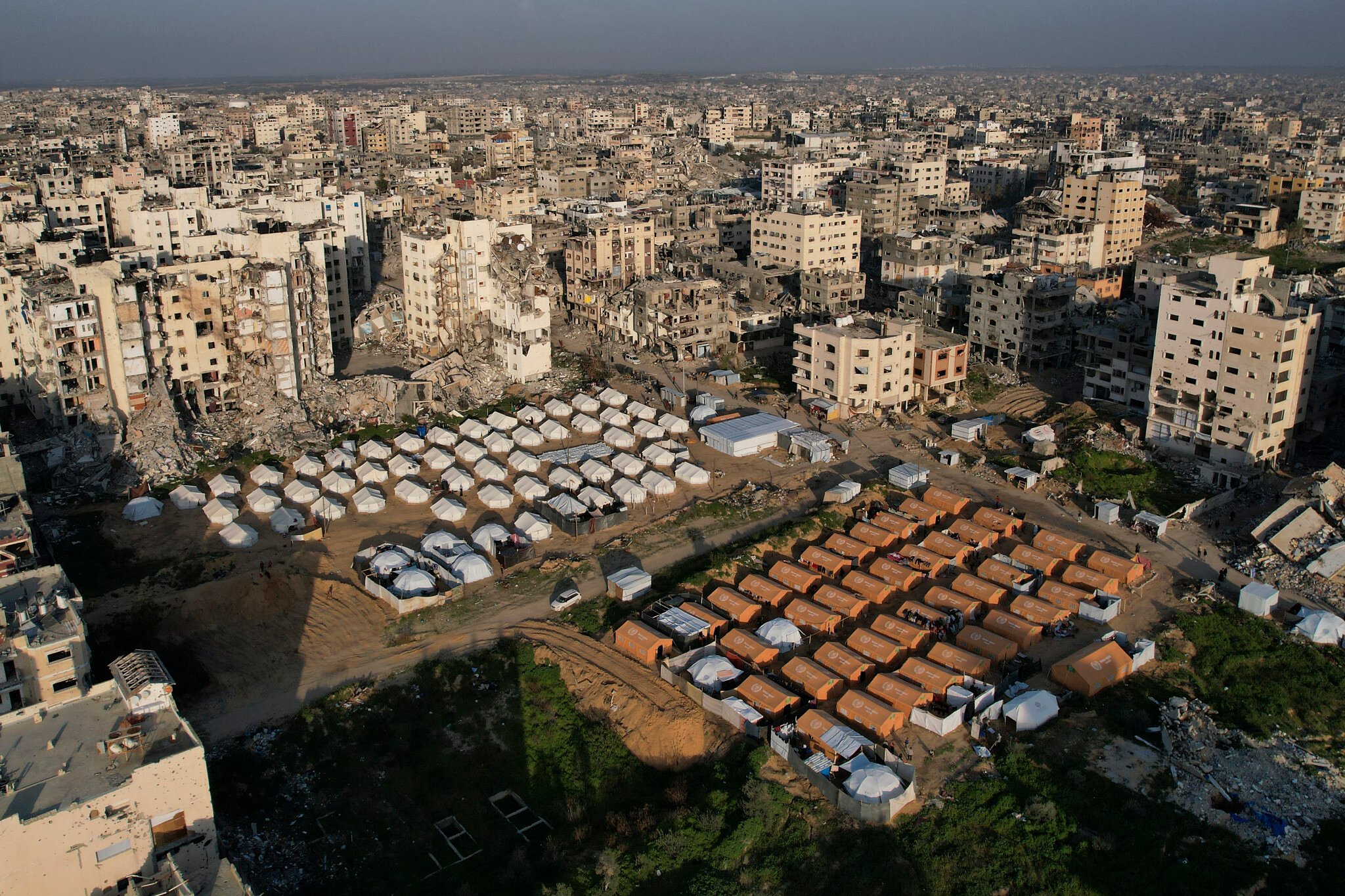
An aerial photograph taken by a drone shows a tent camp for displaced Palestinians amidst the destruction caused by war in Beit Lahiya, northern Gaza Strip, February 17, 2025. (Mohammad Abu Samra/AP)

Central to Egypt’s proposal is the establishment of a Palestinian administration that is not aligned with either Hamas or the Palestinian Authority to run the strip and oversee the reconstruction efforts, according to the two Egyptian officials involved in the efforts.

It also calls for a Palestinian police force mainly made up of former Palestinian Authority policemen who remained in Gaza after Hamas took over the enclave in 2007, with reinforcement from Egyptian- and Western-trained forces.

Asked about the possibility of deploying an outside Arab force in Gaza, one Egyptian official and the Arab diplomat said Arab countries would only agree if there were a “clear path” for the establishment of an independent Palestinian state. Netanyahu has rejected any Palestinian state as well as any role for Hamas or the Western-backed Palestinian Authority in governing Gaza, though he has not put forward any clear alternative.

Hamas has indicated it is willing to give up power in Gaza. Hamas spokesman Abdul Latif al-Qanou told The Associated Press on Sunday that the group has accepted either a Palestinian unity government without Hamas’s participation or a committee of technocrats to run the territory. The Palestinian Authority, which governs pockets of the West Bank, has so far opposed any plans for Gaza that exclude it.

The Western diplomat said France and Germany have backed the idea of Arab countries developing a counterproposal to Trump’s plan, and that Egyptian President Abdel Fattah el-Sissi discussed his government’s efforts with the French president in a phone call earlier this month. Egyptian Foreign Minister Badr Abdelatty also briefed the German foreign minister and other EU officials on the sidelines of last week’s Munich security conference, one of the Egyptian officials said.

Officials from Egypt, Saudi Arabia, Qatar, the United Arab Emirates and Jordan will discuss Egypt’s proposal at a gathering in Riyadh this week, before introducing it to the Arab summit later this month, according to the two Egyptian officials and the Arab diplomat.


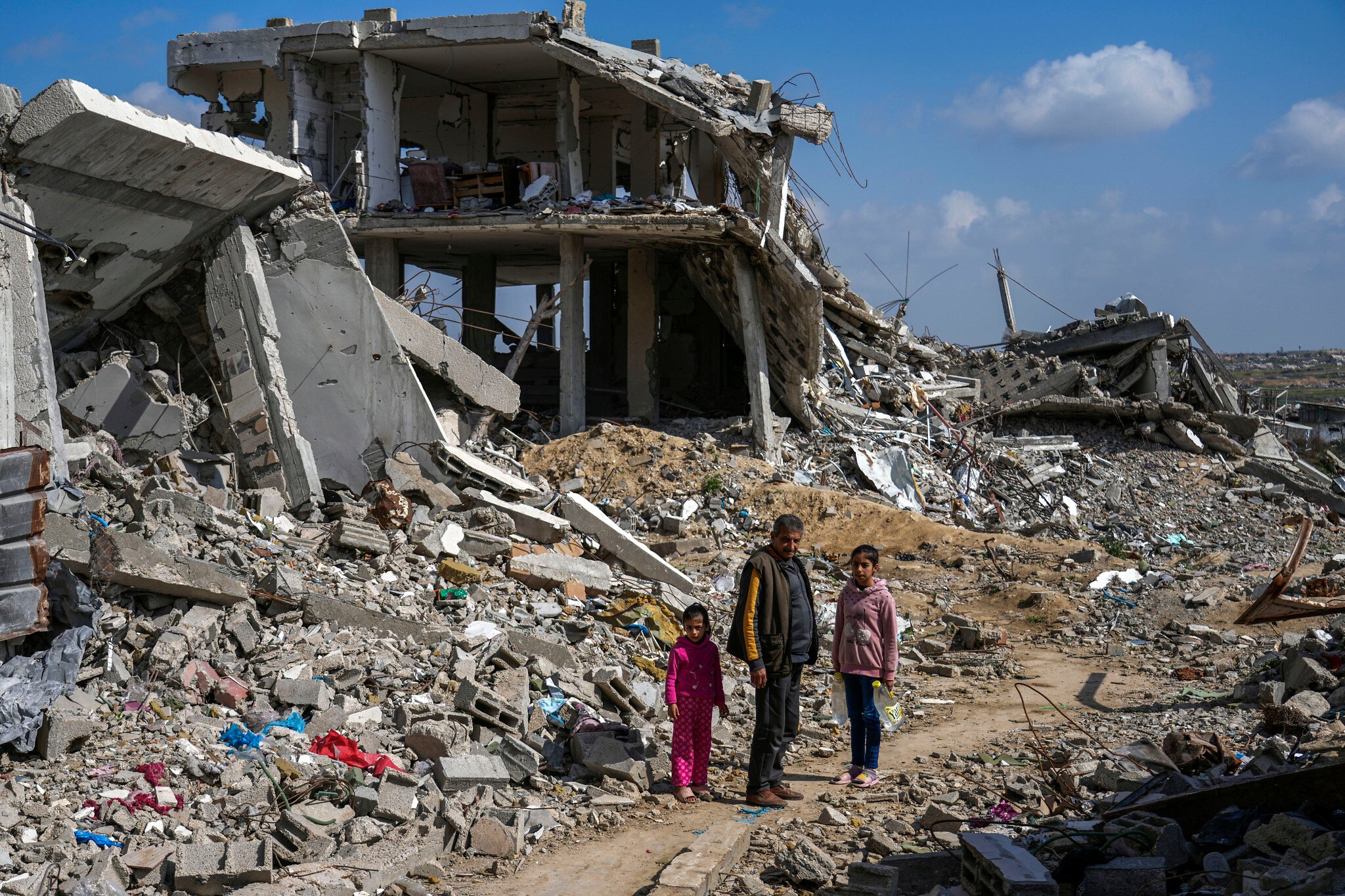
A Palestinian man and two girls stand a mid of the rubble of homes, destroyed during the war between Israel and Hamas in the Bureij refugee camp, central Gaza Strip, February 17, 2025. (Abdel Kareem Hana/AP)

The 16 months of war in Gaza devastated the territory.

Around a quarter million housing units have been destroyed or damaged, according to UN estimates. More than 90 percent of the roads and more than 80% of health facilities have been damaged or destroyed. Damage to infrastructure has been estimated at some $30 billion, along with an estimated $16 billion in damage to housing.

Egypt’s plan calls for a three-phase reconstruction process that will take up to five years, without removing Palestinians from Gaza, the Egyptian officials said.

It designates three “safe zones” within Gaza to relocate Palestinians during an initial six-month “early recovery period.” The zones will be equipped with mobile houses and shelters, with humanitarian aid streaming in.

More than two dozen Egyptian and international firms would take part in removing the rubble and rebuilding the strip’s infrastructure. The reconstruction would provide tens of thousands of jobs to Gaza’s population, the officials said.

The plan is largely the same as that which Arab countries have been working on for the past year, but Israel has long rejected the idea of giving any role to the PA, leaving many of those proposals dead on arrival.

Most critical will be Egypt’s effort to convince Trump to get behind the plan, because if Washington does, it will be easier to get Israel on board as well.

Al Arabiya reported that the Egyptian plan will also include a clause requiring various stakeholders to serve as guarantors that Israel will not resume fighting in Gaza for at least 10 years.

Jerusalem is likely to resist any limits to its ability to use military force against future threats from Gaza.


Global alliance for two-state solution strongly opposes displacement of Gazans

Egypt reaffirms commitment to sovereign Palestinian state

Ibrahim Khazen and Mohammad Sio
 |18.02.2025 -
TRT/AA


CAIRO

The fourth meeting of the Global Alliance for the Implementation of the Two-State Solution took place Monday in the Egyptian capital Cairo, with strong opposition to the displacement of Palestinians dominating discussions.

Hosted by Egyptian Foreign Minister Badr Abdelatty, it brought together senior diplomats, including UN agency for Palestinian refugees (UNRWA) Commissioner-General Philippe Lazzarini, UN humanitarian coordinator for Gaza Sigrid Kaag and representatives from more than 35 countries and international organizations, according to a ministry statement.

Saudi Arabia launched the coalition in September 2024, with its first meeting held in Riyadh the following month.

In his opening remarks, Abdelatty reaffirmed Egypt’s full commitment to the two-state solution, advocating for a Palestinian state along the 1967 borders, with East Jerusalem as its capital. He emphasized that this is the only viable path to lasting regional peace.

He praised Saudi Arabia’s initiative in establishing the coalition and underscored the importance of collaborative efforts to implement it.

Egypt firmly opposes any forced displacement of Palestinians, a stance echoed by other Arab states and the broader international community, he said.

Recently, US President Donald Trump proposed “taking over” Gaza, resettling Palestinians in neighboring countries and turning the enclave into “the Riviera of the Middle East,” which was met with widespread condemnation from the Arab world and beyond.

Abdelatty also highlighted Egypt’s efforts to develop a phased plan for early recovery and Gaza’s reconstruction. He underscored the urgent need to support UNRWA’s humanitarian role, condemning recent Israeli legislation aimed at obstructing the agency’s operations.

He further emphasized the humanitarian crisis in the occupied Palestinian territories, stressing the need for continued support for UNRWA, which he described as “indispensable and irreplaceable.” He also condemned the Israeli parliament’s recent passage of two laws aimed at obstructing the agency’s work.

UNRWA has provided vital relief, health and educational services to Palestinian refugees across five areas of operation: the West Bank, including East Jerusalem, Gaza, Syria, Lebanon and Jordan.

Lazzarini highlighted the agency’s central role in delivering essential services to Palestinians while also detailing the challenges posed by Israeli restrictions.

Kaag expressed hope for stabilizing the ceasefire agreement and easing humanitarian access to Gaza. She also presented preliminary estimates of the cost of rebuilding the Gaza Strip, the statement added, without specifying a figure.

Egypt and Qatar continue intensive mediation efforts to sustain the agreement amid Israeli violations and logistical challenges preventing the full implementation of its first phase.

Top Republican admits ‘very little appetite’ for US control in Gaza

Trump ally Lindsey Graham among US legislators to meet Netanyahu in Tel Aviv on Monday

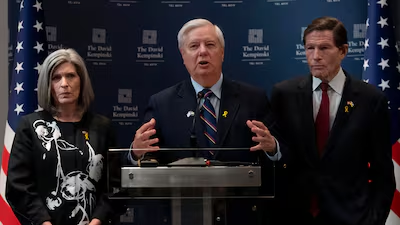
US politicians Lindsey Graham, centre, Joni Ernst, left, and Richard Blumenthal, address journalists as part of a bipartisan US Senate delegation's visit to Tel Aviv. AP


The National
February 18, 2025

A top US Republican and longtime ally of President Donald Trump has said after meeting Israeli Prime Minister Benjamin Netanyahu in Tel Aviv that there is not much support in the US Senate for any American involvement in taking over Gaza.

“One thing I will say, there’s very little appetite that I’ve seen in the United States Senate for America to take over Gaza in any way, shape or form,” Senator Lindsey Graham said.

Mr Graham was part of a bipartisan group of US legislators who met the Israeli leader in Tel Aviv on Monday. Mr Netanyahu has expressed support for Mr Trump’s disputed proposal to permanently resettle Palestinians from Gaza abroad, and for the US to take over the war-ravaged enclave.

The US senator added that, while working on solutions to the Palestinian issue, there is no expectation for Israel to accept a deal that could lead to another October 7 attack or allow Hamas to remain in power. He said the Palestinian Authority, in its current form, is not considered to be a viable solution.

Mr Trump first floated the idea of displacing Palestinians from Gaza earlier this month during an official visit by Mr Netanyahu to Washington. He proposed turning the enclave into the “Riviera of the Middle East” and then suggested that the two million Palestinians who would be displaced under his plan for the US to “own” Gaza would not have the right to return after reconstruction.

“The one thing that President Trump has done, he started a discussion that was long overdue,” said Mr Graham, adding that Arab states had “woken up” to the need for an alternative solution for Gaza.

Mr Trump’s statements sparked strong condemnation across the Arab world and much of Europe, with some critics saying the plan would amount to ethnic cleansing. In response, Arab leaders are set to convene a mini-summit in Riyadh on February 21 to discuss alternatives to Mr Trump’s plan. The summit will include leaders from the six Gulf Co-operation Council nations, along with Egypt and Jordan, according to AFP.

Senator Richard Blumenthal, a Democrat, who also attended the Tel Aviv meeting, said he expected Arab states to put forward a “workable alternative.” He said a possible regional plan could include normalised relations with Israel and a clear path towards Palestinian self-determination.

Mr Blumenthal said Jordan's King Abdullah had convinced him that Arab states would present a plan that covers normalising ties with Israel, self-determination for the Palestinians, and regional defence arrangements and security for Israel.

“If those components are part of a realistic plan, it could be a game-changer for the region,” he said.


Hamas cultural advisor told MNA;

Plan to displace Palestinians is an old conspiracy

Plan to displace Palestinians is an old conspiracy

TEHRAN, Feb. 18 (MNA) – The cultural advisor of Hamas emphasized that the plan to displace Palestinians is not a new issue but rather an old scheme, with conspiracies in Palestine originating from the time of the British occupation in 1917.

Donald Trump used the destruction caused by Zionist attacks on the Gaza Strip as a pretext to call for the complete evacuation of Gaza, proposing the forced migration of its residents to neighboring Arab countries such as Egypt and Jordan while advocating for US control over the 365-kilometer-long strip.

The US president claimed that the goal of this plan is to ensure the safety and well-being of Palestinians, away from violence and unrest, and Egypt and Jordan must accept this American proposal. However, Trump’s claim of seeking security and peace for Palestinians is contradicted by the fact that he has played a major role in the genocide of the Palestinian people, and the Zionist regime has been armed with the deadliest weapons by the US to carry out massacres in Gaza.

Trump’s statements have faced widespread rejection from various countries, particularly Egypt and Jordan, while Palestinians have condemned the proposal as a dangerous plan and an invitation to ethnic cleansing. Notably, redrawing the region’s map according to the American vision and annexing Gaza to occupied Zionist territories are among Trump’s underlying objectives.

The Islamic Resistance Movement Hamas, the United Kingdom, the United Nations, the King of Jordan, a former Saudi intelligence chief, China, the Palestinian Authority's head Mahmoud Abbas, and the preacher of Al-Aqsa Mosque have all reacted to Trump’s proposal for the forced displacement of Gazans, rejecting it outright. These statements are seen as a dangerous move aimed at expanding the Zionist occupiers’ territory, to the detriment of Islamic nations and the forced displacement of Gaza’s residents.

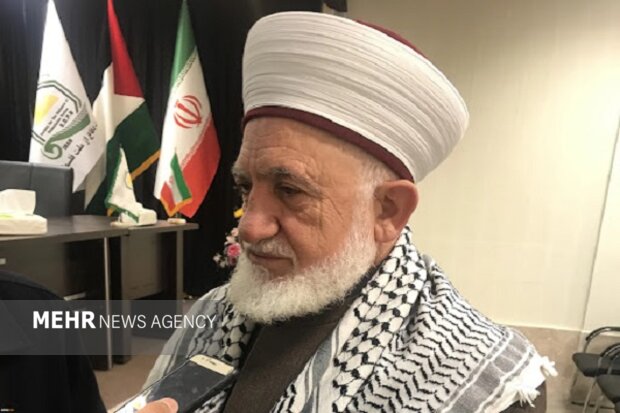
Recently, a Hamas delegation led by Muhammed Ismail Darwish, head of the movement’s council, visited Iran and met with Iranian officials. During this visit, Sheikh Hussein Qassem, Hamas’ cultural advisor, elaborated on the forced displacement plan and the role of the Islamic Republic of Iran in supporting Palestine. Below is his text of the interview with Mehr News Agency:

Conspiracies in Palestine began with the British occupation in 1917 and have continued to this day. The project to displace Palestinians started after 1948 and continued in 1956, targeting the remaining Palestinians, he said.

"The Palestinian people are a resilient nation. The West Bank is under a more severe siege than Gaza, yet it continues to resist with whatever means it has."

Qassem emphasized, "With the support of our brothers in the resistance axis—in Iran, Lebanon, Yemen, and Iraq—we will, God willing, eliminate the Zionist regime. The Islamic Revolution of Iran is a unique model for all liberation movements."

MP/6379154


Netanyahu: Neither Hamas nor Abbas Will Rule Gaza After the War


Israeli tanks are seen in Gaza Monday. (Reuters)

Ramallah: Kifah Zboun
18 February 2025 
AD Ù€ 19 Sha’ban 1446 AH

Israeli Prime Minister Benjamin Netanyahu on Monday blocked Arab efforts to develop a plan for “the next day” in Gaza after the war ends, saying neither Hamas nor the Palestinian Authority, led by President Mahmoud Abbas, will control the Strip in any future plan.

“As I promised, the day after the war in Gaza, neither Hamas nor the Palestinian Authority will be there,” according to a statement from the PM’s office.

His comments came in response to Arab efforts seeking to pressure Hamas to hand over Gaza to the PA and foil a US plan to take ownership of the territory and rebuild it into a “Riviera of the Middle East.”

They also came ahead of an Israeli Security Cabinet meeting to discuss the second phase of the Gaza ceasefire and prisoner exchange deal with Hamas.

Netanyahu had tried to prevent negotiations for the second phase. But following a meeting with US Secretary of State Marco Rubio last week, the PM agree to send a delegation to Egypt on Monday to resume talks with Hamas. But according to Israeli reports, the delegation had not been given a mandate to discuss anything substantive.

A senior Israeli security official familiar with the negotiations told Ynet news on Sunday that Netanyahu is working to prevent the implementation of the second phase of the hostage deal in order to achieve political goals at the expense of hostages’ lives.

The senior Israeli security official maintained that this amounts to a violation of the deal, which stipulates that the parties begin holding negotiations over phase two no later than the 16th day of the first phase, which was on February 3 — nearly two weeks ago.

Israel’s decision to send a delegation to Egypt followed a phone call between Netanyahu and US President Donald Trump’s Middle East envoy Steve Witkoff.

Witkoff told Fox News on Sunday that he also spoke with Qatari Prime Minister Mohammed bin Abdulrahman bin Jassim Al Thani and head of the Egyptian intelligence agency Hassan Mahmoud Rashad and agreed with them on the progression of the second phase of the hostage deal.

‘Them or us’


While Netanyahu faces mounting US pressure to move forward with the talks, he is under similar pressure from far-right members of his coalition to resume the war after the end of the first phase.

Far-right Finance Minister Bezalel Smotrich threatened to quit Netanyahu’s ruling coalition if the war is not resumed after the end of the first stage.

Smotrich in a video statement said he “will demand a vote” by ministers on Trump’s plan and that Israel must “issue a clear ultimatum to Hamas — immediately release all hostages, leave Gaza for other countries and lay down your arms.”

“If Hamas refuses this ultimatum, Israel will open the gates of hell,” he warned.

“I call on the prime minister to declare that once the war resumes after phase one, Israel will, from the first day, seize 10% of Gaza’s territory, establish full sovereignty there and immediately apply Israeli law,” he said.

“It’s them or us. Either we crush Hamas, or God forbid, Hamas will crush us,” Smotrich said.

In return, other Israeli opposition leaders urged the government to complete the deal with Hamas and return all the hostages.

National Unity chairman Benny Gantz said: “We need to harness all the levers of pressure, all the means, and also be prepared for painful concessions and bring them home – down to the last hostage.”


US Secretary of State stresses Gaza 'arrangement' in meeting with Saudi crown prince: State Department


February 17, 2025 
MEMO


United States Senator Marco Rubio testifies before a Senate Foreign Relations Committee hearing on his nomination to be Secretary of State at the Dirksen Senate Building, in Washington D.C., United States on January 15, 2025 [Celal GüneÅŸ – Anadolu Agency]

US Secretary of State Marco Rubio underscored the importance of an “arrangement for Gaza that contributes to regional security” during his meeting with Saudi Crown Prince Mohammed bin Salman in Riyadh, the State Department said Monday.

Rubio and bin Salman reaffirmed their commitment to implementing a ceasefire in Gaza and securing the release of all hostages, including American citizens, according to a readout from State Department Spokesperson Tammy Bruce.

The Secretary also highlighted the 80th anniversary of the 1945 meeting between then-President Franklin Roosevelt and Saudi King Abdulaziz aboard the USS Quincy and expressed a commitment to deepening US-Saudi economic and defense cooperation, she added.

The discussions between Rubio and bin Salman covered regional issues, including Syria, Lebanon, and Red Sea security, with both sides emphasizing the need to ensure freedom of navigation.

Rubio also held talks with Saudi Foreign Minister Prince Faisal bin Farhan Al Saud during his visit.

The US top diplomat arrived in Saudi Arabia early Monday from Israel, where he met with senior officials, including Prime Minister Benjamin Netanyahu.

It was the first visit by Rubio to the Middle East since he became a secretary of state in the administration of President Donald Trump last month.

He is also scheduled to visit the United Arab Emirates as part of his ongoing regional tour.

Rubio’s visit comes as US President Donald Trump has proposed to “take over” the Gaza Strip, relocate Palestinians there to Egypt, Jordan and other countries, and transform it into the “Riviera of the Middle East.” The idea has been widely rejected by the Arab and Muslim world and many other nations, who say it amounts to ethnic cleaning.

The proposal emerged after the truce agreement took effect in Gaza on 19 January, pausing Israel’s 15-month onslaught, which has killed more than 48,000 people and left the enclave in ruins.
South Korea claims DeepSeek transferred data to 3rd party

DeepSeek sent data of South Korean users to ByteDance, parent company of TikTok

Islamuddin Sajid |
18.02.2025 
TRT/AA


ISLAMABAD

South Korea on Tuesday claimed that a China-based artificial intelligence startup DeepSeek sent the nation’s user data to a third party, local media reported.

South Korea's data protection regulator said that DeepSeek sent the nation's user data to Chinese-owned popular video-sharing app TikTok's parent company, ByteDance, according to the Yonhap News Agency.

"We confirmed DeepSeek communicating with ByteDance," the agency quoted the Personal Information Protection Commission (PIPC) official as saying.

The latest claim from a PIPC official came a day after South Korea suspended new downloads of DeepSeek over concerns about its data collection practices.

Previously, several South Korean government ministries and agencies blocked internal access to the AI service amid concerns about its "data management practices."

Last month, the commission formally sought clarification on DeepSeek's data collection and management methods.

DeepSeek has since assigned a representative in South Korea and acknowledged shortcomings in considering the country’s privacy laws while also expressing its will to cooperate with the commission, according to South Korean officials.

The Chinese startup DeepSeek sent shockwaves through the AI industry last month with its cost-effective and free chatbot due to its rapid progress in rivaling US-based OpenAI’s ChatGPT with far fewer resources.

DeepSeek gained unprecedented popularity in mobile app stores across the globe, dethroning ChatGPT in certain regions, including the US.


New earthquake of magnitude 5 recorded between Greek islands of Santorini, Amorgos

17/02/2025, Monday
AA

File photo

Quake occurs at depth of 13 kilometers, says National Observatory of Athens

A new earthquake of magnitude 5 on the Richter scale was recorded on Tuesday morning between the Greek islands of Santorini and Amorgos.

The earthquake occurred at 4.46 a.m. local time (0246GMT) at a depth of 13 kilometers (8.077 miles), according to the Geodynamics Institute of the National Observatory of Athens.

The institute recorded over 30 tremors of different magnitudes since the very early hours of the day.


Men and boys matter: Psychology professor reveals hidden issues we need to talk about


Professor Benjamin Hine of the University of West London (UWL) says men and boys are facing a mental health crisis and they need support across a range of challenges.


Taylor & Francis Group

FacebooX


These include those linked to body image, fatherhood and sexual relationships. His latest book - Current Issues Facing Men and Boys – also argues that men struggle to negotiate harmful notions of masculinity and are not included in conversations around gender.

Current Issues Facing Men and Boys urges the public, policymakers, practitioners and other key stakeholders to explore and support policies and practices that promote male wellbeing. This book comes as the UK government announces plans for the country's first men's health strategy, aiming to address health issues disproportionately affecting men.

Alongside health issues, the book explores everything from fatherhood and education to gaming addiction and homelessness, most of which are often ignored because men are too readily seen as ‘the problem’ rather than ‘having problems’, according to the leading academic.

Throughout the book, Professor Hine calls for an urgent shift in thinking and outlines ways to help men who struggle based on a series of principles. These include cultural and gender inclusivity, evidence-based approaches and early intervention, which he says will ultimately improve gender equality.

Benjamin Hine, Professor of Applied Psychology at the University of West London, a leading expert in this area, is also Chair of the Male Psychology Section of the British Psychological Society and co-founder of the Men and Boys Coalition. He believes that, “In today's rapidly shifting societal landscape, where the discourse around gender equality has gained significant momentum, the unique set of challenges faced by men and boys frequently goes unnoticed or is overshadowed.”

“However, it is essential to approach the subject of men's issues without automatically framing men as ‘the problem’. Men, like all individuals, are complex human beings with their own unique struggles, vulnerabilities, and challenges.”

“Moreover, the task of challenging and redefining the role of masculinity in these issues is not merely an academic exercise but a societal imperative. The health and wellbeing of men and boys depends on our collective ability to foster an understanding of masculinity that embraces vulnerability, values emotional literacy, and celebrates diversity.”

Crucially, inclusive, intersectional approaches for men and boys of all backgrounds, including across ethnic, religious, and gender/sexual identities, should be part of natural thinking for all organisations, including an immediate priority on men’s mental health and high suicide rate.

Professor Hine goes on to warn that it is really important how we have these conversations. If young men feel ‘excluded or alienated’ from gender discussions, which often justifiably focus on critical issues facing ‘women and marginalised groups’, this can leave men feeling resentful and lead to them feeling lonely, alienated, depressed, and engaging with extreme views, especially when they seek solace in toxic online spaces. Part of the problem, he argues, is that issues said to affect women and those which impact men have often been rigidly separated when they are in fact closely linked.

As a whistlestop tour of men’s issues, supported by a wealth of empirical evidence, Professor Hine covers everything from mental health, men in the media, education, fatherhood, sexual violence, homelessness, and much more, including gaming addiction, body image issues, and gang violence. This includes examining how different ‘actors’ in society influence these issues, from institutions like the army, prison and the police, to individual influencers like Andrew Tate and Harry Styles.


US Telehealth may be closing the care gap for people with substance use disorder in rural areas


University of California - Los Angeles Health Sciences


Recognition of telehealth as an effective strategy for delivering treatment for substance use disorder (SUD) has raised hopes for improving access to this treatment in settings with limited transportation or when time constraints compromise regular use of consistent access to in-person substance use treatment.

But the findings from a team of researchers from the Virginia Center for Health Innovation,  UCLA, RAND, and MedInsight, Milliman Inc., suggest that the promise of telehealth may vary by insurance and geography.

New research suggests that people who live in rural areas may be benefiting from telehealth as a modality for substance use disorder treatment to a greater extent than their urban counterparts. Meanwhile, despite accounting for the vast majority of substance use disorder services, people covered by Medicaid managed care are less likely to use telehealth compared with their counterparts who have Medicare Advantage or are commercially insured.

“We found diminishing rates of access to telehealth substance use disorder treatments among Medicaid managed care recipients, who are largely lower-income or socioeconomically disadvantaged,” Dr. Lauryn Walker, Chief Strategy Officer at the Virginia Center for Health Innovation and the study’s lead author. “In contrast, telehealth use appears to be closing previously reported gaps in substance use disorder treatment among rural individuals compared with those in urban settings.”

The findings are described in a research letter to be published Feb. 12 in the peer-reviewed JAMA Network Open.

As telehealth became more popular as a treatment modality, with the hope of expanding access to care, Medicaid managed care beneficiaries received fewer SUD services overall while commercial and Medicare Advantage beneficiaries experienced an increase in service utilization during the same time period. Rural individuals experienced the greatest overall increase in substance use disorder treatment among all populations studied.   

The researchers used the MedInsight Emerging Experience database to examine Medicaid managed care, Medicare Advantage, and commercial insurance claims for all 50 states for about 16 million adults age 18 years and older who were insured for 12 or more months between Jan. 1, 2019 and June 30, 2023.

Key findings include:

  • Monthly telehealth substance use treatment increased substantially from 45to 10,974services, while in-person treatment increased much less notably from 186,000 to 292,300 services between 2019 and 2023
  • Despite the addition of telehealth as a modality of care, average monthly substance use disorder treatment services per 100,000 adults (telehealth and in-person combined) decreased 17% for Medicaid covered individuals while they increased for Medicare Advantage and commercial insurance beneficiaries by 4% and 1%, respectively
  • With Medicaid-covered individuals accounting for 93% of overall SUD treatment and in-person services, but only 75% of telehealth utilization, telehealth use is notably under-represented among those insured by Medicaid. Commercial and MA members, on the other hand, disproportionately use telehealth, accounting for only 5.8% and 0.4% of in-person SUD services respectively, yet 24.0% and 1.0% of telehealth services respectively.
  • Rural individuals experienced an 90% increase in overall substance use treatment per 100,000 adults between 2019 and 2023, while rising 49% among urban individuals.
  • Telehealth may be contributing to the overall increased utilization for rural individuals, with 8% of telehealth services provided to rural individuals compared to 6% of overall and in-person substance use disorder treatment services.

Federal policymakers continue to evolve telehealth and in-person requirements for SUDT. Research on how various populations use telehealth for their substance use disorder treatment can inform future effective policies to improve care for all populations.

“Telehealth is a relatively new modality of care, and policies and procedures are evolving quickly,” said Dr. Katherine Kahn, Distinguished Professor of Medicine in the division of general internal medicine and health services research at the David Geffen School of Medicine at UCLA and the study’s senior author “Understanding who is, and importantly, who is not using telehealth is essential for creating policies that promote access to care and minimize unintended consequences of reductions in care.”

There are some limitations to the study. Organizations voluntarily contribute claims to the database, potentially limiting generalizability. However, the database reflects payer coverage consistent with U.S. demographics.. Also, the findings do not include uninsured individuals as well as providers that do not accept insurance.

Study co-authors are Manying Cui and Dr. John Mafi of UCLA, Jonathan Cantor and Cheryl Damberg of RAND, and Melody Craff of MedInsight, Milliman Inc. Kahn and Mafi are also affiliated with RAND.