Saturday, February 22, 2025

The UK government must make the right call and stop Rosebank for good

19 February, 2025 
Left Foot Forward
Opinion

For a safe climate and affordable energy, we must stop Rosebank and all new oil and gas now.


Lauren MacDonald is the lead campaigner for Stop Rosebank at Uplift.

Uplift and Greenpeace UK filed a legal challenge against the previous Tory government’s decision to grant planning permission for Rosebank and Jackdaw oil and gas fields in Autumn 2023. On 30 January, the Scottish supreme court ruled that the approvals were unlawful and overturned them.

If Storm Éowyn’s battering of Scotland and Ireland last month has taught us anything, it is that climate change is already severely impacting people’s lives here in the UK.

Extreme weather is not just devastating other countries but finding its own unique ways to affect communities closer to home.

We can now access frightening footage of climate impacts, like the brutal Californian wildfires, at the click of a button. A dystopian ability to watch our climate changing in real time.

This reality is one of the many reasons why last month’s legal victory against the Rosebank oil field was so significant.

Rosebank is the UK’s largest untapped oil field, situated 80 miles off the coast of Shetland. Burning its reserves would emit more CO2 than the 700 million people living in the world’s lowest income countries do in a year.

Allowing it to be developed – at a time when experts have warned that opening up new oil and gas fields will push us beyond safe climate limits – would be reckless in the extreme.

The field was waved through by the Conservatives in 2023 – and legally challenged by Uplift and Greenpeace in the Scottish Courts.

The ruling, which overturns Rosebank’s approval, wasn’t just a victory for common sense. If its owners still want to develop the project, they will now need to resubmit an application to the UK government that, finally, accounts for the enormous climate harm caused by burning Rosebank’s oil.

That is because the rules for new oil and gas projects are changing, thanks to a landmark Supreme Court ruling in June last year.

The new rules mean that Rosebank’s enormous climate harm should now be subject to proper assessment and public scrutiny, with the oil and gas companies that own the field being forced to come clean about the massive emissions that will be caused by burning its reserves.

Rosebank is not just a bad deal for our climate, though. It’s a bad deal for the UK too. Rosebank’s reserves are 90% oil, the vast majority of which will be sold for export on the international market, doing nothing to lower our bills or provide energy security in the UK.

At the same time, the UK public would carry almost all the costs of developing Rosebank in the form of billions in tax breaks for the field’s owners. The Norwegian state-backed oil giant, Equinor, which owns 80% of the field and which made £24 billion in profit last year, would take most of the profit from Rosebank.

As for jobs in the UK, Rosebank’s drilling ship has been built in Dubai and the project has yet to provide a single construction or design job in the UK. Unions have rightly called this a betrayal of the UK workforce, which has seen the number of jobs supported by the oil and gas industry more than halve in the past decade as the North Sea declines, despite new fields being approved.

There is a long road ahead if we want to keep Rosebank’s oil in the ground. Any application to develop it would need to pass through multiple regulatory stages before being considered by the Energy Secretary. To be clear, the UK government cannot pre-empt this decision.

Now, though, the government needs to know that, when the time comes, we expect them to make the right call and stop Rosebank for good. Our elected representatives need to hear our concerns about what approving Rosebank would mean for our climate, as well as the harm it would do to the UK’s clean energy ambitions. Approving a huge new oil field, and the signal this would send to investors, would put a handbrake on this country’s shift from expensive oil and gas to homegrown renewable energy.

Over the next month, people right across the country are meeting with their MPs and MSPs to make their views known: that for a safe climate and affordable energy, we must stop Rosebank and all new oil and gas now.

In ruling Rosebank unlawful, the Hon. Lord Ericht said: “the private interests of members of the public in climate change outweigh the private interests of the developers”.

Join us in making sure our voices are louder than theirs: https://www.stopcambo.org.uk/mp-msp-action-week
Ex-Trump ambassador makes fool of herself on Newsnight after claiming ‘UK jails more people for freedom of speech violations than Russia’

FASCISTS HAVE NO RIGHT TO FREE SPEECH

19 February, 2025

“Oh my goodness, I don’t know where you’ve got that from..."


President Trump and his Republican friends are no strangers to pushing misinformation, but even by their own poor standards, the latest claim being made by a Trump supporter is quite something.

With Trump coming under growing criticism from Ukraine and its European allies for cosying up to Putin and going above Ukrainian President Volodymyr Zelensky’s head to negotiate a ceasefire, while at the same time agreeing to give Ukrainian territory to Russia, his supporters have been trying to defend him.

Trump has also drawn condemnation from Zelensky after blaming Ukraine for ‘starting the war’, with the Ukrainian President slamming the US President for living in the ‘disinformation space’.

Appearing on BBC Newsnight to discuss Trump’s decision to U-turn on the Biden administration’s support for Ukraine, former US ambassador and Trump supporter Carla Sands made the ridiculous claim, without any evidence, that there are more people in prison in UK jails for freedom of speech violations than in Putin’s Russia.

Presenter Victoria Derbyshire told Sands of former UK Prime Minister John Major’s comments, who launched a scathing attack on the US for “cuddling” up to Vladimir Putin, after U.S Vice-President JD Vance accused European countries of abandoning free speech.

Major told the BBC: “It’s extremely odd to lecture Europe on the subject of free speech and democracy at the same time they are cuddling Mr Putin.

“In Mr Putin’s Russia, people who disagree with him disappear, or die, or flee the country, or on a statistically unlikely level, fall out of high windows somewhere in Moscow.”

While Derbyshire read out Major’s comments, Sands interrupted and said: “There are more people in jail in the UK because they spoke what they thought was right… than there are in Russia.”

Derbyshire replied: “Oh my goodness, I don’t know where you’ve got that from, we’ve got a guest here who is laughing his head off at that.”

Reacting to Sands’ comments journalist Lewis Goodall posted on X: “A Trump shill on Newsnight claims there are more people in prison in UK jails for freedom of speech violations than in Putin’s Russia.

“These people are radicalised, insane, plain stupid or some combination of all three.”

Senior Tory accidentally exposes his own party’s appalling record on prison spaces


20 February, 2025 
Left Foot Forward

His gotcha question spectacularly backfires...


A senior Tory has accidentally exposed his own party’s poor record on prison spaces, as he revealed that the Conservatives increased jail spaces by just 455 places in fourteen years, which is fewer spaces than the current government has created in its seven months in office.

Tory MP Richard Holden tried to embarrass the Labour government with his written question, which asked how many new prison places were built under the previous Labour administration, between May 1997 and May 2010, and the previous Tory administration, between May 2010 and July 2024, however his attempt spectacularly backfired.

The data revealed that under the last Tory government the capacity of the prison estate increased by just 455 spaces in their fourteen years in power. Meanwhile the previous Labour government boosted spaces by 27,830 new prison places, the data shows.

To make matters worse for Holden, who asked a further written question, data showed that between 2010 and 2024, the Tories closed the doors of more than 7,500 prison cells.

He should now go away and reflect on his party’s poor performance.

Basit Mahmood is editor of Left Foot Forward
TUC General Secretary warns Trump should be “a cautionary tale” against supporting Farage
20 February, 2025 
Left Foot Forward

‘This is what happens when you let the political fraudsters of the populist right in.’


The TUC general secretary Paul Nowak has today issued a stark warning to UK voters with President Donald Trump having waged attacks on workers’ rights during his first few weeks in power.

In a swipe at Reform leader Nigel Farage, Nowak has warned: “This is what happens when you let the populist right in”.


In his first few weeks as president, Trump has fired the head of the US labour watchdog, the National Labor Relations Board, which rules on “unfair labour practices” by bosses, effectively leaving it unable to operate.

Trump has also empowered tech billionaire Elon Musk to fire thousands of federal workers – actions carried out without due process and which union officials say have violated laws and rules.

Highlighting the close relationship between Donald Trump, Elon Musk and Nigel Farage, Nowak says you should “judge a man by the company he keeps”.

The TUC says Farage is defying his voters and constituents by voting against stronger workers’ rights.

Nowak said: “As well as spending vast amounts of time kowtowing to Trump and Musk, Farage and his fellow Reform MPs have voted against the Employment Rights Bill at every stage.

“Given the choice of supporting legalisation that will boost worker protections and incomes – Farage and Reform have chosen instead to be on the side of bad bosses, zero hours contracts and fire and rehire.”

Recent TUC and Hope Not Hate polling shows that voters across the political spectrum – including Reform voters – overwhelmingly back key workers’ rights policies from the government’s flagship workers’ rights legislation.

This includes the majority of voters in Nigel Farage and Kemi Badenoch’s constituency.

TUC General Secretary Paul Nowak said: “What’s unfolding in the US should be a cautionary tale for us all. This is what happens when you let the political fraudsters of the populist right in.

“Having promised to be a champion for working people, President Trump is already torching workers’ rights and slashing public services. And he’s empowered unelected tech billionaire -and union buster – Elon Musk to fire thousands of essential government workers.

“Nigel Farage is making the same bogus claims about being on the side of working people here in the UK. But you should judge a man by his record and the company he keeps.”


Over a million workers remain on zero-hours contracts


18 February, 2025 
Left Foot Forward

The general secretary of the TUC says the latest labour market data highlights the need for Labour's Employment Rights Bill.


Today’s ONS labour market data has revealed that use of zero-hours contracts remains high, with 1.13 million workers in the UK still employed on these terms.

Youth unemployment is at 12.8%, up from 10.6% a year ago, while inactivity from long-term sickness has fallen slightly, but remains high at 2.77 million.

Responding to the latest figures, TUC general secretary Paul Nowak said: “A decade of inaction on insecure work has left a legacy of over a million workers on zero-hours contracts.

“That’s why it’s so important to improve security at work and stop these exploitative working practices. The Employment Rights Bill will rightly ban them.”

The Trades Union Congress has said that one in 12 zero-hours workers have been with their current employer for more than a decade, while almost half have been in the same job for more than two years.

Labour’s Employment Rights Bill aims to end “exploitative zero-hour contracts”, giving workers a right to guaranteed hours, new rights to reasonable notice of shift and payment for shifts that are cancelled or moved at short notice.

Commenting on the figures more broadly, Nowak noted that “there are some better signs in the employment data”, adding “but ministers must keep their focus on supporting jobs”.

“The government’s industrial strategy and infrastructure plans are an opportunity to create good new jobs where they’re most needed. And job seekers need access to well-funded training and employment support.”

On youth unemployment and inactivity due to long term sickness Nowak added: “We need an approach that improves access to health services, and that gives young people genuine opportunities to earn and learn.

“It’s a chance to transform the lives of people who want to work but who face barriers keeping them out of employment.”

Olivia Barber is a reporter at Left Foot Forward
BRITISH TABLOID PRESS
Daily Star praised for front-page that shows Trump as Putin’s poodle

20 February, 2025
Left Foot Forward

“Well done Daily Star, at least one media outlet telling it how it is.”


The Daily Star has been praised for its front-page which shows President Donald Trump as Putin’s poodle, after the Republican attacked Ukrainian President Volodymyr Zelensky.

Tensions between Zelensky and Trump burst out in the open yesterday, after Zelensky slammed Trump for living in a ‘disinformation space’ fuelled by Russia, with Trump retaliating, falsely calling the Ukrainian President a ‘dictator’.

Trump has upended U.S. foreign policy, cosying up to Putin and going above Ukrainian President Volodymyr Zelensky’s head to negotiate a ceasefire, while at the same time agreeing to give Ukrainian territory to Russia and ruling out NATO membership for Ukraine.

That has led to anger and frustration in Kyiv and amongst European allies, with Trump repeating the Kremlin’s talking points.

UK Prime Minister Keir Starmer has stood by the Ukrainian leader, calling him on Wednesday evening and telling him it was “perfectly reasonable” for Ukraine to “suspend elections during wartime as the UK did during World War Two”, Downing Street said.

The US president had earlier criticised Zelensky, saying he had done a “terrible job” and claiming “he refuses to have elections” in Ukraine.

The Daily Star took aim at Trump with its front page, with a picture of a leash around Trump’s neck on the body of a poodle, with Putin holding it.

The headline reads: “PUTIN’S POODLE. Orange manbaby blames UKRAINE for being invaded.”

One social media user wrote on X: “Whoever does the front page of the Star has hit another home run…”

Another added: “Well done Daily Star, at least one media outlet telling it how it is.”


Basit Mahmood is editor of Left Foot Forward


Trump excludes Europe from peace talks, despite US giving less aid than Europe

17 February, 2025


Despite European nations contributing more financial support since the Russia's invasion of Ukraine in 2022, they have been excluded from peace talks


TweetShareWhatsAppMail


Trump has excluded Europe from Russia-Ukraine peace talks, despite European countries providing €18 billion more in aid than the U.S. since Russia’s invasion in February 2022.

Despite European nations contributing more financial support, Donald Trump’s Ukraine envoy, General Keith Kellogg, announced on Saturday that Europe will be excluded from negotiations to end Russia’s war in Ukraine.

Speaking today from the United Arab Emirates, where peace talks between the U.S. and Russia are set to take place, Ukrainian President Volodymyr Zelenskyy confirmed that Kyiv has not been invited and will not participate in the talks.

Analysis by the Kiel Institute for the World Economy, an economic research institute, has found that Europe has provided €132 billion in aid to Ukraine since 2022, compared to €114 billion from the U.S.

Europe has allocated €70 billion in financial and humanitarian aid as well as €62 billion military aid since 2022.

This compares to €64 billion from the US and €50 billion in financial and humanitarian allocations.

European leaders have stressed that there will be no lasting peace in Ukraine without European involvement in the talks.

According to the institute, the U.S. role in aiding Ukraine began to decline in mid-2023, as aid flows dropped sharply for nine months when Congress blocked new funding aid bills.

Despite this, the analysis notes that the sum of aid given to Ukraine is comparatively low when measured as a share of donor GDP.

Germany, the UK, and the US, for example, have mobilised less than 0.2% of their GDP per year to support Ukraine, while other rich donor countries like France, Italy, or Spain only allocated about 0.1% of their annual GDP.

Olivia Barber is a reporter at Left Foot Forward
(SIR) Mick Jagger Can’t Always Get What He Wants—But London Needs What He Opposes


20 February, 2025 
Left Foot Forward Opinion

Mick Jagger once told the world, “You can’t always get what you want.” He was right. The wealthy and connected shouldn’t get to block homes for the most vulnerable. It’s time for London to get what it desperately needs: housing, hope, and progress.


Mick Jagger is a legend. As frontman of the Rolling Stones, he built his career on disruption—shattering norms, challenging authority, and revelling in rebellion. But when it comes to housing, it seems Sir Mick is singing a very different tune: the anthem of the entitled elite.

His opposition to the One Battersea Bridge development—a project that will deliver 51% affordable homes, including much-needed social rent properties—reeks of hypocrisy and privilege. London’s housing crisis demands urgent solutions, and Jagger’s stance is a slap in the face to the 300,000 Londoners languishing on waiting lists.

It’s almost laughable. A man whose career celebrated excess and broke all rules is now demanding limits—on height, on profit, on progress. Let’s not forget, Jagger’s band recorded songs like “Gimme Shelter” while London families were evicted en-masse during the slum -clearances of the 1960s. Today, Jagger is using his wealth and influence to oppose housing for the very people his music once claimed to champion.

One Battersea Bridge isn’t just another high-rise; it’s a rare beacon of hope in London’s dysfunctional housing market. In the middle of a city that started just 2,300 affordable homes this year—against the backdrop of over 170,000 people stuck in temporary accommodation—this scheme offers a bold path forward.

If Labour were to propose bold policy reforms using this as a case study, it should enable all 50 per cent affordable housing developments a “brownfield planning passport” that should be approved by-right on officer recommendation, avoiding the need for committee. This would cut red tape and transform underused land into vibrant mixed communities. With 51% affordable housing on offer (all social rent), this development doesn’t just meet targets—it exceeds them. And yet, figures like Jagger oppose it on aesthetic grounds.

The Labour Party’s manifesto is clear: “The biggest boost in affordable homes for a generation.” This is the very type of development Labour should champion. A project like One Battersea Bridge exemplifies the private sector stepping up, delivering not just homes but public benefit. If approved under a streamlined “planning passport,” projects like these wouldn’t languish in endless committee debates, vulnerable to the whims of celebrity-backed objections. A planning system that listens to the 83,000 children in temporary housing—rather than multimillionaires in Chelsea—is long overdue.

The hypocrisy cuts deeper. Jagger is no stranger to profiting from disruption. Whether it was selling rebellious records or dodging tax to maximise his wealth, he has always found ways to thrive in systems he claimed to oppose. Now, the campaign he supports decries the “profit” of housing developments for “foreign” investors like One Battersea Bridge—ignoring the fact that these profits fund the affordable homes that working families so desperately need.

As long as profit and height remain development’s dirtiest words, we will never fix our housing crisis. Instead of entertaining the loudest voices in the room, Labour should bulldoze outdated planning systems and prioritise those who lack even a roof over their heads. It’s time to tune out the whining of the already-housed and start listening to the voices of the homeless and the overcrowded.

London deserves better. One Battersea Bridge shows us what better can look like: a development that prioritises affordability, maximizes brownfield land, and offers a blueprint for future schemes across the country. It’s proof that the private sector, when guided by the right incentives, can help solve our housing crisis—not exacerbate it.

Mick Jagger once told the world, “You can’t always get what you want.” He was right. The wealthy and connected shouldn’t get to block homes for the most vulnerable. It’s time for London to get what it desperately needs: housing, hope, and progress.

Let’s stop dancing to the tune of celebrity NIMBYs and start building the future our city deserves

Credit: Architect’s view


Christopher Worrall is a housing columnist for LFF. He is on the Executive Committee of the Labour Housing Group, Co-Host of the Priced Out Podcast, and Chair of the Local Government and Housing Member Policy Group of the Fabian Society.


Stop Funding Hate keeps the pressure on M&S over ads on ‘toxic’ GB News

Yesterday
Left Foot Forward

'M&S sponsors GB News. This is not just hate.'


Stop Funding Hate, which campaigns against advertising with media outlets that spread hate and division, has urged supporters to keep pressing M&S bosses to pull their ads from ‘toxic TV channel’ GB News.

This comes after the right-wing channel urged viewers to email M&S telling them they made “the right decision” by advertising on GB News.

Earlier this week, Stop Funding Hate posted on its Facebook page that “There’s a definitely-100%-authentic-grassroots Facebook page calling itself ‘Friends of GB News'”.

The group said the page has been running paid Facebook advertisements praising M&S for advertising on the channel and encouraging people to ask them to keep doing it.

GB News presenter Michelle Dewberry criticised Stop Funding Hate’s call for M&S to drop its ads, saying: “Political, hate-filled activists have constantly, negatively bombarded any brand who has advertised with GB NEWS because they believe that alternate viewpoints must be silenced”.

Stop Funding Hate shared a post on X which said: “So Marks and Spencer are now advertising with GB News, which previously aired commentary disparaging M&S for including a “mandatory” black family and an “obligatory gay couple” in their Christmas ad.”

The campaign group also pointed out that this week GB News aired commentary belittling a black actress on the BBC as a “diversity hire”, and asked “Are Marks and Spencer really comfortable to be associated with this?”.

Stop Funding Hate has emailed supporters asking them to contact M&S bosses urging them to stop advertising on GB News.

The M&S bosses’ emails are stuart.machin@marks-and-spencer.com and chairman@marks-and-spencer.com.

A graphic is circulating on social media with an image of M&S roast beef, playing on the retailer’s famous ad slogan with the caption: “M&S sponsors GB News. This is not just hate.”

In January, the pressure group launched a crowdfunder to help it fightback against right-wing channel GB News, which it says wants to bring Trump’s playbook to Britain.

It has now raised double its initial crowdfunder target. The link to the crowdfunder is here.

Olivia Barber is a reporter at Left Foot Forward
How governments distract from social injustice by creating moral panics


OPINION
Prem Sikka 
Yesterday
Left Foot Forward.


Censorship and indoctrination diminish the possibilities for emancipatory change


The right-wing coups sweeping though the UK, USA and much of Europe are diminishing possibilities of emancipatory change by subtle forms of censorship and indoctrination. Books and scientific journals are being censored to reshape people’s subjectivities and produce a docile population. People are concerned about inequalities, poverty, crumbling infrastructure, loss of social rights and rising power of corporations and wealthy elites. But governments want to make people foot-soldiers of capitalism and corporations, and entice them with possibility of riches through speculation on stock markets. None of this can deliver prosperity, happiness or social stability.
New censorships

The US President Donald Trump has ordered Pentagon-run schools to suspend books “related to gender ideology or discriminatory equity ideology topics”. This builds upon a history of banning school books that the authorities find challenging. Researchers publishing papers in peer-reviewed medical and science journals have been ordered to retract banned terms from research already accepted for publication or in the process of being revised. Those refusing risk ending their scientific careers. The President has blocked Associated Press reporters from the Oval Office briefings.

The UK isn’t an oasis of freedom either. Rather than welcoming education which enables understanding of society, ministers attack media and cultural studies degrees as they encourage critique of contemporary power structures. Books are removed from university libraries because of the grim depiction of everyday realities. There is a history of banning books by authors such as JK Rowling, James Joyce and George Orwell. In 2022, the government ordered schools in England not to use material from groups that believe that capitalism should end. So, what chances that books about the suffragettes, working class history, and the American and French revolutions, or by writers such as Charles Dickens, Mahatma Gandhi, VS Naipaul, HG Wells and Virginia Woolf would be used to stimulate discussions about social justice, inequality, power and democracy? Such literature can demystify power and show that people’s life chances are not governed by some invisible hand of fate. Rather their social condition is governed by institutions of politics, which can be changed.

The state-sponsored censorship is at odds with the need to develop education systems that encourage critical thinking and enable people to analyse the world to secure emancipatory change. Yet increasingly education is associated with the maintenance of status-quo. Those offering alternative worldviews face the prospect of being ostracised, silenced and exiled as the western world races to an inglorious past. Greek philosopher Socrates was sentenced to death for encouraging the young to think critically. Galileo was persecuted by the Catholic Church Galileo advancing the heliocentric model of the universe. Nazi Germany burnt thousands of books that it disapproved of.
Mirage of Riches

Governments are subservient to corporations and the ultra-rich. Rather than addressing the causes of social injustice, governments distract people with promises of riches and security, not through decent wages, healthcare, education and pensions but by serving capitalism and becoming speculators on stock markets.

Share ownership does not spare anyone from the ravages of capitalism. They will still face wage freezes; eroding living standards; rocketing bills for energy, food, water and other essentials, and can be hired and fired just like any employee.

Since the early 1980s, governments have privatised publicly-owned services such as telecommunications and gas. They handed discounted shares to the general public, in the belief that this would encourage share ownership. However, this has not been the case. Today, only around 10.8% of the UK quote company shares are directly held by UK-resident individuals. This is despite numerous tax incentives, such as taxing capital gains and dividends at lower rates than wages.

Undeterred, neoliberals want the state to encourage people to buy/sell shares. In February 2025, a Minister said: “The Government want to see more people taking part in capital markets and benefitting from the long-term financial security that investing can provide”. There is merit in promoting financial literacy, but urging people to speculate on the stock market casino is something entirely different. Governments are not dispelling any of the myths of share ownership.

Due to inequitable distribution of income and wealth, share ownership is beyond the reach of most people. One recent survey suggested that 34% of adults had either no savings or had less than £1,000. Another reported that 66% of adults have average savings of less than £10,000, and there are huge gender differences. Buying and selling shares isn’t a priority for most people, and there are safer investments.

To manage risks of investment, people need to hold diversified portfolios. That is difficult when resources are limited. Some may secure a measure of diversification through Stocks and Share ISAs or unit trusts but governments want to encourage direct share ownership. Financial institutions are able to extract information from company executives over lunch-table meetings, but individual investors have no power to extract or analyse information even when it is publicly available.

Governments create the image that wider share ownership will lead to more investment in the economy. That isn’t necessarily so. Most of the shares and bonds traded on stock markets are not new. Individual A buys shares/bonds from B, money is exchanged between A and B, not-a-penny goes to the company for investment in productive assets.

Contrary to the myths, shareholders do not own companies. They acquire some controlling rights but do not own the company or its assets. Directors of the company are not required obey directions given by the shareholders as individuals, and are not agents appointed by and bound to serve the shareholders as their principals. Their duty is to the company. Shareholders cannot force directors to follow a particular business strategy, disinvest or pay dividends. Their vote on remuneration is usually not binding.

Due to uncertainties, shareholders are focused on short-term returns. In the US, the average share holding duration is around 22 seconds. In the era of automated trading, can the UK be far behind? Consideration of the long-term is inevitably downgraded. Faced with share price volatility and investor pressures, companies are paying larger proportions of earnings in dividends. A Bank of England economist noted that in 1970, major UK companies paid out about £10 of each £100 of profits in dividends. By 2015 the amount was between £60 and £70, often accompanied by a squeeze on labour and investment. Water companies in England are a classic example. They have paid vast amount in dividends by borrowing money, and are now teetering on the edge of bankruptcy. No shareholder objected to vast pay-outs or dumping of sewage in rivers.

The stock market is a casino but it isn’t necessarily a source of new finance. In 2023, companies raised £953.7m by issuing new shares. This rose to £3.4bn in 2024. In 2024, UK-listed companies retuned £86.5bn in dividends to shareholders, and FTSE100 companies alone returned another £56.9bn in share buybacks. The stock market functions as a cash extraction machine. The net result is that companies rely upon retained earnings and debt to finance long-term investment in productive assets. The UK has been bottom of the G7 league for investment in 24 out of last 30 years, and is ranked 28th among 31 OECD countries.

Shareholders have the benefit of limited liability, which confers unlimited liability on others. For example, at Carillion, directors appeased shareholders by paying high dividends, mainly financed by borrowing. The company collapsed with £7bn of liabilities, including a £2.6bn pension liability. Thousands of employees lost some of their pension rights. Thousands of small businesses lost money due to them and became bankrupt. Social irresponsibility is an integral part of share ownership. Companies can pay dividends by flooding rivers with sewage, encouraging smoking and causing health hazards with processed foods, but shareholders do not bear any personal responsibility for the resulting consequences.

There is a strong case for reforming capitalism, share ownership; shareholder-centric model of corporate governance and rights and obligations of stakeholders, but that is not on the government’s agenda.

The western world is moving into a new age of propaganda. Governments rarely address causes of social injustice but manage public concerns by creating new folk-devils and moral panics. They promote the claim that gender orientations, diversity and equality are somehow damaging society rather than inequalities and the power of corporations and wealthy elites. Censorship is enacted, books are banned, and research is obstructed to discipline people, create fear and force compliance. People who struggle to make ends meet are urged to become speculators, and foot-soldiers of capitalism. This promotes a kid of individualism which has little or no regard for collective welfare of society.


Prem Sikka is an Emeritus Professor of Accounting at the University of Essex and the University of Sheffield, a Labour member of the House of Lords, and Contributing Editor at Left Foot Forward.

'Flying blind': Aviation experts sound alarm about dangers of 'senseless' Trump FAA cuts
February 21, 2025
ALTERNET

President Donald Trump and his close ally Elon Musk are insisting that the mass layoffs being pushed by Trump's administration and the Department of Government Efficiency (DOGE), which Musk heads, will not endanger public safety in any way — that their goal is cutting fat and waste from the federal government, not vital functions. But critics of Trump and Musk counter that the layoffs are being carried out in such a reckless, haphazard way that public safety is bound to suffer, from food safety to disaster responses.

Air safety is another major concern of Trump critics, who warn that draconian cuts to the Federal Aviation Administration (FAA) will make flying dangerous in the United States.

Politico addresses the worries of aviation experts in an article by reporters Oriana Pawlyk and Sam Ogozalek published on February 21 and a Politico Playbook column by journalist Zack Stanton published the same day.

Stanton notes, "Public confidence in air travel is already falling following a series of air disasters, AP polling found this week.

Jeff Guzzetti, an aviation safety consultant and former FAA official, told Politico, "I would argue that every job at the FAA right now is safety critical….. (These cuts) certainly (are) not going to improve safety — it can only increase the risk."

Similarly, an aeronautical information specialist who was laid off because of the Trump Administration/DOGE downsizing told Politico, "Air traffic controllers cannot do their work without us…. To put it frankly, without our team.... pilots would quite literally be flying blind."

The aviation expert, interviewed on condition of anonymity, argued that the Trump Administration and DOGE fail to understand the importance of the FAA jobs they are eliminating — and said the workers are being "targeted just as a senseless line item on an Excel sheet."

Pawlyk and Ogozalek report, "The first wave of White House-ordered firings at the Federal Aviation Administration included employees who play important roles in the safety of air travel — despite the Trump Administration's assurances that no 'critical' staff had been axed. More than 130 of the eliminated workers held jobs that directly or indirectly support the air traffic controllers, facilities and technologies that the FAA uses to keep planes and their passengers safe, according to the union that represents them, the Professional Aviation Safety Specialists. That alone creates reason for concern about the impact of the cuts, people familiar with the terminations said, even if the initial firings spared the air traffic controllers themselves."

Read Oriana Pawlyk and Sam Ogozalek's full article for Politico at this link and Zack Stanton's Politico Playbook column here.

'Tax Elon!' Irate crowd shouts down GOP congressman during town hall in deep-red county


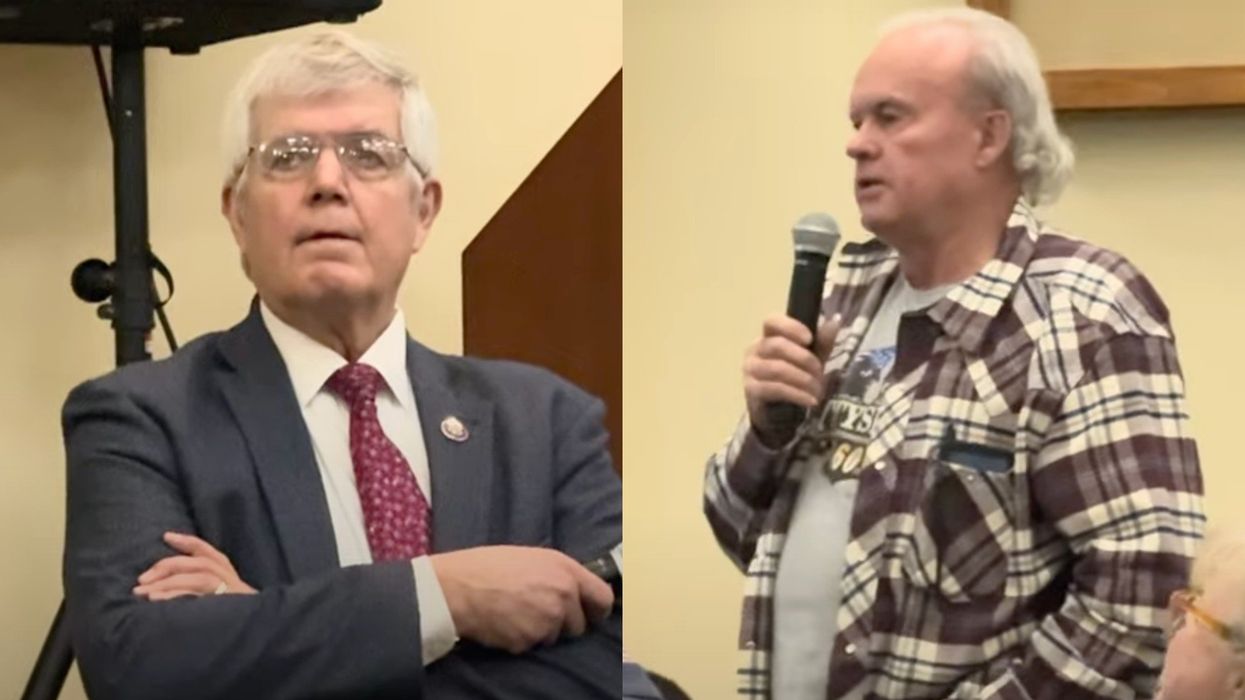
U.S. Rep. Cliff Bentz (R-Ore.) listening to a constituent's question at a town hall on February 20, 2025 (Image: Screengrab via Unsound America / YouTube)

February 22, 2025
ALTERNET

Even residents of a county President Donald Trump won by a significant margin are outraged by the Trump administration's slashing of public services — and their Republican congressman's support of the cuts.

The La Grande, Oregon-based Observer reported Friday that Rep. Cliff Bentz (R-Ore.) was recently met by an angry crowd of constituents during a town hall at Eastern Oregon University. The outlet noted that the audience of several hundred people filled nearly all 435 seats in the McKenzie Theater, and more people filled the aisles and stood along the walls to hear their congressman.

Attendees reportedly grew impatient with Bentz's presentation, yelled "we can read" while he went over PowerPoint slides and urged him to move to the question-and-answer portion of the meeting. At that point, the crowd indicated it was furious with Bentz's support of Tesla and SpaceX CEO Elon Musk's "Department of Government Efficiency," or DOGE (which is not an official federal agency authorized by Congress). Bentz has recently said he would even support firing some of his own staff in order to help DOGE.


READ MORE: 'Shame!' Angry crowd boos Georgia Republican over Trump cuts

In addition to cutting budgets for federal agencies, Bentz talked about his hopes to extend Trump's 2017 tax cut package — which could cost anywhere from $4.6 trillion to $5.5 trillion over a ten-year period. He also said he plans to vote for additional funding for border security and to increase oil and gas production.

While Bentz got back to his desire to reduce federal spending, members of the crowd reportedly shouted over him yelling, "tax Elon," "tax the wealthy," "tax the rich" and "tax the billionaires." Bentz countered that some of his colleagues weren't even holding town halls during this week's Congressional recess, saying: "You should be here to speak with me." The Observer reported that Union County, where Bentz held his town hall, went for Trump by 68%. Bentz won reelection with 64% of the vote in the ruby-red district.

"If you just came to yell, I can leave," Bentz said.

The Observer reported that members of the audience kept coming back to the "power of the purse," which is a power that Article I, Section 8 of the U.S. Constitution specifically delegates to Congress. Bentz pushed back, saying he supports Trump "doing his best to exercise his legal power" to reduce federal spending, and that the president wants to make sure the nation doesn't "go broke." Bentz — who is the lone Republican in the Oregon Congressional Delegation, confronted his own constituents just as Rep. Rich McCormick (R-Ga) had a tense town hall in his own deep-red Georgia district

Click here to read the La Grande Observer's full report.


CLUCK, CLUCK

'A lot of fear': Republicans a no show as Wisconsin farmers complain of Trump chaos
February 21, 2025

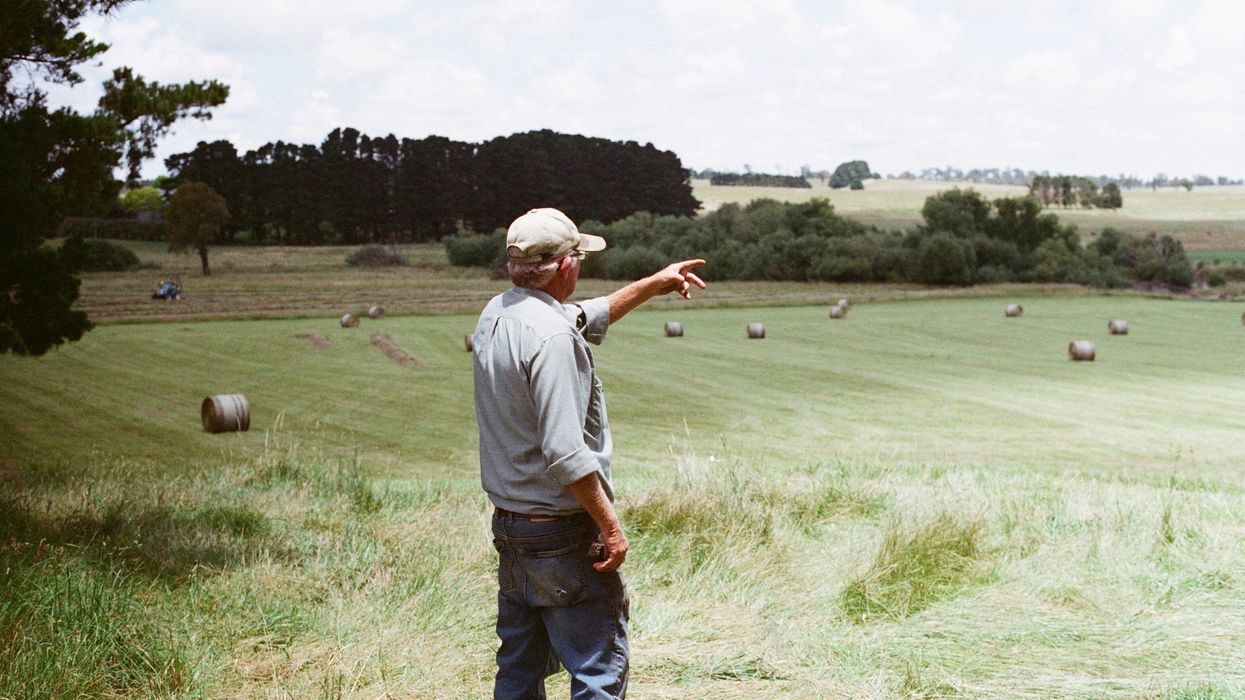
Seven western Wisconsin Republican lawmakers did not appear at an event hosted by the Wisconsin Farmers Union in Chippewa Falls Friday as farmers from the area said they were concerned about the effect that President Donald Trump’s first month in office is having on their livelihoods.

Madison-area U.S. Rep. Mark Pocan (D-Black Earth), state Sen. Jeff Smith (D-Eau Claire) and state Reps. Jodi Emerson (D-Eau Claire) and Christian Phelps (D-Eau Claire) were in attendance.

U.S. Reps. Tom Tiffany and Derrick Van Orden, state Reps. Rob Sommerfeld (R-Bloomer), Treig Pronschinske (R-Mondovi) and Clint Moses (R-Mondovi) and state Sens. Jesse James (R-Thorp) and Rob Stafsholt (R-New Richmond) were all invited but did not attend or send a staff member.

“All four of us want you to know that there are people in elected office who want to fight for you,” Phelps said. “Because I think there’s a lot of fear that comes from the fact that we’re seeing a lot of noise and action from the people who aren’t and some of the people that didn’t show up to this. So I hope that you will also ask questions of them when you get a chance.”

Multiple times during the town hall, Pocan joked that Van Orden was “on vacation.”

Emerson, whose district was recently redrawn to include many of the rural areas east of Eau Claire, told the Wisconsin Examiner she had just been at an event held by the Oneida County Economic Development Corporation where a Van Orden staff member did attend, so she didn’t understand why they couldn’t hear about how Trump’s policies are harming local farmers.

“I get that a member of Congress can’t be at every meeting all the time, all throughout their district,” Emerson said. With 19 counties in the 3rd District, “it’s a big area. But I hope that they’re hearing the stories of farmers and farm-adjacent businesses, even if they weren’t here. There’s something different to sit in this room and look out at all the farmers, and when one person’s talking, seeing the tears in everybody else’s eyes, and it wasn’t just the female farmers that were crying, the big tough guys, and I think that talks about how vulnerable they are right now, how scary it is for some of these folks.”

Carolyn Kaiser, a resident of the nearby town of Wheaton, said she’s never seen her congressional representative, Van Orden, out in the community. Despite Van Orden’s position on the House agriculture committee, Kaiser said her town needs help managing nitrates in the local water supply and financial support to rebuild crumbling rural roads that make it more difficult for farmers to transport their products.

“When people don’t come, it’s unfortunate,” Kaiser said.

Emmet Fisher, who runs a small dairy farm in Hager City, said during the town hall that he was struggling with the freeze that’s been put on federal spending, which affected grants he was set to receive through the U.S. Department of Agriculture (USDA).

Fisher told the Examiner his farm has participated in a USDA program to encourage better conservation practices on farms and that money has been frozen. He was also set to receive a rural energy assistance grant that would help him install solar panels on the farm — money that has also been held up.

The result, he said, is that he’s facing increased uncertainty in an already uncertain business.

“We get all our income from our farm, young family, young kids, a mortgage on the farm, and so, you know, things are kind of tight, and so we try to take advantage of anything that we can,” he said. “[The] uncertainty seems really unnecessary and unfortunate, and it’s very stressful. You know, basically, we have no idea what we should be planning for. The reality is just that in farming already, you can only plan for so much when the weather and ecology and biology matter so much, and now to have all of these other unknowns, it makes planning pretty much impossible.”

A number of crop farmers at the event said the looming threat of Trump imposing tariffs on Canadian imports is alarming because a large majority of potash — a nutrient mix used to fertilize crops — used in the United States comes from Canada. Les Danielson, a cash crop and dairy farmer in Cadott, said the tariffs are set to go into effect during planting season.

“How do you offer a price to a farmer? Is it gonna be $400 a ton, or is it gonna be $500 a ton?” he asked. “I’m not even thinking about the fall. I’m just thinking about the spring and the uncertainty. This isn’t cuts to the federal budget, this is just plain chaos and uncertainty that really benefits no one. And I know it’s kind of cool to think we’re just playing this big game of chicken. Everybody’s gonna blink. But when you’re a co-op, or when you’re a farmer trying to figure out how much you can buy, it’s not fine.”

A recent report by the University of Illinois found that a 25% tariff on Canadian imports — the amount proposed by Trump to go into effect in March — would increase fertilizer costs by $100 per ton for farmers.

Throughout the event, speakers said they were concerned that Trump’s efforts to deport workers who are in the United States without authorization could destroy the local farm labor force, that cuts to programs such as SNAP (commonly known as food stamps) could cause kids to go hungry and prevent farmers from finding markets to sell their products, that cuts to Medicaid could take coverage away from a population of farmers that is aging and relies on government health insurance and that because of all the disruption, an already simmering mental health crisis in Wisconsin’s agricultural community — in rural parts of the state that have seen clinics and hospitals close or consolidate — could come to a boil.

“Rural families, we tend to really need BadgerCare. We need Medicaid. We need those programs, too,” Pam Goodman, a public health nurse and daughter of a farmer, said. “So if you’re talking about the loss of your farming income, that you’re not going to have cash flow, you’re already experiencing significant concerns and issues, and we need the state resources. We need those federal resources. I’ve got families that from young to old, are experiencing significant health issues. We’re not going to be able to go to the hospital. We’re not going to go to the clinic. We already traveled really long distances. We’re talking about the health of all of us, and that is, for me, from my perspective as a nurse, one of my biggest concerns, because it’s all very interrelated.”

Near the end of the event, Phelps said it’s important for farmers in the area to continue sharing how they’re being hurt by Trump’s actions, because that’s how they build political pressure.

“Who benefits from all the chaos and confusion and cuts? Nobody, roughly, but not literally, nobody,” he said. “Because I just want to point out that dividing people and making people confused and uncertain and vulnerable is Donald Trump’s strategy to consolidate his political power.”

“And the people that can withstand the types of cuts that we’re seeing are the people so wealthy that they can withstand them. So they’re in Donald Trump’s orbit, basically,” Phelps said, adding that there are far more people who will be adversely affected by Trump’s policies than there are people who will benefit.

“And you know that we all do have differences with our neighbors, but we also have a lot of similarities with them, and being in that massive group of people that do not benefit from this kind of chaos and confusion is a pretty big similarity,” he continued. “And so hopefully these types of spaces where we’re sharing our stories and hearing from each other will help us build the kind of community that will result in the kind of political power that really does fight back against it.”

Wisconsin Examiner is part of States Newsroom, a nonprofit news network supported by grants and a coalition of donors as a 501c(3) public charity. Wisconsin Examiner maintains editorial independence. Contact Editor Ruth Conniff for questions: info@wisconsinexaminer.com.