Wednesday, March 05, 2025

Survey: 26,000 employees in tech laid off globally since January


By Dr. Tim Sandle
March 5, 2025
DIGITAL JOURNAL


Facial recognition technology. — Image by © Tim Sandle

As new rounds of mass layoffs at major technology companies are being announced in 2025, a new survey examines the workforce reductions around the world in 2024 and since the beginning of the year.

The survey comes from RationalFX, who have aggregated layoff announcements sourced from U.S. notices, the job portal TrueUp, TechCrunch and the Layoffs.fyi tracker for the entirety of 2024.

The firm also looked into the latest layoffs since the beginning of January 2025, focusing on companies in the technology sector. Numbers show that 280,991 employees in technology companies were laid off last year, with another 26,215 let go since January.

A total of 80 tech companies, primarily U.S., have laid off 26,215 employees since January 2025. We found another 40 companies reducing their workforce or shutting down operations altogether but with no confirmed figures for the positions eliminated.

The tech companies with the largest layoffs so far this year are Meta (3,600 job cuts), STMicro (3,000 job cuts), Microsoft (2,280 job cuts), and Amazon (2,100). Enterprise software giant Workday also announced plans to eliminate roughly 8.5 percent of its workforce or around 1,750 positions, followed by GM-owned autonomous taxis Cruise, which laid off 1,050 after being shut down by its parent company in December.

Salesforce and Jeff Bezos’ space travel company have also joined the wave of layoffs, each slashing 1,000 jobs. In 2024, tech companies around the world laid off 280,991 employees, with U.S. tech giants Dell, Intel, and Amazon cutting the most jobs. Within this figure, at least 95,000 workers at U.S.-based tech companies were laid off in mass job cuts in 2024.

Since January 2025, U.S.-based tech companies have slashed another 18,168 jobs. Globally, at least 26,215 employees in the technology sector have lost their jobs.

The top 10 companies with the largest layoffs so far in 2025:

• Meta (Menlo Park, CA, U.S.) – 3,600 laid-off employees
• STMicro (Geneva, Switzerland) – 3,000 laid-off employees
• Microsoft (Redmond, WA, U.S.), 2,280 laid-off employees
• Amazon (Seattle, WA, U.S.) – 2,100 laid-off employees
• Workday (Pleasanton, CA, U.S.) – 1,750 laid-off employees
• Cruise (San Francisco, CА, U.S.) – 1,050 laid-off employees
• Salesforce (San Francisco, CA, U.S.) – 1,000 laid-off employees
• eFishery (Bandung, Indonesia) – 1,000 laid-off employees
• Blue Origin (Kent, WA, U.S.) – 1,000 laid-off employees
• Wayfair (Boston, MA, U.S.) – 730 laid-off employees

In terms of the most recent announcement, in a Form 8-K filing with the U.S. Securities and Exchange Commission (SEC), dated February 27, HP revealed it will eliminate between 1,000 and 2,000 of its workers.

Overall, the opening days of January and the closing days of February have not been good ones for job security in the technology industry.
‘Stab in the back’: Ukrainians in shock after US aid halt


WHEN HISTORY REPEATS ITSELF, FIRST AS TRAGEDY THEN AS FARCE  
 K MARX

By AFP
March 4, 2025


Russian forces have escalated their attacks on eastern Ukraine despite mounting rhetoric from Washington and Moscow over peace - Copyright AFP Tetiana DZHAFAROVA
Sergii VOLSKYI with Florent VERGNES in Kramatorsk

Ukrainians in Kyiv and soldiers on the front lines were in shock on Tuesday and grappling with a sense of betrayal after US President Donald Trump’s decision to suspend military aid.

The move by Trump follows weeks of deteriorating ties between Washington and Kyiv, and Ukrainians said the decision played directly into the hands of the Kremlin.

“It’s like a stab in the back. Because we were counting on them. And we are still counting on them. It’s wrong in my opinion,” Sofia, a Kyiv resident, who declined to give her surname, told AFP.

“Of course it was shocking. These are our main partners,” the 33-year-old financial assistant added.

The United States, which is Ukraine’s most important political ally, has also contributed billions of dollars of vital military assistance to Kyiv since Russia invaded in February 2022.

Trump vowed before his inauguration in January to speedily end the war but had offered no roadmap, spurring fears that Ukraine could be forced into conceding territory to Russia as part of an agreement.

– ‘Europe will be next’ –

Oleksiy, a 26-year-old serviceman, told AFP in the frontline town of Kramatorsk that Ukraine would need to find other ways to make up the shortfalls in aid.

“At the very least, Europe is interested in this. If (Russian forces) capture Ukraine, Europe will be next,” he added.

Denys Kazansky, a Ukrainian media commentator said that while Washington had paused support for Kyiv “North Korea and Iran did not stop military aid to Russia”.

Both Moscow-allied countries have provided critical help to the Russian military since the Kremlin launched its fully-fledged invasion.

“We live in a reality where the United States has become an ally of North Korea, Russia and Iran and it is helping them carry out aggression against a European country,” Kazansky added on social media.

Political analyst Volodymyr Fesenko told AFP that the halt of US military aid did not necessarily mean that Ukraine would imminently lose the war.

“Worsening of the situation — yes. Weakening of Ukraine’s defence capabilities — yes. More vulnerability in case of ballistic missile attacks on Ukraine — yes,” he said.

“But this does not mean the inevitable loss of the war,” he said.

Sergiy Takhmazov, a member of the Ukrainian military, questioned how long Ukrainians would be able to hold out without US support for air defence systems and intelligence sharing.

Prime Minister Denys Shmygal told reporters that Ukraine would find a way to “hold out” and said Kyiv was still open to talks with Washington.

But he said that Ukraine needed security guarantees from its Western allies to deter any future Russian attacks.

“This is existentially important not only for Ukraine, but also for the European Union, for the European continent,” Shmygal said.

– Ukraine could ‘cease to exist’ –

Pavlo Kazarin, a journalist and commentator who joined the military, warned what would happen without those guarantees.

“All those who demand peace from us ignore that the price of our peace will be higher than the price of our war,” he said.

Some of the servicemen AFP spoke with in eastern Ukraine voiced confidence in their country’s own developing arms industry.

“It’s just that so much has already happened, and now to back off or something like that, I don’t see any sense in it,” said a 37-year-old sergeant who identified himself to AFP as Viking.

In the capital, Igor Peresada said the dynamics of fighting would become much more difficult without US military support, but said that it would also be impossible for Ukraine to stop fighting.

“Because if we stop shooting, Ukraine will cease to exist as an independent state. And if Putin wants a ceasefire, he can withdraw his troops, and that’s it, the war will end,” the 57-year-old civil servant said.


Diplomat Charles: UK king’s role in Trump-Ukraine tightrope act


By AFP
March 4, 2025


King Charles welcomed Zelensky to the Sandringham Estate just two days after the Ukrainian leader's dressing down in the Oval Office
 - Copyright ${image.metadata.node.credit} 


Peter HUTCHISON

From showing solidarity with Volodymyr Zelensky to inviting US President Donald Trump for an historic state visit, Britain’s diplomatic drive over Ukraine has a surprising pivotal figure: King Charles III.

The UK head of state may be politically neutral, but that has not stopped the Labour government from calling upon him three times in recent days to aid international diplomacy efforts.

Charles helped smooth Prime Minister Keir Starmer’s visit to the White House last week before separately welcoming Zelensky and Canadian leader Justin Trudeau to his country retreat in Norfolk.

“It’s slightly unusual, but I think it’s a very good use of the royals,” professor Pauline Maclaran at Royal Holloway University of London said of the flurry of meetings.

“Their big asset is this soft power that they can provide, and I think it was much needed at this time,” the royal expert told AFP.

The 76-year-old monarch appears all-too-happy to play his part, as Britain’s diplomatic blitz over Ukraine sees it emerge from the wilderness of the post-Brexit years to take its place again on the world stage.

“It has been six days of royal diplomacy at its most delicate, deliberate and nuanced,” a royal source briefed UK media on Monday.

The source added that Charles “is very conscious of his responsibility globally, regionally and nationally -– and passionately engaged in all the detail”.

“As a global statesman and a head of state for both the UK and Canada, the king’s role is highly significant, and his majesty is determined to play his part, within appropriate parameters,” the source added.

Buckingham Palace never shares information about what is discussed during the monarch’s meetings, but the source said his role “is to offer symbolic gestures, rather than express comment”.

The symbolism was plain to see in the Oval Office last week when Starmer brandished a signed letter from Charles inviting Trump to become the first leader in history to undertake a second state visit to Britain.

In front of the TV cameras a beaming US president read the invitation, said it would be an “honour” to accept, and declared the king “a beautiful man, a wonderful man”.


– ‘Masterstroke’ –


That set the tone for a friendly meeting between Starmer and Trump that was devoid of any verbal fireworks.

“It was a little bit of a masterstroke,” said Maclaran, adding that the king’s invitation was “to impress Trump, to show him the greatest respect, and to ease the way for Starmer to negotiate with him”.

Evie Aspinall, director of the British Foreign Policy Group think-tank, agrees that the gesture helpfully played to Trump’s ego.

“He wants to feel big and important, and we can do that” with a state visit, she told AFP.

Charles’s next diplomatic endeavour was much less flashy but sent an equally strong message, the analysts say.

On Sunday, he warmly welcomed Zelensky to his Sandringham Estate in eastern England just two days after Trump and Vice President JD Vance berated Ukraine’s leader in the Oval Office.

According to royal watchers it cleverly symbolised solidarity with British ally Zelensky, but in a low-key way so as not to offend the thin-skinned Trump.

“The royal family was giving their legitimacy to Zelensky at a time where he really needs it with Trump,” said Aspinall.

For Maclaran, it helped portray “equal respect” to both leaders at a time when Britain is trying to bridge the divide between the United States on one side, and Europe and Ukraine on the other.

Charles is Canada’s head of state and Trudeau said he was going to use Monday’s meeting to talk about defending Canada’s sovereignty, as Trump repeatedly calls for it to become the 51st US state.

It is custom that the monarch acts only on the advice of the prime minister in matters involving the Commonwealth nation but some Canadians have asked why the king has not spoken out in defence of Canada.

Royal commentator Richard Fitzwilliams says Charles must remain wary of becoming too involved in diplomacy due to the unpredictability of the Trump era.

“It’s not only the complexities, it’s the speed at which it moves. It’s very confusing and he’s got to be very, very careful,” Fitzwilliams told AFP.
Trump tariff uncertainty overshadows growth promises: analysts


By   AFP
March 4, 2025


US President Donald Trump's tariffs on Canada, Mexico and China, and the retaliation they attracted, could dent US GDP growth notably if kept in place over a year 
- Copyright AFP Guillermo Arias


Beiyi SEOW

President Donald Trump’s tariffs and the retaliation they attracted will likely weigh on US growth and boost inflation, according to analysts, but, beyond that, uncertainty surrounding the levies threatens to overshadow optimism about his future policies.

Trump reignited trade wars this week with hefty duties on Canadian, Mexican and Chinese imports, drawing sharp retaliation from Ottawa and Beijing, including new tariffs on key American farm products.

Collectively, these could dent US GDP growth by one percentage point and hike inflation by 0.6 points if kept in place for the year, said Nationwide chief economist Kathy Bostjancic.

“Tariffs represent a negative supply shock. It hurts production, raises prices,” she told AFP, warning that business and consumer confidence also take a hit from levies.

And the unpredictability of Trump’s tariff plans stand to offset positivity about the president’s promises of deregulation and tax cuts, which are seen as pro-growth, she said.

“That hope and excitement right now is overwhelmed by the uncertainty of what’s going to play out,” she added.

It also remains unclear if new tariffs will be long-lasting, and they come atop cost-cutting measures in the federal government which are being challenged in courts, KPMG chief economist Diane Swonk said.

The fallout from these efforts can undermine demand.

Trump has not only quickened the pace of tariff hikes in his second term by tapping emergency economic powers to impose them without an investigation period, but his levies cover a larger value of goods.

Trump’s first-term tariffs hit $380 billion worth of US imports over 2018-2019, mainly from China, said Erica York of the Tax Foundation.

But his latest duties introduced over a month impact $1.4 trillion of imports, mostly from allies, she added.

“Because of the faster implementation and the larger magnitude, the new tariffs will be much more disruptive to the US economy than Trump’s first trade war,” York said.


– Prices, jobs –


While the situation is fluid, Bostjancic said prices of products like motor vehicle parts could rise by 10 percent within months, given how integrated North American supply chains are.

This could inflate consumer costs for big ticket items. Used car prices could increase if producing new vehicles became pricey, analysts said.

New homes stand to become more expensive too, potentially making property owners reluctant to move and weighing on the housing market, said Jessica Lautz at the National Association of Realtors.

Trump’s latest 25 percent tariff on Canadian goods hits lumber imports, which are important to homebuilders.

With the breadth of Trump’s current tariff plans, “some companies may not be able to maintain the same level of employment,” Swonk of KPMG warned.

During Trump’s first term, despite an initial uptick in steel industry employment when he imposed tariffs on imports of the metal, these were more than offset by higher input costs and layoffs elsewhere, she noted.


– ‘Choke points’ –


Other near-term effects include countries’ readiness to to hit US “choke points” following experiences from his first administration, said Swonk.

“They’re going to look for the places that are the biggest pinch points for the president’s party and that’s the Republican Party,” she told AFP.

This means taking aim at Republican-dominated states.

When the world’s biggest economy takes action like sweeping tariffs other countries tend respond strategically, targeting countermeasures at areas which likely have more political sway over the administration, she said.

Farm and food products are often primary targets of retaliation, said Wendong Zhang of Cornell University. This could spark the need for federal aid to farmers subsequently.

Already, China said it would impose 10 percent and 15 percent levies on various US agricultural exports including soybeans.

In Trump’s first term, retaliatory tariffs on the United States caused more than $27 billion in US agricultural export losses from mid-2018 to late-2019.

Economists say the hit to growth and inflation in 2025 could be somewhat counterbalanced by aggressive deregulation efforts next year, as Trump’s government seeks to rein in the budget deficit and make certain tax cuts permanent.

For now, the “uncertainty effect,” serves as a tax of its own, Swonk said.
Fact-check: Trump’s claims about Canada


By AFP
March 4, 2025


A truck prepares to enter the United States at a border crossing in Blackpool, Canada, a country which has vowed to hit back if Washington goes ahead with 25 percent tariffs on Canadian imports. — © AFP/File ANDREJ IVANOV
Gwen Roley

US President Donald Trump has said his looming tariffs on Canadian goods are necessary to force action on the migrants and drugs entering the United States through its northern border.

He has also described billions of dollars in daily cross-border trade as a US subsidy and claimed Canada would not be “viable as a country” without it.

According to Trump, Canada’s economic dependence on the United States is one of the reasons it should become the 51st US state.

AFP fact-checked some of the president’s claims about Canada, which include misrepresentations about bilateral economic relations and the situation at the border.

– US supply of Canadian imports –

Trump has claimed that Canada gets 95 percent of its “product” from the United States.

For Canada’s imported goods, that figure is inaccurate, according to Statistics Canada.

In 2024, 62.2 percent of Canada’s total imports came from the United States, the federal agency said.


US President Donald Trump has described billions of dollars in daily cross-border trade with Canada as a US subsidy – Copyright AFP Geoff Robins

But, as University of Toronto economist Joseph Steinberg noted, “a lot of what Canadian consumers buy is produced domestically,” so Trump’s 95 percent claim can only be credibly scrutinized if it is assumed he was talking about imports.

“If we… focus on imports, does the US account for 95 percent? Not quite, although it is a really high number,” Steinberg said.

Statistics Canada also reported 75.9 percent of the country’s exports went to the United States last year.

– US trade deficit –

During the question-and-answer portion of his January World Economic Forum appearance, Trump claimed the United States had a $200 billion or $250 billion trade deficit with Canada.

“That’s an inflated number,” Steinberg said.

The United States Trade Representative and the US Census Bureau put the trade deficit with Canada at $63.3 billion at the end of 2024, while Statistics Canada reported its surplus with the United States as Can$102.3 billion ($70.3 billion).

But trade deficits are not subsidies and the data does not affirm that the United States is propping up Canada’s economy, Steinberg said.

“International trade is a mutually beneficial transaction,” he said. “The United States pays Canada for products, it wouldn’t pay Canada for those products if it didn’t feel that it was worth it in this case.”

US oil purchases from Canada are a main driver of the trade deficit, he added.

– American banks in Canada –

“American banks are not allowed to do business in Canada,” Trump said in a social media post last month.

That claim is also false.

Foreign banks, including American financial institutions, are regulated by Canada’s federal Bank Act.

“There are 16 US-based bank subsidiaries and branches with around Can$113 billion in assets currently operating in Canada,” the Canadian Bankers Association said in a February 3 statement on X.

These include JP Morgan Chase, CitiBank and Bank of America, which have offices in most major Canadian cities.

– Border security –

The Trump administration has said improving border security is a central issue in its relations with Canada.

Trump has claimed that undocumented migrants and the drug fentanyl are flowing across the border in large numbers.

Kelly Sundberg, a criminologist at Mount Royal University in Calgary, said there is no evidence to back up Trump’s claims on fentanyl, as data shows less than one percent of the killer opioid that enters the United States came from Canada.

According to the United States Customs and Border Patrol (CBP) agency, out of over 21,800 pounds (9,900 kilograms) of fentanyl intercepted by agents during the 2024 fiscal year, 43 pounds was seized near the northern border with Canada.

CBP data also reported US border patrol agents apprehended 23,721 people illegally crossing the Canadian border in fiscal year 2024.

Nationally last year, CBP agents came into contact with more than 1.5 million undocumented migrants.

“Canada is under greater threat from the United States than the United States is from Canada for most things — guns, drugs (and) illegal immigrants,” Sundberg said.

He said more relaxed drug laws in Canada could project an inflated sense of illicit substances entering the United States.


‘Terrifying’: Canadian auto workers dismayed at looming US tariffs


By AFP
March 4, 2025


Windsor in Ontario, Canada is at the heart of the Canadian auto industry and is across the border from Detroit, Michigan in the United States - Copyright AFP Geoff Robins

Anne-Marie Provost

Residents of the Canadian border city of Windsor had held out hope US President Donald Trump’s threats of tariffs on imports from Canada would prove hollow, but that faith was dashed Monday, sparking fear for their futures.

Trump had unveiled — and then paused — blanket tariffs of up to 25 percent on imports from major trading partners Canada and Mexico in February, accusing the US neighbors of failing to stop illegal immigration and drug trafficking.

Canadian leaders had been pushing for a deal ahead of the expiration of the halt this week, but Trump said there was “no room left” on Monday for both countries to avoid fresh levies.

The pronouncement sent shockwaves through Windsor, Ontario, home to 250,000 people and the thriving heart of the Canadian auto industry — located just across the border from US industry powerhouse Detroit, Michigan.

Residents said they felt betrayed by Canada’s neighbor and now fear the closures of factories and subcontractors.

“The mood is overall like we’re pretty scared,” said Joel Soleski, 26, who works for carmaker Stellantis.

“The impact would be a layoff until further notice,” he told AFP. “I just bought my first house… I might have to look for work elsewhere.”

The manufacturer is one of the most exposed to the looming tariffs, according to ratings agency Moody’s: 40 percent of Stellantis cars sold in the United States — under the Ram, Fiat, Dodge, or Chrysler brands — are made in Canada and Mexico.

Automotive parts can cross between the United States and Canada up to six times before a vehicle is assembled in Windsor, where the border can be almost forgotten and the economy is deeply integrated with Detroit’s.

Anxiety and anger were palpable among Stellantis workers clocking off on Monday afternoon.

Trump’s decision is “not even logical, it makes absolutely no sense,” said John D’Agnolo, president of a union in Windsor representing 2,000 workers at Ford.

“I can’t imagine how that would work,” he added, predicting layoffs could be seen in a few weeks after the tariffs go into effect, and that vehicles would become more expensive in the long term.

More than two million jobs are at stake in Canada, with 500,000 alone in Ontario, the country’s most populous province.

Ford employee Christina Grossi was in shock.

“They’re our jobs. We’ve been doing this for 100 years,” she said.

“It’s terrifying,” added the woman in her fifties, feeling betrayed by a country she has always considered a strong ally, and where her son is studying.

On Monday, Ontario Premier Doug Ford pledged to fight back.

“They want to hit us hard. We will hit them back twice as hard,” he said.


Trade war brings fear, uncertainty to Canadian border city


By AFP 
March 4, 2025

Anne-Marie PROVOST

In the Canadian city of Windsor, which survives on the cross-border auto industry, the start of a trade war with the United States has opened a period of fear and uncertainty.

Windsor is separated from Detroit, Michigan by a river, and American automakers based in the US city have been an essential employer on the Canadian side for decades.

“The value of what we have around us is based on the automotive industry. So if it were to collapse, that will collapse with it,” Robert Pikata, a 60-year-old who works for Windsor’s municipal government, told AFP.

Like many Windsor residents, Pikata has been following the news closely in recent weeks.

Many had hoped that President Donald Trump would ultimately back away from tariffs that Ford’s CEO Jim Farley warned would “blow a hole” in the auto industry.

But Trump made good on his threat on Tuesday, imposing a 25 percent tariff on Canadian goods.

Canada immediately retaliated, triggering a trade war between historically close allies and threatening future commerce across a border that sees billions of dollars in daily trade.

Addressing Canadians on Tuesday, Prime Minister Justin Trudeau warned of “tough” days ahead.

Pikata said economic conflict with the United States will see living standards in Windsor fall.

He told AFP he was “disappointed and scared at the same time because of the unknown.”

“How is it going to affect me personally and how is it going to affect my family?”

Jessica Dame, a 33-year-old healthcare worker, said businesses across Windsor rely on the US.

“You’re literally breaking relationships,” she said, addressing Trump. “I think we’re gonna see a huge decline in local economies.”


– ‘Shocked, not surprised’ –


Trump’s justifications for launching a trade war with Canada have shifted.

His administration has said the levies are designed to force Canada to act on the flow of undocumented migrants and the drug fentanyl across the border.

Trudeau has maintained that Canada is not a significant contributor to either problem in the United States, and on Tuesday called Trump’s fentanyl justification “completely false.”

Trump has also mused about tariffs as a corrective to the US trade deficit with Canada and falsely claimed that Canada prevents American banks from operating in the country.

The president said this week that auto companies that want to avoid the consequences of tariffs should open plants in the United States.

“Every time I hear (Trump) say something, I always find it’s like 50-50 about whether it’s actually true or not,” university student Zach Puget told AFP in Windsor.

Voicing concern that the trade war would force grocery prices higher, Puget said he was “shocked, but not surprised” that the measures had come into force.

In his address to Canadians, Trudeau offered a stark warning about Trump’s motivation.

He said the US president, who has spoken often of making Canada the 51st American state, “wants to see a collapse of the Canadian economy because that would make it easier to annex us.”

“That is never going to happen,” Trudeau asserted. “We will never be the 51st state.”


Several Canadian provinces ban US alcohol in tariff response


By AFP
March 4, 2025


Donald Trump campaigned on a platform of tariffs and import duties - Copyright AFP/File Angela Weiss

Multiple Canadian provinces, including Ontario and Quebec, banned the sale of US alcohol on Tuesday, part of a broad national retaliation against import tariffs imposed by US President Donald Trump.

“This is an enormous hit to American producers,” Ontario Premier Doug Ford said in announcing the measures imposed by Canada’s largest province.

Stores run by the publicly controlled Liquor Control Board of Ontario (LCBO) sell nearly one billion Canadian dollars ($688 million) worth of US alcohol products each year, Ford said.

The LCBO’s website was down Tuesday, with a notice saying the store was removing “US products in response to US tariffs on Canadian goods.”

In Quebec, the government said it was ordering the provincial alcohol distributor “to stop supplying American alcoholic beverages” to stores, bars and restaurants.

Manitoba’s Premier Wab Kinew posted: “We are taking US alcohol off the shelves.”

The provincial government in British Columbia said its liquor distributor would “stop buying American liquor from ‘red states’,” those that voted for Trump’s Republican Party.

Teachers’ Union Files Lawsuit Against Trump’s Anti-DEI Directive


Trump’s anti-DEI policy “seeks to undermine our nation’s educational institutions,” the plaintiffs say

Truthout
February 27, 2025
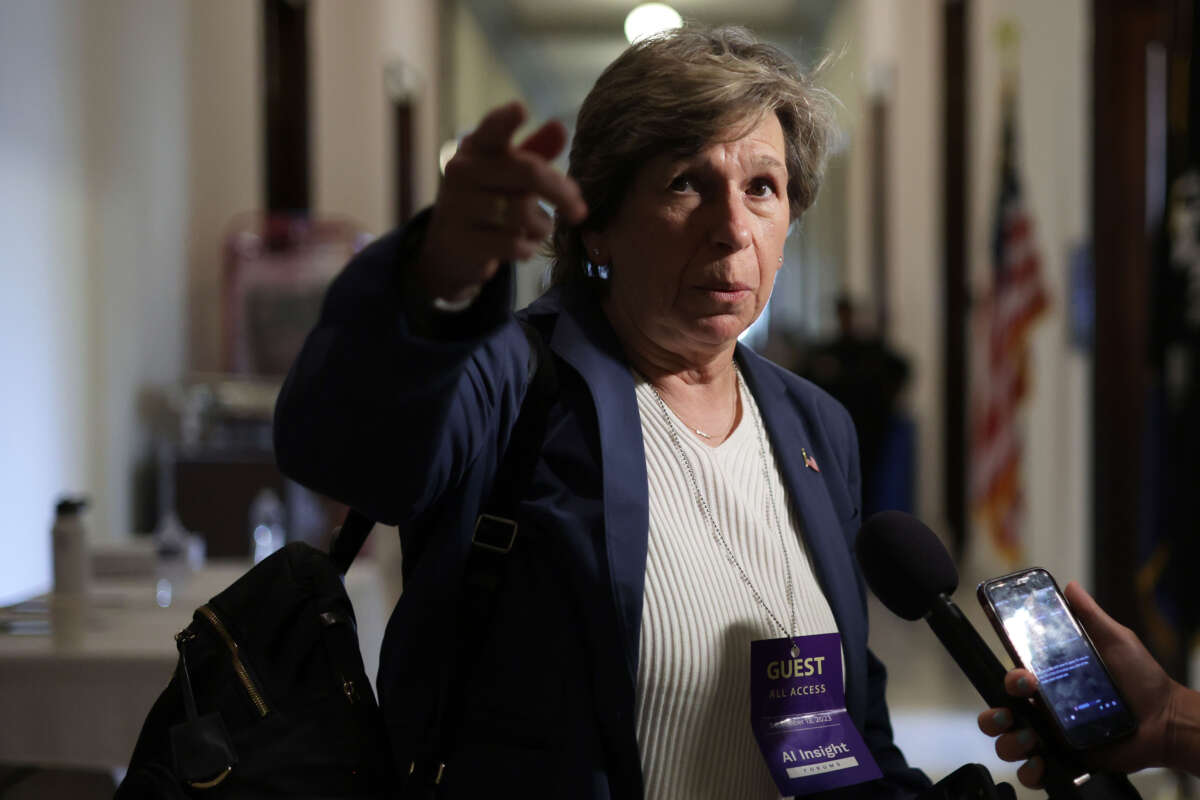
Randi Weingarten, President of American Federation of Teachers, speaks to members of the press at the Russell Senate Office Building on Capitol Hill on September 13, 2023, in Washington, D.C.Alex Wong / Getty Images

Agroup of educators is suing the Department of Education over its recent “Dear Colleague Letter,” (DCL) which gave K-12 schools and federally funded colleges roughly two weeks to stop considering race as a factor in admissions, financial aid and hiring — or risk losing federal funding.

The challenge was brought forward by the American Federation of Teachers (AFT), which represents approximately 400,000 higher education workers, AFT-Maryland, and the American Sociological Association.

“The Department of Education’s new policy, reflected in the February Dear Colleague Letter, seeks to undermine our nation’s educational institutions and is an unlawful attempt to impose this administration’s particular views, which are not based in the law, of how schools and teachers should operate,” Skye Perryman, president and CEO of Democracy Forward, which is representing the plaintiffs, said in a press release. “This is un-American and unlawful.”

The plaintiffs argue in the complaint that the department’s letter appears to classify “a wide variety of core instruction, activities, and programs” used by colleges, K-12 schools, and pre-K institutions as illegal discrimination.

“This vague and clearly unconstitutional memo is a grave attack on students, our profession and knowledge itself. It would hamper efforts to extend access to education, and dash the promise of equal opportunity for all, a central tenant of the United States since its founding,” Randi Weingarten, president of AFT, said in a press release.

The plaintiffs also argue that the letter’s “unprecedented weaponization and undermining of civil rights laws” could allow the Trump administration to threaten federal funding cuts for institutions that teach accurate history, including lessons on slavery, diversity, and inclusion.

“It would ban meaningful instruction on slavery, the Missouri Compromise, the Emancipation Proclamation, the forced relocation of Native American tribes, the laws of Jim Crow, Brown v. Board of Education, the internment of Japanese Americans during World War II, and the Civil Rights Act and the Voting Rights Act,” Weingarten said.

In the complaint, the plaintiffs explain that to avoid enforcement they would need to censor discussions on diversity, equity, and inclusion, eliminate related student groups and programming, and halt any campus activities that could be seen as addressing these issues.

“The overbreadth and vagueness of the law, and the content-based restrictions it places on speech and expression, will force Plaintiffs’ members to choose between chilling their constitutionally protected speech and association or risk losing federal funds and being subject to prosecution,” the complaint says.

The plaintiffs are asking a federal judge to rule the guidance unconstitutional and block its enforcement.

“Federal statute already prohibits any president from telling schools and colleges what to teach. And students have the right to learn without the threat of culture wars waged by extremist politicians hanging over their heads,” Weingarten said in a press release. “Our suit exposes these harms and shows how this memo’s arbitrary and capricious reasoning flies in the face of both American values and established law.”

Last week, a federal judge in Maryland granted a temporary injunction in a separate case, halting portions of Trump’s anti-diversity executive orders. However, according to Inside Higher Ed, while the executive orders and the “Dear Colleague” letter share similarities, they operate independently. As a result, the injunction does not affect the Department of Education’s guidance. The department has reaffirmed its interpretation of the law and stated that the compliance deadline remains unchanged.

Organizations such as the American Council on Education (ACE), EdTrust, and the American Association of University Professors have advised colleges and universities to stay calm and not to overreact to the guidance.

“To be abundantly clear, Dear Colleague letters are not law. They are simply statements of intent by executive agencies about how they intend to interpret the law,” Ted Mitchell, president of ACE, said at a policy briefing. “And so overcompliance, anticipatory compliance, pre-emptive compliance, is not a strategy. The strategy needs to be much more considered, much more nuanced.”

Jon Fansmith, ACE’s senior vice president for government relations and national engagement, emphasized in the same briefing that the vague directive is likely meant “to sow chaos” and “create fear.”

“The idea that every institution in this country could meaningfully come into compliance with this interpretation, even if they wanted to, even if they should … is just ridiculous. It would be impossible for most institutions, let alone all institutions to comply,” Fansmith said.

On Tuesday, the ACE sent a letter to Craig Trainor, the acting assistant secretary of civil rights, urging him to “rescind the DCL.”

“In order to support students and combat discrimination, OCR ought to engage relevant stakeholders in a consultative manner to ensure that institutions of higher education are in compliance with their legal obligations under Title VI and federal nondiscrimination law,” the letter says.


Trump Perpetuates Undeclared War in Somalia With Renewed Airstrikes


The United States has been carrying out operations in Somalia since at least 2002 without a formal war declaration.
March 3, 2025
A man accused of working with the Islamic State, his face covered for a move between buildings, stands for a portrait in prison in Garoowe, Puntland, Somalia, on January 23, 2025.Carolyn Van Houten / The Washington Post via Getty Images

On February 1, 2025, U.S. Africa Command (AFRICOM), in coordination with the federal government of Somalia, conducted the first airstrikes in the country under the new Trump administration. The strikes targeted the Golis Mountains, a rocky, cavernous region in the northwestern part of the country that is said to be a hub for ISIS-Somalia (IS-S). Secretary of Defense Pete Hegseth stated “multiple operatives” were killed in the airstrikes. Two weeks later, additional strikes were carried out in the same region.

In response to the attacks, Trump tweeted: “These killers, who we found hiding in caves, threatened the United States and our Allies … WE WILL FIND YOU, AND WE WILL KILL YOU!”

IS-S has grown in influence since it was formed in 2015 by a group of al-Shabab defectors. The Defense Department claims recent strikes degrade “ISIS’s ability to plot and conduct terrorist attacks” even as Michael Langley, the director of AFRICOM expressed grave concern about the group’s continued growth. IS-S is now an integral financial and recruitment hub for the global Islamic State network, generating millions of dollars in revenue and growing its ranks with fighters from as far north as Morocco to as far south as Tanzania. What was once an underground movement is now capable of providing resources and training to nascent formations across the African continent. The group’s resilience, despite billions of dollars spent on militarism, call U.S. claims of success into question.

The Sky Is a Front in a Boundless War

The Trump administration’s airstrikes are only the newest chapter in a covert war that has persisted across multiple years, administrations and political parties. The United States has been carrying out operations in Somalia since at least 2002 without a formal war declaration. Shortly after the September 11, 2001, plane attacks, George W. Bush, in accordance with the Authorization for Use of Military Force — which granted the president sweeping powers to conduct military operations against groups that perpetrated the attacks or harbored the 9/11 attackers — sent Special Forces and CIA operatives to Somalia to capture suspected al-Qaeda members. He launched the first airstrike in Somalia in 2007, marking the beginning of an air war that the Obama administration would escalate.

The Obama years saw an unprecedented rise in drone warfare. Despite receiving the Nobel Peace Prize eight months into his tenure, Obama ultimately greenlit more drone strikes during his first year in office than Bush carried out during his entire presidency. During his second term in office, his administration stretched the 2001 war authorization to include al-Shabab in Somalia as a party to the armed conflict, providing legal cover for expanded operations in the name of “counterterrorism.”

Related Story   

African People Bear the Weight of US’s Deadly “War on Terror” on the Continent
The post-9/11 creation of “AFRICOM” expanded the U.S.’s military footprint, spreading instability and violence. By Jamila Osman , Truthout  September 11, 2022


During the first Trump administration, large swaths of southern Somalia were designated areas of active hostilities, expanding the parameters of who and what constituted legitimate targets. This weakened civilian protections and the country saw a marked increase in airstrikes. The subsequent Biden administration deployed hundreds of Special Operations forces to Somalia and approved a Pentagon request for standing authority to target suspected al-Shabab leaders.

Two months into his second term, Trump relaxed Biden-era airstrike restrictions, moving away from a strategy focused on high-level operatives. This directive grants commanders greater autonomy to determine targets, including those outside conventional battlefields, signaling a shift toward a more aggressive counterterrorism approach. With a surge in airstrikes in Somalia, including additional ones on February 25, it is clear the country remains a key battleground in this renewed offensive.

The full scale of the air war remains unknown. Much of AFRICOM’s work is shrouded in secrecy, which Brian Castner, Amnesty International’s head of crisis research, calls a “smokescreen for impunity.” The death toll of these operations are also unknown; U.S. claims denying civilian casualties are routinely disputed by people on the ground and the Somali government. A searing report from Amnesty International investigated five airstrikes from 2017 to 2018, which the Department of Defense alleged resulted in no civilian harm. Their findings revealed 14 civilian deaths and eight injuries, exposing a pattern of international human rights law violations.

AFRICOM has also been criticized for the flawed process it uses to distinguish civilians from combatants. They are not required to provide proof that those killed are members of al-Shabab. Abdullahi Hassan, a Somali researcher for Amnesty, speculates that the discrepancies in casualty numbers and the persistent misidentification of civilians stem from either gross incompetence or a deliberate attempt to evade accountability for war crimes.

Since the report’s publication, the number of civilians killed in the air war has increased, but there has been no accountability for their deaths. A 2023 letter authored by 24 Somali and international rights organizations and addressed to the Secretary of Defense says: “Civilian victims, survivors, and their families have yet to receive answers, acknowledgement, and amends despite their sustained efforts to reach authorities over several years.”

One of the people mentioned in the letter, Abubakar Dahir Mohamed, lost his sister Luul and her 4-year-old daughter Mariam in an airstrike on April 1, 2018. The next day, AFRICOM issued a press release claiming that five terrorists had been killed, stating: “We assess no civilians were killed in this airstrike.” It would take a full year for AFRICOM to acknowledge their deaths — the first admission of civilian casualties since the start of the air war. In response to public outcry and pressure, the Pentagon launched an investigation that concluded that the strike had “complied with the applicable rules of engagement.”
Polishing the Image of Empire

The vernacular of war is purposefully opaque. Airstrikes are routinely described as precise, targeted, accurate, deliberate, defensive — a linguistic sleight of hand that obfuscates the immense social, psychological, environmental and financial wreckage left in their wake. The Somali people are no strangers to the doublespeak of the U.S. government. American intervention in East Africa has long been a game of smoke and mirrors, predating the so-called “war on terror.”


Since the report’s publication, the number of civilians killed in the air war has increased, but there has been no accountability for their deaths.

After the Somali government collapsed in 1991, civil war and regional drought triggered the collapse of the agricultural sector, resulting in a famine that claimed hundreds of thousands of lives. With UN approval, the United States launched Operation Restore Hope; 25,000 troops entered the country under the pretense of securing and distributing aid. The mission was twofold: reinforce U.S. dominance in a post-Cold War unipolar world, and rebrand imperialism as benevolent through “humanitarian intervention,” a doctrine that justified breaches of national sovereignty in the interest of alleviating catastrophic human suffering. What began as a peacekeeping mission escalated into a full-scale military campaign that ended with hundreds of thousands of dead Somalis, proving that there are few forces more catastrophic to the peoples of the world than U.S. imperialism.

The presence of foreign troops in Somalia was inseparable from the country’s recent colonial past. UN peacekeepers enforced their mandate through violence and coercion. In one of the most egregious cases, Canadian troops tortured and killed 16-year-old Shidane Arone, a crime that laid bare the racism underpinning modern peacekeeping. In response to the routine harassment and humiliation at the hands of foreign forces, there were large-scale nationalist mobilizations across Mogadishu. In 1993 two Black Hawk helicopters were downed, felled by both fighters and ordinary citizens, who saw the metal of the warplane as a symbol of colonial domination. A 2025 Netflix docuseries is the latest retelling of the Battle of Mogadishu, one of the deadliest operations for U.S. forces since Vietnam. Like its cinematic predecessors, it centers the voices and experiences of the Americans who led the mission.

Carmen, the wife of Army Sergeant Gary Gordon, tearfully recalls learning of his death. They had a child together. “What do you tell a little boy who’s just turned 6? How do you explain something like that?”

In another scene, Halima Weheliye, only a schoolgirl at the time, recounts wandering the streets of Mogadishu praying to be caught in the hair of a stray bullet because she did not want to live without her family, whom she believed had been killed by the Army Rangers.

In yet another scene, a young girl is bleeding from her eyes after an explosion reduces her house to rubble. She will never regain her vision.

“Where is my father?” she asks.

“He’s dead,” her mother responds. “The Americans killed him.”

The docuseries shows mainstream media clips characterizing the Somalis as thugs and vigilantes. The violence of the native is always primitive. The violence of the Americans is always a political necessity. There is nothing groundbreaking about this narrative.

Grief is not mathematical. It defies the simplicity of quantification. And yet there is a glaring disproportionality in how the series treats both power and pain.

“I didn’t understand how humanity could be so cruel,” Carmen says. Her son grows up to become an Army Ranger, a son following in his father’s footsteps, another tale as old as time.

The stock characters used to manufacture consent for imperialism may change, but the story always ends the same way. In the ‘90s, the mission was sold with the promise to save the starving African child. Today, it is the vow to wipe out the specter of the Islamist militant. Regardless of the medium, whether it is this recent docuseries or the 2001 feature film of the same subject, the Americans are the protagonists and the Somalis are the foil, their suffering merely a vehicle to illustrate the humanity and complexity of U.S. forces. Images of a dead American soldier being dragged through the streets and children jumping atop the shell of the burnt Black Hawk like it was a trampoline became the defining images of that failed intervention. The U.S. lost the battle but won the propaganda war at home.

Towards the end of the documentary, Binti Adan recounts the fear that gripped her as explosions rocked the home she sheltered in with her husband and children. Her neighborhood had become, by all definitions, an area of active hostilities.

The world is blood and fire. Her husband is reading the Quran. She tells him they should flee with the children. He is crying. “God is everywhere and there is nowhere to run.”

Three decades later, there is still nowhere to run.

In 2018, Luul and her daughter Mariam were killed by an airstrike while running for their lives. She died cradling her daughter. Her brother gathered the pieces of their mangled flesh. When a fragment of Luul’s skull was found the next day, a gold earring still hung from her earlobe.

With each new airstrike, political pundits speculate on the future of the war on terror in the Horn of Africa, while AFRICOM continues to make bold claims about safety and security. But who will save not just the Somali people, but the world, from the terror of U.S. imperialism?

The Somali people, then and now, are caught between imperialist interests and their own compradorial government, between warring militant factions and their foreign sponsors, between the violence of history and the injustice of how that history is narrated. From Somalia to Afghanistan, Iraq to Libya, the American promise of safety arrives on the wings of drones, its humanitarianism indistinguishable from war.

This article is licensed under Creative Commons (CC BY-NC-ND 4.0), and you are free to share and republish under the terms of the license.


Jamila Osman is a Somali writer from Portland, Oregon. She is an organizer with the Resist US-Led War Movement, a broad network of antiwar and peace groups across the globe.
RFK Jr. Ends 50+ Years of Public Input in HHS Rulemaking Process


This HHS policy shift may allow harmful policies to be fast-tracked without public input.

Truthout
March 3, 2025


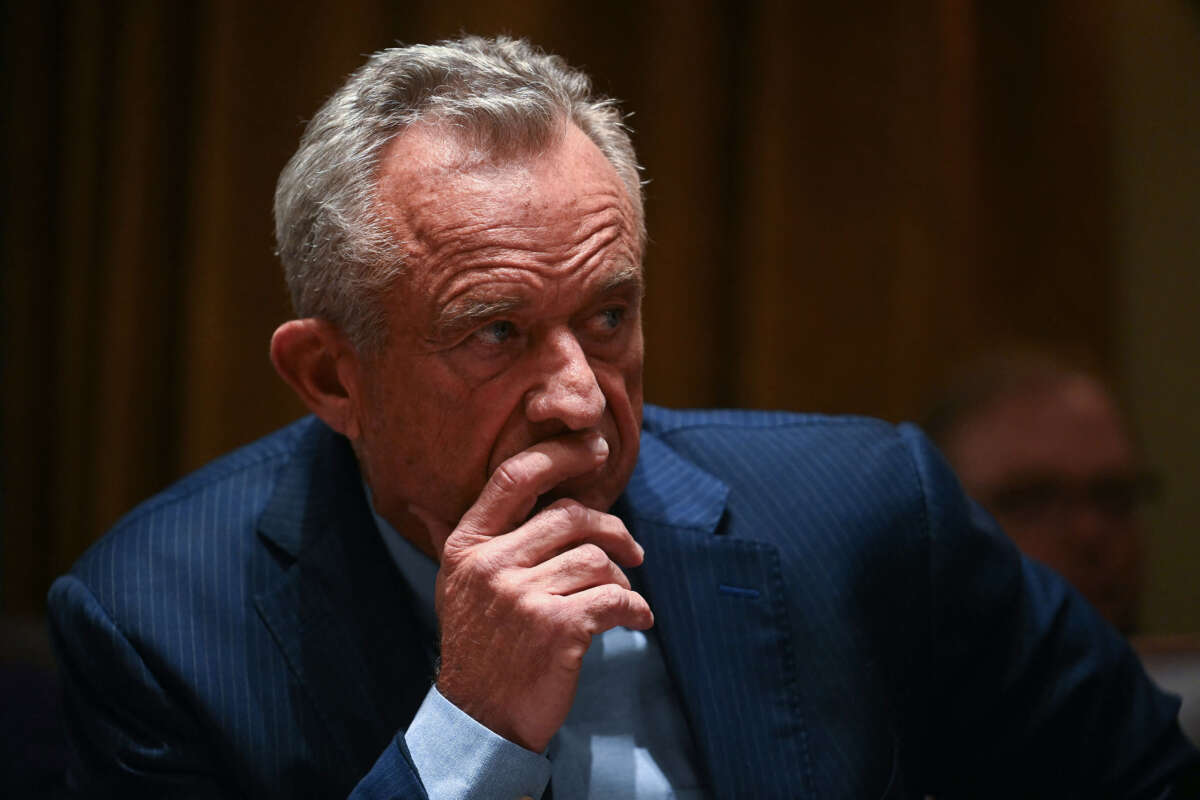
Secretary of Health and Human Services nominee Robert F. Kennedy Jr. listens as President Donald Trump holds a cabinet meeting at the White House in Washington, D.C., on February 26, 2025.Jim Watson / AFP via Getty Images


Truthout is an indispensable resource for activists, movement leaders and workers everywhere. Please make this work possible with a quick donation.

Health and Human Services Secretary Robert F. Kennedy Jr. announced a new policy on Friday that ends over 50 years of public involvement in the department’s rulemaking process by eliminating public comments in certain cases.

Under this policy, the department is no longer required to hold a public notice-and-comment period after publishing proposed rules on matters “relating to agency management or personnel or to public property, loans, grants, benefits, or contracts.”

Advocates say that public comment during rulemaking is vital because it allows stakeholders like medical professionals, advocacy groups, and individuals impacted by the rules to bring evidence, voice concerns, and shape policies directly affecting them. By removing public comments, HHS may be able to enact regulations disproportionately impacting some communities without meaningful engagement of those most adversely affected.

“For decades HHS policies affecting public health and research institutions have benefitted from public stakeholder participation in the policy process. Public input is an essential element of the policy process that reflects our nation’s democratic principles,” Matt Owens, president of the Council on Governmental Relations, told CBS News.

Kennedy had previously pledged that under his command, HHS would be committed to “radical transparency,” but critics argue that rescinding public comment opportunities contradicts this commitment and undermines the original intent of the Administrative Procedure Act (APA).

“My impression of the rule is that [Kennedy is]… trying to insulate himself from accountability,” Lawrence Gostin, faculty director of O’Neill Institute for National & Global Health Law at the Georgetown University Law Center, told The Hill.

Kennedy’s policy shift overturns the department’s 1971 “policy on Public Participation in Rule Making,” commonly referred to as the “Richardson Waiver.” In the original waiver, then-Assistant Secretary for Administration Rodney H. Brady emphasized that the department’s decision to adhere to the notice-and-comment process, despite being exempt, “should result in greater participation by the public in the formulation of this Department’s rules and regulations.”

“The public benefit from such participation should outweigh any administrative inconvenience or delay which may result from use of the APA procedures in the five exempt categories,” Brady continued.

However, Kennedy’s policy shift marks a significant departure from this long-standing approach. “Effective immediately, the Richardson Waiver is rescinded and is no longer the policy of the Department,” Kennedy’s statement says.

Jeff Davis, health policy director for McDermott+ Consulting, told Fierce Healthcare that Kennedy’s policy may infringe on the Supreme Court’s 2019 Azar v. Allina Health Services, which held that, in certain situations, HHS must follow notice-and-comment rulemaking procedures even where the APA does not mandate them explicitly.

The move to cancel public comment periods follows closely on the heels of HHS postponing a vital vaccine committee meeting for the Centers for Disease Control and Prevention, explaining that the delay was meant to “accommodate public comment in advance of the meeting.”

This pattern of limiting public input extends beyond vaccine policy, reaching into broader funding decisions within HHS. For example, last month, a coalition of National Institutes of Health (NIH) grantees sued HHS after the agency drastically reduced funding for research overhead and administrative expenses without offering a public comment period.

While Kennedy’s policy is likely attempting to render this lawsuit moot, Axios has said that its impacts will likely be far broader than NIH contracts and could make it easier for Kennedy to fast-track other types of controversial policy proposals. For instance, last month President Donald Trump signed an executive order requiring a review of treatment involving antidepressants, antipsychotics, and obesity medication for children, claiming that those medications posed a “threat” to adolescents. Since being confirmed, Kennedy has also pledged to investigate abortion pills, reversed HHS guidance on gender-affirming care, and targeted transgender people.
‘We will endure’: Mexican truckers stoic in face of Trump tariffs


By  AFP
March 4, 2025


Trucks queue near the Mexico-US border - Copyright AFP Guillermo Arias

Alexander Martinez

Stuck in a queue at the Mexican-US border, truck driver Juan Diego Mendoza said he was worried about the fallout of President Donald Trump’s tariffs, but believed Mexicans were resilient enough to cope.

“We’re economically strong and self-sufficient. Unlike them, we’re not looking for the car of the year or the best cut of meat. We’re happy with a plate of beans and an egg,” the 31-year-old told AFP.

Mendoza woke earlier than usual to hear Mexican President Claudia Sheinbaum’s response to Trump’s 25-percent tariff.

He supported her decision to wait until Sunday before laying out retaliatory measures, while leaving the door wide open for dialogue.

“The president is handling it intelligently, without getting excited or letting herself be provoked by the arrogance of Trump, who thinks he owns the world,” Mendoza said, at a crossing between Tijuana and San Diego.

The tariff “will have an impact, but we will endure,” he said, warming up the engine of the truck in which he brings meat from the United States to Mexico.

Mendoza is already feeling the impact of the trade tensions, which Trump has linked to drug trafficking and illegal migration.

Due to increased security ordered by Sheinbaum, he and thousands of other truck drivers take up to five hours to cross the border, where vehicles undergo X-rays for contraband.


– Longer waiting times –


Sheinbaum announced the deployment of 10,000 more troops to the frontier in February in exchange for Trump delaying tariffs.

But the pause expired on Tuesday, and longer waiting times due to increased security at the border have led to fewer trips and reduced profits for some haulage companies.

Even before tariffs took effect, 28-year-old truck driver Angel Cervantes said he was feeling the squeeze from duties Trump imposed on China.

There was less work available because many companies in Tijuana export Chinese brand goods, he said, adding that his company lost one client who sold air conditioners.

Cervantes said his income had dropped from about $800 a week to $600, making it harder to support his wife and two children.

But he was confident that Mexico’s free trade agreement with the United States and Canada would survive.

Truck driver Jonathan Figueroa, 26, said that he lost his previous job when a big client of his former employer decided to move its solar panel plant from Mexico to the United States.

“My boss had told me that if Donald Trump won the presidency, the company we supplied would be taken to New Mexico. And so it was,” said the 26-year-old, who was unemployed for four months.

As well as truckers, the tariffs have triggered unease among the many workers in the factories in Mexico’s industrial border zones.

After finishing her 12-hour shift at a car speaker plant, Maria Virginia Gutierrez admitted that she was worried, especially since the factory passed from American hands to a Chinese investor at the start of the year.

Although many in Tijuana fear tariffs will bring pain, there is also a sense that Mexico must maintain its pride and self-respect in the face of Trump’s threats.

“We have to defend ourselves,” Mendoza said.
Mexican Communities in US Rise in Protest Against Trump’s Deportation Threats


You won’t have seen them on the news, but widespread demonstrations are taking place in barrios on the urban fringe.

March 3, 2025

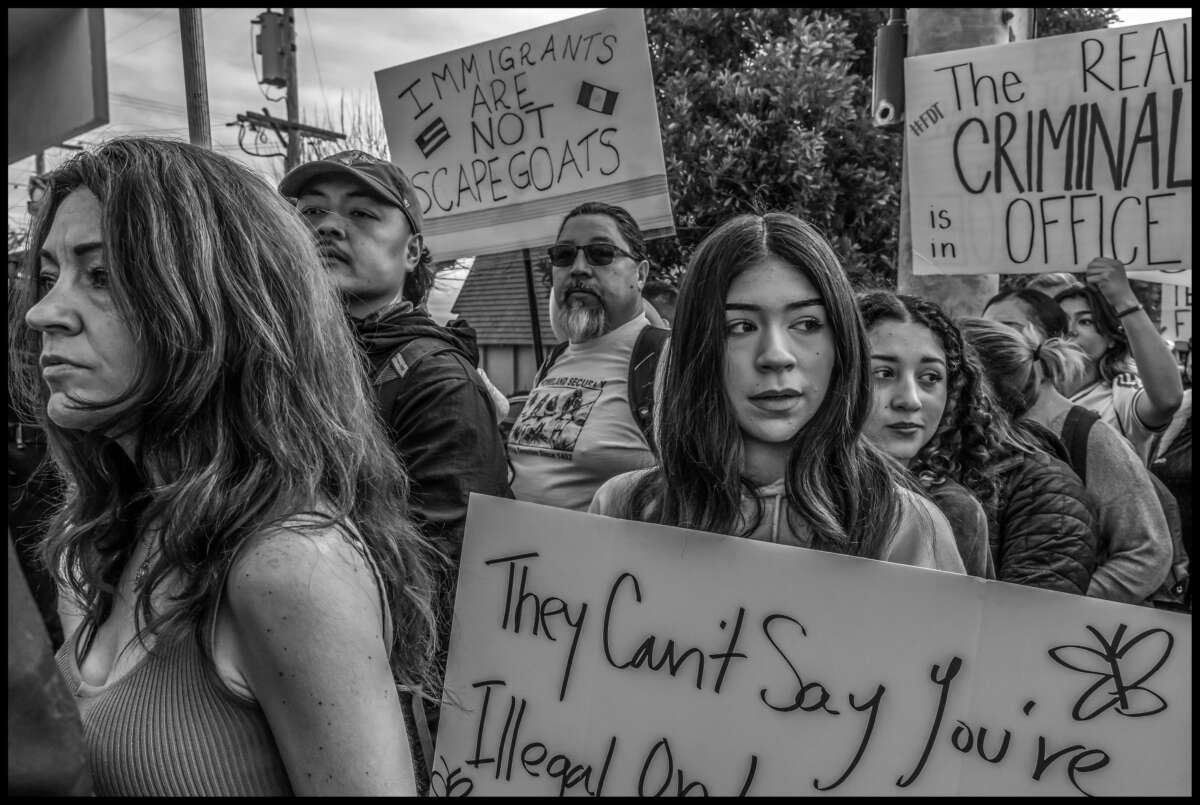
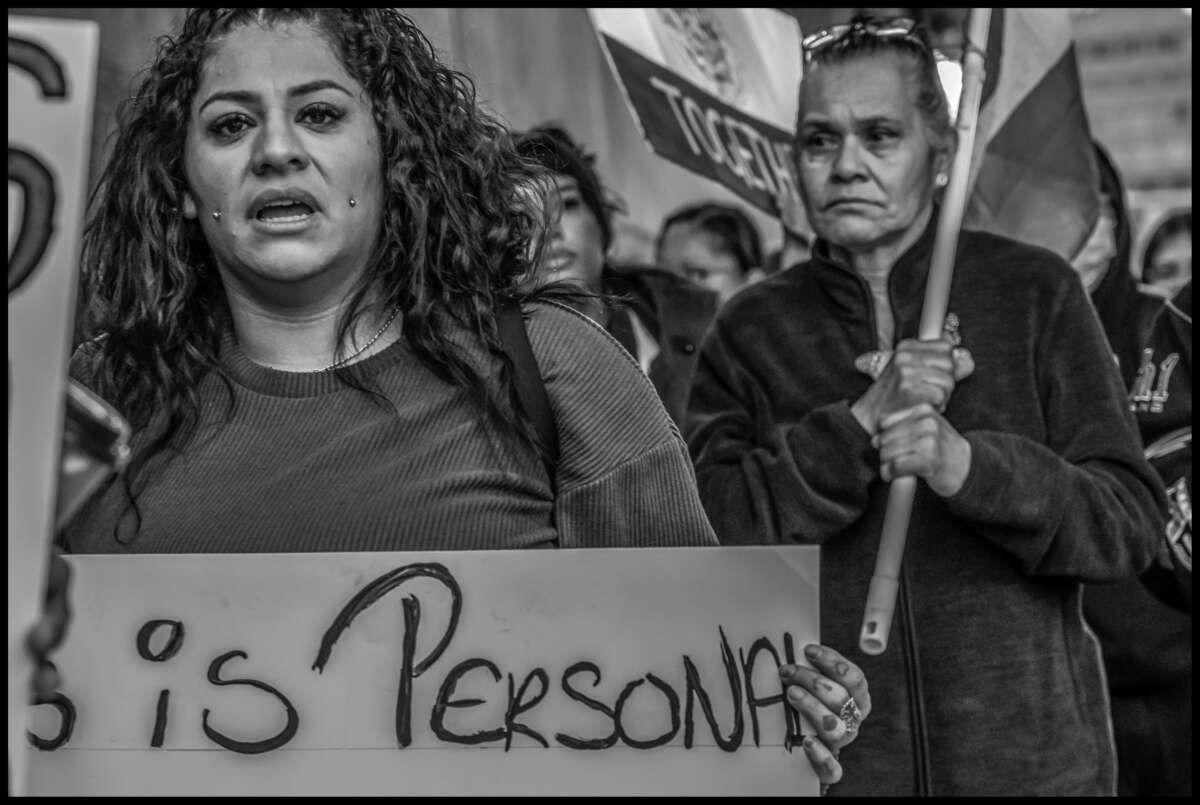
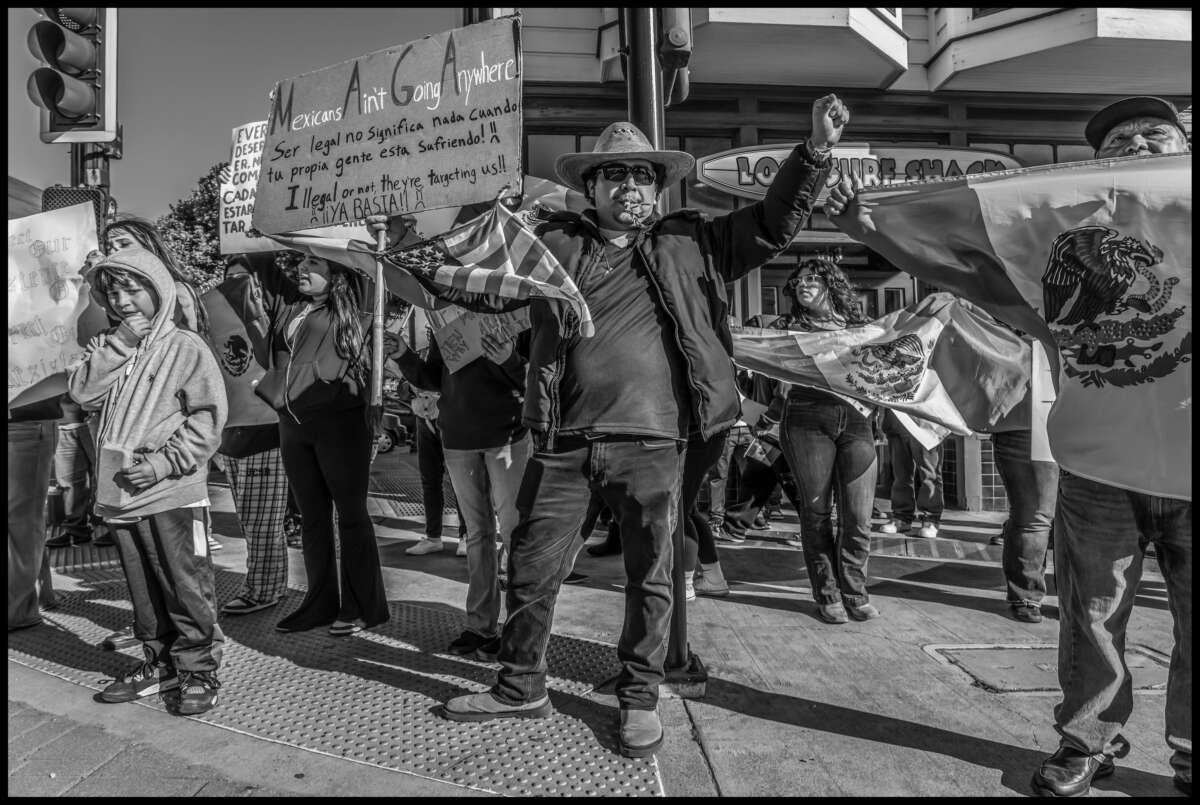
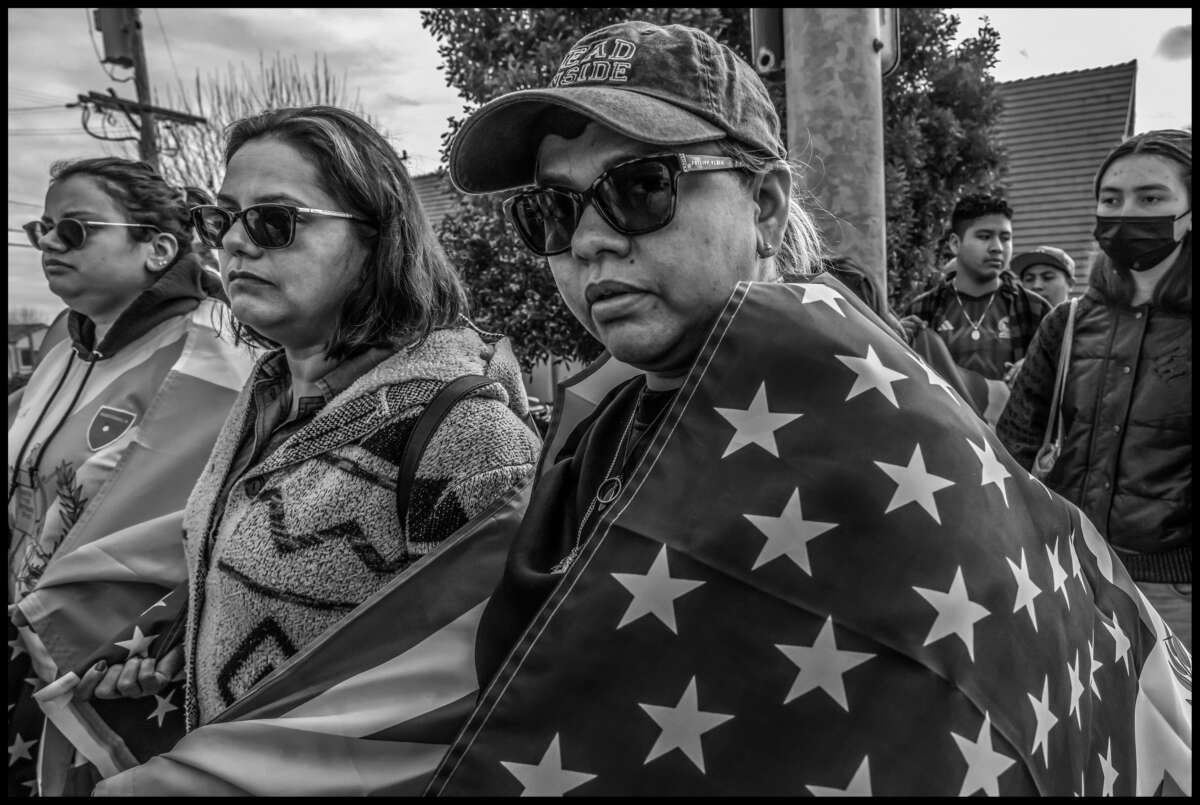
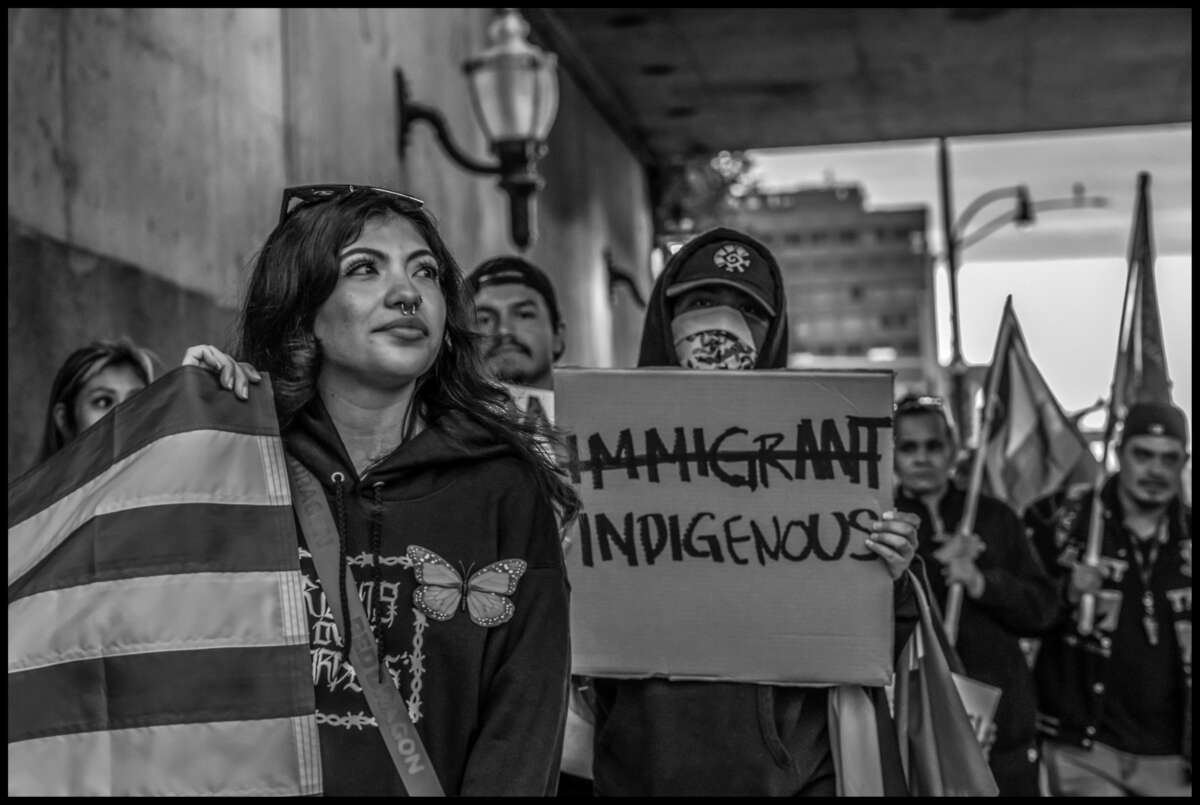
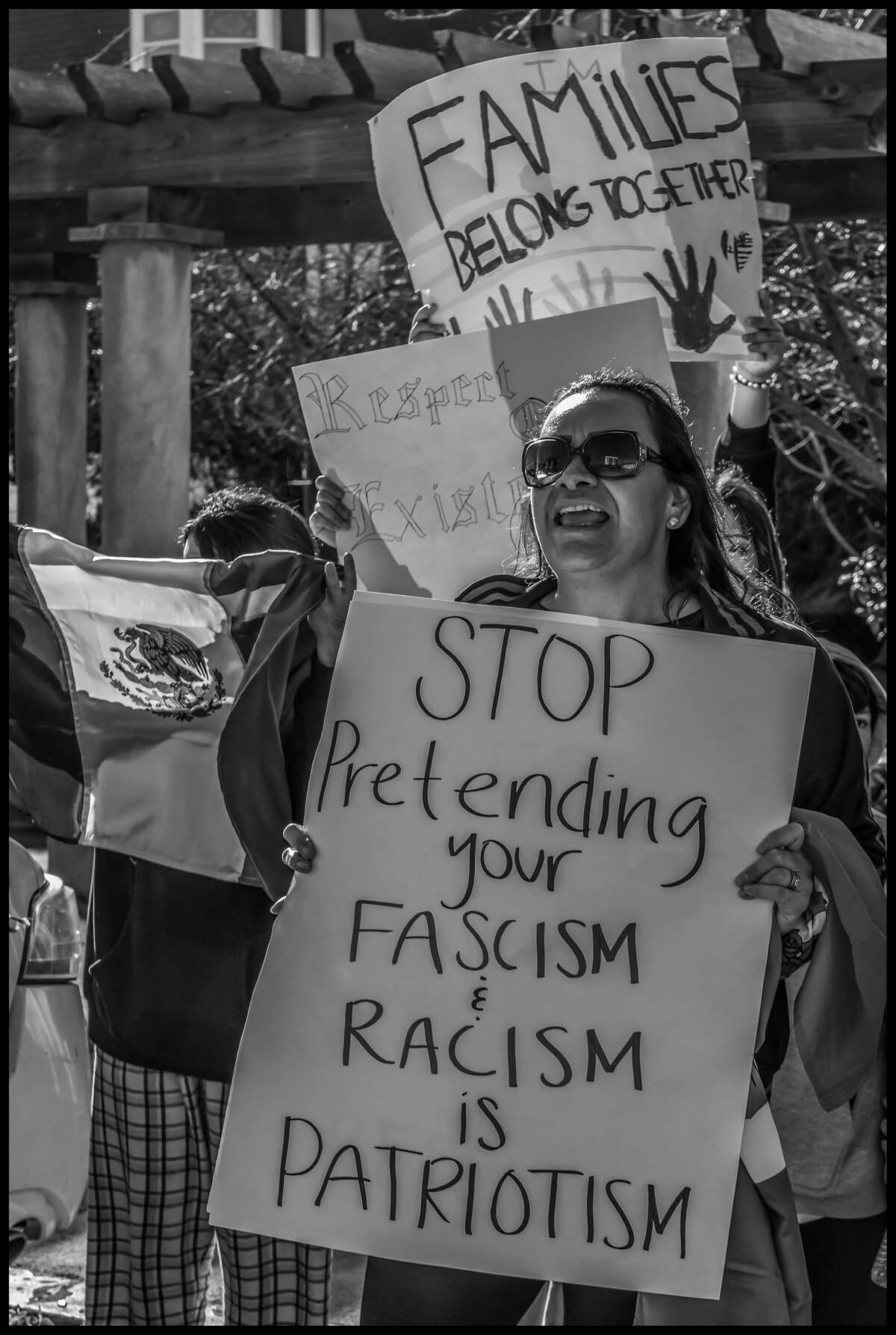
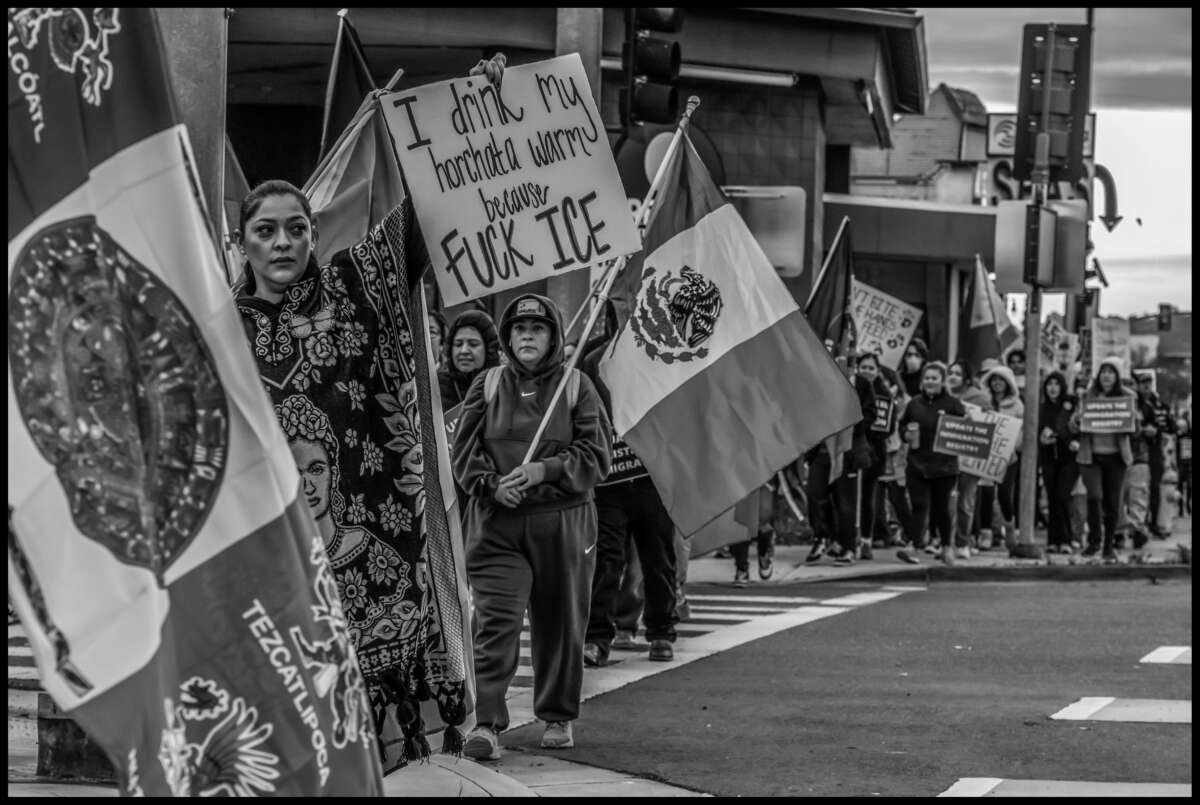
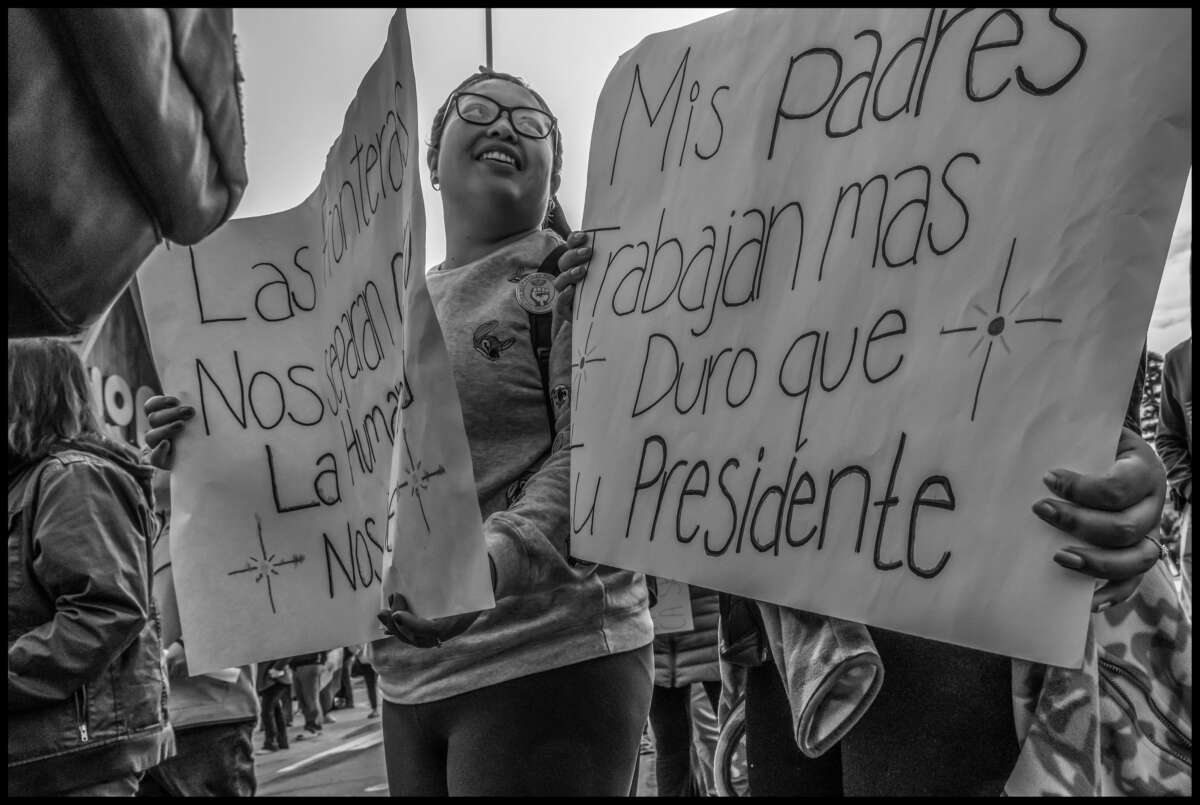
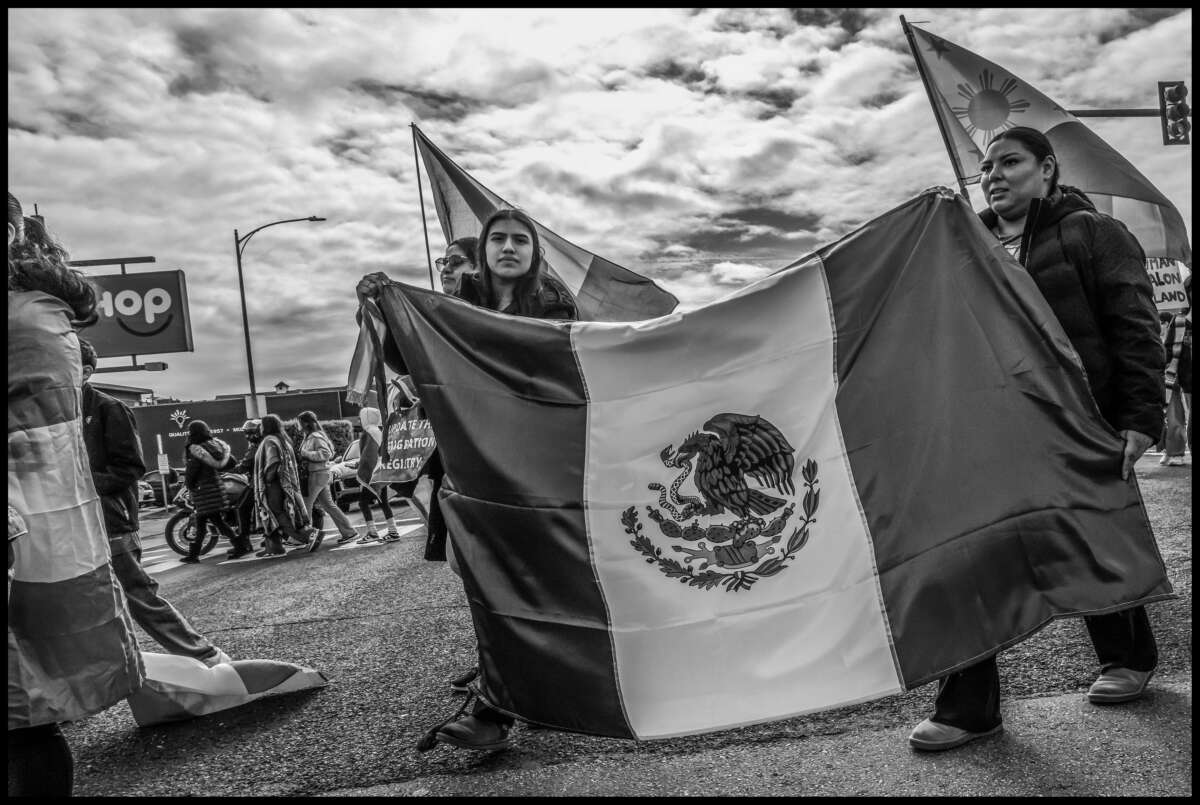
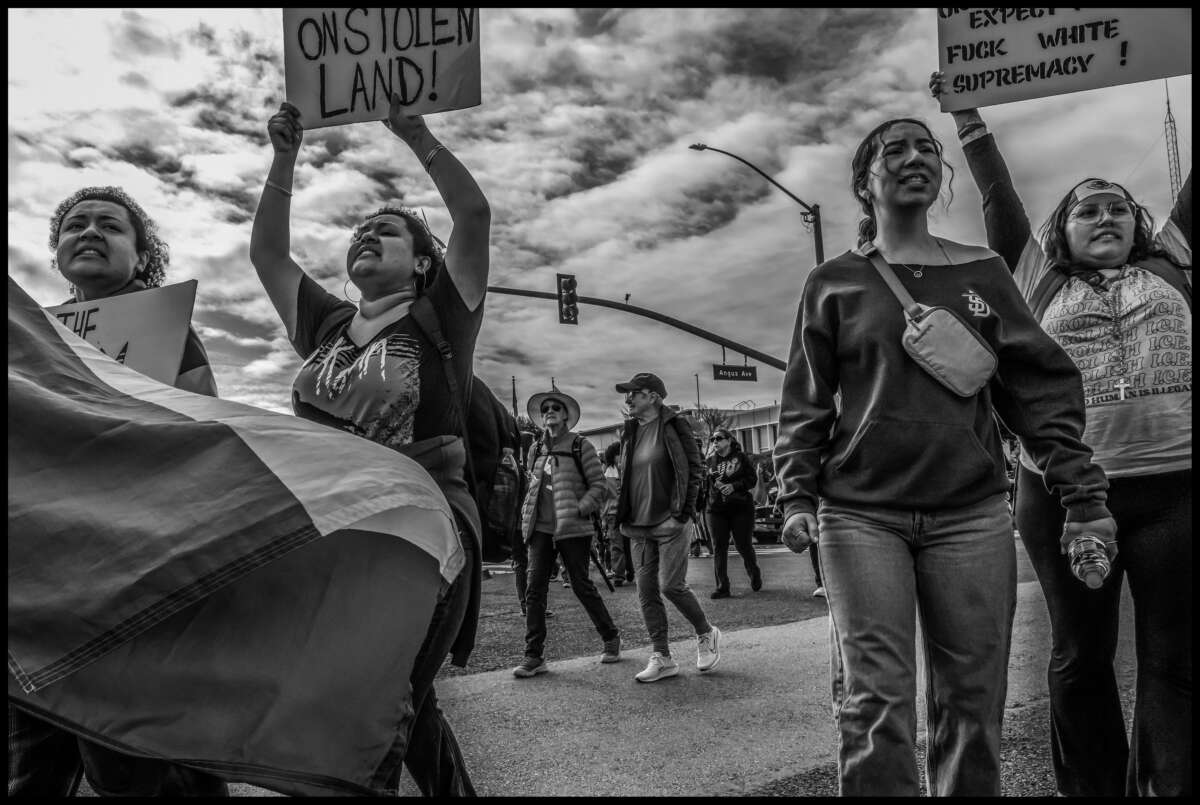
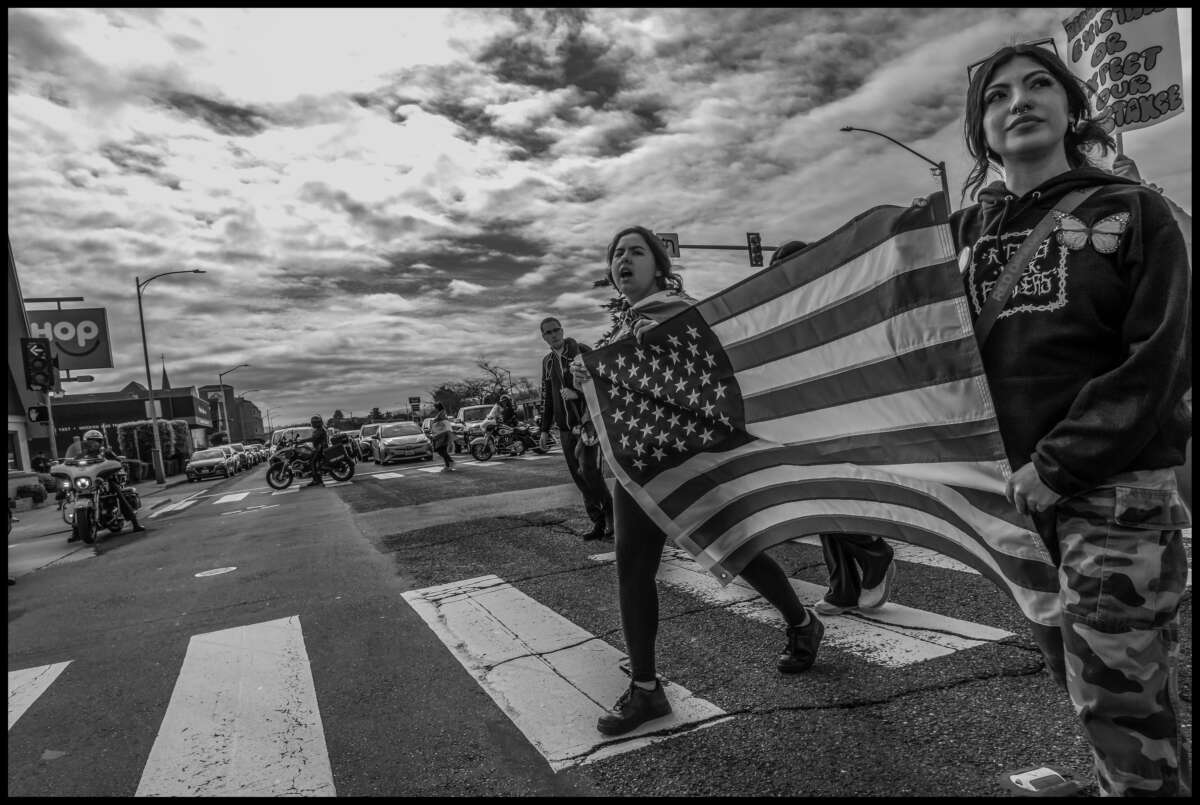
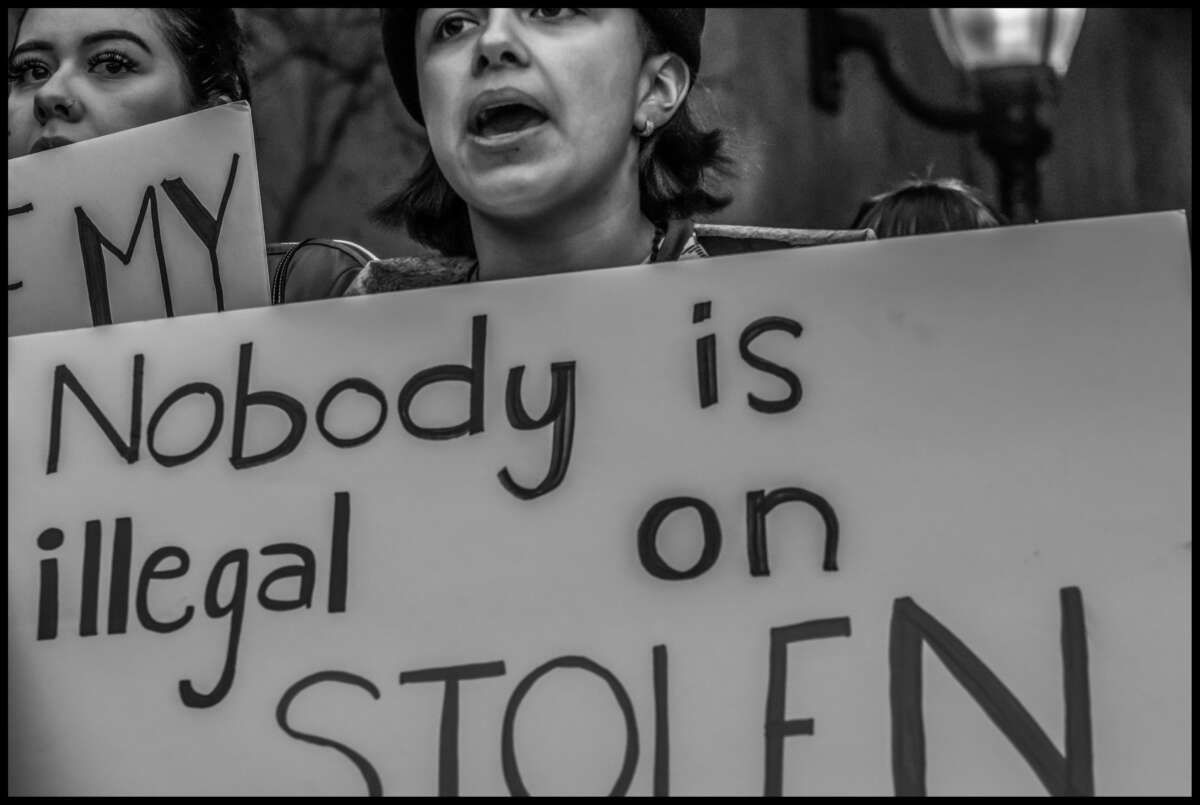
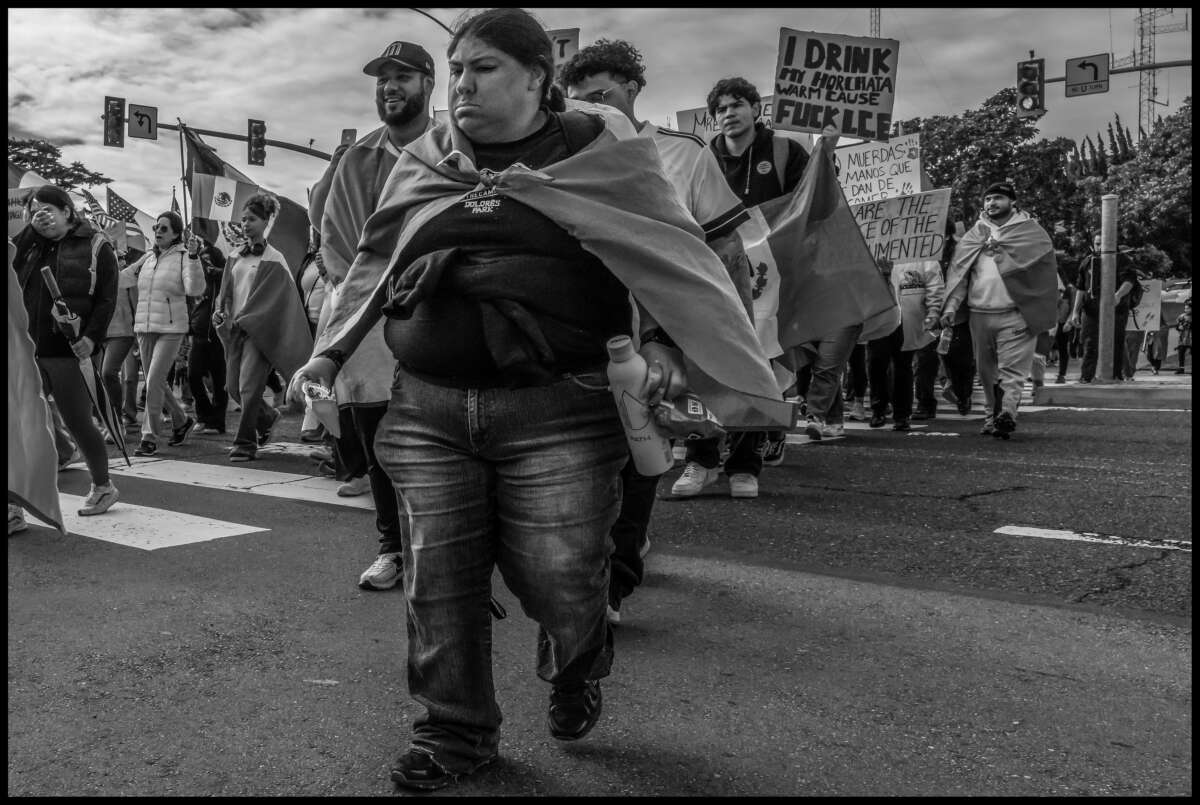
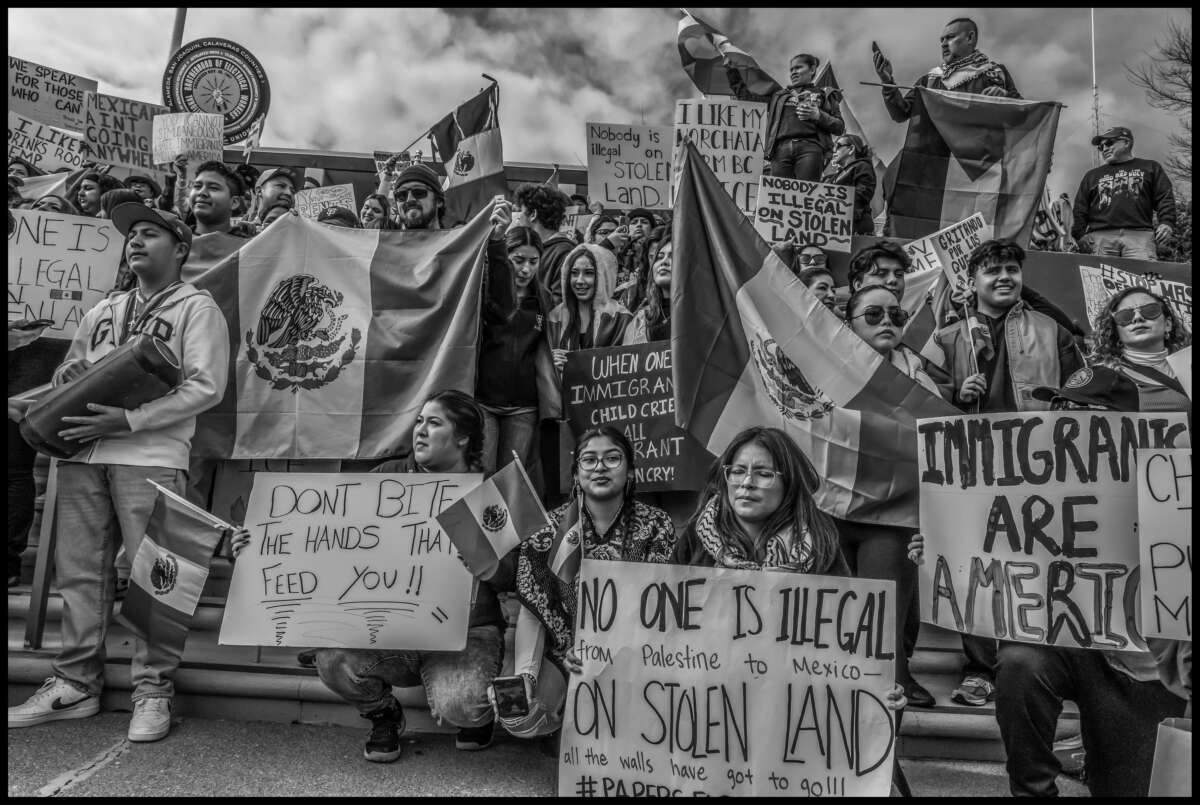
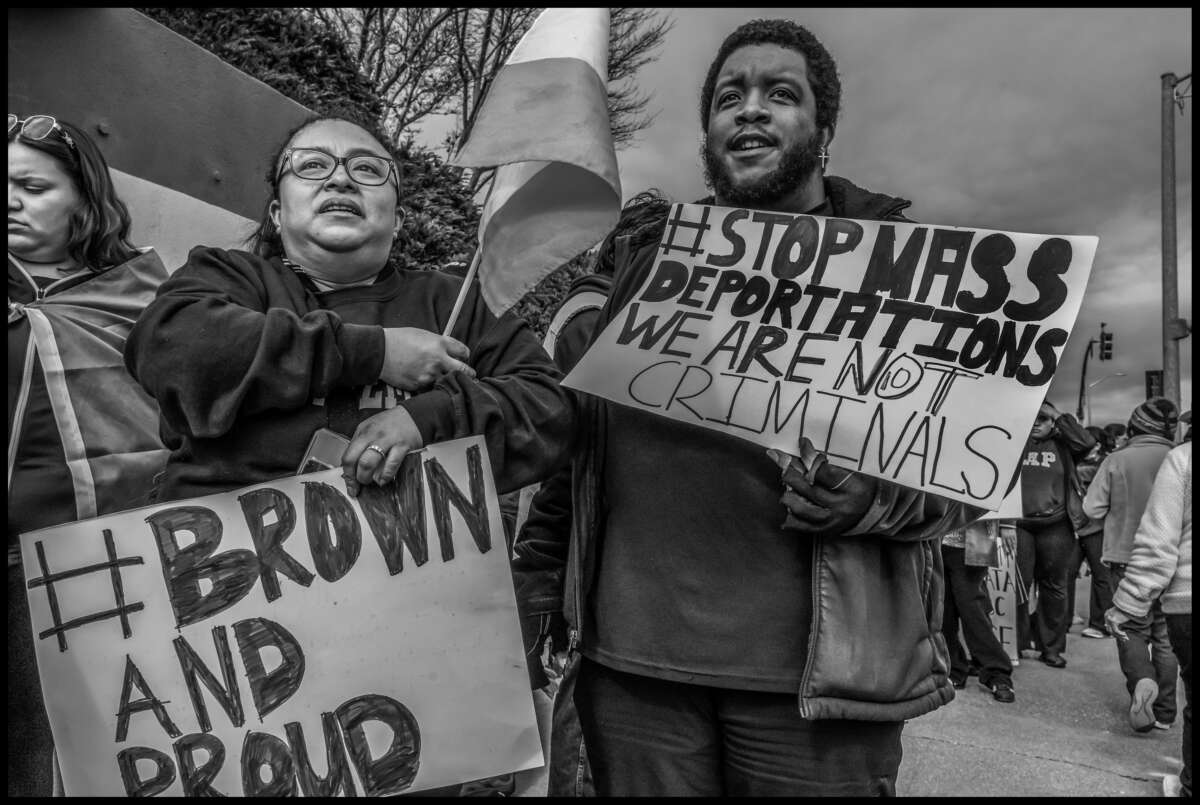
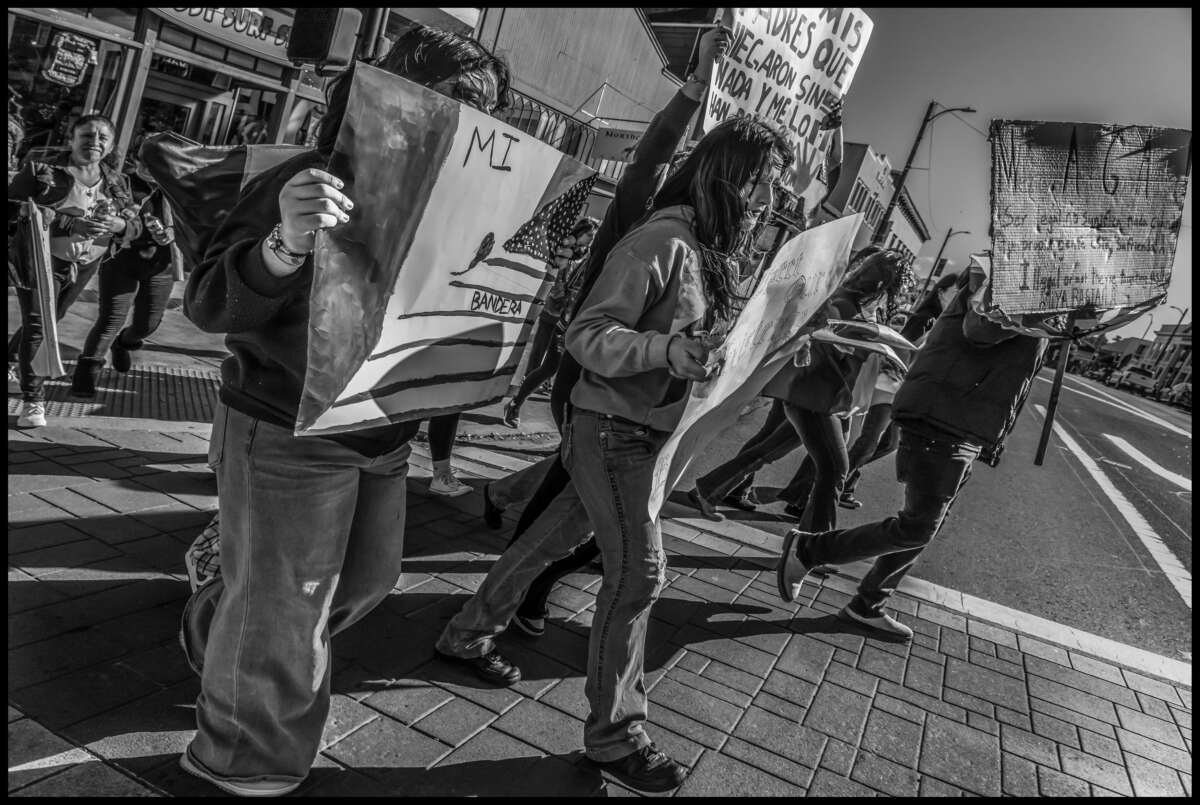
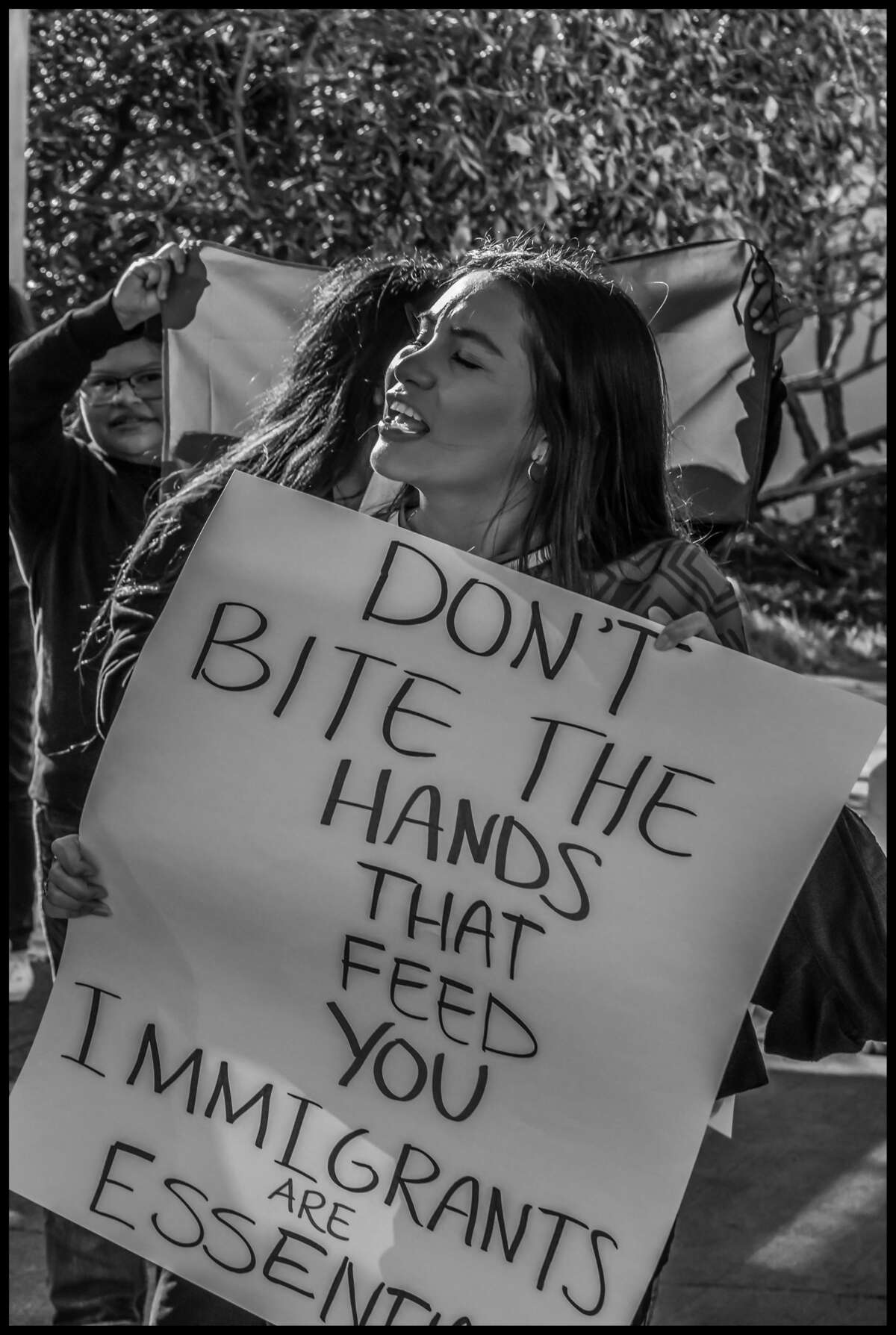
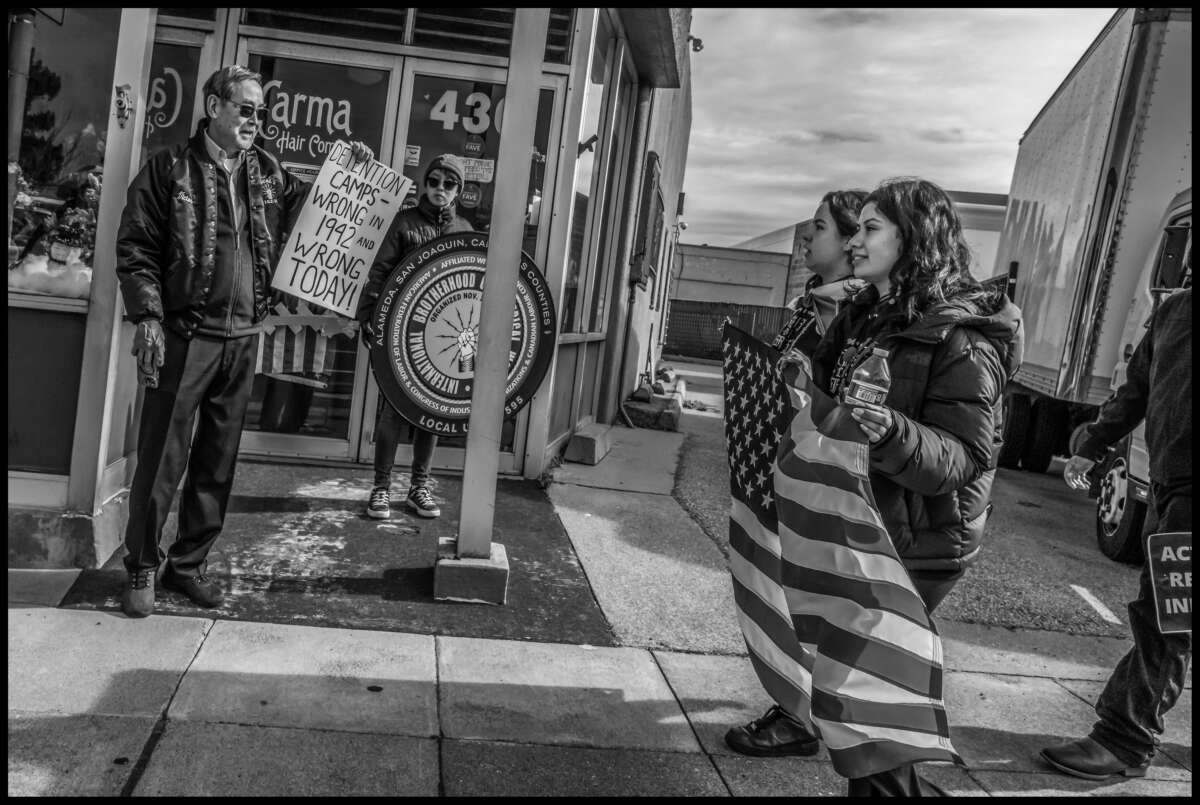
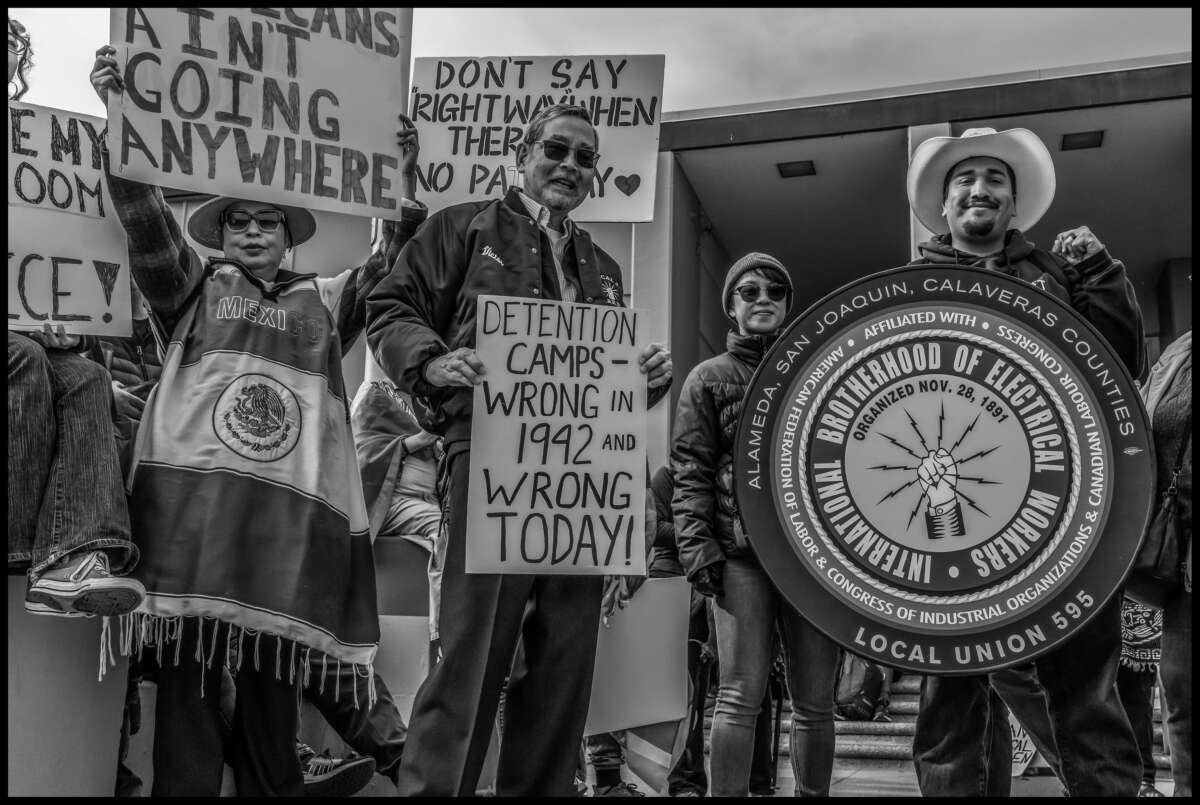
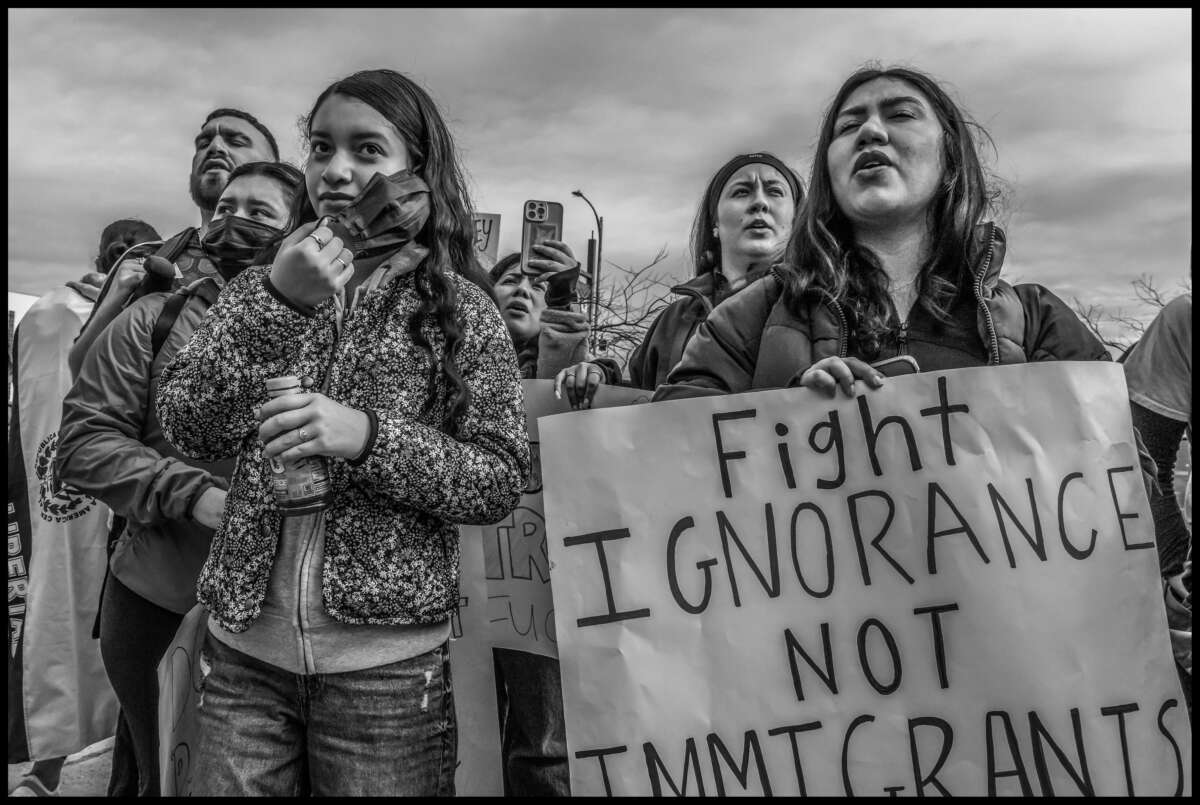
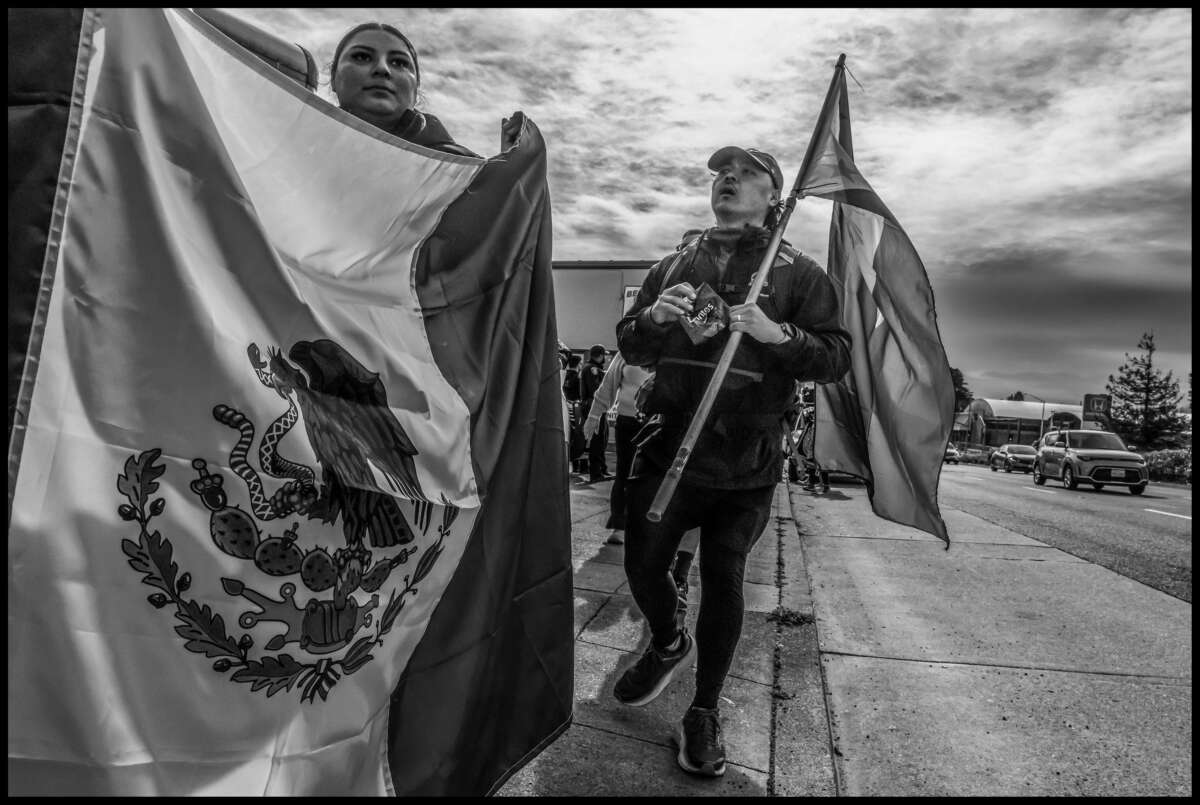
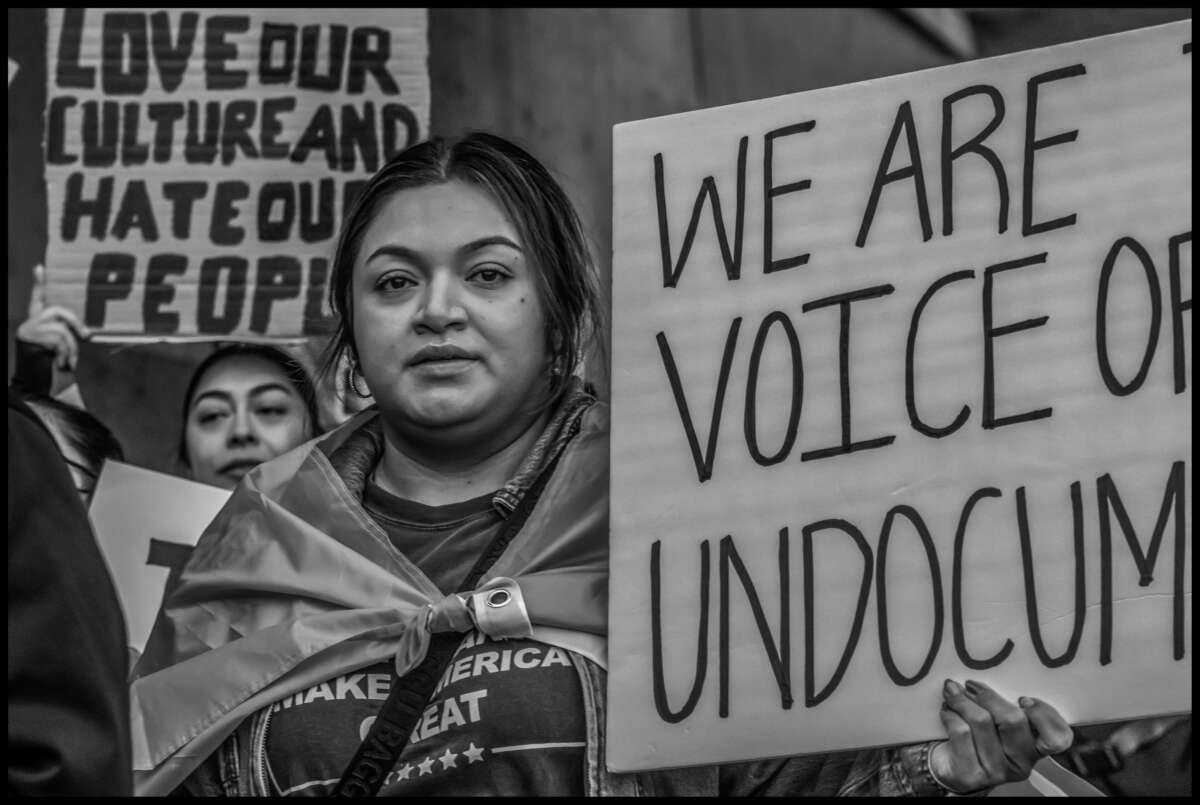
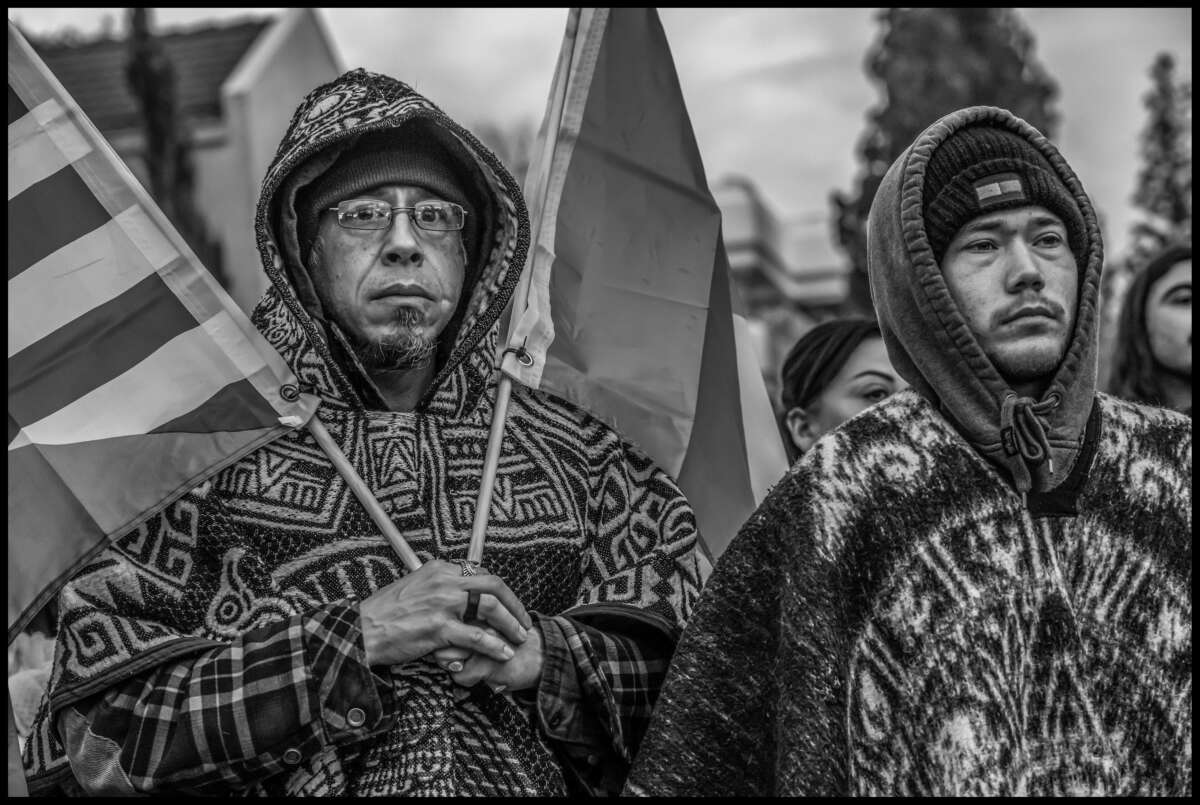
These photos capture protests against ICE and Trump’s threats of mass deportation in February 2025, in San Mateo and Fort Bragg, California.

David Bacon
Photo Essay |

It’s been over a month since Donald Trump took power, after running a campaign soaked in anti-immigrant tirades and threats of mass deportation. The media have concentrated on these threats, but even progressive outlets paid little attention to the responses of the communities threatened. Yet marches and demonstrations have been widespread in Mexican communities.

These protests often take place not in urban centers, which typically receive more media attention, but in the Mexican barrios of the urban fringe. San Mateo is one — on the San Francisco Peninsula south of the city. Fort Bragg is another — a former mill and fishing town three hours north of San Francisco, where Mexican children are a majority in the small city’s schools.

These are not the polite petitions of victims pleading for a softer repression. They are angry protests — people are out in the streets, not cowering behind closed doors. They carry signs with denunciations that declare “MAGA: Mexicans Ain’t Going Anywhere!” or “I drink my horchata warm because Fuck ICE!”

Young Mexican women — some born here, some who came as children, and others who just arrived — carry U.S. flags, not out of false patriotism, but demanding recognition as an essential part of the nation, belonging to this country’s fabric. The many, many Mexican flags have important meaning. They speak of pride in Mexico as a country with a progressive government, in contrast to our reactionary one. They demand that the Mexican presence in this country be recognized as well, with rights and respect for Mexican people.

Not all the flags are Mexican or U.S., Hondurans carry their own, as do Salvadorans and Guatemalans. Some marchers wave the Philippines’ flag with a similar message — recognition for a community with centuries of history, going back to the imperial war that made their homeland a U.S. colony and beyond.

Related Story   

Trump Wants Us to Fear ICE — Our Resistance Must Spread Solidarity, Not Panic
ICE arrived in unmarked vehicles to snatch our neighbors. Here’s how a North Carolina community organized in response. By Lewis Raven Wallace , Truthout  February 21, 2025


These marches with their flags and signs are harbingers of change. They’re not yet as large as the protests that took place in 2006, with its millions in the streets. But they are growing. They are overwhelmingly organized and led by young people and women, and they deserve recognition.

The benefit of organized resistance goes beyond fighting immigration raids. The movements of immigrant workers, their families and their communities have historically fought for deeper social change, beyond deportation defense. They’ve shown great persistence and strategic vision, as they fought threats of deportation while imagining a future of greater equality, working-class rights and social solidarity. That vision is as necessary to defeating repression as action in the streets.

In the flow of people crossing the border, “we see our families and coworkers, while this system only sees money,” says Rene Saucedo, an organizer for the Northern California Coalition for Just Immigration Reform, a grassroots immigrant rights organization that has organized marches and demonstrations supporting the Registry Bill. “So we have to fight for what we really need, and not just what we don’t want.” Marchers carried signs promoting an alternative to deportation, the Registry Bill, HR 1511. This proposal would open legal status to an estimated 8 million people by allowing undocumented immigrants to apply for legal permanent residence. Some of the anti-deportation marchers were veterans of earlier marches last year and the year before, demanding the passage of this bill.

Stepping out is the precondition for mobilizing the support of a broader progressive community behind these protests. The photographs here can’t possibly encompass all the marches or show every aspect of them. Their purpose is to make visible the crucial role of the Mexican community in inspiring a fightback to Trump fascism across the board. They show who’s out there organizing and leading it. Their picket signs and flags graphically present their demands.

Because the new Trump regime is seizing databases previously not under federal control, and has sophisticated tools to track those it targets, there are no individual captions for these photographs and no naming of the individuals in them. They were taken in February 2025 in San Mateo and Fort Bragg, California.


This article is licensed under Creative Commons (CC BY-NC-ND 4.0), and you are free to share and republish under the terms of the license.

David Bacon  is a writer and photographer, and former union organizer. He is the author of several books on labor, migration and the global economy, including In the Fields of the North / En los campos del norte, The Children of NAFTA, Communities Without Borders, Illegal People and The Right to Stay Home. His photographs and stories can be found at here and here.