Thursday, March 20, 2025

How Russia Could Leverage a Ceasefire Against Ukraine


 March 20, 2025

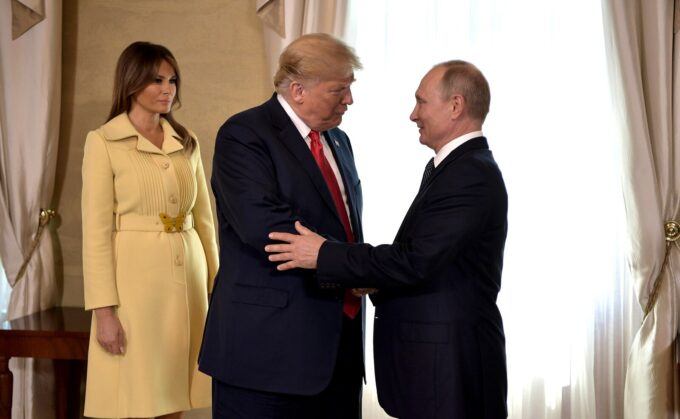
Photograph Source: Russian Presidential Executive Office – CC BY 4.0

Russian President Vladimir Putin is once again playing a calculated game with the proposed ceasefire deal. Putin’s response has been predictably shrewd. He has not outright rejected the proposal, but his conditions—a Ukrainian renunciation of NATO ambitions and territorial concessions—make any deal rather tricky.

However, one thing is certain. If a ceasefire does materialize, it will not be on terms favorable to Kyiv. Rather, it will serve as a tool for Putin to secure long-term strategic advantages.

The Russian military has suffered significant losses, and a month-long pause could allow the Kremlin to replenish supplies, redeploy troops, and reinforce occupied territories. A ceasefire could serve as a tactical breather rather than a genuine step toward peace. Putin understands that Western support for Ukraine is not infinite. By agreeing to a temporary cessation of hostilities, he can test the resolve of Kyiv’s backers and potentially create fissures in the coalition supporting Ukraine. European nations, fatigued by war and economic strain, may be more inclined to push Ukraine into concessions after a period of reduced conflict.

Russia can also use the ceasefire as a diplomatic weapon. By signaling a willingness to engage in talks while simultaneously setting impossible conditions, Putin could paint himself as the reasonable actor while framing Ukraine and the West as obstructing peace. This would play well in the Global South, where Moscow has already made inroads through energy and security partnerships.

Finally, with Trump unlikely to unconditionally support Ukraine, Putin sees an opportunity to force Ukrainian leader Volodymyr Zelensky into a corner. Trump’s approach to Ukraine has been transactional at best. Reports suggest that Trump’s team has been squeezing Zelensky on a potential rare mineral deal, a clear indication that Kyiv cannot expect unwavering support from Washington. The recent pause in military support and intelligence-sharing was also a sign of U.S. fickleness. Without strong American backing, Zelensky may face increasing pressure to make painful compromises.

Although Trump has voiced support for a ceasefire, his dealings with Putin suggest that he is far less interested in extracting serious concessions from Moscow than he is in pressuring Ukraine. During his recent meeting with Zelensky, Trump’s tone was more demanding than supportive. At the same time, Putin has been careful not to alienate Trump.

This puts Zelensky in a precarious position. Ukraine could be forced to negotiate from a weaker stance, particularly on territorial issues. Despite Ukraine’s refusal to formally cede land, a de facto recognition of Russian control over certain regions could become an unavoidable reality. Furthermore, the rare mineral deal that Trump’s allies are pushing has broader implications. If the United States sees strategic economic benefit in working with Ukraine’s mineral sector, but only under certain conditions, then Zelensky’s negotiating power in any ceasefire deal could be further eroded. Putin, always adept at reading geopolitical currents, will see this as an opening to demand even more concessions.

Putin’s long-term vision remains unchanged: he seeks to weaken Ukraine as a sovereign state, drive a wedge between Western allies, and solidify Russia’s geopolitical position. If Moscow ultimately backs a ceasefire deal, it won’t be out of a genuine interest in genuine peace but because it serves Russian interests. A ceasefire with Russian forces still in control of occupied areas  will effectively cement Moscow’s hold on those territories, making it harder for Ukraine to reclaim them diplomatically or militarily in the future. The longer the conflict drags on, the more divided the West could become and the less support Ukraine can expect from its allies. If the ceasefire fails due to Russia’s demands, Putin can blame the West for refusing to make peace. This is particularly useful for bolstering Russian narratives internationally, particularly among nations that are ambivalent about the conflict. And if Trump continues to distance himself from Ukraine, other global powers such as China and India may deepen their economic and strategic ties with Russia, further insulating Moscow from Western pressure and sanctions.

The UK’s Kier Starmer, France’s Emmanuel Macron, and other Western leaders are pushing for a durable peace. Putin’s track record, however, suggests that he is merely buying time for his next move while looking for ways to exploit any fractures in Western resolve. He  is playing the long game. The real question is whether the West is prepared to counter him with equal determination over the long term, or whether Ukraine will be left to fend for itself in the face of Russian pressure and shifting U.S. priorities.

This first appeared on FPIF.

Imran Khalid is a geostrategic analyst and columnist on international affairs. His work has been widely published by prestigious international news organizations and publications.


Negotiations with Putin: Are We Falling into the Appeasement Trap Again?


Is the West facing a new Munich 1938, when Hitler was appeased? Why the anti-diplomatic narrative is still pervasive – even though it is false.

March 19, 2025


Donald Trump met with Vladimir Putin during the G20 Japan Summit Friday, June 28, 2019, in Osaka, Japan. (Official White House Photo by Shealah Craighead)


While the US has initiated preliminary negotiations between Ukraine and Russia, there are again warnings in Europe and the US that this could lead into the appeasement trap once again — as it did when Hitler was able to wrap the major powers around his finger.
The Munich Agreement 1938

Critics who strictly reject any diplomacy with Moscow and demand “no compromises” point to the Munich Agreement of 1938 (by which the occupied Czechoslovakian Sudetenland was annexed by Germany) and the attempt by British Prime Minister Neville Chamberlain to appease Hitler by concessions in regards to rearmament and looking the other way at the “Heim-ins-Reich” annexation of Austria. The policy of allowing and negotiating had led to the invasion of Poland and the Second World War a year later.

This mistake must not be made again, it is said. A Vichy-like regime in Ukraine shouldn’t be allowed to unfold. Therefore, Russia has to be defeated militarily in Ukraine and negotiations with Moscow must be avoided in order not to encourage Vladimir Putin’s appetite for power by showing weakness.

Appeasement: A False Comparison

However, the reference to Munich 1938 and the appeasement strategy is wrong and misleading. Of course, the military triumph of German fascism could have been prevented if Great Britain and the United States had intervened forcefully, according to historians (although this is being debated), but they didn’t really had an interest in doing so at the time — Hitler was not yet persona non grata for the major powers, there was even a certain admiration for him.

But the situation in today’s Russia-Ukraine war, despite all the similarities that may exist at first glance, is quite different from that in Europe in the face of Nazi Germany in 1938.

Since 2014, the U.S. and the EU have massively armed Ukraine. They intervened in the conflict (and ultimately contributed to its creation by seeking to integrate Ukraine into NATO), supported a coup d’état and then installed and promoted pro-Western governments (as the leaked phone call of then Assistant Secretary of State Victoria Nuland underscores), while a civil war broke out in eastern Ukraine.

The Case of Cuba

The US would never accept something like this on its own border. One just has to look at the Cuban missile crisis of 1962, when the deployment of Soviet missiles almost led to a nuclear war. Or take the de facto US occupation of the Cuban port of Guantanamo (in the form of a lease forced under military occupation), including an illegal torture prison system.

No one in the West is upset about this or warns against the dangerous strategy of appeasing the US, which has been strangling Cuba with a relentless embargo and occupying part of its territory for decades, despite protests. In this case, as in many others, the international community, including the Europeans, relies on appeals and UN resolutions that Washington ignores.

Don’t Negotiate with War Criminals

Critics of diplomacy repeatedly point out that you shouldn’t negotiate with war criminals. They point to British war leader Winston Churchill, who advocated a hard line. In 1940, he told the British House of Commons: “An appeasement politician is someone who feeds a crocodile in the hope that it will eat him last.”

However, not negotiating with war criminals is an absurd doctrine — and full of double standards. You don’t have to go back to the colonial history of Europe and North America to understand the absurdity.

The history of US imperialism after 1945 will do. All US presidents are war criminals by conventional standards, as are those who have supported their criminal actions. Perhaps the world should therefore no longer talk to or negotiate with Western governments, because that is appeasement and encourages them to continue with their wrongdoings.
Diplomacy as the Best Way to Peace

But negotiating with war criminals is necessary to defuse conflicts and create peace when a military solution is not achievable and only makes things worse, while a compromise, even if it is unjust, can avert a greater evil. This has been and is constantly being done. After all, aggressors are at the center of conflict escalations.

Should the Palestinians no longer talk to the Netanyahu government because Israeli Prime Minister Benjamin Netanyahu is a war criminal against whom the International Criminal Court has issued an arrest warrant? Or should Israel no longer negotiate a ceasefire with Hamas because Hamas militias have attacked Israel?

Diplomacy is the best way to achieve peace, and that has to include the aggressors. So, as Branko Marcetic stresses, the Saudi government, an extremely repressive monarchy that regularly carries out mass executions and waged a brutal war against Yemen for many years, is negotiating about an end to the war there.

Putin Cannot Be Trusted

Finally, it is said that Putin cannot be trusted. But that is not necessary. All peace diplomacy begins with a lack of trust between the warring parties. Therefore, an important part of the talks is to establish appropriate security mechanisms and precautions that make mere trust in the other side unnecessary.

Unfortunately, the world is not perfect and is full of violence. Abstract moral absolutism (black vs. white) does not help here; we have to look carefully at each individual case, assess the history of the conflict and the grievances, and weigh the respective options in terms of their consequences.

The intention to do good (e.g. to eliminate an injustice), but in doing so to cause knowingly additional injustice and suffering, a greater evil and unacceptable risks for humanity, is by no means moral, but ultimately inhumane.
Ethics of Principle vs. Ethics of Responsibility

Russia’s attack on Ukraine is a serious war crime. Moscow has the unequivocal duty to end the war. And Ukraine has the right to defend itself militarily against occupation. So much for the principles.

But whether it is wise and morally justifiable to continue the proxy war on the Russian border with the aim of expelling Russian troops from Ukraine — and if there is no other way, also with NATO troops — and impose a victor’s peace on Moscow (with a copy of the Treaty of Versailles) is another question.

Delivering more and more and heavier weapons, even offering foreign troops, for a victory that is unattainable in the foreseeable future (it is essentially a war that cannot be won), with a lot of destruction involved, but not allowing talks, diplomacy or compromises: in view of the consequences and the alternatives, this is an unacceptable strategy and a recipe for a possible end of the world. However, it is still the prevailing way of thinking in European capitals and can also be found in the U.S. — even though the mindset is changing.

The consequences of escalating the war in Ukraine with the aim of defeating Russia are far-reaching and dramatic. Many experts and peace activists have warned against this course in Europe and the United States (including former US Secretary of State Henry Kissinger, who is not known for appeasement; see his genocidal order as national security adviser during the Vietnam War: “Anything that flies on everything that moves”).

The Fault of the West

Hundreds of thousands of dead and injured, massive destructions, many supply crises in the Global South and a constant escalation of the threat of nuclear war later, we are now in a mess, while the no-appeasement advocates continue to spread perseverance slogans and call in Europe for a historic militarization without a strategic concept, only that the US now wants a deal and London, Paris, Brussels and Berlin are panicking.

The fact is: war is madness, not its end in a viable diplomatic compromise. Russia bears responsibility for the war-related devastation in Ukraine, just as the US bears responsibility for its far worse devastations around the world. That goes without saying.

But the West and the US-led NATO also bear responsibility because they provoked the conflict and blocked every attempt to defuse it or possibly end the war. As long as they do this, they are not neutral observers and peacemakers, but actors who make everything even worse.

The West’s responsibility for the conflict is not a mere opinion, but the assessment of historians and many political intellectuals since the 1990s. One only has to listen to leading representatives of the US diplomatic corps, among them prominent US hardliners who know Russia very well, for example Jack Matlock, ambassador to Russia under Ronald Reagan, Robert Gates, Defense Secretary under Bush II or the CIA chief during the Biden administration, William Burns, who as ambassador to Russia from 2005 to 2008 cabled warnings to Washington about Moscow’s “red line” in Ukraine.


Ukraine War: So Much for Appeasement

As for the pacification of Ukraine, solutions could have been found early on. The US should never have put Russia under pressure by pushing ahead with NATO expansion into Ukraine and getting involved politically and militarily in the region in the first place.

Since the Russian invasion, a shadow war has been waged against Russia. Ukrainian forces were built up to a bulwark of the West. Today, Ukraine is the largest arms importer in the world.

So the war, supported by Western countries, has been fought in Ukraine against Russian troops for over ten years (including the civil war from 2014), with hundreds of thousands of deaths and injured. Unlike 1938, there has been hardly a sign of appeasement towards Russia, except of Minsk II. It has so far remained “only” a proxy war (i.e. no NATO and US troops fighting against Russians) for obvious reasons: Russia is a nuclear power.

Therefore, the comparison with Hitler and the appeasement policy of 1938 is not only historically relativizing and wrong (as far as the criminality of the Nazi regime, its ambition and its reach of power are concerned), but also ignores what has changed dramatically since 1938: Hitler did not have 5,580 nuclear warheads like Russia today.
Moral Blindness towards the Consequences

The same applies to the US: a Russian escalation in Iraq during the illegal US invasion and occupation would have been madness and an irresponsible risking of nuclear war for the same reason, not to mention the spiraling violence that would have resulted from it.

With each passing year the ongoing war will play into Russia’s hands — even if Ukraine is flooded with even more weapons — as military experts and Ukrainian commanders have been telling us for years. This was also confirmed after Kiev’s stalled spring offensive in 2023, as Ukraine cannot keep up with Russia demographically, economically and militarily, despite historic support from the West.

In the end, Ukraine could even face collapse; this scenario must also be weighed morally. Ultimately, continuing the war means an endless war of attrition with more and more deaths, maiming, general devastation and dangerous instability, which could lead to a (nuclear) world war at any time.

The Key Difference to 1938

This is the fundamental difference to 1938, when a lack of military determination paved the way for a world war, while today a lack of diplomatic resolve is opening the door to military annihilation and a possible world war with a nuclear “game over”.

There were and still are two options in the war in Ukraine: diplomacy or a possible Third World War. This has been hanging over our heads for over three years. The only way out of the misery is negotiations and compromises, with both sides having to be included in the process.

Whether Putin is serious and actually wants a solution (as he repeatedly has asserted) can only be found out by putting him to the test. This has now begun and is to be welcomed, even if Trump is wreaking havoc in other policy areas, pursuing his own geopolitical interests and wants to strengthen US dominance over China.

The Difficult Path to Peace

It will be a very difficult, complex and certainly lengthy process that could fail at any time — both sides must be willing to compromise. Without that, it will not work.

But if the Ukrainian side, supported by the Europeans, continues to boycott negotiations (which the US also did for a long time) by attaching unfulfillable conditions to the talks (Russia must withdraw completely from Ukraine, NATO troops in Ukraine, etc.) and ignoring the military situation, then Putin will probably continue the war because he has the upper hand.

Experts using various approaches and scenarios have developed realistic negotiating terms. There is also the Istanbul Communiqué of April 2022 to build on. None of this seems far-fetched or unattainable (even if ultimately unjust for Ukraine in terms of the territorial issue) if the will for peace appears more important than insisting on the unattainable.

“Betrayal of Ukraine”, New “Yalta Agreement”

We will see how the talks develop. One can only hope that there will be a ceasefire and then, more importantly, real negotiations that can permanently end the fighting through an agreement or at least freeze the conflict.

However, much of the public in Europe and the US remains heated. There is talk of a “betrayal of Ukraine” and a new “Yalta agreement”.

A comparison that is completely exaggerated: back then, at the end of the Second World War, a rigid strategic and ideological line was drawn right through Europe and Germany. A compromise peace in Ukraine will draw a line between a few provinces in eastern Ukraine, far from the western capitals in Europe, as Anatol Lieven of the Quincy Institute for Responsible Statecrafts says.

Eastern Ukraine Is Not the Sudetenland

It will be difficult, if the West continues to use Ukraine to weaken Russia, to build a NATO or whatever military bastion on Russia’s border and to ignore Moscow’s interests in finding a solution to conflict and war.

We should finally realize that eastern Ukraine is not the Sudetenland: otherwise, the fight for about 20 percent of Ukraine will keep paving the way for a possible Third World War.


ZNetwork is funded solely through the generosity of its readers.Donate


David Goeßmann is a journalist and author based in Berlin, Germany. He has worked for several media outlets including Spiegel Online, ARD, and ZDF. His articles have appeared on Truthout, Common Dreams, The Progressive, Progressive International, among others. In his books, he analyzes climate policies, global justice, and media bias.

Wednesday, March 19, 2025


‘Even silence is viewed as dissent’: An interview with Russian trade unionist Pavel Kudyukin


Published 

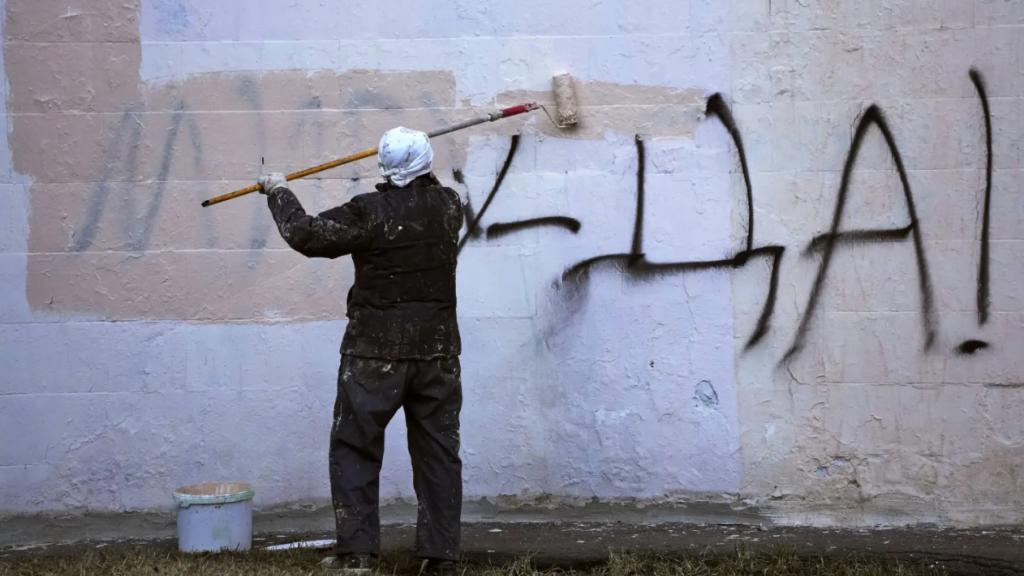
Painting over Yes to Peace

Pavel Kudyukin is co-chair of the University Solidarity trade union and a member of the Council of the Confederation of Labour of Russia (KTR). He also served as Russia’ deputy minister of labour (1991-93). In this extensive interview with Federico Fuentes and Serhii Shlyapnikov for LINKS International Journal of Socialist Renewal, Kudyukin talks about the situation of workers and trade unions in Russia and the territories it occupies, and the debate over whether to expel Russian unions from international bodies. Kudyukin also discusses the differing stances among Russian leftists towards Russia’s war on Ukraine, and the campaigns to free political prisoners held in Russian jails.

Could you describe the situation for workers today in Russia, three years after the start of Russia’s full-scale invasion of Ukraine?

It is important to note that a significant differentiation in wage levels has occurred. Salaries have mostly increased at military enterprises, given the need to attract workers to those jobs. Non-military enterprises facing greater competition for labour have also tried raising wages to attract workers, though not all have succeeded. But wages for a significant portion of workers are stagnating and falling behind price rises. Also, the gap between the average and the median wage — the one that divides earners into two equal halves — is widening.

I recently learned about one metallurgical plant in the Chelyabinsk region, where workers are very dissatisfied with their wage of 50-60 thousand rubles [US$580-600 a month]. While such wages might not seem terrible for the region, it far from matches the reported average wage growth.

In the public sector, wages are falling significantly behind. Funding for public-owned industries has either stagnated or declined in nominal and real terms. The so-called May Decrees of 2012, which sought to align wages in education, science, healthcare and culture with regional averages, are no longer being implemented.

Pensioners face a similar situation. Official indexation does not reflect nor compensate for the actual rise in consumer prices for pensioners’ basic needs. The prices of many essential food products, medicines and utilities — three primary expenses for retirees — are rising faster than overall inflation.

Is the war driving these price rises? Do workers see the connection between the two?

Inflation is being driven by rising prices in the military sector and industries closely tied to the military-industrial complex. However, most people do not associate inflation, which concerns them deeply, with the war. Even official public opinion surveys show that inflation is now the top concern for citizens. But for now, people tend to see it as a separate issue rather than a consequence of the war.

Does this mean that Russian President Vladimir Putin’s goal of keeping the population relatively indifferent to the war has been successful?

Currently, people either try not to think about the war or, to some extent, repeat official propaganda. Some believe that while the war may have been a mistake, now that it has started it must continue.

However, there is a growing sentiment — though difficult to measure precisely — among people that the war needs to end as soon as possible. These people do not necessarily care how it ends: whether through Ukraine’s capitulation or an abrupt declaration by the Russian leadership that all objectives have been achieved. They would likely greet any resolution with relief.

What has the war meant in terms of workers’ rights?

The war has been used to restrict labour rights at enterprises involved in the war effort. Most notably, restrictions on overtime work have been lifted. Legally, this is absurd, as the government decree contradicts the Labour Code, which sets specific limits on overtime. But this is something that happens in Russia: formally, the law takes precedence; but if needed, government decrees override laws.

Entrepreneurs, particularly those from the Russian Union of Industrialists and Entrepreneurs, are taking advantage of this. They are lobbying to raise the permissible amount of overtime work, citing labour shortages. Indeed, there is a labour shortage, though it is uneven across different economic sectors. But just because there is a labour shortage does not mean that any person can easily find a job — there is often a mismatch between people’s qualifications and what enterprises need.

That said, from a worker’s perspective, the current situation is somewhat favourable. Unemployment, as measured by ILO [International Labour Organization] methodology (which is more accurate than the official unemployment rate), is at a historic low. It is approaching what economic theory defines as “full employment,” which is when unemployment falls below 2–3%.

There was a wave of dismissals of workers for their anti-war views, especially in education and theatre. More than 100 people lost their jobs. Did trade unions help workers in these cases?

We tried to provide legal support. We had several court cases challenging dismissals on the basis of procedural violations, specifically breaches of Articles 81 and 82 of the Labour Code, which require employers to offer alternative positions before dismissal. But one common issue we encountered was that individuals were declared “foreign agents” and added to the official registry.

Federal Law 255 imposes severe restrictions on those listed as foreign agents, including bans on teaching in state and municipal educational institutions. So, universities such as Moscow State University, HSE [Higher School of Economics], and RANEPA [The Russian Presidential Academy of National Economy and Public Administration] argued that they could not offer alternative positions because the law prohibits financial support for foreign agents. This interpretation is legally absurd as wages are not financial support; they are compensation for labour. But Russian courts ruled against us.

Also, many members of University Solidarity left the country in two waves: first after February 2022, then after September 2022. This weakened us significantly. However, these former members are actively working on self-organisation efforts for exiled academics.

What other challenges do workers face in organising under wartime conditions?

There are very severe restrictions on the opportunities for collective action. Even an “Italian” strike [a commonly used term in Russia for a work-to-rule strike], which is a classic way to bypass legal restrictions on strikes, is practically impossible under Russian legislation. If we carefully examine the Labour Code, we can see that legally holding a strike is nearly impossible. Italian-style strikes by healthcare workers and some industrial enterprises have been relatively successful in the past. Now, however, they face resistance.

The opportunities for such actions have practically disappeared since 2020, when anti-COVID restrictions on street protests were introduced. Even solo pickets lead to detentions and administrative penalties, despite the law allowing for such actions. This significantly limits the possibilities for trade union activity. When a union cannot organise a strike or a rally, its options for action become very limited.

In some cases, unions manage to participate in collective bargaining and secure improvements in their collective agreements. The problem is that most independent unions are minority unions, meaning they have limited influence in collective bargaining. However, medical unions, Novoprof [New Trade Unions, which unites workers from the service and food sector], and University Solidarity have had some success in making small improvements to working conditions through collective agreements.

But in general, given rising police repression that authorities justify as due to the war, trade union activity is extremely restricted. Large-scale actions that could change this trend are not something most workers are ready for at the moment.

We also know of many cases of trade unionists being jailed. Anton Orlov, a regional coordinator in Bashkortostan of the medical workers union, Action, was jailed for nine years after the Ishimbay strike by medics. Kirill Ukraintsov, a trade union activist from the Courier Union, was also arrested and jailed for several months before being released. Is there a growing sense that solidarity itself is now seen as dangerous?

Yes, absolutely. Collective actions — even when they are purely economic in nature — are perceived as highly disloyal to the authorities. However, there are still occasional surges of activity. 

There are some legal loopholes, for example, that allow protests related to wage arrears or in specific sectors such as delivery work, where people are not employed under formal labour contracts. Paradoxically, this frees them from Labour Code restrictions. A recent example of this phenomenon is the protest of delivery workers in Cheboksary.

We know that this also applies to taxi drivers, who are also not officially employed under labour contracts. Yet, even among them, attempts at self-organisation face pushback. For example, there was an attempt to organise a taxi drivers’ car rally in one city. After the rally, participants were visited at their home by police who conducted checks on their involvement in so-called illegal activities. The police and courts interpret these matters as broadly as possible.

But returning to our questions: What about the situation of workers in the Russian-occupied territories of Ukraine?

Unfortunately, these territories remain a kind of terra incognita for labour rights and economic conditions. It is unclear how employment functions there. It is not even clear who is currently working there or in what conditions, as much of the infrastructure is in ruins.

Moreover, a large part of the male population has been conscripted, even before the full-scale invasion started. In the parts of Donetsk and Luhansk that were under Russian control before 2022, there was a general mobilisation which removed many men from the workforce. The latest data suggests that combat losses among these conscripts are above average.

The two main Russian trade union federations, the Federation of Independent Trade Unions of Russia (FNPR) and the Confederation of Labour of Russia (KTR), reacted differently to the war. How do their responses compare?

FNPR, true to form, displayed full loyalty to the government and actively supported the war. Their 2022 May Day celebrations were disgracefully held under the “Z” symbol [which is used in government war propaganda], thereby turning a day of workers’ solidarity into a symbol of war and aggression. Many FNPR-affiliated unions actively participate in war-related fundraising and military events.

KTR, on the other hand, issued a statement immediately after the full-scale invasion. The statement was cautious in its wording, mainly expressing concern that the war would worsen workers’ conditions and damage traditional ties between Russians and Ukrainians. For May 1, 2022, KTR adopted the slogan “Solidarity is stronger than hatred”, which represented a subtle but clearly oppositional stance to the war. But after its initial statement, KTR has mostly remained silent, avoiding public comments on the war.

Among grassroots unions, the [Interregional Trade Union] Workers Association (MPRA), which represents industrial workers, has a membership that is largely neutral or only mildly pro-war. The teachers’ union did not issue an official statement because some local branches threatened to leave if it did, but individual council members initiated a petition signed by several thousand educators in the first days of the war.

University Solidarity, which represents higher education workers, twice issued explicitly anti-war statements. The second statement, after the announcement of partial mobilisation in September 2022, openly called on people not to participate in the war. The union, along with legal experts, held webinars on how to legally avoid mobilisation. This was important work.

Most other unions, however, have remained silent — though silence itself requires courage in Russia, as it is understood as dissent.

Have anti-war trade unions had any success establishing connections with unions in Ukraine? We know that Ukrainian trade unions are pushing to expel FNPR from international union organisations due to its pro-war stance. What is your opinion?

FNPR voluntarily left the International Trade Union Confederation (ITUC) under the threat of expulsion, though FNPR-affiliated unions remain members of some global trade union federations. As of now, Russian authorities have declared two global unions (ITF and IndustriAll) as “undesirable organisations”. This presupposes that collaboration with such organisations entails criminal persecution. So, FNPR and the KTR member unions have had to leave these organisations.

The problem, unfortunately, is that our Ukrainian colleagues are demanding the exclusion not only of the FNPR but of all Russian trade unions. According to accounts from participants in international forums, Ukrainian representatives deliberately ignore Russian independent unions and push to totally exclude Russian labour organisations. This is not a reasonable stance. It is understandable why Ukrainian unions take this position — it is psychologically justified. But politically, it is not a very wise strategy. It is in the best interest of Ukrainian workers to maintain contact with independent Russian unions that do not support the war.

As for connections with Ukrainian colleagues, these remain but on a personal level. I have an old friend from Kryvyi Rih, and we have remained in contact without conflict. There are other Ukrainian comrades as well that we talk with. However, these are personal rather than institutional connections.

What has been the impact of the war on universities, academic freedom and the right to dissent?

In reality, the crackdown on academic freedom started before the full-scale invasion. Unfortunately, higher education institutions in Russia have always had issues with academic freedom. These issues became more pronounced around 2019, after relatively large-scale protests involving students and some faculty members. This led to increased pressure on educators with independent political and social views.

Universities, including those considered relatively liberal such as HSE, began introducing internal regulations restricting free speech. These restrictions started even earlier, with rules prohibiting faculty members from publicly stating their university affiliation if their opinions did not align with the administration’s stance. Faculty members were also banned from criticising their institutions. This trend is not limited to higher education. For example, a leader of the Moscow Metro workers was fired simply for giving a newspaper interview.

Repression has escalated with increasing political control over universities. Indoctrination courses such as “Fundamentals of Russian Statehood” have been introduced, featuring textbooks filled with obscurantist ideas reminiscent of the most reactionary ideologies of the 19th century. In some cases, students have reported professors for expressing dissenting views. A prominent case involved Maria Rakhmaninova, a professor at the St Petersburg University of Humanities and Social Sciences, who was denounced by her students and quickly dismissed, forcing her into exile.

Are there any strategies among university workers to resist this?

Unfortunately, university workers are highly fragmented. This is a broader issue: Russian workers in general are highly atomised. As a result, resistance strategies are mostly individual. Some faculty members choose to remain silent on sensitive topics, others seek to emigrate if they can secure academic positions abroad, even temporarily. Some try to navigate the restrictions while still promoting progressive ideas in subtle ways. However, there is no unified strategy, and solidarity among academic workers is very weak.

Some well-known left-wing university professors, such as Boris Kagarlitsky and Azat Miftakhov, are currently in prison for their political beliefs. In response, there are campaigns to support leftist political prisoners. Why are such initiatives important?

These efforts represent a last line of defence, so to speak. Even if political action is nearly impossible, showing solidarity with those who have taken action remains crucial.

There is a long-standing tradition of this, going back to pre-revolutionary times. Even during the harshest periods of political repression after the 1870s, there were always support networks for political prisoners, such as the Political Red Cross. Similar organisations existed in Soviet Russia until around 1937.

More recently, there are several initiatives to support leftist political prisoners. One important example is the Leftist Political Prisoners Support Fund. Russia has political prisoners from various ideological backgrounds: liberals, nationalists and leftists. The fund helps support leftist activists who are less publicly visible than their liberal counterparts.

Another interesting initiative is “Dialogues with Kagarlitsky”. Since Boris Kagarlitsky is one of the most prominent leftist political prisoners, this serves as both a platform for public discussion among leftists and an avenue for dialogue between the left and liberals. A wide range of organisations have participated, from anarchists to social democrats to the Committee of Solidarity Actions [which involves several left-wing organisations] and Rabkor [the online media outlet that Kagarlitsky edited until he was jailed]. These discussions have been held in Moscow, St Petersburg, Ufa and Yekaterinburg.

Such efforts help maintain horizontal connections among different leftist groups and remind people that they are not alone. Supporting political prisoners is not just about helping those behind bars — it is just as important for those who remain free.

You signed the statement “ The Left for Peace Without Annexations” that was distributed at a gathering of post-Soviet anti-war left émigrés in Cologne in November. What was the purpose of this statement?

There is a wide range of positions among anti-war leftists regarding questions such as what does the peace we stand for mean? And can this peace be bought at any cost? For example, there is a strong sentiment that the Ukrainian people resisting only increases the casualties, and that, therefore, this resistance should not be supported. Some Western leftists and part of the Russian émigré community support the idea that the Ukrainian people should not be supplied weapons.

But this essentially means handing Ukraine over to Russian aggression — to Kremlin aggression — even if people may not realise this. Meanwhile, no one is restricting arms supplies to Russia from Iran, North Korea, or the delivery of critical components for weapon production from China, and sometimes even from European countries.

The authors of the Left for Peace Without Annexation statement say that only the Ukrainian people can decide how long they are willing to resist and under what conditions they are ready to make peace. Only they can decide what they are willing to compromise on.

It is wrong for Russians, especially Russian leftists, to impose on Ukrainians how they should act or restrict what actions they can take. This could weaken Ukrainian society’s position and even force them into capitulation. We also believe that lasting peace must be based on rejecting annexations, and only one country is capable of carrying out annexations. The main goal was to emphasise these stances.

Some signatories of this letter may be considered revolutionary defeatists. Clearly, this position is a little bit idealistic under the current circumstances, as there are no visible prospects for a revolutionary resolution to the war. But at the very least, we needed to firmly state the possibility of such a position.

AU CONTRAIRE

Gruesome Disinformation


Sufficiently gruesome to learn of the casualties in the Ukraine/Russo war. More gruesome to learn that the statistics don’t reflect actuality and are only another weapon ─ humiliate the opponent and have the public believe the enemy ignores the deaths of its soldiers.

The Kyiv Independent (?), Friday, March 14, 2025, “General Staff: Russia has lost 891,660 troops in Ukraine since Feb. 24, 2022.” In January 2025, Ukraine’s Ministry of Defense estimated that 430,790 Russian troops were killed in 2024 alone.

The International Institute for Strategic Studies (ISSS) is less sanguine: “…as of early January 2025, the IISS estimates that a minimum of 172,000 Russian troops have been killed and 611,000 wounded, of which at least 376,000 are severely wounded (disabled), with up to an accumulated 235,000 wounded but recoverable.”

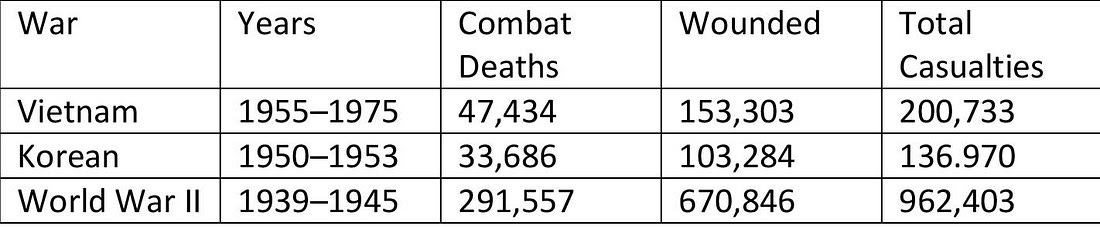
For one simple reason, the statistics don’t seem credible ─ other longer and more deadly wars had fewer casualties. The much, much longer Vietnam War had much less American casualties and the horrific World War II, which featured several beach invasions and large infantry battles, had less American dead and about the same casualties as claimed for the Russian battalions in their present war.

In the three years of war in Ukraine, no large infantry battles have occurred; the battles are mainly heavy weapons pulverizing a civilian area, followed by troops entering and occupying after the area is leveled and the enemy leaves. The Russians may have lost a large number of troops in the early stage of the war (30,000?), during the attempt to invade Kiev and the decision to leave. Later months do not indicate the same rate of casualties. In the next largest battle, three months in Mariupol, Ukraine claims to have killed 6,500 Russian soldiers. Even if this is slightly exaggerated, the next largest battle had only 2000 mortalities/month, which equates to 72,000 deaths in three years of equally intensive battles, of which there were none. On the southern front, Russia captured Kherson with few losses and retreated across the Dnieper when Ukraine launched its only large offensive, ceding Kherson and showing no intention of sacrificing soldiers in a losing battle.

Contrasting with Kyiv Independents stats, is Mediazona, an independent (?) Russian online news source that methodically searched records to obtain military losses. Their meticulous “data service, in collaboration with the BBC Russian Service and a team of volunteers, concluded that, “…Over 95,000 people fighting for Russia’s military have now died as the war in Ukraine enters the fourth year…. Given the estimate above, the true number of Russian military deaths could range from 146,194 to 211,169.”

Why is the number of Russians killed in the three-year war a meaningful and controversial topic? This is Ukraine’s way of informing the public that it may have lost territory but is not losing the war. Russia cannot continue gaining meager ground with a massive number of their soldiers permanently interred in the ground. Russia will be forced into compromise. Dubious logic.

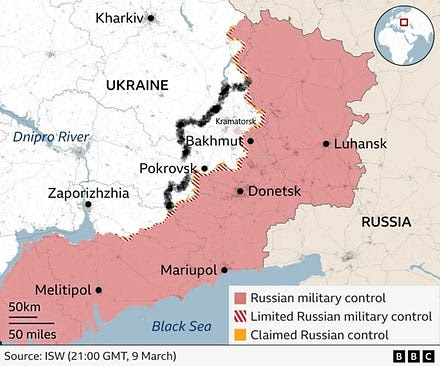
The Russians have all they want — Crimea, the Russian mainland linked to Crimea, and the Luhansk and Donetsk oblasts incorporated into Russia. The war map, as of March 2025, tells that story

The Donetsk basin reaches to the dark lines. Russia needs only to capture Pokrovsk and Kramatorsk to control all the cities of the Donetsk Oblast, and effectively all of Donetsk and Luhansk. Their troops are at the gates of both cities. Super nationalist Vladimir Putin will not rest until his nation controls all of Donetsk, nor will he allow those who have died for that cause to lie buried without the cause succeeding.

Why this farce of “let’s end the war,” without ending the war, is a mystery. Zelensky mentions “guarantees,” undoubtedly meaning that other nations will prevent Russia from interfering again in Ukraine sovereignty. Doesn’t the Ukraine president realize that guarantees are only words on paper, that European governments say what they mean but don’t mean what they say and that governments who change with international styles may not recognize a previous government’s decisions. A solid guarantee has NATO or UN troops at the border between the two warring nations, a prelude to World War III.

“Only the dead have seen the end of war.” ─ George Santayana, “Tipperary.”

Dan Lieberman publishes commentaries on foreign policy, economics, and politics at substack.com.  He is author of the non-fiction books A Third Party Can Succeed in AmericaNot until They Were GoneThink Tanks of DCThe Artistry of a Dog, and a novel: The Victory (under a pen name, David L. McWellan). Read other articles by Dan.