Thursday, March 20, 2025

With all Eyes on Trump, Who has Time for ‘Old News’ Like Outrageous CEO Pay?


 March 19, 2025
cebook

Sam Pizzigati writes on inequality for the Institute for Policy Studies. His latest book: The Case for a Maximum Wage (Polity). Among his other books on maldistributed income and wealth: The Rich Don’t Always Win: The Forgotten Triumph over Plutocracy that Created the American Middle Class, 1900-1970  (Seven Stories Press). 

Hegseth’s Attacks on Black Troops Evoke Long History of Anti-Racist Struggle


 March 19, 2025
FacebookTwitter

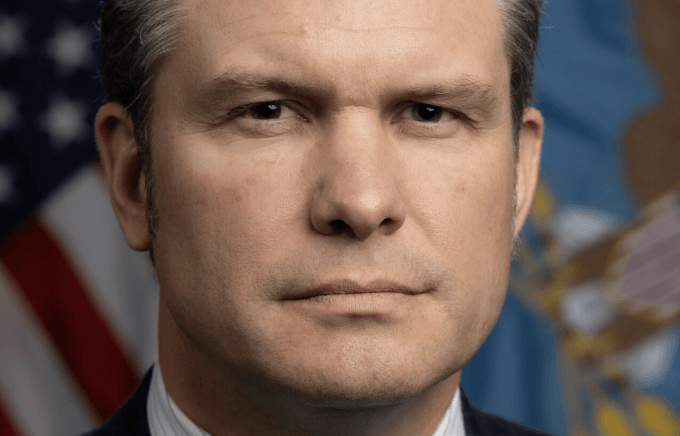
Peter Hegseth, Image via Wikipedia

Peter Hegseth is charging forward on the promise to De-Woke The Military, codified in Trump’s executive order to purge “DEI” from the ranks. Among their targets are Black soldiers, who have been a center–and many times a catalyst–of the broader anti-racist struggle for well over a century.

Some of Hegseth’s orders so far have left little doubt that “DEI” is a code word:

*Banning all Black History Month activities and recognitions the day before it began (while notably allowing military-wide St. Patrick’s Day celebrations)

*Firing African American “DEI General” CQ Brown from Chairman of the Joint Chiefs, after lamenting how “our generals are hunting for racists in our ranks that they know do not exist” (they do)

*Banning Black student groups at military academies

*Bringing back the name “Fort Bragg” to the recently renamed Army post that had honored a Confederate general

*Ordering recruiters to stop attending the Black Engineer of the Year Awards, which one recruiter described as the “most talent-dense event we do”

It has gotten a bit more overt, deleting from the DoD website their only “Medal of Honor Monday” profile of a Black soldier given the award. A slip in the new URL code laid bare the new attitude: three letters were added so the web path would read “DEI Medal of Honor…”

DEI policies did not exist during the Vietnam War; in fact it was much harder for Black soldiers to get recognition. Charles Rogers–who won the award as he was wounded three different times leading a doomed defense of his outpost–was marked “DEI” simply because he was Black.

But the latest stuck out to me as the real shock.

On March 13, Hegseth ordered a review of military standards; and specifically, of beards.

This will likely elude non-veterans but every vet will know that this primarily impacts Black troops, who are commonly exempt from standard shaving requirements due to a skin condition (pseudofolliculitis barbae) which afflicts 45% of Black servicemen.

In other words, Hegseth has found a way to potentially purge thousands of Black servicemen. The Marine Corps has already announced they would do so. The other branches will decide soon.

Hegseth has a very public rationale for all these measures: it is actually about promoting unity! Increasing cohesion by emphasizing what we have in common!

The hallmark of this cohort has been “don’t believe your eyes.” But we all can see what this is.

We’re expected to ignore the context: that Hegseth is deep in a Christian nationalist community led by far-right theologian Doug Wilson, who wrote an entire book defending slavery in the American South. Hegseth bears tattoos associated with white supremacists. He has a long history of rhetoric clearly tapped into the far-right internet ecosphere, dominated by anti-Black content. Hegseth even took known neo-Nazi collaborator Jack Posobiec along with him on his first international trip as Secretary of Defense.

His reforms are not exactly popular in the armed forces, either, nor do they have a significant base among military leadership or academia. They stem primarily from white nationalist attitudes, obsessed with “Critical Race Theory” and now the updated term “DEI.” Their fantasies of purging Black soldiers trace back 160 years.

Black Troops Become the Nucleus of the Freedom Struggle

One of the earliest civil rights struggles in America revolved around Black soldiers.

First it was a struggle for African Americans to have the right to join the Union Army. Many died in those first units just to prove their worth, finally winning federal authorization of Black recruitment.

As predicted by Fredrick Douglass, their heroism in the Civil War would be key to advancing their cause for equality in the North. Once in the military, Black troops waged campaigns (and even mutinies) throughout the war against racist officers and unequal pay, which electrified the freedom struggle everywhere.
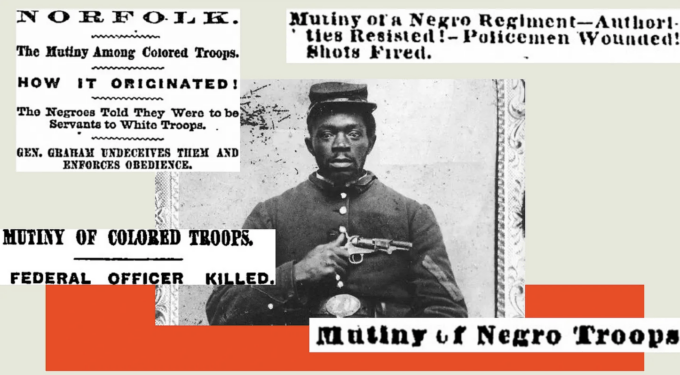
The Confederates, of course, would never allow Black men in the rebel uniform. But they could not accept Black men in any uniform. It drove them insane.

They instituted a policy of executing Black POWs, ignoring the decorum afforded to white POWs. Many massacres of Black troops line the war’s history; at Fort Pillow, around 200 Black soldiers who had surrendered were executed. “Remember Fort Pillow” became a rallying cry across the country, with many wearing the slogan pinned to their uniforms while they defeated their former enslavers in battle.

The Confederates would continue to be driven insane as those Black soldiers became their overseers. Black infantrymen occupied southern towns and cities after the war to keep the defeated in check and to carry out the project of Radical Reconstruction. Considering the way the world looked less than a decade prior, it was truly an unimaginable scenario.

Despite intense racism inside the armed forces, and it’s often totally unjustifiable missions, many in the Black Freedom movement saw military service as a way to challenge racist tropes about Black intelligence and humanity through unquestionable bravery.

Black soldiers also often put their training, guns, and the authority of their uniforms to use in challenging Jim Crow racism, including significant uprisings by garrisoned soldiers in cities like Tampa (1898), Houston (1917), and beyond.

Black infantry units in WWI also earned high prestige for bravery, such as the Harlem Hellfighters. More importantly, they returned to the racist US as skilled, battle-tested combatants. During the wave of white violence in Red Summer of 1919, Black WWI veterans were both the targets of mob violence, and the backbone of defense in battlegrounds like Tulsa. In Washington D.C., Black snipers atop the Howard Theater successfully held off the advance of lynch mobs.
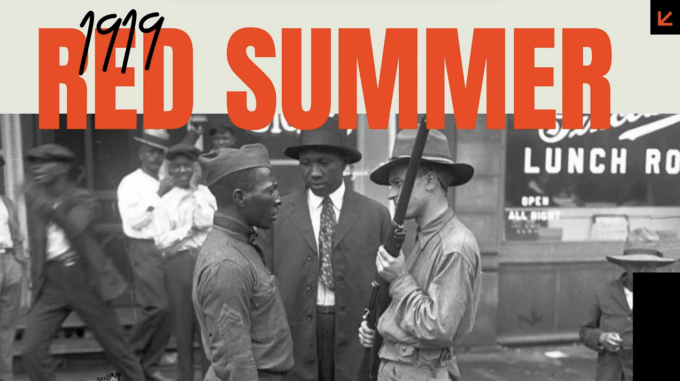
White militiaman confronts Black soldier in Chicago

Preceding Red Summer was the lynching of WWI veteran Wilbur Little, murdered for refusing to take off his Army uniform. At least 16 veterans would be lynched that year.

They were targeted because Black men with guns was an outrage, even symbolically, since what they did with those weapons actually advanced the reputation and esteem of the Black community. And it was a practical barrier against white violence.

Their ability to achieve that status and expertise was gradually eroded. Increasingly kept out of combat arms and leadership roles, they were pushed into dirty work like shoveling coal, digging ditches and working the kitchens.

This rise of Jim Crow turned the military itself into an arena of struggle.

In 1940, 15 Black sailors aboard the USS Philadelphia publicly signed a letter detailing racial discrimination and abuse. After it was published in a newspaper, all were kicked out of the Navy and the struggle for the rights of “The Philadelphia 15” became a rallying cause for the NAACP, socialist parties and others.
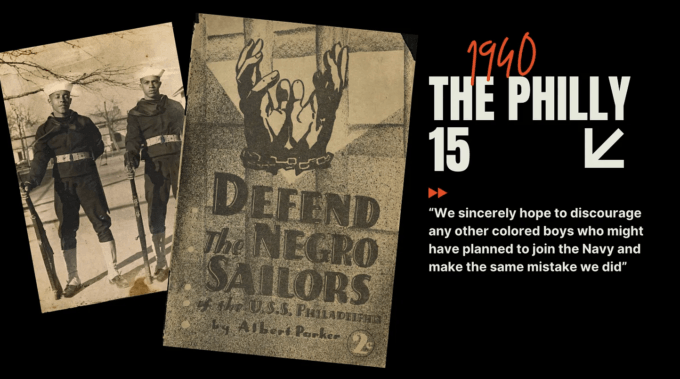
Pamphlet distributed by the Socialist Workers Party, 1940

Through World War II, the Black struggle launched the Double V campaign (Victory Abroad, Victory At Home) which demanded: if Black men and women could fight for freedom abroad, they deserve freedom in the United States.

Black soldiers and sailors were known to carve the Double V symbol onto their chests. It is considered an opening salvo of the Civil Rights movement.

Mass rallies began demanding the desegregation of the military. Various organizations were formed: Committee to End Segregation in the Armed Forces; the League for Non-Violent Civil Disobedience Against Military Segregation and more. With the help of W.E.B. DuBois, they joined into coalition under the name Committee Against Jim Crow in Military Service.

Inside the military, an even hotter struggle was waging. In 1942, 600 Black troops stationed in Australia mutinied, taking over the base and killing racist officers.

The 1944 Port Chicago disaster left around 300 Black sailors dead from loading ammunition under unsafe, overworked conditions by white officers. It led to the largest mutiny in US Navy history. The trial for 50 Black sailors who led the strike became a nationwide campaign for their exoneration.
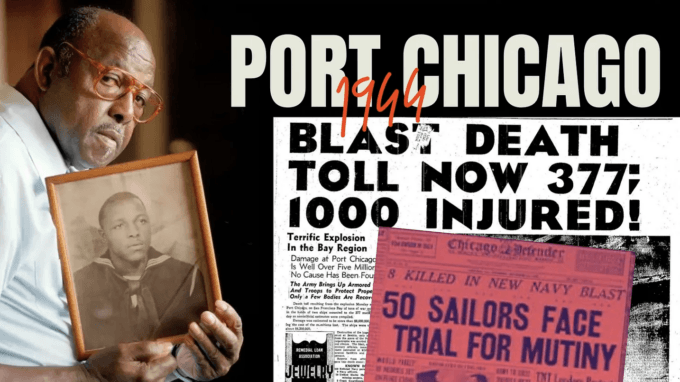
The following year, over 1000 Black sailors went on hunger strike over the policy of only promoting whites.

The demands for equality within the ranks claimed victory with a 1948 Executive Order by Truman, officially desegregating the armed forces.

This became an important part of the framework for civil rights legislation more broadly–not just on paper, but in the movement, as the victory of the military desegregation movement pushed forward equality in all areas of life. On its heels was the Brown v. Board of Education victory, and later the Civil Rights and Voting Rights Acts.

Into Our Era

Over the next 70 years, the military would remain relevant to the anti-racist struggle nationwide. From mutinies during Vietnam to police violence against Black service members in today’s era, it has remained a trigger point.

The new direction of the DoD, under the leadership of obvious racists, sets the stage for a revival.

The 2020 nationwide rebellion against racism was quelled with repression from Trump and lies from Democrats. Those tensions remain very real and unresolved, simmering beneath the surface.

The racist agenda of the Trump Administration, in all aspects of American life, are creating sparks that could catch at any moment. His military agenda is one of those sparks.

Their attitudes flow directly from that of the Confederacy. By that same measure we can reach back into history to draw on the lessons of Black service members, and how they gave momentum and strength to the broader anti-racist struggle.

This piece first appeared on Empire Files.
Mike Prysner is a writer and producer of The Empire Files. Since returning from the Iraq war, he has been an organizer of anti-war veterans and service members. He hosts a military podcast called Eyes Left, and is co-director of the upcoming film on US military pollution, Earth’s Greatest Enemy.

USA

Class, Race, and Gender in the 2024 elections


Thursday 20 March 2025, by Kay Mann


Kamala Harris’ loss to Donald Trump in the 2024 presidential elections was due in large part to declining support for the Democratic candidate from union members, African Americans, and Latino/a s suggesting a decline in class consciousness, working class solidarity, and the strengthening of masculinist and white racial identities. These are shocking not only because of Trump’s hostility to unions, working class problems, and his overt racism and sexism, but because these groups have long been part of the Democratic party voting bloc.


Elections of course can only imperfectly gauge political opinions and social identities, and in the US even more so. With its two main parties controlled by corporate interests, the US is the only global north country without some sort of mass labor, socialist or communist party with links to unions. This means that elections reflect class patterns even less clearly than they may in multiparty parliamentary systems.

And voters of all classes, genders, and races vote for different reasons. Multiple social identities often compete for a vote. Does one for example, vote Republican as a Catholic opposed to abortion, a worker perceiving that the Democrats better represent their interest, or as a person of color for the Democrats, as most racialized minorities have done for decades? More basically, the two-party structure of the system means that incumbents of either party pay for, while the challenger benefits by unpopular issues like high prices, as was the case in these elections. It would take nuanced qualitative studies to have an accurate sense of exactly why voters from groups who have not traditionally Republican would vote for Trump. But these caveats aside, some raw demographic voting data suggest some notable trends.
Dissolution of the Democratic Party coalition

Clearly, we are witnessing the further deterioration of what is left of the grand Democratic Party coalition of labor and African Americans put together by FDR in the 1930s. Since the 1930s, a rough pattern linked working class voters, most unions, African Americans, and ethnic whites to the Democratic party as part or Roosevelt’s New Deal coalition, while the Republican party was seen as the party of business, the wealthy, and small towns and rural areas. The coalition lasted for decades in spite of the little that unions, the working class, and African Americans and other racial minorities received from the Democratic Party in return for their electoral support. The New Deal coalition began to fray in the 1970s with white workers abandoning the DP in favor of the Republican party. The 2024 elections reflected a sharp acceleration to that process.

It is becoming increasingly difficult to find a coherent pattern along class lines in recent US elections. Shifts in consciousness and voting behaviors do not of course occur in a vacuum. The steady, decades-long abandonment of a sector of the working class of all races and genders to the Republican party has been fueled by the DP’s embrace of neo-liberal austerity and failure to offer solutions to working class aspirations.

There is evidence that perceived race and gender identities eclipsed class considerations among sectors of the working class and racialized communities. To the degree that voting for the Democratics has represented a distorted type of class consciousness, and Trump is heavily associated with the wealthy employing class, working class votes for Trump represent a stunning decline of class consciousness. Most unions remain in the Democratic party camp and officially endorsed Harris in the 2024 presidential elections. So, not only did working class people in general vote for an overtly anti-union figure closely associated with the capitalist class, but many of the ten percent of the workforce that is unionized did so, in most cases, against the official position of their unions. The vitriolic attacks on immigrants by Trump and Vance, often with a heavy racist tone found an echo among sectors of the working class and oppressed groups susceptible to scape-goating. To this we could add, susceptibility to protectionist impulses around fears of "foreign competition”, and more generally the corrosive effect on social consciousness that emerges from sustained neoliberal attacks on social services which have stoked the accentuation of competing social identities such as race/ethnicity, and gender in ways that contradict, rather than emphasize social solidarity. Clearly, all of these played a role.
Gender and Race in the Age of Trump

African Americans have been a particularly loyal part of the DP coalition for decades. Well over 90% of Black voters have voted DP until recently. In the 2024 elections however, a full 24% of Black men voted for Trump (while 9% of Black women did). Black men voted less for Harris in 2024, than for Biden in 2020. This was decisive in Harris’ defeat in urban areas in battleground states in the 2024 elections that have been traditionally heavily Democratic like Philadelphia, Pennsylvania, and Milwaukee, Wisconsin. Similarly, around forty percent of Latinos/as/x voted for Trump, (up from the 30-33% who voted for Republican George W. Bush in 2004), including an astounding 47% of Latino men who voted for Trump in 2024. Trump’s reactionary instincts led him to connect with “Bro culture”, a celebration of sexist male attitudes. This message resonates with men across racial and class groups, but evidence has indicated that it is particularly strong in communities of color.

This can be seen in part as a reflection of the decline of feminist consciousness in general. Following victories in the 1970s, the women’s movement pivoted from mass action to legislative, electoral activity, which eventually eroded first the power of the women’s movement and eventually feminist consciousness. It is very likely that in the 2024 elections, some men who may have voted for a male Democrat, voted for Trump or didn’t vote at all, rather than voting for a woman, even though she was a Democrat. Sexist attitudes among some men of all racial and class groups therefore certainly played some roles in both Hillary Clinton’s defeat in in 2016 and Kamala Harris’ in 2024-the only two women who have ever been presidential candidates for major parties.
The Dead End of Racist and Sexist Populism

Trump finds much of his support among conservative upper-class layers and working-class voters without college education. But of course, his government can only serve one class and there is no doubt that that class is the 1%. His racist, anti-immigrant populism will only divert attention from the real problems facing the masses of people in the US today for so long.

When his policies of tax cuts and tariffs, and scapegoating of immigrants and transgender people fail to solve the pressing material problems of working people-including high prices and stagnant wages, while the rich receive more tax cuts, his support will erode. The same neo-liberal attacks on working class standards of living that have helped to fracture working class consciousness, unity, and solidarity will stimulate struggles that will involve working class unity in action and the rebuilding of solidaristic impulses.

The lack of a mass labor or socialist party has meant that the steady stream of racist, anti-immigrant, anti-LGBTQI+ rhetoric coming from the MAGA right and amplified by Trump’s allies Musk and Zuckerberg through their control of Facebook and Twitter is not effectively answered. A mass labor or socialist party would offer an alternative to their racism, sexism, and white nationalism, and the neoliberal austerity of both the Democrats and Republicans, and in doing so reinvigorate class consciousness, and solidarity across race and gender lines.

The building of that party remains central to any real possibility of progressive social change in an age of looming climate disaster, threats to basic democratic rights, and any gains workers and the oppressed have registered in the past. In his first days in office, Trump issued as promised, a flurry of decrees aimed against immigrants LGBTQI+ people, and DEI initiatives which will remove protections from discrimination against racialized minorities, LGBTQI+ people, women, and handicapped people and abolish worker and environmental safety controls. Anti-union decrees will certainly follow shortly. The labor, women’s, immigrant rights, Black, and environmental movements will need to draw on its best traditions of militant mass struggle and solidarity to confront Trump and an employer class encouraged by his anti-regulatory, anti-union policies.


Attached documentsclass-race-and-gender-in-the-2024-elections_a8906.pdf (PDF - 912.5 KiB)
Extraction PDF [->article8906]


Kay Mann
Kay Mann is a Lecturer in Sociology at the University of Wisconsin at Stevens Point and a member of the Milwaukee branch of Solidarity.


International Viewpoint is published under the responsibility of the Bureau of the Fourth International. Signed articles do not necessarily reflect editorial policy. Articles can be reprinted with acknowledgement, and a live link if possible.


Algeria: Colonisation and racism


Wednesday 19 March 2025, by Édouard Soulier, Louisa D


Jean-Michel Apathie, a well-known French mainstream columnist, was suspended from the RTL television channel on 5 March after pointing out that France had committed massacres during the colonisation of Algeria.


The reason for the suspension of this columnist, not known for his radical positions, was that he had said that France had carried out ‘hundreds of Oradour-sur-Glane’ (in reference to the massacre perpetrated by the SS Das Reich division in the Loire village in 1944) in Algeria. This simple statement sparked outrage across all the media outlets of the right wing magnate Vincent Bolloré, as well as the far right politicians Bardella and Ciotti, who referred to Apathie’s origins by describing him as an ‘Algerian influencer’, in a purely racist logic that prevents any comparison between crimes committed by the French and those suffered by them. The matter has even been referred to the media regulatory authority ARCOM. However, Bolloré’s channel was not so zealous when it came to the far right pundit and politician Éric Zemmour, who was never suspended despite several convictions.
The historical reality of the massacres

Apathie merely reiterated the historical truths about the colonial invasion of Algeria from 1830 onwards. He specifically referred to the enfumades, for which General Bugeaud was famous, which consisted of trapping children, women and men taking refuge in a cave and asphyxiating them to death. He could also have mentioned the systematic looting and destruction of villages, the massacres of civilians, beheadings and the use of rape to subjugate populations. These crimes were committed with the aim of monopolising land and resources in order to make room for the settlers. The French colony was established through bloodshed until the war of liberation, during which France also distinguished itself by its war crimes: collective punishments, rapes, massacres and torture.

The brutality of French colonialism is still subject to colonial revisionism. Refusing to acknowledge it implies that any reference to France’s crimes in Algeria would be an insult ‘to the French people’. Moreover, the far right Rassemblement national (RN) has followed suit in its defence of colonisation and racist one-upmanship.

This suspension is part of a worsening of tensions with Algeria, rekindled after Macron’s declaration of Moroccan sovereignty over the Western Sahara.
Racist one-upmanship by the government

Since mid-November, the right and far right have been waging a full-scale attack on the Franco-Algerian agreements, which have governed the entry and residence of nationals of both countries since 1968. First, Retailleau - campaigning for the presidency of the LR party - went one step further after the attack in Mulhouse on 24 February, accusing Algeria of refusing to return expelled Algerians. On 26 February, Bayrou announced a neo-colonial ultimatum: all agreements would be revised within 6 weeks if Algeria did not issue more consular passes.

The same media are in a loop, with the right and far right in unison in calling for the cancellation of these agreements, which would supposedly be unfairly advantageous to Algerians - an agreement obtained after 132 years of colonial domination and whose scope has been reduced by successive agreements.

This new tug-of-war, which mixes domestic and foreign policies, reflects the government’s racist radicalisation, which, at the risk of definitively severing ties with Algeria, marks an amplification of the neo-colonial rhetoric developed for internal and external purposes.

L’Anticapitaliste 13 March 2025


Attached documentsalgeria-colonisation-and-racism_a8909-2.pdf (PDF - 905.3 KiB)
Extraction PDF [->article8909]

Algeria
The Algerian people reiterate their rejection of military rule
The Revolutionary Life and Times of Michel Pablo
The life of an unorthodox Marxist
Kamel Aïssat acquitted! Solidarity and mobilization won the day
Is exercising citizenship a crime in Algeria?
Imperialism
In memory of Patrice Lumumba, assassinated on 17 January 1961
Imperialism as Antagonistic Cooperation
Geopolitical conflicts, anti-imperialism and internationalism in times of “reactionary acceleration”
Marx’s anti-colonialism, new sub-imperialisms and consistent internationalism in a bipolar world
State of the world: economic crisis and geopolitical rivalries

Édouard Soulier

Louisa D


International Viewpoint is published under the responsibility of the Bureau of the Fourth International. Signed articles do not necessarily reflect editorial policy. Articles can be reprinted with acknowledgement, and a live link if possible.