Thursday, March 20, 2025

Why Elon Musk Remains Inseparable From (Some of) His Creations

 March 19, 2025
Facebook

Photograph Source: Fine Apples – CC0

The challenge of separating creators from their creations is not new. However, this age-old dilemma, stretching from Nazi-favored composers to today’s politically divisive billionaires, demands practical rather than merely philosophical solutions.

Elon Musk and his multiple business ventures now stand at the center of this debate. As the world’s richest man deepens his political entanglements through controversial statements and direct government involvement, consumers worldwide face mounting pressure to align their purchasing decisions with their political values. The growing “Tesla Takedown” movement explicitly rejects the notion that Musk’s products can be divorced from his politics.

The Wagner Precedent

The case of Richard Wagner offers a historical lens through which to examine this dilemma. Wagner, who died in 1883—long before Hitler’s rise—wrote viciously antisemitic essays and was later embraced by the Nazi regime as a cultural icon. His music remains unofficially banned in Israel to this day.

In 2001, Argentine-born Israeli conductor Daniel Barenboim provoked outrage when he defied this unofficial ban by playing Wagner at Israel’s national arts festival. The incident highlighted the persistent association between Wagner’s compositions and his hateful ideology, despite the music itself containing no explicit antisemitic content.

Wagner’s case begs the question: Can artistic works transcend their creator’s repugnant beliefs? Wagner scholars continue to debate whether his antisemitism infiltrated his operas through coded caricatures. Yet Wagner’s music—the notes, harmonies, and dramatic structures—contains no inherent antisemitism.

Tesla and Musk’s Machinations

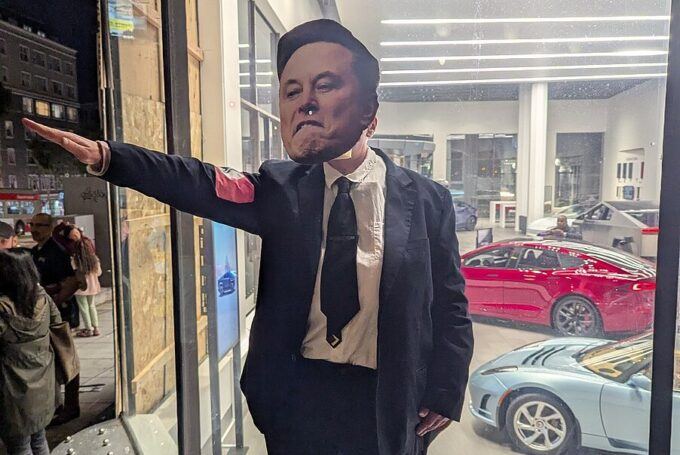
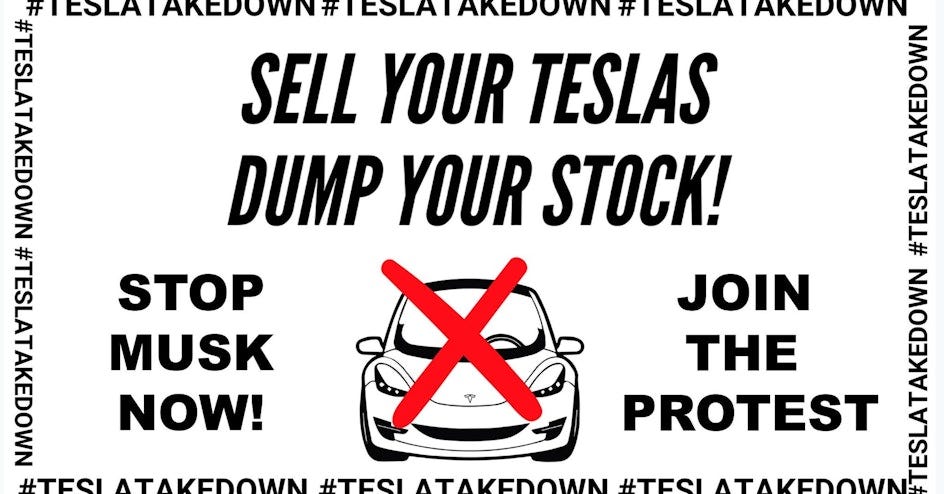
The Tesla controversy parallels Wagner’s case in important ways. The “Tesla Takedown” movement has gained momentum across both the United States and Europe, with protests at over 50 showrooms featuring slogans like “Elon Musk has got to go” and “Burn a Tesla: Save Democracy.” Some demonstrations have evolved beyond mere protest into active vandalism, with charging stations torched in Boston and suspected arson at a dealership in France.

Does a Tesla automobile embody Musk’s political activities and statements? Physically and functionally, a Tesla is simply an assemblage of metal, rubber, plastic, and software designed to transport passengers efficiently using electricity rather than fossil fuels. The car itself holds no political opinions. A Tesla car’s engineering is value-neutral.

When Separation Becomes Impossible

While Wagner’s music and Tesla’s vehicles can plausibly be distinguished from their creators, Starlink—Musk’s satellite internet service—presents a more complicated case. The service itself is technologically impressive. However, Musk’s direct operational control means customers remain vulnerable to his mercurial decision-making.

Consider Ukraine: Initially hailed as one of Ukraine’s staunchest allies, Musk deployed Starlink terminals when Russian malware crippled satellite communications across the country at the invasion’s outset. Three years later though, Musk has weaponized his social platform against President Zelensky, sharing false claims and calling for his replacement. More ominously, Musk has warned that “Ukraine’s entire front line would collapse” without Stalink’s satellite terminals—a reminder of his power to withdraw critical infrastructure during wartime potentially.

The Starlink case demonstrates that separation becomes functionally impossible when a product remains under the creator’s active control. An owner can drive their Tesla regardless of Musk’s latest post on X, but a Starlink user remains dependent on Musk’s continued goodwill.

The Control Continuum

The Starlink example reveals a crucial distinction in our age: the shift from products to services fundamentally alters the creator-creation relationship. This transformation may be the most significant factor in determining whether separation is possible.

Products like Tesla automobiles or Wagner’s recorded compositions exist independently once released into the world. A Tesla owner retains full functionality regardless of Musk’s latest controversial statement or political alliance. The vehicle, once purchased, operates autonomously from its creator’s ongoing decisions or moods. Similarly, a Wagner recording plays the same notes whether one approves of the composer’s antisemitism or not.

Services like Starlink, however, establish a perpetual dependency relationship. This product-service distinction carries profound implications as our economy increasingly shifts toward subscription-based services. Traditional product ownership allowed for a functional separation between creator and creation. Modern digital services, however, maintain persistent tethers to their creators, making separation impossible by design.

The Wagner-Musk comparison ultimately highlights how technology has fundamentally altered the terms of our ethical dilemma. When Musk controls Starlink’s satellites with the press of a button, or when social media platforms can instantly deplatform millions, creator and creation become inseparable by definition.

Perhaps the key distinction is not merely between “good” or “bad” creators but between consumption that preserves our autonomy and consumption that surrenders it. In a world of tech tycoons with unprecedented power, we must remember that market problems require market solutions. The hyper-dependence on Musk’s Starlink—with all its ethical entanglements—can only be resolved through robust competition in satellite-provided internet. We need vibrant market alternatives that prevent any single visionary—however brilliant—from accumulating too much control over critical infrastructure. The ultimate answer to the Musk dilemma is not boycotts or ethical agonizing but competing satellite networks that ensure no individual, nation, or military remains dependent on one man’s goodwill.

Marx borrows this concept to make sense of what he terms "commodity fetishism." As Marx explains, the commodity remains simple as long as it is tied to its use- ...


Georg Lukacs. History & Class Consciousness. Written: 1923;. Source: History & Class Consciousness;. Publisher: Merlin Press, 1967;. Transcribed: Andy Blunden ...


Stung by People Power Protests, Elon Musk


Targets My Group and a Close Friend


March 18, 2025
Facebook

Photo: Indivisible.

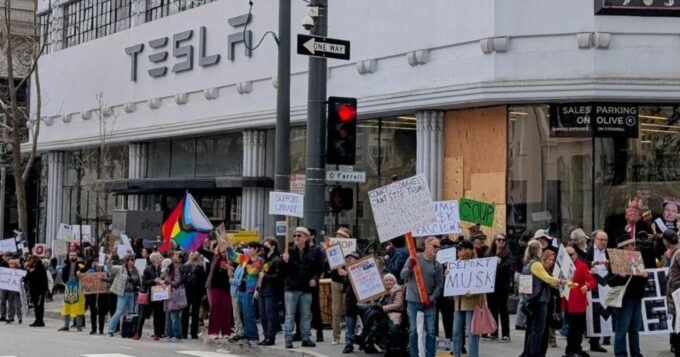
A week ago Saturday Co-President Elon Musk took to his X platform to call out several groups staging protests against his Tesla dealerships for Musk’s Trump Administration role in slashing vital federal government functions. The Tesla Takedown movement has mounted hundreds of peaceful actions around the world. Among the groups he named were the Troublemakers, falsely claiming it is funded by ActBlue. The group has been staging protests at dealerships throughout the Seattle area, a major Tesla market, and had a key role in putting up the decentralized movement’s website, where people around the world can post upcoming actions.

I am a member of the Troublemakers, a Seattle-based group dedicated to nonviolent direct action, and was a part of our first action, one focused on forest preservation. “So Elon’s making us famous,” I thought, grimly amused but aware that being targeted in such a way could lead to consequences.

That happened quickly. The next day Musk took it to a new level, targeting Valerie Costa, a close friend and colleague with whom I have worked for years, first at 350 Seattle, and now at Troublemakers. “Costa is committing crimes,” he charged. Musk has a record of playing fast and loose with the facts, and this was another of his many lies. There have been incidents of vandalism against Tesla cars and dealerships. But Troublemakers is a strictly nonviolent group and does not endorse such actions.

The other day, Val told her story in The Guardian in a story entitled, “Elon Musk targeted me over Tesla protests. That proves our movement is working.” I’ll let Val take it from here:

“As a longtime local activist and organizer in Seattle, I’m accustomed to some conflict with powerful forces. The intention of the Tesla Takedown movement is to make a strong public stand against the tech oligarchy behind the Trump administration’s cruel and illegal actions, and to encourage Americans to sell their Teslas and dump the company’s stock. Protests like these – peaceful, locally organized, and spreading across the world – are at the heart of free speech in a democracy and a cornerstone of US political traditions. So it’s telling that the response from so-called ‘free speech absolutist’ Musk has been to single out individuals – and spread lies about us and our movement. The harassment that has followed his post has been frightening.

“It’s also proof that the Tesla Takedown campaign is working.”
Tesla Takedown Rally organized by Tesla Takedown Boston

Indeed, Tesla stock and sales are tanking. As of today the stock is a little under $240, half of what it was in the euphoria immediately after the election. J.P Morgan projects it to go down by half again, to $120. Meanwhile, Morgan auto analyst Ryan Brinkman last Wednesday cut his first quarter global sales estimate to 355,000, down from 440,000, and a deep plummet from 495,000 in 2024’s fourth quarter.

Clearly connecting those declines to Musk’s work with Trump and connections with Europe’s far right, Brinkman said, “We struggle to thing of anything analogous in the history of the automotive industry, in which a brand has lost so much value so quickly.”

Continuing to tell her story, Val wrote, “I am not the leader of Tesla Takedown. In fact, no one is.

“Here is the truth: Tesla Takedown is a completely decentralized movement with hundreds of protests taking place around the globe, drawing many thousands of people out of their homes and onto the public sidewalks to stand up for programs that support poor people, older people, veterans, the sick. Out of care and concern for others – a foreign concept to those currently in power – people are offering what they can to help. I’ve offered to schlep supplies, and helped someone find a bullhorn. The environmentally focused Seattle organization I’m a part of, Troublemakers, hosts a map where other people and groups can post the locations of forthcoming demonstrations. Troublemakers has about $3,500 in its bank accounts. All of this is a bare-bones, low-budget, people-powered movement – which is exactly why Musk is afraid of it, and casting about to find a villain.”

Val then hit the crux of the issue.

“If we can’t show our opposition to what the government is doing, we are living in a dictatorship. If we are criminalized for calling out the rich and powerful for their illegal actions, that is a dictatorship. I don’t want to live in a dictatorship.

“Make no mistake, it’s scary to be personally called out by the richest man in the world on the platform he owns. It’s scary to be targeted by a seemingly endless number of his devoted trolls and bots. To be doxxed, to have one’s life pored over and exposed, to be smeared, attacked and falsely accused. It’s scarier still when the FBI director gets tagged into the threads and asked to investigate. But I’m not backing down – and even if I did, it wouldn’t make a dent in this movement. Hundreds if not thousands of people have participated in the ways that I have.

“The truth is, the people are powerful. I’ve always believed that. And now we know that Elon Musk does too.”

Val also told her story on Democracy Now.

Val Costa has acknowledged how terrifying it is to be targeted by the world’s richest man (though he may be knocked off that perch soon). But, no surprise to me, she has continued to stand and speak out with courage. Val has been on many direct action frontlines, and is deeply committed to environmental and social justice in all its forms. Knowing Val, Musk’s attack has only made he more pissed off than she was before. Bravo Val!

We who work in movements have known the second Trump Administration would bring an elevated level of uncertainty and risk. But that isn’t stopping us. As Franklin Roosevelt said, “Courage is not the absence of fear, but rather the assessment that something else is more important than fear.” With so much at stake now, there are obviously many things more important than fear. Relatedly, Nelson Mandela said, “I learned that courage was not the absence of fear, but the triumph over it.” Valerie Costa is setting an example of triumph for all of us. One which we will need in coming years as we fight for what is dear to us against oligarchic monstrosities like Elon Musk.

This first appeared in The Raven.


The Meaning Of Privacy


 March 19, 2025
Facebook

Image by Lianhao Qu.

Structures of surveillance have their roots within the infrastructure of our commercial sector and government. This is not new, but the government’s audacity has grown monstrous with the recent example of Mahmoud Khalil and the blatant disregard for the most basic rights of habeas corpus.

Back in 2013, Snowden told us that the capabilities of state government actors were far beyond anything we ever imagined. He warned us that cellular phones are essentially surveillance windows into our lives. So much so that he manually extracted the microphones and cameras from his cellular phones. Furthermore, MSM and normal text messages are not encrypted, which enables the government to access our conversations via phone record providers. The N.S.A. has been collecting petabytes worth of information on every U.S. citizen.

But why is privacy important? A common cynical view is that if you have not done anything wrong, you should have nothing to fear. Deliberately or not, this implies that people who object to invasions of privacy are criminals. Furthermore, the key word “wrong” is defined entirely by the state, whose mandate to serve its people is increasingly fragilized. What happens when, in the name of security, the state deems legitimate dissent to be wrong? Privacy allows us to organize and protect ourselves from the state’s tentacular reach, and as such it is the right on which are founded all the other rights that must be available to the citizens of a healthy democracy.

How, then, did these United States of Surveillance that we live in today come to be? An autopsy is required, and an accelerated timeline must be laid out. When the Cold War ended in 1993, the defense budget was reduced, to the displeasure of defense executives, and the cutting edge of technology was no longer in the hands of Lockheed Martin, whose C.E.O. was then Norman Augustine, following a merger with Marietta Controls. Government officials realized that the commercial sector, Silicon Valley was developing the next generation of technological innovations. The internet was being built, computers and operating systems, including Linux, were being developed, and a renaissance of hand-held electronics was soon to follow.

Shortly before 9/11, Norman Augustine and Gilman Louie founded In-Q-Tel, a C.I.A. backed hedge fund, under the behest of C.I.A. director George Tenet. The purpose of In-Q-Tel is simply stated by Augustine himself in a 2015 Senate hearing before the Committee On Armed Services:

“Today, the leading edge of the state of the art and innovation is often to be found in … Silicon Valley… This led to the establishment of an organization that we called In-Q-Tel, the concept of which was very simple: conduct business on behalf of the government with Silicon Valley and others as they would deal with any other commercial firms. I believe that it is fair to say that this has been an immensely successful endeavor from virtually every perspective.”

This V.C. activity was funded with tax-payer dollars. With this goal in mind, In-Q-Tel invested in Google, Keyhole [later to become Google Earth] and Palantir. These investments gave them access to software licenses and allowed them to establish industry-government relations.

After 9/11, the United States was reeling from the shock of such a challenge to the empire’s worldwide hegemony, which had longed seemed inviolable due to the brutal foreign policies enacted throughout South America, Africa, the Middle East and Asia. The injury of physical destruction was exceeded only by the insult of its suddenness, which moved Government officials in the Bush administration to pass an onslaught of policies enabling law enforcement to deploy surveillance tools on an unprecedented scale, in order to ensure that such an outrage would never happen again.

As a result, data collection began to accelerate, naturally accompanied by the rapidly expanding use of the internet and electronic financial transactions. The former N.S.A. technical director, Brian Snow, told the Telegraph that the N.S.A.’s mass data collection program known as P.R.I.S.M. ramped up enormously under pressure after the 9/11 attacks. Today, the Israeli SIGINT National Unit collaborates and shares intelligence with the N.S.A.. Notably, the communications of Palestinian-Americans in the U.S. are shared without restriction with Israeli intelligence.

When the 2008 economic crash occurred, many companies bought back up their own stocks with Obama’s stimulus package, whereas tech companies like Google, Facebook and Amazon largely expanded their ability to project growth post-2008. Today, without Nvidia, Meta, Amazon, Oracle, Alphabet, Apple, Microsoft and Tesla, the American economy would be doing very poorly, though Tesla stock has been in free fall since Trump’s inauguration. This post-2008 situation the direct result of Obama’s economic policies. The tech sector, boosted by the financial sector, became the bulwark of the American economy, and tech C.E.O.s including Eric Schmidt, Peter Thiel, Elon Musk, Mark Zuckerberg and Jeff Bezos became increasingly prominent public figures. Their ties to the government, initially something of an open secret, appear now to be a matter of course for decision-makers, who question none of these relationships.

The Cambridge Analytica scandal that happened during the 2016 election of Donald Trump, whereby Facebook users were exposed to data collection and targeted political ads that often contained false information. This scandal revealed the potential of social media platforms for mass manipulation, through their incredible capacity for data collection and surveillance. In 2017, Eric Schmidt, who remained as a technical adviser to Alphabet, took on a role at the D.o.D. He chaired the National Security Commission on Artificial Intelligence with Raytheon’s Bob Work, In-Q-Tel’s Gilman Louie and S.R.I. International’s William Mark, among others. The N.S.C.A.I. produced a 750-page report that advocates for more mass data collection:

“The basic purpose of the American government is to protect the security and liberty of the American people. Americans have a long tradition of debating how best to achieve these twin goals when tensions arise between them. The two decades following 9/11 saw intensive efforts to calibrate the government’s powers to stop another terrorist attack with its obligations to respect individual rights and liberties. A.I. is ushering in the next era of this debate because new technologies offer government agencies more powerful ways to collect and process information, track individuals’ behavior and movements, and act on the basis of computer-generated analyses.”

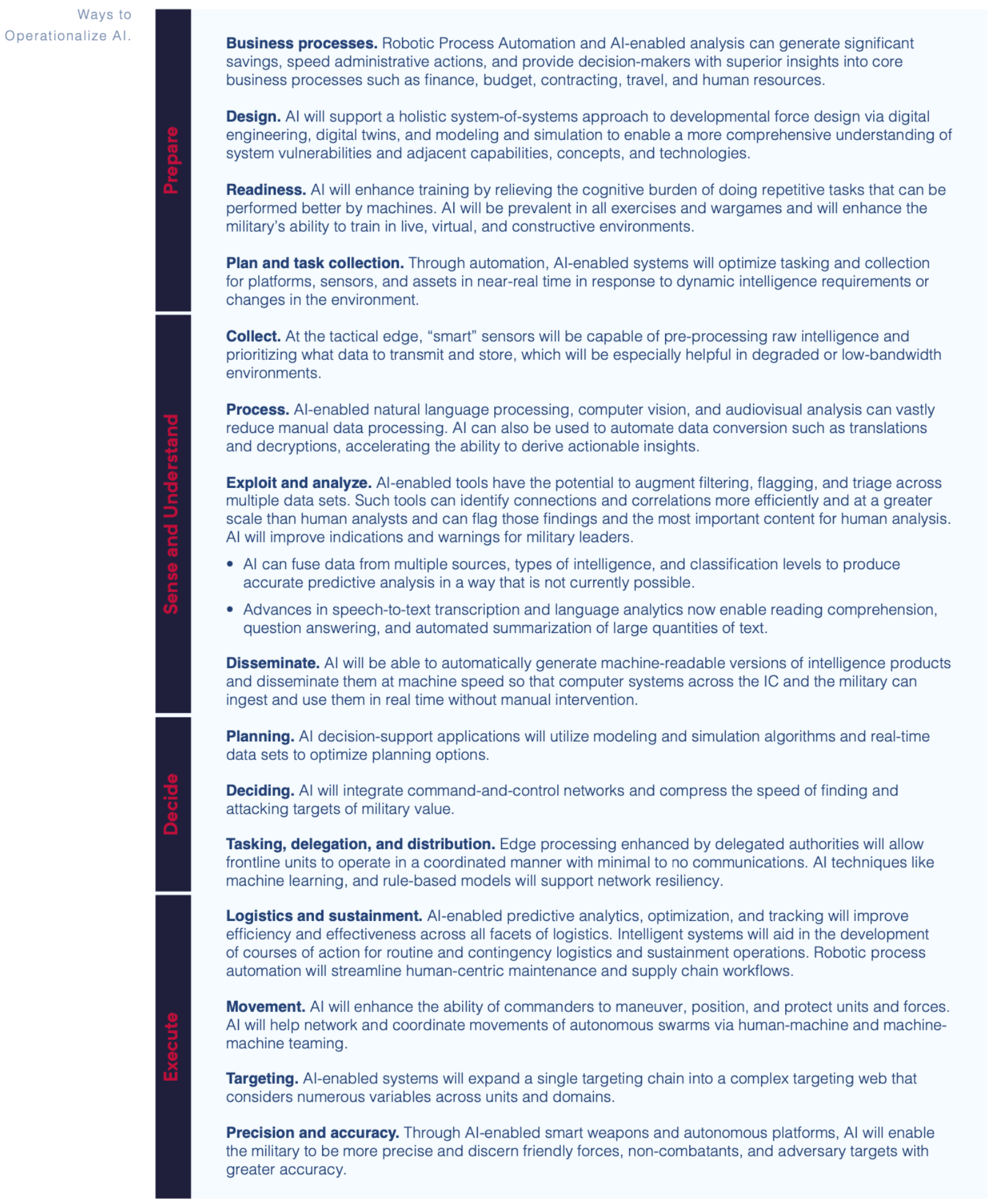
An additional screenshot below reveals a plan with action items on how to operationalize A.I. in combination with data collection.

Meanwhile, Thiel’s Palantir, headed by C.E.O. Alex Karp, was helping I.C.E. to violate the individuals’ privacy in order to track the undocumented community. Undocumented migrants have always been the domestic guinea pigs on whom surveillance measures are tested before being deployed in wider society, As has been consistently reported, the Trump administration’s treatment of human beings who sought a future in the USA was generally detrimental and often inhumane. These reports, however, when they reached mainstream news, were repackaged in a way that conditioned the American people to normalize witnessing the regular violation of human rights.

The violation of rights by companies founded or funded by In-Q-Tel does not stop there. Today, In-Q-Tel’s investment in Niantic has enabled it to scrape data off every Pokemon Go player’s phone and extract photos to create a global 3-D geospatial A.I. for the C.I.A. In addition, Palantir, Google, Microsoft and Amazon provide cloud computing and A.I. services to the Pentagon as part of the Joint War Cloud Capability. The former 3 have all received funding from In-Q-Tel and Amazon acquired companies funded by In-Q-Tel.

And furthermore, PalantirGoogleAmazon and Microsoft are also helping the I.D.F. in their genocidal campaign. Palestinians have been the subjects of tests for the most advanced software-hardware platforms that use these A.I. programs to automate the kind of slaughter exposed by Assange and Manning in 2010. By either providing American A.I. programs [such as Google DeepMind A.I.] or Google/Amazon/Microsoft servers for I.D.F. A.I. to run on, decision making is being accelerated to drive up casualty rates. We have only now witnessed in an unfiltered way the extreme impunity with which aggressors have detached themselves from the violence they commit.

Back home, Skydio, another In-Q-Tel funded drone company has been used to surveil Yale students. Originally founded by members of the Roy group at M.I.T., Skydio is deployed by the I.D.F. in Palestine and it received huge contracts post October 7th, 2023. Social Sentinel, founded by the former head of D.P.S. at Princeton helps scrape students’ social media for purposes of surveillance. Local police and I.C.E. are using automatic license plate readers to create data bases of protesters, Mosque goers and undocumented migrants. These are merely a few examples in a vast array of companies that participate in the surveillance industry.

And we have not even touched upon the trend of ex C.I.A. officers and ex Israeli intelligence embedding themselves within the tech sector and academia. The dean at Columbia who green lit Khalil’s abduction was a former Israeli intelligence officer.

So where does this leave us today?

Let’s go back to June of 2001 and explore the story of Palestinian activist Amer Jubran in Brookline Massachusetts. Jubran was a prominent leader who helped organize a peaceful rally protesting the Israel Day of Celebration and was arrested and accused of “assault with a deadly weapon”. However, the charge was dismissed by a judge who found no grounds for the accusation. Instead, it was revealed during the trial that Brookline police had been collaborating with and were paid by the Israel Day of Celebration organizers to arrest Jubran.

Shortly after 9/11, in November of 2002, Jubran led a pro-Palestinian march in Boston, and was arrested jointly by the Immigration and Naturalization Service and the F.B.I. just a few days later. He was taken from his home in Rhode Island and he was held at a correctional facility for 17 days without bail without any cited charges.. Documents obtained through the Freedom Of Information Act revealed patterns of surveillance in which law enforcement were engaging. The contrast between Jubran’s unjust detainment before and after 9/11 is striking. Ultimately, he was put through a sham 2.5 year trial without due process or charges, which proved too onerous. Jubran “voluntarily left” the United States where he had lived for 15 years. But the injustice for Jubran did not stop there. As Jacobin reported, even after Jubran left for Jordan, because he never stayed silent as an activist, under U.S. colonial power, “the [Jordanian] government charged him with planning attacks on US soldiers in a period during which it was officially denying the presence of US soldiers on its territory.”. The aggression by the U.S. government in Jubran’s case was only the first hint not of an intensification in the country’s hardening grip on its history colonialism.

Jubran’s story is emblematic of the fact that the state has been testing the repeal of rights for many years, as well as experimenting with new technologies and applying legal tricks to oppressed communities and the Global South. Mahmoud Khalil’s recent abduction should come as no surprise; the shock it has caused may be instead a byproduct of the surprise that this was audaciously enacted on a Columbia student and legal resident.

As citizens of the United States of Surveillance, it is necessary to recognize that what we have seen done to Khalil has been done in foreign countries by the US government countless times before this. The rage and anger that is justly felt over Khalil’s abduction is not enough. Jubran is proof that Palestinians, like undocumented migrants, were a testing ground for surveillance and legal tricks. The U.S. government has not changed, was never better than this. The weight of its colonial project has borne down upon the innocent civilians in countless lands for the entirety of the country’s existence. The difference rests with us: we are being progressively othered by the U.S. government, just as it has othered so many peoples abroad in order to justify war, and ultimately profit. The recent wave of pro-Palestinian protests in the heart of the surveillance state provoked its ruling capitalist elites, such that they have now turned the head of colonialism nakedly inward. If you think you are safe, you are wrong.

So we must change our circumstances by simultaneously tackling U.S. foreign and domestic policy. We must organize to pass legislation that prohibits the kind of surveillance we are being subjected to and restore privacy as a right. For without privacy, there is no way to resist.

But in the meantime, as you organize, defend yourself. Here are a few privacy resources:

The Electronic Frontier Foundation Surveillance Self Defense

Privacy Guides On Software And Applications

The Anti-War Initiative, an nascent organization that works to reveal military and defense contracts on campuses. Their can find our work at antiwar.io