Monday, March 24, 2025


Shrinking worlds of Indian history

Rather than asking what Chhaava gets right or wrong, perhaps we should ask: Why does such distortion happen?


Rohan Basu
24 Mar, 2025
DAWN


The film Chhaava, centred on Maratha king Chhatrapati Sambhaji Maharaj, has sparked debates about its portrayal of history. Yet, rather than simply asking what the film gets right or wrong, perhaps we should ask: Why does such distortion happen?

The answer to the question lies in understanding the result of a fundamental rift –– between conceptions of history outside its academic confines, as opposed to its academic counterpart that strives toward ‘decolonisation.’ The national populace’s general mistrust towards the academic practice of many historians and archaeologists working in universities comes from the latter’s refusal to engage in the pursuit of a ‘glorious Hindu nation’ that supposedly was. Any other historical undertaking would inevitably lead to derogatory tags like ‘urban naxal’, ‘Lutyens gang’ or ‘left-liberal.’

The roots of history’s politicisation in India trace back to the late 19th century, when nationalist movements first demanded that Indians reclaim their history from British colonial accounts. Until then, Indian history was dominated by British colonial frameworks, epitomised by James Mill’s influential The History of British India. Mill explicitly divided Indian history into three adversarial stages — Hindu, Muslim, and British — portraying Muslims as aggressive outsiders who corrupted a pure and ancient Hindu civilisation.

In doing so, colonial historiography justified British rule as a supposed liberation from Mus­lim despotism, firmly embedding the Hindu-Muslim binary into historical consciousness. This simplified binary can be traced even further back to the late 18th-century Orientalist scholarship. British Orientalists, working predominantly with upper-caste Hindu literati, sought original texts (‘ur-texts’) like the Manusmriti to codify Indian traditions. Their selective focus on Hindu religious texts as the essence of authentic Indian civilisation implicitly marginalised Muslims as historical intruders.

By presenting Hindu culture as India’s timeless and original heritage, Orientalism (ironically co-opted later by nationalist history) established the groundwork for the communal divisions that began perpetuating in the following decades, reinforced through governance mechanisms such as the census. Moreover, colonial administrative practices did not allow for archival access in the colonies, thus prohibiting the growth of inquiry using the archives.

In 19th-century colonial India, British administrators treated archival records primarily as instruments for bureaucratic efficiency, tax collection, and land revenue management. Unlike in Britain, where archives became accessible symbols of government accountability, in India, archives and historical records suffered from administrative neglect.

This neglect laid the foundation for India’s contemporary archival mismanagement, where invaluable documents routinely rot, disintegrate, or vanish altogether. The economic dynamics of British imperial rule further shaped the nationalist historical project. Following economic crises like the Union Bank collapse in Calcutta (1848) and the British Crown’s takeover of India (1857), the Indian mercantile class, particularly in the Bengal province, lost significant power. Stripped of economic and political agency, the colonised middle class in India turned towards cultural domains, particularly history, as a means of resistance to colonial domination. Strangely mirroring the Volk projects shaping European literary culture, intellectuals in India’s presidency towns crafted nationalist ‘histories’ using myth, blurring the distinction between the two.

Anyone familiar with Dakshinaranjan’s Thakumar Jhuli would notice its resemblance to Grimm’s Fairy Tales — both collections of folklore preserving cultural memory against the onslaught of modernity. In European imperial metropoles, folklore remained a literary pursuit, since ‘scientific history’ naturalised modernity as the culmination of enlightened civilisation. In contrast, Indian intellectuals, grappling with colonial subjugation, turned to mythic pasts, envisioning nationalist resurgence through the excavation, recording and thus recovery of the same.

Bankim Chandra Chattopa­dhyay typified this nationalist historiography. In 1880, through his Bengali magazine Bangadarshan, Bankim called on Bengalis to reclaim their martial heritage using ancient epics like the Mahabharata as historical sources.

However, rather than rejecting orientalist categories, Bankim and other nationalist writers embraced and reinforced them. Muslims continued to be depicted explicitly as foreign aggressors, deepening communal divides and further embedding colonial historiography’s simplistic Hindu-Muslim binary within Indian nationalism. This tendency carried over into the post-colonial period, shaping how the new republic envisioned its history.

Jawaharlal Nehru’s vision of history in The Discovery of India also played a role in framing India’s identity through ancient texts such as the Vedas, Upanishads, and epics like the Mahabharata and Ramayana. In these texts, he sought a ‘romantic’ vision of India that regrettably aligns with Hindu nationalist claims of cultural continuity, which was supposedly disrupted by Muslims and the British. These Hindu nationalist claims even permeated one of the supposed ‘secular’ institutions investigating history — The Archaeo­logical Survey of India (ASI).

This institution carried on its legacy of the early orientalist scholarship: they gave ‘scientific’ veracity to the search for texts that revealed the ‘origins’ of Indian civilisation by locating it in the earth and excavating it to reveal ‘ancient truths’. In postcolonial India, this explicitly became the search for a ‘Hindu past’ in service of a ‘Hindu nation’. While academic history came to be ‘decolonised’ (albeit incomplete), through interventions of Marxists, the Subaltern Studies and a rehabilitated Cambridge School, the ASI never shed its oriental roots. The efforts to identify locations mentioned in the Mahabharata and Ramayana, along with the Saraswati Heritage Project aimed at uncovering archaeological sites along the mythical Saraswati River referenced in the Rigveda — illustrate this tendency.

Therefore, it isn’t a coincidence that the former director of ASI, B.B. Lal, a part of the archaeology of the Ramayana Sites Project (1975-1985), argued that there existed a Ram temple below the Babri Masjid. His intellectual milieu is that of the long nineteenth century which has shaped ‘our’ historical thinking since – that of the community at large, and not necessarily the academic historian. There is a reason why fake WhatsApp histories prevail in community consciousness more than academic history. It is not merely because academic historians do not engage in the public sphere. In fact, the contrary is often the case.

Therefore, to reclaim history from a community that valorises itself while excluding others — and a governmental apparatus overtaken by the same ideology — we must bridge the divide over what defines legitimate sources of knowledge about the past, and a credible approach to history. To salvage the national imagination of India, we must save the ever shrinking worlds of Indian history.

This story was originally published in The Statesman, an ANN partner of Dawn.


From darkness to light: The promise of decentralised community-driven energy in northern Pakistan

Harnessing the power of small-scale hydropower, community-driven energy projects in northern Pakistan are transforming lives — yet governance gaps, climate threats, and systemic inequalities challenge their long-term success.

Published March 21, 2025
DAWNJ

For nearly 12 million people in Pakistan, access to electricity remains a distant dream. The country faces severe challenges — its national grid struggles to reach remote regions, energy prices soar, and energy security remains fragile.

In northern Khyber Pakhtunkhwa (KP), over half the population lives below the poverty line, and in the newly merged districts, this figure jumps to 72 per cent. For these communities, access to energy isn’t just a convenience, it’s a lifeline. High electricity prices push families into energy poverty, forcing them to rely on costly, unreliable alternatives.

Yet, there is hope.

Decentralised, community-driven solutions, particularly hydropower, could offer a way out. KP alone has the potential to produce up to 64,000 MW of electricity through small hydro projects — enough to power millions of homes sustainably.

Over the past decade, the provincial government has embarked on an ambitious journey to electrify its remote regions by building over a thousand micro-hydropower (MHP) units. These projects, supported by well-regarded local organisations such as the Sarhad Rural Support Programme (SRSP), the Aga Khan Rural Support Programme (AKRSP), and Haashar Association, take a community-based approach, aiming to empower local residents through energy. The initiative promises to transform lives, and hundreds of MHPs have succeeded in bringing electricity to the region.

But as with any ambitious plan, challenges abound. Field reports indicate that over 150 units installed since the early 2000s are now non-operational. What can we learn from these successes and setbacks? To find out, we conducted a detailed assessment of MHP infrastructure, combining field visits, key stakeholder interviews and in-depth case studies of three projects in Chitral and Swat. Here, we share the key insights and lessons learned.
Building resilience — where people and technology meet

When it comes to small hydropower projects, success doesn’t just depend on the technology. It’s as much about the people and communities using the technology. In energy projects, this blend of the social and technical — the “sociotechnical” approach — shapes how well these projects deliver real benefits. And in northern Pakistan’s remote areas, this approach has made a tangible difference.

Local hotels and businesses such as general stores, tailors, welders, carpenters, and various cottage industries benefit from more reliable MHP supply

Community-based MHP projects in KP have catalysed substantial socio-economic improvements in impoverished communities, which can be seen in enhanced educational opportunities, poverty reduction, economic development, and women’s enhanced entrepreneurship and health.

Take Kalam, for example. Thanks to two SRSP-managed power plants, there has been a noticeable boost in girls’ school enrolment. The reliable electricity has also powered up healthcare, small businesses, and agriculture, creating new income opportunities and reducing food insecurity. At the same time, the Jungle Inn MHP has been a game changer for local hotels and businesses, allowing them to stay open longer, attract more tourists, and slash their energy bills.


Ayun MHP project, Chitral — an SRSP initiative


On a household level, these MHPs have helped families switch from costly wood and biomass to cleaner, cheaper electricity. The shift has led to better health outcomes, with fewer respiratory problems and lower medical expenses. According to SRSP, since 2016, these projects have cut carbon emissions by 66,000 tonnes annually and reduced community reliance on fossil fuels.

But it’s not all smooth sailing — MHPs face tough challenges, especially with the unpredictable weather patterns in northern Pakistan. Variability of water flow, increasing droughts and flash flooding cause technical problems while extreme vulnerability to climate change is making things worse. Transporting machinery to remote areas is also a logistical nightmare due to rough terrain and poor road access, impacting project cost and complexity.


Reduction in residents’ household energy expenditures from MHP installation.


The projects that thrive are those with strong community involvement and good governance. Unfortunately, many struggling MHPs are held back by poor maintenance, limited technical expertise, community conflicts and local disputes. Our research also uncovered a serious lack of record-keeping in terms of monitoring and evaluation. Many projects have no hydrological data or performance records, and there’s no public information on why some MHPs have failed. This lack of transparency and oversight limits the growth of small-scale renewables, despite their potential to significantly enhance the country’s energy landscape.


Non-operational MHP at Koghuzai, Chitral.


Decentralisation and the dream of energy democracy

Decentralising energy projects sounds like an ideal solution — more control for local communities and energy systems designed to fit their needs. But it’s no silver bullet. In northern Pakistan, where energy infrastructure is slowly expanding to reach underserved areas, decentralisation has exposed serious challenges in governance.

MHP projects are intended to be collaborative efforts, built on participatory decision-making. They bring together a wide range of players: government departments such as the Pakhtunkhwa Energy Development Organisation (Pedo), non-profit organisations (NGOs), Rural Support Programmes (RSPs), local authorities, donors, community organisations, and engineering consultants. Ideally, these stakeholders would work in harmony to plan, fund, and operate the plants under a shared “build-operate-transfer” framework. But that’s not always how it plays out.

The reality is often messy. Governance can break down due to vague roles, imbalanced responsibilities, and a lack of formal ownership agreements. These gaps lead to mismanagement and inefficiency. Communities have reported that funds generated from electricity sales were poorly managed and that promised job opportunities never materialised. Internal issues like nepotism and local power struggles further undermine the fairness of decision-making, reinforcing existing inequalities. Adding to the strain, local governments often lack the capacity to manage these technical projects effectively.


Community respondents’ perceived concerns for nepotism in community organisation membership.


The broader context doesn’t help either. Sectarian violence and political conflicts in the region create instability that can derail projects. Even with recent governance reforms in KP, the region still relies heavily on foreign aid. Donor-led initiatives, with their rigid priorities and short-term funding cycles, can hinder local capacity-building and long-term resilience. That said, there are signs of progress.

Social enterprise models are emerging as a promising alternative, though much more needs to be done. Strengthening local governance frameworks, diversifying funding sources (through options like public-private partnerships, green bonds, and carbon financing), and increasing community involvement are crucial steps forward.

Despite these hurdles, the success stories show that when governance aligns with community needs and participatory processes, decentralised projects can thrive. The dream of energy democracy — where communities control and benefit from their own energy resources — remains within reach, provided we address these governance challenges head-on.

Women in power — driving change in energy projects

When MHP plants light up a community, the benefits often ripple out to women in profound ways. Electricity access has improved education and healthcare for women and girls, boosted literacy rates, and eased daily tasks. Programmes like Pedo’s Ujaloon Ka Safar and RSP-led initiatives have supported women’s socio-economic development, helping them gain better opportunities.

But the picture isn’t all bright. While electricity has made some household chores easier, outdated cooking practices still persist. Women remain reliant on inefficient, polluting fossil fuels such as firewood for cooking — a task that is both time-consuming and harmful to their health. During our surveys, many residents expressed a desire to switch to modern electric appliances, such as washing machines and cookers, but only if costs could be kept manageable. Clearly, any future improvements to MHPs must prioritise access to clean, affordable cooking solutions to truly benefit women.


Left: Perceived impact of MHP electricity on women’s ease of work and availability at time of need. Right: Respondents’ satisfaction with cooking energy.


Despite progress made, gender development remains slow and at times regressive. In a region where gender roles are conservatively defined, women are rarely involved in the planning or management of energy projects. Gender bias still influences who gets a seat at the table in community energy organisations, leaving women with limited say in decision-making. While hundreds of women’s organisations have been set up under RSPs, their scope and effectiveness vary widely across different cultural contexts.

Development programmes have spent decades trying to promote gender equity, but the results have been modest at best. In KP, projects have addressed women’s immediate needs, but they’ve done little to support their broader aspirations — like becoming leaders or entrepreneurs. While a handful of women have launched small businesses thanks to electricity access, many remain confined to traditional roles within the home. Political instability, religious extremism, and entrenched patriarchy continue to block women’s participation in public life and local governance.

That’s not to say these programmes have failed. Initiatives led by organisations like SRSP have made a real difference, improving education and skills for many women. Yet after 30 to 40 years of development work, progress is painfully slow. Female literacy in KP stands at just 37pc, compared to 72pc for men, and nearly 40pc of girls are still out of school. A recent UNDP report reveals that gender inequality is actually worsening, with women’s labour force participation dropping from 16pc in 2006-2007 to just 11.3pc by 2018-2019. Parliamentary representation for women has also declined slightly over the same period.


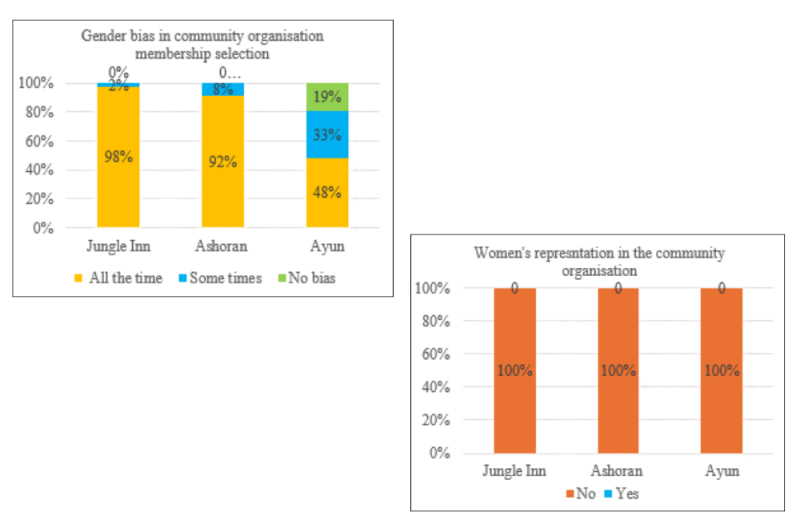
Respondents’ perception of women’s representation and gender bias in community organisation membership.


Why do these disparities persist?

One major reason is that development projects often focus on short-term outputs — such as building schools or distributing resources — without tackling the root causes of gender injustice. Unequal access to resources, power imbalances, and rigid social norms remain largely unchallenged.

The lesson is clear: to build resilient energy systems, we must actively empower women. Studies show that when women play a leadership role, resource management improves, and projects become more adaptable to change. For MHPs and similar initiatives to be truly transformative, they need to support women’s agency, not just their participation. That means involving women at every stage of the project, from planning and execution to governance. Only then can energy access become a tool for empowerment and equality.
Towards resilient and inclusive energy futures

As KP continues to navigate the challenges and opportunities that come with decentralised energy systems, the experiences with MHP projects offer crucial lessons on how localised energy solutions can be refined to better serve communities. These projects are vital for achieving sustainable development in remote areas, but success isn’t just about installing turbines or building infrastructure. It’s about creating systems that are both resilient and equitable — where technology and community needs are deeply interconnected.

From a technical standpoint, we observed that small MHPs (under 100kW) face greater operational challenges than larger ones, highlighting the need for more careful feasibility assessments. However, technology alone won’t ensure sustainability.

Strengthening local institutions, project monitoring, and inclusive governance are critical. Communities must have a genuine role in decision-making, and projects need to address underlying power dynamics and inequalities. As climate change intensifies, adaptable and resilient energy systems will be crucial for northern Pakistan’s survival and growth.

The future of rural electrification in KP and similar regions globally depends on understanding the socio-technical nature of these projects — where technology meets human lives, and where power should mean not just electricity, but empowerment.

Disclaimer: This study has been published as an open-access peer-reviewed journal article in Environmental Research: Infrastructure and Sustainability and can be accessed here. We are grateful to the British Council Researcher Links Climate Challenge Workshops Grant: Delivering a Sustainable Energy Transition for Pakistan for funding this project. We also acknowledge the support of Pedo, SRSP and the Energy & Power Department KP in facilitating data collection and field visits.

Header image: The tourist’s hub, Kalam Valley in Swat, powered by local MHP plants. — photo by author


The author is a Research Associate with the MECS programme at Loughborough University. Her research explores the intersections of the gender-energy nexus in the Global South. She is passionate about problem-driven research, believes in interdisciplinary collaborations and dreams of doing fieldwork across the globe.


This author is a lecturer in the Energy Management and Sustainability programme at the US-Pak Center for Advanced Studies in Energy, UET Peshawar. His interests and research focus on energy policy, grassroots energy innovation, sociotechnical systems, and sustainability.


Protests Mount Against Proposed Canals on Indus River


Abdul Rahman 

The ongoing protests in Sindh against the Green Pakistan Initiative (GPI) will now be joined by farmers in Pakistan’s Punjab province.

Leaders of farmers/tenants from areas affected by Green Pakistan Initiative recently met in Khanewal. Photo: Ammar Ali Jan/X

The opposition to the construction of new canals on the Indus river in Pakistan has intensified amidst the government’s continued refusal to reconsider the Green Pakistan Initiative (GPI). A large number of farmers and left groups have announced their participation in the ongoing protests. A major, nationwide protest against GPI on March 22 was joined by farmers groups and progressive organizations.

AWP calls national mobilisation against the construction of canals

On Monday, March 17, Awami Workers’ Party (AWP), a prominent left party, announced a nationwide protest against the GPI and new canals on the Indus for March 22. Announcing the protest on its social media page, the party claimed that the GPI is an “unjust development project” as the “Indus has the first right to its water.” 

In a statement, AWP warned that Pakistan will face “impending ecological disaster from Gilgit-Baltistan to Sindh if the expropriation of nature and indigenous peoples is not halted.” It claimed that “while on the one hand vast swathes of land, water bodies, minerals, and highlands are being pillaged in the name of development” working people are pushed to the wall at the behest of “establishment, imperialism and numerous regional players.”  

AWP alleged that the project and similar anti-people policies are rooted in Pakistan’s continued dependence on the International Monetary Fund (IMF), which uses its loan conditions to push for the interests of big capital. Such policies promote the colonization of Pakistan’s natural resources, including the Indus river, the AWP stated, calling for a united fight against it by the country’s democratic and progressive forces.

Farmers from Pakistan’s Punjab province join the struggle

Meanwhile, various farmer leaders from Pakistan’s Punjab province met in Khanewal on Sunday under the leadership of Haqooq-e-Khalq Party (HKP). In the meeting, farmers claimed that the project will not only severely affect the farmers in Sindh but that farmers in Punjab will also be badly affected because of it. Blaming the GPI for promoting large scale commercial farming at the cost of small and marginal farmers who would face displacement, they announced a joint struggle against the project starting on March 24.

A fight for the rights of the poor

The GPI was inaugurated by Punjab’s chief minister Mariyam Nawaz last month. The joint project of the Pakistan army and the Punjab government envisages to convert over 5,000 acres of land into a “smart agri farm”, with large-scale investments in building supportive infrastructure in the semi-arid drought prone region of Cholistan in Punjab. For irrigating Cholistan the project envisages six new canals on the Indus river system.

Zulfikar Ali Bhutto, one of the leaders of the anti-canal movement, dismissed the claims made by the ruling establishment calling the protests a rise of regionalism. Bhutto denied that the movement has anything to do with regional nationalism claiming the “fight for the river is the fight for the rights of the poor.” 

Bhutto was speaking in a seminar organized by the Concerned Citizens’ Alliance (CCA) over the Canal issue in Karachi on Wednesday. 

Environmentalists warn of ecological and social consequences

Speaking in the seminar, several other environmentalists questioned the need for new canals on the Indus claiming it will have a disastrous impact on the environment of the lower riparian regions causing droughts and leading to mass displacement. The canal may also affect the water supply to big cities in Sindh such as Karachi, speakers claimed. 

Speakers also questioned the project’s legitimacy as it was approved without following the legal procedures and taking in popular consent.  

Growing opposition across Sindh and Punjab against GPI

HKP, Pakistan Kissan Rabita Committee, and several other groups have been organizing protests against the project across Sindh for months now highlighting the concerns of farmers. The opposition has also claimed that this project would lead to a rise in inter-regional conflicts and harm Pakistan’s federal structure as well.  

Protesters, which also includes the provincial government led by Pakistan People’s Party (PPP), have claimed that new canals on the Indus would completely dry the river affecting lower riparian regions in Sindh. They have also questioned the involvement of big corporations in the project claiming it is being done at the behest of the establishment and the IMF.

Courtesy: Peoples Dispatch


Why Sindh’s farmers are up in arms over the Cholistan canal project

“This is cultural genocide of a people,” 

"On the one hand, fertile farmland is being swallowed up by luxury housing schemes. On the other, farmers are being driven further from their livelihoods. How can we justify this?" questions WWF-P's Hammad Naqi Khan.
Published March 19, 2025
PRISM/DAWN

Among the crowd of students gathered on the Indus Highway on March 4, Saqlain Sindhi’s voice was the loudest. “Darya-e-Sindh par daaka dala jaraha hai (Indus River is being robbed),” he bellowed. As president of the Jeay Sindh Students Federation (JSSF), Sindhi has spent years rallying students, farmers, and labourers, organising protests against policies that threaten the River Indus. But the fight had never been as urgent as it was now.

“The Green Pakistan Initiative is an assault on our river which is vital to our identity, culture, and very existence. This is about our land, our generations to come, and our survival,” Sindhi asserted, speaking to Dawn.com.

Diljan Laghari, vice-president of JSSF-Arisar, also protesting the scheme which aims to construct canals on the Indus river, expanded on this sentiment: “Sindh thrives on agriculture — our economy depends on it. If the Indus river is drained and our water disappears, so does our livelihood. We refuse to let that happen.”

Their words reflect the collective frustration simmering among the youth in Sindh.

The protest was organised weeks after the inauguration of the Cholistan project by Punjab Chief Minister Maryam Nawaz and Chief of Army Staff Gen Asim Munir on February 15, with thousands of protesters marching along the Indus Highway on March 4. Sindhi and Laghari were among the many who took to the streets in Jamshoro, joining students and activists from nationalist student groups.

What began as a peaceful protest soon spiralled into chaos as security forces baton-charged and lobbed teargas shells to disperse the demonstrators, turning it into yet another battle for the river unfolding on its own soil.

Launched last month with three business franchises in Cholistan, the Green Pakistan initiative, Sindhi argued, “masks the systemic erosion of our heritage under the guise of progress and development”.

What’s the project all about?


The Green Pakistan Initiative (GPI), spearheaded by the federal government, hinges on a network of six newly developed canals that will channel water from the Indus river to irrigate Punjab’s Cholistan region. It is being touted as a bold step towards food security and rural upliftment, transforming barren lands through modern farming techniques.

With a three-pronged approach — a Green Agri Mall, a Smart Agri Farm, and an Agri Research and Facilitation Centre — the plan promises farmers cutting-edge support and aims to maximise crop productivity.

As per the scheme, the 176km-long Cholistan canal, which is a core element of the project, will draw water from Punjab’s existing Rasul-Qadirabad, Qadirabad-Balloki and Balloki-Sulemanki (RQBS) link canals at a staggering cost of Rs211.34 billion. The aim is to cultivate a new command area in southern Punjab by irrigating 1.2 million acres in two phases — 455,000 acres in Phase I and 744,000 acres in Phase II.

But what is being hailed as a game-changer for Punjab has triggered an uproar in Sindh, where stakeholders fear the project will siphon away their water rights.

At the centre of the debate is the Sukkur Barrage, a critical component of Sindh’s irrigation system, which supplies water to 8.2 million acres of farmland through seven main canals spanning over 5,800 kilometres. Among them, the Nara Canal (592.7 km) and Rohri Canal (334.26 km) extend deep into Sindh, reaching districts like Badin and Mirpurkhas. The barrage also supplies water to Balochistan via the North Western Canal (NWC), which is reflective of its regional significance.

As the lower riparian province, Sindh contends that these allocations are already extensive and further diversions could cripple its existing irrigation system. Its largest Nara canal’s designed discharge is 13,649 cusecs — almost half of what RQBS’ existing capacity is. Given Punjab’s RQBS will inevitably receive more water than the largest canal in Sindh ever could — why draw from Sindh’s share at all?

Sindh also points out that the plan, reliant on flows from the Sutlej River — a tributary of the Indus that feeds the Cholistan Canal — depends entirely on surplus releases from India, since the river was surrendered under the Indus Water Treaty of 1960. However, with the Sutlej virtually dry, authorities have resorted to an extraordinary measure: manually pumping water from other rivers to sustain the diversion. This spells trouble ahead.

How much of Sindh’s irrigation supply will be compromised? Even a modest reduction in Sukkur’s discharge could disrupt this balance, threatening water availability in tail-end regions already facing acute shortages.

Consequently, Sindh has expressed reservations over the project’s reliance on the Indus river. In January 2024, Sindh’s caretaker Chief Minister Maqbool Baqar questioned the issuance of its certification, voicing concerns to the then caretaker Prime Minister Anwaarul Haq Kakar.

In November last year, Sindh Chief Minister Syed Murad Ali Shah opposed the plan as well, arguing that the Indus River System Authority (Irsa) lacks the mandate to approve it, given that it has no allocation under the 1991 Water Accord and that the project threatens Sindh’s already limited water supply. The contentious water project, challenged by Sindh to protect its permanent water interests, was presented before the Council of Common Interests (CCI) in 2023 and 2024. However, a final decision on the matter remains pending.

Today, opposition to the project has intensified. Just last week, heated debates erupted in the Sindh Assembly as lawmakers clashed over the project before unanimously passing a resolution demanding “an immediate halt to all plans and activities related to the construction of the canals.” CM Murad called for a dialogue among provincial stakeholders to ensure inter-provincial water justice and warned against unilateral diversions. “Sindh’s people have a rightful claim over these rivers,” he stressed.

Many activists, lawyers, farmers, and students have also joined the chorus of concern, cautioning against the far-reaching repercussions of the plan.

With tensions at their peak, critical questions emerge: Why the outrage? What is it about the initiative that has set ablaze such resistance? Who truly benefits from this move and at what cost to those who have relied on the Indus for sustenance for centuries?
The scare of water scarcity

Zulfikar Ali Bhutto Jr, an environmentalist who refers to the Indus river as the “Maa” (mother) of Sindhis, has disparaged the very premise of the project, terming it reckless in the face of worsening water scarcity. He said that the Indus is running dry and Sukkur Barrage is witnessing one of the driest years on record, warning that diverting the Indus’ water through these new canals suggests draining nearly 20,000 cusecs of water when only 18,000 cusecs remain after Sukkur Barrage. “This means we will go into a minus,” he told Dawn.com.

According to Zulfikar Jr, the very authorities driving the plan forward are the ones sounding the alarm on an impending drought. “They are fully aware that Sindh is on the brink of a severe water crisis, yet they continue to authorise diversions that will only accelerate depletion,” said Zulfikar Jr.

Naseer Memon, a consultant on climate change induced natural disasters, echoed this sentiment, saying the government’s indifference to water shortage was evident. “To put it in perspective: Guddu Barrage can sustain about two million acres of land. Given that over six million acres in Cholistan are to be irrigated in the future, the water requirement would be three times what the barrage can supply. The question is — where will this water come from?” he said.

“We simply don’t have enough water,” he highlighted. “Canals remain in drought phases, the dams are steadily shrinking, and for over two decades, Irsa has consistently declared water shortages. The numbers don’t lie either. The average discharge downstream of Kotri has plummeted from 40.69 million acre-feet (MAF) between 1976-1998 to just 14.035 MAF from 1999-2023.”

As of Saturday, Dawn.com reported that Mangla Dam had officially hit its dead level of 1,050 feet, reducing its ability to supply irrigation water to Punjab and Sindh. Tarbela Dam is not far behind, with its water level dangerously close to its dead level of 1,402ft, standing at 1,405.10ft. The Chashma Reservoir, too, is on the verge of depletion, sitting at 639.20ft, a mere inch away from its dead level of 638.15ft.

This acute shortage threatens millions of acres of farmland, putting crops like wheat and sugarcane at severe risk. Consequently, Irsa has warned the two provinces — the country’s main breadbaskets — to prepare for up to a 35 per cent water shortage for the remainder of the Rabi season.

As upstream diversions intensify, they will starve the Indus Delta — the region where the river meets the sea — hastening seawater intrusion and decimating fragile ecosystems. Beyond this, the controversial project carries a dangerous ripple effect, exacerbating water woes in Sindh’s parched cities.

With urban populations swelling, the demand for municipal, industrial, and commercial water is increasing at an equal pace. Karachi alone depends on the Indus for 85pc of its water primarily sourced from Keenjhar Lake, which is fed by the Indus, while Hyderabad, Larkana, and Sukkur rely on it entirely.

However, the worsening scarcity isn’t just an issue of supply — it’s also a public health disaster waiting to unfold. Karachi, Hyderabad, and Sukkur — already crippled by chronic shortages — face a spike in pollution levels as drinking water becomes increasingly toxic.

According to the Water and Sanitation Agency (Wasa), Hyderabad’s water carries 790 milligrams per litre of Total Dissolved Solids (TDS), exceeding the World Health Organisation’s (WHO) 500mg/l threshold. This is a result of shrinking faucet flows in the Indus and unchecked pollution.

Environmental expert Memon explained that as natural river water shrinks, the river loses its ability to cleanse itself, leading to a surge in contamination levels. Constructing more canals upstream will further deprive Kotri Barrage — the source of drinking water in urban centres — of the water needed to dilute contaminants, risking a full-blown health crisis in Karachi, Hyderabad, Tando Mohammad Khan, and Badin.

The dangers of toxic water are tragically familiar. In 2004, Hyderabad saw a devastating outbreak when as many as 55 people lost their lives, and around 6,000 were hospitalised after consuming contaminated water. With worsening water shortages, the risk of another public health disaster looms large.

The Ravi and Sutlej, overloaded with agriculture runoff and industrial waste, are on the verge of becoming entirely unfit for human consumption. “Millions in Karachi and Hyderabad will be forced to drink poisoned water,” he cautioned.

‘Anti-people project?’

The crisis threatens to dismantle entire ways of life. As rivers dry up and land becomes unsuitable for farming, communities that have depended on these waters for generations find themselves at risk of losing their cultural identity.

“Initially, the government was championing the plan as ‘cooperative farming’, presenting it as an inclusive approach to agriculture. They have now tactfully altered their language, terming it ‘corporate farming’ — because that is exactly what it is — a profit-driven, exploitative model of agriculture,” said Zulfikar Jr. He alleged that the federal government is actively seizing lands from farmers in Punjab, Sindh, and Balochistan, to integrate them into these irrigation networks.

According to Zulfikar Jr, farmers, zamindars, and labourers rely on the existing local system which, as imperfect as it may be, manages to sustain the local population. “Now, instead of feeding our own people, this water will irrigate cash crops that can be exported to countries such as China and Saudi Arabia. This project is not for Pakistanis. Let’s be absolutely clear about that,” he stated.

Zulfikar Jr was referring to reports that Pakistan is courting $6 billion from Saudi Arabia, the UAE, Qatar, and Bahrain over the next three to five years to revolutionise its agriculture sector. The aim is to bring 1.5 million acres of unused land under cultivation and upgrade 50 million acres with advanced mechanisation to usher in a new era of corporate farming.

In November 2024, the federal government revealed that only 8.2 million acres of land in Sindh is cultivated compared to more than 30 million acres in Punjab. Against this backdrop, it is important to note that as 18 million acres of land in Sindh remain uncultivated, its water is being diverted to irrigate just 1.2 million acres in Punjab.

Eighteen million acres left barren — to water just one. Let that sink in.


“What do you think will happen then? Farmers will be pushed off their ancestral lands — in southern Punjab, in Sindh, in my hometown, Larkana. And this is not simply a default consequence of the plan; it is deliberate, engineered dislocation,” said Zulfikar Jr.

He added that the displaced haris (farmers) will have no choice but to migrate to urban slums, where they will struggle to find employment. Their traditional way of life will be erased. “This is cultural genocide of a people,” he said.

As a matter of fact, the slow death of Sindh’s fertile lands began several years ago. Seawater intrusion has ravaged Thatta and Badin, regions once renowned for rice and wheat cultivation. They have now turned barren due to increased soil salinity. Over 1.2 million people — mostly small-scale farmers and fisherfolk — have been uprooted as their lands turn uninhabitable. A study by the Sindh Development Institute estimates that 70pc of the delta’s agricultural land is no longer viable for conventional farming.

“They want zamindars to abandon their lands and lease new land at a minimum of 5,000 acres. That’s the size of the Defence Housing Authority (DHA) in Karachi. But most zamindars own 500-600 acres — even the wealthiest waderas do not have 5,000 acres,” he explained. Their goal is to force traditional landowners out of the picture and turn poor farmers into migrant labourers working on land that has been made foreign to them, he claimed.

In a similar vein, Dr Riaz Shaikh, dean of the Faculty of Social Sciences at Szabist, questioned the true intent behind such grand infrastructure projects. His concern underscores a pattern seen elsewhere: land development projects initially presented as solutions for local populations often end up displacing them instead.

“Today, we’re talking about irrigating the land, tomorrow it could easily morph into something else — perhaps a highway slicing through the desert, followed by commercial ventures and farmhouses,” he warned.

Shaikh sees this as yet another “anti-people project” with no input from those most affected. “At the very least, follow international standards. At the very least, ask the people of Cholistan if they agree. But they’re absent from this debate. We are at the mercy of those in power,” he lamented.

Hammad Naqi Khan, director general of WWF-Pakistan (WWF-P), also criticising the blind embrace of corporate farming, said that everything ultimately boils down to elite capture. “On the one hand, fertile farmland is being swallowed up by luxury housing schemes, golf courses, and weekend retreats. On the other, farmers are being driven further from their livelihoods. Both, direct consequences of the plan. How can we justify this?” he said, pointing out the misplaced priorities of the decision-makers.

The land, the rivers, and the traditions tied to them are now collateral damage in the pursuit of an elaborate scheme that will pick profit over people each time, he reinstated.

Memon focused on the aspect of deepening poverty as projects with corporate interests at the expense of those at the margins are pushed forward. “The Indus Delta is already on its last breath. This will be the final nail in its coffin. Visit the region, observe the conditions people live in and you’d think you have stepped into the 16th century.”

A United Nations Development Programme (UNDP) survey on multidimensional poverty reported that in districts such as Sujawal, Thatta, and Badin, nearly 80pc of people live in extreme poverty.

“Their livelihoods are gone. Their health is deteriorating. There is no life for them. And now, this scheme will take away even the last drops of water they rely on.” He called it a great human tragedy.

The collapse of an entire ecosystem


“Almost half of the water comes from glacier melt, and the rest from the rains, primarily monsoon rains. But both lifelines are becoming dangerously unreliable,” WWF-P’s Khan explained, adding that glaciers are melting at an accelerating rate, unleashing floods in one season and leaving parched riverbeds the next. Meanwhile, erratic monsoons swing between extremes — bringing either heavy downpours or droughts. “We are a water-stressed country, yet we continue to mismanage our most precious resource,” he warned.

“At WWF-P, we say ‘no river stretch should run dry.’ That is a basic environmental principle,” he asserted. But the Indus is being choked at its source. With reduced freshwater flows, the sea will further creep inland, swallowing fertile land and poisoning what remains, he stated.

As a consequence, Khan mentioned that there is potential for further loss of mangrove forests — Pakistan’s natural coastal defenders and a breeding ground for marine life. “It’s scientifically established that mangroves require estuaries, the junction where both freshwater and seawater mix, to grow. But with the Indus running dry and failing to replenish these critical ecosystems, the forests will inevitably wither. As they die out, coastal erosion will accelerate, leaving communities vulnerable to tsunamis, storms, and cyclones,” he emphasised.

Equally concerned about the increasing threat of climate change-induced disasters, Shaikh said that mangroves, which produce 10 times more oxygen than an average tree, are vanishing. “Without them, we are exposed”. He added that Sindh’s coastal agriculture, once abundant with premium papayas, bananas, and chikoos, is already in decline.

Moreover, said Shaikh, fishermen along the delta cast their nets into waters that no longer breathe. The river’s flow has weakened, and with it, the oxygen that sustains marine life. As the fish disappear and the nets come up empty, centuries-old coastal communities are forced to abandon their homes and relocate, in pursuit of water that no longer reaches them, he lamented.

Memon concurred. “There are numerous species that depend on mangrove forests as nurseries. Because of the shortage of freshwater flows, the fish species, and the whole aquatic ecosystem, will collapse along with the mangroves.”

Zulfikar Jr, also the founder of Bulhan Bachao, an organisation which works on wildlife conservation through community engagement, cautioned that we’ll be staring at an ecological disaster of unimaginable scale, especially when it comes to the extinction of species like the Indus River dolphin.

The Indus River dolphin, found nowhere else in the world, could be among the first to disappear if the project moves forward. Around 90pc of its population thrives in the very waters that will be siphoned away, he explained. “Over the years, these creatures have navigated the river despite the perils they’ve faced. But they cannot navigate a world without water.”

What could’ve been…

As a water engineer and environmentalist working in the field for around 30 years, Khan said that it saddens him to see decision-makers prioritising such costly infrastructure ventures, rather than addressing the underlying issues within the existing system. “Instead of moving ahead, let’s take a step back,” he suggested.

“Take our agricultural yields — whether it’s cotton, rice, or wheat. We don’t even need to compare our output with superpower countries like China or the US; let’s simply take India’s example. The geographical location is the same, the land is the same, yet we lag far behind. So, if the land itself isn’t the limiting factor, what systemic inefficiencies are holding us back?” Advocating for a glass-half-full outlook, he stressed that this is a reflection of our untapped potential — proof that there is still potential.

He stated that provincial agricultural departments, which should be guiding farmers on best practices, conducting research, and ensuring sustainable land use, remain underperforming and unaccountable. According to him, without strict oversight and reforms, even the most ambitious projects will fail to deliver meaningful, tangible results.

Khan emphasised that policymakers must reassess cropping patterns, tailor decisions based on those assessments, and hold those in charge responsible. “But all we do is throw around buzzwords like ‘corporate farming’ and pursue projects that do more harm than good”.

For him, the discussion needs to shift to overlooked nature-based solutions and alternatives, which offer far more sustainable and cost-effective results. He builds on three key points: strategic land-use planning, innovative water management, and maximising existing resources.

Proper land-use planning, he said, is the foundation of responsible development. “We need to define clear zones for housing, agriculture, industry, and environmental protection. Without this, we will continue to see fertile agricultural land disappear under unchecked urban sprawl, while marginalised areas are expected to sustain large-scale projects with little regard for feasibility.”

Secondly, he underscored the potential of aquaculture and forestry as viable alternatives, particularly in degraded lands. “Look at the blackish water in parts of Cholistan — rather than dismissing it as useless, we should explore what kind of crops can thrive there. Can we grow salt-tolerant crops? Can we use it for aquaculture? What about agroforestry? Can we cultivate tree species that can be harvested in six years for timber or biodiesel?” Khan insisted that these are the questions the government needs to ask before deciding to pour billions into unsustainable projects.

Lastly, he called for enhancing existing irrigation systems within canal command areas. “If food security is the real concern behind corporate farming, why aren’t we first improving the way we irrigate our crops? There is ample opportunity to optimise agronomic practices on the land we already have — if only we choose to look in that direction.”

It’s not Punjab vs Sindh, it’s powerful vs powerless

We already have a troubled situation across all provinces. The people are fuming everywhere, said Memon.

Speaking in the context of Sindh, he warned that a huge political movement is taking root. “If you follow Sindhi media, channels, newspapers — you’d know that every single day brings fresh strikes, demonstrations, and riots. Yet, most mainstream media outlets are barely giving it the coverage it deserves.”

“When that happens, what sentiment do you think it creates? Think politically. Think of relationships between people and between provinces. What is already strained is being further damaged, and this is a dangerous sign for the federation,” he expressed.

Memon brought attention to the fact that the impact of the project will not be exclusive to Sindh; southern Punjab, too, will experience a perpetual water shortage. “Cholistan is already a poverty-stricken region, and its people will not see any economic relief from this initiative. In a corporate farming model, the benefits are reaped solely by private companies and it’s important to not lose sight of who your fight is really against,” he said.

Khan echoed this concern. “A farmer sitting at the tail end of Punjab shares a similar fate with a farmer based in Sindh. He doesn’t get water either — not even through perennial canals. Both of them survive by pumping whatever little water they can,” he said.

“I don’t want to make this a Punjab vs Sindh issue because it really isn’t,” Zulfikar Jr noted too, aware of how easily the outrage against resource exploitation can be conflated with hostility against a specific province. He cautioned to steer clear of narratives that can be reduced to a provincial rivalry.

“I want to see a united, happy, and equal Pakistan, and this project, to put it as simply as I can, is a slap in the face of the unity of our federation,” he concluded.

Header image: Awami Tehreek activists stage a rally against the construction of new canals to draw additional water from Indus River. —PPI
TV REVIEW; ADOLESCENCE

Boys to men

DAWN
March 23, 2025 

The writer is a journalism instructor.


THE TV critic at the Guardian, Lucy Mangan, is stingy with praise. It’s why I did a double take last weekend when I saw her five stars — the highest — for Adolescence. I haven’t always agreed with all her reviews but she’s been spot on about the five stars. There was After the Party — “best acting on TV all year” — and Until I kill You — “fearless TV that values intelligent viewers” last year. But to see “the closest thing to TV perfection in decades” in the headline for Adolescence made me reach for the TV remote control instantly. I didn’t even bother with a trailer which is my usual modus operandi. I’m a sucker for trailers.

We were hooked from the get-go. I’m not spoiling it for you by telling you it is a four-episode show about a teenage boy in the UK accused of murdering a teenage female classmate. It is told from four different perspectives — the police, a psychologist, the school and the parents, all trying to understand what happened. It is deeply engaging and equally disturbing.

We watched it in one day and I recommended it to everyone, warning them that it was heavy. Almost all my friends who are parents to children of all ages were rattled. I was deeply moved but also worried.

What are (y)our children really doing online?


Where are the role models our boys clearly need?

Adolescence gives us a peek into how easily teenage boys can be swayed by “manfluencers” like Andrew Tate, the content creator, banned on several social media platforms for posting hate speech and misogynistic comments. He has said women are men’s property, should be homemakers and should accept men having multiple partners. He was banned on Twitter (now X) in 2017 for saying rape survivors bore some responsibility for “putting themselves in that position”. Elon Musk restored Tate’s account. Tate and his brother are facing rape and trafficking charges in the UK, which they deny.

There is plenty of research to show the dangerous impact Tate’s influence has on boys. UK police, for example, last year linked Tate to the “quite terrifying” radicalisation of boys and young men in a 2024 report into violence against women and girls, according to a story in the BBC. Research at Monash University in Australia last year found that Tate promotes a “conspiracy-like matrix” that “tells boys they are disempowered by contemporary feminist movements, such as #MeToo, and that they need to reclaim their masculinity”.

According to the teachers interviewed in the research, they noticed that boys would first bring up Tate in classrooms “in a non-combative way” but his ideology was soon used as a “catalyst to challenge the women”.

Students believed Tate when he said he is a victim of the justice system and boys “know exactly the type of polarising figure he is, but they feel safe enough to put him into the classroom as a joke”.

But it is no laughing matter especially as we watch the story unfold in Adolescence. These are not innocent teenagers who will grow up to become misogynists, they are already there. They think they are entitled to women’s bodies and spaces.

I see this play out every day in Pakistan. Numerous men kill innumerable women for rejecting their advances or proposals. Last year, HRCP reported 346 victims of gender-based violence, which often gets cloaked as ‘honour’ crimes. There is nothing honourable about killing a woman for exercising agency.

Earlier this week, this paper reported on a man in Gujrat who killed his mother using an iron rod for not making him breakfast. She told him she was fasting and wanted to rest and he killed her. Yet most people get angry at that Aurat March placard which said ‘heat your own food’. These placa­rds tell us everything we need to know about society.

This is men’s entitlement, plain and simple. It comes up when actors like Danish Taimoor go on air and remind everyone, including his superstar wife Ayeza Khan seated next to him, about his right to polygamy. He is trying to clarify what he meant after the (rightful) outrage.

Where are the role models our boys clearly need?

I suspect women will have to keep dying until someone figures something out to criminalise misogyny once and for all.

Adolescence should be a wake-up call for everyone, especially schools who tend to take punitive approaches after an event. They need to realise it’s Andrew Tate today, it will be another ‘manfluencer’ tomorrow and he will be worse.

Parents can start by checking on what their sons are accessing online. What are you teaching them about how to treat others, especially girls? What kind of a role model are you as a father, husband, etc? I’m also looking at mothers who, unfortunately, favour or protect their sons and teach them that entitlement.

X: @LedeingLady

Published in Dawn, March 23rd, 2025
TB burden
March 24, 2025
 DAWN

AS the world observes World Tuberculosis Day, we confront the sombre fact that despite being both preventable and curable, the disease continues to claim over a million lives each year. TB is a contagious bacterial infection which most commonly affects the lungs but can also spread to the brain, kidneys and bones. In 2023, the WHO estimated that 10.8m people fell ill with TB and 1.25m people died. Multidrug-resistant TB — which does not respond to the two most powerful TB drugs — has emerged as a global health security threat, with only two in five patients receiving appropriate treatment. The disease disproportionately affects low- and middle-income countries and is fuelled by risk factors such as undernutrition, smoking, diabetes and HIV. Although some progress has been made globally — with over 79m lives saved through TB efforts since 2000 — the WHO warns that progress is now at risk. A severe drop in funding has disrupted diagnostics, human resource deployment, data systems, and medicine supply chains. In 2023, only 26pc of the $22bn required for global TB care was available. TB research also remains underfunded, with just one-fifth of the $5bn target achieved in 2022.

Pakistan’s situation is deeply worrying. According to the World TB Report 2024, it accounted for 6.3pc of the global TB burden in 2023, ranking it among the countries with the highest number of cases.
It also contributed nearly 8pc to the global gap between estimated TB incidence and the number of people who were actually diagnosed and reported — highlighting critical challenges in case detection. Furthermore, Pakistan is among the 10 countries with the widest gaps in access to MDR-TB treatment, which suggests major shortcomings in diagnosis, reporting and treatment rollout. Decades of underinvestment in public health have left our TB control programme reliant on donor support. This must change. Pakistan must increase domestic investment in TB diagnosis, treatment and research, expand coverage of WHO-recommended rapid diagnostics, improve reporting and surveillance mechanisms, and scale up access to shorter all-oral MDR-TB treatment regimens such as BPaLM. The country also needs to integrate TB care with broader primary and lung health services — especially given the overlapping risks posed by diabetes, undernutrition and pollution. The WHO has called on all governments to ‘Commit. Invest. Deliver’. Pakistan must heed that call — and make TB elimination a health priority.

Published in Dawn, March 24th, 2025
MIGRATION


Unsafe passages
March 24, 2025 
DAWN


WRETCHED social conditions add an extra layer of cruelty to ordinary lives. The UN’s migration agency says that “at least 8,938 people died on migration routes worldwide in 2024”, making it the fifth year that numbers hit record highs and the deadliest one for migrants — almost 9,000 lives lost globally in preventable tragedies. The statistics are, in all likelihood, much higher as scores of deaths and disappearances remain undocumented. The fatalities were highest for Asia, Africa and Europe in 2024: “2,778, 2,242, and 233 respectively”, with 2,452 people perishing in the waters of the Mediterranean, a prime passage to Europe for the desperate. In Pakistan, a national crackdown was announced following the Greek boat tragedy last year, but a few arrests and dismissals was all it took for the government’s fury to fade. These actions were cosmetic at best because the central challenge lies in fighting a deep-rooted culture of corruption and impunity, which permits trafficking networks to operate freely; they keep official palms greased to evade justice.

Subsisting on a bare minimum of resources in times when the average person’s standard of living has fallen significantly, migrants, often poor and marginalised, are easily deceived about the perils these journeys entail. In the quest for a better life, they face abuse and are packed like sardines into unhygienic quarters as they pass through countries that flout international humanitarian laws by shirking all responsibility; even their law-enforcement does not protect them. To alter the gaze on migrants, the narrative has to change: they are victims and not offenders. While recent cases of human traders manipulating air routes to hold migrants for ransom highlight the growth in their range of methods,joblessness, the absence of education and poverty create a sense that happiness and stability can be found in another land. The battle is to ensure that these emotions are solely for home.

Published in Dawn, March 24th, 2025


FEM ICIDE

Hidden horrors

Published March 24, 2025 
DAWN


IMAGINE that your life ended before it even truly began. Imagine that the first bed you were laid in was not some cosy nook in your parents’ home but a garbage heap strewn with refuse and filth. Imagine that the first touch you felt was not the loving caress of a mother but the clawed paw of an animal looking for its next meal.

This is the fate of hundreds, perhaps thousands, of newborns that are abandoned across Pakistan every year; you might even have walked past such a site of horror without even knowing that a new life was taking its last breath just a few feet away, or that a beautiful baby that should be warm and alive was instead growing cold and stiff.

Some lucky few survive; in September last year in the Chatha Bakhtawar area of Islamabad locals found a newborn baby girl inside a red paper bag in a garbage dump. They alerted the Islamabad Police who promptly took the girl to a local hospital, thus saving a life intended for death. One of the rescue team members, constable Muhammad Arif, was childless and has now filed to adopt the little girl.

In February this year, another baby girl was rescued, but not from a garbage dump this time. This innocent baby had been buried alive in a Nowshera graveyard like something out of a tale of pre-Islamic Arabia. She may also now find a home as Major Waqas of the Pakistan Army heard about the case and has filed for adoption.

But most abandoned babies are not as lucky. Case in point: earlier this month the bodies of five newborns were recovered from garbage heaps across Narowal over a period of just 15 days. Most of them had been mauled and mutilated by dogs and cats. Like the two who were rescued, all of these voiceless victims were girls.

A staggering 95pc of abandoned babies are female.


Does that mean that the majority of abandoned newborns are girls or are we drawing the wrong conclusions based on the few examples that have been mentioned?

I spoke with Shabana Edhi, the wife of Faisal Edhi who took over the care of orphans and abandoned children after the passing of Bilquis Edhi. Bilquis Edhi had, in the 1970s, launched the initiative of placing cradles outside Edhi centres in an effort to provide a humane alternative for those who would otherwise have abandoned their babies. That initiative continues to this date, but unfortunately, according to Shabana, very few actually now avail it. She confirms that, yes, the vast majority — a staggering 95 per cent — of abandoned babies are in fact female. Male children are abandoned too, she says, but she also tells us that most male children disposed of in this way are either physically or mentally disabled.

These facts mitigate against the common belief that these are mostly children born out of wedlock and thus abandoned by their parents. The massive gender disparity here can lead to only one conclusion: that these were girl children abandoned simply because the ‘parents’ were unable or, more likely, unwilling to raise a daughter.

“People get ultrasounds in the fifth or sixth month or so, and once they realise they are about to have a girl, they start planning to abandon her.” Poverty plays as much of a role as entrenched gender biases and beliefs, says Shabana, who believes that many of these people already have several children that they cannot care for, and consider the birth of a, or another, girl to be something they simply cannot afford.

But none of this justifies murder, and make no mistake, leaving a child to die in a garbage heap is murder. And every year, 250 to 300 such tiny victims are found across Karachi alone — you can only imagine what the total for the entire country is. In fact, the truly disturbing trend is that Shabana tells us that in recent years the number of babies found alive can be counted on the fingers of one hand. So dire is the situation that the Edhi Foundation has stopped entertaining applications for adoption, simply because there are no children to adopt.

This is also because once they realise they are having a girl, these parents (I use the term in a strictly biological sense) opt to induce early pregnancies with the aid of shady doctors and midwives. Some of these midwives, we are told, take extra money from the parents to dispose of the unwanted child themselves. The child thus prematurely born has a near zero chance of survival, exactly as those who brought it into this world intended. Had they any love or even an iota of humanity in them they would simply have left the children at an Edhi centre. But dumping these babies like trash, or going so far as to bury them alive clearly shows that the intention is to kill.

The writer is a journalist.

X: @zarrarkhuhro

Published in Dawn, March 24th, 2025
Frozen relations
INDIA PAKISTAN

DAWN
March 24, 2025 


The writer is a former ambassador to the US, UK and UN.

TWO recent developments have reinforced the fraught relationship between Pakistan and India, which makes the prospect bleak for any thaw in their ties. The first concerns the terrorist attack and hijacking of the Jaffar Express train in Balochistan and statements that followed from Pakistani officials. The second development involves Indian Prime Minister Narendra Modi’s allegations in a podcast that Pakistan is waging a proxy war against his country. This war of words is, of course, nothing new but its re-eruption makes it even harder to overcome the protracted diplomatic impasse between the two countries.

Following the terrorist incident in Balochistan, Pakistan’s military spokesman accused India of complicity, saying the country’s eastern neighbour has long been involved in fomenting such violence and supporting militant groups. These accusations echo what Islamabad has consistently said about Indian interference; the arrest of RAW operative Kulbhushan Jadhav in 2016 being incontrovertible evidence of this. The Indian naval officer who was convicted of espionage had confessed to his role in subversive activities in Pakistan and assisting Baloch militant groups. India predictably rejected the latest allegations by Pakistani officials as “baseless” saying Pakistan should instead “look inwards”.

In a podcast with Lex Fridman, broadcast on March 16, Prime Minister Modi’s lengthy remarks about the tense relationship with Pakistan added to the toxic environment between the two countries. He attributed the troubled bilateral relationship to Pakistan’s pursuit of “state-sponsored terrorism” and insincere peace efforts over decades. Claiming India had made peace moves but they were met by “betrayal” by Pakistan, which had not chosen the path of peaceful coexistence, he described Pakistan as the “epicentre of turmoil.” This was familiar rhetoric but its strident reiteration at this juncture injected more strains into the relationship.


The outlook for any India-Pakistan normalisation remains bleak.

Modi’s comments, in fact, reinforce the narrative India has increasingly built against Islamabad. This places the blame entirely on Pakistan for the slide in relations as well as shifts the onus on it for any resumption of ‘normal’ diplomatic relations. It is also part of a strategy to mount pressure on Pakistan in what is seen by many in India as a moment of vulnerability. This is also indicated by the way the Indian media went into overdrive after the Balochistan terror attack in what seemed an orchestrated and hyper coverage of the incident.


All this leaves relations between the two neighbours in an uncertain and unstable place. In the absence of formal dialogue, suspended now for well over five years, and given the nature of issues driving present tensions, a backchannel may be useful to manage tensions and avert the risk of miscalculation by either side.

Islamabad seems interested in putting such a mechanism in place and has conveyed this informally through the track two process, which involves exchanges between former officials and other participants from the two countries. In a track two interaction held in London in late February, the Indian side did not respond to Pakistan’s backchannel suggestion. Instead, it said this could be discussed at the leadership level either on the sidelines of the Shanghai Cooperation Organisation summit in July or UNGA in September. That, of course, is if the two prime ministers meet.

At the official level, the Indian view is that existing arrangements are adequate to manage or prevent any crisis and a formal backchannel is not required for now. The reference seems to be to communication that has taken place on an ad hoc basis between Rawalpindi and India’s national security adviser when tensions escalated in the past. The last time this happened was during the Brahmos incident in March 2022, when India accidentally fired a missile from Ambala that landed in Mian Channu in Pakistan. The dangerous situation was quickly defused and a crisis averted.

There are several obstacles to the resumption of formal talks between the nuclear neighbours. The biggest hurdle is the seemingly unbridgeable gap in the two countries’ positions on occupied Jammu and Kashmir. Relations, in fact, broke down when India illegally annexed, bifurcated and absorbed the disputed state of Jammu and Kashmir into the Indian union on Aug 5, 2019 — in violation and defiance of UN Security Council resolutions. Delhi’s action, accompanied by a sweeping set of repressive measures, prompted Pakistan to suspend trade and downgrade diplomatic ties by recalling its high commissioner. The Modi government’s post-2019 actions in J&K further intensified tensions with Pakistan.

India wants Pakistan’s acceptance of Aug 5, 2019, to be the starting point for any re-engagement and is not willing to show any flexibility much less offer any concessions. Its officials have repeatedly said the Kashmir ‘problem’ has been ‘resolved’ and there is nothing to negotiate with Pakistan. In August 2024, Indian Foreign Minister S. Jaishankar declared the “era of uninterrupted dialogue with Pakistan is over … So far as J&K is concerned, [abrogation of] Article 370 is done”. This take-it-or-leave-it approach puts Pakistan in a dilemma. However much the current Pakistani leadership may want to move towards a modus vivendi with India, it cannot abandon its principled position on Kashmir. Relegating Kashmir to the backburner to resume other aspects of the relationship such as trade will enable Delhi to construe that as Pakistan’s de facto acceptance of its August 2019 action. How to square this circle remains a vexing policy challenge.

Nevertheless, working level engagement on practical issues continues through diplomatic missions in both capitals. This led in October 2024 to renewal of the agreement on Kartarpur Corridor for another five years to enable Indian Sikh pilgrims to visit the holy site. This was done at New Delhi’s request. Issuance of visas by both sides for visits to religious sites has been another area of cooperation as has release of fishermen who stray into each other’s territorial waters.

This low-level diplomatic channel obviously can’t produce a thaw. The relationship can only be extricated from its frozen state by the leadership on both sides who show the will and accommodation needed to bring this about. But for now, the Indian leadership seems to have concluded that disengagement with Pakistan better serves its interests. The BJP government also sees a political advantage in constantly demonising Pakistan as this reinforces its Hindutva agenda.

Published in Dawn, March 24th, 2025