Monday, March 31, 2025

Indian Government’s Attacks on Nonprofits May Portend What Lies Ahead in US

Indian nonprofits have had their work obstructed thanks to restrictions on foreign donations. Could the US follow suit?
March 29, 2025   

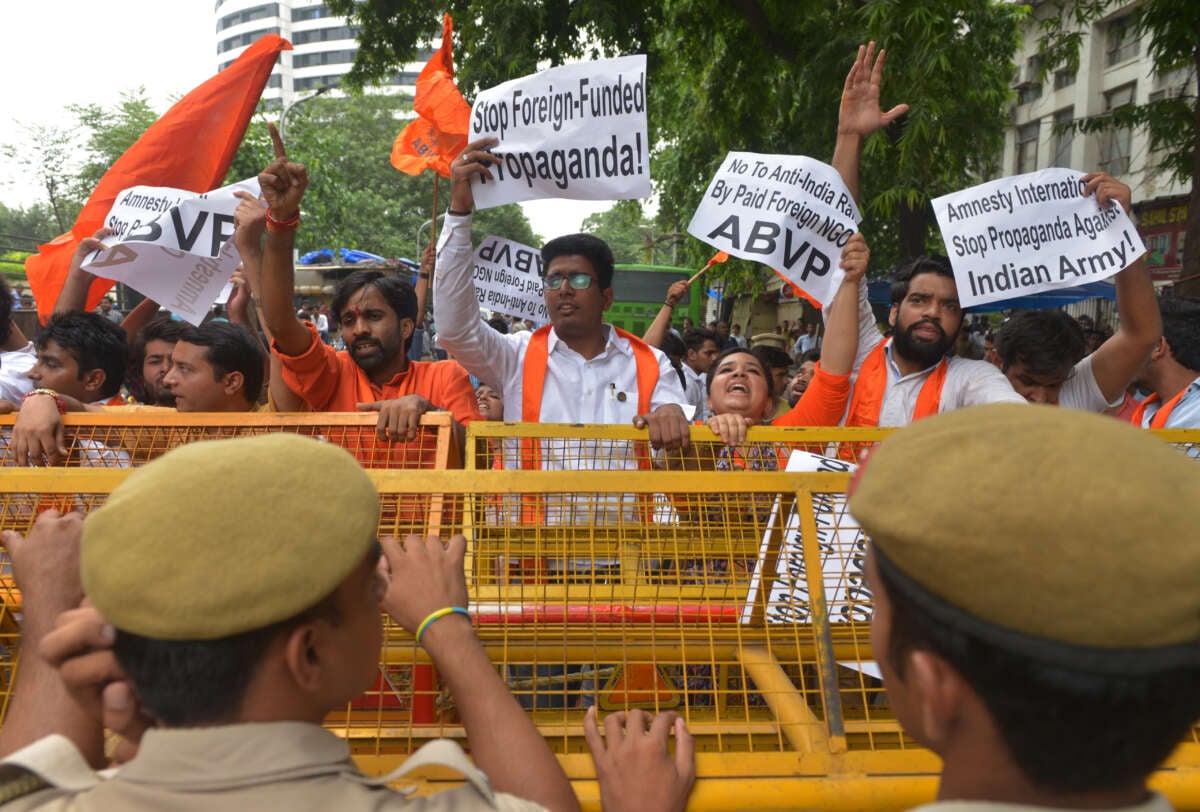
Members of the right-wing Hindu nationalist group ABVP shout slogans against human rights group Amnesty International India, in New Delhi, India
.K Asif / The India Today Group via Getty Images

In March 2023, Meeta, who worked as a community mobilizer and network coordinator with a prominent Delhi-based Indian NGO, lost her job of 15 years. Meeta was fired less than a month after her organization lost its status under the Foreign Contribution (Regulation) Act (FCRA), which governs the receipt and use of foreign funds by nonprofits in India. Organizations without a valid FCRA certification are barred from accessing international donations.

Meeta’s employer is just one of several nonprofit organizations and human rights leaders who have been dismantled or had their work obstructed by the Indian government’s free reign to revoke their FCRA status.

In the U.S., a recent legislative proposal, HR 9495, threatens to impose a familiar type of restriction on nonprofits. Much like the FCRA allows India’s Ministry of Home Affairs to strip nonprofits of certain fundraising status, the proposed bill in the United States would allow the treasury secretary to remove the tax-exempt status of any nonprofit that they unilaterally deem to be a “terrorist supporting organization” without due process or evidence requirements. While the bill was passed in the U.S. House of Representatives in the last legislative session, it never made it through the Senate; now, with a Republican Senate, there are concerns the bill could be reintroduced and more easily become law.

The bill’s critics say this could have far-reaching consequences for organizations engaged in politically sensitive advocacy, and have nicknamed it the “nonprofit killer” bill.

As U.S.-based groups brace for a potential shift in nonprofit funding, India’s experience serves as both a cautionary tale and a stark example of what the U.S. nonprofit sector may endure if HR 9495 is implemented.

Related Story
The Right Has a 150-Page Battle Plan to Shut Down Progressive Civil Society
Attacks on Palestine solidarity are the opening salvo in the right’s stated plan to suppress social justice groups. By Negin Owliaei & Maya Schenwar , Truthout November 27, 2024


Human Rights Work Affected


After losing her job, Meeta, who requested to use a pseudonym in order to speak candidly about her former employer, remained unemployed for nine months. A single mother of two, after years of renting she had just bought a house on a personal loan a month before being let go. But without a job, repaying the loan became a struggle.

Meanwhile, her former employer, which works on sustainable livelihoods, climate resilience and urban homelessness, among other issues, is one of thousands of nonprofits in India that have lost their ability to receive foreign funds under the FCRA over the last several decades, either due to cancellations or nonrenewals of their certification. Without that funding, sources say the organization has had to dramatically downsize.

Some of the most high-profile organizations affected by FCRA restrictions include the Centre for Policy Research (CPR), Save The Children and World Vision, whose licenses have been canceled. Several rights organizations, like Amnesty International India, Environics Trust and Oxfam India, as well as individual activists, like environmental lawyer Ritwick Dutta and human rights advocate Harsh Mander, are also facing criminal charges under fraud and financial irregularities allegations. This has also impacted employment in India’s vast social sector, which consists of 3.3 million nonprofits that employ over 18 million people. For example, Amnesty International has ceased all of its operations within India.

The Citizen for Justice and Peace, led by Teesta Setalvad, has been a longtime critic of Prime Minister Narendra Modi and his alleged role in the 2002 Gujarat riots, in which more than 1,000 people, mostly Muslim, were killed. That organization also lost its FCRA license in 2016. Setalvad said the revocation of the license is part of the “witch hunt” that the Modi government is conducting to target her for speaking against the perpetrators of the riots.

Civil society groups see this as part of a broader crackdown on dissent in India, especially after a 2020 amendment to the FCRA imposed even further restrictions on organizations. According to the CIVICUS Monitor, a global research platform that tracks and assesses the state of civic freedoms, India’s civic space is classified as “repressed.”

In recent years, the Unlawful Activities (Prevention) Act (UAPA) has been increasingly used in addition to the FCRA to target human rights activists and journalists. The UAPA, India’s primary “anti-terror” law, grants sweeping powers to the state, allowing authorities to designate individuals and organizations as terrorists, detain them without charge for up to 180 days, and impose strict bail conditions. Critics argue that its vague definitions and low conviction rates make it a tool for suppressing dissent, with journalists, activists, poets, Kashmiri civilians, and students frequently targeted under its provisions.

Earlier, the law was primarily used to ban organizations deemed a threat to national security. However, a 2019 amendment to the UAPA made it even more powerful by allowing the government to designate individuals as terrorists. Its application surged in the wake of protests around some of the Modi government’s more controversial policies, with several student activists, journalists and lawyers jailed under its provisions.

Now, the tightening of FCRA limitations has further contributed to shrinking this already restricted space.

Several NGOs told Truthout that losing access to foreign funds has drastically affected their ability to sustain human rights work at scale.

Speaking on the condition of anonymity, a spokesperson for another prominent NGO that has been operating in India since independence — working on sustainable livelihoods, education, health and gender issues among marginalized communities — revealed that it has been forced to shut down operations across all states. Similarly, the NGO that Meeta used to work for notes that 95 percent of its operations have had to be scaled down, impacting a majority of its beneficiaries including the urban poor and the homeless, especially from Dalit, Adivasi and religious minority communities.

While the reason for the FCRA nonrenewal of Meeta’s employer was not specified, the other NGO’s reject notice mentioned involvement in activities deemed prejudicial to the public interest ongoing legal cases involving figures in the organization. This falls under Section 12(4) of the FCRA, which states that if any office bearer has a pending prosecution, it can impact the organization’s eligibility, and Section 14(c), which grants the government the authority to cancel an FCRA certificate if it deems it necessary in the public interest. However, the law does not define what constitutes public interest. In attempt to gain renewal, the second NGO said it promptly replaced the board members and submitted an updated list, but this did not change the outcome.

Anisha*, a Supreme Court lawyer who has handled cases involving NGOs and their FCRA licenses and also spoke with Truthout under condition of anonymity, notes that because Section 14(c) is so broadly worded, it makes it easy for authorities to issue vague orders alleging that an organization is acting against public interest and cancel its registration.

Curiously, Section 14(2) of the law says that no order of cancellation shall be made unless the person concerned has been given a reasonable opportunity to be heard. The organizations Truthout spoke to said this has not been the case for their groups when their FCRA registration was canceled or not renewed.

After multiple organizations appealed to the Ministry of Home Affairs for clarification on their FCRA denials, the government, on November 8, 2024, released a notice that cited the reasons for rejection. These included involvement in “anti-development activities,” “inciting malicious protests” and participation in “induced/forceful religious conversions.” Yet again, none of these terms were specifically defined. “This denial has restricted development efforts in reaching the most marginalized communities, and hinders progress on persistent issues such as malnutrition, education, livelihoods, gender, and caste-based discrimination,” said Annie Namala, executive director of the Centre for Social Equity and Inclusion (CSEI). While CSEI is among the NGOs whose FCRA has been renewed, there continues to be uncertainty about making long-term plans for the organization’s work.

“It has also curtailed work that sheds light on critical policy gaps. In the short term, this will directly impact vulnerable populations; in the long run, it will slow national development and progress. This goes against the very development we are all hoping to achieve,” continued Namala.

Even before the mass cancellations, the 2020 amendment to the FCRA had already made it significantly harder to carry out human rights work, say experts. The amendment introduced several restrictive measures, including barring NGOs from sub-granting foreign funds to other FCRA-registered organizations.

“Sub-granting was a very important part of most NGOs work. It allowed us to collaborate with grassroots organizations, and smaller organizations and reach the ground more strongly. Now that we can’t subgrant, we are unable to do any of those,” says Namala. The amendment also capped administrative expenses at 20 percent of an organization’s foreign funds, making it difficult to cover operational costs.

Sambhavna Trust Clinic, which has been a vital source of free specialized medical care for over 37,000 survivors of the Bhopal gas tragedy, was forced to shut down on December 31, 2024, after prolonged delays in renewing its FCRA registration. Founded in 1996 with support from donors around the world, the clinic has been the only facility in Bhopal dedicated to providing long-term health care to those affected by the Union Carbide gas disaster of 1984. (Survivors of the disaster are continuing to fight for remediation and reparations from Dow Chemical, which took over Union Carbide in 2001.) Since losing its FCRA registration in 2019, the clinic has faced mounting challenges. Its daily patient count has dropped from 180 to 200 to just 80 or so over the past five years. “Many essential medicines had to be discontinued, including the Nirgundi oil, which we developed as a safer alternative to harmful painkillers,” says Satinath Sarangi, managing trustee of the clinic.

By November 2024, the clinic ran out of funds and faced liabilities of more than $1.4 million. Staff salaries were slashed by 30 percent and operations ceased, says Sarangi. On January 1, 2025, clinic members led by the leaders of the Union Carbide Poison Victims Healthcare Rights Front, began a sit-in protest.

Fortunately, on the third day, they received their FCRA registration renewal. Sarangi says they are grateful for the decision, and operations have resumed. However, he remains unsure about what prompted the government’s swift action.
Silencing Civil Society

A source who worked at the same organization as Meera notes that words like “human rights” and “advocacy” had to be removed from their official documents because of fear of further intervention.

Anisha, who is using a pseudonym for concerns over professional retribution, says that she has seen a rise in persecution of organizations that undertake advocacy work that does not align with government interests and policies. “NGOs that purportedly present India in a bad light or NGOs promoting interests of minority groups are particularly targeted,” she adds.

In 2022, U.K.-based NGO Save The Children’s Indian counterpart Bal Raksha Bharat, one of India’s leading child rights organizations, came under the government’s radar after the Ministry of Women and Child Development objected to its fundraising campaign on malnutrition, on the ground that the issue was already being addressed by the government. In 2023, Bal Raksha Bharat lost its FCRA status. India has a high prevalence of malnutrition, ranking 105th out of 127 countries on the Global Hunger Index in 2024.

Legal Initiative for Forest and Environment (LIFE) is another NGO that lost its FCRA status in 2023. Ritwick Dutta, an environmental lawyer and a founder of LIFE, is currently mired in a Central Bureau of Investigation (CBI) case against him; the government alleges he was using foreign donations to fund legal activism to “take down India’s existing or proposed coal projects,” and “harm India’s national security.”

LIFE has played a key role in protecting environmental law and helping communities impacted by environmentally harmful projects. Many of these projects are pushed through by bypassing regulations, threatening people’s livelihoods, health and local ecosystems.

Dutta says that neither he nor LIFE has ever been a litigant in any legal case. LIFE relied on foreign funding for 75 to 80 percent of its budget, Dutta says, but with that support now entirely cut off, its work has come to a halt. “We are no longer conducting capacity-building programs, workshops, meetings, or other activities,” he adds.

In the case of Oxfam, LIFE and Environics, Dutta shares that the government first targeted them by revoking their nonprofit status under 12A of the Income Tax Act, which grants nonprofits tax exemptions. “This is the pattern. Once your 12A status is revoked, organizations also lose their ability to secure domestic funding, because it disincentivizes donors from contributing as their donations are no longer tax-exempt,” says Dutta.

Recently, the Income Tax Department revoked the nonprofit status of the Reporters’ Collective, a digital media outlet known for its investigative journalism, saying that their journalism does not serve any public purpose. The collective conducted a wide variety of investigations critical of the ruling government, including reporting on the government’s role in helping coal miners greenwash their violations of environmental laws, as well as on a questionable solar power auction orchestrated by the Modi government that laid the groundwork for an infamous bribery scandal.

Dutta feels that there is a pattern to all these decisions — shutting down voices critical of the government. “The easiest way to silence an organization is through FCRA. If you have FCRA, you can be shut down at any time. No organization with FCRA will dare to speak against the government.”

Dutta, who is challenging the charges, anticipates a prolonged legal battle. When asked about its impact on organizations, he notes that the repercussions extend beyond his case. “It has affected training and capacity building around environmental law. Now there’s a sense of fear among organizations and they will think twice before proceeding with their work,” he says.

That sense of fear is also palpable in the U.S., where rights groups consider what could be coming if HR 9495 becomes law under a Trump administration, offering what the ACLU has called, “a blank check for presidents to shut down organizations that criticize them.” Oxfam has even warned that the bill follows the same “playbook” that other governments worldwide use to crush dissent. If India’s experience is any indication, the passage of this bill could lead to a severe contraction of civil society space, mirroring the shrinking landscape of activism and advocacy in India.

This article is licensed under Creative Commons (CC BY-NC-ND 4.0), and you are free to share and republish under the terms of the license.


Ankita Dhar Karmakar is an independent journalist who reports on gender issues, human rights and education, among other beats. Her work has been featured in BehanBox, The Wire, Swaddle and Sabrang Media. Ankita has worked as a staff reporter at BehanBox, a digital media platform focusing on gender journalism. She is the recipient of the 4th South Asia Laadli Media & Advertising Award For Gender Sensitivity and the 14th Laadli Media Award.


UK Education system needs overhaul to support school anxiety, psychologists say


Book Announcement

Taylor & Francis Group


The UK education system must urgently change to be more understanding of school ‘refusers’, as returning to school might not be the right outcome for some children, psychologists say.

While much has been made of school attendance figures in recent months, a group of experts are suggesting not enough attention has been given to the experiences of parents and young people experiencing school distress.

In a new book, What Can We Do When School’s Not Working?, a parent and two psychologists are urging educators working with children to change their outlook.

Abigail Fisher, a qualified teacher and educational psychologist, Naomi Fisher, a clinical psychologist and author, and illustrator and author Eliza Fricker, are calling on SENCOs, educational support workers, senior leadership teams and local authorities to accept that pushing children into school is not always the healthiest approach.

Naomi herself experienced school distress, and Abigail is her sister, with both going on to train as psychologists. Eliza is the parent of a child with school anxiety.

Naomi explains how hard it can be to experience anxiety around attending school: “My experience has shown me that when things are going wrong for a child at school, we tend to locate the problem in young people and their parents. We don’t think enough about what is happening in our schools.

“As a child, I had my own difficulties in attending school. I was called ‘school phobic’. Now we often say that children have ‘emotionally based school avoidance’ or EBSA. Both terms assume that the child’s reaction to school is the problem, rather than what is going on at school.

“I think we need to shift our perspective. The evidence indicates that many children cannot thrive and learn in the schools we have created for them.  We need to see our children’s reactions – both emotional and behavioural – as important feedback on the system and as an impetus for change.”

The authors have pushed back against recent conversations in the press and among policymakers about school attendance, including the term ‘school refuser’, suggesting it puts the blame on the child – tending instead to refer to children struggling with school attendance or school-based distress.

The book, which is informed by research, clinical practice and lived experience, aims to bring together diverse perspectives on school attendance and to offer different ways to approach this difficult and complex area with young people and their families. It also looks to give professionals insight into the experience of families and young people who struggle with school attendance.

“Young people who do not attend school lack opportunities to learn and are often told that they are failures or losers. These young people have frequently had very bad experiences at school, and may have learnt to think in ways which block their learning, for example thinking about themselves as worthless or as incapable,” the authors say. “It is a big shift to let go of school attendance as the primary goal and to consider what else might work for these children, but for some that is exactly what they require.”

The book comes amid Government talks of a clampdown on pupils missing school and a curriculum review to make school more appealing to pupils currently turned off by it, while some educators and parents are concerned that schools spend too much time on disengaged pupils, which is disrupting the education of those who want to learn.

The authors say that their book is aimed at schools and education practitioners in the hope that they will realise what children with school-based distress are experiencing and change their practice.

“Schools are where young people spend the majority of their time, and it’s where they do much of their growing up,” they explain. “They are learning just as much from how they are treated as from what they are being taught in their lessons.”

The authors cite a body of evidence showing that the more that schools try to change young people’s behaviour and learning with rewards and sanctions, the less young people will be internally motivated to behave well and to learn for its own sake. They also say that having heard from parents, these behaviour modification techniques also have an impact on some children’s self-esteem and emotional well-being, which puts some of them on a path towards school attendance difficulties.

“Creating psychologically healthy schools requires deliberate shifts on the part of educators and school leadership teams towards collaboration and relationships. It doesn’t just happen,” they explain. “It takes a brave educator to make that change, because the prevailing culture of education is that the focus should be on improving test scores, with many interventions being judged against this benchmark.”

The authors put forward a host of suggestions, from creating more psychologically healthy school environments that focus more on holistic wellbeing than attendance figures, utilising interventions for at-risk children such as collaborative open-ended projects or interest-based programmes. They also suggest that forcing children into school, making both home and school unpleasant, can cause chronic stress leading to severe burnout – in which case not returning to school and seeking alternative education is the best option.

“It’s not really feasible that school creates better outcomes for everyone, even those who are very unhappy or failing there. We know that attending school isn’t sufficient for a child to do well, because many children attend school for years and do very poorly at the end. The school building is not infused with magical properties. Not everyone can learn there and for some, insisting that they attend every day prevents them from learning,” they explain.

“As a society we are letting down the children who struggle to attend school. We are not providing them with accessible opportunities to learn – and consequently, they have poor outcomes. This perspective opens up new possibilities, namely whether it could be possible to change what happens when a young person struggles to attend school. The insistence that school is the only way to learn excludes many young people from education.”

 UK

Play “humanizes” pediatric care and should be key feature of a child-friendly NHS – report


University of Cambridge


Play should be a core feature of children’s healthcare in forthcoming plans for the future of the NHS, according to a new report which argues that play “humanises” the experiences of child patients.

The report, by University of Cambridge academics for the charity Starlight, calls for play, games and playful approaches to be integrated into a ‘holistic’ model of children’s healthcare – one that acknowledges the emotional and psychological dimensions of good health, alongside its physical aspects.

Both internationally and in the UK, health systems have, in recent decades, increasingly promoted play in paediatric healthcare. There is a growing understanding that making healthcare more child-friendly can reduce stress and positively improve younger patients’ experiences.

Despite this recognition, play often remains undervalued and inconsistently integrated across healthcare contexts. For the first time, the report compiles evidence from over 120 studies to make the case for its more systematic incorporation.

In the case of the UK, the authors argue that the Government’s forthcoming 10-year health plan for the NHS offers an important opportunity to embed play within a more holistic vision for childhood health.
 

The report was produced by academics at the Centre for Play in Education, Development and Learning (PEDAL) at the Faculty of Education, University of Cambridge. Starlight, which commissioned the review, is a national charity advocating to reduce trauma through play in children’s healthcare.


Dr Kelsey Graber, the report’s lead author, said: “Play and child-centred activities have a unique capacity to support the emotional and mental aspects of children’s healthcare experiences, whether in hospital or during a routine treatment at the GP. It won’t directly change the course of an illness, but it can humanise the experience by reducing stress and anxiety and enhancing understanding and comfort. Hospital-based play opens up a far more complete understanding of what it means for a child to be a healthy or well.”
 

Adrian Voce, Head of Policy and Public Affairs at Starlight, said: “With the government promising to create the healthiest generation of children ever as part of its new long term health plan, this compelling evidence of the benefits of play to children’s healthcare is very timely. We encourage ministers and NHS leaders to make health play teams an integral part of paediatric care.”

The report synthesised evidence from 127 studies in 29 countries. Most were published after 2020, reflecting intensified interest in children’s healthcare interventions following the COVID-19 outbreak.


Some studies focused on medically-relevant play. For example, hospital staff sometimes use role-play, or games and toys like Playmobil Hospital to familiarise children with medical procedures and ease anxiety. Other studies focused on non-medical play: the use of activities like social games, video games, arts and crafts, music therapy and storytelling to help make patients more comfortable. Some hospitals and surgeries even provide “distraction kits” to help children relax.

In its survey of all these studies, the report finds strong evidence that play benefits children’s psychological health and wellbeing. Play is also sometimes associated with positive physical health; one study, for example, found that children who played an online game about dentistry had lower heart rates during a subsequent dental procedure, probably because they felt more prepared.

The authors identify five main ways in which play enhances children’s healthcare based on the available body of evidence:
 

  1. Reducing stress and discomfort during medical procedures: Play is sometimes associated with physiological markers of reduced distress, such as lower heart rates and blood pressure. Therapeutic play can also ease pain and anxiety.


  1. Helping children express and manage emotions. Play can help to alleviate fear, anxiety, boredom and loneliness in healthcare settings. It also provides an outlet for emotional expression among all age groups.


  1. Fostering dignity and agency. In an environment where children often feel powerless and a lack of personal choice, play provides a sense of control which supports mental and emotional wellbeing.


  1. Building connection and belonging. Play can strengthen children’s relationships with other patients, family members and healthcare staff, easing their experiences in a potentially overwhelming environment. This may be particularly important for children in longer term or palliative care.


  1. Preserving a sense of childhood. Play helps children feel like children, and not just patients, the report suggests, by providing “essential moments of happiness, respite and emotional release”.


While play is widely beneficial, the report stresses that its impact will vary from child to child. This variability highlights a need, the authors note, for informed, child-centred approaches to play in healthcare settings. Unfortunately, play expertise in these settings may often be lacking: only 13% of the studies reviewed covered the work of health play specialists, and most of the reported activities were directed and defined by adults, rather than by children themselves.

The report also highlights a major gap in research on the use of play in mental healthcare. Just three of the 127 studies focused on this area, even though 86% emphasised play’s psychological benefits. The report calls for greater professional and academic attention to the use of play in mental health support, particularly in light of escalating rates of mental health challenges among children and young people. More work is also needed, it adds, to understand the benefits of play-based activities in healthcare for infants and adolescents, both of which groups were under-represented in the research literature.

Embedding play more fully in healthcare as part of wider Government reforms, the authors suggest, could reduce healthcare-related trauma and improve long-term outcomes for children. “It is not just healthcare professionals, but also policy leaders who need to recognise the value of play,” Graber said. “That recognition is foundational to ensuring that children’s developmental, psychological, and emotional health needs are met, alongside their physical health.”


The report, Playing with children’s health? will be published on the Starlight website on 31 March: https://www.starlight.org.uk/


Jun 6, 2023 ... 400.8M. 220 p. 23 cm. Huizinga, Johan 'This edition is prepared ... PDF download · download 1 file · SINGLE PAGE ORIGINAL JP2 TAR download.


Stricter oversight needed as financial misconduct drives risk-taking in banking


University of East Anglia


Banks facing regulatory sanctions for financial misconduct tend to adopt riskier business practices, according to new research.

The authors warn repeated or systemic misconduct can accelerate risk-taking in ways that weaken both individual institutions and the wider financial system.

Researchers from the University of East Anglia (UEA), the US Department of the Treasury and Bangor University, in the UK, drew on data from nearly 1,000 publicly listed US banks from 1998 to 2023 - a period spanning multiple economic cycles including the 2007–09 financial crisis.

Their findings, published today in the Journal of Banking & Finance, show that banks referred to authorities for violations - ranging from misrepresentation to failures in anti-money-laundering systems - are significantly more likely to engage in risk-heavy strategies and speculative lending.

Board characteristics can make a difference, with larger and more independent boards, particularly those with older or gender-diverse membership, often dampening the negative impact of misconduct. However, if CEOs hold extensive power or if short-term focused institutional investors hold large stakes, even robust boards may struggle to rein in risky behaviour.

Dr Yurtsev Uymaz from UEA’s Norwich Business School said: “We show that enforcement actions and class-action lawsuits against US banks are linked to increased levels of bank risk-taking. Even one enforcement action correlates with higher risk; for banks facing multiple actions, the effect can be markedly stronger.

“There appears to be no deterrent effect from the fact that banks facing multiple actions experience even higher risk.”

Banks play a foundational role in fuelling economic growth. The study authors, including Prof John Thornton of Norwich Business School and the US Department of the Treasury, and Prof Yener AltunbaÅŸ of Bangor University, warn unethical conduct that fuels risk-taking can reverberate widely, potentially undermining key forms of credit or amplifying systemic instabilities.

Commenting on the implications for policymakers and stakeholders, such as investors and the public, Dr Yurtsev Uymaz said: “Our findings underscore how lapses in ethical conduct can open the door to riskier practices. This doesn’t just affect a bank’s own stability; it ripples out into the wider economy.

“At the same time, we see that strong governance - embodied in larger, more diverse boards - can help reduce the adverse impacts of misconduct. However, these safeguards can be undermined if CEOs wield too much power or if investors push aggressively for short-term returns.

“Addressing these governance gaps, while also strengthening supervision, is critical to ensuring the banking sector supports sustained economic growth rather than threatens it.”

The study adds to a growing discussion of how misconduct can accelerate systemic risks -especially if fines, reputational damage, and other penalties consume bank resources or divert attention from responsible lending.

The researchers make a number of recommendations, including tighter regulatory oversight and enhanced board accountability.

“Regulators could benefit from deploying extra scrutiny on institutions with even a single documented infraction, rather than solely focusing on banks with persistent or repeated misconduct,” said Prof Thornton.

“Ensuring boards have the independence, capacity, and diversity to challenge powerful executives can help deter strategies motivated by short-term gains but detrimental to long-term stability.

“And regular stress-testing exercises should also explicitly factor in the potential for misconduct-related events, capturing associated legal and reputational costs.”

They add that policymakers might explore incentives or structures that promote longer-term thinking among institutional investors, balancing out near-term profit goals with systemic safety.

‘Financial misconduct and bank risk-taking: evidence from US banks’, John Thornton, Yener AltunbaÅŸ and Yurtsev Uymaz is published in Journal of Banking & Finance on March 31.


Mind the seismic gap: Understanding earthquake types in Guerrero, Mexico


Kobe University
250331-Suenaga-Interplate-Guerrero 

image: 

Guerrero, Mexico is an active site with several recent major earthquakes, but also a small area called the ‘Guerrero seismic gap’ (pictured) where no earthquakes have occurred for more than a century. Combined with the fact that it is also an actively studied area, which increases the availability of data, Kobe University geophysicists around SUENAGA Nobuaki decided to see if their simulations could explain the different types of earthquakes occurring there.

view more 

Credit: Modified from Alejandro Linares Garcia via Wikipedia (https://commons.wikimedia.org/wiki/File:ViewPuertoVicenteGuerrero2.JPG)


Plate temperature and water release can explain the occurrence of different types of earthquakes in Guerrera, Mexico. The Kobe University simulation study also showed that the shape of the Cocos Plate is responsible for a gap where earthquakes haven’t occurred for more than a century. The results are important for accurate earthquake prediction models in the region.

Where one tectonic plate is pushed down by another, the resulting stress is released in various tectonic events. There are catastrophic megathrust earthquakes, unnoticeable “slow slip events,” and continuous low-frequency “tectonic tremors,” and knowing which occurs under which conditions is essential to predicting earthquake probabilities and thus preparing for disasters. Kobe University geophysicist SUENAGA Nobuaki says: “We are especially interested in gaps where earthquakes are less likely to occur, because we assume that there is some difference in physical conditions at the plate interface.” Being a specialist in three-dimensional computer simulations to understand the relationship between earthquakes, the temperature at the interface between the plates, and the role of water produced when rocks are transformed under great heat and pressure, Suenaga wanted to apply his experience to finding out what conditions create these distribution patterns.

His team also includes the Colombian research assistant Erika Moreno, who experienced a devastating earthquake in 1999 which also destroyed her family’s house. “I did not understand what was happening around me and so I decided to study Earth sciences to add to our knowledge about the nature of earthquakes,” she says, also mentioning that her studies led her from her home country via the National Autonomous University of Mexico to Kobe University for their pioneering research on computational modeling of earthquake mechanism.

Suenaga’s team thus focused on studying the Guerrero region of Mexico, explaining: “In this region there is a gap where no major earthquake has occurred in over a century, and the risk of one occurring in the near future is high and the expected damage is large. So we thought that the area is important.” However, computer models need to be verified by actual measurements, and the data usually used for this is not available in that area. “We introduced a new indicator that uses data obtained by ships, aircraft, satellites etc., and this made it possible to evaluate our model,” explains the Kobe University researcher.

His team published their results in the journal Scientific Reports, reporting three main findings. First, they were able to show that the temperature at the interface between the plates is a good predictor of the type of earthquake. Second, the seismic gap is caused by the specific shape of the plate in that area, which causes temperatures there to be lower than in the surrounding area. And third, water released from the transformation of the rock can explain the occurrence of slow slip events and tectonic tremors. “This study is the first to estimate the specific amount and location of that water and it revealed that the increased pore pressure from the water could reduce the stress between the plates, allowing them to slip more effectively. Thus, the Guerrero seismic gap can release strain energy through slow slip events,” says Suenaga. Simply put, this area is better lubricated.

However, other studies showed that slow slip events likely don’t release the stress in all parts, and in particular not in shallow parts of the plate, which is where megathrust earthquakes causing catastrophic damage occur. Suenaga explains, “Slow slip events are often seen as precursors of huge earthquakes and so it is important to understand the mechanism behind low slip events.” Moreno adds, “Our work is crucial because studying the way plates are pushed underneath others and the processes that occur as a consequence provides insights into the distribution of volcanism and the locations of earthquakes.”

One goal for this work is to help authorities to make better estimates of earthquake risks and thus improve preparedness. But Suenaga wants to generalize the results to other regions. He explains: “Since the tectonic background and underground structure are completely different depending on the region, it is very difficult to construct a single physical model that can explain earthquake phenomena everywhere. However, we hope to get closer to a universal numerical model by continuing to build models for various subduction zones and deepening our understanding of the physics of earthquake occurrence and modeling know-how.”

This research was funded by the Japan Society for the Promotion of Science (grant 21H05203). It was conducted in collaboration with researchers from the National Autonomous University of Mexico and the Chinese Academy of Sciences.

Kobe University is a national university with roots dating back to the Kobe Higher Commercial School founded in 1902. It is now one of Japan’s leading comprehensive research universities with nearly 16,000 students and nearly 1,700 faculty in 10 faculties and schools and 15 graduate schools. Combining the social and natural sciences to cultivate leaders with an interdisciplinary perspective, Kobe University creates knowledge and fosters innovation to address society’s challenges.