Sunday, April 06, 2025

New Projected Cost of Trump-GOP Tax Cuts for the Rich: 'Staggering' $7 Trillion

"What Republicans are trying to jam through Congress right now is a level of economic recklessness we’ve never seen before," said a group of Democratic lawmakers.
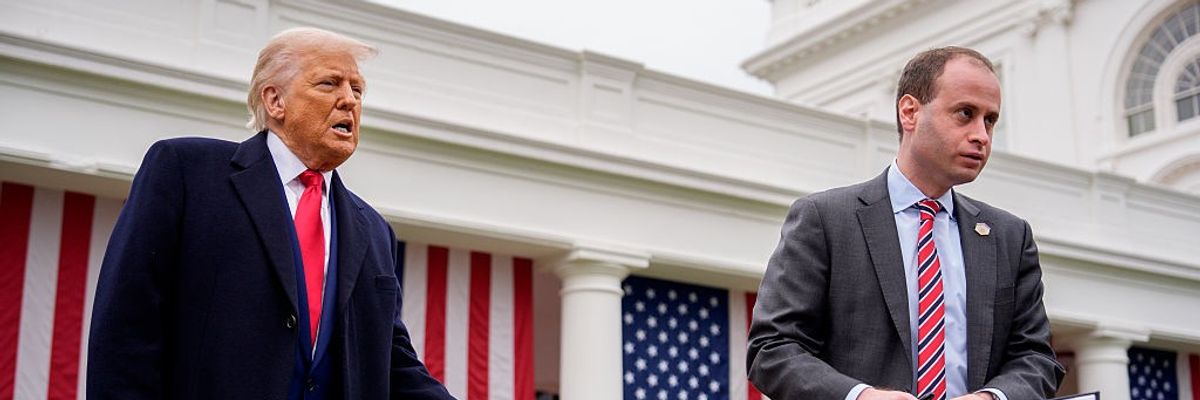


U.S. President Donald Trump stands with White House staff secretary Will Scharf before signing executive orders imposing sweeping tariffs on April 2, 2025 in Washington, D.C.
Photo by Andrew Harnik/Getty Images

Jake Johnson
Apr 04, 2025
COMMON DREAMS

A new analysis indicates Republicans' plan to extend soon-to-expire provisions of their party's 2017 tax law, as well as their push to tack on additional tax breaks largely benefiting the rich and big corporations, would cost $7 trillion over the next decade, a figure that a group of congressional Democrats called "staggering."

The analysis from the nonpartisan Joint Committee on Taxation (JCT), published on Thursday, updates previous estimates that suggested the GOP effort to extend expiring provisions of the 2017 law would cost $4.6 trillion over a 10-year period. The new assessment shows that extending the law's temporary provisions—which disproportionately favored the wealthy—would cost $5.5 trillion over the next decade.

The projected cost of the GOP agenda balloons to $7 trillion after adding Senate Republicans' call for $1.5 trillion in additional tax cuts in the budget resolution they advanced in a party-line vote on Thursday. The GOP has come under fire for using an accounting trick to claim their proposed tax cuts would have no budgetary impact.

"The Republican handouts to billionaires and corporations will come at a staggering cost, and it's unconscionable that their plan to pay for those handouts includes kicking millions of Americans off their health insurance, hiking the cost of living with tariffs, and driving up child hunger," Sen. Ron Wyden (D-Ore.), Sen. Jeff Merkley (D-Ore.), Rep. Richard Neal (D-Mass.), and Rep. Brendan Boyle (D-Pa.) said in a joint statement issued in response to the JCT figures.

"Even after making painful cuts that will inflict hardship on typical American families, Republicans will still risk sending us into a catastrophic debt spiral that does permanent harm to our economy," the Democrats added. "What Republicans are trying to jam through Congress right now is a level of economic recklessness we've never seen before."

The JCT's updated cost analysis came as President Donald Trump plowed ahead with what's been characterized as the biggest tax hike in U.S. history, one that will hit working-class Americans in the form of price increases on household staples and other goods.

Trump administration officials, not known for providing reliable numbers, have claimed the president's sweeping new tariffs could produce roughly $6 trillion in federal revenue over the next decade. The Trump tariffs have sent financial markets into a tailspin, heightened recession fears, and prompted swift retaliation from targeted nations, including China.

In an appearance on MSNBC on Thursday, Boyle—the top Democrat on the House Budget Committee—said Trump's tariffs represent "the single largest tax increase in American history."

"It's a tax that everyone will pay in this country, based on the goods that they buy," said Boyle. "However, it's also a tax that is highly regressive—the poorest amongst us will end up paying a higher percentage of their income."

A previous version of this story incorrectly stated the analysis was conducted by the Congressional Budget Office. It was conducted by the Joint Committee on Taxation.





Trump and Musk Are Out to Kill Social Security

We are all going to have to fight like hell to protect it.


Guests attend a town hall with Sens. Angela Alsobrooks, D-Md., Chris Van Hollen, D-Md., Reps. Kweisi Mfume, D-Md., Johnny Olszewski, D-Md., and Councilman Pat Young at Woodlawn High School in Woodlawn, Md., on Thursday, March 20, 2025.
(Photo: Tom Williams/CQ-Roll Call, Inc via Getty Images)

James Roosevelt Jr
June Hopkins
Apr 05, 2025
Common Dreams


Thank you, Senator Cory Booker. In your record-breaking Senate talk-a-thon, you sounded the alarm about President Donald Trump’s increasingly blatant threats to Social Security, and the devastating impacts for ordinary people who count on it.

Ninety years ago, our three grandfathers created Social Security. It’s the most popular, efficient and effective government program ever, ensuring financial security for 73 million Americans today. Now, appallingly, America's workers and seniors must get ready to fight like hell.

The first draft of Social Security was written by a small committee including Agriculture Secretary Henry A. Wallace and top FDR advisor and Federal Relief Administrator Harry Hopkins, chaired by legendary Labor Secretary Frances Perkins. FDR had insisted that Social Security be funded by a system of payroll taxes, with both worker and employer contributing. He expressed great confidence that this would give workers an unquestionable “legal, moral and political right” to collect benefits.

Save Social Security. Don't "outsource" it. Don’t tolerate this “reverse Robin Hood”—taking from the poor and giving to the rich.

President Dwight Eisenhower got it. There may be “a tiny splinter group” of politicians who want to mess with Social Security, he wrote, but “their number is negligible and they are stupid.”

Now comes Trump and Musk. They’ve fired 7,000 Social Security Administration staffer, citing a “bloated” workforce (actually severely overstretched at 50-year lows), made it harder to access their benefits, and closed most of the regional and field offices, guaranteeing chaos. Musk has called Social Security a "Ponzi scheme" (it’s NOT), and shared a post calling Social Security recipients “the parasite class.” Trump has lied that Social Security benefits are being collected by illegal immigrants (they actually strengthen Social Security by paying payroll taxes while being barred from collecting benefits) and by tens of millions of people over 120 years old (nobody in the worldis over 120 years old, and in fact, only 89,000 people over age 99 receive Social Security benefits). Musk says fraud in "entitlement spending … is the big one to eliminate".

Now, after whipping up anger at imaginary Social Security abuses, Trump is proposing to end all federal taxes on people earning less than $150,000—the largest category of taxes for people in that bracket being the payroll taxes that sustain Social Security— which, when combined with the current payroll tax cap of $176,000, would leave Social Security with virtually no revenues. Trump previously promised to completely end payroll taxes.

Could their intentions be any clearer? Trump campaigned on a promise that Social Security "will not be touched, it will only be strengthened" (and Musk has recently promised that benefits will be increased, unbelievably, without congressional action and without worsening the government spending he enjoys slashing with his chainsaw).

Today, the CEO earning $10 million a year hits that limit and stops paying payroll taxes after the first week of the year, while his janitor keeps paying the 6.2% payroll tax for the next 51 weeks. It's an outrage against all working people.

But remember how a previous President, George W. Bush, wanted to "strengthen" Social Security? By privatizing it. Trump's acting Social Security Commissioner now prefers to frame it as "outsourcing."

The Washington Post reports that with seniors “beside themselves” with uncertainty stoked by all the cutbacks, “many current and former [Social Security] officials” fear that the ultimate goal is privatization. And they’ve got plenty of company among Democrats in Congress. (Trump’s Treasury Secretary recently suggested that the goal was to privatize everything government does.) And Trump’s likeliest argument is that the only way to prevent benefit cuts driven by the system’s looming solvency crisis, and strengthen retirement security, is to put Social Security’s money in Wall Street (rich financiers would surely love the extra $3 trillion in investments).

The fact is that there is absolutely no way for Musk and Trump to reach their goal of eliminating $2 trillion in federal spending without either 1) raising revenues or 2) decimating the largest federal spending program in America: Social Security (Medicare and Medicaid are not far behind).

What could avert such stupidity? Revenues. Make the wealthy pay their fair share. One no-brainer example: eliminate the current $176,000 cap on payroll taxes. Today, the CEO earning $10 million a year hits that limit and stops paying payroll taxes after the first week of the year, while his janitor keeps paying the 6.2% payroll tax for the next 51 weeks. It's an outrage against all working people.

What related outrages should we expect? Start with Trump’s promised $5 trillion of tax cuts for billionaires (like Trump and Musk). That’s the justification for all of Trump’s cuts to programs that help ordinary people, from veterans to children to health care to preventing terrorism. And don’t imagine for a second that the privatization of Social Security can be blocked in Congress, as it was under President George W. Bush. Trump’s reign of boundary-pushing executive orders has made a supine Congress irrelevant and the Constitution a technicality.

Save Social Security. Don't "outsource" it. Don’t tolerate this “reverse Robin Hood”—taking from the poor and giving to the rich. Don’t count on “guardrails” like Congress or the courts. It will take a movement of ordinary Americans shouting to protect FDR’s greatest legacy of financial security for working people.


Our work is licensed under Creative Commons (CC BY-NC-ND 3.0). Feel free to republish and share widely.


James Roosevelt Jr.
James Roosevelt Jr. is the grandson of President Franklin D. Roosevelt and first lady Eleanor Roosevelt. He is also a former associate commissioner at the Social Security Administration.
Full Bio >
Henry Scott Wallace
Henry Scott Wallace is an attorney and foundation executive.
Full Bio >
June Hopkins
June Hopkins is a professor of History Emerita, Georgia Southern University, Armstrong Campus.
Full Bio >
China Retaliates Against Trump 'Bullying' With 34% Tariffs on All US Goods


"Trade and tariff wars have no winners," said China's foreign ministry. "We urge the U.S. to stop doing the wrong thing."


Jake Johnson
Apr 04, 2025
COMMON DREAMS


The Chinese government on Friday responded to U.S. President Donald Trump's sweeping new tariffs with 34% import duties on all American goods beginning next week, intensifying global blowback against the White House and accelerating a worldwide financial market tailspin.

China's tariffs on U.S. imports, which match the tariffs the Trump administration moved this week to impose on Chinese goods, are set to take effect on April 10. Trump's 34% tariffs on Chinese imports come on top of the 20% tariffs the U.S. president imposed earlier this year.

"The U.S. approach does not conform to international trade rules, seriously damages China's legitimate rights and interests, and is a typical unilateral bullying practice," China's Ministry of Finance said in a Friday statement.

Additionally, China's Commerce Ministry announced immediate export restrictions on rare earth materials and "added 16 entities from the U.S., including High Point Aerotechnologies and Universal Logistics Holdings Inc., to its export control list," according to the state-run China Daily.

"Under the new rule," the outlet reported, "Chinese companies are prohibited from exporting dual-use items to these 16 U.S. entities. Any ongoing related export activities should be immediately halted, said the Ministry of Commerce."

Retaliatory tariffs from the world's second-largest economy mark the latest step in a global trade war launched by the Trump White House, which—despite warnings of disastrous impacts for working-class U.S. households and the broader economy—plowed ahead this week with a 10% universal tariff on imports and larger tariffs on a number of trading partners, including China.

Following Trump's official tariff announcement, Beijing condemned the duties as "unacceptable" and vowed to "take measures as necessary to firmly defend [China's] legitimate interests."

"Trade and tariff wars have no winners. Protectionism leads nowhere," said the spokesperson for China's foreign ministry on Thursday. "We urge the U.S. to stop doing the wrong thing, and resolve trade differences with China and other countries through consultation with equality, respect, and mutual benefit."

Other nations hit by Trump's tariffs are expected to respond in the coming days.

European Commission President Ursula von der Leyen told reporters Thursday that the E.U. was "already finalizing the first package of countermeasures in response to tariffs on steel, and we are now preparing for further countermeasures to protect our interests and our businesses if negotiations fail."

Canadian Prime Minister Mark Carney vowed that "we are going to fight these tariffs with countermeasures."

"In a crisis, it's important to come together and it's essential to act with purpose and with force," Carney added. "And that's what we will do."

'Batsh*t Crazy' Trump Tariffs Should Be Seen as $7,000 Tax Hike on Workers, Says Economist

Instead of strategically imposing tariffs, Trump has chosen to "give the country the most massive tax increase in its history, possibly exceeding $1 trillion on an annual basis."


Traders work on the floor of the New York Stock Exchange during morning trading on April 3, 2025 in New York City.
(Photo: Michael M. Santiago/Getty Images)


Jessica Corbett
Apr 03, 2025
COMMON DREAMS


As stocks "nosedived" on Thursday, economists, policymakers, and campaigners around the world continued to warn about the impacts of U.S. President Donald Trump's trade war, which includes a 10% universal tariff for imports and steeper duties—that he claims are "reciprocal"—for dozens of countries, set to take effect over the next week.

"This is how you sabotage the world's economic engine while claiming to supercharge it," wrote Nigel Green, CEO of the international financial consultancy deVere Group. "Trump is blowing up the post-war system that made the U.S. and the world more prosperous, and he's doing it with reckless confidence."

As Bloombergdetailed after the president's "Liberation Day" remarks from the White House Rose Garden:
China's cumulative tariff rate of 54% includes both the 20% duty already charged earlier this year, added to the 34% levy calculated as part of Trump's so-called reciprocal plan, according to people familiar with the matter. The European Union's rate is 20% and Vietnam's is 46%, White House documents showed. Other nations slapped with larger tariffs include Japan with 24%, South Korea with 25%, India with 26%, Cambodia with 49%, and Taiwan with 32%.

In Europe on Thursday, "the regional Stoxx 600 index provisionally ended down around 2.7%," while "the U.K.'s FTSE 100 was down 1.6%, with France's CAC 40 and Germany's DAX posting deeper losses of 3.3% and 3.1%, respectively," according toCNBC.

In the United States, CNBCreported, "the broad market index dropped 4%, putting it on track for its worst day since September 2022. The Dow Jones Industrial Average tumbled 1,200 points, or 3%, while the Nasdaq Composite fell 5%. The slide across equities was broad, with decliners at the New York Stock Exchange outnumbering advancers by 6-to-1."


However, as Economic Policy Institute (EPI) chief economist Josh Bivens noted last week, "because most households depend overwhelmingly on wages from work as their primary source of income and not returns from wealth-holding, the stock market tells us nothing about these households' economic situations."

And Trump's tariffs are expected to hit U.S. households hard, as the cost of his taxes on imports are passed on to consumers.

"Tariffs can be a legitimate and useful tool in industrial policy for well-defined strategic goals, but broad-based tariffs that significantly raise the average effective tariff rate in the United States are unwise," Bivens and EPI senior economist Adam Hersh stressed in a Thursday statement—which also called out Trump for mischaracterizing one of the think tank's 2022 analyses.

"Further, the second Trump administration's rationale, parameters, and timeline for tariffs have been ever-shifting," Bivens and Hersh continued. "As the original post cited by the administration argues, tariffs should not be a goal unto themselves, but a strategic tool to pair with other efforts to restore American competitiveness in narrowly targeted industrial sectors."

Instead of strategically imposing tariffs, Trump has chosen to "give the country the most massive tax increase in its history, possibly exceeding $1 trillion on an annual basis, which comes to $7,000 per household," warned Center for Economic and Policy Research co-founder and senior economist Dean Baker. "And this tax hike will primarily hit moderate and middle-income families. Trump's taxes go easy on the rich, who spend a smaller share of their income on imported goods."

Baker—like various other economists and journalists—also took aim at Trump's claims that the tariffs are reciprocal, explaining:
Trump's team calculated our trade deficit with each country and divided it by their exports to the United States. Trump decided that this figure was equal to that country's tariff on goods imported from the U.S.

Trump's method of calculating tariffs is comparable to the doctor who assesses your proper weight by dividing your height by your birthday. Any doctor who did this is clearly batshit crazy, and unfortunately so is our president. And apparently none of his economic advisers has the courage and integrity to set him straight or to resign.

However, outside Trump's administration, the intense criticism continued to mount, including from groups focused on combating the fossil fuel-driven climate emergency, which also endangers the global economy.

Andreas Sieber, associate director of policy and Campaigns at 350.org, said Thursday that "Trump's tariffs won't slow the global energy transition—they'll only hurt ordinary people, particularly Americans."

"Despite his claims he 'gets' economic policy, his record tells a different story: Tariffs are tanking U.S. stocks and fueling inflation," Sieber added. "The transition to renewables is unstoppable, with or without him. His latest move does little to impact the booming clean energy market but will isolate the U.S. and drive up costs for American consumers."

Allie Rosenbluth, U.S. campaign manager at Oil Change International, similarly emphasized that "Trump's tariffs will hurt working families first and foremost, raising costs for essentials we depend on and threatening to plunge the U.S. economy into a recession. Though Trump pretends to care about the cost of living for ordinary people, his real loyalties lie with his fossil fuel industry donors."

"If he actually cared about energy affordability, he would stop bullying other countries into buying more U.S. liquefied natural gas (LNG), which boosts the fossil fuel industry's profits, but results in increased prices for domestic consumers and pushes us further toward climate catastrophe," she asserted. "The one step countries can take to hit Trump where it hurts most is wean off their dependency on fossil fuels from the United States."


The impact of Trump's new levies won't be limited to working-class people in the United States. Nick Dearden, director of U.K.-based Global Justice Now, pointed out that "Trump has set light to the global economy and unleashed a world of pain, not least on a group of developing countries that will suffer tremendous impoverishment as a result of his punitive tariffs."

"All those affected must come together and stand up to this bully by building a very different international economy that promotes the interests of ordinary people rather than the oligarchs standing behind Trump," he argued. "For all its scraping and crawling, the U.K. got no special treatment here, and the government should learn this lesson fast: They need to stop giving away our rights and protections in a futile effort to appease Donald Trump."

Leaders in the United States are also encouraging resistance to Trump. U.S. Sen. Chris Murphy (D-Conn.) said Wednesday that "this week you will read many confused economists and political pundits who won't understand how the tariffs make economic sense. That's because they don't. They aren't designed as economic policy. The tariffs are simply a new, super dangerous political tool."

Murphy made the case that "the tariffs are DESIGNED to create economic hardship. Why? So that Trump has a straight face rationale for releasing them, business by business or industry by industry. As he adjusts or grants relief, it's a win-win: the economy improves and dissent disappears."

"But as long as we see this clearly, we can stop him. Public mobilization is working. Today, a few Republicans joined Democrats to vote against one set of tariffs," he added, referring to a resolution that would undo levies on Canadian imports. "The people still have the power."


Trump's Absurd Trade Policies Will Impoverish Americans and Harm the World

America’s trade deficit is a measure of the profligacy of America’s corporate ruling class, more specifically the result of chronically large budget deficits resulting from tax cuts for the rich combined with trillions of dollars wasted on useless wars.


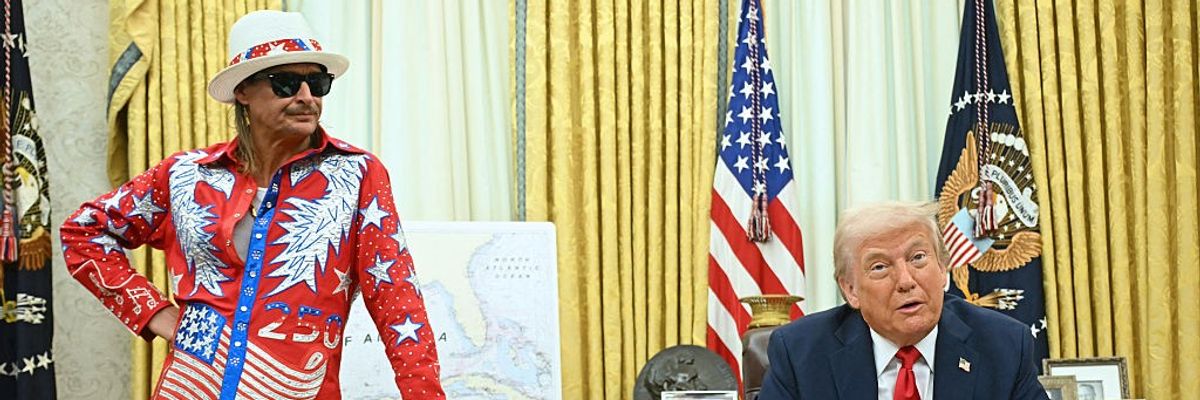
U.S. President Donald Trump signs an executive order alongside right-wing musician Kid Rock in the Oval Office of the White House on March 31, 2025.
(Photo by Saul Loeb / AFP via Getty Images)

Jeffrey D. Sachs
Apr 02, 2025
Common Dreams

U.S. President Donald Trump is trashing the world trade system over a basic economic fallacy. He wrongly claims that America’s trade deficit is caused by the rest of the world ripping off the U.S., repeatedly stating things such as, "Over the decades, they ripped us off like no country has never been ripped off in history…”

Trump aims to close the trade deficit by imposing tariffs, thereby impeding imports and restoring trade balance (or inducing other countries to end their rip-offs of America). Yet Trump’s tariffs will not close the trade deficit but will instead impoverish Americans and harm the rest of the world.

A country’s trade deficit (or more precisely, its current account deficit) does not indicate unfair trade practices by the surplus countries. It indicates something completely different. A current account deficit signifies that the deficit country is spending more than it is producing. Equivalently, it is saving less than it is investing.

America’s trade deficit is a measure of the profligacy of America’s corporate ruling class, more specifically the result of chronically large budget deficits resulting from tax cuts for the rich combined with trillions of dollars wasted on useless wars. The deficits are not the perfidy of Canada, Mexico, and other countries that sell more to the U.S. than the U.S. sells to them.

Trump blames the rest of the world for America’s deficit, but that’s absurd. It is America that is spending more than it earns.

To close the trade deficit, the U.S. should close the budget deficit. Putting on tariffs will raise prices (such as for automobiles) but not close the trade or budget deficit, especially since Trump plans to offset tariff revenues with vastly larger tax cuts for his rich donors. Moreover, as Trump raises tariffs, the U.S. will face counter-tariffs that will directly impede U.S. exports. The result will be lose-lose for the U.S. and the rest of the world.

Let’s look at the numbers. In 2024, the U.S. exported $4.8 trillion in goods and services, and imported $5.9 trillion of goods and services, leading to a current account deficit of $1.1 trillion. That $1.1 trillion deficit is the difference between America’s total spending in 2024 ($30.1 trillion) and America’s national income ($29.0 trillion). America spends more than it earns and borrows the difference from the rest of the world.

Trump blames the rest of the world for America’s deficit, but that’s absurd. It is America that is spending more than it earns. Consider this. If you are an employee, you run a current account surplus with your employer and a deficit with the companies from which you buy goods and services. If you spend exactly what you earn, you are in current account balance. Suppose that you go on a shopping binge, spending more than your earnings by running up credit-card debt. You will now be running a current account deficit. Are the shops ripping you off, or is your profligacy driving you into debt?

Tariffs will not close the trade deficit so long as the fiscal irresponsibility of the corporate raiders and tax evaders that dominate Washington continues. Suppose, for example, that Trump’s tariffs slash the imports of automobiles and other goods from abroad. Americans will then buy U.S.-produced cars and other merchandise that would have been exported. Imports will fall, but so too will exports. Moreover, new tariffs imposed by other countries in response to Trump’s tariffs will reinforce the decline in U.S. exports. The U.S. trade imbalance will remain.

While the tariffs will not eliminate the trade deficit, they will force Americans to buy high-priced U.S.-produced goods that could have obtained at lower cost from foreign producers. The tariffs will squander what economists call the gains from trade: the ability to buy goods based on the comparative advantage of domestic and foreign producers.

The budget deficit is not due to the salaries of civil servants, who are being wantonly fired, or to the government’s R&D spending, on which our future prosperity depends, but rather to the combination of tax cuts for the rich, and reckless spending on America’s perpetual wars...

The tariffs will raise prices for automobiles and wages of automotive workers, but those wage hikes will be paid by lower living standards of Americans across the economy, not by a boost of national income. The real way to support American workers is through federal measures opposite to those favored by Trump, including universal health coverage, support for unionization, and budget support for modern infrastructure, including green energy, all financed with higher, not lower, taxes on the wealthiest Americans and corporate sector.

The federal government does not cover its overall spending with tax revenues because wealthy campaign donors promote tax cuts, tax avoidance (through tax havens) and tax evasion. Remember that DOGE has gutted the audit capacity of the IRS. The budget deficit is currently around $2 trillion dollars, or roughly 6 percent of U.S. national income. With a chronically high budget gap, the U.S. trade balance will remain in chronic deficit.

Trump says that he will cut the budget deficit by slashing waste and abuse through DOGE. The problem is that DOGE mispresents the real cause of the fiscal profligacy. The budget deficit is not due to the salaries of civil servants, who are being wantonly fired, or to the government’s R&D spending, on which our future prosperity depends, but rather to the combination of tax cuts for the rich, and reckless spending on America’s perpetual wars, U.S. funding for Israel’s non-stop wars, America’s 750 overseas military bases, the bloated CIA and other intelligence agencies, and interest payments on the soaring federal debt.

Trump and the Congressional Republicans are reportedly taking aim at Medicaid—that is, at the poorest and most vulnerable Americans—to make way for yet another tax cut for the richest Americans. They may soon go after Social Security and Medicare too.

Trump’s tariffs will fail to close the trade and budget deficits, raise prices, and make America and the world poorer by squandering the gains from trade. The U.S. will be the enemy of the world for the harm that it is causing to itself and the rest of the world.
A Disaster Of Idiocy: So This Penguin Came Up To Me


Penguins on Heard Island protesting Trump's new tariff
Screenshot from Reddit

Abby Zimet
Apr 04, 2025
COMMON DREAMS


Flaunting "the peculiar Trumpian stupidity," the mad king's giddy "liberation" of the global economy - by witlessly slapping tariffs on every country except Russia based on a simplistic, "insane" formula that instantly crashed U.S. and foreign markets - has been universally slammed. And that was before we learned several tariff targets are in fact remote outcroppings of ice and rock populated by no humans but many freeloading penguins and seals, who thank God won't be "looting and pillaging" us any more.

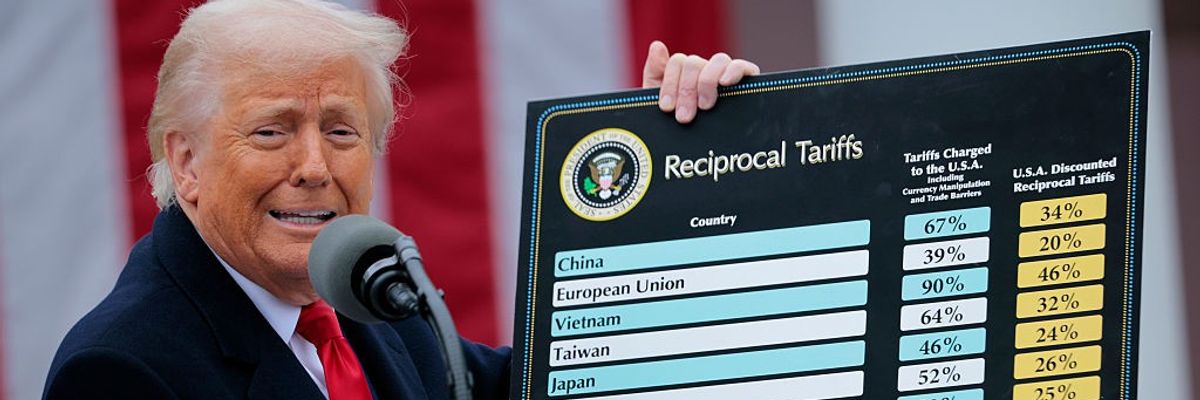
In his announcement we've finally been liberated from being able to buy things from other countries, the fragile, unloved man-child with a terror of being mocked or fleeced based his "batshit crazy" action on a sociopathic "you hurt us, we hurt you" world view, wielding random tariffs as a weapon to "fight back" against countries that have “taken advantage of us." "For decades, our country has been looted, pillaged, raped and plundered by nations near and far," he said of the richest nation in the world. Holding a big chart of his shiny new tariff plan, he repeatedly trotted out a new word he just added to the 17 he already knows. "Reciprocal," he proclaimed, “That means they do it to us, and we do it to them. Very simple. Can’t get simpler than that." Or, it turns out, dumber. Evidently orchestrated by some "willing sycophants," the moronic method he used to calculate trade and economic figures for every country in the world - except Russia - has been compared to "a science project by a stoned high schooler."

In their "back-of-the-envelope calculations" - but with Greek letters! - the White House looked up our trade deficit with each country, divided it by that country's exports, and to be "kind" halved that figure. But obtusely using tariffs to target countries, not products - the only way they can sometimes work - is so random, over-simplified and counter-productive that Thom Hartmann compares it to Yosemite Sam chasing Bugs Bunny around with a shotgun, blasting holes in everything while completely missing his target. As a result of what one expert calls this "extraordinary nonsense," the tariffs bear almost no relation to the economic realities of many countries: There are "grotesque” tariffs of almost 50% on poor countries like Cambodia, Laos, Vietnam, tiny Lesotho in southern Africa, and even the UK, with an almost $12 billion surplus, got a 10% tariff. And thanks to America's voters "handing the keys to the world’s largest economy to a low-wattage imbecile who went broke running casinos," US companies will be hardest hit.

Ironically, the worst will be the biggest - Microsoft, Amazon, Nike, Meta, Tesla, Target, Lululemon, Dollar Tree - whose supply chains depend on overseas manufacturing, mostly in China or Vietnam; Apple will reportedly see $275 billion in market value wiped out. Overall, the "uninformed tariff song-and-dance" meant an economy months ago deemed “the envy of the world” saw markets abruptly plunge into a free-fall that erased nearly $2 trillion from U.S. stocks, a nosedive of over 800 points, the biggest decline in years. Within minutes, over 80% of companies in the S&P 500 were trading lower, a market response traders called "worse than the worst case scenario." In one surreal moment, Trump appeared on air declaring, "Stocks will soar," even as a split screen showed stocks plummeting in real time. A flood of disastrous headlines quickly followed: Stocks "tank," "dive," "slide," "plunge," "dip," ""tumble" as investors "flee," along with the broad consensus, "There really is no positive outcome to this." So much winning.

Donny tried to avoid possible - albeit so unfair - criticism by waiting till 4 p.m. when the markets closed to announce his swell new idea. He failed (again): The backlash was swift. The Shovel: "In 'a massive fucking surprise,' a man who has run six companies into bankruptcy and wasn’t even able to make money out of A CASINO has absolutely no idea what he is doing while in charge of the world’s largest economy." Paul Krugman called the "crudity" of his tariff plan "malignant stupidity." Many cited its fatal flaws: The US isn't "spinning up new Nike factories overnight," employment will soar, so will China's economy in the vacuum, rage will greet ruined retirement funds, even coffee - no we don't make it - will be hit. "There is no reality in which the American consumer does not get majorly fucked," said one sage. "The trouble with tariffs," said a JP Morgan executive, "is they raise prices, slow economic growth, cut profits, increase unemployment, worsen inequality (and) increase global tensions. Other than that, they’re fine.”

Still, being "a blithering idiot," "a fucking moron" and "a Barely Sentient Shitstain," Trump blithely praised himself for allegedly lowering prices on "groceries, an old-fashioned word but beautiful. It's a bag with different things in it." Responses to the "groceries" lecture from "a demented madman who's never set foot in a grocery store": "Good thing we've never heard of them because we can't afford them now," "Give me 2 groceries, my good man!" "President Poopypants is learning us bigly," "You're paying $20 or $30 for a banana? We're going to bring it back down to $10 dollars or whatever you grocery people pay," "And don't forget your ID!" "Stable genius doing stable genius shit here," "A man for the people, just not our people." "It’s like watching a bad episode of South Park," "We are living in the stupid timeline." He also took credit for the word "gasoline - usually we talk about fuel prices. Gas. I love that word." More responses from those paying up to $12 on eggs: "I'd throw eggs at him but they cost more than gasoline." And, "What planet is he living on? Because this one has had enough of him."


- YouTubewww.youtube.com

Still, the idiocy went on. Because the list of the world's countries "plundering" the U.S. was evidently assembled by some clueless MAGA intern who looked them up in Wikipedia, it turns out several targeted with tariffs are a. not countries, b. mostly inhabited by American military and c. have little to no economies and/or no people. They include Tokelau, a New Zealand territory of three atolls in the South Pacific, population 1,600, exports around $100,000; The Marshall Islands, 34 atolls in the North Pacific, home to 82,000 mostly American military at a U.S. base for missile testing; the British Indian Ocean Territory, ditto about 3,000 British and U.S. military and contractors; Saint Pierre and Miquelon, eight small French-owned islands near Newfoundland (few thousand residents, modest shellfish exports somehow hit with 50% tariff; also Australia’s Norfolk Island (big oops), Norway’s Svalbard (polar bears, one town) and remote, volcanic Jan Mayan in the Arctic Ocean, home to 18 researchers at a meteorological station.

The most outlandish, admittedly a tough call, are the Heard and McDonald Islands in the southern Indian Ocean, a collection of small remote islands (not countries) managed by Australia's Antarctic Division, listed as UNESCO World Heritage Sites, and only accessible by sea. Heard, dominated by active volcano Big Ben, is ice, snow and glaciers; McDonald's 100 acres are rocky, and it's had no economic activity since 1877, when the elephant seal trade ended. Mostly used for scientific research, both are uninhabited by humans, but have large populations of penguins, seabirds and elephant seals who don't export anything except cuteness and an occasional waft of "eau de penguin." Still, slap a tariff on those wingless, waddling, fish-gulping, tuxedo-wearing moochers all dressed up with no place to go who've been taking advantage of us way too long: "Flippers up!" "Eat tariffs." "Goddamn woke penguins have to pay up - it's time we stood up to 'em." "Penguins will never menace America again." Etc.

Australia's so pissed they started a government petition topermanently ban Trump, his family, and his flunkies: "Australians have VALUES of mateship, hard work, righting wrongs, and fighting for the underdog" and Trump, opposite, is "an agent of hate and a danger to world peace." Online, almost all the hundreds of comments are from Americans, also Canadians, asking if they can sign, or start their own, or can the Aussies "change your mind, take him and keep him." At home, a Senate resolution just passed rejecting the tariffs, but it'll likely die in the House. FYI: As with deportations and other executive orders, they're treated as laws only because Congress, which ordinarily imposes them, has abandoned its co-equal role before Trump's claim of "national emergency." And servile MAGA bizarrely plays along. On his tariff malpractice, Agriculture Sec. Brooke Rollins praised Trump's "genius" even as a ticker showed stocks down 1,200 points, gushing, "We are really, really excited, and very grateful for (his) leadership (sic)."


The next morning, Trump was likewise delusional. "THE OPERATION IS OVER!” he wrote. “THE PATIENT LIVED, AND IS HEALING! (aka global markets are plummeting like we've never seen). THE PROGNOSIS IS THAT THE PATIENT WILL BE FAR STRONGER, BIGGER, BETTER, AND MORE RESILIENT THAN EVER BEFORE." To reporters, he babbled, "I think it’s going very well... I said this would exactly be the way it is. Now the rest of the world wants to see if there is any way they can make a deal. It’s going to be unbelievable. We’ve never seen anything like it.,,The stock is going to boom. The country is going to boom." (The tricky part: just what kind of boom.) Then he left for a golf dinner with Saudi reps, skipping the viewing of the coffins of four soldiers killed in Lithuania. But one patriot helpfully finished his narrative: "So this penguin came up to me, big penguin, strong penguin, tears running down his flippers, and he came up to me and said ‘Sir, thank you sir, my fellow penguins, they’ve been taking advantage of you sir, in ways that nobody has ever seen, sir...’"

“It’s now clear that the Administration computed reciprocal tariffs without using tariff data. This is to economics what creationism is to biology, astrology is to astronomy, or RFK thought is to vaccine science." - Former Treasury Secretary Lawrence Summers

Trump's Tariffs Are Extremely Dumb, Just Not For The Reasons You Might Think

This is a con on a global scale. Trump is not rejecting the corporate trade model. He’s weaponizing it.


U.S. President Donald Trump holds up a chart of "reciprocal tariffs" while speaking during a “Make America Wealthy Again” trade announcement event in the Rose Garden at the White House on April 2, 2025 in Washington, DC.
(Photo by Chip Somodevilla/Getty Images)


Iza Camarillo
Apr 04, 2025
Common Dreams

On April 2, Donald Trump declared a national emergency and announced sweeping tariffs on nearly all imported goods. The headlines were dramatic — tariffs on China, allies like Canada and Mexico, and everything from cars to coffee beans. His administration framed the move as a patriotic stance for “reciprocal trade” and economic sovereignty.

Don’t be fooled. This isn’t the collapse of “free trade.” It’s the continuation of corporate globalization — just with a MAGA bumper sticker slapped on it.

Trump says he’s standing up for American workers. But he’s the same president who signed the United States-Mexico-Canada Agreement (USMCA) and called it “the fairest, most balanced, and beneficial trade agreement we have ever signed into law.” The rebranded North American Free Trade Agreement (NAFTA) deal — despite some improvements forced in by congressional Democrats and civil society organizations — contained much of the same structural rot that has enabled outsourcing, empowered monopolies, and tied the hands of governments trying to protect their people and environment.

Trump is not rejecting the corporate trade model. He’s weaponizing it.

For decades, “free trade” deals like NAFTA locked in rules written by and for multinational corporations: rules that made offshoring easier, gutted environmental protections, and prioritized investor rights over worker rights. Stagnant wages, emptied factory towns, and rising income inequality have caused widespread pain and frustration among working Americans — which Trump has weaponized again and again.

Tariffs can be part of the answer to these problems, but Trump’s ham-handed approach is not it. There’s no industrial strategy. No labor plan. No climate protections. Just a unilateral, top-down stunt that does nothing to dismantle the corporate architecture still rigging the global economy.

Pair this “concept of a plan” with the rest of his agenda: gutting investment in vital sectors such as biomedical research, support for basic science and clean and affordable energy technologies and products; slashing all efforts to combat child labor and other egregious labor rights violations around the world, providing tax cuts for billionaires and corporations; stripping away health care, food support and other vital services for the most vulnerable Americans, undermining Social Security, and decertifying and undermining the power of labor unions.

It’s clear working people will not be the winners here.


Who Wrote the Rules? U.S. Corporations, Not Foreign Adversaries

Trump loves to blame other countries, claiming global trade has “looted, pillaged, raped, and plundered” the U.S. economy in his “Liberation Day” speech. He claims that the U.S. has been victimized by other countries and has been “too nice” in response.

Nothing could be further from the truth — the rules of the neoliberal trade system were rigged in favor of large corporate interests in the Global North. While workers in the U.S. and around the world were the losers, Wall Street, Big Tech, Big Ag, Big Pharma, and other U.S. corporate giants have always been the winners.

For decades, U.S. corporate lobbyists have used their privileged access to closed-door trade negotiations to rig the rules to maximize their profits, not to serve working people, small businesses, or the environment.

They pushed for extreme intellectual property rules to entrench Big Pharma monopolies that keep the price of medicines sky high, with deadly consequences. They demanded open capital markets and deregulated financial flows for Wall Street while securing rules that let agribusiness giants flood foreign markets with subsidized U.S. commodities, displacing millions of farmers and leading to forced migration.

Trade justice requires more than poorly designed tariffs. It demands systemic reform: binding labor rights, climate protections, resilient supply chains, and democratic accountability. Trump offers none of that.

At the same time, they ensured that governments couldn’t support domestic industries, raise labor standards, or enforce environmental protections without being accused of “trade distortion.” The result was a race to the bottom for workers and communities — here and abroad — with record profits for corporate giants.

It matters a lot that Trump is identifying the wrong perpetrators of the failed global trade system because that sets the table for wrong solutions.

Once we identify multinational corporations as the architects of the current system, we’re directed toward the right solutions – not blanket, high tariffs based on mindless formulas, but a new trade policy and new trade rules that prioritize the interests of workers, consumers, and the environment.

NAFTA to USMCA: Same Corporate Model With Some Improvements (No Thanks to Trump)

Trump spent years railing against NAFTA as the “worst trade deal anybody in history has ever entered into,” tapping into the legitimate grievances of workers and communities harmed by its race to the bottom. He campaigned on a promise to eliminate it and replace it with a better agreement for workers.

However, once elected, he opted to renegotiate and rebrand the deal in the form of the USMCA, which he then insisted was “the best trade deal in history.” Now, in a dizzying reversal, he’s claiming the USMCA has been a disaster that only an aggressive wave of “retaliatory” tariffs on Canada and Mexico will fix.

In reality, while some improvements were forced into the negotiation, the USMCA largely preserved the core logic that made NAFTA so harmful in the first place. It expands corporate rights, limits democratic oversight, and undermines public protections in the name of increased trade.

The new labor provisions — often cited as proof of a “new era” in trade — were not original features of Trump’s deal. They were won through months of intense organizing and negotiation by House Democrats, labor unions, and civil society groups.

Congressional Democrats working in close alliance with the AFL-CIO drew a hard line. Backed by the relentless organizing of groups like Public Citizen, the Communications Workers of America, United Steelworkers, and a transnational coalition of Mexican and Canadian labor and civil society partners, they made it clear: they would block passage of any deal unless meaningful labor enforcement were included and damaging Big Pharma giveaways were removed.

Trump’s administration favored language that preserved corporate prerogatives and offered only symbolic nods to labor rights. Still, in the end, it acquiesced to congressional Democrats’ demands. It incorporated essential tools like the facility-specific Rapid Response Mechanism for labor enforcement and eliminated some of the most egregious giveaways to Big Pharma.

However, the structural rot from NAFTA remained.

While experts across the ideological spectrum lauded the drastic reduction of controversial investor privileges that allow corporations to sue governments over public interest laws through investor-state dispute settlement (ISDS), Trump preserved ISDS for fossil fuel firms operating in Mexico — a carve-out aggressively pushed by Big Oil.

Agribusiness also retained its arsenal. The ongoing U.S. trade challenge to Mexico’s restrictions on genetically modified corn — measures rooted in precautionary health standards and cultural preservation — reveal the deal’s true intent. Rather than respecting national policy space over food safety, trade rules are once again being deployed to dismantle domestic protections at the behest of corporations.

Not only did Trump fail to fix NAFTA, but he made it even worse in at least one crucial way: Big Tech secured its wishlist in the form of a digital trade chapter. These new terms undermine the ability of U.S. states, Congress, and other countries’ governments to hold Big Tech accountable for gender and racial bias in AI, rampant abuse of our privacy, and monopolistic overreach.

Performative “Protectionism” and the Authoritarian Trade Playbook

Far from dismantling the corporate trade regime, Trump’s first term revealed him as a loyal steward of it — so long as he could plaster his name on it. Despite the USMCA rebrand, he left the core NAFTA structure intact and continued to stoke public anger over working people’s struggles — not by confronting the root causes but by scapegoating other nations. And he has been increasingly employing tariff threats as his weapon of choice — not in pursuit of justice but as a blunt instrument of control.

Just weeks ago, Trump threatened new tariffs unless Mexico deployed troops to militarize the border. He pressured Colombia to accept a deportation flight of asylum seekers.

Big Tech companies are awaiting their handouts, as it is widely expected that Trump will lift tariffs on countries that agree to undo tech accountability policies.

And perversely, he is using tariffs as a cudgel to pressure other countries into signing the very liberalizing trade agreements he claims to oppose.

“Liberation Day” was more of the same from this ever-more-authoritarian White House: an emergency decree bypassing Congress, escalating instability, and concentrating power in the executive. Trump hasn’t rejected the anti-democratic nature of the neoliberal trade model — he’s replicating it with a vengeance.

All Madness, No Method

While tariffs can be a useful tool, they must be transparently employed in strategic sectors for a clear purpose following careful analysis and open debate.

Trump’s tariffs, however, are based on misleading data and flawed logic. He uses exaggerated trade deficit calculations and stays silent on how the U.S. dollar’s dominance enables America to import far more than it exports, a luxury most Global South nations — burdened with debt and structural trade deficits — cannot afford.

The methodology behind these tariffs has experts scratching their heads.

Trump claimed that the “reciprocal tariffs” were derived from a detailed assessment of each country’s tariff and non-tariff barriers (more on these in a moment). In fact, the number assigned to each country seems to be based on the difference between the total value of imports the U.S. receives from a country versus the amount we export to it.

Apparently, no regard was given to why there may be a large imbalance. For example, Lesotho, which Trump dismissed as a country “nobody has ever heard of,” was hit with the highest tariff of any country at 50%. Forget the fact that the small, landlocked country’s population of 2 million may not be able to afford Made in America products, leading to a lopsided trade balance.

The crude formula used to determine each country’s “reciprocal” tariff was described by Nobel Prize-winning economist Paul Krugman as something that appeared to be “thrown together by a junior staffer with only a couple of hours’ notice,” and “reads like something written by a student who hasn’t done the reading and is trying to bullshit their way through an exam.”

As some commentators have noted, this tariff breakdown is what you get if you ask ChatGPT to come up with a U.S. trade policy. This could very well be the first global economic policy written “of, by, and for” our robot overlords. What could possibly go wrong?

The Corporate Wishlist

Since the Trump administration clearly did not take on the, admittedly Herculean, task of reviewing the thousands of tariffs and trade barriers imposed by hundreds of countries, it simply used trade imbalances as a crude proxy. It’s a stand-in for the cost of that country’s tariffs and, importantly, its non-tariff barriers.

“Non-tariff barrier” is trade-speak for “any policy that’s not a tariff” but might restrict trade — from climate protections to minimum wage laws to consumer protections in the form of toxic food additives. While many non-tariff barriers serve vital public policies, corporations and trade negotiators often treat them as obstacles to profit.

According to the April 2 executive order, Trump can unilaterally decide to lower the tariffs imposed on a country if it takes “significant steps to remedy non-reciprocal trade arrangements and align sufficiently with the United States on economic and national security matters.”

What constitutes a “significant step” isn’t defined, but it certainly looks like an open invitation for governments to slash their tariffs and reverse policies to appease Trump and his billionaire buddies.

For what exactly those policies may be, just look to the report Trump waved around at the beginning of his so-called “Liberation Day” tariff announcement speech in the Rose Garden.

That document is a 400-page list of the policies that other countries have enacted — or are even considering enacting — that U.S. corporations don’t like. It’s the National Trade Estimates Report on Foreign Trade Barriers, an annual government report that has long been criticized as an inappropriate overreach to name and shame other countries’ legitimate public interest policies. It’s also a glimpse of the policies that Trump may seek to have destroyed in exchange for tariff relief.

The policies targeted in this year’s report include climate protections, including Canada’s Clean Fuel Standard, the European Union’s Deforestation-Free Supply Chain Regulation, and Japan’s renewable energy incentives — all of which are aligned with global climate commitments.

Public health regulations aimed at protecting consumers, preserving biodiversity, and preventing long-term health risks were also attacked. Employed by dozens of countries, these include bans, testing requirements, or even labeling policies on pesticides like Roundup’s glyphosate, genetically engineered food, ractopamine in beef and pork, and heavy metals in cosmetics.

Regulations that promote competition in the digital ecosystem, laws that impose digital services taxes on Big Tech firms, place conditions for cross-border data transfers, promote fairness in the digital economy, and laws that regulate emerging technologies such as AI.

Benefits for Trump’s Buddies

Countries are not the only ones who will be supplicating to avoid the full weight of Trump’s tariffs. Despite Trump’s claims that other countries foot the bill on tariffs, it is U.S. importers who must pay this fee … unless they can convince Trump to grant them a special exemption.

It is well-documented that the opaque and chaotic tariff exclusion process created in Trump’s first term quickly overwhelmed government agencies and enabled a quid pro quo spoils system that rewarded the rich and well-connected. A revolving door of lobbyists, including former and future Trump administration officials, were able to secure lucrative tariff exceptions for their CEO clients through political pressure, informal meetings, and campaign contributions.

Trump’s latest stunt had nothing to do with “liberation.” You can’t fix a rigged trade system while keeping its rules and attacking people at every turn.

Through this system, Trump wielded tariffs and tariff exceptions to reward his friends and punish his enemies. CEOs that donated to Republicans had a 1 in 5 chance of having their exemption request granted versus 1 in 10 for CEOs that supported Democrats, according to a January 2025 study.

If Trump’s recent attacks on law firms, universities, and the press are any indication, he’s prepared to double down on using his second term to punish enemies and enrich himself and his friends. And his dismantling of watchdog agencies and boosting of big business ties set the stage for tariff exemptions to be even more corrupt and harmful to workers, consumers, and the U.S. and global economy.

What other displays of political loyalty might companies offer to Trump for a tariff exclusion this time around? Public endorsement of his policies? Promises to monitor employees for DEI ideologies or views critical of the administration?
We Deserve Better

Trade justice requires more than poorly designed tariffs. It demands systemic reform: binding labor rights, climate protections, resilient supply chains, and democratic accountability. Trump offers none of that.

There’s no industrial plan. No support for unions. No climate-resilience vision. Just a chaotic, performative tariff regime, which in practice will surely be wielded to reward loyalty and punish dissent.

Trump’s latest stunt had nothing to do with “liberation.” You can’t fix a rigged trade system while keeping its rules and attacking people at every turn. Trump talks a big game but serves the same corporate interests that gutted labor rights in the first place. Working people deserve a system with them at the center, not one that favors corporations.

This isn’t trade justice. It’s a con.
Khanna Sounds Alarm as 4,100+ Factory Workers Laid Off Amid Trump Tariff Chaos


"Imagine if federal worker unions and Democratic Party officials showed up at the plant gate of a company that was about to close its doors," said one labor advocate recently. "Why aren't the Democrats doing this?"


Stellantis workers walk to the Warren Stamping Plant to start their shift on April 4, 2025 in Warren, Michigan. Stellantis announced they will temporarily be laying off approximately 900 of its U.S workers at several of its stamping and powertrain plants around the country, including the Warren Stamping Plant, as the tariffs placed on imported automobiles and auto parts by President Donald Trump take effect.
(Photo by Bill Pugliano/Getty Images)


Jon Queally
Apr 06, 2025
COMMON DREAMS


Congressman Ro Khanna is raising the alarm about mass layoffs in the U.S. economy resulting from President Donald Trump's failed economic policies. Over 4,000 factory workers lost their jobs this week due to firings or plant closures.

On Thursday, automaker Stellantis, citing conditions created by Trump's tariffs, announced temporary layoffs for 900 workers, represented by the United Auto Workers (UAW). "The affected U.S. employees," reportedCNN, "work at five different Midwest plants: the Warren Stamping and Sterling Stamping plants in Michigan, as well as the Indiana Transmission Plant, Kokomo Transmission Plant and Kokomo Casting Plant, all in Kokomo, Indiana."

In a social media thread on Saturday night, Rep. Ro Khanna (D-Calif.)—a lawmaker who has advocating loudly, including in books and in Congress, for an industrialization policy that would bring manufacturing jobs back to the United States—posted a litany of other layoffs announced recently as part of the economic devastation and chaos unleashed by Trump as well as conditions that reveal how vulnerable U.S. workers remain.

"This week," Khann wrote, "19 factories had mass layoffs, 15 closed, and 4,134 factory workers across America lost their jobs. Cleveland-Cliffs laid off 1,200 workers in Michigan and Minnesota as they deal with the impact of Trump's tariffs on steel and auto imports."

"We need jobs and currently at this time, the majority of the companies that we work with and represent our members at are not hiring." —Mark DePaoli, UAW

For union leaders representing those workers at Cleveland-Cliffs, they said "chaos" was the operative word. "Chaos. You know? A lot of questions. You've got a lot of people who worked there a long time that are potentially losing their job," Bill Wilhelm, a servicing representative and editor with UAW Local 600, told local ABC News affiliate WXYZ-Channel 7.

The United Auto Workers says the layoff fund set aside for those losing their jobs won't last long and find them new jobs of that quality will not be easy. "Our first concern will be to look around at all the companies where we have members and see if we can find jobs," said the local's 1st vice president, Mark DePaoli. "I mean, jobs are going to be the key. We need jobs and currently at this time, the majority of the companies that we work with and represent our members at are not hiring."

The pain of workers in families in Dearborn, as indicated by Khanna's thread, is just the tip of the iceberg. In post after post, he cataloged a stream of new layoffs impacting workers nationwide and across various sectors:Poultry distributor Perdue Farms laid off 433 workers this week in Monterey, Tennessee.
As part of mass layoffs to the US branches, tractor manufacturer John Deere laid off 9 workers from its Ankeny, Iowa, facility. The company has also voiced concerns over the impact of Trump's tariffs on production.
Semiconductor manufacturer Summit Interconnect closed in Santa Ana, California, costing 74 people their jobs. Congress needs to invest in manufacturing to guide the U.S. into leading semiconductor manufacturing.
Automotive and industrial power transmission manufacturer Bando USA Inc. cut 65 jobs from their facility in Bowling Green, Kentucky.
Coal manufacturer Wilson Creek Energy LLC cut 332 jobs after closing their plant in Friedens, PA. Another 93 workers were cut when the Grantsville, Maryland plant closed.
In Sumner, Washington pipe manufacturer Advanced Drainage Systems closed, costing 54 employees their jobs.
Electrical equipment manufacturer Sensata Technologies closed in Carpinteria, California, resulting in 57 employees losing their jobs. The company is closing to offset the rising costs of inflation.
In San Jose, California, electronics manufacturer InvenSense Inc. laid off 55 people due to new market conditions in the broadening tech industry.
Battery manufacturer Quantumscape Battery Inc. laid off 53 workers in San Jose, California, as part of a restructuring effort.
Medical device manufacturer Biosense Webster Inc. cut 9 jobs when it permanently closed its Los Gatos, California, facility.
Biotech manufacturer ImmunityBio, Inc. laid off 9 employees from its El Segundo, California, facility and one from its facility in Culver City, California.
Food processor Del Monte Foods, Inc. in Hannaford, California, cut 378.
In Agawam, Massachusetts, bakery wholesaler Connecticut Pie, LLC DBA Diana's Bakery laid off 229 workers.
Poultry plant AlaTrade Foods laid off 165 employees at its Phenix City, Alabama, facility.
Food products manufacturer, Rich Products Corporation laid off 139 workers after closing its Santa Fe Springs facility in California to offset rising costs.
In Townson, Maryland, sports apparel manufacturer Fila USA, Inc. laid off 112 workers. The company also laid off 18 employees from their facility in Curtis Bay, Maryland.
Engineering services company, S&B Engineers and Constructors, Ltd. in Kingsport, Tennessee, cut 112 workers.
In Bridgeview, Illinois, 88 workers lost their jobs when sustainable packaging company Smurfit Westrock closed.
Chemical manufacturer Syzygy Plasmonics, conducted layoffs in two Houston, Texas, facilities, cutting 68 jobs total.
Packaging products manufacturer Pregis closed in San Antonio, California. Forty-five people lost their jobs.
In Longview, Texas, construction supplies manufacturer S & B Engineers and Constructors cut 43 jobs.
Board game manufacturer, Edaron, LLC closed in South Hadley, Massachusetts, cutting 24 jobs.
In Holliston, Massachusetts, cannabis manufacturer Pharma Cann laid off 19 workers.
Medical management facility, Prime MSO, LLC closed in Encino, California, costing 6 people their jobs.

With public sector workers being fired in massive numbers nationwide due to the blitzkrieg unleashed by the Elon Musk-led Department of Government Efficiency, or DOGE, private sector workers are no strangers to mass layoffs within a U.S. economy dominated by corporate interests and union density still at historic lows.

Les Leopold, executive director of the Labor Institute who has been sounding the alarm for years about the devastation associated with mass layoffs, wrote recently about how the situation is even worse than he previously understood. On top of existing corporate greed and the stock buyback phenomena driving many of the mass layoffs in the private sector, Trump's mismanagement of tariff and trade policy is almost certain to make things worse, triggering more job losses in addition to higher costs on consumer goods.

In order to combat Trump, Leopold wrote last month, "Democrats should take a page from Trump and put job protection on the top of their agenda. As tariffs bite and cause job destruction, the Democrats should show up and support those laid-off workers."


Instead of simply calling Trump's tariffs "insane," which many rightly have, the Democrats "should call them job-killing tariffs," advised Leopold. "As prices rise, they can blame Trump for that as well."

With Trump's economic policies coming into full view, the picture is bleak for businesses large and small—and that means more pain for workers.

As Axios' Ben Berkowitz reported Saturday. "When everything gets more expensive everywhere because of tariffs, that starts a cycle for businesses, too — one that might end with layoffs, bankruptcies, and higher prices for the survivors' customers," he explained. "The cycle is just starting now, but the pain is immediate."

The "big picture," Berkowitz continued, is this:
The stock market is not the economy, but if you want a decent proxy for Main Street businesses, look at the Russell 2000, a broad measure of the stock market's small companies across industries.

—It's down almost 20% this year alone.
—That in and of itself doesn't make a business turn the lights off, but it says something about public confidence in their prospects.
—"The market is like a real time poll ... this is going to impact all businesses in one way or another undoubtedly," Ken Mahoney of Mahoney Asset Management wrote Friday.
Khanna's Democratic colleague in the House, Rep. Lloyd Doggett of Texas, said the impacts of Trump's tariff and austerity policies are very real and already felt in his district as he roasted Trump for having a reported golfing weekend as the global economy reels and American workers and retirees suffer:


In Sunday comments to Common Dreams, Leopold wanted to know where Khanna and other Democrats were last year when John Deere laid off a thousand workers.

"What do the progressive Democrats have to say about the tens of thousands of mass layoffs that take place each month? Radio silence," he said. "It would be useful if they had a policy that addressed Wall Street induced mass layoffs rather than just opposing tariffs, but I wouldn't bet on that."

On the question of silence and who, ultimately, will stand up for American workers—whether in the public or private sector—it's not clear who will emerge as a true defender or what forces would galvanize to truly represent the interests of the nation's working class.

"Imagine if federal worker unions and Democratic Party officials showed up at the plant gate of a company that was about to close its doors to finance hefty stock buybacks for its billionaire owners," Leopold wrote in early March. "A show of support for their fellow layoff victims and a unity message aimed at stopping billionaire job destruction would be simple to craft and easy to share. It would be news."

"Why aren't the Democrats doing this?" he asked.