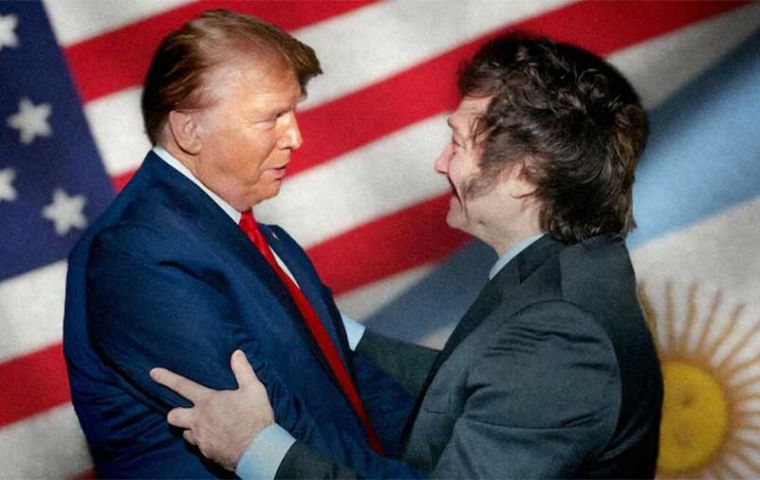
Critics contend that Milei’s philosophy stops short of meaningful political and social reforms and claim his agenda prioritizes enlarging the power and wealth of corporations over expanding individual freedoms.
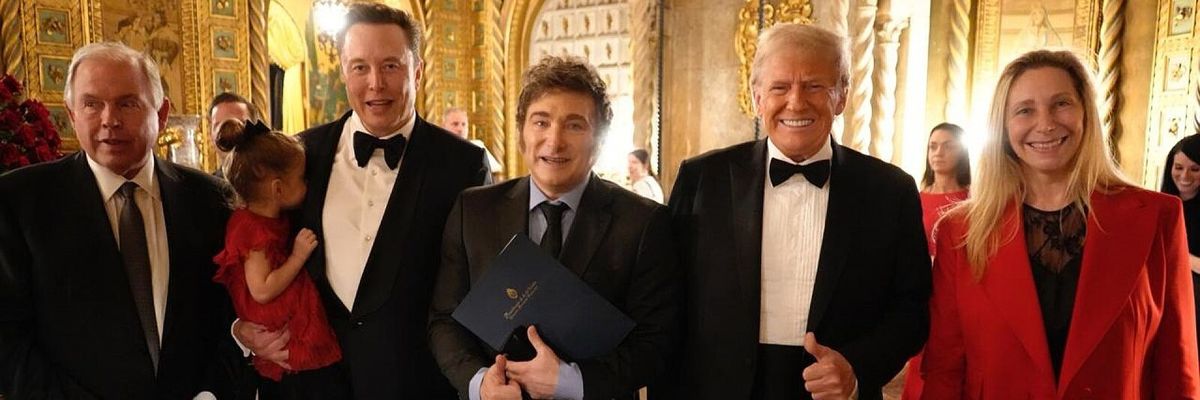
Argentine President Javier Milei poses with then-President Elect Donald Trump and Elon Musk at Mar-a-Lago on November 14, 2024.
(Photo: Argentina.gob.ar)
LONG READ
Andrew Kennis
Apr 06, 2025
Unicorn Riot
Flashback to a pivotal moment in global politics.
It was a crisp evening in December 2021 when Donald Trump stepped onto a gilded stage at the Conservative Political Action Conference (CPAC) in Orlando, Florida. The former president—reduced to a kingmaker, still without access to his Twitter account, and seething over his defeat in 2020, yet still nursing ambitions for a return—spoke to a raucous crowd about the need for a global “populist revival.”
Meanwhile, thousands of miles away, another showman was making his mark.
In Buenos Aires, Javier Milei, then a fiery congressman with a penchant for theatrics and unfiltered invective, was delivering his own bombastic address on live television. Clad in his signature leather jacket and gesturing wildly, Milei railed against the political elite, vowing to obliterate the “parasitic state” with his ever-present chainsaw prop.
As the world braced for this new era of racist and xenophobic leadership, the intertwined fates of Trump and Milei offered a potent lens through which to examine the volatility of contemporary politics.
For a brief moment, the right-wing populist figures seemed like ideological satellites orbiting the same disruptive axis. Trump, sidelined but scheming, watched as the conservative media anointed him the leader of an imagined international populist alliance. Milei, meanwhile, was steadily building a cult following in Argentina, his rise to power hastened by a corporate media landscape eager for controversy and spectacle. Though separated by continents and cultures, Trump and Milei’s shared disdain for establishment politics and a mutual affection for shock value linked their trajectories in the imaginations of their supporters.
Fast forward three years to 2024, and the political world was turned on its head.
Milei, once dismissed as a fringe outsider, seized the presidency of Argentina in a landslide—a triumph of style over substance, fueled by promises of radical economic reform steeped in austerity and deep cuts to public interest spending. Trump, who had clawed his way back to power with a surprise 2024 election victory, eking by with a slimmer popular vote margin and narrower victory than any other in over a century, was mere weeks away from reclaiming the Oval Office.
The unlikely duo became the poster boys of a resurgence of right-wing, white nationalist populism. Trump, emboldened by his razor-thin victory, described Milei as a “brother in arms” during a congratulatory phone call. Milei, ecstatic, became the first world leader to congratulate Trump in person at the 2024 CPAC convention, claiming to be a mutual part of a blessed mission: “Today the world is a much better place because the winds of freedom are much stronger… A true miracle and proof that the forces of heaven are on our side,” Milei jovially proclaimed during his CPAC speech.
Yet, beneath the mutual admiration and bluster lay cracks in their respective facades. While Trump was busy assembling a cabinet that hinted at renewed chaos, Milei’s honeymoon phase was already crumbling under the weight of his own policies. Both men had ascended by exploiting dissatisfaction and anger, but their ability to govern was increasingly in question. And in Milei’s case, his credibility recently took an even greater hit as more details have surfaced that he had once enthusiastically promoted a now-collapsed cryptocurrency scheme, raising the question of whether Argentina’s self-proclaimed libertarian savior had been duped or, even worse, did the duping himself.
For Milei, the exhilaration of victory quickly gave way to mass protests (including ones covered by Unicorn RiotfromlastMay and January / February 2024), economic stagnation, and plummeting public approval. For Trump, the looming challenges of his second presidency—a divided country, international skepticism, and mounting legal troubles—threatened to turn triumph into turmoil.
But if Milei and Trump seemed destined for a political bromance, the rest of Latin America wasn’t nearly as enamored.
While Milei threw himself into Trump’s embrace, other regional leaders responded with defiance. In Mexico, President Claudia Sheinbaum made it clear she would not be bullied into Trump’s hardline immigration policies, standing firm in early diplomatic confrontations even as economic pressures forced some concessions. Colombia’s Gustavo Petro was even more direct in his opposition, warning that Trump’s return signaled renewed imperial aggression and pledging to resist the right-wing tide sweeping the hemisphere. Even Brazil, governed by the more pragmatic Lula da Silva, showed little enthusiasm for Trump’s reemergence, wary of his influence over the continent’s far-right.
Milei, in contrast, found himself increasingly isolated—Trump’s most reliable ideological ally in Latin America, but an outlier rather than the harbinger of a broader regional shift. As he struggled to implement his radical libertarian agenda amid economic turmoil and mounting protests it became clear that his populist revolution was already faltering.
As the world braced for this new era of racist and xenophobic leadership, the intertwined fates of Trump and Milei offered a potent lens through which to examine the volatility of contemporary politics. The parallels were impossible to ignore: two men, propelled to power by mainstream-media-manufactured personalities and plenty of controversy, now tasked with delivering on promises that many deemed impossible. The question wasn’t just whether they would succeed, but whether their respective nations—and the world—could withstand the consequences if they failed.
Milei’s Corporate Media-Facilitated Rise and Apparent Fall from Grace with Argentinians
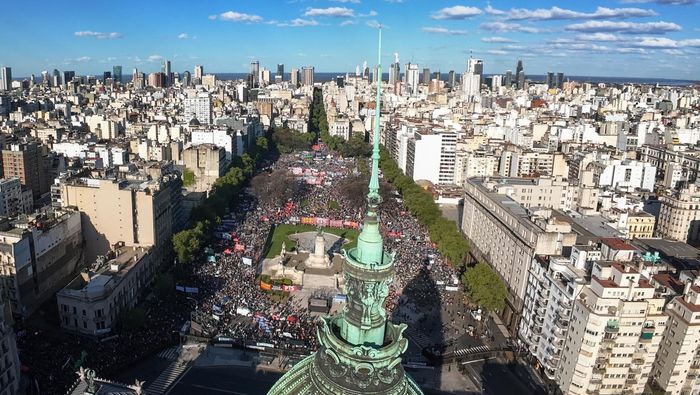
In Buenos Aires on April 23, 2024, hundreds of thousands of people protested deep austerity cuts by Milei to Argentina’s education budget. (Photo: Matías Cervilla)
Javier Milei first gained notoriety as a radio talk-show host in the 2000s, and by the 2010s, he became a television personality and a regular guest on nationally known programs such as Intratables, A Dos Voces, and Todo Noticias (TN). Mainstream media took to Milei, as his propensity to yell and use inflammatory—and often profane—language lent itself toward viral social media distribution, with such antics gaining particular exposure among younger generations.
By November 2021, then, Milei was barely able to garner just a few congressional seats for both himself and his current vice president through a rag-tag and thrown together coalition called La Libertad Avanza (Freedom Advances) which wound up only garnering 17.3% of the vote. That was Milei’s first foray into Argentinian politics.
By 2023, mainstream news media ran one image-driven, personalized story after another, ranging from pieces exploring his haircut and fashion sense to images distributed far and wide of Milei wielding a chainsaw, symbolizing campaign promises to slash through any number of the previous government’s policies.
Milei’s upset victory probably shouldn’t have been seen as a big surprise, given the global drift toward reality show politicians.
The chainsaw symbolism was covered at the expense of more serious coverage, like evaluating Milei’s idea of dumping the Argentinian peso for a dollarized economy—a promise he’s since walked back and will likely never implement.
The media brushed past the impact that cuts to government spending may have on the poverty rate, which rocketed higher throughout 2024. Milei’s characterization of social programs as being nothing more than bureaucracies without any benefit to the public was uncritically noted in passing, if that, while obsession over his “rock star M.O.” and “ loco”ways. Both narratives stemmed from coverage dominated by Clarin, Argentina’s largest newspaper.
In one sub-headline, Milei was generously quoted as saying, “I don’t brush my hair, the wind does,” with the main head asking, “ Who cuts Milei’s hair?”
Thus, instead of covering concerns about Milei taking heartfelt advice from one of his three dogs, whom he claimed transmitted the thoughts and ideas of yet another deceased pet dog, media accounts depicted this as just one of Milei’s many quirky ways, for which he has been long known with a nickname of “El Loco” first being given during his adolescence and lasting through the present.
Argentinian intellectuals, analysts, and critics alike have pointed to Milei’s firebrand public persona playing well to mainstream news coverage as a crucial factor in his quick rise to a viable, and eventually successful presidential candidate. Ricardo Foster, an Argentine philosopher and intellectual, argued that sensationalism and populism were given inordinate airtime without sufficient scrutiny, with an over-prioritization on personality over actual policy viability.
Forrest Hylton, columnist for the London Review of Books and professor of history at the Universidade Federal da Bahia, told Unicorn Riotthat Milei cultivated a “cult-like persona,” which helped to obfuscate that he was an “ideological fanatic” who was armed with proposals, as opposed to chainsaws, that, “will only serve to worsen the continuing economic crisis.”
Gimena Sánchez-Garzoli, a foreign policy analyst and critic with the Washington Office on Latin America (WOLA) who’s intimately familiar with Milei supporters also spoke to Unicorn Riot.
Sánchez-Garzoli is originally from Argentina, and much of her family still resides there, and she assured Unicorn Riot that she “gets” Milei’s surprising and quick political rise all the way to the Casa Rosada(Argentina’s White House). Sánchez-Garzoli pointed to a good chunk of her family in Argentina as “all pro-Milei [and] just people who were very tired with the status quo, which is somewhat understandable, given that a whole generation has been raised on one economic crisis after another.”
Argentina’s status quo has been characterized by several decades of chaotic ups and (mostly) downs in its long-beleaguered economy. An entire generation of ordinary Argentinians has grown up “without a stable middle class or trade unions to turn to” and without first-hand awareness of Argentina’s dictatorial past, Sánchez-Garzoli explained. Many of the concerns about Milei’s autocratic tendencies were at least sometimes quoted in the media, but nevertheless fell on the deaf ears for a large chunk of the populace desperate for any kind of change.
Nonetheless, Milei’s inexperience with national politics still shocked the country after a very strong showing in the first round of presidential voting, with the threshold for winning outright nearly being cleared by Milei, even with support being split between him and a third-placed candidate. Milei’s push in the second round of voting got boosted by a poor and befuddling choice by his opponents. Although his opponent hailed from the incumbent party whose candidates had been in power for 16 of the last 20 years, the choice was, to say the least, a highly questionable one.
2023 was indeed a far cry from the days of Néstor Kirchner, the founding father of the 21st-century embodiment of “Peronists,” later dubbed the “K’s.” Néstor was widely credited with helping the country navigate through the extremely tricky waters of a debt crisis provoked by the International Monetary Fund (IMF). Kirchner consequently became one of Argentina’s most popular presidents ever, with as many as 200,000 Argentinians attending his funeral in the wake of his unexpected death shortly after the end of his second term.
This was how the “K” legacy began as the country happily elected Kirchner’s wife, Cristina, after Néstor passed away shortly after his two terms in office.
In the long run, Argentina never really fully recovered from its IMF-induced meltdown. The “K”s became immersed in a quagmire as neoliberal opposition parties lobbed one accusation of corruption after another and endlessly embroiled Cristina with lawsuits (incidentally, a similar strategy was employed in neighboring Brazil against current president Lula and his predecessor, Dilma Rousseff).
Thus, matters couldn’t have been better for Milei as a challenger, as the Peronist and “K” loyalists witlessly nominated its minister of the economy, the often wooden Sergio Masa, as its presidential candidate. Sánchez-Garzoli remarked, “There was a superiority thing going on with the ‘Ks’ in Argentina that turned a lot of ordinary Argentinians completely off.”
Milei, who deftly established himself as a media darling thanks to an all-too-pliant corporate press, only had to beat the rather uncharismatic Masa. The “K” presidential candidate was saddled by an economy falling yet again into hyperinflation under his administration. Under Masa, inflation rose to levels that rivaled those of the most economically plagued African economies and thus also eclipsed even previous high inflation rates that had long plagued Argentina.
Argentinians found themselves counting away their drastically devalued currency in transaction after transaction, as bill denominations couldn’t keep up with raised prices and one-thousand peso notes were barely worth a U.S. dollar. Meanwhile, the Ks stubbornly refused to print up and distribute currency notes of higher denominations and no one wanted to deal with credit and debit card transactions, with traumatic historical memories of countless Argentianians having their savings wiped out in the wake of the first IMF-caused economic meltdown.
This is how cash became king in Argentina. After all, one cannot know with any degree of security how long their money will be worth anything, which only furthers the spiral of hyperinflation. This cash economy rests on top of a prevalent black market exchange for U.S. dollars, which the wealthiest of Argentinians regularly avail themselves of, causing further damage.
In response to a move by the “Ks” that smacked of hubris, Argentinian voters mercilessly punished the Peronists by electing Milei in a landslide victory against the party’s leading economic manager who oversaw the country’s descent into its worst inflationary recession.
Milei’s upset victory probably shouldn’t have been seen as a big surprise, given the global drift toward reality show politicians. Candidates the world over, ranging from India’s Narendra Modi to Brazil’s Jair Bolosonaro and Donald Trump, prefer to court media spectacles with jaw-dropping and often racist, sexist, and classist remarks via social media, instead of well-thought-out white papers and policy details.
Milei’s Apparent Decline After Hardline Reforms
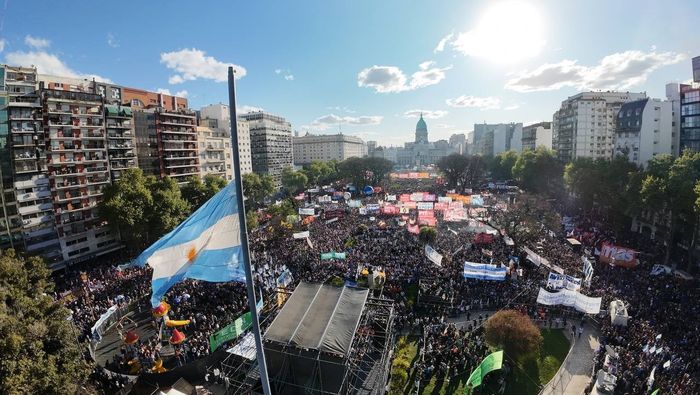
In Buenos Aires on April 23, 2024, hundreds of thousands of people protested deep austerity cuts by Milei to Argentina’s education budget. (Photo: Matías Cervilla)
Less than a year into Milei’s presidency, Argentina erupted in its largest protests in decades. On May 9, 2024, a nationwide general strike brought as many as a million people into the streets, according to organizers, marking the second mass mobilization against his government in just a matter of months. The message was unmistakable: The country was on the brink, and its people were not backing down.
What prompted such extraordinary levels of political resistance and opposition to a president who had won a landslide electoral victory not even a year ago? Sánchez-Garzoli told Unicorn Riot that Milei has a sustainability problem, which presented a challenge considering that the overwhelming majority of the electorate put him into office to gain stability.
“Milei’s economic plans and austerity packages are having a devastating effect on the middle and lower classes in Argentina. Milei has brokered austerity packages with the IMF but has not compensated that with anything else. Cutting all of these public programs is one thing, but leaving the people out on the street without enough food is another. It isn’t sustainable,” explained Sánchez-Garzoli, and increasingly more and more Argentinians seem to agree.
Many observers were left wondering whether Milei had merely been an oblivious front man or something worse: a willing participant in a financial scam.
Milei not only slashed funding for public education but also managed to overcome a veto override attempt by the overwhelmingly opposition-based Congress. In both the lead-up to and in the wake of these events, Milei’s popularity has precipitously dropped, according to public opinion polls. Several sources indicate that his popularity has been steadily falling since the start of his presidency, with one mainstream outlet headlining and questioning, “Is the honeymoon over? Milei’s popularity dips while worry over poverty is on the rise,” even before the mass protest of early October 2024.
For example, one Zuban Córdoba poll highlighted that 57.3% of Argentines disapprove of his performance as of September 2024, a significant increase from the already high 52.5% in April of the same year (the first of two mass protests against Milei’s stance on public education also took place in April 2024). Over that same period, Milei’s “full support” dropped from 38.2% to just 20.3%. A survey from Torcuato Di Tella University showed a sharp decline in public trust in Milei’s government, down to 2.16 points out of a possible 5 as of September, the lowest level since he assumed office. Yet another poll showed only 33% of Argentines as having general confidence in Milei, reflecting growing disillusionment with the president’s lofty campaign promises, particularly as inflation has only been slightly stymied at best while 66% of those surveyed strongly believed unemployment and poverty rates continue to rise.
Results like these point to a slow but steady decline in support of Milei’s image, largely driven by doubts about his ability to resolve the nation’s economic woes while cutting public resources and a political movement lacking any foundation.
Milei’s party is only a recent creation of his own and not linked in any way to a popular movement of any sort. As a result it failed to capture a significant number of seats in Argentina’s legislature. In fact, no other Argentinian president since the U.S.-backed dictatorship was finally toppled in 1983 had been elected with their party receiving as little support as Milei’s, which received just 15% of the seats in the lower house and 10% in the Senate.
Finally, Milei made a slew of campaign promises, chainsaw in hand, that were virtually impossible to deliver on, ranging from dollarization to public spending cuts solving the economy’s woes. He fashioned himself as an evangelist for free markets by exalting cryptocurrencies as a pathway to economic freedom. In recent days (February 2025) it emerged that he’d promoted $LIBRA, a cryptocurrency that collapsed similar to a “pump and dump” (PDF) or Ponzi scheme, leaving countless investors in financial ruin. Videos surfaced of Milei, then a rising political firebrand, endorsing the company in slickly produced ads, describing it as a revolutionary financial opportunity. The coin’s implosion sparked investigations, a pinned tweet got deleted by Milei himself, and over a hundred lawsuits were immediately filed. Many observers were left wondering whether Milei had merely been an oblivious front man or something worse: a willing participant in a financial scam. Either way, the scandal added yet another layer of volatility to his already embattled presidency, fueling doubts about both his judgment and the sincerity of his right-wing populist rhetoric, adding damage to his already low public approval ratings and triggering calls for his impeachment.
Bygone U.S. Policies Cloud Argentina’s Past and Present
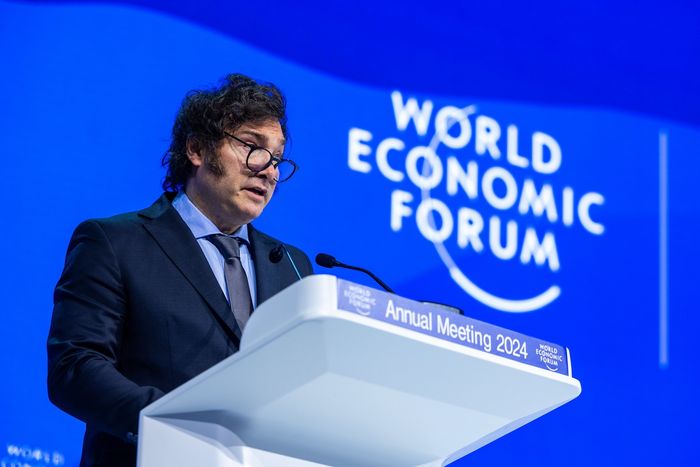
Argentine President Javier Milei speaks at the World Economic Forum in 2024 (Photo: WEF via Flickr/ Creative Commons)
The U.S. is widely accepted as the leading influencer, benefactor, and supporter of the IMF. Similarly, the IMF is widely seen as being a key catalyst for Argentina’s first economic downturn at the turn of the century, which it never fully recovered from. Thus, the question is unavoidable: Does the U.S. bear responsibility for Argentina’s continuing economic rut and subsequently Milei’s meteoric rise and apparent fall?
Unicorn Riot turned to Adolfo Pérez Esquivel, a household name in Argentina and a Nobel Peace Prize winner, to get some answers. He did not mince words when it came to sizing up IMF and U.S. policy toward Argentina during an interview.
“[T]he U.S. continues to treat Latin America as a whole as its ‘backyard,’” Pérez Esquivel said, harkening back to a description first coined by Thomas Mann, a prominent State Department official who served during the John F. Kennedy and Lyndon Johnson administrations. U.S. planners continued to refer to Latin America as America’s “backyard,” particularly Ronald Reagan’s officials who also actively supported an array of Latin American dictatorships in the 1980s, a campaign capped by the Iran-Contra scandal that broke in 1986.
An array of U.S.-supported IMF officials have acknowledged failing Argentina and leaving its economy in tatters for decades.
One high-ranking U.S. official after another, from Secretary of State Henry Kissinger during the Nixon administration, to Jeane Kirkpatrick, U.S. ambassador to the United Nations during the Reagan administration, to the late President Jimmy Carter, supported Argentina’s despotic 1970s regime directly or otherwise.
Pérez Esquivel thus approvingly mentioned one of Latin America’s most famous writers, Eduardo Galeano, the author of The Open Veins of Latin America, and his well-known criticism of so-called third world debt to the U.S. and the IMF working hand-in-hand together and its devastating impact on the continent: “The more the poor countries pay, the more they owe [to the IMF], and the less they have [for themselves],” Pérez Esquivel told Unicorn Riot.
In the midst of Argentina’s first IMF-provoked crisis, Paul Krugman, when he was The New York Times leading economic columnist, acknowledged that “much of the world, with considerable justification, views [the IMF as being a] branch of the U.S. Treasury Department.”
Even the IMF itself would come to admit wrongdoing and has, time and time again, been more a part of the problem than the solution to Argentina’s economic suffering. An array of U.S.-supported IMF officials have acknowledged failing Argentina and leaving its economy in tatters for decades: In 2002, Anne Krueger, the IMF’s first deputy managing director, admitted to the IMF’s strategies having backfired; in 2003, IMF Managing Director Horst Köhler acknowledged that its economic prescriptions were poorly designed; and in 2016, IMF Managing Director Christine Lagarde expressed regret over IMF failures in Argentina, merely saying the IMF did the “best we could.”
Milei’s Domestic “Trajectory”
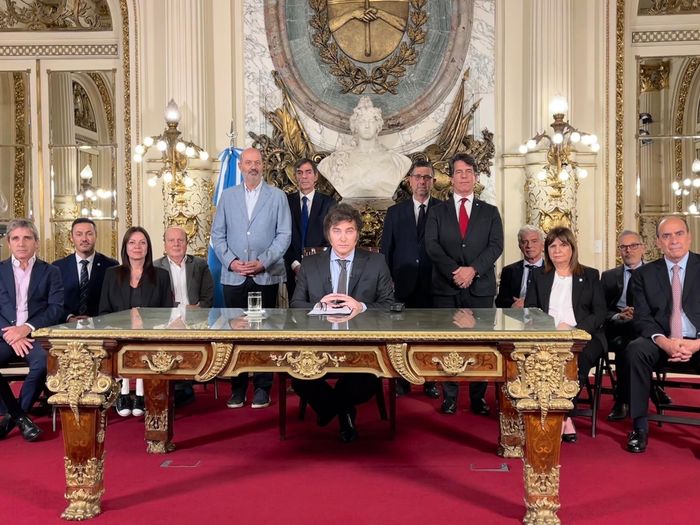
Recently inaugurated President Milei poses with his cabinet on December 20, 2023, at the event signing decrees to slash hundreds of public interest laws and protections. (Photo: casarosada.gob.ar )
It was dinner time during a pleasantly mild spring night in December 2023; Argentina, far south of the equator, has opposite seasons to North America, and Buenos Aires was buzzing with spontaneous protest. Winter vacationing tourists from the Northern Hemisphere looked on with curiosity and confusion, but locals were plenty familiar with what was happening.
As is customary for many Latin American countries during spontaneous resistance, people drummed on pots and pans with kitchen utensils or whatever they could get their hands on. Some joined from their apartment balconies while others gathered in front of restaurants and other public places. This is known in Spanish as a cacerolaz and it was happening in the wake of Milei’s inauguration and one of his very first acts as president.
During one of Milei’s first public speeches, he immediately warned Argentinians of “tough times” to follow—a stark contrast to his enthusiastic campaign promises to instantly transform the economy. In one of the first presidential actions of the still newly minted administration, Milei issued a megadecreto (a mega decree, like an “executive order” in U.S. political parlance), giving credence to the many warnings sounded about Milei’s authoritarian bent.
Civil society has persisted and continued to resist, with more people in Argentina expecting additional mass protests happening before any semblance of poverty reduction and stability is brought to Argentina’s IMF debt plagued economy.
Milei did choose to deliver on a hostility he openly brandished toward civil society and political resistance throughout his campaign by having chosen Victoria Villaruel for his vice presidential candidate. Villaruel is the daughter of one of Argentina’s military generals who hailed from its dictatorial period of the 1980s; she and Milei have both expressed open admiration for the bygone era. Such nostalgia was made concrete just one day after Milei’s inauguration, as he created a national registry tracking a swath of political resistance against his administration, which facilitated increased surveillance by federal forces.
But it was the megadecret o that provoked spontaneous protest in the streets for months on end and up to the present as mass protest after mass protest has been successfully organized. The executive order—known in Spanish as the decreto de necesidad y urgencia—or DNU for short—is a far-reaching presidential decree which eliminated over 300 hard-fought and won domestic laws by civil society with the stroke of a pen and without congressional approval. The brushed-aside laws were mostly public-interested oriented ones, which slashed severance pay, significantly undermined collective bargaining rights, deregulated the rental market, and undermined dozens upon dozens of previously existing protections.
At the end of the day, the megadecreto wound up being reduced to a handful of about 60 executive orders, a significant decrease from the over 300 initially issued.
As Sánchez-Garzoli told Unicorn Riot, however, this was likely what Milei was banking on, in what amounted to a brazen and eventually partially successful “attempt to push his entire agenda onto Congress.”
It was a “a tangible example of his authoritarianism and an extraordinary measure to use to push one’s own agenda through, which is only supposed to be used for specific and limited, emergency purposes. What wound up actually going through were still some 64 laws and thus was a blitzkrieg strategy to make sure as much unilateral imposition as possible could stand,” Sânchez-Garzoli said.
All the while, civil society has persisted and continued to resist, with more people in Argentina expecting additional mass protests happening before any semblance of poverty reduction and stability is brought to Argentina’s IMF debt plagued economy.
“Libertarian” or a “Mecca for the West”?
Just hours after the official presidential election results reached Milei’s campaign, the White House called President-elect Javier Milei to congratulate him and assure him of U.S. support, emphasizing potential bi-national collaboration.
Such congratulations came despite Milei becoming the world’s first self-proclaimed “libertarian” president. Critics argue the label is questionable, given his hostility toward protest and mass assembly rights, as well as his hard-line stances against abortion. Additionally, he has shown little interest in decriminalizing drugs or supporting policies that promote immigration and free movement—stances traditionally associated with so-called “libertarianism.” Instead, critics contend that Milei’s so-called “anarcho-capitalism” stops short of meaningful political and social reforms and claim his agenda prioritizes enlarging the power and wealth of corporations over expanding individual freedoms.
These contradictions were pointed out in an interview with Time reporter Vera Bergengruen, as she questioned Milei’s stances on abortion.
What are the implications of this political backslapping between Milei and leading Wall Street-friendly politicians and Silicon Valley CEOs when it comes to Argentina’s future?
As has been duly acknowledged by Milei, his priorities are more toward attracting foreign investment as opposed to passing domestic legislation to relieve the battered Argentinian economy. He has tried to court powerful political and economic elites through policy stances, rhetoric, and an ideology which caters to them. This has been reflected by Milei’s travel itinerary.
“Milei has spent more time abroad than he has spent in the provinces of Argentina,” Pérez Esquivel told UR. Indeed, the contrast with Milei’s Argentinian presence is one that attracts the ire of civil society in resistance, with Esquivel pointing to these jaunts abroad as evidence of Milei not caring about Argentinians.
Milei has personally met with some of the most powerful billionaires in the world such as Elon Musk, resulting in Musk encouraging his millions of followers to invest in Argentina on his X platform. Other Silicon Valley magnates, including Meta’s Mark Zuckerberg and his peers at Apple, Alphabet (Google), and OpenAI—which is backed by Microsoft—have also been on Milei’s itinerary during his trips to the U.S. This cozying up to billionaire CEOs has attracted the enthusiasm of investors: One U.S.-based financier wrote that the “economic overhaul” by Milei is “not just refreshing, but essential.” Billionaire investor Stanley Druckenmiller announced investments in five Argentinian companies after hearing Milei speak at Davos.
And while Milei has held two in-person meetings within a month of each other with Musk, he had only visited 5 out of 23 of Argentina’s provinces as of September 2024. In one of those provinces, Tierra del Fuego, Milei raced off to meet with Laura Richardson, the commander of United States Southern Command at the time, for a ceremony to announce the construction of a joint naval base, a stark contrast to prior “K” policies distancing the country from U.S. military relations.
U.S. Rep. Maria Elvira Salazar, a Republican representing Florida’s 27th district, endorsed Milei even before the election. Salazar declared Argentina to be a country with “only one culture, only one religion, and only one race, completely homogenous.” Milei himself went so far as to fire an Argentinian Football Association official who merely criticized the Argentinian national soccer team after Manchester City star and national team standout, Julian Alvarez, uploaded an excerpt of its Copa America final winning celebrations to his Instagram account. The video featured racist chants against the French national soccer team, whom it had beat in December 2022’s World Cup final. (Milei wound up meeting with Prime Minister Emanuel Macron in France, in the aftermath of the scandal and shortly before France played against Argentina in an Olympics soccer match in which a brawl happened at the conclusion of the match.)
The affinity between Milei and Trump has not been lost on Salazar, as she has proudly told Politico that “extensive conversations” between the Biden administration and Milei have occurred. “[Argentina is] going through a very bad moment, but they are supported, and they are helped by the big guys, meaning us,” Salazar said.
Cozying up to both CEOs as well as leading public officials from both sides of the aisle in Capitol Hill and the White House is certainly part of how Milei has set out to make Argentina a “Mecca for the West,” as he put it in a during an address he gave in Los Angeles. However, foreign policy experts have expressed concerns about such warming up to the U.S. and the West in general.
Foreign policy expert Alejandro Frenkel wrote that the guiding doctrine of Milei’s foreign policy is a confused “Westernism,” subordinated to the United States and Israel. Others have described “an [outright] open subordination to Washington.”
Cynthia Arnson, an expert on Latin America from the Wilson Center, told Unicorn Riot that, “If Trump wins the White House, there will be an ideological affinity with Milei and there probably will be White House visits, even though there will likely be very little to offer by a Trump White House,” adding that “Milei has been mostly playing ‘footsy’ with the IMF, is looking for postponed payments, and has bent over backwards not to be hostile.”
It’s a strong contrast with past Argentinian efforts to combat the IMF’s corrosive influence on its economic struggles. Thus, this begs the question, what are the implications of this political backslapping between Milei and leading Wall Street-friendly politicians and Silicon Valley CEOs when it comes to Argentina’s future?
Given that Milei has centered his administration on inflation-reduction efforts to address Argentina’s economic woes, the leading economists who voiced concerns in a public letter before his victory are likely still uneasy about the country’s prospects for recovery. In the letter, one renowned economist after another who signed the critique took issue with the idea that “a major reduction in government spending would” help matters for ordinary Argentinians and thought instead that a likely “increase [to] already high levels of poverty and inequality [will ensue], and could result in significantly increased social tensions and conflict.”
In hindsight, this is exactly what has transpired: Argentina’s bleak prospects for improvement now hinge on further change—this time, in service of the public interest rather than against it.
Flashback to a pivotal moment in global politics.
It was a crisp evening in December 2021 when Donald Trump stepped onto a gilded stage at the Conservative Political Action Conference (CPAC) in Orlando, Florida. The former president—reduced to a kingmaker, still without access to his Twitter account, and seething over his defeat in 2020, yet still nursing ambitions for a return—spoke to a raucous crowd about the need for a global “populist revival.”
Meanwhile, thousands of miles away, another showman was making his mark.
In Buenos Aires, Javier Milei, then a fiery congressman with a penchant for theatrics and unfiltered invective, was delivering his own bombastic address on live television. Clad in his signature leather jacket and gesturing wildly, Milei railed against the political elite, vowing to obliterate the “parasitic state” with his ever-present chainsaw prop.
As the world braced for this new era of racist and xenophobic leadership, the intertwined fates of Trump and Milei offered a potent lens through which to examine the volatility of contemporary politics.
For a brief moment, the right-wing populist figures seemed like ideological satellites orbiting the same disruptive axis. Trump, sidelined but scheming, watched as the conservative media anointed him the leader of an imagined international populist alliance. Milei, meanwhile, was steadily building a cult following in Argentina, his rise to power hastened by a corporate media landscape eager for controversy and spectacle. Though separated by continents and cultures, Trump and Milei’s shared disdain for establishment politics and a mutual affection for shock value linked their trajectories in the imaginations of their supporters.
Fast forward three years to 2024, and the political world was turned on its head.
Milei, once dismissed as a fringe outsider, seized the presidency of Argentina in a landslide—a triumph of style over substance, fueled by promises of radical economic reform steeped in austerity and deep cuts to public interest spending. Trump, who had clawed his way back to power with a surprise 2024 election victory, eking by with a slimmer popular vote margin and narrower victory than any other in over a century, was mere weeks away from reclaiming the Oval Office.
The unlikely duo became the poster boys of a resurgence of right-wing, white nationalist populism. Trump, emboldened by his razor-thin victory, described Milei as a “brother in arms” during a congratulatory phone call. Milei, ecstatic, became the first world leader to congratulate Trump in person at the 2024 CPAC convention, claiming to be a mutual part of a blessed mission: “Today the world is a much better place because the winds of freedom are much stronger… A true miracle and proof that the forces of heaven are on our side,” Milei jovially proclaimed during his CPAC speech.
Yet, beneath the mutual admiration and bluster lay cracks in their respective facades. While Trump was busy assembling a cabinet that hinted at renewed chaos, Milei’s honeymoon phase was already crumbling under the weight of his own policies. Both men had ascended by exploiting dissatisfaction and anger, but their ability to govern was increasingly in question. And in Milei’s case, his credibility recently took an even greater hit as more details have surfaced that he had once enthusiastically promoted a now-collapsed cryptocurrency scheme, raising the question of whether Argentina’s self-proclaimed libertarian savior had been duped or, even worse, did the duping himself.
For Milei, the exhilaration of victory quickly gave way to mass protests (including ones covered by Unicorn RiotfromlastMay and January / February 2024), economic stagnation, and plummeting public approval. For Trump, the looming challenges of his second presidency—a divided country, international skepticism, and mounting legal troubles—threatened to turn triumph into turmoil.
But if Milei and Trump seemed destined for a political bromance, the rest of Latin America wasn’t nearly as enamored.
While Milei threw himself into Trump’s embrace, other regional leaders responded with defiance. In Mexico, President Claudia Sheinbaum made it clear she would not be bullied into Trump’s hardline immigration policies, standing firm in early diplomatic confrontations even as economic pressures forced some concessions. Colombia’s Gustavo Petro was even more direct in his opposition, warning that Trump’s return signaled renewed imperial aggression and pledging to resist the right-wing tide sweeping the hemisphere. Even Brazil, governed by the more pragmatic Lula da Silva, showed little enthusiasm for Trump’s reemergence, wary of his influence over the continent’s far-right.
Milei, in contrast, found himself increasingly isolated—Trump’s most reliable ideological ally in Latin America, but an outlier rather than the harbinger of a broader regional shift. As he struggled to implement his radical libertarian agenda amid economic turmoil and mounting protests it became clear that his populist revolution was already faltering.
As the world braced for this new era of racist and xenophobic leadership, the intertwined fates of Trump and Milei offered a potent lens through which to examine the volatility of contemporary politics. The parallels were impossible to ignore: two men, propelled to power by mainstream-media-manufactured personalities and plenty of controversy, now tasked with delivering on promises that many deemed impossible. The question wasn’t just whether they would succeed, but whether their respective nations—and the world—could withstand the consequences if they failed.
Milei’s Corporate Media-Facilitated Rise and Apparent Fall from Grace with Argentinians
In Buenos Aires on April 23, 2024, hundreds of thousands of people protested deep austerity cuts by Milei to Argentina’s education budget. (Photo: Matías Cervilla)
Javier Milei first gained notoriety as a radio talk-show host in the 2000s, and by the 2010s, he became a television personality and a regular guest on nationally known programs such as Intratables, A Dos Voces, and Todo Noticias (TN). Mainstream media took to Milei, as his propensity to yell and use inflammatory—and often profane—language lent itself toward viral social media distribution, with such antics gaining particular exposure among younger generations.
By November 2021, then, Milei was barely able to garner just a few congressional seats for both himself and his current vice president through a rag-tag and thrown together coalition called La Libertad Avanza (Freedom Advances) which wound up only garnering 17.3% of the vote. That was Milei’s first foray into Argentinian politics.
By 2023, mainstream news media ran one image-driven, personalized story after another, ranging from pieces exploring his haircut and fashion sense to images distributed far and wide of Milei wielding a chainsaw, symbolizing campaign promises to slash through any number of the previous government’s policies.
Milei’s upset victory probably shouldn’t have been seen as a big surprise, given the global drift toward reality show politicians.
The chainsaw symbolism was covered at the expense of more serious coverage, like evaluating Milei’s idea of dumping the Argentinian peso for a dollarized economy—a promise he’s since walked back and will likely never implement.
The media brushed past the impact that cuts to government spending may have on the poverty rate, which rocketed higher throughout 2024. Milei’s characterization of social programs as being nothing more than bureaucracies without any benefit to the public was uncritically noted in passing, if that, while obsession over his “rock star M.O.” and “ loco”ways. Both narratives stemmed from coverage dominated by Clarin, Argentina’s largest newspaper.
In one sub-headline, Milei was generously quoted as saying, “I don’t brush my hair, the wind does,” with the main head asking, “ Who cuts Milei’s hair?”
Thus, instead of covering concerns about Milei taking heartfelt advice from one of his three dogs, whom he claimed transmitted the thoughts and ideas of yet another deceased pet dog, media accounts depicted this as just one of Milei’s many quirky ways, for which he has been long known with a nickname of “El Loco” first being given during his adolescence and lasting through the present.
Argentinian intellectuals, analysts, and critics alike have pointed to Milei’s firebrand public persona playing well to mainstream news coverage as a crucial factor in his quick rise to a viable, and eventually successful presidential candidate. Ricardo Foster, an Argentine philosopher and intellectual, argued that sensationalism and populism were given inordinate airtime without sufficient scrutiny, with an over-prioritization on personality over actual policy viability.
Forrest Hylton, columnist for the London Review of Books and professor of history at the Universidade Federal da Bahia, told Unicorn Riotthat Milei cultivated a “cult-like persona,” which helped to obfuscate that he was an “ideological fanatic” who was armed with proposals, as opposed to chainsaws, that, “will only serve to worsen the continuing economic crisis.”
Gimena Sánchez-Garzoli, a foreign policy analyst and critic with the Washington Office on Latin America (WOLA) who’s intimately familiar with Milei supporters also spoke to Unicorn Riot.
Sánchez-Garzoli is originally from Argentina, and much of her family still resides there, and she assured Unicorn Riot that she “gets” Milei’s surprising and quick political rise all the way to the Casa Rosada(Argentina’s White House). Sánchez-Garzoli pointed to a good chunk of her family in Argentina as “all pro-Milei [and] just people who were very tired with the status quo, which is somewhat understandable, given that a whole generation has been raised on one economic crisis after another.”
Argentina’s status quo has been characterized by several decades of chaotic ups and (mostly) downs in its long-beleaguered economy. An entire generation of ordinary Argentinians has grown up “without a stable middle class or trade unions to turn to” and without first-hand awareness of Argentina’s dictatorial past, Sánchez-Garzoli explained. Many of the concerns about Milei’s autocratic tendencies were at least sometimes quoted in the media, but nevertheless fell on the deaf ears for a large chunk of the populace desperate for any kind of change.
Nonetheless, Milei’s inexperience with national politics still shocked the country after a very strong showing in the first round of presidential voting, with the threshold for winning outright nearly being cleared by Milei, even with support being split between him and a third-placed candidate. Milei’s push in the second round of voting got boosted by a poor and befuddling choice by his opponents. Although his opponent hailed from the incumbent party whose candidates had been in power for 16 of the last 20 years, the choice was, to say the least, a highly questionable one.
2023 was indeed a far cry from the days of Néstor Kirchner, the founding father of the 21st-century embodiment of “Peronists,” later dubbed the “K’s.” Néstor was widely credited with helping the country navigate through the extremely tricky waters of a debt crisis provoked by the International Monetary Fund (IMF). Kirchner consequently became one of Argentina’s most popular presidents ever, with as many as 200,000 Argentinians attending his funeral in the wake of his unexpected death shortly after the end of his second term.
This was how the “K” legacy began as the country happily elected Kirchner’s wife, Cristina, after Néstor passed away shortly after his two terms in office.
In the long run, Argentina never really fully recovered from its IMF-induced meltdown. The “K”s became immersed in a quagmire as neoliberal opposition parties lobbed one accusation of corruption after another and endlessly embroiled Cristina with lawsuits (incidentally, a similar strategy was employed in neighboring Brazil against current president Lula and his predecessor, Dilma Rousseff).
Thus, matters couldn’t have been better for Milei as a challenger, as the Peronist and “K” loyalists witlessly nominated its minister of the economy, the often wooden Sergio Masa, as its presidential candidate. Sánchez-Garzoli remarked, “There was a superiority thing going on with the ‘Ks’ in Argentina that turned a lot of ordinary Argentinians completely off.”
Milei, who deftly established himself as a media darling thanks to an all-too-pliant corporate press, only had to beat the rather uncharismatic Masa. The “K” presidential candidate was saddled by an economy falling yet again into hyperinflation under his administration. Under Masa, inflation rose to levels that rivaled those of the most economically plagued African economies and thus also eclipsed even previous high inflation rates that had long plagued Argentina.
Argentinians found themselves counting away their drastically devalued currency in transaction after transaction, as bill denominations couldn’t keep up with raised prices and one-thousand peso notes were barely worth a U.S. dollar. Meanwhile, the Ks stubbornly refused to print up and distribute currency notes of higher denominations and no one wanted to deal with credit and debit card transactions, with traumatic historical memories of countless Argentianians having their savings wiped out in the wake of the first IMF-caused economic meltdown.
This is how cash became king in Argentina. After all, one cannot know with any degree of security how long their money will be worth anything, which only furthers the spiral of hyperinflation. This cash economy rests on top of a prevalent black market exchange for U.S. dollars, which the wealthiest of Argentinians regularly avail themselves of, causing further damage.
In response to a move by the “Ks” that smacked of hubris, Argentinian voters mercilessly punished the Peronists by electing Milei in a landslide victory against the party’s leading economic manager who oversaw the country’s descent into its worst inflationary recession.
Milei’s upset victory probably shouldn’t have been seen as a big surprise, given the global drift toward reality show politicians. Candidates the world over, ranging from India’s Narendra Modi to Brazil’s Jair Bolosonaro and Donald Trump, prefer to court media spectacles with jaw-dropping and often racist, sexist, and classist remarks via social media, instead of well-thought-out white papers and policy details.
Milei’s Apparent Decline After Hardline Reforms
In Buenos Aires on April 23, 2024, hundreds of thousands of people protested deep austerity cuts by Milei to Argentina’s education budget. (Photo: Matías Cervilla)
Less than a year into Milei’s presidency, Argentina erupted in its largest protests in decades. On May 9, 2024, a nationwide general strike brought as many as a million people into the streets, according to organizers, marking the second mass mobilization against his government in just a matter of months. The message was unmistakable: The country was on the brink, and its people were not backing down.
What prompted such extraordinary levels of political resistance and opposition to a president who had won a landslide electoral victory not even a year ago? Sánchez-Garzoli told Unicorn Riot that Milei has a sustainability problem, which presented a challenge considering that the overwhelming majority of the electorate put him into office to gain stability.
“Milei’s economic plans and austerity packages are having a devastating effect on the middle and lower classes in Argentina. Milei has brokered austerity packages with the IMF but has not compensated that with anything else. Cutting all of these public programs is one thing, but leaving the people out on the street without enough food is another. It isn’t sustainable,” explained Sánchez-Garzoli, and increasingly more and more Argentinians seem to agree.
Many observers were left wondering whether Milei had merely been an oblivious front man or something worse: a willing participant in a financial scam.
Milei not only slashed funding for public education but also managed to overcome a veto override attempt by the overwhelmingly opposition-based Congress. In both the lead-up to and in the wake of these events, Milei’s popularity has precipitously dropped, according to public opinion polls. Several sources indicate that his popularity has been steadily falling since the start of his presidency, with one mainstream outlet headlining and questioning, “Is the honeymoon over? Milei’s popularity dips while worry over poverty is on the rise,” even before the mass protest of early October 2024.
For example, one Zuban Córdoba poll highlighted that 57.3% of Argentines disapprove of his performance as of September 2024, a significant increase from the already high 52.5% in April of the same year (the first of two mass protests against Milei’s stance on public education also took place in April 2024). Over that same period, Milei’s “full support” dropped from 38.2% to just 20.3%. A survey from Torcuato Di Tella University showed a sharp decline in public trust in Milei’s government, down to 2.16 points out of a possible 5 as of September, the lowest level since he assumed office. Yet another poll showed only 33% of Argentines as having general confidence in Milei, reflecting growing disillusionment with the president’s lofty campaign promises, particularly as inflation has only been slightly stymied at best while 66% of those surveyed strongly believed unemployment and poverty rates continue to rise.
Results like these point to a slow but steady decline in support of Milei’s image, largely driven by doubts about his ability to resolve the nation’s economic woes while cutting public resources and a political movement lacking any foundation.
Milei’s party is only a recent creation of his own and not linked in any way to a popular movement of any sort. As a result it failed to capture a significant number of seats in Argentina’s legislature. In fact, no other Argentinian president since the U.S.-backed dictatorship was finally toppled in 1983 had been elected with their party receiving as little support as Milei’s, which received just 15% of the seats in the lower house and 10% in the Senate.
Finally, Milei made a slew of campaign promises, chainsaw in hand, that were virtually impossible to deliver on, ranging from dollarization to public spending cuts solving the economy’s woes. He fashioned himself as an evangelist for free markets by exalting cryptocurrencies as a pathway to economic freedom. In recent days (February 2025) it emerged that he’d promoted $LIBRA, a cryptocurrency that collapsed similar to a “pump and dump” (PDF) or Ponzi scheme, leaving countless investors in financial ruin. Videos surfaced of Milei, then a rising political firebrand, endorsing the company in slickly produced ads, describing it as a revolutionary financial opportunity. The coin’s implosion sparked investigations, a pinned tweet got deleted by Milei himself, and over a hundred lawsuits were immediately filed. Many observers were left wondering whether Milei had merely been an oblivious front man or something worse: a willing participant in a financial scam. Either way, the scandal added yet another layer of volatility to his already embattled presidency, fueling doubts about both his judgment and the sincerity of his right-wing populist rhetoric, adding damage to his already low public approval ratings and triggering calls for his impeachment.
Bygone U.S. Policies Cloud Argentina’s Past and Present
Argentine President Javier Milei speaks at the World Economic Forum in 2024 (Photo: WEF via Flickr/ Creative Commons)
The U.S. is widely accepted as the leading influencer, benefactor, and supporter of the IMF. Similarly, the IMF is widely seen as being a key catalyst for Argentina’s first economic downturn at the turn of the century, which it never fully recovered from. Thus, the question is unavoidable: Does the U.S. bear responsibility for Argentina’s continuing economic rut and subsequently Milei’s meteoric rise and apparent fall?
Unicorn Riot turned to Adolfo Pérez Esquivel, a household name in Argentina and a Nobel Peace Prize winner, to get some answers. He did not mince words when it came to sizing up IMF and U.S. policy toward Argentina during an interview.
“[T]he U.S. continues to treat Latin America as a whole as its ‘backyard,’” Pérez Esquivel said, harkening back to a description first coined by Thomas Mann, a prominent State Department official who served during the John F. Kennedy and Lyndon Johnson administrations. U.S. planners continued to refer to Latin America as America’s “backyard,” particularly Ronald Reagan’s officials who also actively supported an array of Latin American dictatorships in the 1980s, a campaign capped by the Iran-Contra scandal that broke in 1986.
An array of U.S.-supported IMF officials have acknowledged failing Argentina and leaving its economy in tatters for decades.
One high-ranking U.S. official after another, from Secretary of State Henry Kissinger during the Nixon administration, to Jeane Kirkpatrick, U.S. ambassador to the United Nations during the Reagan administration, to the late President Jimmy Carter, supported Argentina’s despotic 1970s regime directly or otherwise.
Pérez Esquivel thus approvingly mentioned one of Latin America’s most famous writers, Eduardo Galeano, the author of The Open Veins of Latin America, and his well-known criticism of so-called third world debt to the U.S. and the IMF working hand-in-hand together and its devastating impact on the continent: “The more the poor countries pay, the more they owe [to the IMF], and the less they have [for themselves],” Pérez Esquivel told Unicorn Riot.
In the midst of Argentina’s first IMF-provoked crisis, Paul Krugman, when he was The New York Times leading economic columnist, acknowledged that “much of the world, with considerable justification, views [the IMF as being a] branch of the U.S. Treasury Department.”
Even the IMF itself would come to admit wrongdoing and has, time and time again, been more a part of the problem than the solution to Argentina’s economic suffering. An array of U.S.-supported IMF officials have acknowledged failing Argentina and leaving its economy in tatters for decades: In 2002, Anne Krueger, the IMF’s first deputy managing director, admitted to the IMF’s strategies having backfired; in 2003, IMF Managing Director Horst Köhler acknowledged that its economic prescriptions were poorly designed; and in 2016, IMF Managing Director Christine Lagarde expressed regret over IMF failures in Argentina, merely saying the IMF did the “best we could.”
Milei’s Domestic “Trajectory”
Recently inaugurated President Milei poses with his cabinet on December 20, 2023, at the event signing decrees to slash hundreds of public interest laws and protections. (Photo: casarosada.gob.ar )
It was dinner time during a pleasantly mild spring night in December 2023; Argentina, far south of the equator, has opposite seasons to North America, and Buenos Aires was buzzing with spontaneous protest. Winter vacationing tourists from the Northern Hemisphere looked on with curiosity and confusion, but locals were plenty familiar with what was happening.
As is customary for many Latin American countries during spontaneous resistance, people drummed on pots and pans with kitchen utensils or whatever they could get their hands on. Some joined from their apartment balconies while others gathered in front of restaurants and other public places. This is known in Spanish as a cacerolaz and it was happening in the wake of Milei’s inauguration and one of his very first acts as president.
During one of Milei’s first public speeches, he immediately warned Argentinians of “tough times” to follow—a stark contrast to his enthusiastic campaign promises to instantly transform the economy. In one of the first presidential actions of the still newly minted administration, Milei issued a megadecreto (a mega decree, like an “executive order” in U.S. political parlance), giving credence to the many warnings sounded about Milei’s authoritarian bent.
Civil society has persisted and continued to resist, with more people in Argentina expecting additional mass protests happening before any semblance of poverty reduction and stability is brought to Argentina’s IMF debt plagued economy.
Milei did choose to deliver on a hostility he openly brandished toward civil society and political resistance throughout his campaign by having chosen Victoria Villaruel for his vice presidential candidate. Villaruel is the daughter of one of Argentina’s military generals who hailed from its dictatorial period of the 1980s; she and Milei have both expressed open admiration for the bygone era. Such nostalgia was made concrete just one day after Milei’s inauguration, as he created a national registry tracking a swath of political resistance against his administration, which facilitated increased surveillance by federal forces.
But it was the megadecret o that provoked spontaneous protest in the streets for months on end and up to the present as mass protest after mass protest has been successfully organized. The executive order—known in Spanish as the decreto de necesidad y urgencia—or DNU for short—is a far-reaching presidential decree which eliminated over 300 hard-fought and won domestic laws by civil society with the stroke of a pen and without congressional approval. The brushed-aside laws were mostly public-interested oriented ones, which slashed severance pay, significantly undermined collective bargaining rights, deregulated the rental market, and undermined dozens upon dozens of previously existing protections.
At the end of the day, the megadecreto wound up being reduced to a handful of about 60 executive orders, a significant decrease from the over 300 initially issued.
As Sánchez-Garzoli told Unicorn Riot, however, this was likely what Milei was banking on, in what amounted to a brazen and eventually partially successful “attempt to push his entire agenda onto Congress.”
It was a “a tangible example of his authoritarianism and an extraordinary measure to use to push one’s own agenda through, which is only supposed to be used for specific and limited, emergency purposes. What wound up actually going through were still some 64 laws and thus was a blitzkrieg strategy to make sure as much unilateral imposition as possible could stand,” Sânchez-Garzoli said.
All the while, civil society has persisted and continued to resist, with more people in Argentina expecting additional mass protests happening before any semblance of poverty reduction and stability is brought to Argentina’s IMF debt plagued economy.
“Libertarian” or a “Mecca for the West”?
Just hours after the official presidential election results reached Milei’s campaign, the White House called President-elect Javier Milei to congratulate him and assure him of U.S. support, emphasizing potential bi-national collaboration.
Such congratulations came despite Milei becoming the world’s first self-proclaimed “libertarian” president. Critics argue the label is questionable, given his hostility toward protest and mass assembly rights, as well as his hard-line stances against abortion. Additionally, he has shown little interest in decriminalizing drugs or supporting policies that promote immigration and free movement—stances traditionally associated with so-called “libertarianism.” Instead, critics contend that Milei’s so-called “anarcho-capitalism” stops short of meaningful political and social reforms and claim his agenda prioritizes enlarging the power and wealth of corporations over expanding individual freedoms.
These contradictions were pointed out in an interview with Time reporter Vera Bergengruen, as she questioned Milei’s stances on abortion.
What are the implications of this political backslapping between Milei and leading Wall Street-friendly politicians and Silicon Valley CEOs when it comes to Argentina’s future?
As has been duly acknowledged by Milei, his priorities are more toward attracting foreign investment as opposed to passing domestic legislation to relieve the battered Argentinian economy. He has tried to court powerful political and economic elites through policy stances, rhetoric, and an ideology which caters to them. This has been reflected by Milei’s travel itinerary.
“Milei has spent more time abroad than he has spent in the provinces of Argentina,” Pérez Esquivel told UR. Indeed, the contrast with Milei’s Argentinian presence is one that attracts the ire of civil society in resistance, with Esquivel pointing to these jaunts abroad as evidence of Milei not caring about Argentinians.
Milei has personally met with some of the most powerful billionaires in the world such as Elon Musk, resulting in Musk encouraging his millions of followers to invest in Argentina on his X platform. Other Silicon Valley magnates, including Meta’s Mark Zuckerberg and his peers at Apple, Alphabet (Google), and OpenAI—which is backed by Microsoft—have also been on Milei’s itinerary during his trips to the U.S. This cozying up to billionaire CEOs has attracted the enthusiasm of investors: One U.S.-based financier wrote that the “economic overhaul” by Milei is “not just refreshing, but essential.” Billionaire investor Stanley Druckenmiller announced investments in five Argentinian companies after hearing Milei speak at Davos.
And while Milei has held two in-person meetings within a month of each other with Musk, he had only visited 5 out of 23 of Argentina’s provinces as of September 2024. In one of those provinces, Tierra del Fuego, Milei raced off to meet with Laura Richardson, the commander of United States Southern Command at the time, for a ceremony to announce the construction of a joint naval base, a stark contrast to prior “K” policies distancing the country from U.S. military relations.
U.S. Rep. Maria Elvira Salazar, a Republican representing Florida’s 27th district, endorsed Milei even before the election. Salazar declared Argentina to be a country with “only one culture, only one religion, and only one race, completely homogenous.” Milei himself went so far as to fire an Argentinian Football Association official who merely criticized the Argentinian national soccer team after Manchester City star and national team standout, Julian Alvarez, uploaded an excerpt of its Copa America final winning celebrations to his Instagram account. The video featured racist chants against the French national soccer team, whom it had beat in December 2022’s World Cup final. (Milei wound up meeting with Prime Minister Emanuel Macron in France, in the aftermath of the scandal and shortly before France played against Argentina in an Olympics soccer match in which a brawl happened at the conclusion of the match.)
The affinity between Milei and Trump has not been lost on Salazar, as she has proudly told Politico that “extensive conversations” between the Biden administration and Milei have occurred. “[Argentina is] going through a very bad moment, but they are supported, and they are helped by the big guys, meaning us,” Salazar said.
Cozying up to both CEOs as well as leading public officials from both sides of the aisle in Capitol Hill and the White House is certainly part of how Milei has set out to make Argentina a “Mecca for the West,” as he put it in a during an address he gave in Los Angeles. However, foreign policy experts have expressed concerns about such warming up to the U.S. and the West in general.
Foreign policy expert Alejandro Frenkel wrote that the guiding doctrine of Milei’s foreign policy is a confused “Westernism,” subordinated to the United States and Israel. Others have described “an [outright] open subordination to Washington.”
Cynthia Arnson, an expert on Latin America from the Wilson Center, told Unicorn Riot that, “If Trump wins the White House, there will be an ideological affinity with Milei and there probably will be White House visits, even though there will likely be very little to offer by a Trump White House,” adding that “Milei has been mostly playing ‘footsy’ with the IMF, is looking for postponed payments, and has bent over backwards not to be hostile.”
It’s a strong contrast with past Argentinian efforts to combat the IMF’s corrosive influence on its economic struggles. Thus, this begs the question, what are the implications of this political backslapping between Milei and leading Wall Street-friendly politicians and Silicon Valley CEOs when it comes to Argentina’s future?
Given that Milei has centered his administration on inflation-reduction efforts to address Argentina’s economic woes, the leading economists who voiced concerns in a public letter before his victory are likely still uneasy about the country’s prospects for recovery. In the letter, one renowned economist after another who signed the critique took issue with the idea that “a major reduction in government spending would” help matters for ordinary Argentinians and thought instead that a likely “increase [to] already high levels of poverty and inequality [will ensue], and could result in significantly increased social tensions and conflict.”
In hindsight, this is exactly what has transpired: Argentina’s bleak prospects for improvement now hinge on further change—this time, in service of the public interest rather than against it.