Monday, April 14, 2025

Jewish Group Says Trump 'Using Jews as an Excuse' to Spy on Social Media Posts of Immigrants

One critic accused the administration of "cynically claiming to be fighting antisemitism" despite being "the most openly antisemitic U.S. administration in living history."


A protestor holds a sign that reads, "Jews for Free Speech" during a protest in New York City demanding the release of Mahmoud Khalil, a Palestinian student activist and recent Columbia graduate, on March 10, 2025.

(Photo: Michael Nigro/Pacific Press/LightRocket via Getty Images)


Julia Conley
Apr 12, 2025
COMMON DREAMS

A Jewish-led progressive advocacy group was among those expressing horror Wednesday at a new policy unveiled by the Trump administration as part of what it claims is a wide-scale effort to protect Jewish people from antisemitism, but which critics warn is itself antisemitic.

The decision by the Department of Homeland Security (DHS) to begin considering immigrants' "antisemitic activity on social media," said Bend the Arc: Jewish Action, is actually an example of the administration "using Jews as an excuse to move a cruel, anti-immigrant, authoritarian agenda."

"This will NOT fight antisemitism," said the group. "We refuse to be used this way."

DHS said that effective immediately, U.S. Citizenship and Immigration Services will begin screening immigrants' social media activity for what the administration views as expressions of antisemitism, including "endorsing, espousing, promoting, or supporting antisemitic terrorism, antisemitic terrorist organizations, or other antisemitic activity." The agency's findings could be seen "as a negative factor in any USCIS discretionary analysis when adjudicating immigration benefit requests," such as green card or visa applications, it said.

The agency cited President Donald Trump's executive orders that he says are aimed at "combating antisemitism"—which have also been used to round up international students, deny them due process, and threaten them with deportation for speaking out for Palestinian rights.

DHS did not specify what views expressed on social media could be used against an immigrant applying for benefits, but its approach to the State Department's "catch and revoke" program targeting international students who have called for their schools to divest from Israel suggests the agency won't simply be looking for immigrants who threaten the safety of Jewish people.

"This move by DHS will chill online expression for people in the United States and abroad alike."

In recent weeks the Trump administration has revoked the visas of hundreds of international students and immigration agents have detained Palestinian rights advocates including Mahmoud Khalil and Rumeysa Ozturk. One DHS official explicitly conflated Khalil's involvement in pro-Palestinian protests with terrorism in explaining why he should be deported, and Secretary of State Marci Rubio suggested Ozturk had created "a ruckus" by writing an op-ed calling on her school, Tufts University, to divest from companies that benefit from Israel's assault on Gaza.

Kate Ruane, director of the Free Expression Project at the Center for Democracy and Technology, said that in addition to "targeting people based on nothing more than their First Amendment-protected expression," it will likely used "error-prone automated tools" to detect what it views as antisemitic activity.

"These tools are guaranteed to improperly categorize an unknown number of applicants as violent, terroristic, or antisemitic, even by the administration's broad definitions of those terms," said Ruane. "Given the U.S. government's demonstrated willingness to strip people's legal status for engaging in constitutionally protected speech it dislikes, this move by DHS will chill online expression for people in the United States and abroad alike."

Writer Dan Berger said the administration is "cynically claiming to be fighting antisemitism" despite being "the most openly antisemitic U.S. administration in living history."

Elon Musk, who was chosen by Trump to lead efforts to slash public spending at the Department of Government Efficiency, provoked shock from rights groups—but shrugs from the Republican Party and a leading pro-Israel organization—when he displayed what appeared to be a Nazi salute at an inauguration event in January. He has also promoted Germany's far-right party, Alternative for Germany, which has promoted Nazi slogans, and minimized the Holocaust at a rally for the group.

"Dark, abysmal stuff, and a pox on everyone whose defense of genocide made this possible," said Berger.

Jezebel reporter Kylie Cheung also pointed to politicians on both sides of the aisle, such as former President Joe Biden, who have vehemently supported Israel's assault on Gaza and accused those who speak out against it of antisemitism.

DHS's social media policy, said Cheung, "is the natural conclusion of every politician, Democrat and Republican, broadly smearing anti-genocide protesters as antisemitic terrorist sympathizers for the last two years."
DOGE Is Reportedly Spying on Federal Workers With AI Technology

"We have been told they are looking for anti-Trump or anti-Musk language," an anonymous source said of potential surveillance at the U.S. Environmental Protection Agency.


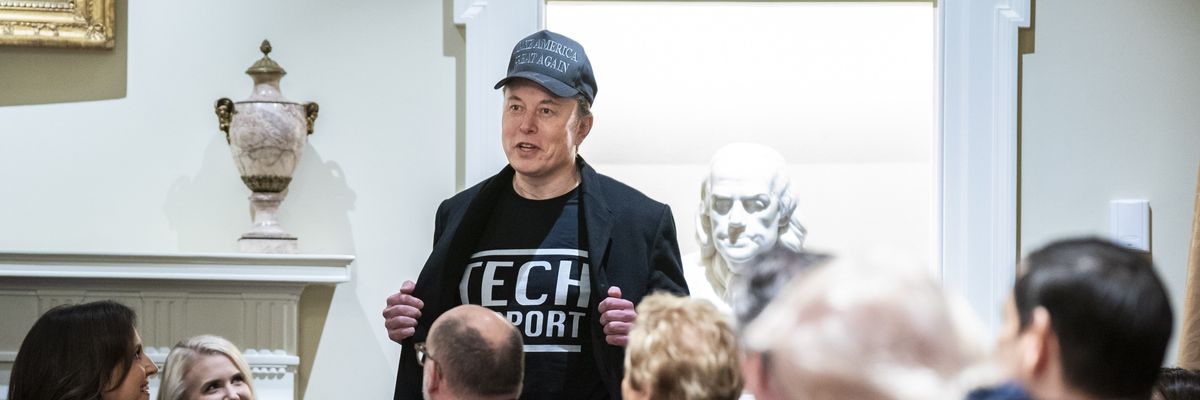
Elon Musk of the Department of Government Efficiency shows off a shirt that says "Tech Support" while speaking at the first cabinet meeting of President Donald Trump's second term at the White House on February 26, 2025 in Washington, D.C.
(Photo: Jabin Botsford/The Washington Post via Getty Images)

Eloise Goldsmith
Apr 10, 2025
COMMON DREAMS

Staff with the U.S. Environmental Protection Agency fear that billionaire and presidential adviser Elon Musk's Department of Government Efficiency is spying on them using artificial intelligence, according to reporting from Reuters, The Guardian, and Crooked Media's newsletter What a Day.

According to Reutersreporting published Tuesday, Trump administration officials told some managers at the EPA that DOGE is rolling out AI to monitor for communications that may be perceived as hostile to U.S. President Donald Trump or Musk, citing two unnamed sources with knowledge of the situation.

According to those two sources, who relayed comments made by Trump-appointed officials in posts at the EPA, DOGE was using AI to monitor communication apps such as Microsoft Teams. "Be careful what you say, what you type, and what you do," an EPA manager said, according to one of the sources.

"We have been told they are looking for anti-Trump or anti-Musk language," a third source told Reuters.

The outlet, however, could not independently confirm whether AI was being implemented.

After the story was published, the EPA told Reuters in a statement that it was "looking at AI to better optimize agency functions and administrative efficiencies." However, the agency said it was not using AI "as it makes personnel decisions in concert with DOGE." The EPA also did not directly address whether it was using AI to snoop on employees.

In response to Reuters' reporting, the government accountability group Citizens for Responsibility and Ethics in Washington wrote on X, "Let's be clear: the career civil servants who work in the government serve the American people, not Donald Trump."


According to Thursday reporting from The Guardian and Reuters, EPA managers told employees during a Wednesday morning meeting that DOGE is "using AI to scan through agency communications to find any anti-Musk, anti-Doge, or anti-Trump statements," according to an employee who was quoted anonymously.

Since returning to power, Trump has launched an all-out assault on environmental protection, including through cuts to programs and personnel at the EPA. According to The New York Times, the EPA has already undergone a 3% staff reduction so far, but the agency also plans to eliminate its scientific research arm, which would mean dismissing as many as 1,155 scientists, according to reporting from last month. EPA Administrator Lee Zeldin has also said he would like to cut 65% of the agency's budget.

The Guardian and What a Day also reviewed an email from a manager at the Association of Clean Water Administrators, a group of state and interstate bodies that works with the EPA on water quality and management, which warned workers that meetings with EPA employees might be monitored by AI.

"We recently learned that all EPA phones (landline/mobile), all Teams/Zoom virtual meetings, and calendar entries are being transcribed/monitored," the email states. The recorded information is then fed into an "AI tool" which analyzes and scrutinizes what has been recorded. "I do not know if DOGE is doing the analysis or … the agency itself," according to the author of the email, per The Guardian and What a Day.

The EPA denied that it's recording meetings, but it did not address the question of an AI tool, according to the outlets.

According to The Guardian and What a Day, employees at other agencies also fear they are being surveilled. For example, a U.S. Department of Veterans Affairs official warned employees that virtual meetings are being recorded in secret, according to an email reviewed by the two outlets. In February, managers at the National Oceanic and Atmospheric Administration warned some workers to be careful about what they say on calls, per an employee there.

"It's like being in a horror film where you know something out there [wants] to kill you but you never know when or how or who it is," one anonymously quoted employee from the U.S. Department of Housing and Urban Development told The Guardian and What a Day, evoking the climate of fear that is rife among government workers.


House GOP Approves 'Modern-Day Poll Tax' With Passage of Orwellian SAVE Act


"Congressional Republicans' anti-voting legislation is a power grab to silence the voices of American citizens—full stop," said one advocate.


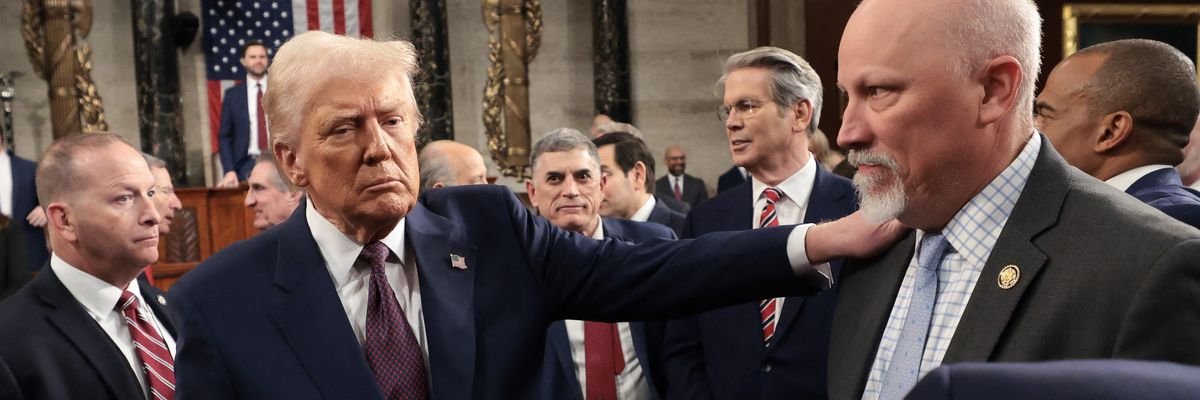
U.S. President Donald Trump greets U.S. Rep. Chip Roy (R-Texas), who proposed the SAVE Act, at the U.S. Capitol in Washington, D.C. on March 4, 2025.
(Photo: Win McNamee/POOL/AFP via Getty Images)

Julia Conley
Apr 10, 2025
COMMON DREAMS

The U.S. House's passage of a bill on Thursday that would require Americans to prove their citizenship with documentation when they register to vote was the Republican Party's response to the fact, said one progressive critic, that "every day more people are catching on to their big grift."

"H.R. 22 is how they plan to keep themselves in power," said Maurice Mitchell, national director of the Working Families Party, of the so-called Safeguard American Voter Eligibility (SAVE) Act. "Not by making life easier for working people, but by making voting harder."

The bill, proposed by Rep. Chip Roy (R-Texas), would require all Americans to present a passport or an original copy of their birth certificate in person when they register to vote and update their voter registration—purporting to combat what Republicans have falsely claimed is a "problem that affects voters in nearly all 50 states": that of noncitizens voting in federal elections.

With noncitizens already barred from voting in federal elections, numerous analyses have found that very few ballots have ever been cast by people who aren't U.S. citizens. The Brennan Center for Justice found that noncitizens were suspected of casting just 30 votes out of 23.5 million in 2016—or 0.0001% of all votes cast.

But the Brennan Center was among many rights advocacy groups warning Thursday that more than 21 million Americans don't have easy access to their birth certificates or a passport, and could be disenfranchised by the SAVE Act.

"The House has just passed one of the worst pieces of voting legislation in American history," said Michael Waldman, the group's president and CEO. "The Senate must stop it. The SAVE Act would put voting out of reach for millions of American citizens. It should not become law."

According to Public Citizen, the SAVE Act has the potential to stop tens of millions of Americans from voting.

About 146 million citizens don't have a passport—nearly as many as the 153 million people who voted in the 2014 presidential election, Public Citizen noted.

The bill could also disenfranchise up to 69 million women and 4 million men who have changed their names after marrying, as they wouldn't be able to use their birth certificates showing their names at birth to prove their citizenship.

Voters in states including West Virginia, Mississippi, Alabama, Arkansas, Kentucky, Louisiana, and Oklahoma, where less than one-third of citizens have a valid passport, could be most impacted by the SAVE Act's requirements.

"The SAVE Act is an assault on a fundamental American freedom—our ability to vote," said Gilbert. "A set of eligible voters who were able to participate in past elections—some who have been registered for decades—will now be unable to cast their ballots."

Along with making voting harder for people in rural areas, naturalized citizens, low-income voters, Native Americans, first-time voters, and people of color—many of whom lack easy access to citizenship documents—the SAVE Act would end voter registration drives, upend online voter registration systems that are used in 42 states, and make it harder for voters to register by mail. States would also be required to establish programs to purge existing voter rolls.

President Donald Trump and the Republicans, said Mitchell, "want to weaken the opposition to their pro-billionaire agenda, even if that means taking away our freedom to vote. But we refuse to be silenced, and we will do everything in our power to stop their shameless power grab."

Four Democratic House members—Reps. Jared Golden (D-Maine), Marie Gluesenkamp Perez (D-Wash.), Henry Cuellar (D-Texas), and Ed Case (D-Hawaii)—joined the Republicans in supporting the legislation.

Common Cause denounced the four Democrats for their vote "to suppress the vote of millions of Americans."

Common Cause president and CEO Virginia Kase Solomón said the SAVE Act should be called "what it is: a modern-day poll tax."

"If this bill becomes law, millions of hardworking Americans will have to either shell out money getting the right papers to prove their citizenship or have no say in the next election for Congress and president," said Kase Solomón.

The point of the bill, she said, is "to make it so difficult to vote that many people will give up on voting all together."

In the Senate, Sen. Mike Lee (R-Utah) introduced a companion bill earlier this year. The GOP, which holds 53 Senate seats while the Democrats hold 47, would need Democrats to join them to overcome the 60-vote filibuster threshold in order to pass the bill.

"Every U.S. senator who cares about protecting our right to the ballot must vote down this poll tax in any form," said Kase Solomón. "Common Cause and our 1.5 million members will make sure every senator hears from the people that this bill is dead on arrival."

Tony Carrk, executive director of the government watchdog group Accountable.US, said the SAVE Act also "paves the way to toss out legal votes and undermine election results that [the Republicans] don't like."

"Congressional Republicans' anti-voting legislation is a power grab to silence the voices of American citizens—full stop," said Carrk. “Donald Trump, Elon Musk, and their allies in Congress are attacking voting by threatening Americans' ability to vote by mail, allowing Musk's [Department of Government Efficiency] to access sensitive personal information, and kneecapping states' ability to run free and fair elections."

"It should send a chill down the spine of every American," he said.
House GOP Passes Bill That Moves Toward Making Trump a 'King With Unlimited Power'


"House Republicans want to make it harder for federal courts to serve as a check on Trump's lawlessness and overreach," said one advocate. "But that's not how our democracy works."


Julia Conley
Apr 10, 2025
COMMON DREAMS

With the Trump administration's attacks on the First Amendment, birthright citizenship, and other constitutional rights in full swing, Republicans in the U.S. House on Wednesday passed a bill that one advocacy group called a "sneak attack" on another bedrock principle of U.S. democracy.

"The passage of the No Rogue Rulings Act (NORRA) is an ideological attack on the checks and balances of our Constitution," said Celina Stewart, CEO of the League of Women Voters.

The bill, which passed 219-213, with only Rep. Mike Turner (R-Ohio) joining Democrats in opposing it, would limit U.S. District Court judges' ability to issue nationwide injunctions blocking President Donald Trump's executive orders.

The legislation was proposed by Rep. Darrell Issa (R-Calif.) after federal judges blocked several actions by Trump, including his executive order aiming to end birthright citizenship, his mass expulsion of immigrants to El Salvador's prison system, his freeze on federal grants and loans, and the so-called Department of Government Efficiency's (DOGE) mass firings of federal employees.

NORRA "brings us one step closer to dismantling our democracy for the benefit of one man and his extreme agenda that is actively harming people across the country," said Maggie Jo Buchanan, interim executive director of the judicial reform group Demand Justice. "Anyone who voted in favor of this bill failed them and our country today."

"Passage of this bill by the U.S. House is an overreach on the part of the legislative branch, and we urge the U.S. Senate to reject this legislation when it comes to the floor."

Members of the judiciary including Judges James Boasberg, Paul A. Engelmayer, and John Batestes have faced calls for impeachment over their respective rulings blocking Trump from sending planeloads of immigrants to El Salvador, barring DOGE from accessing the Treasury Department's payment system, and directing federal health agencies to restore public health data to their websites after Trump ordered them to delete it.

With impeachment votes unlikely to succeed, Stewart said the legislation proposed by Issa "is a political attempt to restrain and block our federal courts from their constitutional responsibility."

"Judges appointed to the federal bench are independent bodies that review executive and legislative actions to determine their constitutionality. This is a simple process that has been in place for centuries," said Stewart.

"The League believes that all powers of the U.S. government should be exercised within the constitutional framework to protect the balance among the three branches of government," she added. "Passage of this bill by the U.S. House is an overreach on the part of the legislative branch, and we urge the U.S. Senate to reject this legislation when it comes to the floor."

Christina Harvey, executive director of the progressive advocacy group Stand Up America, suggested that in their attacks on federal judges, Republicans are trying to weaken "the first line of defense against Donald Trump's attempts to cut essential services and attack our freedoms."

"In response to legal rulings that haven't gone Trump's way, House Republicans want to make it harder for federal courts to serve as a check on Trump's lawlessness and overreach," said Harvey. "But that's not how our democracy works. Trump is a president bound by the checks and balances of our Constitution, not a king with unlimited power."

Rep. Jamie Raskin (D-Md.) pointed to the landmark Supreme Court case Brown v. Board of Education to highlight the irrationality of Republicans' attempt to bar judges from applying their rulings to the entire nation.

"A nationwide injunction is a necessary part of the judicial tool kit," Raskin told NBC News. "Why should every person affected [by an issue] have to go to court? Why should millions of people have to create their own case? Why should Brown vs. Board of Education have applied to just Linda Brown as opposed to everybody affected?"

Harvey called on Senate leaders to "uphold their oath and block any attempt to weaken the federal courts."

"Anything less," she said, "would be walking away from their constitutional duties."


'They Are Laughing at Us All': Trump Tariff Whiplash Boosts Wealth of Mega-Rich by $304 Billion


"Is there any doubt in anyone's mind they were tipped off?" asked one progressive news outlet.


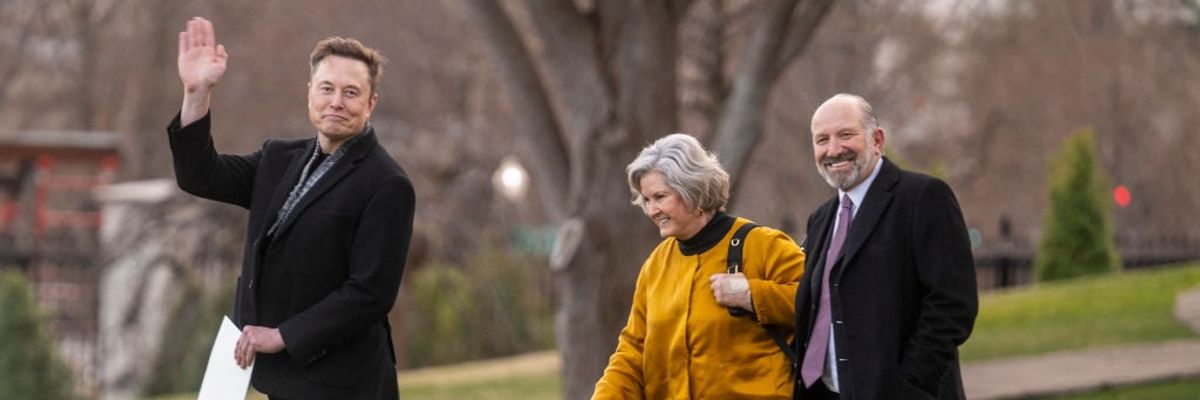
Tesla CEO Elon Musk waves as he walks with U.S. Secretary of Commerce Howard Lutnick and White House Chief of Staff Susie Wiles on March 7, 2025.
(Photo: Jim Watson/AFP via Getty Images)

Jake Johnson
Apr 10, 2025
COMMON DREAMS

As retirees, small business owners, and consumers reeled from the chaos sparked by U.S. President Donald Trump's erratic tariff policies, the richest people on the planet saw their wealth surge Wednesday as the White House partially froze the duties it imposed on most countries.

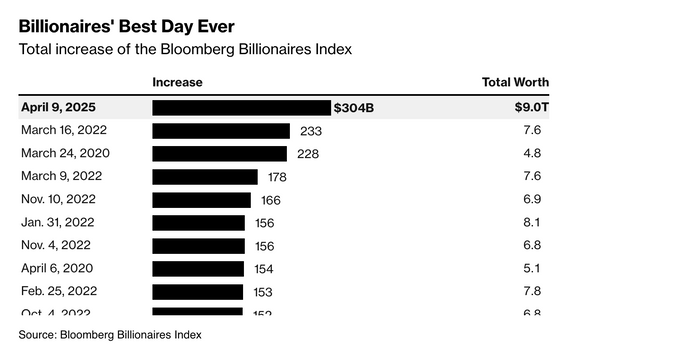
Trump's announcement of the 90-day pause sparked a historic market rally that added $304 billion to the collective wealth of the world's top billionaires, according to a Bloombergestimate. The outlet called the jump "the largest one-day gain in the history of the Bloomberg Billionaires Index," which was launched in 2012.

"The largest individual gainer Wednesday was Tesla Inc. CEO Elon Musk, who added $36 billion to his fortune as the EV manufacturer's stock jumped 23%, followed by Meta Platforms Inc.'s Mark Zuckerberg, who gained almost $26 billion," Bloomberg reported. "Nvidia Corp.'s Jensen Huang saw his wealth rise $15.5 billion as the chipmaker's shares rebounded 19%, nearly offsetting its 13% decline in the week to Tuesday's close."


Though the stock market gave up some of the massive gains on Thursday amid continued uncertainty about Trump's tariffs, the rapid billionaire wealth surge amplified concerns about possible market manipulation and insider trading ahead of the president's announcement of a 90-day pause. Trump publicly encouraged people to buy stock just hours before announcing the pause.

"Is there any doubt in anyone's mind they were tipped off?" The Tennessee Holler, a progressive news outlet, wrote on social media. "They are laughing at us all."

In the days leading up to the president's partial tariff pause, some of his billionaire supporters publicly criticized his approach as their wealth took a hit amid the trade war-induced market sell-off.

According to Bloomberg, the 500 richest people in the world saw their collective wealth fall by $208 billion the day after Trump announced the sweeping tariffs last week. The Wall Street Journalreported Thursday that Treasury Secretary Scott Bessent was "flooded with worried calls from Wall Street over the weekend and felt strongly he had to persuade Trump that a pause was needed."

The partial tariff pause came a day before the Republican-controlled House passed a budget blueprint that paves the way for another round of tax cuts that would primarily benefit the wealthiest Americans.

"These tariffs are not designed to solve an actual trade or economic challenge," Sen. Ron Wyden (D-Ore.), the top Democrat on the Senate Finance Committee, said Thursday. "They're designed to soak typical workers with higher taxes in order to help pay for handouts to the top."

"They're focused on yet more handouts to billionaires and corporations," Wyden added, "and everybody else is going to be on the hook to pay for them."

Under Trump, Egg Prices Smash Record for Third Straight Month

"The only egg prices Donald Trump is lowering," quipped the DNC chair, "is our nest eggs."


Organic pasture-raised eggs are seen on sale for the "low price" of $14.99 per dozen at an Amazon Whole Foods market in San Francisco on March 27, 2025.
(Photo: Brett Wilkins/Common Dreams)

Brett Wilkins
Apr 10, 2025
COMMON DREAMS

For the third straight month, U.S retail egg prices have hit a record high, despite falling wholesale prices, no bird flu outbreaks, and President Donald Trump's campaign promises—and recent misleading claims.

On Thursday, the U.S. Bureau of Labor Statistics' Consumer Price Index (CPI) reported the average retail cost of a dozen eggs rose from $5.90 in February to $6.23 last month.


Earlier this week, Trump claimed that "eggs are down 79%" due to his administration's work, a possible reference to the wholesale price, which does not reflect retail cost due to the role that profit-hungry industrial producers and grocery cartels play in inflating prices.

Trump also said that egg prices "are going down more," a statement that contradicts not only recent trends but also his own administration's Food Price Outlook, which forecasts a 57.6% increase in egg prices for 2025, with a prediction interval of 31.1%-91.5%.

Recent record egg prices have largely been driven by an avian flu epidemic that has forced farmers to cull over 166 million birds, most of them egg-laying hens. However, no farms are currently reporting any bird flu outbreaks.

On Tuesday, Cal-Maine Foods, the nation's largest egg producer, announced quarterly profits of $509 million, more than triple its gains from a year ago. The Mississippi-based company, which produces around 20% of U.S. eggs, also enjoyed a more than 600% increase in gross profits between fiscal years 2021-23, according to the consumer advocacy group Food & Water Watch (FWW).

Yet even as its profits soared, Cal-Maine still took $42 million in federal compensation for losses due to bird flu.


Last month, the U.S. Justice Department's antitrust division launched an investigation of alleged price-fixing by the nation's largest egg producers, including Cal-Maine, which isn't even the largest recipient of avian flu-related government assistance. Versova, which operates farms in Iowa and Ohio, has been allotted more than $107 million in federal bird flu relief, The Washington Postreported Wednesday. Hillandale Farms, a Pennsylvania-based company sold last month to Global Eggs, received $53 million in avian flu-related subsidies.

"For those companies to be bailed out and then turn around and set exploitative prices, it just adds insult to injury for consumers," Thomas Gremillion, director of food policy at the Consumer Federation of America, told the Post. "Absolutely, it's unfair."

FWW research director Amanda Starbuck took aim at the corporate food system, saying Thursday that "the industry is proving itself effective at extracting enormous profits out of American consumers."

"We are all paying for it—at the store, with food shortages, and with the growing threat of the next pandemic," she continued.

"Restoring sanity to the grocery aisle will require immediate action to transform our food system," Starbuck added. "To lower egg prices, the Trump administration must take on the food monopolies, hasten and prioritize its investigation into corporate price fixing, and stop the spread of factory farms."

The fresh CPI figures weren't all bad news, as the index saw its first decline in five years, falling 0.1% mainly on the strength of lower oil prices. The 12-month increase in consumer prices also slowed from 2.8% to 2.4%.

However, the mildly positive CPI news was overshadowed by the economic uncertainty caused by Trump's mercurial global trade war, including a ramped-up 145% tariff on imports from China, one of the top U.S. trading partners, and ongoing stock market chaos.

"The only egg prices Donald Trump is lowering," Democratic National Committee Chair Ken Martin quipped earlier this week, "is our nest eggs."
Analysis of Lobbying in 2024 Shows Clear Target: A Tax Code Forever Favorable to Corporations

"Conversations on Capitol Hill about federal tax policy were dominated by those representing corporate and wealthy interests," said one leader at Public Citizen.


A K Street NW sign stands at the corner of 14th and K Streets NW in downtown Washington, D.C
K Street is the center of the political lobbyist industry in Washington.
(Photo: Bill Clark/CQ Roll Call via Getty)


Eloise Goldsmith
Apr 10, 2025
COMMON DREAMS

As the GOP forges ahead with a tax plan that would primarily benefit the wealthy, the watchdog Public Citizen published a report Thursday which found that the vast majority of tax lobbyists' work in 2024 was done on behalf of corporate clients.

Although the Republican tax and spending bill is taking shape in 2025, not 2024, Public Citizen's report suggests that the general thrust of the tax bill—tax cuts that largely benefit the rich and could lead to a massive slashing of programs including Medicaid—can be explained in part due to the power of corporate lobbying.

"Conversations on Capitol Hill about federal tax policy were dominated by those representing corporate and wealthy interests," said Susan Harley, managing director of Public Citizen's Congress Watch division, in a statement Thursday. "The Trump-Republican tax proposal is a policy of the rich, by the rich, and for the rich."

Republicans are aiming to extend expiring provisions of President Donald Trump's 2017 Tax Cuts and Jobs Acts (TCJA), and also enact additional cuts. On Thursday, the Republican-controlled House of Representatives approved a budget blueprint that gets the GOP one step closer to securing the spending and cuts sought by Trump.

According to Public Citizen's report, most of the corporations and corporate trade associations that were the largest hirers of tax lobbyists in 2024 lobbied specifically on the TCJA.

Most of the TCJA's provisions that impact businesses, like cutting the top corporate income tax rate from 35% to 21%, do not expire—though Trump has said that he would like to see the corporate tax rate further cut, to 15%.

In its analysis, Public Citizen also highlighted that a deduction for "pass-through" businesses—whose owners report their share of profits as taxable income under the individual income tax—is set to expire, though pass-through businesses on average tend to be smaller businesses than their counterparts who pay corporate income tax. Pass-through businesses include sole proprietorships, partnerships, limited liability companies, and S-corporations.

To compile its report, Public Citizen searched all federal lobbying disclosures for 2024 to compile a list of all lobbyists who indicated that they lobbied on "tax issues" (the report notes how they define lobbying on "tax issues").

More than 6,000 lobbyists swarmed Capitol Hill in 2024 to lobby on tax issues, the group found, which amounts to nearly half of all federal lobbyists. Public Citizen highlighted that by comparison, there are only 535 members of Congress.

Out of the top 100 entities hiring the most lobbyists to work on tax issues in 2024, all but two represented corporate interests, according to the report.

The corporate trade group the U.S. Chamber of Commerce topped the list with 99 lobbyists. Other top hirers of tax lobbyists included the telecommunications company Verizon and the global financial technology platform Intuit.

However, according to Public Citizen, counting the number of unique lobbyists does not reveal the "true scope" of lobbying taking place. For example, five new corporations could start lobbying on the same tax issue, but if they hired a lobbyist who had already been working on that tax issue, looking at the individual number of lobbyists would not register this increase in lobbying activity, per the report.

That means that counting the number of "unique lobbyist client relationships" reveals a more accurate picture of lobbying activity.

According to the report, clients sent more than 10,500 lobbyists to influence tax issues on average for each quarter in 2024, and more than 85% of those lobbyists represented corporate interests each quarter.

The report notes that "many of the 15% of entities categorized as not representing corporate interests are likely not lobbying against such interests. Our methodology is conservative. Many nonprofit hospital systems, for example, operate similarly to for-profit entities."
Plainclothes DHS Agents Lied to LA School Officials to Question Elementary Students

The Homeland Security officials falsely told the school principals they had permission from the children's guardians to speak to them.


Two kindergarten students are seen in their classroom at John Mack Elementary School in Los Angeles on January 6, 2025 in Los Angeles.
(Photo: Brian van der Brug/Los Angeles Times via Getty Images)

Julia Conley
Apr 10, 2025
COMMON DRERAMS

The superintendent of Los Angeles public schools, Alberto M. Carvalho, confirmed Thursday that plainclothes federal immigration agents lied to school officials this week in order to gain access to two elementary schools to question several children—which the schools refuses to grant.

Carvalho told reporters that the Department of Homeland Security (DHS) agents told the principals of Lillian Street Elementary School and Russell Elementary School that they had permission from the four children's caretakers to question them—a claim that "was confirmed to be a falsehood,"CBS News reported.

The Biden administration barred immigration agents from trying to conduct enforcement operations in "sensitive" areas like schools and places of worship, but President Donald Trump reversed that policy after taking office, with former acting Homeland Security Secretary Benjamine Huffman saying, "Criminals will no longer be able to hide in America's schools and churches to avoid arrest."

The five children DHS sought to question on Monday ranged from first to sixth graders.

"My very first question starts there, what interest should a Homeland Security agent have in a first grader?" Carvalho told CBS News. "No federal agency has the authority, short of a judicial warrant, that means the equivalent of a criminal subpoena to enter our schools."

Kate Cagle of Spectrum News 1 SoCal reported that the agents wore plain clothes and that children came to the U.S. as unaccompanied minors and are in the care of legal guardians.


"My very first question starts there, what interest should a Homeland Security agent have in a first grader?"

Schools are not required to allow immigration agents onto their campuses without being presented with a warrant. In February, Denver's public school district sued the Trump administration over its policy allowing DHS to attempt raids in schools, saying it had led to decreased attendance as families fear potential enforcement actions in their children's classrooms.

"I am proud of these principals, I am proud of our workforce, I am proud of the clerical staff in the front office, for they did exactly what we trained them to do," said Carvalho. "We declared back in August and September and October that at Los Angeles Unified [School District] we have protocols in place and training in place to prepare our workforce in... protection of our students."

The Los Angeles schools were targeted days after a school principal in the small town of Sackets Harbor, New York, joined the community in demanding the safe return of three children and their mother after they were arrested and detained in a Texas facility by Immigration and Customs Enforcement (ICE) agents.

"As the principal of these students, I need to speak plainly," wrote Jaime Cook in a letter that went viral. "Our three students who were taken by ICE were doing everything right... They are not criminals. They have no ties to any criminal activity. They are loved by their classmates... We are in shock—and it is that shared shock that has unified our community in the call for our students' release."

A rally over the weekend drew more than 1,000 people in the town of just 1,351—part of New York's most reliably Republican congressional district, according to the Cook Partisan Voting Index, and the part-time home of Tom Homan, Trump's border czar.

The children were released along with their mother on Monday after the weekend rally, and were back in school on Wednesday.
Union-Led General Strike Over Austerity Brings Greece to Standstill

"Last week, the government committed €25 billion to defense spending," noted one observer. "Militarization is not just prepping for war, it is austerity."


People take part in a demonstration of labor unions during a 24-hour general strike over austerity measures and the high cost of living in Athens, Greece on April 9, 2025.
(Photo: Aris Messinis/AFP via Getty Images)

Julia Conley
Apr 09, 2025
COMMON DREAMS

A union that represents more than two million private sector workers in Greece said Wednesday that labor unions had "obvious" demands that pushed them to bring the country to a 24-hour standstill: "Pay rises and collective labor contracts now!"

The country's two main unions representing both the public and private sectors called the strike, which canceled all domestic and international flights for 24 hours starting at midnight Wednesday; left buses, trains, and other public transport operating for only part of the day; and eliminated ferry service and other public services for the day.

The unions are demanding a return to full collective bargaining rights, which were suspended in international bailout agreements during Greece's financial crisis from 2009-18.


"Before 2012, half of Greek workers had collective wage agreements," Yiorgos Christopoulos of the General Confederation of Workers (GSEE) told Al Jazeera. "But there was also a national wage agreement signed by employers and unions which meant more than 90% of workers enjoyed maternity leave."

Since the bailouts, Christopoulos said, "the government has put individual contracts at the heart of its policy. But individuals are powerless to bargain [with] their employers."

As the country relied on international bailouts worth about 290 billion euros ($319 billion) to stay afloat, wages and pensions were eroded.

Now, Kathimerinireported in January, three out of 10 Greeks in urban areas and more than 35% of people in the country as a whole are spending more than 40% of their income on housing and utilities.

Greece has the European Union's largest rate of people spending at least 40% on housing and essentials.

On top of that, said GSEE on Wednesday, "prices have gone so high that we're buying fewer goods by 10% compared to 2019."

"Workers' incomes are being devoured by rising costs, with no government response," said the union.

Author and political ecologist Patrick Bresnihan noted that the austerity policies remain even as the government approved 25 billion euros ($27 billion) for defense spending last week.


The government, controlled by the conservative New Democracy Party, recently increased the monthly minimum wage by 35% to 880 euros ($970). But Eurostat, the E.U.'s statistics agency, found earlier this year that the minimum salary in terms of purchasing power in Greece was still among the lowest in the bloc.

Officials have pledged to again raise the minimum wage to align more closely with the rest of the E.U., but the average salary is still 10% lower than in 2010.

The Civil Servants Confederation (ADEDY), is also demanding the return of holiday bonuses, which provided workers with two months' pay before the financial crisis.

One trade unionist, Alekos Perrakis, told Euronews that corporate profits are growing as working people continue to struggle.

"We demand that increases be given for all salaries, which aren't enough to last until even the 20th of the month," said Perrakis. "We demand immediate measures for health, for education, for all issues where the lives of workers are getting worse as the profits of large monopolies continue to grow."
Argentina General Strike Demands End to Milei's 'Chainsaw' Austerity Policies


"The Milei government has picked a fight with workers and pensioners, and now they will feel the full force of organized labor," said one union leader.


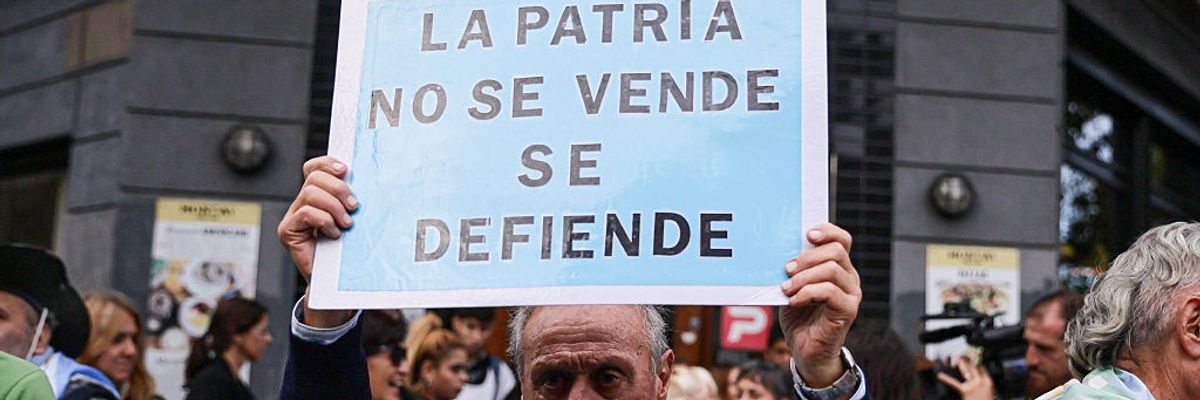
A retiree holds a placard reading "The Country Is Not For Sale, It Is Defended" in Buenos Aires during an April 10, 2025 nationwide general strike against the administration of right-wing President Javier Milei.

(Photo: Luciano Gonzalez/Anadolu via Getty Images)


Brett Wilkins
Apr 10, 2025
COMMON DREAMS

Increasingly fed up with economic policies under which poverty and inflation have soared while vital social services, wages, and the peso have taken huge hits, disaffected Argentinians took to the streets of cities across the South American nation Wednesday for the third general strike of right-wing President Javier Milei's tumultuous 16-month presidency.

Led by the General Confederation of Labor (CGT)—an umbrella group of Argentinian unions—the "paro general," or general stoppage, drew workers, the unemployed, pensioners, educators, students, and others affected by Milei's severe austerity measures and his administration's plans for more deep cuts. Demonstrations continued throughout Thursday.

"In the face of intolerable social inequality and a government that ignores calls for better wages and a dignified standard of living for all, the workers are going on strike," CGT explained ahead of the action.


Airlines canceled hundreds of flights as air traffic controllers and other airport workers joined the strike; many schools, banks, and other offices shut down; and ports, some public transport, and other services ground to a halt.

"The only thing the administration has brought is a wave of layoffs across state agencies, higher poverty rates, and international debts, which are the biggest scam in Argentina's history," the Association of Airline Pilots (APA) said.

Rodolfo Aguiar, secretary general of the Association of State Workers (ATE), said Wednesday that "after this strike, they have to turn off the chainsaw; there's no room for more cuts," a reference to both Milei's ubiquitous campaign prop and his gutting of public programs upon which millions of Argentinians rely.

"Right now, the crisis Argentina is facing is worsening," Aguiar added, warning about government talks with the International Monetary Fund. "The rise in the dollar will quickly translate into food prices, and the new deal with the IMF is nothing more than more debt and more austerity measures."

Milei's government is nearing agreement on a $20 million IMF bailout, a deeply unpopular proposition in a country left reeling by the U.S.-dominated institution's missteps and intentional policies that benefit foreign investors while causing acute suffering for millions of everyday Argentinians. Argentina already owes $44 billion to the IMF.

"We already have experience as Argentinians that no agreement has been beneficial for the people," retiree and striker Rezo Mossetti told Agence France-Press in Buenos Aires Thursday, lamenting that his country keeps getting into "worse and worse" debt.

CGT decided to launch the general strike during a March 20 meeting that followed a pensioner-led March 12 protest outside the National Congress in Buenos Aires. After fringe elements including rowdy soccer fans known as "barrabravas" joined the protests and committed acts of violence and vandalism, police responded by attacking demonstrators with "less-lethal" weapons including water cannons and tear gas. A gas canister struck freelance photojournalist Pablo Grillo in the head, causing a severe brain injury that required urgent surgery.

This, after Argentinian Security Minister Patricia Bullrich invoked controversial measure empowering more aggressive use of force against protesters and rescinding a ban on police use of tear gas canisters. The Security Ministry also filed a criminal complaint dubiously accusing organizers of the March 12 protest of sedition.

Milei and his supporters have portrayed the general strike as a treasonous assault on the fragile Argentinian economy and those taking part in the day of action as lazy and jobless.

When Clarín, the country's largest newspaper, cited a study by the Argentine University of Enterprise claiming that the general strike would cost the national economy around $185 million per day, University of Buenos Aires professor Sergio Wischñevsky retorted: "Very revealing. It means that's the magnitude of the wealth workers produce every day. It's the best argument to stop ignoring workers."

As he has done with past protests against his rule, Milei has also framed the general strike as "an attack against the republic" and repeated his threat that police would "crack down" on demonstrators.


General strikers largely shrugged off the threats of police violence and state repression.

"The right to strike is a worker right and I think there has to be more strikes because the situation with this government is unsustainable," Hugo Velazuez, a 62-year-old worker striking in Buenos Aires, toldReuters.

While the Argentinian mainstream media's coverage of the general strike was largely muted, images posted by independent progressive media showed parts of central Buenos Aires appearing practically empty.


Workers around the world showed solidarity with striking Argentinians.

"The Milei government has picked a fight with workers and pensioners, and now they will feel the full force of organized labor," said Paddy Crumlin, president of the London-based International Transport Workers' Federation (ITF), which boasts nearly 20 million members in 677 unions in 149 nations. "The international trade union movement stands ready to fight back with our Argentine comrades. We will not rest until these attacks on workers' rights are defeated."


ITF noted that various sectors of Argentina's transportation sector "are under direct threat of privatization," including the national commercial airline, Aerolíneas Argentinas, the National Highway Board, and the Argentinian Merchant Marine.

Milei—a self-described anarcho-capitalist who was elected in November 2023 on a wave of populist revulsion at the status quo—campaigned on a platform of repairing the moribund economy, tackling inflation, reducing poverty, and dismantling the state. He made wild promises including dollarizing Argentina's economy and abolishing the central bank.

However, the realities of leading South America's second-largest economy have forced Milei's administration to abandon or significantly curtail key agenda items, leading to accusations of neoliberalism and betrayal from the right and hypocrisy and rank incompetence from the left. According to most polling, Milei's approval rating has fallen from net positive to negative in just a few months.

Particularly galling to many left-of-center Argentinians is Milei's cozying up to far-right figures around the world, especially U.S. President Donald Trump.

Andrew Kennis, a Rutgers University media studies professor specializing in Latin America, noted similarities between the protests in Argentina and anti-Trump demonstrations in the United States.

"It's no coincidence that 5.2 million people were in the streets in all 50 states just this past Saturday and that the U.S. is now catching up with the mass resistance that's long been going on in Argentina," Kennis told Common Dreams Thursday.

Kennis—who this week published a deep dive on Milei's "destructive chainsaw theory" in Common Dreams—added that in the cases of both Milei and Trump, "there was no real honeymoon period, as there almost always is" for most new presidencies.

"In both countries, people were in the streets pretty damned fast and furiously," he added.