SPACE/COSMOS
Bezos Versus Musk: Which Billionaire Will Trash Space the Most?
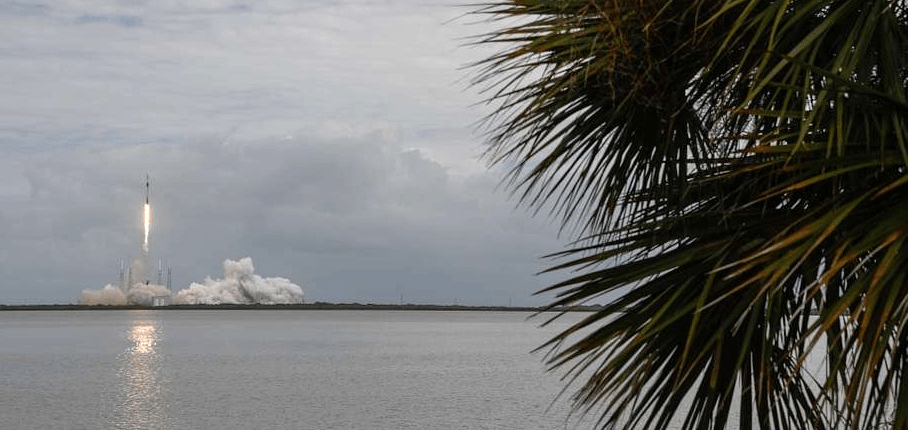
Photo credits: Public domain and Steve Jurvetson (CC BY-SA 2.0).
Amazon’s Project Kuiper is sending its first satellites into space. The company’s founder and executive chair, Jeff Bezos, seems keen to challenge all things Musk—including Elon’s SpaceX Starlink system.
The satellites in Amazon’s $10 billion-plus Kuiper Atlas project are being launched with the Lockheed Martin-designed Atlas V rocket, at Cape Canaveral’s Space Force Station.
OK, a few thoughts on the matter that corporate media probably won’t contemplate.
Astronomical Funding
Fifteen years ago, Barack Obama’s White House trumpeted an increase in NASA funding. Obama said it would “help improve the daily lives of people here on Earth” and help companies produce “new means of carrying people and materials out of our atmosphere”—first to an asteroid, later to Mars. I’m just a little unclear about how, overall, sending hundreds of billions of dollars into space has been improving my daily life so far. If you ask me, money for reliable bus service would help a lot more. Universal medical care. Free higher education.
The benefits to the planet’s most massive corporations are obvious. I hear Amazon’s lining up deals in Britain, Indonesia, Australia, and potentially Taiwan.
This lucrative new space race feeds off the human need for information, especially where internet access is sparse.
Profit Streams
Yes, Starlink connects people in far-flung places with internet services. And it calls these people markets. It’s not hard to imagine unbanked populations being converted into profit streams, once they’re online.
Moreover, when wealthy companies secure US government backing, they can become political instruments, manipulating the populations they claim to serve. Polish taxpayers have forked over an annual $50 million to provide Starlink’s services to Ukraine. But Poland’s foreign minister tweeted out concerns about the trustworthiness of US-based Starlink. Be quiet, small man, Musk snapped back. (Musk then bragged about having challenged Putin to one-on-one physical combat.)
People with unfathomable wealth take more billions in handouts from the US military in the name of national security. General Chance Saltzman, Chief of Space Operations for the US Space Force, recently named SpaceX as a recipient of nearly $6 billion more. Saltzman called the contract “a strategic necessity that delivers the critical space capabilities our warfighters depend on to fight and win.”
Got it. Warfighters gonna warfight. Blam! Zonk! Kapow! Splat!
Cosmic Sprawl
So here comes Jeff Bezos, a prominent player in Donald Trump’s troupe of lickspittles since January. With the Trump regime now describing Amazon Prime as a model for deportation, who knows? Maybe “alien enemies” (those people who have autism awareness tattoos or otherwise ruffle the regime’s feathers) could be shipped into orbit.
In any case, Amazon’s space project will pile 3,200+ satellites onto the tens of thousands that Elon’s launching into the low Earth orbit (within a 1,200-mile band around Earth). Space scientists have long pressed for reviews of the satellites’ impact on the delicate balance of elements and molecules in the air when these things ultimately burn up in our atmosphere.
And the Federal Communications Commission enables it all.
Welcome to outer space in the Anthropocene.
ELVIS has entered orbit: Pioneering imaging system to enhance space biology and life detection beyond earth
ISS National Lab-sponsored investigation to test a new holographic microscope will launch on NASA’s SpaceX CRS-32 mission
International Space Station U.S. National Laboratory
image:
Portland State University's Extant Life Volumetric Imaging System (ELVIS) is shown during testing.
view moreCredit: Jay Nadeau
KENNEDY SPACE CENTER (FL), April 15, 2025 – Onboard the International Space Station (ISSInternational Space Station), the Extant Life Volumetric Imaging System, dubbed ELVIS, is not about resurrecting rock-n-roll legends but pioneering scientific discovery. Using innovative holographic technology to deliver detailed 3D views of cells and microbes, the system allows scientists to study the adaptability and resilience of life under extreme conditions. Knowledge gained could reveal how life might persist on distant moons and planets, significantly enhancing our search for life outside Earth.
Beyond the capabilities of traditional two-dimensional microscopes, ELVIS offers scientists a closer look at the intricate structure, volume, and environmental interactions of cellular organisms. This detailed view enables more accurate biological assessments that could shed light on the ability of life to thrive in the most extreme environments of space.
Portland State University (PSU), in collaboration with NASA’s Jet Propulsion Laboratory, is spearheading the ELVIS project, which is scheduled to launch on SpaceX’s 32nd Commercial Resupply Services (CRS) mission, contracted by NASA. The investigation, sponsored by the ISS National Laboratory®, combines expertise in biology, physics, and cutting-edge imaging technology, says Jay Nadeau, a physics professor at PSU and a principal investigator on the project.
“We are thrilled to leverage the ISS National Lab to prepare ELVIS for its future roles in space exploration missions,” says Nadeau. She added, “The successful operation of ELVIS in the demanding conditions of space not only paves the way for its use in off-Earth environments but also holds implications for enhancing biomedical and microbiological research on our planet.”
During its tenure in space, ELVIS will focus its analysis on two resilient types of Earth-based life forms: Euglena gracilis, a microalga lauded for its adaptability, and Colwellia psychrerythraea, a bacterium that thrives in frigid ocean waters. This study goes beyond merely observing organisms; it tests their observable and genetic adaptations to microgravity. The insights gained could illuminate how life might survive beneath the icy shells of distant moons like Europa and Enceladus.
Built to endure the rigors of space, ELVIS incorporates durable, low-maintenance components and features automation that minimizes astronaut involvement, ensuring experiments can run continuously without disruption. As ELVIS gears up for launch, the team looks forward to testing its full potential to explore the resilience and adaptability of life under extreme conditions, Nadeau noted.
SpaceX CRS-32 is scheduled to launch no earlier than April 21, 2025, at 4:15 a.m., from Launch Complex 39A at NASA’s Kennedy Space Center in Florida.
For additional information on ISS National Lab-sponsored investigations launching on NASA’s SpaceX CRS-32, visit our launch page. To learn more about the research and technology development sponsored by the ISS National Lab, including how to propose concepts for future space-based research, visit our website.
Download a high-resolution image for this release: Ph.D. Student Nikki Johnson and ELVIS
NSF-funded research heads to the international space station on NASA's SpaceX CRS-32 mission
ISS national lab-sponsored investigations aim to enhance drug manufacturing and develop new materials for aerospace, defense, energy, and robotics
International Space Station U.S. National Laboratory
image:
Left: A drop of protein solution less than two and a half centimeters in diameter formed in the RSD onboard the International Space Station. Right: An image showing a computed Newtonian flow diagram for the drop.
view moreCredit: J. Adam
KENNEDY SPACE CENTER (FL), April 16, 2025 – Three investigations funded by the U.S. National Science Foundation (NSF) and sponsored by the International Space Station (ISSInternational Space Station) National Laboratory are launching on SpaceX’s 32nd Commercial Resupply Services (CRS) mission, contracted by NASANational Aeronautics and Space Administration. These experiments leverage the microgravityThe condition of perceived weightlessness created when an object is in free fall, for example when an object is in orbital motion. Microgravity alters many observable phenomena within the physical and life sciences, allowing scientists to study things in ways not possible on Earth. The International Space Station provides access to a persistent microgravity environment. environment to advance fundamental science that could lead to improved pharmaceutical manufacturing, new materials with valuable industrial applications, and the next generation of soft active materials with lifelike properties.
These projects build on a strong, multi-year collaboration between the ISS National Lab and NSF, which allocates millions of dollars to space-based projects within the fields of tissue engineering and transport phenomena, including fluid dynamics. To date, more than 30 projects funded by NSF and sponsored by the ISS National Lab have launched to the orbiting laboratory, with nearly 70 additional projects preparing for flight. Below are details about the three NSF-funded investigations launching on NASA’s SpaceX CRS-32.
Improving Medicine Manufacturing
An investigation by Rensselaer Polytechnic Institute (RPI), supported by Tec-Masters, builds on previous research to examine protein fluid flow and clumping—a problem that occurs during manufacturing of protein-based pharmaceuticals that affects the quality of the drug.
“Proteins are used to make various therapies and must be concentrated in medicines to avoid needing to administer large amounts of fluid,” says Amir Hirsa, professor of mechanical, aerospace, and nuclear engineering at RPI. “But above a certain concentration, the proteins tend to form aggregates or clump.”
On Earth, studying protein behavior is complicated by interactions between the solution and the container used to hold it. But on the ISS, researchers can use the Ring-Sheared Drop module to form liquid into a self-contained sphere held between two rings.
Hirsa and his team can use this device to study protein motion and create more accurate models of the factors that lead to clumping, especially during drug manufacturing and dispensation to patients. The team also can test computer models that predict the behavior of proteins of vastly different concentrations and types, such as hormones and antibodies. Findings from this research could help uncover ways to avoid or reverse protein clumping, which would have a significant impact on the pharmaceutical industry.
“Another very important aspect of this work is making this data, which is so difficult to get, available to other scientists through open data repositories,” says Joe Adam, a research scientist at RPI. “Other scientists may see something even more interesting than we do.”
Developing New Materials
An investigation from the University of Alabama at Birmingham, supported by Leidos, will examine the formation of ceramic composites, which have valuable applications in several industries, including aerospace, defense, and energy. The study focuses on polymer-derived titanium carbide and silicon carbide composites that have electrical conductivity, are stable at high temperature, can be made into almost any shape and size, and are lightweight yet strong.
“These materials can be used in different extreme conditions, such as high temperatures and highly acidic or oxidative environments, where other materials become unstable or cannot survive,” says Kathy Lu, a professor in the Department of Mechanical and Materials Engineering.
Studying these composites in microgravity could reveal unique behaviors that cannot be replicated on Earth. Findings from this research could inform new techniques for ground- and space-based manufacturing of materials with specific properties for applications such as heat exchangers, electric systems, energy storage, electrodes, and microsystems.
“Nobody has studied microgravity’s effects on these ceramics, and the results could be helpful for the broader family of ceramics and other possible additives, such as fibers and nanoscale materials,” Lu says.
Studying Active Matter
A research team at the University of California, Santa Barbara (UCSB) will leverage microgravity to study active matter—microscopic particles that use energy to produce motion—and its effects on the separation of non-mixable liquids. These liquids, such as oil and water, separate into concentrated droplets of one substance dispersed in the other, a phenomenon known as active liquid-liquid phase separation (LLPS). This investigation, supported by Redwire Space Technologies, seeks a better understanding of active LLPS, which plays a key role in physics, materials science, engineering, and biology.
“Active fluids are made of billions of small molecular motors that push and pull on each other and generate a turbulent flow, like a windy day stirs the water on a beach,” says UCSB professor Zvonimir Dogic. “A long-term goal is using active matter in microfluidic devices to stir and control the separation of two substances. We’re trying to create simplified systems that start to mimic biology.”
Active LLPS could be used to create materials with lifelike properties, such as the ability to move, change shape, and self-repair, that could be used to develop more lifelike robotics.
SpaceX CRS-32 is scheduled to launch no earlier than April 21, 2025, at 4:15 a.m., from Launch Complex 39A at NASA’s Kennedy Space Center in Florida. For additional information on ISS National Lab-sponsored investigations launching on NASA’s SpaceX CRS-32, visit our launch page. To learn more about the research and technology development sponsored by the ISS National Lab, including how to propose concepts for future space-based R&D, visit our website.
Download a high-resolution image for this release: SpaceX CRS-32 NSF Science
Curiosity rover finds large carbon deposits on Mars
UCalgary scientist Ben Tutolo lead author in groundbreaking study published in the journal, Science
image:
Ben Tutolo, associate professor in the Department of Earth, Energy and Environment in the Faculty of Science at the University of Calgary, is the lead researcher on a paper about Mars. Tutolo is a participating scientist on the NASA Mars Science Laboratory Curiosity Rover team.
view moreCredit: University of Calgary 2025 Riley Brandt/University of Calgary
Research from NASA’s Curiosity rover has found evidence of a carbon cycle on ancient Mars, bringing scientists closer to an answer on whether the Red Planet was ever capable of supporting life.
Lead author Dr. Ben Tutolo, PhD, an associate professor with the Department of Earth, Energy and Environment in the Faculty of Science at the University of Calgary, is a participating scientist on the NASA Mars Science Laboratory Curiosity Rover team.
The team is working to understand climate transitions and habitability on ancient Mars as Curiosity explores Gale Crater.
The paper, published this week in the journal Science, reveals that data from three of Curiosity’s drill sites had siderite, an iron carbonate material, within sulfate-rich layers of Mount Sharp in Gale Crater.
“The discovery of large carbon deposits in Gale Crater represents both a surprising and important breakthrough in our understanding of the geologic and atmospheric evolution of Mars," says Tutolo.
Reaching the strata, he says, was a long-term goal of the Mars Science Laboratory mission.
“The abundance of highly soluble salts in these rocks and similar deposits mapped over much of Mars has been used as evidence of the ‘great drying” of Mars during its dramatic shift from a warm and wet early Mars to its current, cold and dry state,” says Tutolo.
Sedimentary carbonate has long been predicted to have formed under the CO2-rich ancient Martian atmosphere, but Tutolo says identifications had previously been sparse.
NASA’s Curiosity rover landed on Mars on Aug. 5, 2012, and has travelled more than 34 kilometres on the Martian surface.
The discovery of carbonate suggests that the atmosphere contained enough carbon dioxide to support liquid water existing on the planet’s surface. As the atmosphere thinned, the carbon dioxide transformed into rock form.
NASA says future missions and analysis of other sulfate-rich areas on Mars could confirm the findings and help to better understand the planet’s early history and how it transformed as its atmosphere was lost.
Tutolo says scientists are ultimately trying to determine whether Mars was ever capable of supporting life – and the latest paper brings them closer to an answer.
“It tells us that the planet was habitable and that the models for habitability are correct,” he says.
“The broader implications are the planet was habitable up until this time, but then, as the CO2 that had been warming the planet started to precipitate as siderite, it likely impacted Mars’ ability to stay warm.
“The question looking forward is how much of this CO2 from the atmosphere was actually sequestered? Was that potentially a reason we began to lose habitability?”
The latest research, he says, fits with his ongoing work on Earth – trying to turn anthropogenic CO2 into carbonates as a climate change solution.
“Learning about the mechanisms of making these minerals on Mars helps us to better understand how we can do it here,” he says. “Studying the collapse of Mars’ warm and wet early days also tells us that habitability is a very fragile thing.”
Tutolo says it’s clear that small changes in atmospheric CO2 can lead to huge changes in the ability of the planet to harbour life.
“The most remarkable thing about Earth is that it’s habitable and it has been for at least four billion years,” he adds. “Something happened to Mars that didn’t happen to Earth.”
Journal
Science
Method of Research
Data/statistical analysis
Subject of Research
Not applicable
Article Title
Carbonates identified by the Curiosity rover indicate a carbon cycle operated on ancient Mars
Article Publication Date
18-Apr-2025
Curiosity rover identifies carbonates, providing evidence of a carbon cycle on ancient Mars
Summary author: Walter Beckwith
NASA’s Curiosity rover has uncovered a hidden chemical archive of ancient Mars’ atmosphere, which suggests that large amounts of carbon dioxide have been locked into the planet’s crust, according to a new study. The findings provide in situ evidence that a carbon cycle once operated on ancient Mars and offer new insights into the planet’s past climate. The Martian landscape shows clear signs that liquid water once flowed across its surface, which would have required a much warmer climate than the planet has today. It is therefore thought that Mars’ CO2 atmosphere must have been thicker in the past, to maintain warmer conditions. A climate containing abundant liquid water and atmospheric CO2 is expected to have reacted with Martian rocks, triggering geochemical processes that produce carbonate minerals. However, while previous analyses of Martian rock have detected the presence of carbonates, the quantities found were lower than expected from geochemical models.
Using data from the Curiosity rover, Benjamin Tutolo and colleagues investigated carbonate minerals in part of Gale crater – which once contained an ancient lake. In 2022 and 2023, Curiosity drilled four rock samples from different stratigraphic units representing transitions from lakebed to wind-blown environments and analyzed their mineralogy using the rover’s onboard X-ray diffractometer. Tutolo et al. identified siderite (iron carbonate) in high concentrations – ranging from approximately 5% to over 10% by weight – within magnesium sulfate-rich layers. This was unexpected, because orbital measurements had not detected carbonates in these strata. Given its provenance and chemistry, the authors infer that the siderite formed by water-rock reactions and evaporation, indicating that CO₂ was chemically sequestered from the Martian atmosphere into the sedimentary rocks. If the mineral composition of these sulfate layers is representative of sulfate-rich regions globally, those deposits contain a large, previously unrecognized carbon reservoir. The carbonates have been partially destroyed by later processes, indicating that some of the carbon dioxide was later returned to the atmosphere, forming a carbon cycle. “As details of Mars’ geochemistry are discovered through orbital and rover investigations around the planet, additional clues are revealed about the diversity of potentially habitable environments,” write Janice Bishop and Melissa Lane in a related Perspective.
Journal
Science
Article Title
Carbonates identified by the Curiosity rover indicate a carbon cycle operated on ancient Mars
Article Publication Date
18-Apr-2025
NRL’s Narrow Field Imager captures first light
Naval Research Laboratory
image:
The first light image taken on April 14, 2025, by the PUNCH Narrow Field Imager demonstrates that the camera is in focus, working properly, and able to capture deep-field images of the solar corona against the glare of the Sun. This image has been filtered to highlight the stars that are visible through the far brighter “F corona” (also called zodiacal light) that surrounds the Sun. The instrument is not yet fully aligned with the Sun, leading to bright glints of sunlight, which are visible to the right of the Sun’s location on the image. (Photo courtesy of NASA)
view moreCredit: NASA
WASHINGTON, D.C. — The U.S. Naval Research Laboratory’s (NRL) Narrow Field Imager (NFI) captured its first light images on April 14, offering a preliminary glimpse of the Sun’s corona, as NASA’s Polarimeter to Unify the Corona and Heliosphere (PUNCH) mission opened two of its four instrument doors for the first time in space.
On April 16, the other two Wide Field Imagers (WFI) opened their doors and also started capturing images.
These initial images from NFI are primarily focused on calibrating the instrument and confirming its pointing accuracy. The NFI image was filtered to show the star field surrounding the Sun, with part of the constellation Pisces highlighted. The Sun itself is hidden behind the instrument's occulter, a disk that blocks direct sunlight, appearing as a bright ring in the center.
Launched on March 11 into space aboard a SpaceX Falcon 9 rocket, the NFI deployed from Falcon 9 on March 12. PUNCH is a four-satellite constellation, collecting observations in low Earth orbit. It will conduct global, 3D observations of the inner heliosphere to investigate the solar corona's evolution into the solar wind.
The NRL-developed NFI, sponsored by NASA, is a compact, externally occulted coronagraph. The external occulter blocks direct sunlight from entering the main optical aperture, which views the corona and starfield around the Sun using a compound lens system. Polarization is resolved using a polarizing filter wheel and the image is digitized using a CCD camera with a 2K x 2K active detector area.
"We are thrilled to see these first light images from NFI," said NRL Coronal and Heliospheric Physics Section Head Robin Colaninno, Ph.D. "This is a major milestone for the PUNCH mission and a testament to the hard work and dedication of the entire team. We are eager to begin using NFI to study the Sun's corona in unprecedented detail and learn more about how the solar wind is generated."
Over the next few weeks, the PUNCH team will refine the spacecraft's pointing and calibrate the NFI to reduce stray light. Once this process is complete, the NFI will be able to capture detailed images of the Sun's corona, similar to those taken by its predecessor, the NRL-developed Compact Coronagraph (CCOR-1).
By capturing the evolution of coronal mass ejections (CMEs), PUNCH will provide scientists new data on their formation and propagation. This is essential for understanding and predicting these events, which can cause significant disruptions on Earth, including satellite damage, radio communication blackouts, and power grid failures. Enhanced predictions will also safeguard robotic explorers operating in interplanetary space.
PUNCH is currently in a 90-day commissioning phase, during which time the four spacecraft will be maneuvered into their final orbital configuration and the instruments will be calibrated. Following commissioning, PUNCH will begin its two-year primary science mission.
About the U.S. Naval Research Laboratory
NRL is a scientific and engineering command dedicated to research that drives innovative advances for the U.S. Navy and Marine Corps from the seafloor to space and in the information domain. NRL, located in Washington, D.C. with major field sites in Stennis Space Center, Mississippi; Key West, Florida; Monterey, California, and employs approximately 3,000 civilian scientists, engineers and support personnel.
For more information, contact NRL Corporate Communications at (202) 480-3746 or nrlpao@nrl.navy.mil. Please reference package number at top of press release.
SwRI-led PUNCH mission instruments collect first images
NASA spacecraft meeting milestones toward final commissioning
image:
On April 14, 2025, the SwRI-led PUNCH mission opened the doors of two instruments, collecting this first-light image and demonstrating that the cameras are in focus, working properly and capturing deep-field images of the “night” sky against the “noontime” glare of space. Several familiar constellations are visible, including Taurus (just right of top center) and the Pleiades (upper right). The soft diffuse glow is “zodiacal light,” glinting off microscopic dust particles orbiting the Sun.
view moreCredit: NASA/Southwest Research Institute
SAN ANTONIO — April 17, 2025 —The Southwest Research Institute-led Polarimeter to Unify the Corona and Heliosphere, or PUNCH, mission collected its first images following its March 11 launch into polar orbit around the Earth. The mission’s four small suitcase-sized spacecraft will act as a single virtual instrument 8,000 miles across to image the solar corona, the Sun’s outer atmosphere, as it transitions into the solar wind that fills and defines our solar system.
“We opened the instrument doors on the Near Field Imager (NFI) and one Wide Field Imager (WFI) on April 14,” said PUNCH Principal Investigator Dr. Craig DeForest of SwRI’s Solar System Science and Exploration Division located in Boulder, Colorado. “On April 16, the other two WFIs opened their doors collected their first-light demonstration images also. All four instruments are functioning as designed. We’re excited to finish on-orbit commissioning and get these cameras working together.”
PUNCH’s constellation includes one satellite carrying an NFI coronagraph, developed by the U.S. Naval Research Laboratory, that images the Sun’s corona continuously. The other three carry SwRI-developed WFIs, “heliospheric imagers” that are designed to view the very faint outermost portion of the solar corona and the solar wind itself.Features in the tenuous solar wind, streaming out from the Sun at over a million miles per hour, are less than 0.1% as bright as the Milky Way galaxy backdrop. PUNCH raw images contain mostly stars and “zodiacal light” — a haze of dust orbiting the Sun in the inner solar system. Eliminating the starfield and the zodiacal light, while preserving the very faint solar wind signal, requires extraordinary care because the smallest artifact or miscalibration would swamp the solar wind signal.
The spacecraft are in the midst of a 90-day commissioning period, operating from SwRI’s Mission Operations Center. Then in June 2025, the science mission begins, and the Science Operations Center will begin processing the data to share with NASA and the rest of the world.
“Throughout the commissioning phase, the PUNCH team is calibrating the NFI data to remove 99% of the light to show materials streaming out from the Sun’s outer atmosphere in stunning detail,” DeForest said. “The three WFI ‘first-light’ images show star fields, but the ultimate goal is to remove the star field and other background light and preserve the faint glimmer of the solar wind as it travels to Earth.”
During commissioning, PUNCH also demonstrated novel, water-powered, shot-glass-sized rocket engines. To run the engine, each spacecraft electrolyzes water, building up small stores of high-pressure hydrogen and oxygen that it then burns as fuel. Each cycle delivers a “kick” of about one inch per second (2 cm/sec), just enough to correct for small orbital shifts and keep the constellation stable.
“PUNCH is the first space mission to rely on this type of engine, which carries safe, inert, non-toxic propellant,” DeForest said. “That safety and stability are worth it even though the thrusters are more complex than conventional hydrazine rockets.”
Each satellite needs to fire its thruster hundreds of times, reliably and repeatably, over the course of the mission. On April 2, as part of its commissioning, the WFI-2 spacecraft demonstrated its first three charge-and-fire cycles, modifying its orbital velocity relative to the other PUNCH spacecraft as they drift apart to reach their final positions — a third of the way around the world from one another.
Inside each instrument, a space rated scientific-grade camera developed by RAL Space will collect three raw images, through three different polarizing filters, every four minutes. This new perspective will allow scientists to discern the exact trajectory and speed of coronal mass ejections as they move through the inner solar system, improving on current coronagraphs that only measure the corona itself and also cannot measure motion in three dimensions.
For more information, visit https://www.swri.org/markets/earth-space/space-research-technology/space-science/heliophysics.
This composite of first-light images taken April 14, 2025, by PUNCH/WFI2 (top) and PUNCH/NFI (inset) shows how the fields of view fit together. When the four NASA spacecraft are fully deployed, they will work together to view a field 90° across. Constellations have been identified to show the size of the field of view. The SwRI-led PUNCH mission acquired these first images during instrument commissioning, demonstrating that the cameras are in focus, working properly and capturing deep-field images of the “night” sky against the “noontime” glare of space.
Credit
NASA/Southwest Research Institute/NRL


