Thursday, April 17, 2025

Noboa Victory in Ecuador’s Elections Provokes Fraud Charges, Rests on US Intervention


 April 16, 2025
Facebook

Incumbent Ecuadorian president Daniel Noboa of the National Democratic Action Party took 56% of the vote in the second round of elections taking place on April 13. With 95% of the votes counted, Luisa González, candidate of the social democratic Citizens’ Revolution Party gained 44% of the vote.

Polling had shown the two candidates tied at 44% each. First round voting on February 9 had Noboa taking 44.2% of the vote and González, 43.9% ─ with Leónidas Iza, leader of the indigenous Pachakutik party, securing 5.29% of the vote.  His second-round support for González appears to have been inconsequential.

Noboa took office following a second round of elections in October 2023 that gave him 52% of the vote and González 48%. He was completing the term of President Guillermo Lasso, a conservative former banker who had resigned because of bribery charges. Noboa will serve until 2029.

González appeared to have been astonished at the results, and with good reason; the two candidates had been evenly matched until now.  She exclaimed that, “Today, we do not recognize the results. I denounce before my people, before the media, and before the world, that Ecuador is living through a dictatorship, and we are confronting the most grotesque electoral fraud.”

González on April 11 denounced the Noboa government for replacing the military security team assigned to protect her, claiming that the action “puts my life at risk and that of my family.” Presidential candidate Fernando Villavicencio had been assassinated while campaigning in 2023. Since then, “more than 30 politicians, judicial authorities, and journalists have been killed,” according to one report.

On the day before the elections, Noboa decreed a “state of exception” in seven provinces, in sections of Quito and in prisons. The measure, referring to “internal armed conflict,” calls for curfews and mobilization of the police and military forces.

The election results cast doubt on the legitimacy of Ecuador’s democracy and portend troubles ahead for Ecuador’s already beleaguered majority population. Crime has reached record heights along with narcotrafficking, militarization, and aggressive U.S. intervention. Adding to a bleak outlook is the dissolution of the progressive legacy of Rafael Correa’s presidency (2007-2017) that gave rise to the Citizens’ Revolution movement and González’s candidacy.

Born in Miami, Daniel Noboa studied at three U.S. universities and benefits from family businesses worth $1.3 billion. His campaign featured “promises to stop the violence, finish with electric power backouts and raise people’s purchasing power through neoliberal measures,” according to one report. The BBC suggests that, “Noboa has tried to reposition himself, with a campaign centered on reinforcing his profile as a strong leader confronting the possible return of the left to Ecuadorian politics.”.

A recent accounting places Ecuador’s most recent murder rate at 38.8 murders per 100,000 inhabitants, up from 6.45 per 100,000 in 2015, under Rafael Correa’s government. Seizures of illegal drugs in Ecuador, mainly cocaine, are unprecedented ─ 33% higher in 2024 than in 2023. Ecuador produces much cocaine, but is also a throughway for Colombian-produced illicit drugs on their way to Europe and the United States.

News surfaced during the campaign that authorities had seized cocaine from banana containers shipped to Europe by Noboa Trading Company. Lanfranco Holdings S.A., co-owned by President Noboa and his brother, claims 51% equity in that company.

Ecuador’s GDP is falling. An ongoing energy crisis stems from drought and deteriorating infrastructure. Unemployment has increased and the poverty rate presently is 28%. The Noboa government recently obtained a $4 billion loan from the International Monetary Fund.

Daniel Naboa attended Donald Trump’s Inauguration as U.S. president. Meeting with Trump in Florida on March 29, Noboa requested U.S. designation of irregular armed groups in Ecuador as terrorist organizations. Beginning in 2024, the U.S. military has been preparing to deploy warships, weapons and personnel to Ecuador’s Galápagos Islands.

Plans are afoot for a new U.S. naval base at Manta. President Correa had closed down a U.S. airbase there in 2009. Naboa is seeking to modify Ecuador’s Correa-era Constitution so as to permit foreign military bases. Agreements are in place for the arrival in Ecuador of U.S. troops, possible soon.

The debacle of this election highlights a contrast. On the one hand there are the achievements of Correa’s presidency and goals of González’s campaign and on the other, the record of Naboa’s government and of U.S. intervention.

Analyst Stansfield Smith, in a 2017 report, surveyed accomplishments of the Correa’s government. They include: taxation of the rich;, non-payment of illegitimate debt; steady and significant GDP growth; doubling of Ecuador’s minimum wage; reduction of the poverty rate from 37.6% to 22% (rural poverty from 61% to 35%); construction of 31 new hospitals, either completed or in progress; and the addition of 34,000 new health workers.

Commentator Irene León, writing in La Jornada on April 12,  summarized goals articulated by the Citizens’ Revolution candidate. González “proposes an ethical pact to pacify the country, as well as to restore the democratic fabric and institutionality destroyed in recent years … [She] proposes a foreign policy characterized by the return to regional integration and multilateralism, the revitalization of the national economy and production, and the articulation of State policies around economic, geopolitical, social, cultural and gender justice, among others.”

Just as Luisa González’s electoral defeat will surely discourage hopes for a revived Citizens’ Revolution movement, it will also encourage U.S. intervention. Analyst William Blum recalls that, prior to Correa’s government, U.S. agents had “infiltrated, often at the highest levels, almost all political organizations of significance, from the far left to the far right.”

Now with Noboa in charge, old ways are back. For instance, the Naboa government and U.S.-based Erik Prince recently agreed that armed mercenaries hired by Prince’s Academi Company ─ formerly Blackwater ─ will be carrying out “war on crime” in Ecuador.

W.T. Whitney Jr. is a retired pediatrician and political journalist living in Maine.


Unchecked Power to Total Jerks


 April 17, 2025
FacebookTwitter

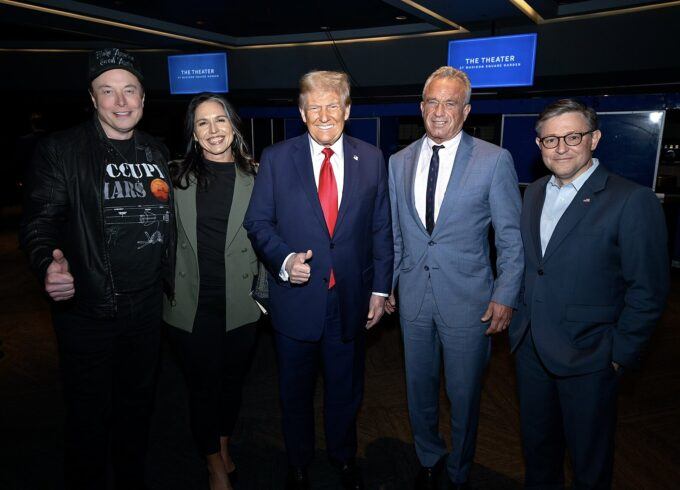
Photograph Source: Office of Speaker Mike Johnson – Public Domain

The Trump administration is claiming powers in both domestic and foreign affairs that vastly exceed those of prior presidents. He bases his claim on his unprecedented “mandate” in which he did not get even a majority of the votes. His popular vote victory margin was less than Hillary Clinton’s margin in her Electoral College loss to Trump in 2016. But facts mean little to Trump and his followers.

This is a big problem. We probably would not want to see unchecked powers going to any presidential administration, no matter how competent, but it is especially dangerous in the hands of incompetents who often do not have a clue.

The displays of incompetence in Trump’s first 80 days are endless. The most visible was the war-planning session, involving all the top military and intelligence officials (except Trump), conducted over Signal. And they apparently did not even know their guest list since they included a senior editor/reporter from The Atlantic magazine. This would have led to an immediate impeachment resolution and likely actual impeachment under Biden.

But this is just the beginning. We have Elon Musk running around with his chainsaw, wrecking one government agency after another.

Musk apparently could not be bothered to take even a few minutes to learn about the agencies he was sawing through. For example, he immediately offered buyout plans to encourage retirements even at agencies like the Federal Aviation Administration, which already had a serious shortage in many key positions, like air-traffic controllers.

He decided the entirety of USAID was waste, fraud, and abuse, seemingly without knowing that it supported an AIDS program in Africa (PEPFAR) that had saved the lives of tens of millions of people. Incredibly, Musk insisted that no one had died because of his cuts.

Musk’s greatest idiocy involves Social Security. He discovered their inactive files and immediately began screaming about tens of millions of dead people getting Social Security. This was absurd. The Social Security Administration (SSA) knew these people were dead and almost no one on Musk’s list was getting benefits. They didn’t clean up their files because it would cost millions of dollars to do it and cleaning the files would not affect the operation of the program. In the interest of efficiency, they decided not to waste the money.

Then Musk discovered that we have 4-year-old kids getting Social Security benefits, which he quickly touted as more evidence of fraud. Apparently, Musk didn’t know that children of deceased workers are eligible for benefits, a feature of the program that most of us think is pretty good.

Musk also got the brilliant idea of ignoring privacy laws and entering a number of legal immigrants as dead on the Social Security files. (These files are not supposed to be used for anything other than Social Security, except for some rare exceptions.) Being listed as dead makes it almost impossible for them to work, have a bank account, or credit card. The idea was to force these people to leave the country.

Supposedly these people were all suspected of terrorism or had criminal records. That doesn’t seem to be the case. One of the newly dead people was just 13.

Musk then went to look at the unemployment insurance system and did the same sort of idiocy. He found tens of thousands of obvious frauds, people who were well over one hundred years old. It turns out that these people had already been identified as having committed fraud and were not receiving benefits. The decisionwas made to keep them on file, with explicitly impossible birthdates, to protect against someone using the same phony identification that was initially used. Again, a few minutes of homework might have saved Musk much embarrassment.

(I’ve had many people point to Musk’s great business successes to tell me he is not an idiot. I don’t have any idea or interest in Musk’s IQ. The fact is, he does and says many idiotic things, which is what I am interested in.)

Musk’s co-president, Donald Trump, is certainly no better. His latest tariff tantrum is the most obvious example. He was ostensibly planning his “retaliatory” tariffs for weeks. But when he finally presented them on “Liberation Day,” they bore no relationship to any tariffs or trade restrictions that countries imposed on our exports. In fact, Trump even imposed tariffs on uninhabited islands off the coast of Australia. Incredibly they even got the academic work they cited in their tariff formula wrong.

When the tariffs had the predictable effect on the stock market, Trump quickly retreated and reduced most of his tariffs, except the one on goods imported from China which he hugely raised. Trump then insisted he had planned to roll back his “Liberation Day” tariffs all along.

The worst incident of Trump’s incompetence is probably his deportation of immigrants to serve indeterminate sentences in a hellhole prison in El Salvador. Supposedly these people were ruthless gang members who had committed heinous crimes. Clearly this was not the case for many of them. At least one was sent there based on tattoos that had nothing to do with gang membership, and was here going through the legal process of applying for asylum.

If this person, Kilmar Abrego Garcia, and the others had the opportunity to have a normal immigration hearing, where they could present evidence, the mistake likely would not have been made. But that is not the way Trump and his team operate. They don’t care about the evidence; they just do what they want.

What makes the Musk-Trump’s team incompetence even worse is that they don’t know how to admit a mistake. Any normal person, when realizing the horrible error in sending a completely innocent person to a terrifying prison, would try to correct it as quickly as possible. Instead, these pathetic power-hungry men can’t even acknowledge the most obvious mistakes. (Musk still has not apologized for his idiocy about 20 million dead people getting Social Security.)

So we are left in a situation where we see completely incompetent people grabbing ever more power to do whatever they feel like. That is not good.

This first appeared on Dean Baker’s Beat the Press blog.

Dean Baker is the senior economist at the Center for Economic and Policy Research in Washington, DC. 


Limiting the President’s Authority is a Good Idea


 April 16, 2025


FacebookTwitterReddit

Seven Republican Senators have joined together in a proposal that would limit the president’s authority to impose tariffs. If the Democrats in the Senate joined with the Republicans, they would have the votes needed to approve the bill. While they would face a certain presidential veto and other hurdles, it is a goal worth pursuing.

The bill, the Trade Review Act of 2025, would sunset any tariffs after 60 days if they are not approved by Congress. It also gives Congress the authority to reverse any tariff before this deadline with a joint resolution of Congress. The bill also requires the president to promptly submit an explanation for whatever tariffs they do put in place.

This proposal is solidly grounded, both as a general principle and also given the specific circumstances the country faces now following the tariffs recently imposed by President Trump.

As a general matter, the Constitution explicitly grants Congress the power to tax. It would be absurd if there were a loophole that allowed the president to impose taxes of any size for indefinite duration in the form of tariffs. This is especially wrongheaded given that the largest single source of revenue in the early years of the Republic was tariff revenue. Clearly the founders knew what tariffs were and decided to give that authority to Congress.

It is hard to understand how the wording in Article I Section 8, can be interpreted in any way other than that the power to impose tariffs rests with Congress:

“The Congress shall have Power To lay and collect Taxes, Duties, Imposts and Excises, to pay the Debts and provide for the common Defence and general Welfare of the United States;”

If the president can impose a tariff of any size, on whatever imports they choose, without seeking Congressional approval, it makes a mockery of Congressional taxing authority. It also gives the president enormous power to raise or lower taxes in exchange for personal favors from individuals, corporations, or foreign governments.

The tariffs recently implemented by President Trump present an especially good case for Congressional intervention. The tariffs put in place violate many longstanding trade agreements with other countries. There is also little obvious rationale for tariffs that in many cases are especially high on major trading partners and longstanding allies.

The amount of tax revenue potentially raised through these tariffs is extraordinarily large. Peter Navarro, the president’s trade adviser, estimated that they would raise $600 billion a year, or $6 trillion over the course of a decade. This is an enormous tax increase on businesses and consumers. It dwarfs the size of tax changes that are intensely debated within Congress.

President Trump has also indicated that he is prepared to make deals with both foreign governments and specific industries for tariff relief. This is precisely the sort of non-transparent process that the Constitution sought to prevent, where major decisions on taxation are made completely outside of public view.

It is important that Congress exercise its authority on taxation. That requires President Trump’s tariffs to be subject to Congressional approval.

This first appeared on Dean Baker’s Beat the Press blog.

Dean Baker is the senior economist at the Center for Economic and Policy Research in Washington, DC.