It’s possible that I shall make an ass of myself. But in that case one can always get out of it with a little dialectic. I have, of course, so worded my proposition as to be right either way (K.Marx, Letter to F.Engels on the Indian Mutiny)
Thursday, April 17, 2025
Opinion
On Good Friday, Jesus was disappeared to silence his message
(RNS) — The solidarity that Jesus offered the vulnerable on the cross long ago calls Christians to stand up to oppression today.
A prisoner is moved at the Terrorist Confinement Center in Tecoluca, El Salvador, March 26, 2025. (AP Photo/Alex Brandon) Kelly Brown Douglas and Matthew Heyd April 17, 2025
(RNS) — Kilmar Abrego Garcia sits in a megaprison in El Salvador. Stopped last month while driving home from work by federal agents with his 5-year-old son in the back seat, he was illegally deported due to “administrative error,” according to the Immigration and Customs Enforcement agency. The prison has been described as a labor camp. Garcia is not safe.
He’s one of hundreds of migrants “disappeared” through deportation in the last two months as federal agents invade neighborhoods, lurk outside food pantries and separate parents from young children.
Rome’s imperial agents wanted Jesus to be “disappeared.” The Romans who governed Judea attempted to silence Jesus and frighten his followers into submission. Crucifixion was a public spectacle of oppression. Fear was the point.
This week, Christians around the world spend time in prayer and reflection as we remember Jesus’ death and prepare for Easter celebrations on Sunday morning. Good Friday serves as a solemn day weighted with tradition.
Good Friday also shows us that God stands with us always. Jesus’ crucifixion was a radical act of solidarity. We can’t be disappeared. Oppression isn’t the way of God. Fear doesn’t win.
In this way, Good Friday represents more than a time for reflection; it is a call to action. It’s a call to take seriously the meaning of the cross in a time when people’s lives and livelihoods are at stake. At a time when the love of God must be known through the pursuit of justice.
Jesus’ ministry was defined by his identification with the marginalized — the poor, the sick, the outcasts. He didn’t just speak about caring for the needy; he embodied it through his actions. He healed the sick, fed the hungry, welcomed the excluded and stood with those whom society had cast aside. His was not a passive compassion; it was an active demonstration of love and justice.
Moreover, Jesus confronted the structures that oppressed and dehumanized people. He pronounced woes on the rich and powerful who ignored the cries of the poor and the oppressed. He boldly declared that it would be easier for a camel to pass through the eye of a needle than for a rich person to enter the Kingdom of God. This wasn’t just a spiritual teaching; it was a direct critique of the economic and social systems that perpetuated injustice.
Jesus also spoke fiercely against the leaders of his time. He called Herod, the ruler of Galilee, a “fox.” This wasn’t a personal insult, but a sharp critique of political rulers who prioritized their own power over the well-being of the people they were meant to serve. It was a condemnation of the political culture that upheld self-interest at the expense of justice.
It’s no surprise, then, that Jesus’ ministry aroused animosity among the ruling authorities. His refusal to cooperate with the political and religious systems that trampled the dignity of the poor, the marginalized and the disenfranchised made him a threat to the powers that be. In the end, the political and religious authorities of the first-century Roman world joined forces to eliminate the “Jesus problem,” and they did so by crucifying him.
In this, we see a stark parallel to our own time. The cross is, at its core, a symbol of God’s love — a love that confronts the extremities of human hate with the vast power of divine justice. It’s a reminder that God’s love is not abstract, but incarnate in the fight for justice. The crucifixion of Jesus shows us that when it comes to injustice there is no neutrality. Jesus’ commitment to God’s justice is clear, and it challenges all of us who claim to follow him to stand on the side of the oppressed.
We are living in a moment in which the church is once again being called to take seriously the cross at the center of its faith. Just as Jesus confronted the injustices of his time, so too must the church confront the injustices of ours. This means speaking out against economic inequality, racism, exploitation and any system that benefits the few while leaving the many to suffer. It means rejecting any form of Christianity that lends legitimacy to bigotry, in the guise of white Christian nationalism or of any other harmful ideology. It means standing with those whose humanity is denied, with those being criminalized for who they are. It means speaking truth to power.
Tyranny and totalitarianism thrive when fear silences resistance. Good Friday tells us that standing for justice will not always be popular or safe. Just as Jesus was crucified for challenging the status quo, so too may the church face opposition for challenging today’s powers. The cross reminds us that true discipleship is not about comfort or safety; it’s about faithfully following the path of Jesus, no matter the cost. We can’t be silenced.
The church today is called to stand against the political, cultural and economic forces that threaten not just democracy but our very humanity. As we reflect on the crucifixion of Jesus, we must also reflect on what it means for us today. It’s not enough to merely acknowledge Jesus’ sacrifice; we must take seriously the implications of his life, death and resurrection.
On Good Friday, Christians reflect on the profound weight of what this day represents: a time when we remember the crucifixion of Jesus, the pivotal moment in the Christian faith.
On this Good Friday, we remember Kilmar Abrego Garcia and all those under threat in our prayers. Jesus’ death serves as a divine act of redemption for our collective salvation. The solidarity that Jesus offered on the cross long ago calls us to stand up to oppression today. We can’t be disappeared. Fear doesn’t win.
(The Rev. Kelly Brown Douglas, the canon theologian at Washington National Cathedral, is currently a visiting professor at Harvard Divinity School. The Rt. Rev. Matthew Heyd is the 17th bishop of the Episcopal Diocese of New York. The views expressed in this commentary do not necessarily reflect those of RNS.)
SISTERS OF PERPETUAL INDULGENCE
San Francisco’s Hunky Jesus Contest stirs up controversy, community and 'courage'
SAN FRANCISCO (RNS) — Hosted by a global order of drag nuns, the Easter event draws thousands to what some call sacrilege but its participants say is liberating, joyful, even sacred.
Participants in the 2024 Hunky Jesus competition at Dolores Park in San Francisco, March 31, 2024. (Photo by Garaje Gooch, courtesy of Sisters of Perpetual Indulgence)
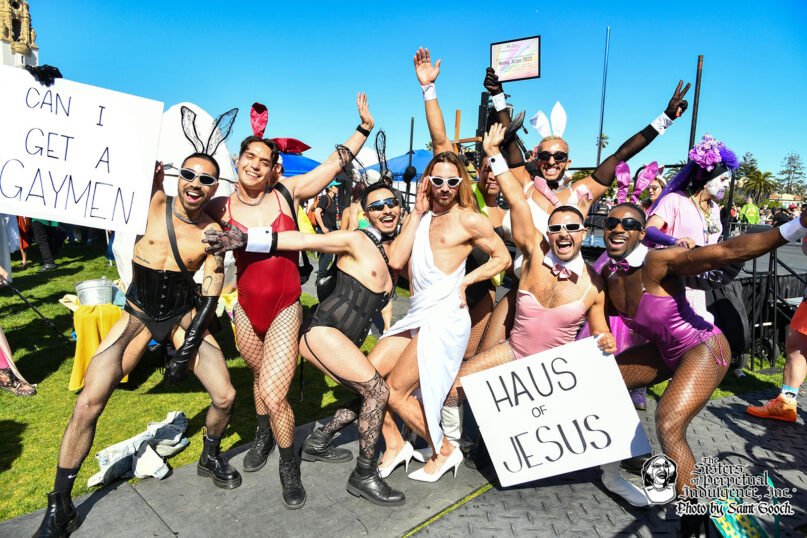
SAN FRANCISCO (RNS) — The most popular Easter service in this capital of alternative living occurs not in church but on the sloping lawns of Dolores Park, where thousands show up in their Sunday best — which at the annual Hunky Jesus Contest can mean steampunk bonnets, a life-size Peep suit or, for those competing, elaborate (and usually scanty) Jesus and Mary costumes.
The event is hosted by the Sisters of Perpetual Indulgence, the global nonprofit group of drag nuns founded in San Francisco on Easter Sunday 46 years ago. Over the years, “Hunky Jesus” has expanded from a small anniversary celebration for the sisters alone to a raucous, all-day affair. Today, the free festival includes a family egg hunt, musical acts and a “canonization” ceremony in which community members are recognized for service.
Today, the Sisters of Perpetual Indulgence have hundreds of members across the U.S. and in 14 countries. Made up of queer and trans individuals, the sisters are not affiliated with the Catholic Church or any official religious organization. But like traditional nuns, they do take lifelong vows of service and see their work as “ministry and outreach to those on the margins.
The day’s biggest draw, of course, is its eponymous contest: A handful of competitors vie for the titles of Hunky Jesus and Foxy Mary. Last year’s winning Jesus, very of-the-moment, was “Ken Jesus,” who blasphemed both the box-office giant “Barbie” and the resurrection by sporting a pink crown of thorns and a blond bowl cut, striking a crucified pose in the doll’s distinctive box.
His packaging even included a disclaimer: “Actual miracles not included.”
From the outset, the sisters and their Easter celebration have drawn calls of sacrilege and bigotry, even by some progressive and gay Christians. In 2023, after the Los Angeles Dodgers announced plans to recognize the sisters for public service, then-U.S. Sen. Marco Rubio decried them as “a group that mocks Christians through diabolical parodies of our faith.”
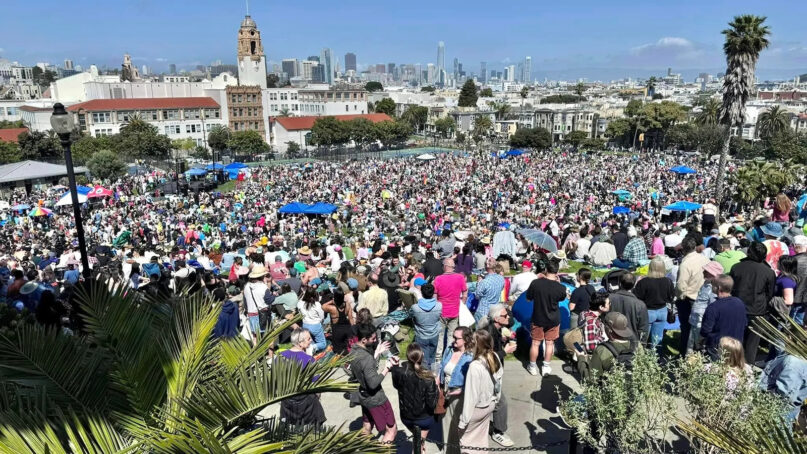
Overview of the 2024 Easter festivities at Dolores Park in San Francisco. (Photo by Ardo Servito, courtesy of Sisters of Perpetual Indulgence)
Nonetheless, in a metro area famous for its gay culture but where the number of nonreligious nearly equals the Christian population, many San Franciscans consider Hunky Jesus their Easter tradition. The event offers a playful space to celebrate both the Christian holiday and the LGBTQIA+ community. Attendees describe the day as liberatory, joyful and even sacred.
“The Easter event is probably the most spiritual, beautiful, uplifting, holy event I can think of,” said Sister Roma, the celebration’s longtime emcee. “It’s just about pure love.”
The sisters were among the first activists to serve gay men affected by AIDS. Over the years, the organization has organized HIV benefits, offered sex education, served the unhoused, advocated for public safety and raised tens of thousands of dollars for school programs and more.
The sisters, according to co-founder Ken Bunch, were born out of boredom. Bunch (later Sister Vish Knew) moved from Iowa to the Castro District in the late 1970s, bringing along some nuns’ habits that he and his drag troupe acquired from a convent in Cedar Rapids.
On a lark, Bunch and two friends decided to don the habits on Easter Sunday 1979, walking through the streets of the city. The public’s reaction was “electric,” Bunch recently told Little Village Magazine.
Exhilarated, the trio wore the outfits again at a gay softball game. By 1980, they had a name for their organization, new nun monikers and a mission statement: to “promulgate universal joy and expiate stigmatic guilt.”
It was that beginning, and not necessarily Easter itself, that the sisters chose to celebrate annually. In time, though, the anniversary and high holy day bled into one another.
Participants in the 2024 Easter festivities at Dolores Park in San Francisco. (Photo by Garaje Gooch, courtesy of Sisters of Perpetual Indulgence)
Participants in the 2024 Easter festivities at Dolores Park in San Francisco. (Photo by Garaje Gooch, courtesy of Sisters of Perpetual Indulgence)
On Easter 1995, two sisters started a controversial pub crawl that parodied the Stations of the Cross. Four years later, on its 20th anniversary, the organization obtained a permit to host an Easter block party. Some city residents were incensed. A spokesman for the Roman Catholic archdiocese compared it to “allowing a group of neo-Nazis to close a city street for a celebration on the Jewish feast of Passover.”
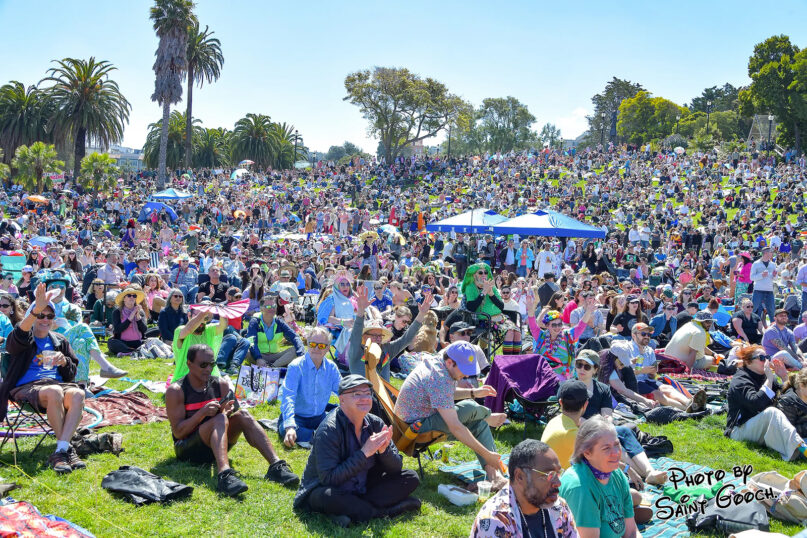
Sister Roma was there for the 1999 Easter party — the first time, in her recollection, there was a Hunky Jesus Contest. The event was intended as a thank-you to San Francisco for allowing the sisters to “be of service with them,” she said. Five thousand people showed up. The next year, the sisters moved the celebration to Dolores Park, where it has mostly remained ever since. In 2024, an estimated 10,000 people attended.
Devlin Shand, a photographer, has competed twice for the Hunky Jesus title, coming in second in 2016 with Drop Dead Jesus, performing a “death drop” — a dramatic drag move he has never done before or since. “I actually rolled my ankle on the stage,” he said. “But it was worth it.”
Shand first attended after relocating to San Francisco in 2014. “It was what I moved to San Francisco for: that kind of irreverent, joyful energy that allows you to poke fun at something.” A queer gay man who was raised Catholic, Shand said, “It’s no secret that queer people are oppressed by Christianity. This whole event really is reclamation of the things that have held us down.”
Participants in the 2023 Easter festivities at Dolores Park in San Francisco. (Photo by Garaje Gooch, courtesy of Sisters of Perpetual Indulgence)
While Shand no longer identifies as Christian, some LGBTQ individuals who do have more complicated feelings around the sisters’ Easter party. The conservative Catholic writer Andrew Sullivan, who is gay, infamously railed against the event in 2011, challenging the sisters to “hold a Hunky Mohammad Contest on Ramadan.”
The Rev. Donal Godfrey, an openly gay Jesuit priest and chaplain at the University of San Francisco, has a more measured response. “Clearly it is controversial,” he said by email. As a matter of respect, Godfrey would prefer the event not be “played out in a public park.”
At the same time, he noted, he is far more disturbed by, say, the Trump administration’s recent deportations to El Salvador. “I believe the Christian God must find that much more deeply blasphemous.”
Others see harmony between the holiday and Hunky Jesus. Julia Tremaroli, a data analyst who was raised Catholic, said she has never “felt any sort of disrespect towards Jesus, Mary and the Catholic religion” at the event. Instead, Tremaroli, who identifies as queer-curious, finds the day to be a “Venn diagram” that brings together current and former Christians and the LGBTQ+ community and “finds the beauty at the center.”
“It’s so much more than just a drag show or a costume contest,” she said. “It’s a community event that celebrates what is good and can be good about Easter and Catholicism.”
As irreverent as Hunky Jesus is, Sister Merry Peter explained, the contest embodies a core principle of the sisters: “using the symbology of these traditions to open up a conversation with a society.”
Attendees of the 2024 Easter festivities at Dolores Park in San Francisco. (Photo by Garaje Gooch, courtesy of Sisters of Perpetual Indulgence)
Often, that conversation has a political edge. Last year, state Sen. Scott Wiener stepped up to the mic and called out, “Let’s hear it for triggering the right-wing extremists!” He earned cheers from the crowd — and coverage from Fox News.
This year, the event’s theme is especially pointed: “No Easter without the T.” “We are definitely expressing solidarity with the trans members of our community, who are under really vicious and cynical attack right now,” said Sister Merry Peter.
“It’s always been an act of defiance and solidarity,” said Shand, but in a time when the Trump administration is unwinding the rights of trans people and some emboldened lawmakers are threatening same-sex marriage, Hunky Jesus is taking on an added level of resistance.
“Right now is a moment that requires courage and requires community, which our Easter definitely creates,” Sister Merry Peter said.
Over the years, she has encountered people from all walks of life at the Hunky Jesus Contest — including, she said, traditional Catholic nuns.
That kind of diversity creates courage, Sister Merry Peter argued. “You may be an Irish nun sitting on your picnic blanket, but you might be next to a 300-pound drag queen in a giant pink Easter bonnet.
“That’s going to give you a sense that, maybe, there’s a little more room to express yourself than you grew up with.”
OPINION
Why America's Greek Orthodox leader needs Trump on his side
(RNS) — The current ecumenical patriarch of Constantinople, Bartholomew I, has balanced the growing power of Moscow, but the question of a successor has become pressing.
Ecumenical Patriarch Bartholomew leads the official door-opening ceremony of lower Manhattan’s St. Nicholas Greek Orthodox Church on Nov. 2, 2021. (AP Photo/Ted Shaffrey, File)
(RNS) — In September Patriarch Bartholomew I, the ecumenical patriarch of Constantinople, will travel from Istanbul to the United States to collect his Templeton Prize. In his 34 years on the throne of St. Andrew, the spiritual leader of a broad segment of the Eastern Orthodox world has made a reputation for himself as a moderate voice in not only the church but the affairs of Eastern Europe, the Balkans and the Middle East — places where the defense of human rights, interreligious dialogue and environmental justice are often helpful.
More notably, the patriarch of Constantinople has long provided the most powerful and consistent balance to Kirill, the patriarch of Moscow, an ally of Russian President Vladimir Putin and a chief propagandist for the regimeat home and abroad.
But Bartholonew is 85, and the question of a successor has become pressing. The pool of successors is limited by the terms of the 1923 Treaty of Lausanne, which officially ended World War I. It also established the borders of the modern Turkish state and set the terms by which the Greek Orthodox Patriarchate was allowed to remain in the country, with the stipulation that the patriarch must be a Turkish citizen.
Over the past century, as Christians have fled genocide and persecution in the country, the number of clerics eligible to assume the patriarchal throne has diminished. For those who favor a modern Orthodox Church and a moderating presence in an increasingly authoritarian world, the obvious choice to succeed Bartholomew is Archbishop Elpidophoros of America, the current hierarch of the Greek Orthodox Archdiocese in America.
Born Ioannis Lambriniadis in Istanbul in 1967, Archbishop Elpidophros attended high school and university in Athens, Greece, before doing his postgraduate work in Germany, Lebanon and Thessaloniki, Greece. Since becoming archbishop of America in 2011, he has discomfited conservatives who call his positions on abortion, same-sex couples and women’s roles in the institutional church too liberal, especially for Orthodox Christianity. This criticism that has been seized upon by pro-Russian forces eager to forward their claim to be the guardians of “traditional Orthodoxy.”
He has also drawn fire from Turkish nationalists, who have objected to his calls to end the Turkish occupation of Northern Cyprus, his use of the world “ecumenical” to describe the patriarch of Constantinople (Turkey does not recognize the global role of the patriarch) and his use of the name Constantinople for the city as opposed to its post-1930 name, Istanbul. Recently, Turkish nationalists have called for his Turkish passport to be revoked and for him to banned in the country, in effect calling for him to be barred from becoming the next patriarch of Constantinople.
On March 24, the day before Greek Independence Day, Elpidophoros gave remarks at the White House to commemorate the Greek revolution against the Ottoman Empire, as is customary for the Greek archbishop. The archbishop fulsomely praised his host, President Donald Trump, saying he had led “the world in championing freedom and peace between all people,” horrifying many who had looked to Elpidophoros as a source of hope for a progressive future for the Orthodox world.
While this reaction is understandable, realpolitik is, well, real, and in the present situation, giving ground might be the best strategy to win the war. There are few people more prone to flattery than Trump, especially perhaps superfluous flattery. He also is prone to abandoning ideological commitments in the name of personal taste. This is exactly what the archbishop needs to overcome his precarious position with his countrymen.
Trump clearly has an affinity for strongmen in general and Russia in particular. Elpidophoros has proved himself a potentially powerful enemy of both. It would be disastrous for Elpidophoros to follow Bishop Marian Budde’s lead and call attention to himself. It would also be a disaster for the largely wealthy and well-connected Greek American community and for the vulnerable Greek minorities in Turkey and Cyprus, not to mention the Ukrainian Orthodox Christians who have shifted their allegiance from Moscow to Constantinople.
There are some for whom this explanation will not be enough to excuse Elpidophoros’ remarks, certainly those American progressives for whom symbolic speech acts are more valued than actually advancing the cause. But no leader, whether of church or state, will pass their test. Rather, we should let Elpidophoros’ words and deeds over more than a decade, as well as those of his enemies, speak for themselves. He remains the best hope for a moderate, modern and thoughtful future for Orthodox Christianity. (Katherine Kelaidis, a research associate at the Institute of Orthodox Christian Studies in Cambridge, England, is the author of “Holy Russia? Holy War?” and the forthcoming “The Fourth Reformation.” The views expressed in this commentary do not necessarily reflect those of RNS.)
Catholic University of America student has visa revoked by Trump administration
WASHINGTON (RNS) — The news adds a Catholic school founded by U.S. bishops to the growing list of colleges where international students have had their visas revoked. McMahon Hall at Catholic University of America, in Washington, D.C. (Photo by Túrelio/Wikipedia/CC-BY-SA-2.5)
WASHINGTON (RNS) — A student at the Catholic University of America in Washington, D.C., has had their visa revoked by the federal government, adding a Catholic school founded by U.S. bishops to the growing list of colleges where international students have had their visas revoked by President Donald Trump’s administration.
According to a CUA spokesperson, the student was removed from the Student and Exchange Visitor Information System, a database the Department of Homeland Security uses to track international students and their statuses.
“We can acknowledge that a student’s SEVIS record has been terminated by the Department of Homeland Security,” CUA spokesperson Karna Lozoya said in a statement to RNS. “As a member of our learning community, we have been supportive of the student in ensuring he is supported and informed of his rights.”
Lozoya did not offer specific details about the student or their situation.
The move is part of a sweeping immigration crackdown by the Trump administration, with the federal government changing the legal status of more than 1,300 international students in the U.S. — often with little to no explanation — according to Inside Higher Ed. A lawsuit filed on Wednesday by some impacted students against the government alleges the reasons for the revocations are often tied to minor offenses such as traffic stops or criminal cases that were dismissed.
The number of Catholic colleges impacted is unclear. On Monday (April 14), another Catholic school in the nation’s capital, Georgetown University, announced that at least 10 students on its campus have had their visas revoked. In addition, at least two students at Fordham University in New York City have had their visas revoked.
Officials at Notre Dame, one of the most prominent Catholic universities in the country, did not respond to multiple requests to detail how many, if any, of its own students are impacted.
But while Fordham and Georgetown are often associated with more liberal versions of U.S. Catholicism, CUA, which was founded by U.S. bishops who also sit on the school’s board of trustees, has long been connected with the tradition’s conservative wing.
Catholic leaders have been vocal opponents of the administration’s immigration policies, with Cardinal Blase Cupich of Chicago criticizing Trump’s plans for mass deportation in a sermon before the president even assumed office. Vice President JD Vance, who is Catholic, feuded with bishops on the issue shortly after being inaugurated, making a theological argument that was ultimately refuted by Pope Francis himself in a letter that also condemned Trump’s mass deportation plans.
In the letter, which was addressed to U.S. bishops, Francis said that “the act of deporting people who in many cases have left their own land for reasons of extreme poverty, insecurity, exploitation, persecution or serious deterioration of the environment, damages the dignity of many men and women, and of entire families, and places them in a state of particular vulnerability and defenselessness.”
Meanwhile, the U.S. Conference of Catholic Bishops is currently suing the administration over its decision to freeze the refugee program and cut off funds to religious groups that partner with the government to resettle refugees. And last month, Catholic bishops co-authored a report with evangelical Christian groups noting that 1 in 12 Christians in the U.S. could be impacted by Trump’s deportation push, a number that rises to 1 in 5 Catholics, according to the report.
The Trump administration’s crackdown has impacted more than 210 colleges and universities, including religious colleges such as Baylor University and Oklahoma Christian University, according to Inside Higher Ed.
Whether international students at divinity schools and seminaries have been impacted remains unclear: Many did not respond to requests for comment, and while Yale Divinity School and University of Chicago Divinity acknowledged students at their parent universities have had their visa status revoked — four at Yale and three at the University of Chicago, as well as four recent graduates — officials at both institutions declined to specify whether any were students at the divinity schools.
Railways were essential to carrying out the Holocaust – decades later, corporate reckoning continues
(The Conversation) — Even when companies do not face legal liability, public pressure can help force a reckoning with complicity in genocide, slavery and other atrocities. Liliane Lelaidier-Marton stands in front of the kind of car her parents were forced into in Drancy, France, when deported to their deaths. () Sarah Federman April 17, 2025
(The Conversation) — The Holocaust could not have happened without the railways.
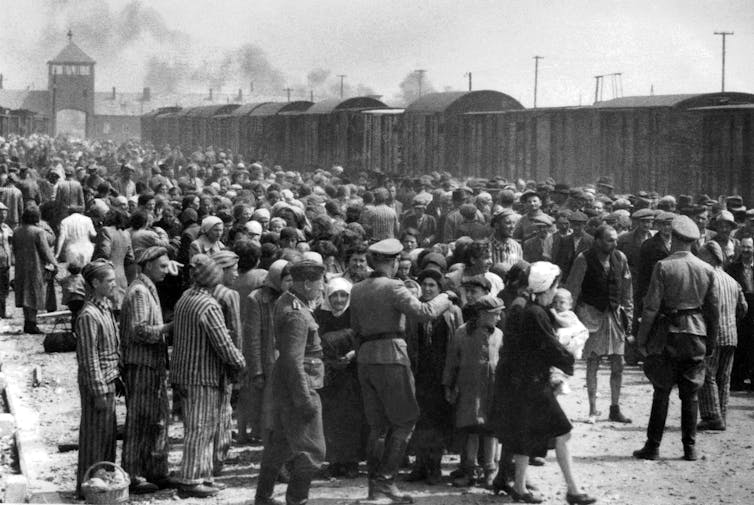
Preeminent Holocaust scholar Raul Hilberg underscored that almost everyone murdered at a camp arrived by train, including Jews, political prisoners and other “undesirables.” Since the 1990s, groups of survivors have asked European railway companies to acknowledge and atone for their critical role – a reminder that war, genocide and other atrocities cannot occur without corporate participation.
One long-running attempt met a setback on Feb. 21, 2025, when the U.S. Supreme Court threw out an appeals court ruling in favor of survivors seeking atonement from Hungary’s state railways. The lower court held that plaintiffs could sue the company over looting during the deportation of 440,000 Jews, most of whom were murdered at Auschwitz-Birkenau. The Supreme Court disagreed, however, saying the case did not warrant an exception to law protecting foreign governments from being sued in U.S. courts.
Even without legal rulings, however, survivors have sometimes mobilized enough public support to force rail companies to confront their complicity.
I wrote a book about one such case: the French national railways’ multiple roles in World War II, and the company’s 30-year struggle to make amends. I dug through archives and legal documents and spoke to over 120 experts – including historians, legislators, executives and more than 90 Holocaust survivors – about what obligations, if any, they believe railways have today.
The French national railways’ wartime activities and slow roll to accountability helped me better understand and articulate productive ways that companies can respond to demands for atonement decades or more after the events.
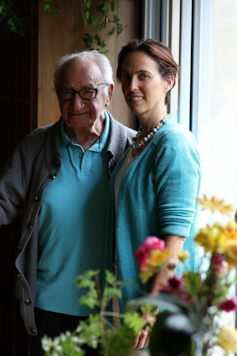
The author stands with Daniel Urbejtel, one of the youngest people who survived deportation to Auschwitz. Sarah Federman Multiple wartime roles
The French railway company, known as the SNCF, played more than one role during the war. Depending on which facts you focus on, you can see the company as a victim, hero or perpetrator.
With roughly 500,000 employees at the time, the company found itself in the crosshairs of the Nazi occupation. When France capitulated to Germany on June 22, 1940, the country was divided into occupied and free zones, and the French national railways were put under German command.
After the war, the acts of the brave railway workers came to light. Some slowed trains so deportees could jump off; some found other ways to facilitate escapes. Near the city of Lille, some SNCF workers helped save dozens of Jewish children. Most importantly, some workers coordinated with the French Resistance on D-Day, sabotaging trains to prevent German armaments from reaching the Normandy beaches and fighting off the Allies.
After the war, the SNCF amplified heroic stories with the help of the French government, using a film, pamphlets and other means.
‘La Bataille du Rail,’ a 1946 film about French railway workers during the war.
These stories are true – even if those workers made up less than 1% of the workforce. Surely, some stories were never told. But even if we double or triple the number, such resistance was an exception, not the rule.
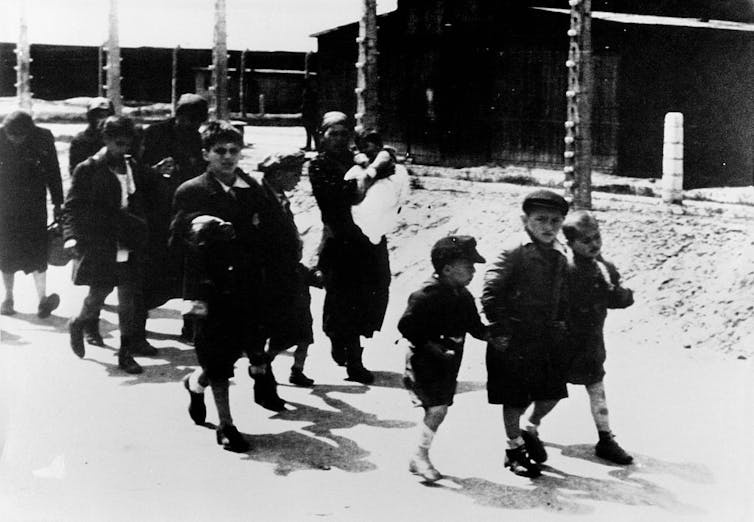
The SNCF transported approximately 76,000 Jewish deportees in merchandise cars to the German border, where a Nazi train driver carried them on to their deaths. While it’s possible the company didn’t understand the mass murder occurring at Auschwitz or other camps, drivers knew they carried unwilling passengers crammed together with little food, water or air in extreme weather without stopping. The deportation trains continued for two months after D-Day. Push for justice
Yet SNCF’S image as part of the Resistance lived on in France until the 1990s, when survivors first approached the company for atonement. SNCF escaped legal liability, but public pressure forced the company to respond. Though it never financially compensated victims directly, the SNCF did commission an independent study, opened its archive to the public, made statements of regret and contributed to Holocaust commemoration and education. A couple married for over 50 years discovered that their fathers were deported on the same train. Sarah Federman
The conversation then moved beyond French borders. In 2014, after Holocaust survivors protested the SNCF’s bids for contracts in the U.S., French and American ambassadors hammered out a US$60 million fund to compensate survivors who were not covered by other programs.
The SNCF’s journey toward accountability encouraged debates involving rail companies in the Netherlands, Belgium and Hungary, which had also transported hundreds of thousands of people to their deaths.
In 2019, Holocaust survivor Salo Muller successfully lobbied the Dutch state-owned railways for an apology and compensation for deportees. The company gave €15,000 – about $16,500 – to each survivor who had been forced to pay for their own ticket to be transported in horrific conditions to death camps. In the case of deceased survivors, the railway offered half that amount to heirs.
Not about the money
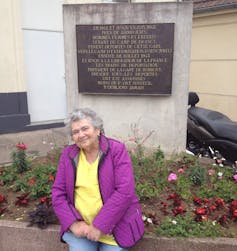
Liliane Lelaidier-Marton in front of a memorial at Drancy, France, where her father was deported. Sarah Federman
In 2012, historian Michael Marrus invited me to join him at Corporate Liability for Human Rights Violations, a conference at the University of Tel Aviv. There, he slapped his hands on the table and all but shouted to his senior colleagues, “It’s not about the money!”
Judicial rulings and financial payouts make headlines and create important precedents. But my interviews with survivors confirmed the spirit of Marrus’ words: “People want to set the record straight, to tell the story, and to have their history constitute a warning.”
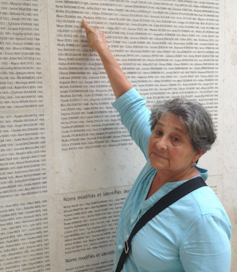
Liliane Lelaidier-Marton took me to the Shoah Memorial in Drancy, France, where her parents had been interned before deportation. She appreciated the memorials and visitor center, which acknowledge her loss and their suffering. Renée Fauguet-Zejgman and I went to a ceremony in Paris together so she could read her murdered father’s name – an opportunity sponsored, in part, by the SNCF. Daniel Urbejtel, one of the youngest to survive Auschwitz, didn’t hold on to special anger against the railways. But when I told him about their statement of regret and funding of memorial sites, he said, “I’m glad that they did that.”
Renée Fauguet-Zejgman points to her father’s name on a memorial in Paris. Sarah Federman
Leo Bretholz, who jumped out of an SNCF train bound for Auschwitz, wanted a verbal acknowledgment of the harm and an apology along with compensation. Stanley Kalmanovitz, who received over $200,000 from the 2014 settlement for his deportation to Auschwitz, told me, “The money came at a good time in my life … but this is not a settlement of conscience.” He knew the railway company was trying to win U.S. contracts and saw the money as a way to get survivors out of the way.
Motivations aside, Kalmanovitz wondered what people today expect from the SNCF workers during the war. He said, “What was the French railroad supposed to do? Someone has a gun at your head, what do you do? You take the bullet? Then, if everyone takes a bullet, who’s left?”
Historians only know of one French train driver who defied orders to drive his train. Léon Bronchart refused to drive a train filled with either German soldiers or political prisoners. He lost his bonus and title, but not his life.
While a number of survivors I spoke with wanted SNCF to atone, others expressed misgivings about holding today’s company accountable for the actions of its predecessors. Thousands of Jews around Paris were arrested in July 1942, including more than 4,000 children. Most were later deported to Auschwitz. Antoine Gyori/Sygma via Getty Images
Restoring dignity
Today, some companies are trying to address their connections to mass atrocities: not only the Holocaust, but also other genocides, the transatlantic slave trade, colonialism and even ecological destruction.
I encourage companies, institutions and ambassadors to focus on addressing harm, rather than on calculating their institution’s percentage of guilt or complicity. These difficult – if not impossible – calculations distract institutions from supporting the innocent people grappling with the aftermath and from preventing future harm.
While money matters, people also want their dignity restored and suffering acknowledged – and companies can do this work without lawsuits prompting them. When they do it on their own, stakeholders see their efforts as evidence of a moral conscience rather than an economic necessity.
This look back encourages stakeholders to consider how today’s corporate actions may be judged in the years ahead. Will future generations celebrate or condone their use of natural resources, labor practices or any participation in the deportations of their day? (Sarah Federman, Associate Professor of Conflict Resolution, Kroc School of Peace Studies, University of San Diego. The views expressed in this commentary do not necessarily reflect those of Religion News Service.)
The Conversation religion coverage receives support through the AP’s collaboration with The Conversation US, with funding from Lilly Endowment Inc. The Conversation is solely responsible for this content.
THE MAN WHO MADE THE TRAINS RUN ON TIME
Hannah Arendt, Eichmann in Jerusalem: A Report on the Banality of Evil
defining the banality of evil in very different terms. The war was serious, and while everybody was certain of the righteousness of their cause, very few, I ...
As a starting point, neurodivergent refers to individuals whose neurocognitive functioning differs from what dominant societal standards define as “normal.” This includes conditions such as autism, ADHD, OCD , dyspraxia and Parkinson’s disease, among others.[1]
Activism takes many forms that are influenced by background and experiences. For me, being active has often meant navigating uncomfortable or painful sensory environments, learning activist scripts and other skills, adapting to challenging learning formats, and shouldering additional emotional labour to manage social interactions and hierarchies.
While activism often brings together marginalised people, it also comes with sacrifices. Staying silent about personal challenges, investing a lot of time and emotional labour, and overworking to sustain campaigns often fall on a small group of dedicated activists. At times, activist spaces are influenced by traditional ways of organising including top down hierarchical command structure and authoritative leadership styles rooted in traditional, masculine norms of dominance, control, and, at times, political opportunism.
However, personal, organisational, and political aspects of activism are deeply interconnected, should be discussed more together and require collective efforts to transform how we organise.
“You Don’t Look Autistic”: Unmasking Stereotypes
I am autistic with a formal “diagnosis”, which is the primary lens through which I approach this article, alongside my experiences as a woman living under capitalism. I acknowledge my privileges and that my perspective is shaped by a Western viewpoint. While I do not speak for all autistic or neurodivergent individuals, or for all women, I hope to contribute to this broader discussion.
It is also important to recognise the validity of those who are autistic without a diagnosis. Many face barriers such as prejudice within the medical system, financial constraints, and limited access to services. These challenges are often greater for people from marginalised backgrounds. Autistic people seeking gender-affirming care face additional difficulties if they have a diagnosis, and many women, trans, and non-binary people are diagnosed later in life due to outdated diagnostic criteria and cultural stigma.
Historically, autism diagnosis guidelines have been influenced by male-centred stereotypes, leading to many people being undiagnosed or misdiagnosed based on their gender, race, or class. Early research by Hans Asperger, whose complicity in the Nazi regime has been exposed, framed Asperger’s (now part of the autism spectrum) as a condition affecting “intelligent but troubled” boys from white privileged backgrounds. This narrow perspective excluded women/non-binary and people of colour from early diagnostic criteria, reinforcing the “male brain” theory. Until recently, the diagnosis ratio of males to females was approximately 4 to 1. However, this gap is changing, and we now know autism can present in different ways across people.[2]
Stereotypes, such as the belief that individuals with autism are unempathetic and possess a rude monotone voice, who are often mainly portrayed in technical fields, are harmful and contribute to misunderstandings. Even those who exhibit traits often considered “masculine” might be overlooked in the diagnostic process. Devon Price’s book Unmasking Autism gives voice to a diverse range of experiences, discusses the impact of masking autistic traits, and highlights the ableism faced by individuals who disclose their autism.
Research also indicates a connection between autism and being LGBTQ+. Both groups share a history of being subject to harmful practices, including behavioural therapies like Applied Behaviour Analysis (ABA) and gay conversion therapy, both developed by Ole Ivar Lovaas, which have had long-term psychological effects.[3]
Moreover, labels like “high functioning” and “low functioning” oversimplify the experiences of autistic individuals. Functioning, often defined by capitalist standards of “normality,” typically involves passing as a non-autistic person, such as maintaining employment, even while some may struggle with sensory issues, executive functioning challenges, or mental health concerns due to having to mask. Labels like “low functioning” can perpetuate stigma and isolation, causing the needs and abilities of autistic individuals to be overlooked
[Trigger warning: the following section discusses suicide]
Alienation and Mental Health
Karl Marx’s theory of alienation describes how people become alienated from their labour, the products of their work, other workers, and their sense of self under capitalism. In a competitive market, value is placed on the endless pursuit of profit and growth, rather than on the collective well-being of people. This includes nature, sensory environments, workplace requirements, and the necessary care and support systems.
The impact of these pressures is particularly evident in the mental health challenges faced by autistic people. Research has shown that autistic people are at a significantly higher risk of suicide and self-harm. A study outlined how this can arise from the need to mask autistic traits, inadequate support, and internalised feelings of being a burden, among other reasons. Additionally, there is a notable lack of research on mental health at the intersections of autism with non-binary, LGBTQ+, and racial and ethnic identities. However, it is well established that autistic people and those in the LGBTQ+ community face disproportionately high rates of mental health challenges and suicide risk.[4]
Feelings of alienation extend to the workplace. Society prioritises profit over well-being, valuing people primarily for their productivity. Those who meet the standards of the “productive worker” are often exploited for their surplus labor, which refers to the value they create beyond what they are paid for. In contrast, people who cannot meet these standards due to disability, illness, mental health issues, or other reasons are labeled as burdens on society and relegated to the “surplus population.” The state establishes institutions to determine who is “deserving” and “undeserving,” while the media reinforces the state’s narrative that frames these individuals as attempting to exploit the system.[5]
Currently, autistic adults face disproportionately low employment rates. In Ireland, only 16% of autistic individuals are in full-time employment, and 32% engage in some form of paid work.[6] Janine Booth, an autistic trade union activist, explores the experiences of autistic workers in her book Autism Equality in the Workplace.[7] Booth highlights that the focus should not be on changing autistic people to fit existing workplaces but rather on transforming workplaces and organise to give voice to autistic people.
The goal should not be to make autistic people fit better into systems designed to exploit us. Instead, we need to transform workplaces and build grassroots trade union activism that gives a voice to autistic people and others disability workers. Alongside this, we need care and support systems that benefit everyone, designed for solidarity, not profit, and rooted in care for people and the planet, rather than exploitation.
Neurodiversity Movement
The term “neurodivergent” was coined by Kassiane Asasumasu in 2000, while the concept of “neurodiversity,” referring to variation in neurocognitive function, was coined by the autistic-run group ‘InLv’ in 1996. The broader idea of neurological diversity was widely discussed in many autistic spaces during the 1990s, without a sole owner.[8] This neurodivergent movement gained traction with the rise of the internet, which allowed autistic people to connect with one another, share their experiences, and challenge the prevailing narratives that pathologised differences in neurological functioning.
Nick Walker published the essay “Throw Away the Master’s Tools” in 2012. Walker defines the pathology paradigm as the belief that there is a single “normal” way for brains to be configured and function, and that any deviation from this norm is inherently wrong. In contrast, the neurodiversity paradigm views neurodivergence as a natural and healthy part of human diversity, akin to variations in ethnicity or gender. Walker argues that there is no “normal” or “right” mind, asserting that the social dynamics surrounding neurodiversity are similar to those of other forms of social inequality and power relations. She argues that this paradigm shift must occur within both individual consciousness and broader culture. This articulation and shift from the pathology paradigm to the neurodiversity paradigm, was very influential in the neurodiversity movement and broader discussion.[9]
More recently, Robert Chapman’s book, Empire of Normality, offers a deep Marxist historical analysis of the development of the “Empire of Normality” alongside the rise of capitalism.
In their work, Chapman examines how the prevailing understandings of normality and neurodivergence in society are shaped by the changing material relations of capitalism. They consider the intersecting oppressions of gender, race, and class, positioning neurodivergence at the centre. One of Chapman’s insights is that “since the pathology paradigm, and the way it naturalises increasingly restricted conceptions of normality, grew precisely to mirror the needs of the capitalist economy, these material conditions must be changed, not just our thinking.” This calls for a shift beyond just changing attitudes and thoughts, but a change to the “deeper structures of society”.[10]
Unity in Collective Care and Action
There is inspiration to be taken from the neurodiversity movement in understanding the value of everyone, regardless of their neurocognitive function, and that it does not mean anyone is broken or less. As Chapman notes, “[i]t takes all kinds of minds for society to function,” and I would extend this to be true for activist organisations, particularly socialist and anti-capitalist ones. I am also influenced by Penny Duggan’s article on feminist organising.[11]
Typically, collective organising is discussed a lot within non-hierarchical spaces, not as much in organisations with a central leadership. However, there are issues with a lack of structure, as highlighted in ‘The Tyranny of Structurelessness’.[12]
I set out a definition of collective organising to frame debate on this in existing activist spaces. Those who are marginalised or lack power often question internal functioning, while those with power may dismiss these concerns as distractions from the “real” struggles or immediate crises.
Definition
Collective organising involves activists coming together on an agreed political platform to recognise and value the different minds, backgrounds, and experiences that influence strategies and intervene in struggles effectively. At meetings, we are all equal and debating ideas is not only a political process but can inform the best strategies and build the organisation long term.
Activist spaces and organisations can reflect the ideologies and power dynamics present in society. It is important to reflect on and challenge these within day to day activities, organisations and movements. This includes addressing issues like communication, knowledge, social capital, organising (planning, meeting format, advance notice, procedures etc), accessibility, and unconscious biases related to gender, disability or other oppressions. Removing barriers to participation, and empowering unheard voices to organise and challenge these barriers together, should be encouraged and facilitated.
Tasks should be distributed fairly, acknowledging varying capacities due to personal circumstances, caregiving, or disabilities. Different learning and education needs should also be supported as part of the collective process.
Leadership is not about a top-down command structure or one-way decision-making. This must also be avoided in broader community work, where power dynamics are present between experienced activists and the communities they organise with. Leadership should avoid gatekeeping decisions, roles, topics, or areas of work, and must resist any form of tokenism or typecasting of activists.
Leadership, whether individual or collective, must be accountable, transparent, and informed by the experiences and insights of activists and the people in our workplaces and other struggles. Structured forums for feedback, debate, and reflection should be used as part of an ongoing lively democratic organisation. The goal is not to dictate to others, or stomp out minority voices, but to build leadership within organisations and communities.
The care of activists is not a personal responsibility but a collective. Whether it involves mental health, childcare at events, accessibility, or other barriers, we should act and use our voices in solidarity. We should recognise that the personal is always political and that boundaries must be respected.
The practice of collective care should replace the language and traditions of bureaucratic sacrifice. This must be reflected in our structures, communication, how we support activists, and openness to creative organising methods.
Final Thoughts
For me, neurodivergent liberation is inseparable from the fight to build strong, democratic socialist organisations and broader movements online, in trade unions, housing struggles, resistance to the far right and other campaigns. It is about creating spaces where activists, whether neurodivergent, women, LGBTQ+, or non-binary etc, can collectively organise and challenge internal functioning of activist spaces, build organisations and inform the struggles they are part of.
How we organise is not an abstract question separated from the political project. It determines decision making, whose voices are heard, how strategies are formed, and whether we build movements and leaders, or burnout activists for short term campaign gains.
The neurodiversity movement, including wider demands around disability and care are not side issues; they are part of our class consciousness on how we organise, challenge oppression, build solidarity and movements.
Notes
1.Nick Walker, ‘Neuroqueer Heresies: Notes on the Politics of Neurodiversity’ (Weird Books for Weird People, 2021).
2.Devon Price, ‘Unmasking Autism: The Power of Embracing Our Hidden Neurodiversity ’ (Monoray, 2022).
3.Jodie Hare, ‘Autism Is Not a Disease’ (Verso, 2024).















_1b.jpg)
