Friday, April 18, 2025

Chinese Students and Scholars Faced Targeting Before Trump. Now It’s Escalating.


As the US and China jockey for dominance, anti-Chinese bigotry is driving visa denials for students and scholars.
April 18, 2025
Yaorusheng / Moment / Getty Images

Less than 100 days into President Donald Trump’s second term, international academic workers find themselves at the intersection of a crackdown on immigrants and political intrusion into higher education. The Department of Education has stripped several universities of billions of dollars in federal funding over alleged “campus antisemitism” and DEI policies, and has threatened to do the same to others. Over a thousand international scholars are currently facing visa revocations and deportations, some for expressing dissent, but many for reasons unknown.

Arab, Muslim and Latinx scholars are not the only ones facing intensified scrutiny — Chinese scholars also face particular challenges. On March 19, at least six universities received letters from the House Select Committee on the Chinese Communist Party (CCP) requesting information on the enrollment, research involvement and funding of Chinese faculty and students. In the letters, Chinese academics are painted as a “Trojan horse” at top U.S. institutions, here to steal sensitive technologies for China’s military and economic advantage.

These letters escalate anti-Chinese sentiments that have grown across party lines in parallel with the geopolitical tensions between the U.S. and China. As U.S. policy makers confront what may be the end of the neoliberal order and China’s rise calls into question the role of the U.S. as the sole global superpower, scapegoating China is now bipartisan.

It is not hard to see why blaming China for the devastating effects of neoliberal globalization works: although deindustrialization in the U.S. occurred well before China joined the World Trade Organization, China’s rapid growth coincided with the dismantling of the U.S. industrial base as corporations fled to seek cheap labor and higher returns. Blaming China is now politically convenient for the same leaders who fostered this deindustrialization. In the 1990s, policy makers on both sides capitulated to aggressive lobbying by American companies to pass the North American Free Trade Agreement and not subject the renewal of China’s “most favored nation” trade status to strict human rights conditions. Since the relationship between U.S. businesses and China has frayed, condemning China lets politicians deflect blame for widespread economic anxiety and avoid confronting corporate power.

While China’s authoritarianism and its challenges to some sectors of the U.S. and global economy are real, U.S. attempts to curb China’s economy and military have produced policies limiting U.S.-China academic exchange to prevent the Chinese government from allegedly using its citizens as spies. The reality is that these policies have had little impact on espionage but have taken a heavy toll on scholars.

In 2018, Trump’s China Initiative deployed FBI agents on campuses nationwide to counter CCP economic espionage. As then-FBI Director Christopher Wray explained in a Senate Judiciary Committee hearing in July 2019, the initiative was based on the conviction that China is deploying “a slew of non-traditional collectors … businessmen, scientists, high-level academics, graduate students. People who are not intelligence officers by profession, but who are … working on behalf of the Chinese government.”

The China Initiative investigated hundreds of scholars, many of whom lost their jobs as a result. By 2021, less than 30 percent of cases resulted in convictions or guilty pleas — a staggering discrepancy from the overall federal rate, which sits above 90 percent. The vast majority of scholars were of Chinese descent, drawing strong condemnation for racial profiling. Though the Biden administration ended the program in 2022 after the DOJ itself concluded that it “helped give rise to a harmful perception that … we in some way view people with racial, ethnic or familial ties to China differently,” Congress has repeatedly tried to revive the China Initiative, and similar programs continued under Biden.

Funding agencies took it upon themselves to do the FBI’s job. The National Institutes of Health, the U.S. government’s main agency for biomedical and public health research, conducted hundreds of investigations that continue to this day behind closed doors. Last year, another top federal funder of scientific research, the National Science Foundation (NSF), pledged $67 million to establish research security centers nationwide, as mandated by the 2022 CHIPS and Science Act to bolster the U.S. semiconductor industry. The reality, though, is a web of officers often lacking relevant scientific or academic background, making national security judgements on research they do not understand.

In a context where the very notion of what constitutes a national security threat is largely ambiguous and often overlaps with efforts to preserve the competitive edge of U.S. companies in highly lucrative fields, the disproportionate power of federal funding agencies to dictate what research can be conducted and with whom poses a serious threat to academic freedom and jeopardizes the international scientific collaboration necessary to address the greatest challenges of our time, such as climate change and global public health.

Amid heightened scrutiny over research and funding, Chinese scholars face increasingly stringent visa restrictions. Under Proclamation 10043, issued in 2020, Trump restricted visas for Chinese academics affiliated with institutions linked to China’s “Military-Civil Fusion Strategy.” Over a thousand visas were revoked from Chinese graduate and postdoctoral scholars, some well into their programs. The definition of “military-civil fusion strategy” was left intentionally vague so that “officials [could] expand or change the definitions of what constitutes a threat as needed.” Despite attempts to draw attention to the dangers of such a broad application of this policy, under Biden, U.S. Customs and Border Protection wielded the proclamation heavy-handedly to harass, interrogate and deport Chinese scholars with valid visas at the border.

Since Trump took office a second time, we have seen a new, frightening wave of anti-Chinese targeting aimed at people in academia. Project 2025 doubles down on the vilification of China and Chinese nationals by calling for the revival of the China Initiative through executive action and supporting the discontinuation of visas for Chinese students and researchers. Just days before the March 19 letters from the House Select Committee on the CCP, Congress introduced a bill to ban student visas for all Chinese nationals. A few days later, on March 27, the House passed H.R. 1048, or the DETERRENT Act, a bill that would make reporting requirements for gifts and contracts from countries labeled as “of concern” — China in primis — disproportionately onerous for U.S. academic institutions.

Universities themselves have largely accepted and legitimized the targeting of Chinese nationals, offering little support. The University of Maryland, College Park (UMD), one of the six institutions addressed by the House Select Committee on the CCP, has seen this before. In 2023, UMD received a federal information request on a group of Asian-origin faculty. These professors — many of whom had been U.S. citizens for decades — were later detained and interrogated at airports regarding alleged conflicts of interest in research funding. Although they were eventually released, they were able to trace a direct line between their treatment and the information UMD had provided. United Academics of Maryland-UMD, UMD’s faculty union, is actively organizing to ensure UMD’s response to the House Committee letter doesn’t result in the same outcome — or worse.

The next year, still under the Biden administration, two UMD Chinese graduate students were denied entry at the border, likely due to Proclamation 10043, and faced automatic visa bans in the middle of their degrees. UMD’s International Student and Scholar Services (ISSS) — which charges international students extra fees, supposedly for enhanced support — proved inept, at one point ignoring a student for a month during their visa ban appeal. When asked to comment on these cases, UMD declined, citing privacy concerns and federal law.

The UMD Graduate Labor Union-UAW (GLU) rallied around three demands: allow their colleagues to complete their degrees remotely; provide financial help with legal and personal costs; and take proactive action to condemn this anti-Chinese attack and provide guidance to other Chinese students who might be targeted. Organizers launched petitions with thousands of signatures, grilled administrators at public town halls and private council meetings, created Know Your Rights resources and worked with national organizations to collect testimonies for Congress opposing Proclamation 10043.

Because of Maryland law, GLU has limited power as an unrecognized union without collective bargaining rights. Ultimately, neither of the Chinese grads could finish their degrees remotely. Organizers hit dead ends seeking financial help. Eventually, ISSS sent an advisory to Chinese students — a small win considering UMD loathes transparent communication; at the time of writing, UMD’s response to the ongoing crisis has been deeply inadequate, consisting of one brief email to international students only, with standard resources students largely deem insufficient for the magnitude of the issue. GLU has provided emotional and community support that UMD could or would not: the sense that anyone actually cared and was trying to fight this injustice.

Graduate workers across the country have used collective power to force universities to protect international students. For instance, the University of Michigan’s grad union secured assistance funds specifically for international workers through their contract. Several graduate unions organized enough political and legal pressure, including by getting their universities to file a lawsuit, to overturn an ICE directive to deport international students in 2020.

More political pressure is needed to protect Chinese scholars. Currently, bipartisan policy toward China assumes that the only possible global order is one where the U.S. dominates while China is kept in check. This dangerous framework ignores the reality at hand and fuels real harm — targeting Chinese people and Asian American and Pacific Islander communities more broadly, while depriving U.S. academic institutions of the vital talent and international research needed to remain competitive and meet the needs of our historical moment.

While very effective at disrupting the lives of thousands, anti-Chinese bigotry will not solve the current economic and social instability that gave us Trump. Instead, it distracts from real solutions that challenge corporate power and risks furthering corporate influence on academia by subordinating what constitutes “good” and “safe” scientific research to geopolitical calculus.

The latest wave of repression targeting all international scholars is an extension of the policies that have already affected Chinese academics. If we are serious about fighting Trump’s attack on higher education and immigrant communities, academics and institutions must organize collective pressure on Democratic leaders to oppose these initiatives.

This article is licensed under Creative Commons (CC BY-NC-ND 4.0), and you are free to share and republish under the terms of the license.


Valentina Dallona
Valentina Dallona moved to the U.S. for grad school at Johns Hopkins University, where she founded and led the graduate workers’ union drive. She then became a full time labor organizer, helping thousands of nurses win their union elections. She is currently the Political Director at Justice Is Global, where she works to build support for a progressive U.S.-China policy.

Rose Ying
Rose Ying is a PhD candidate and organizer with the Graduate Labor Union-UAW at the University of Maryland, College Park.


'Feel the pain': Trump’s 'destructive' policies slammed after layoffs announced in key swing state


April 18, 2025
ALTERNET

In Pennsylvania — a volatile swing state that has a popular Democratic governor, Josh Shapiro, but narrowly went to now-President Donald Trump and Republican now-Sen. Dave McCormick in 2024 — the economy is expected to be a major issue in the 2026 midterms. And the Keystone State, according to the Pennsylvania Capital-Star, is suffering a negative impact from Trump's steep new tariffs.

Mack Trucks, on Thursday, April 17, announced between 250 and 350 layoffs at its Lehigh Valley Operations plant near Allentown, Pennsylvania — and is citing tariffs as one of the reasons.

Capital-Star reporter Peter Hall quotes Mack Trucks spokesperson Kimberly Pupillo as saying, "Heavy-duty truck orders continue to be negatively affected by market uncertainty about freight rates and demand, possible regulatory changes, and the impact of tariffs. Today, we informed our employees that this, unfortunately, means we'll have to lay off 250-350 people at LVO over the next 90 days. We regret having to take this action, but we need to align production with reduced demand for our vehicles."

READ MORE: Trucking industry giant blames Trump tariffs in layoff of hundreds of workers

Pennsylvania State Rep. Josh Siegel, a Democrat, is blaming Trump outright. In a press release, the lawmaker described the layoffs as "a clear signal of the dangerous economic instability being fueled by the Trump Administration's chaotic tariff policies."

The Mack Truck layoffs are a hot topic on X.com, formerly Twitter.

Siegel tweeted, "Trump's delusional and destructive tariffs are costing families in my region their livelihoods! Tariffs aren't saving American industry, they’re raising costs on all families, destroying our economy and creating uncertainty for families and businesses!"

The conservative group Republicans Against Trump tweeted, "NEW: Mack Trucks will lay off between 250 and 350 workers at its Lehigh Valley Operations center in Pennsylvania, citing economic uncertainty caused by Trump’s tariffs, a company spokesperson said Thursday. End this reckless trade war now."

The Cato Institute's Scott Lincicome pointed out that Trump's tariffs specifically are being blamed for the layoffs.

Retired attorney CCJ bluntly posted, "Congratulations, Lehigh Valley, PA 2024 Trump voters! This is what you voted for! Layoffs caused by Trump Tariffs! No more eggs for you!"

Nachama Soloveichik, former communications director for ex-South Carolina Gov. Nikki Haley (a conservative Republican), noted that the Lehigh Valley is full of swing voters.

Soloveichik tweeted, "This is a swing district north of Philadelphia that Republicans just flipped by a razor thin margin after trying and failing to flip it for so many years. Free trader @SenToomey represented this district from 2000-2006."

X user John Anderson wrote, "They shouldn't complain They voted for Trump now they go what they voted for."

Conservative/libertarian Brian Vasquez posted, "Most think this is temporary. 'He's negotiating!' They will not start to pay attention and really care unless they are personally impacted. Unfortunately, I think everybody is about to feel the pain from these tariffs."
Kilmar Abrego García Case Shows Constitutional Crisis Is Here

“Depriving due process is the domino that causes the rest of the legal system to fall,” one constitutional scholar said.

April 17, 2025

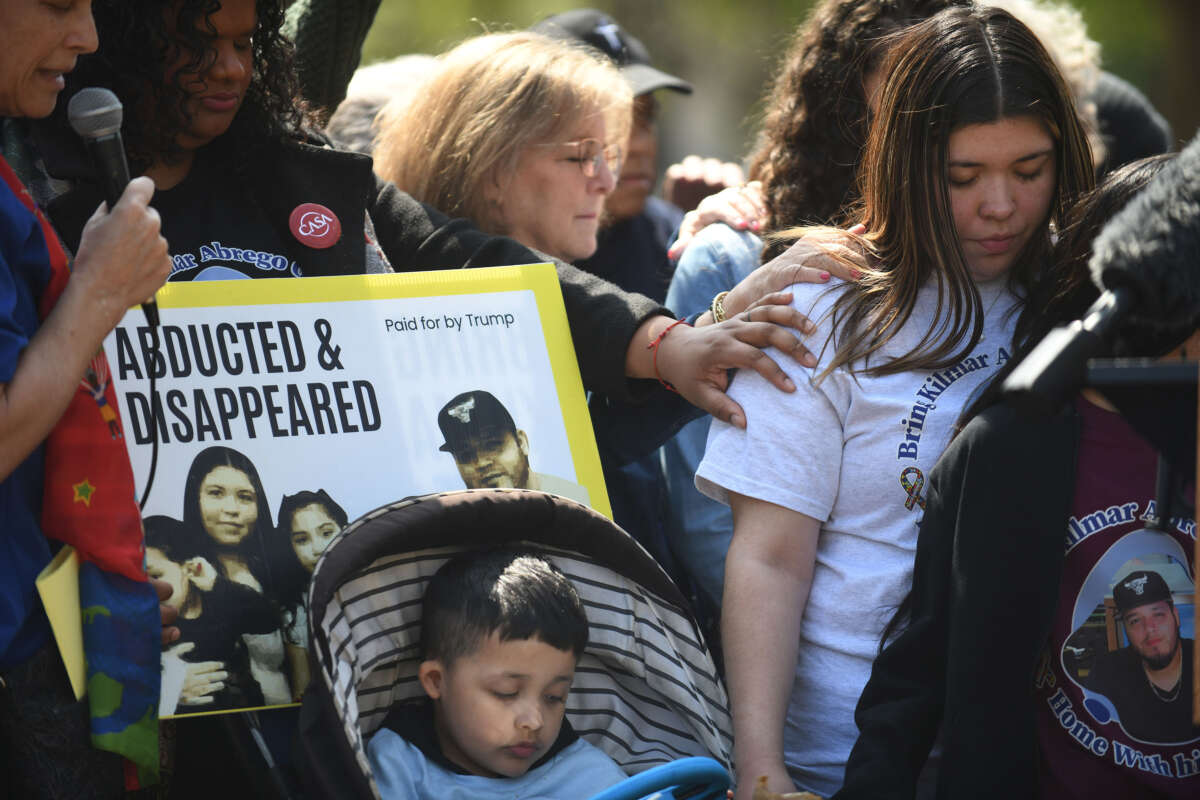
Jennifer Vasquez Sura and her children attend an interfaith prayer vigil for her husband Kilmar Abrego García, held outside the White House in Washington, D.C., on April 14, 2025.Astrid Riecken For The Washington Post via Getty Images

Lately I’ve been wondering where the tipping point is: how long can pundits brandish phrases like “threat to democracy,” or debate whether the United States is in a “constitutional crisis,” before the perpetual asking of that question itself reveals the answer? If Donald Trump and his allies are whittling away at democracy’s very core, will there be a moment of mainstream consensus — when we can look at the remaining form and say, yes, this no longer resembles what we had before?

The case of Kilmar Abrego García might be that threshold. The Trump administration admits that the Maryland father, originally from El Salvador, was deported accidentally to that country’s infamous maximum-security prison, known as the “Terrorism Confinement Center,” or CECOT. The Supreme Court has now upheld a lower court’s order instructing the administration to “facilitate” Abrego García’s return. And yet Trump has thumbed his nose at the judiciary, going so far as to stage a publicized Oval Office meeting on April 14 with El Salvador’s self-described dictator Nayib Bukele, in which both leaders told reporters that they had no power over Abrego García’s release.

Two days later, a federal judge found probable cause to hold Trump officials in criminal contempt of court orders in a different case. Judge James Boasberg said the administration had engaged in “willful disobedience of judicial orders” to halt the deportation flights of more than 200 migrants, mostly Venezuelans sent to CECOT. The administration has invoked the Alien Enemies Act in its justification to deport the men, alleging, with scant evidence, that they were involved in the Tren de Aragua or MS-13 gangs.

I spoke to a legal scholar and a historian of fascism who both said that the Trump administration’s acts of judicial defiance and clear disregard for due process carry grave stakes for civil liberties and U.S. democracy.

“I think U.S. liberal democracy is under attack. As much as a government can engage in this kind of assault, there’s no question: nothing like this has happened in U.S. history,” said John Connelly, a professor at UC Berkeley and an expert in the political history of eastern and central Europe. “I think there are efforts to undo its substance by attempting to reduce the courts in particular — to close their ability to operate how they’re supposed to operate, which is to act as a check on power, especially executive power.”


Van Hollen Denied Visit With Abrego García as Republicans Take Selfies at Prison
One Republican posted a picture of himself posing with both thumbs up in front of a cell crammed with men.  By Sharon Zhang , Truthout April 17, 2025


James Sample, a law professor at Hofstra University specializing in constitutional law and democracy, said the U.S. is already in a constitutional crisis. “The one scenario for which our constitutional framework is simply not equipped is the scenario where a powerful executive simply ignores rulings of the courts,” he told me. “The republic is in intensive care at the moment, and it’s not clear that it will come out of it in the same condition.”

The Trump administration’s legal argument in the Abrego García case rests on the difference between two words: “facilitate” and “effectuate.” Maryland District Court Judge Paula Xinis had ordered the administration to do both, setting forth a strict timeline for when Abrego García should be returned to the U.S. and afforded due process. The Supreme Court clarified in its opinion that Xinis could not order the president to “effectuate” Abrego García’s return because legal precedent discourages the judiciary from directly intervening in the executive branch’s foreign affairs. Even so, the theatrics of this week’s Oval Office moment are patently ridiculous. Trump is one of the most powerful leaders in the world, and the U.S. is paying El Salvador $6 million to imprison Abrego García alongside the deported Venezuelans and other migrants. Sample noted that “facilitate” still means that Trump must make a good-faith attempt to get Abrego García back — simply throwing up his hands and saying “oops” sure looks like a failure to comply with court orders.

“By any reasonable definition of facilitate, including its use elsewhere in immigration law and extradition contexts, what the administration has done so far doesn’t qualify,” said Sample. “We haven’t even seen an indication that the president or secretary of state has asked for García’s return. That seems like the most basic step. Instead, we got this Oval Office circus, this shell game, where the presidents of both countries are seated three feet apart, and each claims it’s the other’s responsibility.”


“We got this Oval Office circus, this shell game, where the presidents of both countries are seated three feet apart, and each claims it’s the other’s responsibility.”

At that meeting, Trump officials repeatedly stated that Abrego García was a member of the violent international MS-13 gang and therefore deserved to be sent to CECOT. “In 2019, two courts — an immigration court and an appellate immigration court — ruled that he was a member of MS-13,” Attorney General Pam Bondi told reporters. “It’s up to El Salvador whether they want to return him. That’s not up to us.”

But Bondi’s statement would fail even Constitutional Law 101, Sample said. That’s because Abrego García has not been convicted of or even charged with any crime. Police officers in Prince George’s County, Maryland, arrested Abrego García in 2019 because he was undocumented and they suspected he was a member of MS-13. A police report cited Abrego García’s Chicago Bulls hat and hoodie as support for his gang affiliation and stated that a confidential informant had claimed he was a member of the “Westerns” clique of MS-13 in Long Island, New York — a place Abrego García has never lived. The informant testimony was sufficient for an immigration court to deny Abrego García bond, which an appellate court affirmed, but this is not the same thing as a court finding him guilty of criminal gang membership. The only way for that to happen is if Abrego García is charged with a crime and afforded due process — neither of which have happened.

“It’s a scary time when the president of the United States, who is not a lawyer, is surrounded by lawyers, including the attorney general and other surrogates, who repeat false claims that wouldn’t pass even the ‘Schoolhouse Rock’ version of law school,” said Sample. “The fact that the attorney general is defining the executive branch as the final arbiter of criminality should send chills down the spine of every American and every person in America.”


“The fact that the attorney general is defining the executive branch as the final arbiter of criminality should send chills down the spine of every American and every person in America.”

Conservatives — including Vice President J.D. Vance — have argued that the U.S. government should not be obligated to honor due process for undocumented immigrants. But legal experts have pointed to the neglect of due process in Abrego García’s case as a threat to everybody in the U.S., including citizens. “The Government’s argument,” Supreme Court Justice Sonia Sotomayor wrote in a statement accompanying the ruling, “implies that it could deport and incarcerate any person, including U.S. citizens, without legal consequence, so long as it does so before a court can intervene.” Trump himself has clearly stated he aims to expand his deportation regime, telling Bukele during the Oval Office meeting that “the homegrowns are next” and instructing the dictator to build “about five more” prisons to meet the demand.

Sample put it this way: “We are all Kilmar Abrego García.” He explained, “If you take away due process, there’s nothing preventing the exact same treatment from being applied to U.S. citizens. A citizen’s only defense, in such a case, would be: ‘I’m a U.S. citizen — I’m entitled to due process.’ But if there’s no process, there’s no arena to make that argument. Depriving due process is the domino that causes the rest of the legal system to fall.”

I asked Connelly what we can learn from looking at historical examples in which other legal systems have fallen. He noted that, while he doesn’t believe in drawing direct parallels, he can see echoes of post-1933 Germany in our current U.S. political moment.

For instance, in Germany, “the government achieved cooperation from the Reichstag to rule by decree, which included disabling the courts.” The Nazis, Connelly said, “didn’t disable the Weimar Constitution; they exploited its weaknesses to create a total state.” But the German legal system was “far more centralized than ours, and there was very little opposition from German elites at the time,” which helped facilitate the Nazis’ fascist takeover.

“Here’s where I hope we’ll see a difference in our own case: the legal profession in Germany cooperated wholeheartedly. Generally speaking, lawyers and judges supported the regime,” said Connelly. “It remains to be seen what will happen in our country if the federal government attempts to do illegal things — whether the courts and the states will push back. We’re still in the early days. We haven’t had a real showdown yet.”

On the other side of the same coin, Sample noted that his biggest concern right now is Trump’s complicit Congress and the conservative supermajority on the Supreme Court. “If this Court is our best hope for protecting the republic, it’s hard not to be pessimistic,” he said, pointing to the court’s ruling last year that granted Trump sweeping immunity from criminal prosecution.

But Connelly emphasized that learning from history can help us chart a way forward. He pointed to the trend of “anticipatory compliance” in totalitarian regimes, where people comply with a regime’s demands before they’re even made, declining to speak out for fear of potential repercussions. “But it’s vital to remain vigilant and act as though we are in a free society,” said Connelly. “If we stop acting freely, we become complicit in reducing our freedom. Resistance is key to stopping civil liberties from being restricted.”

“You can’t appease a bully. You have to show that you’re not afraid and develop firm opposition,” he continued. “In the 1930s, the German elite thought they could appease Hitler and use him. That was obviously incorrect.”
El Salvador president tried to stage visiting US senator’s photo for propaganda: report


Democratic U.S. Senator Chris Van Hollen meets Kilmar Abrego Garcia, a man wrongly deported to El Salvador by the administration of Republican President Donald Trump, at a location given as El Salvador, in this image released April 17, 2025. Senator Chris Van Hollen via X/Handout via REUTERS

Ailia Zehra
April 18, 2025
ALTERNET

When Sen. Chris Van Hollen (D-Md.) received applause Thursday after he succeeded in meeting with Kilmar Abrego Garcia, the man wrongly deported to a notorious prison in El Salvador, Salvadoran President Nayib Bukele was quick to share photos from Van Hollen's meeting with Garcia.

"Kilmar Abrego Garcia, miraculously risen from the 'death camps' & 'torture', now sipping margaritas with Sen. Van Hollen in the tropical paradise of El Salvador," Bukele wrote.

But a New York Times report published Friday said an aide to the El Salvador president placed two glasses with cherries and salted rims on the table in front of Van Hollen and Abrego Garcia during their meeting to stage the photo and use it to reject reports regarding mistreatment of prisoners in Salvadoran jails.

The photos showed Abrego Garcia and the Maryland Democrat sitting at a table in a dining space surrounded by vibrant greenery, as well as greeting one another on the gleaming floor of the hotel lobby.

Earlier, Van Hollen was prevented from visiting Abrego Garcia by Salvadoran military officials, who he claimed were trying to obstruct his trip to the prison. "This is about bringing home a man they ADMIT should've never been abducted. I won't rest until then," he said.

Prisons in El Salvador are said to be overcrowded where instances of torture are well-documented. "This mass incarceration has aggravated historically poor conditions in detention, including extreme overcrowding, violence, and poor access to goods and services essential to rights, such as food, drinking water, and health care," said a Human Rights Watch report released in 2022.

Meanwhile, American political commentators reacted to the Salvadoran president's X post, saying he "caved" to pressure. Earlier this week, Bukele had vowed not to return the deported man to the United States during his Oval Office meeting with President Donald Trump. Many said that Van Hollen's success in meeting with Abrego Garcia indicates that the backlash against the Maryland man's wrongful deportation was effective.

'You caved': El Salvador president ripped for posting photos from US Senator’s meeting

Salvadoran President Nayib Bukele on February 25, 2025
 (Casa Presidencial El Salvador/Flickr)

Ailia Zehra
April 18, 2025

Sen. Chris Van Hollen (D-Md.) received applause Thursday after he succeeded in meeting with Kilmar Abrego Garcia, the man wrongly deported to a notorious prison in El Salvador who has become the face of the Trump administration's mass deportation drive. But El Salvador President Nayib Bukele used the opportunity to denounce critics.

Bukele was quick to share photos from Van Hollen's meeting with Garcia on the social platform X, saying, "Kilmar Abrego Garcia, miraculously risen from the 'death camps' & 'torture', now sipping margaritas with Sen. Van Hollen in the tropical paradise of El Salvador!"

American political commentators reacted to the Salvadoran president's post, saying he "caved" to pressure. Earlier this week, Bukele had vowed not to return the deported man to the United States during his Oval Office meeting with President Donald Trump.

ALSO READ: Senator gives ultimatum to El Salvador’s government in case of wrongfully deported man

MSNBC contributor Rotimi Adeoye wrote, "You caved lol please wear a suit next time you enter our oval office, thanks."

Political commentator Krystal Ball said, "That Bukele was pressured into doing this is so important. It is a significant step towards making sure the Trump regime will not just be able to endlessly disappear people into foreign prisons. Please keep up the pressure!!!"

The Atlantic writer Tyler Harper shared a video clip from Van Hollen from a news conference he addressed in El Salvador, saying, "It’s hard not to find this image — of a single Democratic senator standing alone in some empty room in a foreign country and defending the rule of law — very moving."

"There should have been more senators there with him, but kudos to Van Hollen," he added.

Others echoed this view, noting that Van Hollen took action instead of merely issuing statements.

Karthik Soora, a Democratic politician from Texas, wrote, "I loved Booker’s filibuster, but Van Hollen demonstrated more clearly than anyone what the difference between action and performance is."

On Wednesday, Van Hollen flew to El Salvador and said the main goal of his trip was to meet with Abrego Garcia. "Tonight I had that chance. I have called his wife, Jennifer, to pass along his message of love. I look forward to providing a full update upon my return," he said in a post on X announcing he succeeded in meeting with Abrego Garcia.

Trump giving prisoners fewer rights than they had in World War II internment camps: analyst

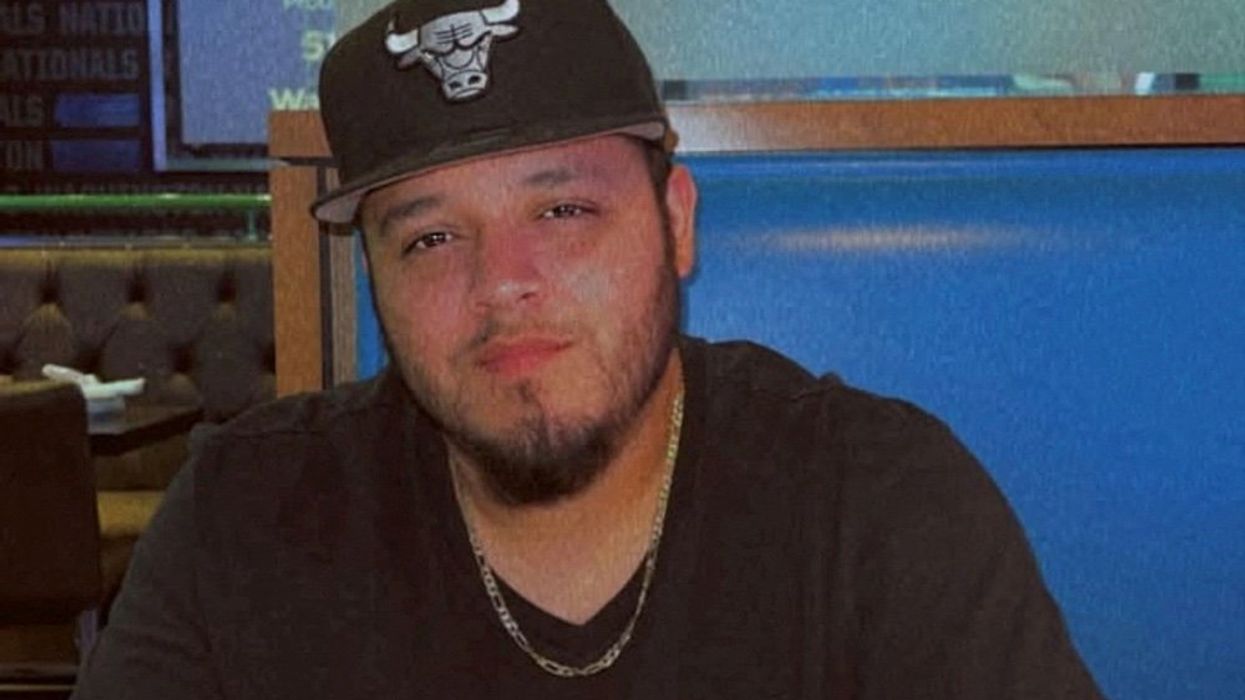
Kilmar Abrego Garcia, a Salvadoran migrant who lived in the U.S. legally with a work permit and was erroneously deported to El Salvador, is seen wearing a Chicago Bulls hat, in this handout image obtained by Reuters on April 9, 2025. Abrego Garcia Family/Handout via REUTERS

Ailia Zehra
April 15, 2025
ALTERNET

President Donald Trump's refusal to bring a Maryland man, who was wrongfully deported to a notorious prison in El Salvador, back to the United States — despite a Supreme Court ruling — has raised serious concerns among some analysts, who say that such an unchecked use of the Alien Enemies Act is unprecedented.

In a report published in the New York Times Tuesday, reporters note that even during World War II, there was "a check" on the government and individuals who received a hearing under the civilian boards were mostly freed.

"During World War II, the Department of Justice established civilian hearing boards in which 'registered aliens' of German, Italian and Japanese descent arrested by the government could argue they were not a danger to the nation, legal scholars said," the report states.

"Many scholars have criticized that process as deeply flawed; detainees were not afforded lawyers and could still be held based on hearsay and bias or racial discrimination," the New York Times adds.

The report then quoted Eric L. Muller, a professor at the University of North Carolina School of Law, who said the process nevertheless provided 'a check' on the government, adding the majority of people who obtained a hearing under the civilian boards were released.

Many observers have echoed this sentiment. Senior journalist Chris Lehmann wrote in The Nation on Monday, "The illegal operation that has sent at least 238 immigrants to El Salvador’s brutal and repressive Cecot megaprison will continue in defiance of the Constitution, human rights protections, and whatever remains of the rule of law."

"So will the Trump administration’s attempts to gaslight the world about the nature of its depradations?" he asked.

On Monday, Sen. Chris Van Hollen (D-Md.) requested a meeting with El Salvador President Nayib Bukele during his current visit to the U.S. to discuss the return of Kilmar Abrego Garcia, a Maryland man who was wrongly deported to an infamous Salvador prison due to an "administrative error" by the Trump administration.

In a letter to the Salvadoran ambassador to the U.S. Milena Mayorga written Monday, Hollen said U.S. Supreme Court ruled unanimously that Abrego Garcia was wrongly deported to a prison in El Salvador.

"I have met with Mr. Abrego Garcia’s wife, mother and brother and, as you can imagine, they are extremely worried about his health, safety, and continued illegal confinement, as am I," he wrote in the letter.

During a press conference alongside Bukele in the Oval Office on Monday, Trump claimed that the Supreme Court had ruled 9–0 in his favor and that the ruling in the case meant that the U.S. government would have to provide a plane only if the Salvadoran president chose to return Garcia.

“Of course I’m not going to do it,” Bukele said when asked by reporters if he would help return the man, adding that returning him would be akin to smuggling “a terrorist into the United States.”

According to some political commentators, Trump is openly defying the judiciary. Others have warned that this development poses a risk to the credibility of the 2026 midterm elections.
'Disgusting fascism': Experts warn White House 'openly mocking' courts is 'very dangerous'


U.S. President Donald Trump speaks on the day he signs executive orders in the Oval Office at the White House in Washington, D.C., U.S., April 17, 2025. REUTERS/Evelyn Hockstein


David Badash
April 18, 2025
NEW CIVIL RIGHTS MOVEMENT


The Trump White House is coming under fire for what appears to be an attempt to mock the U.S. Supreme Court, the facts in the case of a Maryland man wrongly deported to a maximum-security prison in El Salvador, and The New York Times.

The White House’s official account on the social media platform X posted a “corrected” version of a New York Times story—corrections that have drawn concern and scorn from the legal community and political commentators.

“Senator Meets With Wrongly Deported Maryland Man in El Salvador,” read a screenshot of the Times’ headline.

But the White House’s version (below), complete with red ink and cross outs, reads: “Senator Meets With MS-13 Illegal Alien in El Salvador Who Is Never Coming Back.”

The White House added remarks saying, “Fixed it for you, @NYTimes. Oh, and by the way, @ChrisVanHollen — he’s NOT coming back.”


Senator Chris Van Hollen (D-MD) traveled to El Salvador this week and, after several days, was finally permitted to meet with Kilmar Abrego Garcia—the legal U.S. resident whom the Trump administration has admitted in court it wrongly deported. Multiple courts, including the Supreme Court, have ordered the administration to “facilitate” his return. Yet the Trump administration appears to be refusing.

Friday’s claim that Abrego Garcia is “never coming back” was taken as a serious statement of intent by some.


Attorney Aaron Regunberg wrote: “The White House is saying he’s ‘never coming back’ — they are explicitly declaring they will violate a unanimous Supreme Court order.” Calling out Senate Democratic Minority Leader Chuck Schumer, Regunberg wrote: “you said this was your red line that would trigger ‘extraordinary action.’ So…where the f are you?”

“2 telling things here,” offered The Washington Post’s senior political reporter Aaron Blake. “1) White House crosses out ‘wrongly,’ despite repeatedly acknowledging its error in court. 2) ‘who’s never coming back’ is basically taunting SCOTUS. Signals the opposite of any intent to ‘facilitate’ his return.”

“The White House press shop lies and claims Mr. Abrego was not wrongfully deported, despite having acknowledged that fact at every single stage of the court process; at the district court, the circuit court, and the Supreme Court,” noted attorney Aaron Reichlin-Melnick. “They are openly contemptuous of the truth.”


Civil rights attorney Patrick Jaicomo, replying to the White House, wrote: “There is a mistake in the headline. You didn’t wrongly deport Garcia. You wrongly imprisoned him without due process. So, fix your mistake, as the courts have ordered. You don’t have to keep doubling down on bad decisions.”

Attorney Dilan Esper added, “I’ll remind you that the federal judges issuing orders see this.”

Veteran journalist John Harwoood called it, “disgusting fascism,” and wrote that “the Trump WH is garbage from top to bottom.”

Opinion writer Magdi Jacobs noted, “They’re moving from evading the judiciary to openly mocking it. This is very dangerous territory.”


Some others addressed what they appeared to suggest was the juvenile nature of the White House’s post.

“When you graduate from 4chan and land your first job at the White House,” wrote Talking Points Memo publisher Josh Marshall.

“The Trump admin really wants to distract people from the fact that it illegally sent someone to El Salvador in violation of a court order & binding law, either out of malice or sheer incompetence. No amount of s—posting will change that,” said Reason magazine’s Billy Binion.

“This is the evil of the Trump White House,” remarked Fred Wellman, an Army veteran, political consultant, and the host of the podcast “On Democracy.”


Journalist and author Robert Lusetich observed: “The White House, an ever-lasting symbol of the power, dignity and greatness of the United States. Now, a trolling meme account.”

Anti-gun-violence activist Fred Guttenberg declared the White House is “staffed by pathetic punk 2nd grade pre pubescent children.”

Journalist James Surowiecki commented, “Your tax dollars are paying for this childish cr–.”

See the White House’s social media post above or at this link.
A Nation of Sheep? Trump's Fascist Tactics Working All Too Easily


Where are the nationwide protests? The national strikes against the destruction of what is left of U.S. democracy? As for the eerie complacency of the Democrats, it is hardly surprising why there is such a huge loss of trust in the leadership of the Democratic Party.


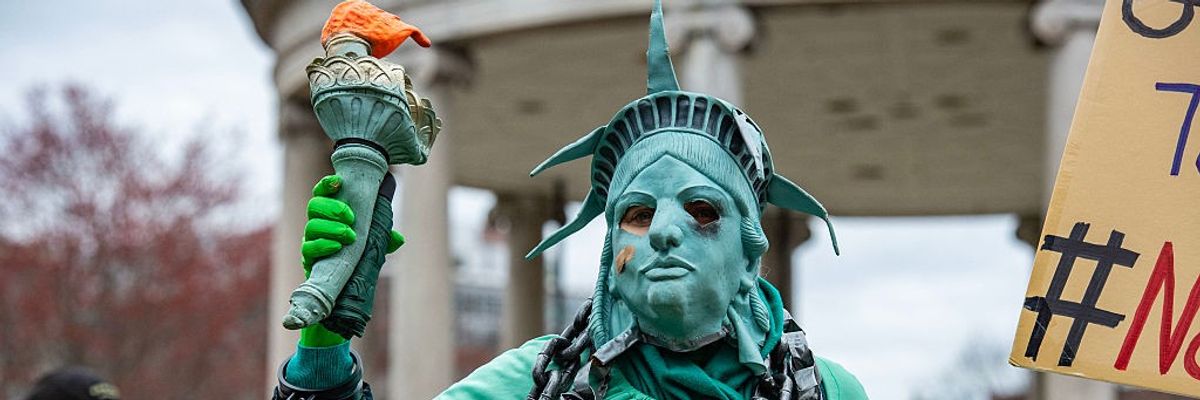
A demonstrator dressed as a Statue of Liberty in chains takes part in the nationwide "Hands Off!" protest against US President Donald Trump and his advisor, Tesla CEO Elon Musk, in Boston, Massachusetts on April 5, 2025.
(Photo by Joseph Prezioso/AFP via Getty Images)


C.J. Polychroniou
Apr 18, 2025

Trump’s historic first 100 days are just around the corner. How is the U.S. doing? What are the global implications, including for climate and the environment, of Trump’s policies to create a “new world order” and “Make America Wealthy Again? In the interview that follows with independent French-Greek journalist Alexandra Boutri, political scientist/political economist, author and journalist C.J. Polychroniou argues that both the future of U.S. democracy and of humanity as a whole are at great risk because of an ignorant, self-serving autocrat at the helm of the world’s most powerful nation.

Alexandra Boutri: Trump’s first 100 days are nearing the end. What have we learned so far about Trump’s second term and his direction for the country?

C. J. Polychroniou: The first thing that ought to be said is that there are significant differences between Trump’s first and second terms. This time he has a much clearer agenda, largely thanks to Project 2025, and is better prepared to see it through to the end. The aim is to undo race and gender progress, restore white dominance, deregulate the economy and use whatever means are available to further enrich the super-rich, and use economic coercion to secure U.S. hegemony. It’s a thoroughly anti-democratic, blatantly neofascist vision that spells serious trouble for the future of democracy, especially given America’s fragile democratic convictions. Indeed, one of the most shocking things so far is the ease with which the country is heading toward a 21st century version of fascism under Trump’s second term.

One of the most shocking things so far is the ease with which the country is heading toward a 21st century version of fascism under Trump’s second term.

This disturbing development speaks volumes of the weaknesses of the U.S. labor movement as well as of the overwhelmingly apolitical nature of civil society. Where are the nationwide protests? The national strikes against the destruction of what is left of U.S. democracy? As for the eerie complacency of the Democrats, it is hardly surprising why there is such a huge loss of trust in the leadership of the Democratic Party.

Alexandra Boutri: Are we witnessing a revolution in the making?

C. J. Polychroniou: With regard to what Trump is doing to American society and its institutions, the right word is “counterrevolution.” Trump is carrying out a fascist destabilization of society in order to stop a progressive agenda, establish new forms of political legitimacy, and suppress, if not eliminate, threats from below. With regard to foreign affairs, he sees the world as a zero-sum game. But it would be naïve to think that what he is after are the interests of the average American citizen. Trump has nothing but contempt for working people. He is both after a world order and an economic regime at home that enriches corporations and the ultrawealthy at the expenses of the many.

Trump is carrying out a fascist destabilization of society in order to stop a progressive agenda, establish new forms of political legitimacy, and suppress, if not eliminate, threats from below.

Alexandra Boutri: Why is the Trump administration so keen in controlling education and taking over cultural institutions, such as the Kennedy Center for the Performing Arts?

C. J. Polychroniou: Exerting power over education, taking control of cultural institutions and silencing the press are primary aims of every self-respecting authoritarian regime that wishes to take over civil society in order to transform a country’s political landscape and colonize the consciousness of its citizens. Mussolini did so in Italy; Hitler in Germany; Franco in Spain; and even the colonels of Greece. What Trump and the thugs surrounding him are doing are precisely just that: they are trying to suppress ideas they despise, silence dissent, and convert citizens into a nation of sheep. Fascist goals, fascist tactics. Pure and simple. And, sadly enough, he seems to be doing it with great ease as a huge portion of the American citizenry has already been turned into a nation of sheep. Now it's only up to that small but courageous community of American dissenters and radicals to stand up to the ignorant and stupid autocrat.

Alexandra Boutri: China is standing up to Trump’s bullying tariffs, but the same cannot be said about Europe. Why is that?

C. J. Polychroniou: You have here two entirely different situations. China is a single, unified country. The European Union (EU) is a group of 27 independent countries with different histories, cultures, languages, customs, and interests. These member states work together to promote peace, security and economic efficiency. But the EU lacks a unified military and a centralized fiscal authority. Moreover, Europe is more dependent on trade than either China or the U.S. And since the end of the Second World War, Europe’s defense is also too reliant on the U.S. It is thus hardly surprising that EU senior officials have been desperately trying since the start of Trump’s tariff actions to appear conciliatory and even willing to bend over backwards to appease America’s new King. They were forced to impose new tariffs on specific U.S. products in retaliation for Trump’s 25 percent tariffs on imported steel and aluminum. But don’t forget that Trump even rejected EU’s offer to drop tariffs. And, of course, the EU has now paused its countermeasures on U.S. trade tariffs as a response to the U.S. delaying by 90 days its so-called reciprocal tariffs.

China is not backing down because it can afford to do so. Its leadership knows that it can deal with the side effects of a trade war far more effectively--and less painfully--than the U.S. can. The extent to which Trump seems to understand the realities of the U.S.-trade relationship, let alone of the mechanisms that the Chinese government has at its disposal to deal with economic side effects, is highly questionable.

Indeed, it’s safe to say that a U.S. trade deal with Europe will eventually take place no matter what. Italy’s neo-fascist but politically savvy prime minister Giorgia Meloni may be able to secure an EU-U.S. trade deal in a fashion that no top EU official could, perhaps only because Trump is smitten with her. But what happens with China is anyone’s guess. There are both economic and geopolitical considerations behind Trump’s hostility towards China. And the Chinese no longer view their country as a semi-peripheral country in the global capitalist world. China’s global influence is growing, so its leaders are not going to be intimidated by Trump’s chicken game over tariffs.

Alexandra Boutri: One last question. How would Trump’s energy and deregulation policies impact the fight for climate change?

C. J. Polychroniou: When all is said and done, this is the most important issue of all facing the future of humanity. We have a planet on the precipice. I hate to sound pessimistic, but the odds are already stacked against us. Trump’s manic energy and deregulation policies, which come on top of a mania to deny climate change, will make the task of net-zero emissions by 2050 simply impossible to achieve.

We have a planet on the precipice. I hate to sound pessimistic, but the odds are already stacked against us.

I say this because Trump’s energy and deregulation policies will encourage other fossil-fuel hungry nations to continue with the further exploration and consumption of the poisons that are destroying the planet. In addition, and indicative of what’s happening on the ground with regard to the fight against global warming, a new study by the Political Economy Research Institute (PERI) at the University of Massachusetts Amherst reveals that “governments throughout the world continue to subsidize both the consumption and production of oil, coal, and natural gas.” Overall fossil fuel subsidies, for 2023, amounted to $1.1 trillion. Obviously, such a staggering amount in subsidies to the fossil fuel industry seems to indicate that governments across the world only have worries about short-termism and think very little about the future of humanity. But that’s what capitalism is all about, isn’t it?
Will Trump Come for the Climate Movement on Earth Day?

After decimating federally funded climate science, the administration is targeting those who take that science and try to turn it into change.


A Greenpeace activist holds a banner showing a wind turbine that reads, "Future vs. Trump" as the same image is projected on the facade of the U.S. Embassy to protest against the withdrawal of the United States by newly-inaugurated U.S. President Donald Trump from the Paris agreement on January 21, 2025 in Berlin, Germany.
(Photo: Sean Gallup/Getty Images)

Bill Mckibben
Apr 18, 2025
The Crucial Years

It snowed Wednesday night in the Green Mountains, a typically beautiful late-season fluff-fest. Which meant I got to rise at 6 this morning and go for a ski before the spring sun turned it to slush—helpful, because I needed to clear my head a little.

That’s because word came that night that, having dispensed with immigrants, law firms, humanitarian workers, and universities, the Trump administration was now turning its crosshairs on climate advocates. Nothing specific yet, but E&E News was reporting on widespread rumors that the administration planned (on Earth Day no less!) to cancel the tax-exempt status of many green groups:
“There's lots of rumors about what terrible thing [Trump] wants to do on Earth Day, to just give everybody the middle finger,” Brett Hartl, director of governmental operations at the Center for Biological Diversity, said.

An environmental funder granted anonymity to speak freely speculated Trump might try to do to nonprofits what he’s threatened to do with universities.

“The rumors feel credible because this is playbook they use,” the funder said. “That’s why people are taking it very seriously.”

Another environmentalist expressed concern that the administration could attempt to target green groups by defining efforts to limit fossil fuel development as a threat to national security.

The threat comes amid the ongoing decimation of federally funded climate science. In the last few days, for instance, the National Oceanic and Atmospheric Administration has announced it will no longer be maintaining its remarkable map of sea-surface temperatures, while the National Institutes of Health said it was no longer gathering information on the health impacts of global warming.
The NIH said in an internal document obtained by The New York Times that it was the agency’s new policy “not to prioritize” research related to climate change. The document also described the organization’s intent not to fund research on gender identity, vaccine hesitancy, or diversity, equity, and inclusion. N.I.H. employees were instructed to tell researchers to “remove all” mention of the topics and resubmit their applications, even if the main focus was unrelated.

The policy shift on climate change, first reported by ProPublica, stands to drastically limit U.S.-based research into its health effects, which tries to answer questions like whether events like wildfires and heatwaves can affect cardiovascular health and pregnancy.

But now the administration is targeting those who take that science and try to turn it into change. They are the undergunned and outmanned equivalent of the armies of corporate lobbyists, producing the reports and briefing papers that try to stand up to the tide of right-wing media. I know a great many of these people, and I admire their work endlessly; it’s an honor to be counted among them, even if I’m only a volunteer. It was perhaps inevitable that Trump and his team would target us; together we’ve been making life harder for his clients in the fossil fuel industry. And in the new America, if you don’t knuckle under you get a knuckle sandwich. Figuratively speaking. One hopes.

Anyway, there are two questions worth asking. One is, will Trump pay any price for these attacks on climate science and advocacy? He’s not immune to the laws of politics—he clearly paid a price for his absurd tariff policy, which is why he backed off. In the case of tariffs, Trump’s problem was more or less immediate feedback: The bond market threatened to take down the American economy—”got a little queasy” as the president put it—and so he blinked. Slightly longer term feedback will likely come in the form of a recession. The phrase du jour, repeated endlessly, was that he had “touched a hot stove.”

My guess is, very few people would drill for oil without compensation; a great many people will try to defend the planet even if it costs them a lot.

By that standard, one assumes the administration doesn’t fear blowback from a mere hot planet. And yet even if it doesn’t work as fast the bond market, the world’s climate system is now malfunctioning in more or less real time. March was the hottest March on record, topping 2024 by just a smidge; meanwhile, carbon dioxide in the atmosphere grew at a record pace last year, apparently because overheated forests are losing some of their capacity as a carbon sink. We’re headed toward what is already forecast to be a more-active-than-usual hurricane season. Trump now owns all this in a way none of his predecessors did: They (with the exception of former President Joe Biden) may not have done much about climate change, but they didn’t insist it was a hoax. So when Tampa drowns or Tucson bakes or whatever happens next, it may stick to him in a way it hasn’t before. He’s got no credible scientific defenders (although the climate denial crew did enlist Elon Musk’s Grok 3 AI to write a paper last week). Damage to his brand is at least a possibility, especially if Democrats display even the slightest skill in linking, say, rising insurance premiums to the climate crisis.

The other question is, will this stop the climate movement? Of course it will make things harder, diverting time and attention and money from important work to dealing with lawyers and auditors; I get to work with paid staff at places like Third Act, and they are not just deeply good people, they are also crucial to making volunteers much more effective.

But the conceit of the right-wing has always been that climate scientists and activists are in it for the money, right down to insisting that protesters outside Tesla dealerships have been paid by George Soros. (I’ve taken my “Kia EV’s Rule” sign out several times, and no check yet!) This has always been an absurd claim: Climate scientists are not getting rich, and most activists could make more money doing almost anything else. Meanwhile, oil executives do get very rich indeed (Trump’s Energy Secretary, fracking honcho Chris Wright, is reportedly worth $171 million), and the success of their companies is due in no small part to an endless collection of tax loopholes and federal, state, and local subsidies. My guess is, very few people would drill for oil without compensation; a great many people will try to defend the planet even if it costs them a lot.

We’ll find out. We’re gearing up for the public launch of SunDay, the nationwide September mass action in defense of renewable energy. If you’re in the Boston area, come to Old North Church at 6:30 pm on Saturday April 26 for a launch ceremony (green lantern in Paul Revere’s steeple!); if you’re anywhere else, we’re doing a digital nationwide launch on April 28. Draw us a sun today to help! Here’s this week’s inspiration, from Lisa Gundlach.


Earth Day Massacre? Environmental Groups Fear Trump Ready to Take Aim at Nonprofit Status


"The rumors feel credible because this is the playbook they use," said one environmental funder. "That's why people are taking it very seriously."


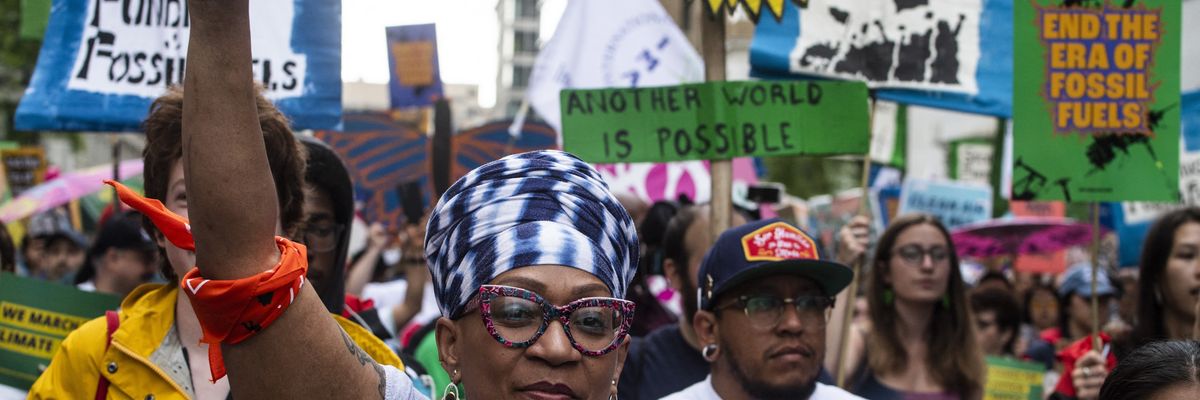
Environmental activists protest during the "End the Era of Fossil Fuels" rally on Earth Day, as they march to the White House in Washington, DC, on April 22, 2023.
(Photo: Roberto Schmidt/AFP via Getty Images)


Eloise Goldsmith
Apr 17, 2025
COMMON DREAMS

Environmental groups are bracing for the Trump administration to potentially target their tax-exempt status, a move that could come down on Earth Day, this coming Tuesday, according to reporting from multiple outlets published Wednesday.

Rumors about such a move are swirling as the Trump administration is also reportedly considering plans to revoke Harvard University's tax-exempt status, a major escalation against the elite institution that critics said marks just the start of a broader assault on nonprofits that refuse to acquiesce to the administration's demands.

Fears that President Donald Trump will try to revoke environmental groups' tax-exempt status is the "rumor of the day that is flying around D.C.," Brett Hartl, the government affairs director at the nonprofit Center for Biological Diversity, toldE&E News. "There's lots of rumors about what terrible thing [Trump] wants to do on Earth Day, to just give everybody the middle finger."

Sources who spoke to Bloomberg Law on the condition of anonymity told the outlet that multiple conservation and environmental groups are preparing and assembling legal teams in response to the rumors. Per Bloomberg Law, a potential order from Trump could also seize groups' funding and designate them as domestic terrorists.

"We are trying to not panic, because we don't know what it is," Hartl told E&E News, though he added that environmentalists would "rally together and support each other."

Kieran Suckling, executive director for the Center for Biological Diversity, told Bloomberg Law that his organization is preparing for a potential order, and said the group would take legal action if it comes to pass.

501(c)(3) tax-exempt organizations, such as the Center for Biological Diversity and Earthjustice, are exempt from federal income tax and can collect tax-deductible donations.

The environmentalist and author Bill McKibben reacted to the reporting by remarking that the threat comes amid the "ongoing decimation of federally funded climate science."

"I know a great many of these people, and I admire their work endlessly; it's an honor to be counted among them, even if I'm only a volunteer," he said of those who work for green groups. "It was perhaps inevitable that Trump and his team would target us; together we've been making life harder for his clients in the fossil fuel industry. And in the new America, if you don't knuckle under you get a knuckle sandwich. Figuratively speaking. One hopes."

Only the Internal Revenue Service can investigate and revoke a tax exemption, and senior executive branch officials are explicitly barred from asking the IRS to conduct or cease an audit of a taxpayer, according to The Washington Post. There are some circumstances under which the IRS may revoke a tax-exempt status.

"Neither the president, the U.S. Department of Justice, the U.S. Department of the Treasury, or the IRS have the ability to revoke the federal tax-exempt status of any entity through executive order or with the mere stroke of a pen," wrote Jeffrey Tenenbaum, a nonprofit attorney, on Thursday.

The procedure for revoking federal tax exemption requires "individual case-by-case IRS audits of each organization, with ample opportunity for the entity to defend itself, and including multiple routes of appeal," he added.

CNN was first to report Wednesday that the IRS—where Trump has installed an ally as interim commissioner—is weighing whether to revoke Harvard's tax exemption, news that came a day after the president suggested on his social media platform Truth Social that "perhaps Harvard should lose its Tax Exempt Status and be Taxed as a Political Entity if it keeps pushing political, ideological, and terrorist inspired/supporting 'Sickness?'"

According to E&E News, this suggestion by Trump in regard to Harvard has heightened environmental groups' concerns that the administration might take action against their tax-exempt status.

"The rumors feel credible because this is playbook they use," one environmental funder, who was granted anonymity, told E&E News. "That's why people are taking it very seriously."
'Arbitrary, Outlandish, and Unjustified': Raskin Warns Trump Against Invoking Insurrection Act

"There is no factual predicate for Trump to invoke the Insurrection Act at the southern border or anywhere else in the United States," said the congressman and constitutional scholar.


A Stryker platoon is stationed near the fence at the southern U.S. border with Mexico, in Douglas, Arizona, on April 3, 2025.
(Photo: David Swanson/AFP via Getty Images)


Jessica Corbett
Apr 18, 2025
COMMON DREAMS

After being "flooded with messages," the U.S. Rep. Jamie Raskin issued a lengthy Friday statement about mounting rumors that Republican President Donald Trump "may invoke the Insurrection Act of 1807 and deploy the National Guard to conduct arrests at the border or elsewhere on U.S. soil" as soon as this weekend.

Although "we have no specific information indicating that this will happen," noted Raskin (D-Md.)—the House Judiciary Committee's ranking member and a constitutional scholar—the public "anxiety arises from the fact that April 20 is the due date for a report from Trump's Cabinet on the state of the southern border called for in a presidential executive order which specifically mentions the Insurrection Act."

As Homeland Security Secretary Kristi Noem and Pentagon chief Pete Hegseth have prepared to hand over their report, warnings and explainer articles have circulated this week. Bill Blum wrote about it at Truthdig, PolitiFactdetailed the difference between invoking the Insurrection Act and martial law, and both the ACLU and the Interfaith Alliance shared blog posts. That all followed a Waging Nonviolence piece from earlier this month laying out what to do if Trump takes the feared action.


Raskin explained that "the Insurrection Act was designed for only the most extraordinary and dire circumstances, specifically when unlawful rebellion 'make[s] it impracticable to enforce the laws of the United States in any state by the ordinary course of judicial proceedings.'"

Invoking the law in the current reality, he continued, "would be an arbitrary, outlandish, and unjustified exercise of power. It cannot be the case that this is 'the most secure border in history' and simultaneously that we need to invoke the Insurrection Act to address the crisis there."

According to the congressman: "There is no factual predicate for Trump to invoke the Insurrection Act at the southern border or anywhere else in the United States. The courts are open and perfectly functional (much to Trump's dismay), state and local police continue to enforce the laws, and the Trump administration routinely celebrates the safety and calm at the border."

"Trump might want to call out the troops because they look 'tough,'" he acknowledged. "That seems to have been his rationale for using military planes as props to fly immigrants to Guantánamo Bay and El Salvador's brutal mega-prison. This is plainly no justification for triggering the act, and Trump would also essentially be admitting extreme policy failure. This can be the most secure border in history, or it can be an insurrection requiring the extraordinary use of the American military in our own society. But it certainly cannot be both."


Since returning to power, having campaigned on the promise of mass deportations, Trump has sparked fears about crackdowns on civil society, sent immigration agents after foreign students critical of U.S. support for Israel's genocidal assault on the Gaza Strip, and shipped hundreds of migrant men to El Salvador's Terrorism Confinement Center (CECOT)—including Maryland resident Kilmar Abrego Garcia, who was supposed to be protected by a court order blocking deportation to his homeland.

Raskin said on social media Thursday that he was "grateful to my friend" and fellow Maryland Democrat, Sen. Chris Van Hollen, "for traveling to El Salvador to try to check on Abrego Garcia's condition."

"We will not let up the pressure on the self-proclaimed dictator of El Salvador or the aspiring dictator here," he pledged. "We will continue the fight to bring Abrego Garcia home."

The congressman also highlighted that Juan Carlos Lopez-Gomez, a 20-year-old U.S.-born American citizen, was detained at a Florida jail this week at the request of immigration authorities. Raskin said: "How is it possible U.S. citizens are being held as illegal aliens in America even after they produce their birth certificate? This is intolerable."

In his Friday statement, Raskin concluded with a message for Trump: "I urge the president to make the report public and to commit himself to protecting the civil rights and civil liberties of the people of the United States by keeping the military out of civilian law enforcement matters. We must stop playing cheap political games with immigration, and we must restore the rule of law in America."
‘Help us,’ says wife of Gaza medic missing since ambulance attack


By AFP
April 17, 2025


Footage recovered by the Palestinian Red Crescent of part of the deadly March 23 ambush by the Israeli army shows the ambulances responding to an emergency call with their lights flashing. - Copyright AFP KAMIL KRZACZYNSKI

More than three weeks after an Israeli military ambush killed 15 of her husband’s fellow medics, Nafiza al-Nsasrah says she still has no idea where he is being held.

“We have no information, no idea which prison he’s in or where he is being held, or what his health condition is,” Nsasrah told AFP, showing a photograph of her husband Asaad in his medic’s uniform at the wheel of an ambulance.

The Palestinian Red Crescent said Sunday that Nsasrah was in Israeli custody after being “forcibly abducted” when Israeli soldiers opened fire on a convoy of ambulances on March 23.

In the early hours of that day, Israeli soldiers ambushed a convoy of ambulances and a firetruck near the southern city of Rafah as the crew responded to emergency calls.

Eight staff members from the Red Crescent, six from the Gaza civil defence agency and one employee of the UN agency for Palestinian refugees were killed in the attack, according to the UN humanitarian office OCHA.

Their bodies were found buried in the sand near the site of the shooting in the Tal al-Sultan neighbourhood of Rafah, in what OCHA described as a mass grave.

One member of the crew survived the attack. He was initially detained by troops but subsequently released.

The Palestinian Red Crescent was able to recover footage of part of the attack filmed by one of the medics on his mobile phone before he was gunned down.

An Israeli military official told journalists that the soldiers who fired at the ambulances “thought they had an encounter with terrorists”.

The video footage contradicts that account as the ambulances had their lights blinking when they came under attack.


– ‘Intent to kill’ –


“At the time of the incident, we had no idea what had happened,” Nsasrah said in the plastic-sheet shelter in the southern city of Khan Yunis which she and her family have called home for nearly a year.

Her husband’s body was not among those found in the mass grave near Rafah.

“We heard some ambulances had been surrounded (by the Israeli army), so we called (the Red Crescent) because (my husband) was late to return from his shift,” the 43-year-old said.

“They told us that he was surrounded but didn’t know what had happened exactly.”

Afterwards, the Red Crescent told her that he had been detained by Israeli forces.

“We felt a little relieved but not completely because detainees often face torture. So we are still afraid,” Nsasrah said, her voice drowned out by the persistent buzz of an Israeli surveillance drone overhead.

When the Red Crescent announced he had been detained, AFP reached out to the Israeli military for confirmation.

The military responded by referring AFP to an earlier statement noting that armed forces chief Lieutenant General Eyal Zamir had ordered a thorough investigation into the attack.

The March 23 killings occurred days into a renewed Israeli offensive in the Hamas-ruled territory and drew international condemnation.

The Palestinian Red Crescent has charged that Israeli soldiers shot the medics in their upper body with “intent to kill”.

Nsasrah, her husband and their six children have been living under canvas in Khan Yunis since May last year.

Despite the hardship, she remains determined to get her husband back.

“I call on the international community to help us get any information on Asaad Al-Nsasrah,” she said.

“I ask to obtain information about his health condition and to allow us to visit him or to help us get him released.”