Saturday, April 19, 2025


Nigeria signs minerals pact with South Africa in diversification push

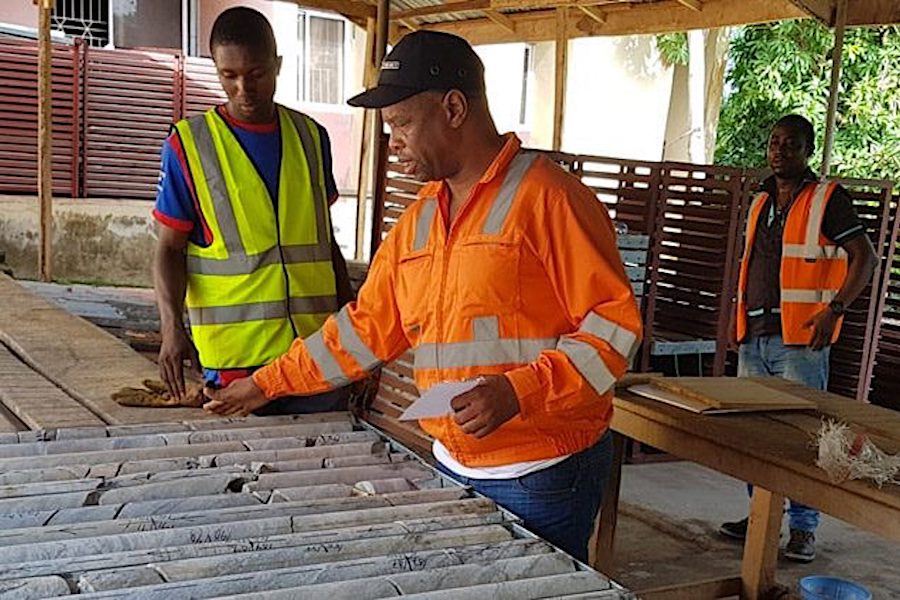
Employees study drill core at Segilola gold project in Nigeria. (Image: Thor Explorations)

Nigeria and South Africa have signed an accord to boost cooperation in mining, Nigeria’s mines minister said on Thursday, highlighting Abuja’s push to diversify its economy away from oil.

Mines Minister Dele Alake said the two countries will partner on mining, including geological mapping using drones, share mineral data, and jointly explore agro and energy minerals in Nigeria.

Besides oil, Nigeria is also rich in gold, limestone, lithium, iron ore and zinc. Nigeria has around 23 mineral deposits in commercial quantities.

Nigeria is seeking to revamp a mining sector that has long been underdeveloped, contributing less than 1% to its gross domestic product.

South Africa’s established mining expertise makes it a key partner in this effort, Alake said.

(By Camillus Eboh; Editing by Elisha Bala-Gbogbo and David Evans)


Iron ore price set for second weekly loss as tariff turmoil weighs

Reuters | April 18, 2025 | 


Iron ore briquettes stockpile. Credit: Vale

Iron ore futures slipped on Friday and were headed for a second weekly loss weighed down by the lingering Sino-US trade tensions, but resilient demand, upbeat economic data and hopes of more stimulus from top consumer China cushioned the fall.


The most-traded September iron ore contract on China’s Dalian Commodity Exchange (DCE) dropped 1.76% to 699 yuan ($95.80) a metric ton, its lowest since April 11. It registered a weekly drop of 0.7%.

The benchmark May iron ore on the Singapore Exchange fell 0.88% to $96.95 a ton as of 0706 GMT, posting a 0.2% decline so far this week.


Even as US President Donald Trump signalled a potential end to the tit-for-tat tariff hikes between the US and China that shocked markets, all eyes are on more progressive signs of easing trade tensions between the two superpowers.

Goldman Sachs analysts forecast iron ore prices to fall to $90 by the fourth quarter and $80 by the fourth quarter of 2026, citing a return to surplus from the second half of the year.

“We expect tariffs to weigh on both China domestic demand and steel exports over the remainder of the year,” they said, lowering their ex-China seaborne ore demand growth forecast to 3% from previous 5%.

But near-term ore demand remained firm, limiting price loss. A Mysteel survey showed average daily hot metal output, a gauge of iron ore consumption, steadied at a nearly 17-month high of 2.4 million tons on Thursday.

Also, a raft of better-than-expected Chinese data, coupled with hopes of Beijing unveiling more measures to counter the US tariff shocks, boosted sentiment.

Other steelmaking ingredients on the DCE languished, with coking coal and coke down 0.68% and 0.35%, respectively.

Most steel benchmarks on the SHFE retreated. Rebar lost 0.81%, hot-rolled coil dipped 0.66%, stainless steel fell 0.62%. Wire rod advanced 0.48%.

($1 = 7.2961 Chinese yuan)

(By Amy Lv and Lewis Jackson; Editing by Sumana Nandy)

 Iron ore miners in rocky start to year as tariff turmoil begins

Stock image.

The world’s biggest iron ore miners face a difficult start to the year, after extreme weather impacted production and as their biggest customer China braces for a trade war.

This week, BHP Group Ltd., Rio Tinto Group, and Vale SA all reported drops in quarterly shipments from the year before, the result of disruptions from cyclones in Australia’s Pilbara and heavy rains in northern Brazil. Rio was worst affected, with exports slumping 9% to a six-year low.

That leaves the companies needing to play catch-up on their supply targets at a time when escalating tensions with the US could wreak havoc on the Chinese economy. The question now is whether Beijing will deliver enough stimulus to support demand for steel and its inputs, of which iron ore is key.

“We might see a recovery phase where these companies ramp up production to compensate for the lost output,” said David Cachot, an iron ore research director at Wood Mackenzie Ltd. “Market participants are waiting to see what Beijing will do to further stimulate its economy, an additional source of concern the country did not need.”

Market dives

Before the supply disruptions hit and trade tensions ratcheted higher, the iron ore market was contending with a surge in supply just as demand in China’s maturing economy was dwindling. Still, benchmark iron ore futures in Singapore were steady, averaging around $103 a ton over the first three months, about the same as the previous quarter.


But the market dived earlier this month, to below $95 a ton at one point, after the Trump administration announced punitive tariffs on China, and Beijing responded with its own eye-watering levies on the US.

Now, China’s economic targets are in doubt, and officials have set a clear goal of expanding domestic consumption to counter the hit to exports. That could lift demand for the steel used in vehicles, household durable goods and machinery. Iron ore traders are also probably hoping that Beijing doesn’t ignore the playbook it has used during previous downturns, which involves splurging on more steel-intensive infrastructure to generate growth.

BHP chief executive officer Mike Henry warned on Thursday that slower global growth and a fragmented trading environment could have a significant impact on the company.

“China’s ability to shift toward a consumption-led economy and for trade flows to adapt to the new environment will be key to sustaining the global outlook,” he said.

(By Katharine Gemmell)


THE BLACK PRINCE OF PRIVATE SECURITY SERVICES

Exclusive: Trump supporter Prince reaches deal with Congo to help secure mineral wealth
April 17, 2025
REUTERS


Erik Prince arrives for New York Young Republican Club Gala in New York City, New York, U.S., December 10, 2022. REUTERS/Jeenah Moon/File Photo

Summary

Blackwater founder struck agreement before M23 rebel advance

Focus on boosting tax collection, cutting cross-border smuggling

Implementation talks come as US, Congo explore mineral partnership


April 17 (Reuters) - Prominent Trump supporter Erik Prince has agreed to help Democratic Republic of Congo secure and tax its vast mineral wealth, according to two sources close to the private security executive, a Congolese government official and two diplomats.
The agreement, aimed at reaping more revenue from an industry marred by smuggling and corruption, was reached before Rwanda-backed M23 rebels launched a major offensive in January that has seen them seize eastern Congo's two largest cities.

The discussions now on implementing the deal with Prince come as the U.S. and Congo explore a broader deal on critical minerals partnerships, after Congo pitched a minerals-for-security deal to U.S. President Donald Trump's administration.
Prince founded Blackwater before renaming the private military company and selling it in 2010 after several employees were indicted on charges of unlawfully killing Iraqi civilians. The men were convicted but later pardoned by Trump during his first term.
The Trump administration has not said how the U.S. might contribute to security in Congo as part of any minerals deal. Analysts and former U.S. officials have said leaning on security contractors such as Prince could be an option.
Advertisement · Scroll to continue

A Congolese government source told Reuters that any agreement between Congo and Prince would need to be reviewed in light of the push for a deal with the U.S.
The security deal was agreed with the finance ministry, and Prince's advisers will focus on improving tax collection and reducing cross-border smuggling of minerals, the two sources close to Prince said. There were no plans to deploy security contractors to areas of active conflict, the sources said.
Prince declined to comment through a spokesperson. The Congo presidency did not respond to a request for comment. The U.S. State Department declined to comment.


INITIAL FOCUS ON COPPER MINES, SOURCE SAYS

Democratic Republic of Congo has vast reserves of copper, cobalt, lithium and coltan - a mineral used widely in smartphones, computers and electric vehicles - but has been plagued for decades by violence in its eastern region.


The agreement between Congo and Prince initially involved a plan to deploy contractors to Goma, the capital of North Kivu province and the largest city in eastern Congo. But Goma is now under M23 control and that plan has been put on hold. M23 controls tracts of mineral-rich territory.
A source close to the Congolese government told Reuters an initial deployment of Prince's advisers was expected to start in the south, far from the area controlled by M23 and its allies.
"If you just look at Katanga, if you look at Kolwezi down just off the Zambian-Congo border, they claim that there's like $40 million a month in lost revenue of what's going out and what's coming in," the source said.
A diplomatic source also told Reuters the first stage of Prince's effort in Congo would focus on securing mines and tax revenues in copper-producing Katanga province.

One of the sources close to Prince said advisers were expected to deploy with technical experts from a company specialised in testing and inspecting commodities. The advisers would initially target larger mines and expand as revenue collection improved.
The source did not provide details on how the advisers would tackle corruption in the sector that has long drained revenue that would otherwise flow to the state.

A source in the office of Congolese President Felix Tshisekedi said an agreement in principle had been signed with Prince, but the details on where and how many advisers would be deployed remained to be established.
HISTORY OF WORKING IN AFRICA
Prince has worked in Africa for over a decade, initially providing logistics for oil and mining companies working in remote corners of the continent.
A number of Prince-controlled companies have operated in Congo since 2015. They have been involved in trucking and have also sought to get involved in the minerals sector.
The two sources close to Prince said the new agreement followed years of talks over how to improve Congo's control over its mineral resources.
Prince previously proposed sending thousands of contractors to the eastern region during talks with Kinshasa in 2023, a U.N. expert panel reported that year. Those discussions did not ultimately lead to a deal.
Congo has long accused Rwanda of plundering minerals from the region, a claim supported by independent entities including the United Nations and the nonprofit Global Witness. Rwanda denies that.
That loss of mining revenue is one of the key concerns that Prince's team will seek to address, one of the sources close to Prince said.
The goal is to ensure "that extraction industries and others are operating transparently, and that their production and revenues is properly distributed in accordance with the Congolese mining code", the source said.
United Nations and Western governments say Rwanda has provided arms and troops to the ethnic Tutsi-led M23.
Rwanda has denied backing M23. It says its military has acted in self-defence against Congo's army and a Rwandan militia operating in east Congo that was founded by perpetrators of the Rwandan genocide.

Reporting by Jessica Donati and Sonia Rolley; Editing by Robbie Corey-Boulet and Alison Williams

Our Standards: The Thomson Reuters Trust Principles.
Trump to approve land swap for Rio Tinto copper mine opposed by Native Americans

Reuters | April 17, 2025 | 


The mine is estimated to produce as much as 40 billion pounds of copper over 40 years. (Image courtesy of Resolution Copper.)

The Trump administration said on Thursday it would approve a land swap needed for Rio Tinto and BHP to build one of the world’s largest copper mines, despite concerns from Native Americans that it would destroy a site of religious value.


The move is likely to escalate tensions between Indigenous groups vocal about the need to preserve historical lands and Western governments eager to boost critical minerals production and offset China’s sector dominance.

The US Forest Service, which is part of the Agriculture Department, said it will republish within 60 days an environmental report needed for the Resolution Copper project land swap to occur.

Congress and then-President Barack Obama approved the mine in 2014 after it was added at the last minute to a must-pass military funding bill with the condition that an environmental report be published.

The underground mine – which President Donald Trump approved in his first term before successor Joe Biden reversed him – would supply more than a quarter of US appetite for copper and be a key part of Trump’s plan to boost US mining.

Copper is used in construction, transportation, electronics and many other industries. The United States imports roughly half of its copper needs each year.

Yet the mine’s construction would cause a crater that would swallow the Oak Flat site where Arizona’s San Carlos Apache worship. That has fueled strong opposition from all but one of the state’s 22 Native American tribes, as well as the National Congress of American Indians.

Apache Stronghold, a nonprofit group comprised of the San Carlos Apache Tribe and conservationists, asked the US Supreme Court last September to block the land swap. The court has not yet decided whether to take that case.

Apache Tribe takes fight against Resolution Copper to US Supreme Court

Were the court to do so, however, the Forest Service said on Thursday it “may reevaluate how to proceed” regarding the land swap.

“The US government is rushing to give away our spiritual home before the courts can even rule, just like it’s rushed to erase Native people for generations,” said Wendsler Nosie, an Apache Stronghold leader.

The group and their attorneys at the Becket Fund for Religious Liberty contend the government would be violating the First Amendment’s guarantee of freedom of religion if the mine is developed.

“This makes the stakes crystal clear: if the court doesn’t act now, Oak Flat could be transferred and destroyed before justice can be served,” said Luke Goodrich, a Becket attorney.

Representatives for the San Carlos Apache were not immediately available to comment.

Rio Tinto said the move was a “positive step forward” and it would continue to work on the project, on which it and BHP have already spent more than $2 billion. They have yet to produce any copper.

“The Resolution Copper mine is vital to securing America’s energy future and infrastructure needs with a domestic supply of copper and other critical minerals,” said a Rio spokesperson.

BHP, which owns 45% of the project to Rio’s 55%, said “Resolution has committed to maintaining open dialogue with the local community and Native American tribes to advance the project responsibly.”

The Forest Service’s move was applauded by Mila Besich, the Democratic mayor of Superior, Arizona, the town closest to the Resolution project.

“This is a milestone in a very long process,” said Besich. “This is a good thing for our town.”

Rio has said it plans to keep all of Resolution’s copper inside the US should the mine be approved. The company controls one of the two US copper smelters.

(By Ernest Scheyder; Editing by Sandra Maler, Rod Nickel and Franklin Paul)


Trump to fast-track permitting for 10 mining projects across US


Reuters | April 18, 2025 | 


Credit: Perpetua Resources

The White House on Friday said it will fast-track permitting for 10 mining projects across the United States as part of President Donald Trump’s push to expand critical minerals production.


The projects – which would supply copper, antimony and other minerals – have been granted FAST-41 status, a federal initiative launched in 2015 to streamline approvals of critical infrastructure.

The White House said it will add more projects.

The initial 10 are listed on a US federal website where their permitting progress can be publicly tracked, part of what the Trump administration calls a push for greater transparency and faster permitting.

“This transparency leads to greater accountability, ensuring a more efficient process,” the White House said in a statement.

The move boosts a proposed Idaho antimony and gold mine from Perpetua Resources, a proposed Arizona copper mine from Rio Tinto, a proposed Montana copper and silver mine from Hecla Mining, expansion of Albemarle’s Nevada lithium mine, an Arkansas direct lithium extraction project from Standard Lithium, and an Alabama metallurgical coal project from Warrior Met Coal, among others. Metallurgical coal is used to make steel.

Perpetua said it was “honored by this selection … which validates the urgency and importance of our project for America’s economic and national security.”

Rio said it believes its Resolution copper project in Arizona “is vital to securing America’s energy future and infrastructure needs with a domestic supply of copper.”

Albemarle said it looks “forward to further engaging with the administration as it seeks to advance a US lithium supply chain.”

Standard Lithium and Warrior were not immediately available to comment.

South32’s Hermosa zinc-manganese project in Arizona was fast-tracked by former President Joe Biden, the first mine to receive the FAST-41 treatment.

Trump earlier this week ordered a probe into potential new tariffs on all US critical minerals imports, a major escalation in his dispute with global trade partners and an attempt to pressure industry leader China.

(By Ernest Scheyder; Editing by Lisa Shumaker and Chris Reese)


U.S. Begins Work on Next Offshore Oil Leasing Plan—And It’s a Big One

The Biden offshore era is officially in the rearview mirror. On Friday, Interior Secretary Doug Burgum kicked off the long march toward America’s 11th National Outer Continental Shelf (OCS) Oil and Gas Leasing Program—a sprawling, bureaucratic saga that ultimately decides where and when offshore drilling can happen.

The process begins with a simple Request for Information (RFI) from the Bureau of Ocean Energy Management (BOEM), opening a 45-day public comment window. Expect everyone from oil majors to angry seagull lobbyists to weigh in.

Burgum, no stranger to energy-first headlines, is framing this as a patriotic play. “Energy Dominance,” he declared, is back on the table. And this time, it comes with a fresh map: the newly minted “High Arctic” planning area off Alaska, BOEM’s 27th and frostiest zone, joins the roster alongside updated boundaries for existing areas.

If you're wondering why this matters, here’s the math: as of April 1, BOEM oversees 2,227 active offshore leases, 469 of which are currently pumping out oil and gas. In FY2024, these offshore sites generated $7 billion for the feds and accounted for about 14% of all U.S. oil production. That’s not chump change—it’s strategic leverage.

And yet, the current five-year plan (2024–2029) includes just three lease sales, all in the Gulf of America. The new 11th plan could change that, dramatically—though no actual lease areas are on the table just yet.

This is Trump-era energy policy in full swing: fewer climate slogans, more hydrocarbons. Whether this translates into real barrels or just big political theater remains to be seen. But one thing’s clear—the offshore oil show is getting a new script, and Act I has just begun.

By Julianne Geiger for Oilprice.com


Trump Opens Up Pacific Islands Marine Monument for Fishing

The waters around Palmyra Atoll are part of the Pacific Islands Heritage Marine National Monument (file image courtesy USFWS)

Published Apr 17, 2025 7:11 PM by The Maritime Executive


On Thursday, President Donald Trump opened up the Pacific Islands Heritage Marine National Monument to commercial fishing, allowing U.S.-flagged tuna boats to pursue their catch within an area covering more than 400,000 square miles of the U.S. exclusive economic zone. The area has been closed to fishing ever since the national monument was expanded by former President Barack Obama in 2014.

"The economic zone . . . is huge and it's exclusively ours. So why wouldn't we have our fishermen fish there?" said Commerce Secretary Howard Lutnick at a signing ceremony. "Every country in the world, they all fish the 200 miles off the coast, and we were stopping our own fishermen."

Going forward, fishing permits and catch limits in the area will be regulated by the Western Pacific Regional Fishery Management Council and  NOAA Fisheries under U.S. law. Foreign vessels will be excluded, except for foreign-flag fishing tenders (with appropriate permits.) The extent of any agency resources for enforcement in this far-flung region is unknown: NOAA Fisheries is being downsized by the administration, and may soon be folded into the U.S. Fish and Wildlife Service, according to leaked plans from the White House Office of Management and Budget.

The PIHMNM covers nearly half of the U.S. EEZ in the Pacific Islands. American Samoa is highly dependent on tuna for jobs and economic growth, and the administration says that withdrawing access to such a large swath of the fishing grounds in the U.S. EEZ was detrimental to Samoa's commercial fishermen. 

"I find that a prohibition on commercial fishing is not, at this time, necessary for the proper care and management of the [PIHMNM] or the objects of historic or scientific interest therein," the president wrote in the order.

DEI

The Maritime Executive's Annual Offshore Energy Edition is Available Online

magazine cover

Published Apr 18, 2025 11:55 AM by Tony Munoz


(Article originally published in Mar/Apr 2025 edition.)


CELEBRATING WOMEN

With the IMO’s International Day for Women in Maritime coming up in May, we thought it appropriate to highlight two stellar examples of women’s achievements in our current issue. The first is Elpi Petraki, pictured on the cover, and the second is Helen Barden, featured in our Executive Achievement column.

Elpi, of course, is the dynamic President of WISTA International, the leading organization for women in maritime. In her third year at the helm, she has increased membership, introduced new programs, expanded the group’s reach and been a champion for diversity and inclusion in the maritime and trade arenas. Read all about it in this edition’s Case Study and Executive Interview.

Helen Barden is a decarbonization expert and Director of External Affairs at NorthStandard, one of the world’s largest P&I Clubs. She’s one of the few “go to” lawyers in the world when it comes to the liability regimes required to support the maritime industry’s transition to net zero. You won’t want to miss what she has to say in her interview with Senior Editor Jack O’Connell. And by the way, she’s also a proud member of WISTA.

We wish Elpi and Helen continued success in their groundbreaking careers!

The policies of the new Administration in Washington and their impact on global trade are the subject of no fewer than three of the articles in this edition. View from the E.U. columnist Erik Kravets kicks it off in “Unfair Trade,” where he posits that Trump’s tariffs don’t signal the end of globalization but rather an attempt to level the playing field. Energy guru Allen Brooks explores the implications for oil and gas prices in “Is the World We Know Ending?,” and Jack O’Connell discusses the Administration’s efforts to revive America’s shipbuilding industry and ocean-going fleet in “Making Maritime Great Again.”

Lots of intellectual capital there for the taking!

Meanwhile, News Editor Paul Benecki writes about a “Change of Direction” in his Offshore Energy Report with offshore wind taking a back seat to a resurgent oil and gas industry, and new writer Brian Gicheru explores the challenges – and the promise – of carbon capture technology for maritime in “Value Chain.”

On the technology side, master mariner Sean Hogue explains how the right marine coating can go a long way toward reducing drag and saving on fuel in “Peak Performance.” Chad Fuhrmann underscores the vital role played by lubes and additives in his cleverly titled “Oil and Water,” and Tom Peters discusses the wonders of 3D printing, among other topics, in his Pipes, Pumps & Valves feature.

Not to be missed!

Rounding out this edition and coming full circle is Sean Holt’s fine article on Energy Ports titled “Strategic Channels,” in which he argues that three key U.S. ports are taking the lead in the fossil fuel revival. You’ll just have to read the article to find out what ports he’s talking about.

So there you have it! A lot to digest, so take your time and enjoy. And here’s to the women in our lives! – MarEx


Tony Munoz is the Publisher and Editor-in-Chief of The Maritime Executive.

To read the latest edition of the magazine, go to The Maritime Executive March/April 2025 Offshore Energy Report.  To subscribe to the magazine, please go to https://www.maritime-executive.com/subscribe.


The opinions expressed herein are the author's and not necessarily those of The Maritime Executive.
 

Advanced Safety Monitoring System from Hanwha Ocean Receives ABS Approval

ABS
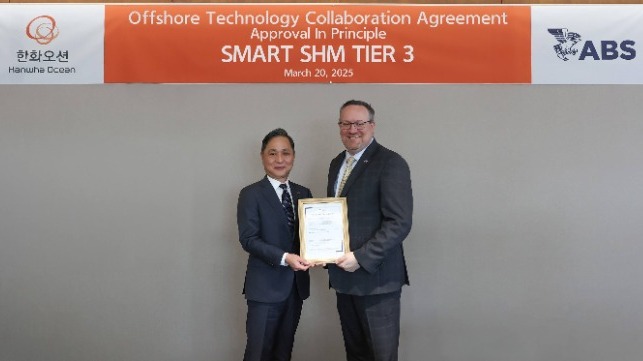
on Young Chang, CTO of Hanwha Ocean Product & Technology Strategy, with Patrick Ryan, ABS Senior Vice President and Chief Technology Officer

Published Apr 18, 2025 1:11 PM by The Maritime Executive


[By: ABS]

Hanwha Ocean has received the ABS SMART (SHM) Tier 3 approval in principle (AIP) for its advanced hull monitoring system.

The system from Hanwha Ocean is designed to estimate structural damage to ships and offshore assets during operation, which can support decision making for the optimal maintenance timing to maintain safety. ABS SMART(SHM) Tier 3 recognizes systems that employ hull sensors combined with additional algorithms to generate structural health insights at critical locations, even at locations where no sensors are present.

The AIP is one of the first fruits of the Offshore Technology Collaboration Agreement signed by ABS and Hanwha Ocean in 2024. The agreement promotes technology development in three areas: digitalization and artificial intelligence, cybersecurity operations, and sustainability.

“ABS celebrates this achievement with Hanwha Ocean, a milestone in our collective pursuit of safety at sea. As a leader in supporting the adoption of smart technologies in the maritime and offshore sectors, ABS recognizes the transformative capabilities of these systems – advancing health and condition awareness, operational optimization and, eventually, classification supported by condition-based programs,” said Patrick Ryan, ABS Senior Vice President and Chief Technology Officer.

“Recently, shipowners have been including digital technologies as part of their contractual requirements, and classification societies are also in the process of refining regulations related to digitalization. Based on this approval, we will proactively respond to the growing demand for smart and digital technologies in the shipping industry,” said Young Chang Shon, Chief Technology Officer of Hanwha Ocean.

The hull monitoring system from Hanwha Ocean is being developed in accordance with the ABS Guide for Smart Functions for Marine Vessels and Offshore Units, which can be found here.

The products and services herein described in this press release are not endorsed by The Maritime Executive.


Remote Inspections Support Safety and Efficiency

ABS illustration
Courtesy ABS

Published Apr 18, 2025 1:22 PM by Matthew Tremblay


The evolution of remote inspection technologies is redefining how class and regulators verify compliance, writes Matthew Tremblay, ABS Vice President, Global Offshore.

The safety we expect in the maritime supply chain depends on all its components working properly. From commodity producer or manufacturer to carrier and end user, all assets must be built, operated and managed with safety in mind.

The appeal of state-of-the-art audit services stretches beyond operators of vessels, facilities and equipment to a wider range of operators across the breadth of the supply chain for equipment and materials manufacturing.

To support this end-to-end approach, remote inspection applications, ranging from component design and manufacture, through to construction and in-service maintenance are evolving at a rapid pace.

The evolution of the technology to make this happen - and how it can be applied in remote inspections - signals a major transition in how the industry is addressing the monitoring and integrity of assets regardless of location.

Just as importantly, the technology is generating more detailed insight than was once possible with the human eye, representing a step change in how these services are attracting the interest of more operators globally.

Remote Impetus

The impetus for ABS to re-evaluate long-standing business practices came in part from the pandemic. Restrictions on physically attending assets for inspection spurred demand for remote surveys and audits to augment the traditional survey experience by allowing surveyors to perform a range of actions without being physically present while simultaneously capturing all survey and audit requirements.

Access to remote surveys and audits allowed for business continuity, particularly during challenging times that may create scheduling conflicts or personnel or logistical issues.

Remote inspection technologies help to reduce direct human intervention on site and in dangerous situations, which is enhancing a safety-first approach with the adoption of tools, software, and systems that improve safety, performance, and operating costs for the client.

The ability of these technologies to navigate through complex and dangerous environments, access restricted spaces, and perform inspections with precision and agility was comprehensively proven. This dramatically reduces risk and, in the longer term, cost, by reducing human intervention and automating maintenance inspections. Advances in image recognition from deep-learning techniques have made it possible to create a high-fidelity model of the world around an asset.

Overcoming Objections

Remote inspection suffered initially from the perception of being less effective than an in-person, onboard survey. However, the process has evolving from simply replicating what is done onboard to identifying and assessing a broader set of data to make more informed compliance and safety related decisions.

The availability of higher bandwidth, lower-latency connectivity thanks to LEO internet connectivity, supported by cloud-based data storage means we are able to leverage a wider range of data in real time.

Remote inspection is now a tool in the larger toolbox of data-driven verification which includes the use of both transactional data such as maintenance, condition monitoring results, inspection records and time-series data from sensors, and health monitoring approaches.

This evaluation of a broader set of data means our new remote way of working can actually be more comprehensive and effective than traditional in-person visual examination and testing.

Meeting Challenges

Confronted by daily challenges, complexities, uncertainties and opportunities, it is easy to lose sight of a simple fact: companies that fully assess their risks are better able to manage them strategically. Delivering effective remote inspection services with the support of independent expertise from companies like ABS is vital to sustaining asset safety and efficiency.

Joint ventures and collaborations with technology developers, which introduce valuable core inspection and maintenance competencies into businesses, are beginning to redefine industry perceptions of safety, and foster important dialogue about sustainable energy supply and demand issues.

These challenges can then be tackled collaboratively. These programs are particularly valuable when seen alongside industry trends. A maturing shipping fleet – particularly in the dry bulk sector - has the potential to introduce new risks without close attention to asset maintenance and component health.

We are also seeing a greater number of assets change hands more frequently. In its simplest terms, this can be a change of personnel, right through to a new organization inheriting new assets. Both these cases are examples of where the remote technologies can help.

From Proactive to Reactive

The economic implications of adopting remote inspection technologies are profound. Beyond the direct cost savings, the early detection of failures through enhanced monitoring can prevent extensive damage and downtime, further optimizing the financial viability of oil and gas assets.

The ability to conduct thorough inspections remotely means that maintenance can be potentially proactive rather than reactive, which is less costly and more efficient for the operator and their teams – and can save on mobilization costs that helps to reduce risks associated with offshore travel.

Remote inspection technologies are the primary catalyst for transitioning from traditional human-resourced maintenance to real-time risk assessments and insights, which is more cost-effective and allows second-by-second assessment of an asset’s integrity. This enables maintenance responses based on actual needs rather than forecasts. It reduces downtime for the operator, the supply chain and engineers or surveyors.

However the ultimate goal of remote technologies is not to entirely remove employees from inspection operations, but to use technologies as a way to more efficiently and effectively inform decision makers without the need to be physically present onboard thanks to, for example, sensor technologies.

Sensor systems are evolving and their application across transport, infrastructure and other assets are expanding at a fast rate to meet the demands of expanded remote inspection technologies, the need to cut costs, and to ensure efficiencies are met safely.

Supporting Applications

ABS is at the forefront of how remote inspection technologies are being developed and applied, helping companies execute inspections swiftly, accurately, and with minimal disruption to operations.

Clients have told ABS what a difference the remote inspection services have made to their operations since they were first introduced. Recent projects indicate how the scope of new remote inspection services can be applied and have shown the benefits of adopting this approach more widely as alarms and alerts for critical assets.

While ABS took the decision to officially launch its remote offshore surveys as far back as 2018 following a lengthy period of testing and evaluation, it has since taken the decision to extend its range of technologies to provide more choice and flexibility for how clients.

ABS’s Operations Support Center (OSC) is the global hub for management of remote surveys, staffed with trained and qualified surveyors ready to connect to assets and perform remote surveys. The rapid expansion of asset connectivity and remote inspection technologies enables the OSC to serve as a core function in ABS’s approach to class surveys.

Matthew Tremblay is ABS Vice President of Global Offshore.

The opinions expressed herein are the author's and not necessarily those of The Maritime Executive.


Norway’s Largest Battery-Powered Ferry Starts Delivery Run from Turkey

battery-powered ferry
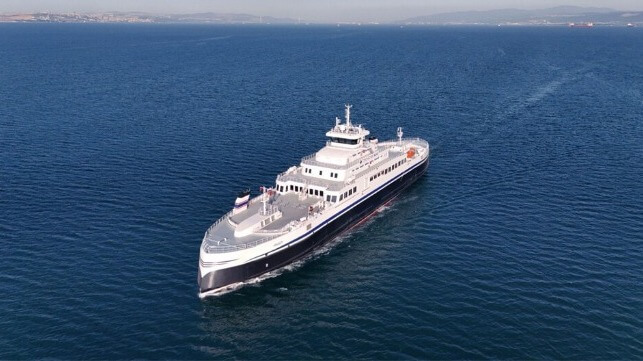
Hinnoy is Norway's largest bettery-powered ferry (Cemre Shipyard)

Published Apr 17, 2025 6:35 PM by The Maritime Executive


The largest fully battery-powered ferry planned for operations in Norway’s Arctic fjord region has completed construction and began its delivery run from Turkey to Norway this week. The vessel is set to set several new marks in size and speed as well as its charging capabilities as the largest of its kind yet built for operations in Norway.

The Hinnøy is 7,115 gross tons and 117 meters (384 feet) in length. Built by Turkey’s Cemre shipyard for Norwegian ferry operator Torghatten Nord, the RoRo double-ended ferry was designed by Norwegian Ship Design. The companies highlight it will have a record-breaking speed of 14 knots and power systems capable of a one-hour run in the weather and exposed conditions in Norway’s fjords and Arctic waters.

The ferry is larger replacing LNG-fueled ferries that have operated on the route between Bognes and Lødingen for the past decade. Torghatten highlights the design is enclosed to handle the relatively weather-hard conditions. Typically, battery ferries that have been placed into service so far are open designs for shorter distance runs.


The new vessel has a capacity for 399 passengers and 120 cars. It was classsed by DNV and is registered in Norway. The shipyard lists propulsion as two Schottel 1.800 kW motors supported by a Siemens water-cooled battery system with approximately 4.750 kWh and a Siemens electrical system.

It was outfitted with two independent power systems to provide redundancy and ensure it could operate even if one fails. On-shore it will be supported by what may be the largest connections with 9,200,000 watts for fast charging of the onboard batteries. In case the shore power is unavailable, biodiesel generators will provide sufficient power for normal operation.

The order was placed for the ferry in April 2022 and it was launched in November 2023. The delivery trip commenced on April 15 from Yilova, Turkey after the final functional testing and certification.

The vessel is seen as a milestone for electric ferries and a key part of meeting Norway’s increasing environmental regulations.

Torghatten Nord plans to continue its advanced ferry designs having selected Norway's Myklebust Verft to build two ferries which will be the world's largest hydrogen ships. The ferries, which will also be 117 meters in length are designed to carry up to 120 cars on Norway's longest ferry route between Bodø and Lofoten. They are scheduled for delivery in 2026.