Thursday, May 29, 2025

South African Union Responds to White House Debacle

Wednesday 28 May 2025, by Collective

The General Industries Workers Union of South Africa (GIWUSA), a leftwing voice in the South African labor movement, posted the statement below following the May 21 White House meeting of Donald Trump and president Cyril Ramaphosa. Trump’s sickening racism was on full display as he pressed the mythology of the “white genoicide” of Afrikaner farmers. On this occasion Trump even exceeded his everyday spectacle, presumably prompted by Elon Musk who’s seeking to extort favorable concessions for his Starlink operation in South Africa.


At the same time, we think that [international] readers will find the response of South African labor militants to be a revealing look into the sharp class and political divisions in today’s South Africa and the crisis of the African National Congress government.

THE GENERAL INDUSTRIES Workers Union of South Africa (GIWUSA) denounces in the strongest terms President Cyril Ramaphosa’s shameful pilgrimage to Washington to beg favors from the world’s leading racist imperialist, Donald Trump. This spectacle represents one of clearest expressions of the African National Congress leader’s betrayal of the national liberation struggle, reminding us of Marikana when he emailed in a request for what became a massacre, on behalf of the same London mining house that the British (Tory) prime minister once called ‘the unacceptable face of capitalism.’ The White House lunch and no-doubt humiliating press conference afterwards will also confirm South Africa’s status as a neocolonial vassal state of Western Imperialism, willing to bend on a knee at the slightest threat, with Ramaphosa attempting to compete with the corrupt Arab sheiks who last week gave Trump vast personal and corporate gifts.

Washington Pilgrimage

Yesterday, President Cyril Ramaphosa arrived in Washington DC, cap in hand, to beg for the favor of Donald Trump—a racist demagogue who has spent months vilifying South Africa as a ‘genocidal’ state while openly advancing white-supremacist narratives, opposed to long-overdue land reform and affirmative action in big business. Today’s meeting is not diplomacy as the media and its commentators want to believe; it is the culmination of 31 years of ANC capitulation to imperialism, now laid bare as Ramaphosa grovels before a man who brands the country’s land reform as ‘racist,’ and who insults the sovereignty of the country, paid for with the blood of the black working class and martyrs of the national liberation struggles against the Apartheid regime and Colonialism. He is also expected to ‘drop the megaphone’ on the other most vital liberation struggle: Palestinians against Israel, at a time Trump talks of removing a million Gazans and forcibly relocating them to Libya.

These are the same masses he betrayed, and the same imperialist interests he served at the CODESA deal-making that left intact the structures of apartheid-capitalism and in countless business deals Ramaphosa made afterwards (with the likes of Glencore, McDonalds, CocaCola, MTN, Standard Bank and others), right up to the illegal stuffing of his Phala Phala couches with undeclared US dollars provided by a Sudanese tycoon in 2020.

All these events are not isolated but constitute one unbroken chain of political treachery and capitulations, including Trump-scale corporate blunders that – like the U.S. President’s former Atlantic City casinos – also left two of Ramaphosa’s firms (Molope Group and JCI) close to bankruptcy in 1998. Hence the shift in his debt+share strategy, to a form of shake-down Black Empowerment entailing enforced partnerships with white capital: exactly what Elon Musk objects to and Ramaphosa appears to have succumbed to, with talk of a work-around so Musk violates SA’s corporate affirmative action provisions.

The common denominator of these political actions is the underlying political economy of the state and national power structure itself. There are names and addresses associated with that power structure – such as Johan Rupert who helped arrange the White House visit – along with Trump’s white golfing heroes: Ernie Els, Retief Goosen and Gary Player. The latter is one of Trump’s main recreational allies, and who can forget his role as apartheid’s leading sports ambassador. For Ramaphosa and spokesperson Vincent Magwenya to continue – again and again and again – to promote the idea that Ramaphosa and Trump will bond over 18 holes on a well-watered course while vast parts of the city of Johannesburg – especially black townships but now also the formerly-white suburbs – go without drinking water, is symbolic of the times and crimes we face.

Under bourgeois democracy, the capitalist class and imperialism have only a degree of influence – not 100% determination – over who becomes government, although in South African they made sure by the late 1980s that ANC elites – starting with Ramaphosa – rapidly shifted from the 1955 Freedom Charter mandate and then the 1994 Reconstruction and Development Programme, to the 1996 neoliberal GEAR regime. The overall choice of government rest with the electorate that is overwhelmingly working class. The powers of imperialism and the local capitalist class – which are intertwined and overlap greatly under neocolonialism – lie in their monopoly over the economy and control over levers of the financial system and trade.

As the recent report of Just Share on manipulation of cimate policy shows, capitalists rely upon this economic power to circumvent democratic processes and impose their interests and choices over state policy. Trump is only unique in that he is a maverick, who cares less about the public perceptions and feelings of his enemies (including some powerful elites) and of the working-class people in his own country especially if they are not in his white-male MAGA Make America Great Again camp. He cares nothing about the oppressed people across the world. Tailoring state policy to satisfy leading capitalists’ domestic and foreign interests, and advance imperialism is nothing new. The only thing new is the openness and unflinching public blackmail with which Trump is doing it, openly advertising his corrupt personal tendencies.

Trump’s Racist Fabrications and Imperialist Bullying


Trump has weaponised lies about ‘white genocide’ to justify cutting aid – with Elon Musk’s DOGE team knocking out 18% of South Africa’s AIDS programme as well as health research plus the $1 billion Just Energy Transition Partnership loan – and expelling the country’s ambassador and military attached. He went from causing tragedies to farce by last week resettling 59 Afrikaners as ‘refugees’—a grotesque spectacle that insults the millions of Black South Africans who endured real oppression and bloody massacres under apartheid and who in many ways continue to bear these conditions over 30 years into the era of democracy. One just has to look at all instances of police and security violence directed by the state and corporate power and one will find that victims are invariably black.

The Trump administration demands that South Africa exempt U.S. corporations from Black Economic Empowerment (BEE) laws, effectively reinstating apartheid-era economic apartheid. We are certainly not supporters of this kind of assimilation, in which BEE adds a layer of black-diamond brutality to South African capitalism. But it is also clear that the net result of any other policy pursued on the basis of capitalism will be an exclusive ownership of the economy by the white elite and foreign owned Multinational Corporations, as was the case during the 1998 crash of first-generation black capitalism, when the JSE’s black-owned firms crashed 50% in value and all the models allowing repayment of debt through sale of shares suddenly failed. Neither that generation nor the current generation of BEE deals makes any sense. But to end all efforts at integration of the C Suite, as Trump insists, is not negotiation; it is colonial imposition.


Ramaphosa’s ANC: A Willing Partner in Subjugation


The ANC’s betrayal did not start today. Since coming to power in 1994, ANC state elites preserved white monopoly capital while masking its surrender with empty slogans. Ramaphosa, a billionaire who crushed Marikana’s workers, now begs Trump to spare South Africa from tariffs—proof that the ANC’s ‘negotiated settlement’ was a pact with monopoly capital and imperialism, not a break from it. If he succeeds in restoring AGOA-style 0% tariffs (which we do not anticipate), the main beneficiaries are Mercedes, BWM and other foreign car companies, BHP Billiton’s South32 aluminium smelter, Luxembourg-based ArcelorMittal’s steel foundries, the (New York Stock Exchange-listed) Sasol filthy petrochemical plants and other leading foreign capitalists.

The GNU coalition with the DA has only accelerated this surrender, as Ramaphosa’s delegation includes ministers ready to barter away not only workers’ rights, but broader environmental and social-investment regulations protecting even the most elementary rights of communities against mining monopolies, for Wall Street’s approval.

On the latter points, the DA’s position is on public record and the ongoing court case against Employment Equity is only the latest tactic in their 30-years long battle. On attacks against workers and community rights, the ANC and DA are completely aligned as evident on the anti-labour laws amendments and the publication of MPRDA amendments bill few days ago. These are calculated to make it easy to fire workers and obtain environmental authorisations in the interests of capital and they are tabled by ANC ministers. The role of Dion George as ‘environment minister’ – after his previous postings in Sandton representing the ultra-rich as a DA MP, and before that in the 1980s SADF doing what he terms his ‘national service’ (for which nation?) – confirms the GNU’s pro-capital slant in areas our future generations will condemn us for, e.g. in agreeing with Trump that a de facto fossil-fuel addiction is just fine. Hence Ramaphosa is bringing massive offshore oil&gas deals to the White House in hopes that ExxonMobil, Chevron, ConocoPhillips and other U.S. firms will step in where TotalEnergies, Shell and local oil men have failed.

The Real Crisis: South Africa’s Neocolonial Chains

Trump’s threats expose the ANC’s fatal dependency upon imperialist markets. Over $2.7 billion in trade hinges on retaining the 0%-tariff AGOA deal, which Trump dangles like a noose but which we can safely predict is now ancient history (even tiny Lesotho was hit with Trump’s 50% tariff on ‘Liberation Day,’ and South Africa’s was 32%, even if these were soon paused).

Because of the neo-colonial relationships with international trading partners, instead of industrialising properly by rebuilding clothing, textiles, footwear, appliances, electronics and other essential goods, the ANC’s neoliberals turned us into slave labour and the country into a quarry and garden for Western capital from the mid-1990s. Two of the most important exports to the U.S. are minerals (especially platinum and gold) and agricultural products from plantations (especially fruit). These deals plus the AGOA emphasis on aluminium and steel, have locked us into raw material exports, with only automobiles as exceptions.

Now, as Trump demands Ramaphosa kneel, he offers Starlink exemptions to Musk – another apartheid beneficiary – and his data-vacuuming empire. What we have learned about Musk’s manipulation of X.com twitter accounts, and of his DOGE team’s looting of U.S. government data, suggests that we should be keeping him at arms length, not allowing Musk to suck in South Africans’ personal, private data via Starlink.

The agenda Ramaphosa is following will, simply, make labour even more cheap, and make non-renewable resources – especially minerals – and land available for wanton plunder and looting. Ramphosa’s offer to buy methane gas from the U.S. instead of embarking on a genuine Just Energy Transition makes a mockery of the decarbonisation, since the methane is 85 times more potent a greenhouse gas than CO2 over a twenty-year period. Trump and former coal-mining tycoon Ramaphosa – aged 78 and 72, respectively – simply do not care about leaving an inhabitable planet behind them for coming generations.

The Way Forward: Break the Chains of Neocolonialism!

We cannot beg for scraps from Trump’s table. The solution is revolutionary change:

– Nationalise the mines, banks, and monopolies under workers’ control – no compensation to thieves!

– Expropriate big landed estates into public ownership to be managed by those working it and also to redistribute it to the landless for increased food production, housing and other uses.

– Rebuild manufacturing through state-led industrialisation, including beneficiation of the minerals and Green industrial revolution, thus breaking imperialist dependency.

– Lower interest rates to ensure productive capital can be deployed into job-creating investments, and impose tighter exchange controls to halt the existing runaway capital flight.

– Refuse any new unfair trade and investment deals – and cancel all existing unequal trade deals – and refuse to be blackmailed by Washington, either via AGOA or the IMF’s influence over Treasury’s budget, also unveiled on May 21.

– Forge international solidarity with working and oppressed people in America, and with anti-imperialist movements everywhere, while reaffirming aid to Palestine not only through new International Court of Justice anti-genocide demands but also through imposition of BDS (including against Glencore and Ramaphosa’s brother-in-law Patrice Motsepe), instead of groveling to racist warmongers like Trump.

Ramaphosa’s trip is a disgrace, but it exposes the truth: the ANC has sold out. The working class must take power into its own hands.

Source: Against the Current.

P.S.


If you like this article or have found it useful, please consider donating towards the work of International Viewpoint. Simply follow this link: Donate then enter an amount of your choice. One-off donations are very welcome. But regular donations by standing order are also vital to our continuing functioning. See the last paragraph of this article for our bank account details and take out a standing order. Thanks.

Attached documentssouth-african-union-responds-to-white-house-debacle_a9015.pdf (PDF - 921.6 KiB)
Extraction PDF [->article9015]


International Viewpoint is published under the responsibility of the Bureau of the Fourth International. Signed articles do not necessarily reflect editorial policy. Articles can be reprinted with acknowledgement, and a live link if possible.

 

Inside Die Linke: An interview on the state of Germany’s left party


Die Linke graphic Tempest

First published at Tempest and RS21.

After geopolitical upheaval and a snap election in February brought a new coalition to power, the political situation in Germany is rapidly changing. Even as the far right Alternative for Germany (AfD) is on the rise, Germany’s left-wing party, Die Linke (The Left) surged in the most recent election to over double its prior size. 

Sean Larson sat down with Frieda Holm and Maria Sommer of the revolutionary socialist group marx21 to discuss the shifting dynamics within Die Linke, navigating the pitfalls of parliament, and building durable infrastructure for the class struggle within and beyond the party. 

Until recently, Die Linke appeared to be in decline. What led to Die Linke‘s revival not just as a voting organization, but as a political party with now over 100,000 members? And what is the current situation within the party, months after the election?

Frieda Holm: After a period of stagnation, there was a long, existential debate within Die Linke around the question of Sarah Wagenknecht, which culminated in Wagenknecht’s departure in the fall of 2023. After Wagenknecht left the party, we saw the first wave of people join Die Linke, even long-standing activists, who said that they felt that now after Wagenknecht and her racist politics were gone, now we can fight for Die Linke.

From there, a strategic process began. As a result of that, Die Linke launched a participatory offensive, conducted through the strengthened local structures, with a goal of aligning Die Linke’s program with the main concerns people had. Our compass was: The party will not pull itself out of the crisis using its own resources. It needs new, motivated people with their own ideas. The party must open up by making a concrete offer to people to join in. It was the largest organizing campaign in the history of the party, attempting to build a model of Die Linke that relies on local activity, goes into the neighborhoods, and derives its priorities and platform from talking to people. This was the background when the snap elections were called.

During the federal election campaign, all parties other than Die Linke  incited hatred against refugees, demanded tougher migration policies, border closures, and so on. Last year there was already a huge wave of protests against the far right Alternative for Germany (AfD) and their deportation plans. Previously, the Greens benefited from those protests, but now the Greens were part of the same dynamic and ultimately wanted to govern with the mainstream party of the right, the Christian Democratic Union (CDU), which meant that space was opened up for Die Linke  to lead as a consistent force on anti-fascism.

So there was a subjective factor of strategic development in the party in terms of structures and the new profile, and also the dominant debates of the moment, both of which came together for the relative success of Die Linke  in the elections.

The question remains, however, about whether this can lead to a different party that is sustainable in the medium or long-term. Die Linke ’s slogan during the elections was “everyone wants to govern, we want change.” The party framed politics as above versus below, and emphasized a class-political approach.  And the question is, can we continue to maintain the clarity of making politics for and with the people down here against those up there?

Or do we risk adapting to the very image of dominant politics that people on their doorsteps and in this campaign have often expressly rejected. They’re actually fed up with politics now because it’s being made from above and, ultimately, is not for them. So it’s a question of how to make the innovations and political direction of the last year and a half sustainable.

Maria Sommer: Die Linke now has 10 percent in the current polls, and we are gaining more support. At the same time, there are a lot of people projecting onto Die Linke  that it’s supposed to become this new force beyond social democracy. There is pressure from within and outside the party, including from the liberal Green milieu, for Die Linke to assume responsibility for the larger left-liberal milieu now, including in foreign policy. Basically they want Die Linke  to drop the “outdated” peace policy and become the standard bearer for the larger oppositional milieu.

All of this means that we are operating not only as an opposition force, but are also dealing with expectations from those who see a Left-Green-liberal government project as the only opposition to the right. That’s why it’s going to be a big challenge to say: “let’s stick to the recipe for success, underdog politics, meaning us at the bottom against the top, we don’t want to govern, we want to change, we build power from below,” and so on. The question of government is very appealing, especially in times of setbacks and crises. We should also not suggest that we on the Left never want to take power. But we must not make the mistake of suggesting that we can take shortcuts. From that perspective, fighting for the direction of the party will be a challenge.

Then there is the question of the new members and how we can integrate them. We’ve now gained 60,000 new members within four months — it’s a re-foundation of Die Linke, simply put. And the question is, can they establish a new ethos within the party? If so, then we’ll manage to remain anti-establishment and build a grassroots membership party capable of running big campaigns like expropriating landlords. But it’s really a question of strength, and whether people can integrate these new people into the big debate that is about to come.

I would say there are a lot of people who want to develop a new party. But of course there are still various theories of change and concepts of socialism. In any case, there is a new common course that puts class politics at the forefront and wants to make politics for the class. But this also conceals differences. Basically, a central difference remains between socialism from above and below. For us, this means strengthening the few approaches and projects that rely on genuine participation from below. Just as the doorstep campaign was essentially designed to do.

Part of the trap for Die Linke  and many other left-wing mass parties in Europe is voters’ expectation that they would enter government to fulfill their promises. However, once in government, they are pressured to play by the rules and implement austerity measures, deportations, etc. What opportunities does Die Linke have to be a force in society when the party is not in power?

FH: It’s an interesting moment, because I would estimate that a large proportion of the new members in Die Linke aren’t actually joining to be part of a party that is just like any other party, just a little bit more focused on social justice. Instead, they have joined above all with an understanding that we do politics differently, we anchor ourselves in the neighborhoods, we do politics not for, but with the people. They are totally attracted to that, which corresponds to a strategy of building power from below and is actually very close to what we in marx21 would propose. And at the same time, the vision is not spelled out in detail, in contrast to others who simply say, “we are looking for progressive majorities in a governing coalition.” So the central question is: What is our plan to win with the course of a radical, rebellious social opposition? What other path to change can we show  and prove in practice?

We are at the very beginning of demonstrating what an alternative to typical governing could look like, by building power and an ability to push through things from below. A lot of it will be determined by how we conduct campaigns and struggles going forward.

When you think about other left-reformist projects like Sanders or Corbyn, these were more focused on mobilization for elections or as an end in itself. We are trying to use campaigns to actually build the Left. Maybe it’s useful to give a concrete example here, namely with the heating costs campaign.

During the election we had a strategy of having door-to-door conversations, but we wanted to use that opportunity to experiment with organizing neighbors and tenants, and actually make a concrete difference for people as Die Linke. In Germany there is a legal trick whereby if landlords bill their heating costs incorrectly or via the wrong system, tenants can claim back 15 percent of their costs, but few tenants know that. A lot of people we were talking to at the doors talked about high rents and prices, and that was a chance for us to say basically, you can get 150 euros back from your landlord, who most people hate anyway. We then helped people to actually do it as Die Linke. They would send their bill to Die Linke offices, we would check it, and then get tenants everything they need to send the letter to their landlord and get their money back.

Then it scaled up. In a few places, including Berlin, we came across cases where entire blocks were affected. We organized a tenants’ meeting to inform people so they could take action in their buildings. Then people would get in touch and say “I can talk to my neighbors about it,” etc. In this way we moved from door-to-door conversations toward supporting people fighting back and gaining experience in political activity. It’s so low-threshold, but at the same time it makes an immediate difference for people, where they realize, hey, I can do something.

We now plan to continue this sort of campaigning post-election, and we have a few anchor points for Die Linke’s extra-parliamentary work that emerged from the election campaign. Through those, we can then ask questions like: what are the radical reforms for which we want to build a mass movement in the coming years?

There is enormous potential to demonstrate what this alternative kind of politics looks like with the rent issue, where things are really coming to a head. The questions become concrete around whether Die Linke — as an opposition — can push through something like a rent cap or a municipalization, by organizing tenants, a second referendum, and mass mobilizations. If Die Linke can become an organic, driving force of a social movement that then leads to the government having to make concessions, it will succeed in organizing effective resistance against the austerity policies of Merz’s coalition.

These are the things that will determine what comes of all these new people coming into the party with a lot of hope. Our ability to effectively spell out this political approach will determine if the influx of new members will contribute to building power from the bottom up.

Can you describe the structures and tendencies within Die Linke, how they developed and where they are now? What forces exist that could play a role in shifting the party in new directions?

MS: When the party was founded, you basically had people from the Party of Democratic Socialism (PDS) in the East (the successor to the former ruling party in East Germany, the Socialist Unity Party, SED), coming together with the trade union Left in the West, plus a kind of radical, anti-capitalist left current, and that was the makeup of Die Linke then. The PDS especially had a theory of change based on proxy politics, or politics from above. The party model that came out of that founding moment was not at all geared towards being a membership-based, socialist party.

This constellation basically no longer exists, the PDS is no longer as strong, and there is a new opportunity. What’s interesting now is that debates are proceeding — including in the party apparatus — in which we could actually make such a thing happen in the coming period.

FH: In principle, the political tendencies that have dominated the debates within the party for a long time still exist. They have been partially mixed together or scrambled, but I would say none of these tendencies has a footing in a significant part of the party’s base.

With the Movement Left — a kind of caucus or organized tendency with Die Linke — it’s a bit different from other tendencies insofar as it’s not a completely decoupled space where programmatic questions are discussed with no relation to grassroots activity. But even with the Movement Left, it’s not like there are thirty Movement Left district associations or something that pursue a specific political model. So because of this context, specific examples take on importance by showing new ways of doing politics, such as the election campaign of Nam Duy Nguyen in Leipzig, in which a direct mandate seat was won by a person of color for the first time in the East, or Ferat Koçak in Neukölln. Both of those were done in a mass participatory way, from below.

Yes, we in marx21 played a role in both, but it’s a project of the left wing of Die Linke in a more expansive sense. It’s not as if one tendency or we ourselves as actors did it alone, but rather they came from strongholds of the party (Leipzig, Neukölln), which we tried to use as “lighthouse” models for how this politics-from-below approach could work.

That’s actually what I would say had the strongest impact on new members everywhere. The strategy of speaking to people at 100,000 doors during the national elections in order to set Die Linke’s priorities was modelled directly on the Leipzig success. People saw what happened in Leipzig and wanted to do it, and then Neukölln came along and proved it could be done on a much larger scale. Such concrete successes have the most potential to change things and that’s why we focused so much on creating such models or examples, to prove that it can work.

That brings us to these structural questions. If you look at the structure of Die Linke, including the constitution and the entire form, everything is conceptualized exclusively through party conferences and executive boards and elections for party conferences and so on. That is, the basic function of a grassroots member is to regularly attend events to elect delegates, program points, motions, or candidates. That’s all. Of course, you’re encouraged to be active somehow and wave the flag to make the party visible locally or something like that, but the overall political model is the same. Ultimately, you’re only working for parliament, the platform, and the elections.

Now it has become interesting, because the party leaders themselves say that Die Linke should become a membership- based socialist party, or what has become almost synonymous, a party that organizes the class. But the question is what does that actually look like? Of the 110,000 members of Die Linke, 109,000 are not in any parliaments, but those are the members who must become the source of our power. That means we need co-determination, we need delegates who can decide on the practical direction of the party, we need the capacity to unite around a common plan. All of this raises the question of the organizational model.

I think there’s a chance to create something in this structure that encourages member self-empowerment rather than limits what people can do with their party. Of course, that does not yet create a revolutionary force. But it is exciting, because a lot of the limitations we have encountered in the past — with the outsized role of the parliament, for example — come from the fact that all decision-making spaces are geared toward that kind of model, without counterweights built in. This is still a complicated question though, and we are discussing it in the party now.

MS: Technically, the elected leadership of the party is supposed to be the political leadership. But for a long time the parliamentary group determined Die Linke’s direction because they had the most power. During the crisis, the apparatus actually came to be the political leadership, and it was completely at odds with the parliamentary group.

We, or the radical left in general, used to always think the structural question and our relationship to the structures was basically apolitical. But now we have to confront this question of how to develop new party structures that allow for more democratization. There is a new opportunity to promote a perspective of socialism from below through a new party model, with term limits, salary caps for parliamentarians, etc. I think that’s common sense for about 70 percent of the party right now.

That’s definitely cool, but the other question is, at what point does it actually make sense to set out to lead and build a revolutionary party? My feeling is that we’re always doing this balancing act, so to speak. I don’t think we should put that forward as the goal for Die Linke itself, because then there will always be the question of whether our actions are to be trusted. At the same time, I feel that for a revolutionary party to assume a historical role, the working class must be stronger. In Germany, it’s only strong in certain areas. I believe we actually need to reach a different point in the class struggle in order to talk about this question of the revolutionary party properly.

What we are doing now in Die Linke is everything we can to strengthen the working-class struggle and improve the balance of power, while being careful not to discipline it. That’s how I see our function in the party. There’s a risk there of tipping over, but right now things are heading in a good direction and that is really helping us.

On that note, historically, the unions in Germany were more closely associated with the Social Democratic Party (SPD). What does the situation look like now with Die Linke and the unions, and also non-unionized workers? What plans or prospects are there for building and deepening this party-class relationship?

FH: Well, the situation is complicated. On the one hand, the SPD has now entered a coalition government with the CDU, and if the government now abandons the eight-hour day — one of the main achievements of the labor movement — like the CDU wants to, then there is a question of union stability, and whether they will need other allies beyond the SPD in order to not be completely exposed to the new austerity program, Agenda 2030.

On the other hand, Die Linke still doesn’t have a strong foothold in workplaces, it doesn’t have a workplace practice at all really. The party does have relations with union officials, and there are a lot of union secretaries or people who work in the union apparatus who are also in Die Linke. But there is neither a real network within the workplaces nor a serious relationship with key class conflicts such as the hospital movement.

There are emerging efforts at strike solidarity, however, with Die Linke members going to picket lines and raising funds. More promising, in the last year healthcare workers have come together and started the first network of nurses within the party and beyond it. The Rosa Luxemburg Foundation, which is tied to Die Linke, also sponsors a huge annual conference for union renewal that attracts a lot of people. These are the kinds of things that I believe could be the first beacons for spelling out Die Linke’s workplace practice more generally.

We are grappling with how to actually speak to workers in their own idiom, and how to create structures for workers so that they can be part of the party’s work. Some of these things I think the Belgian Workers’ Party has already figured out better. We are at an experimental level: small experiments, initial attempts. In strongholds where we as marx21 are more involved, there are also closer networks that are promising, such as Neukölln.

Could you describe the activist milieu in Germany a bit more? What does the constellation of forces organizing around antiracism, queer politics, feminism, climate and other issues look like, both inside and outside Die Linke?

MS: To be honest, it is bleak. The climate movement in Germany is basically at a standstill. Ende Gelände and Fridays for Future — which used to be these huge, sustained movements — are very weak now and more or less inactive. They don’t have a project right now. There was a brief upsurge at Tesla, but it was very small and essentially all the usual Left suspects. The same applies to feminist and queer contexts. Of course, there are networks, but these don’t currently amount to an actual social movement, I would say.

FH: The antifascist coalition which blockaded the AfD party conferences has now become a focal point for what was the radical wing of the climate movement. So that includes the anticapitalist group Interventionist Left, and many autonomists such as TOP (a Berlin-based group, Theorie.Organisation.Praxis), all the radical left groups that had long had the climate blockades as a project, once those became weaker, they came together again around antifascism.

At the same time, there has been a crisis of the broad social Left, and even more so of the radical Left, which has meant that Die Linke has now become a strong pole of attraction. I think it’s more the case that Die Linke and the desperately needed organization it offers provides a kind of survival perspective for the movements, rather than a strategic power perspective. But the politics brought in from the movements on e.g. anti-fascism, even offensive anti-fascism, and on climate issues, has been crucial for setting the course of Die Linke and for the fact that Die Linke could be accepted. But it’s not as if there is pressure on Die Linke from the outside.

MS: I should say, there has been one significant movement, the Palestine solidarity movement, which is very small in Germany, very marginalized, and that’s the area that we have not managed to substantially help build.

Yes, Die Linke has had a contradictory approach to the global Palestine solidarity movement. Could you say a bit about the current state of things regarding Palestine solidarity in Germany?

MS: The Middle East debate remains a challenge. At the last party conference in May, the party members decided by a narrow majority that from now on the Jerusalem definition of antisemitism should be the basis for the party’s political actions. This decision is a step in the right direction. Many members are calling for clearer politics and a break with the raison d’état on behalf of the party. Especially in light of anti-antisemitism, i.e., the taking up of the antisemitism critique from the right, it is important that Die Linke has a clear understanding of when a statement is antisemitic and when it is not. For many, this is now a great help in being able to participate in pro-Palestinian activities without worrying about being defamed.

But many people are also dissatisfied with the decision. A day before the party conference, the party leadership issued a statement on Israel’s right to exist. This has a lot to do with reputational concerns: For the right-wing Springer press, any form of criticism of Israel by Die Linke is worth a major story. But that’s not all: of course, there are still members within the party who align themselves with the Antideutsch (anti-German) scene. However, Israel’s war crimes and the recent years of post-colonial movements have also changed the forces within the party. The challenge now will be to strengthen practical initiatives so that solidarity with Palestine is not lost amidst power struggles.

We have different constellations on this between the U.S. and Germany, but I sometimes feel like in Germany, we act as if it’s particularly difficult to show solidarity with Palestine. But I think it’s just as difficult in the U.S., to be honest. So being in Germany is a poor excuse, that’s how I feel. In any case we do have problems speaking about it within Die Linke. So much of the party has simply been blind on this issue.

We thought about why that could be, and it seems to us that most people actually know far too little about it. There isn’t the long history of Palestine solidarity and education here. So they are simply not informed, and this politics of fear prevents education on the issue, even though most of the people coming from university got some kind of post-colonial education and are very open-minded to a more progressive stance of Die Linke toward Palestine. So we have started showing the No Other Land film, for example during the election campaign in Neukölln and Leipzig, with guests, and it has been well-received. It’s a very humanistic introduction to the topic and therefore feasible for a broad audience to go there and initiate debates.

But to be clear, all of this, against the backdrop of the genocide, everything in Germany is totally embarrassing.

Are there new opportunities for Die Linke and the Palestine solidarity movement after the election? Or what are their views on Palestine with these thousands of new members?

FH: There are a few MPs who are more explicitly pro-Palestine on the issue, which has brought it more into the open, and some party leaders have also changed their tune, for example clearly naming the genocide and calling out repression against Palestine solidarity. One MP from Die Linke attended the first session of the new Bundestag wearing a kuffiyeh, which caused a huge scandal in the mainstream media. But this is a sideshow.

I don’t want to mislead though, because when the headwinds come against Die Linke on this issue, it quickly changes. But unlike with weapons deliveries to Ukraine, things have shifted more toward Die Linke having a better position on this. A lot of people who have joined the party were politicized through the antiracist and anticolonial debates in recent years, and have developed a deep moral antiracism, and feel like it’s wrong. These people are saying hey, we’re against oppression and this is the example of that, why isn’t Die Linke more clearly against it?

Are there still people in Die Linke calling the cops on pro-Palestine demonstrations?

MS: Absolutely. But the question is: how do things get better? You have to organize it. If we don’t start something, or if the Movement Left doesn’t call for a demonstration, then nothing will happen. And then the new members will eventually learn that you don’t say anything about Palestine as a leftist in Germany. That’s what you are taught.

Could you say a little more about marx21? What representatives do you all have elected to various levels, and what role does parliamentary work play in your general political perspective?

FH: We are currently around 460 people. It’s growing very quickly. I’d say probably a third of us are active in Die Linke, so that is a strength. We have four elected representatives: three in the Bundestag and one in the Saxon state parliament.

We have discussed a lot in recent weeks about the role of revolutionary MPs. We believe in limiting one’s own salary, limited terms of office, and regularly discussing one’s policies with marx21, but also with local left-wing structures. There is a learning process underway, and we are trying to spell out what revolutionary work in parliament looks like in the current context, in concrete terms. So how much time do they spend in parliament, how much time do they spend outside, etc. The salary caps, term limits, etc. are essentially meant as protective mechanisms against simply drifting into parliament.

But there is also an important function of being in parliament as a space to demonstrate the balance of power and be able to speak to the outside world. We want their work to actually benefit us, both in the class conflict and the organizing work going on outside parliament. In other words, to use the access to public relations, prominent people, and resources to advance the political development on the Left from the bottom up. That’s how I would summarize it, but what that actually means is very complicated. So do you specialize in a specific policy area in detail and become an expert, or do you just become a megaphone and give good speeches? It’s not always clear what revolutionaries should do in all circumstances.

MS: A year ago, when everyone in the world was declaring Die Linke dead, there were basically a few people who were seriously thinking about what realistic potential there was for Die Linke, and what our contribution could be. We set out some parameters and guardrails, and then decided to try it. We thought what we need is to build some lighthouse models that can activate the grassroots and serve as the example for a nationwide campaign that is participatory. 

Frieda Holm is an active member of Die Linke and a member of marx21.

Maria Sommer is active in Die Linke and studied philosophy and sociology. She is a member of marx21.

Sean Larson is a member of the Tempest Collective in the U.S. and a founding editor of Rampant Magazine.


Portugal

Hard questions for Left Bloc after a terrible parliamentary election


Thursday 29 May 2025, by Left Bloc


The 18 May parliamentary elections were a disaster for Portugal’s Left Bloc. The far right has replaced the Socialist Party as the main opposition to the conservative government, and may now push for constitutional changes. All left parties suffered, but none as much as the Left Bloc. Its vote collapsed and it lost 4 of its 5 seats in the Assembly of the Republic ( parliament). In this National Board resolution, the Left Bloc leadership takes stock of the legislative election results, starting from the national context and the party’s campaign, to find answers for the future.【AN]


The Left Bloc has achieved its worst result in its history in elections for the Assembly of the Republic. The Bloc faces these results with concern and intends to carry out an assessment that allows it to correct mistakes made, listen to all militants and also independent people, and mature an orientation that guarantees the influence of this political project, its social intervention and its alternative. This process is not done hastily nor by finding a single explanatory factor. It requires time, humility, openness and availability to find paths that we will only discover collectively.

The sum of votes for parties to the left of PS is the lowest ever, and the same applies when this sum includes PS. These defeats - of the left as a whole and of the Bloc - place the country before grave risks. To understand them, it is necessary to study the factors that determined the electoral disaster, as well as what is specific to each political force. This resolution discusses some national and international political constraints and their impact, particularly the Prime Minister’s manoeuvre, the effect of transforming immigration into the centre of political debate, and also the fear of war. It also begins a reflection on our campaign.

The election context


The political crisis created by the Prime Minister following the violation of his exclusivity duties was a manoeuvre with precedents in recent governance that contributed to the degradation of the political environment. It proved successful for Montenegro, allowing him to recover capacity for initiative. His first indication, in the sense of admitting a constitutional revision with IL and Chega, even if cloaked in a declaration about open availability, is an undisguised and extremely serious threat against some of the pillars of April’s democratic achievements.

The occupation of the centre of political debate by the immigration theme was an important factor in the left’s failure. Portugal suffered one of the most profound transformations in its social composition and working-class profile. In just a few years, the number of foreign workers multiplied tenfold and corresponds to about a third of the active population. A relevant segment of this new working class does not come from Portuguese-speaking countries. In this context, the failure of service and regularisation services and disinvestment in comprehensive responses in housing, public services and language access enhanced the far-right narrative. This was adopted by the government in justifying new legislation and also legitimised, secondarily, by PS’s retreats on the theme. This narrative was popularised by the sensationalism of some media outlets and especially by mass manipulation through social networks. In fact, the far-right managed to transform immigration into the explanation for all the population’s life difficulties, from housing to hospitals.

The Bloc and other parties were penalised in the vote as a consequence of this reality. The lesson is that anti-racist and anti-fascist militant action continues to be central, the creation of common and unitary spaces, intervention in popular territories disputed by authoritarianism and hate speech. It is crucial to find ways to open trade unions to foreign workers, to create inclusion mechanisms, to prevent the exploitation of differences to promote social resentment. The fight against the division of the working class is essential today as tomorrow.

Trump’s re-election has several consequences for international politics, which boost the far-right: firstly, it promotes genocide in Gaza and makes Netanyahu unassailable to international pressure, antagonising governments that denounced Palestinian genocide, such as South Africa’s; secondly, it seeks an alliance with Putin; thirdly, it promotes a reactionary international that directly involves the American administration in German and other European countries’ elections; fourthly, it uses tariffs as an economic policy of submission of its allies and partners, and confrontation with China.

In this international context, the Left Bloc identified the risk of accentuating the rightward turn verified for a year, particularly under increased militarist pressure in this new framework. This pressure creates fear and displaces politics to the right, leading centre parties to accept the European arms race and submission to NATO.

These three factors - AD’s gambit, which adopted the discourse on stability that gave PS absolute majority in 2022; the centrality of the immigration question, defining all national politics; and fear of militarist propaganda - were determining factors in the general election context.

The immediate response to the constitutional threat


The greatest transformation that occurred on 18 May was Chega’s growth. This result demonstrates its capacity to maintain the electorate it recovered from abstention in 2024, increasing it throughout the territory, particularly in more socially depressed areas, interior regions and former industrial belts. Predictably rising to second party in number of deputies (should the counting of emigration constituency votes conclude thus), Chega effectively begins to dispute government. This new situation will translate into a general degradation of democratic exercise conditions, both in parliament (where Chega has conducted a strategy of exhausting debate and expression conditions for several years) and in society, with the trivialisation of racist, sexist, transphobic and homophobic violence and, generally, fascist violence. By becoming majority in the south of the country and in Setúbal, and by reinforcing its vote in all districts, the far-right gains popular votes, including many that were previously represented by left-wing forces. With this representation, Chega will aggravate its xenophobic and anti-democratic campaign, articulated with the action of criminal groups moving in its periphery (see the recent attack on the 25 April demonstration by a neo-Nazi gang, immediately applauded by Chega).

In the new parliamentary composition, none of the three largest parties can form a majority with smaller parties. However, for the first time, parties to the right of PS exceed the two-thirds threshold that allows them to promote constitutional changes. This fact becomes central in the present political situation, configuring a real risk of regressive alteration of the constitutional regime, considering PSD’s history in this matter, both in the attack on pensions under the troika, and in proposals for electoral law revision, or in recent declarations about the right to strike. IL and Chega have already announced their intentions. The Left Bloc considers essential the united expression of all voices and political forces that see themselves in the values and text of the 25 April Constitution, in defence of the freedoms and guarantees it enshrines.

For the Bloc, the objective is not only to resist the fascist and xenophobic wave or possible and dangerous conjugations of the right and far-right, or PS support for Montenegro’s governance. The Bloc’s objective is to rise again, recover, create and broaden alliances and fight for our people with determination.

The Bloc’s campaign


In the new political circumstances, we revised our campaign model. Thus, we decided to focus on a few essential themes to which we gave the greatest prominence, seeking to dispute public debate: rent caps, rights of shift workers and tax on fortunes. We did not abandon other programmatic battles that make the Bloc’s identity, such as public services, equality, rejection of xenophobia, or opposition to war, but we concentrated on those themes so they would be our brand. It was also in this way that we avoided empty discussion about governability, pointing to measures that would allow life changes for significant parts of the population and that our parliamentary representation would dispute in any circumstance. This policy had effect: the rent caps question was important in political debate, forced all our adversaries to pronounce themselves, was reinforced by increasingly alarming news about the housing crisis and was identified by part of the population as a valid response. It will continue to be one of the most important fights for our people’s life - even the majority of working families who buy their own home know that their children will not be able to do so and cannot rent a house. The second proposal, about shift work, was supported by thousands of workers. However, neither impelled electoral recovery in the context described above.

Secondly, our campaign favoured decentralised initiatives of direct contact through door-to-door campaigning. We went to more than twenty thousand homes and initiated a form of political action that will be fundamental in the future. We did this in a differentiated way across the country, mobilising young militants, recent and older adherents, who verified how they could intervene directly and not as spectators of the electoral campaign. For the same reason, we replaced traditional rallies with "coffee conversations", open to dialogue with everyone, and with creative and animated parties and public sessions.

Thirdly, we mobilised all our forces, including the candidacies of the party’s founders. These candidacies had no electoral effect, but had militant effect, energising campaigns in larger districts.

These choices did not reverse our electoral cycle and the Bloc suffered its worst defeat. And, knowing that discussion about the election assessment will allow identifying errors and will appreciate, beyond the referred questions, communication models, forms of organisation, campaign pedagogy, adequacy of responses to dirty campaigns, or other aspects of this battle, the Bloc affirms that it will not stop fighting for what we took to these elections: for a popular housing policy, for workers’ rights, against inequality and for quality and guarantee of public services, against fascist threats and for unity in defence of democratic life and the constitutional rules that protect it.
Deliberations

On 13 and 14 June, in Porto, the Left Bloc hosts the founding congress of the European Left Alliance for People and Planet, a new European political party that brings together Left Bloc (Portugal), La France Insoumise (France), Left Alliance (Finland), Podemos (Spain), Red-Green Alliance (Denmark), Razem (Poland) and Left Party (Sweden). The advance of far-right forces and social, environmental and international crises require more effective cooperation of green, feminist and anti-racist European left. The Left Bloc commits to this new alliance and invites adherents and sympathisers to active participation in this moment of debate and learning. In this congress, open to participation of other left forces, European and international, and to movements and social activism, we intend to create new forms of solidarity work and prepare concrete mobilisation actions against capitalism and against war, resistance to the far-right and recovery of social majorities on the left.

The Left Bloc will continue preparing its candidacies for local elections, reaffirming its commitment to programmatic understandings for left convergences, whether these are with PS in Lisbon to defeat Carlos Moedas, or to affirm left local alternatives. Even in councils where the Bloc has already presented candidacy, it maintains its availability for convergence processes, whenever possible, with PCP, Livre, PAN and citizen movements.

Given the numerous youth adhesions verified throughout the electoral campaign and in days following the elections, the National Board reiterates its appeal for participation in Freedom Camp, which will take place in the centre of the country from 24 to 27 July. This and other enlarged meetings of political formation and debate, such as Socialism 2025, which will take place from 29 to 31 August, are critical in this new phase of the country’s life.

In face of the new political situation and the Bloc’s heavy electoral defeat, the National Board decides to launch a new National Convention call for 29 and 30 November. This is therefore not about resuming the process that was suspended due to elections, given that the change in national political circumstances, the need for profound reflection and definition of an orientation for coming years could not be treated as mere conclusion of a process initiated in January 2025, when legislative elections were not even imagined and Trump had not taken office. With this decision, a new period opens for presentation of orientation motions and the universe of adherents with right to elect and be elected is updated.

24 May 2025

Translated by Adam Novak for ESSF from [Esquerda.nethttps://www.esquerda.net/artigo/bloco-quer-resistir-e-recuperar-mas-tambem-ampliar-aliancas-para-lutar-com-determinacao].

Attached documentshard-questions-for-left-bloc-after-a-terrible-parliamentary_a9020.pdf (PDF - 920.2 KiB)
Extraction PDF [->article9020]

Portugal
“We want to be able to look further than the end of the month”
The Carnation Revolution of Portugal Today: The New Challenge from the Far-Right
Europe in the Trump-Putin Axis Trap
Austerity or Raising the Minimum Wage: Catarina Martins on Portugal’s Experience
Portugal: Deadly forest fires

Left Bloc
The Left Bloc in Portugal was founded in 1999 by the PSR (Portuguese section of the Fourth International, the UDP and Politica 21, a current from the Portuguese Communist Party.

International Viewpoint is published under the responsibility of the Bureau of the Fourth International. Signed articles do not necessarily reflect editorial policy. Articles can be reprinted with acknowledgement, and a live link if possible.
 

The Philippines after the mid-term elections: Towards a showdown in 2028


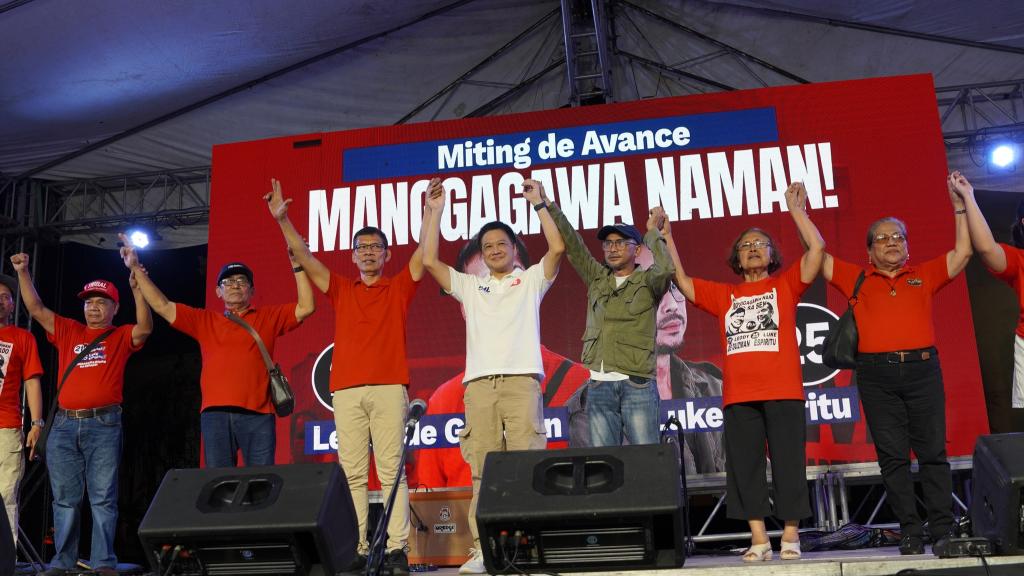
PLM election rally

[Editor’s noteFilipino socialist activist Merck Maguddayao, from the Partido Lakas ng Masa, will be speaking at Ecosocialism 2025, September 5-7, Naarm/Melbourne, Australia. For more information on the conference visit ecosocialism.org.au.]

The situation after the May 12 mid-term general elections in the Philippines can be summarised as follows: “All the forces of heaven and hell are in formation, ready for the battle to come.” 

Election winners

Twelve senators — half of Congress’ upper house — were up for election. Of those, four direct allies of former president Rodrigo Duterte were among the six most voted: his former presidential management staff head, Christopher “Bong” Go; former police chief Ronald “Bato” dela Rosa; TV host and lawyer Rodante “Dante” Marcoleta; and news anchor Erwin Tulfo.

After being roundly defeated in the 2022 elections, Liberal politicians reversed their fortunes this time around, with Paolo Benigno “Bam” Aquino and Francis “Kiko” Pangilinan rounding out the top six. They will join Risa Hontiveros in the senate, the lone Opposition senator during the Duterte administration. 

Of the remaining six senators elected, four are viewed as close to President Ferdinand “Bongbong” Marcos Jr, while the other two are seen as potential allies of Duterte, including Bongbong’s sister Imee Marcos and Camille Villar. Imee openly sided with the Dutertes after Rodrigo’s arrest and incarceration at The Hague. During the election campaign, Imee and Villar were billed as guest candidates of Duterte’s party, Partido Demokratiko Pilipino (Philippine Democratic Party, PDP). 

How they will vote on the impeachment case against vice-president Sara Duterte, as well as their response to the International Criminal Court’s (ICC) case against Duterte and possible arrest of his allies, will become clear in the coming months. 

Party lists

The most voted party list in the House of Representatives was that of progressive centre-left party Akbayan, which secured three representatives: human rights lawyer Chel Diokno, current Akbayan MP Perci Cendaña, and Muslim woman leader Dahda Ismula. The Mamamayang Liberal party obtained one seat, electing Leila de Lima, who was persecuted and jailed for most of Duterte’s term in office.

According to the law, party-list representatives make up 20% of the 300-odd lower house MPs and had to traditionally come exclusively from marginalised sectors. However, local political dynasties have managed to hijack party lists ever since a 2013 Supreme Court ruling facilitated this. 

This meant that among the top party-list winners were: Tingog (from the Romualdez clan, who is a cousin of Marcos Jr), Agimat (the Revillas clan), ACT-CIS (the Tulfo clan) and PPP (the Duterte clan). The election of Duterte Youth party-list representatives to Congress has been suspended by the Commission on Elections (COMELEC) pending resolution of disqualification charges filed against them. 

Progressives and socialists

Left national democrats (NDs) associated with the Makabayan bloc won two seats via the ACT-Teacher and Kabataan party lists, respectively. Their other party lists, Gabriela and Bayan Muna, failed to get anyone elected. New left party list, Kamanggagawa, which is linked to the leftist organisation Alab Katipunan, will have one representative in the new Congress. 

There were several other left and progressive groups that registered impressive results, even though they failed to win any Senate seats. Partido Lakas ng Masa (Party of the Labouring Masses, PLM) senate candidate Luke Espiritu achieved the highest vote of any left force running for senate, with more than 6.4 million votes (more than 11% of total votes). This represented a doubling of his 2022 election vote. Another PLM senate candidate, Ka Leody de Guzman, won more than 4 million votes (7%).

Candidates from the Makabayan bloc, such as Teddy Casiño, Arlene Brosas, Danilo Ramos, Liza Masa and France Castro, also won millions of votes, while progressive liberal Heidi Mendoza garnered more than 8 million votes. 

Imminent battles

All political forces — from the extreme right-wing and dynastic forces of Duterte and Marcos, through to liberals, centre-left progressives, left NDs and the socialist left (represented by PLM) — are locked into an electoral showdown, with the 2028 presidential elections in sight. How these forces will fare in the coming political battles will be determined by events in the months ahead. 

We will have to see how they react to Sara Duterte’s impeachment case, Rodrigo Duterte’s trial, the threat to arrest more of Duterte’s minions, the growing movement being promoted by anti-fraud groups, the Church and former military generals questioning COMELEC over unexplained electoral anomalies, and other battles that are expected to erupt over economic crises and social injustices. 

The various groups in battle represent different and conflicting class forces. The task of the left is to shape this battle into a contest between the ruling classes and the masses of working class and marginalised sectors. This means campaigning for and forming a broad united front capable of opposing and eventually overthrowing the rule of the political dynasties encrusted at the top of all government structures. 

The 2028 presidential elections will undoubtedly be shaped by the battle between the two most powerful dynasties: the Marcoses and the Dutertes. Faced with this, the left must explain the crucial role of the mass movement in building a force capable of blocking their destructive ambitions and laying the foundations for a Gobyerno ng Masa (government of the masses).

Mobilising the mass movement

The main task of socialist forces is to begin expanding and strengthening their mass base across the country. Its small mass base and narrow political reach are major obstacles that need to be overcome. 

To build an electoral base, the left needs to find a way to reach the majority of the country’s 18 regions, 82 provinces and 254 electoral districts. But expanding electoral reach must also mean expanding and strengthening mass struggles in between, during and after election campaigns.

Socialist forces should not just prepare for elections. The issue is not simply winning seats in structures infested by dynasties and trapos [traditional politicians]. The left should aim to capture political power and build an alternative Gobyerno ng Masa at all levels of government.

Yet, the die is cast on the 2028 electoral battle. Political dynasties will remain the main issue, as the Marcos and Duterte clans face off in another showdown. They are not, however, the only actors at play; all political forces are gearing up for this battle. 

Build the Grand Alliance Against Dynasties

The battle cry should be to not only build an electoral movement or alliance, but for a Grand Alliance Against Political Dynasties. This battle cry can mark out the battle lines for the fight not in 2028 but the years to come. 

The Grand Alliance Against Dynasties should be defined by the following: 

  • It should encompass various political forces from the broad spectrum of liberals, centre-left progressives, left NDs and socialists;

  • It should not be a gathering of progressive group leaders but a formation representing mass organisations; 

  • It should include progressive Church groups, the middle classes, patriotic soldiers and the entire Filipino people — workers, the poor, students, youth, women, farmers, fisherfolks, LGBTQIA+ community, environmental groups, and all those that make up the 99% of society.

  • It should not be just for elections but be a centre for advancing mass struggles. 

Back to business for Marcos Jr

Only two weeks have passed since the election, but the Marcos Jr administration is back to business. 

The president called on his Cabinet members to resign as a gesture of moving on and addressing people’s concerns, which were reflected in the election results. But Marcos Jr has retained his presidential economic team, a sign he plans to further consolidate the government’s neoliberal policies and reaffirm support for those oligarchs and cronies aligned with him. 

Marcos Jr has retained his Department of Finance Secretary, Ralph Recto, who in 2005 engineered the infamous 12% consumption tax (known as the Expanded Value Added Tax, EVAT), and was responsible for the recent raid on PhilHealth’s savings to bolster Marcos Jr's Maharlika Fund.

Housing department secretary Jerry Acuzar, who came from a real estate development agency, has been replaced by real estate and construction mogul Ramon Aliling, ensuring the continued privatisation of housing projects. Acuzar admitted to the failure of the administration’s housing project (the 4PH Pabahay Program) prior to the election.

Newly appointed environment secretary Raphael Lotilla comes from being secretary of the Department of Energy, which was accused by various multi-sectoral groups of graft regarding violations of a coal moratorium and endorsing energy oligarch Aboitiz Corp.

Renewed battlegrounds

We have also seen a renewal of people’s struggles for their rights and existence. 

The recent resistance by the Tondo community — where hundreds of Barangay 262 and 264 residents battled with a police-backed demolition team, preventing them entering their community — showcased the back-to-the-struggle mood of the population. 

The left needs to be prepared to advance and lead such emerging local mass struggles. In this sense, preparations for the 2028 election should be viewed as secondary to advancing broad working-class struggles. 

However, in preparing for the 2028 preparation, the left must also contest the upcoming Barangay (local council) and Sangguniang Kabataan (SK or youth council) elections on December 1. 

Congress is discussing laws to delay the elections, but given the not-so-favourable showing for government candidates, Marcos Jr will likely ensure the elections goes ahead as scheduled. 

There is a ban on political dynasties participating in local SK elections. This provides the left with an opportunity to expand its local government base. PLM is calling on its capable community leaders, especially youth and student leaders, to intervene in these elections. 

PLM believes the left must continue to contest elections, nationally and locally, while expanding and strengthening its forces for the coming final showdown: the capture of political power and establishment of a Gobyerno ng Masa that can steer the course towards a socialist future for all. 

Sonny Melencio is the Chairperson of Partido Lakas ng Masa (PLM), which fielded Ka Leody de Guzman and Luke Espiritu as senate candidates in the May 12 elections.