Friday, May 30, 2025

Trump’s Middle East Focus: From the Axis of Evil to the Axis of Plutocrats

Trump’s foreign policy trip marked a stark pivot away from what had long been a neoconservative version of Middle Eastern policymaking in Washington. Will the result be peace or just profit?
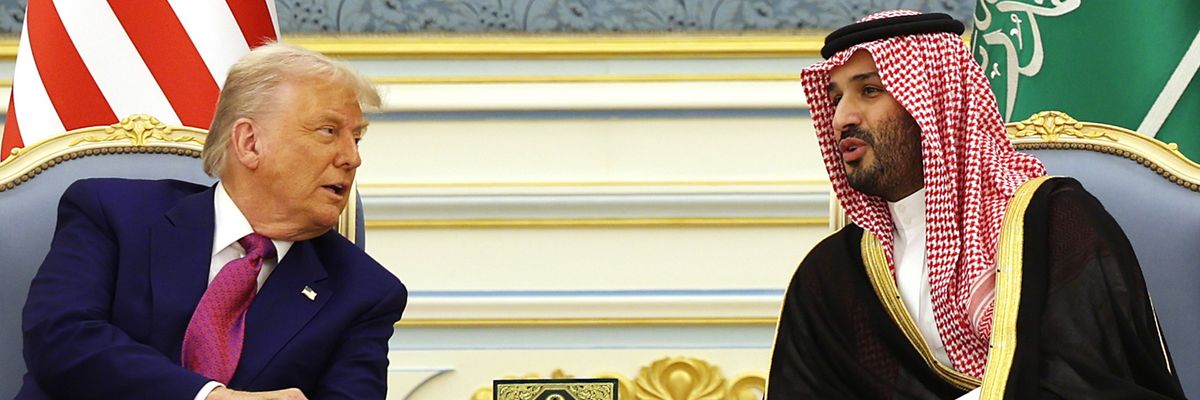

President Donald Trump meets with Saudi Crown Prince Mohammed bin Salman during a “coffee ceremony” at the Saudi Royal Court on May 13, 2025, in Riyadh, Saudi Arabia.
(Photo: Win McNamee/Getty Images)


Juan Cole
May 30, 2025
TomDispatch


Colorful career criminal Willie Sutton once may (or may not) have been asked why he robbed banks. “Because that is where the money is,” he supposedly replied. A similar principle may explain the first foreign trip of President Donald J. Trump’s second term, which was not to a traditional U.S. ally in Europe. Rather, he set off to visit the capitals of the Gulf hydrocarbon potentates Saudi Arabia, Qatar, and the United Arab Emirates. In royal palaces there, he feasted and was offered hundreds of billions of dollars in investments in American companies and opportunities for the Trump Organization, too. Qatar even courted controversy by giving him a $400 million Boeing 747-8 plane to serve as a future Air Force One.

And the publicity was regal. Strikingly missing, however, was a side trip to Israel or any evident consultations with the extremist government of Prime Minister Benjamin Netanyahu.

If Israel gets in the way of deal-making with the Gulf plutocrats, it could become an annoyance that Trump might feel he can’t afford.

Instead, Israel was frozen out and blindsided by Trump’s pronouncements. On the eve of his trip, the president took the Israelis by surprise when he abruptly announced that he would halt his (costly and fruitless) bombing campaign against the Houthis of Yemen. Israeli leaders then had to listen to Trump proclaim that the U.S. “has no stronger partner” than Saudi Arabia, with which he brokered a $142 billion deal for American arms. The United Arab Emirates has a sovereign wealth fund of $2.2 trillion, while Saudi Arabia’s is $1.1 trillion and that country’s leader, Crown Prince Mohammad bin Salman, has already deposited $2 billion of it in the investment firm of Trump’s son-in-law Jared Kushner. Qatar’s sovereign wealth fund has $526 billion. And such sums don’t even include those countries’ vast currency reserves, earned by selling petroleum and fossil gas.

And in that single, several-day trip, President Trump managed to realign U.S. Middle Eastern policy to center on—and yes, it should be capitalized!—an Axis of the Plutocrats, Gulf sheikhs who are using their galactic fortunes to reshape the region from Libya to Sudan, Egypt to Syria, and who are hungrily eyeing new investment opportunities in areas like the emerging artificial intelligence industry.
Syria: A Very Strong Background

Oh, and while he was traveling Trump revealed that Turkish President Tayyip Erdogan and Saudi Arabia’s bin Salman had indeed convinced him to lift American sanctions on Syria, a step distinctly opposed by the Israelis. While in the Saudi capital of Riyadh, he even held a surprise meeting with fundamentalist Syrian President Ahmad al-Shara, who had once led an al Qaeda affiliate. Asked about whether the Israelis opposed the step, Trump replied, “I don’t know. I didn’t ask them about that.” In fact, The Associated Pressreported that, in an April meeting with Trump, Netanyahu had specifically pleaded with him not to lift those sanctions on Syria, since he claimed he feared that the new fundamentalist government there might eventually stage an attack on Israel.

Trump appears to have been entirely unmoved by Netanyahu’s plea. After meeting al-Shara in Riyadh, the president summed up his view of the former guerrilla and supporter of hardline Salafi Islam this way: “Young, attractive guy. Tough guy. Strong past. Very strong past. Fighter.” On recognizing Damascus’s new government and issuing a waiver on those congressionally mandated sanctions, Trump observed, “Now it’s their time to shine… So, I say, ‘Good luck, Syria.’ Show us something very special.” It’s worth noting that al-Shara claims he wants good relations with all his country’s neighbors and is open to peace with Israel.

You wouldn’t know it from Netanyahu’s heated rhetoric, but during the Syrian civil war of the last decade, Israel did give medical help to the Support Front (Jabhat al-Nusra) that al-Shara founded and led when it was fighting against Bashar al-Assad’s dictatorial regime. Since al-Shara’s group sometimes persecuted the heterodox Druze minority in Syria, this step outraged Israel’s own Druze minority, some of whom at one point attacked an ambulance taking a wounded Syrian rebel to an Israeli hospital, while the group’s leaders lobbied Netanyahu to cease aiding the al Qaeda-linked outfit.

Netanyahu’s recent suggestions to Trump that al-Shara, now in control of much of Syria, poses a threat to Israel, were therefore wholly disingenuous. Moreover, the jackboot is entirely on the other foot. As soon as the revolution in Damascus succeeded, Netanyahu ordered an orgy of destruction, bombing naval ships in the Syrian port of Latakia and military installations across the country, leaving Syria virtually helpless. Israeli troops then marched into Syria, occupying swathes of its territory and taking control of a dam that supplies 40% of its water. Israeli far-right cabinet member Bezalel Smotrich then pledged that Israel’s multi-front war of expansion there would only end when Syria was—you couldn’t put it more bluntly than this—“dismantled.”

Now, Israeli analysts not only fear a resurgent Syria but also worry that since Erdogan has Trump’s ear on Syrian policy, he will be emboldened. Turkey, after all, backed the rebel group that has now taken power and is their main international sponsor. Turkish fighter jets are already operating in northern Syrian air space, and Israel’s attempt to establish hegemony over its southern regions is endangered by Turkish claims that, going back to Ottoman times, Syria has always been in its sphere of influence.
Iran: No Nuclear Dust

Trump also sidelined Netanyahu during his trip by continuing to press for a new nuclear deal with Iran. His Gulf Arab hosts showed a collective enthusiasm for the ongoing talks, and Trump revealed that Qatar’s ruler, Tamim Bin Hamad Al Thani, had indeed lobbied him to begin direct discussions with Iran. The Gulf Arab monarchies fear being caught in the crossfire of any future American-Israeli war with Iran. The leaders of Qatar and the other Gulf states are anxious that the (all too literal) fallout from any aerial strikes on enriched nuclear materials in Iran could drift onto their populations, affecting their water supplies. Trump tried to reassure his hosts that “we’re not going to be making any nuclear dust in Iran,” adding that he wanted to try negotiations first in hopes of forestalling any such outcome.

During both the first Trump administration and the Biden administration, Washington’s pitch to the Gulf Arab states was that they should recognize Israel, do business with it, and form a military alliance with it against Iran. Jared Kushner succeeded in making this argument to the postage-stamp Gulf countries of the United Arab Emirates and Bahrain, which signed the Abraham Accords with Israel on September 15, 2020.

Trump appears to have developed the same fascination that possessed Barack Obama when it comes to “opening” Iran the way Richard Nixon once opened China.

However, Kushner and then-President Biden failed to bring Saudi Arabia aboard. Crown Prince Mohammed bin Salman resisted going on a war footing with Iran, especially after the devastating 2019 attack by that country or one of its proxies on the Kingdom’s Abqaiq refinery, which underlined Riyadh’s vulnerability. Not surprisingly, then, in March 2023, the Saudi foreign minister joined his Iranian counterpart in Beijing, where the two countries restored diplomatic relations and began deconfliction talks.

Once Israel launched its total war on the Gazan population in October 2023, bin Salman could hardly sign on to the Abraham Accords. In the region, it would have looked as if he were helping to destroy the Palestinian Arabs while putting a target on Iran, one of the Palestinians’ few remaining state champions. Unlike Bahrain and the United Arab Emirates, Saudi Arabia has a substantial citizen population—some 19 million people—whose opinions the government has to be at least a little bit anxious about, especially since the blood of the average Saudi is indeed boiling at the daily atrocities being committed by Israel in Gaza. Last year, bin Salman’s office leaked to Politico that he feared he would be assassinated if he recognized Israel under such grim circumstances and he insisted on the need for an independent Palestinian state (which seemed to get Washington off his back on the issue).

In addition, Trump appears to have developed the same fascination that possessed Barack Obama when it comes to “opening” Iran the way Richard Nixon once opened China. Nothing, of course, could be more unwelcome in Tel Aviv. Netanyahu has repeatedly threatened to attack Iran’s civilian nuclear enrichment facilities (though Western intelligence agencies do not believe that country actually has a nuclear weapons program). In an April meeting, Trump informed Netanyahu that he wanted to try negotiations before anybody attacked Iran and pointedly gave the prime minister a copy of his book The Art of the Deal.
Qatar: A Fundamental Role

If Qatar did convince Trump to try negotiating with Iran, then Sheikh Tamim won a major round in the contest for influence with the American president. It was a victory in keeping with Doha’s longstanding regional role as a mediator and seeker of peaceful solutions to conflict. And the rise of Qatari influence is another blow to Netanyahu, who has attempted to sideline the Gulf gas giant even though he was happy to make use of its services.

Since Hamas’ bloodthirsty October 7, 2023, attack on Israel, elements of the Israeli government and its supporters have attempted to blame Qatar for supposedly supporting and bankrolling Hamas. The allegations are breathtakingly false and serve as a smokescreen for Hamas’ actual patron (in a manner of speaking), Netanyahu himself. They were aimed, however, precisely at turning Qatar into a distrusted regional pariah, a ploy that has so far failed spectacularly.

That the fundamentalist Hamas movement came to power at the ballot box in Gaza in 2006 and could not be dislodged struck Netanyahu as a potential blessing. The bad blood between Hamas in Gaza and the Palestinian Liberation Organization (PLO) on the West Bank left Palestinians politically divided. Netanyahu made that very rivalry a pretext for preventing the establishment of a state for the 5 million stateless Palestinians under Israeli occupation. He put severe import-export restrictions on Gaza but otherwise allowed Hamas to run it as its own fiefdom. Hamas rocket fire from time to time (which seldom did any real damage) was a price Netanyahu was then willing to pay. He had a close associate act as a go-between regarding transfers of money from Qatar and Egypt into Gaza for civilian aid and administration. From 2021 on, Egypt and Qatar deposited aid money for Gaza civilian reconstruction in an Israeli bank account, and then Israel transferred it to the Gazans.

That’s right: Bibi Netanyahu was once functionally Gaza’s comptroller. Moreover, in 2011-2012, the Obama administration asked Qatar to host members of the Hamas civilian politbureau so that they could take part in indirect negotiations with both the U.S. and Israel. The favor Qatar did for Washington and Tel Aviv, however, would prove burdensome to its diplomacy. In 2018, the emir of Qatar, Sheikh Tamim, grew so frustrated with Hamas that he decided to kick its officials out and cease sending aid to Gaza. Terrified that his divide-and-rule approach to the Palestinians might be jeopardized, Netanyahu frantically dispatched the head of the Israeli intelligence outfit Mossad to Qatar to plead with the emir to continue the arrangement.

In 2020, The Times of Israel revealed that Mossad head Yossi Cohen had written a letter to Tamim about the Gaza money transfers, saying: “This aid has undoubtedly played a fundamental role in achieving the continued improvement of the humanitarian situation in the Gaza Strip and ensuring stability and security in the region.” As late as 2023, other Israeli government officials were still sending similar messages, according to that paper. The subsequent attempt of the Netanyahu government to shift blame for its disgraceful Gaza policy onto Qatar has struck few seasoned observers as plausible.

Regarding Trump’s recent visit, the Israeli genocide in Gaza was the one outstanding issue on which Gulf leaders appear to have made little headway. After a roundtable with Qatari business leaders, the president said of Gaza, “Let the United States get involved and make it just a freedom zone.” These remarks, wholly detached from reality, did not clarify whether he still agreed with Netanyahu on a plan to ethnically cleanse the Gaza Strip, which no one in the Arab Gulf could accept. In any case, insiders say Trump is frustrated that Netanyahu doesn’t “wrap up” the war, but that the president has not exerted the pressure necessary to stop it.
A Stark Pivot

Trump’s foreign policy trip marked a stark pivot away from what had long been a neoconservative version of Middle Eastern policymaking in Washington. In the era of President George W. Bush, some officials typically argued that Israel was Washington’s only reliable democratic partner in the Middle East and that all policy in the region should be organized around that reality. In the process, of course, they downplayed the plight of the Palestinians, claiming in 2002 that peace would only come in the region when the Iraqi government of Saddam Hussein was overthrown. They gradually developed a rhetoric for stuffing Washington’s version of democracy down the gullets of Middle Eastern regimes—at the point of a gun, if necessary. They either marginalized Arab regimes or sought to scare them into an alliance with Israel. Their ultimate goal then was a war on Iran that would overthrow the government there. “Everyone wants to go to Baghdad. Real men want to go to Tehran,” they used to proclaim in a creepy combination of male chauvinism and juvenile jingoism.

Trump’s own regime is, of course, not free of either toxic masculinity or a jejune hyper-nationalism. However, unlike Bush and the neocons, the 47th president seems uninterested in kicking off long, debilitating foreign wars, which his base has come to hate. Still, think of him, at least in part, as Trump of Arabia. Of course, he’s mainly interested in making money for himself and his wealthy backers there. If Israel gets in the way of deal-making with the Gulf plutocrats, it could become an annoyance that Trump might feel he can’t afford. So far, however, the president seems unwilling to make the hard choices necessary to end the genocide and position the Middle East and the U.S. for prosperity, leaving us all in limbo with only a new Trump Tower in Dubai to show for it.


© 2023 TomDispatch.com


Juan Cole
Juan Cole teaches Middle Eastern and South Asian history at the University of Michigan. His newest book, "Muhammad: Prophet of Peace Amid the Clash of Empires" was published in 2020. He is also the author of "The New Arabs: How the Millennial Generation Is Changing the Middle East" (2015) and "Napoleon's Egypt: Invading the Middle East" (2008). He has appeared widely on television, radio, and on op-ed pages as a commentator on Middle East affairs, and has a regular column at Salon.com. He has written, edited, or translated 14 books and has authored 60 journal articles.
Full Bio >
UPDATES

Oxfam Warns Israel's 'Annihilation Campaign' Is 'Entirely Erasing Gaza'

"The pattern suggests not an effort to neutralize a threat, but a deliberate campaign to dismantle and depopulate Gaza—a process of forced displacement which is a war crime."


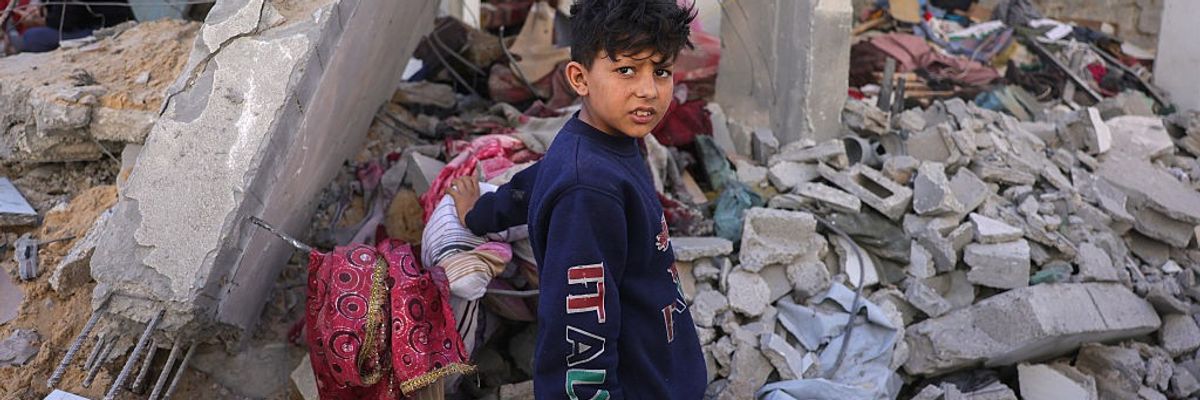
A Palestinian boy walks among the rubble of a home destroyed by Israeli bombing in Jabalia, Gaza, Palestine on May 29, 2025.
(Photo: Bashar Taleb/AFP via Getty Images)


Brett Wilkins
May 29, 2025
COMMON DREAMS

Israel's U.S.-backed mass displacement of Palestinians in the Gaza Strip "is entirely erasing Gaza," a leading international charity said Thursday as the United Nations' Middle East peace envoy warned that ongoing airstrikes, forced starvation, and general despair have plunged the embattled coastal enclave into "an abyss."

Since unilaterally breaking a cease-fire on March 2, "Israel issued nearly one displacement order every two days, strangling people into isolated areas covering less than 20% of the Gaza Strip," Nairobi, bKenya-based Oxfam International noted.

"Combined with deliberate deprivation, this reveals a strategy not of targeting militants, but of dismantling and erasing Gaza itself," Oxfam added. Some Israeli leaders have explicitly called for Gaza's "erasure" to avenge the Hamas-led October 7, 2023 attack on Israel.

"People are so exhausted, many would rather face death than flee again."

"For over 600 days, Israel has been saying it's targeting Hamas, but it is civilians who have been corralled, bombed, and killed en masse every day," said Bushra Khalidi, Oxfam's policy lead in the Occupied Palestinian Territory.

"The displacement orders follow a clear and calculated pattern: using the threat of violence to herd civilians into ever-shrinking zones of confinement," Khalidi added. "This isn't counterterrorism, as Israel alleges—it's the systematic clearing of Gaza through militarized force into enclaves of internment."


Oxfam analyzed Israel's more than 30 displacement orders, which, combined with Israel Defense Forces (IDF)-designated "no-go zones," cover more than 80% of the 141-square mile Gaza Strip.

"The sheer scale and relentless frequency of these orders have made it virtually impossible for people to find refuge," the charity said. "The pattern suggests not an effort to neutralize a threat, but a deliberate campaign to dismantle and depopulate Gaza—a process of forced displacement which is a war crime."

As Oxfam noted:
In just the last week (15–20 May), over 160,000 people were displaced—part of a broader total of nearly 600,000 people displaced since March 18, many of them repeatedly. One of the most significant recent orders, issued on 20 May, covered 34.9 square kilometers, roughly 10% of Gaza's land area, that affected 150,000–200,000 people in North Gaza's Beit Lahia and Jabalia. The effect of such orders on already-displaced populations has been devastating.

"Imagine trying to move with four children or an elderly parent in the middle of the night, with no transport and nowhere to go," said Oxfam gender adviser Fidaa Alaraj, who has been displaced with her family several times. "People are so exhausted, many would rather face death than flee again."

PalestiniansUnited Nations expertsinternational humanitarian groupsprogressive U.S. lawmakers, and others including a former right-wing Israeli defense minister have called Israel's forced displacement ethnic cleansing.

Fugitive Israeli Prime Minister Benjamin Netanyahu—who is wanted by the International Criminal Court for alleged war crimes and crimes against humanity in Gaza, including extermination and forced starvation—recently said that Israel will control all of Gaza after Operation Gideon's Chariots, a campaign to conquer, ethnically cleanse, and indefinitely occupy the strip.

Far-right members of Netanyahu's Cabinet and the Israeli Knesset want to permanently seize Gaza and reestablish Jewish-only apartheid colonies in the coastal enclave, which U.S. President Donald Trump has proposed taking over and turning into the "Riviera of the Middle East."

"There is one essential condition: We must not reach a situation of famine, both from a practical standpoint and a diplomatic one," Netanyahu said on May 19. "People simply won't support us."

While 82% of Israelis surveyed in a recent poll said they supported the ethnic cleansing of Gaza—and nearly half backed a biblical genocide of Palestinians—much of the world is aghast at Israel's annihilation of the strip, which has left more than 191,000 people dead, maimed, or missing and around 2 million others forcibly displaced, often more than once.

Meanwhile, the famine against which Netanyahu warned looms larger than ever as hundreds of Gazans, mostly children and the elderly, have recently died from malnutrition and lack of medical care, according to local officials.

On Thursday, Sigrid Kaag, the interim U.N. Special Coordinator for the Middle East Peace Process, warned that Gazans are "being starved and denied the very basics" by Israel, which in March tightened an already crippling "complete siege" of Gaza. The blockade has been cited in the South Africa-led genocide case against Israel currently before the International Court of Justice.

"The entire population of Gaza is facing the risk of famine," she warned, likening the trickle of aid allowed into the strip by Israel to offering "a lifeboat after the ship has sunk."

Kaag highlighted the despair pervasive among Gazans, who she said bid farewell not by saying, "Goodbye, see you tomorrow," but rather with the words "see you in heaven."

"Death is their companion. It's not life, it's not hope," she said.

"Since the collapse of the ceasefire in March, civilians have constantly come under fire, confined to ever-shrinking spaces, and deprived of lifesaving relief," Kaag added. "Israel must halt its devastating strikes on civilian life and infrastructure."

"This annihilation campaign and the bloodshed must end."

Echoing Kaag's remarks, Oxfam's Khalidi said that "this annihilation campaign and the bloodshed must end. It is long past time for Western governments and other influential powers to move beyond statements and apply meaningful pressure on Israel to lift the siege and abandon any designs on annexing Gaza."

"Peace cannot be brokered on the ruins of Gaza nor the theft of Palestinian land," she stressed. "Ahead of the Two-State Solution Summit planned in New York next month, world leaders must urge Israel to lift the siege and abandon any annexation plans of Gaza or the West Bank."

"What's at stake is not only Palestine's future," Khalidi argued, "but the integrity of every nation that claims to uphold international law."


New Illegal Settlements Show Israel Is 'Blatantly Working to Destroy the Palestinian People'

"The international community is enabling Israel's crimes by standing aside while millions of Palestinians are subjected to this racist and brutal regime of the Israeli government," said the Israeli human rights group B'Tselem.


Palestinian women look at the ruins of what used to be their home in Nour Shams Refugee Camp in the occupied West Bank on May 29, 2025.
(Photo: Wahaj Bani Moufleh/Middle East Images via AFP)

Jake Johnson
May 30, 2025
COMMON DREAMS

Israeli government officials confirmed Thursday that they have approved the largest expansion of unlawful settlements in the occupied West Bank in decades, including the construction of new settlements and the "legalization" under Israeli law of existing outposts in the Palestinian territory.

The decision, reportedly made during a secret Israeli security cabinet meeting last week, drew sharp backlash from Israeli human rights organizations. A spokesperson for B'Tselem said the latest expansion of settlements—which the International Court of Justice has condemned as part of an illegal annexation campaign—shows that "Israel continues to promote Jewish supremacy through the theft of Palestinian land and the ethnic cleansing of the West Bank."

"The Israeli government is openly and blatantly working to destroy the Palestinian people, and any chances for a normal future for the people living between the Jordan River and the sea," the spokesperson said. "The international community is enabling Israel's crimes by standing aside while millions of Palestinians are subjected to this racist and brutal regime of the Israeli government."

Israeli settlements in the West Bank have grown rapidly since the Hamas-led attack of October 7, 2023, with the United Nations Human Rights Office estimating that Israel moved ahead with plans to build more than 20,000 housing units in new or existing settlements between November 2023 and October 2024.

"This extremist Israeli government is trying by all means to prevent the establishment of an independent Palestinian state," Nabil Abu Rudeineh, a spokesperson for Palestinian President Mahmoud Abbas, toldReuters on Thursday.

Israeli Defense Minister Israel Katz confirmed that's the government's objective, declaring that settlement expansion "prevents the establishment of a Palestinian state that would endanger Israel."

"The Israeli government no longer pretends otherwise: The annexation of the occupied territories and expansion of settlements is its central goal."

The new expansion will add nearly two dozen settlements, according to far-right Israeli Finance Minister Bezalel Smotrich, who lives in a West Bank settlement and vocally supports annexation of the Palestinian territory.

"This is a great day for settlement and an important day for the state of Israel," Smotrich wrote in a social media post on Thursday.

The announcement came amid continued Israeli raids and home demolitions in the West Bank, alongside the Israeli military's devastating assault on the Gaza Strip. Israel's attacks have displaced tens of thousands of people in the West Bank and virtually the entire population of Gaza.

It's unclear where the new settlements will be located in the West Bank, given that the expansion decision was made in secret. The Israeli anti-occupation group Peace Now suggested that the secrecy could stem from "concerns about the proceedings in the International Criminal Court, which has begun investigating Israel's settlement construction and development as possible war crimes."

The Wall Street Journalreported earlier this week that the chief prosecutor of the International Criminal Court was considering arrest warrants against Smotrich and Israeli National Security Minister Itamar Ben-Gvir for their roles in expanding West Bank settlements.

"The Israeli government no longer pretends otherwise: The annexation of the occupied territories and expansion of settlements is its central goal," Peace Now said in a statement Thursday. "The cabinet's decision to establish 22 new settlements—the most extensive move of its kind since the Oslo Accords, under which Israel committed not to establish new settlements—will dramatically reshape the West Bank and entrench the occupation even further."

"At a time when both the Israeli public and the entire world is demanding an immediate end to the war, the government is making clear—again and without restraint—that it prefers deepening the occupation and advancing de facto annexation over pursuing peace," the group added.

Israel minister says ‘time to go in with full force’ in Gaza

By AFP
May 30, 2025


Israeli tanks take position on the Gaza border amid calls from a far-right minister to use "full force" in the battered territory. - Copyright AFP/File ISAAC LAWRENCE


Alice CHANCELLOR

An Israeli far-right minister said on Friday it was time to use “full force” in Gaza, after Hamas said a new US-backed truce proposal failed to meet its demands.

Negotiations to end nearly 20 months of war have so far failed to achieve a breakthrough, with Israel resuming operations in Gaza in March ending a six-week truce.

Israel recently intensified its offensive in what it says is a renewed push to destroy Palestinian militant group Hamas, whose October 7, 2023 attack triggered the war.

“Mr Prime Minister, after Hamas rejected the deal proposal again — there are no more excuses,” far-right National Security Minister Itamar Ben Gvir said on his Telegram channel, addressing Prime Minister Benjamin Netanyahu.

“The confusion, the shuffling and the weakness must end. We have already missed too many opportunities. It is time to go in with full force, without blinking, to destroy, and kill Hamas to the last one.”

The White House said on Thursday that President Donald Trump and US envoy Steve Witkoff had “submitted a ceasefire proposal to Hamas that Israel backed”.

Press Secretary Karoline Leavitt added that discussions were “continuing” with the militants.

Israel has not confirmed that it approved the new proposal.

Hamas sources said last week the group had accepted a US-backed deal, but on Thursday political bureau member Bassem Naim said the new version meant “the continuation of killing and famine… and does not meet any of our people’s demands, foremost among them halting the war”.

“Nonetheless, the movement’s leadership is studying the response to the proposal with full national responsibility,” he added.


– ‘Retreat’ –


A source close to the group said the new version “is considered a retreat” from the previous one, which “included an American commitment regarding permanent ceasefire negotiations”.

According to two sources close to the negotiations, the new proposal involves a 60-day truce, potentially extendable to 70 days, and the release of five living hostages and nine bodies in exchange for Palestinian prisoners during the first week.

It also involves a second exchange of the same number of living and dead hostages during the second week, according to the sources.

The same sources said Hamas had agreed last week to two exchanges on the same terms, but one during the first week of the truce and the other during the final week.

Out of 251 hostages seized during the October 2023 attack, 57 remain in Gaza, including 34 the Israeli military says are dead.

The humanitarian situation in the territory remains dire despite aid beginning to trickle in after a more than two-month Israeli blockade.

Food security experts say starvation is looming for one in five people.

Medical facilities in Gaza, meanwhile, have come under increasing strain and repeated attack.

French President Emmanuel Macron said Friday that European countries should “harden the collective position” against Israel if it does not respond appropriately to the humanitarian situation in Gaza.

With international pressure mounting on Israel over the deepening hunger crisis, Macron said action was needed “in the next few hours and days”.

In its latest update Thursday, the health ministry in Hamas-run Gaza said at least 3,986 people had been killed in the territory since Israel resumed major operations on March 18, taking the war’s overall toll to 54,249, mostly civilians.

Hamas’s attack on Israel resulted in the deaths of 1,218 people, mostly civilians, according to an AFP tally based on official figures.

UN blasts new US-backed aid distribution system in Gaza

By AFP
May 28, 2025


Palestinians receive food packages from a US-backed foundation in the southern Gaza Strip - Copyright AFP -


AFP team in Gaza, Louis Baudoin-Laarman in Ramallah and Kyoko Hasegawa in Tokyo

The UN on Wednesday condemned a US-backed aid system in Gaza after 47 people were injured during a chaotic food distribution, where the Israeli military said it did not open fire at crowds.

The issue of aid has come sharply into focus amid a hunger crisis coupled with intense criticism of the Gaza Humanitarian Foundation (GHF), a shadowy group that has bypassed the longstanding UN-led system in the territory.

According to the UN, 47 people were injured in the mayhem that erupted on Tuesday when thousands of Palestinians desperate for food rushed into a GHF aid distribution site, while a Palestinian medical source said at least one had died.

Ajith Sunghay, the head of the UN Human Rights Office in the Palestinian territories, said most of the wounded had been hurt by gunfire, and based on the information he had, “it was shooting from the IDF” — the Israeli military.

The Israeli military rejected the accusation, with Colonel Olivier Rafowicz telling AFP that Israeli soldiers “fired warning shots into the air, in the area outside” the centre managed by the GHF, and “in no case towards the people.”

With the war sparked by Hamas’s October 2023 attack on Israel entering its 600th day on Wednesday, Palestinians in Gaza felt there was no reason to hope for a better future.

In Israel, the relatives of people held hostage in Gaza since the October 7 attack longed for the return of their loved ones, with hundreds gathering in their name in Tel Aviv.

“Six hundred days have passed and nothing has changed. Death continues, and Israeli bombing does not stop,” said Bassam Daloul, 40, adding that “even hoping for a ceasefire feels like a dream and a nightmare.”


– ‘Waste of resources’ –


The UN has repeatedly hit out against the GHF, which faces accusations of failing to fulfil the principles of humanitarian work, and Philippe Lazzarini, head of the UN agency for Palestinian refugees, on Wednesday reiterated the criticism.

“I believe it is a waste of resources and a distraction from atrocities. We already have an aid distribution system that is fit for purpose,” he said during a visit in Japan.

In Gaza, the civil defence agency said Israeli air strikes killed 16 people since dawn Wednesday.

Heba Jabr, 29, who sleeps in a tent in southern Gaza with her husband and their two children, was struggling to find food.

“Dying by bombing is much better than dying from the humiliation of hunger and being unable to provide bread and water for your children”, she told AFP.

Israel imposed a full blockade on Gaza for over two months, before allowing supplies in at a trickle last week.

A medical source in southern Gaza told AFP that after Tuesday’s stampede at the GHF site “more than 40 injured people arrived at Nasser Hospital, the majority of them wounded by Israeli gunfire”, adding that at least one had died since.

The source added that “a number of other civilians also arrived at the hospital with various bruises”.


– Hostage families’ anguish –


On Tuesday, the GHF said around “8,000 food boxes have been distributed so far… totalling 462,000 meals”.

UN agencies and aid groups have argued that the GHF’s designation of so-called secure distribution sites contravenes the principle of humanity because it would force already displaced people to move again in order to stay alive.

Israel stepped up its military offensive in Gaza earlier this month, while mediators push for a ceasefire that remains elusive.

In Israel, hundreds of people gathered to call for a ceasefire that would allow for the release of hostages held by militants in Gaza since their 2023 attack.

Protesters gathered along the country’s roads and on the main highway running through the Israeli coastal city of Tel Aviv at 6:29 am, the exact time the unprecedented October 7 attack began.

Most Israeli media headlines read “600 days”, and focused on the hostage families’ struggle to get their relatives home.

Other events were planned across Israel to make the 600th day of captivity for the 57 remaining hostages still in Gaza.

Some 1,218 people were killed in Hamas’ October 7, 2023, attack, mostly civilians, according to an AFP tally based on official figures.

The health ministry in Hamas-run Gaza said on Wednesday that at least 3,924 people had been killed in the territory since Israel ended a ceasefire on March 18, taking the war’s overall toll to 54,084, mostly civilians.

EU hardens tone on Israel, but will it make a difference?


By AFP
May 28, 2025


The EU has long struggled to have an impact on the conflict - Copyright AFP -


Olivier BAUBE

With reports of acute suffering in Gaza flooding the airwaves, EU leaders have toughened their tone on Israel — but the bloc will need to bridge deep divisions to move from rhetoric to a real-world impact on the conflict.

The shift has been most noticeable from key power Germany, one of Israel’s staunchest allies in the world, its loyalty rooted in the trauma of the Holocaust.

After an Israeli strike killed dozens, including many children, in a Gaza school-turned-shelter Monday, German Chancellor Friedrich Merz declared he “no longer understands” Israel’s objectives in the war-ravaged Palestinian enclave.

“The way in which the civilian population has been affected… can no longer be justified by a fight against Hamas terrorism,” he said.

Berlin’s stern new tone found an echo Tuesday in Brussels, where the German head of the European Commission, Ursula von der Leyen, denounced as “abhorrent” and “disproportionate” the past days’ attacks on civilian infrastructure in Gaza.

An EU diplomat called such language both “strong and unheard of” coming from the commission chief, among the first to rally to Israel’s side in the wake of the October 7, 2023 Hamas attacks that triggered the Gaza war.

The explanation? “Merz has moved the dial” in Brussels, said one EU official.

“There’s been a very notable shift over recent weeks,” agreed Julien Barnes-Dacey, head of the Middle East programme at the European Council on Foreign Relations (ECFR), in a podcast by the think-tank — arguing it reflects a “sea change of European public opinion”.

Translating talk into action is another matter, however.


– Longstanding divisions –


Germany, the main supplier of weapons to Israel after the United States, this week rebuffed calls to cut off arms sales to Prime Minister Benjamin Netanyahu’s government.

On Tuesday however, in a barely veiled threat, its foreign minister warned Israel against crossing a line.

“We defend the rule of law everywhere and also international humanitarian law,” said Johann Wadephul. “Where we see that it is being violated, we will of course intervene and certainly not supply weapons that would enable further violations.”

The European Union has long struggled to have an impact on the Mideast conflict due to long-standing divisions between countries that back Israel and those seen as more pro-Palestinian.

Last week, in a milestone of sorts, the bloc launched a review to determine whether Israel is complying with human-rights principles laid out in its association agreement with the EU — a move backed by 17 of 27 member states.

EU top diplomat Kaja Kallas said Wednesday she hopes to present options on the next steps to foreign ministers at a June 23 meeting in Brussels.

Suspending the EU-Israel accord outright would require unanimity among member states — seen by diplomats as virtually unthinkable.

Berlin was among the EU capitals that opposed even reviewing the deal, as did fellow economic heavyweight Italy.

But Barnes-Dacey sees “the possibility of a qualified majority of states imposing some restrictions” under the trade component of the agreement.

The EU is Israel’s biggest commercial partner, with 42.6 billion euros ($48.2 billion) traded in goods in 2024. Trade in services reached 25.6 billion euros in 2023.

An EU diplomat says it is not yet clear whether there is sufficient support for the move, which needs backing from 15 member states, representing 65 percent of the bloc’s population.

For Kristina Kausch, a Middle East expert at the German Marshall Fund think tank, it is too soon to speak of a European policy shift.

“Even the review of the association agreement is only a review,” she said. “What counts is the action.”

Momentum to ramp up pressure is growing by the day, however, spearheaded by the most vocal critics of Israel’s assault such as Spain, Belgium and Ireland.

“My personal view is that it very much looks like genocide,” said Belgium’s foreign minister, Maxime Prevot. “I don’t know what further horrors need to take place before we dare use the word.”

Accusations that Israel is committing “genocide” in Gaza have been levelled by rights groups, UN officials and a growing number of countries.

Israel rejects the charge, and in Europe even the governments most sympathetic to the Palestinians are treading carefully.

One tangible next step could be the broader recognition of Palestinian statehood — with France seeking to move forward on the matter ahead of a UN conference in June.

“Will that have an immediate impact? Probably not,” said Barnes-Dacey.

“But I do think it will have an impact if Israel knows that it no longer has the free path that it’s had for so long.”


'When The Hague Is Against Me, I Know I'm on the Right Path,' Says Accused Israeli War Criminal Ben-Gvir

"No arrest warrant of any kind will deter me," said far-right Israeli National Security Minister Itamar Ben-Gvir.


Israeli National Security Minister Itamar Ben-Gvir marches through the Muslim Quarter of Jerusalem on May 26, 2025.
(Photo: Eyal Warshavsky/SOPA Images/LightRocket via Getty Images)

Jake Johnson
May 28, 2025
COMMON DREAMS

Far-right Israeli National Security Minister Itamar Ben-Gvir responded proudly Wednesday to reports that the chief prosecutor of the International Criminal Court was considering arrest warrants against him and fellow extremist minister Bezalel Smotrich over their roles in expanding illegal settlements in the occupied West Bank.

Ben-Gvir, who has openly fought efforts to deliver aid to starving Palestinians and worked to prevent progress toward a durable cease-fire, wrote in a social media post that "when The Hague is against me, I know I'm on the right path"—suggesting he would view an arrest warrant from the ICC as a badge of honor.

"I have one clear message to the chief prosecutor at the International Criminal Court in The Hague," he wrote. "No arrest warrant of any kind will deter me from continuing to work for the people of Israel and the Land of Israel. The prosecutor in The Hague does not scare me."

The Israeli minister's post came after The Wall Street Journalreported that ICC chief prosecutor Karim Khan "was preparing to seek arrest warrants for two far-right Israeli cabinet members before he went on leave as the United Nations investigates sexual-assault allegations against him."

The Journal noted that the cases center on Ben-Gvir and Smotrich's "roles in expanding Jewish settlements in the West Bank." Both ministers live in West Bank settlements, which have expanded significantly since Israel began its full-scale assault on the Gaza Strip following the Hamas-led attack of October 7, 2023.

"A decision on whether to pursue the cases falls to Khan's two deputies, and it is unclear how they plan to proceed," the Journal reported. "ICC prosecutors have been weighing whether Smotrich and Ben-Gvir committed war crimes by pushing construction of West Bank Jewish settlements."

Late last year, the ICC issued arrest warrants for Israeli Prime Minister Benjamin Netanyahu and former Israeli Defense Minister Yoav Gallant, accusing the pair of committing war crimes in the Gaza Strip.

Khan decided to take leave earlier this month amid the U.N. probe of sexual assault allegations made by one of his aides. Khan has denied the accusations, which have thrown the ICC into chaos at a pivotal moment.

Journalist Alice Speri reported for Drop Site earlier this month that "the woman's accusations were far more serious than what has been revealed so far, and include what she described to colleagues as monthslong grooming, psychological coercion, and sexual advances, which eventually escalated into 'unwanted' and 'coerced' sex that lasted nearly a year and continued even after she told Khan that his conduct had left her suicidal."

Khan's alleged conduct and the resulting blowback risks compromising the ICC's work to hold Israeli officials to account for war crimes committed in the occupied Palestinian territories, advocates and court officials fear.

Speri reported that "many at the court, including the alleged victim... understood the abuse allegations were political dynamite and 'a gift for Israel,' as one person put it, and they worried about how they may be used to discredit the ICC, and particularly delegitimize the case against Netanyahu, which many believed was warranted and crucial."
Judge Rules Trump Admin's Detention of Mahmoud Khalil 'Likely' Unconstitutional

"Every day Mahmoud spends languishing in an ICE detention facility in Jena, Louisiana, is an affront to justice, and we won't stop working until he is free," said Khalil's legal team.


A protester holds a photo of Columbia University student organizer Mahmoud Khalil as demonstrators gather to protest against the deportation of immigrants to El Salvador on April 24, 2025 in New York City.
(Photo: Michael M. Santiago/Getty Images)

Julia Conley
May 29, 2025
COMMON DREAMS

Former Columbia University student protester Mahmoud Khalil remained in detention in Louisiana Thursday even after a ruling by a federal judge who found that his imprisonment by Trump immigration officials is "likely" unconstitutional—but his attorneys expressed hope that the decision brought Khalil a step closer to being reunited with his wife and newborn son.

U.S. District Court Judge Michael Farbiarz in New Jersey ruled that Secretary of State Marco Rubio has likely violated constitutional law in his attempt to use Section 1227 of the U.S. Code to remove Khalil from the United States.

Rubio first claimed that Khalil's involvement in student protests supporting Palestinian rights last year threatened U.S. foreign policy interests, and then alleged that Khalil committed fraud by not disclosing information about his past work with the Syria Office at the British Embassy in Beirut and with the United Nations Relief and Works Agency for Palestine Refugees (UNRWA), an agency that has long received U.S. funding to provide aid to Palestinians in Gaza.

Calling the administration's pursuit of Khalil's deportation "unprecedented," Farbiarz wrote, "The issue now before the court has been this: Does the Constitution allow the Secretary of State to use Section 1227, as applied through the determination, to try to remove the petitioner from the United States? The court's answer: likely not."

"If Section 1227 can apply, here, to the petitioner, then other, similar statutes can also one day be made to apply," the judge added. "Not just in the removal context, as to foreign nationals. But also in the criminal context, as to everyone."


But Farbiarz called on Khalil's legal team to provide more information pertaining to the government's accusations against him regarding his immigration application, and declined to issue a preliminary injunction to release Khalil on bail—or to move him from an Immigration and Customs Enforcement detention center in Jena, Louisiana to one in New Jersey where he would be closer to his wife and son.

The judge wrote that his finding "does not entitle [Khalil] to a preliminary injunction. He has not put before the court evidence as to the various other things he must prove... before an injunction might issue... The court will give the petitioner a chance to quickly fill out the record, and for the respondents to then weigh in."

Khalil is being represented by groups including the ACLU, the Center for Constitutional Rights, the ACLU of New Jersey, and several legal firms. His legal team said that Farbiarz "held what we already knew: Secretary Rubio's weaponization of immigration law to punish Mahmoud and others like him is likely unconstitutional."

"We will work as quickly as possible to provide the court the additional information it requested supporting our effort to free Mahmoud or otherwise return him to his wife and newborn son," said the team. "Every day Mahmoud spends languishing in an ICE detention facility in Jena, Louisiana, is an affront to justice, and we won't stop working until he is free."

Khalil was informed by immigration agents who detained him outside his Columbia University-owned apartment in March that his green card had been revoked, before they took him in an unmarked vehicle to a detention center in New Jersey. He was then transferred 1,400 miles away to Jena where he's been separated from his legal counsel as well as his family

An immigration judge in Louisiana ruled last month that the administration can pursue Khalil's deportation. The case in New Jersey is challenging his detention on the grounds that his constitutional free speech and due process rights have been violated.

Several other international students who have been detained for supporting Palestinian rights—and opposing Israel's U.S.-backed assault on Gaza—have been released from detention in recent weeks.

Elora Mukherjee, a professor at Columbia Law School, said Farbiarz's ruling was "a victory in terms of the court recognizing that the targeting of Mahmoud Khalil based on his protected speech violates the due process protection he should be afforded under the Constitution."

"People around the world are watching to see what is happening in Mahmoud Khalil's case as one of the most prominent examples of the Trump administration taking actions against international students in the United States," Mukherjee told The Washington Post. "And I think the biggest takeaway that people will see is that he is still in detention in Louisiana, separated from his wife and his newborn baby and having missed his graduation. It is a symbol of the hostility of the executive branch to international students and lawful permanent residents right now."


Judge Extends Block on Trump DHS Effort to Prevent Harvard Enrollment of Foreign Students

"Too many international students to count have inquired about the possibility of transferring to another institution," said the school's director of immigration services in a recent court filing.


Graduates from Harvard Graduate School of Design celebrate during their commencement ceremony on May 29, 2025 in Cambridge, Massachusetts. The joyous occasion unfolds amid escalating tensions between Harvard and the Trump administration.
(Photo: Libby O'Neill/Getty Images)


Eloise Goldsmith
May 29, 2025
COMMON DREAMS


A federal judge on Thursday extended an order blocking the Trump administration's move to end Harvard University's ability to enroll international students, a small victory for the elite school.

The U.S. Department of Homeland Security (DHS) announced last week that Homeland Security Secretary Kristi Noem ordered the agency to yank Harvard's Student Exchange and Visitor Program (SEVP) certification. "Harvard can no longer enroll foreign students and existing foreign students must transfer or lose their legal status," said DHS in a statement.

The following day, Harvard sued over the move. That same day, U.S. District Judge Allison Burroughs handed down a temporary restraining order freezing the ban while the litigation proceeds. And on Thursday, Burroughs ordered that the temporary restraining order remain in place until a preliminary injunction is issued, according to the court docket.

Earlier Thursday, the Trump administration submitted a letter to the court that it had sent to Harvard the day before, letting the school know that it has 30 days to respond with "any sworn statements, documents, or other evidence on which the school relies to rebut the alleged grounds for withdrawal" of the university's SEVP certification. Failure to respond to the notice within that time period will result in a withdrawal of the certification, according to the letter.

Politico reported that despite this revelation that the Trump administration is no longer immediately imposing the cancellation, Burroughs said during the hearing that an order barring the Trump administration from taking action against Harvard is still needed.

In its lawsuit, Harvard wrote that its more than 7,000 F-1 and J-1 visa holders and their dependents have "become pawns in the government's escalating campaign of retaliation."

During the the 2023-2024 school year, international students accounted for 5.9% of the total U.S. higher education population, or over 1.1 million students.

In a Wednesday court filing, Maureen Martin, director of immigration services at the school, said that because of the Trump administration's revocation notice currently enrolled international students are "reconsidering their futures at Harvard."

"Too many international students to count have inquired about the possibility of transferring to another institution," Martin told the court.

Harvard also held its commencement on Thursday.
Frozen Frog Embryos Could Deport Kseniia Petrova to Russia

Vermont Federal District Court orders ICE to free a Harvard scientist in the “most valued and needed field in current medical research,” but her fate remains uncertain.


A view of the U.S. District Court of Vermont in Burlington, Vermont is shown on April 7, 2025.
(Photo: Mostafa Bassim/Anadolu via Getty Images

Mary Dingee Fillmore
May 30, 2025
Common Dreams

Much more is at stake in Kseniia Petrova’s case than a handful of frozen French frog embryos. The latest scene in the drama played out Wednesday morning at Vermont District Court with 50 or so supporters. In contrast to the hundreds of signs for the Madhawi and Ozturk hearings, just one older woman held a small brown cardboard square she must have made herself: “Free Kseniia Petrova.”

“Do you have a connection to this case?” I asked her. Her faded T-shirt looked so different from the fashionable garb of the city scientists and allies.

“I’m just an American who’s fed up with what’s going on,” she said. She understood the importance of this moment, and so did District Judge Christina Reiss. Why were we in this Vermont courtroom again? Yet another person detained in Boston by Immigration and Customs Enforcement (ICE) was whisked away and jailed in Vermont, where their attorney filed for habeas corpus, the process for challenging wrongful detention. Wednesday’s hearing was primarily on the question of whether bail would be granted.

At every stage, this case has been handled as if a neighbor who let his dog poop on someone’s lawn was put in jail for a month and charged with criminal trespassing and environmental endangerment.

Ten minutes before the hearing began, Petrova herself appeared on two big screens, a diminutive figure imprisoned in a small white room. Alone, not even an interpreter. Her dark brown hair and eyes stood out against her pale skin. She wore prison garb, an ill-fitting, short-sleeved khaki shirt with a white tee beneath it. Even so, she looked cold, holding herself.

By noon, the rule of law had won again in Vermont. Judge Reiss ruled that customs officers do not, in her words, have the power of the Secretary of State to revoke a visa on the spot. This was done to Petrova with no factual or legal basis. A customs violation is not a reason for being inadmissible to the United States. The judge brushed aside the government’s notion that there had been any undue delay in filing for habeas corpus. She ordered that Petrova be freed from ICE custody on bail, telling the government to propose release conditions by May 30. She did stop short of granting Petrova’s request that ICE be ordered not to rearrest her as soon as she is free, although her lawyer pointed out that there is strong reason to be apprehensive.

Kseniia Petrova did her boss a favor by agreeing to carry a package of frog embryos back from France for another lab leader. Perhaps she expected to be in the hands of a more rational system than she faced in Russia, which she fled after her arrest for opposing the war in Ukraine. Text exchanges after her plane landed in Boston show her light mood about the fertilized eggs: “I can’t swallow them!” she replied when asked what her plan was for getting the items through customs. But what should have been a light comedy of errors turned into a Chekovian plot with shocking escalations.

When a dog identified something unusual in Petrova’s suitcase, she was taken aside, and the scientific samples were revealed. The customs official said they had revoked her visa, meaning she was in the country illegally; she was told she could return to France and reapply to the U.S., or be sent to Russia. She chose France, an offer which was then revoked, and ICE locked her up in Vermont, then Louisiana. At every stage, this case has been handled as if a neighbor who let his dog poop on someone’s lawn was put in jail for a month and charged with criminal trespassing and environmental endangerment.

Just how serious was Petrova’s infraction? And is the person who committed it a danger to society? A flight risk?

In court Wednesday, the founder of the field of regenerative medicine, Dr. Michael West, testified that the samples were “inert, nontoxic, nonliving,” in no way a hazard. When he said they had no commercial value, Petrova visibly chuckled. He likened them to “shoe leather” as a source of potential biological hazards.

When asked about Petrova’s science, Dr. West said that she is doing excellent work in the “most valued and needed field in current medical research.”

“Would you hire her?” Dr. West was asked.

“In a heartbeat,” he replied. That got a big smile from Petrova—and a garbled objection from the government.

Prof. Marc Kirschner, Petrova’s ultimate boss, came personally to testify from the laboratory which bears his name at Harvard Medical School. He spoke of Petrova’s “significant impact” on his laboratory. Her absence is keenly felt. Her particular contribution was finding ways to quantify the “amazing pictures of tissues” from the lab’s newly invented microscope. Dr. Kirschner too was unable to imagine that she would be a danger to society. Petrova’s scientific peers also testified that she loves her job, and misses her work, her friends, and colleagues. Petrova wrote that the lab was a “paradise.” Is that the word of someone who wants to flee?

Would it have been better judgment for Petrova to submit paperwork for the preserved frog eggs? Of course. But has anyone who has ever crossed an international boundary not quietly carried at least one dubious item at some point? The government’s response to this minor offense has been Orwellian. Judge Reiss said, “The government is essentially saying, ‘We revoked your visa, now you have no documentation and now we’re going to place you in removal proceedings.’” Then the government detained her. When a bail hearing was scheduled that could result in Petrova’s release, the government only took two hours to trump up criminal charges against her. It was an obvious ploy to keep her in custody even if the judge released her.

Behavior which usually results in a small fine suddenly became criminal—subject to fines of up to $250,000 and up to 20 years in prison. Comparable cases involve boots made of endangered sea turtles or living birds smuggled in panty hose.

Do these twists and turns sound like the United States of America, or like Vladimir Putin’s Russia? At this point, Petrova will only go free if the Massachusetts Criminal Court also grants bail—and if ICE doesn’t snap her up again, or deport her to Russia. As Judge Reiss said, “Ms. Petrova’s life and well-being are in peril if she is deported to Russia,” and she is serving our national interests in research where answers are desperately needed.

So far, this drama has been something of a farce. Let’s not allow it to end in tragedy.


Targeting foreign students, Trump hits a US lifeline


By AFP
May 29, 2025


A Chinese student wearing a New York marathon t-shirt walks at Beijing Foreign Studies University - Copyright AFP Jade GAO


Shaun TANDON

On the campaign trail last year, then-candidate Donald Trump proposed handing US residency cards automatically to international students when they earn diplomas, bemoaning that they were leaving to form successful companies in China and India.

Now back at the White House, Trump’s message has changed drastically.

Hoping to crush an academic establishment he sees as his enemy, Trump has launched unprecedented actions against international students that experts warn are likely to decrease enrollment and could trigger a brain drain of top talent.

In a matter of days, the Trump administration has sought to bar all foreign students from Harvard University, one of most prestigious US institutions, and Secretary of State Marco Rubio has vowed to “aggressively” revoke visas to students from China, long the top source of students to the United States although recently eclipsed by India.

Rubio has already yanked thousands of visas, largely over students’ involvement in activism critical of Israel’s offensive in Gaza but also over minor traffic violations and other infractions.

“The US, historically, has a reputation around the world of having a very open atmosphere for scientific and technical research, and that draws a lot of people, especially people from countries that don’t necessarily have that kind of openness,” said Phoebe Sengers, a professor in information science and science and technology studies at Cornell University.

She said it’s certain the number of international students will “plummet in the coming years.”

“The challenge with that is that students who would come here don’t just disappear. They will stay in their home countries or go to other countries where they can get a technical education, and they’re going to be building businesses in those countries and competing directly with our firms,” she said.


– Universities as ‘enemy’ –


US universities have long been reputed to be among the world’s best, and among the most expensive to attend.

International students who pay full tuition are vital sources of revenue, as are federal research grants, which the Trump administration is also slashing.

The State Department has justified its crackdown by pointing to “theft” of US technology by China, and Trump has spoken of making more spots for US-born students.

But Trump’s inner circle has long made clear its intentions to battle universities — whose often left-leaning faculties, high costs and selectivity make them perfect foils for a presidency centered on countering elites and foreigners.

Vice President JD Vance stated in no uncertain terms his hope to destroy the power of academe in a 2021 speech entitled, “The universities are the enemy.”

Yet Vance himself rose from poverty to power through Yale Law School, one of the country’s most elite institutions.

Universities have an outsized influence on the economy, with international students directly contributing $50 billion to the US economy in 2023, according to the US Commerce Department.

Many top US entrepreneurs are immigrants who came as students, including Trump’s ally Elon Musk, with around half of the Fortune 500 companies founded by immigrants or their children.

Krishna Bista, a professor at Morgan State University who studies international student mobility, said the tone set by the Trump administration “could deter even the most qualified applicants” from the United States.

“It’s not just a visa issue — it affects students’ sense of safety, belonging and academic freedom,” he said.

“Other nations are building policies to recruit talent — it’s irrational for the US to push it away.”

The Hong Kong University of Science and Technology recently offered fast-track admissions to Harvard students whom Trump wants to force to transfer.


– Growing competition –


The United States across administrations has wooed international students, although the number also declined following the September 11, 2001 attacks due to greater curbs of all visas.

A world-record 1.1 million international students studied in the United States in the 2023-24 academic year, according to a State Department-backed report of the Institute of International Education.

But international students on average make up just under six percent of the US university population — far below Britain, the second top destination for international students, where the figure is 25 percent.

The opportunity to change course may have already slipped away.

“Even if everything was turned around tomorrow, our reputation as an open and welcoming society has already taken significant damage,” Sengers said.

“It would take a concerted effort to bring things back to where they were four months ago.”

Democratic Socialist Mamdani Puts Dent in Cuomo's Lead in NYC Mayoral Race

"We're now 8 points away from sending Andrew Cuomo back to the suburbs," said mayoral candidate and state Assemblymember Zohran Mamdani.


New York City mayoral candidate Zohran Mamdani speaks enthusiastically into the microphone at a rally at Brooklyn Steel in Brooklyn, New York on May 4 2025.
(Photo: Madison Swart/Hans Lucas/AFP via Getty Images)

Eloise Goldsmith
May 29, 2025
COMMON DREAMS

New York City mayoral candidate and state Assemblymember Zohran Mamdani, a democratic socialist who is running on a platform focused on affordability, is chipping away at former Democratic New York Gov. Andrew Cuomo's lead in the race head of the June 24 primary, which will be conducted via ranked choice voting.

Results of a poll from Emerson College Polling, PIX11, and The Hillreleased on Wednesday found that in the first round of voting, 35% of voters support Cuomo, 23% support Mamdani, a democratic socialist, and 11% support city Comptroller Brad Lander.

The new poll shows other candidates, such as former city Comptroller Scott Stringer, state Sen. Jessica Ramos, and state Sen. Zellnor Myrie, earning less than 10% of the vote. The survey was conducted from May 23-26 among 1,000 registered voters, including 606 Democratic primary voters.

In the tenth round of rank choice simulation, Cuomo wins with 54% of the vote and Mamdani earns 46%, a gap of 8 points, according to the poll.

A Marist poll from earlier in May had Cuomo prevailing over Mamdani in the fifth round by 24 points, when excluding undecided voters.

"We're now 8 points away from sending Andrew Cuomo back to the suburbs," Mamdani wrote on X on Wednesday, reacting to the most recent poll results.

According to The Hill, Cuomo's spokesperson downplayed the results of the poll and emphasized that Cuomo remains the frontrunner.

Cuomo resigned as governor in 2021 following the release of a report which found that he had sexually harassed several women. He denies wrongdoing. He officially entered the mayoral race in March.

Waleed Shahid, a communications and political strategist, offered his analysis of the poll on Thursday, writing that "to break through, Mamdani has to become the default progressive choice—not just for the left, but for the white liberals who likely backed [Elizabeth] Warren, [Pete] Buttigieg, and [Joe] Biden in 2020," speaking of the 2020 Democratic presidential primary. "And it also means making real inroads into Cuomo's base—especially Black voters and moderate Manhattanites."

Shahid appeared to direct other candidates who are broadly considered to the left of Cuomo to drop out.

"If you're nowhere near 2nd (Stringer, Ramos, Myrie, etc.), work through your five stages of political grief. Take one for the team... and stop wasting time to protect your pride. This city's bigger than any one person," he wrote.

Bill Neidhardt, a political strategist, who, according to Gothamist, is an adviser for New Yorkers for Lower Costs, a political action committee supporting Mamdani, referenced the polling results and wrote on Thursday: "Democrats need to CONSOLIDATE behind Mamdani."

The most recent poll came a day after Mamdani announced the top lines of an internal poll that has him earning 27% in the first round while Cuomo notches 40% of the vote. In the final round, that internal poll has Cuomo prevailing in the final round of voting with 56% of the vote compared to Mamdani's 44%.

Mamdani has become a viable contender in the race in part because of an impressive ground game. Volunteers with his campaign have knocked on 600,000 doors around the city, according to a statement sent to multiple outlets this week.