Saturday, June 21, 2025

Stephen Miller: how an anti-immigrant crusade is remaking US policy

Long read

Top adviser Stephen Miller has urged US President Donald Trump to take a harsh line on immigration starting with the infamous "Muslim ban" of his first administration. Now, Miller's insistence that ICE triple arrests to 3,000 a day has sparked mass protests while border patrols are forced to prioritise rounding people up off the streets over targeting criminals – just to make the quota.


Issued on: 19/06/2025 
By: Paul MILLAR   
FRANCE24
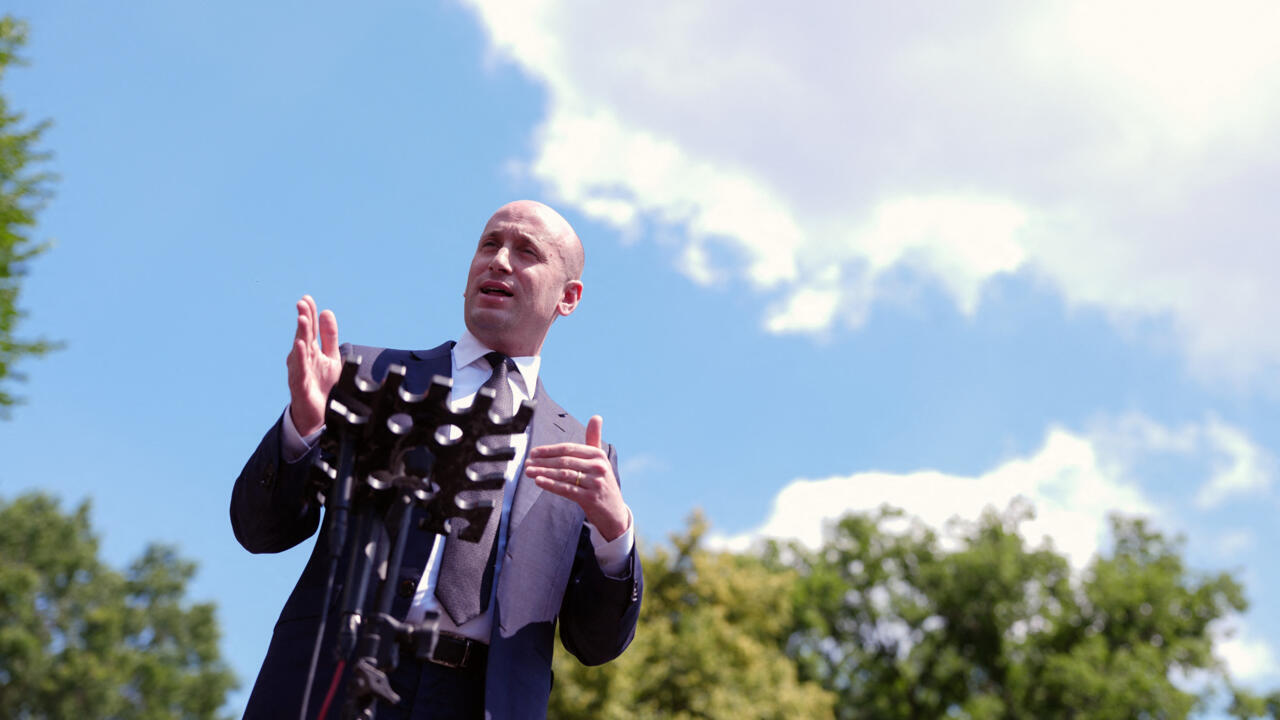

White House Deputy Chief of Staff Stephen Miller speaks to the media outside the White House on May 30, 2025 in Washington, DC. © Getty Images via AFP


Stephen Miller no longer feels at home in his country. As tens of thousands of people across Los Angeles took to the streets last weekend to protest against a wave of immigration enforcement raids on workplaces and warehouses in the city’s garment district, the deputy White House chief of staff took to social media to square off against Californian Governor Gavin Newsom.

“Huge swaths of the city where I was born now resemble failed third world nations,” he wrote. “A ruptured, balkanised society of strangers.”

Miller has become the face of US President Donald Trump’s anti-immigration policies at their most militant. He is a figure who increasingly frames his calls for mass deportations as a public safety measure to keep the West free from foreign invaders pouring in from the global South – despite the government's own findings that even illegal immigrants commit crimes at dramatically lower rates than US-born nationals.

During Trump’s first term in the White House, Miller was the key architect of the president's “Muslim ban”, a 2017 executive order that banned people from six Muslim-majority countries from entering the US.

Miller was also a vocal supporter of the policy of deliberately separating children from their parents at the Mexican border to discourage families from trying to seek asylum – a practice that reached new heights as a deliberately punitive measure under Trump.

Miller has hardly softened since his return to the halls of the White House. Weeks before the wave of armed US Immigration and Customs Enforcement (ICE) raids on workplaces set off mass demonstrations in Los Angeles, Miller hammered the agency’s leadership for its failure to make arrests at a rate that would allow Trump to keep his pledge to deport a million undocumented migrants in his first year.

What the country needed, he said, was 3,000 arrests each and every day – a dizzying increase from the daily average of about 650 in the president’s first five months in office. As of 2023, more than 13.7 million people were believed to be living in the US without legal authorisation, according to the Migration Policy Institute.

The mass demonstrations that greeted this rise in arrests has so far not deterred the administration. Echoing Miller’s warnings of degenerating inner cities overrun with foreign invaders, Trump on Monday called on ICE to ramp up their raids in Democratic-run cities such as Los Angeles, New York and Chicago, accusing the Democratic Party – without evidence – of using millions of undocumented migrants to artificially bloat their voter base and steal elections.

“I have directed my entire Administration to put every resource possible behind this effort, and reverse the tie of Mass Destruction Migration that has turned once idyllic Towns into scenes of Third World Dystopia,” he wrote on social media.

Rut Bermejo Casado, associate professor in politics and public policies at the Universidad Rey Juan Carlos, said that Miller had played a powerful role in changing the public debate around immigration during the Trump interregnum.

“I think he's key,” she said. “He has had time to strategically plan his policies from the first administration to the second one, and he has refined the coherence of the discourse – a cultural nativist discourse. During the first administration, [the Muslim ban] or the policy about separating families were just initiatives, not very well planned in advance. He has since had time to plan the discourse and the methods very well, to do it in a more rational way, and also to make it more difficult to … stop all of them.”
Enfant terrible

Miller, 39, rose quickly from being a congressional staffer to sit at the right hand of the president of the United States. Born and raised in the wealthy liberal enclave of Santa Monica in southern California, Miller found himself thrust into the state school system after an earthquake devastated a number of rental properties managed by his family’s real estate business.

In high school, Miller quickly made a name for himself as an arch-contrarian with a taste – and talent – for provoking his liberal peers. In a school divided between largely working-class Latinos and children from wealthier White families, he railed against his classmates’ supposed lack of “basic English skills” and the school’s policy of making announcements in both Spanish and English.

Classmates recall a young Miller ostentatiously leaving his garbage lying around for custodial workers to clean up, at one point standing up to deliver a now-infamous speech calling on his classmates to throw their leftovers on the ground, according to Jean Guerrero's book, "Hatemonger: Stephen Miller, Donald Trump, and the White Nationalist Agenda."

“Am I the only one who is sick and tired of being told to pick up my trash when we have plenty of janitors who are paid to do it for us?” he said.

Warming to his role, the teenage Miller became an unrelenting critic of the school administration’s allegedly liberal leanings and soon caught the attention of Larry Elder, a right-wing radio host who would have the ferociously articulate Miller on as a guest more than 70 times.

At North Carolina's elite Duke University, Miller quickly leveraged his growing media presence and ties with right-wing ideologues such as David Horowitz to land a gig as a bi-weekly columnist for the campus newspaper. Flourishing in the tense climate of the US War on Terror, he was the national campus coordinator of Horowitz’s Terrorism Awareness Project, designed to warn students of "Islamofascism", the threat of Islamic jihad and “mobilise support for the defence of America and the civilisation of the West”.

His big break came when three White lacrosse players were accused of raping a Black woman who had been hired to strip for them. Miller’s outspoken support for the three men became a constant refrain across the national right-wing media landscape, with the college junior appearing on the Bill O’Reilly Show and Nancy Grace to denounce what he called “the moral bankruptcy of the left’s politically correct orthodoxy and the corruption of our culture”.

When the players were found not guilty after a four-month secret investigation by the state attorney general, Miller championed it as a vindication of his view that the US had become a hostile place for White Americans.

“Three of our peers faced a devastating year-long persecution because they were White and their accuser Black,” he wrote.
Rising star

Miller’s newfound national celebrity catapulted him into the fast-radicalising world of Republican politics, where he landed his first job as press secretary first to Tea Party heavyweight Michelle Bachmann and then Alabama senator Jeff Sessions.

While working for Sessions, Miller played a key role in torpedoing a bipartisan immigration bill that would have tightened border security while providing a pathway to citizenship for millions of undocumented migrants in the US. The proposed legislation’s collapse would mark an abrupt end to the Republican party’s efforts to reach a compromise on undocumented migration, wilting before the onslaught of rising far-right calls for mass deportations.

It was during these formative years that Miller would deepen his contacts with far-right figures such as Steve Bannon, frequently lobbying his publication Breitbart to cite reports from the explicitly anti-immigration Centre for Immigration Studies, a think-tank founded by the eugenicist John Tanton.


THE SMIRK
01:40© France 24


In leaked emails, he enthusiastically encouraged the publication to draw comparisons between US immigration policy and Le Camp des Saints, a French dystopian novel popular across the far right that imagines refugees from the global South flooding the West and overwhelming its White population.

When Trump announced his presidential bid with a promise to crack down on irregular immigration and build a wall on the Mexico border, Miller launched himself into the campaign.

Bermejo Casado said that Miller and his allies had been instrumental in the growing militarisation of immigration policy in the US.

“If they say that we are in a crisis, we are in an exceptional time, we need exceptional measures, that brings onto the table methods and tools that were unpalatable or would be considered draconian if we were in another moment,” she said.
No more half-measures

During Trump’s first term, Miller led the fight to dismantle Obama’s Deferred Action for Childhood Arrivals, a programme giving short-term renewable protections to undocumented migrants who had been brought to the US as children. He fought for, and won, a sharp reduction in the number of refugees accepted by the US each year – despite the fact that Miller’s own family fled to the US at the turn of the century to escape anti-Semitic pogroms in the Russian Empire.

Kathleen Bush-Joseph, a lawyer and policy analyst with the Migration Policy Institute’s US Immigration Policy Program, said that the US’s longstanding gridlock over immigration reform had given Trump a powerful platform on which to call for drastic action.

“The fact that the US immigration system is so outdated and overwhelmed and under-resourced means that yes, Trump has been able to exploit some of these really long-standing problems,” she said. “In terms of the politics, even under the Biden administration there were leaders of so-called sanctuary jurisdictions who were calling for more federal action. They wanted coordination of new arrivals, they wanted help with the reception of tens of thousands of people who didn’t have community ties that were trying to go into these city shelters – which are not designed for receiving immigrant families in such large numbers. So some of this is really a reflection at the end of the day of congressional inaction.”

She said that the relentless spectacle of armed ICE raids and military planes packed with shackled deportees were designed to send a very clear message to Trump’s base.
'Manufactured crisis of the nation: Stephen Miller depicting L.A. protests as an existential fight'
18:36
FRANCE 24 © 2025


“There’s rhetoric, and there are images,” she said. “And there are these high-profile moves like Alien Enemies Act deportations, putting people in jail in El Salvador, sending people to Guantanamo Bay, using military planes for deportations. These are a very calculated part of the administration’s rhetoric and narrative, and the story that they're trying to tell about immigration. And while those moves are happening, they've been laying the groundwork for doing the things that will actually lead to the deportation of large numbers of people over time – because the high-profile ones are not that.”

Despite Miller’s zeal, though, the ICE raids that set off the Los Angeles protests reveal the extent to which the Trump administration has been hard-pressed to deliver on its promised mass deportations. Liam Haller, a researcher at the German Centre for Integration and Migration Research, said that ICE just didn’t have the means to make Miller’s dream a reality.

“While immigration hawks such as Miller have certainly achieved short-term policy implementations such as increased ICE raids, long-term or fundamental reforms remain elusive,” he said. “Although the ICE raids have garnered much attention and significant blowback, the agency is fundamentally constrained. They still do not have the manpower to enact deportations on the scale originally envisioned – which is largely why deportation numbers under Trump's second term still fall near where they were under Obama.”

With Trump’s “Big Beautiful Bill” potentially devoting more than $150 billion to immigration enforcement, including the hiring of 10,000 new ICE agents and the construction of new detention centres capable of housing 100,000, Miller’s dream of mass deportations may soon find itself on surer footing. In any case, Bermejo Casado said, the architect of Trump’s most hardline immigration policies had already succeeded in taking the debate around migration into muddier waters.

“I think there has been a change – before, the discourse was to control borders, to focus on irregular migrants, but I think that focus has blurred in the last years, and particularly with the far-right discourse against migration,” she said. “But it's very different, because in one case you are focusing on ‘They are not law-abiding people’ and this other one your focus is that ‘They are not like us – they are different, they are not culturally integrated’. And that is also part of the discourse of Miller.”
SPACE/COSMOS

France becomes biggest shareholder in Eutelsat, EU rival to Musk's Starlink

France on Thursday became the biggest shareholder in satellite company Eutelsat, which is widely regarded as a potential European rival to Elon Musk's Starlink. France chose to act now to avoid depending on "other powers" in the future, said President Emmanuel Macron.


Issued on: 19/06/2025 - 
By: FRANCE 24

A photograph showing the Eutelsat's logo displayed on its headquarters in Issy-les-Moulineaux, southwest of Paris, on June 19, 2025. © Martin Lelievre, AFP


The French state is set to become Eutelsat's biggest shareholder following a 1.35 billion-euro ($1.55 billion) investment that the financial ministry said will help the satellite company compete with Elon Musk's Starlink.

Debt-laden Eutelsat has garnered unprecedented attention this year from European governments seeking alternatives to reliance on US satellite companies.

"The race is on. That's why we have to take a position now and invest now. Otherwise, the whole market will be occupied and France and Europe will depend on other powers in future," Macron's office told AFP.

The 717 million-euro capital injection by the French state, which was part of an overall deal with other investors worth 1.35 billion euros, will make Paris Eutelsat's largest shareholder, raising its stake from 13 percent to just under 30 percent.


The announcement comes as competition heats up in the satellite communications sector, where Elon Musk's Starlink is a dominant player, but some governments would prefer sovereign solutions.

Eutelsat boasts more than 600 satellites since merging with British firm OneWeb in 2023, making it the world's second-largest operator of low Earth orbit (LEO) satellites, behind Starlink, and the obvious candidate as a European champion.

The company has in the past called itself "the only LEO alternative to Starlink".

"Eutelsat is a strategic asset contributing to European strategic autonomy," French Finance Minister Éric Lombard's office said.

But it remains far smaller than the American heavyweight, which has 6,000 satellites lofted into orbit by Musk's comparatively cheap, reusable SpaceX rockets.

Set to be completed by the end of this year, the capital increase is "a pivotal step in Eutelsat's strategic and financing roadmap, enabling the execution of its strategic vision", it said.

The new investment will fund a renewal of Eutelsat's satellite fleet and improve its financial situation, including through a debt restructuring.

Eutelsat is also gearing up to contribute to the Iris² network of European satellites in multiple orbits, supposed to offer communication services from 2030.
Rush for connectivity

"The war in Ukraine has shown the importance of space infrastructure for resilient communications infrastructure, whether civilian or military," Lombard's office said.

"It has also spotlighted Europe's dependence on non-European technology."

Musk has called Starlink the "backbone" of the Ukrainian army because of its wide use defending against Russia's invasion since 2022 – and warned that "their entire front line would collapse if I turned it off", sending Europeans scrambling for alternatives.

Eutelsat had already this week signed a 10-year, billion-euro deal at the Paris Air Show to provide military communications for the French armed forces.

And presenting its latest quarterly results last month, the firm said it was in active sales talks with governments both inside and outside Europe.

Major shareholders stumping up money alongside Paris are shipping giant CMA CGM, Indian telecoms operator Bharti Airtel and the FSP investment fund, owned by seven French insurance companies.

The two-stage plan includes a "reserved" capital increase open only to the four named investors, with a second round open to others.

"Discussions are ongoing" with other investors including the British government, "which could join the capital raise in due course", Eutelsat said.

(FRANCE 24 with AFP)

British surgeon says witnessed ‘indiscriminate bombing of the entire population’ in Gaza

19/06/2025 - 
09:17 min
From the show

A British surgeon who has been traveling to and from Gaza to provide medical aid has spoken to FRANCE 24 about her frustration that the situation there is not fully recognised globally. Doctor Victoria Rose has completed several block stints in hospitals in Gaza, working to save lives. She says that what she witnessed is often suppressed or dismissed as fake news, but in reality, she has seen the indiscriminate bombing of the entire population. She spoke to us in Perspective.


Violence against children in conflict hit 'unprecedented levels' in 2024, UN report says


Violence against children in war zones surged to "unprecedented levels" in 2024, a UN report said Thursday, with the Palestinian territories occupying top spot in the dismal rankings. The report documented 41,370 grave violations, the highest since global monitoring began nearly 30 years ago.


Issued on: 20/06/2025 
By: FRANCE 24

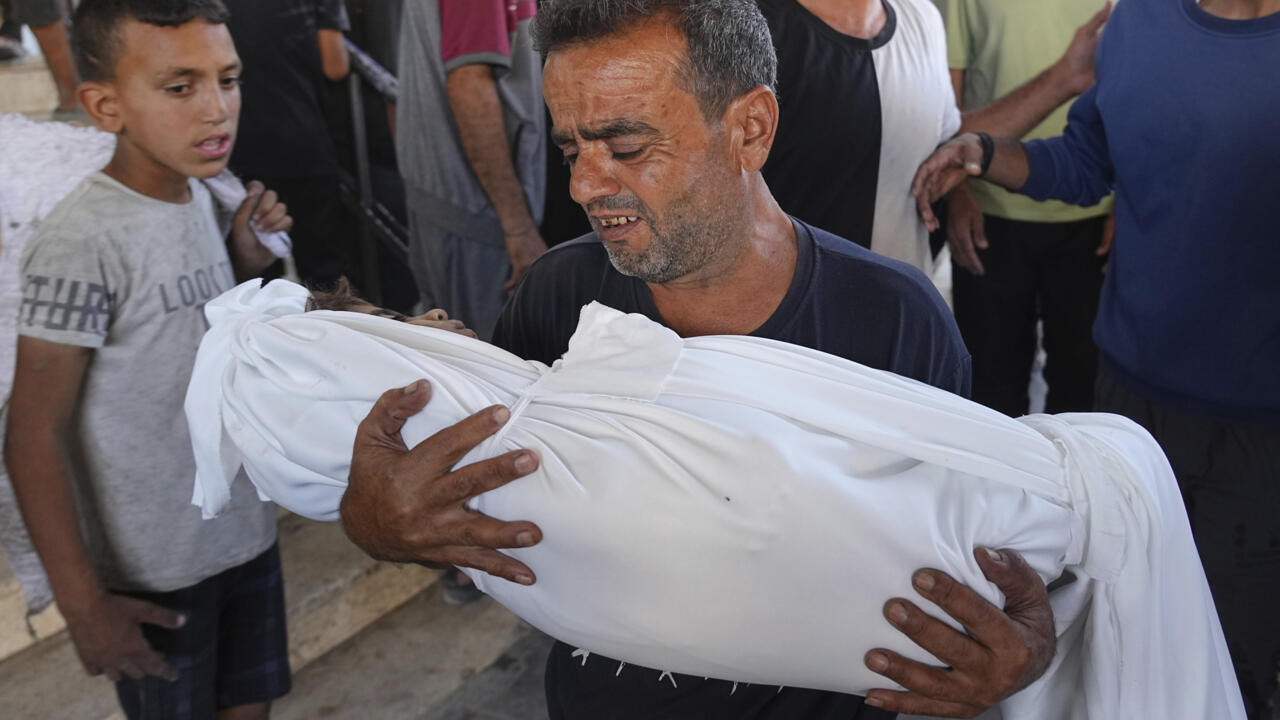
A Palestinian man carries the body of his child who was killed in an Israeli military strike on Gaza, at Al-Shifa Hospital in Gaza City, Thursday, June 19, 2025. © Jehad Alshrafi, AP

From Gaza to the Democratic Republic of Congo, violence against children in conflict zones reached "unprecedented levels" in 2024, a United Nations annual report said Thursday.

"In 2024, violence against children in armed conflict reached unprecedented levels, with a staggering 25 percent surge in the number of grave violations in comparison with 2023," according to the report from UN Secretary-General Antonio Guterres.

The report verified 41,370 grave violations against children in 2024 -- including 36,221 committed in 2024 and 5,149 committed previously but confirmed in 2024 -- the highest number since the monitoring tool was established nearly 30 years ago.

The new high beats 2023, another record year, which itself represented a 21 percent increase over the preceding year.

With more than 4,500 killed and 7,000 injured, children continue to bear "the brunt of relentless hostilities and indiscriminate attacks," the report said.

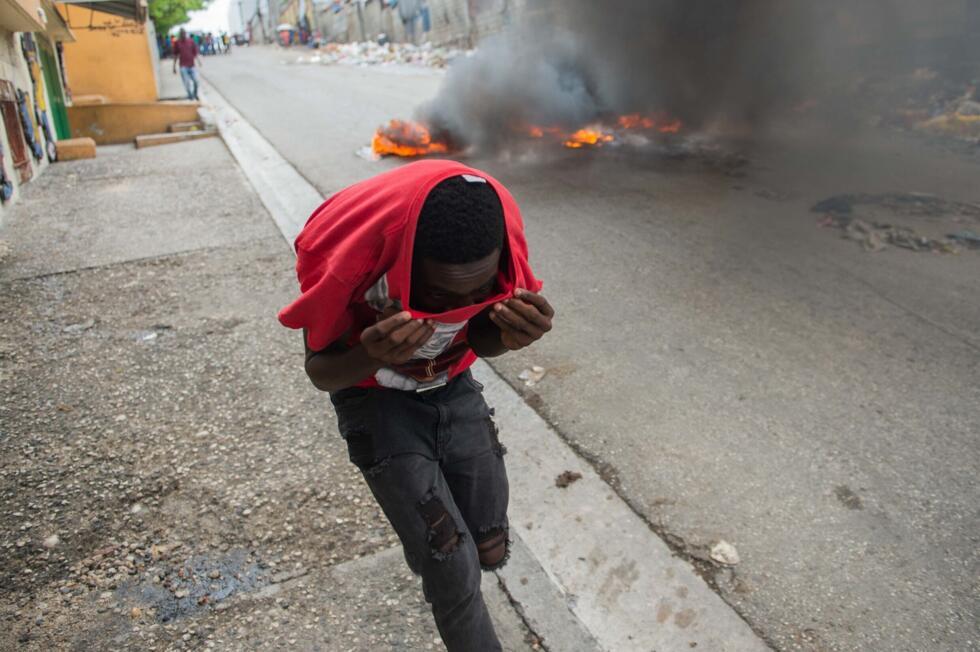
A man runs near burning tires during a protest against insecurity in Port-au-Prince 
Haiti on April 16, 2025. © Clarens Siffroy, AFP

There was also a marked increase in the number of child victims of multiple violations to 22,495.

"The cries of 22,495 innocent children who should be learning to read or play ball -- but instead have been forced to learn how to survive gunfire and bombings -- should keep all of us awake at night," said Virginia Gamba, special representative of the UN secretary-general for children and armed conflict.

"This must serve as a wake-up call. We are at the point of no return."

In its annual report, the UN compiles violations of the rights of children, those aged under 18, in some 20 conflict zones around the world.

In its appendix, a "list of shame" calls out those responsible for these violations -- a powerful coalition of Haitian gangs was added this year -- which include child killings and mutilations, recruitment to violence, kidnappings, denial of humanitarian aid and sexual violence.

The Israeli armed forces, which were named last year along with Palestinian militant group Hamas, remain on the list.

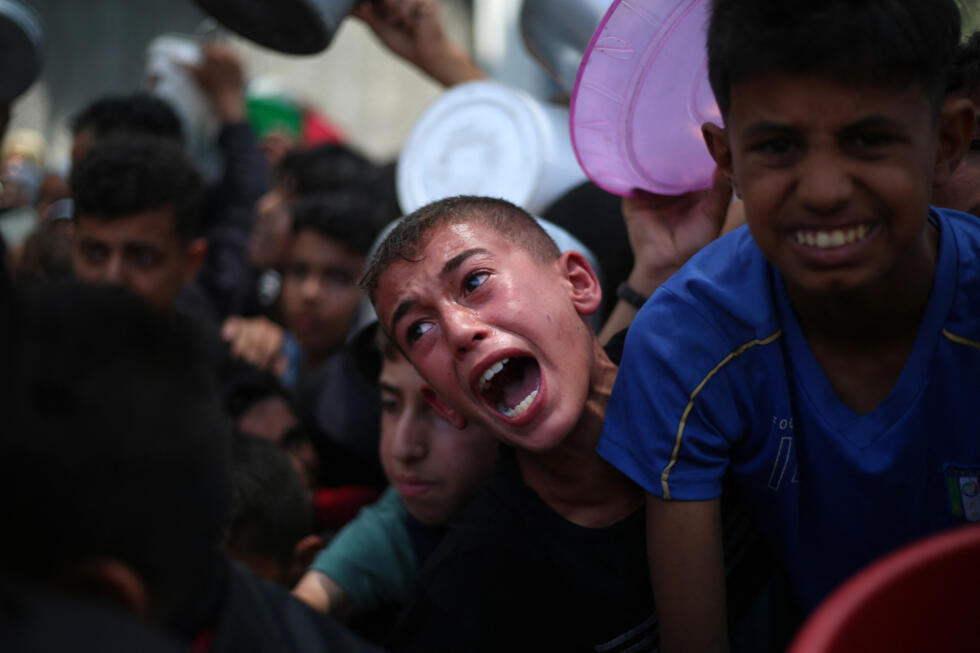
Palestinian children wait for food at a distribution point in Nuseirat, in the central Gaza Strip, on June 11, 2025. © Eyad Baba, AFP


Conflict casualties

The Palestinian territories occupy the top spot in the dismal rankings, with more than 8,500 serious violations, the vast majority attributed to Israeli forces, including more than 4,800 in the Gaza Strip.

This figure includes confirmation of 1,259 Palestinian children killed in Gaza, and the UN notes it is currently verifying information on an additional 4,470 children killed in 2024 in the war-torn territory.

Violence erupted there following Hamas's unprecedented attack on Israel on October 7, 2023.

The report also calls out Israel's military operations in Lebanon, where more than 500 children were killed or injured last year.

Following the Palestinian territories, the countries where the UN recorded the most violence against children in 2024 are: the Democratic Republic of the Congo (more than 4,000 grave violations), Somalia (more than 2,500), Nigeria (nearly 2,500), and Haiti (more than 2,200).

"List of shame" inductees include Haitian gang coalition "Viv Ansanm," blamed for a 490 percent increase in violations, including child recruitment, murders and gang rapes.

Another addition to the list is Colombian drug cartel Clan del Golfo, which is accused of child recruitment.

Colombia in general recorded a significant increase in cases of forced recruitment, with 450 children in 2024 compared to 262 the previous year.

Remaining on the list are the Sudanese army and the paramilitary Rapid Support Forces, which have been fighting in Sudan for more than two years.

Also listed again is the Russian army for its actions in Ukraine, where the report records a 105 percent increase in serious violations between 2023 and 2024.


One million Haitian children face 'critical' food shortage, says UN


More than one million children in Haiti are suffering critical food shortages due to violence, displacement and limited aid access, UNICEF said Thursday. Nearly 2.9 million children – one in four – face severe food insecurity, per the global hunger monitoring system IPC.


Issued on: 18/04/2025 - 
By FRANCE 24

Residents walk past a burnt car blocking the street as they evacuate the Delmas 22 neighborhood to escape gang violence in Port-au-Prince, Haiti, on May 2, 2024. © Ramon Espinosa, AP


More than one million children in Haiti are suffering "critical" food shortages as a result of chronic violence, displacement and restricted access to humanitarian aid, the UN children's agency said Thursday.

"We are looking at a scenario where parents can no longer provide care and nutrition to their children as a result of ongoing violence, extreme poverty, and a persistent economic crisis," UNICEF's representative in Haiti, Geeta Narayan, said in a statement.

Across most of Haiti, armed violence is causing a "nutrition crisis for families", the agency said.

Since the start of 2025, "UNICEF and its partners have treated over 4,600 children with severe acute malnutrition" which was "only 3.6 percent of the 129,000 children projected to need life-saving treatment this year", the body added.

According to the latest Integrated Food Security Phase Classification (IPC) used by international aid bodies, about 2.9 million children "are facing consistently high levels of food insecurity across the country" – or around one in four in Haiti.

01:49© FRANCE 24

Violence is also increasingly cutting off access to health care, including life-saving treatments, "putting children at greater risk of various forms of malnutrition and preventable disease", UNICEF said.

In Haiti's capital Port-au-Prince, less than half of health facilities are in full operation, with two of the three main public hospitals "out of commission".

"Just as needs intensify, the response is increasingly constrained by funding shortfalls", UNICEF highlighted.

Its nutrition scheme is part of a Humanitarian Action for Children appeal that is short of 70 percent of needed funds.

(FRANCE 24 with AFP)


Marseille museum showcases rich history of Mediterranean tattooing


Health risks from Israeli strikes on Iran’s nuclear sites are currently low. That could change fast

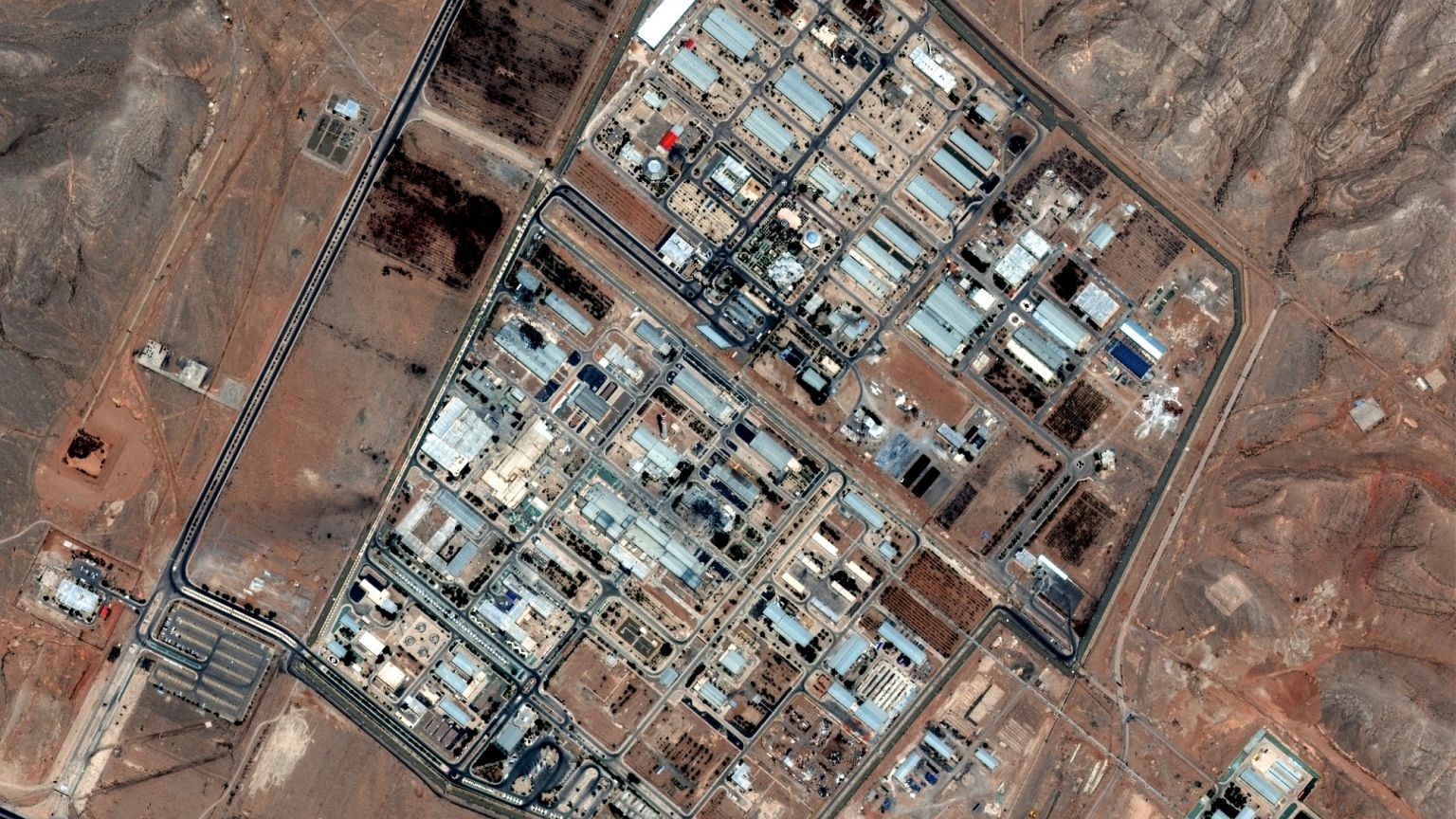
This satellite image provided by Maxar Technologies shows the Isfahan enrichment facility in Iran after being hit by Israeli airstrikes, on June 14, 2025.
Copyright Maxar Technologies via AP Photo

By Gabriela Galvin
Published on 

The attacks have raised fears about nuclear contamination that could raise health risks.

As the conflict between Israel and Iran intensifies, air strikes on Iran’s nuclear sites could have serious health consequences across the region.

Monitoring groups have not yet documented any such impact. On Monday, the International Atomic Energy Agency (IAEA), the United Nations’ nuclear watchdog, said it had not identified radiation leaks as a result of Israeli strikes that began Friday and have killed hundreds of people in Iran.

But that could change quickly as the attacks continue.

Tedros Adhanom Ghebreyesus, chief of the World Health Organization (WHO) said Tuesday that he is worried about “the targeting of nuclear sites, which may have immediate and long-term impacts on the environment and health of people in Iran and across the region”.

Not all strikes on nuclear facilities would be the same, and an Israeli military official has said their forces plan to minimise the risk of a nuclear disaster and the consequences for civilians.

“There are gradients of risk,” Simon Bennett, who leads the civil safety and security unit at the University of Leicester in the UK and wrote a book on wartime risks to nuclear facilities, told Euronews Health.

A successful attack on a live nuclear reactor would be the most devastating to human health, spreading radioactive materials that could endanger people hundreds of kilometres away.

But Iran’s only commercial nuclear power plant, the Bushehr plant, has not been targeted or affected by the recent attacks, according to the IAEA.

Strikes thus far

Israel has targeted three key nuclear facilities: Natanz, Isfahan, and Fordo.

The sites use centrifuges to enrich uranium gas, which produces the fuel that powers civilian nuclear reactors. These centrifuges would also be central to an Iranian effort to develop nuclear weapons, which European Union officials have said must not happen.

Israeli strikes fully destroyed the above-ground plant at the Natanz facility, which is more than 100 miles from Tehran. The attacks also severely damaged the site’s below-ground operations, which contain its centrifuges.

According to the IAEA’s director general Rafael Mariano Grossi, there is both “radiological and chemical contamination” inside the Natanz facility.

During an emergency meeting on Monday, Grossi said uranium isotopes may have spread within the facility. Such a leak would consist primarily of alpha particles and would pose a “significant danger if uranium is inhaled or ingested”.

Those dangers include a higher risk of cancer and damage to the kidneys, lungs, and bones.

“However, this risk can be effectively managed with appropriate protective measures, such as using respiratory protection devices while inside the affected facilities,” Grossi added.

The level of radioactivity surrounding the site, meanwhile, “has remained unchanged and at normal levels, indicating no external radiological impact to the population or the environment from this event,” Grossi said.

Israel also hit a nuclear research facility in Isfahan on Friday, the IAEA said, damaging four buildings, including a uranium conversion plant. But there has been no sign of increased radiation there.

Potential future attacks

Israel has been eyeing an attack on the secretive Fordo fuel enrichment site, which is where many analysts believe Iran has been working on its nuclear weapons capabilities. The site, built clandestinely, was first publicly acknowledged in 2009.

Fordo is buried deep in the mountains of northern Iran, and US President Donald Trump is reportedly considering dropping a bunker-busting bomb to destroy the heavily fortified facility.

The site’s location deep below ground means that in the immediate aftermath, “the likelihood of significant contamination [in the surrounding region] is significantly reduced, if not zero,” Bennett said.

Over time, though, radioactive isotopes would be “leaching into the groundwater,” he added.

That means it will be critical that Iran allows the IAEA into the country to help manage any leaks – similarly to how the agency assists at the Chernobyl site in Ukraine, decommissioning and managing radioactive waste, Bennett said.

It’s not yet clear whether Iran will do so. One week into the conflict, it is still escalating.

“At this point, given the fog of war… everything is conjecture,” Bennett said.


Netherlands returns more than 100 Benin Bronzes looted from Nigeria

Benin Bronzes, that were stolen in Africa during colonial times, are displayed in Berlin, Germany, 15 September 2022
Copyright AP Photo

By Sarah Miansoni
Published on 

The Dutch government agreed to return 119 Benin Bronzes to Nigeria in February, and the official handover ceremony will take place on 21 June. British colonial troops originally stole the artefacts in 1897.

It took more than a century but they are finally home. The Netherlands have returned 119 Benin Bronzes to Nigeria, nearly 130 years after they were looted by British colonial troops.

This shipment is the largest physical return of Benin artefacts to Nigeria to date. The Netherlands had agreed to their transfer in February upon request from the Nigerian government.

The official handover ceremony will take place on 21 June at the National Museum in Lagos, in the presence of representatives from both nations.

“The symbolism of this occasion cannot be overemphasised and what it means for the pride and dignity of not just the Benin people, but the whole of Nigeria”, said Olugbile Holloway, director-general of Nigeria's National Commission for Museums and Monuments, in a statement.

“We thank the Netherlands for the good example set and look forward to forging even greater ties between our two nations through cultural diplomacy”, he added.

Benin Bronzes are inspected before the official handover ceremony on 21 June
Benin Bronzes are inspected before the official handover ceremony on 21 June @gbileholloway/Instagram

Most of the Bronzes were part of the Dutch State Collection and were exhibited at the Wereldmuseum in Leiden. Four items will remain on display there on a loan agreement.

“We congratulate Nigeria on their persistent advocacy for the return of the Benin Bronzes”, said Dutch Ambassador for International Cultural Cooperation Dewi van de Weerd.

“We hope that this restitution is not the final chapter, but the foundation for further cooperation between Dutch and Nigerian museums.”

The Benin Bronzes are a group of several thousand plaques and sculptures made between the 15th and 19th centuries. Artefacts include ornaments, jewellery and masks, many of which decorated the royal palace of the Kingdom of Benin, now the Southern Nigerian Edo state.

Most of these objects were stolen in 1897, during a brutal punitive expedition in which British troops killed thousands of people and looted the palace.

Following the violent raid, the Kingdom of Benin was absorbed into colonial Nigeria. The stolen pieces were eventually sold to over 130 museums in 20 countries, mostly in the United Kingdom and Germany.

The result of a long-running effort

Nigeria has relentlessly campaigned over the years to reclaim the Bronzes.

The country signed a repatriation agreement with Germany in July 2022 for the return of 1,130 Benin Bronzes. Twenty of them landed in Abuja, the Nigerian capital, in December 2022.

Nigeria also sent a repatriation request to the British Museum in October 2021. The institution retains over 900 objects from the Kingdom of Benin.

Debates over the restitution of Africa’s looted art has reached several European countries in recent years.

Benin received 26 royal treasures from France in 2021. The pieces were stolen during the 1892 colonisation of the Dahomey kingdom. Mati Diop’s 2024 documentary Dahomey chronicled the restitution process.

The Nigerian government has yet to announce how and where the newly returned Benin Bronzes will be displayed.

In the meantime, young contemporary artists from Benin city, in southern Nigeria, have put together an exhibition on “Reclaiming heritage: new narratives”, currently on display in the National Museum in Lagos.

How the water gun has become a symbol for Barcelona residents 'fed up' with the tourism industry

The phenomenon started last July, when a fringe, left-wing activist group held its first successful rally.


Copyright AP Photo/Pau Venteo

By Euronews Travel with AP
18/06/2025 - 

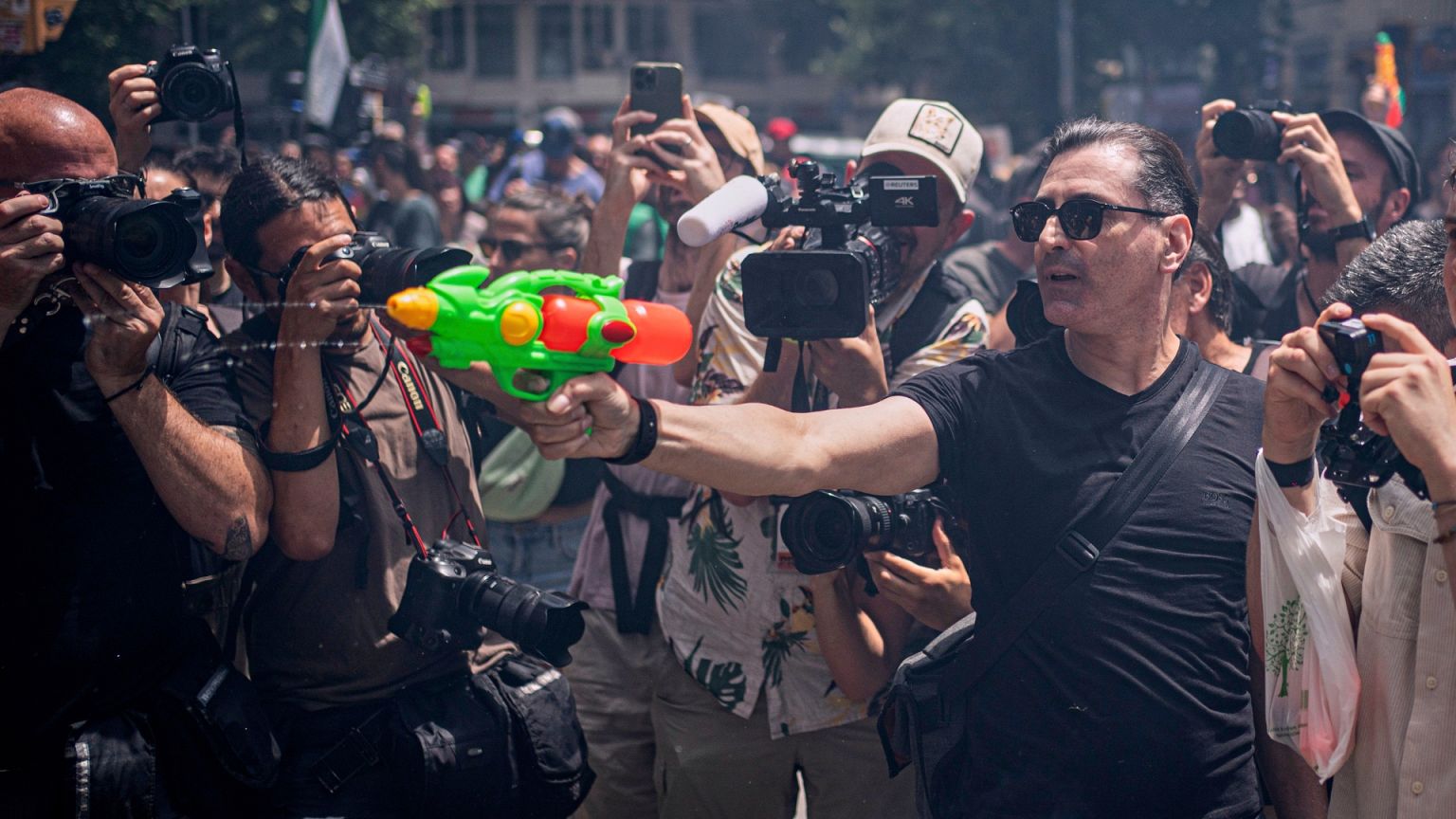
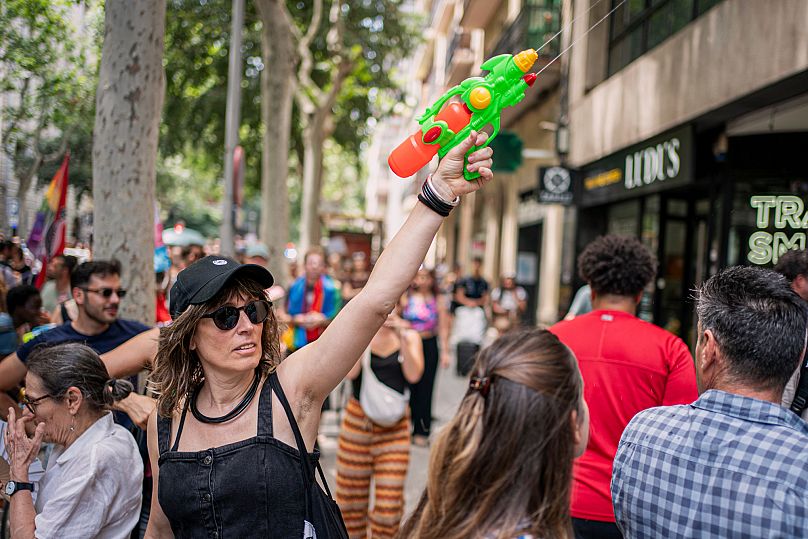
A group of tourists were sitting at an outdoor table in the Spanish city of Barcelona, trying to enjoy their drinks, when a woman raised a cheap plastic water gun and shot an arc of water at them.

Her weapon of choice - the cheap, squirt-squirt variety - is an increasingly common fixture at anti-tourism protests in the southern European country, where many locals fear that an overload of visitors is driving them from their cherished neighbourhoods.

How did the humble water gun become a symbol of discontent?

From refreshing to revolutionary

The phenomenon started last July, when a fringe, left-wing activist group based in Barcelona that promotes the “degrowth” of the city’s booming tourism sector held its first successful rally. Some brought water guns to shoot one another and stay cool in the summer heat.

“What happened later went viral, but in reality it was just kind of a joke by a group of people who brought water guns because it was hot," Adriana Coten, one of the organisers of Neighbourhood Assembly for Tourism Degrowth, told The Associated Press.

Then, some turned their water guns from each other to tourists. The images went around the world, becoming a publicity coup for the anti-tourism cause.

The guns reappeared in April when the same group stopped a tour bus in Barcelona, the Catalan capital.

Barcelona protesters carrying water guns a minority

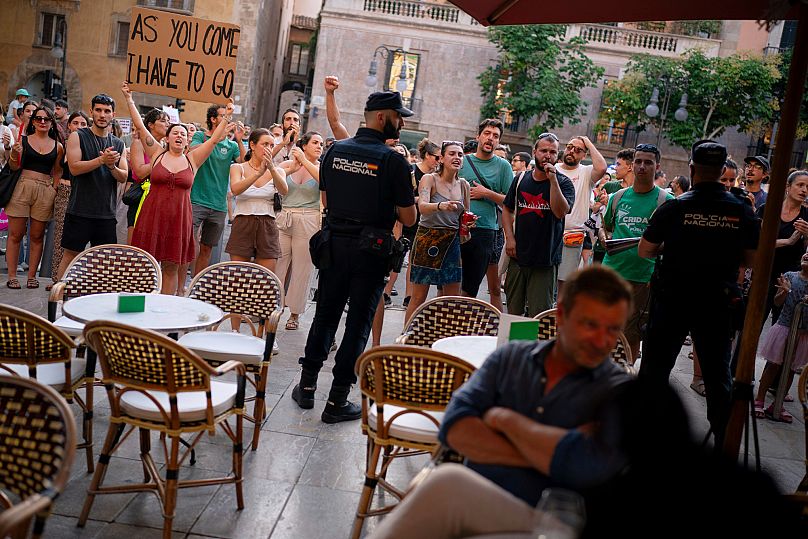
On Sunday, around a thousand people marched from a luxury shopping boulevard popular with affluent foreigners before police stopped them from getting closer to Barcelona's top sightseeing destination: La Sagrada Familia church.

The marchers spritzed unsuspecting tourists along the way, chanting slogans and carrying protest signs. One read: “One more tourist, one less resident!”

They left a trail of stickers on hotel doors, lampposts and outdoor café tables showing a squirting water gun encircled by a message in English: “Tourist Go Home!”

People demonstrate next to a restaurant during a protest against overtourism in the Balearic island of Mallorca, Spain.AP Photo/Joan Mateu Parra

Still, the number of Barcelona protesters carrying water guns was a minority, and in the gun-toting group, many were only shooting in the air or at each other. One dad was toting his baby in a front-pack, water gun in hand.

Outside the protests, Barcelona locals are not toting water guns or taking aim at tourists. And many in the city still support tourism, which is a pillar of the local economy.

‘A symbol’ of frustration


Can the water gun really change the minds of tourists, authorities or the businesses that drive the industry? Depends on who you ask.

Protester Lourdes Sánchez and her teenage daughter, each holding a water gun, said the gun "really isn’t to hurt anyone.”

“This is a symbol to say that we are fed up of how tourism industry is transforming our country into a theme park,” Sánchez said.

A protester holds a water gun during a protest against overtourism in Barcelona, Spain.AP Photo/Pau Venteo

Another demonstrator, Andreu Martínez, acknowledged it was “to bother the tourists a bit."

Laurens Schocher, a 46-year-old architect, said he didn't shoot any suspected tourists but hoped that carrying a water gun would bring more attention to their cause.

“I don’t think the tourists will get it," he said. "I think this is to send a message to authorities.”

A squirt can hurt your feelings

The marchers had no monster, pump-action water cannons that most kids use for backyard battles in the summer. Theirs were the old-school, cheap-o water guns that send a slim jet of water not that far away.

Some tourists who were sprayed took it in stride, even claiming it was refreshing on a day with temperatures pushing up to around 30 degrees Celsius.

But there were moments of tension. When several marchers squirted workers at a large hostel, tempers flared, and one worker spat at his attackers as he slammed the hostel door shut.

Nora Tsai, who had just arrived from Taiwan on a short visit, was among those spritzed on Sunday. She said she was a bit frightened and saddened. The “Tourist go home!" chants didn't help either.

“I still like Barcelona," she said. "I have met a lot of people who were kind.”


Best and funniest signs from mass No Kings protests against Trump

Best and funniest signs from mass No Kings protests against Trump
Copyright David Mouriquand


By David Mouriquand
Published on 

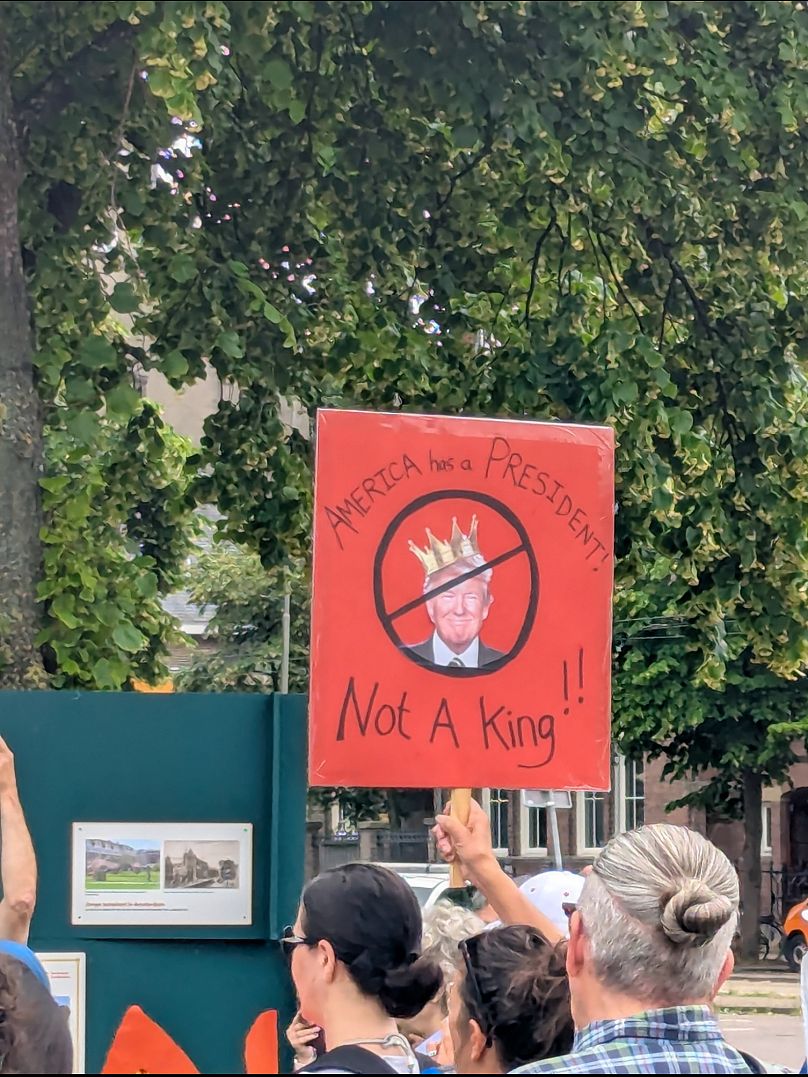
The national and international protests against President Donald Trump took place in towns and cities across the US and Europe in a coordinated event titled "No Kings". Here are some of the best placards from this weekend’s movement outside the US embassy in Amsterdam.

A stone throw's away from the American embassy in Amsterdam this weekend was held a "No Kings" protest. Except it was dubbed "No Tyrants", as countries with constitutional monarchies sought to avoid confusion with anti-monarchic movements. 

This was one among thousands of similar protests that occurred over the weekend, all with the aim to denounce Donald Trump’s overreach and to reject “authoritarianism, billionaire-first politics, and the militarization of (US) democracy.”  

The rallies, which follow the Hands Off! protests and the marches triggered by Trump sending in the National Guard in LA, were also a direct response to a military parade rolling through Washington that celebrated the US Army’s 250th anniversary – and handily coincided with Trump’s 79th birthday.

The last US military parade was held by President George HW Bush in June 1991, celebrating the victory in the Gulf War. 

More than 2,000 protests were scheduled across all 50 US states last Saturday and organizers estimate that more than five million people participated. Several European territories like Germany, France, Spain, Italy, Ireland, UK and Belgium saw protests organized by Democrats Abroad – and the Netherlands was no different.  

Outside the US consulate in Amsterdam gathered a few hundred people, and it was inspiring to see this crowd mobilize and to witness their fighting spirit.  

The speeches were short but passionate; the singing of ‘America (My Country ‘Tis of Thee)’ was heartwarming; and the megaphoned demand that demonstrators take six steps back to avoid being on the bike path was one of the perfect and Dutch-appropriate interjections I’ve ever heard.

The protest signs also showcased the creativity, humour and passion of those involved. Here are some of the best placards I saw at the Amsterdam's "No Tyrants" protest - and stay until the end for the cutest protestor ever:  


Not A KingDavid Mouriquand

Turd ReichDavid Mouriquand

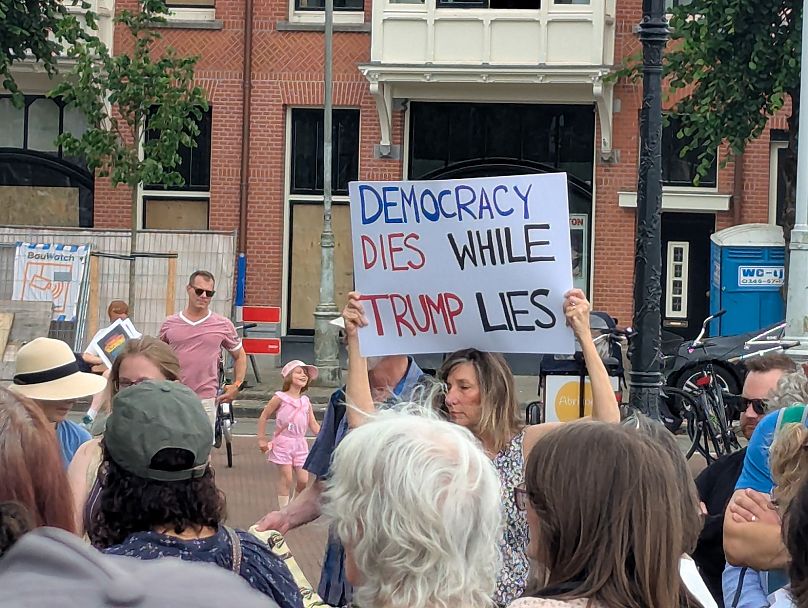
Democracy dies while Trump liesDavid Mouriquand

Dump the circusDavid Mouriquand

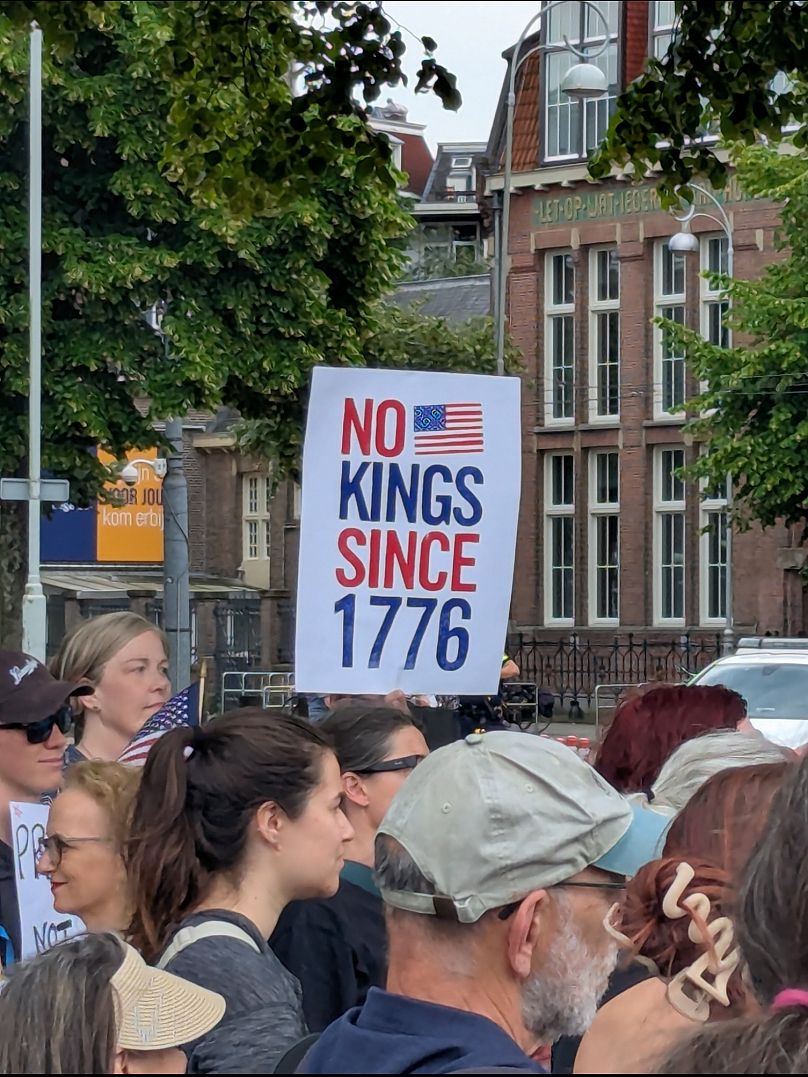
No Kings Since 1776David Mouriquand

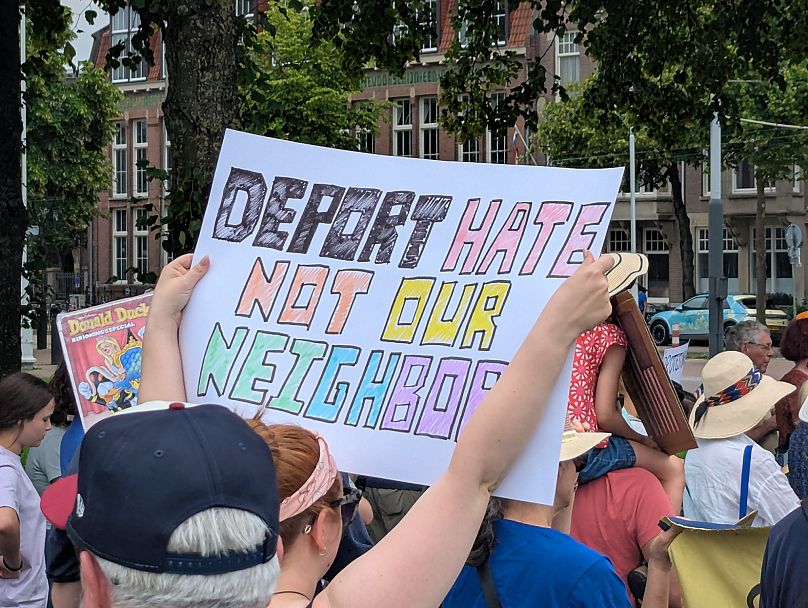
Deport HateDavid Mouriquand

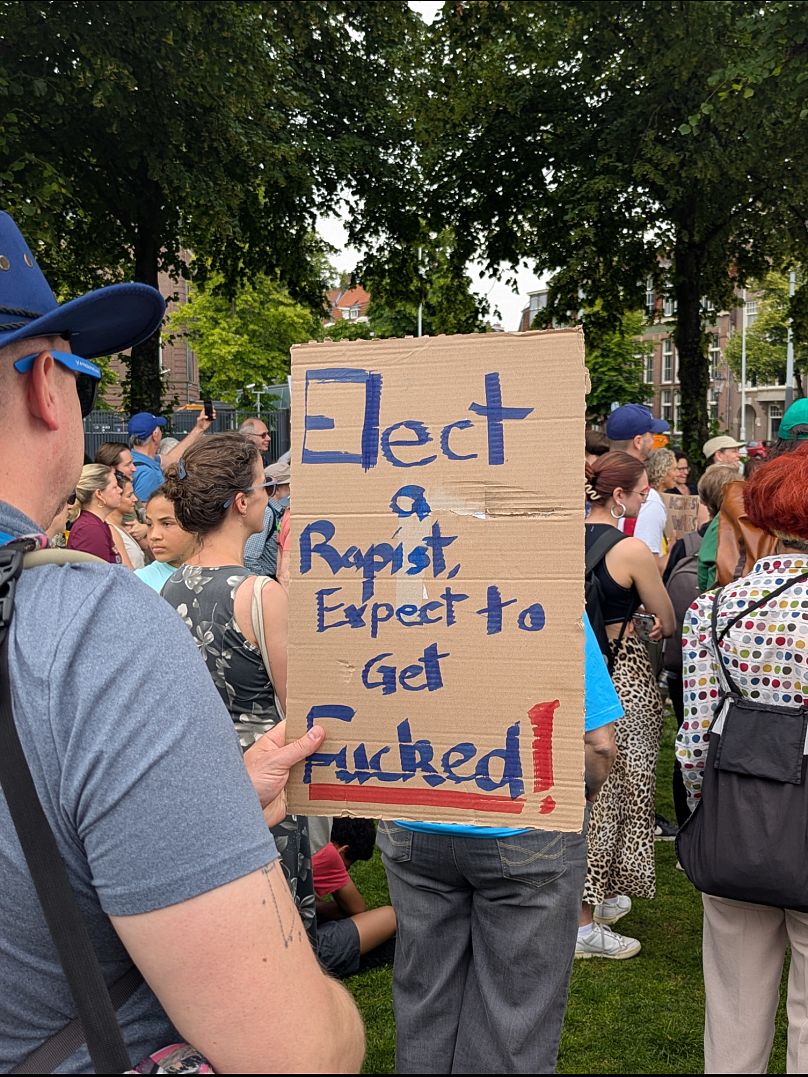
ExpectationsDavid Mouriquand

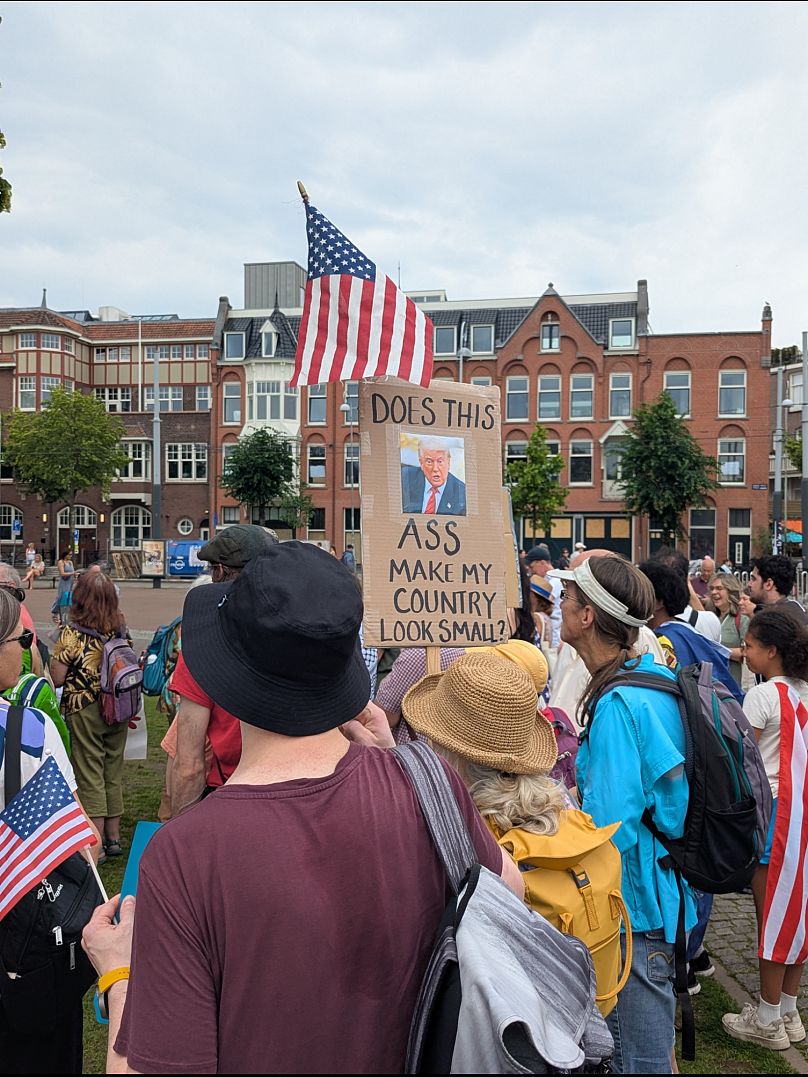
Does This Ass Make My Country Look Small?David Mouriquand

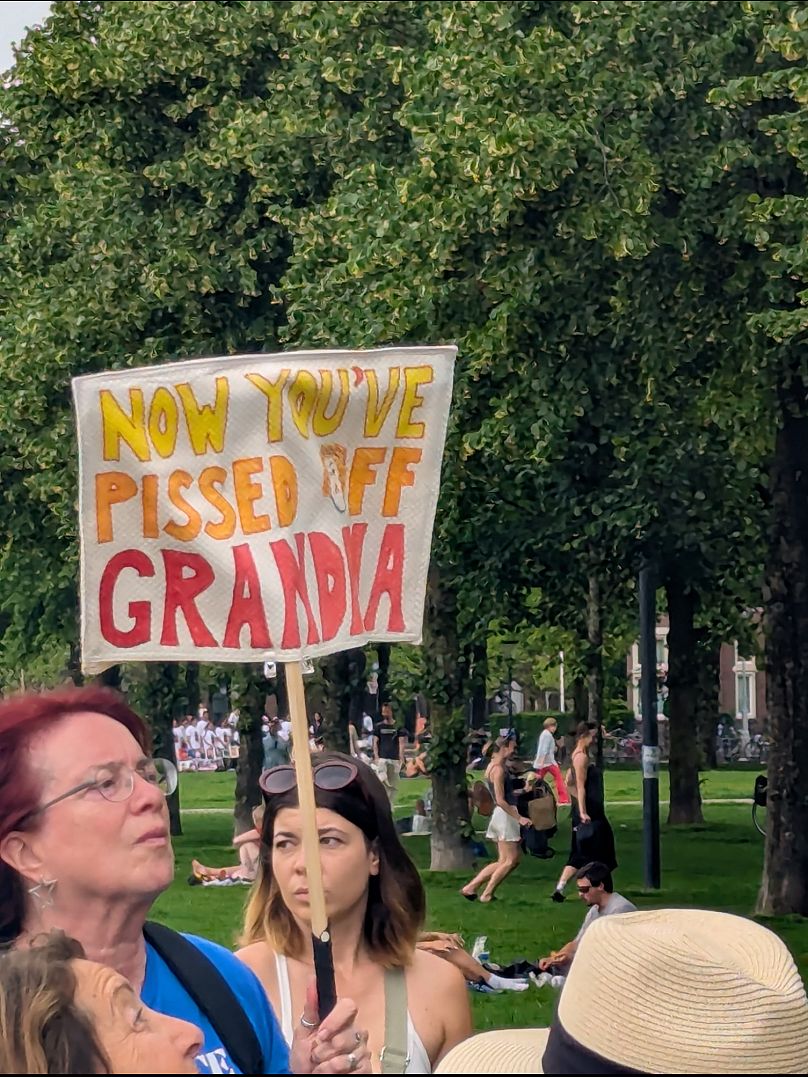
Now You've Pissed Off GrandmaDavid Mouriquand

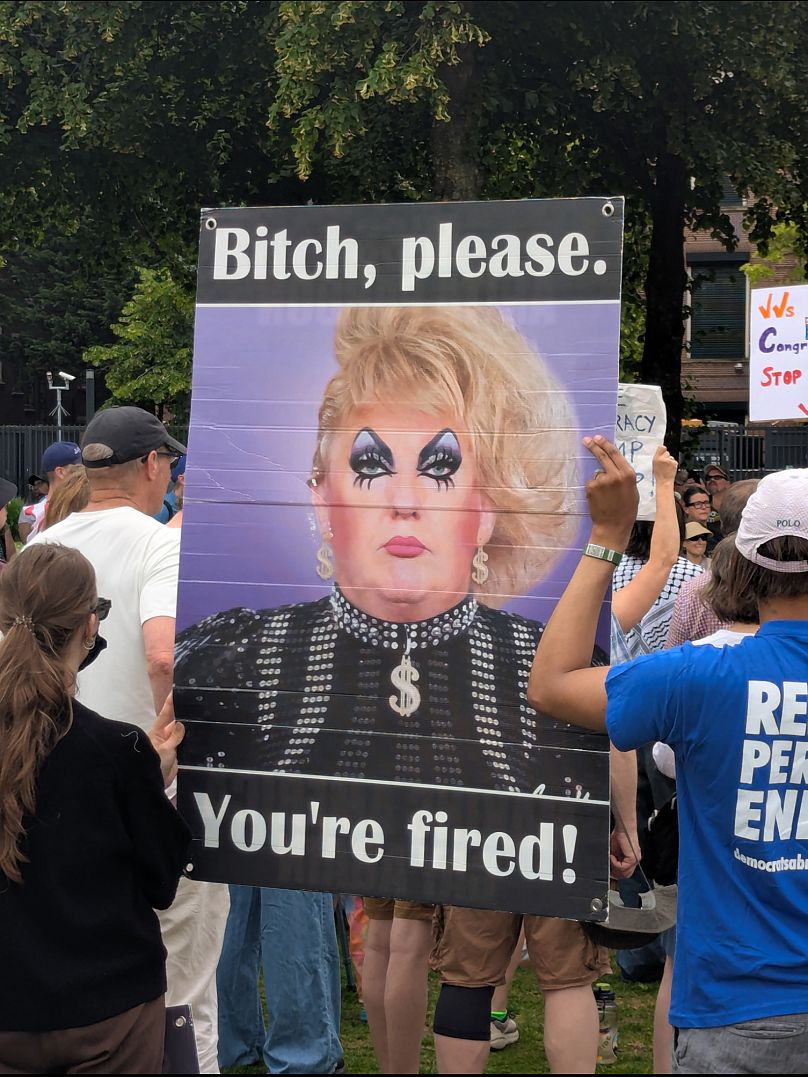
You're FiredDavid Mouriquand

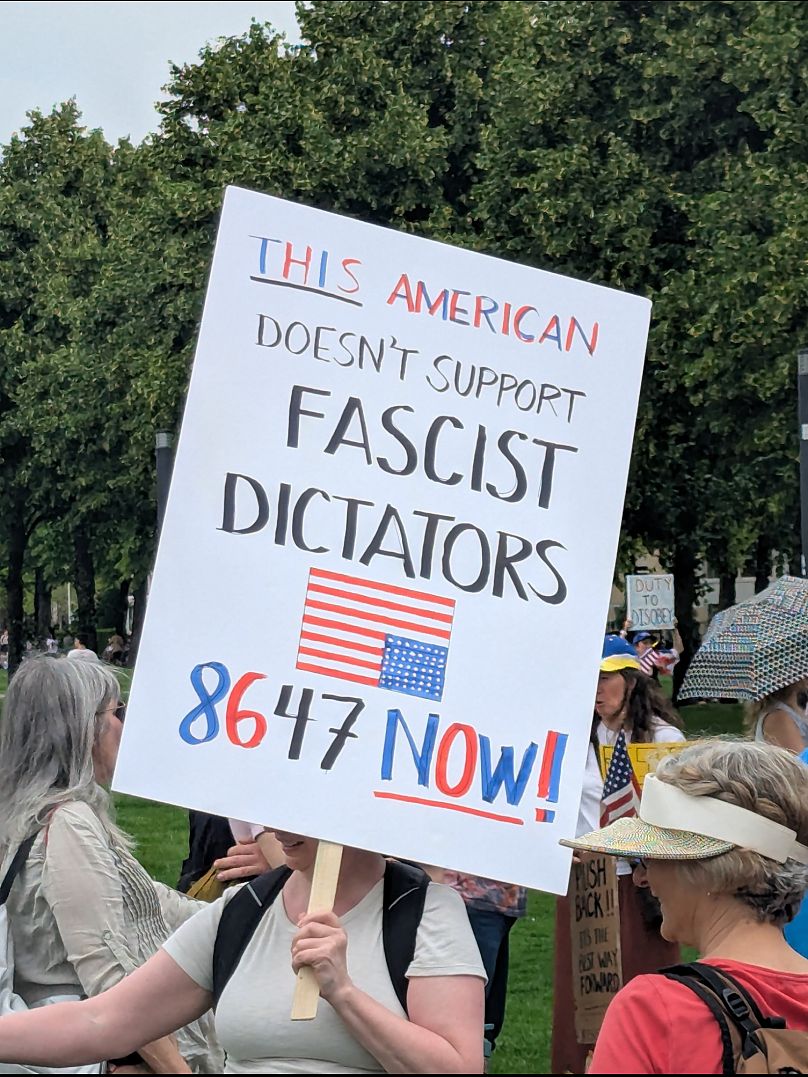
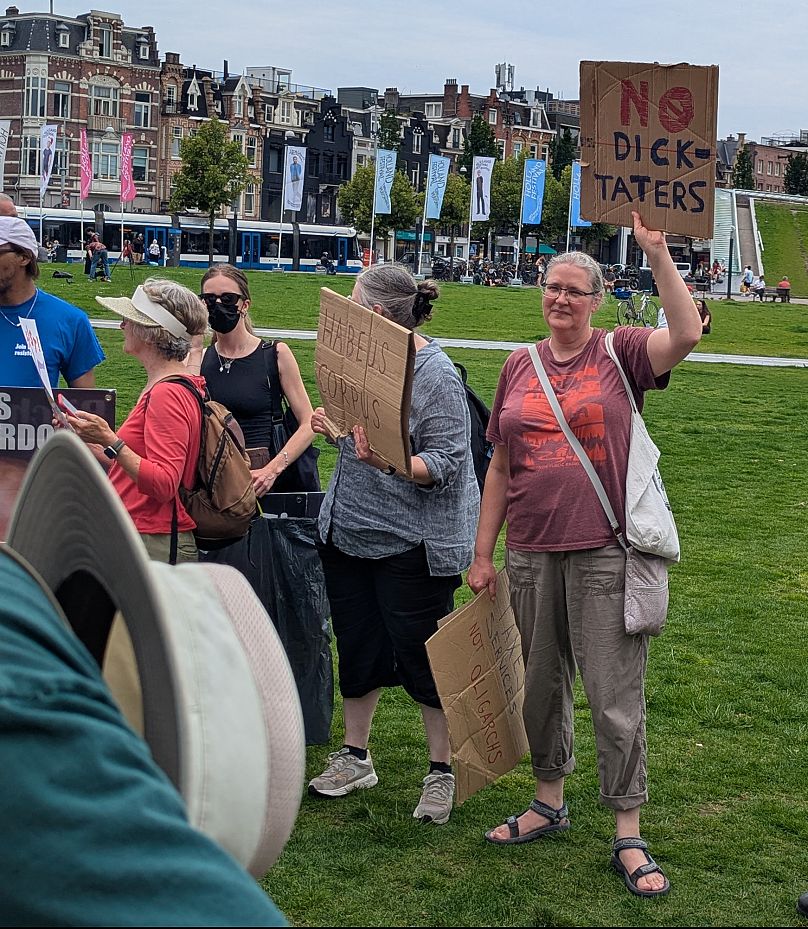
DictatorsDavid Mouriquand

Dictators IIDavid Mouriquand

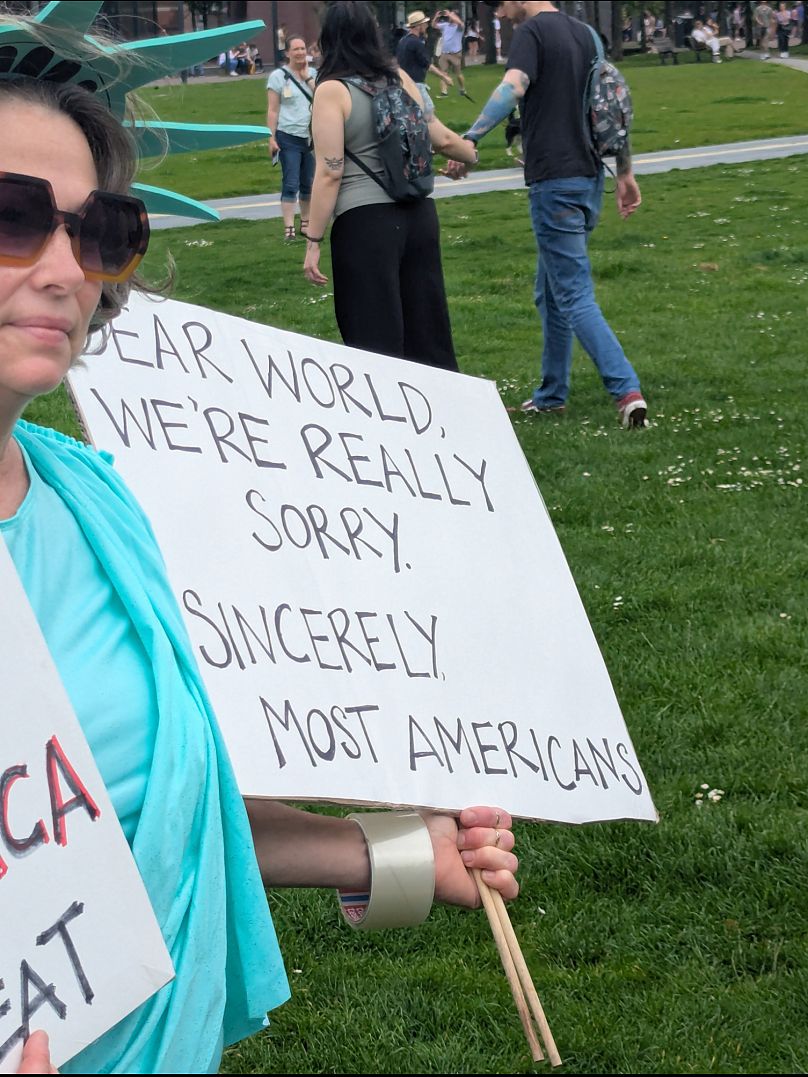
Dear World...David Mouriquand

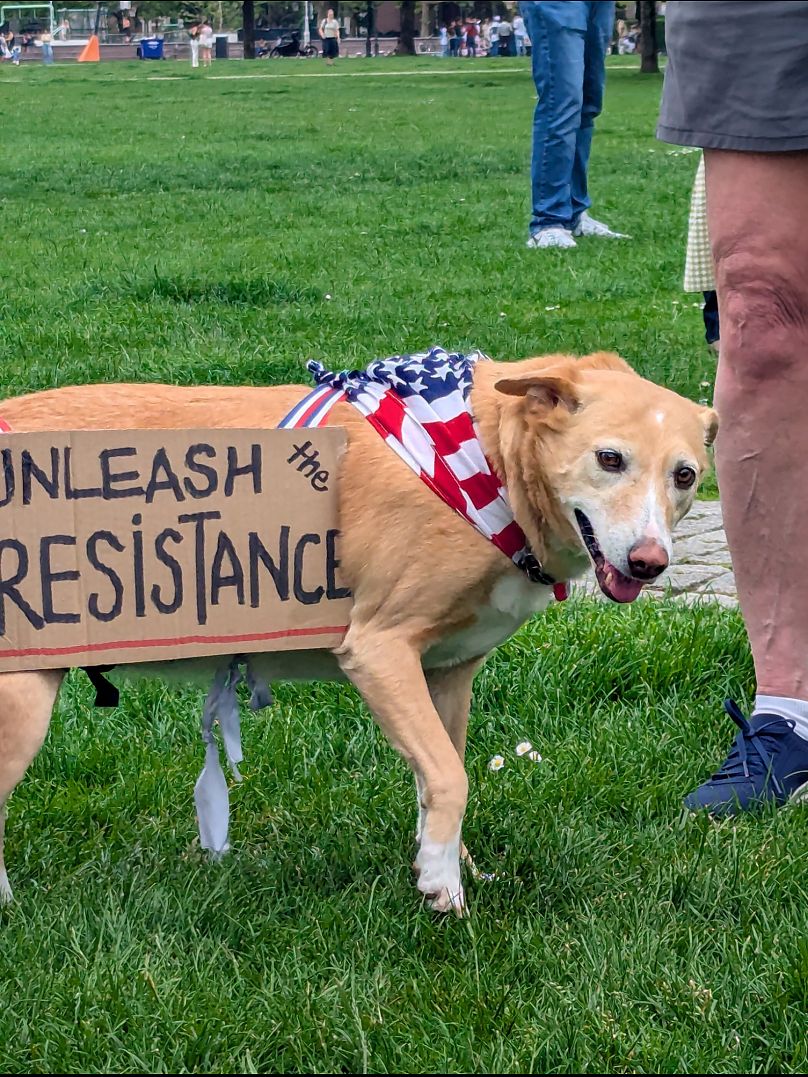
Unleash The ResistanceDavid Mouriquand

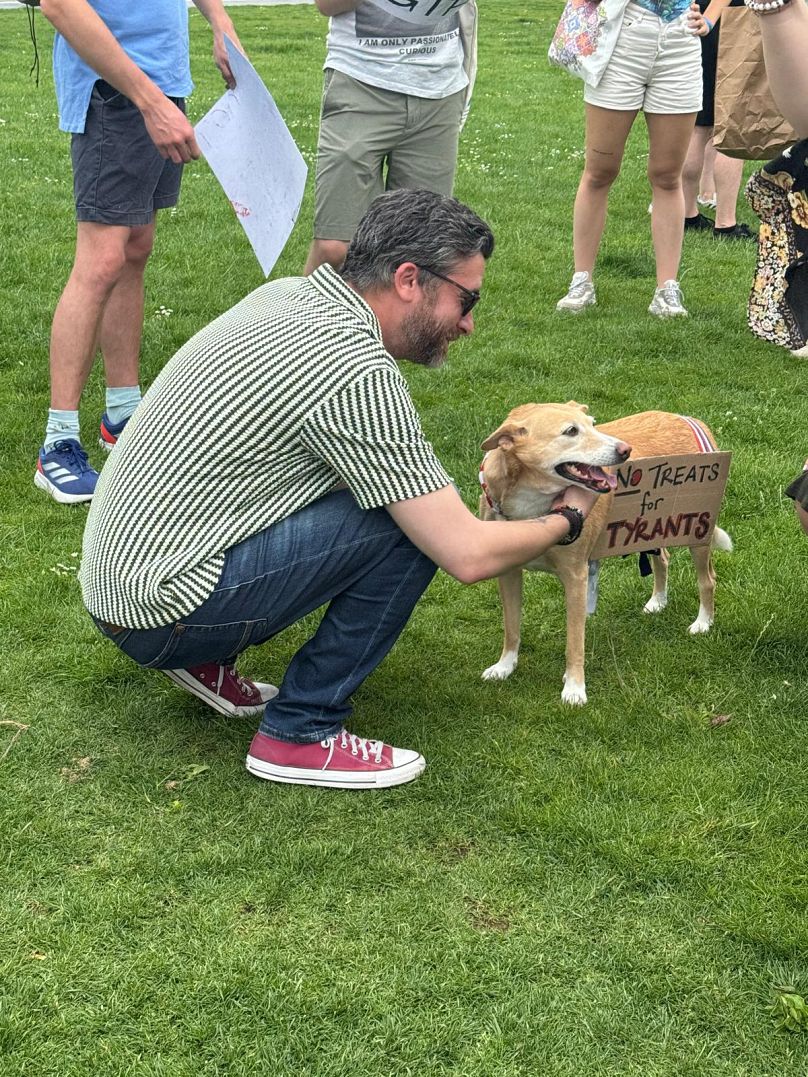
]No Treats For TyrantsErin Erginer

No Treats For Tyrants IIDavid Mouriquand