Thousands set up street blockades in Serbia after arrests of anti-government protesters
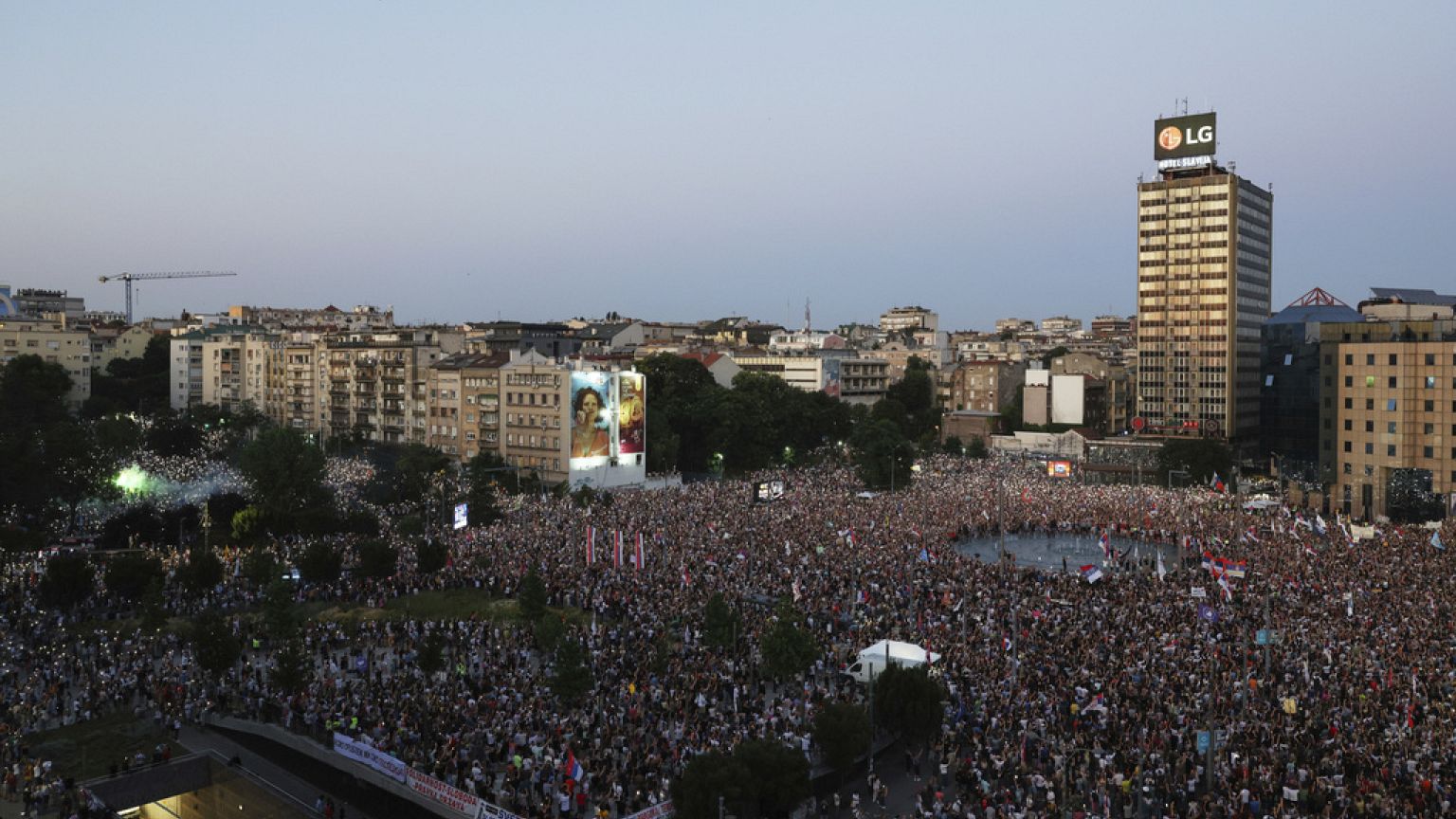 Copyright Marko Drobnjakovic/Copyright 2025 The AP. All rights reserved
Anti-government protests started after a renovated rail station canopy collapsed in November, killing 16 people. Many in Serbia blamed the tragedy in the northern city of Novi Sad on corruption-fuelled negligence in state infrastructure projects.
Thousands of people set up street blockades in Serbia on Sunday, angry over the arrest of anti-government protesters who clashed with police at a massive rally a day earlier calling for snap parliamentary elections.
Demonstrators set up metal fences and put garbage containers in various locations across the city, also blocking a key bridge over the Sava River.
Elsewhere in Serbia in the city of Novi Sad, protesters pelted the offices of the ruling populist Serbian Progressive Party with eggs.
Local media reported that similar protest blockades were organised in other smaller cities as well.
The protesters demanded that authorities release dozens of university students and other protesters who were jailed for attacking the police or for allegedly plotting to overthrow the government at a rally on Saturday in Belgrade.
Tens of thousands had gathered at that rally. They demanded early elections after months of protesters spurred by a deadly train station awning collapse blamed on government corruption.
The anti-corruption protests have been going on for eight months after the deadly collapse of the newly renovated train station canopy in the city of Novi Sad in November 2024, which killed 16 people.
Protesters declared the current populist government “illegitimate” and laid the responsibility for any violence on the government.
Clashes with riot police on Saturday erupted after the official part of the rally ended. Police used pepper spray, batons and shields while protesters threw rocks, bottles and other objects.
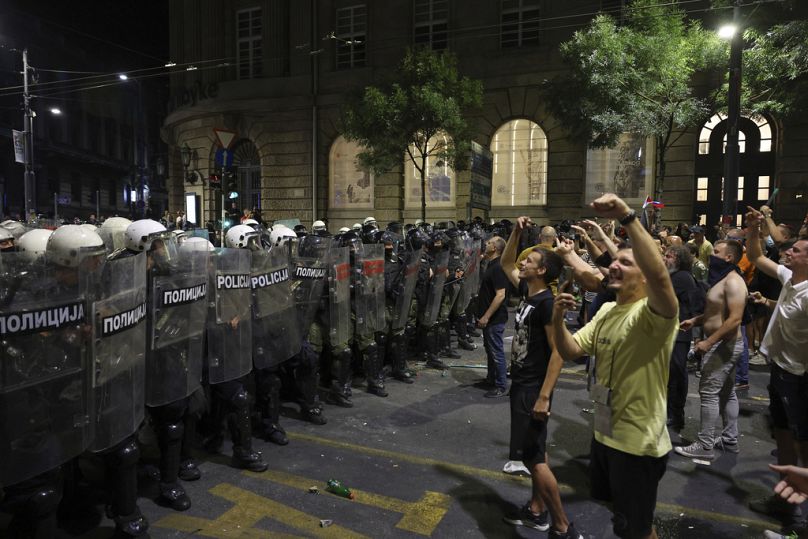 Riot police block a street to prevent clashes between anti-government protesters and government supporters at the end of a rally Marko Drobnjakovic/Copyright 2025 The AP. All rights reserved
Police said on Sunday that 48 officers were injured while 22 protesters sought medical help. Out of 77 people detained, 38 remained in custody Sunday, most of them facing criminal charges, said Interior Minister Ivica Daci
At least eight more people were detained during the day, the prosecutors said.
Serbian President Aleksandar Vučić earlier Sunday announced the arrests at a press conference, accusing organizers of the rally of inciting violence and attacks on police, urging legal prosecution.
He also criticized "terrorists and those who tried to bring down the state,” singling out University of Belgrade's head dean, Vladan Djokic, who was among the protesters.
“There will be more arrests,” Vučić said. “Identification of all individuals is underway.”
He and his ruling Serbian Progressive Party have rejected calls for early elections, accusing protesters of seeking to incite unrest under foreign influence without providing evidence.
Thousands of people set up street blockades in Serbia on Sunday, angry over the arrest of anti-government protesters who clashed with police at a massive rally a day earlier calling for snap parliamentary elections.
Demonstrators set up metal fences and put garbage containers in various locations across the city, also blocking a key bridge over the Sava River.
Elsewhere in Serbia in the city of Novi Sad, protesters pelted the offices of the ruling populist Serbian Progressive Party with eggs.
Local media reported that similar protest blockades were organised in other smaller cities as well.
The protesters demanded that authorities release dozens of university students and other protesters who were jailed for attacking the police or for allegedly plotting to overthrow the government at a rally on Saturday in Belgrade.
Tens of thousands had gathered at that rally. They demanded early elections after months of protesters spurred by a deadly train station awning collapse blamed on government corruption.
The anti-corruption protests have been going on for eight months after the deadly collapse of the newly renovated train station canopy in the city of Novi Sad in November 2024, which killed 16 people.
Protesters declared the current populist government “illegitimate” and laid the responsibility for any violence on the government.
Clashes with riot police on Saturday erupted after the official part of the rally ended. Police used pepper spray, batons and shields while protesters threw rocks, bottles and other objects.
Police said on Sunday that 48 officers were injured while 22 protesters sought medical help. Out of 77 people detained, 38 remained in custody Sunday, most of them facing criminal charges, said Interior Minister Ivica Daci
At least eight more people were detained during the day, the prosecutors said.
Serbian President Aleksandar Vučić earlier Sunday announced the arrests at a press conference, accusing organizers of the rally of inciting violence and attacks on police, urging legal prosecution.
He also criticized "terrorists and those who tried to bring down the state,” singling out University of Belgrade's head dean, Vladan Djokic, who was among the protesters.
“There will be more arrests,” Vučić said. “Identification of all individuals is underway.”
He and his ruling Serbian Progressive Party have rejected calls for early elections, accusing protesters of seeking to incite unrest under foreign influence without providing evidence.
Serbian riot police clash with anti-government protesters

Serbian riot police fired tear gas and clashed with anti-government protesters in central Belgrade late on June 28, following a largely peaceful day of demonstrations demanding snap elections.
Tens of thousands of demonstrators, led by university students, filled the streets of the capital earlier in the day in what has become the culmination of nearly eight months of persistent protests. The unrest was sparked by a fatal infrastructure collapse at Novi Sad railway station in November, and has since evolved into a broader movement challenging Vucic’s 12-year grip on power.
Tensions flared after 10 p.m. local time as riot police attempted to disperse crowds heading towards government buildings, where Vucic’s supporters had gathered earlier in the day. Clashes erupted when protesters got closer to the Presidency building, prompting a forceful response from security forces.
Student organisers, who had coordinated the day’s rally, said they lost control of the situation as authorities deployed tear gas and pepper spray. Members of the Gendarmerie issued warnings via megaphones, instructing protesters to disperse or face intervention.
According to independent broadcaster N1, journalists were injured during the scuffles. Video reports showed firecrackers, flares and cannon blasts being used as protesters attempted to breach police cordons. The confrontation was a rare escalation following months of largely non-violent demonstrations.
The unrest came amid growing pressure on the government, which has intensified its rhetoric and security measures in recent days. Authorities announced the arrests of several individuals allegedly plotting a violent uprising. State-controlled media aired footage of seized weapons, with Vucic’s ruling Serbian Progressive Party (SNS) claiming evidence of a foreign-backed “colour revolution.”

Despite the evening's violence, the protest began in a markedly different tone. Demonstrators marched peacefully through Belgrade, calling for democratic reforms and an end to corruption. Vucic has faced increasing criticism over authoritarian tendencies, control of the media and cronyism. While he remains popular in some quarters, Saturday’s events suggest a determined opposition unwilling to be silenced.
Some 140,000 protesters rally against populist Serbia govt
Some 140,000 anti-government protesters clashed with police in Serbia’s capital Saturday evening demanding the populist government hold early elections. Students have kept up protests in recent months, demanding justice for 16 people killed when a train station collapsed last November – a tragedy blamed on government ineptitude and corruption.
Issued on: 29/06/2025
By:
FRANCE 24
Video by:
FRANCE 24
Around 140,000 protesters rallied in Belgrade, the largest turnout in recent months, as student-led demonstrations mount pressure on the populist government to call early elections.
The rally was one of the largest in over half a year of student-led actions, which began in November after the roof of a train station collapsed in the northern city of Novi Sad, killing 16 people – a tragedy widely blamed on entrenched corruption.
Earlier on Saturday, a sea of protesters filled Belgrade's largest square and poured into several surrounding streets.
The Independent Protest Monitor, Archive of Public Gatherings, estimated the crowd size at around 140,000, significantly higher than the police estimate of 36,000.
Read moreWhy has the EU kept silent on Serbia’s massive protest movement?
"We want elections!" the crowd chanted, waving Serbian flags and holding banners bearing the names of cities and towns from around the country.
For more than half a year, students have blockaded universities and organised large demonstrations around the country, demanding a transparent investigation into the deaths.

But in contrast with previous gatherings, which have remained peaceful, clashes erupted between demonstrators and riot police.
AFP journalists witnessed police firing tear gas and stun grenades as protesters hurled flares at rows of police in several clashes following the huge gathering in Serbia's capital.
Police director Dragan Vasiljevic said officers had used batons after coming under attack but denied deploying "chemical agents" to disperse the crowd.
Dozens were detained, while six officers and two people were injured in the violence, Vasiljevic said.
Watch more
'We will rally as long as it takes'
Frustrated by government inaction over the tragedy, students have been calling for elections since May.
"We show once again that we will not stop," law student Stefan Ivakovic told AFP.
"We will rally as long as it takes until the demands are met."
Ahead of Saturday's protest, organisers issued an "ultimatum" for President Aleksandar Vucic to announce elections by 9pm (1900 GMT) – a demand he had rejected well before the deadline.
As the protest ended, organisers played a statement to the crowd, calling for Serbians to "take freedom into your own hands" and giving them the "green light".
"The authorities had all the mechanisms and all the time to meet the demands and prevent an escalation," the organisers said in a statement on Instagram after the rally.
"Instead, they chose violence and repression against the citizens. Any radicalisation of the situation is their responsibility."
'Foreign powers'

Following the clashes, the police minister "strongly condemned the attacks" on officers and said those responsible would be arrested.
According to pro-government media, Vucic will address the public at 11am (9 am GMT) on Sunday, although no details were confirmed.
Earlier, Vucic posted a photo of himself visiting nearby pro-government encampments outside the parliament building, issuing a message of support to an earlier counter-demonstration there.
But the crowd near the camps had dwindled significantly from its initial thousands.
The outcry over the Novi Sad disaster has already toppled the country's prime minister, but the governing party remains in power – with a reshuffled government and the president at its heart.
Vucic, who had warned of violence before the rally, has repeatedly said the protests are part of a foreign plot to destroy his government.
More than a dozen people have been arrested in recent weeks, a crackdown that has now become routine ahead of large demonstrations.
On Friday, five people were remanded in custody accused of plotting to overthrow the government, according to a statement from Serbia's Higher Court in Belgrade.
'Arrests, interrogations, and attacks'
Students have also called for the removal of the pro-government encampments, warning of the "radicalisation" of the movement if their demands are not met.
"We have been with the students from the very beginning, and we will continue to stand with them," University of Belgrade rector Vladan Djokic told AFP before the clashes.
Djokic, who has become a vocal supporter of the protest movement, earlier told the crowd that students had faced "arrests, interrogations, and attacks" in the months leading up to the rally.
Earlier this month, local polls in two municipalities marked the first electoral clash between an opposition coalition and Vucic's Serbian Progressive Party.
As before, Vucic denied allegations of fraud.
(FRANCE 24 with AFP)
Mina PEJAKOVIC
Sat, June 28, 2025

Thousands gathered in Belgrade ahead of an 'ultimatum' for President Aleksandar Vucic to call early elections (OLIVER BUNIC)OLIVER BUNIC/AFP/AFPMore
Tens of thousands of Serbian protesters converged on Belgrade on Saturday to press their demand for early elections after months of student-led strikes.
As the hours-long rally began, massive crowds were building, with more streaming into a major square of the capital, according to AFP journalists.
Carrying Serbian flags and banners, many emblazoned with the names of cities and towns throughout the Balkan nation, the protest began with a rendition of the national anthem.
"We are not the problem, we are the consequence," one banner read.
Anti-graft protests have rocked the country since November, when the roof of a train station collapsed in the northern city of Novi Sad, killing 16 people -- a tragedy widely blamed on entrenched corruption.
For more than half a year, students have blockaded universities and organised large demonstrations around the country, demanding a transparent investigation into the deaths.
With little action from authorities, their focus shifted last month to calling for early parliamentary elections.
The student organisers have set an "ultimatum" for President Aleksandar Vucic to call for early elections by 9 pm (1900 GMT) Saturday.
Vucic had already rejected on Friday the students' demand, having previously stated that a national election would not be held before the end of 2026.
"The ultimatum was not accepted, you don't have to wait until 9 pm tomorrow," Vucic said, according to RTS state television.
-'Foreign powers'-
Nearby, thousands of Vucic supporters were also rallying in a counter-demonstration outside the parliament building.
Joining the pro-government encampments that have blocked a main intersection in the city for months, the crowd was marked with bikers and war veterans.
The outcry over the Novi Sad disaster has already toppled the country's prime minister, but the governing party remains in power -- with a reshuffled government and the president at its heart.
Vucic has repeatedly accused the protests, which have remained peaceful throughout, of being part of a foreign plot to destroy his government.
"The foreign powers sent an ultimatum through local henchmen," Vucic said after attending a mass in the central Serbian city of Krusevac on Friday.
Fuelling fears of confrontations between the two large groups, Vucic warned Saturday that "there will be violence" toward the end of the student protest.
More than a dozen people have been arrested in recent weeks, a crackdown that has now become a routine government reaction ahead of large demonstrations.
On Friday, five people were remanded in custody for allegedly plotting to overthrow the government, according to a statement from Serbia's Higher Court in Belgrade.
-'Radicalisation'-
Students have also called for the removal of the pro-government encampments, while warning of "radicalisation" of the movement if their demands were not met.
Police urged protesters to remain peaceful.
"Any attempt to attack the police, to storm any state institution, media outlet, or private property will not be tolerated by the Serbian police," police director Dragan Vasiljevic said in a statement.
Initial plans by Vucic's party to host a counter-rally were scrapped, though party officials said they might visit their supporters' camps.
Saturday's rally is expected to be the largest since March, when 300,000 people gathered in Belgrade, according to an independent counting organisation.
Earlier this month, local polls in two municipalities marked the first electoral clash between an opposition coalition and Vucic's Serbian Progressive Party.
The governing party secured a narrow victory amid accusations of voter bribery and electoral interference -- similar to those following its win in the December 2023 parliamentary elections.
As before, Vucic denied allegations of fraud.
bur-al/js
Serbian riot police fire tear gas at anti-government protesters demanding an early election
JOVANA GEC
Sat, June 28, 2025

Riot police block a street as anti-government protesters light flares at the end of a rally pressing for an early election after nearly eight months of almost daily anti-corruption demonstrations that have shaken the populist government of President Aleksandar Vucic, in Belgrade, Serbia, Saturday, June 28, 2025. (AP Photo/Darko Vojinovic)ASSOCIATED PRESS

Riot police take positions on a street during a major anti-government rally pressing for an early election after nearly eight months of almost daily anti-corruption demonstrations that have shaken the populist government of President Aleksandar Vucic, in Belgrade, Serbia, Saturday, June 28, 2025. (AP Photo/Marko Drobnjakovic)ASSOCIATED PRESS

Riot police take positions on a street during a major anti-government rally pressing for an early election after nearly eight months of almost daily anti-corruption demonstrations that have shaken the populist government of President Aleksandar Vucic, in Belgrade, Serbia, Saturday, June 28, 2025. (AP Photo/Marko Drobnjakovic)ASSOCIATED PRESS

Riot police block a street to prevent clashes between anti-government protesters and government supporters at the end of a rally pressing for an early election after nearly eight months of almost daily anti-corruption demonstrations that have shaken the populist government of President Aleksandar Vucic, in Belgrade, Serbia, Saturday, June 28, 2025. (AP Photo/Darko Vojinovic)ASSOCIATED PRESS

People wave their mobile phones with flashing lights during a major anti-government rally in Belgrade, Serbia, Saturday, June 28, 2025.
BELGRADE, Serbia (AP) — Riot police fired tear gas at thousands of anti-government protesters in Serbia's capital on Saturday.
The major rally in Belgrade against Serbia's populist president, Aleksandar Vucic, was called to back a demand for an early parliamentary election.
The protest by tens of thousands was held after nearly eight months of persistent demonstrations led by Serbia's university students that have rattled Vucic's firm grip on power in the Balkan country.
The huge crowd chanted “We want elections!” as they filled the capital’s central Slavija Square and several blocks around it, with many unable to reach the venue.
Tensions were high before and during the gathering. Riot police deployed around government buildings and close to a camp of Vucic’s loyalists in central Belgrade. Skirmishes erupted between riot officers and groups of protesters near the camp.
“Elections are a clear way out of the social crisis caused by the deeds of the government, which is undoubtedly against the interests of their own people,” said one of the students, who didn't give her name while giving a speech on a stage to the crowd. “Today, on June 28, 2025, we declare the current authorities illegitimate.”
At the end of the official part of the rally, students told the crowd to “take freedom into your own hands.”
University students have been a key force behind nationwide anti-corruption demonstrations that started after a renovated rail station canopy collapsed, killing 16 people on Nov. 1.
Many blamed the concrete roof crash on rampant government corruption and negligence in state infrastructure projects, leading to recurring mass protests.
“We are here today because we cannot take it any more,” Darko Kovacevic said. “This has been going on for too long. We are mired in corruption."
Vucic and his right-wing Serbian Progressive Party have repeatedly refused the demand for an early vote and accused protesters of planning to spur violence on orders from abroad, which they didn't specify.
Vucic's authorities have launched a crackdown on Serbia's striking universities and other opponents, while increasing pressure on independent media as they tried to curb the demonstrations.
While numbers have shrunk in recent weeks, the massive showing for Saturday's anti-Vucic rally suggested that the resolve persists, despite relentless pressure and after nearly eight months of almost daily protests.
Serbian police, which is firmly controlled by Vucic's government, said that 36,000 people were present at the start of the protest on Saturday.
Saturday marks St. Vitus Day, a religious holiday and the date when Serbs mark a 14th-century battle against Ottoman Turks in Kosovo that was the start of hundreds of years of Turkish rule, holding symbolic importance.
In their speeches, some of the speakers at the student rally on Saturday evoked the theme, which was also used to fuel Serbian nationalism in the 1990s that later led to the incitement of ethnic wars following the breakup of the former Yugoslavia.
Hours before the student-led rally, Vucic’s party bused in scores of its own supporters to Belgrade from other parts of the country, many wearing T-shirts reading: “We won’t give up Serbia.” They were joining a camp of Vucic’s loyalists in central Belgrade where they have been staying in tents since mid-March.
In a show of business as usual, Vucic handed out presidential awards in the capital to people he deemed worthy, including artists and journalists.
“People need not worry — the state will be defended and thugs brought to justice," Vucic told reporters on Saturday.
Serbian presidential and parliamentary elections are due in 2027.
Earlier this week, police arrested several people accused of allegedly plotting to overthrow the government and banned entry into the country, without explanation, to several people from Croatia and a theater director from Montenegro.
Serbia's railway company halted train service over an alleged bomb threat in what critics said was an apparent bid to prevent people from traveling to Belgrade for the rally.
Authorities made similar moves back in March, before what was the biggest ever anti-government protest in the Balkan country, which drew hundreds of thousands of people.
Vucic’s loyalists then set up a camp in a park outside his office, which still stands. The otherwise peaceful gathering on March 15 came to an abrupt end when part of the crowd suddenly scattered in panic, triggering allegations that authorities used a sonic weapon against peaceful protesters — an accusation officials have denied.
Vucic, a former extreme nationalist, has become increasingly authoritarian since coming to power more than a decade ago. Though he formally says he wants Serbia to join the European Union, critics say Vucic has stifled democratic freedoms as he strengthened ties with Russia and China.
___
Serbia's police clashes with anti-government protesters
Reuters
Sat, June 28, 2025

Anti-government protest in Belgrade

Anti-government protest in Belgrade

Anti-government protest in Belgrade

Anti-government protest in Belgrade

BELGRADE (Reuters) -Serbian police on Saturday evening clashed with anti-government protesters demanding snap elections and an end to the 12-year rule of President Aleksandar Vucic.
Police deployed scores of officers in riot gear around government buildings, parliament and nearby Pionirski Park, where throngs of Vucic's backers from across the country gathered in a counter-protest.
After the protest ended at around 10 p.m. (2000 GMT) some protesters who wanted to confront Vucic's backers threw flares at police, while the police used pepper spray to disperse them.
The protesters shouted: "Keep the shields down," calling on the police to stop intervening.
Months of protests across the country, including university shutdowns, have rattled Vucic, a populist, whose second term ends in 2027, when there are also parliamentary elections scheduled.
Vucic's opponents accuse him and his allies of ties to organised crime, violence against rivals and curbing media freedoms, something they deny.
The student protest is set to last until 9 p.m. (1900 GMT) at Slavija Square and Nemanjina Avenue, where most of the government offices are located.
The protesters, who want the government to heed their demands by the end of the protest, have pledged non-violence.
Vucic has previously refused snap elections. His Progressive Party-led coalition holds 156 of 250 parliamentary seats.
On Saturday, Vucic said unspecified "foreign powers" were behind the protest. He said police should be restrained, but warned that violence will not be tolerated.
“The country will be defended, and thugs will face justice,” he told reporters in Belgrade.
Sladjana Lojanovic, 37, a farmer from the town of Sid in the north, said she came to support students.
"The institutions have been usurped and ... there is a lot of corruption. Elections are the solution, but I don't think he (Vucic) will want to go peacefully," she told Reuters.
In the days ahead of the protest, police arrested about a dozen anti-government activists, charging them with undermining the constitution and terrorism. All denied the charges.
Protests by students, opposition, teachers, workers and farmers began last December after 16 people died on November 1 in a Novi Sad railway station roof collapse. Protesters blame corruption for the disaster.
The Belgrade rally coincides with St. Vitus Day, venerated by most Serbs, which marks the 1389 Battle of Kosovo with Ottoman Turks.
Serbian protesters mark Vidovdan with calls to end president's 12-year rule

Tens of thousands of protesters, led by students and anti-corruption activists, flooded the streets of Belgrade on June 28, calling for snap parliamentary elections and an end to President Aleksandar Vucic’s 12-year rule.
Gathering on Slavija Square in the Serbian capital, demonstrators marked Vidovdan, one of Serbia’s most politically symbolic dates, with a protest that showed widespread dissatisfaction with the government. The protest remained peaceful throughout the day, tensions flared after 10:30 p.m.
The government claimed the turnout was around 36,000, though aerial images and ground reports suggest significantly higher numbers, with crowds overflowing from the city’s main junction into surrounding streets. The Archive of Public Gatherings estimated that around 140,000 people were present.
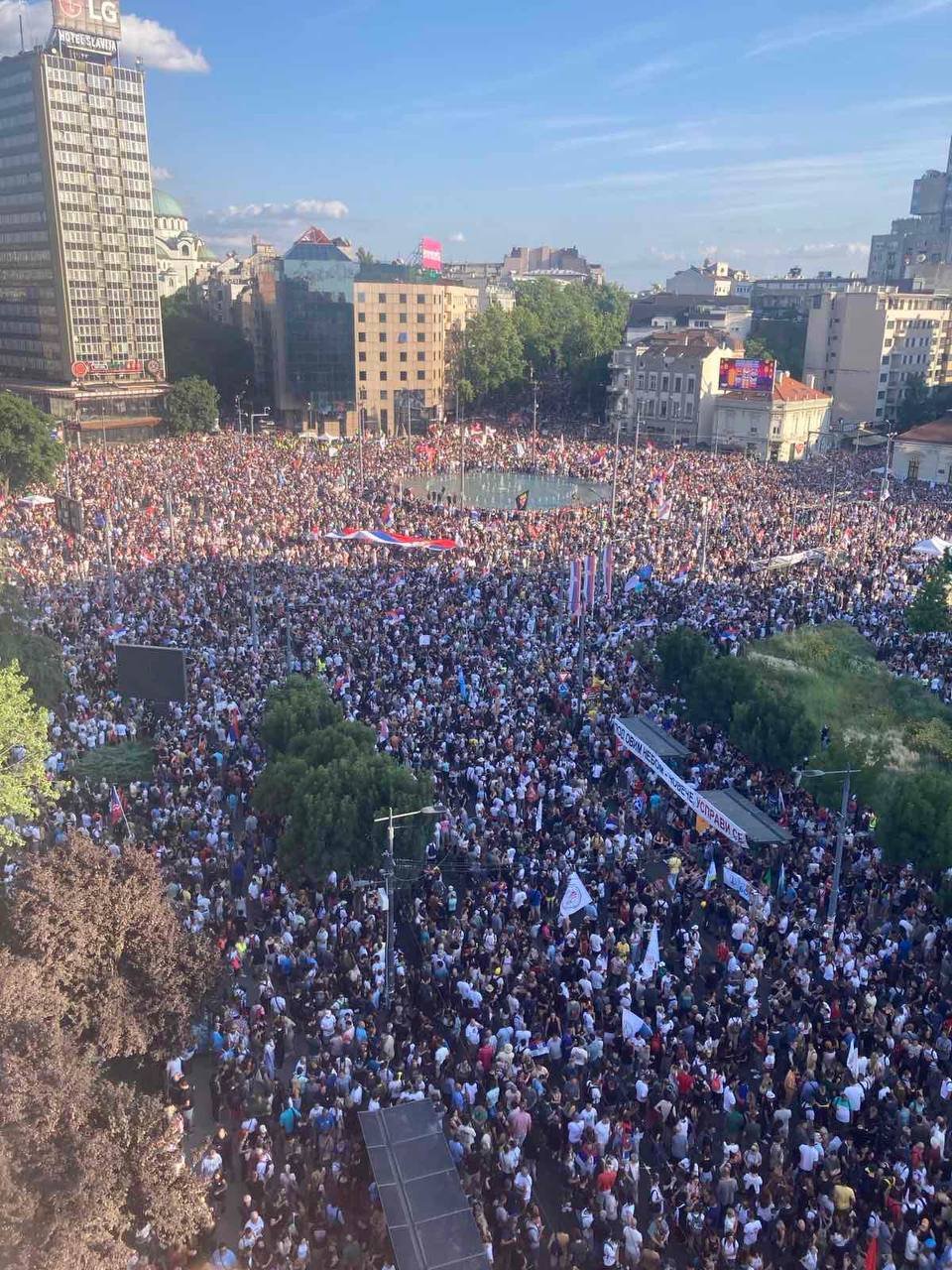
“The ultimatum has expired,” student organisers declared toward the end of the protest, referring to a 9:00 p.m. deadline they had set for the government to announce elections or face a wave of civil disobedience.
The demonstration took place amid escalating rhetoric and security crackdowns from the government. In the days leading up to the protest, Serbian authorities arrested several individuals they accused of plotting a violent coup. State-aligned media aired reports of discovered weapons, dubbing it proof of what Vučić’s Serbian Progressive Party (SNS) called a “colour revolution” backed by foreign actors.
Despite fears of unrest, the protest unfolded peacefully through most of the day — mirroring the tone of previous mass demonstrations this year. Trains into the capital were suspended following a reported bomb threat, in what critics saw as a bid to suppress turnout. Still, convoys of motorbikes and cars with out-of-town license plates poured into Belgrade, with bikers assembling outside the IKEA on the highway before joining the march.
“Today, June 28, 2025, we declare the current government illegitimate,” a student protester said from the stage. “In the last 13 years, we have witnessed the collapse of all fundamental institutions. There is no area where corruption has not entered.”
The protest, timed to coincide with Vidovdan — the anniversary of the 1389 Battle of Kosovo — carries deep historical and political weight. The date also marks other pivotal moments in Serbian history, including the 1914 assassination of Archduke Franz Ferdinand, the 1948 expulsion of Yugoslavia from the Cominform, and the 2001 extradition of Slobodan Milosevic to The Hague.
That symbolism was not lost on either the demonstrators or the state. “Students are our only true comrades-in-arms,” said Nenad Stanić, a veteran of the 1999 Battle of Košare, addressing the crowd. “There is no giving up, no withdrawal, no surrender and no turning back.”
Individuals from all walks of life attended the rally — veterans, students, bikers, pensioners, and celebrities such as former basketball stars Dejan Koturovic and Dejan Bodiroga. The rector of the University of Belgrade, Vladan Dokic, addressed the crowd, warning of a country turning away from democratic and cultural values. “Everyone here can see the kind of crisis the country is sinking into, which rejects those values, underestimates knowledge and culture, destroys institutions,” he said.
The protest followed a smaller pro-government rally near Pionirski Park, organised by the SNS. Authorities quickly dismissed the opposition gathering as a failure, claiming the turnout was three times smaller than that of the March protests.
In an increasingly defensive tone, President Vucic continues to frame dissent as foreign interference. He is currently writing what he describes as a “manual” for defending sovereign governments against colour revolutions. On a recent trip to the UAE, he claimed that Sheikh Mohammed bin Zayed al-Nahyan expressed interest in publishing the book in the Arab market — a gesture Vucic said meant a great deal to him.
“I will write it personally, no one else will write it,” Vucic told TV Pink earlier this year. “I believe it will be one of the best-selling books in the world... a textbook on how enemies of free countries are organised, how they bribe people in your country, how they train them.”
Critics have pointed to what they call increasingly surreal claims by the president, including suggestions that “blockaders” — many of whom were children or not yet born in 2001 — were responsible for orchestrating the extradition of Milosevic.
Late in the evening, clashes broke out between protesters and police as authorities attempted to prevent crowds from moving towards the Presidency where pro-government demonstrators had earlier gathered. Student organisers announced they no longer had control over the situation after riot police used tear gas and pepper spray to push back crowds.
Members of the Gendarmerie used megaphones to demand that protesters leave or face intervention. According to independent outlet N1, journalists were injured in the scuffles. Firecrackers and cannon shots were reportedly thrown, and masked individuals clashed with riot police, with some throwing flares to break through police cordons — marking a rare escalation after months of largely peaceful demonstrations.
After eight months of tireless protest and government evasion, students are still able to mobilise tens of thousands to the streets. The longer the protests continue, however, the greater chance there is for incidents and clashes with the police. For President Vucic, the only off-ramp may lie at the ballot box.


