Friday, July 04, 2025


Unlocking the hidden biodiversity of Central Europe’s villages


Hun-Ren Ökológiai Kutatóközpont
Working with D-vac insect suction sampler 

image: 

Project leader, Péter Batáry, working with D-vac insect suction sampler in the centre of village Salköveskút, Hungary. The samples revealed significantly higher vegetation-dwelling arthropod species richness at village edges compared to centres, especially in forest-dominated landscapes.

view more 

Credit: Photo: Attila Torma


Villages, often separated from larger towns and cities, consist of clusters of households and a few public buildings. Despite their long history, the biodiversity of European villages has been understudied compared to urban areas, forests, grasslands, or agricultural fields. A new study reveals their biodiversity potential and how nearby landscapes influence biodiversity patterns and human well-being.

This research was led by an international team from the HUN-REN Centre for Ecological Research with 20 other institutes contributing from Hungary, Romania, Germany, and Italy. Published in Nature Sustainability, the study examines how landscape complexity and proximity to cities affect village biodiversity and socioeconomic conditions. The findings show higher biodiversity in villages within forest-dominated landscapes compared to agricultural settings, while city proximity boosts human well-being.

The researchers surveyed biodiversity in 64 villages around 16 mid-size cities in Hungary and Romania. Half of the villages were near cities, the other half farther away, and were either in agriculture- or forest-dominated landscapes. The team conducted botanical surveys, used pitfall traps for ground-dwelling arthropods, employed D-vac suction sampling for vegetation-dwelling arthropods, and set trap nests for cavity-nesting bees and wasps, as well as point counts for birds.

They documented 1,164 species across nine taxonomic groups. Multitrophic diversity, a measure of overall biodiversity, was 15% lower in villages surrounded by agricultural fields than by forests. Lead author Dr. Péter Batáry explains, “This underscores the importance of landscape-wide species pools in shaping village biodiversity. City proximity had little impact on species numbers and overall diversity, suggesting other factors have a greater influence.”

The team also collected socioeconomic data for Hungarian villages to calculate the Better Life Index, reflecting human well-being through living conditions and quality of life. The Better Life Index was 27% higher in villages in the agglomerations of cities and 14% higher in villages in forest-dominated landscapes than those in agricultural ones. Co-author Dr. Katalin Szitár notes, “Proximity to urban areas brings better access to services, while forested landscapes offer cleaner air and more green spaces, enhancing living standards and quality of life.”

Using GIS, the researchers measured the Human Footprint Index (HFI) to assess environmental impact from infrastructure and land use. Villages with a higher Better Life Index also had a higher HFI, especially near cities, indicating that better living standards can increase environmental impacts. A higher HFI was linked to lower multitrophic diversity, revealing a trade-off between human development and biodiversity. However, forest-dominated landscapes maintained higher biodiversity despite increased human activity, suggesting complex landscapes can mitigate biodiversity loss. Dr. Edina Török notes, “Our findings highlight the delicate balance needed to enhance human well-being without compromising the ecological health of rural landscapes.”

To be effective, sustainable village management should integrate landscape context into development plans. For villages near cities, minimizing soil sealing and green infrastructure intensification can help protect biodiversity. In villages predominantly surrounded by forests, limiting agricultural expansion is crucial. Increasing the connectivity of villages centres with forests and upgrading green infrastructure in agricultural areas can boost biodiversity and well-being. Collaboration between residents, authorities, and landowners, combining policy-driven and community-driven actions, is vital. Dr. Péter Batáry emphasizes, “The EU Rural Development Strategy should prioritize biodiversity management to improve conservation and landscape quality in and around villages.”

The village of Botfa lies in the agglomeration of the medium-size city Zalaegerszeg, Hungary. Proximity to the city was associated with higher human well-being without reducing biodiversity, despite increased human footprint.

Várda is an example of a village embedded in an agriculture-dominated landscape, where multitrophic diversity was 15% lower on average than in forested  landscapes.


Credit

Photo: Tamás Lakatos


Human wellbeing on a finite planet towards 2100: new study shows humanity at a crossroads


The Club of Rome


The peer-reviewed study, The Earth4All Scenarios: Human Wellbeing on a Finite Planet Towards 2100, uses a system dynamics-based modelling approach to explore two future scenarios: Too Little Too Late, and the Giant Leap. The model presented in the paper provides the scientific basis for the analysis and policy recommendations of Earth for All: A Survival Guide for Humanity, published in 2022. 

The model’s findings show that under our current ‘business as usual’ conditions – the Too Little Too Late scenario – humanity risks a gradual slide into ever worsening breakdowns: a steadily greyer and more fragmented world.  

However, the Giant Leap scenario demonstrates that a window of opportunity still remains open for global action to reverse declining wellbeing trends, keep global warming below 2°C, reduce inequality, and create the conditions for sustained prosperity throughout the century. 

The study identifies five “extraordinary turnarounds” which, if enacted simultaneously, could fundamentally alter humanity's trajectory: ending poverty, reducing inequality, empowering women, and transforming global food and energy systems. “Extraordinary” refers to a substantial change in investments relative to the previous four decades. 

Lead author Per Espen Stokens of BI Norwegian Business School said: “We asked a simple but urgent question: can human wellbeing improve while reducing pressures on the planetary boundaries? Our model says yes – but only if we make these turnarounds through decisive shifts in our current economic policies.” 

A key innovation of the study is the introduction of two novel indices: social tension and wellbeing. This enabled the researchers to model not just the complex interactions between economic and environmental factors in the two scenarios, but also include social feedback loops capturing trust, public investment, and political capacity. The modelling results suggests that rising inequality and environmental degradation fuel social tensions, which in turn reduce governments' capacity to implement the long-term policies needed to address existential risks linked to climate change and other planetary boundaries. 

 “By integrating a social tension index and a wellbeing index, we have been able to highlight the importance of social dynamics in climate scenarios,” explained co-author Nathalie Spittler of BOKU University. "Achieving climate goals is not just a question of technological and economic developments. If wellbeing declines and social tensions rise, this creates a negative feedback loop where the very conditions needed for transformational change become harder to achieve." 

Conversely, the study suggests that actions to reduce inequality and increase social cohesion and wellbeing are key if governments want to implement policy shifts on climate and other global issues. 

The study highlights the speed and scale of action required to ensure wellbeing for all on a liveable planet by 2100. “The Giant Leap scenario shows we have is a technically plausible, but ambitious path forward,” commented Per Espen Stoknes. “It requires a level of international cooperation and political leadership we have yet to see, but such a political shift could still deliver a thriving future for humanity on a stable planet.” 

'Blood for food': The US soldier-spies sidelining UN aid work in Gaza


Hundreds of Gazan civilians have been killed while seeking aid, including from sites run by the Gaza Humanitarian Foundation (GHF), a US- and Israel-backed private entity that rights groups say lacks the expertise to distribute aid in accordance with international law. US and Israeli documents reveal a complex web of military veterans, former intelligence officials and evangelical Christians behind the new aid group which is sidelining the UN and its partners in Gaza.


Issued on: 03/07/2025 -
FRANCE24
Jessica LE MASURIER/
Jack POULSON


LONG READ


US private security firms employing former US special forces have been operating in Gaza since late January. © Omar al-Qatta, AFP


Gaza's health ministry reported last week that at least 549 Palestinians had been killed, and 4,066 injured, while seeking aid since the introduction of a controversial US-backed distribution system on May 27. Gazans are now forced to travel through militarised areas in southern Gaza to pick up bags of food, frequently resulting in the Israeli military firing on civilian aid seekers.

Behind the statistics are grieving families. One Gazan, whose little brother was killed as he sought aid west of Gaza City, told FRANCE 24 that he got a call from Al Shifa hospital on Tuesday June 17. His brother was dumped there, wrapped in a bag.

“He was killed by an Israeli sniper, shot while crowds rushed towards aid trucks,” he said, “I touched his body and found the sniper's bullet had entered through his left shoulder and exited through his heart.”

“We couldn’t bury him that night because of the war,” he added. “He spent his last night at home – dead.”

“He wasn’t just my little brother. He was the joy in our home – the soul of the family. Everywhere he went, laughter followed. He was generous, loved by all, kind hearted. But now... He’s no longer here,” he wrote.

“He was killed while searching for a piece of bread, while the world remains silent – watching, or justifying the killing.”

Beginning in March, Israel blocked deliveries of food and other crucial supplies into Gaza for more than two months. It began allowing supplies to trickle in at the end of May through sites run by the Gaza Humanitarian Foundation (GHF) and secured by armed US contractors, with Israeli troops on the perimeter.

The UN has boycotted the GHF, refusing to work with the group over concerns it violates humanitarian principles and was designed to help Israeli military objectives in the enclave. UN Secretary General Antonio Guterres on Friday told the press that, “Any operation that channels desperate civilians into militarised zones is inherently unsafe. It is killing people.”

'Blood for food'

A UN source in Gaza who requested anonymity explained that the new system forces civilians to approach evacuated areas, putting their lives at risk.

“Because there is not enough aid, people go in the thousands into the areas under evacuation, and this is where the IDF (Israel Defense Forces) kills them for not coming one by one,” the source said. “It’s blood for food.”
Palestinians carry humanitarian aid packages near the Gaza Humanitarian Foundation distribution center in Khan Younis in the southern Gaza Strip on June 26. © Abdel Kareem Hana, AP

A report by the Israeli newspaper Haaretz in early June cited several eyewitness accounts of civilians encountering fire from tanks, drones and helicopters as they sought food at GHF distribution sites.

Both the GHF and the Israeli army have rejected such accounts.

A GHF spokesperson told FRANCE 24 that, “There has not been a single fatality at or near any of GHF [sic] distribution sites. Period.”

“Hamas doesn’t want us here because they want to control the aid,” the spokesperson added.

Israel has repeatedly accused Hamas of looting aid, without providing evidence. It sees the GHF as crucial to undermining what remains of Hamas's control over Gaza.

As Israeli Prime Minister Benjamin Netanyahu explained in a recent interview with Fox News: “We have a plan, that we devised with the help of American firms, to separate the giving of the humanitarian aid to the population from Hamas control.”


Who is behind the GHF network?

Who is behind GHF network? © FRANCE 24

After the tumultuous resignation of its original executive director, the Gaza Humanitarian Foundation is now led by former USAID official John Acree and former Trump adviser Johnnie Moore, an evangelical preacher and public relations professional with close ties to both the US president and Israel's Netanyahu.

US President Donald Trump speaks to a group of evangelical leaders, including Reverand Johnnie Moore (R) in the Oval Office at the White House in Washington DC, on July 10, 2017. © Social media via Reuters

During Trump's first term in office, Moore was part of an evangelical Christian drive to convince the president to recognise Jerusalem as the Israeli capital and move the US embassy there. He recently wrote in a post on X, “There’s nothing more Christian than feeding people in need.”

Read moreAs the Gaza Humanitarian Foundation names a new chief, suspicions swirl over its funding

GHF’s private security partner, Safe Reach Solutions (SRS), is run by Philip Francis Reilly, a former head of the CIA’s covert action – “special activities” – unit with experience of training insurgencies such as Nicaragua’s right-wing Contras militias.

Philip Francis Reilly, a former CIA special activities chief and current CEO of private security firm Safe Reach Solutions. © Photo from LinkedIn.

Safe Reach first began operating in late January, leading a vehicle inspection checkpoint effort along the Netzarim Corridor splitting northern and southern Gaza with another private security contractor, UG Solutions.

Both companies have been urgently recruiting former intelligence officers and special forces veterans to run their Gaza operations.

'Unconventional warfare'

Safe Reach job postings have requested expertise with processing CCTV and aerial surveillance footage. A contractor with UG Solutions further recently told The Associated Press that American analysts and Israeli soldiers sit next to each other in a control room, analysing the results of facial recognition software running on top of real-time footage of distribution sites.

Safe Reach told the AP that it has never used biometrics; an anonymous employee from the security contractor told the Israeli news outlet Shomrim in late May that the firm’s surveillance is focused on preventing groups such as Hamas from bringing weapons near aid distribution sites.

A job posting from UG Solutions sought former members of US Army Special Forces and Delta Force who were “skilled in unconventional warfare tactics” and could deploy to an undisclosed overseas location within two weeks of May 20. The posting also enquired about proficiency with “Belt-Fed Machine Guns”.

Screengrab from UG Solutions job posting for Senior Special Operations Contractor. 
© FRANCE 24

Footage provided to The AP by their UG Solutions contractor source was geolocated to GHF distribution sites and, according to forensic audio experts, machine guns were being fired within 50 to 60 metres of the camera microphone. The most recent LinkedIn comment attributed to Joseph A. L’Etoile – a former chief operating officer of Orbis and self-identified contractor with Safe Reach – also stated that, “Nothing beats a belt fed MG [machine gun] for engaging moving targets.”

“Bringing in such individuals with no obvious qualifications in aid delivery, accompanied by serious personal firepower, plays directly into concerns of humanitarian aid professionals that SRS and GHF are there for military purposes, more than feeding a starving population,” James Wasserstrom, an expert on conflict and post-conflict reconstruction who worked in Afghanistan, Ukraine and Kosovo for the UN, and then the US government, told FRANCE 24.

GHF told FRANCE 24 in response that, “This so-called expert obviously knows nothing about our operations,” adding that “GHF personnel includes humanitarian experts.”

Read more

An IDF soldier providing security to the GHF distribution sites recently told Haaretz that the Israeli-armed militia of the Palestinian alleged drug trafficker Yasser Abu Shabab – a Hamas opponent with alleged ties to ISIS – has affiliates participating in an external layer of security.

Yasser Abu Shabab. Photo from the Popular Forces’ Facebook page. 
© Popular Forces' Facebook page

A UN source inside Gaza told FRANCE 24 that both GHF and the IDF are collaborating with Abu Shabab's militia, which the source said “used to loot UN convoys” in the enclave. The militiamen, wearing “bulletproof vests and tactical helmets and holding brand new Kalashnikovs", are deployed inside the Israeli military zones that surround the GHF centers, the source explained.

JUST LIKE; THE FRENCH CONNECTION, AIR AMERICA, THE GOLDEN TRIANGLE, IRAN CONTRA, GRENADA

GHF and Safe Reach Solutions both told FRANCE 24 that allegations of their collaboration with Abu Shabab were “false".

Netanyahu, however, has admitted that Israel is supporting anti-Hamas clans in Gaza “on the advice of security officials”, with a view to undermining the Palestinian Islamist group.

“What is bad about that?" Netanyahu said in a video posted to social media on June 5. “It is only good, it is saving lives of Israeli soldiers.”

Intelligence contractors and family wealth management

McNally Capital founder and co-CEO Ward McNally. © McNally Capital

McNally Capital, the private equity firm behind the Gaza Humanitarian Foundation network, made its name advising wealthy families on how to invest their fortunes. It was founded by Ward McNally in 2008, a decade after he sold his inherited stake in the mapping and publishing company Rand McNally, a household name in the US.

Many of McNally Capital’s recent investments have been in US-based defence and aerospace contractors. This has included an investment in Safe Reach Solutions, which McNally Capital helped form through the Wyoming-based "generational wealth management" firm Two Ocean Trust, as revealed by the state’s public corporate records.


Safe Reach Solutions updated its address to a UPS store in Alexandria, Virginia on June 11. © FRANCE 24

Roughly four years ago, McNally acquired the McLean-based intelligence contractor Orbis Operations, which was then chaired by former acting CIA director Michael J. Morell.

Reilly, the CEO of Safe Reach Solutions, led the creation of both GHF and SRS as an offshoot of his work with Orbis. Last year it was revealed that Orbis was using numerous controversial surveillance tools, including commercial cellphone location tracking.

An investigation from Shomrim in early May revealed that the same lawyer had registered both SRS in Wyoming and the original incarnation of GHF in Delaware in November, with the original GHF legal entity being renamed to “For Those in Need Foundation” in February and swapped out for a company newly registered under the original name.
Delaware articles of incorporation of the original incarnation of the Gaza Humanitarian Foundation, which was subsequently renamed to “For Those in Need Foundation.” © Shomrim

Later the same month, The New York Times reported that the November incorporations of GHF and SRS were handled by “representatives” of Reilly, in relation to his work at Orbis. McNally Capital subsequently confirmed to Reuters that it had an “economic interest” in SRS and helped with the company’s legal formation.

McNally Capital did not respond to FRANCE 24’s request for comment.


Former ‘Blackwater’

Charles J. “Chuck” Africano in Tel Aviv in October 2024. © Facebook posting by Robert E. Skelton on October 21, 2024.

The sole American director of Safe Reach’s Israeli branch is the financial officer Charles J. Africano.

Africano and Reilly have overlapped professionally for years, including circa 2015 at Constellis – a successor to the private military contractor Blackwater that gained notoriety for a civilian massacre in Iraq – and then at the similarly controversial private security and surveillance firm Circinus. Africano’s connections with GHF were first highlighted by Middle East Eye and independently confirmed from public records by FRANCE 24.

The company officials section of the official Israeli corporate record for Safe Reach Solutions, LLC, listing both Charles J. Africano and the accountant Guy Vardi. © FRANCE 24

Africano is also a member of the private LinkedIn group of the Tampa-based special operations contractor Quiet Professionals, which was acquired last month by McNally and is led by former Delta Force sergeant major Andy Wilson.

Quiet Professionals CEO Andy Wilson (right) standing with Florida Governor Ron DeSantis in Tampa’s International Airport following a Middle East rescue operation. 
© Social media

Quiet Professionals on Friday celebrated the completion of an affiliated non-profit's mission to extract Americans from Israel.

When reached for comment regarding its relationship with Quiet Professionals, GHF responded with a refusal to discuss its financial relationships, stating, “Like most non-profits, we don't disclose our donors to protect their privacy.”


Screenshot from Quiet Professionals website. © Quiet Professionals website

Special operations-affiliated private contractors form a tight-knit group.

Both Orbis Operations and Quiet Professionals were acquired by McNally in partnership with NIO Advisors, the Illinois-based strategic advisory firm of investor Christopher J. Oates, who was recently revealed through public records to have helped establish the Israeli branch of Safe Reach Solutions.
Screengrab from Quiet Professionals website. © Quiet Professionals website

The chief business officer of Quiet Professionals, Leo Kryszewski, has also publicly disclosed spending four years with the CIA’s special activities division and the US Army's Office of Military Support, a secretive intelligence unit often referred to as Task Force Orange. Africano was publicly credited with setting up the first bank account of the task force’s de facto non-profit arm.

Public US military procurement records have revealed that Quiet Professionals is providing its Cerebra Gray data analytics platform to the Army’s Fort Huachuca in Arizona to train covert operatives in evading foreign counterintelligence services, including through hiding and remotely wiping cellphone data.

Orbis and Quiet Professionals did not respond to FRANCE 24’s request for comment.


A $30 million award to GHF

Despite the UN’s serious misgivings about the high rate of civilian casualties among Gazans trying to access GHF aid hubs, the US State Department on Thursday afternoon announced its approval of a $30 million grant for the new organisation through the recently gutted USAID.

When asked during the press briefing whether the State Department opposed Israeli blockades on pre-existing aid groups, principal deputy spokesperson Tommy Pigott said, “What we’re pushing for is for other countries to support the Gaza Humanitarian Foundation’s work.”

A US government source who requested anonymity cited a special adviser to the State Department as having “vehemently pushed for (the) State (Department) to support the GHF mechanism”. The source described the adviser as a “20-something-year-old” Trump political appointee with “very little experience of the region”.

Leaked documents obtained by FRANCE 24 from USAID’s Bureau of Humanitarian Affairs (BHA) include GHF’s “Technical Narrative” proposal and an automated message from BHA’s award management system, Abacus, stating that the GHF funding relates to a “high-priority” White House directive.

An employee of what remains of BHA, who requested anonymity, stated that GHF’s application for funding fell “well below our normal technical standards for funding". “Additional funds were added to the Gaza project for a [White House] high-priority directive,” they added.

Photo from an anonymous Gazan who paid 500 shekels ($144) for a 25kg bag of flour in northwest Gaza City on June 17, 2025. © FRANCE 24

Josh Paul, a former director of public affairs in the State Department’s Bureau of Political-Military Affairs, said the new foundation’s lack of transparency leaves it wide open to abuses.

“I cannot recall a time during my service in government in which the US contributed half a billion dollars to an entity as new, opaque and questionable as the ‘Gaza Humanitarian Foundation',” he said, referring to reports earlier this month that the State Department was considering a $500 million grant for GHF.

“Not only has this mechanism proven to be deeply flawed – indeed, responsible for the deaths of hundreds of Palestinians through its operations – but its formation through a series of shell companies and interweaving personalities and organisations creates the significant risk of diversion of funds and corruption,” Paul said. “There is a significant likelihood that much of these funds, rather than buying food for starving people in Gaza, will be lost to waste, abuse and fraud."

The US State Department did not respond to FRANCE 24’s request for comment.


‘Aiding and abetting war crimes’


The Gaza Humanitarian Foundation is not the only Gaza aid group founded by former US military and intelligence officials. Fogbow, an offshoot of the New York-based business intelligence firm Veracity Worldwide, planned to deliver aid to Gaza via an ill-fated floating pier.


Supporters of the GHF say its cooperation with the Israeli army gives it an advantage over established aid organisations, which have been at loggerheads with Israeli authorities since the start of the war.

“What GHF has been able to achieve that other organisations have not is far better deconfliction with the IDF,” Safe Reach Solutions told FRANCE 24.

“Deconfliction”, however, has come at a terrible cost for desperate Gazan civilians who risk their lives each day simply trying to access food from GHF distribution sites.

The head of the UN agency for supplying aid into Palestine, Philippe Lazzarini, has described the GHF as a “lame, medieval and lethal system that is deliberately harming people under the camouflage of ‘humanitarian aid’ with lies, deceit and cruelty".

Lazzarini said in a June 18 post on X that the deaths of civilians seeking aid was a “disgrace”, adding: “Inviting starving people to their death is a war crime.”

The World Food Programme and other UN agencies say they are much better equipped – with the “logistics capacity, expertise and operational coverage” – to distribute food aid to Palestinians in the Gaza Strip in accordance with international humanitarian law.

The New York-based Center for Constitutional Rights notified the Gaza Humanitarian Foundation in early June of its potential legal liability for complicity in war crimes. “The GHF operations run the risk of aiding and abetting war crimes, crimes against humanity and even genocide,” senior staff attorney Katherine Gallagher told FRANCE 24.

A group of 15 human rights and legal groups joined these calls with an open letter on Monday, also warning GHF that it was risking legal liability. As agencies like UNICEF, UNRWA and other NGOs are supplanted, the letter said, GHF’s aid model for Palestinians “exposes them to violence”, including requiring them to travel long distances to just a handful of distribution hubs.

The letter urges donors and private contractors to withdraw from any involvement with the GHF in favour of supporting aid models “that uphold international humanitarian law”.
THANK DOGE

'Women are having to sell sex for fish': Head of ActionAid Zambia on USAID cuts


PERSPECTIVE © FRANCE 24
Issued on: 03/07/2025 - 
08:34 min
From the show

The director of ActionAid Zambia has spoken to FRANCE 24 about the dire conditions women are facing in the country because of cuts to USAID. This as the organisation is officially wound down, ending billions of dollars' worth of aid programmes across the world. In Zambia, the cuts mean women are having to sell sex to men in order to be able to go fishing to feed themselves and their families. Faides TembaTemba spoke to us from the UN Conference on Financing for Development in the Spanish city of Seville.


WATER WAR

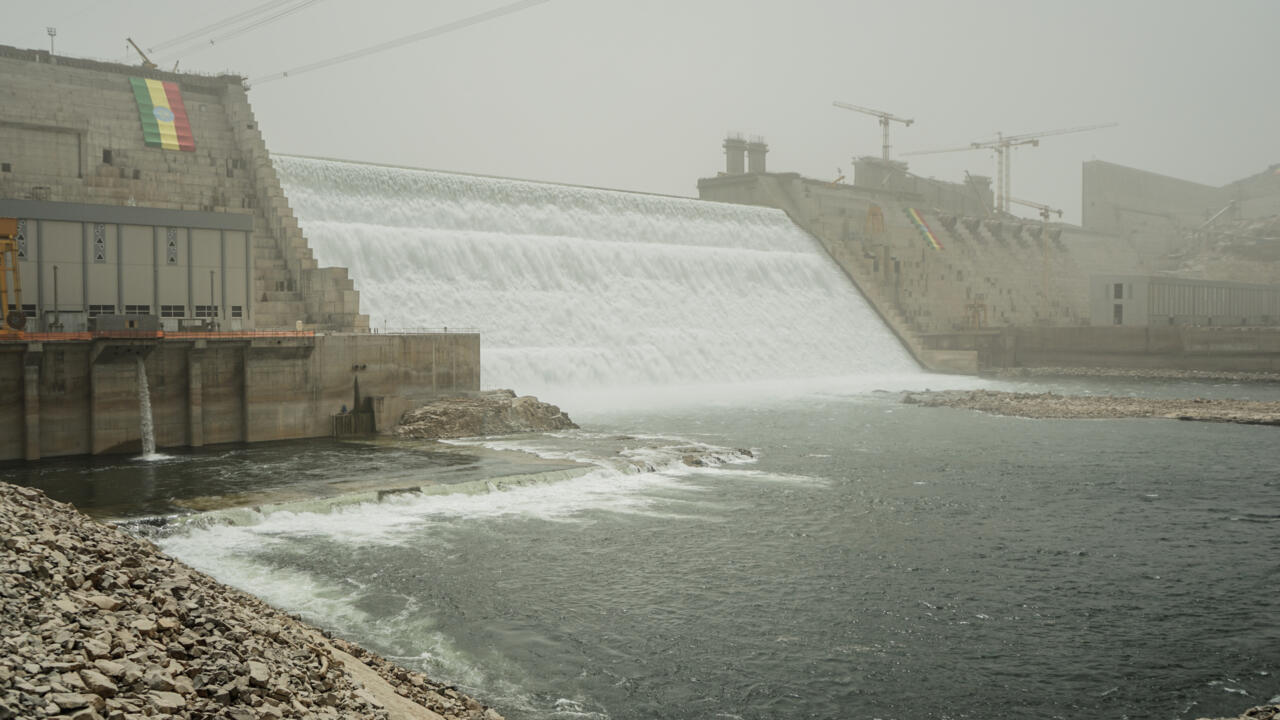
Ethiopia completes controversial Nile dam, escalating dispute with Egypt

Egypt, which has long asserted its majority rights to Nile water according to the terms of a colonial-era agreement.

Ethiopia’s prime minister said on Thursday the contested Grand Ethiopian Renaissance Dam on the Nile is complete, a key step in a dispute with Egypt over water rights. Cairo opposes the project, fearing it will cut its vital Nile water supply, calling it an existential threat. Egypt, reliant on the Nile for agriculture and its 105 million people, has long sought a binding deal on water sharing.


Issued on: 04/07/2025 -
By:  FRANCE 24

Egypt and Sudan have long worried Ethiopia's mega-dam on the Blue Nile 
will impact their water supply. © Amanuel Sileshi, AFP


Ethiopia’s prime minister said Thursday that a controversial power dam on the Nile is now complete, a major milestone for his country amid a dispute with Egypt over equitable sharing of the water.

Egypt has long opposed the dam because of concerns it would deplete its share of Nile River waters. Egypt has referred to the dam, known as the Grand Ethiopian Renaissance Dam, as an existential threat because the Arab world’s most populous country relies almost entirely on the Nile to supply water for agriculture and its more than 100 million people.

Negotiations between Ethiopia and Egypt over the years have not led to a pact, and questions remain about how much water Ethiopia will release downstream if a drought occurs.

Ethiopian Prime Minister Abiy Ahmed, in his address to lawmakers Thursday, said his government is “preparing for its official inauguration" in September.


“While there are those who believe it should be disrupted before that moment, we reaffirm our commitment: the dam will be inaugurated,” he said.

Abiy said his country “remains committed to ensuring that our growth does not come at the expense of our Egyptian and Sudanese brothers and sisters".

“We believe in shared progress, shared energy, and shared water,” he said. “Prosperity for one should mean prosperity for all.”

Ethiopia and Egypt have been trying to find an agreement for years over the $4 billion dam, which Ethiopia began building in 2011. Tensions over the dam, the largest in Africa, once were so high that some observers feared the two countries might go to war over it.

But Ethiopia won the diplomatic support of upstream nations such as Uganda, home to a regional partnership of 10 countries that last year signed an accord on the equitable use of water resources from the Nile River basin.

The accord of the partnership, known as the Nile Basin Initiative, came into force in October without being ratified by Egypt or Sudan.

The dam, on the Blue Nile near the Sudan border, began producing power in 2022. The project is expected to ultimately produce over 6,000 megawatts of electricity, which is double Ethiopia’s current output and enough to make the East African nation of 120 million a net energy exporter.

The dam is located about 500 kilometres (311 miles) northwest of the Ethiopian capital of Addis Ababa. It is 1,800 metres long and 175 metres high, and is backed by a reservoir that can hold up to 74 billion cubic metres of water, according to the main contractor.

Ethiopia insists the dam is a crucial development that will help pull millions of its citizens out of poverty and become a major power exporter.

It was not immediately possible to get a comment from Egypt, which has long asserted its rights to Nile water according to the terms of a colonial-era agreement.

The agreement between Egypt and the United Kingdom gave downstream Egypt and Sudan rights to the Nile water, with Egypt taking the majority.

That agreement, first signed in 1929, took no account of the other nations along the river basin that have demanded a more equitable accord.

(FRANCE 24 with AP)
California's largest blaze this year explodes in size amid scorching heat, high winds

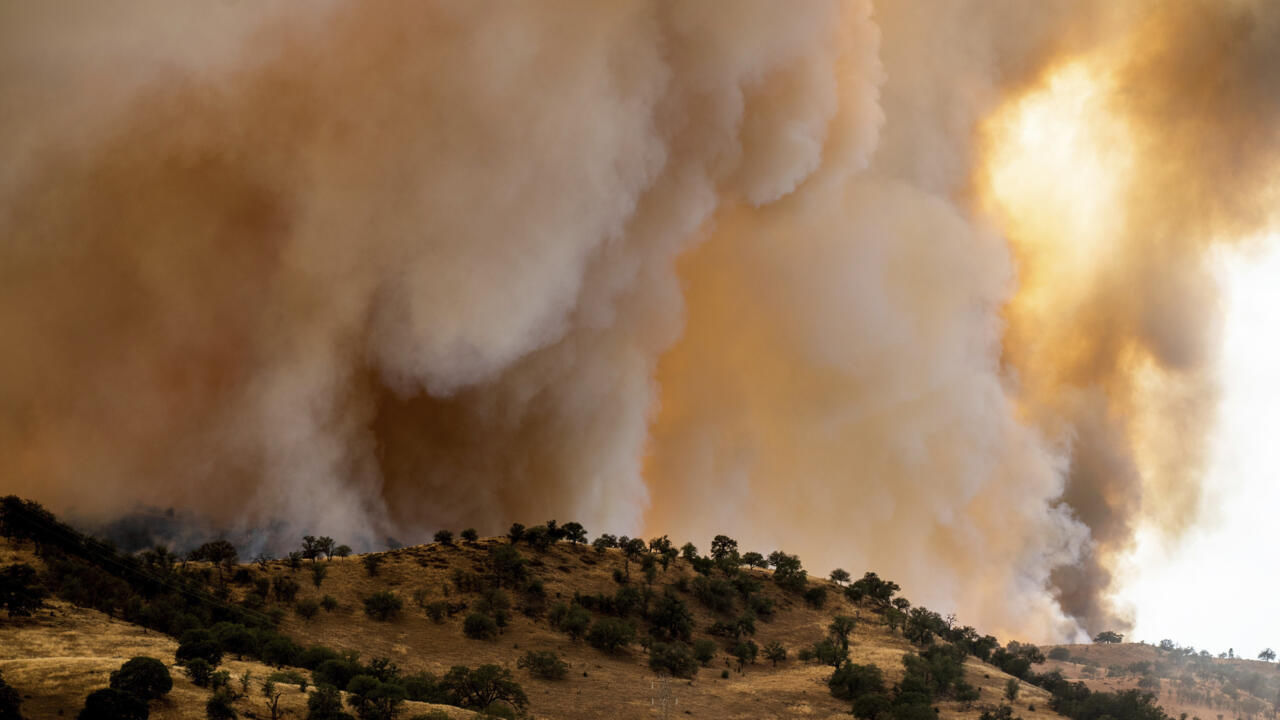
A wildfire in central California's wilderness rapidly expanded Thursday as hot, dry conditions heightened fire risks ahead of July Fourth. The Madre Fire, now the state's largest this year, scorched over 82 square miles (212 sq km) in San Luis Obispo County since Wednesday. Containment remained at just 10% by evening.


Issued on: 04/07/2025 - 
By: FRANCE 24

The Madre wildfire burns on Thursday, July 3, 2025, in San Luis Obispo County, California. © Noah Berger, AP

A wildfire in a wilderness area of central California exploded in size as dry, hot weather Thursday raised the fire risk for large portions of the state ahead of the July Fourth holiday.

The Madre Fire became California's largest blaze so far this year, ripping through grasslands after breaking out Wednesday in southeastern San Luis Obispo County. It swiftly grew to more than 82 square miles (212 square kilometers). It was just 10% contained by Thursday evening.

Evacuation orders and warnings were issued for tiny communities near State Route 166 as flames moved through hilly terrain toward the Carrizo Plain National Monument, about 45 miles (72 kilometres) east of Santa Maria. The region about 125 miles (200 kilometres) northwest of Los Angeles contains vast grasslands that draw visitors in the spring to see its wildflowers.

Part of Route 166 East was closed Thursday, and there was “no estimate for re-opening", California Department of Transportation, known as Caltrans, said on social media.

The fire was pushed by summer gusts that typically increase as the sun starts going down, said meteorologist Ryan Kittell with the National Weather Service.

“The winds are pretty light during the day, but they do pick up pretty substantially in the afternoon and evening hours,” Kittell said.

He said gusts could reach 40 mph (64 kph) later in the day Thursday, posing new challenges for firefighters working in 95-degree F heat (35 C).

Dozens of smaller wildfires were burning across the state.

Southern California's Wolf Fire reached 55% containment Thursday after charring more than 3.7 square miles (9.5 square kilometres) of dry brush since breaking out June 29 in Riverside County east of Los Angeles.

(FRANCE 24 with AP)
CIA UP TO OLD TRICKS

US, Colombia recall top diplomats as rift deepens over alleged assassination plot

The US and Colombia recalled their top diplomats Thursday amid escalating tensions, linked to an alleged plot against Colombia’s leftist president. Washington first withdrew its chargé d'affaires, citing "baseless and reprehensible" comments from Colombia’s government, a State Department spokesperson said, without further elaborating.


Issued on: 04/07/2025 -
By:  FRANCE 24

This combination of pictures created on January 26, 2025 shows Colombian President Gustavo Petro in Bogota on July 09, 2024 and US President Donald Trump in Washington, DC, on January 20, 2025. © Luis Acosta, AFP

The United States and Colombia called home their respective envoys on Thursday in an apparent acceleration of worsening ties, against the backdrop of an alleged plot against Colombia's leftist leader.

Washington went first, recalling its charge d'affaires John McNamara "following baseless and reprehensible statements from the highest levels of the Government of Colombia", State Department spokeswoman Tammy Bruce said, without giving specifics.

In addition to McNamara's recall, Bruce said the United States "is pursuing other measures to make clear our deep concern over the current state of our bilateral relationship".

She did not detail the actions.

Within hours, Colombian President Gustavo Petro announced he was calling home his top diplomat in Washington in response.

Ambassador Daniel Garcia Pena "must come to inform us of the development of the bilateral agenda", Petro wrote on X, such as tapping South America's "great potential for clean energy" and the fight against "drug lords and their international finances".

The diplomatic spat came on the heels of the resignation of Colombia's foreign minister earlier Thursday – the latest top-ranking official to exit Petro's government.

"In recent days, decisions have been made that I do not agree with and that, out of personal integrity and institutional respect, I cannot support," Laura Sarabia, Petro's former chief of staff, wrote on X.

Plot investigation


Colombia was until recently one of the United States's closest partners in Latin America. But ties have sharply deteriorated.

Colombian prosecutors opened an investigation this week into an alleged plot to overthrow Petro with the help of Colombian and American politicians, following the publication by the Spanish daily El Pais of recordings implicating former foreign minister Alvaro Leyva.

"This is nothing more than a conspiracy with drug traffickers and apparently, the Colombian and American extreme right," Petro said on Monday.

In late January, the United States briefly suspended consular services to retaliate for Petro's refusal to allow US military planes to return Colombian migrants to their homeland.

Petro accused the United States of treating the migrants like criminals, placing them in shackles and handcuffs.

The pair issued threats and counter threats of crippling trade tariffs of up to 50 percent.

A backroom diplomatic deal involving the deployment of Colombian Air Force planes to collect the migrants averted a looming trade war at the eleventh hour.

Colombia's leftist government also recently refused a US request to extradite two prominent guerrilla leaders wanted by Washington for drug trafficking.

(FRANCE 24 with AFP)
WWIII

Top China official says US defence chief 'inciting conflict'


Beijing (AFP) – A senior Chinese official accused the United States defence chief on Thursday of "inciting confrontation and conflict" after he urged American allies to bolster their militaries to counter Beijing.


Issued on: 03/07/2025 -

Liu Jianchao, the head of the International Department of China's ruling Communist Party, said Hegseth's remarks were "a new incarnation of hegemonic thinking"
 © WANG Zhao / AFP

China and the United States last month said they had reached an understanding on a trade deal -- a truce after bruising tit-for-tat tariffs on each other's goods.

But the two countries still disagree on issues ranging from technology and security to geopolitics, including the conflicts in Ukraine and the Middle East, as well as Beijing's territorial claims in Asia.

US Defense Secretary Pete Hegseth has warned that China is preparing to use military force to upend the balance of power in Asia and has urged American allies to achieve "peace through strength".

On Thursday, Liu Jianchao, the head of the International Department of China's ruling Communist Party, said Hegseth's remarks constituted "hegemonic thinking".

"What he truly wants is force, not dialogue," Liu told the World Peace Forum in Beijing.

"What he is inciting is confrontation and conflict, not peace and harmony," he said.

China and the United States have long been at odds over Beijing's expansive claims in the strategically crucial South China Sea, and its refusal to rule out using force to seize Taiwan, the self-governed island it claims as its own.

"The Chinese government has made it crystal clear that it will never back down on these issues," Liu said.

"The Chinese people will do their utmost to strive for the prospect of peaceful reunification of the motherland, but we will never allow Taiwan independence," he added.

"The United States must respect China's sovereignty on this issue."

© 2025 AFP