Saturday, July 05, 2025


The 1775 Switcheroo That Begot American Independence – OpEd

Detail of King George III, in coronation robes, United Kingdom, portrait painting by Allan Ramsay. Credit: Wikipedia Commons


By 

As Americans celebrate the 249th anniversary of the Declaration of Independence, we should also toast the 250th anniversary of a savvy political two-step that paved the way to formally breaking with Britain the following year. 

“We, your Majesty’s faithful subjects…” began the petition beseeching reconciliation with King George from the Second Continental Congress on July 5, 1775.  That offering became known as the Olive Branch Petition.  The following day, Congress issued its  Declaration of the Causes and Necessity of Taking Up Arms, explaining why hostile British troops would henceforth be gunned down on the battlefields of America. 

Were the petition  and the Declaration on Taking Up Arms sent  to England on the same ship?  If so, was a sticker attached to the Olive Branch petition saying,  “Open me first”?   The petitioners “entreat your Majesty’s gracious attention to this our humble petition,” stressed their “utmost deference for your Majesty,” boasted that “our breasts retain too tender a regard for the kingdom from which we derive our origin,” and stressed that they remained  “faithful subjects” to “our Mother country.”  The petition neglected including an expiration date for any purported loyalty.

Even tying a red ribbon around that petition would not have helped.  King George III refused to accept it or even to read it.  The king’s obstinacy helped spur  the rarely remembered provision of the First Amendment of the Bill of Rights – the right “to petition the Government for a redress of grievances.”

That Olive Branch petition was fiercely controversial within Congress.  Virginia delegate Benjamin Harrison declared, “There is but one word in the paper of which I approve, and that is the word ,  ‘Congress.’” Harrison was later elected governor of Virginia; his son and great-grandson both became U.S. presidents. The Olive Branch petition passed as one last attempt at reconciliation with the British monarch.  Many Americans believed that the king had been misled by his corrupt or devious advisors.  This was the 1700s version of the Russian folk saying – “if only the Czar knew about all the starving peasants!”   

King George’s response to the petition was shaped by the British disaster at Bunker Hill, when patriot sharpshooters killed or wounded every British officer on the battlefield.  That Pyrrhic victory spooked the British generals but the lesson was not learned until far too late in London.  Two days after the Olive Branch petition was delivered to British officials in London, the British government formally labeled the American colonies in a state of “open and avowed rebellion” and called for “utmost endeavours to withstand and suppress such rebellion.” The subsequent vast increase in British aggression – aided by the eloquence of Thomas Paine – swayed hundreds of thousands of Americans’ minds in favor of independence at any cost. 

The July 6 Declaration, written by Thomas Jefferson and John Dickinson,  castigated “the legislature of  Great-Britain” which “attempted to effect their cruel and impolitic  purpose of enslaving these colonies by violence.”  Americans felt that the British legislature had been warring on them practically since the day the French and Indian War ended.  The Stamp Act became legendary but it was not as politically toxic as the Declaratory Act of 1766. That law  announced that Parliament “had, hath, and of right ought to have, full power and authority to make laws and statutes of sufficient force and validity to bind the colonies and people of America, subjects of the crown of Great Britain, in all cases whatsoever.” Congress’s July 6 1775 Declaration demanded to know: “What is to defend us against so enormous so unlimited a power? Not a single man of  those who assume it, is chosen by us; or is subject to our  control or influence.” Law after law trumpeted Americans’ legal inferiority to their foreign masters.  “Writs of assistance” entitled British soldiers to search any home for evidence of evading tariffs on tea or whiskey. Massachusetts lawyer James Otis denounced those writs for conferring “a power that places the liberty of every man in the hands of every petty officer.” 

The 1775 Declaration proclaimed: “We have counted the cost of this contest, and find nothing so  dreadful as voluntary slavery.” “Slavery by Parliament” was a commonly used denunciation of British legislative power grabs. Law Professor John Phillip Reid, author of The Concept of Liberty in the Age of the American Revolution, noted that “most commentators of the Eighteenth Century thought slavery the opposite of liberty without equating it with chattel slavery…. The word ‘slavery’ did outstanding service during the revolutionary controversy… because it summarized so many political, legal and constitutional ideas and permitted a writer to say so much about liberty.” Bernard Bailyn, author of The Ideological Origins of the American Revolution, wrote, “‘Slavery’ was a central concept in eighteenth-century political discourse. As the absolute political evil, it appears in every statement of political principle… in every exhortation to resistance.”

The British parliament saw the American colonies as offering “all the easy emoluments of  statuteable plunder” – a phrase  in the 1775 Declaration that captured the default attitude of politicians practically everywhere throughout history to anyone under their sway.   The Continental Congress scoffed that their British rulers “boast of their privileges and civilization, and  yet proffer no milder conditions than servitude or death.”   The Declaration stated that “we mean not to dissolve that union which has so long and so  happily subsisted between us.” But it warned that Americans would only lay down their arms “when hostilities shall cease on the part of the  aggressors, and all danger of their being renewed shall be  removed, and not before.”

The Declaration on Taking Up Arms contains flashes of wisdom that should have been burned into popular memory as much as any phrase from the following year’s Declaration of Independence. In 1775,  Congress boldly declared that “our attachment to no nation upon earth should  supplant our attachment to liberty.”   Unfortunately, Washington policymakers deep-sixed that maxim long ago in their pursuit of domineering much of the globe.  

One year later, Americans offered only contempt and cannon balls for King George.  Jefferson wrote in the Declaration: “A Prince, whose character is thus marked by every act which may define a Tyrant, is unfit to be the ruler of a free people.”  Revolutionary leaders exploit the king as the perfect villain from central casting. 

Actually, there is plenty of political wisdom in both the 1775 and 1776 declarations, as well as many other state papers in that era. But schools are probably doing a worse job than ever before in helping young Americans recognize the deadly risks of officialdom unleashed. Former Supreme Court Justice Sandra Day O’Connor groused in 2014 that fewer than 20% of high school seniors “can say what the Declaration of Independence is, and it’s right there in the title.”  Did O’Connor roll over in her grave when President Trump recently astounded an ABC reporter by asserting that the 1776 Declaration was “a declaration of unity and love and respect”? 

Regardless of Oval Office revisionism, Americans should never forget that their nation was forged in resistance to political slavery and claims by distant masters to unlimited power.

  • An earlier version of this piece was published by the Libertarian Institute. 

James Bovard

James Bovard, 2023 Brownstone Fellow, is author and lecturer whose commentary targets examples of waste, failures, corruption, cronyism and abuses of power in government. He is a USA Today columnist and is a frequent contributor to The Hill. He is the author of ten books, including Last Rights: The Death of American Liberty.


 

Namibia Struggles To Contain Illegal Fishing By Foreign Trawlers

Trawler Boat Fishing Fish Water Sea Vietnam Ocean Travel

By 

It is around midnight and a Namibian vessel’s radar detects a foreign trawler notorious for illegal, unreported and unregulated fishing entering Namibian waters. The Namibian vessel communicates with the country’s fisheries monitoring center in Walvis Bay and the Navy and fisheries department are alerted.


However, there are no law enforcement vessels near the Namibia-Angola maritime border and the foreign vessel evades authorities.

This scenario unfolds routinely and no suspicious vessels have recently been apprehended and prosecuted in Namibia, reported senior researcher Carina Bruwer of Enhancing Africa’s Response to Transnational Organized Crime  project.

Namibian waters are regularly targeted by foreign fishing vessels, particularly Chinese, that engage in illegal activities to plunder valuable horse mackerel and other species, such as hake, kingklip and dentex. The country loses more than $83.7 million annually to illegal, unreported and unregulated fishing, driving food insecurity and threatening the jobs of more than 18,000 people who work in Namibian fisheries.

China is the world’s worst illegal fishing offender, according to the IUU Fishing Risk Index. Of the top 10 companies engaged in illegal fishing globally, eight are from China.

Matti Amukwa, chairperson of the Confederation of Namibian Fishing Associations, has called for urgent action to stop illegal fishing.


“For too long have we allowed outsiders to rape our Namibian fish stocks,” Amukwa said in a letter to the Ministry of Fisheries seen by The Namibian newspaper. “We need to take action now and stop the damage being done by well-known IUU vessels … We cannot rely on other countries’ governments to stop the pilferage of our resources.”

Foreign fishing boats are notorious for abusing local rules to file a foreign-owned and operated fishing vessel onto an African registry and fish in local waters. This is known as “flagging in” or flying a “flag of convenience.” It helps a vessel’s owners dodge financial charges and other regulations.

Many of the vessels flying flags of convenience in Namibia come from Angola. During a closed fishing season in 2022, officials seized a Russian trawler belonging to a Chinese company with 300 tons of horse mackerel aboard near Angola’s Namibe Province, Bruwer reported. Angola loses about $227 million annually to illegal fishing.

While foreign vessels are not authorized to fish in Angolan waters, illegal fishing operators commonly use shell companies, front companies and joint venture agreements that make it difficult to investigate and prosecute ships accused of illegal fishing.

Armando Filipe, a member of an Angolan artisanal fishing cooperative, decried the presence of foreign trawlers in his country’s waters. “The trawlers themselves catch an exaggerated amount of what should be caught and, in many cases, they do not take advantage of it, they throw it back into the sea,” Filipe told Voice of America.

Offending vessels in the region also fly flags of convenience from Cameroon, a popular flag for Russians. These vessels commonly turn off their Automatic Identification System shortly before crossing the maritime border into Namibia. After robbing Namibia of fish, they reactivate the identification system and return to Angola, where the catch is illegally transshipped.

When illegal fishing vessels are denied port access in Namibia, they are known to dock in Cape Town. Because they carry no fish, it is difficult for authorities to gather evidence of wrongdoing.

Bruwer wrote that the recently established Southern African Development Community Atlantic Project is a promising collaborative effort to address illegal fishing. This project aims to facilitate cross-border cooperation to address illegal fishing and other crimes in Angola, Namibia and South Africa. It has developed a risk register to help countries identify previous suspicious activity before vessels request to enter ports.

“To reach its full potential, this cooperation must be complemented by increased law enforcement capacity at sea, states refusing to flag or give fishing licenses to suspicious vessels, and the development of policies and practices related to disclosing vessel ownership to ensure accountability,” Bruwer wrote.


Africa Defense Forum

The Africa Defense Forum (ADF) magazine is a security affairs journal that focuses on all issues affecting peace, stability, and good governance in Africa. ADF is published by the U.S. Africa Command.

Encrypted Militancy: China’s Technological Enablement Of Militancy In Kashmir – Analysis

INDIAN IMPERIALIST PARANOIA


military center control command artificial intelligence grok


By 

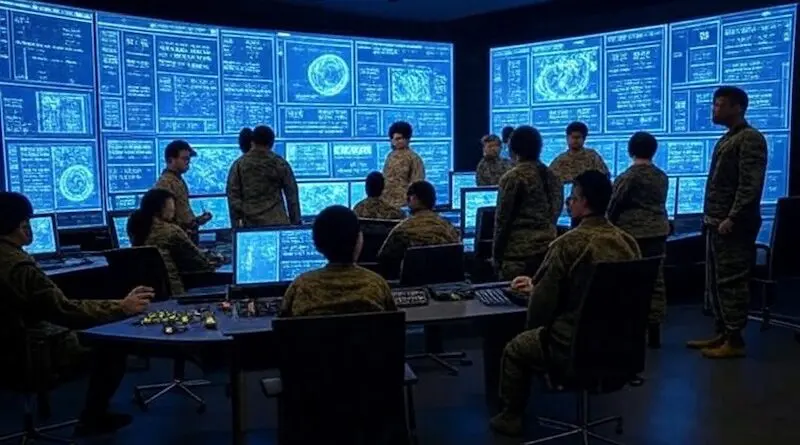
Chinese encrypted tech and telecom systems are reshaping militancy in Kashmir—amplifying cross-border ops and eroding India’s surveillance edge.

\

By Soumya Awasthi

The evolving militancy in Jammu and Kashmir (J&K) has moved far beyond the contours of conventional insurgency. While weapons and ideology remain central, the current phase is characterised by an integrated, sophisticated digital battlefield interwoven with international support. At the heart of this transformation lies China’s silent but strategic footprint, discernible via its high-grade military exports to Pakistan, dual-use surveillance and communication technologies, and digital infrastructure that enables anonymity, coordination, and logistical support for militant operations. This subtle yet impactful participation is altering the very fabric of cross-border militancy and cyber-insecurity in the region.

Chinese Visibility in Kashmir’s Conflict Ecosystem

The China-Pakistan defence partnership has deepened considerably over the past decade.  According to the 2025 annual report of the Stockholm International Peace Research Institute (SIPRI), China accounted for 81 percent of Pakistan’s arms imports—approximately US$5.28 billion—between 2019 and 2023. These imports extend beyond traditional armaments to include dual-use technology, such as encrypted communication tools, unmanned aerial vehicles (UAVs), satellite systems, and surveillance technologies. Much of this equipment has increasingly been recovered from encounters with militants in Kashmir.

For instance, during the April 2025 Pahalgam attack, militants were reportedly found using Huawei satellite phones and Chinese-manufactured Global Positioning System (GPS) devices. These, along with body cameras and ultra sets, suggest a marked shift from rudimentary tactics to coordinated, tech-assisted operations, such as handheld radios, Garmin GPS devices, Pakistani SIM-based burner phones, topographic maps, and Handycam video recorders. Chinese-origin equipment—including assault rifles and encrypted communication systems—has been recovered in multiple counter-terrorism operations in Kupwara, Handwara, and Bandipora.

Furthermore, an even more alarming facet of this trend is its intersection with the decaying control mechanisms within Pakistan’s military-intelligence apparatus. Despite the formal nature of Sino-Pak defence deals, the porous and often corrupt channels within Pakistan’s security agencies enable the subterfuge and leakage of sophisticated Chinese hardware to non-state actors. UAVs such as the Wing Loong II and CH-4A, which are reportedly part of Pakistan’s inventory, are believed to be used for reconnaissance, supply drops, and surveillance over the Line of Control (LoC), blurring the lines between state and proxy engagement.

\

Pakistani ISR Capabilities and Their Strategic Utility

Pakistan’s intelligence, surveillance, and reconnaissance (ISR) capabilities have expanded substantially through Chinese assistance. Telecom towers operated by China Mobile Pakistan (Zong) under the China-Pakistan Economic Corridor (CPEC) umbrella provide digital coverage across the Pakistan-occupied Kashmir (PoK), particularly in border districts adjacent to India. These installations—coupled with Chinese radar systems such as the JY and HGR series—provide real-time situational awareness to Pakistani agencies and their militant proxies. This digital scaffold enables coordinated infiltration and disrupts Indian surveillance dominance along the Line of Control (LoC).

Migration to Chinese Apps and Platforms

An equally significant component of Chinese involvement unfolds in the digital domain. Indian intelligence agencies have documented over 50 cases where terrorists used Chinese-origin platforms—such as WeChat, IMO, GPS Faker, and Location Changer—to communicate during or ahead of operations. Despite formal bans on these apps in India, militants exploit Virtual Private Networks (VPNs), spoofed Internet Protocol (IP) addresses, and Pakistani SIM cards to circumvent restrictions.

These digital tools are often pre-installed in training camps in PoK, with smartphones loaded with GPS spoofers and Android Application Package (APKs) via third-party app stores such as APKPure and Aptoide. These platforms operate outside Indian jurisdiction, making it virtually unfeasible to regulate access effectively. Moreover, many of these communications take place over China’s Tiantong-1 satellite network—managed by China Telecom—which offers uninterrupted service in remote terrains with limited mobile coverage.

Chinese-built telecom infrastructure in PoK further complicates the challenge. Telecom signals from Zong and Telenor routinely penetrate Indian territory in districts such as Kupwara, Rajouri, Poonch, and Uri, enabling cross-border communication that often evades Indian monitoring systems.

The Attribution Challenge and Legal Constraints

While Western apps are subject to compliance under international agreements, specifically the Mutual Legal Assistance Treaties (MLATs), Chinese platforms remain immune/exempt due to digital ambiguity. This isolation enables them to function as safe havens for illicit communication. Additionally, Chinese cybersecurity regulations create a technological smokescreen that disables user attribution, allowing terrorists to operate in a digital sanctuary. For example, the real-name registration requirements are easily circumvented using fake IDs or VPNs, rendering user identities unverifiable. App providers must retain user data; however, access is limited to Chinese authorities, which restricts external investigations. Furthermore, strict data localisation laws and barriers to cross-border information sharing prevent Indian agencies from accessing critical metadata or communication logs. These structural barriers hamper India’s ability to trace and attribute digital activity linked to cross-border militancy, offering operational cover for state-enabled non-state actors.

Bridging the Digital Sovereignty Deficit

India struggles to counter digital terrorism because of its fragmented cyber laws, limited international cooperation frameworks, and China’s deliberate digital opacity. The absence of bilateral mechanisms or meaningful cooperation from China further impedes proactive surveillance.

Several significant gaps in India’s current legal and policy framework must be bridged, considering the evolving threat landscape. The present approach primarily targets specific platforms rather than addressing the broader problem of cross-border digital interoperability and device-level intrusions. In Kashmir, where foreign telecom infrastructure distorts sovereignty, this is a critical blind spot.

A recalibration of India’s strategic posture is essential. To counter Pakistan–China digital collusion—particularly in the context of Kashmir—the Government of India must adopt a holistic strategy that encompasses surveillance, policy reform, and international diplomacy.  First, surveillance must shift towards pattern recognition, metadata analytics, and behavioural tracking using Artificial Intelligence/Machine Learning tools adapted to Indian regional and linguistic contexts. Second, the government must create a National Digital Forensics Council to unify efforts among intelligence agencies, private cybersecurity firms, and academia. Third, threat indicators, including not just blacklisted apps, must be shared across platforms using nodes facilitated by the Ministry of Electronics and Information Technology (MeitY).

Finally, India should leverage international collaborations with the Association of Southeast Asian Nationscountries, the European Union, and the Five Eyes alliance to pressure Chinese app intermediaries and hosting services, particularly in Southeast Asia, to enhance visibility and transparency. The promotion of digital sovereignty norms, regional data mirroring agreements, and legal reciprocity frameworks must be integrated into this effort. This approach would also align with India’s evolving data diplomacy—which utilises digital regulations and app bans as a strategic tool to counter foreign surveillance—a key concern underscored in debates on data sovereignty and economic security.

Conclusion

The Chinese telecom ecosystem’s entrenchment in Kashmir’s militancy is no longer a theoretical possibility—it is an operational reality. Through military-grade hardware, ISR augmentation, and digital anonymity, China has enabled Pakistan-backed proxies to enhance their effectiveness. If India is to preserve its digital sovereignty and national security, it must invest in legal reforms, technological countermeasures, and international coordination to confront this multilayered challenge.


  • About the author: Soumya Awasthi is a Fellow with the Centre for Security, Strategy, and Technology at Observer Research Foundation.
  • Source: The article was published by Observer Research Foundation.


Observer Research Foundation

ORF was established on 5 September 1990 as a private, not for profit, ’think tank’ to influence public policy formulation. The Foundation brought together, for the first time, leading Indian economists and policymakers to present An Agenda for Economic Reforms in India. The idea was to help develop a consensus in favour of economic reform
s.