Saturday, July 05, 2025

  Israel and the Albanese Report


An Economy of Genocide


It makes for stark and dark reading. The report for the UN Human Rights Council titled From economy of occupation to economy of genocide makes mention of “corporate entities” who have been enriched by “the Israeli economy of illegal occupation, apartheid and now genocide.” Authored by the relentless Francesca Albanese, the Special Rapporteur on the situation of human rights in the Palestinian territories occupied since 1967, it is unflinching in its assessments and warnings to companies doing business with Israel.

What makes the investigative undertaking by Albanese useful is its examination of the corporate world and its links to the colonial, settler program of removing and displacing a pre-existing population. The machinery of conquest of any state necessarily involves not only the desk job occupants in civilian bureaucracies and high-ranking military commanders, but those in the corporate sector, eager to make a profit. “Colonial endeavours and associated genocides,” writes Albanese, “have historically been driven and enabled by the corporate sector. Commercial interests have contributed to the dispossession of Indigenous peoples of their lands – a mode of domination known as ‘colonial racial capitalism’.”

Eight private sectors come in for scrutiny: arms manufacturers, tech firms, building and construction entities, those industries concerned with extraction and services, banks, pension funds, insurers, universities and charities. “These entities enable the denial of self-determination and other structural violations in the occupied Palestinian territory, including occupation, annexation and crimes of apartheid and genocide, as well as a long list of ancillary crimes and human rights violations, from discrimination, wanton destruction, forced displacement and pillage to extrajudicial killing and starvation.”

Central to the multifaceted economy of genocide, the report charges, is the military-industrial complex that forms “the economic backbone of the State.” Albanese cites a stellar example: the F-35 fighter jet, developed by US-based Lockheed Martin, in collaboration with hundreds of other companies “including Italian manufacturer Leonardo S.p.A, and eight States.”

Since October 2023, the process of colonisation and displacement has assumed an air of urgency, aided by the private sector. In 2024, US$200 million was advanced for “colony construction”. Between November 2023 and October 2024, 57 new colonies and outposts were established “with Israeli and international companies supplying machinery, raw materials and logistical support.” Examples include the maintenance and expansion of the Jerusalem Light Rail Red Line, the construction of the new Green Line, encompassing 27 kilometres of new tracks and 50 stations in the West Bank. The infrastructure has proven to be invaluable in linking the colonial project to West Jerusalem. Despite some companies withdrawing from the project “owing to international pressure”, an entity such as the Spanish/Basque Construcciones y Auxiliar de Ferrocarriles has been a keen participant, along with suppliers of excavating machinery (South Korea’s Doosan and Sweden’s Volvo Group), and providers of materials for the light-rail bridge (Germany’s Heidelberg Materials AG).

Beyond the structural and physical program of construction and displacement, all designed to extinguish any semblance of self-determination on the part of the Palestinians, come other features of the colonial project. A prominent feature of this, Albanese notes, is that of “surveillance and carcerality”. Repressing Palestinians has become a “progressively automated” affair, with tech companies feeding Israel’s voracious security appetite with “unparalleled developments in carceral and surveillance devices”, some of which include closed-circuit television networks, biometric surveillance, advanced tech checkpoint networks, drone surveillance and cloud computing.

Palantir Technologies Inc., a specialist in software platforms, comes in for a special mention. “There are reasonable grounds to believe Palantir has provided automatic predictive policing technology, core defence infrastructure for rapid and scale-up construction and deployment of military software, and its Artificial Intelligence Platform, which allows real-time battlefield data integration for automated decision making.”

With the report released, the dance of dissimulation began. Lockheed Martin told the Middle East Eye that foreign military sales were not their preserve as far as accountability or cause of concern was, a lofty, business-like attitude unshackled from a moral compass. Such sales took place between governments, meaning that the US government would be best placed to answer any questions. Hand washing and deferrals of guilt is a private sector speciality after all.

In a more direct fashion, both Israel and the United States have continued their “Hate Albanese” campaign, boringly reiterating old accusations while adopting novel interpretations of international law. Given the obvious loathing of international human rights conventions by Israeli officials and their US backers, this is decidedly rich, even more so given such jurisprudence as that of the International Court of Justice’s Advisory Opinion of July 2024, and the International Criminal Court arrest warrants for Israeli officials, including Prime Minister Benjamin Netanyahu. (These developments figure prominently in Albanese’s assessment.)

According to the ICJ, all States were under an obligation to “cooperate with the United Nations” on ensuring “an end to Israel’s illegal presence in the Occupied Territory and the full realization of the right of the Palestinian people to self-determination”. Israel’s continued presence in the OPT was illegal. “It is a wrongful act of a continuing character which has been brought about by Israel’s violations, through its policies and practices, of the prohibition on the acquisition of territory by force and the right to self-determination of the Palestinian people.”

From Israel came the view that the report was “legally groundless, defamatory and a flagrant abuse of [Albanese’s] office.” A June 20 letter to UN Secretary-General António Guterres from the Trump administration obtained by The Washington Free Beacon took issue with Albanese’s supposed record of “virulent antisemitism and support for terrorism”, bitchily sniping at her legal qualifications. Little is actually mentioned of international law in the bilious missive by US Ambassador Dorothy C. Shea, acting representative to the UN, other than a snotty dismissal of UN General Assembly resolutions and advisory opinions by the International Court of Justice as lacking any binding force “on either States or private actors”.

Shea claims Albanese “misrepresented her qualifications for the role by claiming to be an international lawyer despite admitting publicly that she has not passed a legal bar examination or been licensed to practice law.” A fabulous accusation, given the surfeit of allegedly qualified legal members working in the Israeli Defense Forces and other offices executing their program of displacement, starvation and killing.

The accusations against various corporate entities, notably over 20 US entities, were “riddled with inflammatory rhetoric and false accusations”, making such daring claims of “gross human rights violations”, “apartheid” and “genocide”. These charges, ventured through letters of accusation, constituted “an unacceptable campaign of political and economic warfare against the American and worldwide economy.”

It comes as little surprise that the security rationale – one that says nothing of the Palestinian right to self-determination, let alone rights to life and necessaries – marks the entire complaint against Albanese’s apparent lack of impartiality. “Business activities specifically targeted by Ms. Albanese contribute to and help strengthen national security, economic prosperity, and human welfare across the Middle East, North Africa, and Europe.” Just don’t mention the Palestinians.

Binoy Kampmark was a Commonwealth Scholar at Selwyn College, Cambridge. He lectures at RMIT University, Melbourne. Email: bkampmark@gmail.comRead other articles by Binoy.

We Will Never Forget that the BBC Has Helped to Enable a genocide


damning report has now confirmed what many of us already knew: that the BBC’s reporting of Israel’s war on Gaza is far from impartial.

The Centre for Media Monitoring (CfMM) analysed the BBC’s coverage of the 12 months following Hamas’ one-day attack on 7 October 2023. Their huge report reveals a clear dynamic: “the marginalisation of Palestinian suffering and the amplification of Israeli narratives.”

The report showed that, despite the killing of 34 times more Palestinians, the BBC gave Israeli deaths 33 times more coverage, interviewed more than twice as many Israelis as Palestinians (1,085 v 2,350), and shared the Israeli perspective 11 times more frequently than the Palestinian one (2,340 v 217).

Complicit in genocide

The report, which examined over 35,000 pieces of content produced by “the world’s most trusted broadcaster,” is full of similarly shocking evidence. But perhaps the most deplorable is the BBC’s failure to report confessions of genocidal intent by Israel’s leaders. Not a single BBC article reported Israel’s prime minister Netanyahu’s biblical “Amalek” reference – a people the Jews were commanded by God to annihilate – or president Herzog’s claim of Palestinian collective responsibility. Just 12 out of 3,873 articles bothered to mention former defence minister Gallant’s statement in which he referred to Palestinians as “human animals”, ordered “a complete siege on the Gaza strip”, and promised “we will eliminate everything”. Genocidal intent is notoriously difficult to prove when classifying an act as genocide, yet here are Israel’s own leaders, readily admitting their intention to wipe out an entire people.

Peter Oborne, one of several journalists to question the BBC about the findings in the report during a parliamentary meeting, said: “You never educated your audience about the genocidal remarks, and according to this report, on one hundred occasions, one hundred occasions, you’ve closed down the references to genocide by your guests. This makes you complicit.”

Lack of crucial context

Oborne’s brilliant tirade, which can be viewed here, also flagged the BBC’s failure to report on two Israeli military doctrines – the Hannibal directive and the Dayiha doctrine – which provide essential context to understanding Israel’s response to the 7 October attacks.

The Hannibal directive allows the Israeli military to use any force necessary to prevent its soldiers from being captured and taken into enemy territory – even if that means opening fire on those captives. A major investigation by Israeli newspaper Haaretz revealed that the procedure was activated during the 7 October attacks, and a UN report concluded that at least 14 Israeli civilians were deliberately killed by their own army on that day as a result of the directive. But as Israel refused to cooperate with the UN investigation – and barred medical professionals and others from doing so – we do not know the true figure. A year-long investigation by Electronic Intifada, however, found it to be in the hundreds.

The BBC has also never mentioned Israel’s Dahiya doctrine. Named after a Beirut suburb that was decimated by Israel in 2006, the Dahiya doctrine is the use of disproportionate force to destroy civilians and everything that supports them so that they will never again contemplate resistance. It is a form of collective punishment – and unquestionably a war crime – that has been applied to Gaza over the past 20 months. The BBC’s decision not to ever mention this doctrine is, as Oborne calls it, “a grotesque omission”, for it provides fundamental context to Israel’s devastating assault on Gaza following 7 October.

No desire to change

You only have to look at the representative the BBC chose to respond to the accusations in the report and defend its Gaza coverage to see how little it cares – and how unlikely it is to change. Richard Burgess, executive news editor at the BBC, admitted he’s “not a Middle East expert” and doesn’t claim to understand the doctrines. A rightly exasperated Oborne responded, “Then send someone along who does!” When a senior news editor is asked to justify their organisation’s coverage of what is widely considered a genocide, ignorance of the full facts is truly an appalling defense.

Soon after the report was released – as if to demonstrate its complete unwillingness to modify its pattern of bias – the BBC announced that its long-awaited documentary, Gaza: Doctors Under Attack, would not be aired. The film explores the systematic destruction of Gaza’s health service by Israeli forces as well as the abuse suffered by Palestinian medics. The BBC claimed that broadcasting the film could create “a perception of partiality”. But as former BBC journalist and news presenter Karishma Patel tweeted: “How? This film shows the reality of Israel’s actions. You can’t fling the accusation of bias at realities you simply don’t want on air.” Just as the harrowing documentary on life in Gaza seen through the eyes of Palestinian children was pulled by the BBC months previously, the BBC’s silencing of Palestinian voices appears to be institutional. It’s simply what it does.

Israel apologists

And just when you think it couldn’t get any worse, it does. On 27 June, the Israeli newspaper Haaretz published a horrific article about the Gaza Health Foundation (GHF) – the controversial Israeli-controlled aid distribution centres. The IDF soldiers Haaretz interviewed confirmed what Palestinians have been claiming for weeks: that soldiers are being ordered to massacre desperate, starving civilians queuing up for food. “It’s a killing field,” one soldier said. “Where I was stationed, between one and five people were killed every day. They’re treated like a hostile force – no crowd-control measures, no tear gas – just live fire with everything imaginable: heavy machine guns, grenade launchers, mortars.” Another added, “Sometimes we just charge at them from close range. But there’s no danger to the forces…I’m not aware of a single instance of return fire.”

Did the BBC pick up on this story? Of course it didn’t. It did however publish an ‘explainer’ about the shootings at GHF sites via its Verify service. BBC Verify calls itself a “specialist team of journalists” who “fact-check information, verify video, counter disinformation, and analyse data to separate fact from fake.” But rather than using actual testimony from IDF soldiers to corroborate reports of shootings, their specialist journalists looked at some video footage and concluded that they paint a murky picture: “While the videos show an overall picture of danger and chaos, they do not definitively show who is responsible for firing.”

The rest of the article reads like a PR piece for the government of Israel: Israeli government spokesman David Mencer is quoted saying that the reports of hundreds of civilians being killed is “another untruth”; Hamas are of course likely responsible; while a GHF spokesperson is “pleased” with its first month of operations. We know the BBC Verify journalists will have read the Haaretz article. That they chose to completely ignore it and concoct this pile of Israel apologia is frankly appalling.

The truth is coming out

The BBC obviously has no intention of reforming and will continue to provide cover for Israel’s crimes for as long as it possibly can. But despite their best efforts, the truth about Israel is finding its way out. The documentary that the BBC refused to air has now found a home on Channel 4 in the UK and on Zeteo News worldwide. And the BBC’s attempt to control their Glastonbury coverage by barring pro-Palestinian band Kneecap from their live broadcast, failed spectacularly when punk duo Bob Vylan chose to use their set to condemn Israel’s war crimes, live on air. Lead singer Bobby called out the UK and US for being “complicit in war crimes” and led chants of “free Palestine” and “death to the IDF”, which the crowd enthusiastically shouted back. The crowd’s response, and the fact that a huge number of other artists also spoke out in support of Palestine, suggests the tide is shifting.

True to form, the BBC swiftly removed Bob Vylan’s performance from iPlayer and released a grovelling statement expressing regret that it hadn’t pulled the live stream and describing Vylan’s words as “deeply offensive” and “utterly unacceptable.” That our state broadcaster is so quick to condemn words but ignores a massacre of unarmed civilians tells you everything you need to know about the BBC – and you can’t help but sense that it is losing control of the narrative. Anyone with any conscience simply cannot agree that calling out a genocide is worse than committing one.

History will not be kind to the genocide enablers. And thanks to reports like CfMM’s, we will always remember on whose side the BBC stood.

Sylvia Monkhouse is a freelance copywriter and activist based in Surrey in the UK. She has written for various charities and non-profit organisations. Read other articles by Sylvia.
Exclusive: EU to offer five options over Israeli human rights breaches

Copyright 2025 The Associated Press. All rights reserved

By Shona Murray & Maïa de La Baume
Published on 04/07/2025 -


The EU’s foreign policy chief will present member states with five options in response to Israel’s breach of the EU-Israel Association Agreement during a meeting next week, several EU sources familiar with the issue have told Euronews.

The EU found recently that Israel is in breach of the human rights clause of its association agreement due to violations in Gaza and the West Bank.

The sources told Euronews that the EU's top diplomat would submit her options to member states on Wednesday ahead of a Foreign Affairs Council the following week.

The options will include the full or partial suspension of the Association Agreement, sanctions on individuals such as members of the Israeli government, military or extremist settlers, trade measures, an arms embargo, or a suspension of scientific cooperation such as Horizon Europe Research and Innovation programme.

However, the sources acknowledged that with member states at odds over the issue, it is unlikely that there will be agreement on any of the five options.

Depending on the course of action, EU rules oblige countries to agree unanimously or through qualified majority voting (QMV).

The EU agreed to review its association agreement with Israel in May after the country's military offensive in Gaza and the West Bank, as well as its blocking of food, fuel, water and basic medical supplies to the besieged population.

But since Tel Aviv launched strikes against Iran last month, and in the face of a potential ceasefire in Gaza, there is even less appetite in Europe to take any action against Israel.
Motion to prove 'impossible', sources say

Despite the eight-page review listing Israel’s human rights violations, the 27 European leaders agreedat their Council summit last week to only “continue discussions ... taking into account the evolution of the situation on the ground.”

A full suspension of the Association Agreement would be impossible as it would require unanimity, and many countries, including the Czech Republic, Germany and Hungary, oppose the idea.

Diplomats also doubt that the European Commission, which has complete competence over trade, would agree to a partial suspension of the trade elements of the agreement. Such a suspension would require a qualified majority vote, and if one or several large countries are against the decision, the vote fails.

Currently, Germany is the most significant EU country selling arms to Israel. Most countries have reduced or officially ended arms sales to Israel.

However, a formal arms embargo is unlikely to pass as Germany, alongside Hungary, Austria and Czechia, and potentially others such as Italy, would not support it.

Sanctions against Israeli individuals require unanimous support, and several sources confirm this to be an "impossible" motion due to the member states' positions.

Suspending Israel’s membership of Horizon Europe’s research programme only requires a qualified majority, but sources from member states admit there is currently “no momentum” within the EU to act against Israel.

“To cause such suffering to the civilian population, as has increasingly been the case in recent days, can no longer be justified by the fight against Hamas terrorism,” German Chancellor Friedrich Merz has said criticising the Israeli action.

According to several EU officials who spoke to Euronews on condition of anonymity, however, the German government is now fully supportive of Tel Aviv.

An EU official from a member state which opposes taking action said they would consider "measures that can improve the situation on the ground – we don't feel these [options] would help to make things better", the official said.
Commissioners say no to trade measures

Meanwhile, the European Commission – as opposed to the member states - has full competence over trade, so any trade sanctions would have to be decided by the Commission.

Euronews can also reveal that in a recent top-secret meeting of the college of 27 Commissioners, including President Von der Leyen, EU commissioners refused to support trade measures against Israel.

A source close to Kallas told Euronews her ambition is to "'stop the killing and get the food, medicine and aid into Gaza – she doesn't care how it's done."

Last week, she dispatched Christophe Bigot, the EU's special representative (EUSR) for the Middle East peace process, to Israel and the Palestinian Territories to examine the humanitarian crisis in Gaza and the West Bank.
RelatedEU summit: Leaders meet to talk Israel, Gaza, Ukraine and sanctions against Russia
EU leaders leave Israel partnership on shelf despite pressure to act

EU officials are also considering ongoing talks between the Trump administration and Israeli Prime Minister Benjamin Netanyahu to initiate a ceasefire, and whether this may influence decisions at the EU level.

The UK, Australia, Canada, New Zealand and Norway last month sanctioned Israeli ministers Itamar Ben Gvir and Bezalel Smotrich for "incitements of violence against Palestinian communities".
Hamas ready to start talks on Gaza ceasefire proposal 'immediately'


Hamas on Friday said it had given a positive response to a proposal for a ceasefire with Israel mediated by Egypt and Qatar and that it was ready to start talks "immediately". Earlier this week, US President Donald Trump said Israel had agreed to the terms of a 60-day truce proposal and urged Hamas to accept the deal.

Issued on: 04/07/2025 -
By:
FRANCE 24
Video by:
Vedika BAHL/
Yinka OYETADE

01:46
A Palestinian man inspects the damage after an Israeli strike in the Al-Bureij camp in the central Gaza Strip on July 4, 2025. © Eyad Baba, AFP

Hamas said Friday it was ready to start talks "immediately" on a proposal for a ceasefire 


with Israel in Gaza after responding in "a positive spirit" to a draft deal envisaging a release of hostages and negotiations on ending the conflict.

"The movement is ready to engage immediately and seriously in a cycle of negotiations on the mechanism to put in place" the terms of a draft truce proposal received from Egyptian and Qatari mediators, the militant group said in a statement.

Hamas said earlier on Friday it was "conducting consultations with leaders of Palestinian forces and factions regarding the proposal received... from the mediators".

It was not clear if Hamas’s statement meant it had accepted the proposal from US President Donald Trump for a 60-day ceasefire.


03:48© France 24


Hamas has been seeking guarantees that the initial truce would lead to a total end to the war, now nearly 21 months old.

Hours earlier, Israeli Prime Minister Benjamin Netanyahu vowed to bring home all the hostages held by militants in Gaza, after coming under massive domestic pressure over their fate.

"I feel a deep commitment, first and foremost, to ensure the return of all our abductees, all of them," Netanyahu said.

Trump said Tuesday that Israel had agreed on terms for a 60-day ceasefire in Gaza and urged Hamas to accept the deal before conditions worsen, adding on Thursday that he wanted "safety for the people of Gaza".

"They've gone through hell," he said.

A Palestinian source familiar with the negotiations told AFP earlier this week that the latest proposals included "a 60-day truce, during which Hamas would release half of the living Israeli captives in the Gaza Strip" – thought to number 22 – "in exchange for Israel releasing a number of Palestinian prisoners and detainees".

Two previous ceasefires brokered by Qatar, Egypt and the United States have seen temporary halts in fighting, coupled with the return of Israeli hostages in exchange for Palestinian prisoners.

Out of 251 hostages seized by Palestinian militants during the October 2023 attack, 49 are still held in Gaza, including 27 the Israeli military says are dead.

Nearly 21 months of war have created dire humanitarian conditions for the more than two million people in the Gaza Strip, where Israel has recently expanded its military operations.

The military said in a statement it had been striking suspected Hamas targets across the territory, including around Gaza City in the north and Khan Younis and Rafah in the south.

The health ministry in Gaza said the number of Palestinians killed in the territory has passed 57,000.

(FRANCE 24 with AP and AFP)


The Time Has Arrived for a Comprehensive Middle East Peace


The United States must recognize that its own strategic interests require a decisive break from partnering in Israel’s destructive strategy.

by  | Jul 3, 2025 | 

Reprinted from Common Dreams.

The attack by Israel and the U.S. on Iran had two significant effects. First, it once again exposed the root cause of turmoil in the region: Israel’s project to “reshape the Middle East” through regime change, aimed at maintaining its dominance and blocking a Palestinian state. Second, it highlighted the futility and recklessness of this strategy. The only path to peace is a comprehensive agreement that addresses Palestine’s statehood, Israel’s security, Iran’s peaceful nuclear program, and the economic recovery of the region.

Israel wants to topple the Iranian government because Iran has supported proxies and non-state actors aligned with the Palestinians. Israel has also consistently undermined U.S.-Iran diplomacy regarding Iran’s nuclear program.

The far-right Israeli government’s refusal to accept a Palestinian state is the root of the problem.

When the British empire promised a Jewish homeland in Mandatory Palestine in 1917, the Palestinian Arabs constituted 90% of the population and Jews less than 10% of the population. In 1947, with intense U.S. lobbying, the U.N. General Assembly voted to grant 56% of Palestine to a new Zionist state, while the Jews were only 33% of the population. Palestinians rejected this as a violation of their right to self-determination. After the 1948 war, Israel expanded to 78% of Palestine, and in 1967, occupied the remaining 22% – Gaza, the West Bank, East Jerusalem, and the Golan Heights.

Instead of returning occupied lands in exchange for peace, Israeli right-wing politicians insisted on permanent control of 100% of the land, with the Likud founding charter declaring in 1977 that there would be only Israeli sovereignty “between the Sea and Jordan.”

Israeli Prime Minister Benjamin Netanyahu represents this policy of domination—and has served as prime minister for a total of 17 years since 1996. When he came to power, he and his U.S. neocon allies authored the “Clean Break” strategy to block the creation of a Palestinian state. Instead of pursuing land for peace, Israel aimed to reshape the Middle East by overthrowing governments that supported the Palestinian cause. The U.S. would be the implementing partner of this strategy.

This is exactly what happened after 9/11, as the U.S. led or sponsored wars against Iraq (invasion in 2003), Lebanon (U.S. funding and arming Israeli aggressions), Libya (NATO bombing in 2011), Syria (CIA operation during 2010’s), Sudan (supporting rebels to break Sudan apart in 2011), and Somalia (backing Ethiopia’s invasion in 2006).

Contrary to the glib promises by Netanyahu to the U.S. Congress in 2002 – that regime change in Iraq would bring a new day to the Middle East – the 2003 Iraq War augured the events that were to come across the region. Iraq descended into turmoil, and since then, each new war has brought death, destruction, and economic disarray.

This month, Israel attacked Iran even as negotiations between Iran and the U.S. were underway to ensure the peaceful use of Iran’s nuclear program – repeating the same WMD propaganda that Netanyahu used to justify the Iraq War.

Israel has been claiming for more than 30 years that Iran is on the verge of acquiring nuclear weapons. However, on June 18, 2025, the International Atomic Energy Agency (IAEA) director general stated that there is “no proof of a systematic effort” by Iran to develop nuclear weapons. More to the point, Iran and the U.S. were actively engaged in negotiations according to which the IAEA would monitor and verify the peaceful nature of Iran’s nuclear program.

The attack on Iran proves yet again the futility and nihilism of Netanyahu’s approach. The Israeli and U.S. attacks accomplished nothing positive. According to most analysts, Iran’s enriched uranium remains intact, but is now in a secret location rather than under IAEA monitoring. In the meantime, with Israel’s ongoing genocide in Gaza, neither peace nor security have been achieved.

Israel has driven the region to a 4,000-kilometer swash of violence from Libya to Iran through its reckless, lawless, and warmongering actions, all ultimately aimed at preventing a State of Palestine by “remaking” the Middle East.

The solution is clear: It is time for the United States to recognize that its own strategic interests require a decisive break from partnering in Israel’s destructive strategy.

Prioritizing genuine peace in the Middle East is not only a moral imperative, but a fundamental U.S. interest – one that can only be achieved through a comprehensive peace deal. The key pillar of this deal is for the U.S. to lift its veto on a Palestinian State on the borders of June 4, 1967, and to do so at the start, not in some vague distant future that never actually arrives.

For more than 20 years, Arab nations have backed a practical peace plan. So too has the Organization for Islamic Cooperation (OIC), with its 57 member countries, and the League of Arab States (LAS), with its 22 members. So too have almost all the nations in the U.N. General Assembly. So too has the International Court of Justice in its 2024 ruling that Israel’s occupation is illegal. Only Israel, with support from the U.S. veto, has stood in the way.

Here is a seven-point peace plan in which all parties would benefit. Israel would gain peace and security. Palestine would achieve statehood. Iran would win an end to economic sanctions. The U.S. would win an end to costly and illegal wars fought on Israel’s behalf, as well as the risks of nuclear proliferation if the current violence continues. The Middle East would win economic development, security, and justice.

  • First, an immediate cease-fire would apply across the entire region—and the cease-fire would include an immediate release of all hostages and prisoners.
  • Second, the U.N. Security Council would vote upfront to welcome Palestine as the 194th U.N. Member State on the June 4, 1967 borders, with East Jerusalem as its capital. Israel and Palestine could subsequently agree on mutually desired border adjustments.
  • Third, Israel would withdraw from all territories occupied since 1967. U.N.-mandated international forces would ensure a peaceful, orderly transition; a transfer of Palestinian territories to Palestinian authorities; and mutual security for both Israel and Palestine.
  • Fourth, the territorial integrity and sovereignty would be guaranteed for Lebanon, Syria, and all states in the region. All non-state armed groups would be demilitarized, and foreign troops would be withdrawn.
  • Fifth, the U.N. Security Council would adopt an updated nuclear agreement with Iran, including binding verification, and with all economic sanctions on Iran lifted alongside Iran’s verified compliance with the peaceful uses of its nuclear program.
  • Sixth, Israel and all Arab and Islamic states would establish full diplomatic relations following the admission of the State of Palestine as a U.N. member state.
  • Seventh, the Middle East nations would establish an international fund for rebuilding the war-torn parts of Lebanon, Syria, and Palestine, with contributions coming from within the region and from external sources.

Jeffrey D. Sachs is a University Professor and Director of the Center for Sustainable Development at Columbia University, where he directed The Earth Institute from 2002 until 2016. He is also President of the UN Sustainable Development Solutions Network and a commissioner of the UN Broadband Commission for Development. He has been advisor to three United Nations Secretaries-General, and currently serves as an SDG Advocate under Secretary-General Antonio Guterres. Sachs is the author, most recently, of A New Foreign Policy: Beyond American Exceptionalism (2020). Other books include: Building the New American Economy: Smart, Fair, and Sustainable (2017), and The Age of Sustainable Development, (2015) with Ban Ki-moon.

Sybil Fares is a specialist and advisor in Middle East policy and sustainable development at SDSN.


Hamas is open to a ceasefire agreement. But Netanyahu says there's no room for group in postwar Gaza


JERUSALEM (AP) — Trump said Tuesday that Israel had agreed on terms for a 60-day ceasefire in Gaza and urged Hamas to accept the deal before conditions worsen.


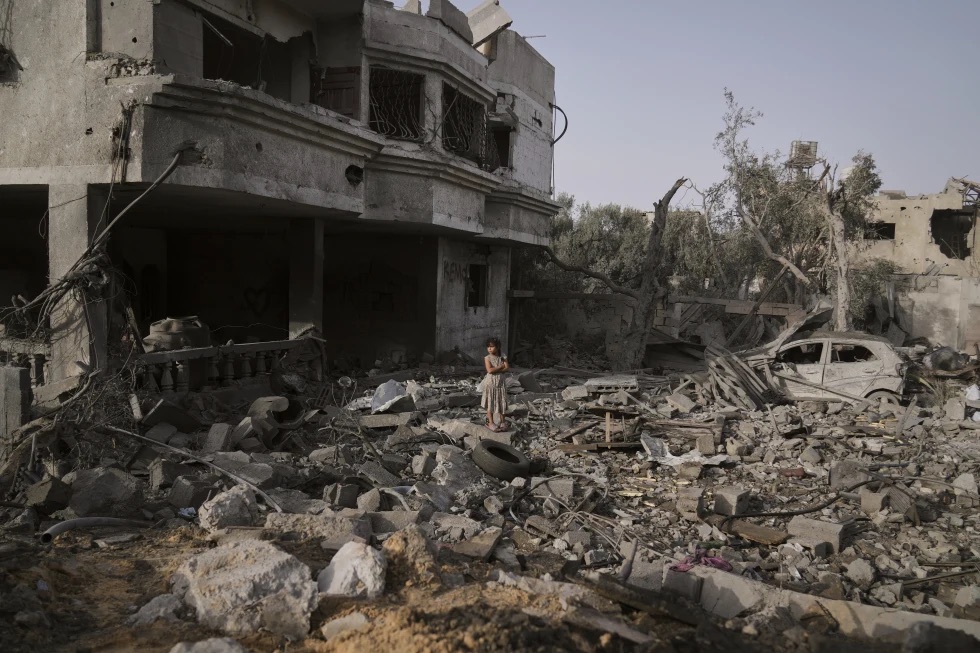
A Palestinian girl stands atop the rubble of the AI-Aimawi family's home that was destroyed by Israeli airstrikes in Al-Zawaideh, Gaza Strip, Tuesday, July 1, 2025. 
(AP Photo/Abdel Kareem Hana)

Associated Press
July 2, 2025

JERUSALEM (AP) — Hamas suggested Wednesday that it was open to a ceasefire agreement with Israel, but stopped short of accepting a Washington-backed proposal announced by U.S. President Donald Trump hours earlier, insisting on its longstanding position that any deal bring an end to the war in Gaza.

Israeli Prime Minister Benjamin Netanyahu, meanwhile, vowed “there will be no Hamas” in postwar Gaza.

Trump said Tuesday that Israel had agreed on terms for a 60-day ceasefire in Gaza and urged Hamas to accept the deal before conditions worsen. The U.S. leader has been increasing pressure on the Israeli government and Hamas to broker a ceasefire, and hostage agreement and bring about an end to the war.

Trump said the 60-day period would be used to work toward ending the war — something Israel says it won’t accept until Hamas is defeated. He said that a deal might come together as soon as next week.

But Hamas’ response, which emphasized its demand that the war end, raised questions about whether the latest offer could materialize into an actual pause in fighting.

Hamas official Taher al-Nunu said that the militant group was “ready and serious regarding reaching an agreement.”

He said Hamas was “ready to accept any initiative that clearly leads to the complete end to the war.”

A Hamas delegation is expected to meet with Egyptian and Qatari mediators in Cairo on Wednesday to discuss the proposal, according to an Egyptian official. The official spoke on condition of anonymity, because he wasn’t authorized to discuss the talks with the media.

Disagreement on how the war should end

Throughout the nearly 21-month-long war, ceasefire talks between Israel and Hamas have repeatedly faltered over whether the war should end as part of any deal.

Hamas said in a brief statement Wednesday that it had received a proposal from the mediators and is holding talks with them to “bridge gaps” to return to the negotiating table to try to reach a ceasefire agreement.

Hamas has said that it’s willing to free the remaining 50 hostages, less than half of whom are said to be alive, in exchange for a complete Israeli withdrawal from Gaza and an end to the war.

Israel says it will only agree to end the war if Hamas surrenders, disarms and exiles itself, something the group refuses to do.

An Israeli official said that the latest proposal calls for a 60-day deal that would include a partial Israeli withdrawal from Gaza and a surge in humanitarian aid to the territory. The mediators and the U.S. would provide assurances about talks to end the war, but Israel isn’t committing to that as part of the latest proposal, the official said.

The official wasn’t authorized to discuss the details of the proposed deal with the media and spoke on condition of anonymity.

It wasn’t clear how many hostages would be freed as part of the agreement, but previous proposals have called for the release of about 10.

Israel has yet to publicly comment on Trump’s announcement. On Monday, Trump is set to host Netanyahu at the White House, days after Ron Dermer, a senior Netanyahu adviser, held discussions with top U.S. officials about Gaza, Iran and other matters.

Trump issues another warning

On Tuesday, Trump wrote on social media that Israel had “agreed to the necessary conditions to finalize the 60 Day CEASEFIRE, during which time we will work with all parties to end the War.”

“I hope, for the good of the Middle East, that Hamas takes this Deal, because it will not get better — IT WILL ONLY GET WORSE,” he said.

Trump’s warning may find a skeptical audience with Hamas. Even before the expiration of the war’s longest ceasefire in March, Trump has repeatedly issued dramatic ultimatums to pressure Hamas to agree to longer pauses in the fighting that would see the release of more hostages and a return of more aid for Gaza’s civilians.

Still, Trump views the current moment as a potential turning point in the brutal conflict that has left more than 57,000 dead in the Palestinian territory.

Gaza’s Health Ministry said the death toll passed the 57,000 mark Tuesday into Wednesday, after hospitals received 142 bodies overnight. The ministry doesn’t differentiate between civilians and combatants in its death count, but says that more than half of the dead are women and children.

Since dawn Wednesday, Israeli strikes killed a total of 40 people across the Gaza Strip, the mMinistry said. Hospital officials said four children and seven women were among the dead.

The Israeli military, which blames Hamas for the civilian casualties because it operates from populated areas, was looking into the reports.

The war began on Oct. 7, 2023, when Hamas-led militants attacked southern Israel, killing 1,200 people and taking roughly 250 hostages.

The war has left the coastal Palestinian territory in ruins, with much of the urban landscape flattened in the fighting. More than 90% of Gaza’s 2.3 million population has been displaced, often multiple times. And the war has sparked a humanitarian crisis in Gaza, pushing hundreds of thousands of people toward hunger.

Hospital director killed

The director of the Indonesian Hospital, Dr. Marwan Sultan, was killed in an apartment in an Israeli strike west of Gaza City, a hospital statement said. The hospital is the Palestinian enclave’s largest medical facility north of Gaza City and has been a critical lifeline since the start of the Israel-Hamas war.

The hospital was surrounded by Israeli troops last month, and evacuated alongside the other two primary hospitals in northern Gaza.

The bodies of Sultan, his wife, daughter and son-in-law, arrived at Shifa Hospital torn into pieces, according to Issam Nabhan, head of the nursing department at the Indonesian Hospital.

“Gaza lost a great man and doctor,” Nabhan said. “He never left the hospital one moment since the war began and urged us to stay and provide humanitarian assistance. We don’t know what he did to deserve getting killed.”

___

Bassem Mroue reported from Beirut. Kareem Chehayeb in Beirut, and Josef Federman in Jerusalem, contributed to this report.

___

Follow the AP’s war coverage at https://apnews.com/hub/israel-hamas-war
ROGUE NATION

Israel 'systematically' violating Lebanon ceasefire deal

Issued on: 05/07/2025 - 

Lebanon said one person was killed and six wounded on Saturday in a series of Israeli strikes in the south despite a fragile ceasefire deal. Lebanese Deputy Prime Minister Tarek Mitri tells FRANCE 24 that Israel is "systematically" violating the ceasefire, with more than 3,500 violations since the deal was signed in November.

Video by:  FRANCE 24


Israel conducts deadly strikes on southern Lebanon despite fragile ceasefire

Israeli strikes on southern Lebanon killed one person and wounded six on Saturday, said the Lebanese health ministry, as the Israeli military continued to target militant group Hezbollah despite a November 2024 ceasefire deal.


Issued on: 05/07/2025 - 
By:  FRANCE 24

Shiite worshippers walk past the rubble of buildings destroyed by previous Israeli strikes during a religious procession in Kfarkila in southern Lebanon on July 5, 2025. © Rabih Daher, AFP

Lebanon said one person was killed and six wounded on Saturday in a series of Israeli strikes in the south despite a ceasefire between Israel and militant group Hezbollah.

An "Israeli enemy drone strike on a vehicle" in the town of Bint Jbeil "killed one person and wounded two", Lebanon's health ministry said in a statement carried by the official National News Agency (NNA).

The Israeli military said in a statement that its forces "struck and eliminated" an operative from Hezbollah's elite Radwan force in the area.

The health ministry also reported one person wounded in a drone strike on another car in the same town, and two others seriously wounded in a similar raid on a vehicle in nearby Shaqra.

Israel 'systematically' violating Lebanon ceasefire deal

14:56© France 24


Also on Saturday, the ministry reported that a separate Israeli drone strike wounded one person in Shebaa, elsewhere in the south, with NNA reporting that a house was targeted.

Israel has kept up its bombardment of Lebanon since a November 27 ceasefire that sought to end more than a year of hostilities with Hezbollah including two months of all-out war that left the Iran-backed group severely weakened.

On Thursday, an Israeli strike on a vehicle at the southern entrance of Beirut killed a man and wounded three other people, Lebanon said, as the Israeli army said it hit a "terrorist" working for Iran.


Under the ceasefire deal, Hezbollah was to pull its fighters back north of the Litani river, about 30 kilometres (20 miles) from the Israeli border, leaving the Lebanese army and United Nations peacekeepers as the only armed parties in the region.

Israel was required to fully withdraw its troops from the country, but has kept them in five places it deems strategic.

Israel has warned that it will keep striking Lebanon until Hezbollah has been disarmed.

(FRANCE 24 with AFP)


Greed: The Survival of a Primitive Emotion


Congressional passage of Donald Trump’s “Big, Beautiful Bill” provides the latest evidence that human greed, despite its primitive nature, remains alive and well.

Perhaps most noticeably, the legislation provides for over $3 trillion in tax cuts that disproportionately help the wealthy and their corporations. This largesse is facilitated by slashing over $1.4 trillion in healthcare and food assistance for low-income Americans and increasing the national debt by $3.3 trillion. Estimates reveal that at least 16 million Americans will lose health care coverage and 7 million people (including 2 million children) will lose food aid or have their food aid cut significantly. Meanwhile, according to the Yale Budget Lab, the nation’s top 0.1 percent―people with an annual income over $3.3 million―will receive tax cuts of $103,500 on average. Condemning the legislation, the president of the U.S. Conference of Catholic Bishops declared simply that it “takes from the poor to give to the wealthy.”

Other measures in the legislation supporting the wealthy and their businesses at public expense include financial subsidies for coal, oil, and gas companies, the opening of opportunities for oil and gas corporations to drill on public lands (including the Arctic National Wildlife Refuge and the National Petroleum Reserve), and the reduction of royalty fees for such fossil fuel drilling.

Of course, this kind of class legislation and the greed that inspires it are nothing new. Throughout history, some people have amassed great fortunes, often with the assistance of governments and other powerful entities. Kings, princes, and their courtiers provided themselves with castles, vast landed estates, and other perquisites of wealth, while millions of their subjects lived in miserable huts and dug a few potatoes out of their fields in a desperate effort to survive. In later years, this situation was replicated to some extent as business titans garnered great wealth by exploiting workers in factories, mines, and fields.

Although this pattern of economic inequality was viewed as immoral by every great religious and ethical system, it did have a brutal logic to it. After all, in these situations of overall scarcity, some people would be poor and some would surely die. By contrast, growing rich helped guarantee survival for oneself and one’s family.

But with the advent of the industrial revolution, these tragic circumstances began to dissipate, for human beings increasingly possessed the knowledge, skills, and resources that had the potential to produce decent lives for everyone. Indeed, as science, technology, and factory output advanced and produced unprecedented abundance, there was no longer any morally justifiable basis for the existence of hunger, homelessness, and mass sickness.

In these altered conditions, avarice has become increasingly irrational―the driving force behind irrational men like Donald Trump and his billionaire friends, who, even as millions of people live and die in poverty and misery, seek to wallow in great wealth.

Gandhi put it concisely when he declared, decades ago: “The world has enough for everyone’s need, but not enough for everyone’s greed.”

Fortunately, over the course of human history, humane thinkers, social movements, and political parties have worked to rein in untrammeled greed in the interest of a better life for all humanity. In recent centuries, they have recognized the fact that sharing the wealth is not only a moral stance, but a feasible one.

Let’s hope, then, that despite this brazen and regressive move by the Trump administration to bolster economic privilege at the expense of human needs, the forces favoring human equality and compassion will ultimately prevail.

Lawrence S. Wittner is Professor of History Emeritus at SUNY/Albany and the author of Confronting the Bomb (Stanford University Press). Read other articles by Lawrence, or visit Lawrence's website.
In the Philippines, Communist guerrillas make a last stand


FOCUS © FRANCE 24
Issued on: 04/07/2025 -
 

05:47 min
From the show

It's the oldest Communist guerrilla group in the world. The New People’s Army (NPA) has waged a violent campaign against the Philippine government since 1969. The conflict has killed an estimated 40,000 people. But today, the rebel group is struggling. Since the failure of a 2019 ceasefire, Manila has hunted down Communist sympathisers, mainly in the movement's rural strongholds.


In 2023, NPA forces controlled about 200 villages, compared to more than 1,300 in 2008. Stripped of its funding and influence, the group has only around 1,500 armed fighters left.


The Philippines' president, Ferdinand Marcos Jr, has vowed that the army will complete its rout of the NPA by 2028. FRANCE 24's William de Tamaris reports.


By:
William DE TAMARIS
Justin McCURRY

Jazzman Ludovic Louis draws inspiration from anti-colonial activist Frantz Fanon

Africa
EYE ON AFRICA © FRANCE 24
Issued on: 04/07/2025 -
From the show

2025 marks the 100th anniversary of the birth of Frantz Fanon. The psychiatrist's work has had a significant impact on post-colonial movements around the world, especially in North Africa. When filmmaker Jean-Claude Barny explored his life in the biopic Fanon, he chose Ludovic Louis to create the soundtrack. The jazz composer and trumpeter employed a bold musical alliance, creating a dialogue between North African and Middle Eastern sounds. Ludovic Louis is our guest on Eye on Africa.

Also in the programme, Gabon's former first lady Sylvia Bongo and her son Nourredin have testified in a Paris court, alleging they were tortured by Gabonese security forces during their 20 month detention between 2023 and 2025. Gabonese authorities say it's an attempt to draw attention away from an upcoming corruption trial.

And we meet Kim Zulu, a 25-year-old fashion blogger from Johannesburg. She has her own TikTok, Instagram, and even LinkedIn. But there’s one catch: she doesn’t actually exist. We look at the rise of AI-generated influencers.
By:

Clarisse FORTUNÉ

Laurent BERSTECHER

Tom CANETTI
French-Algerian writer Boualem Sansal won't appeal sentence, hopes for pardon


French-Algerian writer Boualem Sansal will not appeal his five-year prison sentence, sources close to the author said on Saturday. French Prime Minister François Bayrou has said he hoped Algeria would pardon the author, who was arrested in November for saying France had unfairly ceded Moroccan territory to Algeria during the colonial era.


Issued on: 05/07/2025 
By: FRANCE 24


photo of Franco-Algerian writer Boualem Sansal taken in Paris on September 4, 2015. © Joël Saget, AFP


French-Algerian writer Boualem Sansal will not appeal his five-year prison sentence to Algeria's supreme court, said sources close to the author on Saturday, adding that they remain hopeful for a pardon.

The 80-year-old dual national writer was sentenced to five years behind bars on March 27 on charges related to undermining Algeria's territorial integrity over comments made to a French media outlet.

On July 1, an Algerian appeals court upheld the sentence.

Read moreAlgeria upholds five-year jail sentence for writer Boualem Sansal


"According to our information, he will not appeal to the supreme court," the president of the author's support committee, Noëlle Lenoir, told broadcaster France Inter on Saturday.

"Moreover, given the state of the justice system in Algeria ... he has no chance of having his offence reclassified on appeal," the former European affairs minister said.

"This means that the sentence is final."

Sources close to Sansal told AFP that the writer had "given up his right to appeal".

His French lawyer, Pierre Cornut-Gentille, declined to comment when contacted by AFP.

France's prime minister François Bayrou said earlier this week that he hoped Algeria would pardon the author, whose family has highlighted his treatment for prostate cancer.

But Sansal was not among the thousands pardoned by Algeria's president on Friday, the eve of the country's independence day.

"We believe he will be released. It is impossible for Algeria to take responsibility for his death in prison," Lenoir said, adding she was "remaining hopeful".

A prize-winning figure in North African modern francophone literature, Sansal is known for his criticism of Algerian authorities as well as of Islamists.

The case against him arose after he told the far-right outlet Frontières that France had unjustly transferred Moroccan territory to Algeria during the colonial period from 1830 to 1962 – a claim Algeria views as a challenge to its sovereignty and that aligns with longstanding Moroccan territorial assertions.

Sansal was detained in November 2024 upon arrival at Algiers airport. On March 27, a court in Dar El Beida sentenced him to a five-year prison term and fined him 500,000 Algerian dinars ($3,730).

Appearing in court without legal counsel on June 24, Sansal said the case against him "makes no sense" as "the Algerian constitution guarantees freedom of expression and conscience".

The writer's conviction has further strained tense France-Algeria relations, which have been complicated by issues such as migration and France's recognition of Moroccan sovereignty over Western Sahara, a disputed territory claimed by the Algeria-backed Polisario Front.

(FRANCE 24 with AFP)
South Africa's one million invisible children without birth certificates


Our correspondent in Cape Town – An NGO has taken the South African government to court over a backlog of hundreds of thousands of applications for late birth registration, with some people waiting for seven years for a response from Home Affairs. Living without a birth certificate restricts access to healthcare and education in South Africa. On the continent, more than half of Africa's children under five lack any form of legal identity.


Issued on: 05/07/2025 - 
FRANCE24/AFP
By: Tom CANETTI


Qamani Sentiwe with medals and trophies he has won playing football at the local Pinelands football club. While his coach wants him to play professionally, he can't play in tournaments because he doesn't have a birth certificate. © Tom Canetti, FRANCE 24


Qamani’s dream is to one day play for the Bafana Bafanas, South Africa’s national football team. But his coach says he can’t partake in local tournaments because he doesn’t have a birth certificate. The 15-year-old is among over one million children in the country without the document, which prevents them from accessing healthcare, education, employment, and in some cases, social activities.

“Sometimes I feel like I’m not a complete person,” Qamani said. “It feels like I’m not the same as other children.”

Qamani’s mother was 16 when she gave birth to him in the Eastern Cape. The teenage mother did not have her own identification at the time so she could not register her son’s birth, before she abandoned him. It was then up to Qamani's grandmother to raise him in a neighbouring province, the Western Cape.

Grandmother Nozibele Dada and Qamani live in a township in Langa, 10 kilometres from Cape Town in the poverty-stricken Cape Flats. Their tiny shack sleeps eight family members in the same room.

Ms Dada looks tired. She stares blankly at the wall in front of her when asked about the topic of Qamani’s birth certificate. She has been fighting a years-long battle to get her grandson his documents, trying to navigate extensive bureaucratic requirements while at the same time worrying about how to fund their next meal. Ms Dada doesn’t receive any welfare grants from the government to help raise her grandson, as he doesn’t officially exist.

“Every time we call Home Affairs, they tell us they will call us back,” she said. “We’ve been waiting for four years.”

Qamani Sentiwe (left) and his grandmother Nozibele Dada in front of their small home in Langa, a township in Cape Town. © Tom Canetti, FRANCE 24

There is a backlog of more than 250,000 people who have been waiting up to seven years for Home Affairs to register their late birth registration applications. The number of people living without birth certificates is much larger, as many never apply, or give up, often due to the rigorous bureaucratic process. For the 12 million South Africans living in extreme poverty, the process is sometimes unaffordable.

“I am scared, because I think: what will happen after I die?” said Ms Dada. “What will happen to my grandchild?”

“We have faith someone will help us,” an optimistic Qamani, sitting next to his grandmother, interjected.
Trapped in legal and social limbo

The Children’s Institute, a research group advocating for children’s rights, is trying to help Qamani by taking the South African government to court over the backlog in late birth registrations. The NGO argues that the backlog is unconstitutional and has included affidavits from 15 affected people in its court papers filed in the Western Cape High Court.

Ms Nosipho Mnyakama is another one of the cases included in the papers. She does not have a birth certificate of her own because she is an orphan and consequentially neither does her 19-year-old daughter. Ms Mnyakama lives in a township in Khayelitsha in the Western Cape but Home Affairs said to lodge her application she must travel more than 1,000 kilometres to her birth province, the Eastern Cape, which she cannot afford to do.

Senior Legal Researcher at the Children’s Institute Paula Proudlock said that Home Affairs is a national agency and that it should be able to communicate internally between provinces, rather than put the onus back on poor South Africans to travel across the country.

“There are over-zealous rules about who can register an orphaned or abandoned child,” she said. “We found that Home Affairs pushes these families away and doesn’t encourage them.”

A faded image of Qamani Sentiwe when he was four-years-old on Grandmother Dada's fridge. © Tom Canetti, FRANCE 24

Proudlock said the rigorous process for late birth registration is “not actually geared for the people that it’s serving” but rather to “help officials avoid a bad performance review”.

“South Africans coming forward are being treated with suspicion that they are an illegal immigrant rather than rightful parents who are assisted to quickly register a child,” she said.

Proudlock said the families the Children's Institute is assisting have been waiting “between two to seven years” and one of the reasons for the bottlenecking of registrations is the interview process, when a panel of five Home Affairs officials, including an immigration officer, interview the family and the child to verify the information they’re giving.

“The interviews are not necessary in all of the cases,” Proudlock said. “The documents in front of an official and the family presenting themselves to that official are sufficient evidence.”

There are roughly 200,000 applicants for late birth registration in South Africa per year, and while the law does not require it, Home Affairs insists on an interview process for every case. Proudlock and the Children’s Institute are calling for the process to be easier to navigate, and that it encourages applicants, rather than pushes them to give up.

Statistics from the 2024 Mid-Year Population Estimates (MYPE) reflected a decrease in the number of births registered, and therefore a decrease in the number of families receiving child support grants (CSG) that they would otherwise be eligible for. This trend is expected to get worse over time.
Source: K. Hall calculations from MYPE 2024 series, Thembisa v 4.8, Recorded live births, SASSA social grant statistics. © Tom Canetti, FRANCE 24

“It’s the poorest people and the most vulnerable who will suffer the most,” Proudlock said.

Some of those who acquire their birth certificate after a late birth registration are then able to find employment and open bank accounts. Cape Town gardener Bongumusa Bernat was 31 years old when he received his birth certificate. He says “life was hard” before his employer funded his transportation to where he was born in KwaZulu-Natal to satisfy Home Affairs’ application requirements.


Bongumusa Bernat gardening at his workplace in Hout Bay, Cape Town.
 © Tom Canetti, FRANCE 24

“I don’t want this to happen to my children,” he said. “It’s better that it happened to me because my children must not ever experience my situation.”

“You can’t live without these documents – it’s like someone is handcuffing you.”

Bernat was previously unable to afford the trip to his birthplace to lodge his application but also struggled to find work as no one trusted him without an official identification. He even feared he could become a victim of xenophobic attacks that sometimes occur in townships against foreigners.

“I was afraid that someone would attack me, thinking that I'm an illegal migrant,” he said. “People think I’m from another country because my hair is different and I was afraid because I didn’t have proof of being from South Africa.”

Now that he has his birth certificate, Bernat said “life is much better than before”.

“I even have access to a bank,” he said. “I have insurance and I can save some money.”

The predicament of undocumented people is not unique to South Africa, but felt across the continent. There are 540 million people in Africa without an official identification according to the UN Economic Commission for Africa (UNECA).

Children are most at risk, with more than half of the continent's children under five lacking a birth certificate.
TORY, LABOUR, SAME OLD STORY

UK police arrest supporters of banned Palestine Action group at London protest


British police on Saturday arrested more than 20 people on suspicion of terrorism offences after they demonstrated beneath a statue of Mahatma Gandhi in London in support of the Palestine Action group. The protest came hours after the Palestine Action group was banned under British anti-terror laws.


Issued on: 05/07/2025 - 
By: FRANCE 24

Protesters demonstrate in support of 'Palestine Action', organised by the Defend Our Juries group, in front of the Mahatma Gandhi statue in London, July 5, 2025. 
© Jeff Moore, AP

More than 20 people were arrested Saturday in the UK on suspicion of terrorism offenses after protesters gathered in central London in support of Palestine Action.

The protest in Parliament Square came hours after the pro-Palestinian activist group was banned in Britain under anti-terrorism laws.

The group lost a last-minute court battle late Friday seeking to block the British government's ban, which came into effect at midnight. Activists and their supporters have said the group is non-violent and advocates civil disobedience, and condemned the government decision as authoritarian.

A small group of protesters stood beneath a statue of Mahatma Gandhi and held placards reading, “I oppose genocide. I support Palestine Action.”


Police surrounded them and several people were taken away. One woman seen lying on the ground in handcuffs was carried by officers to a police van.

“Palestine Action is a proscribed group and officers will act where criminal offences are committed,” the Metropolitan Police said in a statement.

The designation as a proscribed group under the Terrorism Act 2000 means that membership of the group and support of its actions a criminal offense punishable by up to 14 years in prison.

Under UK law, offences include inviting support, expressing approval, or displaying symbols of a banned group and are punishable by up to 14 years in prison and/or a fine. Britain has proscribed 81 groups under anti-terrorism laws, including Hamas, al Qaeda and the Islamic State (IS) group.

The government moved to ban Palestine Action after activists broke into a Royal Air Force base in Brize Norton in Oxfordshire, England, on June 20, damaging two planes using red paint and crowbars in protest at the British government's ongoing military support for Israel in its war in Gaza.

Police said that the incident caused around 7 million pounds' ($9.4 million) worth of damage.

Four people between 22 and 35 years old were charged Thursday with conspiracy to commit criminal damage and conspiracy to enter a prohibited place for purposes prejudicial to the interests of the U.K.

No pleas were entered at Westminster Magistrates’ Court in central London and the four are scheduled to appear on July 18 at the Central Criminal Court.

Palestine Action has targeted Israel-linked companies in Britain in its protests, with British Interior Minister Yvette Cooper saying that violence and criminal damage have no place in legitimate protest and that the group's activities justify proscription.

Critics of the decision, including some UN experts and civil liberties groups, have argued that damaging property does not amount to terrorism.

At another protest on Saturday, the police arrested five pro-Palestine protesters from the Youth Demand group who threw red paint over a truck involved in London's Pride parade and glued themselves to the vehicle. The parade later resumed.

(FRANCE 24 with AP and Reuters)