It’s possible that I shall make an ass of myself. But in that case one can always get out of it with a little dialectic. I have, of course, so worded my proposition as to be right either way (K.Marx, Letter to F.Engels on the Indian Mutiny)
Wednesday, July 16, 2025
Battery sharing could cut energy costs for communities
As solar and wind use grows, study offers cost-effective solution for local energy storage
What if neighbourhoods could lower their electricity bills without investing in expensive battery systems? An international study led by researchers at CWI (the national research institute for mathematics and computer science in the Netherlands) suggests exactly that: by leasing capacity from large, commercially operated batteries, communities can access the benefits of energy storage without the high upfront costs or additional technical challenges.
In collaboration with GIGA Storage, a leading operator of grid-connected batteries in the Netherlands, the University of Glasgow (UK) and Princeton University (US), the researchers developed a method to determine how much battery capacity energy communities should rent, and at what price, so that both the community and the battery operator gain financially. Their approach was tested using real-world data from a community of 200 homes equipped with a wind turbine. They showed that considerable savings are possible, even after subtracting the battery rental costs.
Storing excess power
The research comes at a time when rooftop solar panels and small wind turbines are increasingly common in residential areas, but many households struggle to store excess power for later use. Meanwhile, commercial battery operators are looking for stable revenue streams in volatile energy markets. This study proposes a solution that benefits both sides.
The core idea is simple: a battery operator rents out a portion of its large grid-connected battery to an energy community. That battery stores energy when prices are low and releases it when demand (and prices) rise. The researchers developed a mathematical model to find the “sweet spot”: how much capacity to rent out and when to charge or discharge, depending on market prices, tariffs, and community energy demand.
Reducing battery degradation
Importantly, the team also tackled a practical challenge: how to control a grid-connected battery without wearing it out. Professor Valentin Robu, leading investigator of the project, explains: ““Our work explores a number of techniques for modifying linear optimization algorithms. The goal is to increase long-term financial gains from using the battery capacity, while reducing the number of charge/discharge cycles, which can lead to a reduction of the battery’s remaining useful lifetime.”
The method was tested using both battery data from GIGA Storage and energy demand and wind generation data from the UK and the Netherlands. The approach is designed to be applicable in different countries, market settings and community models. It is a step forward in allowing energy communities to use more of their own locally generated renewable energy, increasing the financial viability of community energy projects, and reducing dependence on big utility companies.
This research was supported by the EU-funded TESTBED-2 project under the Marie Curie Staff Exchange Programme (MSCA-RISE). The collaboration with GIGA Storage was also supported by a knowledge voucher from the Dutch Ministry of Economic Affairs, a government subsidy instrument that supports collaboration between businesses and research institutes.
Boston, MA—Living near Coldwater Creek—a Missouri River tributary north of St. Louis that was polluted by nuclear waste from the development of the first atomic bomb—in childhood in the 1940s, ’50s, and ’60s was associated with an elevated risk of cancer, according to a new study led by Harvard T.H. Chan School of Public Health. The researchers say the findings corroborate health concerns long held by community members.
The study will be published July 16 in JAMA Network Open. It coincides with Congress having passed an expanded version of the Radiation Exposure Compensation Act (RECA) as part of the Trump tax bill, through which Americans, including Coldwater Creek residents, can receive compensation for medical bills associated with radiation exposure.
Most studies of radiation exposure have focused on bomb survivors who have had very high levels of exposure; far less is known about the health impacts of lower levels of radiation exposure.
For this study, the researchers used a subsample of 4,209 participants from the St. Louis Baby Tooth – Later Life Health Study (SLBT), a cohort composed of many individuals who lived near Coldwater Creek as children and who donated their baby teeth beginning in 1958 to measure exposure to radiation from atmospheric nuclear testing. The participants, who lived in the Greater St. Louis area between 1958 and 1972, self-reported incidences of cancer, allowing the researchers to calculate cancer risk in accordance with childhood residence proximity to Coldwater Creek.
The findings showed a dose-response effect—those living nearest to the creek had a higher risk for most cancers than those living farther away. There were 1,009 individuals (24% of the study population) who reported having cancer. Of those, the proportion was higher for those living near the creek—30% lived less than one kilometer away, 28% between one and five kilometers away, 25% between five and 20 kilometers away, and 24% 20 kilometers or more away).
The researchers estimated that those living more than 20 kilometers away from the creek had a 24% risk of any type of cancer. Compared to this group, among those who lived less than one kilometer away from the creek, the risk of developing any type of cancer was 44% higher; solid cancers (cancers that form a mass, as opposed to blood cancers), 52% higher; radiosensitive cancers (thyroid, breast, leukemia, and basal cell), 85% higher; and non-radiosensitive cancers (all except thyroid, breast, leukemia, and basal cell), 41% higher. The risk went down among those who lived between one and 5 kilometers away from the creek, and then down a little more among those who lived 5-20 kilometers away, but was still slightly higher than those living more than 20 kilometers away.
“Our research indicates that the communities around North St. Louis appear to have had excess cancer from exposure to the contaminated Coldwater Creek,” said corresponding author Marc Weisskopf, Cecil K. and Philip Drinker Professor of Environmental Epidemiology and Physiology. “These findings may have broader implications—as countries think about increasing nuclear power and developing more nuclear weapons, the waste from these entities could have huge impacts on people’s health, even at these lower levels of exposure.”
Other Harvard Chan School authors included Michael Leung, Ian Tang, Joyce Lin, Lorelei Mucci, Justin Farmer, and Kaleigh McAlaine.
The study was funded by the National Institutes of Health (R01ES031943, P42ES030990, P30ES000002 and T32ES007069).
"Cancer Incidence and Childhood Residence Near the Coldwater Creek Radioactive Waste Site,” Michael Leung, Ian W. Tang, Joyce J.Y. Lin, Lorelei Mucci, Justin G. Farmer, Kaleigh McAlaine, Joseph J. Mangano, Marc. G. Weisskopf, JAMA Network Open, July 16, 2025, doi: 10.1001/jamanetworkopen.2025.21926
Harvard T.H. Chan School of Public Healthis a community of innovative scientists, practitioners, educators, and students dedicated to improving health and advancing equity so all people can thrive. We research the many factors influencing health and collaborate widely to translate those insights into policies, programs, and practices that prevent disease and promote well-being for people around the world. We also educate thousands of public health leaders a year through our degree programs, postdoctoral training, fellowships, and continuing education courses. Founded in 1913 as America’s first professional training program in public health, the School continues to have an extraordinary impact in fields ranging from infectious disease to environmental justice to health systems and beyond.
Cancer Incidence and Childhood Residence Near the Coldwater Creek Radioactive Waste Site
Article Publication Date
16-Jul-2025
COI Statement
Dr Mucci reported equity interest in Convergent Therapeutics, a radiopharmaceutical oncology company, and consulting for Bayer Pharmaceuticals outside the conduct of the study. No other disclosures were reported.
Westinghouse, Google aim to speed up reactor construction with AI
Westinghouse has announced it is to collaborate with Google Cloud to use artificial intelligence tools to streamline construction of new nuclear plants and enhance the operations of existing nuclear power plants.
Westinghouse's vision of an AP300 plant (Image: Westinghouse)
In September last year, Westinghouse introduced the HiVE System - a generative artificial intelligence system built on more than 75 years of proprietary data, knowledge and expertise. The system features a Nuclear Large Language Model AI System named bertha, after Bertha Lamme who was the first woman in the US to receive a mechanical engineering degree - in 1893 - and then became the first female engineer hired by Westinghouse. According to Westinghouse, these nuclear-specific AI solutions will optimise new nuclear deployment of its AP1000 reactor, AP300 small modular reactors and eVinci microreactor technologies.
Under its agreement with Google Cloud, the two companies will pair Westinghouse's HiVE and bertha nuclear AI solutions with Google Cloud technologies and expertise to "transform the construction of advanced Westinghouse nuclear reactors into an efficient, repeatable process and enhance the operations of existing nuclear power plants using data-driven insights".
"As the only fully licensed, construction-ready modular reactor available today, our AP1000 technology is the quickest way to add new sources of affordable and abundant nuclear energy to the US grid," said Westinghouse Interim Chief Executive Officer Dan Sumner. "By partnering with Google Cloud to enhance our HiVE and bertha technology, and backed by 75 years of our proprietary nuclear data, we can accelerate the deployment of new AP1000 units while implementing powerful AI technologies that will optimise the construction and operations of nuclear power plants."
"This partnership with Westinghouse combines Google Cloud's AI technologies and expertise with Westinghouse's century-long expertise in nuclear innovation to chart a new path towards a smarter and safer future," said Kyle Jessen, Managing Director, Commercial Industries, Google Cloud. "Artificial intelligence is not merely a tool; it can give companies a critical competitive advantage. Westinghouse is demonstrating what's possible."
As part of this collaboration, Westinghouse and Google Cloud have successfully achieved a first-of-a-kind proof of concept leveraging Westinghouse's WNEXUS digital plant design platform and HiVE artificial intelligence enhanced by Google Cloud technologies, including Vertex AI, Gemini and BigQuery, to autonomously generate and optimise AP1000 modular construction work packages.
Idaho National Laboratory collaborates with Microsoft to streamline nuclear licensing
(IDAHO FALLS, Idaho) — The Idaho National Laboratory (INL) and Microsoft Corporation (Microsoft) have announced a collaboration to use Microsoft’s Azure cloud and artificial intelligence (AI) technologies to streamline the nuclear permitting and licensing application process.
The U.S. Department of Energy (DOE) Office of Nuclear Energy through the National Reactor Innovation Center provided funding for the project.
“This is a big deal for the nuclear licensing process,” said Jess Gehin, associate laboratory director for Nuclear Science and Technology at Idaho National Laboratory. “Introducing AI technologies will enhance efficiency and accelerate the deployment of advanced nuclear technologies.”
INL will leverage a Microsoft-developed solution built with Azure AI services to generate engineering and safety analysis reports, which are standard reports submitted as a part of applications for construction permits and operating licenses for nuclear power plants.
For reactor developers, generating these large, detailed reports is typically a time-consuming and expensive process that requires compiling safety data and language from multiple sources. The Azure AI-powered solution will help streamline and accelerate the review process.
The technology is designed to ingest and analyze nuclear engineering and safety documents, and generate documentation required by the U.S. Nuclear Regulatory Commission (NRC) and DOE for nuclear licensing.
The tool does not perform analyses on the documents but rather automates the process of constructing licensing documents for subsequent human verification.
“Artificial intelligence technologies can enable a new frontier of innovation and advancement by automating routine processes, accelerating development and freeing scientists and researchers to focus on the real complex challenges affecting our society,” said Heidi Kobylski, vice president for Federal Civilian Agencies, Microsoft. “We are honored to collaborate with INL to help address the complicated process of nuclear licensing to potentially help speed the approval of nuclear reactors necessary to support our increasing energy demands.”
The tool has wide applicability for nuclear energy-related licensing, including new light water reactors and upgrades to existing light water reactors. The Azure AI-powered solution could be especially useful for licensing advanced reactors, which often have different designs, fuels, coolants and materials than the conventional reactors typically reviewed by the NRC. The technology can generate reports for any nuclear facility licensed through NRC or DOE authorization, including nuclear energy test facilities.
“AI holds significant potential to accelerate the process to design, license, and deploy new nuclear energy for the nation’s increasing energy needs,” said Chris Ritter, division director of Scientific Computing and AI at INL. “INL looks forward to early research to evaluate the applicability of generative AI in the nuclear licensing space.”
The latest AI tool is not the first collaboration between INL and Microsoft. In 2023, INL and Idaho State University (ISU) nuclear engineering students developed the world’s first nuclear reactor digital twin — a virtual replica of ISU’s AGN-201 reactor — using the company’s Azure cloud computing platform.
A simulation of the Pile Fuel Cladding Silo - one of the oldest waste stores and one of the highest hazard facilities on the UK's Sellafield site - is making it safer to upgrade robots handling waste within it.
A PFCS waste handling robot (Image: RAICo)
The Pile Fuel Cladding Silo (PFCS) was built in the 1950s and is based on the simple design of a grain silo. The concrete structure is 29 metres long, 10 metres wide and 18 metres high and is divided into six tall compartments. It contains irradiated cladding materials removed from fuel assemblies used in some of the UK's earliest reactors at Windscale and Chapelcross. It stopped receiving waste in the early 1970s and now holds more than 3200 cubic metres of intermediate-level waste.
The PFCS was originally designed to remain sealed forever, but equipment has now been installed to enable the safe removal of the wastes so the facility can be decommissioned. Within the silo is a Waste Container Handling Facility, a concrete room where robots process waste containers.
One such robot is a large six-axis industrial robot arm, which unbolts empty containers, sends them to be filled with waste, then securely bolts the returning containers for onward transfer. The arm also swabs the outside of the container to check for contamination and puts the swab in a deposit box for analysis.
Executing pre-programmed tasks is routine. However, when physical upgrades are needed, such as adding new swabbing tools to the robot arm, operators have to take the robot out of service, and suit up in full protective gear to make changes. Changes then need multiple test runs, often with several human re-entries to adjust the setup. Each entry creates risks to human health and risk of damaging the robot, whilst trial runs for new setups create downtime. Even pure software upgrades require downtime while the new programme runs on the robot, monitored by cameras and personnel in the facility.
Simulator developed
Through the PFCS Operational Simulator (OpSim) project, a team from the Robotics and Artificial Intelligence Collaboration (RAICo) has developed a simulation that allows these changes to tooling or operational procedures to be tested and validated in the simulation before deployment into the facility. Once validated, software updates can be transferred digitally to the robot with almost no downtime, and physical updates need far fewer entries to make changes.
RAICo is a collaboration between the UK Atomic Energy Authority (UKAEA), Nuclear Decommissioning Authority (NDA), Sellafield Ltd, the University of Manchester and AWE Nuclear Security Technologies aimed at accelerating deployment of robotics and AI to solve shared nuclear decommissioning and fusion engineering challenges.
The PFCS OpSim project harnessed cutting-edge robotics, purpose-built 3D software, and a team that combined RAICo and Sellafield Ltd expertise in digital technologies and nuclear decommissioning environments.
To map the waste handling facility, a robotic quadruped, Spot, entered the silo with a LiDAR scanner, which uses lasers to collect precise positional data of everything in the space. Those data points were converted into 3D CAD assets, which were used to build a precise digital replica of the PFCS. That was done using RAICo's in-house 3D visualisation software platform, RHOVR (Remote Handling Operations Virtual Reality), which harnesses the Unreal Engine - better known for its use in video games - to create hyper-realistic 3D environments.
Next, an off-the-shelf simulator of the robot's hardware and software was acquired, and integrated into the RHOVR setup – the most technically challenging element of the project – so the team could run robot programmes in a photorealistic virtual environment. Finally, the simulator was validated over six months, before being formally demonstrated at RAICo1 in March this year.
The demonstration was successful and a working version has since been established at Sellafield Ltd's Engineering Centre of Excellence, where it is already being used to execute and verify existing robot programmes in the simulation environment, as well as for providing visual demonstrations of how the PFCS facility operates.
Additional applications
Many Sellafield facilities have similar setups, for example the Waste Transfer Route - the pathway of waste to storage and disposal - uses similar robots in similar sealed rooms for bolting and unbolting waste containers. That opens the door to future projects through the RAICo programme that could adapt the simulator to a wide range of use cases across the Sellafield site.
"This collaboration with RAICo has continued to help Sellafield approach complex robotic operations in hazardous environments," said Rav Chunilal, head of robotics and artificial intelligence at Sellafield Ltd. "By working seamlessly together we've developed a simulator that allows us to test and deploy changes virtually, reducing downtime and risk, and making it safer for our operators. It's accelerating our mission and setting a new benchmark for innovation in nuclear decommissioning which can be repeated across Sellafield and other NDA group operating companies."
NDA Head of R&D Kate Canning added: "This is a great example of a solution that can be deployed across the NDA group, bringing even greater benefits. It demonstrates the value of NDA group's participation in the RAICo programme which is accelerating deployment of transformational technologies across our sites and facilities."
The first batch of waste was successfully retrieved from the PFCS in August 2023 and it is expected to take many years to empty the silo.
Kairos Power installs third test unit reactor vessel
Wednesday, 16 July 2025
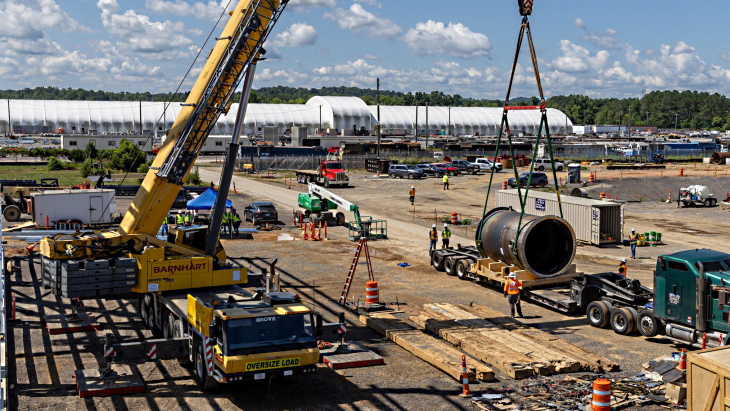
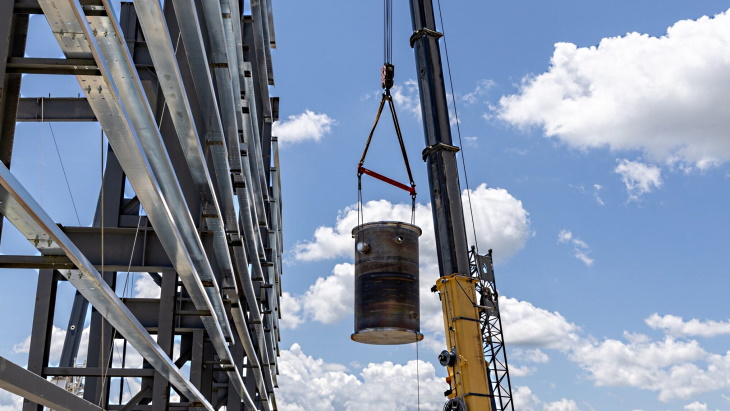
Kairos Power has installed the reactor vessel for its third Engineering Test Unit, which is under construction in Oak Ridge, Tennessee. The non-nuclear prototype will be used to pilot new manufacturing techniques and construction processes to lower the cost of building the company's commercial reactor.
(Image: Kairos Power)
Kairos is following an iterative approach for the development of its Fluoride Salt-Cooled High-Temperature Reactor (KP-FHR) technology. Its first Engineering Test Unit (ETU 1.0) is a full-scale, electrically heated prototype of the Hermes reactor which carried out more than 2000 hours of pumped salt operations demonstrating the design and integration of key systems, as well as exercising the supply chain and establishing new capabilities, including the production of the high-purity fluoride-lithium-beryllium (FLiBe) salt coolant.
The non-power Engineering Test Unit 2 (ETU 2.0) followed ETU 1.0 and will demonstrate modular construction methods: as part of the project the company is ramping up output of ASME U-stamped pressure vessels, producing specialised reactor components, and gaining proficiency in modular construction methods. Kairos Power has established a dedicated shop in its Albuquerque facility for KP-FHR vessel production.
(Image: Kairos Power)
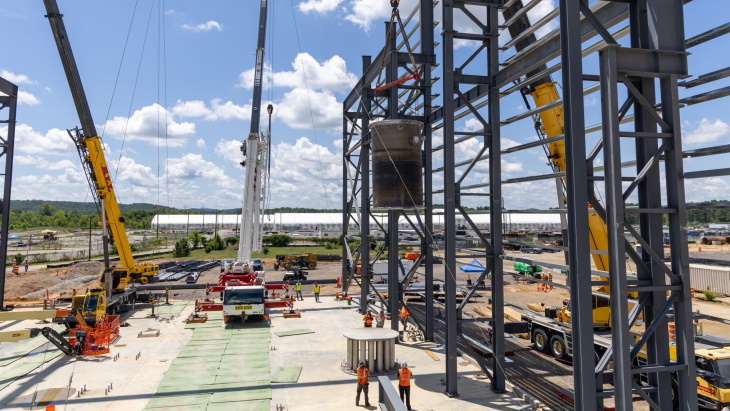
Kairos has now announced the installation of the 14-foot-tall (4.3 metres) reactor vessel of its third Engineering Test Unit (ETU 3.0). The non-nuclear mockup is being built adjacent to the site of Hermes - a low-power reactor currently under construction to advance the company's commercial KP-FHR reactor.
The ETU 3.0 reactor vessel was fabricated in partnership with Cambridge Vacuum Engineering and the University of Sheffield's Advanced Manufacturing Research Centre, using cutting-edge electron beam welding technology. The ETU 3.0 vessel project allowed Kairos to evaluate the advanced welding technique to enable faster, more cost-effective production of reactor vessels with precise tolerances for future commercial deployments.
(Image: Kairos Power)
The KP-FHR is one of five technologies selected in 2020 to receive federal funding for risk reduction projects under the US Department of Energy's (DOE's) Advanced Reactor Demonstration Program (ARDP), with the department investing up to USD303 million in the Hermes reactor project. Under its agreement with the DOE, Kairos receives fixed, performance-based payments from DOE upon demonstrating the completion of pre-determined project milestones.
"Kairos Power's novel contract with DOE allows us to remain agile while demonstrating continued progress as a responsible steward of public funding," said Kairos Power CEO and co-founder Mike Laufer. "ARDP support is helping us to move quickly through progressively sophisticated iterations, gaining essential learning that will enable commercial deployment of our advanced reactor technology on a meaningful timeline."
(Image: Kairos Power)
The ETU 3.0 building is being constructed around the reactor vessel in a streamlined sequence, which allowed the oversized component to be moved into position before the roof and other elements are in place. Kairos is collaborating with Barnard Construction to build the facility, using it as a proving ground to refine civil construction methods and quality assurance procedures for the Hermes reactor.
In addition to piloting new construction methods and manufacturing processes, ETU 3.0 will ultimately support the Hermes reactor as an operator training centre and test platform for remote handling and maintenance equipment. The facility will help improve operator safety and reduce downtime by prequalifying procedures for maintaining and replacing high-temperature reactor systems and components.
Hermes is the first non-light-water reactor to be permitted in the USA in more than 50 years. It will not produce electricity, but Hermes 2 - a two 35 MWt-unit plant for which the US Nuclear Regulatory Commission issued a construction permit in November - will include a power generation system.
The ETU 3.0 building will also house a Modular Systems Facility where plant equipment modules for ETU 3.0 and the Hermes reactor will be staged, assembled, and tested prior to installation. Kairos said the modular reactor construction methods being piloted with the ETU series and Hermes will be foundational to reducing construction costs and timelines for future plant deployments.
"The ability to test innovative production methods with our non-nuclear iterations is a game-changer for us," said Kairos Power Vice President of Manufacturing Craig Gerardi. "By serving as a vehicle to exercise the supply chain and gain construction proficiency, the ETU programme helps build confidence in our ability to deliver reactors for Kairos Power customers."
The commercial version of the KP-FHR is expected to be deployed in the 2030s.
Reactor vessel installed at Xudabao 1
Wednesday, 16 July 2025
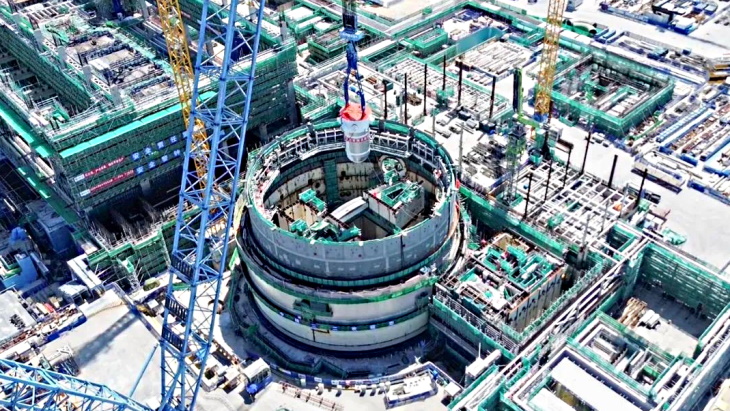
The reactor pressure vessel has been installed at unit 1 of the Xudabao nuclear power plant in China's Liaoning Province. It will be one of two CAP1000 reactors planned for the first plant, where two VVER-1200 reactors are also under construction.
(Image: CNNC)
The vessel - weighing more than 300 tonnes - was hoisted into position within the reactor building on 13 July. The vessel will house the nuclear reactor and is the core of a nuclear power plant.
"The successful installation of the pressure vessel not only provides sufficient space and technical preparation for the subsequent installation of key equipment such as steam generators, main pipelines, pressurisers, and reactor internals, but also marks the steady progress of Xudabao nuclear power plant unit 1 from the civil construction stage to the equipment installation stage," China National Nuclear Corporation (CNNC) said.
(Image: CNNC)
On 6 November 2023, the Ministry of Ecology and Environment announced that the National Nuclear Safety Administration had decided to issue a construction licence for Xudabao units 1 and 2, which will both feature 1250 MWe CAP1000 reactors - the Chinese version of the Westinghouse AP1000. A ceremony was held later that month at the Xudabao site near Xingcheng City, Huludao, to mark the start of construction of unit 1.
The Xudabao project was originally expected to comprise six CAP1000 reactors, with units 1 and 2 in the first phase. Site preparation began in November 2010. The National Development and Reform Commission gave its approval for the project in January 2011. CNNC noted that the total investment in units 1 and 2 exceeds CNY48 billion (USD6.6 billion).
However, with a change in plans, construction of two Russian-supplied VVER-1200 reactors as Xudabao units 3 and 4 began in July 2021 and May 2022, respectively.
The Xudabao plant is owned by Liaoning Nuclear Power Company Ltd, in which CNNC holds a 70% stake with Datang International Power Generation Company holding 20% and State Development and Investment Corporation owning 10%. The general contractor is China Nuclear Power Engineering Company Ltd, a subsidiary of CNNC.
Two further CAP1000 reactors are proposed for units 5 and 6 at the Xudabao plant.
Site named for first SOLO microreactor in US
Wednesday, 16 July 2025
Italy-based micro-modular reactor developer Terra Innovatum Srl has signed a memorandum of understanding with Rock City Admiral Parkway Development in Illinois to host the first deployment site for its SOLO reactor.
(Image: Terra Innovatum)
The memorandum of understanding (MoU) foresees the Rock City site - a six-million square-foot industrial park in Illinois in the USA - becoming the site for the first-of-a-kind SOLO micro-modular reactor with an option to deploy up to 50 on the site in the future.
The reactor(s) would supply power to the businesses operating at the park.
Alessandro Petruzzi, Co-founder and CEO of Terra Innovatum, said: "Rock City is the perfect location for our first deployment as it showcases the massive real-world application potential of our micro-modular reactors and is in close proximity to a hotbed of nuclear research and talent."
Joe Koppeis, Founder and Board Director of Admiral Parkway, said: "We are excited to partner with Terra Innovatum’s team to bring their innovative energy technology to the world. Once SOLO secures regulatory approval, we will be honoured to host the first-of-a-kind and take the next steps towards wider commercialisation."
Special purpose acquisition company GSR III Acquisition Corp, which is listed on the Nasdaq stock exchange, is in the process of a business combination with Terra Innovatum which, when it closes, would see the micro reactor developer becoming a public company listed on Nasdaq.
The MoU says that, pending US Nuclear Regulatory Commission (NRC) and other necessary approvals, Terra Innovatum will supply power via the initial unit for a 15-year term, with an option to extend to 45 years.
Background
Terra Innovatum is developing its SOLO micro modular reactor design, intended to form the basis for a scalable modular energy platform from MWe to GWe-class. A SOLO unit is designed to deliver approximately 1 MWe. The design features a solid heterogeneous composite moderator and is intended to accommodate both traditional zircaloy-clad low-enriched uranium (LEU) fuel or, when available, LEU+ and high-assay low-enriched uranium (HALEU) fuels. Heat removal is accomplished by helium gas which eliminates the need for water from the reactor coolant system.
The reactor is intended to feature autonomous operation, on-line safeguards-by-design, and a defence-in-depth structure of radiological barriers with the intent to minimise or eliminate emergency planning zone requirements beyond the operational boundary.
The NRC is currently engaged in pre-application activities with Terra Innovatum.
China's largest uranium mining project enters production
Tuesday, 15 July 2025
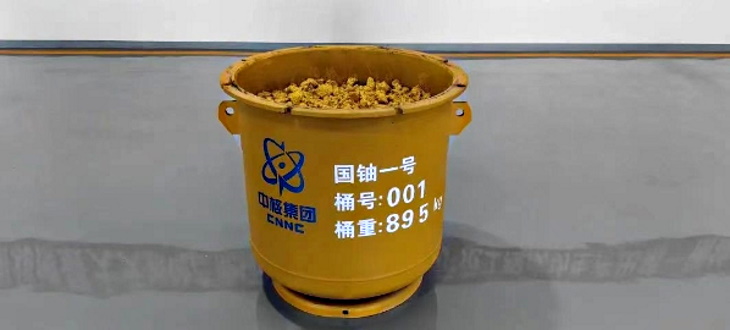
Exactly one year after construction began, China has produced its first barrel of natural uranium from its largest domestic project - the National Uranium No.1 demonstration project - in Ordos in the Inner Mongolia Autonomous Region.
The National Uranium No.1 well field (Image: CNNC)
China National Nuclear Corporation (CNNC) broke ground for the project on 12 July 2024. The project integrates automation, remote centralised control and big data analysis. It uses CO2 and O2 in-situ recovery (also known as in-situ leaching), where uranium is extracted through a closed-loop circulation of the uranium solution without lifting the ores to the surface for processing - a technique said to avoid water, gas and solid wastes and minimise carbon emissions.
CNNC has now announced that the project successfully produced the first barrel of uranium products on 12 July.
(Image: CNNC)
"As the largest natural uranium production capacity project in China's nuclear and mining industry in the past 70 years, the successful production of the first barrel of uranium marks that China's uranium resource development has officially entered a new era of green, safe, intelligent and efficient," CNNC said. "After completion, it will provide a solid resource guarantee for national energy security and nuclear industry development, and will also greatly enhance the international competitiveness of China's natural uranium industry."
CNNC noted that in the past, China's uranium development was mainly concentrated in volcanic and granite uranium mines in the south. However, over the past two decades, major breakthroughs have been made in the prospecting of sandstone uranium mines in the north. In 2023, China released the top ten uranium prospecting results, predicting more than 2.8 million tonnes of uranium resources. The main uranium resources are concentrated in the sandstone uranium mines in the north, among which the Ordos Basin has become the country's largest uranium resource base.
The technology used at the National Uranium No.1 project will be "fully applied and accelerated to the development of uranium resources in China's northern basins such as Songliao, Erlian, Ordos, and Yili, supporting the construction of a number of new uranium mining bases and fully guaranteeing the demand for uranium resources for nuclear energy development," CNNC said. "In the future, the National Uranium No.1 technology will 'go abroad' and be promoted to uranium mines around the world to ensure the safe and orderly development of global nuclear power."
"This demonstration project is a major achievement in China's third-generation uranium mining and processing technology," said Yuan Xu, chairman of CNNC subsidiary China National Uranium Corporation.
The project is part of China's nuclear energy development plan, with natural uranium being the basis of the nuclear fuel cycle, and with demand forecast to increase as nuclear energy capacity expands across the world.
China currently has 58 operable reactors providing capacity of 56.93 GWe. There are a further 32 reactors under construction which will provide a further 34.2 GWe of capacity and there are dozens more at the planning or proposed stage. According to World Nuclear Association's information paper on China's nuclear fuel cycle, China aims to produce one-third of its uranium domestically, obtain one-third through foreign equity in mines and joint ventures in other countries and to purchase one-third on the open market.
Inner dome hoisted into place at Lufeng 6
Tuesday, 15 July 2025
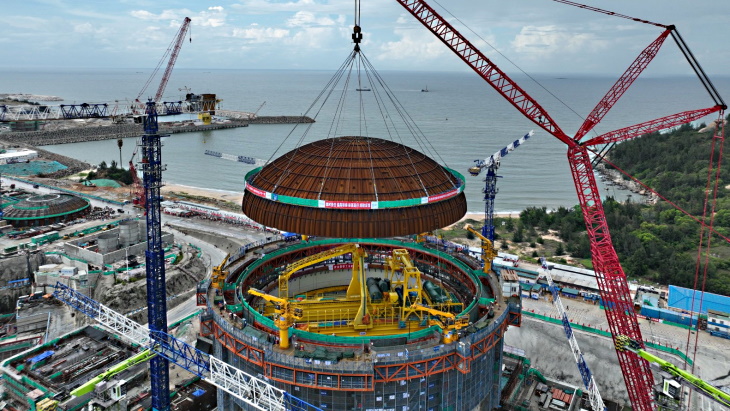
The inner containment dome has been installed at unit 6 of the Lufeng nuclear power plant in China's Guangdong province. It is the first of two HPR1000 (Hualong One) units under construction at the site, where four CAP1000s are also planned.
(Image: CGN)
The steel dome - measuring 45 metres in diameter and almost 14 metres in height, and weighing about 238 tonnes - was raised some 60 metres above ground level using a crawler crane and lowered into position on top of the walls of the double containment structure. An outer dome will subsequently be installed over the inner one.
"The project construction team accurately predicted the difficulties of hoisting through simulation and deduction of the whole process, and comprehensively used 3D laser simulation and real-scene replication technology, finite element analysis, real-time meteorological monitoring and other technical means to ensure that the dome was successfully hoisted into place in one go," said Zhang Weixiao, the person in charge of the dome hoisting operation.
(Image: CGN)
The main function of the dome is to ensure the integrity and leak tightness of the reactor building, and it plays a key role in the containment of radioactive substances.
China General Nuclear (CGN) said the installation of the dome "marks the successful capping of the reactor building of the Hualong One nuclear power unit, and the project construction officially shifted from the civil construction stage to the equipment installation stage".
The construction of Hualong One reactors as units 5 and 6 at the Lufeng plant was approved by the State Council in April 2022. First concrete for unit 5 was poured on 8 September 2022, with that for unit 6 following on 26 August 2023. Units 5 and 6 are expected to be connected to the grid in 2028 and 2029, respectively.
The proposed construction of four 1250 MWe CAP1000 reactors (units 1-4) at the Lufeng site was approved by China's National Development and Reform Commission in September 2014. However, the construction of units 1 and 2 did not receive State Council approval until 19 August last year. The first safety-related concrete for the nuclear island of unit 1 was poured on 24 February this year. Approval for units 3 and 4 is still pending. The CAP1000 design is the Chinese version of the Westinghouse AP1000.
According to CGN, once all six units are in operation, the Lufeng plant will generate about 52 TWh, which will reduce standard coal consumption by almost 16 million tonnes and reduce carbon dioxide emissions by more than 42 million tonnes
Carney heads to Hamilton to meet steelworkers as U.S. trade talks continue
Prime Minister Mark Carney will make an announcement on the steel industry during a visit to Hamilton.
OTTAWA — Prime Minister Mark Carney is scheduled to be in Hamilton today to make an announcement related to the steel industry.
It has been more than a month since U.S. President Donald Trump doubled tariffs on steel and aluminum from 25 to 50 per cent, adding further economic insult to the two industries in Canada.
Carney met with his cabinet virtually on Tuesday and told reporters before that meeting he doesn’t think Trump will agree to any trade deals without including some tariffs.
Carney will tour a steel company in the city and meet with workers during his visit to Hamilton.
Carney and Trump have been negotiating a new economic and security pact since early May and last week Trump unilaterally pushed the deadline for reaching that from July 21 to Aug. 1.
He told Carney in a letter on July 10 Canada will be hit with 35 per cent tariffs that day, with the White House saying the current plan is for that to apply only to those Canadian imports not covered under the existing Canada-U.S.-Mexico Agreement.
Carney says negotiations with the U.S. are likely to intensify as that Aug. 1 deadline approaches.
This report by The Canadian Press was first published July 16, 2025.
David Baxter, The Canadian Press
Carney casts doubt on Canada securing a tariff-free deal with Trump
Canada's prime minister is forging ahead with plans to come to a trade agreement with the United States. CTV National's Colton Praill on the upcoming meeting.
Most countries will likely have to accept some baseline tariff rate on their goods by the United States, Prime Minister Mark Carney signalled Tuesday morning, on his way into a meeting with his cabinet on Parliament Hill.
“There is not much evidence at the moment — from the deals, agreements and negotiations with the Americans, for any country or any jurisdiction — to get a deal without tariffs,” Carney said in French, when asked whether he believes it’s possible to have the levies removed entirely.
Canada, he added, is uniquely positioned to have effectively free trade with the United States.
A slate of stacked U.S. tariffs on Canadian goods, as well as Canadian countermeasures, have been in place for months.
Following the G7 summit in Kananaskis, Alta., last month, Carney signalled he and U.S. President Donald Trump agreed to iron out a trade deal before July 21. But, in a letter addressed to Carney and posted to Truth Social last week, Trump said he’ll be hitting Canada with 35 per cent tariffs on Canadian products starting Aug. 1. Carney subsequently revised the deadline to reach a deal to that date.
Carney also told reporters before Tuesday’s cabinet meeting that he expects talks with the United States will “intensify” in the next few weeks.
“At the same time, we need to recognize that the commercial landscape globally has changed,” he said. “It has changed in a fundamental manner, and we will continue to focus on what we can most control, which is building a strong Canadian economy. It’s part of what we’ll be discussing at cabinet today.”
The prime minister added that the situation needs to be “stabilized,” especially for the sectors that are particularly affected by Trump’s tariffs.
Carney is also set to meet with Canada’s premiers in Huntsville, Ont., next week.
In a post on social media Tuesday afternoon, Conservative Leader Pierre Poilievre criticized Carney for conceding that a fully tariff-free deal with Trump may not be possible.
“Another unilateral concession from a man who said he would never back down to the U.S. president,” he wrote.
“That is why New Democrats urge the Carney government to cease offering unilateral concessions without securing reciprocal benefits from the U.S.,” he added. Carney comments a ‘wake-up call’: trade lawyer
William Pellerin, an international trade lawyer with McMillan and former litigator for Canada in trade disputes with the United States, said Carney’s comments on Tuesday can serve as a “bit of a wake-up call for Canadians and Canadian businesses that we might not get back to a place of no tariffs.”
Speaking to CTV News, Pellerin said businesses should prepare for that to be the case.
Pellerin said there is “a lot of scenario planning” underway for Canadian businesses and industry, while Carney’s comments could be “laying the groundwork or setting expectations” for Canadians.
“I think there’s still quite a bit of optimism and hope that we will get to a reasonable place with the United States as our, by far, largest trading partner,” he said. “But today might have been kind of the first opening, or the first time that we’ve really heard that we might not get there.”
Speaking to reporters earlier on Tuesday, Carney indicated Canada has one of the lowest effective tariff rates compared to other countries. According to Pellerin, Canada is “actually not doing terribly.”
He said while there are some sectors that have been hit with more punishing tariffs — such as steel and aluminum — the vast majority of goods being compliant with the Canada-U.S.-Mexico free trade agreement brings the average, or effective, tariff rate down.
“If Canada could get to a place where we have just a very low baseline tariff that applies only to a certain subsect of products, I think we could be OK,” Pellerin said. “But certainly, right now, the steel industry and others are really suffering.” Most prefer ‘hard’ approach to Trump: survey
Amid the ongoing negotiations with the U.S., new data from the Angus Reid Institute show nearly two thirds of survey respondents want to see the Canadian government take a harder line.
According to the new numbers, 63 per cent of people want to see a “hard approach,” which the polling firm characterizes as “refusing difficult concessions even if it means a worsening of trade relations with the U.S.”
Meanwhile, 37 per cent of people prefer a “soft approach,” which the firm considers “making difficult concessions to keep a good relationship with our biggest trading partner.”
“When the political rhetoric trickles down to things like household income and people feeling secure or insecure as to whether or not they’re going to have a job next year, that’s really where we have to see how much of that elbows up rhetoric continues to hold,” said Angus Reid Institute president Shachi Kurl, in an interview with CTV News.
The Angus Reid survey also laid out which concessions in which sectors — such as supply management, the digital services tax, fresh water, and defence spending, for example — Canadians may or may not be willing to make.
The data from Angus Reid about a hard versus soft approach to negotiations were taken before Trump’s letter threatening 35 per cent levies.
Kurl said there was already a “significant amount of division” among Canadians when it comes to their confidence in Carney’s ability to effectively negotiate with Trump, even before the president’s latest threat.
Nearly half of respondents (48 per cent), she said, are confident the two leaders can hash out a deal, whether they trust Carney can negotiate one, or because they believe Trump will back down on his threat.
Conversely, Kurl said, 45 per cent say they’re not confident in an imminent deal, whether that’s because they don’t trust the prime minister, or because they believe Trump is “too unpredictable and too capricious.”
“And therefore, no matter what we do, we can stand on our head, it still won’t matter,” she said.
“So those really represent an almost even division between those who are confident and those who are not confident,” Kurl also said. With files from CTV News’ Rachel Aiello and Colton Praill

_31794.jpg)
_20224.jpg)
_15696.jpeg)
_94679.jpg)
_13696_74338.jpg)
_37300.jpg)
_44516.jpg)