Thursday, July 24, 2025

Gazan doctor being held in 'inhumane' conditions in Israeli jail, says lawyer

It is thought that since his detention Dr Abu Safiya has been held at a number of Israeli jails. His lawyer said she was allowed access to meet with him at Ofer prison, near Jerusalem.


Lisa Holland
Communities correspondent @LisaatSky
Tuesday 22 July 2025 

- Detained doctor 'has lost third of body weight'

Detained doctor 'has lost third of body weight'


The lawyer of a high-profile Gazan doctor detained by Israel since last December has spoken of her shock over his condition after being allowed a rare visit to see him in jail.

Ghaid Qassem has told Sky News that Dr Hussam Abu Safiya - the director of the Kamal Adwan hospital in northern Gaza - survives on very little food, including two spoonfuls of rice a day and has lost a third of his body weight. She said he has been subjected to severe beatings.

"As a young woman, seeing an older man - a respected doctor like Hussam Abu Safiya - broken in front of me, degraded, surrounded by prison guards, in the worst possible condition, how am I supposed to feel?" she said.

"The conditions of his detention are extremely harsh, inhumane, with continuous assaults.

"This is the sixth time he has been brutally attacked.

"The most recent incident was on 24 June 24, which coincided with the end of Israel's war with Iran and the strike on Soroka Hospital in Beersheba [Israel].

"It seems the prison authorities decided to take revenge. They raided Abu Safiya's cell and began assaulting him.

More on Gaza


Gaza food situation 'worst it's ever been', charity says - as tank attack reportedly kills 12 at camp


Watch Deir al Balah skyline live from Gaza amid reports of Israeli offensive


Israel launches ground assault on central Gazan city, says charity


"He was beaten, sustaining bruises on his head, neck, and back. Afterwards, he requested medical treatment because he felt abnormal heartbeats, but his request was denied."
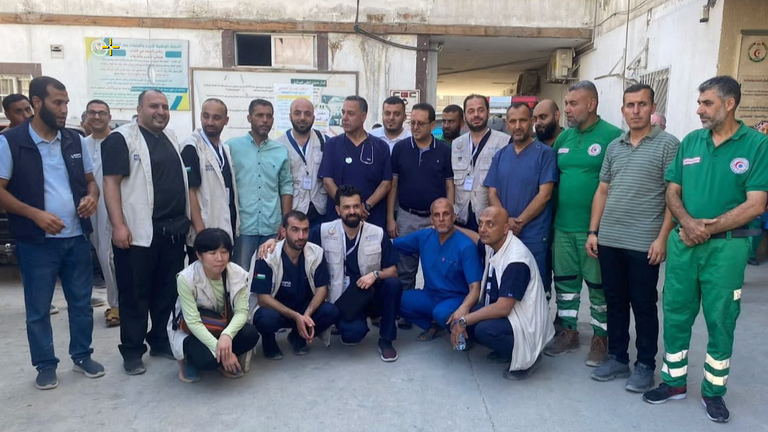
Image:Dr Hussam Abu Safiya (centre) with his colleagues. Pic: Dr Eid Sabbah, Kamal Adwan Hospital
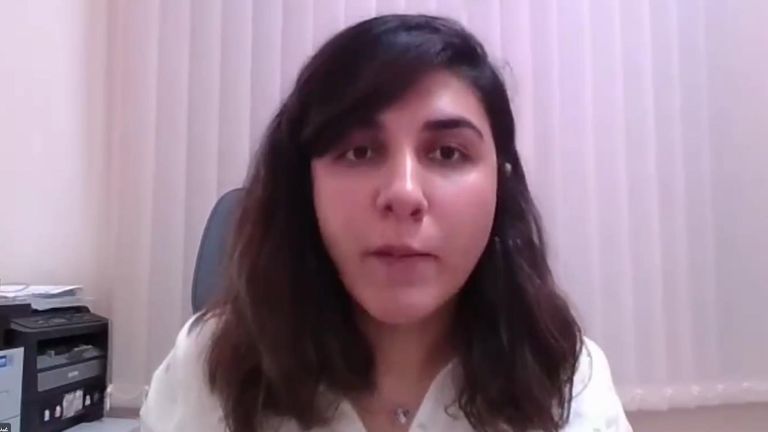
Image:Ghaid Qassem

It is thought that since his detention Dr Abu Safiya has been held at a number of Israeli jails.


His lawyer said she was allowed access to meet with him at Ofer prison, near Jerusalem.

Ms Qassem said there was no proper healthcare or hygiene and it is claimed the paediatrician is being held in an underground cell.

"They can't shower, their clothes aren't replaced, not even underwear," she said. "Scabies is rampant, skin diseases are widespread and the most basic medical attention is only given when they see you're on the verge of death."

Dr Abu Safiya was last seen in Gaza, wearing his white doctor's coat as he walked through the rubble outside his hospital towards an Israeli tank in December 2024.
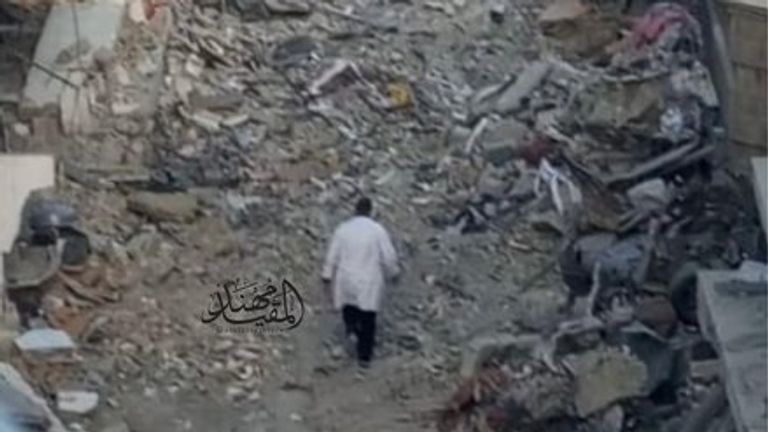
I
mage:This is believed to be one of the last sightings of Dr Hussam Abu Safiya before he was detained

Before then he had become a well-known voice and face of the Kamal Adwan hospital, sharing videos about the siege of the medical facility and explaining how staff were struggling to continue working under Israeli bombardment.

The hospital has since been forced to close down.

Oneg Ben Dror, from Physicians for Human Rights Israel, told Sky News they believe Dr Abu Safiya is one of more than a 100 medical professionals from Gaza currently being detained in Israeli jails.
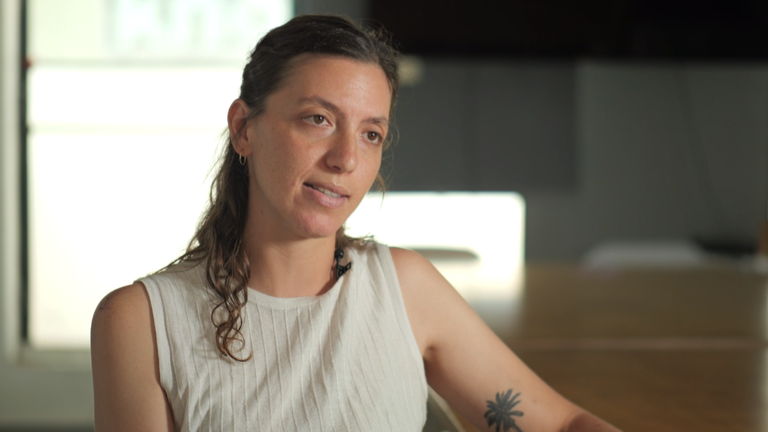
Image:Oneg Ben Dror, from Physicians for Human Rights Israel

She said: "We know that more than 250 health care workers were arrested since the start of the war on Gaza.

"Part of them were released, and more than 100 are still detained. We have their names, and we managed to visit dozens of them while in detention.

"All those we met weren't charged officially with any offence.

"We asked them about the interrogation and all of them said the questions they were asked weren't about them or a specific offence.

"It was more information gathering about their workplace and people they knew and this is against international law arresting them while doing their job and holding them for intelligence gathering and as bargaining chips for a potential deal."

A spokesperson for the Israel Prison Service (IPS) said: "All prisoners are detained according to the law. All basic rights required are fully applied by professionally trained prison guards.

"We are not aware of the claims you described, and as far as we know, no such events have occurred under IPS responsibility.

"Nonetheless, prisoners and detainees have the right to file a complaint that will be fully examined and addressed by official authorities."

Dr Abu Safiya's colleague, Dr Eid Sabbah, head of the nursing department at Kamal Adwan Hospital, told Sky News more than 30 medical staff from the hospital have been killed during the conflict.
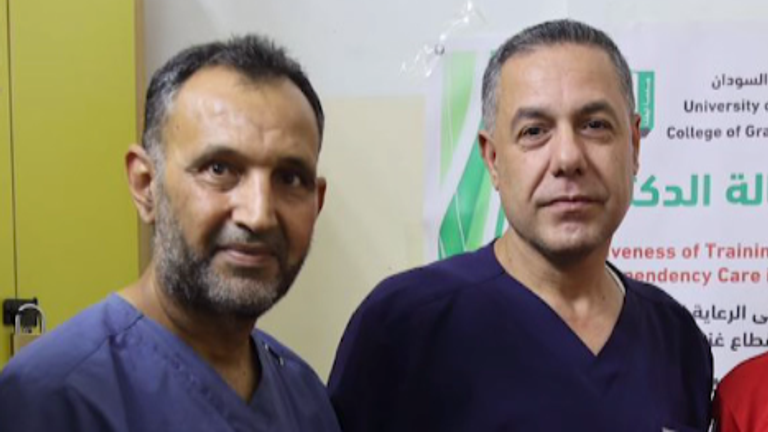
Image:Dr Hussam Abu Safiya and Dr Eid Sabbah, worked together in Gaza. Pic: Dr Eid Sabbah, Kamal Adwan Hospital

He said: "We pray to God to give Dr Abu Safiya strength, to ease his suffering soon, and to see him free - just like the rest of our people, our patients, our wounded, and all the doctors who were detained from this hospital.

"He is in a very difficult situation. The news we are hearing is troubling and far from reassuring.

"He was the kind of doctor who took bold stands for his colleague. At the same time, he never abandoned his patients, even under extreme pressure.

"Despite calls urging him to evacuate the hospital for his own safety, he refused to leave. He stayed by his patients' sides, fully committed to serving them - especially the children, the elderly, the women, and the injured."
Bangladesh : “a widespread and systemic culture of torture”

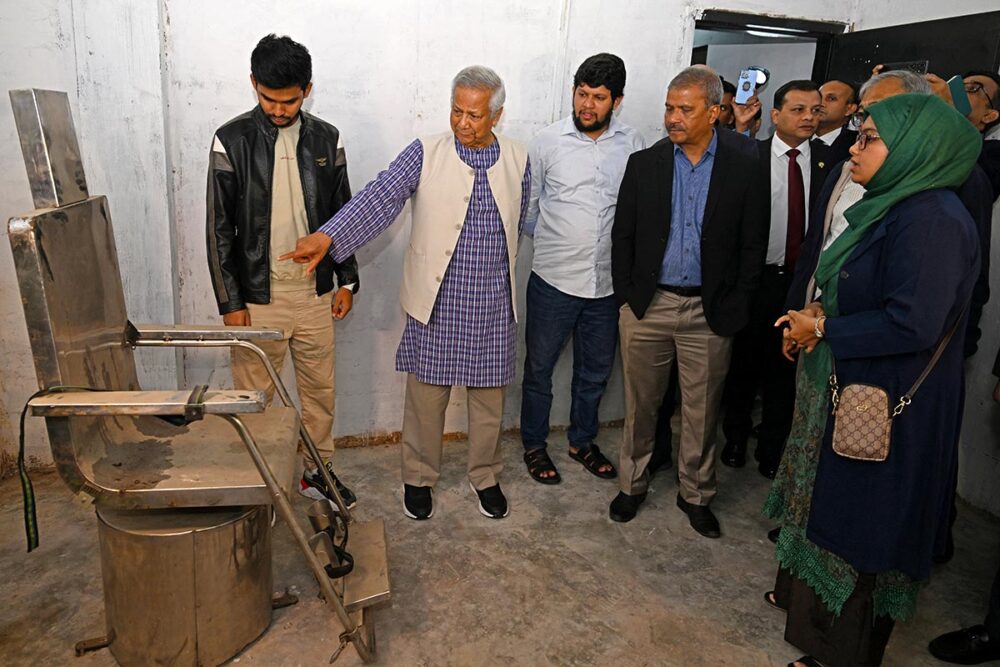
Specialized interrogation rooms, electric shocks, “rotating chairs”, “pulley systems used to suspend people” and waterboarding, along with soundproofing devices to muffle the victims’ screams... The latest report by Bangladesh’s Commission of inquiry on enforced disappearances uncovers the former regime's chambers of horror.


In early February 2025, Bangladesh's interim head of government Muhammad Yunus (second from left) visits the “House of Mirrors” and shows a torture device in a detention center allegedly run by the army's intelligence services in Dhaka. Photo: © Office of the Chief Advisor to the Interim Government of Bangladesh / AFP

By David Bergman (in Dhaka, Bangladesh)
JUSTICE INFO
21 July 2025

The report was submitted to the government in June 2025, but only selected chapters have been made public so far, and what they reveal chills the blood of the reader as they show the extent of the ordeal Bangladesh’s secret detainees went through: a damning second interim report by Bangladesh’s Commission of Inquiry on Enforced Disappearances has linked a “widespread and systematic culture of torture” to the enforced disappearances established during the tenure of the former Awami League government.

Set up in August 2024 by the country’s interim administration, the Commission found that “nearly every secret detention facility” uncovered during its investigation “had specialised interrogation rooms equipped with torture devices”. “Despite significant efforts to destroy evidence after 5 August, we were able to uncover traces consistent with survivor testimonies,” including remnants of a “rotating chair” and a “pulley system used to suspend people”, the report notes, adding that “at almost every destroyed location, remnants of soundproofing materials were found”. This equipment was designed, it claimed, “to muffle the victims' screams and prevent them from being heard beyond the room’s walls”.

“I could even smell burning flesh”

After beatings, which the report stated were a “ubiquitous form of abuse”, the second most common form of torture was the administration of electric shocks. One survivor recalled having electric clips attached to his genitals: “Whenever they put on the switch, I felt my limbs were burning. Sometimes, I could even smell burning flesh.”

The report stated that electric shock machines “were used almost everywhere, including in abduction vehicles” and that one soldier recalled his commander referring to the portable electric shock machine as a “balls machine”, crudely highlighting, the report noted, the “area [of the body] where the shock would be administered”.

Other forms of torture included the use of the “rotating chair”, a device that spun victims at extreme speeds, often causing vomiting, urination, defecation, and loss of consciousness, and waterboarding.

“They started pouring water over a towel covering my face,” said a 27-year-old detainee, quoted in the report. “They poured a whole jug of water on my face. I was suffocating. Then they removed the towel and said, ‘What were you doing?’ I said, ‘Sir, what can I say? Please tell me why you brought me here.’ They said, ‘That won’t do. Put the towel back, pour water again.’ They did this three or four times, then asked others to take me away.”

Mir Ahmed bin Quasem, a lawyer who was secretly detained for eight years after being picked up by law enforcement authorities in August 2016 and released onto the streets of the capital city the day after the fall of the Awami League government on 6 August 2024, told Justice Info that his detention felt “worse than death”. “I didn't see sunlight in eight years. I was blindfolded and handcuffed, I couldn't say when it was day or night. I didn't know what happened to my wife or family, my daughter or my mother. While I was in that cell with no light and not knowing anything, it felt like I had been buried alive.”

Two-thirds of the disappearances linked to state agencies

The Commission recorded 1,772 cases of enforced disappearance between 2009 and 2024. Of these, 1,427 victims were eventually released, either into the criminal justice system or freed after extended periods in secret detention. However, 345 individuals remain unaccounted for.

According to the report, 67% of these disappearances were linked to formal state agencies, particularly the paramilitary Rapid Action Battalion (RAB), and specialized police units such as the Detective Branch and the Counter Terrorism and Transnational Crime unit. The report does not explain who was responsible for the remaining 33 percent of the disappearances.

Sanjida Islam, the coordinator of Mayer Dak (“Mothers’ Call”), an organisation of families of the disappeared, welcomed the report but criticised the focus of the Commission. “Instead of focusing on the cases of those who remained disappeared, the Commission strategically shifted its focus toward those who returned from secret detention centre. While this may offer insight into patterns and perpetrators, it cannot come at the expense of the disappeared who never returned,” she told Justice Info. “This approach left many families – who had provided exhaustive evidence, testimony and date – feeling sidelined and unheard.”

FIND THIS ARTICLE INTERESTING?
Sign up now for our (free) newsletter to make sure you don't miss out on other publications of this type.

The report also points to the involvement of the military intelligence agency, the Directorate General of Forces Intelligence (DGFI), in some enforced disappearances, adding, however, that the military agency often used law enforcement agencies to carry out the pick-ups.

“Due to DGFI’s limited operational capacity, it frequently relied on RAB intelligence for operational support when conducting abductions,” the report states. “After interrogation and torture, detainees were either returned to RAB or transferred to the Detective Branch, where many were subsequently executed extrajudicially or held under fabricated charges for extended periods.”

From a sample of 253 cases, the Commission found that victims were held for varying periods – from one day to over five years, with a median detention length of 47 days. Fewer than half of these individuals were affiliated with opposition political parties, though the Commission noted that many were reluctant to talk about their political identity.

Sheikh Hasina, “prime facie responsible”

The five-member Commission also provides evidential support to the conclusion from its first earlier report, published in December 2024, that former prime minister Sheikh Hasina was “prime facie responsible for acts of enforced disappearances”.

It states that General Akbar, the former head of DGFI, informed the Commission that he had “directly discussed the case of Humam Quader Chowdhury, a known victim (…) with Sheikh Hasina herself”. “In one case, a junior DGFI officer recalled hearing his director speak about a detainee’s fate in a way that made clear Sheikh Hasina was informed of him and had expressed an opinion on the matter,” the report added.

The commission report describes a “three-tiered pyramid” chain of command responsible for the enforced disappearances. “At the top lies the strategic layer, occupied by key political figures, such as Sheikh Hasina, General Tariq Siddiqui, the Home Minister, and other senior officials, who held the authority to order abductions and extrajudicial killings,” the report states. “Below this is the executive layer, comprising senior Generals and high-ranking members of the police and other security forces. These individuals directly received instructions from the political leadership and, as such, could serve as vital witnesses to their involvement. At the base is the functional layer, made up of lower-ranking personnel within the security apparatus who carried out the operations under orders from above.”

In response to the report, Mohammad Ali Arafat, a former state minister of Information who now speaks for the Awami League, refuted the government’s complicity. “I can say with utmost confidence that there was no political directive or endorsement of any alleged torture, let alone a policy of torture, either from the Prime Minister Sheikh Hasina or her cabinet, or the Awami League as a party,” he told Justice Info. “If any such crime was indeed committed, it would have taken place without the knowledge of the political leadership.”

He went on to blame the country’s “security forces and intelligence agencies tied to the military and armed forces” which, he said, have always acted with very little civilian oversight”. “It is possible that these facilities, if they existed at all, were run without the consent or knowledge of the political government by the officials of the security forces and intelligence agencies.”

Did the current army help accused officers escape?

The report does suggest that the current army command was complicit in allowing six retired army officers escape arrest after the country’s International Crimes Tribunal (ICT-BD) issued warrants against them in January 2025 for their role in enforced disappearances. Two months earlier, the Home ministry had agreed to revoke their passports and the army was told in advance about the issuance of the arrest warrants.

“Those who were within the country and residing in secured, well-known locations in January 2025, including inside the Dhaka cantonment, are now unavailable to the justice process,” the report stated. “This raises serious concerns, particularly given that their passports had been revoked, there appeared to be no alternative travel documents, and the military authorities had been informed in advance of the impending warrants. The implication is that, despite being within reach of enforcement mechanisms, these high-ranking officers were permitted to abscond.”

The report goes on to say that, “this sequence of events has generated deep disquiet about the future of accountability efforts. Those within the security forces who genuinely wish to support this inquiry have privately expressed concern that if such senior figures are allowed to evade justice without consequence, then the institutional will to pursue accountability is perhaps fundamentally compromised.”

On 10 July 2025, the ICT-BD indicted Hasina for the offence of crimes against humanity relating to her role in the killings of hundreds of people by the country’s law enforcement authorities between 16 July and 5 August 2024, the day Hasina flew out to India. Also indicted on five charges are former Home minister Asaduzzaman Khan, also believed to be in India and former police chief Chowdhury Abdullah Al-Mamun who has agreed to give evidence against his two co-defendants as a state witness in exchange for a reduced sentence.

Bangladesh’s interim government, headed by Nobel Peace Prize laureate Muhammad Yunus, sent a formal request to India for Hasina’s extradition, but India has not responded. Hasina and Khan will be tried in absentia.

Scientists work to understand why dozens of whales have recently died in the San Francisco Bay Area

The majestic ocean creatures are still recovering from a massive die-off in 2019-23 that is estimated to have cut their population by 45 percent

Io Dodds
in San Francisco
Tuesday 22 July 2025 
The Independent


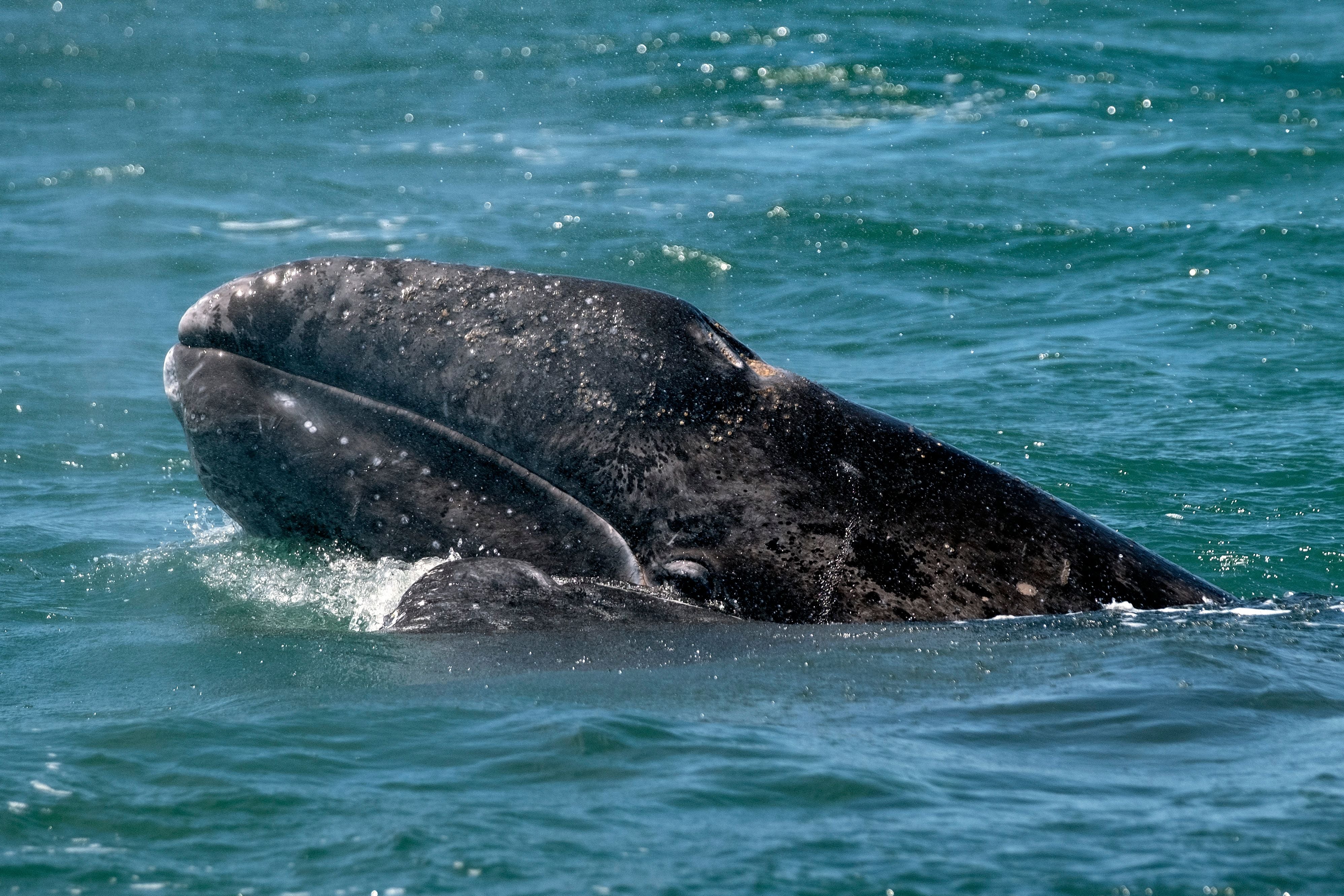
open image in galleryResearchers have reported an "unusually high" number of gray whale sightings in the region recently (Alfredo Estrella / AFP via Getty Images)

Scientists are investigating a sharp rise in the number of whales killed in the San Francisco Bay Area in 2025 even as local whale pods struggle to recover from a massive die-off in 2019.

The California Academy of Sciences said on Monday that researchers had logged the deaths of 21 gray whales, two unidentified baleen whales, and one minke whale in waters near San Francisco this year so far, compared to 14 in 2019 and 15 in 2021.

Researchers also reported an "unusually high" number of gray whale sightings in the region, with more than 30 individuals confirmed versus only six in 2024.

"This latest gray whale caught everyone a bit by surprise, given how late in the season it is and the fact that we had not sighted the species in the Bay in nearly two weeks," Kathi George, director of cetacean conservation biology at the Marine Mammal Center in nearby Sausalito, told ABC News.

"It shows signs of concern for this population as it moves forward into the future... we know that climate change is changing ocean conditions and changing prey available availability for these whales in the Arctic."


open image in galleryResearchers have reported an "unusually high" number of gray whale sightings in the region recently (Alfredo Estrella / AFP via Getty Images)


open image in galleryA young male gray whale beached at Kirby Cove, on the Marin Headlands near San Francisco (Marjorie Cox / The Marine Mammal Center)

RECOMMENDED

Orcas captured ‘kissing’ on camera for the first time

Eight of the gray whales were probably killed by vessel strikes, the Academy said, but the cause of death for the others was uncertain. Nor was it clear why so many whales were visible in the Bay Area this year.


Gray whale populations in the North Pacific are still reeling from an estimated 45 per cent drop between 2019 and 2023, during which nearly 700 whales died along the west coast of North America.


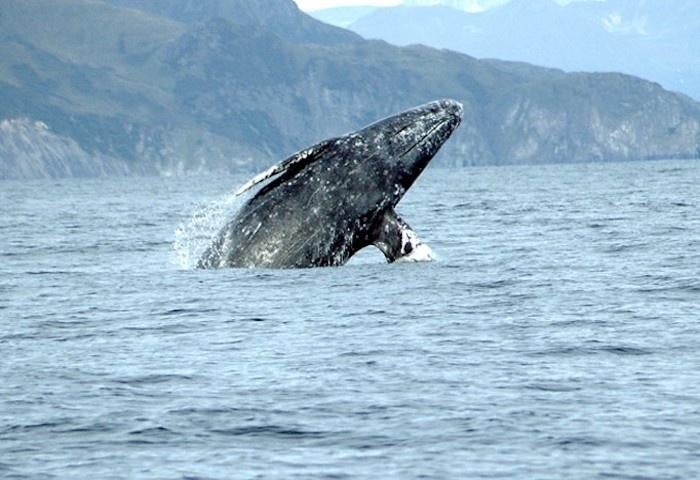
open image in galleryA gray whale breaching (NOAA Fisheries)

That episode, known by scientists as an "unusual mortality event", is thought to have slashed whale numbers from around 20,500 in 2019 to just over 14,500 in 2023.


A study in 2023 found evidence that melting Arctic sea ice had prolonged the die-off, in comparison to previous such events, by disrupting the food chain of algae and plankton on which gray whales ultimately depend.


open image in galleryGray whales are highly social animals (AFP via Getty Images)

Gray whales are large, highly social filter feeders that migrate up and down the west coast of North America, traveling thousands of miles from their summer feeding grounds near Alaska to their winter breeding areas off western Mexico.


Once common in the Atlantic Ocean too, they were hunted in huge numbers by humans for their blubber throughout the 19th century.

Now they exist in two populations in the northwest and northeast Pacific, with the former group being officially endangered.
Western aid cuts cede ground in Southeast Asia to China, study suggests

86 million people still live on less than $3.65 a day


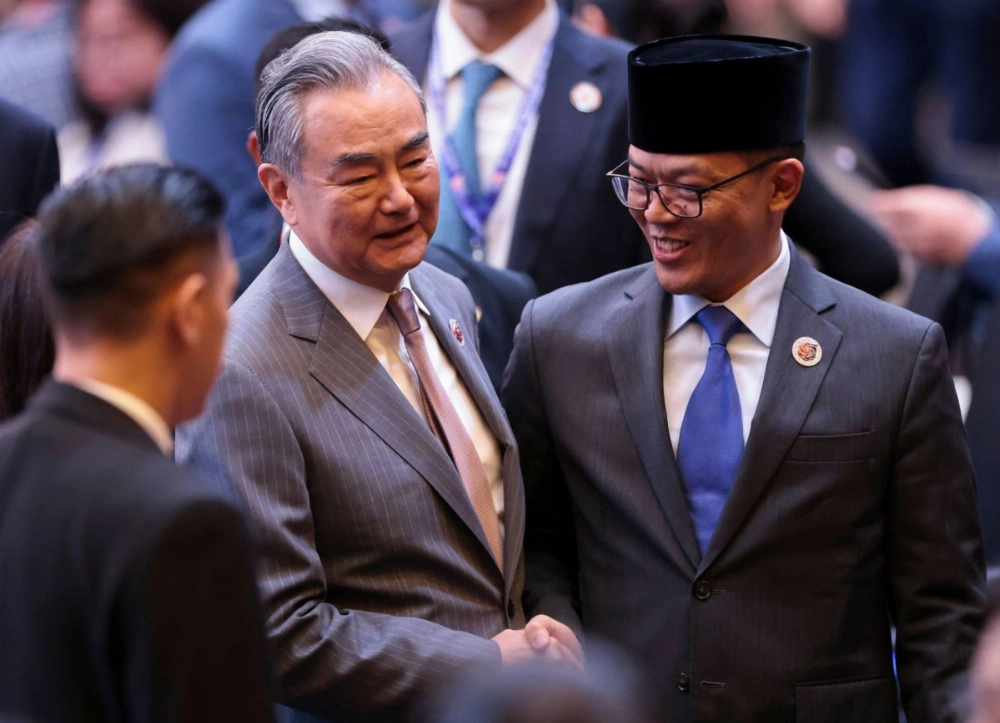
Chinese Foreign Minister Wang Yi (left) shakes hands with Indonesian Minister for Foreign Affairs Sugiono during the 58th ASEAN Foreign Ministers' meeting and related meetings in Kuala Lumpur on July 10. | AFP-JIJI

AFP-JIJI
Jul 22, 2025

Sydney –

China is set to expand its influence over Southeast Asia's development as the administration of U.S. President Donald Trump and other Western donors slash aid, a study by an Australian think tank said Sunday.

The region is in an "uncertain moment," facing cuts in official development finance from the West as well as "especially punitive" U.S. trade tariffs, the Sydney-based Lowy Institute said.

"Declining Western aid risks ceding a greater role to China, though other Asian donors will also gain in importance," it said.

Total official development finance to Southeast Asia — including grants, low-rate loans and other loans — grew "modestly" to $29 billion in 2023, the annual report said.

But Trump has since halted about $60 billion in development assistance — most of the United States' overseas aid program.

Seven European countries — including France and Germany — and the European Union have announced $17.2 billion in aid cuts to be implemented between 2025 and 2029, it said.

And the United Kingdom has said it is reducing annual aid by $7.6 billion, redirecting government money toward defense.

Based on recent announcements, overall official development finance to Southeast Asia will fall by more than $2 billion by 2026, the study projected.

"These cuts will hit Southeast Asia hard," it said.

"Poorer countries and social sector priorities such as health, education, and civil society support that rely on bilateral aid funding are likely to lose out the most."

Higher-income countries already capture most of the region's official development finance, said the institute's Southeast Asia Aid Map report.

Poorer countries such as East Timor, Cambodia, Laos and Myanmar are being left behind, creating a deepening divide that could undermine long-term stability, equity and resilience, it warned.

Despite substantial economic development across most of Southeast Asia, around 86 million people still live on less than $3.65 a day, it said.

"The center of gravity in Southeast Asia's development finance landscape looks set to drift East, notably to Beijing but also Tokyo and Seoul," the study said.

As trade ties with the United States have weakened, Southeast Asian countries' development options could shrink, it said, leaving them with less leverage to negotiate favorable terms with Beijing.

"China's relative importance as a development actor in the region will rise as Western development support recedes," it said.

Beijing's development finance to the region rose by $1.6 billion to $4.9 billion in 2023 — mostly through big infrastructure projects such as rail links in Indonesia and Malaysia, the report said.

At the same time, China's infrastructure commitments to Southeast Asia surged fourfold to almost $10 billion, largely due to the revival of the Kyaukphyu Deep Sea Port project in Myanmar.

By contrast, Western alternative infrastructure projects had failed to materialize in recent years, the study said.

"Similarly, Western promises to support the region's clean energy transition have yet to translate into more projects on the ground — of global concern given coal-dependent Southeast Asia is a major source of rapidly growing carbon emissions."

Climate disasters  drain Southeast Asia’s shrinking aid budgets

The 2025 Lowy Institute Southeast Asia  
Aid Map reveals relief spending has soared while prevention investment stagnates, forcing hard choices for development partners.


Flood waters inside a convenience store in Chiang Mai after Thailand’s northern provinces were hit by torrential rain following Typhoon Yagi in the preceding weeks (AFP/Getty Images)


Published 22 Jul 2025 
Grace Stanhope,  Alexandre Dayant
Lowy Institute

Last September, Typhoon Yagi killed hundreds, injured thousands, and displaced even more across Vietnam, Myanmar, Laos, Thailand and the Philippines. The cost of damage ran into the billions – more than US$3 billion for Vietnam alone. Humanitarian assistance and disaster relief were sent from all over the world, from Australia, China, the United Kingdom, Europe, the United States, Russia, and other Southeast Asian nations.

It was an example of the type of help the region is expected to need ever more of in coming decades. The Lowy Institute’s 2025 Southeast Asia Aid Map, released this week, shows that assistance to Southeast Asia for extreme weather events and disasters hit a record high US$1.4 billion in 2023 (the latest full year of available data). It’s still a small proportion of overall humanitarian and development spending: just 5% of the total $29 billion provided in official development finance in 2023. But it’s growing rapidly, and that means that the region’s partners have tough choices ahead.

The number of people affected by extreme weather events in Southeast Asia grew again in 2024 and shows no sign of slowing down.

Southeast Asia’s energy demand is on track to double, surpassing Europe by 2050. The region’s clean energy shortfall will become the world’s problem.

The World Bank and Japan are the main providers of humanitarian assistance and disaster relief, known as HADR, together responsible for two-thirds of all disaster relief. France, the United States, the Asian Development Bank and Australia are also major contributors. France, Canada and Japan devote the highest proportion of their overall aid and development budgets to HADR. But we already know that France and the United States will restrict their foreign aid spending after announcing dramatic cuts in early 2025. Despite its relative weight as Southeast Asia’s third-largest development partner in 2023, China ranks 24th for disaster relief.

These providers also give differently. For grants, the United States is by far the most generous provider, while Japan dominates in concessional loans.

The primary mode of delivery, and the reason the World Bank ranks so highly in this sector, are what are called “CAT-DDO loans”, standing for Catastrophe Deferred Drawdown Option. These are liquidity tools for middle-income economies. The line of financing is pre-approved, once the recipient country has met certain requirements for disaster preparedness, and then can be accessed instantly after a disaster. For example, the World Bank has committed more than $1.5 billion to the Philippines across three different non-concessional CAT-DDO loans since 2015.

The trajectory is certain. HADR will consume greater proportions of shrinking foreign aid budgets – around the world, and especially in Southeast Asia. The Climate Risk Index ranks Myanmar and the Philippines among the top ten affected countries globally, and UNESCAP estimates that only 7.4% of financial needs for disaster adaptation are met in Southeast Asia.

All this is treating symptoms of a changing climate, not the cause. The Lowy Institute’s Southeast Asia Aid Map also finds that international support for Southeast Asia’s clean energy transition is sorely lacking, at just US$708 million in 2023 – only just more than half of what was spent on disaster relief. Southeast Asia is by no means responsible for the bulk of historical emissions, and the effects of climate change are of course global, meaning there is no link between the site of an extreme weather event and the location of the generated emissions. But Southeast Asia’s energy demand is on track to double, surpassing Europe by 2050. The region’s clean energy shortfall will become the world’s problem.

Broader climate development finance is also in trouble, with analysis revealing the $4 billion provided for climate-resilient and low-carbon infrastructure in 2023 is less than 3% of what the ADB estimates the region needs annually. 2023 also saw the lowest level on record of funding directed to projects that list climate action as their principal objective.

The choice is between short-term relief and long-term prevention. There is clearly a role and a need for both. As HADR absorbs greater amounts of foreign aid, Southeast Asian governments and their development partners must confront that choice with clarity. An option may be to ring-fence funding for adaptation, particularly in the most disaster-prone regions.


SOUTH AFRICA 'AZANIA'


Helen Zille’s transphobia
JULY 22, 2025
AFRICA IS A COUNTRY

In echoing the anti-trans panic sweeping the Global North, South African political heavyweight Helen Zille joins a reactionary tradition of racialized sex policing.


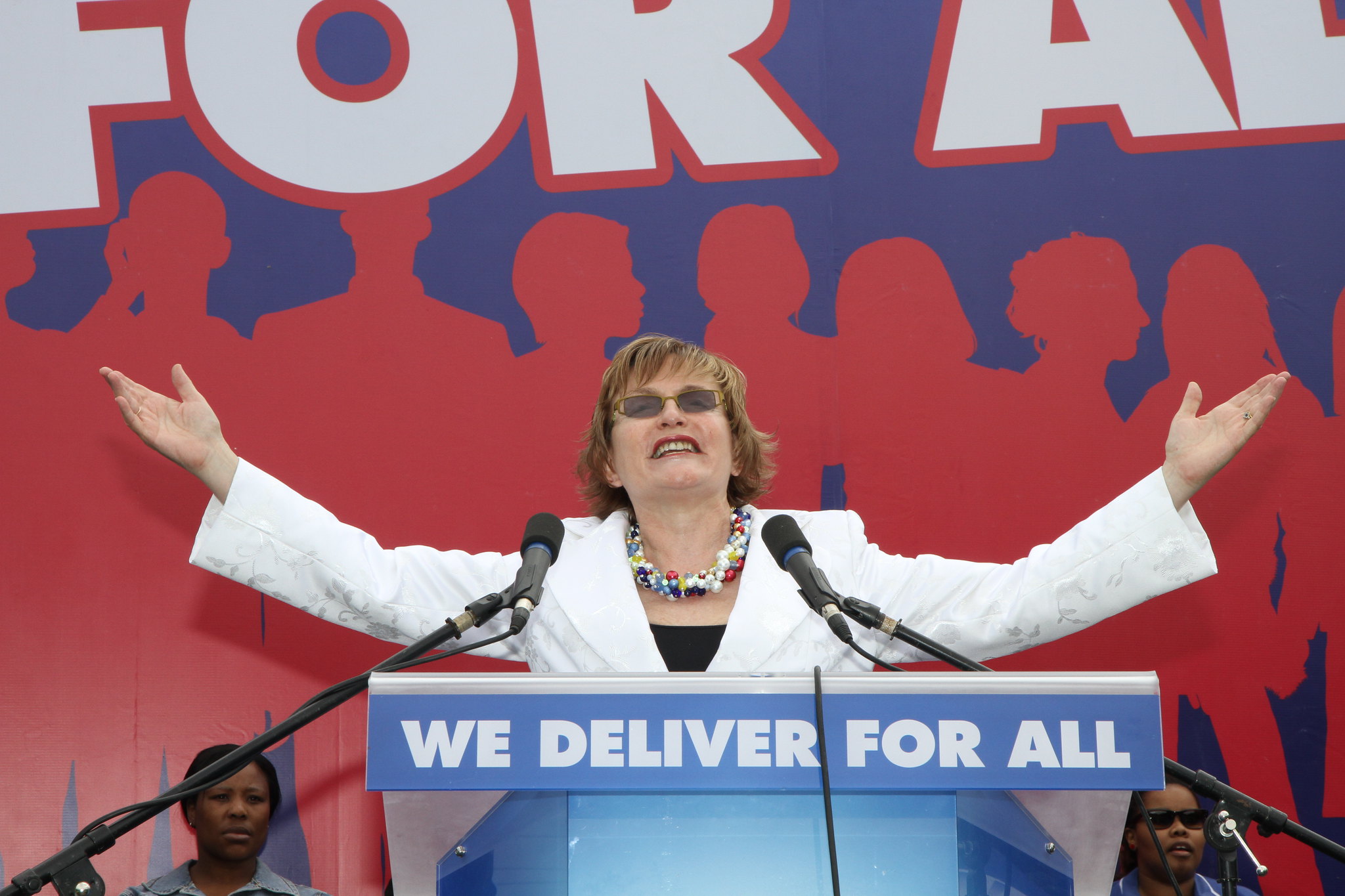
Helen Zille, at a Freedom Day Rally in Mamelodi, Tshwane.
 Image via Democratic Alliance on Flickr CC BY-SA 2.0.

Helen Zille has been spewing vitriol on X again, and this time her target is trans people. Her tweet comes following the UK ruling to limit the definition of sex to a binary assigned at birth. Zille celebrated alongside prominent “gender-critical” figures like JK Rowling, tweeting: “They have protected the rights of women across the English-speaking world from a contagion as dangerous, socially, as Covid was, medically.”

Several South African queer organizations (including the Triangle Project, African Trans Network, and Gender Dynamix) voiced condemnation, calling for a public apology and for the Democratic Alliance to take disciplinary action. Many warn that Zille’s public status may galvanize support for views that endanger trans South Africans already disproportionately vulnerable to violence and stigma. Indeed, the fringe gender-critical group First Do No Harm SA quickly released their own statement thanking Zille for her “courage” because, “until now FDHNSA has been the only voice speaking out …” about the ‘fact’ that sex “cannot be changed.”

It’s not the first time that Zille, current chairperson of the DA’s Federal Council, has come under fire for her comments online. Perhaps most infamously, in 2017, she faced disciplinary action after tweeting that colonialism was “not ONLY negative.” More recently, in 2023, she received backlash for a prior instance of transphobia.

In light of the rapidly growing moral and legal panic around transgender rights in the Global North, Zille’s comments cannot be dismissed as simply an offshoot of reactionary thought. Rather, they illuminate the disturbing alliance between the anti-gender movement and colonial white supremacy. Whether intentional or not, her comments rest on a history of policing sex and gender in the service of colonial domination. Certainly, the dubious language of her tweet raises an eyebrow: when she says “the English-speaking world,” to whom exactly is Zille referring?

Binary sex was enforced by colonial powers to establish racial hierarchy. Knowledge regimes that were part myth-making and part pseudo-science claimed that the more “civilized” a group was, the greater the difference between male and female. In Southern Africa in particular, this idea was manipulated to prove the “superiority” of whiteness by claiming that intersexuality was more common among Africans.

This trope of the sexually ambiguous African was promoted just as the existence of sex diversity among Europeans was being increasingly “corrected” by surgical intervention. To be sure, modes of controlling sex were violent against all trans and intersex people, but they were meted out differently based on race. Colonial scientists and doctors produced a slew of deeply biased texts to back up claims that black bodies were “naturally” more sexually non-normative. Meanwhile, in Europe, invasive surgeries were increasingly performed on white intersex children. While black and brown children were marked as already “unfixable” by their race, white children were positioned as “at risk,” and in need of “protection” through “correcting” their sex into a male/female binary.

Decrying the abuse of “vulnerable children” and (cis) women is an emotional flashpoint all too commonly deployed by the gender-critical movement. Zille, too, echoes such sentiments in her Facebook follow-up to the offending tweet, writing that “the greatest danger has been posed to vulnerable tweens, teens and adolescents.” While it is seldom explicitly stated that this refers to white children, it remains uncanny that the gender critical feminist brigade that Zille has aligned herself with comprises a majority of Global North white women—who insist that their phobic diatribe is about protecting women and children’s “rights” and a “common sense” sex binary. It is tempting to point out that British colonizers, too, claimed to be “protecting” both “women” and “rationality,” both narrowly defined.

The apartheid regime exercised its own racialised controls over binary sex. In 1974, the National Party legalized the change of sex for individuals who had undergone surgery. While this may seem surprising, it granted the state power over designating the “correct” sex to (mostly white) individuals who had undergone what they deemed sufficient medical processes. It is also significant that gender-affirming surgery at the time was largely employed to “cure” homosexuality. This raises the question: if legal recognition is not new, is the problem with trans existence itself, or with greater self-determination?

While the gender-criticals might not explicitly say “white” women and “white” children, they don’t need to: their nostalgia for a fictitious past of “untainted” binary sex is glaringly resonant with colonial discourse.

For now, Zille seems unsatisfied with the relative lack of uptake of transphobic discourse by South African state actors. However, while a public apology is a start, it is not enough, nor is characterizing “GogoZille” (as she is sometimes playfully referred to) as an individual bad egg.

We must be proactive to prevent the anti-gender movement from gaining more traction on South African soil, and strengthen alliances between African and transnational groups who have been resisting the transphobic moral panic since even before it blew up in the US and UK. Let us reject the divisive rhetoric that seeks to split the “LGB” from the “TQI+.” The struggles of sex- and gender-diverse minorities in Africa have been intertwined since long before the coining of the terms transgender or intersex.

Zille’s tweets hail an opportunity for South Africans to let our actions speak as loudly as our international “LGBTQI+-friendly” reputation does. If there is an exceptionalism we should lean into, it is this: white supremacy and its bedfellow transphobia should have no home in South Africa.

About the Author

Shelley Pryde is a South African currently pursuing a PhD in Gender, Women, and Sexuality Studies at the University of Washington. She researches queer nightlife, performance, and activism in Cape Town in relation to transnational politics, neoliberal governance, and apartheid and colonial history.


Venezuela accuses El Salvador of torturing migrants deported by US

Venezuela’s Attorney General Tarek Saab said Monday his office will investigate El Salvador’s President Nayib Bukele and two officials over alleged abuse of Venezuelans detained in El Salvador. The Venezuelans were sent to El Salvador from the US by the Trump administration. They were released last week under the terms of a prisoner exchange agreed with the US.


Issued on: 22/07/2025 -
By:FRANCE 24

Handout picture released on March 16, 2025, by El Salvador's presidency press office shows the arrival of alleged members of Venezuelan criminal organisation Tren de Aragua. © AFP

Venezuela Attorney General Tarek Saab said on Monday that his office will investigate El Salvador's President Nayib Bukele and two other officials for the alleged abuse of Venezuelans who were detained in the Central American country.

More than 250 Venezuelans held in El Salvador's notorious CECOT prison returned to Venezuela on Friday, under the terms of a prisoner exchange agreed with the United States.

Detainees suffered human rights abuses ranging from sexual abuse to beatings, were denied medical care or treated without anesthesia and given food and water that made them ill, Saab said at a press conference.

As well as Bukele, Venezuela will investigate El Salvador's Justice Minister Gustavo Villatoro and Head of Prisons Osiris Luna Meza, Saab said, after showing videos of former detainees recounting torture and showing injuries – including a missing molar, bruising and scars – they said were the result of the abuse.

Bukele's office did not immediately respond to a request for comment, and Reuters was not able to immediately confirm the assertions made in the videos. Two of those shown speaking were identifiable as former detainees in CECOT.

© France 24
01:44


Late on Monday, Bukele posted about the return on social media but did not comment on the abuse allegations.

"The Maduro regime was satisfied with the swap deal; that's why they accepted it," he said on X. "Now they scream their outrage, not because they disagree with the deal but because they just realized they ran out of hostages from the most powerful country in the world."

The Venezuelans were sent to El Salvador from the United States in March after US President Donald Trump invoked the 1798 Alien Enemies Act to deport alleged members of the Tren de Aragua gang without normal immigration procedures.

The deportations drew fierce criticism from human rights groups and a legal battle with the Trump administration. Family members and lawyers of many of the men deny they had gang ties.

The former detainees arrived near Caracas on Friday, where some reunited with their families, but they have not yet returned to their own homes.

"I can't stop thinking of the hunger my son went through," Yajaira Fuenmayor, the mother of former El Salvador detainee Alirio Guillermo Belloso, said on Sunday afternoon from her home in Maracaibo.

"I have a salad ready, some grilled arepas (traditional corn cakes) because he loves them, and there is fish in the refrigerator to fry."

The government has said the men will be medically evaluated and interviewed before being released. It has always said the El Salvador detentions were illegal and that only seven of the men had serious criminal records.

POLITICAL PRISONERS FREED

The Venezuelan opposition has regularly critiqued the government of President Nicolas Maduro for holding activists and others in similar conditions within Venezuela.

The US said last week that 80 Venezuelans would be released from Venezuelan jails as part of the swap, which also freed 10 Americans held in Venezuela.

Forty-eight Venezuelan political prisoners have so far been released, legal rights advocacy group Foro Penal said earlier on Monday on X.

"We regret the absence of an official list that allows us to verify with more precision," the group said, adding that some lists in circulation have included people not classed as political detainees, people who had already been released and even prisoners who have died.

The communications ministry did not immediately respond to a request for comment about who is set to be released and whether any of them will be subject to house arrest or other alternatives to detention.

The main opposition coalition in Venezuela has cheered the release of the prisoners.

But the coalition said on Sunday nearly 1,000 people remain jailed in Venezuela for political reasons and 12 others have been arrested in recent days, in what it called a "revolving door" for political prisoners.

(FRANCE 24 with Reuters)
Indigenous organization condemns Trump’s call to bring back Washington NFL team name

July 21, 2025
By Kelly Geraldine Malone The Canadian Press


WASHINGTON - The Association on American Indian Affairs is condemning U.S President Donald Trump’s call for Washington’s football team to revert to its old name, saying any claim that Indigenous nations support the use of Indigenous-themed mascots is false.

“These mascots and names do not honour Native Peoples — they reduce us to caricatures,” the Association on American Indian Affairs said in a statement.

“Our diverse Peoples and cultures are not relics of the past or mascots for entertainment. Native Nations are sovereign, contemporary cultures who deserve respect and self-determination, not misrepresentation.”

On Sunday, in a social media post, Trump threatened to hold up a new stadium deal if the NFL’s Washington Commanders team doesn’t return to its old name, which was considered offensive by Indigenous Americans. In his post, the president claimed that “Indians are being treated very unfairly.”

The Commanders and the District of Columbia government announced a deal earlier this year to build a new home for the football team. It’s not clear if Trump can even delay the deal.

The president also called for Cleveland’s baseball team to revert to its former name, which was also seen as offensive to Indigenous Peoples.

In an earlier post, Trump called the team the “The Washington ‘Whatever’s’” and claimed Indigenous people “in massive numbers, want this to happen.”

“Their heritage and prestige is systematically being taken away from them. Times are different now than they were three or four years ago. We are a Country of passion and common sense. OWNERS, GET IT DONE!!!” Trump posted.

The Association on American Indian Affairs is the is the oldest national Native American non-profit in the United States and has been operating for more than 100 years.

It said Indigenous communities and experts have repeatedly and clearly said that these themed mascots are offensive and dehumanizing.

The association pointed to research that found that these mascots are consistently associated with negative health outcomes for Indigenous people, especially youth, and lead to lower self-esteem, increased psychological distress and harm to community well-being.

“There is no genuine respect for Native Nations here — only empty gestures and political theatre. Claiming that ‘Indians are being treated very unfairly’ while simultaneously gutting Native programs is hypocrisy at its worst,” the statement said.

The Washington football team and Cleveland baseball team announced their name changes in 2020 as many sports franchises — including some in Canada — stopped using similar names and logos in response to decades of pushback from Indigenous activists and communities.

The year 2020 saw the emergence of a wave of racial justice protests triggered by the death of George Floyd, a Black man who died during an arrest in Minneapolis. Since his return to the White House, Trump has rolled back many of the changes made in the wake of Floyd’s death, including diversity, equity and inclusion programs throughout government.

The Canadian Football League team in Edmonton also dropped its former name in 2020 after years of criticism from representatives of the Inuit community, who called it offensive. The team was ultimately renamed the Elks the following year but the change divided some team supporters.

A new regime at the Elks has been subtly embracing the old name again this year — and even put up a sign with the old name in a slogan above the entrance to the Elks’ locker room.


— With files from The Associated Press


This report by The Canadian Press was first published July 21, 2025


.
Trump administration releases FBI records on MLK Jr. despite his family's opposition


Published : July 22, 2025 
Korea Herald

Rev. Martin Luther King, Jr. walks across the balcony of the Lorraine Motel in Memphis, Georgia, April 3, 1968, a day before his assassination at the same motel. (AP-Yonhap)

The Trump administration on Monday released records of the FBI's surveillance of Martin Luther King Jr., despite opposition from the slain Nobel laureate's family and the civil rights group that he led until his 1968 assassination.

The digital document dump includes more than 240,000 pages of records that had been under a court-imposed seal since 1977, when the FBI first gathered the records and turned them over to the National Archives and Records Administration.

In a lengthy statement released Monday, King's two living children, Martin III, 67, and Bernice, 62, said their father's killing has been a "captivating public curiosity for decades." But the pair emphasized the personal nature of the matter and urged that the files "be viewed within their full historical context."

The Kings got advance access to the records and had their own teams reviewing them. Those efforts continued even as the government granted public access. Among the documents are leads the FBI received after King's assassination and details of the CIA's fixation on King's pivot to international anti-war and anti-poverty movements in the years before he was killed. It was not immediately clear whether the documents shed new light on King's life, the Civil Rights Movement or his murder.

"As the children of Dr. King and Mrs. Coretta Scott King, his tragic death has been an intensely personal grief — a devastating loss for his wife, children, and the granddaughter he never met -- an absence our family has endured for over 57 years," they wrote. "We ask those who engage with the release of these files to do so with empathy, restraint, and respect for our family's continuing grief."

They also repeated the family's long-held contention that James Earl Ray, the man convicted of assassinating King, was not solely responsible, if at all.

Bernice King was 5 years old when her father was killed at the age of 39. Martin III was 10.

A statement from the office of Director of National Intelligence Tulsi Gabbard called the disclosure "unprecedented" and said many of the records had been digitized for the first time. She praised President Donald Trump for pushing the issue.

Trump promised as a candidate to release files related to President John F. Kennedy's 1963 assassination. When Trump took office in January, he signed an executive order to declassify the JFK records, along with those associated with Robert F. Kennedy's and MLK's 1968 assassinations.

The government unsealed the JFK records in March and disclosed some RFK files in April.

The announcement from Gabbard's office included a statement from Alveda King, Martin Luther King Jr.'s niece, who is an outspoken conservative and has broken from King's children on various topics — including the FBI files. Alveda King said she was "grateful to President Trump" for his "transparency."

Separately, Attorney General Pam Bondi's social media account featured a picture of the attorney general with Alveda King.

Besides fulfilling Trump's order, the latest release means another alternative headline for the president as he tries to mollify supporters angry over his administration's handling of records concerning the sex trafficking investigation of Jeffrey Epstein, who killed himself behind bars while awaiting trial in 2019, during Trump's first presidency. Trump last Friday ordered the Justice Department to release grand jury testimony but stopped short of unsealing the entire case file.

Bernice King and Martin Luther King III did not mention Trump in their statement Monday. But Bernice King later posted on her personal Instagram account a black-and-white photo of her father, looking annoyed, with the caption "Now, do the Epstein files."

And some civil rights activists did not spare the president.

"Trump releasing the MLK assassination files is not about transparency or justice," said the Rev. Al Sharpton. "It's a desperate attempt to distract people from the firestorm engulfing Trump over the Epstein files and the public unraveling of his credibility among the MAGA base."

The King Center, founded by King's widow and now led by Bernice King, reacted separately from what Bernice said jointly with her brother. The King Center statement framed the release as a distraction — but from more than short-term political controversy.

"It is unfortunate and ill-timed, given the myriad of pressing issues and injustices affecting the United States and the global society," the King Center, linking those challenges to MLK's efforts. "This righteous work should be our collective response to renewed attention on the assassination of a great purveyor of true peace."

The King records were initially intended to be sealed until 2027, until Justice Department attorneys asked a federal judge to lift the sealing order early. Scholars, history buffs and journalists have been preparing to study the documents for new information about his assassination on April 4, 1968, in Memphis, Tennessee.

The Southern Christian Leadership Conference, which King co-founded in 1957 as the Civil Rights Movement blossomed, opposed the release. The group, along with King's family, argued that the FBI illegally surveilled King and other civil rights figures, hoping to discredit them and their movement.

It has long been established that then-FBI Director J. Edgar Hoover was intensely interested if not obsessed with King and others he considered radicals. FBI records released previously show how Hoover's bureau wiretapped King's telephone lines, bugged his hotel rooms and used informants to gather information, including evidence of King's extramarital affairs.

"He was relentlessly targeted by an invasive, predatory, and deeply disturbing disinformation and surveillance campaign orchestrated by J. Edgar Hoover through the Federal Bureau of Investigation," the King children said in their statement.

"The intent ... was not only to monitor, but to discredit, dismantle and destroy Dr. King's reputation and the broader American Civil Rights Movement," they continued. "These actions were not only invasions of privacy, but intentional assaults on the truth — undermining the dignity and freedoms of private citizens who fought for justice, designed to neutralize those who dared to challenge the status quo."

The Kings said they "support transparency and historical accountability" but "object to any attacks on our father's legacy or attempts to weaponize it to spread falsehoods."

Opposition to King intensified even after the Civil Rights Movement compelled Congress and President Lyndon B. Johnson to enact the Civil Rights Act of 1964 and the Voting Rights Act of 1965. After those victories, King turned his attention to economic justice and international peace. He criticized rapacious capitalism and the Vietnam War. King asserted that political rights alone were not enough to ensure a just society. Many establishment figures like Hoover viewed King as a communist threat.

King was assassinated as he was aiding striking sanitation workers in Memphis, part of his explicit turn toward economic justice.

Ray pleaded guilty to King's murder. Ray later renounced that plea and maintained his innocence until his death in 1998.

King family members and others have long questioned whether Ray acted alone, or if he was even involved. Coretta Scott King asked for the probe to be reopened, and in 1998, then-Attorney General Janet Reno ordered a new look. Reno's Justice Department said it "found nothing to disturb the 1969 judicial determination that James Earl Ray murdered Dr. King."

In their latest statement, Bernice King and Martin Luther King III repeated their assertions that Ray was set up. They pointed to a 1999 civil case, brought by the King family, in which a Memphis jury concluded that Martin Luther King Jr. had been the target of a conspiracy.

"As we review these newly released files," the Kings said, "we will assess whether they offer additional insights beyond the findings our family has already accepted." (AP)
khnews@heraldcorp.com
Budapest mayor says probe of banned Pride march sees him as a 'suspect'

Tens of thousands of protesters marched through Hungary's capital city on June 28 as a banned Pride march swelled into a mass anti-government demonstration.

Budapest's Mayor Gergely Karacsony speaks during a joint demonstration organised by opposition parties during the celebrations of the 65th anniversary of the Hungarian Uprising of 1956, in Budapest, Hungary, October 23, 2021.
(photo credit: Marton Monus/Reuters)

By REUTERS
JULY 24, 2025 

The mayor of Budapest said on Thursday he had become a "suspect" in a police investigation targeting the organizers of an LGBTQ+ rights rally that turned into an anti-government protest last month.

Tens of thousands of protesters marched through Hungary's capital city on June 28 as a banned Pride march swelled into a mass anti-government demonstration in one of the biggest shows of opposition to nationalist Prime Minister Viktor Orban.

"I have become a suspect, and if in this country this is the price we have to pay for standing up for our own and others' freedom, then I am even proud of it," Mayor Gergely Karacsony said in a post on his Facebook page.

Police did not reply to emailed Reuters questions seeking comment. The mayor's office told Reuters that Karacsony would be questioned by police as a suspect next week.

Orban's conservative nationalist government has gradually curtailed the rights of the LGBTQ+ community in the past decade, and lawmakers passed a law in March that allowed for the banning of Pride marches, citing the need to protect children.
Behind the Pride eventThe mayor tried to circumvent the law by organizing Pride as a municipal event, which he said did not need a permit. Police, however, banned the event, arguing that it fell under the scope of the child protection law.

Orban had warned of "legal consequences" for organizing and attending the march. Police said earlier that they would not investigate those who attended the event.

A person wears a mask depicting Hungarian Prime Minister Viktor Orban on the back of the head during the Budapest Pride March in Budapest, Hungary, June 28, 2025. (credit: LISA LEUTNER/REUTERS)But there is an investigation under way against an unknown perpetrator, news site 444.hu said on Thursday.


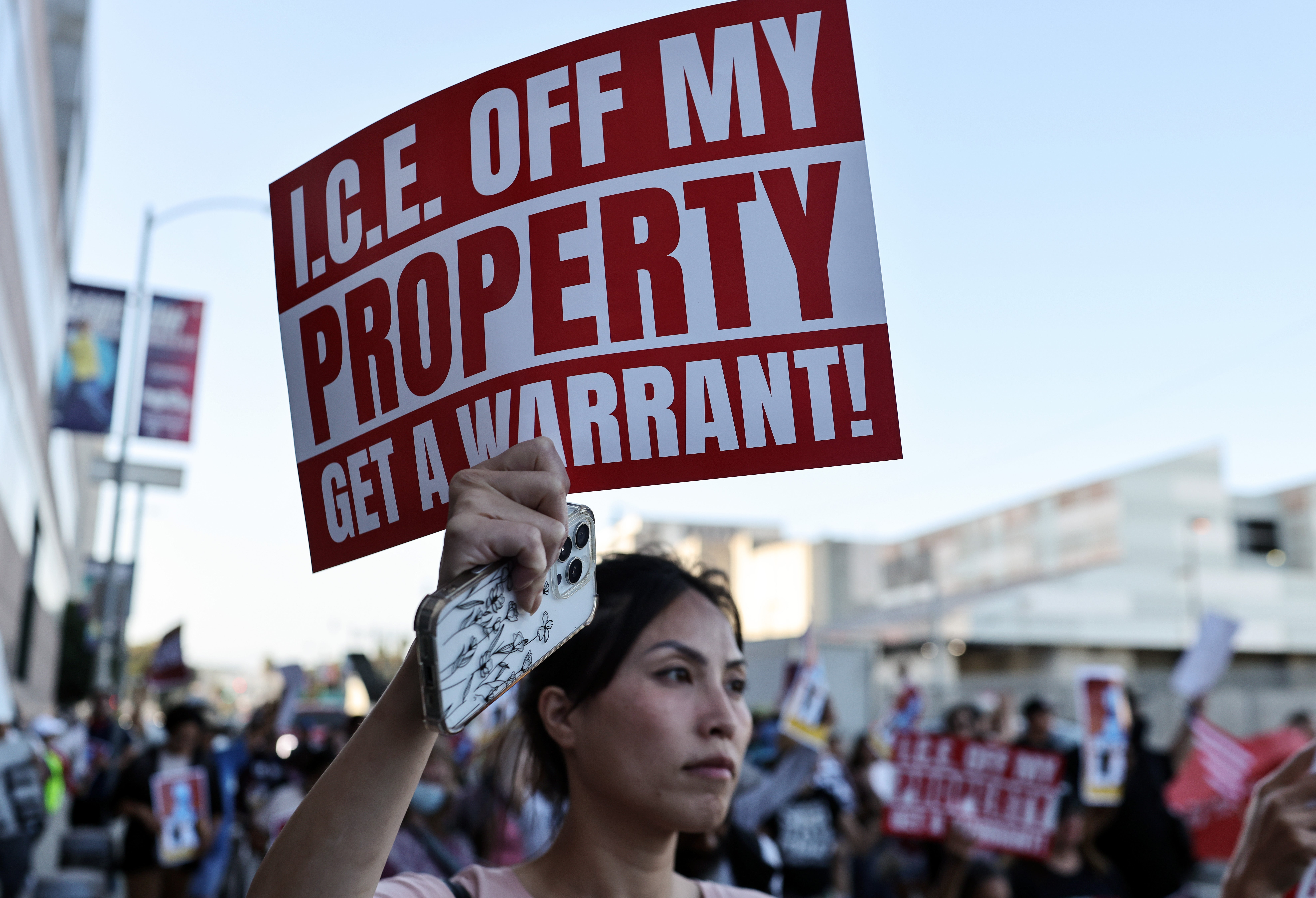



‘It’s racist’: Latino tenants who sued their landlord got threatening message about ICE


Tenant is a U.S. citizen who claims they were illegally evicted to flip a Los Angeles rental home

Josh Marcus
in San Francisco
Wednesday 23 July 2025 
The Independent


A Los Angeles area family of Latino renters suing their landlord over a 2024 eviction claim they were met with a thinly veiled threat that they would be picked up by immigration agents, amid the ongoing, high-profile campaign of raids across the city.

“It’s not fair for him to take advantage of that,” former tenant Yicenia Morales told The Los Angeles Times. “I was born here. I have a birth certificate. I pay taxes.”

“I was already depressed over the eviction,” she added. “Now I’m hurt, embarrassed and nervous as well. Will he really call ICE on us?”

“It’s racist,” her attorney, Sarah McCracken, added in an interview with the paper. “Not only is it unethical and probably illegal, but it’s just a really wild thing to say — especially since my clients are U.S. citizens.”

The controversy stems from a June message from attorney Rod Fehlman, whom Morales and her lawyers at the firm Tobener Ravenscroft said they saw in state records was the legal point of contact for landlord Celia Ruiz and her real estate agent David Benavides.

Alleged ICE-related threat to renter suing ex-landlord comes as immigration agents have conducted large-scale operations across Los Angeles area (Getty Images)

RECOMMENDED
1.4M of the nation's poorest renters risk losing their homes with Trump's proposed HUD time limit

In the midst of a back-and-forth over the case in June, Fehlman sent an aggressive message referencing recent arrests by Immigration and Customs Enforcement, McCracken said.

“It is also interesting to note that your clients are likely to be picked up by ICE and deported prior to trial thanks to all the good work the Trump administration has done in regards to immigration in California,” Fehlman told the renters’ legal team in email after being served this summer, according to McCracken.

Fehlman told The Independent he cannot comment on “ongoing litigation,” but said the message was taken out of context. Instead of a threat, he said, he was warning Morales’s San Francisco-based lawyer about the ongoing pattern of ICE agents arresting immigrants at courthouses and immigration offices.

“My email mentions nothing about Ms. McCracken's client's citizenship,” Fehlman wrote in an email. “This is an ongoing problem in Southern California and a sad reality that litigants have been picked randomly at Courthouses. It is unfortunate that this comment has been taken out of context intentionally by Ms. McCracken's firm and used to defame my office.”

(The real estate agent named in the suit responded to the complaint with a different law firm than Fehlman’s, according to the Times, and the renters have been unable to serve the landlord with the complaint yet. Fehlman did not respond to a question regarding which parties he was or had been representing in the eviction dispute.)

McCracken told The Independent she was taken aback by her exchanges with Fehlman.

“This case doesn’t involve my client’s race or ethnicity or immigration status, or at least it didn’t until he made that comment,” she said. “We just thought it was irrelevant and an inappropriate way to try and get an edge in the case.”

The Independent has contacted Morales for comment.

Real estate agent Benavides, when reached by The Independent, hung up.

On Tuesday, California Attorney General Rob Bonta warned that discriminating, retaliating against, or attempting to influence tenants based on their immigration status, including by reporting tenants to immigration services, is illegal.

“California tenants — no matter their immigration status — have a right to safe housing and to access housing documents in a language they can understand,” Bonta said in a statement. “I will use the full force of my office to go after those who seek to take advantage of California tenants during an already challenging time.”

McCracken said she has encountered landlords making verbal comments about ICE to tenants in the past. Now, however, she said people seem “emboldened” to make boundary-pushing spoken and written comments about race and immigration status to renters under the second Trump administration, based on what she has heard from potential clients and legal colleagues.

Renters have faced threats over their immigration status predating the second Trump term, too.

In 2019, a New York judge fined a landlord $5,000 and ordered the payment of $12,000 in damages to a tenant who was threatened with ICE if they didn’t pay rent, thought to be the first such case in the country.

Earlier this year, an Illinois judge ruled on a similar case, dating back to 2022.

Under the Trump administration, with its mass expansion of military-style immigration raids, unscrupulous individuals have also allegedly impersonated ICE to achieve unsavory ends, including a January incident in which a North Carolina man allegedly pretended to be an immigration agent to coerce a woman into having sex.

ICE impersonators have also allegedly harassed businesses and intimated motorists.